

- Market Size (2026)
- USD 231.2 Mn
- Forecast (2036)
- USD 362.5 Mn
- CAGR (2026 to 2036)
- 4.6%
How big is Salon Backwash Units Market in 2026?
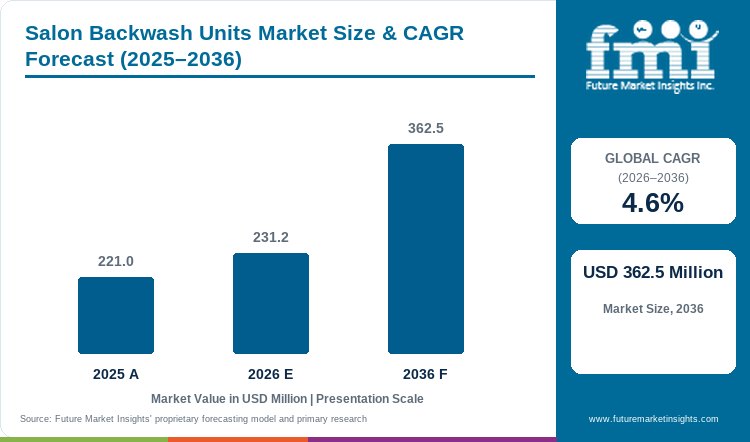
USD 231.2 million in 2026 and USD 362.5 million by 2036, expanding at a 4.6% CAGR.
Sales of salon backwash units are estimated to rise at a 4.6% CAGR through 2036, increasing market value from USD 221.0 million in 2025 to USD 231.2 million in 2026 before reaching USD 362.5 million by 2036. Salon operators are using backwash stations for scalp-care and head-spa services rather than limiting them to routine washing activities. Maletti reported in June 2025 that more salons were converting wash stations into treatment areas for scalp-care and head-spa services. Longer treatment sessions increase the importance of adjustable recline and ergonomic neck support because a single station can generate revenue across multiple service categories instead of supporting shampooing alone.
that more salons were turning wash stations into treatment areas for scalp-care and head-spa services. Longer treatment time raises the value of adjustable recline and neck support because one fixed wash point can earn revenue beyond routine shampooing.
Country conditions change how quickly the forecast converts into replacement orders for professional salons. Japan's Ministry of Health, Labour and Welfare reported 274,070 beauty establishments at the end of March 2024 in its fiscal 2024 national report published in October 2025. A mature network this large supports recurring replacement demand while raising expectations for compact footprints and dependable service. The USA carries a 5.0% CAGR compared with Japan's 3.7% because fragmented operators face different financing and installation decisions. Each national route therefore converts the same global equipment need into a different replacement schedule.
Key Takeaways
- Longer scalp-care and head-spa services increase replacement value because one wash position can support more paid treatment time.
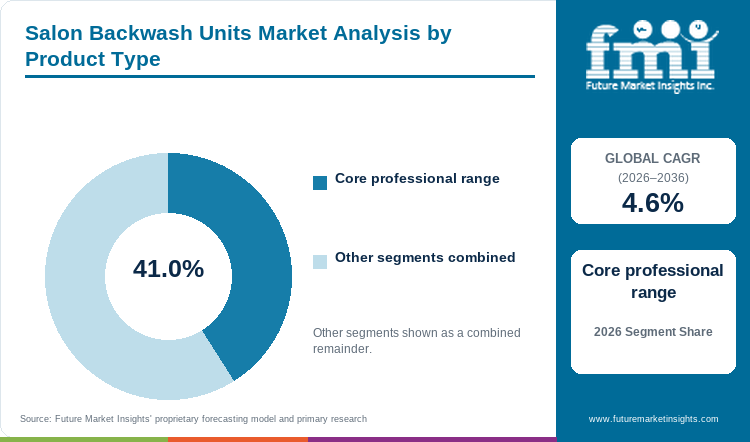
- Core professional range is likely to capture 41.0% of product type demand in 2026, owing to repeat-use durability in mainstream salon fit-outs.
- The end-user category is forecast to be led by hair salons at 30.0% share in 2026, driven by repeated shampoo and color services.
- Based on offering, core equipment is projected to account for 41.0% in 2026, attributable to the installed basin-chair system carrying the main capital commitment.
- Plumbing changes and temporary loss of a wash position can delay replacement even after comfort features become commercially attractive.
- Some of the key players in this market include Takara Belmont Corporation, Maletti S.p.A., Gamma & Bross S.p.A., Salon Ambience, Nelson Mobilier, Pietranera S.r.l., REM UK, Comfortel, AgvGroup S.r.l., and Collins Manufacturing Company.
Analyst Perspective
"Salon owners should evaluate backwash equipment as a service-producing asset whose value depends on treatment duration and daily station use. Installation planning should start with plumbing and operator access before comfort features are compared against the available refurbishment budget."
- Rahul Pandita, Principal Consultant, Future Market Insights
How is the salon backwash units market segmented?
Product Type, End User, Offering, Price Tier, Sales Channel and Region
The salon backwash units market is segmented by product type, end user, offering, price tier, sales channel and region. Product type covers core professional range, premium and specialist range, and entry and value range. End user covers hair salons, barbershops, spas and wellness centers, nail salons and medspas, and other professional settings. Offering covers core equipment, accessories, and consumables and refills. Price tier covers economy, mid-range, and premium. Sales channel covers professional distributors, direct sales, and B2B e-commerce.
What operating condition supports core professional range demand in the product type category?
Core professional units serve salons that need a fixed wash station to perform reliably through repeated shampoo and color workflows. Maletti introduced the Heaven wash unit in February 2025 with adjustable neck support and treatment-oriented washing positions. The Heaven configuration keeps routine service central while adding options for longer scalp-care sessions that can justify a higher equipment specification. The same economics influence salon service demand because a station must handle everyday turnover before premium functions earn their cost. Buyers therefore value durable upholstery and serviceable plumbing alongside comfort features that reduce routine operating friction. A balanced professional specification keeps the core professional range suited to routine replacement needs within the product type category.
- By product type, core professional range is estimated to hold 41.0% in 2026, owing to repeat-use durability and serviceable plumbing requirements.
- Salon owners compare neck support and basin access against installed cost before choosing equipment for repeated daily washing services.
How do hair salons evaluate dedicated backwash units within the end-user category?
Hair salons use backwash equipment inside the standard shampoo and color sequence instead of treating washing as an occasional facility. USA Bureau of Labor Statistics occupational data for May 2025 counted 305,710 wage-employed hairdressers and cosmetologists plus 15,000 barbers and 8,070 shampooers. Repeated movement between styling and washing makes a dedicated basin a workflow requirement for many operators. The same recurring service pattern shapes salon services in North America because the wash point must support several appointments during a normal shift. Spas can justify longer specialist treatments, but general hair salons generate broader routine use of installed backwash equipment.
- Hair salons are set to lead the end-user category with 30.0% share in 2026, supported by routine wash-stage use during shampoo and color services.
- Dedicated wash points reduce service interruption where shampooing and color work repeatedly move clients between styling and basin positions.
How does core equipment secure its position within the offering category?
Core equipment carries the main installed value because the basin and seating structure determine plumbing location and client position. Pietranera published its 2025 Head Spa catalogue with Fable and Fable Lift wash-treatment beds built with integrated basins and treatment positioning. Those systems place service capability inside the fixed station instead of relying on detachable accessories. Consumables used in professional hair care can be added later, but the workstation still determines which accessories remain compatible during its service life. Fixed-station concentration keeps the basin-chair assembly central to replacement spending and explains why core equipment accounts for the largest offering share.
- In 2026, core equipment is expected to lead offering with 41.0% share, attributable to the installed basin-chair assembly concentrating the main equipment investment.
- Replacement decisions begin with the fixed station because later accessories still depend on its dimensions and permanent service connections.
What supports mid-range demand within the price tier category?
Mid-range equipment suits salons that need professional durability without paying for every motorized or treatment-specific option. REM UK lists Avalon Baltic and Fame Baltic as new additions to its 2025 wash-unit range with straightforward installation and broad upholstery choice. The Avalon and Fame specification gives independent salons practical comfort without forcing a premium treatment platform into every refurbishment. Hair care demand is rewarding better client positioning as wash services repeat during the day. Premium systems earn higher spending only where longer paid treatments can recover the extra capital. Economy models remain useful for basic washing but offer fewer configuration choices during refurbishment.
- By price tier, mid-range is forecast to represent 44.0% in 2026, driven by salons balancing service life with available refurbishment budgets.
- Buyers move toward premium equipment only after longer treatments can recover the additional cost of recline or head-spa functions.
How do professional distributors shape sales-channel demand for salon backwash units?
Backwash units carry more installation risk than portable tools because dimensions and drainage must match the salon before delivery. Gamma & Bross states in its 2026-2027 promotion that selected shampoo stations are stocked in Italy for international sales and in New York for the USA and Canada. Regional stocking shortens the path between specification and replacement while preserving delivery support near the salon. Beauty and wellness operators still use direct manufacturer sales for larger projects with complex layouts. B2B e-commerce works best for standardized replacement orders where site dimensions and service connections are already known before purchase.
- Professional distributors are projected to hold 42.0% of sales-channel demand in 2026, influenced by specification support and local after-sales access.
- Local service and replacement-part access reduce the operating risk created when one fixed wash position is unavailable after installation.
What are the drivers, restraints and opportunities in the Salon Backwash Units Market?
Treatment-heavy wash services increase equipment value, installation obligations delay replacements, and retrofit-friendly head-spa formats widen the renovation opportunity.
- Driver: Longer scalp-care and head-spa services increase the commercial value of recline and operator-access features.
- Restraint: Water-system duties and plumbing work add costs that extend beyond the equipment purchase price during salon refurbishment.
- Opportunity: Retrofit-friendly head-spa equipment can add paid treatment capability without requiring a complete salon rebuild.
Head-spa services extend the revenue role of the wash station
Salon operators gain a stronger replacement case when the wash position carries paid treatment time and repeat service revenue instead of only routine shampooing. Nelson Mobilier documented the Nelbyspa head-spa bed in September 2025 during a working demonstration that connected the unit to water and electricity. Longer treatment formats make recline quality and practitioner access more important during equipment selection. The same service economics influence spa services where comfort must hold through extended appointments without consuming another dedicated treatment room. Backwash suppliers therefore gain demand when treatment menus make the installed wash point responsible for both routine turnover and longer scalp-care sessions.
Installation duties raise the true replacement threshold
Salon refurbishment must account for the water system as well as the chair and basin before replacement work begins. UK Health Security Agency guidance updated in January 2025 names hairdressers among organizations responsible for managing safe water supplies. Safe-water management can add flushing plans and maintenance access to the drainage work already required for a fixed wash point. Closing one wash position raises the replacement hurdle for smaller salons because the fit-out removes billable capacity from the schedule. The restraint becomes stronger where older pipe routes require floor work or where massage equipment adds electrical and water connections that need specialist installation.
Retrofit-friendly treatment formats widen the renovation route
Renovation budgets can support new treatment revenue when the equipment adds head-spa capability without forcing a complete room rebuild. Salon Ambience lists Paradise as a new 2026 wash unit with massage versions and an optional Head SPA kit. The configuration lets an operator choose the treatment depth that fits the existing service model before committing to a separate treatment bed. Hair styling products and scalp-care services can then use the same installed wash point during longer appointments. Suppliers can target refurbishment spending more effectively when modular treatment options preserve existing plumbing positions and reduce the amount of construction needed for service expansion.
Which country CAGRs are covered in the Salon Backwash Units Market?
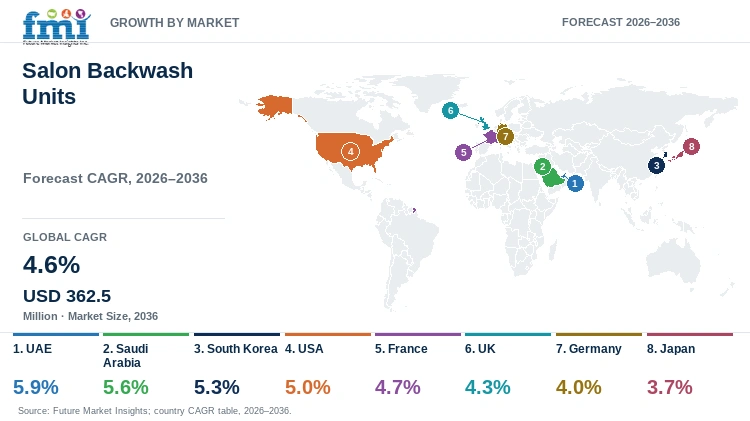
| Country | CAGR |
|---|---|
| UAE | 5.9% |
| Saudi Arabia | 5.6% |
| South Korea | 5.3% |
| USA | 5.0% |
| France | 4.7% |
| UK | 4.3% |
| Germany | 4.0% |
| Japan | 3.7% |
How do country-level CAGRs compare in the Salon Backwash Units Market?
The country forecast range spans 2.2 percentage points from UAE at 5.9% to Japan at 3.7%. Gulf markets form the upper group with South Korea and the USA close behind. France and the UK occupy the middle range while Germany and Japan show slower replacement-led growth. The 2.2-point spacing reflects different fit-out conditions and does not measure present national market size.
- UAE growth depends on local service support because imported equipment must remain maintainable after professional premises receive their business approvals.
- Saudi Arabia links equipment demand to licensed salon premises where facility requirements move wash-station specification earlier in fit-out planning.
- South Korea combines expanding franchise hair-beauty activity with repeatable urban formats that favor standardized equipment dimensions at multiple sites.
- USA demand reflects large professional workforce and fragmented ownership that makes financing and distributor support important during replacement decisions.
- France combines improving salon visit frequency with small-business economics that reward equipment capable of supporting more service value per station.
- UK salon economics make operating costs and downtime important when independent owners decide whether refurbishment can absorb wash-station replacement.
- Germany retains a mature salon base where durable equipment and planned service continuity carry more weight than rapid greenfield expansion.
- Japan has a dense national salon network that shifts competition toward compact footprints and reliable replacement performance within existing premises.
Comparable CAGRs can therefore produce different buying conditions because installation rules and salon economics vary between countries. A slower forecast can still represent substantial replacement demand where the installed salon base is mature and equipment use is frequent.
The full report provides country-level CAGR analysis across North America, Latin America, Western Europe, Eastern Europe, East Asia, South Asia and Pacific, and the Middle East and Africa.
Country-wise Analysis
- UAE salon investment operates within a national licensing system that connects federal business records with licensing authorities in all seven emirates. By 2036, UAE is projected to grow at 5.9% CAGR, influenced by licensed business formation and the need for maintainable imported equipment. The UAE Government updated its National Economic Register page in April 2026 and describes the register as a federal platform integrating national and local economic-license data. The federal register keeps equipment decisions tied to licensed premises and locally accountable installation requirements in every emirate. Imported wash units also need accessible service support after commissioning because salon downtime directly removes billable capacity. Distributors with spare parts and installer coordination can reduce downtime when salons replace fixed stations.
- Saudi salon fit-outs must satisfy national facility requirements before operators can treat the wash station as a furniture-only purchase. Saudi Arabia's salon backwash units outlook is anticipated to advance at 5.6% CAGR over the assessment period, supported by national facility requirements that move equipment decisions earlier in fit-out planning. The Ministry of Municipalities and Housing updated requirements for women's beauty salons and relaxation centers in May 2025. Those national requirements cover site and operating conditions that influence equipment placement before the salon can open. Plumbing routes and station dimensions therefore need coordination with the approved premises plan before equipment installation begins. Suppliers that provide clear drawings and local installation support can reduce rework during licensed salon openings and refurbishments.
- South Korean salon chains increasingly use franchise formats that repeat service layouts at multiple urban locations. Salon backwash unit demand in South Korea is forecast to rise at 5.3% CAGR over the forecast period, attributable to expanding franchise formats with repeatable site specifications. Statistics Korea reported in December 2025 that hair-beauty franchise establishments increased from 4,718 in 2023 to 5,024 in 2024. Franchise growth does not represent every salon but it documents a national multi-site format that can standardize equipment decisions. Wash units still need compact dimensions because dense urban premises leave less room for maintenance and service access. Suppliers that maintain consistent models and parts can support repeat ordering during franchise expansion and replacement cycles.
- USA salon equipment buying is spread among employed professionals and independent operators with different capital budgets. Adoption of salon backwash units in the USA is estimated to expand at 5.0% CAGR through 2036, influenced by large professional workforce and fragmented purchasing. The USA Bureau of Labor Statistics reported 595,000 hairdressers and cosmetologists in 2025 and listed 48% of workers in that occupation as self-employed. High self-employment keeps many replacement decisions close to the service floor and sensitive to daily cash flow. Installation downtime raises the hurdle for small sites because every closed wash position removes billable service capacity. Financing and distributor support therefore matter when owners replace fixed salon chairs and wash stations without closing billable capacity for long periods.
- French salons depend on repeat client visits that make wash-station comfort visible during every color and treatment appointment. The French salon backwash units sector is projected to record 4.7% CAGR during the assessment period, shaped by improving visit frequency and replacement wear at fixed wash stations. Union Nationale des Entreprises de Coiffure reported in January 2026 that visits per active client increased 3.14% during 2025. Higher visit frequency raises the number of wash cycles handled by installed equipment without implying a larger national salon count. Smaller operators still need refurbishment spending to fit available cash without weakening normal working-capital needs. Durable surfaces and serviceable components can therefore improve replacement economics where wash stations carry frequent daily use.
- UK salon owners are balancing equipment replacement against weak small-business margins and higher operating costs. In the UK, salon backwash unit demand is predicted to advance at 4.3% CAGR through 2036, aided by replacement needs despite tight independent-business economics. The National Hair & Beauty Federation reported in April 2026 that 54.8% of 423 surveyed businesses were breaking even or operating at a loss. Weak operating margins make installation downtime and unexpected plumbing work harder for independent salon owners to absorb. Routine hair services still require an installed wash station even when owners postpone broader refurbishment spending. Suppliers that provide clear installation information and reliable parts support can shorten the disruption period when older equipment must be replaced.
- German salon replacement decisions occur inside a mature craft-business environment where equipment life and service continuity receive close attention. Germany is estimated to post 4.0% CAGR over the forecast period, linked to a mature salon base that prioritizes equipment life and planned service continuity. Zentralverband des Deutschen Friseurhandwerks reported in July 2026 that sector sales increased 2.2% during 2025 despite continuing cost pressure. Modest revenue improvement can support replacement but does not remove labor and material constraints. Salon operators therefore favor equipment that limits unplanned downtime and can be serviced without replacing the entire station. Backwash suppliers can compete on durable mechanisms and local parts availability when salons schedule refurbishment to avoid disrupting booked client appointments.
- Japan's salon network gives replacement quality more commercial weight than greenfield installation alone in established premises. Salon backwash unit sales in Japan are forecast to expand at 3.7% CAGR by 2036, reinforced by a dense installed salon base and selective replacement cycles. The Ministry of Health, Labour and Welfare reported 274,070 beauty establishments at the end of March 2024 in its fiscal 2024 national report published in October 2025. A national installed base of this scale supports recurring equipment replacement and increases demand for compact layouts that fit existing plumbing. Furniture spending still competes with other refurbishment priorities when salons plan replacement work inside existing premises. Suppliers can win replacement orders by combining space-efficient wash units with reliable service support.
Who are the notable companies in the Salon Backwash Units Market?
Takara Belmont Corporation, Maletti S.p.A., Gamma & Bross S.p.A., Salon Ambience, Nelson Mobilier, Pietranera S.r.l., REM UK, Comfortel, AgvGroup S.r.l., and Collins Manufacturing Company serve the defined salon backwash units market.
Competition centers on companies that design complete wash units and suppliers that extend the station toward head-spa treatments. Entry requires proven basin-chair engineering because salon owners compare dimensions and service access before committing plumbing work. Geographic reach also matters after installation because parts and technical support determine how quickly a failed wash position returns to service.
- Takara Belmont Corporation, Maletti S.p.A., Gamma & Bross S.p.A., Nelson Mobilier and Pietranera S.r.l. sell treatment-oriented backwash or head-spa systems.
- Salon Ambience, REM UK and AgvGroup S.r.l. supply broad wash-unit ranges covering routine salon layouts alongside higher-comfort configurations.
- Comfortel and Collins Manufacturing Company combine backwash equipment with regional sales or service routes that support installation and later maintenance.
Competitive Benchmarking: Salon Backwash Units Market
| Company | Backwash System Depth | Installation & Ergonomic Adaptability | Salon Service Support | Geographic Reach |
|---|---|---|---|---|
| Takara Belmont Corporation | High | High | High | Global |
| Maletti S.p.A. | High | High | High | Europe and international |
| Gamma & Bross S.p.A. | High | High | High | Europe, North America and international |
| Salon Ambience | High | High | Medium | Europe and international |
| Nelson Mobilier | High | High | High | Europe and export markets |
| Pietranera S.r.l. | High | High | Medium | Europe and international |
| REM UK | High | High | High | UK and export markets |
| Comfortel | High | High | High | Australia, New Zealand and international stockists |
| AgvGroup S.r.l. | High | High | Medium | Europe and international |
| Collins Manufacturing Company | High | High | High | North America |
Scoring basis: High system depth requires at least four documented backwash or head-spa configurations while Medium requires two or three and Low identifies one. High adaptability requires at least three documented positioning or installation options while Medium requires two and Low identifies one. High service support requires at least two current sales or technical-support routes while Medium requires one documented route and Low indicates only basic transaction support.
Key Developments in the Salon Backwash Units Market
- In September 2025, Maletti S.p.A. introduced SPA Garçon as a head-spa system designed for professional scalp-care services inside hair salons.
- In September 2025, Gamma & Bross S.p.A. showcased its new Head Spa line at MCB Paris with Monolithwash Pedi Spa and Gravity shampoo beds.
- In August 2025, Takara Belmont Corporation launched YUME II and YUME DX II shampoo units for longer head-spa and salon-care services.
Key Players in the Salon Backwash Units Market
Integrated backwash and head-spa systems
- Takara Belmont Corporation
- Maletti S.p.A.
- Gamma & Bross S.p.A.
- Nelson Mobilier
- Pietranera S.r.l.
Salon wash-unit specialists
- Salon Ambience
- REM UK
- AgvGroup S.r.l.
Regional salon equipment platforms
- Comfortel
- Collins Manufacturing Company
Salon Backwash Units Market - Report Scope
| Coverage field | Report scope |
|---|---|
| Market breakdown | By product type, end user, offering, price tier, sales channel and region. |
| Quantitative Units | USD million. |
| Market Definition | Revenue includes salon backwash or shampoo units and unit-specific accessories tied to the installed station. It excludes haircare formulations, general styling chairs without washing functions, plumbing service revenue and downstream salon services. |
| Regions Covered | USA, Germany, France, UK, Saudi Arabia, UAE, Japan, South Korea, and 20+ countries included in the full report. |
| Countries Covered | Takara Belmont Corporation, Maletti S.p.A., Gamma & Bross S.p.A., Salon Ambience, Nelson Mobilier, Pietranera S.r.l., REM UK, Comfortel, AgvGroup S.r.l., and Collins Manufacturing Company. |
| Key Companies Profiled | Takara Belmont Corporation, Maletti S.p.A., Gamma & Bross S.p.A., Salon Ambience, Nelson Mobilier, Pietranera S.r.l., REM UK, Comfortel, AgvGroup S.r.l., and Collins Manufacturing Company. |
| Forecast Period | 2026 to 2036. |
| Approach | Primary and secondary research with market triangulation. |
Salon Backwash Units Market - Research Methodology
| Method | Approach |
|---|---|
| Primary Research | FMI analysts gathered input from manufacturers, service providers, technology developers, distributors, end users, procurement teams, and subject-matter experts. Interviews examined purchasing decisions, product or service evaluation, adoption barriers, approval requirements, pricing considerations, and expectations for technical or commercial support. Respondents were also asked what evidence is required before a trial, pilot, or initial order develops into regular purchasing. |
| Desk Research | Desk research covered government statistics, regulatory publications, trade data, industry associations, technical literature, standards, company filings, product information, and official corporate announcements. Sources were reviewed for relevance, publication date, geographic coverage, and consistency with the defined market scope. Claims relating to performance, applications, approvals, capacity, investment, and commercial activity were retained only when supported by credible public evidence. |
| Market Sizing and Forecasting | The market model combined the baseline value with historical performance, segment structure, pricing and volume indicators, adoption levels, company participation, and country-level demand conditions. Forecast assumptions considered economic activity, investment trends, regulatory developments, technology adoption, purchasing cycles, supply availability, and barriers to wider market use. Segment and regional estimates were reconciled before the final market total was calculated. |
| Data Validation | Estimates were checked against multiple independent indicators, including public data, company activity, trade patterns, industry developments, and findings from primary interviews. Validation also tested whether products, services, applications, and company revenues fell within the defined market boundaries. Adjacent categories, unsupported claims, overlapping revenues, and activities without direct market relevance were excluded to reduce double counting and maintain consistency across segments and countries. |
Salon Backwash Units Market by Segments
Salon Backwash Units Market segmented by Product Type:
- Core professional range
- Premium & specialist range
- Entry & value range
Salon Backwash Units Market segmented by End User:
- Hair salons
- Spas & wellness centers
- Nail salons
- Medspas & clinics
- Barbershops
Salon Backwash Units Market segmented by Offering:
- Core equipment
- Consumables & refills
- Accessories
Salon Backwash Units Market segmented by Price Tier:
- Mid-range
- Economy
- Premium
Salon Backwash Units Market segmented by Sales Channel:
- Professional distributors
- Direct sales
- B2B e-commerce
Salon Backwash Units Market by Region:
- North America
- United States
- Canada
- Latin America
- Brazil
- Mexico
- Chile
- Rest of Latin America
- Western Europe
- Germany
- United Kingdom
- Italy
- Spain
- France
- Nordics
- Benelux
- Rest of Western Europe
- Eastern Europe
- Russia
- Poland
- Hungary
- Balkan and Baltic States
- Rest of Eastern Europe
- East Asia
- China
- Japan
- South Korea
- South Asia and Pacific
- India
- ASEAN
- Australia and New Zealand
- Rest of South Asia and Pacific
- Middle East and Africa
- Kingdom of Saudi Arabia
- Other GCC Countries
- Türkiye
- South Africa
- Other African Union Countries
- Rest of Middle East and Africa
Research Sources and Bibliography
- Maletti S.p.A. (2025, June 23). Korean Head Spa: The new frontier of wellness.
- Maletti S.p.A. (2025, February 5). Heaven: The new standard in professional hair washing by Maletti.
- USA Bureau of Labor Statistics. (2026). Occupational Employment and Wage Statistics, May 2025 national occupation data.
- Pietranera S.r.l. (2025, January). Catalogue & prices 2025: Head Spa experience (Rev. 01/25).
- REM UK. (2025, January). REM 2025 Salon Collection.
- Gamma & Bross S.p.A. (2026). Promo 2026/27: Hair salon furniture promotions.
- Nelson Mobilier. (2025, September 3). Behind the scenes: Filming our first Head Spa movie with Nelbyspa.
- UK Health Security Agency. (2025, January 22). A safe water supply: Information for all organisations.
- Salon Ambience. (2026). Collection 2026: Paradise wash unit.
- The Official Platform of the UAE Government. (2026, April 17). National Economic Register.
- Ministry of Municipalities and Housing, Saudi Arabia. (2025, May 14). Updated requirements for women’s beauty salons, relaxation centers, and body care facilities.
- Statistics Korea. (2025, December 23). Preliminary results of the 2024 Franchise Survey.
- USA Bureau of Labor Statistics. (2026, August 27). Barbers, hairstylists, and cosmetologists.
- Union Nationale des Entreprises de Coiffure. (2026, January 30). Baromètre UNEC / HAIRNET Bilan 2025 : le retour à la croissance.
- National Hair & Beauty Federation. (2026, April 7). Energy price crisis threatens hair & beauty sector.
- Zentralverband des Deutschen Friseurhandwerks. (2026, July 10). Wirtschaftliche Lage des Friseurhandwerks: Positive Entwicklung trotz Herausforderungen.
- Ministry of Health, Labour and Welfare, Japan. (2025, October 21). Health Administration Report, fiscal 2024: Beauty establishment counts by year.
- Maletti S.p.A. (2025, September 25). SPA Garçon: The new standard for Head Spa in hair salons.
- Gamma & Bross S.p.A. (2025, September 16). Mondial Coiffure Beauté 2025.
- Takara Belmont Corporation. (2025, August 1). YUME II and YUME DX II flagship shampoo units launch announcement.
- Takara Belmont Corporation. (2026). Professional salon equipment and YUME wash-unit information. Retrieved September 16, 2026.
- Maletti S.p.A. (2026). Head Spa and professional wash-unit range. Retrieved September 16, 2026.
- Gamma & Bross S.p.A. (2026). Head Spa equipment and shampoo-station range. Retrieved September 16, 2026.
- Salon Ambience. (2026). Wash units for hairdressers. Retrieved September 16, 2026.
- Nelson Mobilier. (2026). Catalogue 2026 and Nelbyspa documentation. Retrieved September 16, 2026.
- Pietranera S.r.l. (2026). Head Spa experience and wash-unit range. Retrieved September 16, 2026.
- REM UK. (2026). Backwash units and customer support information. Retrieved September 16, 2026.
- Comfortel. (2026). Salon wash lounges and service support. Retrieved September 16, 2026.
- AgvGroup S.r.l. (2026). Wash-unit and Head SPA range. Retrieved September 16, 2026.
- Collins Manufacturing Company. (2026). Backwash systems and technical support. Retrieved September 16, 2026.
- Maletti S.p.A. (2026, June 25). Spa Garçon Éclat: Technology and innovation redefine the salon experience.
- Gamma & Bross S.p.A. (2026, March 29). Cosmoprof Worldwide Bologna 2026.
- Salon Ambience. (2026, March). New Paradise wash unit, Collection 2026.
- Comfortel. (2026, September). Eden Head Spa Wash Lounge preorder availability.
- Pietranera S.r.l. (2025, September 8). Open Day 20 October - Head Spa Experience.
- Collins Manufacturing Company. (2025, December 10). Blush Shampoo Shuttle technical specification.
This bibliography is provided for reader reference and is not exhaustive. The full report contains the complete reference list and detailed citations.
This Report Answers
- How large is the salon backwash units market in 2026 and 2036?
- Which service changes are increasing demand for treatment-oriented salon backwash equipment?
- Which product type accounts for 41.0% of demand in 2026?
- How do hair salons account for 30.0% of end-user demand?
- Why does core equipment represent 41.0% of offering demand in 2026?
- How do growth rates differ among the eight country markets covered here?
- Which companies supply direct backwash and head-spa equipment to professional salons?
- Which installation conditions can delay a salon backwash unit replacement decision?
Frequently Asked Questions
How big is the Salon Backwash Units Market in 2026?
The salon backwash units market is valued at USD 231.2 million in 2026 and is projected to reach USD 362.5 million by 2036. Longer wash-stage treatments strengthen replacement economics where one installed station supports routine washing and paid scalp-care services.
What is the CAGR of the Salon Backwash Units Market from 2026 to 2036?
The salon backwash units market is projected to grow at 4.6% CAGR between 2026 and 2036. Replacement spending depends on treatment-oriented refurbishment that can absorb plumbing work without removing wash capacity for extended periods.
Which product type leads the Salon Backwash Units Market in 2026?
The core professional range segment is expected to hold 41.0% of product type demand in the salon backwash units market in 2026. Routine salon workflows favor equipment that combines repeat-use durability with serviceable installation and practical client support.
Which end-user segment leads the Salon Backwash Units Market in 2026?
The hair salons segment is expected to hold 30.0% of end-user demand in the salon backwash units market in 2026. Shampoo and color workflows repeatedly move clients to the basin which keeps dedicated backwash equipment in frequent professional use.
Which countries are projected to record the highest growth through 2036?
UAE is projected to grow at 5.9% CAGR followed by Saudi Arabia at 5.6% and South Korea at 5.3% through 2036. Their buying conditions differ because licensing structures and multi-site service formats change how equipment is specified and maintained.
Which companies are active in the Salon Backwash Units Market?
Key companies in the salon backwash units market include Takara Belmont Corporation, Maletti S.p.A., Gamma & Bross S.p.A., Salon Ambience, Nelson Mobilier, Pietranera S.r.l., REM UK, Comfortel, AgvGroup S.r.l., and Collins Manufacturing Company. Competition centers on wash-unit breadth and the service support available before and after installation.
Preview the report firsthand - request a free sample
Get SampleGet the brochure for pricing and purchase details.
Get PDFTable of Content
- Key Takeaways
- Market Size and CAGR
- Top Growth Driver
- Fastest Growing Segment
- Leading Region
- Key Companies
- Emerging Opportunities
- Executive Summary
- Global Market Outlook
- Demand-side Trends
- Supply-side Trends
- Technology Roadmap Analysis
- Analysis and Recommendations
- Analyst Perspective (What is happening? Why now? What should investors know?)
- Key Questions Answered
- How large is the market?
- What is the CAGR?
- What are key trends?
- Which region dominates?
- Who are the leaders?
- Market Overview
- Market Coverage / Taxonomy
- Market Definition / Scope / Limitations
- Research Methodology
- Chapter Orientation
- Analytical Lens and Working Hypotheses
- Market Structure, Signals, and Trend Drivers
- Benchmarking and Cross-market Comparability
- Market Sizing, Forecasting, and Opportunity Mapping
- Research Design and Evidence Framework
- Desk Research Programme (Secondary Evidence)
- Expert Input and Fieldwork (Primary Evidence)
- Tooling, Models, and Reference Databases
- Data Engineering and Model Build
- Quality Assurance and Audit Trail
- Market Background
- Market Dynamics (Drivers, Restraints, Opportunity, Trends)
- Scenario Forecast (Optimistic, Likely, Conservative)
- Impact Analysis
- AI Impact
- Sustainability Impact
- Regulatory Impact
- Technology Impact
- Consumer / Buyer Analysis
- Purchase Drivers
- Adoption Barriers
- Buyer Journey
- Opportunity Map Analysis
- Product Life Cycle Analysis
- Supply Chain Analysis
- Investment Feasibility Matrix
- Value Chain Analysis
- PESTLE and Porter's Analysis
- Regulatory Landscape
- Regional Parent Market Outlook
- Production and Consumption Statistics
- Import and Export Statistics
- Global Market Analysis and Forecast, 2021 to 2036
- Historical Market Size Value (USD Million) Analysis, 2021 to 2025
- Current and Future Market Size Value (USD Million) Projections, 2026 to 2036
- Y-o-Y Growth Trend Analysis
- Absolute $ Opportunity Analysis
- Global Market Pricing Analysis, 2021 to 2036
- Global Market Analysis and Forecast, By Product Type, 2021 to 2036
- Introduction / Key Findings
- Historical Market Size Value (USD Million) Analysis By Product Type, 2021 to 2025
- Current and Future Market Size Value (USD Million) Analysis and Forecast By Product Type, 2026 to 2036
- Core professional range
- Premium & specialist range
- Entry & value range
- Y-o-Y Growth Trend Analysis By Product Type, 2021 to 2025
- Absolute $ Opportunity Analysis By Product Type, 2026 to 2036
- Global Market Analysis and Forecast, By End User, 2021 to 2036
- Introduction / Key Findings
- Historical Market Size Value (USD Million) Analysis By End User, 2021 to 2025
- Current and Future Market Size Value (USD Million) Analysis and Forecast By End User, 2026 to 2036
- Hair salons
- Spas & wellness centers
- Nail salons
- Medspas & clinics
- Barbershops
- Y-o-Y Growth Trend Analysis By End User, 2021 to 2025
- Absolute $ Opportunity Analysis By End User, 2026 to 2036
- Global Market Analysis and Forecast, By Offering, 2021 to 2036
- Introduction / Key Findings
- Historical Market Size Value (USD Million) Analysis By Offering, 2021 to 2025
- Current and Future Market Size Value (USD Million) Analysis and Forecast By Offering, 2026 to 2036
- Core equipment
- Consumables & refills
- Accessories
- Y-o-Y Growth Trend Analysis By Offering, 2021 to 2025
- Absolute $ Opportunity Analysis By Offering, 2026 to 2036
- Global Market Analysis and Forecast, By Price Tier, 2021 to 2036
- Introduction / Key Findings
- Historical Market Size Value (USD Million) Analysis By Price Tier, 2021 to 2025
- Current and Future Market Size Value (USD Million) Analysis and Forecast By Price Tier, 2026 to 2036
- Mid-range
- Economy
- Premium
- Y-o-Y Growth Trend Analysis By Price Tier, 2021 to 2025
- Absolute $ Opportunity Analysis By Price Tier, 2026 to 2036
- Global Market Analysis and Forecast, By Sales Channel, 2021 to 2036
- Introduction / Key Findings
- Historical Market Size Value (USD Million) Analysis By Sales Channel, 2021 to 2025
- Current and Future Market Size Value (USD Million) Analysis and Forecast By Sales Channel, 2026 to 2036
- Professional distributors
- Direct sales
- B2B e-commerce
- Y-o-Y Growth Trend Analysis By Sales Channel, 2021 to 2025
- Absolute $ Opportunity Analysis By Sales Channel, 2026 to 2036
- Global Market Analysis and Forecast, By Region, 2021 to 2036
- Introduction
- Historical Market Size Value (USD Million) Analysis By Region, 2021 to 2025
- Current Market Size Value (USD Million) Analysis and Forecast By Region, 2026 to 2036
- North America
- Latin America
- Western Europe
- Eastern Europe
- East Asia
- South Asia and Pacific
- Middle East and Africa
- Market Attractiveness Analysis By Region
- North America Market Analysis and Forecast, By Country, 2021 to 2036
- Historical Market Size Value (USD Million) Trend Analysis By Market Taxonomy, 2021 to 2025
- Market Size Value (USD Million) Forecast By Market Taxonomy, 2026 to 2036
- By Country
- United States
- Canada
- By Product Type
- By End User
- By Offering
- By Price Tier
- By Sales Channel
- By Country
- Market Attractiveness Analysis
- By Country
- By Product Type
- By End User
- By Offering
- By Price Tier
- By Sales Channel
- Key Takeaways
- Latin America Market Analysis and Forecast, By Country
- Historical Market Size Value (USD Million) Trend Analysis By Market Taxonomy, 2021 to 2025
- Market Size Value (USD Million) Forecast By Market Taxonomy, 2026 to 2036
- By Country
- Brazil
- Mexico
- Chile
- Rest of Latin America
- By Product Type
- By End User
- By Offering
- By Price Tier
- By Sales Channel
- By Country
- Market Attractiveness Analysis
- By Country
- By Product Type
- By End User
- By Offering
- By Price Tier
- By Sales Channel
- Key Takeaways
- Western Europe Market Analysis and Forecast, By Country
- Historical Market Size Value (USD Million) Trend Analysis By Market Taxonomy, 2021 to 2025
- Market Size Value (USD Million) Forecast By Market Taxonomy, 2026 to 2036
- By Country
- Germany
- United Kingdom
- Italy
- Spain
- France
- Nordics
- Benelux
- Rest of Western Europe
- By Product Type
- By End User
- By Offering
- By Price Tier
- By Sales Channel
- By Country
- Market Attractiveness Analysis
- By Country
- By Product Type
- By End User
- By Offering
- By Price Tier
- By Sales Channel
- Key Takeaways
- Eastern Europe Market Analysis and Forecast, By Country
- Historical Market Size Value (USD Million) Trend Analysis By Market Taxonomy, 2021 to 2025
- Market Size Value (USD Million) Forecast By Market Taxonomy, 2026 to 2036
- By Country
- Russia
- Poland
- Hungary
- Balkan and Baltic States
- Rest of Eastern Europe
- By Product Type
- By End User
- By Offering
- By Price Tier
- By Sales Channel
- By Country
- Market Attractiveness Analysis
- By Country
- By Product Type
- By End User
- By Offering
- By Price Tier
- By Sales Channel
- Key Takeaways
- East Asia Market Analysis and Forecast, By Country
- Historical Market Size Value (USD Million) Trend Analysis By Market Taxonomy, 2021 to 2025
- Market Size Value (USD Million) Forecast By Market Taxonomy, 2026 to 2036
- By Country
- China
- Japan
- South Korea
- By Product Type
- By End User
- By Offering
- By Price Tier
- By Sales Channel
- By Country
- Market Attractiveness Analysis
- By Country
- By Product Type
- By End User
- By Offering
- By Price Tier
- By Sales Channel
- Key Takeaways
- South Asia and Pacific Market Analysis and Forecast, By Country
- Historical Market Size Value (USD Million) Trend Analysis By Market Taxonomy, 2021 to 2025
- Market Size Value (USD Million) Forecast By Market Taxonomy, 2026 to 2036
- By Country
- India
- ASEAN
- Australia and New Zealand
- Rest of South Asia and Pacific
- By Product Type
- By End User
- By Offering
- By Price Tier
- By Sales Channel
- By Country
- Market Attractiveness Analysis
- By Country
- By Product Type
- By End User
- By Offering
- By Price Tier
- By Sales Channel
- Key Takeaways
- Middle East and Africa Market Analysis and Forecast, By Country
- Historical Market Size Value (USD Million) Trend Analysis By Market Taxonomy, 2021 to 2025
- Market Size Value (USD Million) Forecast By Market Taxonomy, 2026 to 2036
- By Country
- Kingdom of Saudi Arabia
- Other GCC Countries
- Türkiye
- South Africa
- Other African Union Countries
- Rest of Middle East and Africa
- By Product Type
- By End User
- By Offering
- By Price Tier
- By Sales Channel
- By Country
- Market Attractiveness Analysis
- By Country
- By Product Type
- By End User
- By Offering
- By Price Tier
- By Sales Channel
- Key Takeaways
- Key Countries Market Analysis
- United States
- Pricing Analysis
- Market Share Analysis, 2025
- By Product Type
- By End User
- By Offering
- By Price Tier
- By Sales Channel
- Canada
- Pricing Analysis
- Market Share Analysis, 2025
- By Product Type
- By End User
- By Offering
- By Price Tier
- By Sales Channel
- Mexico
- Pricing Analysis
- Market Share Analysis, 2025
- By Product Type
- By End User
- By Offering
- By Price Tier
- By Sales Channel
- Brazil
- Pricing Analysis
- Market Share Analysis, 2025
- By Product Type
- By End User
- By Offering
- By Price Tier
- By Sales Channel
- Chile
- Pricing Analysis
- Market Share Analysis, 2025
- By Product Type
- By End User
- By Offering
- By Price Tier
- By Sales Channel
- Germany
- Pricing Analysis
- Market Share Analysis, 2025
- By Product Type
- By End User
- By Offering
- By Price Tier
- By Sales Channel
- United Kingdom
- Pricing Analysis
- Market Share Analysis, 2025
- By Product Type
- By End User
- By Offering
- By Price Tier
- By Sales Channel
- Italy
- Pricing Analysis
- Market Share Analysis, 2025
- By Product Type
- By End User
- By Offering
- By Price Tier
- By Sales Channel
- Spain
- Pricing Analysis
- Market Share Analysis, 2025
- By Product Type
- By End User
- By Offering
- By Price Tier
- By Sales Channel
- France
- Pricing Analysis
- Market Share Analysis, 2025
- By Product Type
- By End User
- By Offering
- By Price Tier
- By Sales Channel
- India
- Pricing Analysis
- Market Share Analysis, 2025
- By Product Type
- By End User
- By Offering
- By Price Tier
- By Sales Channel
- ASEAN
- Pricing Analysis
- Market Share Analysis, 2025
- By Product Type
- By End User
- By Offering
- By Price Tier
- By Sales Channel
- Australia and New Zealand
- Pricing Analysis
- Market Share Analysis, 2025
- By Product Type
- By End User
- By Offering
- By Price Tier
- By Sales Channel
- China
- Pricing Analysis
- Market Share Analysis, 2025
- By Product Type
- By End User
- By Offering
- By Price Tier
- By Sales Channel
- Japan
- Pricing Analysis
- Market Share Analysis, 2025
- By Product Type
- By End User
- By Offering
- By Price Tier
- By Sales Channel
- South Korea
- Pricing Analysis
- Market Share Analysis, 2025
- By Product Type
- By End User
- By Offering
- By Price Tier
- By Sales Channel
- Russia
- Pricing Analysis
- Market Share Analysis, 2025
- By Product Type
- By End User
- By Offering
- By Price Tier
- By Sales Channel
- Poland
- Pricing Analysis
- Market Share Analysis, 2025
- By Product Type
- By End User
- By Offering
- By Price Tier
- By Sales Channel
- Hungary
- Pricing Analysis
- Market Share Analysis, 2025
- By Product Type
- By End User
- By Offering
- By Price Tier
- By Sales Channel
- Kingdom of Saudi Arabia
- Pricing Analysis
- Market Share Analysis, 2025
- By Product Type
- By End User
- By Offering
- By Price Tier
- By Sales Channel
- Türkiye
- Pricing Analysis
- Market Share Analysis, 2025
- By Product Type
- By End User
- By Offering
- By Price Tier
- By Sales Channel
- South Africa
- Pricing Analysis
- Market Share Analysis, 2025
- By Product Type
- By End User
- By Offering
- By Price Tier
- By Sales Channel
- UAE
- Pricing Analysis
- Market Share Analysis, 2025
- By Product Type
- By End User
- By Offering
- By Price Tier
- By Sales Channel
- United States
- Market Structure Analysis
- Competition Dashboard
- Competition Benchmarking
- Market Share Analysis of Top Players
- By Regional
- By Product Type
- By End User
- By Offering
- By Price Tier
- By Sales Channel
- Emerging Startups
- Innovation Benchmarking
- Competition Analysis
- Competition Deep Dive
- Takara Belmont Corporation
- Overview
- Product Portfolio
- Profitability by Market Segments
- Sales Footprint
- Strategy Overview
- Marketing Strategy
- Product Strategy
- Channel Strategy
- Maletti S.p.A.
- Gamma & Bross S.p.A.
- Salon Ambience
- Nelson Mobilier
- Pietranera S.r.l.
- REM UK
- Comfortel
- AgvGroup S.r.l.
- Collins Manufacturing Company
- Takara Belmont Corporation
- Case Studies
- Success Stories
- Recent Developments
- Competition Deep Dive
- Assumptions & Acronyms Used


