

- Market Size (2026)
- USD 217.2 Mn
- Forecast (2036)
- USD 357.2 Mn
- CAGR (2026 to 2036)
- 5.1%
How big is Salon Capes & Textiles Market in 2026?
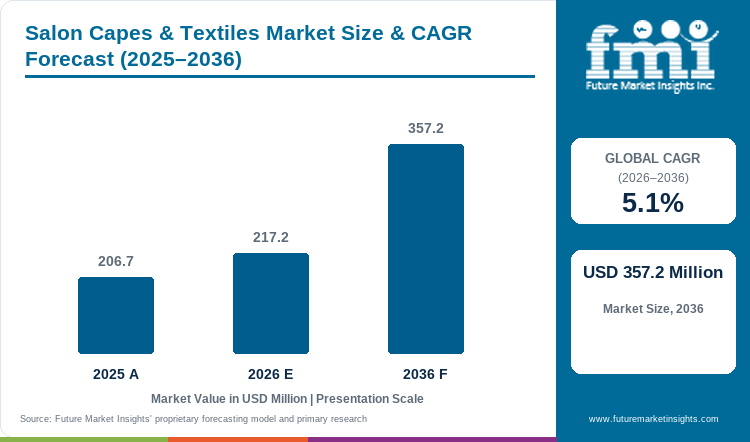
USD 217.2 million in 2026 and USD 357.2 million by 2036, expanding at 5.1% CAGR.
Sales of salon capes & textiles are estimated to rise at 5.1% CAGR through 2036, increasing valuation from USD 206.7 million in 2025 to USD 217.2 million in 2026, and reaching USD 357.2 million by 2036. Recurring client services create the purchase case because each occupied chair needs a clean protective layer between clients. The USA Bureau of Labor Statistics counted 670,800 workers classified as barbers and hairdressers, hairstylists or cosmetologists in 2025. BLS identifies salons and barbershops as the primary work setting for these professional occupations nationwide. Cutting and coloring therefore place capes and towels inside repeated service cycles during a working day. That workforce scale makes durable professional hair care routines relevant to textile replacement because operators must keep enough washable stock available between services.
Country growth differs because venue structure changes how buyers specify and replenish working textiles. Japan’s health ministry reports 274,070 beauty establishments at the end of March 2024. That installed base supports routine replacement volume for professional textiles but also faces persistent low-price competition. South Korea adds an organized franchise layer that can standardize pack specifications among branded locations. UAE operators work under national worker-health controls that keep hygiene requirements visible during staff onboarding. These conditions produce different order sizes and replacement timing even though every market requires clean capes and service linens.
Key Takeaways
- Recurring client protection and clean-stock requirements keep salon capes and service textiles inside regular replacement budgets for professional venues.
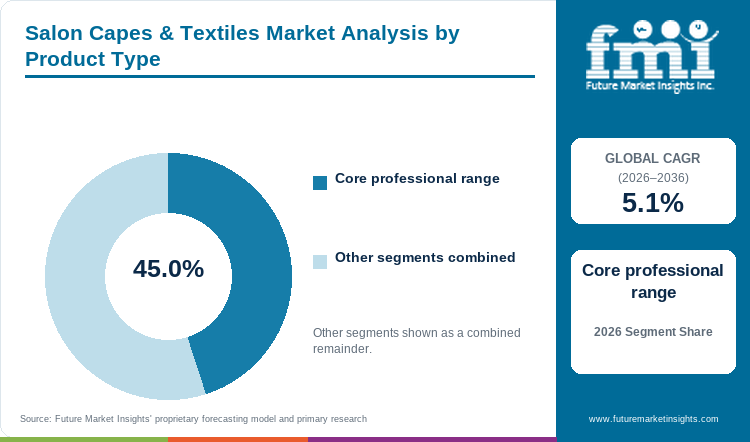
- By product type, core professional range is estimated to hold 45.0% in 2026 owing to washable protection that suits frequent daily services.
- In 2026, hair salons are expected to lead end user demand with 28.0% share because chair-based services repeatedly expose protective textiles to hair and chemicals.
- By offering, core equipment is forecast to represent 40.0% in 2026 because reusable capes and towels form the standing textile inventory for routine operations.
- Independent operators can delay premium replacement when better materials do not produce a clear wash-life or staining advantage over lower-cost textiles.
- Some of the key players in this market include Conair, Gharieni Group, Takara Belmont, Wella Company, Wahl, Kao Corporation, REM UK, Andis, L’Oréal, and Henkel.
Analyst Perspective
“Salon textile value is decided at the service station and in the laundry room over the product’s working life. Suppliers gain repeat business when wash resistance and closure durability match chemical exposure plus replenishment needs.”
- Rahul Pandita, Principal Consultant, Future Market Insights
How is the salon capes & textiles market segmented?
Salon Capes & Textiles Market is segmented by Product Type, End User, Offering, Price Tier, Sales Channel, and Region.
The salon capes & textiles market is segmented by product type, end user, offering, price tier, sales channel, and region. Product type covers core professional, premium - specialist, and entry - value ranges while end users include hair salons, spas - wellness centers, nail salons, medspas - clinics, and barbershops. Offering covers core equipment, consumables - refills, and accessories while price tier includes mid-range, economy, and premium products. Sales channels comprise professional distributors, direct sales, and B2B e-commerce for the defined commercial routes.
What supports core professional range demand within the product type category?
Operators choose core professional capes when daily cutting and color services require protection that tolerates repeated laundering. Wahl’s 5 Star Cape documents polyester construction plus water resistance, bleach resistance, color-cream resistance, and static control. Those specifications keep the product focused on routine workstation use and frequent cleaning during daily client services. Related protective clothing categories face the same need to match material performance with the exposure encountered during use.
- Based on product type, core professional range is projected to account for 45.0% in 2026 due to broad use during cutting, coloring, and general salon services.
- Professional operators compare closure security and wash durability with chemical resistance because textile failure becomes visible during repeated client-facing services.
How do hair salons shape demand within the end user category?
Hair salons place capes and towels inside nearly every core service sequence from cutting to shampooing and coloring. Wella Professionals launched Color Xpress in March 2025 as a ten-minute professional root-touch-up service. Faster color appointments can increase daily service turnover and keep clean protective textiles inside the same high-frequency workflow. Salons also purchase hair styling products through the same professional workstation channel under a shared trade-account structure.
- By end user, hair salons are estimated to hold 28.0% in 2026 supported by repeated client protection during cutting, washing, styling, and color services.
- High chair utilization raises clean textile changes each day before visible staining or closure wear forces permanent replacement. Related hair brushes share the same professional workstation purchase route used by salon and barber accounts.
What role does core equipment play within the offering category?
Reusable capes and towels operate as working inventory because used items cannot return directly to a clean service station. California sanitation rules require used towels and linens to remain out of service until properly laundered and sanitized. Salon managers therefore carry enough stock to cover active chairs plus laundry turnaround at each venue. The same separation principle appears in nonwoven protective clothing where barrier items are selected for contamination control and replacement conditions. For salon textiles the economic question is whether repeated washing preserves coverage and fastening performance.
- In 2026, core equipment is expected to lead offering with 40.0% share owing to the standing reusable inventory required for continuous professional service.
- Reserve stock protects service continuity when previously used capes and towels are unavailable during collection, washing, drying, or inspection for damage.
Why does mid-range pricing shape professional textile selection?
Small salons need capes that outlast economy options without tying unnecessary cash to premium finishes on every chair. The National Hair & Beauty Federation stated in March 2025 that its cost model expected 19% of sector businesses to shift toward self-employment. That pressure favors pack sizes and replacement prices that owner-managers can approve without long capital reviews. Purchases often sit beside wider beauty and personal care spending in the same account.
- By price tier, mid-range is forecast to represent 47.0% in 2026 attributable to operators balancing service appearance with measurable wash life and manageable replacement cost.
- Mid-range products earn repeat orders when better closures and fabric performance reduce premature replacement without pushing a routine consumable toward furniture-level approval.
What drives professional distributors within the sales channel category?
Professional distributors reduce the number of separate accounts a salon must manage for tools, textiles, chemicals, and other working supplies. L’Oréal’s 2025 half-year results reported faster e-commerce and selective distribution within Professional Products while the division maintained tailored salon services. That channel mix keeps professional accounts active in both distributor and digital purchasing routes. The route also overlaps with organic personal care assortments carried through professional beauty channels.
- Professional distributors are likely to capture 41.0% share in 2026 because broad trade assortments simplify replenishment for fragmented salons and barbershops.
- Distributor value rises when local inventory shortens replacement time and account staff can match textile specifications with the buyer’s existing service mix.
What are the drivers, restraints and opportunities in the Salon Capes & Textiles Market?
Hygiene-led textile rotation supports repeat demand, small-business cost pressure delays discretionary upgrades, and measurable wash-life performance gives suppliers a practical route to repeat orders.
- Driver: Clean-stock requirements turn repeated client services into repeated handling and eventual replacement of capes, towels, and protective service linens.
- Restraint: Owner-operated salons may defer premium textile replacement when operating costs rise faster than the visible performance benefit of an upgrade.
- Opportunity: Suppliers can improve repeat ordering by documenting wash tolerance, chemical resistance, closure durability, and reliable local replenishment for professional accounts.
Professional venues need enough clean textiles to keep occupied chairs operating while used items move through laundering. Dubai Municipality’s July 2025 salon guidance formalizes health and safety expectations and recognizes product distributors plus equipment suppliers as staff-training resources. That operating framework keeps hygiene procedures visible within routine service delivery at professional venues. Each additional service cycle exposes capes and towels to hair, water, color products, and repeated fastening. Busy venues therefore need clean reserve stock before the next laundry return arrives during active service hours. Operators replace textiles when staining or loss of barrier performance affects presentation or protection. Adjacent lab safety clothing categories provide a useful navigation point for buyers comparing barrier performance without changing the salon-specific evidence base.
Cost pressure can extend replacement cycles even when a textile is visibly worn by small professional operators. The National Hair & Beauty Federation reported in February 2025 that 78% of surveyed UK hair and beauty businesses planned price increases within three months. The survey also found that 31% had reduced workforce levels during the prior quarter. Those figures describe an owner base protecting cash and labor budgets during a cost shock. A cape or towel remains a low-value item individually but a full clean-stock set spans multiple chairs and reserve inventory. Suppliers must therefore show a measurable service-life advantage before premium materials displace economy products in price-sensitive venues.
The commercial opportunity is to match textile specifications to changing treatment-station workflows at professional venues. Gharieni introduced SpaFusion Flow in March 2025 as a convertible spa bed with an integrated pedicure tub. Multifunction treatment rooms need towels and protective covers that fit more than one service position and cleaning routine. Suppliers can document wash temperatures and drying requirements alongside closure construction and chemical tolerance. Buyers then compare replacement intervals and care requirements before appearance becomes the deciding factor during reordering decisions. Related beach towels demand also centers on repeated washing and drying but salon exposure adds chemicals and client-protection requirements. Local stock allows distributors to convert those specifications into repeat orders without asking small venues to hold excessive reserve inventory.
Which country CAGRs are profiled in the Salon Capes & Textiles Market?
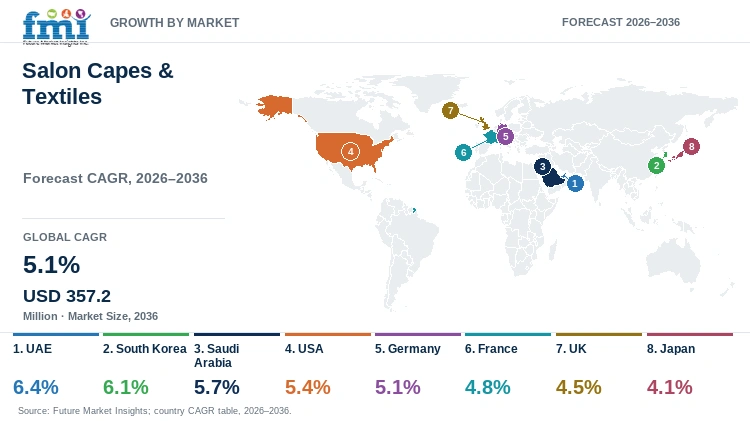
| Country | CAGR |
|---|---|
| UAE | 6.4% |
| South Korea | 6.1% |
| Saudi Arabia | 5.7% |
| USA | 5.4% |
| Germany | 5.1% |
| France | 4.8% |
| UK | 4.5% |
| Japan | 4.1% |
How do country-level CAGRs compare in the Salon Capes & Textiles Market?
The 2.3 percentage-point spread separates three faster-growth markets from a tighter group of mature service economies. UAE and South Korea occupy the upper band as formal operating standards and organized professional channels support specification consistency. Japan is forecast at 4.1% despite its extensive beauty-establishment base and persistent price competition. The table measures growth pace and does not state current revenue or installed salon scale.
- UAE combines premium service positioning with national worker-health requirements that keep hygiene controls visible during venue operations and staff onboarding.
- South Korea has an organized franchise layer that can standardize textile packs and replenishment rules at multiple professional locations.
- Saudi Arabia is formalizing salon operating requirements while local distribution remains important for supplying compliant professional venues on regular schedules.
- USA combines a large professional workforce with many independent businesses which creates numerous replenishment decisions outside centralized chain purchasing.
- Germany has thousands of small hairdresser enterprises where distributor reach and value-conscious specifications matter more than large single-account orders.
- France has a substantial self-employed personal-services base that favors practical pack sizes and clear replacement economics for owner-managed venues.
- UK operators face documented cost pressure which can slow premium upgrades even as routine hygiene needs continue to sustain replacement demand.
- Japan combines a dense beauty-establishment network with low-price competition which makes visible durability benefits important for premium textile conversion.
Comparable CAGRs can still produce different commercial conditions because venue structure and local operating rules change order size, channel choice, and replacement timing. The full report provides country-level CAGR analysis across North America, Latin America, Western Europe, Eastern Europe, East Asia, South Asia and Pacific, and the Middle East and Africa.
Country-wise Analysis
- Professional service activity in the United States gives suppliers a large continuing base of chair-level textile use. Salon capes & textiles demand in USA is forecast to rise at 5.4% CAGR over the forecast period owing to repeated cutting and coloring services. The May 2025 Occupational Employment and Wage Statistics survey counted 320,710 wage-and-salary barbers and hairdressers, hairstylists or cosmetologists nationally. That employment base reflects daily chair traffic at salons and barbershops without counting self-employed workers. Distributors need small-pack availability and dependable replenishment because many accounts cannot hold large reserve inventories. Durable textiles earn repeat orders when wash life remains visible under routine chemical and moisture exposure.
- Germany’s hairdressing base is dominated by small craft enterprises that place routine textile purchasing close to day-to-day operating budgets. By 2036, Germany is projected to grow at 5.1% CAGR attributable to a broad professional venue base with small average account size. Federal Statistical Office craft data recorded 53,107 hairdresser enterprises in 2024 with about four persons engaged per enterprise. That structure expands the number of sales points but limits the value of each reorder. Mid-range specifications fit this setting when suppliers make laundering life and chemical resistance easy to compare. Professional distributors also need regional stock because a small salon cannot absorb long delivery gaps by carrying extensive spare capes and towels.
- France has a large owner-managed personal-services base where replacement decisions are closely tied to cash flow and visible textile condition. France’s salon capes & textiles outlook is anticipated to advance at 4.8% CAGR over the assessment period supported by regular salon services and fragmented ownership. INSEE counted 56,000 non-salaried workers outside micro-enterprises in hairdressing and beauty care at the end of 2024. That national count confirms a sizeable independent buyer base and limits the share of orders controlled by large chains. Suppliers can reduce purchasing friction with practical pack sizes and consistent distributor availability for independent professional accounts. Premium upgrades need a clear service-life benefit because owner-operators can postpone replacement until staining or closure wear becomes noticeable to clients.
- UK salons combine an established trade-distributor channel with operating-cost pressure that directly affects discretionary textile upgrades. Adoption of salon capes & textiles in the UK is estimated to expand at 4.5% CAGR through 2036 supported by continuing professional service activity. The National Hair & Beauty Federation’s 2025 Straightening Out the Costs report described 50,000 businesses and 220,000 workers in the sector. That national scale includes many small businesses managing tighter labor and operating budgets and economy textiles can remain in use longer as presentation declines gradually. Suppliers need transparent trade pricing and fabrics that retain appearance after frequent laundering cycles. Reliable stock also matters because independent salons cannot easily cover delayed shipments with large on-site reserves.
- Saudi Arabia is tightening operating requirements for beauty venues as licensing and health rules become more explicit for professional establishments. The Saudi Arabia salon capes & textiles sector is projected to record 5.7% CAGR during the assessment period driven by formal salon operation and continuing service investment. The Ministry of Municipalities and Housing updated requirements for women’s beauty salons in May 2025 and added conditions covering chair spacing, tool sterilization, and single-use tools. Those rules do not measure textile demand directly but they establish a professional hygiene setting in which protective inventory must fit documented operating procedures. Local distributors therefore need clear care instructions and consistent pack availability for smaller operators using products under frequent cleaning.
- UAE salon operations place visible emphasis on worker health and service hygiene within a premium service environment. In UAE, salon capes & textiles demand is predicted to advance at 6.4% CAGR through 2036 supported by formal health controls and active professional service channels. The UAE Government updated national residence-visa health guidance in October 2025 and specifies additional syphilis and hepatitis B screening for workers in salons and beauty centers. Worker screening does not measure textile demand directly but confirms national health oversight at establishments that buy protective textiles. Premium materials need to retain appearance after frequent washing because service presentation is part of venue positioning.
- Japan combines a very dense beauty-establishment base with persistent price competition among operators serving local customers. Japan is estimated to post 4.1% CAGR over the forecast period owing to regular service volume from a large installed venue network. The national 2024 Sanitary Administration Report was released through e-Stat in October 2025 and covers beauty establishments plus employed beauticians. Ministry data record 579,768 employed beauticians nationwide at the end of March 2024 within the same reporting system. That workforce supports repeated cape and towel use but does not guarantee premium conversion among price-sensitive operators.
- South Korea combines independent beauty businesses with a franchise layer that can standardize supply decisions among branded locations. Salon capes & textiles sales in South Korea are forecast to expand at 6.1% CAGR by 2036 reinforced by organized salon networks and fast replenishment. The Ministry of Data and Statistics counted 23,246 workers in franchise hair beauty shops during 2024 and recorded 5.1% growth from 2023. Franchise systems can specify common colors, dimensions, and replacement rules among multiple branded salon locations. Independent salons require flexible pack sizes and B2B ordering that fit smaller account volumes. Suppliers that can serve both account types can convert service activity into repeat textile orders without imposing one purchasing model on the entire country.
Who are the notable companies in the Salon Capes & Textiles Market?
Conair, Gharieni Group, Takara Belmont, Wella Company, Wahl, Kao Corporation, REM UK, Andis, L’Oréal, and Henkel are notable companies participating through direct accessories, salon infrastructure, or professional beauty channels.
Competition is fragmented because the target company set contains direct cape suppliers alongside equipment manufacturers and professional hair companies with salon-channel access. Wahl documents a dedicated professional cape while Conair and Andis reach barbers and stylists through workstation accessories. Gharieni Group, Takara Belmont, and REM UK enter the same accounts through salon or spa equipment. Wella Company, Kao Corporation, L’Oréal, and Henkel influence professional hair purchasing but should not be read as direct textile manufacturers. Medspa accounts also overlap with non-medical aesthetic devices during room fit-out and service expansion.
- Direct cape and workstation accessory participants include Wahl, Conair, and Andis because they reach barbers and stylists through products used beside the service chair.
- Salon and spa infrastructure participants include Gharieni Group, Takara Belmont, and REM UK because equipment projects influence room specification and accessory compatibility.
- Professional hair channel participants include Wella Company, Kao Corporation, L’Oréal, and Henkel because their salon relationships affect account access without proving direct textile supply.
Competitive Benchmarking: Salon Capes & Textiles Market
| Company | Direct Textile Assortment | Professional Venue Access | Station & Service Adjacency | Geographic Reach |
|---|---|---|---|---|
| Conair | Medium | High | High | North America, Europe, international BaBylissPRO channels |
| Gharieni Group | Low | High | High | Europe, North America, Middle East, international spa markets |
| Takara Belmont | Low | High | High | Japan, North America, Europe, Asia |
| Wella Company | Low | High | Medium | Global professional salon markets |
| Wahl | High | High | High | Global professional barber and salon markets |
| Kao Corporation | Low | High | Medium | Professional hair brands in more than 40 countries |
| REM UK | Low | High | High | UK, Europe, international salon and spa projects |
| Andis | Medium | High | High | North America and international barber channels |
| L’Oréal | Low | High | Medium | Global professional beauty markets |
| Henkel | Low | High | Medium | Global professional hair markets |
Scoring basis: High direct textile assortment requires documented professional capes or comparable protective textiles sold for salon use. Medium identifies a narrower accessory route and Low means no direct textile range was verified. High professional venue access requires broad documented salon or barber reach while Medium reflects a narrower route. High station and service adjacency requires direct workstation equipment or accessories while Medium reflects professional products used inside the same service environment.
Key Developments in the Salon Capes & Textiles Market
- In July 2026, Gharieni Group introduced ZenFusion Flow and named Takara Belmont as its European distribution partner for the multifunctional salon and spa treatment bed.
- In March 2026, Wella Company launched BlondorPlex 9 for professional blonding services which keeps chemical-exposure protection relevant at color workstations using reusable capes and towels.
- In September 2025, L’Oréal completed its acquisition of Color Wow and added the professional haircare and styling brand to its Professional Products portfolio and salon-channel reach.
Key Players in the Salon Capes & Textiles Market
Direct Protective Textile and Workstation Accessory Channels
- Wahl
- Conair
- Andis
Salon and Spa Equipment Channels
- Gharieni Group
- Takara Belmont
- REM UK
Professional Hair and Salon Service Channels
- Wella Company
- Kao Corporation
- L’Oréal
- Henkel
Salon Capes & Textiles Market - Report Scope
| Coverage field | Report scope |
|---|---|
| Market breakdown | By product type, end user, offering, price tier, sales channel, and region. |
| Quantitative Units | USD million. |
| Market Definition | Professional capes, towels, service linens, robes, protective covers, and closely related textile accessories sold for salon, barber, spa, wellness, nail, and medspa use. |
| Regions Covered | North America, Latin America, Western Europe, Eastern Europe, East Asia, South Asia and Pacific, and Middle East and Africa. |
| Countries Covered | USA, Germany, France, UK, Saudi Arabia, UAE, Japan, South Korea, and 20+ countries included in the full report. |
| Key Companies Profiled | Conair, Gharieni Group, Takara Belmont, Wella Company, Wahl, Kao Corporation, REM UK, Andis, L’Oréal, Henkel. |
| Forecast Period | 2026 to 2036. |
| Approach | Primary and secondary research with market triangulation. |
Salon Capes & Textiles Market - Research Methodology
| Method | Approach |
|---|---|
| Primary Research | FMI analysts gathered input from manufacturers, service providers, technology developers, distributors, end users, procurement teams, and subject-matter experts. Interviews examined purchasing decisions, product or service evaluation, adoption barriers, approval requirements, pricing considerations, and expectations for technical or commercial support. Respondents were also asked what evidence is required before a trial, pilot, or initial order develops into regular purchasing. |
| Desk Research | Desk research covered government statistics, regulatory publications, trade data, industry associations, technical literature, standards, company filings, product information, and official corporate announcements. Sources were reviewed for relevance, publication date, geographic coverage, and consistency with the defined market scope. Claims relating to performance, applications, approvals, capacity, investment, and commercial activity were retained only when supported by credible public evidence. |
| Market Sizing and Forecasting | The market model combined the baseline value with historical performance, segment structure, pricing and volume indicators, adoption levels, company participation, and country-level demand conditions. Forecast assumptions considered economic activity, investment trends, regulatory developments, technology adoption, purchasing cycles, supply availability, and barriers to wider market use. Segment and regional estimates were reconciled before the final market total was calculated. |
| Data Validation | Estimates were checked against multiple independent indicators, including public data, company activity, trade patterns, industry developments, and findings from primary interviews. Validation also tested whether products, services, applications, and company revenues fell within the defined market boundaries. Adjacent categories, unsupported claims, overlapping revenues, and activities without direct market relevance were excluded to reduce double counting and maintain consistency across segments and countries. |
Salon Capes & Textiles Market by Segments
Salon Capes & Textiles Market segmented by Product Type:
- Core professional range
- Premium - specialist range
- Entry - value range
Salon Capes & Textiles Market segmented by End User:
- Hair salons
- Spas - wellness centers
- Nail salons
- Medspas - clinics
- Barbershops
Salon Capes & Textiles Market segmented by Offering:
- Core equipment
- Consumables - refills
- Accessories
Salon Capes & Textiles Market segmented by Price Tier:
- Mid-range
- Economy
- Premium
Salon Capes & Textiles Market segmented by Sales Channel:
- Professional distributors
- Direct sales
- B2B e-commerce
Salon Capes & Textiles Market by Region:
- North America
- United States
- Canada
- Latin America
- Brazil
- Mexico
- Argentina
- Chile
- Western Europe
- Germany
- France
- United Kingdom
- Italy
- Spain
- Benelux
- Nordics
- Eastern Europe
- Poland
- Czech Republic
- Romania
- Hungary
- East Asia
- China
- Japan
- South Korea
- South Asia and Pacific
- India
- ASEAN
- Australia and New Zealand
- Middle East and Africa
- GCC Countries
- South Africa
- Türkiye
- Israel
Research Sources and Bibliography
- USA Bureau of Labor Statistics. (2026, August 27). Barbers, hairstylists, and cosmetologists.
- Ministry of Data and Statistics, Republic of Korea. (2025, December 24). Preliminary results of the 2024 Franchise Survey.
- Wahl Professional. (2026). 5 Star Cape. Retrieved September 16, 2026.
- Wella Company. (2025, March 1). Wella Professionals launches Color Xpress: A new 10-minute permanent color for Xpress root touch-up services.
- California Board of Barbering and Cosmetology. (n.d.). Article 12 - Health and safety.
- Institut national de la statistique et des études économiques. (2026, June 30). Les revenus d’activité des non-salariés en 2024.
- Dubai Municipality. (2025, July 7). Ideal Salon Technical Guidelines, Version 4.
- National Hair & Beauty Federation. (2025, February 25). Hair and beauty sector faces critical turning point as businesses plan price hikes and job cuts.
- National Hair & Beauty Federation. (2025, March 27). NHBF Spring Statement 2025 response.
- National Hair & Beauty Federation. (2025, February 27). Straightening Out the Costs Report: 2025.
- L’Oréal. (2025). 2025 half-year results.
- Gharieni Group. (2025, March 7). Gharieni unveils the SpaFusion Flow: The ultimate multi-functional spa bed with integrated pedi-tub.
- USA Bureau of Labor Statistics. (2026). Occupational employment and wages, May 2025.
- Federal Statistical Office of Germany. (2026). GENESIS-Online, Table 53111-0002: Craft enterprises and persons engaged by trade. Retrieved September 16, 2026.
- Ministry of Municipalities and Housing, Saudi Arabia. (2025, May 14). MOMAH announces updated requirements for women’s beauty salons and relaxation and body care centers.
- The Official Platform of the UAE Government. (2025, October 22). Health conditions for UAE residence visa.
- Ministry of Health, Labour and Welfare, Japan. (2025, October 21). Report on Public Health Administration: Beauty establishments and employed beauticians, 2024.
- Gharieni Group. (2026, July 14). Gharieni unveils ZenFusion Flow.
- Wella Company. (2026, March 3). Wella Professionals launches BlondorPlex 9: Welcome to the Blonde Technology Era.
- L’Oréal. (2025). Sales at 30 September 2025.
- BaBylissPRO. (2026). About BaBylissPRO. Retrieved September 16, 2026.
- Kao Corporation. (2026). Kao Professional Hair. Retrieved September 16, 2026.
- REM UK. (2026). REM salon furniture, barbering furniture and spa furniture. Retrieved September 16, 2026.
- Andis Company. (2025, February 28). Andis Foundation supports barber and beauty professionals affected by California wildfires.
- Gharieni Group. (2026, May 8). Gharieni Group launches Cobotics Innovations, pioneering the Wellness Cobot Generation.
- Gharieni Group. (2026). Quality & craftsmanship. Retrieved September 16, 2026.
- Takara Belmont USA. (2025, July 1). Takara Belmont launches the Dainty Diamond Stitch.
- Wella Company. (2025, October 1). Introducing SMOOTHFILLER by Wella Professionals.
- Wahl UK. (2025). A clipper that can handle anything.
- Kao Corporation. (2026, July 13). World-first verification of the mechanism underlying perceptible damage in post-colored hair and the structural changes that occur within hair over 7 days after coloring.
- REM UK. (2025, March 21). Luxury spa experiences at sea: REM’s partnership with luxurious cruise liners.
- L’Oréal. (2025, June 30). L’Oréal signs an agreement to acquire Color Wow.
- Henkel. (2026, July 7). Henkel successfully closes acquisition of premium hair care brand OLAPLEX.
- Wella Company. (2025, September 8). Sebastian Professional announces global brand relaunch amplifying self-expression and individuality through hair.
- Henkel. (2026, March 11). Henkel delivers organic growth in 2025 and increases profitability through innovation and more efficiency.
- Kao Corporation. (2026, July 13). Kao aims to make Liese Asia’s No. 1 fashion hair color brand and accelerate hair care business growth.
- L’Oréal. (2026). 2025 annual results.
This bibliography is provided for reader reference and is not exhaustive. The full report contains the complete reference list and detailed citations.
This Report Answers
- How large is the salon capes & textiles market through 2036?
- Which service conditions keep professional salon textiles in repeat replacement cycles?
- Which product type accounts for 45.0% of demand in 2026?
- How do hair salons influence cape and towel replacement frequency?
- Why does core equipment represent 40.0% of offering demand?
- Which country conditions explain different growth rates among the eight markets?
- How do professional distributors convert fragmented salon demand into repeat orders?
- Which companies participate through textiles, equipment, or professional beauty channels?
- What limits premium textile replacement among owner-operated professional beauty venues?
Frequently Asked Questions
How big is the Salon Capes & Textiles Market in 2026?
The salon capes & textiles market is valued at USD 217.2 million in 2026 and is forecast to reach USD 357.2 million by 2036. Routine protective-textile rotation links market value to ongoing client service and continuing replenishment at professional venues.
What is the CAGR of the Salon Capes & Textiles Market from 2026 to 2036?
The salon capes & textiles market is projected to grow at a 5.1% CAGR between 2026 and 2036. Replacement demand follows laundering frequency, visible staining, closure wear, and continuing professional service activity at salons and barbershops.
Which product type holds 45.0% of salon capes & textiles demand in 2026?
The core professional range is projected to hold 45.0% of product type demand in the salon capes & textiles market during 2026. Operators choose these products for repeatable coverage and washable performance during frequent cutting and color services.
Which countries record 6.4% and 6.1% CAGRs through 2036?
UAE is forecast at 6.4% CAGR and South Korea at 6.1% CAGR through 2036 within the eight-country comparison. Formal operating controls and organized professional channels support more standardized specification and replenishment in these two markets.
Which companies are active in the Salon Capes & Textiles Market?
Key companies participating in the salon capes & textiles market include Conair, Gharieni Group, Takara Belmont, Wella Company, Wahl, Kao Corporation, REM UK, Andis, L’Oréal, and Henkel. Their roles span direct accessories, salon equipment, and professional beauty channels that reach the same professional accounts.
Preview the report firsthand - request a free sample
Get SampleGet the brochure for pricing and purchase details.
Get PDFTable of Content
- Key Takeaways
- Market Size and CAGR
- Top Growth Driver
- Fastest Growing Segment
- Leading Region
- Key Companies
- Emerging Opportunities
- Executive Summary
- Global Market Outlook
- Demand-side Trends
- Supply-side Trends
- Technology Roadmap Analysis
- Analysis and Recommendations
- Analyst Perspective (What is happening? Why now? What should investors know?)
- Key Questions Answered
- How large is the market?
- What is the CAGR?
- What are key trends?
- Which region dominates?
- Who are the leaders?
- Market Overview
- Market Coverage / Taxonomy
- Market Definition / Scope / Limitations
- Research Methodology
- Chapter Orientation
- Analytical Lens and Working Hypotheses
- Market Structure, Signals, and Trend Drivers
- Benchmarking and Cross-market Comparability
- Market Sizing, Forecasting, and Opportunity Mapping
- Research Design and Evidence Framework
- Desk Research Programme (Secondary Evidence)
- Expert Input and Fieldwork (Primary Evidence)
- Tooling, Models, and Reference Databases
- Data Engineering and Model Build
- Quality Assurance and Audit Trail
- Market Background
- Market Dynamics (Drivers, Restraints, Opportunity, Trends)
- Scenario Forecast (Optimistic, Likely, Conservative)
- Impact Analysis
- AI Impact
- Sustainability Impact
- Regulatory Impact
- Technology Impact
- Consumer / Buyer Analysis
- Purchase Drivers
- Adoption Barriers
- Buyer Journey
- Opportunity Map Analysis
- Product Life Cycle Analysis
- Supply Chain Analysis
- Investment Feasibility Matrix
- Value Chain Analysis
- PESTLE and Porter's Analysis
- Regulatory Landscape
- Regional Parent Market Outlook
- Production and Consumption Statistics
- Import and Export Statistics
- Global Market Analysis and Forecast, 2021 to 2036
- Historical Market Size Value (USD Million) Analysis, 2021 to 2025
- Current and Future Market Size Value (USD Million) Projections, 2026 to 2036
- Y-o-Y Growth Trend Analysis
- Absolute $ Opportunity Analysis
- Global Market Pricing Analysis, 2021 to 2036
- Global Market Analysis and Forecast, By Product Type, 2021 to 2036
- Introduction / Key Findings
- Historical Market Size Value (USD Million) Analysis By Product Type, 2021 to 2025
- Current and Future Market Size Value (USD Million) Analysis and Forecast By Product Type, 2026 to 2036
- Core professional range
- Premium - specialist range
- Entry - value range
- Y-o-Y Growth Trend Analysis By Product Type, 2021 to 2025
- Absolute $ Opportunity Analysis By Product Type, 2026 to 2036
- Global Market Analysis and Forecast, By End User, 2021 to 2036
- Introduction / Key Findings
- Historical Market Size Value (USD Million) Analysis By End User, 2021 to 2025
- Current and Future Market Size Value (USD Million) Analysis and Forecast By End User, 2026 to 2036
- Hair salons
- Spas - wellness centers
- Nail salons
- Medspas - clinics
- Barbershops
- Y-o-Y Growth Trend Analysis By End User, 2021 to 2025
- Absolute $ Opportunity Analysis By End User, 2026 to 2036
- Global Market Analysis and Forecast, By Offering, 2021 to 2036
- Introduction / Key Findings
- Historical Market Size Value (USD Million) Analysis By Offering, 2021 to 2025
- Current and Future Market Size Value (USD Million) Analysis and Forecast By Offering, 2026 to 2036
- Core equipment
- Consumables - refills
- Accessories
- Y-o-Y Growth Trend Analysis By Offering, 2021 to 2025
- Absolute $ Opportunity Analysis By Offering, 2026 to 2036
- Global Market Analysis and Forecast, By Price Tier, 2021 to 2036
- Introduction / Key Findings
- Historical Market Size Value (USD Million) Analysis By Price Tier, 2021 to 2025
- Current and Future Market Size Value (USD Million) Analysis and Forecast By Price Tier, 2026 to 2036
- Mid-range
- Economy
- Premium
- Y-o-Y Growth Trend Analysis By Price Tier, 2021 to 2025
- Absolute $ Opportunity Analysis By Price Tier, 2026 to 2036
- Global Market Analysis and Forecast, By Sales Channel, 2021 to 2036
- Introduction / Key Findings
- Historical Market Size Value (USD Million) Analysis By Sales Channel, 2021 to 2025
- Current and Future Market Size Value (USD Million) Analysis and Forecast By Sales Channel, 2026 to 2036
- Professional distributors
- Direct sales
- B2B e-commerce
- Y-o-Y Growth Trend Analysis By Sales Channel, 2021 to 2025
- Absolute $ Opportunity Analysis By Sales Channel, 2026 to 2036
- Global Market Analysis and Forecast, By Region, 2021 to 2036
- Introduction
- Historical Market Size Value (USD Million) Analysis By Region, 2021 to 2025
- Current Market Size Value (USD Million) Analysis and Forecast By Region, 2026 to 2036
- North America
- Latin America
- Western Europe
- Eastern Europe
- East Asia
- South Asia and Pacific
- Middle East and Africa
- Market Attractiveness Analysis By Region
- North America Market Analysis and Forecast, By Country, 2021 to 2036
- Historical Market Size Value (USD Million) Trend Analysis By Market Taxonomy, 2021 to 2025
- Market Size Value (USD Million) Forecast By Market Taxonomy, 2026 to 2036
- By Country
- United States
- Canada
- By Product Type
- By End User
- By Offering
- By Price Tier
- By Sales Channel
- By Country
- Market Attractiveness Analysis
- By Country
- By Product Type
- By End User
- By Offering
- By Price Tier
- By Sales Channel
- Key Takeaways
- Latin America Market Analysis and Forecast, By Country
- Historical Market Size Value (USD Million) Trend Analysis By Market Taxonomy, 2021 to 2025
- Market Size Value (USD Million) Forecast By Market Taxonomy, 2026 to 2036
- By Country
- Brazil
- Mexico
- Argentina
- Chile
- By Product Type
- By End User
- By Offering
- By Price Tier
- By Sales Channel
- By Country
- Market Attractiveness Analysis
- By Country
- By Product Type
- By End User
- By Offering
- By Price Tier
- By Sales Channel
- Key Takeaways
- Western Europe Market Analysis and Forecast, By Country
- Historical Market Size Value (USD Million) Trend Analysis By Market Taxonomy, 2021 to 2025
- Market Size Value (USD Million) Forecast By Market Taxonomy, 2026 to 2036
- By Country
- Germany
- France
- United Kingdom
- Italy
- Spain
- Benelux
- Nordics
- By Product Type
- By End User
- By Offering
- By Price Tier
- By Sales Channel
- By Country
- Market Attractiveness Analysis
- By Country
- By Product Type
- By End User
- By Offering
- By Price Tier
- By Sales Channel
- Key Takeaways
- Eastern Europe Market Analysis and Forecast, By Country
- Historical Market Size Value (USD Million) Trend Analysis By Market Taxonomy, 2021 to 2025
- Market Size Value (USD Million) Forecast By Market Taxonomy, 2026 to 2036
- By Country
- Poland
- Czech Republic
- Romania
- Hungary
- By Product Type
- By End User
- By Offering
- By Price Tier
- By Sales Channel
- By Country
- Market Attractiveness Analysis
- By Country
- By Product Type
- By End User
- By Offering
- By Price Tier
- By Sales Channel
- Key Takeaways
- East Asia Market Analysis and Forecast, By Country
- Historical Market Size Value (USD Million) Trend Analysis By Market Taxonomy, 2021 to 2025
- Market Size Value (USD Million) Forecast By Market Taxonomy, 2026 to 2036
- By Country
- China
- Japan
- South Korea
- By Product Type
- By End User
- By Offering
- By Price Tier
- By Sales Channel
- By Country
- Market Attractiveness Analysis
- By Country
- By Product Type
- By End User
- By Offering
- By Price Tier
- By Sales Channel
- Key Takeaways
- South Asia and Pacific Market Analysis and Forecast, By Country
- Historical Market Size Value (USD Million) Trend Analysis By Market Taxonomy, 2021 to 2025
- Market Size Value (USD Million) Forecast By Market Taxonomy, 2026 to 2036
- By Country
- India
- ASEAN
- Australia and New Zealand
- By Product Type
- By End User
- By Offering
- By Price Tier
- By Sales Channel
- By Country
- Market Attractiveness Analysis
- By Country
- By Product Type
- By End User
- By Offering
- By Price Tier
- By Sales Channel
- Key Takeaways
- Middle East and Africa Market Analysis and Forecast, By Country
- Historical Market Size Value (USD Million) Trend Analysis By Market Taxonomy, 2021 to 2025
- Market Size Value (USD Million) Forecast By Market Taxonomy, 2026 to 2036
- By Country
- GCC Countries
- South Africa
- Türkiye
- Israel
- By Product Type
- By End User
- By Offering
- By Price Tier
- By Sales Channel
- By Country
- Market Attractiveness Analysis
- By Country
- By Product Type
- By End User
- By Offering
- By Price Tier
- By Sales Channel
- Key Takeaways
- Key Countries Market Analysis
- United States
- Pricing Analysis
- Market Share Analysis, 2025
- By Product Type
- By End User
- By Offering
- By Price Tier
- By Sales Channel
- Canada
- Pricing Analysis
- Market Share Analysis, 2025
- By Product Type
- By End User
- By Offering
- By Price Tier
- By Sales Channel
- Mexico
- Pricing Analysis
- Market Share Analysis, 2025
- By Product Type
- By End User
- By Offering
- By Price Tier
- By Sales Channel
- Brazil
- Pricing Analysis
- Market Share Analysis, 2025
- By Product Type
- By End User
- By Offering
- By Price Tier
- By Sales Channel
- Chile
- Pricing Analysis
- Market Share Analysis, 2025
- By Product Type
- By End User
- By Offering
- By Price Tier
- By Sales Channel
- Germany
- Pricing Analysis
- Market Share Analysis, 2025
- By Product Type
- By End User
- By Offering
- By Price Tier
- By Sales Channel
- United Kingdom
- Pricing Analysis
- Market Share Analysis, 2025
- By Product Type
- By End User
- By Offering
- By Price Tier
- By Sales Channel
- Italy
- Pricing Analysis
- Market Share Analysis, 2025
- By Product Type
- By End User
- By Offering
- By Price Tier
- By Sales Channel
- Spain
- Pricing Analysis
- Market Share Analysis, 2025
- By Product Type
- By End User
- By Offering
- By Price Tier
- By Sales Channel
- France
- Pricing Analysis
- Market Share Analysis, 2025
- By Product Type
- By End User
- By Offering
- By Price Tier
- By Sales Channel
- India
- Pricing Analysis
- Market Share Analysis, 2025
- By Product Type
- By End User
- By Offering
- By Price Tier
- By Sales Channel
- ASEAN
- Pricing Analysis
- Market Share Analysis, 2025
- By Product Type
- By End User
- By Offering
- By Price Tier
- By Sales Channel
- Australia and New Zealand
- Pricing Analysis
- Market Share Analysis, 2025
- By Product Type
- By End User
- By Offering
- By Price Tier
- By Sales Channel
- China
- Pricing Analysis
- Market Share Analysis, 2025
- By Product Type
- By End User
- By Offering
- By Price Tier
- By Sales Channel
- Japan
- Pricing Analysis
- Market Share Analysis, 2025
- By Product Type
- By End User
- By Offering
- By Price Tier
- By Sales Channel
- South Korea
- Pricing Analysis
- Market Share Analysis, 2025
- By Product Type
- By End User
- By Offering
- By Price Tier
- By Sales Channel
- Poland
- Pricing Analysis
- Market Share Analysis, 2025
- By Product Type
- By End User
- By Offering
- By Price Tier
- By Sales Channel
- Hungary
- Pricing Analysis
- Market Share Analysis, 2025
- By Product Type
- By End User
- By Offering
- By Price Tier
- By Sales Channel
- Türkiye
- Pricing Analysis
- Market Share Analysis, 2025
- By Product Type
- By End User
- By Offering
- By Price Tier
- By Sales Channel
- South Africa
- Pricing Analysis
- Market Share Analysis, 2025
- By Product Type
- By End User
- By Offering
- By Price Tier
- By Sales Channel
- UAE
- Pricing Analysis
- Market Share Analysis, 2025
- By Product Type
- By End User
- By Offering
- By Price Tier
- By Sales Channel
- Saudi Arabia
- Pricing Analysis
- Market Share Analysis, 2025
- By Product Type
- By End User
- By Offering
- By Price Tier
- By Sales Channel
- United States
- Market Structure Analysis
- Competition Dashboard
- Competition Benchmarking
- Market Share Analysis of Top Players
- By Regional
- By Product Type
- By End User
- By Offering
- By Price Tier
- By Sales Channel
- Emerging Startups
- Innovation Benchmarking
- Competition Analysis
- Competition Deep Dive
- Conair
- Overview
- Product Portfolio
- Profitability by Market Segments
- Sales Footprint
- Strategy Overview
- Marketing Strategy
- Product Strategy
- Channel Strategy
- Gharieni Group
- Takara Belmont
- Wella Company
- Wahl
- Kao Corporation
- REM UK
- Andis
- L’Oréal
- Henkel
- Conair
- Case Studies
- Success Stories
- Recent Developments
- Competition Deep Dive
- Assumptions & Acronyms Used


