

- Industry Size (2026)
- USD 3.1 Bn
- Forecast (2036)
- USD 5.0 Bn
- CAGR (2026 to 2036)
- 4.9%
Lab Safety Clothing Market Forecast and Outlook 2026 to 2036
The global lab safety clothing market is forecasted to reach USD 3.1 billion in 2026 and expand to USD 5.0 billion by 2036, advancing at a CAGR of 4.9%. FMI analysis indicates a shift from generic personal protective equipment (PPE) toward application-specific, high-performance technical apparel. Industry demand is increasingly driven by the expansion of biopharmaceutical R&D and a tightening regulatory landscape that mandates certified protection against complex chemical and biological hazards.
"We remain excited for and confident in DuPont's value creation opportunities following the Electronics separation, centered around the high growth businesses of Water and Healthcare, along with other market-leading industrial product lines." -Lori Koch, DuPont Chief Executive Officer
The growing focus on hygiene and sanitation, along with development of new and advanced products is fueling market growth. This focus on advanced material integration is mirrored in Kimberly-Clark Professional’s latest strategic roadmap, which prioritizes the "Science of Sustainability." By debuting a circular economy program for lab garment recycling at recent industry forums, the company has successfully transitioned its value proposition from "disposable protection" to "responsible lifecycle management." This movement confirms that the market’s future value is increasingly tied to the premiumization of sustainable materials, moving laboratories away from low-cost, high-waste alternatives toward high-durability or biodegradable technical solutions.
The market’s outlook is further defined by the integration of smart textiles and antimicrobial treatments. Leading brands are expanding their presence in high-growth biotech hubs while emphasizing "comfort-driven compliance" recognizing that breathable, lightweight fabrics improve worker adherence to safety protocols. Companies are also investing in capacity expansions to support manufacturing hubs. For example, in April 2025, Thermo Fisher Scientific Inc. invested to support manufacturing in the USA.
Summary of Lab Safety Clothing Market
- How do FMI Analysts see the Market Evolving?
- The sector is expected to move from generic PPE to high-performance, traceable, function-specific garments, as assessed through FMI product portfolio analysis, certification benchmarking, and buyer preference studies.
- What is the Growth Outlook?
- FMI projects 4.9% CAGR from 2026-2036, expanding from USD 3.1 billion to USD 5.0 billion, based on FMI bottom-up revenue modeling, regulatory mapping, and laboratory procurement tracking.
- Which Country holds the Largest Share?
- The United States leads the market, supported by FMI country-level demand modeling, compliance intensity scoring, and institutional procurement analysis.
- How Large will the Market be by 2036?
- The market is forecast to reach USD 5.0 billion by 2036, derived from FMI long-term forecasting by product mix, application intensity, and historical spend validation.
- What is the Market Definition?
- The market includes certified protective clothing for laboratory chemical, biological, and physical hazards, defined using FMI taxonomy validation, application mapping, and scope exclusion frameworks.
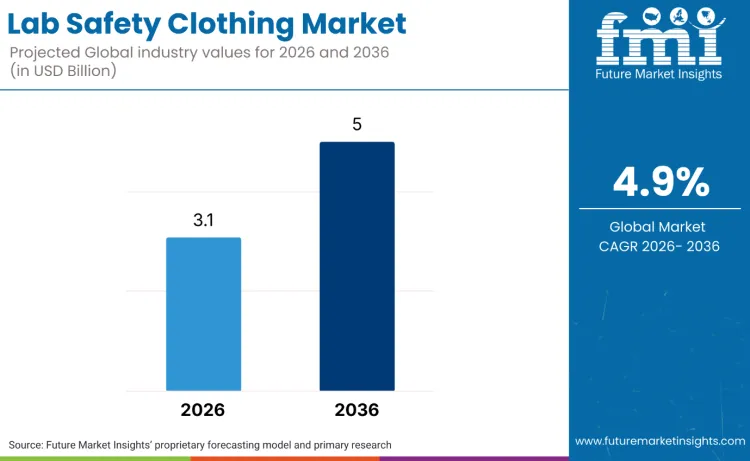
Lab Safety Clothing Market Key Takeaways
| Metric | Value |
|---|---|
| Market Value (2026) | USD 3.1 billion |
| Market Forecast Value (2036) | USD 5.0 billion |
| Forecast CAGR (2026-2036) | 4.9% |
Source: Future Market Insights (FMI) analysis, based on proprietary forecasting model and primary research.
How Do Biosafety and Occupational Safety Policies Drive Demand in the Lab Safety Clothing Market?
The tightening of global biosafety and occupational safety frameworks is directly reshaping procurement priorities in laboratory environments. Updated guidance from regulators such as OSHA, the European Union, and national biosafety authorities increasingly emphasizes engineering and personal protection controls over procedural reliance, shifting responsibility toward certified, application-specific safety garments. This policy direction is accelerating demand for lab safety clothing that supports validated chemical resistance, biosafety containment, and digital compliance management, including emerging requirements for blockchain interoperability to enable auditable tracking of garment usage, exposure history, and lifecycle integrity.
Manufacturers are aligning product development with this regulatory shift by embedding advanced materials, antimicrobial treatments, and digital traceability architectures into laboratory apparel portfolios. High-performance lab coats and protective suits are being designed to integrate with enterprise safety systems, where blockchain interoperability supports immutable records of sterilization cycles, usage hours, and regulatory inspections. Strategic moves by leading suppliers toward lifecycle-managed and digitally enabled garments reflect this transition from disposable protection toward compliance-ready safety platforms.
Commercial indicators confirm the durability of this policy-driven demand. Specialty lab safety clothing portfolios linked to regulated environments continue to outperform generic PPE categories, supported by sustained procurement from pharmaceutical, biotech, and academic research institutions. Growth in certified, traceable apparel systems underscores how biosafety policy, reinforced by blockchain interoperability requirements, is redefining value creation across the lab safety clothing market.
How is the Lab Safety Clothing Market Segmented?
The lab safety clothing market has been segmented based on product type, application, end user, and region. In terms of product type, the market is divided into lab coats and jackets, coveralls and protective suits, disposable gowns and aprons, chemical-resistant garments, flame-resistant and ESD garments, and accessories. By application, the market is divided into chemical handling laboratories, biosafety and BSL labs, cleanroom and semiconductor facilities, healthcare labs and phlebotomy, and education and general research. By end user, the market is segmented into pharma and biotech manufacturing, hospitals and diagnostic labs, academic institutions, industrial and chemical plants, and semiconductor and electronics. Regionally, the market is divided into North America, Europe, Asia Pacific, Latin America, and Middle East and Africa.
Why Do Lab Coats and Jackets Dominate the Lab Safety Clothing Market?
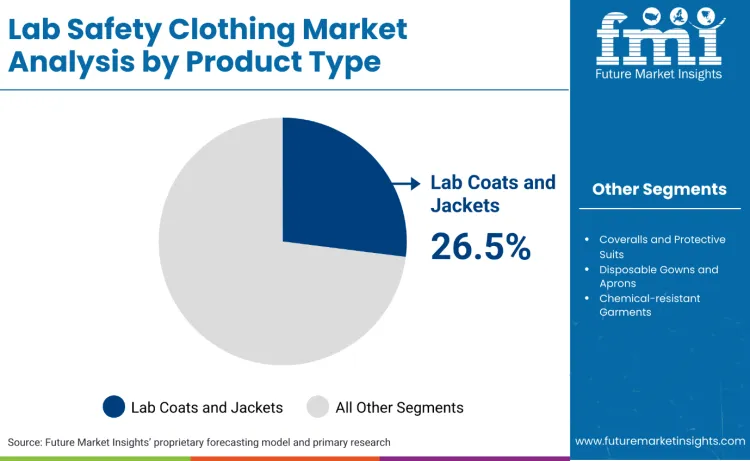
Lab coats and jackets continue to lead the market, accounting for 26.5% of the share, driven by their widespread use across diverse laboratory environments, standardized safety protocols, and rising use of personal protective equipment. This product type offers the versatility needed for routine laboratory work and general protection requirements, making it ideal for academic, pharmaceutical, and research institutions. Coveralls and protective suits capture 18.0% of the market, supporting comprehensive protection for high-hazard environments, particularly in chemical handling and contamination-sensitive applications. Their coverage is critical for procedures where complete body protection is essential.
Public deployment of these protective garment types is accelerating through institutional and regulatory mandates. In the US, new workplace safety protocols and OSHA requirements push for widespread access to appropriate lab safety clothing, aligning with educational and institutional safety requirements. Manufacturers continue to prioritize innovation in these key product lines, optimizing comfort and protection for academic and research environments.
Across the globe, the trend toward enhanced laboratory safety supports lab coats and jackets, while coveralls and disposable garments are gaining traction in markets requiring comprehensive protection and contamination control and companies are aggressively earning profits. DuPont supplies a range of Tyvek® and Tychem® protective garments including lab coats, coveralls, and chemical protective suits designed to shield personnel from chemical and biological hazards.
How Do Application Requirements Influence Lab Safety Clothing Selection?
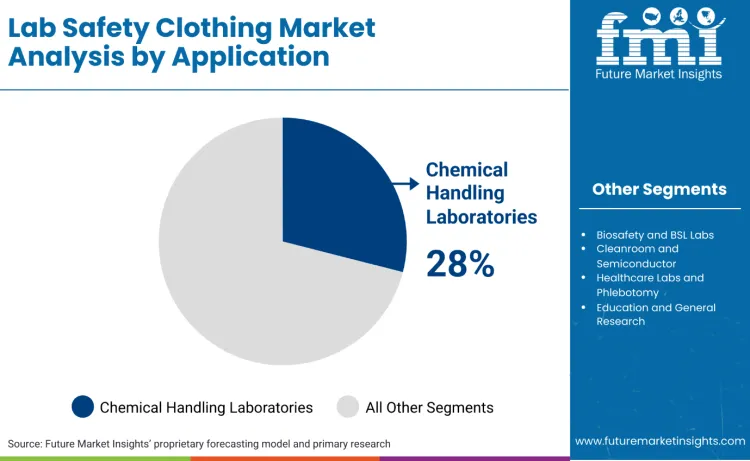
Chemical handling laboratories stands as the dominant segment, commanding 28.0% of the market share. By providing protection against chemical splashes, vapors, and direct contact with hazardous substances, chemical-resistant garments allow researchers to bypass the traditional trial-and-error approach to safety that once limited laboratory productivity.
This methodology is preferred because it maximizes protection against diverse chemical hazards while maintaining operational flexibility, even when working with newly developed compounds or unknown chemical interactions. Lakeland Industries, Inc. produces ChemMax® chemical protective suits and coveralls with barrier films and multi-layer constructions for splash and hazardous chemical protection in lab and industrial settings.
Beyond mere protection, the preference for chemical handling applications is rooted in comprehensive risk management and the creation of validated safety protocols. Through advanced material technologies and specialized barrier coatings, chemical-resistant garments minimize exposure risks while maintaining wearer comfort and mobility, transforming the economics of laboratory safety.
This approach produces standardized protection levels that are essential for maintaining consistent safety standards across diverse chemical research applications. Consequently, chemical handling applications serve as both a safety foundation and an operational enabler, allowing firms to build more resilient and productive laboratory environments.
How Is Regulatory Standardization Altering Entry Barriers in the Lab Safety Clothing Market?
Regulatory authorities are moving beyond basic PPE certification toward lifecycle-level validation of laboratory safety apparel, significantly raising compliance thresholds. Updated occupational safety frameworks increasingly require documented performance consistency, exposure traceability, and post-use integrity verification for lab garments. This shift favors established manufacturers with audited material science capabilities and digital compliance infrastructure, while increasing entry barriers for smaller suppliers unable to support certification, documentation, and lifecycle reporting at scale.
As regulatory scrutiny intensifies, procurement is consolidating around vendors capable of meeting multi-jurisdictional safety standards with repeatable validation. FMI observes that compliance complexity is accelerating market concentration, pushing the lab safety clothing sector toward a smaller pool of globally compliant suppliers.
How Is Digital and Smart Textile Integration Transforming Traditional Lab Safety Garments?
Suppliers are embedding sensing, tracking, and antimicrobial technologies into traditional lab coats, suits, and chemical-resistant garments to convert passive apparel into active safety platforms. Smart textiles capable of monitoring exposure duration, environmental conditions, and garment degradation are gaining traction across regulated laboratory environments. This evolution supports real-time compliance oversight rather than periodic manual inspection.
This convergence of textiles and digital monitoring is reshaping product differentiation. Garments that integrate seamlessly with laboratory safety management systems and digital compliance workflows are increasingly preferred in pharmaceutical and biotech laboratories, where audit readiness and exposure documentation carry operational and legal importance.
What Impact Are Corporate Spin-Offs and Portfolio Restructuring Having on Market Agility?
Large industrial groups are restructuring safety and healthcare portfolios to improve innovation speed and regulatory focus. The separation of healthcare and safety units from diversified conglomerates enables focused investment in advanced materials, smart garment development, and digital safety capabilities without internal capital competition.
FMI analysis indicates that these focused entities are moving faster to integrate smart textiles, antimicrobial coatings, and digital lifecycle management into lab safety clothing portfolios. This structural shift is intensifying competitive pressure on mid-sized and regional players, accelerating consolidation and reinforcing the dominance of specialized, compliance-oriented manufacturers.
How Is the Lab Safety Clothing Market Evolving Globally?
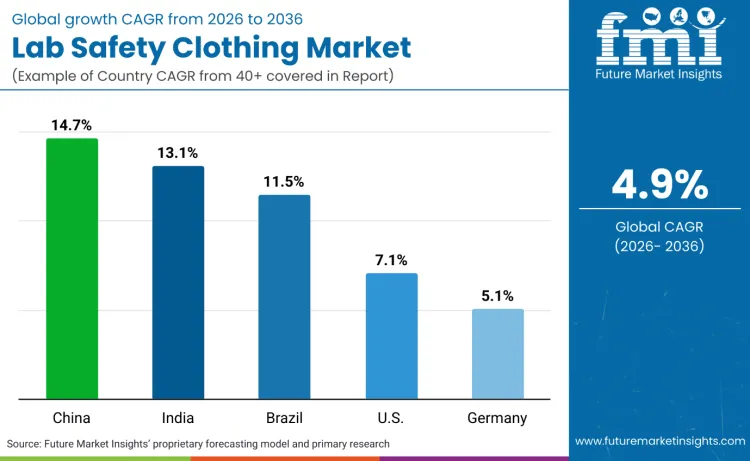
Global demand for lab safety clothing products is increasing as laboratories expand protective capabilities while addressing enhanced protection, comfort optimization, and compliance validation application requirements. Growth demonstrates rising use of advanced protective platforms, hazard-specific garment positioning, and performance-optimized protection specifications across pharmaceutical institutions, research facilities, and industrial laboratories. Product selection focuses on protection effectiveness, wearer comfort, and performance under various laboratory scenarios. China records 14.7% CAGR, India records 13.1% CAGR, Brazil records 11.5% CAGR, USA records 7.1% CAGR, and Germany records 5.1% CAGR. Adoption remains driven by enhanced protection requirements and safety capabilities rather than volume expansion alone.
| Country | CAGR (2025-2035) |
|---|---|
| China | 14.7% |
| India | 13.1% |
| Brazil | 11.5% |
| USA | 7.1% |
| Germany | 5.1% |
Source: Future Market Insights (FMI) historical analysis and forecast data.
China: How is the Rising Laboratory Infrastructure Development Driving Advanced Safety Adoption?
The primary driver in China is the unprecedented growth of domestic research and development capabilities and pharmaceutical manufacturing infrastructure. Driven by this national scale of laboratory capability expansion, the Chinese lab safety clothing market is set to grow at a 14.7% CAGR during the study period, led by massive demand in pharmaceutical development and research sectors.
The most significant opportunity lies in the integration of AI-powered safety monitoring with advanced protective garments. As China targets "manufacturing sovereignty" in pharmaceuticals, there will be a burgeoning demand for specialized safety clothing that supports complex manufacturing processes like biologics production and gene therapy manufacturing in the next five years. Additionally, the push for decentralized research will catalyze a shift toward modular, application-specific protective systems, addressing diverse hazard profiles across lower-tier research facilities.
India: Is the "Research Infrastructure" Movement Elevating Safety Standards?
In India, the market is dominated by the evolution toward industrial automation and safety excellence and protection-positioned garment categories. A major driver is the recent "Setting up of a Nationwide Network of Laboratories for Managing Epidemics and National Calamities” scheme, which allows Indian research institutions to position advanced protective equipment alongside international safety capabilities from a single quality framework. This "protection-first" approach is essential for Indian researchers currently competing with international safety standards in domestic pharmaceutical development applications. Reflecting this maturity, the Indian lab safety clothing market is projected to grow at a 13.1% CAGR during the study period.
India's growing role as a global hub for pharmaceutical outsourcing creates a massive opening for specialized protective garments tailored to international safety standards. Finally, there is a burgeoning demand for cost-effective protective solutions that address safety requirements while maintaining accessibility across tier-2 and tier-3 research facilities.
Brazil: Will Expanding Research Sector Accelerate Safety Platform Integration?
Brazil's lab safety clothing market is uniquely shaped by research sector expansion and laboratory infrastructure development. Brazilian researchers are increasingly adopting advanced protective platforms, maintaining safety positioning for capability assurance while using accessible pricing for broader research appeal. Consequently, the Brazilian lab safety clothing market is expected to grow at a 11.5% CAGR during the study period, as research-focused organizations invest in validated protective and safety-focused categories.
A secondary opportunity is found in the modernization of clinical and diagnostic infrastructure within Brazil's universal healthcare system, the SUS. By 2036, the integration of smart textiles that monitor worker health and environmental exposure will offer a strategic advantage for institutions seeking to reduce occupational accidents, where Brazil currently ranks high globally. Suppliers who establish local manufacturing micro-factories or accredited testing centers will be best positioned to capture market share, as Brazil’s strict Certificate of Approval requirements and preference for regional supply chain resilience create a natural barrier for purely import-based models.
Germany: Is the "Safety Innovation" Strategy Revitalizing Laboratory Protection?
Germany’s lab safety clothing market is expanding due to stricter occupational safety enforcement, rising pharmaceutical and biotechnology research activity, and higher adoption of advanced biosafety protocols. Laboratories increasingly prioritize certified, durable garments that support chemical resistance, comfort, and digital compliance, driven by Industry 4.0 integration and heightened regulatory scrutiny. As German institutions prioritize safety innovation and research excellence, the German lab safety clothing market is set to grow at a 5.1% CAGR during the study period, focusing heavily on protection and safety capability enhancement.
Significant opportunities exist in the development of specialized apparel for the burgeoning cell and gene therapy sectors centered in clusters like the Rhine-Main and Munich regions. Suppliers can capitalize on this by offering lab coats that feature haptic feedback systems or integrated RFID tags to ensure automated compliance with the stringent German Federal Institute for Occupational Safety and Health (BAuA) guidelines.
USA: How is the "Laboratory Safety Renaissance" Driving Protection Innovation?
The USA market is increasingly focused on the innovation and diversity of advanced protective applications. Rising adoption of advanced biosafety standards and audit-ready safety programs is increasing demand for certified, traceable, and application-specific protective garments across regulated laboratories. Supported by these safety development mandates, the USA lab safety clothing market is set to grow at a 7.1% CAGR during the study period.
Technological integration presents a second major frontier, particularly for labs operating under the rigorous oversight of OSHA and the FDA. In the USA, where liability and litigation risks are exceptionally high, clothing that provides a verifiable digital audit trail of exposure levels and sterilization cycles offers a powerful value proposition for large pharmaceutical enterprises and academic medical centers.
Who are the Major Players Active in the Lab Safety Clothing Market?
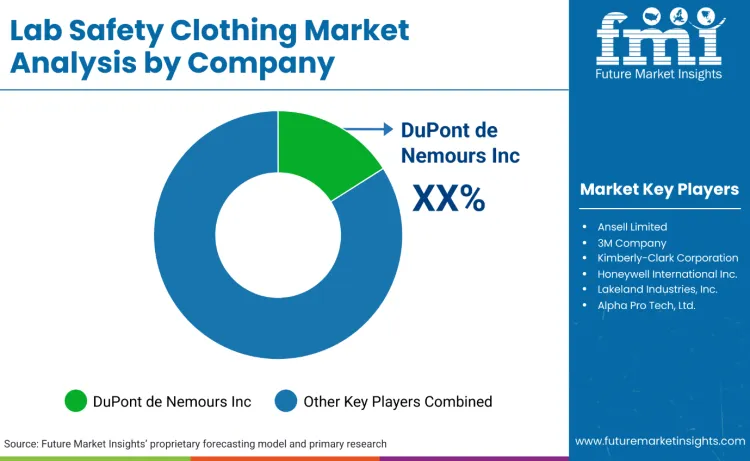
The competitive landscape for the lab safety clothing market is defined by a strategic transition toward smart protective technologies and the integration of advanced materials to enhance protection while maintaining comfort. As laboratory operations prioritize complex procedures and hazardous material handling, the market features highly intensive rivalry focused on increasing the effectiveness and wearability of protective garments. Analysis indicates that market leaders are aggressively pursuing vertical integration, acquiring specialized textile manufacturers to offer "complete protection" solutions that minimize safety gaps.
This shift is particularly evident in the rapid adoption of nanotechnology and advanced polymer materials, which have enhanced protective capabilities while reducing garment weight and improving breathability, allowing players to capture high-value applications in pharmaceutical manufacturing and biotechnology research. For instance, market leader Ansell has strategically positioned its laboratory protection portfolio toward specialized chemical resistance, launching advanced polymer-based garments to meet evolving safety regulations.
Key Industry Developments:
- In October 2025, Thermo Fisher unveiled to acquire Clario Holdings, Inc., a leading provider of endpoint data solutions for clinical trials, to improve its research processes with deeper insights.
- In March 2025, Ansell announced the expansion of its portfolio to include Kimtech™ and KleenGuard™ after the strategic acquisition of Kimberly-Clark's Personal Protective Equipment (KCPPE) business.
Key Players in the Lab Safety Clothing Market
- DuPont de Nemours, Inc.
- Ansell Limited
- 3M Company
- Kimberly-Clark Corporation
- Honeywell International Inc.
- Lakeland Industries, Inc.
- Alpha Pro Tech, Ltd.
- International Enviroguard, Inc.
- Kappler, Inc.
- VF Corporation
Market Definition
The lab safety clothing market refers to the global protective equipment applications of specialized garment platforms designed to provide protection against chemical, biological, and physical hazards in laboratory environments. It includes both standard and specialized protective offerings, with segments that cater to various laboratory applications such as chemical handling, cleanroom operations, and biological safety. The market size is measured in USD billion and analyzed over the 2026 to 2036 period.
The lab safety clothing market includes product types such as lab coats, protective suits, chemical-resistant garments, and specialized accessories, utilized through both research institutions and industrial laboratory applications. The market is expanding due to growing interest in enhanced safety protocol development, protective equipment innovations, and evolving regulatory requirements toward higher-protection and more specialized safety capabilities.
Market Inclusion
Included in the lab safety clothing market scope are protective products categorized by type (lab coats, coveralls, disposable garments, and chemical-resistant clothing), with segmentation based on applications (chemical handling, biosafety, cleanroom operations), research focus (pharmaceutical, academic, industrial), and protection requirements (chemical resistance, comfort, durability). The scope includes safety garment platforms with a focus on protection effectiveness, laboratory compatibility, and regulatory compliance, particularly those marketed through specialized suppliers, research institutions, and pharmaceutical manufacturing facilities.
Geographically, the market encompasses key regions such as North America, Europe, Asia Pacific, Latin America, and the Middle East and Africa, with country-level analysis for significant markets like China, India, Brazil, USA, and Germany.
Market Exclusion
Excluded from the lab safety clothing market scope are non-protective clothing and garments not designed for laboratory safety applications, such as general workwear, medical scrubs not meeting laboratory protection standards, and fashion or casual clothing. Additionally, products not intended for laboratory or research applications are not included.
The market excludes non-safety clothing products, as well as protective equipment that is not marketed as laboratory safety garments, such as industrial workwear or construction safety clothing. Furthermore, products with non-compliant protection specifications or those that do not meet regional regulatory standards for laboratory safety are outside the market's defined scope.
Scope of the Report
| Items | Values |
|---|---|
| Quantitative Units | USD billion |
| Product Type | Lab Coats and Jackets; Coveralls and Protective Suits; Disposable Gowns and Aprons; Chemical-resistant Garments; Flame-resistant and ESD Garments; Accessories |
| Application | Chemical Handling Laboratories; Biosafety and BSL Labs; Cleanroom and Semiconductor; Healthcare Labs and Phlebotomy; Education and General Research |
| End User | Pharma and Biotech Manufacturing; Hospitals and Diagnostic Labs; Academic Institutions; Industrial and Chemical Plants; Semiconductor and Electronics |
| Regions Covered | North America, Europe, Asia Pacific, Latin America, Middle East and Africa |
| Countries Covered | China, India, Brazil, USA, Germany, and 40+ countries |
| Key Companies Profiled | DuPont; Ansell; 3M; Kimberly-Clark; Honeywell; Others |
| Additional Attributes | Revenue analysis by product type, application, and end user; performance in laboratory applications and protective capabilities across pharmaceutical institutions, research facilities, and industrial applications; protection effectiveness enhancement, comfort optimization, and platform benefits under laboratory applications; impact on safety outcomes, protection precision, and platform differentiation during procurement processes; compatibility with safety protocols and laboratory preferences; procurement dynamics driven by protection positioning, safety innovation programs, and long-term research partnerships. |
Lab Safety Clothing Market by Segment
Product Type:
- Lab Coats and Jackets
- Coveralls and Protective Suits
- Disposable Gowns and Aprons
- Chemical-resistant Garments
- Flame-resistant and ESD Garments
- Accessories
Application:
- Chemical Handling Laboratories
- Biosafety and BSL Labs
- Cleanroom and Semiconductor
- Healthcare Labs and Phlebotomy
- Education and General Research
End User:
- Pharma and Biotech Manufacturing
- Hospitals and Diagnostic Labs
- Academic Institutions
- Industrial and Chemical Plants
- Semiconductor and Electronics
Region:
- Asia Pacific
- China
- Japan
- South Korea
- India
- Australia and New Zealand
- Thailand
- Rest of Asia Pacific
- Europe
- Germany
- United Kingdom
- France
- Italy
- Spain
- Nordic
- Netherlands
- Rest of Europe
- North America
- USA
- Canada
- Mexico
- Latin America
- Brazil
- Chile
- Colombia
- Argentina
- Rest of Latin America
- Middle East and Africa
- Kingdom of Saudi Arabia
- Other GCC Countries
- Turkey
- South Africa
- Other African Union
- Rest of Middle East and Africa
Bibliography
- Occupational Safety and Health Administration. (2023). OSHA personal protective equipment (Publication No. 3151). USA Department of Labor.
- Love, T. S., Roy, K. R., & West, S. S. (2024). A call to prioritize safety in STEM and CTE: Addressing overcrowded classes and other critical safety issues. Laboratories, 1(1), 52-58.
- Khattar, R. B., & Nehme, M. E. (2024). Emergence and evolution of standardization systems in medical biology laboratories. Advances in Laboratory Medicine / Avances en Medicina de Laboratorio, 5, 261-267.
Frequently Asked Questions
How big is the lab safety clothing market in 2026?
The global lab safety clothing market is estimated to be valued at USD 3.1 billion in 2026.
What will be the size of the lab safety clothing market in 2036?
The market size for the lab safety clothing market is projected to reach USD 5.0 billion by 2036.
How much will the lab safety clothing market grow between 2026 and 2036?
The lab safety clothing market is expected to grow at a 4.9% CAGR between 2026 and 2036.
What are the key product types in the lab safety clothing market?
The key product types in the lab safety clothing market include lab coats and jackets, coveralls and protective suits, disposable gowns and aprons, and chemical-resistant garments.
Which end user will contribute a significant share in the lab safety clothing market in 2026?
In terms of end user, the pharma and biotech manufacturing segment is set to command a 26.0% share in the lab safety clothing market in 2026.
Preview the report firsthand - request a free sample
Get SampleGet the brochure for pricing and purchase details.
Get PDFTable of Content
- Executive Summary
- Global Market Overview
- Key Insights
- Market Forecast
- Strategic Recommendations
- Market Overview
- Market Definition
- Market Taxonomy
- Scope and Limitations
- Research Methodology
- Research Approach
- Data Sources
- Analytical Framework
- Market Dynamics
- Drivers
- Restraints
- Opportunities
- Trends
- Market Sizing and Forecast
- Market Value (2026-2036)
- Y-o-Y Growth Analysis
- Market Share by Product Type
- Market Share by Application
- Market Share by End User
- Market Segmentation Analysis
- Product Type
- Lab Coats and Jackets
- Coveralls and Protective Suits
- Disposable Gowns and Aprons
- Chemical-resistant Garments
- Flame-resistant and ESD Garments
- Accessories
- Application
- Chemical Handling Laboratories
- Biosafety and BSL Labs
- Cleanroom and Semiconductor
- Healthcare Labs and Phlebotomy
- Education and General Research
- End User
- Pharma and Biotech Manufacturing
- Hospitals and Diagnostic Labs
- Academic Institutions
- Industrial and Chemical Plants
- Semiconductor and Electronics
- Product Type
- Regional Market Analysis
- Asia Pacific
- North America
- Europe
- Latin America
- Middle East and Africa
- Competitive Landscape
- Market Share of Key Players
- Competitive Benchmarking
- Key Player Strategies
- Key Takeaways
- Market Summary
- Future Trends and Forecast
- Strategic Recommendations


