

- Industry Size (2025)
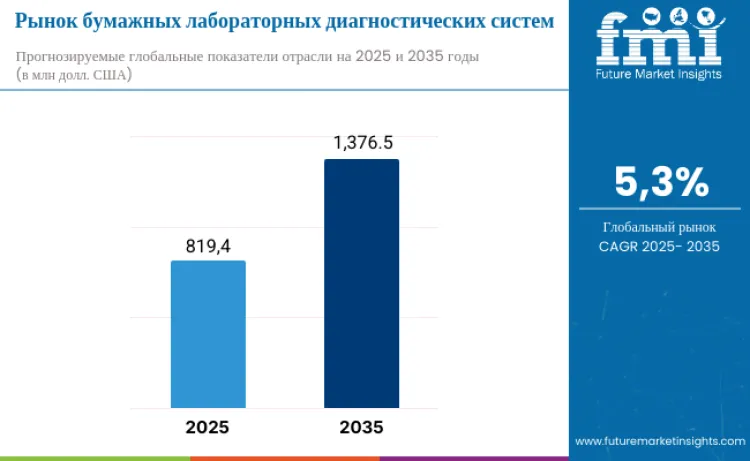
- USD 819.4 Mn
- Forecast (2035)
- USD 1376.5 Mn
- CAGR (2025 to 2035)
- 5.3%
Lab-on-Paper Diagnostics Market Forecast and Outlook 2025 to 2035
Global lab-on-paper diagnostics market is projected to reach USD 1,376.5 million by 2035, reflecting an absolute increase of USD 557.1 million from its USD 819.4 million valuation in 2025. Growing at 5.3% CAGR, the market is set to expand by nearly 1.6×, driven by rapid adoption of ultra-low-cost POC testing, decentralized diagnostics, and large-scale deployment across infectious disease surveillance, maternal and neonatal screening, chronic disease monitoring, and emergency triage systems. Despite this momentum, limited sensitivity in complex biomarker detection and regulatory standardization issues may restrict penetration in advanced clinical settings.
Growth aligns with global transitions toward portable, equipment-free diagnostic models. Lab-on-paper platforms enable community health workers, clinicians, and home users to conduct rapid testing without laboratory infrastructure. Their increasing use in epidemic response, large-field screening, and low-resource environments is reinforced by 30-70% faster turnaround times and 60-90% cost reductions compared with traditional laboratory workflows.
Quick Stats for Lab-on-Paper Diagnostics Market
- Lab-on-Paper Diagnostics Market Value (2025): USD 819.4 million
- Lab-on-Paper Diagnostics Market Forecast Value (2035): USD 1,376.5 million
- Lab-on-Paper Diagnostics Market Forecast CAGR: 5.3%
- Leading Market Segment: Paper-based Microfluidic Devices 29.6% share, favored for ultra-low-cost, equipment-free multiplex testing in resource-constrained settings
- Key Growth Regions: Asia Pacific, Latin America, Middle East & Africa
- Top Players: Diagnostics for All, Abionic SA, MicroLIQUID, PaperLab, Nirmidas Biotech
Technological advancements in wax-printed microfluidics, lateral-flow innovations, nanomaterial-based signal amplification, and CRISPR paper-strip detection are reshaping the landscape. Integration of smartphone-enabled optical readers, digital imaging algorithms, electrochemical sensing, and multiplexed bioassays supports accurate, instrument-free pathogen and biomarker screening. Government disease-control initiatives, pandemic-preparedness programs, and global public-health investments continue accelerating adoption. Meanwhile, academic laboratories and medtech developers are innovating biodegradable substrates and scalable printing techniques, ensuring cost-efficient production and expanding deployment across both emerging and high-resource healthcare markets.
Lab-on-Paper Diagnostics Market Year-over-Year Forecast (2025 to 2035)
Between 2025 and 2030, the lab-on-paper diagnostics market is projected to grow from USD 819.4 million to USD 1,062.0 million, representing an increase of USD 242.6 million, or 43.5% of total decade growth. This expansion is driven by increased use of low-cost POC tools in primary care, wider infectious-disease screening in emerging economies, and rapid adoption of smartphone-integrated paper biosensors. Manufacturers are advancing scalable microfluidic printing, CRISPR-enabled assays, and sensitivity-enhanced chemistries while partnering with global health organizations to support large-scale screening.
From 2030 to 2035, the market will rise from USD 1,062.0 million to USD 1,376.5 million, representing a 56.5% increase over the decade. The commercialization of multiplexed paper platforms, biodegradable nanomaterials, digital readouts, and AI-supported interpretation will drive growth. Strong collaboration among medtech firms, government agencies, and academic centers will accelerate regulatory progress and reimbursement adoption as pandemic preparedness, antimicrobial resistance surveillance, and home-based chronic-care monitoring increase reliance on accessible, low-infrastructure lab-on-paper solutions.
Lab-on-Paper Diagnostics Market Key Takeaways
| Metric | Value |
|---|---|
| Market Value (2025) | USD 819.4 million |
| Market Forecast Value (2035) | USD 1,376.5 million |
| Forecast CAGR (2025 to 2035) | 5.3% |
Why Is the Lab-on-Paper Diagnostics Market Growing Worldwide?
The lab-on-paper diagnostics market expands by enabling rapid, low-cost, equipment-free testing in settings where laboratory infrastructure is limited. Paper-based platforms typically deliver 30-70% faster turnaround and 60-90% lower cost than conventional lab workflows, making them ideal for infectious-disease monitoring, maternal and neonatal programs, chronic-care screening, and outbreak response. Their accessibility strengthens diagnostic coverage across remote and low-resource regions.
Global health-security initiatives, pandemic-preparedness programs, and community surveillance investments reinforce adoption across government agencies, NGOs, and telehealth networks. Advancements in CRISPR-enabled paper tests, nanomaterial biosensors, and smartphone optical readers enhance accuracy and applicability. While sensitivity challenges and regulatory variability remain, integration into advanced hospital systems is steadily increasing as validation frameworks evolve.
How Is the Lab-on-Paper Diagnostics Market Segmented by product type, Application, end user, and Region?
The market is segmented by product type, application, and end-user. By product type, the market is divided into paper-based microfluidic devices, lateral flow assays, electrochemical paper sensors, colorimetric/optical paper sensors, and other hybrid/smart paper platforms. Based on application, the market is categorized into infectious disease diagnostics, environmental & food safety testing, point-of-care clinical testing, veterinary & agricultural diagnostics, and research & educational applications. End-users include academic & research institutes, hospitals & clinics, diagnostic laboratories, and home/remote testing users. Regionally, the market is divided into Asia Pacific, Europe, North America, Latin America, and Middle East & Africa.
By Product Type, Paper-based Microfluidic Devices Hold the Largest Share
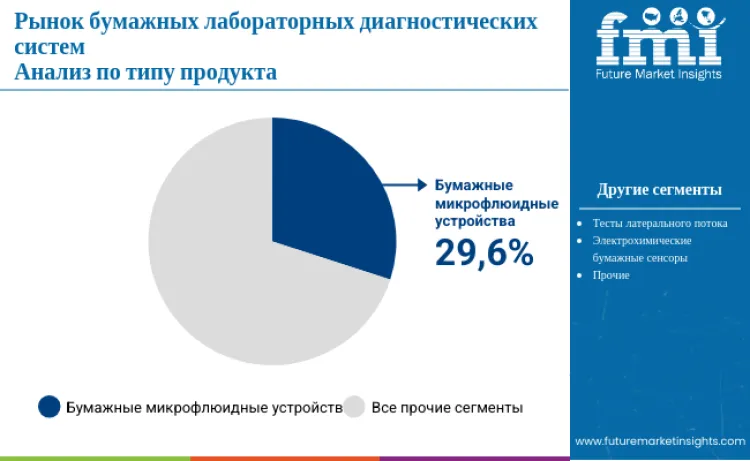
Paper-based microfluidic devices lead the market with 29.6% share in 2025, driven by engineered microchannels that support multiplex biochemical reactions, capillary flow control, and enzyme-linked detection for quantitative and semi-quantitative diagnostics. Their dominance reflects demand for ultra-low-cost, equipment-free platforms suitable for infectious, metabolic, and environmental testing in resource-limited settings. Next-generation lateral flow formats hold 25.3%, while electrochemical and colorimetric sensors contribute strong uptake through high-sensitivity detection. Hybrid paper-electronics systems account for 11.5%, gaining traction through CRISPR integration, IoT connectivity, and emerging biodegradable biosensor innovations.
By Application, Infectious Disease Diagnostics Lead Market Adoption
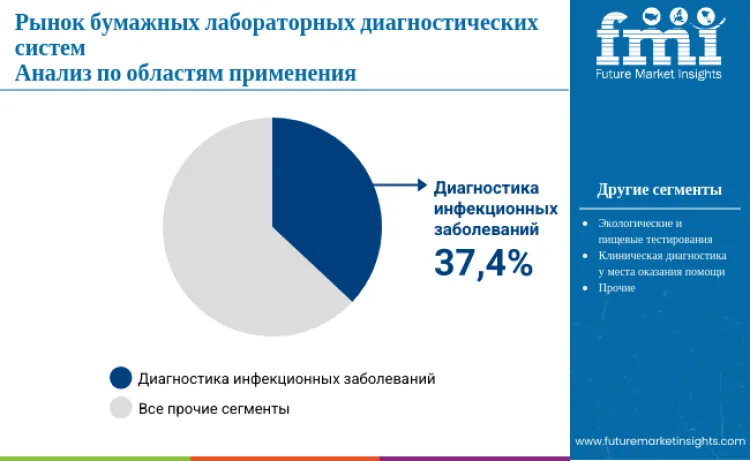
The infectious disease diagnostics segment leads with 37.4% share in 2025, driven by global priorities in pathogen detection, outbreak screening, and decentralized surveillance. Adoption is strengthened by malaria, TB, dengue, and maternal-child health programs that rely on rapid, disposal-friendly, cold-chain-free paper assays usable in rural clinics and emergency settings. Point-of-care clinical testing holds 19.2%, while environmental safety diagnostics account for 21.8%. Veterinary diagnostics represent 11.6%, and education/research 10%, supporting agricultural disease control and biodevice development. Demand is reinforced by LMIC modernization, mobile health expansion, AMR monitoring, and smartphone-integrated paper testing systems.
By End-User, Academic & Research Institutes Account for the Highest Share
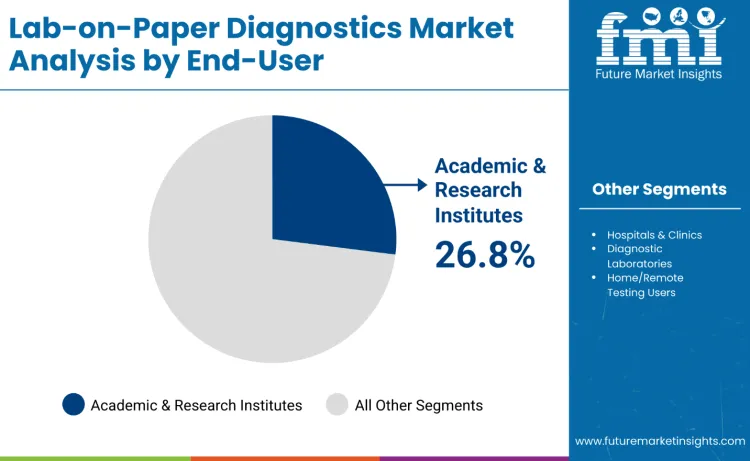
Academic and research institutes lead end-user adoption with a 26.8% share in 2025, driven by strong investment in biosensor R&D, microfluidic prototyping, nanomaterial ink development, and CRISPR-paper assay innovation. Universities and global research consortia are advancing paper-biochip design, eco-friendly materials, and scalable fabrication techniques. Hospitals and clinics hold 28.3% of the market, integrating paper-based tests for triage, emergency care, and maternal-child screening. Diagnostic laboratories account for 23.5%, while home and remote users represent 21.4%, supported by rapid POC kits and preventive screening tools. Academic leadership is reinforced by grants, industry collaboration, and workforce training in paper-bioengineering.
What Are the Major Drivers, Restraints, and Emerging Trends Influencing the Lab-on-Paper Diagnostics Market?
The lab-on-paper diagnostics market is driven by global momentum toward decentralized testing and low-cost disease surveillance. Rising infectious disease burden and pandemic-preparedness priorities increase demand for rapid, portable diagnostics suitable for viral, bacterial, and vector-borne screening in resource-limited regions. Growth in point-of-care and remote tele-diagnostic models is strengthening adoption, as paper-based tests offer instrument-free sample-to-result workflows for community clinics, mobile health programs, and home testing. Government-funded research and academic innovation pipelines further accelerate the development of CRISPR-enabled paper biosensors, nanomaterial-enhanced chips, and smartphone-readout platforms, with expanding applications in oncology, chronic disease monitoring, and public health surveillance.
What Restraints Limit Wider Adoption of Lab-on-Paper Diagnostic Technologies?
Restraints include sensitivity and specificity constraints for complex biomarkers, requiring further optimization compared with conventional laboratory assays. Regulatory variability across regions may slow approvals for advanced microfluidic paper platforms, while manufacturing scale-up challenges persist for nanomaterial-functionalized substrates, enzyme-stabilized reagents, and biodegradable papers. Environmental stability issues, particularly in high-heat or high-humidity climates, necessitate improved packaging and stabilization chemistries. Adoption in tertiary hospitals may initially lag until standardization frameworks, quality benchmarks, and reimbursement pathways mature for quantitative paper-based diagnostics capable of complementing or replacing established laboratory technologies.
What Emerging Trends Are Shaping the Future of the Lab-on-Paper Diagnostics Market?
Key trends show rapid adoption across Asia-Pacific and Sub-Saharan Africa through large-scale screening initiatives, global health partnerships, and primary-care investments prioritizing decentralized, cost-efficient diagnostics. Technological advancements focus on multiplexed paper platforms, electrochemical readouts, cloud-linked smartphone imaging, and AI-enabled interpretation, enabling near-laboratory accuracy without instrumentation. Sustainability initiatives promote biodegradable substrates and greener fabrication chemistries. Rising interest from diagnostics companies and med-tech investors signals increasing commercialization momentum. Competitive pressure may emerge from portable molecular systems and lab-on-chip devices, requiring paper-based platforms to maintain advantages in affordability, disposability, ease-of-use, and scalable deployment.
How Are Leading Countries Driving Growth in the Lab-on-Paper Diagnostics Market?
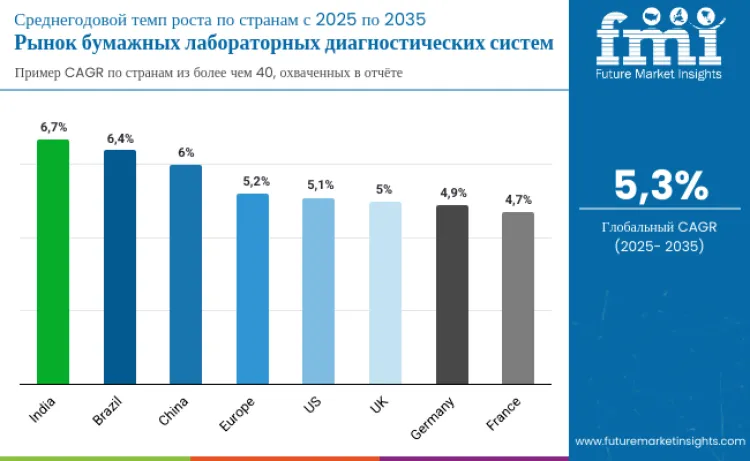
| Country | CAGR (2025 to 2035) |
|---|---|
| USA | 5.1% |
| Brazil | 6.4% |
| China | 6.0% |
| India | 6.7% |
| Europe | 5.2% |
| Germany | 4.9% |
| France | 4.7% |
| UK | 5.0% |
India leads the lab-on-paper diagnostics market with a 6.7% growth rate, supported by healthcare digitization and large-scale screening initiatives. China follows at 6.0%, driven by strengthening primary care and low-cost diagnostic innovation. Brazil grows at 6.4% through expanding public-health programs, while South Africa accelerates adoption via TB and HIV surveillance. The USA advances at 5.1% through NIH-funded R&D, and Europe grows at 5.2%, with Germany at 4.9%, France at 4.7%, and the UK at 5.0%. Together, India and China anchor global scaling while mature regions refine technology and deployment models.
The report covers an in-depth analysis of 40+ countries top-performing countries are highlighted below.
How Is Paper-Based Diagnostic Innovation Accelerating Market Growth in China?
China shows strong growth potential in the Lab-on-Paper Diagnostics Market, maintaining a 6.0% CAGR through 2035, supported by national healthcare modernization, infectious-disease surveillance, and expansion of decentralized POC networks. Major innovation hubs, Beijing, Shanghai, Shenzhen, and Guangzhou, lead advancements in microfluidics, biosensor engineering, CRISPR-paper assays, and nanomaterial signal amplification. High-volume manufacturing and automation enable rapid commercialization and cost-efficient chip production for large-scale deployment in primary care and rural clinics. Government-led disease-preparedness programs and industry collaboration further reinforce China’s role as a global accelerator in low-cost, scalable paper-based diagnostics.
Why Are Public-Health Capacity Building Programs Enhancing Market Adoption in India?
India leads global lab-on-paper diagnostics deployment, sustaining strong momentum with a 6.7% CAGR through 2035. Adoption is accelerating across metropolitan innovation hubs, medical universities, and public health systems to support community screening, infectious-disease control, and decentralized primary care. Growth is driven by the National Health Mission, Ayushman Bharat, and rising investment in paper-microfluidics R&D, indigenous manufacturing, and biosensor innovation. Programs targeting TB, dengue, malaria, maternal-child health, and AMR surveillance expand nationwide usage. Make-in-India incentives, biotech entrepreneurship, and partnerships with NGOs and global health organizations further enable scalable production and rural deployment.
How Is Precision Biomedical Research Advancing Market Leadership in Germany?
Germany’s biomedical ecosystem shows advanced development of lab-on-paper diagnostics, supported by strong translational research, precision engineering, and rigorous clinical validation. The market grows steadily with a 4.9% CAGR through 2035, driven by investments in microfluidics, nanomaterial-enabled sensing, and point-of-care integration across public-health and academic networks. Innovation hubs in Berlin, Munich, Heidelberg, and Hamburg are advancing enzyme-stabilized substrates, CRISPR-paper nucleic acid detection, and hybrid optical-electrochemical readouts. German institutions prioritize analytical rigor and regulatory-grade reliability, with EU-aligned quality frameworks, automated reagent printing, scalable nanomaterial methods, and digital-health interoperability strengthening decentralized diagnostic capabilities.
Why Is Public-Health Outreach Expansion Fueling Market Demand in Brazil?
Brazil leads Latin American adoption of lab-on-paper diagnostics, driven by expanding public-health outreach, strong infectious-disease surveillance, and rising demand for low-cost decentralized testing. The market grows at a 6.4% CAGR through 2035, supported by national programs targeting dengue, Zika, chikungunya, tuberculosis, and water-borne pathogens across São Paulo, Rio de Janeiro, Brasília, and Porto Alegre. Public-sector procurement, NGO-led initiatives, and university-biotech partnerships accelerate deployment and domestic production. Increasing tele-health integration enables smartphone-readout paper diagnostics, while mobile clinics and community health agents expand screening coverage in underserved regions, strengthening Brazil’s diagnostic accessibility.
How Do Advanced Biomedical Ecosystems Strengthen Market Performance in the United States?
The United States lab-on-paper diagnostics market shows mature scientific and commercial momentum, supported by leading research institutions, NIH-backed innovation programs, and strong participation from biotech startups and global med-tech firms. The market grows at a 5.1% CAGR through 2035, driven by expanding point-of-care models, emergency-preparedness legislation, and decentralized diagnostics for primary care and home health. Innovation hubs in Boston, the San Francisco Bay Area, Houston, and the Research Triangle advance microfluidics, CRISPR-paper assays, and smartphone biosensing. Federal grants, BARDA partnerships, and NIH RADx programs accelerate commercialization and nationwide deployment across clinics, rural networks, and tele-diagnostic systems.
How Is Public Health Innovation Supporting Market Growth in the United Kingdom?
Medical innovation hubs in London, Oxford, Cambridge, and Manchester are advancing lab-on-paper diagnostics through academic research, NHS-affiliated labs, and biotech start-ups. The United Kingdom shows solid momentum with a 5.0% CAGR through 2035, supported by national diagnostics missions, NHS decentralized testing pilots, and demand for scalable, low-cost tools for infectious diseases, AMR monitoring, and chronic-care management. UK researchers are innovating microfluidics, CRISPR-enabled paper tests, and smartphone-linked lateral-flow systems. Strong university-biotech collaboration, government funding, and sustainability-focused healthcare models further accelerate commercialization and equitable regional deployment.
How Are Healthcare Innovation Investments Advancing Market Expansion Across Europe?
The lab-on-paper diagnostics market in Europe is projected to increase from USD 186.8 million in 2025 to USD 304.2 million by 2035, growing at a 5.0% CAGR. Growth is supported by EU commitments to decentralized diagnostics, AMR surveillance, and low-cost testing in primary-care networks. Germany leads with 26.4% share in 2025, moderating to 25.8% by 2035 due to strong biomedical R&D environments and adoption across academic hospitals and translational institutes. France rises from 20.8% to 21.1%, while Italy remains stable at 11.7%, driven by regional deployments in elderly care and emergency screening.
Spain increases from 9.1% to 9.3%, supported by vector-borne disease surveillance and primary-care innovation. The Netherlands maintains 6.2% through biomaterials research leadership and digital health integration. The Rest of Europe grows from 4.3% to 4.6%, reflecting continued adoption across Nordic and Central-Eastern modernization programs and expanding access to affordable, field-ready diagnostic technologies.
High-Precision Biosensing Standards Shape Diagnostic Adoption in Japan
Lab-on-paper diagnostics market in Japan reflects a mature, quality-focused ecosystem built on advanced paper-microfluidic systems, enzyme-stabilized substrates, and CRISPR-paper detection technologies. University hospitals, geriatric care programs, and translational research centers drive adoption as the country prioritizes analytical precision, reagent stability, and high reproducibility. Strong collaboration among research universities, government funding agencies, and diagnostics manufacturers supports development of clinically reliable, regulation-ready platforms integrated with digital health systems.
Innovation hubs in Tokyo, Osaka, Kyoto, and Kanagawa are leading deployment pilots where paper-based assays enable rapid detection for chronic disease monitoring, elderly care workflows, and infectious-disease surveillance. Japan’s rigorous clinical standards and technology refinement continue to shape sustained adoption of advanced lab-on-paper solutions.
International Partnerships Strengthen Diagnostic Innovation in South Korea
The lab-on-paper diagnostics market in South Korea is expanding through strong collaboration between global biosensor innovators and domestic healthcare, academic, and research institutions. International diagnostic providers are establishing solid presence via technology transfer, clinical-validation partnerships, and technical service support. Growing emphasis on rapid point-of-care testing, digital-health integration, and scalable biosensor manufacturing is driving adoption across hospitals, universities, and biotech startups for infectious-disease detection, cancer biomarker studies, and triage applications.
Local med-tech distributors are broadening access through partnerships with global microfluidics and CRISPR-paper technology companies, offering user localization, reagent programs, optimized logistics, and regulatory guidance. Joint R&D between international firms and public research agencies is shaping hybrid models that blend global innovations with Korea’s biomedical engineering strengths and national healthcare-preparedness priorities.
How Competitive Is the Global Lab-on-Paper Diagnostics Market and What Defines Its Structure?
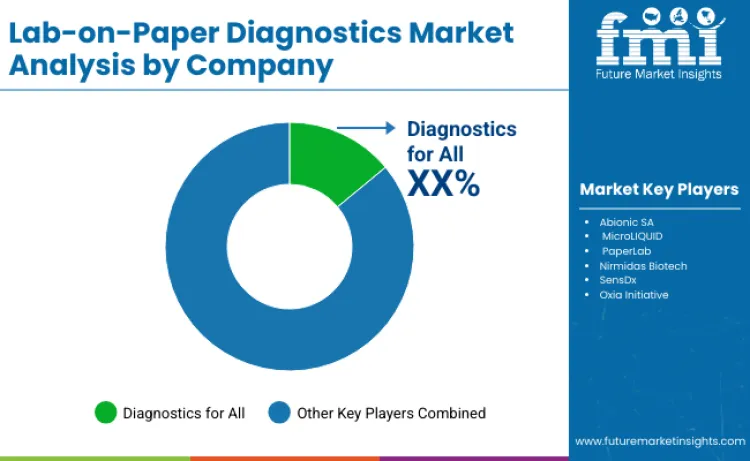
The lab-on-paper diagnostics market features a concentrated landscape with a core group of leading innovators and a rapidly expanding ecosystem of academic spin-outs, health-tech startups, and global public-health partners. The top players hold a substantial share of global revenue, leveraging proprietary microfluidic fabrication, reagent-stabilization technologies, and strong collaborations with government agencies, NGOs, and translational research institutions. Competition is defined by assay sensitivity, stability, manufacturing scalability, and clinical-validation strength, as end-users prioritize diagnostic accuracy, shelf-life, and reliability in diverse field environments. Diagnostics for All leads the segment, while Abionic SA, MicroLIQUID, PaperLab, and Nirmidas Biotech strengthen the competitive field through advances in microfluidics, nanoparticle chemistry, CRISPR-paper sensing, and smartphone-enabled readouts.
Challenger firms such as SensDx, Oxia Initiative, and InnovaPrep are gaining momentum by targeting niche diagnostic applications including respiratory pathogens, agricultural disease management, and environmental biosurveillance. Their strategies center on university partnerships, public-health collaborations, and accelerated clinical validation. A broad base of emerging innovators across North America, Europe, and Asia contributes to rapid R&D progress in signal amplification, bio-ink printing, biodegradable substrates, and portable detection modules. Overall, the market rewards companies that combine high analytical accuracy with scalable production, strong regulatory readiness, and integrated digital connectivity for tele-diagnostic and public-health surveillance workflows.
Key Players in the Lab-on-Paper Diagnostics Market
- Diagnostics for All
- Abionic SA
- MicroLIQUID
- PaperLab
- Nirmidas Biotech
- SensDx
- Oxia Initiative
- InnovaPrep
- Others
Scope of the Report
| Item | Value |
|---|---|
| Quantitative Units | USD 819.4 million |
| Product Type | Paper-based Microfluidic Devices, Lateral Flow Assays (Next-gen formats), Electrochemical Paper Sensors, Colorimetric/Optical Paper Sensors, Others (Hybrid/Smart Paper Platforms) |
| Application | Infectious Disease Diagnostics, Environmental & Food Safety Testing, Point-of-Care Clinical Testing, Veterinary & Agricultural Diagnostics, Research & Educational Applications |
| End User | Hospitals & Clinics, Diagnostic Laboratories, Academic & Research Institutes, Home/Remote Testing Users |
| Regions Covered | Asia Pacific, Europe, North America, Latin America, Middle East & Africa |
| Country Covered | China, India, Germany, Brazil, USA, UK, Japan, and 40+ countries |
| Key Companies Profiled | Diagnostics for All, Abionic SA,MicroLIQUID, PaperLab, Nirmidas Biotech, SensDx, Oxia Initiative, InnovaPrep, Others |
| Additional Attributes | Revenue analysis spans paper-microfluidics, advanced lateral flow, and electrochemical/optical paper sensors across major regions. Competition is led by paper-biosensor innovators and diagnostics spinouts. Growth is driven by sensitivity, stability, multiplexing, smartphone readouts, and CRISPR-paper, nanomaterials, biodegradable substrates, scalable printing, and decentralized screening programs. |
Lab-on-Paper Diagnostics Market by Segments
Product Type:
- Paper-based Microfluidic Devices
- Lateral Flow Assays (Next-gen formats)
- Electrochemical Paper Sensors
- Colorimetric/Optical Paper Sensors
- Others (Hybrid/Smart Paper Platforms)
Application:
- Infectious Disease Diagnostics
- Environmental & Food Safety Testing
- Point-of-Care Clinical Testing
- Veterinary & Agricultural Diagnostics
- Research & Educational Applications
End User:
- Hospitals & Clinics
- Diagnostic Laboratories
- Academic & Research Institutes
- Home/Remote Testing Users
Region:
- Asia Pacific
- China
- India
- Japan
- South Korea
- Vietnam
- Australia & New Zealand
- ASEAN
- Rest of Asia Pacific
- Europe
- Germany
- United Kingdom
- France
- Italy
- Spain
- Netherlands
- Nordic
- BENELUX
- Rest of Europe
- North America
- United States
- Canada
- Mexico
- Latin America
- Brazil
- Argentina
- Rest of Latin America
- Middle East & Africa
- Kingdom of Saudi Arabia
- Other GCC Countries
- Turkey
- South Africa
- Other African Union
- Rest of Middle East & Africa
Frequently Asked Questions
How big is the lab-on-paper diagnostics market in 2025?
The global lab-on-paper diagnostics market is valued at USD 819.4 million in 2025.
What will be the size of the lab-on-paper diagnostics market in 2035?
The market is projected to reach USD 1,376.5 million by 2035.
How fast will the lab-on-paper diagnostics market grow between 2025 and 2035?
The market will grow at a CAGR of 5.3% from 2025 to 2035.
Which product type leads the lab-on-paper diagnostics market in 2025?
Paper-based microfluidic devices lead the market with a 29.6% share in 2025.
Who are the major players in the lab-on-paper diagnostics market?
Key players include Diagnostics for All, Abionic SA, MicroLIQUID, PaperLab, and Nirmidas Biotech.
Preview the report firsthand - request a free sample
Get SampleGet the brochure for pricing and purchase details.
Get PDFTable of Content
- Executive Summary
- Regional Level Market Outlook
- Demand-side Trends
- Supply-side Trends
- Technology Roadmap Analysis
- Analysis and Recommendations
- Market Overview
- Market Coverage / Taxonomy
- Market Definition / Scope / Limitations
- Market Background
- Market Dynamics
- Drivers
- Restraints
- Opportunity
- Trends
- Scenario Forecast
- Demand in Optimistic Scenario
- Demand in Likely Scenario
- Demand in Conservative Scenario
- Opportunity Assessment
- Market Trade Assessment
- Products Market Assessment
- Investment Feasibility Matrix
- Value Chain Analysis
- Participants and their Roles
- Profit Margin Analysis
- Operating Margins By Region
- PESTLE and Porter’s Analysis
- Regulatory Landscape
- By Key Regions
- By Key Countries
- Regional Parent Market Outlook
- Product Launches & Development
- Technological Innovation
- Market Dynamics
- Regional Level Market Analysis 2020 to 2024 and Forecast, 2025 to 2035
- Historical Market Size USD Million & Units Analysis, 2020 to 2024
- Current and Future Market Size USD Million & Units Projections, 2025 to 2035
- Y-o-Y Growth Trend Analysis
- Absolute $ Opportunity Analysis
- Regional Level Market Analysis 2020 to 2024 and Forecast 2025 to 2035, By Product Type
- Introduction / Key Findings
- Historical Market Size USD Million & Units Analysis By Product Type, 2020 to 2024
- Current and Future Market Size USD Million & Units Analysis and Forecast By Product Type, 2025 to 2035
- Paper-based Microfluidic Devices
- Lateral Flow Assays (Next-gen formats)
- Electrochemical Paper Sensors
- Colorimetric/Optical Paper Sensors
- Others (Hybrid/Smart Paper Platforms)
- Y-o-Y Growth Trend Analysis By Product Type, 2020 to 2024
- Absolute $ Opportunity Analysis By Product Type, 2025 to 2035
- Regional Level Market Analysis 2020 to 2024 and Forecast 2025 to 2035, By Application
- Introduction / Key Findings
- Historical Market Size USD Million & Units Analysis By Application, 2020 to 2024
- Current and Future Market Size USD Million & Units Analysis and Forecast By Application, 2025 to 2035
- Infectious Disease Diagnostics
- Environmental & Food Safety Testing
- Point-of-Care Clinical Testing
- Veterinary & Agricultural Diagnostics
- Research & Educational Applications
- Y-o-Y Growth Trend Analysis By Application, 2020 to 2024
- Absolute $ Opportunity Analysis By Application, 2025 to 2035
- Regional Level Market Analysis 2020 to 2024 and Forecast 2025 to 2035, By End User
- Introduction / Key Findings
- Historical Market Size USD Million & Units Analysis By End User, 2020 to 2024
- Current and Future Market Size USD Million & Units Analysis and Forecast By End User, 2025 to 2035
- Hospitals & Clinics
- Diagnostic Laboratories
- Academic & Research Institutes
- Home/Remote Testing Users
- Y-o-Y Growth Trend Analysis By End User, 2020 to 2024
- Absolute $ Opportunity Analysis By End User, 2025 to 2035
- Regional Level Market Analysis 2020 to 2024 and Forecast 2025 to 2035, By Region
- Introduction
- Historical Market Size USD Million & Units Analysis By Region, 2020 to 2024
- Current Market Size USD Million & Units Analysis and Forecast By Region, 2025 to 2035
- North America
- Latin America
- East Asia
- South Asia
- Western Europe
- Eastern Europe
- Middle East & Africa
- Market Attractiveness Analysis By Region
- North America Market Analysis 2020 to 2024 and Forecast 2025 to 2035, By Country
- Historical Market Size USD Million & Units Trend Analysis By Market Taxonomy, 2020 to 2024
- Market Size USD Million & Units Forecast By Market Taxonomy, 2025 to 2035
- By Country
- USA
- Canada
- Mexico
- By Product Type
- By Application
- By End User
- By Country
- Market Attractiveness Analysis
- By Country
- By Product Type
- By Application
- By End User
- Key Takeaways
- Latin America Market Analysis 2020 to 2024 and Forecast 2025 to 2035, By Country
- Historical Market Size USD Million & Units Trend Analysis By Market Taxonomy, 2020 to 2024
- Market Size USD Million & Units Forecast By Market Taxonomy, 2025 to 2035
- By Country
- Brazil
- Argentina
- Rest of Latin America
- By Product Type
- By Application
- By End User
- By Country
- Market Attractiveness Analysis
- By Country
- By Product Type
- By Application
- By End User
- Key Takeaways
- East Asia Market Analysis 2020 to 2024 and Forecast 2025 to 2035, By Country
- Historical Market Size USD Million & Units Trend Analysis By Market Taxonomy, 2020 to 2024
- Market Size USD Million & Units Forecast By Market Taxonomy, 2025 to 2035
- By Country
- China
- Japan
- South Korea
- By Product Type
- By Application
- By End User
- By Country
- Market Attractiveness Analysis
- By Country
- By Product Type
- By Application
- By End User
- Key Takeaways
- South Asia Market Analysis 2020 to 2024 and Forecast 2025 to 2035, By Country
- Historical Market Size USD Million & Units Trend Analysis By Market Taxonomy, 2020 to 2024
- Market Size USD Million & Units Forecast By Market Taxonomy, 2025 to 2035
- By Country
- India
- ASEAN Countries
- Australia & New Zealand
- Rest of South Asia
- By Product Type
- By Application
- By End User
- By Country
- Market Attractiveness Analysis
- By Country
- By Product Type
- By Application
- By End User
- Key Takeaways
- Western Europe Market Analysis 2020 to 2024 and Forecast 2025 to 2035, By Country
- Historical Market Size USD Million & Units Trend Analysis By Market Taxonomy, 2020 to 2024
- Market Size USD Million & Units Forecast By Market Taxonomy, 2025 to 2035
- By Country
- Germany
- UK
- France
- Italy
- Spain
- BENELUX
- Nordic Countries
- Rest of Western Europe
- By Product Type
- By Application
- By End User
- By Country
- Market Attractiveness Analysis
- By Country
- By Product Type
- By Application
- By End User
- Key Takeaways
- Eastern Europe Market Analysis 2020 to 2024 and Forecast 2025 to 2035, By Country
- Historical Market Size USD Million & Units Trend Analysis By Market Taxonomy, 2020 to 2024
- Market Size USD Million & Units Forecast By Market Taxonomy, 2025 to 2035
- By Country
- Russia
- Hungary
- Poland
- Rest of Eastern Europe
- By Product Type
- By Application
- By End User
- By Country
- Market Attractiveness Analysis
- By Country
- By Product Type
- By Application
- By End User
- Key Takeaways
- Middle East & Africa Market Analysis 2020 to 2024 and Forecast 2025 to 2035, By Country
- Historical Market Size USD Million & Units Trend Analysis By Market Taxonomy, 2020 to 2024
- Market Size USD Million & Units Forecast By Market Taxonomy, 2025 to 2035
- By Country
- Saudi Arabia
- Other GCC Countries
- Türkiye
- South Africa
- Rest of MEA
- By Product Type
- By Application
- By End User
- By Country
- Market Attractiveness Analysis
- By Country
- By Product Type
- By Application
- By End User
- Key Takeaways
- Market Structure Analysis
- Competition Dashboard
- Competition Benchmarking
- Market Share Analysis of Top Players
- By Regional
- By Product Type
- By Application
- By End User
- Competition Analysis
- Competition Deep Dive
- Diagnostics for All
- Overview
- Key Financials
- Key Developments
- Global/Regional Footprint
- Abionic SA
- Overview
- Key Financials
- Key Developments
- Global/Regional Footprint
- MicroLIQUID
- Overview
- Key Financials
- Key Developments
- Global/Regional Footprint
- PaperLab
- Overview
- Key Financials
- Key Developments
- Global/Regional Footprint
- Nirmidas Biotech
- Overview
- Key Financials
- Key Developments
- Global/Regional Footprint
- SensDx
- Overview
- Key Financials
- Key Developments
- Global/Regional Footprint
- Oxia Initiative
- Overview
- Key Financials
- Key Developments
- Global/Regional Footprint
- InnovaPrep
- Overview
- Key Financials
- Key Developments
- Global/Regional Footprint
- Diagnostics for All
- Competition Deep Dive
- Assumptions & Acronyms Used
- Research Methodology


