

- Market Size (2026)
- USD 214.9 Mn
- Forecast (2036)
- USD 363.6 Mn
- CAGR (2026 to 2036)
- 5.4%
How big is Satin Bonnets & Pillowcases Market in 2026?
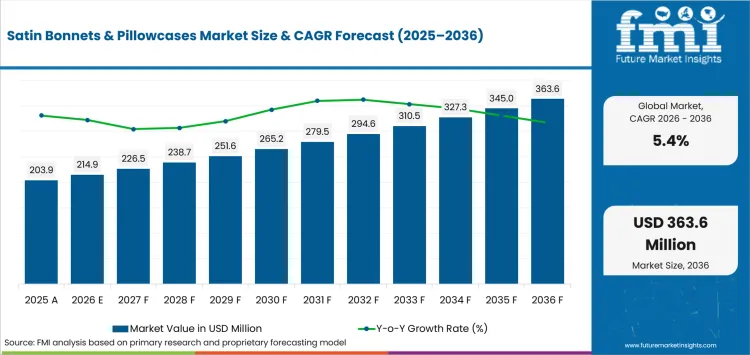
USD 214.9 Million in 2026 and USD 363.6 Million by 2036 at a 5.4% CAGR.
Demand for satin bonnets and pillowcases is projected to expand at 5.4% CAGR between 2026 and 2036, lifting valuation from USD 214.9 million in 2026 to USD 363.6 million by 2036. Nighttime hair protection is the core valuation bridge. The American Academy of Dermatology Association noted in June 2022 that curly and coily hair is more prone to dryness and breakage. Its sleep-care guidance recommends routines that reduce friction against the pillowcase. That mechanism gives satin bonnets and pillowcases a clear consumer job: preserve styles while reducing rubbing during sleep. Digital retail also makes this low-ticket accessory easy to compare and reorder. The USA Census Bureau reported in August 2026 that e-commerce accounted for 17.1% of USA retail sales in the second quarter. For suppliers, conversion depends less on category awareness than on credible material descriptions and secure fit. Care durability and a proportionate price then determine whether first use becomes repeat demand.
Country conditions change the route to purchase. USA demand benefits from a mature online channel, yet textile claims must sit beside clear fibre and origin disclosures. In the UK, the Office for National Statistics reported that online sales represented 29.4% of retail sales in June 2026. Brazil adds a stronger compliance gate because Inmetro requires permanent textile labelling that identifies fibre composition. France brings circularity scrutiny to household textiles through its extended producer responsibility framework. These differences shape merchandising, packaging and channel economics rather than changing the product's basic function. Interest converts into revenue when the buyer can verify what the satin is made from, judge fit for the intended hairstyle and understand how the item will perform after repeated washing.
Key Takeaways
- The category converts nighttime friction reduction into a beauty-care purchase, with textured-hair routines, secure fit and repeatable fabric feel driving everyday use.
- Everyday essentials hold a 41.0% share in 2026 because the segment matches habitual nightly use and low-friction replacement purchasing.
- Standard accounts for a 44.0% share in 2026 because familiar satin construction supports accessible pricing and straightforward care expectations.
- Single tools represent a 44.0% share in 2026 because they support trial, replacement and targeted fit without the added cost of a multi-item purchase.
- Mid-range holds a 43.0% share in 2026 because it balances accessible purchase economics with room for differentiated construction and presentation.
- E-commerce & DTC accounts for a 30.0% share in 2026 because product comparison, visual merchandising and low-ticket fulfilment align with the category.
- Low entry barriers intensify price comparison, while better sizing, durable construction and clear fiber labeling give specialist brands room to defend mid-range value.
- Direct satin-accessory brands include Kitsch, Grace Eleyae, YANIBEST, KISS Colors & Care, Cantu Beauty, Firstline Brands (Evolve), Annie International, and Bonnet Queen.
Analyst Perspective
“This category is easy to copy visually and harder to execute consistently. Repeat purchase comes from fit, seam quality, fabric feel and care performance, especially for braids, locs and high-volume styles where a generic bonnet can fail quickly.”
- Rahul Pandita, Principal Consultant, Future Market Insights
How is the Satin Bonnets & Pillowcases Market segmented?
The market is segmented by Product Type, Nature, Offering, Price Tier, and Sales Channel.
Product Type separates routine nighttime items from specialist and pro-grade formats. Nature distinguishes standard satin from eco and premium propositions. Offering captures whether the buyer purchases one tool, a set or a replacement format. Price Tier reflects how materials, construction and presentation translate into willingness to pay. Sales Channel distinguishes direct digital discovery from specialty beauty retail, mass retail and salon-led purchase paths. These axes matter because a bonnet or pillowcase can solve the same functional problem while carrying very different fit, material and channel economics.
Why does Standard lead the Nature category?
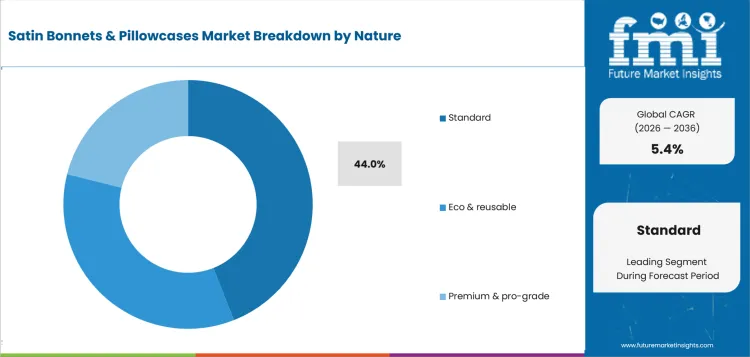
Standard offerings lead when buyers want the satin function without the cost or education burden associated with premium materials. Conventional synthetic satin can deliver a smooth sleep surface, familiar machine-care routines and predictable colour or print options. That creates a broad middle ground between inexpensive commodity goods and premium alternatives such as pure silk. The commercial test is consistency. Buyers need the labelled fibre composition to match the product description, while seams, elastic and closures must withstand repeated use. Brands that keep the construction understandable can sell on performance cues such as smoothness, fit and care rather than asking the customer to interpret complex textile claims. Premium construction borrows expectations from professional hair channels where moisture, finish and styling longevity matter.
- Standard accounts for a 44.0% share in 2026 because familiar satin construction supports accessible pricing and straightforward care expectations.
- Kiss Products stated in June 2026 that its crepe satin reversible bonnet uses two densities of silky polyester, providing a dated example of standard synthetic satin being engineered around feel, breathability and hold.
Why do Everyday essentials lead the Product Type category?
Everyday essentials fit the category's most repeatable use case: a low-complexity item that enters the bedtime routine with little instruction. A standard bonnet or pillowcase can be used nightly and replaced without changing the wider hair-care regimen. This matters for curly, coily and protective styles because the purchase sits between styling sessions rather than competing with them. The American Academy of Dermatology Association's June 2022 guidance links sleep routines to lower friction against the pillowcase. Commercially, that favors products that communicate a simple protective function, feel comfortable for long wear and require little adjustment after purchase. Everyday bonnet use is increasingly embedded in broader hair care routines rather than treated as an occasional accessory.
- Everyday essentials hold a 41.0% share in 2026 because the segment matches habitual nightly use and low-friction replacement purchasing.
- In June 2026, Kiss Products listed a super-jumbo crepe satin bonnet for long and thick natural hairstyles. The format shows how an everyday item can add fit-specific detail without leaving the routine-use category.
Why do Single tools lead the Offering category?
Single tools lower the commitment required to enter the category. A buyer can try one bonnet for a protective style or one pillowcase for a preferred sleeping setup before deciding whether a second item is useful. This also suits replacement behaviour because elastic fatigue, changes in hairstyle or washing frequency may create a need for one component rather than a full set. Single-item merchandising is especially effective online because size, closure and print can be shown in a compact product page. Bundles can raise basket value later, but the initial conversion remains easier when the buyer does not need to justify several related accessories at once. Single-item and kit merchandising also connect with hair styling purchases made to preserve a finished look overnight.
- Single tools represent a 44.0% share in 2026 because they support trial, replacement and targeted fit without the added cost of a multi-item purchase.
- In October 2023, Kitsch launched limited-edition Harry Potter satin pillowcases as individual products alongside a collector bundle, illustrating how single units can remain the core entry point even when sets are offered.
Why does Mid-range lead the Price Tier category?
Mid-range positioning works when the customer wants a visible step up from generic marketplace goods but does not want to pay for luxury silk. The value proposition is therefore built around construction and experience: a secure closure, a wider or softer band, a distinctive print and a fabric description that can be checked. This price tier also leaves room for licensed aesthetics without requiring a fundamentally different use case. The risk is that design alone cannot sustain repeat purchase if the product slips, snags or loses feel after washing. Mid-range suppliers need enough quality control to make the premium over economy goods understandable at first use. Pillowcase pricing is influenced by the adjacent pillow market where textile feel and durability are easy for shoppers to compare.
- Mid-range holds a 43.0% share in 2026 because it balances accessible purchase economics with room for differentiated construction and presentation.
- Kitsch announced a Lisa Frank collaboration in November 2025 that included satin pillowcases, showing how licensed design can refresh the middle of the market without changing the core nighttime function.
Why do E-commerce & DTC lead the Sales Channel category?
Digital channels fit the category because the purchase decision is highly visual and specification-led. Consumers can compare print and pillow size on the same product page. They can also assess bonnet volume, band construction and fibre claims without professional fitting. Reviews and product images also reduce uncertainty around slippage and hairstyle capacity. The channel is not frictionless, however. Textile descriptions must be accurate and return economics can deteriorate when fit is unclear. USA and UK retail data show why brands keep investing in digital discovery. The channel works best when merchandising converts product details into an immediately understandable use case rather than relying on generic beauty claims. E-commerce bundles can place satin pillowcases inside wider home bedding assortments, expanding discovery beyond beauty-only channels.
- E-commerce & DTC accounts for a 30.0% share in 2026 because product comparison, visual merchandising and low-ticket fulfilment align with the category.
- The USA Census Bureau reported in August 2026 that e-commerce represented 17.1% of second-quarter retail sales, while the UK Office for National Statistics reported a 29.4% online share in June 2026.
What are the drivers, restraints and opportunities in the Satin Bonnets & Pillowcases Market?
Nighttime hair-protection routines support demand, while material and fit inconsistency restrains repeat purchase, and specialist fit plus durable design creates the clearest opening.
- Driver: Normalized nighttime routines for reducing friction, preserving styles and limiting moisture loss support recurring consumer use.
- Restraint: Commodity pricing, ambiguous fibre descriptions and poor fit can undermine trust and raise return or replacement dissatisfaction.
- Opportunity: Hairstyle-specific sizing, more durable construction and credible material claims can move buyers beyond generic one-size products.
Consumers adopt the category when hair-care routines create a reason to protect a style between wash or styling sessions. The American Academy of Dermatology Association stated in June 2022 that curly and coily hair is more prone to dryness and breakage. Its sleep guidance focuses on reducing friction against the pillowcase. A satin bonnet or pillowcase therefore converts a broad hair concern into a simple nightly action. This mechanism is most pronounced when the accessory complements an existing routine rather than asking the consumer to replace other products. Suppliers benefit when they present the item as a maintenance tool with a clear use condition and realistic performance claim.
The main restraint appears at comparison and repeat purchase. Products marketed as satin can use different fibre compositions, so consumers can encounter materially different goods under similar language. In the USA, the Federal Trade Commission requires covered textile products to disclose fibre content, country of origin and the responsible marketer. That rule illustrates why vague material language is commercially risky. Fit adds a second friction because a bonnet that slips or compresses a protective style can fail even if the fabric feels smooth. Brands must therefore control labelling, construction and sizing before promotional claims can translate into durable repeat demand.
The opportunity is to design around use cases that generic listings handle poorly. Long braids, locs, dense curls and large protective styles require more capacity than a standard cap. Household-textile circularity also raises the value of durable materials and credible care guidance. ADEME's 2026 publication on France's 2024 clothing, household-linen and footwear stream shows the scale of policy attention around textile placement, collection and treatment. Suppliers that can combine fit-specific architecture with long-wear construction are better placed to defend price and reduce replacement dissatisfaction. The opening is practical: make sizing explicit, make fibre claims verifiable and make the product last through routine washing.
Which country CAGRs are profiled in the Satin Bonnets & Pillowcases Market?
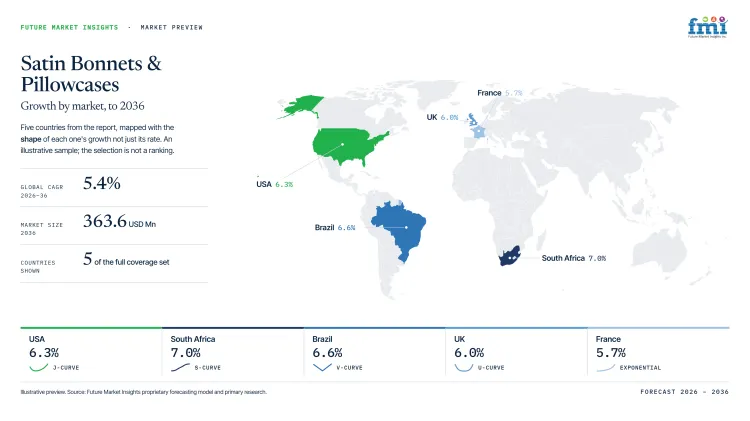
| Country | CAGR (2026-2036) |
|---|---|
| USA | 6.3% |
| UK | 6.0% |
| Brazil | 6.6% |
| France | 5.7% |
| South Africa | 7.0% |
| Canada | 5.4% |
How do country-level CAGRs compare in the Satin Bonnets & Pillowcases Market?
The six profiled countries span a 1.6 percentage-point CAGR range from 2026 to 2036. South Africa at 7.0% and Brazil at 6.6% form the upper-growth band. USA at 6.3% and UK at 6.0% occupy the middle, where established digital retail supports broad product discovery. France at 5.7% and Canada at 5.4% form the lower band. These rates describe forecast pace, not absolute country size. The commercial distinction lies in how quickly suppliers can build compliant assortments, localize fit and material messaging, and support the channel economics required in each market.
- Consumers can discover satin sleep accessories through DTC sites, marketplaces and beauty retailers, which makes specification quality central to conversion. In USA, that operating setting accompanies a 6.3% CAGR through 2036.
- A 6.0% CAGR places UK within the profiled set, but purchasing hinges on a specific condition: Online retail gives consumers a mature route to compare beauty-sleep accessories without relying on salon recommendation.
- Brazil's 6.6% outlook is shaped by execution conditions. Purchase economics combine strong textured-hair relevance with a more explicit product-labelling gate for textiles.
- For France, the forecast reaches 5.7% CAGR. Household-linen purchasing is increasingly framed by broader textile circularity and producer-responsibility expectations.
- Hair-accessory demand can develop quickly, but imported textile products face clear consumer-protection labelling duties. That gives South Africa a distinct Satin Bonnets & Pillowcases path within its 7.0% CAGR forecast.
- Canada carries a 5.4% CAGR through 2036, with conversion tied to this market reality: Buyers have broad access to beauty and household-textile channels, but imported consumer textiles must satisfy federal disclosure requirements.
CAGR alone cannot determine country priority because a higher rate may start from a smaller base or carry higher route-to-market costs. Supplier economics also depend on assortment breadth, import treatment, digital customer acquisition and returns. The full report therefore evaluates growth pace together with local buyer behaviour and the broader regional coverage rather than using the profiled CAGR table as a market-size ranking.
Country-wise Analysis
- USA: Consumers can discover satin sleep accessories through DTC sites, marketplaces and beauty retailers, which makes specification quality central to conversion. For USA, the Satin Bonnets & Pillowcases market is projected to advance at 6.3% CAGR through 2036. The USA Census Bureau reported in August 2026 that e-commerce represented 17.1% of second-quarter retail sales. A practical constraint is not access but differentiation because similar-looking goods can vary in fibre, fit and finish. Providers need accurate textile disclosures, clear size information and stronger construction proof to justify repeat purchase in a highly comparable online environment.
- UK: Online retail gives consumers a mature route to compare beauty-sleep accessories without relying on salon recommendation. Satin Bonnets & Pillowcases sales in UK are expected to grow at 6.0% CAGR over 2026 to 2036. The Office for National Statistics reported in July 2026 that online sales reached 29.4% of retail sales in June. Heavy digital comparison can compress perceived differentiation and expose weak fit descriptions through returns. Competitive suppliers need local fulfilment, concise material disclosure and product pages that explain bonnet capacity or pillow dimensions before the buyer reaches checkout.
- Brazil: Purchase economics combine strong textured-hair relevance with a more explicit product-labelling gate for textiles. A 6.6% CAGR is projected for Satin Bonnets & Pillowcases in Brazil between 2026 and 2036. Inmetro's Portaria No. 118 of March 2021 implemented Mercosur textile-labelling rules and requires permanent fibre information for covered products. Importers therefore face a compliance task before design and influencer activity can translate into scale. Market entrants need Portuguese-language labels, verifiable fibre composition and price ladders that work through local distributors as well as digital channels.
- France: Household-linen purchasing is increasingly framed by broader textile circularity and producer-responsibility expectations. Through 2036, the market for Satin Bonnets & Pillowcases in France is set to register a 5.7% CAGR. ADEME published 2024 data for clothing, household linen and footwear in May 2026 and documented a large national textile stream subject to collection and treatment policy. The central purchase barrier is proving durability and material claims without overpricing a small accessory. Suppliers can respond with traceable fibre descriptions, care guidance and construction that supports longer use rather than disposable positioning.
- South Africa: Hair-accessory demand can develop quickly, but imported textile products face clear consumer-protection labelling duties. Growth in Satin Bonnets & Pillowcases across South Africa is projected at 7.0% CAGR from 2026 to 2036. SAnews reported in May 2021 that the National Consumer Commission required imported textiles to carry permanent country-of-origin, care and fibre information. Non-compliant consignments can create direct cost through return or destruction. Qualified suppliers need compliant packaging, value-focused assortment planning and bonnet sizes that address braids, locs and high-volume natural styles without forcing premium pricing.
- Canada: Buyers have broad access to beauty and household-textile channels, but imported consumer textiles must satisfy federal disclosure requirements. The ten-year forecast for Satin Bonnets & Pillowcases in Canada reaches 5.4% CAGR. Competition Bureau Canada updated its detailed textile-labelling guidance in May 2024 and distinguishes representation labels from required disclosure labels for fibre information. The harder operating issue is balancing compliance with a compact low-ticket package. Local partners need precise fibre and dealer information, clear care instructions and disciplined assortment depth so compliance cost does not overwhelm item economics.
Who are the notable companies in the Satin Bonnets & Pillowcases Market?
Kitsch, Grace Eleyae, YANIBEST, KISS Colors & Care, Cantu Beauty, Firstline Brands (Evolve), Annie International, and Bonnet Queen.
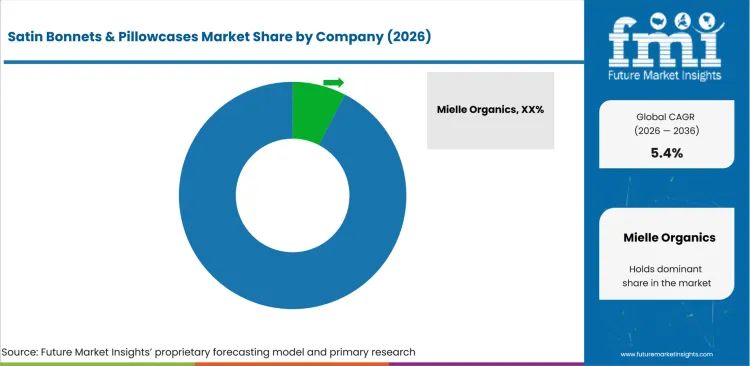
Direct competition is concentrated among brands that sell satin sleep accessories rather than adjacent beauty tools. Kitsch spans satin pillowcases and bonnet-led sleep accessories; Grace Eleyae is built around satin-lined protective headwear; YANIBEST and Bonnet Queen compete through bonnet fit and construction; KISS Colors & Care, Cantu Beauty, Firstline Brands and Annie International bring broader hair-accessory retail reach. The rest of the field is shaped by specialist bonnet construction, fabric and fit choices, and broader beauty-accessory distribution.
- Design-led sleep accessories: Kitsch and Grace Eleyae connect hair protection with visible design, premium construction and DTC merchandising.
- Specialist bonnet brands: YANIBEST and Bonnet Queen emphasize adjustable, reversible or size-led bonnet propositions.
- Mass beauty-accessory routes: KISS Colors & Care, Cantu Beauty, Firstline Brands and Annie International provide broader beauty retail or supply-channel access.
Competitive Benchmarking: Satin Bonnets & Pillowcases Market
| Brand / Company | Direct Category Position | Core Format | Consumer Proposition | Channel Footprint |
|---|---|---|---|---|
| Kitsch | Direct satin sleep-accessories brand | Satin bonnets and pillowcases | Design-led hair-friction protection | DTC, beauty retail and international |
| Grace Eleyae | Satin-lined hair-protection specialist | Satin-lined caps and bonnets | Secure-fit overnight protection | DTC and international e-commerce |
| YANIBEST | Satin sleep-accessory specialist | Adjustable and double-layer bonnets | Fit and anti-friction positioning | DTC and global online channels |
| KISS Colors & Care | Mass beauty-accessory brand | Satin bonnet caps | Value and broad retail access | US beauty retail and e-commerce |
| Cantu Beauty | Textured-hair brand with sleep accessory | Satin sleep cap and tie bonnet | Curl and edge protection | Broad beauty retail |
| Firstline Brands (Evolve) | Hair-accessory portfolio | Reversible and adjustable satin bonnets | Assortment breadth and fit | Professional and retail beauty channels |
| Annie International | Hair-accessory supplier | Satin bonnets and sleep caps | Size breadth and value | Beauty-supply and retail channels |
| Bonnet Queen | Specialist DTC bonnet brand | Adjustable and reversible satin bonnets | Fit variety and specialist styling | DTC |
The comparison concentrates on direct satin-product presence, format breadth, fit or protection proposition, and the retail routes through which consumers can repurchase the item.
Key Developments in the Satin Bonnets & Pillowcases Market
- In November 2025, Kitsch announced a Lisa Frank collaboration that included satin pillowcases in multiple nostalgic prints. The collaboration extended licensed aesthetics into a functional sleep accessory and created a reason to refresh the assortment without redesigning the core product architecture. For suppliers, the development shows how controlled-edition design can support gifting and repeat browsing. Long-term repurchase still depends on fit, feel and durability.
- In June 2026, Kiss Products listed a reversible super-jumbo crepe satin bonnet made with two densities of silky polyester. The format was designed for long, thick and natural hairstyles and added a wider edge plus softer stretch. The development is commercially relevant because it addresses a specific failure point in one-size products: insufficient volume or uncomfortable hold for braids, locs and dense protective styles.
Key Players in the Satin Bonnets & Pillowcases Market
Design-Led Sleep Accessories
- Kitsch
- Grace Eleyae
Specialist Bonnet Brands
- YANIBEST
- Bonnet Queen
Beauty-Accessory Distribution
- KISS Colors & Care
- Cantu Beauty
- Firstline Brands (Evolve)
- Annie International
Satin Bonnets & Pillowcases Market - Report Scope
| Coverage field | Report scope |
|---|---|
| Market breakdown | Product Type, Nature, Offering, Price Tier, Sales Channel |
| Quantitative Units | USD Million |
| Market Definition | Revenue includes consumer satin bonnets and satin pillowcases sold within the stated segmentation universe, including attributable value from sets or kits that contain these named items. It excludes silk-only products, non-satin bedding, hair-care formulations and unrelated beauty accessories. |
| Regions Covered | North America; Latin America; Western Europe; Eastern Europe; East Asia; South Asia and Pacific; Middle East and Africa |
| Countries Covered | USA, UK, Brazil, France, South Africa, Canada, and more than twenty-five additional countries in the full report |
| Key Companies Profiled | Kitsch; Grace Eleyae; YANIBEST; KISS Colors & Care; Cantu Beauty; Firstline Brands (Evolve); Annie International; Bonnet Queen |
| Forecast Period | 2026 to 2036 |
| Approach | Hybrid bottom-up and top-down sizing reconciles product, channel and country inputs to the defined revenue boundary while excluding adjacent categories and duplicate value. |
Satin Bonnets & Pillowcases Market - Research Methodology
| Method | Approach |
|---|---|
| Primary Research | Primary research examines perspectives from manufacturers and brand owners as well as distributors, retailers, salons and end users. The work tests product definitions, purchase criteria, channel behaviour, fit requirements and replacement patterns. |
| Desk Research | Desk research reviews government statistics, textile-labelling rules, regulator guidance and company product materials. It also evaluates dated corporate or retail developments available through August 18, 2026. |
| Market Sizing and Forecasting | Market sizing uses a hybrid bottom-up and top-down approach that reconciles product scope, channel structure, country conditions and adoption mechanisms. Forecast assumptions consider replacement behaviour, digital access, product differentiation, compliance friction and price-tier mix without assigning undisclosed model weights. |
| Data Validation | Validation cross-checks definitions, dates, country evidence and company roles against the market boundary. Duplicate value is removed, silk-only pillowcases and unrelated beauty accessories are excluded, and unsupported claims are not carried into the final market view. |
Satin Bonnets & Pillowcases Market by Segments
Satin Bonnets & Pillowcases Market segmented by Product Type:
- Everyday essentials
- Specialist tools
- Pro-grade & premium
Satin Bonnets & Pillowcases Market segmented by Nature:
- Standard
- Eco & reusable
- Premium & pro-grade
Satin Bonnets & Pillowcases Market segmented by Offering:
- Single tools
- Sets & kits
- Refills & replacements
Satin Bonnets & Pillowcases Market segmented by Price Tier:
- Mid-range
- Economy
- Premium
Satin Bonnets & Pillowcases Market segmented by Sales Channel:
- E-commerce & DTC
- Specialty beauty retail
- Mass retail
- Salons
Satin Bonnets & Pillowcases Market by Region:
- North America
- United States
- Canada
- Latin America
- Brazil
- Mexico
- Argentina
- Chile
- Western Europe
- Germany
- France
- United Kingdom
- Italy
- Spain
- Benelux
- Nordics
- Eastern Europe
- Poland
- Czech Republic
- Romania
- Hungary
- East Asia
- China
- Japan
- South Korea
- South Asia and Pacific
- India
- ASEAN
- Australia and New Zealand
- Middle East and Africa
- GCC Countries
- South Africa
- Türkiye
- Israel
Research Sources and Bibliography
- American Academy of Dermatology Association (2022, June 29). 6 curly hair care tips from dermatologists.
- Federal Trade Commission (2014, July 2). Threading Your Way Through the Labeling Requirements Under the Textile and Wool Acts.
- USA Census Bureau (2026, August 18). Quarterly Retail E-Commerce Sales Report.
- Office for National Statistics (2026, July 24). Retail sales, Great Britain: June 2026.
- Instituto Nacional de Metrologia, Qualidade e Tecnologia (2021, March 11). Portaria Inmetro No. 118 and textile-labelling requirements.
- ADEME (2026, May 5). Textiles d'habillement, linge de maison et chaussures: données 2024.
- SAnews (2021, May 24). Ensuring importers comply with Consumer Protection Act.
- Competition Bureau Canada (2024, May 1). Detailed requirements for Textile labelling requirements.
- KISS USA (2026, June 5). Kiss Colors & Care Crepe Satin Reversible Hair Bonnet.
- Real Simple (2023, October 31). Kitsch Just Dropped Satin 'Harry Potter' Pillowcases, and They're Already On Sale.
- Kitsch (2025, November 13). Lisa Frank x Kitsch collaboration announcement.
- Kitsch. (2026). Satin Bonnets and Satin Pillowcases.
- Grace Eleyae. (2026). The Slap Satin-Lined Cap.
- YANIBEST. (2026). Premium Satin Bonnet Collection.
- KISS Colors & Care. (2026). Satin Bonnet Cap.
- Cantu Beauty. (2026). Satin Sleep Cap Tie Bonnet.
- Firstline Brands. (2026). Evolve Satin Bonnets.
- Annie International. (2026). Bonnets and Sleep Caps.
- Bonnet Queen. (2026). Premium Satin Bonnets.
This Report Answers
- How is demand for the Satin Bonnets & Pillowcases Market expected to evolve through 2036?
- What hair-care and retail pressures support demand for satin bonnets & pillowcases?
- Why do Everyday essentials hold the leading position within Product Type?
- How does Standard within Nature influence purchasing and downstream replacement demand?
- Why do Single tools hold the leading position within Offering?
- How do growth rates compare across USA, UK, Brazil, France, South Africa, and Canada?
- Which companies specialize in satin sleep accessories and which serve buyers through broader beauty portfolios?
- What material, fit and labelling frictions limit adoption or repeat purchase?
- What should beauty and retail decision-makers evaluate before purchasing or listing satin bonnets & pillowcases?
Frequently Asked Questions
What is driving growth in the Satin Bonnets & Pillowcases Market?
Growth is supported by nighttime hair-protection routines that make friction reduction and style preservation part of regular beauty care. Digital retail broadens discovery, while fit-specific designs give consumers more reasons to replace generic bonnets or standard pillowcases.
Who are the key players in the Satin Bonnets & Pillowcases Market?
Key players include Kitsch, Grace Eleyae, YANIBEST, KISS Colors & Care, Cantu Beauty, Firstline Brands (Evolve), Annie International and Bonnet Queen. They differ most clearly in fit engineering, assortment breadth, design, price point and beauty-channel access.
What notable restraint affects the Satin Bonnets & Pillowcases Market?
The main restraint is inconsistent material and fit quality across products that can look interchangeable online. Ambiguous fibre descriptions, weak elastic or closure construction and poor hairstyle capacity can increase returns and reduce repeat purchase even when category awareness is high.
Why should executives track the Satin Bonnets & Pillowcases Market?
The category links a low-ticket textile accessory to recurring hair-care behaviour and digital beauty merchandising. Executives should track whether suppliers can defend differentiation through material transparency, specialist fit and reliable construction rather than relying on design novelty alone.
What business problem does the Satin Bonnets & Pillowcases Market address?
The market addresses friction and moisture-management concerns that arise while consumers sleep with styled, curly or coily hair. Bonnets and pillowcases offer a passive overnight layer that can help preserve styles without adding another active hair-care formulation.
What should beauty and retail decision-makers evaluate in the Satin Bonnets & Pillowcases Market?
Decision-makers should evaluate fibre disclosure, seam quality and closure or band design. They should also assess bonnet capacity, pillow dimensions and care durability while testing whether packaging can reduce returns across DTC and store-based channels.
What limits return on investment in the Satin Bonnets & Pillowcases Market?
Return on investment weakens when customer-acquisition cost, fulfilment and returns consume the margin on a low-ticket item. It also suffers when poor durability shortens brand loyalty, forcing suppliers to reacquire customers instead of benefiting from trusted replacement demand.
What supports long-term commercial confidence in the Satin Bonnets & Pillowcases Market?
Long-term confidence comes from a durable use mechanism rather than a single trend: consumers continue to manage friction, moisture and style preservation overnight. The forecast rises from USD 214.9 Million in 2026 to USD 363.6 Million by 2036 at 5.4% CAGR.
Preview the report firsthand - request a free sample
Get SampleGet the brochure for pricing and purchase details.
Get PDFTable of Content
- Key Takeaways
- Market Size and CAGR
- Top Growth Driver
- Fastest Growing Segment
- Leading Region
- Key Companies
- Emerging Opportunities
- Executive Summary
- Global Market Outlook
- Demand-side Trends
- Supply-side Trends
- Technology Roadmap Analysis
- Analysis and Recommendations
- Analyst Perspective (What is happening? Why now? What should investors know?)
- Key Questions Answered
- How large is the market?
- What is the CAGR?
- What are key trends?
- Which region dominates?
- Who are the leaders?
- Market Overview
- Market Coverage / Taxonomy
- Market Definition / Scope / Limitations
- Research Methodology
- Chapter Orientation
- Analytical Lens and Working Hypotheses
- Market Structure, Signals, and Trend Drivers
- Benchmarking and Cross-market Comparability
- Market Sizing, Forecasting, and Opportunity Mapping
- Research Design and Evidence Framework
- Desk Research Programme (Secondary Evidence)
- Expert Input and Fieldwork (Primary Evidence)
- Tooling, Models, and Reference Databases
- Data Engineering and Model Build
- Quality Assurance and Audit Trail
- Market Background
- Market Dynamics (Drivers, Restraints, Opportunity, Trends)
- Scenario Forecast (Optimistic, Likely, Conservative)
- Impact Analysis
- AI Impact
- Sustainability Impact
- Regulatory Impact
- Technology Impact
- Consumer / Buyer Analysis
- Purchase Drivers
- Adoption Barriers
- Buyer Journey
- Opportunity Map Analysis
- Product Life Cycle Analysis
- Supply Chain Analysis
- Investment Feasibility Matrix
- Value Chain Analysis
- PESTLE and Porter's Analysis
- Regulatory Landscape
- Regional Parent Market Outlook
- Production and Consumption Statistics
- Import and Export Statistics
- Global Market Analysis and Forecast, 2021 to 2036
- Historical Market Size Value (USD Million) Analysis, 2021 to 2025
- Current and Future Market Size Value (USD Million) Projections, 2026 to 2036
- Y-o-Y Growth Trend Analysis
- Absolute $ Opportunity Analysis
- Global Market Pricing Analysis, 2021 to 2036
- Global Market Analysis and Forecast, By Product Type, 2021 to 2036
- Introduction / Key Findings
- Historical Market Size Value (USD Million) Analysis By Product Type, 2021 to 2025
- Current and Future Market Size Value (USD Million) Analysis and Forecast By Product Type, 2026 to 2036
- Everyday essentials
- Specialist tools
- Pro-grade & premium
- Everyday essentials
- Y-o-Y Growth Trend Analysis By Product Type, 2021 to 2025
- Absolute $ Opportunity Analysis By Product Type, 2026 to 2036
- Global Market Analysis and Forecast, By Nature, 2021 to 2036
- Introduction / Key Findings
- Historical Market Size Value (USD Million) Analysis By Nature, 2021 to 2025
- Current and Future Market Size Value (USD Million) Analysis and Forecast By Nature, 2026 to 2036
- Standard
- Eco & reusable
- Premium & pro-grade
- Standard
- Y-o-Y Growth Trend Analysis By Nature, 2021 to 2025
- Absolute $ Opportunity Analysis By Nature, 2026 to 2036
- Global Market Analysis and Forecast, By Offering, 2021 to 2036
- Introduction / Key Findings
- Historical Market Size Value (USD Million) Analysis By Offering, 2021 to 2025
- Current and Future Market Size Value (USD Million) Analysis and Forecast By Offering, 2026 to 2036
- Single tools
- Sets & kits
- Refills & replacements
- Single tools
- Y-o-Y Growth Trend Analysis By Offering, 2021 to 2025
- Absolute $ Opportunity Analysis By Offering, 2026 to 2036
- Global Market Analysis and Forecast, By Price Tier, 2021 to 2036
- Introduction / Key Findings
- Historical Market Size Value (USD Million) Analysis By Price Tier, 2021 to 2025
- Current and Future Market Size Value (USD Million) Analysis and Forecast By Price Tier, 2026 to 2036
- Mid-range
- Economy
- Premium
- Mid-range
- Y-o-Y Growth Trend Analysis By Price Tier, 2021 to 2025
- Absolute $ Opportunity Analysis By Price Tier, 2026 to 2036
- Global Market Analysis and Forecast, By Sales Channel, 2021 to 2036
- Introduction / Key Findings
- Historical Market Size Value (USD Million) Analysis By Sales Channel, 2021 to 2025
- Current and Future Market Size Value (USD Million) Analysis and Forecast By Sales Channel, 2026 to 2036
- E-commerce & DTC
- Specialty beauty retail
- Mass retail
- Salons
- E-commerce & DTC
- Y-o-Y Growth Trend Analysis By Sales Channel, 2021 to 2025
- Absolute $ Opportunity Analysis By Sales Channel, 2026 to 2036
- Global Market Analysis and Forecast, By Region, 2021 to 2036
- Introduction
- Historical Market Size Value (USD Million) Analysis By Region, 2021 to 2025
- Current Market Size Value (USD Million) Analysis and Forecast By Region, 2026 to 2036
- North America
- Latin America
- Western Europe
- Eastern Europe
- East Asia
- South Asia and Pacific
- Middle East & Africa
- Market Attractiveness Analysis By Region
- North America Market Analysis and Forecast, By Country, 2021 to 2036
- Historical Market Size Value (USD Million) Trend Analysis By Market Taxonomy, 2021 to 2025
- Market Size Value (USD Million) Forecast By Market Taxonomy, 2026 to 2036
- By Country
- USA
- Canada
- By Product Type
- By Nature
- By Offering
- By Price Tier
- By Sales Channel
- By Country
- Market Attractiveness Analysis
- By Country
- By Product Type
- By Nature
- By Offering
- By Price Tier
- By Sales Channel
- Key Takeaways
- Latin America Market Analysis and Forecast, By Country
- Historical Market Size Value (USD Million) Trend Analysis By Market Taxonomy, 2021 to 2025
- Market Size Value (USD Million) Forecast By Market Taxonomy, 2026 to 2036
- By Country
- Brazil
- Mexico
- Chile
- Rest of Latin America
- By Product Type
- By Nature
- By Offering
- By Price Tier
- By Sales Channel
- By Country
- Market Attractiveness Analysis
- By Country
- By Product Type
- By Nature
- By Offering
- By Price Tier
- By Sales Channel
- Key Takeaways
- Western Europe Market Analysis and Forecast, By Country
- Historical Market Size Value (USD Million) Trend Analysis By Market Taxonomy, 2021 to 2025
- Market Size Value (USD Million) Forecast By Market Taxonomy, 2026 to 2036
- By Country
- Germany
- UK
- Italy
- Spain
- France
- Nordic
- BENELUX
- Rest of Western Europe
- By Product Type
- By Nature
- By Offering
- By Price Tier
- By Sales Channel
- By Country
- Market Attractiveness Analysis
- By Country
- By Product Type
- By Nature
- By Offering
- By Price Tier
- By Sales Channel
- Key Takeaways
- Eastern Europe Market Analysis and Forecast, By Country
- Historical Market Size Value (USD Million) Trend Analysis By Market Taxonomy, 2021 to 2025
- Market Size Value (USD Million) Forecast By Market Taxonomy, 2026 to 2036
- By Country
- Russia
- Poland
- Hungary
- Balkan & Baltic
- Rest of Eastern Europe
- By Product Type
- By Nature
- By Offering
- By Price Tier
- By Sales Channel
- By Country
- Market Attractiveness Analysis
- By Country
- By Product Type
- By Nature
- By Offering
- By Price Tier
- By Sales Channel
- Key Takeaways
- East Asia Market Analysis and Forecast, By Country
- Historical Market Size Value (USD Million) Trend Analysis By Market Taxonomy, 2021 to 2025
- Market Size Value (USD Million) Forecast By Market Taxonomy, 2026 to 2036
- By Country
- China
- Japan
- South Korea
- By Product Type
- By Nature
- By Offering
- By Price Tier
- By Sales Channel
- By Country
- Market Attractiveness Analysis
- By Country
- By Product Type
- By Nature
- By Offering
- By Price Tier
- By Sales Channel
- Key Takeaways
- South Asia and Pacific Market Analysis and Forecast, By Country
- Historical Market Size Value (USD Million) Trend Analysis By Market Taxonomy, 2021 to 2025
- Market Size Value (USD Million) Forecast By Market Taxonomy, 2026 to 2036
- By Country
- India
- ASEAN
- Australia & New Zealand
- Rest of South Asia and Pacific
- By Product Type
- By Nature
- By Offering
- By Price Tier
- By Sales Channel
- By Country
- Market Attractiveness Analysis
- By Country
- By Product Type
- By Nature
- By Offering
- By Price Tier
- By Sales Channel
- Key Takeaways
- Middle East & Africa Market Analysis and Forecast, By Country
- Historical Market Size Value (USD Million) Trend Analysis By Market Taxonomy, 2021 to 2025
- Market Size Value (USD Million) Forecast By Market Taxonomy, 2026 to 2036
- By Country
- Kingdom of Saudi Arabia
- Other GCC Countries
- Türkiye
- South Africa
- Other African Union
- Rest of Middle East & Africa
- By Product Type
- By Nature
- By Offering
- By Price Tier
- By Sales Channel
- By Country
- Market Attractiveness Analysis
- By Country
- By Product Type
- By Nature
- By Offering
- By Price Tier
- By Sales Channel
- Key Takeaways
- Key Countries Market Analysis
- USA
- Pricing Analysis
- Market Share Analysis, 2025
- By Product Type
- By Nature
- By Offering
- By Price Tier
- By Sales Channel
- Canada
- Pricing Analysis
- Market Share Analysis, 2025
- By Product Type
- By Nature
- By Offering
- By Price Tier
- By Sales Channel
- Mexico
- Pricing Analysis
- Market Share Analysis, 2025
- By Product Type
- By Nature
- By Offering
- By Price Tier
- By Sales Channel
- Brazil
- Pricing Analysis
- Market Share Analysis, 2025
- By Product Type
- By Nature
- By Offering
- By Price Tier
- By Sales Channel
- Chile
- Pricing Analysis
- Market Share Analysis, 2025
- By Product Type
- By Nature
- By Offering
- By Price Tier
- By Sales Channel
- Germany
- Pricing Analysis
- Market Share Analysis, 2025
- By Product Type
- By Nature
- By Offering
- By Price Tier
- By Sales Channel
- UK
- Pricing Analysis
- Market Share Analysis, 2025
- By Product Type
- By Nature
- By Offering
- By Price Tier
- By Sales Channel
- Italy
- Pricing Analysis
- Market Share Analysis, 2025
- By Product Type
- By Nature
- By Offering
- By Price Tier
- By Sales Channel
- Spain
- Pricing Analysis
- Market Share Analysis, 2025
- By Product Type
- By Nature
- By Offering
- By Price Tier
- By Sales Channel
- France
- Pricing Analysis
- Market Share Analysis, 2025
- By Product Type
- By Nature
- By Offering
- By Price Tier
- By Sales Channel
- India
- Pricing Analysis
- Market Share Analysis, 2025
- By Product Type
- By Nature
- By Offering
- By Price Tier
- By Sales Channel
- ASEAN
- Pricing Analysis
- Market Share Analysis, 2025
- By Product Type
- By Nature
- By Offering
- By Price Tier
- By Sales Channel
- Australia & New Zealand
- Pricing Analysis
- Market Share Analysis, 2025
- By Product Type
- By Nature
- By Offering
- By Price Tier
- By Sales Channel
- China
- Pricing Analysis
- Market Share Analysis, 2025
- By Product Type
- By Nature
- By Offering
- By Price Tier
- By Sales Channel
- Japan
- Pricing Analysis
- Market Share Analysis, 2025
- By Product Type
- By Nature
- By Offering
- By Price Tier
- By Sales Channel
- South Korea
- Pricing Analysis
- Market Share Analysis, 2025
- By Product Type
- By Nature
- By Offering
- By Price Tier
- By Sales Channel
- Russia
- Pricing Analysis
- Market Share Analysis, 2025
- By Product Type
- By Nature
- By Offering
- By Price Tier
- By Sales Channel
- Poland
- Pricing Analysis
- Market Share Analysis, 2025
- By Product Type
- By Nature
- By Offering
- By Price Tier
- By Sales Channel
- Hungary
- Pricing Analysis
- Market Share Analysis, 2025
- By Product Type
- By Nature
- By Offering
- By Price Tier
- By Sales Channel
- Kingdom of Saudi Arabia
- Pricing Analysis
- Market Share Analysis, 2025
- By Product Type
- By Nature
- By Offering
- By Price Tier
- By Sales Channel
- Türkiye
- Pricing Analysis
- Market Share Analysis, 2025
- By Product Type
- By Nature
- By Offering
- By Price Tier
- By Sales Channel
- South Africa
- Pricing Analysis
- Market Share Analysis, 2025
- By Product Type
- By Nature
- By Offering
- By Price Tier
- By Sales Channel
- USA
- Market Structure Analysis
- Competition Dashboard
- Competition Benchmarking
- Market Share Analysis of Top Players
- By Regional
- By Product Type
- By Nature
- By Offering
- By Price Tier
- By Sales Channel
- Emerging Startups
- Innovation Benchmarking
- Competition Analysis
- Competition Deep Dive
- Mielle Organics
- Overview
- Product Portfolio
- Profitability by Market Segments
- Sales Footprint
- Strategy Overview
- Marketing Strategy
- Product Strategy
- Channel Strategy
- Kitsch
- Camille Rose
- Slip
- Beautyblender
- EcoTools
- Paris Presents
- Sigma Beauty
- Conair
- Kiss Products
- Mielle Organics
- Case Studies
- Success Stories
- Recent Developments
- Competition Deep Dive
- Assumptions & Acronyms Used


