

- Market Size (2026)
- USD 920.7 Mn
- Forecast (2036)
- USD 1572.7 Mn
- CAGR (2026 to 2036)
- 5.5%
How big is Scale Dissolver Chemicals Market in 2026?
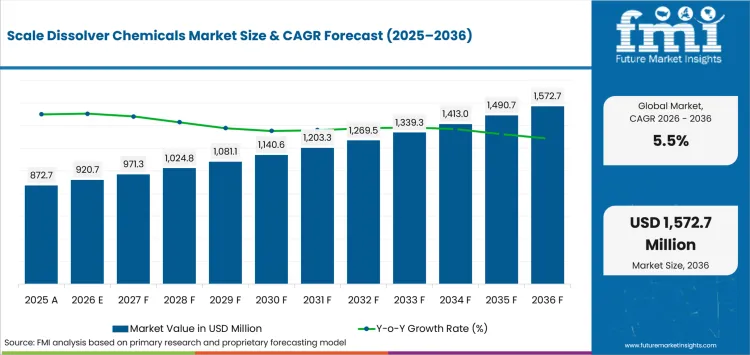
USD 920.7 Million in 2026 and USD 1,572.7 Million by 2036 at a 5.5% CAGR.
Demand for scale dissolver chemicals is projected to expand at 5.5% CAGR between 2026 and 2036, lifting valuation from USD 920.7 million in 2026 to USD 1,572.7 million by 2036. Demand is tied to the cost of restoring flow after mineral deposits narrow tubing or restrict injection. Deposits can also foul equipment or impair the near-wellbore zone. The spending trigger is therefore an operating problem rather than a new-well count alone. Mature assets matter because repeated water handling and pressure changes can expose producing systems to recurring deposition risks. The Norwegian Offshore Directorate reported in August 2026 that 97 fields were operating on the Norwegian shelf at year-end 2025. It also noted that many fields are producing 10 to 30 years longer than originally planned. Longer field lives extend the period in which operators may need chemical cleanup. Buyers respond by screening scale mineralogy and metallurgy. They also test temperature, brine chemistry, and placement method before selecting a dissolver. The purchasing decision is won by chemistry that removes the deposit without creating a larger integrity or formation-damage problem.
Country conditions change how that need converts into orders. Norway combines a mature offshore base with long-producing fields, so qualification quality and offshore service execution carry weight. KSA and the UAE combine large upstream systems with expanding water injection or produced-water reinjection programs. Their buyers favor suppliers that can support field trials and reliable regional supply. Brazil is more intervention-window sensitive because much of its growth is tied to deepwater and pre-salt production. The USA has a much larger and more fragmented well population, which rewards rapid screening and basin-level logistics. Across these markets, technical need is only the first step. Conversion occurs when the dissolver is proven against the actual deposit. The treatment must also fit the operator’s downtime and integrity limits. Environmental and cost constraints still apply.
Key Takeaways
- Spending is tied to production restoration: operators purchase dissolver chemistry when mineral deposits restrict flow and a chemical treatment can recover capacity with less disruption than mechanical intervention.
- HCl-based dissolvers account for 28.0% of the Chemistry segment in 2026, supported by fast reaction with acid-soluble carbonate deposits and established acid-handling workflows.
- Calcium carbonate represents 32.0% of Scale Type in 2026, reflecting its broad occurrence and the availability of established acid and non-acid removal pathways.
- Wellbore descaling holds 29.0% of Application in 2026 because downhole restrictions create a direct production-restoration or injectivity case for chemical removal.
- Mature wells account for 30.0% of Well Type in 2026 because longer productive lives increase the number of operating cycles in which deposited scale can require remediation.
- Production chemical suppliers hold 36.0% of Sales Channel in 2026 because formulation support and field-specific screening are central to product selection.
- Mineral variability, corrosion risk and short intervention windows complicate selection, while mixed-scale and sour-service applications support higher-value testing and field support.
- Production-chemistry and intervention suppliers include SLB, Baker Hughes, Halliburton, Clariant, Innospec, Nouryon, Solvay, BASF, and TETRA Technologies.
Analyst Perspective
“The commercial question is not whether a dissolver reacts with scale, but whether it removes the actual deposit without transferring corrosion, emulsion or compatibility problems elsewhere in the system. Sample-led selection and field support are therefore central to value capture.”
- Nikhil Kaitwade, Principal Consultant, Future Market Insights
How is the Scale Dissolver Chemicals Market segmented?
The market is segmented by Chemistry, Scale Type, Application, Well Type, and Sales Channel.
Chemistry separates strong mineral acids from organic-acid and chelant approaches. It also covers sulfonated and iron-sulfide-specific approaches. Scale Type distinguishes carbonate deposits from harder sulfate scales, iron sulfide, and mixed mineral deposits. Application identifies where the chemical is used, from wellbore descaling through production restoration. Well Type captures the operating context that changes treatment design and risk. Sales Channel distinguishes product-led supply from intervention-led service delivery and direct operator procurement. These axes interact in practice. A buyer does not choose chemistry independently of the deposit or placement method. The winning formulation must match mineralogy first, then survive the field conditions and the operator’s treatment window.
Why does Wellbore descaling lead the Application category?
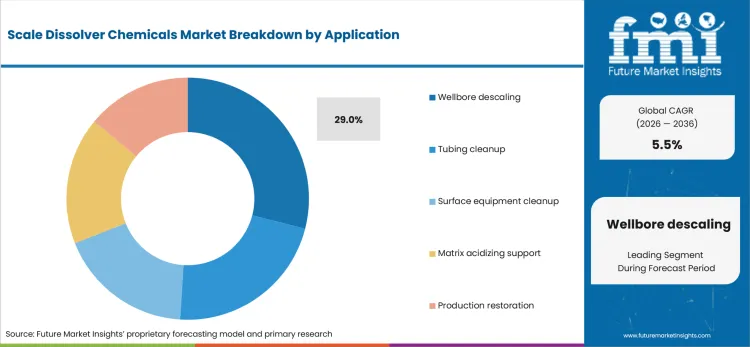
Wellbore descaling leads because a restricted tubing string or near-wellbore interval converts chemical performance directly into production or injection recovery. The buyer can compare the treatment cost with deferred production, workover expense, or a mechanical cleanout. That creates a clearer payback test than routine surface cleaning. Delivery still matters. Placement may use bullheading or coiled tubing. Jobs can also rely on soaking, staged placement, or another intervention method. The formulation must also be recoverable without creating secondary precipitation. Suppliers that combine dissolver selection with placement knowledge can therefore capture more value than suppliers that sell chemistry alone, especially in mature wells where access windows are limited. Treatment selection is usually evaluated inside a wider oilfield chemicals program that also manages corrosion and flow assurance.
- Wellbore descaling holds 29.0% of Application in 2026 because downhole restrictions create a direct production-restoration or injectivity case for chemical removal.
- In February 2025, Baker Hughes received a multi-year specialty chemicals award for Guyana FPSOs that includes water-injection and production chemical services, demonstrating how chemical programs are embedded in operating-system performance rather than sold as isolated products.
Why do HCl-based dissolvers lead the Chemistry category?
HCl-based dissolvers lead where carbonate scale must be removed quickly and where metallurgy and formation conditions permit a strong mineral acid. Their commercial advantage is a familiar treatment workflow and high reaction rate against acid-soluble deposits. That fit is most pronounced in jobs where soak time must be short and the deposit is confirmed as carbonate-rich. The chemistry is less universal than its leading position suggests. Sulfate scales need other approaches, while acid-sensitive formations and corrosion-prone metallurgy can shift buyers toward organic acids or chelants. This creates a market in which HCl leads on speed and familiarity, but alternatives win on selectivity and compatibility. Dissolver programs often sit beside scale inhibitor strategies used to reduce the frequency of repeat deposition.
- HCl-based dissolvers account for 28.0% of the Chemistry segment in 2026, supported by fast reaction with acid-soluble carbonate deposits and established acid-handling workflows.
- Clariant documented SCALETREAT SD 8015 in May 2025 as a converter-and-chelant sulfate scale dissolver, illustrating the specialized chemistry required when HCl is not the appropriate removal route.
Why does Calcium carbonate lead the Scale Type category?
Calcium carbonate leads because deposition can emerge as produced fluids experience pressure change and evolving water chemistry through the production system. It also offers a comparatively direct chemical-removal route. This combination matters commercially: the deposit is common enough to create repeat work, while the treatment can often be planned with established acid or non-acid dissolver options. Harder barium and strontium sulfate deposits remain important but usually require more specialized conversion or chelation. Iron sulfide brings a different safety and corrosion problem. Calcium carbonate therefore benefits from both frequency and treatability, which supports a larger recurring addressable pool than more difficult but less broadly encountered scale types. Sales-channel strength is closely tied to broader production chemicals relationships at producing assets.
- Calcium carbonate represents 32.0% of Scale Type in 2026, reflecting its broad occurrence and the availability of established acid and non-acid removal pathways.
- BASF’s 2025 oilfield product range lists aminocarboxylic-acid and methanesulfonic-acid scale dissolver chemistries, showing the commercial breadth of chemical routes available for mineral-removal programs.
Why do Mature wells lead the Well Type category?
Mature wells lead because scale-removal demand accumulates over the productive life of an asset. Repeated water movement and declining reservoir pressure can change scale risk. Changing lift conditions and prior interventions can also create more opportunities for deposits to impair flow. Mature assets also have an installed base advantage. Operators have already committed capital to the well and may prefer a chemical restoration job when it can defer a workover or sustain economic production. The Norwegian shelf illustrates this logic. Many fields are producing well beyond their original plans. That does not guarantee a dissolver job, but it expands the period in which flow-assurance and remediation spending can recur. Complex cleanup jobs can also interact with oilfield surfactants when wettability, emulsions or fluid compatibility affect treatment performance.
- Mature wells account for 30.0% of Well Type in 2026 because longer productive lives increase the number of operating cycles in which deposited scale can require remediation.
- The Norwegian Offshore Directorate reported in August 2026 that several Norwegian fields are producing 10 to 30 years longer than originally planned, reinforcing the commercial importance of life-extension maintenance and intervention.
Why do Production chemical suppliers lead the Sales Channel category?
Production chemical suppliers lead because scale dissolver purchases are formulation decisions before they are logistics decisions. Buyers need mineral identification and compatibility testing. They also need dosage design and treatment sequencing. A supplier that can test representative brine or deposit samples can reduce the risk of choosing a chemistry that dissolves too slowly or damages metallurgy. Well intervention providers remain important when placement requires specialist equipment. Direct operator contracts matter for large programs with repeat consumption. Regional distributors can serve smaller accounts, but they are less likely to own the technical selection process. The leading channel therefore sits closest to chemical qualification and recurring production-chemistry relationships. Mixed deposits create room for higher-value specialty chemicals where tailored chelation or compatibility is required.
- Production chemical suppliers hold 36.0% of Sales Channel in 2026 because formulation support and field-specific screening are central to product selection.
- Nouryon announced a Houston oilfield Innovation Center in June 2025. Its testing spans production and stimulation. It also covers corrosion and scale-related applications, reinforcing the value of technical support close to buyers.
What are the drivers, restraints and opportunities in the Scale Dissolver Chemicals Market?
Longer-producing and water-managed wells support repeat remediation demand, while mineral-specific qualification and corrosion risk constrain selection, and low-corrosion chemistry for hard deposits creates the clearest expansion path.
- Driver: Longer-producing wells and water-management intensity increase the operating window in which scale can impair production or injection.
- Restraint: Dissolver choice is constrained by scale mineralogy and metallurgy. Formation compatibility, treatment time, and handling requirements narrow the viable options.
- Opportunity: Chelant and hybrid formulations can expand chemical removal for sulfate, iron sulfide, and mixed mineral deposits where conventional acid is a poor fit.
The demand driver is asset life rather than drilling activity alone. The Norwegian Offshore Directorate reported in August 2026 that 97 fields were operating on the Norwegian shelf at year-end 2025. It also stated that some fields are producing decades beyond their original plans. Longer operating lives create more cycles of water handling, lift changes, and maintenance. Each cycle can expose wells or facilities to deposition risk. Scale dissolvers compete for the portion of that maintenance budget where chemical cleanup is faster or less disruptive than mechanical removal. The commercial effect is repeatable demand tied to the installed producing base, especially where production restoration has a measurable value.
The restraint appears at qualification. A chemistry that removes one mineral quickly can be unsuitable for another deposit or for the surrounding metallurgy. Clariant’s May 2025 SCALETREAT SD 8015 documentation emphasizes sulfate-scale conversion, chelation, and avoidance of clay-related formation damage. Halliburton’s SureDscale portfolio separates acid and non-acid options and highlights sensitive-metallurgy compatibility. These are not catalog details; they define the buyer’s test. Operators often need deposit analysis and lab screening before field use. That adds time and technical cost. It can also reduce the addressable customer pool for a single formulation, particularly when intervention windows are short or environmental handling requirements are strict.
The opportunity is to make difficult deposits easier to treat without increasing integrity risk. Sulfate and iron-sulfide scale can require specialized chemistry. Mixed deposits add another layer because one treatment may remove only part of the blockage. Suppliers can capture more value with non-acid, chelant, or staged systems that work across wider mineral combinations. Nouryon’s June 2025 investment in a Houston oilfield Innovation Center shows that suppliers are placing more testing capability near producing basins. The most pronounced commercial position is not simply a broader product list. It is a faster path from sample characterization to a field-qualified program. The winning program balances dissolution rate and compatibility. It must also meet handling and job-economics requirements.
Which country CAGRs are profiled in the Scale Dissolver Chemicals Market?
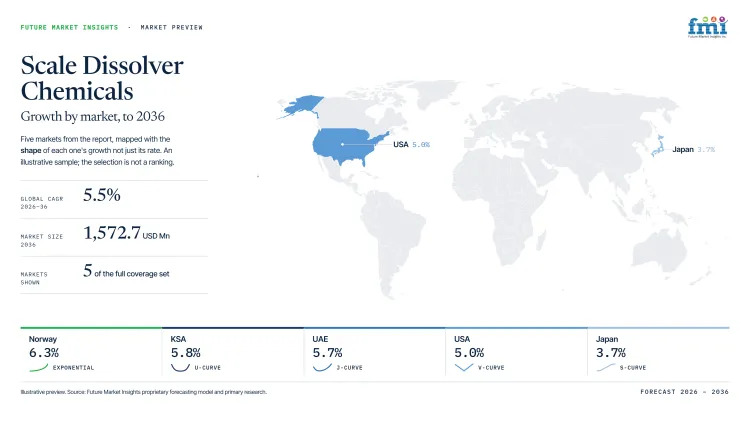
| Country | CAGR (2026-2036) |
|---|---|
| Norway | 6.3% |
| USA | 5.0% |
| Japan | 3.7% |
| KSA | 5.8% |
| UAE | 5.7% |
| Brazil | 5.4% |
| Canada | 4.9% |
How do country-level CAGRs compare in the Scale Dissolver Chemicals Market?
The profiled growth rates span 2.6 percentage points, from Norway at 6.3% CAGR to Japan at 3.7% CAGR from 2026 to 2036. Norway forms the top end of the range. KSA at 5.8% and UAE at 5.7% create a second high-growth band. Brazil at 5.4% sits just below that group. USA at 5.0% and Canada at 4.9% are closely aligned, while Japan is lower because its domestic producing-well base is much narrower. These rates describe forecast pace, not absolute market size. Supplier priorities should also account for field count and offshore intensity. Water management and procurement concentration matter as well. Intervention economics can change the ranking again.
- For Norway, the forecast reaches 6.3% CAGR. Offshore operators buy around field-specific technical qualification and the economics of extending mature assets.
- Purchasing is decentralized across many operators and service companies, so speed of diagnosis and local availability matter alongside unit cost. That gives USA a distinct Scale Dissolver Chemicals path within its 5.0% CAGR forecast.
- Japan carries a 3.7% CAGR through 2036, with conversion tied to this market reality: Buyers operate within a smaller domestic upstream base, which makes each chemical program more selective and technically specific.
- At 5.8% CAGR, KSA remains commercially distinct. Procurement is concentrated around large upstream systems where reliability, qualification, and local support carry high weight.
- UAE is forecast at 5.7% CAGR. Scale-removal demand is shaped by integrated water management across mature and high-throughput upstream assets.
- Buying is heavily influenced by deepwater execution, FPSO uptime, and the cost of intervention windows. In Brazil, that operating setting accompanies a 5.4% CAGR through 2036.
- A 4.9% CAGR places Canada within the profiled set, but purchasing hinges on a specific condition: Procurement spans oil sands and conventional production. Tight resources and offshore operations add further variation, so one formulation rarely fits every basin.
CAGR should therefore be treated as a timing signal rather than a proxy for revenue scale. A slower-growing country can still contain a larger installed base or a wider service network. A faster-growing country can remain concentrated among a small number of operators with demanding qualification rules. The broader commercial assessment needs both pace and addressability. It should also account for which scale types are present, whether treatment is downhole or at surface, and how much technical support is required to convert a chemical into a successful field job.
Country-wise Analysis
- Norway: Offshore operators buy around field-specific technical qualification and the economics of extending mature assets. Through 2036, the market for Scale Dissolver Chemicals in Norway is set to register a 6.3% CAGR. The Norwegian Offshore Directorate reported in August 2026 that 97 fields were operating at year-end 2025 and that several fields are producing decades beyond original plans. The central purchase barrier is that offshore jobs must fit narrow operating windows and strict compatibility requirements. Account teams need strong lab screening, offshore-ready logistics, and formulations that reduce corrosion or formation-damage risk while restoring production or injection.
- USA: Purchasing is decentralized across many operators and service companies, so speed of diagnosis and local availability matter alongside unit cost. Growth in Scale Dissolver Chemicals across USA is projected at 5.0% CAGR from 2026 to 2036. The USA Energy Information Administration reported in July 2026 that crude output averaged a record 13.6 million barrels per day in 2025, with the Permian at 6.6 million barrels per day. What slows conversion is asset diversity and tight treatment economics. Qualified suppliers need basin-level inventory, fast sample screening, and flexible job sizes that fit both high-rate shale assets and older producing wells.
- Japan: Buyers operate within a smaller domestic upstream base, which makes each chemical program more selective and technically specific. The ten-year forecast for Scale Dissolver Chemicals in Japan reaches 3.7% CAGR. METI reported in February 2026 that Japan’s FY2024 independent development ratio for oil and natural gas was 42.1% and noted the country’s heavy import dependence. The harder operating issue is limited domestic well volume rather than lack of technical need. Local partners need targeted support for domestic operators, compact inventories, and high-confidence compatibility data instead of a broad-volume sales model.
- KSA: Procurement is concentrated around large upstream systems where reliability, qualification, and local support carry high weight. Between 2026 and 2036, sales of Scale Dissolver Chemicals in KSA are expected to rise at 5.8% CAGR. Aramco reported in March 2026 that the Marjan crude oil increment came onstream and water injection operations commenced at the Berri increment. A local execution risk is performance under high-throughput field conditions plus the need for dependable regional supply. Commercial suppliers need local technical service, high-temperature and brine testing, and formulations that can be integrated into established production-chemistry and intervention workflows.
- UAE: Scale-removal demand is shaped by integrated water management across mature and high-throughput upstream assets. The Scale Dissolver Chemicals outlook for UAE points to a 5.7% CAGR from 2026 to 2036. ADNOC’s 2025 Sustainability Report describes expanded water-handling and injection capacity, 100% produced-water reinjection at Bu Hasa and Asab, and a roadmap to raise reinjection across mature fields. The main commercial hurdle is chemical compatibility across different brines and asset conditions. Vendors need representative-fluid testing, rapid technical response, and regional supply that supports both wellbore and water-system remediation programs.
- Brazil: Buying is heavily influenced by deepwater execution, FPSO uptime, and the cost of intervention windows. For Brazil, the Scale Dissolver Chemicals market is projected to advance at 5.4% CAGR through 2036. Petrobras filed its 2025 Form 20-F in April 2026 and reported that pre-salt production represented 82% of total production. A practical constraint is not only chemistry performance. Offshore logistics and deferred production can dominate the job economics. Providers need offshore-qualified packages, strong compatibility data, and service planning that minimizes soak time and repeat mobilization on remote producing systems.
- Canada: Procurement spans oil sands and conventional production. Tight resources and offshore operations add further variation, so one formulation rarely fits every basin. Scale Dissolver Chemicals sales in Canada are expected to grow at 4.9% CAGR over 2026 to 2036. The Canada Energy Regulator reported in June 2026 that national crude oil and equivalent production averaged a record 5.35 million barrels per day in 2025. The limiting factor is geographic and operating diversity, including cold-weather logistics and differing water chemistries. Competitive suppliers need basin-specific formulations, winterized delivery where required, and service coverage that can support both Western Canadian and offshore treatment programs.
Who are the notable companies in the Scale Dissolver Chemicals Market?
SLB, Baker Hughes, Halliburton, Clariant, Innospec, Nouryon, Solvay, BASF, and TETRA Technologies.
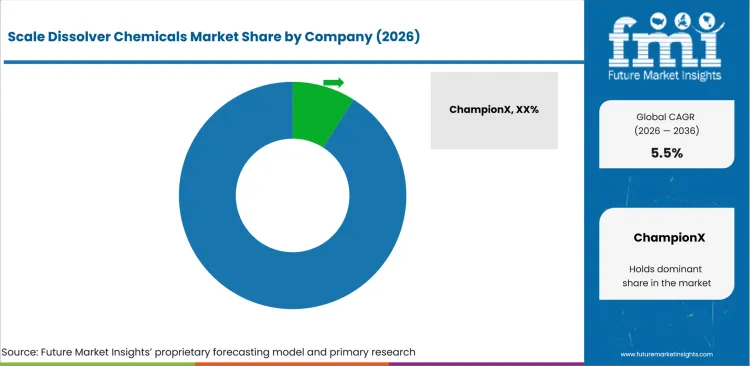
The market combines integrated oilfield service platforms with specialty chemical suppliers. SLB completed its acquisition of ChampionX on July 16, 2025, and former ChampionX production-chemicals activities now sit within SLB's portfolio. Baker Hughes and Halliburton link chemistry with intervention capability, while Clariant, Innospec and Nouryon compete through formulation and application support. Solvay, BASF and TETRA Technologies add broader chemical or oilfield-fluid capabilities.
- Integrated production and intervention platforms: SLB, Baker Hughes and Halliburton combine chemistry with field execution, production diagnostics or intervention services.
- Specialty formulation suppliers: Clariant, Innospec and Nouryon compete through tailored production chemistry and technical application support.
- Broader chemical and fluid platforms: Solvay, BASF and TETRA Technologies contribute specialty chemistry, formulation inputs or oilfield-fluid capabilities.
Competitive Benchmarking: Scale Dissolver Chemicals Market
| Company | Current Role | Scale-Dissolver Relevance | Service Model | Reach |
|---|---|---|---|---|
| SLB | Integrated oilfield technology and production chemicals | Flow-assurance and scale-removal chemistry | Chemistry plus field service | Global |
| Baker Hughes | Integrated oilfield service | Production chemistry and intervention | Field execution and chemical programs | Global |
| Halliburton | Integrated oilfield service | Scale-removal and stimulation chemistry | Intervention service | Global |
| Clariant | Specialty production chemicals | Sulfate and carbonate treatment chemistry | Chemistry and application support | Global |
| Innospec | Specialty oilfield chemicals | Scale-control and removal formulations | Chemistry and technical service | International |
| Nouryon | Specialty chemicals | Chelant and specialty oilfield chemistry | Formulation and technical support | Global |
| Solvay | Specialty chemicals | Chelation and chemical inputs | Chemical supply and technical support | Global |
| BASF | Chemical and oilfield additive platform | Oilfield chemical formulation inputs | Chemical supply | Global |
| TETRA Technologies | Oilfield fluids and services | Completion and production-fluid support | Field service and supply | International |
Comparison centers on direct scale-treatment relevance, ability to support field selection and deployment, compatibility with wider production programs, and geographic service reach.
Key Developments in the Scale Dissolver Chemicals Market
- In July 2025, SLB completed the acquisition of ChampionX. The transaction integrated ChampionX production chemicals with SLB’s production and recovery portfolio. For scale dissolver buyers, the practical implication is a larger combined route to field deployment and international account coverage. It also changes competitive interpretation because ChampionX capabilities now sit inside SLB even when legacy ChampionX products remain relevant to buyer comparisons.
- In June 2025, Nouryon opened an Innovation Center for oilfield applications in Houston, Texas. The facility includes testing capabilities across production and stimulation. It also covers corrosion and scale-related applications, with full operation expected in July 2025. The investment improves proximity between formulation work and North American field needs. It can shorten qualification cycles when scale-removal programs require representative brines, asset-specific compatibility work, or rapid reformulation.
- In February 2025, Baker Hughes received a multi-year specialty chemicals award from ExxonMobil Guyana for the Uaru and Whiptail developments. The scope includes topsides and subsea chemicals. It also covers water injection and utility chemicals for two FPSOs with combined design capacity of 500,000 barrels per day. The award illustrates how production-chemical supply is tied to integrated offshore operating systems. That route to market favors suppliers able to combine chemistry, local supply, and service reliability.
- In May 2025, Clariant published SCALETREAT SD 8015 as a sulfate scale dissolver based on converters and chelating agents. The product is described for barium, strontium, and calcium sulfates as well as carbonate and iron-containing deposits. It is also formulated to limit clay-related formation damage. The product documentation broadens the commercial case for non-HCl chemistry in hard-scale and mixed-deposit remediation where mineral selectivity and formation compatibility are critical.
Key Players in the Scale Dissolver Chemicals Market
Integrated Production Platforms
- SLB
- Baker Hughes
- Halliburton
Specialty Production-Chemistry Suppliers
- Clariant
- Innospec
- Nouryon
Chemical and Fluid Platforms
- Solvay
- BASF
- TETRA Technologies
Scale Dissolver Chemicals Market - Report Scope
| Coverage field | Report scope |
|---|---|
| Market breakdown | Chemistry; Scale Type; Application; Well Type; Sales Channel |
| Quantitative Units | USD Million |
| Market Definition | Revenue from formulated scale dissolver chemicals sold for chemical removal or remediation of deposited inorganic scale in upstream oil and gas production and intervention. This includes the defined chemistry, scale type, application, well type, and sales channel universe. It excludes inhibitor-only revenue, mechanical descaling without chemical revenue, downstream finished-product revenue, adjacent substitutes, and raw inputs not sold as scale dissolvers. |
| Regions Covered | North America; Latin America; Western Europe; Eastern Europe; East Asia; South Asia and Pacific; Middle East and Africa |
| Countries Covered | Norway, USA, Japan, KSA, UAE, Brazil, Canada, and more than twenty-five additional countries in the full report |
| Key Companies Profiled | SLB; Baker Hughes; Halliburton; Clariant; Innospec; Nouryon; Solvay; BASF; TETRA Technologies |
| Forecast Period | 2026 to 2036 |
| Approach | Hybrid bottom-up and top-down sizing reconciles supplier participation, buyer use cases, country operating conditions, and segment demand while removing adjacent-category double counting. |
Scale Dissolver Chemicals Market - Research Methodology
| Method | Approach |
|---|---|
| Primary Research | Structured primary research with production-chemistry suppliers, well-intervention specialists, flow-assurance teams, procurement functions, and oil and gas operators is used to test product-selection logic, treatment triggers, channel roles, and adoption frictions. No interview or respondent counts are stated. |
| Desk Research | Review of regulator and official production data, company filings, peer-reviewed technical material, product documentation, and public operating evidence. Sources are screened for relevance to formulated scale dissolver chemicals and the defined upstream applications. |
| Market Sizing and Forecasting | FMI combines supplier-side revenue mapping with demand-side use cases across Chemistry, Scale Type, Application, Well Type, Sales Channel, country conditions, and intervention patterns. Forecast assumptions consider production activity, mature-well remediation intensity, water-management exposure, treatment qualification, and supplier commercialization. |
| Data Validation | Findings are cross-checked across technical, commercial, and country evidence. Adjacent scale inhibitors, mechanical descaling without chemical revenue, raw inputs not sold as scale dissolvers, downstream finished-product revenue, and unsupported claims are excluded to avoid double counting. |
Scale Dissolver Chemicals Market by Segments
Scale Dissolver Chemicals Market segmented by Chemistry:
- HCl-based dissolvers
- Organic acid dissolvers
- Chelant-based dissolvers
- Sulfonated scale dissolvers
- Iron sulfide dissolvers
Scale Dissolver Chemicals Market segmented by Scale Type:
- Calcium carbonate
- Barium sulfate
- Strontium sulfate
- Iron sulfide
- Mixed mineral scale
Scale Dissolver Chemicals Market segmented by Application:
- Wellbore descaling
- Tubing cleanup
- Surface equipment cleanup
- Matrix acidizing support
- Production restoration
Scale Dissolver Chemicals Market segmented by Well Type:
- Mature wells
- Offshore wells
- Sour wells
- Water injection wells
- Gas wells
Scale Dissolver Chemicals Market segmented by Sales Channel:
- Production chemical suppliers
- Well intervention services
- Direct operator contracts
- Regional distributors
Scale Dissolver Chemicals Market by Region:
- North America
- United States
- Canada
- Latin America
- Brazil
- Mexico
- Argentina
- Chile
- Western Europe
- Germany
- France
- United Kingdom
- Italy
- Spain
- Benelux
- Nordics
- Eastern Europe
- Poland
- Czech Republic
- Romania
- Hungary
- East Asia
- China
- Japan
- South Korea
- South Asia and Pacific
- India
- ASEAN
- Australia and New Zealand
- Middle East and Africa
- GCC Countries
- South Africa
- Türkiye
- Israel
Research Sources and Bibliography
- Norwegian Offshore Directorate (2026, August 1). Production, operating Fields and investments - The Shelf in 2025.
- USA Energy Information Administration (2026, July 9). The United States produced more crude oil than any other country in 2025.
- Ministry of Economy, Trade and Industry, Japan (2026, February 17). FY2024 Independent Development Ratio of Oil and Natural Gas in Japan Released.
- Saudi Aramco (2026, March 10). Aramco announces fourth quarter and full-year 2025 results.
- ADNOC (2025). Sustainability Report 2025.
- Petrobras (2026, April 8). Petrobras files Form 20-F 2025.
- Canada Energy Regulator (2026, June 17). Market Snapshot: Canada sets new record in crude oil production in 2025.
- SLB (2025, July 16). SLB Completes Acquisition of ChampionX.
- Baker Hughes (2025, February 3). Baker Hughes Secures Major Chemicals Award from ExxonMobil Guyana for FPSOs.
- Nouryon (2025, June 18). Nouryon launches Innovation Center for oilfield solutions in Texas, US.
- Clariant (2025, May 7). SCALETREAT SD 8015.
- BASF (2025). BASF Oilfield Chemicals Product Range.
- Halliburton (n.d.). SureDscale scale removal chemistry solutions.
- Innospec (n.d.). Well Remediation.
- ChampionX (n.d.). Scale management and iron sulfide dissolver solutions.
This Report Answers
- How is demand for the Scale Dissolver Chemicals Market expected to evolve through 2036?
- Which production, water-management, and asset-life pressures support demand for scale dissolver chemicals?
- Why do HCl-based dissolvers hold the leading position in the Chemistry category?
- How does calcium carbonate scale influence the recurring need for chemical removal?
- Why does wellbore descaling hold the leading position in the Application category?
- How do forecast growth rates differ across Norway, USA, Japan, KSA, UAE, Brazil, and Canada?
- Which roles do SLB, Clariant, Baker Hughes, Halliburton, Innospec, Nouryon, Solvay, BASF, and TETRA Technologies play in the competitive landscape?
- What qualification, corrosion, mineral-specific, and field-execution constraints can delay adoption?
- What should production, flow-assurance, intervention, and procurement decision-makers evaluate before purchasing a scale dissolver program?
Frequently Asked Questions
What is driving growth in the Scale Dissolver Chemicals Market?
Growth is supported by longer-producing wells and recurring water-management conditions that can create mineral deposition across tubing, near-wellbore zones, and production equipment. Operators spend when chemical removal offers a practical route to restore flow, injection, or equipment performance without a larger intervention.
Who are the key players in the Scale Dissolver Chemicals Market?
Key players include SLB, Baker Hughes, Halliburton, Clariant, Innospec, Nouryon, Solvay, BASF and TETRA Technologies. SLB includes the former ChampionX production-chemicals activities following the July 2025 acquisition.
What notable restraint affects the Scale Dissolver Chemicals Market?
The main restraint is qualification because a chemistry that works on one deposit can be unsuitable for another mineral, metallurgy, or formation condition. Sample characterization and compatibility testing can delay purchase. Treatment sequencing and safe handling can also narrow the formulations eligible for a job.
Why should executives track the Scale Dissolver Chemicals Market?
The market connects production-chemistry spending directly to asset life, intervention economics, and water-management intensity. Executives can use it to judge where technical support or local inventory can change competitive position. Hard-scale chemistry and integrated service capability can convert a recurring maintenance problem into defensible revenue.
What business problem does the Scale Dissolver Chemicals Market address?
Scale dissolver chemicals remove deposited inorganic minerals that can restrict tubing or impair near-wellbore flow. They can also address reduced injectivity or fouled surface equipment. The business objective is to restore operating performance while avoiding the cost, downtime, or access burden of a larger mechanical intervention.
What should production and flow assurance leaders evaluate in the Scale Dissolver Chemicals Market?
Decision-makers should evaluate the confirmed scale mineralogy and dissolution rate. Metallurgy compatibility and formation risk also matter. Placement method, handling requirements, and the total intervention window complete the job design. They should also assess supplier testing capability and field support because the same formulation can perform differently under changing brine and temperature conditions.
What limits return on investment in the Scale Dissolver Chemicals Market?
Return on investment weakens when diagnosis is wrong or dissolution is incomplete. Excessive soak time and treatment-created corrosion can also erode value. Mobilization cost and deferred production matter as well, especially offshore, so buyers must compare total job economics rather than chemical price alone.
What supports long-term commercial confidence in the Scale Dissolver Chemicals Market?
Long-term confidence is supported by a large installed producing base and continued asset-life extension in mature fields. Ongoing investment in water injection and production chemistry also supports repeat need. Application testing strengthens the case further because scale remediation remains tied to operational uptime rather than to a single drilling cycle.
Preview the report firsthand - request a free sample
Get SampleGet the brochure for pricing and purchase details.
Get PDFTable of Content
- Key Takeaways
- Market Size and CAGR
- Top Growth Driver
- Fastest Growing Segment
- Leading Region
- Key Companies
- Emerging Opportunities
- Executive Summary
- Global Market Outlook
- Demand-side Trends
- Supply-side Trends
- Technology Roadmap Analysis
- Analysis and Recommendations
- Analyst Perspective (What is happening? Why now? What should investors know?)
- Key Questions Answered
- How large is the market?
- What is the CAGR?
- What are key trends?
- Which region dominates?
- Who are the leaders?
- Market Overview
- Market Coverage / Taxonomy
- Market Definition / Scope / Limitations
- Research Methodology
- Chapter Orientation
- Analytical Lens and Working Hypotheses
- Market Structure, Signals, and Trend Drivers
- Benchmarking and Cross-market Comparability
- Market Sizing, Forecasting, and Opportunity Mapping
- Research Design and Evidence Framework
- Desk Research Programme (Secondary Evidence)
- Expert Input and Fieldwork (Primary Evidence)
- Tooling, Models, and Reference Databases
- Data Engineering and Model Build
- Quality Assurance and Audit Trail
- Market Background
- Market Dynamics (Drivers, Restraints, Opportunity, Trends)
- Scenario Forecast (Optimistic, Likely, Conservative)
- Impact Analysis
- AI Impact
- Sustainability Impact
- Regulatory Impact
- Technology Impact
- Consumer / Buyer Analysis
- Purchase Drivers
- Adoption Barriers
- Buyer Journey
- Opportunity Map Analysis
- Product Life Cycle Analysis
- Supply Chain Analysis
- Investment Feasibility Matrix
- Value Chain Analysis
- PESTLE and Porter's Analysis
- Regulatory Landscape
- Regional Parent Market Outlook
- Production and Consumption Statistics
- Import and Export Statistics
- Global Market Analysis and Forecast, 2021 to 2036
- Historical Market Size Value (USD Million) Analysis, 2021 to 2025
- Current and Future Market Size Value (USD Million) Projections, 2026 to 2036
- Y-o-Y Growth Trend Analysis
- Absolute $ Opportunity Analysis
- Global Market Pricing Analysis, 2021 to 2036
- Global Market Analysis and Forecast, By Chemistry, 2021 to 2036
- Introduction / Key Findings
- Historical Market Size Value (USD Million) Analysis By Chemistry, 2021 to 2025
- Current and Future Market Size Value (USD Million) Analysis and Forecast By Chemistry, 2026 to 2036
- HCl-based dissolvers
- Organic acid dissolvers
- Chelant-based dissolvers
- Sulfonated scale dissolvers
- Iron sulfide dissolvers
- HCl-based dissolvers
- Y-o-Y Growth Trend Analysis By Chemistry, 2021 to 2025
- Absolute $ Opportunity Analysis By Chemistry, 2026 to 2036
- Global Market Analysis and Forecast, By Scale Type, 2021 to 2036
- Introduction / Key Findings
- Historical Market Size Value (USD Million) Analysis By Scale Type, 2021 to 2025
- Current and Future Market Size Value (USD Million) Analysis and Forecast By Scale Type, 2026 to 2036
- Calcium carbonate
- Barium sulfate
- Strontium sulfate
- Iron sulfide
- Mixed mineral scale
- Calcium carbonate
- Y-o-Y Growth Trend Analysis By Scale Type, 2021 to 2025
- Absolute $ Opportunity Analysis By Scale Type, 2026 to 2036
- Global Market Analysis and Forecast, By Application, 2021 to 2036
- Introduction / Key Findings
- Historical Market Size Value (USD Million) Analysis By Application, 2021 to 2025
- Current and Future Market Size Value (USD Million) Analysis and Forecast By Application, 2026 to 2036
- Wellbore descaling
- Tubing cleanup
- Surface equipment cleanup
- Matrix acidizing support
- Production restoration
- Wellbore descaling
- Y-o-Y Growth Trend Analysis By Application, 2021 to 2025
- Absolute $ Opportunity Analysis By Application, 2026 to 2036
- Global Market Analysis and Forecast, By Well Type, 2021 to 2036
- Introduction / Key Findings
- Historical Market Size Value (USD Million) Analysis By Well Type, 2021 to 2025
- Current and Future Market Size Value (USD Million) Analysis and Forecast By Well Type, 2026 to 2036
- Mature wells
- Offshore wells
- Sour wells
- Water injection wells
- Gas wells
- Mature wells
- Y-o-Y Growth Trend Analysis By Well Type, 2021 to 2025
- Absolute $ Opportunity Analysis By Well Type, 2026 to 2036
- Global Market Analysis and Forecast, By Sales Channel, 2021 to 2036
- Introduction / Key Findings
- Historical Market Size Value (USD Million) Analysis By Sales Channel, 2021 to 2025
- Current and Future Market Size Value (USD Million) Analysis and Forecast By Sales Channel, 2026 to 2036
- Production chemical suppliers
- Well intervention services
- Direct operator contracts
- Regional distributors
- Production chemical suppliers
- Y-o-Y Growth Trend Analysis By Sales Channel, 2021 to 2025
- Absolute $ Opportunity Analysis By Sales Channel, 2026 to 2036
- Global Market Analysis and Forecast, By Region, 2021 to 2036
- Introduction
- Historical Market Size Value (USD Million) Analysis By Region, 2021 to 2025
- Current Market Size Value (USD Million) Analysis and Forecast By Region, 2026 to 2036
- North America
- Latin America
- Western Europe
- Eastern Europe
- East Asia
- South Asia and Pacific
- Middle East & Africa
- Market Attractiveness Analysis By Region
- North America Market Analysis and Forecast, By Country, 2021 to 2036
- Historical Market Size Value (USD Million) Trend Analysis By Market Taxonomy, 2021 to 2025
- Market Size Value (USD Million) Forecast By Market Taxonomy, 2026 to 2036
- By Country
- USA
- Canada
- By Chemistry
- By Scale Type
- By Application
- By Well Type
- By Sales Channel
- By Country
- Market Attractiveness Analysis
- By Country
- By Chemistry
- By Scale Type
- By Application
- By Well Type
- By Sales Channel
- Key Takeaways
- Latin America Market Analysis and Forecast, By Country
- Historical Market Size Value (USD Million) Trend Analysis By Market Taxonomy, 2021 to 2025
- Market Size Value (USD Million) Forecast By Market Taxonomy, 2026 to 2036
- By Country
- Brazil
- Mexico
- Chile
- Rest of Latin America
- By Chemistry
- By Scale Type
- By Application
- By Well Type
- By Sales Channel
- By Country
- Market Attractiveness Analysis
- By Country
- By Chemistry
- By Scale Type
- By Application
- By Well Type
- By Sales Channel
- Key Takeaways
- Western Europe Market Analysis and Forecast, By Country
- Historical Market Size Value (USD Million) Trend Analysis By Market Taxonomy, 2021 to 2025
- Market Size Value (USD Million) Forecast By Market Taxonomy, 2026 to 2036
- By Country
- Germany
- UK
- Italy
- Spain
- France
- Nordic
- BENELUX
- Rest of Western Europe
- By Chemistry
- By Scale Type
- By Application
- By Well Type
- By Sales Channel
- By Country
- Market Attractiveness Analysis
- By Country
- By Chemistry
- By Scale Type
- By Application
- By Well Type
- By Sales Channel
- Key Takeaways
- Eastern Europe Market Analysis and Forecast, By Country
- Historical Market Size Value (USD Million) Trend Analysis By Market Taxonomy, 2021 to 2025
- Market Size Value (USD Million) Forecast By Market Taxonomy, 2026 to 2036
- By Country
- Russia
- Poland
- Hungary
- Balkan & Baltic
- Rest of Eastern Europe
- By Chemistry
- By Scale Type
- By Application
- By Well Type
- By Sales Channel
- By Country
- Market Attractiveness Analysis
- By Country
- By Chemistry
- By Scale Type
- By Application
- By Well Type
- By Sales Channel
- Key Takeaways
- East Asia Market Analysis and Forecast, By Country
- Historical Market Size Value (USD Million) Trend Analysis By Market Taxonomy, 2021 to 2025
- Market Size Value (USD Million) Forecast By Market Taxonomy, 2026 to 2036
- By Country
- China
- Japan
- South Korea
- By Chemistry
- By Scale Type
- By Application
- By Well Type
- By Sales Channel
- By Country
- Market Attractiveness Analysis
- By Country
- By Chemistry
- By Scale Type
- By Application
- By Well Type
- By Sales Channel
- Key Takeaways
- South Asia and Pacific Market Analysis and Forecast, By Country
- Historical Market Size Value (USD Million) Trend Analysis By Market Taxonomy, 2021 to 2025
- Market Size Value (USD Million) Forecast By Market Taxonomy, 2026 to 2036
- By Country
- India
- ASEAN
- Australia & New Zealand
- Rest of South Asia and Pacific
- By Chemistry
- By Scale Type
- By Application
- By Well Type
- By Sales Channel
- By Country
- Market Attractiveness Analysis
- By Country
- By Chemistry
- By Scale Type
- By Application
- By Well Type
- By Sales Channel
- Key Takeaways
- Middle East & Africa Market Analysis and Forecast, By Country
- Historical Market Size Value (USD Million) Trend Analysis By Market Taxonomy, 2021 to 2025
- Market Size Value (USD Million) Forecast By Market Taxonomy, 2026 to 2036
- By Country
- Kingdom of Saudi Arabia
- Other GCC Countries
- Türkiye
- South Africa
- Other African Union
- Rest of Middle East & Africa
- By Chemistry
- By Scale Type
- By Application
- By Well Type
- By Sales Channel
- By Country
- Market Attractiveness Analysis
- By Country
- By Chemistry
- By Scale Type
- By Application
- By Well Type
- By Sales Channel
- Key Takeaways
- Key Countries Market Analysis
- USA
- Pricing Analysis
- Market Share Analysis, 2025
- By Chemistry
- By Scale Type
- By Application
- By Well Type
- By Sales Channel
- Canada
- Pricing Analysis
- Market Share Analysis, 2025
- By Chemistry
- By Scale Type
- By Application
- By Well Type
- By Sales Channel
- Mexico
- Pricing Analysis
- Market Share Analysis, 2025
- By Chemistry
- By Scale Type
- By Application
- By Well Type
- By Sales Channel
- Brazil
- Pricing Analysis
- Market Share Analysis, 2025
- By Chemistry
- By Scale Type
- By Application
- By Well Type
- By Sales Channel
- Chile
- Pricing Analysis
- Market Share Analysis, 2025
- By Chemistry
- By Scale Type
- By Application
- By Well Type
- By Sales Channel
- Germany
- Pricing Analysis
- Market Share Analysis, 2025
- By Chemistry
- By Scale Type
- By Application
- By Well Type
- By Sales Channel
- UK
- Pricing Analysis
- Market Share Analysis, 2025
- By Chemistry
- By Scale Type
- By Application
- By Well Type
- By Sales Channel
- Italy
- Pricing Analysis
- Market Share Analysis, 2025
- By Chemistry
- By Scale Type
- By Application
- By Well Type
- By Sales Channel
- Spain
- Pricing Analysis
- Market Share Analysis, 2025
- By Chemistry
- By Scale Type
- By Application
- By Well Type
- By Sales Channel
- France
- Pricing Analysis
- Market Share Analysis, 2025
- By Chemistry
- By Scale Type
- By Application
- By Well Type
- By Sales Channel
- India
- Pricing Analysis
- Market Share Analysis, 2025
- By Chemistry
- By Scale Type
- By Application
- By Well Type
- By Sales Channel
- ASEAN
- Pricing Analysis
- Market Share Analysis, 2025
- By Chemistry
- By Scale Type
- By Application
- By Well Type
- By Sales Channel
- Australia & New Zealand
- Pricing Analysis
- Market Share Analysis, 2025
- By Chemistry
- By Scale Type
- By Application
- By Well Type
- By Sales Channel
- China
- Pricing Analysis
- Market Share Analysis, 2025
- By Chemistry
- By Scale Type
- By Application
- By Well Type
- By Sales Channel
- Japan
- Pricing Analysis
- Market Share Analysis, 2025
- By Chemistry
- By Scale Type
- By Application
- By Well Type
- By Sales Channel
- South Korea
- Pricing Analysis
- Market Share Analysis, 2025
- By Chemistry
- By Scale Type
- By Application
- By Well Type
- By Sales Channel
- Russia
- Pricing Analysis
- Market Share Analysis, 2025
- By Chemistry
- By Scale Type
- By Application
- By Well Type
- By Sales Channel
- Poland
- Pricing Analysis
- Market Share Analysis, 2025
- By Chemistry
- By Scale Type
- By Application
- By Well Type
- By Sales Channel
- Hungary
- Pricing Analysis
- Market Share Analysis, 2025
- By Chemistry
- By Scale Type
- By Application
- By Well Type
- By Sales Channel
- Kingdom of Saudi Arabia
- Pricing Analysis
- Market Share Analysis, 2025
- By Chemistry
- By Scale Type
- By Application
- By Well Type
- By Sales Channel
- Türkiye
- Pricing Analysis
- Market Share Analysis, 2025
- By Chemistry
- By Scale Type
- By Application
- By Well Type
- By Sales Channel
- South Africa
- Pricing Analysis
- Market Share Analysis, 2025
- By Chemistry
- By Scale Type
- By Application
- By Well Type
- By Sales Channel
- USA
- Market Structure Analysis
- Competition Dashboard
- Competition Benchmarking
- Market Share Analysis of Top Players
- By Regional
- By Chemistry
- By Scale Type
- By Application
- By Well Type
- By Sales Channel
- Emerging Startups
- Innovation Benchmarking
- Competition Analysis
- Competition Deep Dive
- ChampionX
- Overview
- Product Portfolio
- Profitability by Market Segments
- Sales Footprint
- Strategy Overview
- Marketing Strategy
- Product Strategy
- Channel Strategy
- Clariant
- Baker Hughes
- Halliburton
- SLB
- Innospec
- Nouryon
- Solvay
- BASF
- TETRA Technologies
- ChampionX
- Case Studies
- Success Stories
- Recent Developments
- Competition Deep Dive
- Assumptions & Acronyms Used


