

- Market Size (2026)
- USD 640.7 Mn
- Forecast (2036)
- USD 1033.7 Mn
- CAGR (2026 to 2036)
- 4.9%
How big is Scorch Retarders Market in 2026?
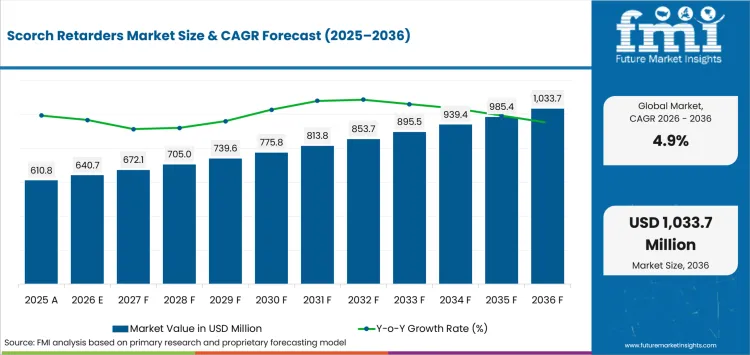
USD 640.7 million in 2026 and USD 1033.7 million by 2036 at a 4.9% CAGR.
Demand for scorch retarders is projected to expand at 4.9% CAGR from 2026 to 2036 as valuation is projected to rise from USD 640.7 million in 2026 to USD 1033.7 million by 2036. Automotive production continues to support large-scale rubber consumption across tire manufacturing. OICA reported global vehicle production of 96.4 million units in 2025, up 3.9% from the previous year. The resulting volume of tire production creates ongoing demand for additives that improve processing control during rubber compounding. Scorch retarders are used to delay premature curing and maintain manufacturing flexibility before final vulcanization takes place.
Country demand converts differently because mature rubber plants carry established recipes while expanding production bases create fresh qualification sequences. Germany illustrates the mature side after wdk reported in February 2025 that domestic rubber production and sales each fell about 3% during 2024. Cost pressure makes formulation changes compete against a demanding economic test across industrial rubber products. Faster-growing manufacturing bases create first-time approvals sooner when application support reaches plants before commercial production ramps.
Key Takeaways of Scorch Retarders Market
- Repeated tire and technical-rubber production raises scorch-retarder demand because compounders need workable processing time before intended sulfur cure begins.
- Organic acid retarders are projected to account for 46.0% of product type demand in 2026 owing to flexible use across qualified sulfur-cure packages.
- SBR is estimated to represent 26.0% of rubber type demand in 2026 as high-volume tire compounds require tightly controlled cure timing.
- Industrial rubber goods are anticipated to capture 42.0% of application demand in 2026 because varied molding sequences reward dependable scorch protection.
- Recipe-specific qualification often delays supplier switching since additional scorch safety must preserve press cycles and final vulcanizate performance.
- LANXESS, NOCIL Limited, Shandong Yanggu Huatai Chemical Co., Ltd., Arkema, Linkwell Rubber Chemicals Co., Ltd., Sovereign Chemical Company, Kemai Chemical Co., Ltd. and China Sunsine Chemical Holdings Ltd. are some notable players.
Analyst Perspective
"Scorch-retarder offers should be judged against reproducible scorch delay and cure-curve stability inside the customer’s exact compound. Commercial value is earned when technical support shortens qualification and dependable replenishment prevents production teams from reopening an approved formulation."
- Nikhil Kaitwade, Principal Consultant, Future Market Insights
How is the Scorch Retarders Market segmented?
The scorch retarders market is segmented by product type, rubber type, application, form, sales channel and region.
Product type includes PVI or CTP, organic acid, sulfenamide-compatible and specialty rubber retarders while rubber type covers natural rubber, SBR, EPDM, NBR and butyl or halobutyl. Applications cover tires, industrial rubber goods, hoses and belts, footwear and wire and cable rubber. Form includes powder, granules, pre-dispersed masterbatch and liquid dispersion while sales channels include rubber chemical distributors, direct tire company supply, compounder supply and masterbatch suppliers.
Why do industrial rubber goods lead demand within the application category?
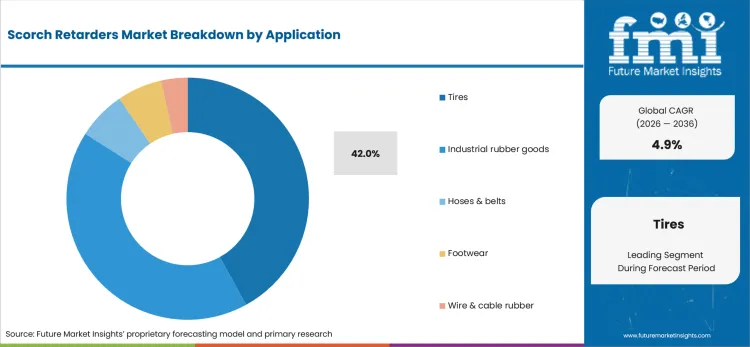
Industrial rubber goods include hoses and belts alongside seals and molded parts that pass through mixing before final vulcanization. Freudenberg reported in March 2026 that its sealing business started building a new elastomer mixing plant in Weinheim for automotive and general industry. The new mixing capacity supports compound development across vulcanised solid rubber production serving several different part geometries.
- Industrial rubber goods capture 42.0% of application demand in 2026 owing to varied part geometries requiring repeatable processing safety across qualified formulations.
- Plants approve scorch retarders by compound family since a dosage protecting one molding sequence sometimes alters cure timing in another production process.
Why do organic acid retarders lead demand within the product type category?
Organic acid retarders give compounders a chemistry route for extending scorch safety without changing the broader purpose of the sulfur cure package. Their relevance rises where tire vulcanization accelerators must retain final cure performance while processing time stays protected. LANXESS described an April 2026 rubber portfolio that combined vulcanization activators with pre-dispersed chemicals and processing aids for compound-specific use.
- Organic acid retarders account for 46.0% of product type demand in 2026 as established sulfur systems reward controllable delay before crosslinking accelerates.
- Qualification depends on dose response and cure-curve behavior because the same retarding action must preserve press timing and required vulcanizate properties.
Why does SBR lead demand within the rubber type category?
SBR compounds often carry silica and multifunctional cure packages that make timing control valuable during mixing and forming. synthetic rubber cure systems require retarder selection that preserves the current accelerator balance and established tire interfacial performance.
- SBR represents 26.0% of rubber type demand in 2026 supported by large tire applications that create recurring batches under controlled sulfur-cure conditions.
- LANXESS reported in March 2025 that Rhenocure DR/S was developed for high-performance passenger tires using SBR/BR compounds with high silica content. The development illustrates why tire cord adhesives and related interfaces must remain stable during cure-package changes.
Why do granules lead demand within the form category?
Granules reduce loose-powder handling inside rubber plants without changing the active cure-control purpose of the additive. Automated weighing favors contained formats that release consistent active material during repetitive mixing batches across large regional production programs.
- Granules hold 37.0% of form demand in 2026 attributable to controlled particle handling that simplifies dosing inside repetitive rubber mixing operations.
- LANXESS reported in March 2026 that a pearl-form rubber process additive delivered reproducible dosing and dust-free processing for tire production. The plant-handling logic also applies to tire masterbatch materials even though the cited product is not a scorch retarder.
What are the drivers, restraints and opportunities in the Scorch Retarders Market?
Higher rubber-processing throughput supports demand while formulation economics constrain switching and supplier qualification creates new recurring-volume opportunities.
- Driver: New tire and technical-rubber capacity increases recurring compound batches that require controlled processing time before final vulcanization.
- Restraint: Rubber-additive cost increases often delay formulation changes unless improved scorch safety protects scrap rates or press economics.
- Opportunity: Suppliers pursue new approvals by combining cure-control evidence with traceable materials and plant-level qualification support.
Tire Capacity Adds Repeated Cure-Control Demand
New tire capacity turns cure control into a recurring formulation requirement because every qualified production batch must remain workable before vulcanization begins. Continental reported in May 2026 that its expanded Rayong plant added annual capacity for three million passenger and light-truck tires. Scorch-retarder demand converts most directly where compound throughput rises and plant engineers protect mixing or forming time without disturbing the approved final cure schedule.
Input Costs Tighten the Switching Case
Input-cost pressure narrows the economic case for changing an established cure package even when additional scorch safety has clear technical value. LANXESS raised prices for tire and specialty rubber functional additives by 15% to 50% in March 2026 because energy and raw-material costs increased. Formulators therefore need measurable reductions in premature-cure risk or scrap exposure before accepting another additive cost and repeating qualification work.
Qualification Converts Into Repeat Orders
Qualification work offers a revenue route for suppliers that combine cure-control performance with documentation needed across broader eco-friendly tire and rubber additives. Kemai Chemical reported in April 2026 that several rubber additives gained ISCC PLUS certification for bio-based or recycled feedstock routes. Scorch-retarder suppliers apply comparable traceability discipline to reduce documentation friction while application testing remains responsible for proving cure behavior inside each compound.
Which country CAGRs are profiled in the Scorch Retarders Market?
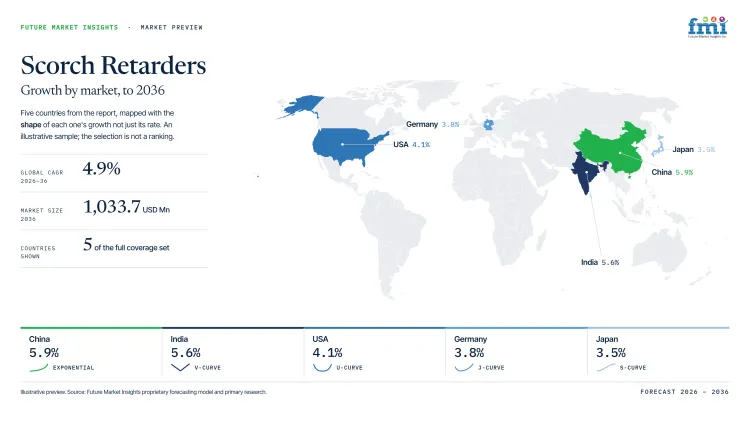
| Country | CAGR |
|---|---|
| Thailand | 5.0% |
| Brazil | 4.6% |
| United States | 4.1% |
| Germany | 3.8% |
| Japan | 3.5% |
How do country-level CAGRs compare in the Scorch Retarders Market?
Forecasts span 1.5 percentage points overall from Thailand at 5.0% to Japan at 3.5% CAGR. Thailand and Brazil form the higher-growth pair while three mature markets cluster between 3.5% and 4.1%. Narrow rate differences do not indicate current revenue and make local operating conditions the stronger planning guide for supplier entry.
- Thailand’s new tire projects create qualification work near automotive production lines adding local manufacturing capacity.
- Brazil’s rubber-input balancing raises the value of formulation stability and dependable inventory across compounder routes.
- United States replacement demand rewards dependable replenishment across established plants with long-standing approved compound systems.
- Germany’s cost-led industrial orders increase scrutiny on additives unable to defend throughput economics in sites.
- Japan’s mature tire production favors documented grades that fit controlled cure windows without formulation variability.
The full report provides country-level CAGR analysis across North America, Latin America, Europe, East Asia, South Asia, Oceania and the Middle East and Africa.
Country-wise Analysis
- Thailand’s tire supply chain is adding capacity around automotive clusters as the Board of Investment reported in January 2026 that 288 automotive and parts investment applications in 2025 included radial-tire activity from Sumitomo Rubber. Scorch-retarder demand in Thailand is forecast to expand at 5.0% CAGR through 2036 as new tire lines create qualification work for cure packages before commercial output reaches routine full commercial production scale nationwide. Regional inventory and responsive technical teams provide a direct enabler for new projects, although suppliers must align compound trials with commissioning schedules or plants retain incumbent formulations during several initial production cycles instead.
- Brazilian compounders manage a domestic rubber base alongside recurring import balancing for selected inputs, which makes stable inventories especially valuable as natural rubber supply conditions tighten across major domestic tire and technical-rubber plants nationwide. Brazil’s scorch retarders market is projected to record 4.6% CAGR over the forecast period as established commercial processing sites continue qualifying cure-control additives against changing raw-material conditions and current domestic delivery economics nationwide. MDIC approved a March 2026 duty reduction to zero for an 8,000-tonne natural-rubber latex quota after shortage conditions justified import relief and retarder suppliers remain reliant on stock and compound support during qualification cycles.
- United States tire plants operate across a mature replacement market where approved compounds and steady replenishment often matter more than frequent reformulation, especially for additives that influence sulfur-cure timing in routine high-volume operations nationwide. The United States scorch retarders market is estimated to expand at 4.1% CAGR through 2036 as established tire and technical-rubber plants continue consuming qualified cure-control chemistry across recurring commercial production batches nationwide. USTMA reported in March 2026 that 2025 tire shipments totaled 336.3 million units before forecasting 338.9 million for 2026, so suppliers need local inventory and change-control evidence before replacing incumbent grades during plant trials.
- German rubber processors work inside a mature specification base with severe manufacturing-cost pressure, so formulation changes must defend their economics against existing approved recipes and tightly managed schedules across current domestic customer programs nationwide. Scorch-retarder demand in Germany is forecast to rise at 3.8% CAGR over the assessment period as technical-rubber and tire plants continue valuing processing safety under disciplined cost control across established domestic sites. wdk reported in February 2026 that domestic rubber production declined for a fourth consecutive year and industrial-rubber orders were almost exclusively cost-oriented, favoring suppliers that quantify scrap avoidance and throughput protection before repeating qualification.
- Japanese tire manufacturers operate with mature compound specifications that place high value on reproducible processing behavior, making batch consistency a direct enabler for any additive that changes cure timing across recurring production programs. JATMA reported in 2026 that automotive-tire production reached 123.281 million units during 2025 and increased 0.8% year over year, providing a large recurring production base for qualified rubber additives across established domestic plants. Scorch-retarder demand in Japan is forecast to expand at 3.5% CAGR through 2036 as suppliers compete on consistency and formulation evidence, while established cure packages make switching costly across replacement and original-equipment tire programs.
Who are the notable companies in the Scorch Retarders Market?
LANXESS, NOCIL Limited, Shandong Yanggu Huatai Chemical Co., Ltd., Arkema, Linkwell Rubber Chemicals Co., Ltd., Sovereign Chemical Company, Kemai Chemical Co., Ltd. and China Sunsine Chemical Holdings Ltd. are the notable companies profiled in this market.
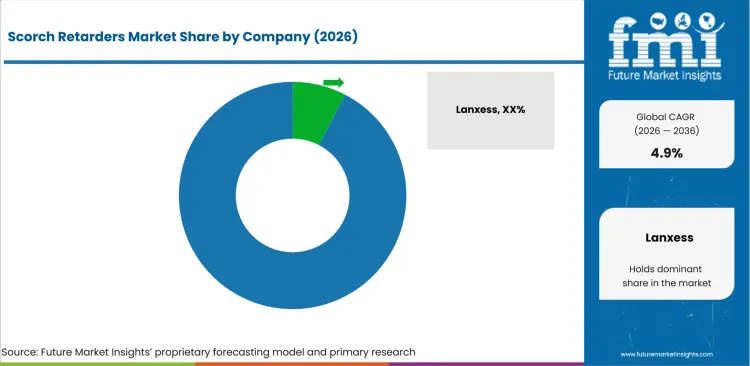
Competition combines direct PVI or CTP suppliers with broader rubber-additive platforms that support cure-package formulation and plant handling. Entry barriers remain technical because approved retarders must preserve final cure behavior inside established accelerator systems.
- LANXESS, NOCIL Limited, Shandong Yanggu Huatai, Linkwell and Sovereign Chemical compete most directly around scorch inhibition or PVI and CTP supply.
- Arkema combines rubber-curing chemistry with polymer-bound delivery formats that address dosing and dispersion requirements across industrial compounders.
- Kemai Chemical and China Sunsine compete from broader vulcanization-additive platforms that support adjacent cure-control purchasing and regional manufacturing.
Competitive Benchmarking: Scorch Retarders Market
| Company | Direct Cure-Control Fit | Delivery-Form Flexibility | Application Qualification Depth | Geographic Reach |
|---|---|---|---|---|
| LANXESS | High | High | High | Global |
| NOCIL Limited | High | Medium | High | Asia, Europe and Americas |
| Shandong Yanggu Huatai Chemical Co., Ltd. | High | High | High | Asia, Europe and Americas |
| Arkema | Medium | High | High | Global |
| Linkwell Rubber Chemicals Co., Ltd. | High | Medium | Medium | Asia and international markets |
| Sovereign Chemical Company | High | Medium | Medium | North America and international sales |
| Kemai Chemical Co., Ltd. | Medium | High | High | Asia, Europe and Americas |
| China Sunsine Chemical Holdings Ltd. | Medium | Medium | High | Asia and international markets |
Key Developments in the Scorch Retarders Market
- In April 2026, China Sunsine Chemical Holdings Ltd. reported commercial production from its 40,000-tonne-per-year solvent MBT project at Hengshun while identifying MBT as an accelerator intermediate.
- In March 2026, NOCIL Limited approved a Dahej brownfield expansion covering peak-utilization rubber chemicals and integrated inputs with H1 FY2028 completion targeted without dedicated PVI capacity disclosed.
- In September 2025, LANXESS announced USA production of selected rubber-processing promoters at Bushy Park with November startup expected while confirming the products were not scorch retarders.
Key Players in the Scorch Retarders Market
Direct Scorch-Retarder and Cure-Control Suppliers
- LANXESS
- NOCIL Limited
- Shandong Yanggu Huatai Chemical Co., Ltd.
- Linkwell Rubber Chemicals Co., Ltd.
- Sovereign Chemical Company
Integrated Vulcanization and Delivery-Form Platforms
- Arkema
- Kemai Chemical Co., Ltd.
Broader Rubber-Chemical Platforms
- China Sunsine Chemical Holdings Ltd.
Scorch Retarders Market - Report Scope
| Coverage field | Report scope |
|---|---|
| Market breakdown | By product type, rubber type, application, form, sales channel and region. |
| Quantitative Units | Revenue in USD million and CAGR in %. |
| Market Definition | Commercial scorch retarders used to delay premature vulcanization in qualified rubber compounds and sulfur-cure systems. |
| Regions Covered | North America, Latin America, Europe, East Asia, South Asia and Pacific and Middle East and Africa. |
| Countries Covered | Thailand, Brazil, United States, Germany, Japan, and 20+ countries included in the full report. |
| Key Companies Profiled | LANXESS, NOCIL Limited, Shandong Yanggu Huatai Chemical Co., Ltd., Arkema, Linkwell Rubber Chemicals Co., Ltd., Sovereign Chemical Company, Kemai Chemical Co., Ltd. and China Sunsine Chemical Holdings Ltd. |
| Forecast Period | 2026 to 2036. |
| Approach | Primary and secondary research with market triangulation. |
Scorch Retarders Market - Research Methodology
| Method | Approach |
|---|---|
| Primary Research | FMI analysts gathered input from manufacturers, service providers, technology developers, distributors, end users, procurement teams, and subject-matter experts. Interviews examined purchasing decisions, product or service evaluation, adoption barriers, approval requirements, pricing considerations, and expectations for technical or commercial support. Respondents were also asked what evidence is required before a trial, pilot, or initial order develops into regular purchasing. |
| Desk Research | Desk research covered government statistics, regulatory publications, trade data, industry associations, technical literature, standards, company filings, product information, and official corporate announcements. Sources were reviewed for relevance, publication date, geographic coverage, and consistency with the defined market scope. Claims relating to performance, applications, approvals, capacity, investment, and commercial activity were retained only when supported by credible public evidence. |
| Market Sizing and Forecasting | The market model combined the baseline value with historical performance, segment structure, pricing and volume indicators, adoption levels, company participation, and country-level demand conditions. Forecast assumptions considered economic activity, investment trends, regulatory developments, technology adoption, purchasing cycles, supply availability, and barriers to wider market use. Segment and regional estimates were reconciled before the final market total was calculated. |
| Data Validation | Estimates were checked against multiple independent indicators, including public data, company activity, trade patterns, industry developments, and findings from primary interviews. Validation also tested whether products, services, applications, and company revenues fell within the defined market boundaries. Adjacent categories, unsupported claims, overlapping revenues, and activities without direct market relevance were excluded to reduce double counting and maintain consistency across segments and countries. |
Scorch Retarders Market by Segments
Scorch Retarders Market segmented by Product Type:
- PVI / CTP retarders
- Organic acid retarders
- Sulfenamide-compatible retarders
- Specialty rubber retarders
Scorch Retarders Market segmented by Rubber Type:
- Natural rubber
- SBR
- EPDM
- NBR
- Butyl / halobutyl
Scorch Retarders Market segmented by Application:
- Tires
- Industrial rubber goods
- Hoses & belts
- Footwear
- Wire & cable rubber
Scorch Retarders Market segmented by Form:
- Powder
- Granules
- Pre-dispersed masterbatch
- Liquid dispersion
Scorch Retarders Market segmented by Sales Channel:
- Rubber chemical distributors
- Direct tire company supply
- Compounder supply
- Masterbatch suppliers
Scorch Retarders Market by Region:
- North America
- United States
- Canada
- Latin America
- Brazil
- Mexico
- Chile
- Rest of Latin America
- Western Europe
- Germany
- United Kingdom
- Italy
- Spain
- France
- Nordics
- Benelux
- Rest of Western Europe
- Eastern Europe
- Russia
- Poland
- Hungary
- Balkan and Baltic States
- Rest of Eastern Europe
- East Asia
- China
- Japan
- South Korea
- South Asia and Pacific
- India
- ASEAN
- Australia and New Zealand
- Rest of South Asia and Pacific
- Middle East and Africa
- Kingdom of Saudi Arabia
- Other GCC Countries
- Türkiye
- South Africa
- Other African Union Countries
- Rest of Middle East and Africa
Research Sources and Bibliography
- OICA. (2026, April 23). Auto industry growth shifted east in 2025 amid global repositioning.
- Wirtschaftsverband der deutschen Kautschukindustrie e.V. (2025, February 14). Mitgliederumfrage der deutschen Kautschukindustrie: Lage des Produktionsstandorts Deutschland besorgniserregend.
- LANXESS. (2026, April 7). LANXESS showcases its diverse portfolio for the rubber industry at India Rubber Expo 2026.
- LANXESS. (2025, March 5). Tire Technology Expo: LANXESS presents innovative and sustainable rubber additives.
- Freudenberg. (2026, March 30). Freudenberg presents financials for 2025.
- LANXESS. (2026, March 3). LANXESS at the Tire Technology Expo: New high-performance additives for the tire industry.
- Continental. (2026, May 22). Continental Inaugurates Expansion of its Tire Plant in Rayong, Thailand.
- LANXESS. (2026, March 11). LANXESS raises prices for rubber additives.
- Kemai Chemical Co., Ltd. (2026, April 28). ISCC PLUS.
- Thailand Board of Investment. (2026, January 26). Thailand's Investment Applications Reach New Highs in 2025, Fueled by Digital and Advanced Industries.
- Ministério do Desenvolvimento, Indústria, Comércio e Serviços. (2026, March 26). Deliberações da 235ª Reunião Ordinária do Comitê-Executivo de Gestão (Gecex).
- USA Tire Manufacturers Association. (2026, March 4). USTMA February 2026 Forecast Predicts Slightly Higher 2026 Tire Shipments for USA Tire Market.
- Wirtschaftsverband der deutschen Kautschukindustrie e.V. (2026, February 20). Lage der deutschen Kautschukindustrie zeigt: Produktionsverlagerungen ins Ausland sind real.
- Japan Automobile Tyre Manufacturers Association. (2026).
- NOCIL Limited. (Retrieved August 13, 2026). NOCIL Limited.
- Shandong Yanggu Huatai Chemical Co., Ltd. (Retrieved August 13, 2026). Company Profile.
- Arkema. (2025). Arkema unveils groundbreaking solution to redefine polymer curing.
- Linkwell Rubber Chemicals Co., Ltd. (Retrieved August 13, 2026). Linkwell Rubber Chemicals.
- Sovereign Chemical Company. (Retrieved August 13, 2026). Rubber Chemicals.
- China Sunsine Chemical Holdings Ltd. (Retrieved August 13, 2026). China Sunsine Chemical Holdings Ltd..
- China Sunsine Chemical Holdings Ltd. (2026, April 30). Voluntary Disclosure - Business Updates.
- NOCIL Limited. (2026, March 16). Disclosure under Regulation 30 of SEBI (Listing Obligations and Disclosure Requirements) Regulations, 2015- Capacity Expansion at Dahej Plant.
- LANXESS. (2025, September 5). LANXESS expanding USA rubber additives production.
This bibliography is provided for reader reference and is not exhaustive. The full report contains the complete reference list and detailed citations.
This Report Answers
- What market value is projected for scorch retarders between 2026 and 2036 under the current forecast?
- Which rubber-processing conditions create recurring commercial demand for scorch-retarding chemistry across qualified formulations and production lines?
- Why do organic acid retarders account for the largest product type share during the 2026 assessment?
- Why do industrial rubber goods represent the largest application share within the current market structure?
- How do granulated delivery forms change dosing and qualification requirements inside modern rubber mixing operations?
- What does the narrow growth spread across Thailand, Brazil, United States, Germany and Japan mean for supplier planning?
- Which competitive capabilities distinguish direct scorch-retarder specialists from broader vulcanization-additive platforms serving compounders across markets?
- What technical and commercial frictions determine whether an approved trial becomes a recurring scorch-retarder order?
Frequently Asked Questions
How big is the Scorch Retarders Market in 2026?
The scorch retarders market is valued at USD 640.7 million in 2026. Growth is driven by continued demand from rubber processors seeking to prevent premature vulcanization during production.
What is the CAGR of the Scorch Retarders Market from 2026 to 2036?
The scorch retarders market is projected to grow at a CAGR of 4.9% between 2026 and 2036. Expansion is supported by recurring demand from tire manufacturing and technical rubber applications.
Which product type leads the Scorch Retarders Market?
Organic acid retarders are projected to account for 46.0% of the market in 2026. Their leading share is supported by their effectiveness in extending processing safety and improving cure control in rubber compounds.
Which rubber type leads the Scorch Retarders Market?
SBR is projected to account for 26.0% of the market in 2026. Its dominance is driven by widespread use in tire production and other rubber applications that require precise cure timing.
Which companies are active in the Scorch Retarders Market?
Key companies operating in the market include LANXESS, NOCIL, Shandong Yanggu Huatai, Arkema, Linkwell, Sovereign Chemical, Kemai Chemical, and China Sunsine. These companies compete through rubber additive portfolios, curing technology expertise, and global supply capabilities.
Preview the report firsthand - request a free sample
Get SampleGet the brochure for pricing and purchase details.
Get PDFTable of Content
- Key Takeaways
- Market Size and CAGR
- Top Growth Driver
- Fastest Growing Segment
- Leading Region
- Key Companies
- Emerging Opportunities
- Executive Summary
- Global Market Outlook
- Demand-side Trends
- Supply-side Trends
- Technology Roadmap Analysis
- Analysis and Recommendations
- Analyst Perspective (What is happening? Why now? What should investors know?)
- Key Questions Answered
- How large is the market?
- What is the CAGR?
- What are key trends?
- Which region dominates?
- Who are the leaders?
- Market Overview
- Market Coverage / Taxonomy
- Market Definition / Scope / Limitations
- Research Methodology
- Chapter Orientation
- Analytical Lens and Working Hypotheses
- Market Structure, Signals, and Trend Drivers
- Benchmarking and Cross-market Comparability
- Market Sizing, Forecasting, and Opportunity Mapping
- Research Design and Evidence Framework
- Desk Research Programme (Secondary Evidence)
- Expert Input and Fieldwork (Primary Evidence)
- Tooling, Models, and Reference Databases
- Data Engineering and Model Build
- Quality Assurance and Audit Trail
- Market Background
- Market Dynamics (Drivers, Restraints, Opportunity, Trends)
- Scenario Forecast (Optimistic, Likely, Conservative)
- Impact Analysis
- AI Impact
- Sustainability Impact
- Regulatory Impact
- Technology Impact
- Consumer / Buyer Analysis
- Purchase Drivers
- Adoption Barriers
- Buyer Journey
- Opportunity Map Analysis
- Product Life Cycle Analysis
- Supply Chain Analysis
- Investment Feasibility Matrix
- Value Chain Analysis
- PESTLE and Porter's Analysis
- Regulatory Landscape
- Regional Parent Market Outlook
- Production and Consumption Statistics
- Import and Export Statistics
- Global Market Analysis and Forecast, 2021 to 2036
- Historical Market Size Value (USD Million) Analysis, 2021 to 2025
- Current and Future Market Size Value (USD Million) Projections, 2026 to 2036
- Y-o-Y Growth Trend Analysis
- Absolute $ Opportunity Analysis
- Global Market Pricing Analysis, 2021 to 2036
- Global Market Analysis and Forecast, By Product Type, 2021 to 2036
- Introduction / Key Findings
- Historical Market Size Value (USD Million) Analysis By Product Type, 2021 to 2025
- Current and Future Market Size Value (USD Million) Analysis and Forecast By Product Type, 2026 to 2036
- PVI or CTP retarders
- Organic acid retarders
- Sulfenamide-compatible retarders
- Specialty rubber retarders
- PVI or CTP retarders
- Y-o-Y Growth Trend Analysis By Product Type, 2021 to 2025
- Absolute $ Opportunity Analysis By Product Type, 2026 to 2036
- Global Market Analysis and Forecast, By Rubber Type, 2021 to 2036
- Introduction / Key Findings
- Historical Market Size Value (USD Million) Analysis By Rubber Type, 2021 to 2025
- Current and Future Market Size Value (USD Million) Analysis and Forecast By Rubber Type, 2026 to 2036
- Natural rubber
- SBR
- EPDM
- NBR
- Butyl or halobutyl
- Natural rubber
- Y-o-Y Growth Trend Analysis By Rubber Type, 2021 to 2025
- Absolute $ Opportunity Analysis By Rubber Type, 2026 to 2036
- Global Market Analysis and Forecast, By Application, 2021 to 2036
- Introduction / Key Findings
- Historical Market Size Value (USD Million) Analysis By Application, 2021 to 2025
- Current and Future Market Size Value (USD Million) Analysis and Forecast By Application, 2026 to 2036
- Tires
- Industrial rubber goods
- Hoses & belts
- Footwear
- Wire & cable rubber
- Tires
- Y-o-Y Growth Trend Analysis By Application, 2021 to 2025
- Absolute $ Opportunity Analysis By Application, 2026 to 2036
- Global Market Analysis and Forecast, By Form, 2021 to 2036
- Introduction / Key Findings
- Historical Market Size Value (USD Million) Analysis By Form, 2021 to 2025
- Current and Future Market Size Value (USD Million) Analysis and Forecast By Form, 2026 to 2036
- Powder
- Granules
- Pre-dispersed masterbatch
- Liquid dispersion
- Powder
- Y-o-Y Growth Trend Analysis By Form, 2021 to 2025
- Absolute $ Opportunity Analysis By Form, 2026 to 2036
- Global Market Analysis and Forecast, By Sales Channel, 2021 to 2036
- Introduction / Key Findings
- Historical Market Size Value (USD Million) Analysis By Sales Channel, 2021 to 2025
- Current and Future Market Size Value (USD Million) Analysis and Forecast By Sales Channel, 2026 to 2036
- Rubber chemical distributors
- Direct tire company supply
- Compounder supply
- Masterbatch suppliers
- Rubber chemical distributors
- Y-o-Y Growth Trend Analysis By Sales Channel, 2021 to 2025
- Absolute $ Opportunity Analysis By Sales Channel, 2026 to 2036
- Global Market Analysis and Forecast, By Region, 2021 to 2036
- Introduction
- Historical Market Size Value (USD Million) Analysis By Region, 2021 to 2025
- Current Market Size Value (USD Million) Analysis and Forecast By Region, 2026 to 2036
- North America
- Latin America
- Western Europe
- Eastern Europe
- East Asia
- South Asia and Pacific
- Middle East & Africa
- Market Attractiveness Analysis By Region
- North America Market Analysis and Forecast, By Country, 2021 to 2036
- Historical Market Size Value (USD Million) Trend Analysis By Market Taxonomy, 2021 to 2025
- Market Size Value (USD Million) Forecast By Market Taxonomy, 2026 to 2036
- By Country
- USA
- Canada
- By Product Type
- By Rubber Type
- By Application
- By Form
- By Sales Channel
- By Country
- Market Attractiveness Analysis
- By Country
- By Product Type
- By Rubber Type
- By Application
- By Form
- By Sales Channel
- Key Takeaways
- Latin America Market Analysis and Forecast, By Country
- Historical Market Size Value (USD Million) Trend Analysis By Market Taxonomy, 2021 to 2025
- Market Size Value (USD Million) Forecast By Market Taxonomy, 2026 to 2036
- By Country
- Brazil
- Mexico
- Chile
- Rest of Latin America
- By Product Type
- By Rubber Type
- By Application
- By Form
- By Sales Channel
- By Country
- Market Attractiveness Analysis
- By Country
- By Product Type
- By Rubber Type
- By Application
- By Form
- By Sales Channel
- Key Takeaways
- Western Europe Market Analysis and Forecast, By Country
- Historical Market Size Value (USD Million) Trend Analysis By Market Taxonomy, 2021 to 2025
- Market Size Value (USD Million) Forecast By Market Taxonomy, 2026 to 2036
- By Country
- Germany
- UK
- Italy
- Spain
- France
- Nordic
- BENELUX
- Rest of Western Europe
- By Product Type
- By Rubber Type
- By Application
- By Form
- By Sales Channel
- By Country
- Market Attractiveness Analysis
- By Country
- By Product Type
- By Rubber Type
- By Application
- By Form
- By Sales Channel
- Key Takeaways
- Eastern Europe Market Analysis and Forecast, By Country
- Historical Market Size Value (USD Million) Trend Analysis By Market Taxonomy, 2021 to 2025
- Market Size Value (USD Million) Forecast By Market Taxonomy, 2026 to 2036
- By Country
- Russia
- Poland
- Hungary
- Balkan & Baltic
- Rest of Eastern Europe
- By Product Type
- By Rubber Type
- By Application
- By Form
- By Sales Channel
- By Country
- Market Attractiveness Analysis
- By Country
- By Product Type
- By Rubber Type
- By Application
- By Form
- By Sales Channel
- Key Takeaways
- East Asia Market Analysis and Forecast, By Country
- Historical Market Size Value (USD Million) Trend Analysis By Market Taxonomy, 2021 to 2025
- Market Size Value (USD Million) Forecast By Market Taxonomy, 2026 to 2036
- By Country
- China
- Japan
- South Korea
- By Product Type
- By Rubber Type
- By Application
- By Form
- By Sales Channel
- By Country
- Market Attractiveness Analysis
- By Country
- By Product Type
- By Rubber Type
- By Application
- By Form
- By Sales Channel
- Key Takeaways
- South Asia and Pacific Market Analysis and Forecast, By Country
- Historical Market Size Value (USD Million) Trend Analysis By Market Taxonomy, 2021 to 2025
- Market Size Value (USD Million) Forecast By Market Taxonomy, 2026 to 2036
- By Country
- India
- ASEAN
- Australia & New Zealand
- Rest of South Asia and Pacific
- By Product Type
- By Rubber Type
- By Application
- By Form
- By Sales Channel
- By Country
- Market Attractiveness Analysis
- By Country
- By Product Type
- By Rubber Type
- By Application
- By Form
- By Sales Channel
- Key Takeaways
- Middle East & Africa Market Analysis and Forecast, By Country
- Historical Market Size Value (USD Million) Trend Analysis By Market Taxonomy, 2021 to 2025
- Market Size Value (USD Million) Forecast By Market Taxonomy, 2026 to 2036
- By Country
- Kingdom of Saudi Arabia
- Other GCC Countries
- Türkiye
- South Africa
- Other African Union
- Rest of Middle East & Africa
- By Product Type
- By Rubber Type
- By Application
- By Form
- By Sales Channel
- By Country
- Market Attractiveness Analysis
- By Country
- By Product Type
- By Rubber Type
- By Application
- By Form
- By Sales Channel
- Key Takeaways
- Key Countries Market Analysis
- USA
- Pricing Analysis
- Market Share Analysis, 2025
- By Product Type
- By Rubber Type
- By Application
- By Form
- By Sales Channel
- Canada
- Pricing Analysis
- Market Share Analysis, 2025
- By Product Type
- By Rubber Type
- By Application
- By Form
- By Sales Channel
- Mexico
- Pricing Analysis
- Market Share Analysis, 2025
- By Product Type
- By Rubber Type
- By Application
- By Form
- By Sales Channel
- Brazil
- Pricing Analysis
- Market Share Analysis, 2025
- By Product Type
- By Rubber Type
- By Application
- By Form
- By Sales Channel
- Chile
- Pricing Analysis
- Market Share Analysis, 2025
- By Product Type
- By Rubber Type
- By Application
- By Form
- By Sales Channel
- Germany
- Pricing Analysis
- Market Share Analysis, 2025
- By Product Type
- By Rubber Type
- By Application
- By Form
- By Sales Channel
- UK
- Pricing Analysis
- Market Share Analysis, 2025
- By Product Type
- By Rubber Type
- By Application
- By Form
- By Sales Channel
- Italy
- Pricing Analysis
- Market Share Analysis, 2025
- By Product Type
- By Rubber Type
- By Application
- By Form
- By Sales Channel
- Spain
- Pricing Analysis
- Market Share Analysis, 2025
- By Product Type
- By Rubber Type
- By Application
- By Form
- By Sales Channel
- France
- Pricing Analysis
- Market Share Analysis, 2025
- By Product Type
- By Rubber Type
- By Application
- By Form
- By Sales Channel
- India
- Pricing Analysis
- Market Share Analysis, 2025
- By Product Type
- By Rubber Type
- By Application
- By Form
- By Sales Channel
- ASEAN
- Pricing Analysis
- Market Share Analysis, 2025
- By Product Type
- By Rubber Type
- By Application
- By Form
- By Sales Channel
- Australia & New Zealand
- Pricing Analysis
- Market Share Analysis, 2025
- By Product Type
- By Rubber Type
- By Application
- By Form
- By Sales Channel
- China
- Pricing Analysis
- Market Share Analysis, 2025
- By Product Type
- By Rubber Type
- By Application
- By Form
- By Sales Channel
- Japan
- Pricing Analysis
- Market Share Analysis, 2025
- By Product Type
- By Rubber Type
- By Application
- By Form
- By Sales Channel
- South Korea
- Pricing Analysis
- Market Share Analysis, 2025
- By Product Type
- By Rubber Type
- By Application
- By Form
- By Sales Channel
- Russia
- Pricing Analysis
- Market Share Analysis, 2025
- By Product Type
- By Rubber Type
- By Application
- By Form
- By Sales Channel
- Poland
- Pricing Analysis
- Market Share Analysis, 2025
- By Product Type
- By Rubber Type
- By Application
- By Form
- By Sales Channel
- Hungary
- Pricing Analysis
- Market Share Analysis, 2025
- By Product Type
- By Rubber Type
- By Application
- By Form
- By Sales Channel
- Kingdom of Saudi Arabia
- Pricing Analysis
- Market Share Analysis, 2025
- By Product Type
- By Rubber Type
- By Application
- By Form
- By Sales Channel
- Türkiye
- Pricing Analysis
- Market Share Analysis, 2025
- By Product Type
- By Rubber Type
- By Application
- By Form
- By Sales Channel
- South Africa
- Pricing Analysis
- Market Share Analysis, 2025
- By Product Type
- By Rubber Type
- By Application
- By Form
- By Sales Channel
- USA
- Market Structure Analysis
- Competition Dashboard
- Competition Benchmarking
- Market Share Analysis of Top Players
- By Regional
- By Product Type
- By Rubber Type
- By Application
- By Form
- By Sales Channel
- Emerging Startups
- Innovation Benchmarking
- Competition Analysis
- Competition Deep Dive
- Lanxess
- Overview
- Product Portfolio
- Profitability by Market Segments
- Sales Footprint
- Strategy Overview
- Marketing Strategy
- Product Strategy
- Channel Strategy
- NOCIL
- Sunsine Chemical
- Shandong Yanggu Huatai
- Kemai Chemical
- Eastman Chemical
- Arkema
- Kumho Petrochemical
- Rhein Chemie
- Jiangsu Sinorgchem
- Lanxess
- Case Studies
- Success Stories
- Recent Developments
- Competition Deep Dive
- Assumptions & Acronyms Used


