

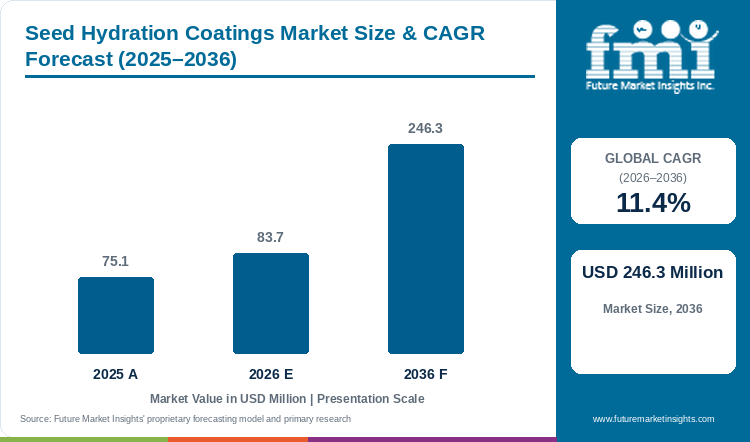
- Market Size (2026)
- USD 83.7 Mn
- Forecast (2036)
- USD 246.3 Mn
- CAGR (2026 to 2036)
- 11.4%
How big is Seed Hydration Coatings Market in 2026?
The seed hydration coatings market is estimated at USD 75.1 million in 2025 and is expected to reach USD 83.7 million in 2026. Sales of seed hydration coatings are forecast to grow at an 11.4% CAGR for the decade to 2036 and reach USD 246.3 million by 2036.
Sales of seed hydration coatings are highest in corn and cereal seed plants, which treat the largest lots before each planting window. The seed hydration coatings market, at USD 75.1 million in 2025, is expected at USD 83.7 million in 2026 and USD 246.3 million by 2036 as treaters add moisture layers to standard recipes. The largest seed volumes get the layer first. Field data show the scale, as US farmers planted 95.3 million acres of corn and 85.4 million acres of soybeans in 2026, USDA reported on 30 June 2026.[1] Such large seed lots, treated in a few weeks, favour coatings that dose as a slurry with the existing recipe.
Recent results point to steady seed enhancement orders. For instance, Croda (Incotec) reported 4% organic growth in Seed for January to June 2026, with Crop Protection down 2%.[2] In practice, for seed companies, a growing coatings supplier means more trial capacity and faster reformulation support, and a buyer can ask for moisture claims backed by local emergence data.
FMI data indicate that bio-based films will gain fastest, as European treaters replace synthetic polymer binders ahead of microplastic limits. Consequently, buyers that qualify a starch or cellulose coating early will avoid a rushed recipe change later.
Key Market Trends & Insights
- Synthetic polymers are expected to keep first place at 49.9% of 2026 coating material sales, as every treater line already handles acrylic and polyvinyl film binders. Starch and cellulose films follow near 30.2%, and clay carriers about 12.4%.
- Every bag of hybrid corn leaves the plant treated, so corn and cereals lead 2026 crop type sales at a likely 49%. Inoculant-safe coatings for soybean and pulses reach 21.5%, and pelleted vegetables 15.8%.
- Seed company plants are projected to cover 42% of treatment point sales in 2026, with commercial seed treaters at about 33.5%.
- Liquid slurry is estimated at 50.1% of formulation sales in 2026, as treaters add hydration polymers to the same tank as fungicides and colourants.
Regional Highlights
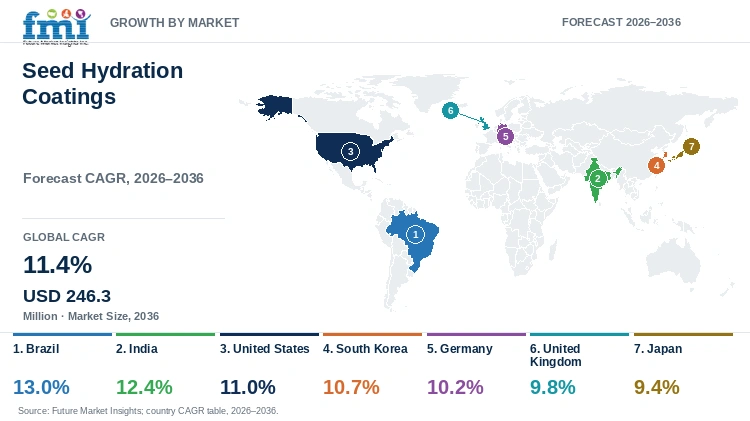
- Brazil is set for the fastest growth, at 13% in the FMI outlook, as soybean and second-crop corn areas expand on dry, hot soils.
- India, at 12.4%, also grows above the 11.4% global rate on erratic monsoon sowing. Growth in the United States is forecast at 11%, a little under the 11.4% figure for the seed hydration coatings market, as corn and soybean slurry recipes are already widespread. South Korea is projected at 10.7% on direct-seeded rice and Germany at 10.2% on winter cereals, and the United Kingdom and Japan expand more slowly, at 9.8% and 9.4%, on moist autumn drilling and tray-raised rice.
- Monsoon gaps are raising establishment risk in India. Paddy sowing in India fell 3.35% to 414.10 lakh hectares by 28 August 2026 amid deficient rains, Deccan Herald reported.[3] Late or patchy sowing after poor rains is the setting in which seed companies add a moisture-holding layer, so dry years bring forward trials in rice and pulses.
Market Size & Forecast
Table 1: Market Size and Forecast for the Seed Hydration Coatings Market (USD million and percentage), 2025 to 2036
| Metric | Value |
|---|---|
| 2025 Market Size | USD 75.1 million |
| Estimated Market Size in 2026 | USD 83.7 million |
| Projected Market Size by 2036 | USD 246.3 million |
| CAGR, 2026 to 2036 | 11.4% |
| Added Revenue, 2026 to 2036 | USD 162.6 million |
| Market Expansion Multiple | 2.9x |
Demand for seed hydration coatings grows lot by lot, as seed companies add a moisture-holding layer to recipes for crops sown into dry or unpredictable seedbeds. In Brazil, for instance, growers added about 1.3 million hectares of soybeans and 762.5 thousand hectares of corn in the 2025/26 season, Conab data show.[4] Much of that new area is sown into hot, dry seedbeds, so area growth in Brazil turns directly into treated seed volume. At the same time, hydration grades are gaining share inside each coating recipe, as the broader seed coating material market moves at only 5.9% CAGR. FMI analysis shows the seed hydration coatings market adding close to USD 162.6 million of sales between 2026 and 2036, so the 2036 figure equals nearly 2.9 times the 2026 base. On the other hand, a wet run of seasons in key cereal belts would slow trial-to-order conversion.
Field Crop Seed Lots, Specialty Crops and Bio-Based Films
Field crop seed lots carry most volume. In Europe, for example, Germany plans 6.03 million hectares of cereals for the 2026 harvest, up 1.8%, with winter wheat on 2.9 million hectares, top agrar reported from Destatis estimates.[5] A larger winter wheat area adds certified seed lots that pass through treaters each autumn. Likewise, the UK wheat area rose 9.1% to 1.7 million hectares in 2025.[6] Cereal seed companies treat in short autumn windows, so a hydration coating needs to flow through the treater without slowing the line.
Specialty crops pay more per unit of seed. Among these, Germains Seed Technology said Xbeet enrich 400, which adds rhizobacteria to primers, nutrients and biostimulants, raises sugar beet yields by 2%, or 1.5 t/ha for a 75 t/ha grower.[7] A yield claim of that size lets beet seed suppliers charge more for multi-layer packages, which leaves room for a hydration layer. Research is also widening the choice of bio-based materials. Meanwhile, researchers at Al-Farabi Kazakh National University patented a coating of polymer hydrogel, clay, rice husk ash and starch that let coated seeds of rapeseed, tomato and sugar beet sprout within 7 to 8 days.[8] As a result, bio-based films will move first into vegetable and beet seed, as coating cost is small next to seed value.
Table 2: Crop Area and Seed Enhancement Indicators for the Seed Hydration Coatings Market (area, yield and growth), 2025 to 2026
| Indicator | Data Point | Relevance | Source |
|---|---|---|---|
| US corn and soybean area, 2026 | 95.3 million and 85.4 million acres | Seed lots for slurry coatings | [1] |
| Croda Seed organic growth, H1 2026 | Up 4% | Seed enhancement orders | [2] |
| Brazil soybean area change, 2025/26 | Up 1.3 million hectares | Seed lots in hot, dry seedbeds | [4] |
| Germany cereal area, 2026 harvest | 6.03 million hectares; up 1.8% | Cereal seed treatment volume | [5] |
| UK wheat area, 2025 | 1.7 million hectares; up 9.1% | Autumn-sown seed treatment | [6] |
| Germains Xbeet enrich 400, 2025 | 2% yield gain claimed | Premium beet seed packages | [7] |
| South Korea rice area, 2026 | 670,000 hectares; down 1.1% | Direct-seeded rice establishment | [9] |
Analyst Perspective
“Seed companies buy a hydration coating to protect establishment on the first rain, and a coating that also slows germination or blocks oxygen gets dropped after one season. The products that will scale are those that pass the treater line, the storage test and the field emergence test together. I expect bio-based films to take over in vegetable and beet seed first, giving starch and cellulose binders a foothold at European treaters.”
- Nikhil Kaitwade, Principal Consultant, Future Market Insights.
How is the seed hydration coatings market segmented?
The market is segmented into coating material, crop type, treatment point, formulation, and region. Synthetic polymers are expected to lead coating material with 49.9% share in 2026, and corn and cereals lead crop type with 49%.
By coating material: synthetic polymers, bio-based polymers, mineral carriers, and others.
By crop type: corn and cereals, soybean and pulses, vegetables, and other crops.
By treatment point: seed company plants, commercial seed treaters, and on-farm treatment.
By formulation: liquid slurry, dry powder, and encrusting and pelleting blends.
By region: field crop, vegetable and specialty seed buyers in North America, Latin America, Western Europe, Eastern Europe, East Asia, South Asia and Pacific, and Middle East and Africa.
Why do synthetic polymers lead seed hydration coatings sales by coating material?
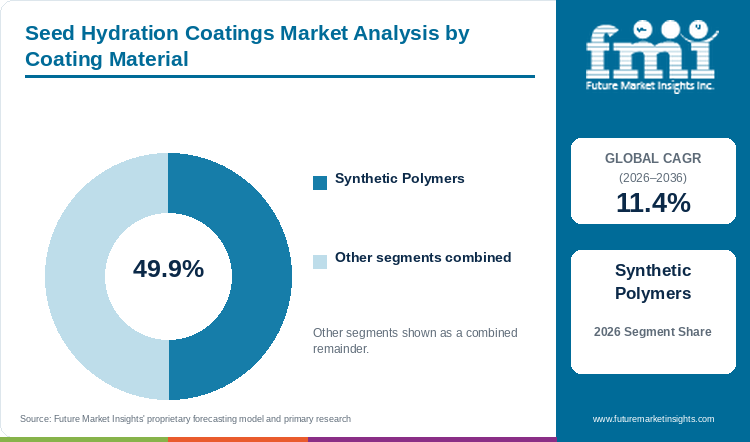
Synthetic polymers are expected to lead coating material sales with 49.9% share in 2026, ahead of bio-based polymers at about 30.2% and mineral carriers at an estimated 12.4%.
Table 3: Coating Material Share for the Seed Hydration Coatings Market (percentage share), 2026
| Coating Material | Estimated Share (2026) |
|---|---|
| Synthetic Polymers | 49.9% |
| Bio-Based Polymers | 30.2% |
| Mineral Carriers | 12.4% |
| Others | 7.5% |
| Total | 100.0% |
Table 4: Coating Material Leadership and Market Growth for the Seed Hydration Coatings Market (segment and CAGR percentage), 2026 to 2036
| Metric | Value |
|---|---|
| Global CAGR (2026 to 2036) | 11.4% |
| Leading Segment | Synthetic Polymers |
Treaters know how acrylic and polyvinyl films behave on dust-off and flow, so synthetic polymers will keep the coating material lead at 49.9% in 2026. Bio-based polymers, near 30.2%, use starch, cellulose and chitosan hydrogels that hold water and break down in soil, and chitosan films alone have a 6.5% CAGR outlook in the chitosan-based seed coatings market. Mineral carriers, by comparison, at about 12.4%, use bentonite, zeolite and clay to buffer moisture around the seed. Other materials, at 7.5%, include humic and superabsorbent blends. Over the forecast period, as EU microplastic limits approach, bio-based polymers will take share from synthetic binders.
- Acrylic, polyvinyl and polyurethane dispersions make up most synthetic polymer volume.
- University research is adding bio-based options for hydration films. KazNU researchers reported a patented hydrogel, clay and starch seed coating in November 2025.[8] A starch and clay system of this kind gives European treaters a candidate to replace synthetic binders before microplastic limits apply.
Why do corn and cereals lead seed hydration coatings sales by crop type?
Corn and cereals are likely to lead crop type sales with 49% share in 2026, with soybean and pulses at about 21.5% and vegetables at roughly 15.8%.
Table 5: Crop Type Share for the Seed Hydration Coatings Market (percentage share), 2026
| Crop Type | Estimated Share (2026) |
|---|---|
| Corn and Cereals | 49% |
| Soybean and Pulses | 21.5% |
| Vegetables | 15.8% |
| Other Crops | 13.7% |
| Total | 100.0% |
Every bag of hybrid corn and most certified cereal seed is treated before sale, so corn and cereals are projected to lead crop type sales at 49% in 2026. On scale alone, US corn plantings of 95.3 million acres in 2026 alone keep treater lines busy each planting season.[1] That volume makes corn the first crop in which a hydration add-on reaches scale. Soybean and pulses, about 21.5%, in contrast need coatings that do not harm rhizobia inoculants. Vegetables, an estimated 15.8%, use pelleted and film-coated seed for precision drills, and the smart seed coatings market covers the triggered-release films used there. Other crops, at 13.7%, include sugar beet, rice and cotton.
- Hybrid corn, winter wheat and barley seed make up most cereal volume.
- Soybean area is growing faster than corn in the United States. US soybean plantings rose 5% to 85.4 million acres in 2026.[1] More soybean acres raise demand for coatings that leave rhizobia inoculants unharmed.
Why do seed company plants lead seed hydration coatings sales by treatment point?
Seed company plants are projected to lead treatment point sales with 42% share in 2026, ahead of commercial seed treaters at an estimated 33.5% and on-farm treatment at about 24.5%.
Table 6: Treatment Point Share for the Seed Hydration Coatings Market (percentage share), 2026
| Treatment Point | Estimated Share (2026) |
|---|---|
| Seed Company Plants | 42% |
| Commercial Seed Treaters | 33.5% |
| On-Farm Treatment | 24.5% |
| Total | 100.0% |
Large seed companies apply a fixed recipe to each variety in company plants, test germination after storage and print the treatment on the bag, so seed company plants will lead treatment point sales at 42% in 2026. Behind them, commercial seed treaters, near 33.5%, serve retailers and cooperatives with custom recipes close to planting. On-farm treatment, about 24.5%, covers farm-saved cereal and pulse seed treated through mobile units. In the years ahead, hydration coatings will grow fastest at seed company plants, since one approval covers millions of units.
- Hybrid corn, vegetable and sugar beet seed is treated almost entirely in company plants.
- Coating specialists that supply company plants are growing. Croda (Incotec) reported 4% organic growth in Seed in H1 2026.[2] Growth at a supplier to seed company plants supports the lead of that treatment point through the forecast period.
Why does liquid slurry lead seed hydration coatings sales by formulation?
Liquid slurry is estimated to lead formulation sales with 50.1% share in 2026, ahead of dry powder at about 27.6% and encrusting and pelleting blends at 22.3%.
Table 7: Formulation Share for the Seed Hydration Coatings Market (percentage share), 2026
| Formulation | Estimated Share (2026) |
|---|---|
| Liquid Slurry | 50.1% |
| Dry Powder | 27.6% |
| Encrusting and Pelleting Blends | 22.3% |
| Total | 100.0% |
Most treaters meter one slurry that carries the fungicide, colourant and polymer together, so liquid slurry will lead formulation sales at 50.1% in 2026. Dry powder, near 27.6%, plays a different role and is used as a finishing layer to improve flow and as a planter-box additive. Encrusting and pelleting blends, about 22.3%, build up small vegetable and beet seed for precision drilling and can carry nutrients as well, a nutrient role covered by the seed nutrient coatings market, expected to grow at an 11.3% CAGR. For example, Germains added primers, nutrients and rhizobacteria to the Xbeet enrich 400 beet package.[7] Multi-layer packages of this kind raise the value of each pelleted seed and favour blends that carry several functions.
- Low-viscosity polymer dispersions that mix with crop protection slurries lead liquid volume.
- Suppliers are using trial data to sell premium beet packages. Germains offers a sugar beet seed calculator that turns UK trial data into yield and return estimates.[7] Return estimates shown to growers make higher-priced encrusted seed easier to justify.
What are the drivers, restraints, and opportunities in the seed hydration coatings market?
Uneven soil moisture at sowing pushes seed companies to protect early establishment. Oxygen and germination trade-offs, plus treater line compatibility, slow approval, and biodegradable films for microplastic-free seed open new demand.
- Driver: Shallow sowing, dry seedbeds and erratic first rains make each emergence failure costly, so seed companies look for a coating that keeps water near the seed.
- Restraint: A swollen coating can cut oxygen to the embryo or slow germination, and every new layer has to pass flow, dust and storage tests.
- Opportunity: Starch, cellulose and mineral films that hold water and break down in soil fit European rules on synthetic polymer microparticles.
Dry Seedbeds Raise the Value of Early Establishment
Seed companies sell establishment as much as genetics, and a failed crop establishment costs a replant. Evidence of this risk comes from India, as farmers had sown 1,071.1 lakh hectares of kharif crops by 28 August 2026, against 1,091 lakh hectares at the same point of 2025, with rice down 3.35% amid deficient rains.[3] A shortfall of that size after weak rains raises the value of seed that establishes on the first moisture. Area growth adds to the exposed acreage. In addition, Brazil expanded soybean and corn areas into the 2025/26 season.[4] In turn, each dry sowing window adds a reason to trial moisture-holding coatings.
Germination and Line Tests Slow Approval
Approval is slow, and in FMI's view treater line tests weigh as heavily as field results. In particular, a hydrogel layer that swells too far can starve the embryo of oxygen, and a sticky film can bridge in the treater or clog a planter. To manage this, Germains has run Xbeet demonstration trials on a UK farm for at least five years.[7] Trial programmes of that length show the long lead time before a new layer reaches commercial seed. Most seed companies will therefore run at least two seasons of storage and emergence tests before a full switch.
Biodegradable Films Open European Demand
European seed treaters face a deadline to replace persistent polymer binders, and that opens orders for bio-based films. Early work is promising, and the KazNU team patented a starch, clay and hydrogel coating that holds enough moisture for weekly watering in trials.[8] A film that holds water and breaks down in soil meets both the agronomic and the regulatory test. Commercially, Croda (Incotec) grew Seed sales 4% in the first half of 2026 against weaker crop protection.[2] Therefore, suppliers with a tested biodegradable hydration film will gain first approvals at European beet, vegetable and cereal seed plants.
Which country CAGRs are profiled in the seed hydration coatings market?
Table 8: Country CAGR Comparison for the Seed Hydration Coatings Market (CAGR percentage), 2026 to 2036
| Country | CAGR (2026 to 2036) |
|---|---|
| Brazil | 13% |
| India | 12.4% |
| United States | 11% |
| South Korea | 10.7% |
| Germany | 10.2% |
| United Kingdom | 9.8% |
| Japan | 9.4% |
How do country-level CAGRs compare in the seed hydration coatings market?
Brazil heads the seven countries at 13%, as soybean and second-crop corn spread on hot, dry soils. India follows at 12.4%, as monsoon delays raise the cost of patchy crop establishment. Next, FMI data indicate 11% for the United States, as large corn and soybean lots there already carry slurry coatings, a touch slower than the 11.4% seed hydration coatings rate. South Korea (10.7%) and Germany (10.2%) are half a point apart, one driven by direct-seeded rice and the other by winter cereals. Lower down, the United Kingdom is forecast at 9.8% on damp autumn seedbeds, and Japan, at 9.4%, is slowest, as most paddies are planted with nursery-raised seedlings.
- Safrinha corn in Brazil is sown into drying soils right after the soybean harvest, so establishment risk is highest on the fastest-growing area. Seed companies serving those fields are the first large buyers of hydration layers.
- Erratic monsoon onset in India delays and thins kharif sowing, pushing hybrid rice and cotton seed firms toward protective coatings. Suppliers that price for in-house treaters at Indian seed companies can scale quickly.
- US corn and soybean seed already carries slurry recipes, so hydration polymers enter as a low-cost add-on. Volume gains come from coverage of more lots, and suppliers compete on tank compatibility.
- Labour shortages are moving Korean rice growers to direct seeding, which needs seed that establishes fast in flooded fields. Coating suppliers with rice-specific films gain a new outlet there.
- EU limits on synthetic polymer microparticles force German cereal treaters to test biodegradable binders early. First approvals there could set the standard for other EU seed plants.
- Damp autumn drilling limits the need for moisture layers on UK wheat, so early use is concentrated in premium sugar beet packages. Suppliers selling bundled beet seed treatments have the clearest route in.
- Most Japanese rice is transplanted from nursery trays, leaving direct seeding, and coated seed, a small niche. Cold, flooded fields also narrow the materials that work, which keeps the supplier field small.
Full report country CAGRs cover: seven rates in all, led by Brazil and India on dry-season sowing risk, followed by the corn-heavy United States, then rice and cereal markets in South Korea, Germany, the United Kingdom and Japan, plus regional rates for the remaining standard countries.
Country-wise Analysis
Brazil Seed Hydration Coatings Market Outlook (2026 to 2036)
Brazilian crop area keeps expanding into drier land. Conab put Brazil's 2025/26 cultivated area at 83.5 million hectares, with soybeans up 2.7% and corn up 3.5%, in a September 2026 estimate reported by Revista Cultivar.[4] Above all, much of the new area is second-crop corn sown into drying soils after soybean harvest. As a result, seed hydration coatings in Brazil carry a 13% CAGR outlook, the fastest of the seven countries, as seed companies serve those safrinha fields.
Key takeaway: Safrinha corn on drying soils makes Brazil the fastest-growing country.
India Seed Hydration Coatings Market Outlook (2026 to 2036)
Weak monsoon rains are delaying sowing across India. Kharif sowing in India lagged in 2026, with rice acreage down 3.35% by late August as deficient rains hit Karnataka, Telangana, Jharkhand and Madhya Pradesh.[3] In response, hybrid rice, cotton and vegetable seed companies treat seed in-house and can add a hydration layer to protect seedlings after delayed rain. Over time, repeated monsoon gaps strengthen the case for coated seed, and India is placed at 12.4% for seed hydration coatings, ahead of the 11.4% global rate.
Key takeaway: Monsoon risk raises demand in India.
United States Seed Hydration Coatings Market Outlook (2026 to 2036)
Shifts between corn and soybean acres change the seed mix US treaters handle. USDA estimated 2026 corn plantings at 95.3 million acres, down 3%, and soybeans at 85.4 million acres, up 5%.[1] Seed companies there treat nearly all corn and most soybean seed in company plants with slurry recipes, so a hydration polymer is an add-on to an existing step. On FMI's forecast, demand for seed hydration coatings in the United States grows at 11%, as the add-on reaches more hybrid corn lots each season.
Key takeaway: US growth comes from slurry add-ons on large corn and soybean lots.
South Korea Seed Hydration Coatings Market Outlook (2026 to 2036)
Korean rice farming is shrinking and changing method. South Korea's rice area fell 1.1% to 670,000 hectares in 2026, the Ministry of Data and Statistics said in October 2026.[9] Alongside this, with fewer hectares and an older farm workforce, growers lean toward direct seeding, and coated seed for that method needs to float less and establish faster in flooded fields. Consequently, a 10.7% CAGR is expected for seed hydration coatings in South Korea as direct seeding spreads.
Key takeaway: Direct seeding opens a coated-seed outlet in Korean paddies.
Germany Seed Hydration Coatings Market Outlook (2026 to 2036)
German cereal area is stable to rising. German farmers plan 6.03 million hectares of cereals for 2026, and winter wheat covers 48% of that area.[5] Winter wheat on that scale gives treaters a large, recurring autumn seed volume. Besides this, seed treaters there face the EU limits on synthetic polymer microparticles, which push early trials of biodegradable films. With early movers trialling microplastic-free films, growth of seed hydration coatings in Germany is projected at 10.2%, a little behind the 11.4% overall pace.
Key takeaway: New film rules make German cereal treaters early testers.
United Kingdom Seed Hydration Coatings Market Outlook (2026 to 2036)
UK cereal seed volumes are recovering. The UK wheat area rose 9.1% to 1.7 million hectares in 2025 on better autumn drilling, Defra reported.[6] A larger wheat area adds treated seed volume for autumn treaters. At the same time, Germains targets UK sugar beet growers with Xbeet enrich 400, which claims a 2% yield gain.[7] Premium beet packages are the likeliest first home for hydration layers in the United Kingdom. With moist autumn seedbeds in most seasons, the UK outlook for seed hydration coatings is more modest, at a 9.8% CAGR.
Key takeaway: Beet seed packages lead early use in the United Kingdom.
Japan Seed Hydration Coatings Market Outlook (2026 to 2036)
Japanese rice growers mostly transplant seedlings raised in nursery trays, and direct seeding with iron-coated seed covers a small share of paddy area. Seed coatings there also need to work in cold, flooded fields, which narrows the choice of materials. For these reasons, in FMI's estimate, demand for seed hydration coatings in Japan rises at a 9.4% CAGR, the slowest pace of the seven countries.
Key takeaway: Transplanting habits slow Japan.
Who are the notable companies in the seed hydration coatings market?
Bayer, Syngenta, Corteva Agriscience, BASF, Germains Seed Technology, Croda (Incotec), Centor Group and Precision Laboratories are the profiled companies.
FMI analysis shows seed and crop protection groups with treatment platforms, coating polymer makers and seed enhancement specialists competing in the market. Among these, Seed organic sales at Croda (Incotec) grew 4% in January to June 2026.[2] Steady growth at a dedicated coating specialist shows seed enhancement holding up as crop protection weakens. Specialists are also selling on yield claims. Similarly, Germains Seed Technology markets Xbeet enrich 400 to UK beet growers with a claimed 2% yield gain.[7] Yield-backed packages give specialists pricing power over generic film suppliers. Bayer, Syngenta, Corteva Agriscience, BASF, Centor Group and Precision Laboratories complete the group.
- Seed and crop protection groups with treatment platforms: Bayer, Syngenta and Corteva Agriscience.
- Coating chemistry and seed enhancement specialists: BASF, Germains Seed Technology and Croda (Incotec).
- Seed film and water management formulators: Centor Group and Precision Laboratories.
Competitive Benchmarking: Seed Hydration Coatings Market
Table 9: Competitive Benchmarking for the Seed Hydration Coatings Market (qualitative ratings), 2026
| Company | Water Management | Film Coatings | Treater Integration | Recent Activity |
|---|---|---|---|---|
| Precision Laboratories | High | High | High | Low |
| Croda (Incotec) | Medium | High | High | High |
| Germains Seed Technology | Medium | Medium | High | High |
| BASF | Low | High | High | Low |
| Syngenta | Low | High | High | Low |
Ratings compare the companies on water management, film coatings, treater integration and recent activity.
Key Developments in the Seed Hydration Coatings Market
- South Korean data released on 8 October 2026 showed the rice area falling 1.1% to 670,000 hectares in 2026, adding pressure to move toward labour-saving direct seeding.[9]
- Conab put the 2025/26 Brazilian grain crop at 361.7 million tonnes, up 2.6%, in the estimate of 15 September 2026, pointing to larger seed lots for the next planting.[4]
- Indian rice sowing was reported 3.35% lower amid deficient rains on 31 August 2026; for seed companies this strengthens the case for protective coatings in kharif crops.[3]
- In half-year results of 28 July 2026, Croda (Incotec) showed Seed up 4% on an organic basis, ahead of Crop Protection, a sign that seed enhancement demand holds through weaker farm cycles.[2]
- On 30 June 2026, USDA reported 2026 corn plantings of 95.3 million acres and soybeans of 85.4 million acres, a mix that tilts treater demand toward soybean-safe coatings.[1]
- Destatis estimates put the German cereal area at 6.03 million hectares for 2026, according to top agrar on 19 May 2026, which keeps autumn treater volumes high.[5]
- On 21 November 2025, Al-Farabi Kazakh National University reported a patented hydrogel and starch seed coating, adding a bio-based option for treaters facing microplastic limits.[8]
- Germains Seed Technology set out Xbeet enrich 400 for UK sugar beet, according to Farmers Guide on 10 August 2025, a package that raises the value of each treated beet seed.[7]
Key Players in the Seed Hydration Coatings Market
Seed and Crop Protection Groups
- Bayer
- Syngenta
- Corteva Agriscience
Coating Chemistry and Seed Enhancement Specialists
- BASF
- Germains Seed Technology
- Croda (Incotec)
Seed Film and Water Management Formulators
- Centor Group
- Precision Laboratories
Seed Hydration Coatings Market - Report Scope
Table 10: Report Scope for the Seed Hydration Coatings Market (coverage fields and definitions), 2026 to 2036
| Coverage field | Report scope |
|---|---|
| Market breakdown | Coating material; crop type; treatment point; formulation; region |
| Quantitative units | USD million |
| Market definition | Seed-applied coating materials whose main function is to hold or regulate water at the seed surface during imbibition and emergence, including polymer, bio-based and mineral films sold to seed companies, commercial treaters and farms. Treated seed value, crop protection actives, colourants without a water function and treatment equipment are excluded. |
| Regions covered | North America; Latin America; Western Europe; Eastern Europe; East Asia; South Asia and Pacific; Middle East and Africa |
| Countries covered | United States; Canada; Brazil; Mexico; Argentina; Chile; Germany; France; United Kingdom; Italy; Spain; Benelux; Nordics; Poland; Czech Republic; Romania; Hungary; China; Japan; South Korea; India; ASEAN; Australia and New Zealand; GCC Countries; South Africa; Türkiye; Israel |
| Key companies profiled | Bayer, Syngenta, Corteva Agriscience, BASF, Germains Seed Technology, Croda (Incotec), Centor Group, Precision Laboratories |
| Forecast period | 2026 to 2036 |
Seed Hydration Coatings Market - Research Methodology
Table 11: Research Methodology for the Seed Hydration Coatings Market (research methods and approach), 2026 edition
| Method | Approach |
|---|---|
| Data Sources | Company results, industry associations, government statistics and trade publications. |
| Desk Research | Desk research covers seed treatment practice, crop areas, sowing conditions, coating materials and microplastic rules. |
| Market Sizing and Forecasting | Sizing starts from the 2026 base of USD 83.7 million and the 11.4% CAGR for 2026 to 2036. |
| Data Validation | Figures are cross-checked across company, industry and government sources. |
Seed Hydration Coatings Market by Segments
Seed Hydration Coatings Market segmented by Coating Material:
- Synthetic Polymers
- Bio-Based Polymers
- Mineral Carriers
- Others
Seed Hydration Coatings Market segmented by Crop Type:
- Corn and Cereals
- Soybean and Pulses
- Vegetables
- Other Crops
Seed Hydration Coatings Market segmented by Treatment Point:
- Seed Company Plants
- Commercial Seed Treaters
- On-Farm Treatment
Seed Hydration Coatings Market segmented by Formulation:
- Liquid Slurry
- Dry Powder
- Encrusting and Pelleting Blends
Seed Hydration Coatings Market by Region
- North America
- United States
- Canada
- Latin America
- Brazil
- Mexico
- Argentina
- Chile
- Western Europe
- Germany
- France
- United Kingdom
- Italy
- Spain
- Benelux
- Nordics
- Eastern Europe
- Poland
- Czech Republic
- Romania
- Hungary
- East Asia
- China
- Japan
- South Korea
- South Asia and Pacific
- India
- ASEAN
- Australia and New Zealand
- Middle East and Africa
- GCC Countries
- South Africa
- Türkiye
- Israel
Research Sources and Bibliography
- [1] U.S. Department of Agriculture, National Agricultural Statistics Service. (2026, June 30). Corn planted acreage down 3% from 2025, soybean acreage up 5% from last year. https://www.nass.usda.gov/Newsroom/2026/06-30-2026.php
- [2] Croda International Plc. (2026, July 28). Results for the six months ended 30 June 2026. https://www.croda.com/en-gb/media-hub/news/general/2026-half-year-results
- [3] Deccan Herald. (2026, August 31). Paddy sowing declines 3.35% in Kharif season amid deficient rains. https://www.deccanherald.com/india/paddy-sowing-declines-335-in-kharif-season-amid-deficient-rains-4130614
- [4] Revista Cultivar. (2026, September 15). Conab eleva safra 2025/26 a 361,7 milhões de toneladas. https://revistacultivar.com.br/noticias/conab-eleva-safra-2025-26-a-361-7-milhoes-de-toneladas
- [5] top agrar. (2026, May 19). Getreideanbaufläche 2026 hat sich nach Tiefststand von 2024 weiter stabilisiert. https://www.topagrar.com/acker/news/getreideanbauflache-2026-hat-sich-nach-tiefststand-von-2024-weiter-stabilisiert-20025570.html
- [6] Department for Environment, Food & Rural Affairs. (2025, December 11). Agricultural Land Use in United Kingdom at 1 June 2025. https://www.gov.uk/government/statistics/agricultural-land-use-in-the-united-kingdom/agricultural-land-use-in-united-kingdom-at-1-june-2025
- [7] Farmers Guide. (2025, August 10). Enrich beet yields with latest innovations in seed technology. https://www.farmersguide.co.uk/?p=111494
- [8] Al-Farabi Kazakh National University. (2025, November 21). KazNU scientists have developed an effective way to protect seeds. https://farabi.university/news/100157?lang=en
- [9] The Korea Times. (2026, October 8). Korea's rice production projected to fall 0.6% in 2026: data ministry. https://www.koreatimes.co.kr/southkorea/20261008/koreas-rice-production-projected-to-fall-06-in-2026-data-ministry
This bibliography is provided for reader reference. The full report contains the complete reference list and detailed citations.
This Report Answers
- How big is the seed hydration coatings market during 2026?
- What market size is projected by 2036?
- Which coating material holds notable share?
- Which crop type holds notable share?
- Which countries have notable growth?
- Which companies are notable in the market?
Frequently Asked Questions
How large is the seed hydration coatings market expected in 2026?
The seed hydration coatings market is estimated at USD 83.7 million in 2026 by FMI, up from USD 75.1 million in 2025. Sales of seed hydration coatings are projected to reach USD 246.3 million by 2036.
What CAGR is projected for the seed hydration coatings market through 2036?
Sales of seed hydration coatings are expected to grow at an 11.4% CAGR through 2036. Dry sowing windows, bigger treated seed lots and the move to biodegradable films carry that growth.
Which coating material holds a notable market share in 2026?
Synthetic polymers will lead with 49.9% share in 2026. Bio-based polymers follow at about 30.2%.
Which crop type holds a notable market share in 2026?
Corn and cereals are likely to lead with 49% share. Soybean and pulses follow at an estimated 21.5%.
Which country has a notable expansion outlook through 2036?
FMI projects Brazil to grow fastest, at a 13% CAGR. India follows at 12.4%.
Who are the key companies in the seed hydration coatings market?
Bayer, Syngenta and Corteva Agriscience lead the seed and crop protection groups, and BASF, Germains Seed Technology and Croda (Incotec) lead the coating specialists. Centor Group and Precision Laboratories complete the company group.
Preview the report firsthand - request a free sample
Get SampleGet the brochure for pricing and purchase details.
Get PDFTable of Content
- Key Takeaways
- Market Size and CAGR
- Top Growth Driver
- Fastest Growing Segment
- Leading Region
- Key Companies
- Emerging Opportunities
- Executive Summary
- Global Market Outlook
- Demand-side Trends
- Supply-side Trends
- Technology Roadmap Analysis
- Analysis and Recommendations
- Analyst Perspective (What is happening? Why now? What should investors know?)
- Key Questions Answered
- How large is the market?
- What is the CAGR?
- What are key trends?
- Which region dominates?
- Who are the leaders?
- Market Overview
- Market Coverage / Taxonomy
- Market Definition / Scope / Limitations
- Research Methodology
- Chapter Orientation
- Analytical Lens and Working Hypotheses
- Market Structure, Signals, and Trend Drivers
- Benchmarking and Cross-market Comparability
- Market Sizing, Forecasting, and Opportunity Mapping
- Research Design and Evidence Framework
- Desk Research Programme (Secondary Evidence)
- Expert Input and Fieldwork (Primary Evidence)
- Tooling, Models, and Reference Databases
- Data Engineering and Model Build
- Quality Assurance and Audit Trail
- Market Background
- Market Dynamics (Drivers, Restraints, Opportunity, Trends)
- Scenario Forecast (Optimistic, Likely, Conservative)
- Impact Analysis
- AI Impact
- Sustainability Impact
- Regulatory Impact
- Technology Impact
- Consumer / Buyer Analysis
- Purchase Drivers
- Adoption Barriers
- Buyer Journey
- Opportunity Map Analysis
- Product Life Cycle Analysis
- Supply Chain Analysis
- Investment Feasibility Matrix
- Value Chain Analysis
- PESTLE and Porter's Analysis
- Regulatory Landscape
- Regional Parent Market Outlook
- Production and Consumption Statistics
- Import and Export Statistics
- Global Market Analysis and Forecast, 2021 to 2036
- Historical Market Size Value (USD Million) Analysis, 2021 to 2025
- Current and Future Market Size Value (USD Million) Projections, 2026 to 2036
- Y-o-Y Growth Trend Analysis
- Absolute $ Opportunity Analysis
- Global Market Pricing Analysis, 2021 to 2036
- Global Market Analysis and Forecast, By Coating Material, 2021 to 2036
- Introduction / Key Findings
- Historical Market Size Value (USD Million) Analysis By Coating Material, 2021 to 2025
- Current and Future Market Size Value (USD Million) Analysis and Forecast By Coating Material, 2026 to 2036
- Synthetic Polymers
- Bio-Based Polymers
- Mineral Carriers
- Others
- Y-o-Y Growth Trend Analysis By Coating Material, 2021 to 2025
- Absolute $ Opportunity Analysis By Coating Material, 2026 to 2036
- Global Market Analysis and Forecast, By Crop Type, 2021 to 2036
- Introduction / Key Findings
- Historical Market Size Value (USD Million) Analysis By Crop Type, 2021 to 2025
- Current and Future Market Size Value (USD Million) Analysis and Forecast By Crop Type, 2026 to 2036
- Corn and Cereals
- Soybean and Pulses
- Vegetables
- Other Crops
- Y-o-Y Growth Trend Analysis By Crop Type, 2021 to 2025
- Absolute $ Opportunity Analysis By Crop Type, 2026 to 2036
- Global Market Analysis and Forecast, By Treatment Point, 2021 to 2036
- Introduction / Key Findings
- Historical Market Size Value (USD Million) Analysis By Treatment Point, 2021 to 2025
- Current and Future Market Size Value (USD Million) Analysis and Forecast By Treatment Point, 2026 to 2036
- Seed Company Plants
- Commercial Seed Treaters
- On-Farm Treatment
- Y-o-Y Growth Trend Analysis By Treatment Point, 2021 to 2025
- Absolute $ Opportunity Analysis By Treatment Point, 2026 to 2036
- Global Market Analysis and Forecast, By Formulation, 2021 to 2036
- Introduction / Key Findings
- Historical Market Size Value (USD Million) Analysis By Formulation, 2021 to 2025
- Current and Future Market Size Value (USD Million) Analysis and Forecast By Formulation, 2026 to 2036
- Liquid Slurry
- Dry Powder
- Encrusting and Pelleting Blends
- Y-o-Y Growth Trend Analysis By Formulation, 2021 to 2025
- Absolute $ Opportunity Analysis By Formulation, 2026 to 2036
- Global Market Analysis and Forecast, By Region, 2021 to 2036
- Introduction
- Historical Market Size Value (USD Million) Analysis By Region, 2021 to 2025
- Current Market Size Value (USD Million) Analysis and Forecast By Region, 2026 to 2036
- North America
- Latin America
- Western Europe
- Eastern Europe
- East Asia
- South Asia and Pacific
- Middle East and Africa
- Market Attractiveness Analysis By Region
- North America Market Analysis and Forecast, By Country, 2021 to 2036
- Historical Market Size Value (USD Million) Trend Analysis By Market Taxonomy, 2021 to 2025
- Market Size Value (USD Million) Forecast By Market Taxonomy, 2026 to 2036
- By Country
- United States
- Canada
- By Coating Material
- By Crop Type
- By Treatment Point
- By Formulation
- By Country
- Market Attractiveness Analysis
- By Country
- By Coating Material
- By Crop Type
- By Treatment Point
- By Formulation
- Key Takeaways
- Latin America Market Analysis and Forecast, By Country
- Historical Market Size Value (USD Million) Trend Analysis By Market Taxonomy, 2021 to 2025
- Market Size Value (USD Million) Forecast By Market Taxonomy, 2026 to 2036
- By Country
- Brazil
- Mexico
- Argentina
- Chile
- By Coating Material
- By Crop Type
- By Treatment Point
- By Formulation
- By Country
- Market Attractiveness Analysis
- By Country
- By Coating Material
- By Crop Type
- By Treatment Point
- By Formulation
- Key Takeaways
- Western Europe Market Analysis and Forecast, By Country
- Historical Market Size Value (USD Million) Trend Analysis By Market Taxonomy, 2021 to 2025
- Market Size Value (USD Million) Forecast By Market Taxonomy, 2026 to 2036
- By Country
- Germany
- France
- United Kingdom
- Italy
- Spain
- Benelux
- Nordics
- By Coating Material
- By Crop Type
- By Treatment Point
- By Formulation
- By Country
- Market Attractiveness Analysis
- By Country
- By Coating Material
- By Crop Type
- By Treatment Point
- By Formulation
- Key Takeaways
- Eastern Europe Market Analysis and Forecast, By Country
- Historical Market Size Value (USD Million) Trend Analysis By Market Taxonomy, 2021 to 2025
- Market Size Value (USD Million) Forecast By Market Taxonomy, 2026 to 2036
- By Country
- Poland
- Czech Republic
- Romania
- Hungary
- By Coating Material
- By Crop Type
- By Treatment Point
- By Formulation
- By Country
- Market Attractiveness Analysis
- By Country
- By Coating Material
- By Crop Type
- By Treatment Point
- By Formulation
- Key Takeaways
- East Asia Market Analysis and Forecast, By Country
- Historical Market Size Value (USD Million) Trend Analysis By Market Taxonomy, 2021 to 2025
- Market Size Value (USD Million) Forecast By Market Taxonomy, 2026 to 2036
- By Country
- China
- Japan
- South Korea
- By Coating Material
- By Crop Type
- By Treatment Point
- By Formulation
- By Country
- Market Attractiveness Analysis
- By Country
- By Coating Material
- By Crop Type
- By Treatment Point
- By Formulation
- Key Takeaways
- South Asia and Pacific Market Analysis and Forecast, By Country
- Historical Market Size Value (USD Million) Trend Analysis By Market Taxonomy, 2021 to 2025
- Market Size Value (USD Million) Forecast By Market Taxonomy, 2026 to 2036
- By Country
- India
- ASEAN
- Australia and New Zealand
- By Coating Material
- By Crop Type
- By Treatment Point
- By Formulation
- By Country
- Market Attractiveness Analysis
- By Country
- By Coating Material
- By Crop Type
- By Treatment Point
- By Formulation
- Key Takeaways
- Middle East and Africa Market Analysis and Forecast, By Country
- Historical Market Size Value (USD Million) Trend Analysis By Market Taxonomy, 2021 to 2025
- Market Size Value (USD Million) Forecast By Market Taxonomy, 2026 to 2036
- By Country
- GCC Countries
- South Africa
- Türkiye
- Israel
- By Coating Material
- By Crop Type
- By Treatment Point
- By Formulation
- By Country
- Market Attractiveness Analysis
- By Country
- By Coating Material
- By Crop Type
- By Treatment Point
- By Formulation
- Key Takeaways
- Key Countries Market Analysis
- United States
- Pricing Analysis
- Market Share Analysis, 2025
- By Coating Material
- By Crop Type
- By Treatment Point
- By Formulation
- Canada
- Pricing Analysis
- Market Share Analysis, 2025
- By Coating Material
- By Crop Type
- By Treatment Point
- By Formulation
- Mexico
- Pricing Analysis
- Market Share Analysis, 2025
- By Coating Material
- By Crop Type
- By Treatment Point
- By Formulation
- Brazil
- Pricing Analysis
- Market Share Analysis, 2025
- By Coating Material
- By Crop Type
- By Treatment Point
- By Formulation
- Chile
- Pricing Analysis
- Market Share Analysis, 2025
- By Coating Material
- By Crop Type
- By Treatment Point
- By Formulation
- Germany
- Pricing Analysis
- Market Share Analysis, 2025
- By Coating Material
- By Crop Type
- By Treatment Point
- By Formulation
- United Kingdom
- Pricing Analysis
- Market Share Analysis, 2025
- By Coating Material
- By Crop Type
- By Treatment Point
- By Formulation
- Italy
- Pricing Analysis
- Market Share Analysis, 2025
- By Coating Material
- By Crop Type
- By Treatment Point
- By Formulation
- Spain
- Pricing Analysis
- Market Share Analysis, 2025
- By Coating Material
- By Crop Type
- By Treatment Point
- By Formulation
- France
- Pricing Analysis
- Market Share Analysis, 2025
- By Coating Material
- By Crop Type
- By Treatment Point
- By Formulation
- India
- Pricing Analysis
- Market Share Analysis, 2025
- By Coating Material
- By Crop Type
- By Treatment Point
- By Formulation
- ASEAN
- Pricing Analysis
- Market Share Analysis, 2025
- By Coating Material
- By Crop Type
- By Treatment Point
- By Formulation
- Australia and New Zealand
- Pricing Analysis
- Market Share Analysis, 2025
- By Coating Material
- By Crop Type
- By Treatment Point
- By Formulation
- China
- Pricing Analysis
- Market Share Analysis, 2025
- By Coating Material
- By Crop Type
- By Treatment Point
- By Formulation
- Japan
- Pricing Analysis
- Market Share Analysis, 2025
- By Coating Material
- By Crop Type
- By Treatment Point
- By Formulation
- South Korea
- Pricing Analysis
- Market Share Analysis, 2025
- By Coating Material
- By Crop Type
- By Treatment Point
- By Formulation
- Poland
- Pricing Analysis
- Market Share Analysis, 2025
- By Coating Material
- By Crop Type
- By Treatment Point
- By Formulation
- Hungary
- Pricing Analysis
- Market Share Analysis, 2025
- By Coating Material
- By Crop Type
- By Treatment Point
- By Formulation
- Türkiye
- Pricing Analysis
- Market Share Analysis, 2025
- By Coating Material
- By Crop Type
- By Treatment Point
- By Formulation
- South Africa
- Pricing Analysis
- Market Share Analysis, 2025
- By Coating Material
- By Crop Type
- By Treatment Point
- By Formulation
- United States
- Market Structure Analysis
- Competition Dashboard
- Competition Benchmarking
- Market Share Analysis of Top Players
- By Regional
- By Coating Material
- By Crop Type
- By Treatment Point
- By Formulation
- Emerging Startups
- Innovation Benchmarking
- Competition Analysis
- Competition Deep Dive
- Precision Laboratories
- Overview
- Product Portfolio
- Profitability by Market Segments
- Sales Footprint
- Strategy Overview
- Marketing Strategy
- Product Strategy
- Channel Strategy
- Croda (Incotec)
- Germains Seed Technology
- BASF
- Syngenta
- Bayer
- Corteva Agriscience
- Centor Group
- Precision Laboratories
- Case Studies
- Success Stories
- Recent Developments
- Competition Deep Dive
- Assumptions & Acronyms Used


