

- Market Size (2026)
- USD 275.9 Mn
- Forecast (2036)
- USD 735.3 Mn
- CAGR (2026 to 2036)
- 10.3%
How big is Seed Active Carriers Market in 2026?
Sales in the seed active carriers market are projected to grow at 10.3% CAGR through 2036. Market size rises from USD 250.1 million in 2025 to USD 275.9 million in 2026 and is expected to reach USD 735.3 million by 2036.
Use of crop protection products, nutrients and biologicals on seed is creating requirement for carriers holding treatment without affecting flowability and planter accuracy. FMI estimates the market to rise from USD 250.1 million in 2025 to USD 275.9 million in 2026 and reach USD 735.3 million by 2036, registering 10.3% CAGR during 2026 to 2036. Actives are expected to be applied on one seed and planting cycles create recurring consumption. USDA estimated 95.3 million corn acres in the USA in 2026, with biotech varieties covering 92% of corn acreage. [1] Advances in seed treatment materials improves formulation compatibility and upkeep demand.
USA and South Korea adoption differs by crop and treatment scale. The USA is forecast to expand at 9.9% CAGR during 2026 to 2036, while South Korea is anticipated at 9.6%. Corn and soybean programs create batch prospects in the USA, whereas rice preparation supports crop-specific use in South Korea. USDA data show South Korea had 678,000 hectares of harvested rice area and 74,000 hectares of soybean area in 2025/26. [22] Low dust-off and equipment compatibility is likely to receive preference, as per FMI analysis. Treater access can improve USA opportunity, while compatibility information is expected to strengthen South Korean adoption.
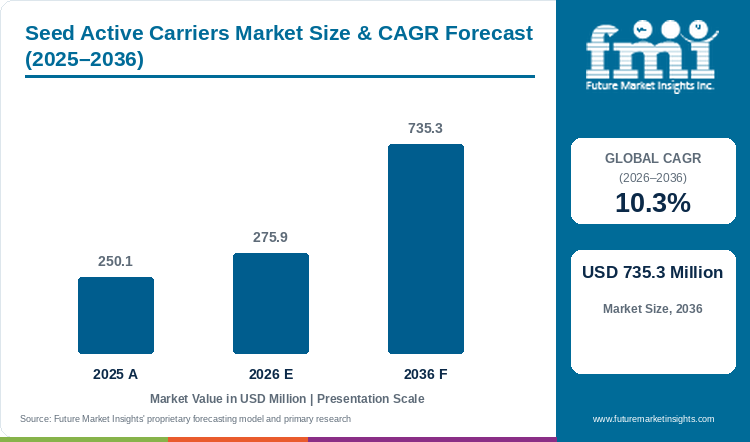
Seed Active Carriers Market Size & CAGR Forecast (2025-2036)
| Year | Basis | Market value (USD million) |
|---|---|---|
| 2025 | Actual | 250.1 |
| 2026 | Estimate | 275.9 |
| 2036 | Forecast | 735.3 |
| CAGR, 2026 to 2036 | 10.3% | |
Source: Future Market Insights proprietary forecasting model and primary research.
Key Takeaways
- Demand rises when the carrier can hold several seed-applied products without affecting drying, seed flow, dust control and planting accuracy.
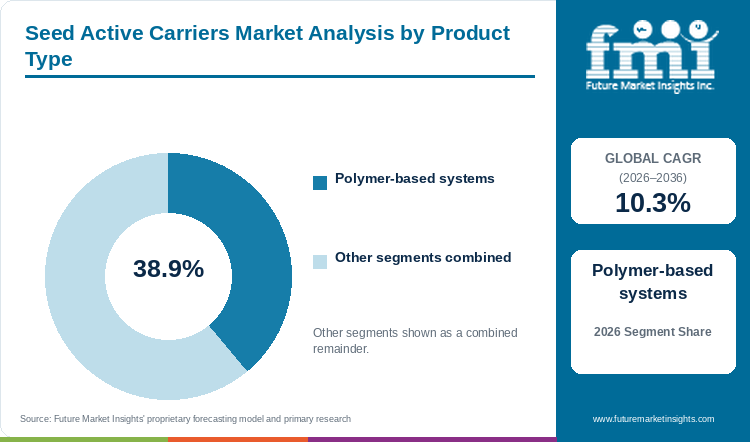
- Based on product type, polymer-based systems are projected to account for 38.9% in 2026, supported by adhesion and plantability requirements.
- By crop type, corn and cereals are estimated to hold 43.6% in 2026, attributable to recurring broad-acre treatment volumes.
- In 2026, in-plant treatment is expected to lead treatment point with 45.5% share, owing to centralized recipe and finished-seed control.
- The USA is projected at 9.9% CAGR through 2036, while South Korea follows at 9.6% under different crop and treatment routines.
- Notable companies include Syngenta, Corteva Agriscience, BASF, Germains Seed Technology, Incotec, Centor Group, Precision Laboratories, and Novonesis.
Analyst Perspective
“I see demand moving towards carriers which can hold crop protection, nutrition and biological treatments on the same seed. The real opportunity will remain with formulations proving seed flow, germination and equipment compatibility under regular commercial treatment.”
- Nikhil Kaitwade, Principal Consultant, Future Market Insights.
How is the Seed Active Carriers Market segmented?
Seed Active Carriers Market is segmented by five primary commercial axes and region: product type, crop type, treatment point, formulation, sales channel, and region. In 2026, polymer-based systems are projected at 38.9%, corn and cereals at 43.6%, in-plant treatment at 45.5%, liquid slurries at 50.9%, and agri-input distributors at 45.6%.
Seed active carriers market is segmented by product type, crop type, treatment point, formulation, sales channel and region.
By product type: polymer-based systems, biological or microbial systems, nutrient-loaded systems, and others.
By crop type: corn and cereals, soybean and pulses, vegetables, and cotton and others.
By treatment point: in-plant seed companies, commercial seed treaters, on-farm treatment, and others.
By formulation: liquid slurries, dry powders, film coats and encrusting, and others.
By sales channel: agri-input distributors, cooperatives, agri-retail chains, online or direct-to-farm, and others.
By region: North America, Latin America, Western Europe, Eastern Europe, East Asia, South Asia and Pacific, and Middle East and Africa.
What makes Polymer-Based Systems central to Product Type?
Based on product type, polymer-based systems are projected to account for 38.9% in 2026, supported by active retention and flowability.
| Product type | Share (2026) |
|---|---|
| Polymer-based systems | 38.9% |
| Other segments combined | 61.1%* |
| Total | 100.0% |
| Metric | Value |
|---|---|
| Global CAGR (2026-2036) | 10.3% |
| Leading segment | Polymer-based systems |
Polymer-based systems are gaining preference as treated seed moves through conveying, bagging, transportation and planting before reaching the field. These systems help the treatment remain attached on the seed surface, and at the same time, support the flow required across commercial equipment, functioning similarly to advanced seed encapsulation materials. FMI research indicates that polymer properties also allow color, crop protection products and other compatible materials to be placed as one coating. However, the same polymer cannot be moved across every crop without testing, as seed shape, active loading and drying conditions changes its behavior. This requirement is making crop-level abrasion and plantability checks very important for wider adoption.
- Polymer-Based Systems hold 38.9% share in 2026, attributable to their use in active retention, dust management and commercial seed flow.
- In 2026, BASF lists Sepiret Red 01 as a microplastic-free coating developed for major European corn treatments.[3]
Why does Corn and Cereals lead Crop Type?
By crop type, corn and cereals are estimated to hold 43.6% in 2026, owing to repeatable high-volume treatment.
Corn and cereals are treated in large seasonal lots, due to which even a small change in drying or coating consistency can affect complete treatment-line output. In January 2026, USDA NASS reported that U.S. grain producers harvested 86.8 million acres of corn and 37.3 million acres of wheat during the 2025 crop year.[4] These crop areas do not directly provide carrier revenue; however, they show the volume of seed where dust-off, coverage and singulation has to remain repeatable. Since these crops move through industrial treatment and planting systems, seed stress protectors and carriers giving the same result across larger batches are facing higher preference.
- Corn and Cereals account for 43.6% share in 2026, owing to recurring broad-acre treatment and large seasonal seed volumes.
- Large and repeatable seed lots support the use of carrier systems that can maintain the same coating behavior across every commercial batch.
How does In-Plant Treatment shape Treatment Point?
In 2026, in-plant treatment is expected to lead treatment point with 45.5% share, driven by centralized recipe control.
In-plant treatment allows seed companies to manage application rate, mixing order, drying, color and finished-seed quality before the seed enters distribution. This treatment point is preferred for recipes having several liquid and dry components, including microbial seed primers, as equipment setting and release of every lot can be controlled at one place. EPA procedures covers commercial treatment, on-farm application, packaging, equipment cleaning and calibration activities.[5] Such process requirements are supporting centralized treatment where the complete recipe can be checked before dispatch, which is expected to upkeep the share of in-plant seed companies.
- In-Plant Treatment holds 45.5% share in 2026, driven by centralized recipe handling and control over finished-seed performance.
- Centralized treatment also enables seed companies to correct mixing or drying conditions before a complete commercial lot is released.
What supports Liquid Slurries in Formulation?
By formulation, liquid slurries are forecast to represent 50.9% in 2026, enabled by controlled metering through commercial treaters.
Liquid slurries are used for metering polymers, colorants, inoculants and biological seed carriers into batch or continuous treatment equipment at a defined rate. Their liquid form supports mixing through pumps and commercial treaters, due to which dosing can be adjusted without changing the complete treatment setup. At the same time, water activity, tank residence and combination with other products can affect drying and microbial survival. Therefore, liquid slurries are facing higher adoption where suppliers can show that the formulation remains stable during application and for the required period after treatment.
- Liquid Slurries represent 50.9% share in 2026, supported by controlled metering and their fit with existing commercial treating equipment.
- Novonesis states that Cell-Tech liquid provides thirty days of on-seed survivability and has a 1.16 fluid-ounce use rate.[6]
What drives Agri-Input Distributors in Sales Channel?
Agri-input distributors are set to lead sales channel with 45.6% share in 2026, supported by local stocking and technical access.
Agri-input distributors connect specialized formulation companies with commercial treaters, cooperatives, seed companies and farm buyers. This sales channel becomes important where carrier selection changes with local crops, treatment timing, handling conditions, and compatibility with agricultural surfactants. Large seed companies may purchase directly under approved recipes; however, smaller treatment businesses depend more on local stocking and application guidance. The wider presence of biological products is also increasing the need for correct storage and handling at the channel level, which provides further scope for distributors having technical access near the customer.
- Agri-Input Distributors hold 45.6% share in 2026, underpinned by local stocking, treatment guidance and access to smaller commercial buyers.
- Croda reported 8% constant-currency growth in Seed Enhancement sales during 2025, showing continued activity in specialist seed services.[7]
What are the drivers, restraints, and opportunities in the Seed Active Carriers Market?
In the seed active carriers market, demand is driven by higher functional loading on seed and tighter stewardship, while recipe validation constrains switching and biological-compatible carrier systems create the clearest expansion path.
- Driver: More actives on each seed increase the need for retention, uniform dosing, dust control, and stable flow.
- Restraint: New recipes must prove seed safety, drying, abrasion, equipment compatibility, and active-package stability.
- Opportunity: Biological and nutrient-loaded systems can expand when they preserve viability through treatment and storage.
Functional Loading Raises Carrier Demand
Seed surfaces are now carrying crop protection, commercial biofertilizers, nutrition, color and biological functions together, which has increased the need for adhesion and uniform dosing. EPA updated its pollinator best-management-practice page in March 2026 and continued to mention reduction of exposure to dust from treated seed.[8] This is making low rub-off an important factor during handling and planting. However, dust release and drying changes with seed geometry, active loading and treatment setting. Due to this, buyers require crop-specific results before moving a carrier into wider commercial use, as one result cannot explain its performance across every seed and recipe.
Qualification Slows Carrier Switching
Changing a carrier affects drying, dust-off, flowability, germination and distribution of the active package, including microbial disease suppressors within the same recipe. The European Chemicals Agency (ECHA) adopted restrictions on intentionally added microplastics under EU Regulation 2023/2055, requiring agricultural seed treatments and coating polymers to transition to biodegradable alternatives.[9] This creates an alternative where polymer requirements are changing; however, it does not remove the need for equipment and crop qualification. Seed companies generally continue with an accepted carrier until the replacement provides the same treatment coverage and production output. These longer testing requirements are restraining quick switching, especially where an existing recipe already performs without interruption.
Biological Delivery Opens New Uses
Biological delivery is opening new applications for seed active carriers, especially where living organisms and specialized organic fertilizers need protection during treatment, storage and planting. In October 2025, Albaugh introduced BIOST 2G nematicide and insecticide biological seed treatment following U.S. EPA approval, expanding dual-action biological protection across commercial row crops.[10] Such longer treatment window can allow biological products to be applied before the seed reaches the farm, instead of depending on last-minute application. Nevertheless, compatibility with the other products in the recipe and storage conditions remains very important. Carriers maintaining microbial survival without slowing the treatment line are therefore expected to gain higher adoption during the forecast period.
Which country CAGRs are profiled in the Seed Active Carriers Market?
| Country | CAGR 2026-2036 |
|---|---|
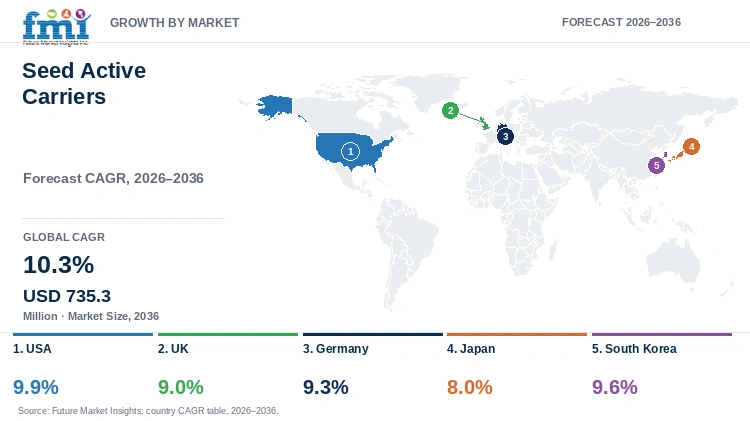
| USA | 9.9% |
| UK | 9.0% |
| Germany | 9.3% |
| Japan | 8.0% |
| South Korea | 9.6% |
How do country-level CAGRs compare in the Seed Active Carriers Market?
As per the analysis from FMI, country growth rates differ through 2036 because crop scale, treatment practices, and authorization requirements are not uniform across markets. The USA and South Korea lead projected growth above 9.5 per cent, while Germany, the UK, and Japan follow distinct seed-protection structures.
- The USA demand gains from large commercial corn and soybean programs and established broad-acre treatment infrastructure.
- South Korea benefits from national pest surveillance and structured rice seed preparation routines.
- Germany relies on professional cereal treatment facilities and strict dust-control compliance.
- The UK combines recurring cereal acreage with authorized seed-treatment evaluation routes.
- Japan emphasizes detailed registration dossiers, local trial verification, and crop-specific disinfection practices.
Full report country CAGRs cover: North America; Latin America; Western Europe; Eastern Europe; East Asia; South Asia and Pacific; Middle East and Africa.
Country-wise Analysis
- By 2036, the USA is projected to grow at 9.9% CAGR, supported by large commercial corn and soybean treatment programs. In June 2026, USDA NASS reported 95.3 million corn acres and 85.4 million soybean acres planted across domestic farms, with biotech varieties covering 92% of corn acreage.[11] These volumes are expected to raise carrier consumption across commercial treatment alongside commercial bioinsecticides; however, adoption will remain connected with drying, active retention and planter movement rather than crop area alone.
- Seed active carrier sales in the UK are forecast to expand at 9.0% CAGR through 2036, influenced by cereal cultivation and treated-seed authorization. Defra reported 3.013 million hectares of cereals and 19.524 million tonnes of production for 2025.[12] This recurring crop base is supporting industrial seed treatment across wheat, barley and other cereals. However, every active package has to follow its permitted authorization route. Carriers supported by dust behavior and recipe compatibility information are therefore expected to witness better acceptance among local seed companies and commercial treaters.
- Germany's seed active carriers outlook is anticipated to advance at 9.3% CAGR over the assessment period, attributable to professional cereal treatment. Destatis estimated 6.03 million hectares of cereal area in May 2026.[13] Selected treatment approvals require professional facilities and abrasion-dust controls, which is supporting centralized treatment and measured coating performance. Apart from compliance, replacement polymers must maintain coverage, drying and seed movement on the equipment already used. This is creating opportunities for low-dust materials accompanied with crop and application evidence.
- Adoption of seed active carriers in Japan is estimated to expand at 8.0% CAGR through 2036, supported by crop-specific disinfection and integrated pest-management practices. MAFF updated its integrated-control guidance in June 2026 and published a March 2026 practice manual covering rice and several horticultural crops.[14] FMI data suggests that this structure helps buyers connect a treatment practice with its permitted use rather than relying on a broad formulation claim. Carriers that work with the approved treatment practice while maintaining germination are expected to gain preference, which also explains the measured growth outlook of the country.
- South Korea is estimated to post 9.6% CAGR over the forecast period, supported by established rice seed preparation and nursery practices. Statistics Korea reported 677,597 hectares of rice area for 2025,[15] while national crop-pest systems continued monthly prevention guidance during 2026.[16] Such practices create a regular treatment sequence before nursery establishment. Carrier additions need to work with local disinfection products and should not delay emergence or nursery activities. Thus, formulations supported with local handling and compatibility information can witness better adoption across the country.
Who are the notable companies in the Seed Active Carriers Market?
Syngenta, Corteva Agriscience, BASF, Germains Seed Technology, Incotec, Centor Group, Precision Laboratories, and Novonesis are the notable companies profiled in this market.
In the FMI report, competitive position is connected with carrier capability, biological compatibility, and ease of adding the product into commercial treatment workflows. Syngenta, Corteva Agriscience and BASF connect seed-applied products with wider crop protection programs, while Germains Seed Technology, Incotec, Centor Group and Precision Laboratories focus more on coating materials and application performance. Novonesis is positioned in biological delivery where microbial survival and time on seed remains important. Companies are selected by testing the carrier on intended crop, active combination, treatment equipment and storage period. Hence, a wider company portfolio alone cannot support approval if the formulation affects seed flow, germination or treatment stability.
- Integrated platforms: Syngenta, Corteva Agriscience, and BASF connect seed-applied portfolios, stewardship resources, and commercial program access.
- Coating specialists: Germains Seed Technology, Incotec, Centor Group, and Precision Laboratories focus on polymer formulation, film coating, application support, and process troubleshooting.
- Biological delivery specialists: Novonesis, BASF, and Syngenta address inoculant handling, compatibility, survival, and crop-specific biological delivery.
Competitive Benchmarking: Seed Active Carriers Market
| Company | Coating depth | Application fit | Current activity | Reach |
|---|---|---|---|---|
| Syngenta | High | High | High | High |
| Corteva Agriscience | High | High | High | High |
| BASF | High | High | High | High |
| Germains Seed Technology | High | High | High | Medium |
| Incotec | High | High | High | High |
| Centor Group | High | Medium | High | Medium |
| Precision Laboratories | Medium | High | High | Medium |
| Novonesis | High | High | High | High |
High represents broad public evidence across the stated capability, Medium represents narrower evidence, and Low represents limited documented breadth. These ratings describe public company capability and do not indicate product quality, revenue share or company ranking.
Key Developments in the Seed Active Carriers Market
- In September 2026, Incotec completed its Tianjin facility upgrade, bringing Asia-Pacific R&D, production, sales, and marketing teams into one location.[19]
- In April 2026, Incotec launched Disco Red L-1140, a microplastic-free film coat developed for cereal seed.[20]
- In January 2026, Corteva Agriscience introduced Ympact biological seed treatment to support seedling resilience and early vigor across European cereal crops.[21]
- In August 2025, Incotec made its expanded Pergamino film-coating unit fully operational, increasing regional production capacity fivefold.[17]
Key Players in the Seed Active Carriers Market
Integrated seed-treatment platforms
- Syngenta
- Corteva Agriscience
- BASF
Seed-coating and enhancement specialists
- Germains Seed Technology
- Incotec
- Centor Group
- Precision Laboratories
Biological delivery specialists
- Novonesis
Seed Active Carriers Market - Report Scope
| Coverage field | Report scope |
|---|---|
| Market breakdown | Product Type, Crop Type, Treatment Point, Formulation, and Sales Channel. |
| Quantitative units | USD million. |
| Market definition | Revenue from carrier and coating systems sold for seed application. Finished treated seed, genetics, machinery, and standalone crop-protection active revenue are excluded. |
| Regions covered | North America; Latin America; Western Europe; Eastern Europe; East Asia; South Asia and Pacific; Middle East and Africa. |
| Countries covered | USA, UK, Germany, Japan, South Korea, and additional countries in the full report. |
| Key companies profiled | Syngenta, Corteva Agriscience, BASF, Germains Seed Technology, Incotec, Centor Group, Precision Laboratories, Novonesis. |
| Forecast period | 2026 to 2036. |
| Approach | The Future Market Insights report covers supplier activity, segment structure, application routes, and country adoption conditions within the stated market boundary. |
As noted by FMI, the report covers commercial seed active carriers and excludes finished treated seed, genetics, machinery, and standalone crop-protection active revenue.
Seed Active Carriers Market - Research Methodology
| Method | Approach |
|---|---|
| Primary Research | Analysts gathered input from manufacturers, service providers, technology developers, distributors, end users, procurement teams, and subject-matter experts. Interviews examined purchasing decisions, product evaluation, adoption barriers, approval requirements, pricing, and technical support. |
| Desk Research | Desk research covered government statistics, regulatory publications, trade data, industry associations, technical literature, standards, company filings, product information, and official corporate announcements. Sources were checked for date, geography, and direct market relevance. |
| Market Sizing and Forecasting | The model combined the baseline value with historical performance, segment structure, pricing and volume indicators, adoption levels, company participation, and country demand conditions. Forecast assumptions included regulation, technology use, purchasing cycles, and supply availability. |
| Data Validation | Estimates were checked against public data, company activity, trade patterns, and primary-research findings. Adjacent categories, unsupported claims, overlapping revenue, and activities outside the defined market were excluded. |
Seed Active Carriers Market by Segments
Seed Active Carriers Market segmented by Product Type:
- Polymer-based systems
- Biological or microbial systems
- Nutrient-loaded systems
- Others
Seed Active Carriers Market segmented by Crop Type:
- Corn and cereals
- Soybean and pulses
- Vegetables
- Cotton and others
Seed Active Carriers Market segmented by Treatment Point:
- In-plant seed companies
- Commercial seed treaters
- On-farm treatment
- Others
Seed Active Carriers Market segmented by Formulation:
- Liquid slurries
- Dry powders
- Film coats and encrusting
- Others
Seed Active Carriers Market segmented by Sales Channel:
- Agri-input distributors
- Cooperatives
- Agri-retail chains
- Online or direct-to-farm
- Others
Seed Active Carriers Market by Region
- North America
- United States
- Canada
- Mexico
- Latin America
- Brazil
- Argentina
- Chile
- Rest of Latin America
- Western Europe
- Germany
- United Kingdom
- France
- Italy
- Spain
- Benelux
- Nordics
- Rest of Western Europe
- Eastern Europe
- Poland
- Romania
- Hungary
- Czech Republic
- Rest of Eastern Europe
- East Asia
- China
- Japan
- South Korea
- South Asia and Pacific
- India
- ASEAN
- Australia and New Zealand
- Rest of South Asia and Pacific
- Middle East and Africa
- GCC Countries
- South Africa
- Türkiye
- Rest of Middle East and Africa
Research Sources and Bibliography
- [1] United States Department of Agriculture, National Agricultural Statistics Service. (2026, June 30). Corn planted acreage down 3% from 2025, soybean acreage up 5% from last year.
- [2] Eurostat. (2025, October 27). Agricultural production - crops: Cereals production across EU member states.
- [3] BASF Agricultural Solutions. (2026). Seed Coatings by BASF: Technical specifications and crop applications.
- [4] United States Department of Agriculture, National Agricultural Statistics Service. (2026, January 12). Crop production 2025 summary: Corn and wheat harvested acreage.
- [5] U.S. Environmental Protection Agency. (2026). Standard operating procedures for seed treatment, Policy 14.1: Commercial and on-farm treating standards.
- [6] Novonesis. (2026). Cell-Tech for soybeans, US liquid inoculant formulation guide.
- [7] Croda International Plc. (2026). Life sciences business review: Performance in 2025 and seed enhancement growth.
- [8] U.S. Environmental Protection Agency. (2026, March 5). Best management practices for pollinator protection during seed planting.
- [9] European Chemicals Agency. (2025). Regulation (EU) 2023/2055: Restriction on intentionally added synthetic polymer microparticles in agricultural inputs and seed treatment.
- [10] Albaugh LLC. (2025, October 29). Albaugh introduces BIOST 2G nematicide and insecticide biological seed treatment to U.S. seed treatment market.
- [11] United States Department of Agriculture, Economic Research Service. (2026, June 30). Adoption of genetically engineered crops in the U.S.: Corn and soybean acreage report.
- [12] Department for Environment, Food & Rural Affairs. (2026, September 3). Agriculture in the United Kingdom 2025: Chapter 7, Crops and arable production.
- [13] Statistisches Bundesamt. (2026, May 19). German cereal area in 2026: Preliminary agricultural acreage results.
- [14] Ministry of Agriculture, Forestry and Fisheries, Japan. (2026, June 5). Promotion of integrated pest management and crop protection guidelines.
- [15] Statistics Korea. (2025, August 28). 2025 cultivated area survey results: Rice and pepper agricultural production.
- [16] Rural Development Administration, Republic of Korea. (2026). National crop pest management system: Crop protection notices.
- [17] Incotec. (2025, August 25). Upgraded facility in Argentina fully operational: Fivefold expansion in film coating capacity.
- [18] Incotec. (2026, September 8). Renewed labs in Brazil: Hub for customer collaboration, seed pathology, and biological testing.
- [19] Incotec. (2026, September 15). Incotec strengthens seed enhancement in China with Tianjin facility upgrade.
- [20] Incotec. (2026, April 8). New microplastic-free seed coating Disco Red L-1140 developed for cereal seed.
- [21] Corteva Agriscience. (2026, January 26). Ympact biological seed treatment update: Field trial evaluation and crop resilience.
- [22] United States Department of Agriculture, Foreign Agricultural Service. (2026). South Korea production: Annual area harvested, 2025/2026.
This bibliography is provided for reader reference. The full report contains the complete reference list and detailed citations.
This Report Answers
- What is Seed Active Carriers Market worth during 2026?
- What value is Seed Active Carriers Market projected by 2036?
- Which product type holds notable Seed Active Carriers Market share?
- Which crop type holds notable Seed Active Carriers Market share?
- Which countries have notable Seed Active Carriers Market growth?
- Which companies are notable in Seed Active Carriers Market today?
Frequently Asked Questions
How large is the Seed Active Carriers Market expected to be in 2026?
Future Market Insights estimates that the seed active carriers market will reach USD 275.9 million in 2026. The market is projected to expand further and reach USD 735.3 million by 2036 as more products are being applied on seed and require stable coating performance.
What CAGR is forecast for the Seed Active Carriers Market through 2036?
As per FMI, the seed active carriers market is projected to grow at a 10.3% CAGR from 2026 to 2036. Growth is supported by increasing adoption of ready-to-use carrier systems in commercial seed treatment and biological input integration.
Which product type holds a notable seed active carriers demand share in 2026?
Future Market Insights projects polymer-based systems to hold 38.9% of product type demand in 2026. The segment benefits from higher active retention, dust management, and reliable seed flow across automated treating equipment.
Which crop type holds a notable seed active carriers share in 2026?
FMI finds that corn and cereals will hold 43.6% of crop type demand in 2026. Demand is supported by recurring broad-acre treatment volumes and the need for uniform coating across large seasonal lots.
Which country has a notable seed active carriers expansion outlook during the forecast period?
Future Market Insights predicts the USA to expand at a 9.9% CAGR during the 2026 to 2036 assessment period. Growth is supported by extensive commercial corn and soybean treatment operations and established seed-coating infrastructure.
Which companies are active in the Seed Active Carriers Market during 2026?
Notable companies active in the market include Syngenta, Corteva Agriscience, BASF, Germains Seed Technology, Incotec, Centor Group, Precision Laboratories, and Novonesis. These companies are focusing on polymer formulation, biological compatibility, regional testing facilities, and technical application support.
Preview the report firsthand - request a free sample
Get SampleGet the brochure for pricing and purchase details.
Get PDFTable of Content
- Key Takeaways
- Market Size and CAGR
- Top Growth Driver
- Fastest Growing Segment
- Leading Region
- Key Companies
- Emerging Opportunities
- Executive Summary
- Global Market Outlook
- Demand-side Trends
- Supply-side Trends
- Technology Roadmap Analysis
- Analysis and Recommendations
- Analyst Perspective (What is happening? Why now? What should investors know?)
- Key Questions Answered
- How large is the market?
- What is the CAGR?
- What are key trends?
- Which region dominates?
- Who are the leaders?
- Market Overview
- Market Coverage / Taxonomy
- Market Definition / Scope / Limitations
- Research Methodology
- Chapter Orientation
- Analytical Lens and Working Hypotheses
- Market Structure, Signals, and Trend Drivers
- Benchmarking and Cross-market Comparability
- Market Sizing, Forecasting, and Opportunity Mapping
- Research Design and Evidence Framework
- Desk Research Programme (Secondary Evidence)
- Expert Input and Fieldwork (Primary Evidence)
- Tooling, Models, and Reference Databases
- Data Engineering and Model Build
- Quality Assurance and Audit Trail
- Market Background
- Market Dynamics (Drivers, Restraints, Opportunity, Trends)
- Scenario Forecast (Optimistic, Likely, Conservative)
- Impact Analysis
- AI Impact
- Sustainability Impact
- Regulatory Impact
- Technology Impact
- Consumer / Buyer Analysis
- Purchase Drivers
- Adoption Barriers
- Buyer Journey
- Opportunity Map Analysis
- Product Life Cycle Analysis
- Supply Chain Analysis
- Investment Feasibility Matrix
- Value Chain Analysis
- PESTLE and Porter's Analysis
- Regulatory Landscape
- Regional Parent Market Outlook
- Production and Consumption Statistics
- Import and Export Statistics
- Global Market Analysis and Forecast, 2021 to 2036
- Historical Market Size Value (USD Million) Analysis, 2021 to 2025
- Current and Future Market Size Value (USD Million) Projections, 2026 to 2036
- Y-o-Y Growth Trend Analysis
- Absolute $ Opportunity Analysis
- Global Market Pricing Analysis, 2021 to 2036
- Global Market Analysis and Forecast, By Product Type, 2021 to 2036
- Introduction / Key Findings
- Historical Market Size Value (USD Million) Analysis By Product Type, 2021 to 2025
- Current and Future Market Size Value (USD Million) Analysis and Forecast By Product Type, 2026 to 2036
- Polymer-based systems
- Biological or microbial systems
- Nutrient-loaded systems
- Others
- Y-o-Y Growth Trend Analysis By Product Type, 2021 to 2025
- Absolute $ Opportunity Analysis By Product Type, 2026 to 2036
- Global Market Analysis and Forecast, By Crop Type, 2021 to 2036
- Introduction / Key Findings
- Historical Market Size Value (USD Million) Analysis By Crop Type, 2021 to 2025
- Current and Future Market Size Value (USD Million) Analysis and Forecast By Crop Type, 2026 to 2036
- Corn and cereals
- Soybean and pulses
- Vegetables
- Cotton and others
- Y-o-Y Growth Trend Analysis By Crop Type, 2021 to 2025
- Absolute $ Opportunity Analysis By Crop Type, 2026 to 2036
- Global Market Analysis and Forecast, By Treatment Point, 2021 to 2036
- Introduction / Key Findings
- Historical Market Size Value (USD Million) Analysis By Treatment Point, 2021 to 2025
- Current and Future Market Size Value (USD Million) Analysis and Forecast By Treatment Point, 2026 to 2036
- In-plant seed companies
- Commercial seed treaters
- On-farm treatment
- Others
- Y-o-Y Growth Trend Analysis By Treatment Point, 2021 to 2025
- Absolute $ Opportunity Analysis By Treatment Point, 2026 to 2036
- Global Market Analysis and Forecast, By Formulation, 2021 to 2036
- Introduction / Key Findings
- Historical Market Size Value (USD Million) Analysis By Formulation, 2021 to 2025
- Current and Future Market Size Value (USD Million) Analysis and Forecast By Formulation, 2026 to 2036
- Liquid slurries
- Dry powders
- Film coats and encrusting
- Others
- Y-o-Y Growth Trend Analysis By Formulation, 2021 to 2025
- Absolute $ Opportunity Analysis By Formulation, 2026 to 2036
- Global Market Analysis and Forecast, By Sales Channel, 2021 to 2036
- Introduction / Key Findings
- Historical Market Size Value (USD Million) Analysis By Sales Channel, 2021 to 2025
- Current and Future Market Size Value (USD Million) Analysis and Forecast By Sales Channel, 2026 to 2036
- Agri-input distributors
- Cooperatives
- Agri-retail chains
- Online or direct-to-farm
- Others
- Y-o-Y Growth Trend Analysis By Sales Channel, 2021 to 2025
- Absolute $ Opportunity Analysis By Sales Channel, 2026 to 2036
- Global Market Analysis and Forecast, By Region, 2021 to 2036
- Introduction
- Historical Market Size Value (USD Million) Analysis By Region, 2021 to 2025
- Current Market Size Value (USD Million) Analysis and Forecast By Region, 2026 to 2036
- North America
- Latin America
- Western Europe
- Eastern Europe
- East Asia
- South Asia and Pacific
- Middle East and Africa
- Market Attractiveness Analysis By Region
- North America Market Analysis and Forecast, By Country, 2021 to 2036
- Historical Market Size Value (USD Million) Trend Analysis By Market Taxonomy, 2021 to 2025
- Market Size Value (USD Million) Forecast By Market Taxonomy, 2026 to 2036
- By Country
- United States
- Canada
- Mexico
- By Product Type
- By Crop Type
- By Treatment Point
- By Formulation
- By Sales Channel
- By Country
- Market Attractiveness Analysis
- By Country
- By Product Type
- By Crop Type
- By Treatment Point
- By Formulation
- By Sales Channel
- Key Takeaways
- Latin America Market Analysis and Forecast, By Country
- Historical Market Size Value (USD Million) Trend Analysis By Market Taxonomy, 2021 to 2025
- Market Size Value (USD Million) Forecast By Market Taxonomy, 2026 to 2036
- By Country
- Brazil
- Argentina
- Chile
- Rest of Latin America
- By Product Type
- By Crop Type
- By Treatment Point
- By Formulation
- By Sales Channel
- By Country
- Market Attractiveness Analysis
- By Country
- By Product Type
- By Crop Type
- By Treatment Point
- By Formulation
- By Sales Channel
- Key Takeaways
- Western Europe Market Analysis and Forecast, By Country
- Historical Market Size Value (USD Million) Trend Analysis By Market Taxonomy, 2021 to 2025
- Market Size Value (USD Million) Forecast By Market Taxonomy, 2026 to 2036
- By Country
- Germany
- United Kingdom
- France
- Italy
- Spain
- Benelux
- Nordics
- Rest of Western Europe
- By Product Type
- By Crop Type
- By Treatment Point
- By Formulation
- By Sales Channel
- By Country
- Market Attractiveness Analysis
- By Country
- By Product Type
- By Crop Type
- By Treatment Point
- By Formulation
- By Sales Channel
- Key Takeaways
- Eastern Europe Market Analysis and Forecast, By Country
- Historical Market Size Value (USD Million) Trend Analysis By Market Taxonomy, 2021 to 2025
- Market Size Value (USD Million) Forecast By Market Taxonomy, 2026 to 2036
- By Country
- Poland
- Romania
- Hungary
- Czech Republic
- Rest of Eastern Europe
- By Product Type
- By Crop Type
- By Treatment Point
- By Formulation
- By Sales Channel
- By Country
- Market Attractiveness Analysis
- By Country
- By Product Type
- By Crop Type
- By Treatment Point
- By Formulation
- By Sales Channel
- Key Takeaways
- East Asia Market Analysis and Forecast, By Country
- Historical Market Size Value (USD Million) Trend Analysis By Market Taxonomy, 2021 to 2025
- Market Size Value (USD Million) Forecast By Market Taxonomy, 2026 to 2036
- By Country
- China
- Japan
- South Korea
- By Product Type
- By Crop Type
- By Treatment Point
- By Formulation
- By Sales Channel
- By Country
- Market Attractiveness Analysis
- By Country
- By Product Type
- By Crop Type
- By Treatment Point
- By Formulation
- By Sales Channel
- Key Takeaways
- South Asia and Pacific Market Analysis and Forecast, By Country
- Historical Market Size Value (USD Million) Trend Analysis By Market Taxonomy, 2021 to 2025
- Market Size Value (USD Million) Forecast By Market Taxonomy, 2026 to 2036
- By Country
- India
- ASEAN
- Australia and New Zealand
- Rest of South Asia and Pacific
- By Product Type
- By Crop Type
- By Treatment Point
- By Formulation
- By Sales Channel
- By Country
- Market Attractiveness Analysis
- By Country
- By Product Type
- By Crop Type
- By Treatment Point
- By Formulation
- By Sales Channel
- Key Takeaways
- Middle East and Africa Market Analysis and Forecast, By Country
- Historical Market Size Value (USD Million) Trend Analysis By Market Taxonomy, 2021 to 2025
- Market Size Value (USD Million) Forecast By Market Taxonomy, 2026 to 2036
- By Country
- GCC Countries
- South Africa
- Türkiye
- Rest of Middle East and Africa
- By Product Type
- By Crop Type
- By Treatment Point
- By Formulation
- By Sales Channel
- By Country
- Market Attractiveness Analysis
- By Country
- By Product Type
- By Crop Type
- By Treatment Point
- By Formulation
- By Sales Channel
- Key Takeaways
- Key Countries Market Analysis
- United States
- Pricing Analysis
- Market Share Analysis, 2025
- By Product Type
- By Crop Type
- By Treatment Point
- By Formulation
- By Sales Channel
- Canada
- Pricing Analysis
- Market Share Analysis, 2025
- By Product Type
- By Crop Type
- By Treatment Point
- By Formulation
- By Sales Channel
- Mexico
- Pricing Analysis
- Market Share Analysis, 2025
- By Product Type
- By Crop Type
- By Treatment Point
- By Formulation
- By Sales Channel
- Brazil
- Pricing Analysis
- Market Share Analysis, 2025
- By Product Type
- By Crop Type
- By Treatment Point
- By Formulation
- By Sales Channel
- Chile
- Pricing Analysis
- Market Share Analysis, 2025
- By Product Type
- By Crop Type
- By Treatment Point
- By Formulation
- By Sales Channel
- Germany
- Pricing Analysis
- Market Share Analysis, 2025
- By Product Type
- By Crop Type
- By Treatment Point
- By Formulation
- By Sales Channel
- United Kingdom
- Pricing Analysis
- Market Share Analysis, 2025
- By Product Type
- By Crop Type
- By Treatment Point
- By Formulation
- By Sales Channel
- Italy
- Pricing Analysis
- Market Share Analysis, 2025
- By Product Type
- By Crop Type
- By Treatment Point
- By Formulation
- By Sales Channel
- Spain
- Pricing Analysis
- Market Share Analysis, 2025
- By Product Type
- By Crop Type
- By Treatment Point
- By Formulation
- By Sales Channel
- France
- Pricing Analysis
- Market Share Analysis, 2025
- By Product Type
- By Crop Type
- By Treatment Point
- By Formulation
- By Sales Channel
- India
- Pricing Analysis
- Market Share Analysis, 2025
- By Product Type
- By Crop Type
- By Treatment Point
- By Formulation
- By Sales Channel
- ASEAN
- Pricing Analysis
- Market Share Analysis, 2025
- By Product Type
- By Crop Type
- By Treatment Point
- By Formulation
- By Sales Channel
- Australia and New Zealand
- Pricing Analysis
- Market Share Analysis, 2025
- By Product Type
- By Crop Type
- By Treatment Point
- By Formulation
- By Sales Channel
- China
- Pricing Analysis
- Market Share Analysis, 2025
- By Product Type
- By Crop Type
- By Treatment Point
- By Formulation
- By Sales Channel
- Japan
- Pricing Analysis
- Market Share Analysis, 2025
- By Product Type
- By Crop Type
- By Treatment Point
- By Formulation
- By Sales Channel
- South Korea
- Pricing Analysis
- Market Share Analysis, 2025
- By Product Type
- By Crop Type
- By Treatment Point
- By Formulation
- By Sales Channel
- Poland
- Pricing Analysis
- Market Share Analysis, 2025
- By Product Type
- By Crop Type
- By Treatment Point
- By Formulation
- By Sales Channel
- Hungary
- Pricing Analysis
- Market Share Analysis, 2025
- By Product Type
- By Crop Type
- By Treatment Point
- By Formulation
- By Sales Channel
- Türkiye
- Pricing Analysis
- Market Share Analysis, 2025
- By Product Type
- By Crop Type
- By Treatment Point
- By Formulation
- By Sales Channel
- South Africa
- Pricing Analysis
- Market Share Analysis, 2025
- By Product Type
- By Crop Type
- By Treatment Point
- By Formulation
- By Sales Channel
- United States
- Market Structure Analysis
- Competition Dashboard
- Competition Benchmarking
- Market Share Analysis of Top Players
- By Regional
- By Product Type
- By Crop Type
- By Treatment Point
- By Formulation
- By Sales Channel
- Emerging Startups
- Innovation Benchmarking
- Competition Analysis
- Competition Deep Dive
- Syngenta
- Overview
- Product Portfolio
- Profitability by Market Segments
- Sales Footprint
- Strategy Overview
- Marketing Strategy
- Product Strategy
- Channel Strategy
- Corteva Agriscience
- BASF
- Germains Seed Technology
- Incotec
- Centor Group
- Precision Laboratories
- Novonesis
- Syngenta
- Case Studies
- Success Stories
- Recent Developments
- Competition Deep Dive
- Assumptions & Acronyms Used


