

- Market Size (2026)
- USD 104.8 Mn
- Forecast (2036)
- USD 281.8 Mn
- CAGR (2026 to 2036)
- 10.4%
How big is Seed Priming Materials Market in 2026?
Sales in the seed priming materials market are projected to grow at 10.4% CAGR through 2036. Market size rises from USD 94.9 million in 2025 to USD 104.8 million in 2026 and is expected to reach USD 281.8 million by 2036.
Uniform germination and better crop establishment are increasing the use of seed priming materials. These materials control hydration before sowing and hold inputs close to seed. FMI estimates the market to rise from USD 94.9 million in 2025 to USD 104.8 million in 2026 and reach USD 281.8 million by 2036, witnessing 10.4% CAGR from 2026 to 2036. A 2025 review found that priming can improve germination, seedling establishment and tolerance against environmental and biological stress.[1] Growth is expected where treated seed retains its response after drying, storage and mechanical planting. Unstable formulation can hamper repeat purchases.
Treatment conditions are creating different prospects in Germany and the USA. Germany is anticipated to expand at 10.0% CAGR during 2026 to 2036, while the USA is forecast at 9.7% CAGR. German dust-mitigation requirements can support qualified materials, whereas large crop programs support repeated use across USA seed volumes. USDA reported 95.3 million corn acres and 85.4 million soybean acres planted in 2026.[2] FMI expects German opportunities to develop through process evidence and treatment-line compatibility. USA revenue sales prospects will depend more on scalable recipes, distributor support and materials which do not disturb drying time, storage quality or planter movement.
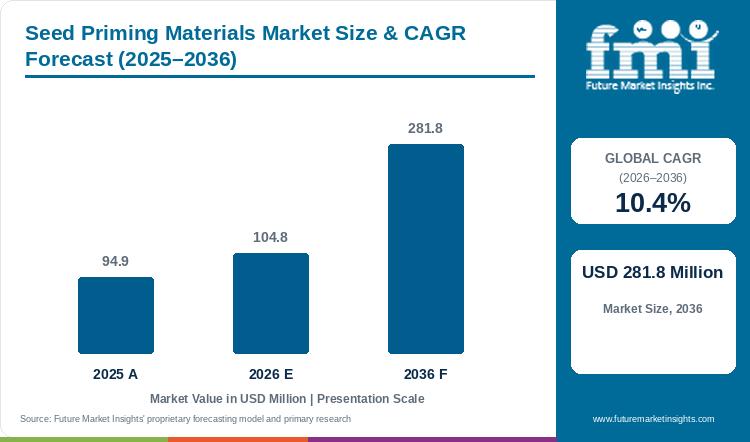
Seed Priming Materials Market Size & CAGR Forecast (2025-2036)
| Year | Basis | Market value (USD million) |
|---|---|---|
| 2025 | Actual | 94.9 |
| 2026 | Estimate | 104.8 |
| 2036 | Forecast | 281.8 |
| CAGR, 2026 to 2036 | 10.4% | |
Source: Future Market Insights proprietary forecasting model and primary research.
Key Takeaways
- Increasing use of controlled pre-sowing conditioning is supporting demand as the material improves establishment without disturbing storage and planter handling.
- Based on product type, polymer-based systems are projected to account for 42.7% in 2026, owing to its adhesion, binding and payload-control properties.
- By crop type, corn and cereals are estimated to hold 42.6% in 2026, supported by large seed volumes and mechanized planting programs.
- In 2026, in-plant treatment is expected to lead treatment point with 44.6% share, owing to controlled application, drying and lot release.
- Germany is projected to expand at 10.0% CAGR and the USA at 9.7% through 2036, backed by different treatment and crop conditions.
- Some of the key participants in seed priming materials market are Bayer SeedGrowth, Syngenta, Corteva Agriscience, BASF, Germains Seed Technology, Pivot Bio, Groundwork BioAg and Verdesian Life Sciences.
Analyst Perspective
“I see demand moving towards priming systems which keep crop response stable after storage and mechanical planting. Biological combinations will find wider use when compatibility improves without increasing drying time or treatment-line handling.”
- Nikhil Kaitwade, Principal Consultant, Future Market Insights.
How is the seed priming materials market segmented?
Seed priming materials market is segmented by five primary commercial axes and region: product type, crop type, treatment point, formulation, sales channel, and region. In 2026, polymer-based systems are projected at 42.7%, corn and cereals at 42.6%, in-plant treatment at 44.6%, liquid slurries at 42.5%, and agri-input distributors at 44.2%.
Seed priming materials market is segmented by product type, crop type, treatment point, formulation, sales channel and region.
By product type: polymer-based systems, biological or microbial systems, nutrient-loaded systems, and others.
By crop type: corn and cereals, soybean and pulses, vegetables, cotton and others.
By treatment point: in-plant treatment, commercial seed treaters, on-farm treatment, and others.
By formulation: liquid slurries, dry powders, film coats and encrusting, and others.
By sales channel: agri-input distributors, cooperatives, agri-retail chains, online or direct-to-farm, and others.
By region: North America, Latin America, Western Europe, Eastern Europe, East Asia, South Asia and Pacific, and Middle East and Africa.
Why do polymer-based systems retain product type demand?
Based on product type, polymer-based systems are projected to account for 42.7% in 2026, supported by adhesion and payload placement.
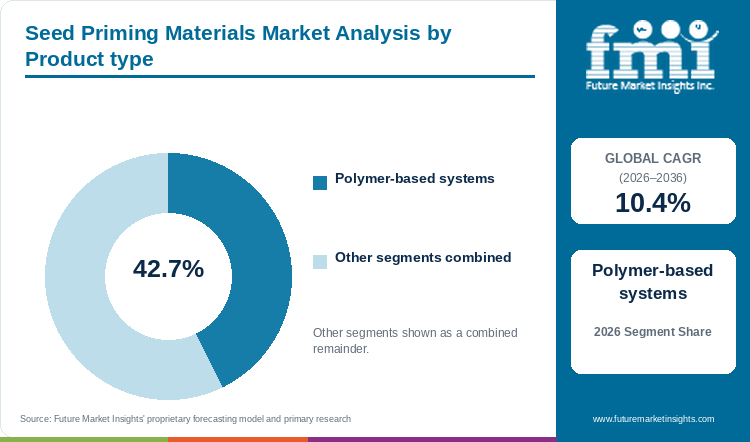
| Product type | Share (2026) |
|---|---|
| Polymer-based systems | 42.7% |
| Other segments combined | 57.3%* |
| Total | 100.0% |
| Metric | Value |
|---|---|
| Global CAGR (2026-2036) | 10.4% |
| Leading segment | Polymer-based systems |
Polymer-based systems are used to hold treatment materials on the seed and to keep the coating spread more evenly across its surface. A thin film reduces the loss of biologicals, nutrients and other inputs when seed is dried, packed and moved through planting equipment, encouraging wider adoption of microplastic-free seed coatings. A 2025 study identified storage stability and method standardization as continuing limits for primed seed.[3] According to FMI, this is the reason polymer-based systems are projected to account for 42.7% in 2026, as the polymer is not selected only for adhesion but also for what happens after treatment. Automated lines will further support adoption, provided viscosity, dose and drying time remain consistent from one production lot to another.
- Polymer-based systems are projected to hold 42.7% of product type revenue in 2026 because films and binders support repeatable treatment.
- The supplier must show that coating uniformity remains stable through drying, storage, and mechanical planting.
What supports corn and cereals as the preferred crop category?
By crop type, corn and cereals are estimated to hold 42.6% in 2026, owing to repeatable high-volume treatment.
Corn and cereal seeds move through large treatment and planting programs, due to which a small coating problem can continue across a very large volume. The U.S. Department of Agriculture projected 225.0 million acres of corn, wheat and soybeans in 2025, including 94.0 million corn acres and 47.0 million wheat acres.[4] This gives corn and cereals a wider base for one qualified formulation to be repeated across several production lots using commercial seed treatment materials. In the FMI report, the category is estimated to hold 42.6% share in 2026. Demand is further supported by mechanized planting, although dust formation, sticking and uneven seed movement can restrict the use of a formulation even when its germination response is suitable.
- Large seed volumes and mechanized planting support this category, as one qualified treatment can be repeated across several production lots.
- Dose consistency and planter flow determine whether a treatment can move from a trial into a recurring program.
How does in-plant treatment meet seed-company operating needs?
In 2026, in-plant treatment is expected to lead with 44.6% share, driven by centralized recipe and quality control.
In-plant treatment keeps mixing, application, drying, storage and lot release at one location, which helps a seed company to control the complete process. The Julius Kühn-Institut guideline became effective from June 1, 2025 and connects listed treatment facilities with dust-mitigation systems and recurring checks.[5] This makes centralized treatment more suitable when a recipe change needs to be tested before seed enters distribution. As noted by FMI, in-plant treatment is expected to hold 44.6% share in 2026 because settings can be repeated across several lots. The advantage will remain stronger where treatment teams can integrate seed stress protectors and control dose and dry-down without slowing regular plant throughput.
- In-plant treatment is expected to account for 44.6% in 2026 because centralized facilities can repeat validated dose and dry-down settings.
- Factory qualification also concentrates purchasing among technical teams that compare seed safety, dust, coating quality, and throughput.
Why do liquid slurries fit commercial formulation systems?
By formulation, liquid slurries are forecast to represent 42.5% in 2026, enabled by metered application and mixing flexibility.
Liquid slurries place binders, nutrients or biological materials on moving seed within one treatment step, facilitating the application of microbial seed primers. In February 2025, Groundwork BioAg introduced Rootella Forte powder while continuing Rootella L liquid, which shows that one format cannot suit every handling and application requirement.[6] Liquid systems are easier to meter on automated lines and this is supporting their 42.5% formulation share in 2026. FMI research indicates that commercial use will remain higher where treatment volume can be adjusted without making the seed too wet. However, unsuitable viscosity or slow drying can reduce storage quality and plantability, due to which the liquid route still needs close formulation control.
- Liquid slurries are forecast to represent 42.5% of formulation revenue in 2026 because automated plants can meter a defined treatment volume.
- Poor viscosity control or slow dry-down can still reduce storage quality and plantability.
Which conditions keep agri-input distributors relevant to sales?
Agri-input distributors are set to lead sales channel with 44.2% share in 2026, underpinned by local technical access.
Priming ingredients require local guidance on crop fit, storage, mixing order, and treatment equipment. In January 2025, ADAMA and Groundwork BioAg announced a distribution partnership for Rootella inoculants, placing specialized agricultural inoculants within an established commercial channel.[7] Distributor relevance increases when local inventory is paired with compatibility guidance and seasonal application support.
- Agri-input distributors are projected to hold 44.2% of sales in 2026 because advisers connect product instructions with seasonal crop programs.
- Local inventory matters after the adviser confirms compatibility with seed, equipment, storage time, and the rest of the treatment stack.
What are the drivers, restraints, and opportunities in the seed priming materials market?
In the seed priming materials market, the key driver is controlled establishment, the key restraint is recipe qualification, and the key opportunity is integrated delivery.
- Driver: Seed companies use pre-sowing conditioning to improve establishment and place functional inputs near the seed.
- Restraint: Materials must pass seed-safety, storage, coating, handling, and regulated-component compatibility checks.
- Opportunity: Integrated polymer, nutrient, and biological systems can combine several functions within one qualified application.
Controlled Establishment Supports Material Use
Seed priming begins part of the germination process before sowing, which can shorten the time required for seedlings to establish under uneven field conditions, functioning alongside commercial biofertilizers to enhance root vigor. A 2025 study reported that salicylic acid priming improved germination and salt-stress tolerance in Phaseolus vulgaris genotypes.[8] This type of response is increasing interest in materials which can hold the required moisture condition after drying. The driver is therefore not priming alone, but a visible field response that remains after storage and planting. Materials creating dust, poor flow or reduced seed safety can still lose adoption, even when the active treatment shows a positive laboratory result.
Recipe Qualification Slows Commercial Release
A priming ingredient comes in contact with moisture, coatings, active ingredients, compatible agricultural surfactants, and storage conditions, due to which one material change can disturb the complete recipe. The International Seed Federation maintains strict seed treatment stewardship guidelines and dust-off thresholds that require recipe verification before treated seeds enter commercial distribution.[9] This makes qualification a major restraint, especially where a seed company manages several crops and treatment combinations. Suppliers have to show coating quality, dust level, flowability, biological viability and seed safety before regular use. The delay is not only a regulatory issue; it also comes from the practical need to ensure that a new material does not reduce an already approved treatment performance.
Integrated Delivery Expands Application Scope
Combining polymers, nutrients and biological materials in one treatment package is opening new application possibilities for seed priming materials. In September 2025, Bayer SeedGrowth introduced Susteed biological seed treatment for oilseed rape and vegetable seeds in Belgium.[10] The development shows how biological functions are being placed directly on seed, which further creates requirement for specialized biological seed carriers and coating materials. Opportunity will be higher for systems that perform more than one function without adding a separate treatment step. Proper mixing order, drying limit and storage instruction will still remain important, because seed companies will avoid a combined recipe if it increases treatment time or affects finished-seed handling.
Which country CAGRs are profiled in the seed priming materials market?
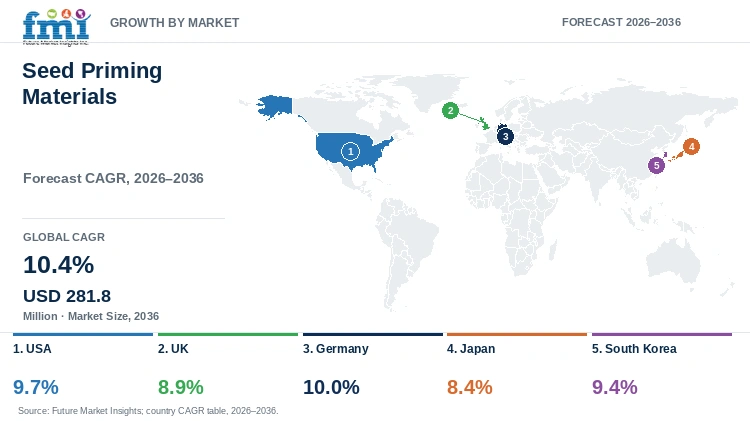
| Country | CAGR from 2026 to 2036 |
|---|---|
| USA | 9.7% |
| UK | 8.9% |
| Germany | 10.0% |
| Japan | 8.4% |
| South Korea | 9.4% |
How do country-level CAGRs compare in the seed priming materials market?
Country demand is expected to remain positive through 2036; however, every country will not follow the same treatment route. Germany and the USA have stronger commercial treatment conditions, while Japan and South Korea are moving through crop-specific seed quality and preparation programs. As per the analysis from FMI, these differences explain why country CAGRs remain close but not equal, as adoption depends on planted area, factory treatment and the amount of evidence required before a material is used regularly.
- USA demand benefits from commercial treatment capacity and a broad planted base for corn, cereals, and soybean.
- The UK combines cereal production with a defined transition for imported pesticide-treated seed after June 2027.
- Germany links listed treatment facilities with dust-mitigation quality systems and documented process checks.
- Japan supports seed-quality continuity and crop-specific registration work for vegetable seed treatment.
- South Korea uses extension guidance and crop-disease preparation to reinforce pre-sowing treatment practice.
Full report country CAGRs cover: North America; Latin America; Western Europe; Eastern Europe; East Asia; South Asia and Pacific; Middle East and Africa.
Country-wise Analysis
- By 2036, the USA is projected to grow at 9.7% CAGR, supported by large corn, wheat and soybean planting programs. In January 2026, the U.S. Department of Agriculture recorded final 2025 corn production at 15.3 billion bushels and soybean production at 4.36 billion bushels.[11] Such large seed volumes can support repeated use of one qualified formulation through centralized plants and dealer networks. Seed companies are expected to prefer materials which maintain coating uniformity and planter flow, as treatment failure can affect a large number of acres. Worker exposure and stewardship requirements will also influence adoption when priming materials are used along with commercial bioinsecticides or pesticide components.
- The UK seed priming materials outlook is anticipated to advance at 8.9% CAGR through 2036, influenced by cereal production and changes in treated-seed authorization. A September 2026 government evidence pack recorded 6.1 million hectares of croppable area and stated that cereal farms used 33% of England’s farmed area.[12] This supports demand for pre-sowing materials which can be applied repeatedly across cereal seed lots. Great Britain will also require an identical authorization from July 1, 2027 for imported seed treated with the relevant plant protection product. This will increase the need for clear documentation when priming materials are included in combined treatment recipes.
- Germany seed priming materials sector is projected to record 10.0% CAGR during the assessment period, owing to industrial treatment and documented quality control. Germany's Federal Office of Consumer Protection and Food Safety maintains monthly updated registries of authorized seed-applied plant protection products and facility standards.[13] The regulatory framework connects recipe changes with recurring checks and trial treatment where required. This is expected to support demand for polymer and slurry materials which can maintain adhesion, dose consistency and dust performance across seed lots. At the same time, new materials will need stronger process evidence before they are used in regular factory treatment.
- In Japan, demand for seed priming materials is predicted to advance at 8.4% CAGR through 2036, supported by focus on vegetable seed treatment and supply continuity. In July 2026, the Ministry of Agriculture, Forestry and Fisheries opened support for maintaining and expanding registrations for vegetable seed-treatment pesticides.[14] Although this program covers regulated treatments, it shows the importance of validated seed preparation in the country. High-value vegetable seeds can support crop-specific priming and coating where germination rate, application quantity and storage stability are properly documented. Demand is therefore expected to increase through proven crop use rather than one formulation for every seed type.
- South Korea is estimated to post 9.4% CAGR over the forecast period, backed by extension-based seed preparation and disease-control practices. In May 2025, the Rural Development Administration advised soybean growers that suitable pre-sowing seed disinfection can reduce disease incidence and support germination quality.[15] This guidance relates to disinfection; however, it confirms an established treatment step before planting. Seed priming materials can enter this workflow when the instructions remain simple and the formulation works with approved disease-control products. Local storage guidance and mixing sequence will be important because adoption is closely linked with seasonal farm use.
Who are the notable companies in the seed priming materials market?
Bayer SeedGrowth, Syngenta, Corteva Agriscience, BASF, Germains Seed Technology, Pivot Bio, Groundwork BioAg, and Verdesian Life Sciences are notable companies profiled in this market.
Seed priming materials market includes integrated treatment companies, coating and priming specialists, and developers of biological or nutrient inputs. Bayer SeedGrowth, Syngenta and Corteva Agriscience provide seed-applied products with crop and application support. Germains Seed Technology works more closely with priming, pelleting and coating, while Pivot Bio and Groundwork BioAg provide biological materials through different application formats. Buyers compare germination safety, coating uniformity, drying time, storage stability, dust and planter movement before approving a supplier. Therefore, one company can have a stronger position in factory treatment and another in on-farm placement, as the buying requirement changes with crop, equipment and storage period.
- Integrated seed-applied platforms: Bayer SeedGrowth, Syngenta, and Corteva Agriscience combine treatment portfolios with crop and application support.
- Coating and process specialists: BASF and Germains Seed Technology support coating, priming, and finished-seed handling requirements.
- Biological and nutrient payload specialists: Pivot Bio, Groundwork BioAg, and Verdesian Life Sciences develop on-seed microbial or nutrient functions.
Competitive Benchmarking: Seed Priming Materials Market
| Company | Coating integration | Payload depth | Process support | Geographic reach |
|---|---|---|---|---|
| Bayer SeedGrowth | High | High | High | High |
| Syngenta | Medium | High | High | High |
| Corteva Agriscience | Medium | Medium | High | High |
| BASF | Medium | High | High | High |
| Germains Seed Technology | High | Medium | High | Medium |
| Pivot Bio | Low | High | Medium | Medium |
| Groundwork BioAg | Low | High | Medium | Medium |
| Verdesian Life Sciences | Low | Medium | Medium | Medium |
High indicates broader public evidence for the stated capability, while Medium and Low indicate narrower documented activity. These ratings show capability coverage and not company quality or market-share ranking.
Key Developments in the Seed Priming Materials Market
- In July 2026, Syngenta and Groundwork BioAg entered a commercial partnership to distribute mycorrhizal inoculants for seed and soil applications.[19]
- In March 2026, Pivot Bio launched RETAIN Dry for sorghum as a direct-to-seed planter-box formulation, expanding the company platform across liquid, on-seed and dry application routes.[16]
- In March 2026, Bayer SeedGrowth launched Raxil Rise for cereal seed treatment in Canada to power disease protection and early crop establishment.[18]
- In November 2025, Syngenta received U.S. EPA registration for Victrato seed treatment for soybean and cotton, with availability planned for the 2026 planting season.[17]
Key Players in the Seed Priming Materials Market
Integrated seed-applied platforms
- Bayer SeedGrowth
- Syngenta
- Corteva Agriscience
Coating and process specialists
- BASF
- Germains Seed Technology
Biological and nutrient payload specialists
- Pivot Bio
- Groundwork BioAg
- Verdesian Life Sciences
Seed Priming Materials Market - Report Scope
| Coverage field | Report scope |
|---|---|
| Market breakdown | Product type; crop type; treatment point; formulation; sales channel; region. |
| Quantitative units | USD million. |
| Market definition | Supplier revenue from polymers, microbial inoculants, nutrient-loading agents, binders, carriers, and liquid or dry materials sold for controlled pre-sowing conditioning or priming-integrated seed enhancement. |
| Exclusions | Finished treated-seed value, downstream crop output, stand-alone field applications, and adjacent treatments outside the defined priming workflow. |
| Regions covered | North America; Latin America; Western Europe; Eastern Europe; East Asia; South Asia and Pacific; Middle East and Africa. |
| Countries covered | USA; UK; Germany; Japan; South Korea; additional countries in the full report. |
| Forecast period | 2026 to 2036. |
| Approach | The report covers supplier activity, segment structure, treatment routes, and country adoption conditions within the stated market boundary. |
Seed Priming Materials Market - Research Methodology
| Method | Approach |
|---|---|
| Primary Research | Analysts gathered input from manufacturers, service providers, technology developers, distributors, end users, procurement teams, and subject-matter experts. Interviews examined purchasing decisions, product or service evaluation, adoption barriers, approval requirements, pricing considerations, and expectations for technical or commercial support. Respondents were also asked what evidence is required before a trial, pilot, or initial order develops into regular purchasing. |
| Desk Research | Desk research covered government statistics, regulatory publications, trade data, industry associations, technical literature, standards, company filings, product information, and official corporate announcements. Sources were reviewed for relevance, publication date, geographic coverage, and consistency with the defined market scope. Claims relating to performance, applications, approvals, capacity, investment, and commercial activity were retained only when supported by credible public evidence. |
| Market Sizing and Forecasting | The market model combined the baseline value with historical performance, segment structure, pricing and volume indicators, adoption levels, company participation, and country-level demand conditions. Forecast assumptions considered economic activity, investment trends, regulatory developments, technology adoption, purchasing cycles, supply availability, and barriers to wider market use. Segment and regional estimates were reconciled before the final market total was calculated. |
| Data Validation | Estimates were checked against multiple independent indicators, including public data, company activity, trade patterns, industry developments, and findings from primary interviews. Validation also tested whether products, services, applications, and company revenues fell within the defined market boundaries. Adjacent categories, unsupported claims, overlapping revenues, and activities without direct market relevance were excluded to reduce double counting and maintain consistency across segments and countries. |
Seed Priming Materials Market by Segments
Seed Priming Materials Market by Product type:
- Polymer-based systems
- Biological or microbial systems
- Nutrient-loaded systems
- Others
Seed Priming Materials Market by Crop type:
- Corn and cereals
- Soybean and pulses
- Vegetables
- Cotton and others
Seed Priming Materials Market by Treatment point:
- In-plant treatment
- Commercial seed treaters
- On-farm treatment
- Others
Seed Priming Materials Market by Formulation:
- Liquid slurries
- Dry powders
- Film coats and encrusting
- Others
Seed Priming Materials Market by Sales channel:
- Agri-input distributors
- Cooperatives
- Agri-retail chains
- Online or direct-to-farm
- Others
Seed Priming Materials Market by Region
- North America
- United States
- Canada
- Latin America
- Brazil
- Mexico
- Argentina
- Chile
- Western Europe
- Germany
- France
- United Kingdom
- Italy
- Spain
- Benelux
- Nordics
- Eastern Europe
- Poland
- Czech Republic
- Romania
- Hungary
- East Asia
- China
- Japan
- South Korea
- South Asia and Pacific
- India
- ASEAN
- Australia and New Zealand
- Middle East and Africa
- GCC Countries
- South Africa
- Türkiye
- Israel
Research Sources and Bibliography
- [1] Cañizares, E., et al. (2025, April 29). Seeds of change: Exploring the transformative effects of seed priming in sustainable agriculture. Physiologia Plantarum, 177(3), e70226.
- [2] U.S. Department of Agriculture, National Agricultural Statistics Service. (2026, June 30). Corn planted acreage down 3% from 2025, soybean acreage up 5% from last year.
- [3] Ochoa-Chaparro, E. H., et al. (2025, June 5). Seed nanopriming with ZnO and SiO2 enhances germination, seedling vigor, and antioxidant defense under drought stress. Plants, 14(11), 1726.
- [4] U.S. Department of Agriculture. (2025, February 27). Grains and oilseeds outlook for 2025.
- [5] Julius Kühn-Institut. (2025, March 1). Verfahren und Anforderungen an Saatgutbehandlungseinrichtungen, Richtlinie 5-1.1.
- [6] Groundwork BioAg. (2025, February 25). Groundwork BioAg expands Rootella portfolio and Rootella Carbon Program at Commodity Classic 2025.
- [7] ADAMA. (2025, January 6). Groundwork BioAg and ADAMA partner to offer Rootella inoculants.
- [8] Karimi, M. R., et al. (2025, April 17). Seed priming with salicylic acid enhances salt stress tolerance in Phaseolus vulgaris genotypes. BMC Plant Biology, 25, 489.
- [9] International Seed Federation. (2025). Seed treatment stewardship guidelines and dust-off quality protocols.
- [10] Bayer SeedGrowth. (2025, September 29). Susteed brings together biologicals and seed treatments.
- [11] U.S. Department of Agriculture, National Agricultural Statistics Service. (2026, January 12). Crop production 2025 summary.
- [12] Department for Environment, Food and Rural Affairs. (2026, September). Farming evidence pack: A high-level overview of the UK agricultural industry.
- [13] German Federal Office of Consumer Protection and Food Safety. (2026, May). Concise list of plant protection products.
- [14] Ministry of Agriculture, Forestry and Fisheries, Japan. (2026, July 21). Call for vegetable seed-treatment technology projects.
- [15] Rural Development Administration, Republic of Korea. (2025, May 8). Soybean farming: Preparation from seed selection to planting.
- [16] Pivot Bio. (2026, March 11). Pivot Bio launches RETAIN Dry for sorghum growers.
- [17] Syngenta. (2025, November 10). Syngenta introduces Victrato seed treatment for nematode and disease protection.
- [18] Bayer SeedGrowth. (2026, March 29). Rising to new heights: New solutions and systems power Raxil’s future in Canada.
- [19] Syngenta. (2026, July 14). Syngenta and Groundwork BioAg enter partnership to bring innovation in biologicals and soil carbon solutions to farmers.
This bibliography is provided for reader reference. The full report contains the complete reference list and detailed citations.
This Report Answers
- What is Seed Priming Materials Market worth during 2026?
- What value is Seed Priming Materials Market projected by 2036?
- Which product type holds notable Seed Priming Materials Market share?
- Which crop type holds notable Seed Priming Materials Market share?
- Which countries have notable Seed Priming Materials Market growth?
- Which companies are notable in Seed Priming Materials Market today?
Frequently Asked Questions
How large is Seed Priming Materials Market expected to be in 2026?
Future Market Insights estimates that the seed priming materials market will be valued at USD 104.8 million in 2026. The market is projected to reach USD 281.8 million by 2036 as coating and biological systems find wider use.
What CAGR is forecast for Seed Priming Materials Market through 2036?
As per FMI, the seed priming materials market is projected to expand at a 10.4% CAGR from 2026 to 2036. Growth is supported by pre-sowing hydration, material placement and the need for better seed-handling performance.
Which product type holds a notable demand share during 2026?
Future Market Insights projects polymer-based systems to hold 42.7% of product type revenue in 2026. The segment benefits from adhesion, uniform material placement and easier control during drying and storage.
Which crop type holds a notable market share during 2026?
FMI finds that corn and cereals will account for 42.6% of crop type revenue in 2026. Large seed volumes and mechanized planting programs are supporting the use of repeatable treatment recipes.
Which country has a notable expansion outlook through 2036?
Future Market Insights predicts Germany to register a 10.0% CAGR during the 2026 to 2036 assessment period. Growth is supported by industrial treatment facilities following documented process and dust-mitigation controls.
Which companies are active in Seed Priming Materials Market during 2026?
Notable companies profiled in the market include Bayer SeedGrowth, Syngenta, Corteva Agriscience, BASF, Germains Seed Technology, Pivot Bio, Groundwork BioAg, and Verdesian Life Sciences. These companies are working across coating, biological placement, crop support and different seed-treatment formats.
Preview the report firsthand - request a free sample
Get SampleGet the brochure for pricing and purchase details.
Get PDFTable of Content
- Key Takeaways
- Market Size and CAGR
- Top Growth Driver
- Fastest Growing Segment
- Leading Region
- Key Companies
- Emerging Opportunities
- Executive Summary
- Global Market Outlook
- Demand-side Trends
- Supply-side Trends
- Technology Roadmap Analysis
- Analysis and Recommendations
- Analyst Perspective (What is happening? Why now? What should investors know?)
- Key Questions Answered
- How large is the market?
- What is the CAGR?
- What are key trends?
- Which region dominates?
- Who are the leaders?
- Market Overview
- Market Coverage / Taxonomy
- Market Definition / Scope / Limitations
- Research Methodology
- Chapter Orientation
- Analytical Lens and Working Hypotheses
- Market Structure, Signals, and Trend Drivers
- Benchmarking and Cross-market Comparability
- Market Sizing, Forecasting, and Opportunity Mapping
- Research Design and Evidence Framework
- Desk Research Programme (Secondary Evidence)
- Expert Input and Fieldwork (Primary Evidence)
- Tooling, Models, and Reference Databases
- Data Engineering and Model Build
- Quality Assurance and Audit Trail
- Market Background
- Market Dynamics (Drivers, Restraints, Opportunity, Trends)
- Scenario Forecast (Optimistic, Likely, Conservative)
- Impact Analysis
- AI Impact
- Sustainability Impact
- Regulatory Impact
- Technology Impact
- Consumer / Buyer Analysis
- Purchase Drivers
- Adoption Barriers
- Buyer Journey
- Opportunity Map Analysis
- Product Life Cycle Analysis
- Supply Chain Analysis
- Investment Feasibility Matrix
- Value Chain Analysis
- PESTLE and Porter's Analysis
- Regulatory Landscape
- Regional Parent Market Outlook
- Production and Consumption Statistics
- Import and Export Statistics
- Global Market Analysis and Forecast, 2021 to 2036
- Historical Market Size Value (USD Million) Analysis, 2021 to 2025
- Current and Future Market Size Value (USD Million) Projections, 2026 to 2036
- Y-o-Y Growth Trend Analysis
- Absolute $ Opportunity Analysis
- Global Market Pricing Analysis, 2021 to 2036
- Global Market Analysis and Forecast, By Product type, 2021 to 2036
- Introduction / Key Findings
- Historical Market Size Value (USD Million) Analysis By Product type, 2021 to 2025
- Current and Future Market Size Value (USD Million) Analysis and Forecast By Product type, 2026 to 2036
- Polymer-based systems
- Biological or microbial systems
- Nutrient-loaded systems
- Others
- Y-o-Y Growth Trend Analysis By Product type, 2021 to 2025
- Absolute $ Opportunity Analysis By Product type, 2026 to 2036
- Global Market Analysis and Forecast, By Crop type, 2021 to 2036
- Introduction / Key Findings
- Historical Market Size Value (USD Million) Analysis By Crop type, 2021 to 2025
- Current and Future Market Size Value (USD Million) Analysis and Forecast By Crop type, 2026 to 2036
- Corn and cereals
- Soybean and pulses
- Vegetables
- Cotton and others
- Y-o-Y Growth Trend Analysis By Crop type, 2021 to 2025
- Absolute $ Opportunity Analysis By Crop type, 2026 to 2036
- Global Market Analysis and Forecast, By Treatment point, 2021 to 2036
- Introduction / Key Findings
- Historical Market Size Value (USD Million) Analysis By Treatment point, 2021 to 2025
- Current and Future Market Size Value (USD Million) Analysis and Forecast By Treatment point, 2026 to 2036
- In-plant treatment
- Commercial seed treaters
- On-farm treatment
- Others
- Y-o-Y Growth Trend Analysis By Treatment point, 2021 to 2025
- Absolute $ Opportunity Analysis By Treatment point, 2026 to 2036
- Global Market Analysis and Forecast, By Formulation, 2021 to 2036
- Introduction / Key Findings
- Historical Market Size Value (USD Million) Analysis By Formulation, 2021 to 2025
- Current and Future Market Size Value (USD Million) Analysis and Forecast By Formulation, 2026 to 2036
- Liquid slurries
- Dry powders
- Film coats and encrusting
- Others
- Y-o-Y Growth Trend Analysis By Formulation, 2021 to 2025
- Absolute $ Opportunity Analysis By Formulation, 2026 to 2036
- Global Market Analysis and Forecast, By Sales channel, 2021 to 2036
- Introduction / Key Findings
- Historical Market Size Value (USD Million) Analysis By Sales channel, 2021 to 2025
- Current and Future Market Size Value (USD Million) Analysis and Forecast By Sales channel, 2026 to 2036
- Agri-input distributors
- Cooperatives
- Agri-retail chains
- Online or direct-to-farm
- Others
- Y-o-Y Growth Trend Analysis By Sales channel, 2021 to 2025
- Absolute $ Opportunity Analysis By Sales channel, 2026 to 2036
- Global Market Analysis and Forecast, By Region, 2021 to 2036
- Introduction
- Historical Market Size Value (USD Million) Analysis By Region, 2021 to 2025
- Current Market Size Value (USD Million) Analysis and Forecast By Region, 2026 to 2036
- North America
- Latin America
- Western Europe
- Eastern Europe
- East Asia
- South Asia and Pacific
- Middle East and Africa
- Market Attractiveness Analysis By Region
- North America Market Analysis and Forecast, By Country, 2021 to 2036
- Historical Market Size Value (USD Million) Trend Analysis By Market Taxonomy, 2021 to 2025
- Market Size Value (USD Million) Forecast By Market Taxonomy, 2026 to 2036
- By Country
- United States
- Canada
- By Product type
- By Crop type
- By Treatment point
- By Formulation
- By Sales channel
- By Country
- Market Attractiveness Analysis
- By Country
- By Product type
- By Crop type
- By Treatment point
- By Formulation
- By Sales channel
- Key Takeaways
- Latin America Market Analysis and Forecast, By Country
- Historical Market Size Value (USD Million) Trend Analysis By Market Taxonomy, 2021 to 2025
- Market Size Value (USD Million) Forecast By Market Taxonomy, 2026 to 2036
- By Country
- Brazil
- Mexico
- Argentina
- Chile
- By Product type
- By Crop type
- By Treatment point
- By Formulation
- By Sales channel
- By Country
- Market Attractiveness Analysis
- By Country
- By Product type
- By Crop type
- By Treatment point
- By Formulation
- By Sales channel
- Key Takeaways
- Western Europe Market Analysis and Forecast, By Country
- Historical Market Size Value (USD Million) Trend Analysis By Market Taxonomy, 2021 to 2025
- Market Size Value (USD Million) Forecast By Market Taxonomy, 2026 to 2036
- By Country
- Germany
- France
- United Kingdom
- Italy
- Spain
- Benelux
- Nordics
- By Product type
- By Crop type
- By Treatment point
- By Formulation
- By Sales channel
- By Country
- Market Attractiveness Analysis
- By Country
- By Product type
- By Crop type
- By Treatment point
- By Formulation
- By Sales channel
- Key Takeaways
- Eastern Europe Market Analysis and Forecast, By Country
- Historical Market Size Value (USD Million) Trend Analysis By Market Taxonomy, 2021 to 2025
- Market Size Value (USD Million) Forecast By Market Taxonomy, 2026 to 2036
- By Country
- Poland
- Czech Republic
- Romania
- Hungary
- By Product type
- By Crop type
- By Treatment point
- By Formulation
- By Sales channel
- By Country
- Market Attractiveness Analysis
- By Country
- By Product type
- By Crop type
- By Treatment point
- By Formulation
- By Sales channel
- Key Takeaways
- East Asia Market Analysis and Forecast, By Country
- Historical Market Size Value (USD Million) Trend Analysis By Market Taxonomy, 2021 to 2025
- Market Size Value (USD Million) Forecast By Market Taxonomy, 2026 to 2036
- By Country
- China
- Japan
- South Korea
- By Product type
- By Crop type
- By Treatment point
- By Formulation
- By Sales channel
- By Country
- Market Attractiveness Analysis
- By Country
- By Product type
- By Crop type
- By Treatment point
- By Formulation
- By Sales channel
- Key Takeaways
- South Asia and Pacific Market Analysis and Forecast, By Country
- Historical Market Size Value (USD Million) Trend Analysis By Market Taxonomy, 2021 to 2025
- Market Size Value (USD Million) Forecast By Market Taxonomy, 2026 to 2036
- By Country
- India
- ASEAN
- Australia and New Zealand
- By Product type
- By Crop type
- By Treatment point
- By Formulation
- By Sales channel
- By Country
- Market Attractiveness Analysis
- By Country
- By Product type
- By Crop type
- By Treatment point
- By Formulation
- By Sales channel
- Key Takeaways
- Middle East and Africa Market Analysis and Forecast, By Country
- Historical Market Size Value (USD Million) Trend Analysis By Market Taxonomy, 2021 to 2025
- Market Size Value (USD Million) Forecast By Market Taxonomy, 2026 to 2036
- By Country
- GCC Countries
- South Africa
- Türkiye
- Israel
- By Product type
- By Crop type
- By Treatment point
- By Formulation
- By Sales channel
- By Country
- Market Attractiveness Analysis
- By Country
- By Product type
- By Crop type
- By Treatment point
- By Formulation
- By Sales channel
- Key Takeaways
- Key Countries Market Analysis
- United States
- Pricing Analysis
- Market Share Analysis, 2025
- By Product type
- By Crop type
- By Treatment point
- By Formulation
- By Sales channel
- Canada
- Pricing Analysis
- Market Share Analysis, 2025
- By Product type
- By Crop type
- By Treatment point
- By Formulation
- By Sales channel
- Mexico
- Pricing Analysis
- Market Share Analysis, 2025
- By Product type
- By Crop type
- By Treatment point
- By Formulation
- By Sales channel
- Brazil
- Pricing Analysis
- Market Share Analysis, 2025
- By Product type
- By Crop type
- By Treatment point
- By Formulation
- By Sales channel
- Chile
- Pricing Analysis
- Market Share Analysis, 2025
- By Product type
- By Crop type
- By Treatment point
- By Formulation
- By Sales channel
- Germany
- Pricing Analysis
- Market Share Analysis, 2025
- By Product type
- By Crop type
- By Treatment point
- By Formulation
- By Sales channel
- United Kingdom
- Pricing Analysis
- Market Share Analysis, 2025
- By Product type
- By Crop type
- By Treatment point
- By Formulation
- By Sales channel
- Italy
- Pricing Analysis
- Market Share Analysis, 2025
- By Product type
- By Crop type
- By Treatment point
- By Formulation
- By Sales channel
- Spain
- Pricing Analysis
- Market Share Analysis, 2025
- By Product type
- By Crop type
- By Treatment point
- By Formulation
- By Sales channel
- France
- Pricing Analysis
- Market Share Analysis, 2025
- By Product type
- By Crop type
- By Treatment point
- By Formulation
- By Sales channel
- India
- Pricing Analysis
- Market Share Analysis, 2025
- By Product type
- By Crop type
- By Treatment point
- By Formulation
- By Sales channel
- ASEAN
- Pricing Analysis
- Market Share Analysis, 2025
- By Product type
- By Crop type
- By Treatment point
- By Formulation
- By Sales channel
- Australia and New Zealand
- Pricing Analysis
- Market Share Analysis, 2025
- By Product type
- By Crop type
- By Treatment point
- By Formulation
- By Sales channel
- China
- Pricing Analysis
- Market Share Analysis, 2025
- By Product type
- By Crop type
- By Treatment point
- By Formulation
- By Sales channel
- Japan
- Pricing Analysis
- Market Share Analysis, 2025
- By Product type
- By Crop type
- By Treatment point
- By Formulation
- By Sales channel
- South Korea
- Pricing Analysis
- Market Share Analysis, 2025
- By Product type
- By Crop type
- By Treatment point
- By Formulation
- By Sales channel
- Poland
- Pricing Analysis
- Market Share Analysis, 2025
- By Product type
- By Crop type
- By Treatment point
- By Formulation
- By Sales channel
- Hungary
- Pricing Analysis
- Market Share Analysis, 2025
- By Product type
- By Crop type
- By Treatment point
- By Formulation
- By Sales channel
- Türkiye
- Pricing Analysis
- Market Share Analysis, 2025
- By Product type
- By Crop type
- By Treatment point
- By Formulation
- By Sales channel
- South Africa
- Pricing Analysis
- Market Share Analysis, 2025
- By Product type
- By Crop type
- By Treatment point
- By Formulation
- By Sales channel
- United States
- Market Structure Analysis
- Competition Dashboard
- Competition Benchmarking
- Market Share Analysis of Top Players
- By Regional
- By Product type
- By Crop type
- By Treatment point
- By Formulation
- By Sales channel
- Emerging Startups
- Innovation Benchmarking
- Competition Analysis
- Competition Deep Dive
- Bayer SeedGrowth
- Overview
- Product Portfolio
- Profitability by Market Segments
- Sales Footprint
- Strategy Overview
- Marketing Strategy
- Product Strategy
- Channel Strategy
- Syngenta
- Corteva Agriscience
- BASF
- Germains Seed Technology
- Pivot Bio
- Groundwork BioAg
- Verdesian Life Sciences
- Bayer SeedGrowth
- Case Studies
- Success Stories
- Recent Developments
- Competition Deep Dive
- Assumptions & Acronyms Used


