
- Market Size (2026)
- USD 533.4 Mn
- Forecast (2036)
- USD 4584.3 Mn
- CAGR (2026 to 2036)
- 24.0%
How big is the Self-Sovereign Identity Market in 2026?
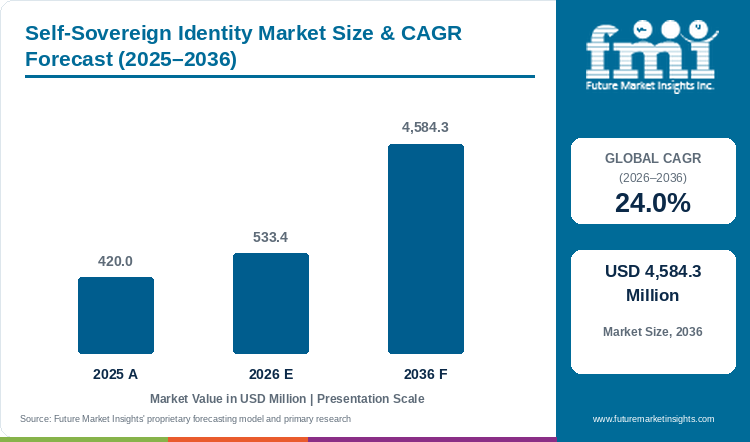
By 2036, FMI expects the global self-sovereign identity market to reach USD 4,584.3 million, growing at 24.0% a year from 2026 to 2036. The market was valued at USD 420.0 million in 2025. FMI estimates USD 533.4 million for 2026.
Self-Sovereign Identity Market Size and Forecast
Table 1: Self-Sovereign Identity Market Size and Forecast
| Market size and forecast | Value |
|---|---|
| Market size in 2025 | USD 420.0 million |
| Estimated market size in 2026 | USD 533.4 million |
| Projected market size by 2036 | USD 4,584.3 million |
| CAGR from 2026 to 2036 | 24.0% |
Source: Future Market Insights analysis of the Self-Sovereign identity market, 2026.
Commercial demand is concentrating around credential acceptance. Issuance and verification platforms lead component revenue because an identity document needs a trusted issuer and a service willing to accept its proof. The European Commission's digital identity framework extends national identity schemes into wallets for public and private services. This creates integration work at both ends of a transaction.
Technical agreement is reducing one barrier to procurement. W3C published seven Recommendations in its Verifiable Credentials 2.0 family on 15 May 2025, including a common data model and mechanisms for credential integrity and status. Buyers still need agreement on issuer authority and the attributes a verifier will accept. Dock Labs' August 2025 account of its integration with cheqd illustrates a commercial response: a credential platform can use external identity infrastructure and avoid maintaining its own network. Integration and recurring service revenue therefore depend on usable trust arrangements. The identity verification market provides adjacent purchasing context.
Key Market Trends & Insights
- Credential status is becoming a procurement requirement alongside issuance. W3C's 2025 standards family includes a mechanism for publishing suspension and revocation information. Buyers need evidence that a presented credential remains acceptable after the original issue date.
- Government document programmes are opening particular acceptance routes. GOV.UK guidance identifies the digital Veteran Card as available in its One Login app, with a digital driving licence described as a subsequent document. The initial credential mix sets the first integration opportunities.
- Consolidation is giving wallet and credential suppliers established digital trust sales channels. Validated ID states that it joined Signaturit Group in 2025.
Regional Highlights
- India, Germany and France are gaining share of global revenue. FMI projects India from 7.0% to 8.8%, Germany from 9.0% to 10.5% and France from 5.0% to 5.4% by 2036.
- Revenue rises in the United States, China and Japan, though each loses global share. FMI projects the United States from 24.0% to 22.0%, China from 7.0% to 5.9% and Japan from 4.0% to 3.4% over the same period.
Analyst Perspective
“FMI expects acceptance services to decide which wallet programmes produce repeat business. A large issuance exercise has limited commercial value if employers, banks or public agencies still ask for the same documents again. Suppliers need to demonstrate a complete route from an authorised issuer to an accepted transaction. Recovery, withdrawal of credentials and continued compatibility deserve as much attention as the initial wallet download.”
- Sudip Saha, Principal Consultant, FMI
How is the Self-Sovereign Identity Market segmented?
- By component: Wallets and Agents. Credential Issuance and Verification Platforms. Identifier Registry and Network Services. Professional and Integration Services.
- By end use: Government and Public Sector. Banking and Financial Services. Healthcare. Education and Employment. Retail and Travel. Others.
- By holder type: Individuals, Organizations and Legal Entities, and Devices and Things.
- By region: North America. Western Europe. East Asia. South Asia and Pacific. Rest of world.
Why does the Credential Issuance and Verification Platforms segment lead by Component in the Self-Sovereign Identity Market in 2026?
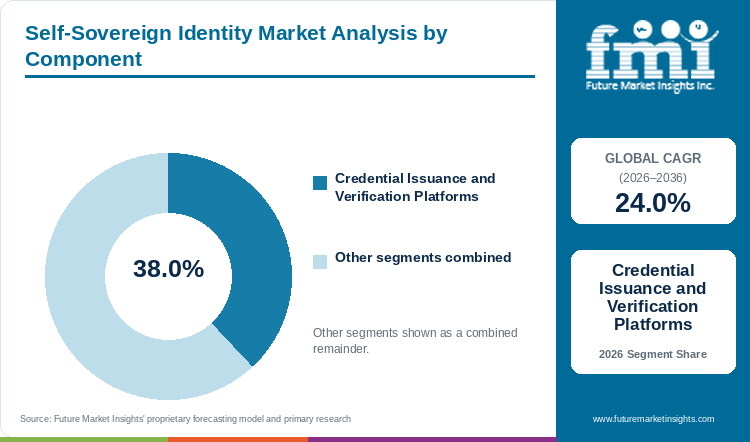
The Credential Issuance and Verification Platforms segment holds 38.0% of the Self-Sovereign Identity Market by component in 2026.
An issuer platform sits where authoritative records become portable credentials. It also gives the issuing organisation control over eligibility, renewal and withdrawal. PingOne Credentials describes a SaaS portal for creating, issuing, managing and revoking credentials held by their owner. These continuing administrative functions explain why component revenue is not confined to the mobile wallet interface.
The leading 2026 category does not remain the leader by the end of the forecast. FMI projects a 37.8% share for issuance and verification platforms in 2036, compared with 39.7% for Wallets and Agents. Platform revenue still reaches USD 1,731.2 million at a 23.9% CAGR. Wallet revenue grows at 25.9% to USD 1,817.8 million. Broader presentation and wallet-management activity accounts for the change in mix.
An open credential format does not eliminate the issuer's operational responsibilities. A platform must preserve an accurate connection between the underlying record and the credential currently accepted by services. The leading offers will therefore be judged on issuer administration and verifiable lifecycle behaviour, alongside integration into existing identity and access management systems.
Wallets and Agents, Identifier Registry and Network Services and Professional and Integration Services together hold the remaining 62.0% by component.
Table 2: Component, 2026 Share
| Leading Share | 2026 market share |
|---|---|
| Credential Issuance and Verification Platforms | 38.0% |
| All Other Segments Combined Share | 62.0% |
Source: Future Market Insights analysis of the Self-Sovereign identity market, 2026.
Why does the Government and Public Sector segment lead by End Use in the Self-Sovereign Identity Market in 2026?
The Government and Public Sector segment holds 32.0% of the Self-Sovereign Identity Market by end use in 2026.
Public authorities have a distinctive role because they originate identity and entitlement evidence that other organisations may accept. Demand is awarded through separate document programmes. A driving licence, professional authorisation and public benefit entitlement have different issuing bodies and withdrawal conditions. In the United Kingdom, wallet guidance separates departments that can add documents from other public bodies that can initially use information in the wallet. That division creates distinct supplier requirements for issuance and acceptance.
FMI projects government and public sector revenue of USD 170.7 million in 2026 and USD 1,683.7 million in 2036, a 25.7% CAGR. The forecast reflects expanding credential programmes and supporting services.
Private-sector demand remains commercially substantial. Banking and Financial Services holds 28.0% in 2026, followed by Education and Employment at 12.0%. For those buyers, a public credential can become an input to an existing decision process. Acceptance still depends on the institution's legal responsibilities and the assurance attached to the specific document. Suppliers that connect public credentials to established onboarding systems have a clearer commercial proposition than those relying only on the prospect of a universally accepted identity wallet.
Banking and Financial Services, Healthcare, Education and Employment, Retail and Travel and Others together account for the remaining 68.0% by end use.
Table 3: End Use, 2026 Share
| Leading Share | 2026 market share |
|---|---|
| Government and Public Sector | 32.0% |
| All Other Segments Combined Share | 68.0% |
Source: Future Market Insights analysis of the Self-Sovereign identity market, 2026.
Why does the Individuals segment lead by Holder Type in the Self-Sovereign Identity Market in 2026?
The Individuals segment holds 74.0% of the Self-Sovereign Identity Market by holder type in 2026.
Individual holders lead because public wallet programmes are designed around residents and citizens before they extend to businesses or equipment. The German federal government's 15 October 2026 announcement described the Bundestag's passage of the Digital Identity Act and stated that documents were planned to be stored in the d-you wallet from January 2027. California's July 2025 pilot report likewise distinguishes an identity gateway from the planned use of credentials held on residents' devices.
Organizational and device holders follow a different adoption sequence. A legal-entity credential must connect to company registers, signing authority and procurement rules, so each programme needs institutional agreement before volume appears. Credentials for devices depend on equipment makers and operators agreeing a common issuance and verification model. Both holder types therefore depend on regulatory sponsors and standards work.
FMI's 2026 assessment values the Individuals segment at USD 394.7 million. Individual credentials are issued in large counts at low unit value, so revenue depends on wallet and verification platform contracts. Platform suppliers should size organizational credentials as a separate sale with a longer qualification cycle.
Organizations and Legal Entities and Devices and Things together hold the remaining 26.0% by holder type.
Table 4: Holder Type, 2026 Share
| Leading Share | 2026 market share |
|---|---|
| Individuals | 74.0% |
| All Other Segments Combined Share | 26.0% |
Source: Future Market Insights analysis of the Self-Sovereign identity market, 2026.
What are the key drivers restraints and opportunities?
Government credential programmes and reusable acceptance services support expansion. Incompatible implementations and uncertain relying-party acceptance constrain deployment. Wallet integration and lifecycle services provide opportunities beyond the original credential issue.
Driver
Public authorities and regulated institutions need trusted digital evidence that remains usable across separate services.
Restraint
A common credential format does not settle which issuer a service trusts or which wallet implementation it accepts.
Opportunity
Verification gateways and issuer-management services can connect new holder-controlled credentials to existing operating systems.
How do purchasing rules and qualification affect Self-Sovereign identity market demand?
Government decisions are creating defined implementation work. The European framework retains member states as providers of digital identities and extends their use through wallets and other attestations. Public credentials can then enter banking, education and travel processes that already have an identity decision to make. The sales opportunity concerns that connection: translating accepted credential evidence into the relying party's required decision and audit record.
Commercial supply is becoming more modular. Dock Labs reported that maintaining its own network imposed overhead that diverted resources from credential solutions, and described its migration to cheqd infrastructure in August 2025. FMI reads this as evidence of specialisation within one supplier relationship. The wider implication is that issuance software, wallet software and network services can be purchased separately when interfaces and operating responsibilities are clear.
What limits reliable Self-Sovereign identity market supply and quality?
Wallet interoperability requires more than the ability to read a signature. A verifier must recognise the issuer and understand whether the credential remains valid for the intended purpose. Procivis' country profiles illustrate how compatibility is tested against particular reference implementations and versions. Buyers should expect configuration and regression work when those implementations change. A claim of broad standards support is insufficient evidence that the next national wallet release will operate without testing.
Product maturity also differs. IBM's current Verify documentation labels its Verifiable Credentials feature a closed beta. That status matters to procurement even when a supplier has a large identity business. Evaluation should distinguish a documented feature from a generally available managed service. The associated commercial risk is a delay between pilot acceptance and a supported production arrangement. Contracts need a clear service boundary for credential recovery, issuer-key changes and the handling of suspended documents.
Where can suppliers win additional business in the Self-Sovereign identity market?
The strongest near-term opening lies in accepting credentials that already exist. Trinsic presents an acceptance gateway covering several types of digital IDs, while MATTR demonstrates issuance and verification in remote and in-person settings. These are different offers from operating a national identity registry. Buyers can select an acceptance service around a defined transaction and add other document types as there is a business reason to do so.
Integration providers also have work in connecting trustworthy credentials to systems that retain authorisation decisions. Suppliers serving the broader digital identity services market can participate through scoped credential and wallet services, provided their revenue is separated from unrelated verification and authentication work.
Self-Sovereign Identity Market by Country (2026 to 2036)
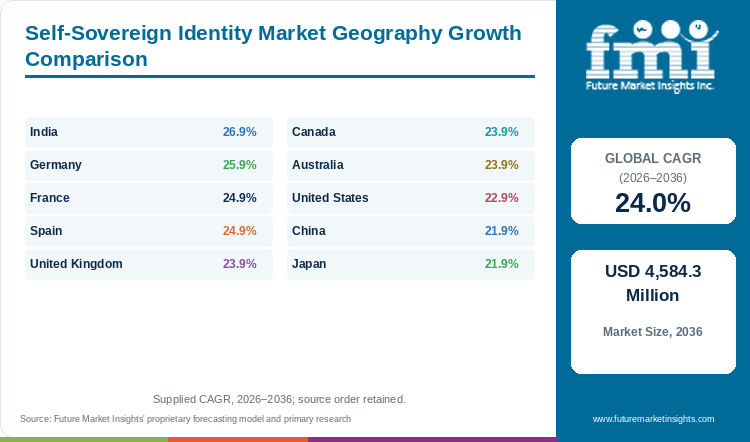
Table 5: Self-Sovereign Identity Market Country Growth Forecast
| Country | CAGR, 2026 to 2036 |
|---|---|
| India | 26.9% |
| Germany | 25.9% |
| France | 24.9% |
| Spain | 24.9% |
| United Kingdom | 23.9% |
| Canada | 23.9% |
| Australia | 23.9% |
| United States | 22.9% |
| China | 21.9% |
| Japan | 21.9% |
Source: Future Market Insights analysis of the Self-Sovereign identity market, 2026.
India
Selective disclosure has become a concrete feature of India's public identity discussion. On 28 January 2026, the government announced the new Aadhaar app. Its release describes customised QR requests through which residents share particular fields, and states that digitally signed verifiable credentials are shared without verifiers storing the Aadhaar number. This creates a relevant reference for credential handling.
India has the fastest forecast growth among the named countries at 26.9% CAGR from 2026 to 2036. FMI projects revenue increasing from USD 37.3 million to USD 405.1 million. The commercial opportunity lies in services around presentation and acceptance where the holder controls the credential exchange. A large national identity base can shorten the search for an authoritative source, but paid software adoption still depends on the receiving organisation's workflow.
The app announcement lists use cases including hotel check-in, gig-worker verification and age checks. Those transactions have different evidence needs. A service that only needs confirmation of age should not automatically request a complete identity record. Suppliers can differentiate by implementing the requested attribute and preserving the institution's ability to verify its origin. FMI expects integration discipline to be important: the commercial offer needs a clear boundary between app functionality already provided publicly and additional services bought by an enterprise. The strongest opportunities address a specific acceptance problem instead of charging for duplication of the public identity function.
Germany
Germany's public timetable makes deployment status particularly important. The d-you wallet is scheduled to launch on 2 January 2027, with its first credentials and use cases available at launch. The Bundestag's passage of the Digital Identity Act in October 2026 supplies the legal basis, and the launch date gives suppliers a fixed milestone for integration work. An implementation supplier can therefore have current development work before the citizen-facing service is broadly available. Orders and use are separate milestones.
FMI forecasts a 25.9% CAGR from 2026 to 2036, taking German revenue from USD 48.0 million to USD 481.3 million. The expected expansion reflects wallet implementation and the connections that issuers and accepting services need to establish. The national programme gives vendors an identifiable technical and legal route. Germany's share of global revenue rises from 9.0% to 10.5%. The USD 433.3 million rise over the decade ranks Germany second for increase.
The government's announcement describes an intended digital counterpart of the identity card and the prospect of adding further documents. FMI's commercial interpretation is that the first identity credential opens one class of transaction, while additional attestations create separate integration work. A supplier's addressable revenue depends on which part it delivers: the wallet, issuer systems or verification at the service provider. Centralised public authority over the underlying identity remains compatible with holder-controlled presentation, but the entire government identity budget is not SSI revenue.
France
An accepted travel transaction gives France a visible route beyond wallet enrolment. In July 2026, the Interior Ministry said France Identité could be used for baggage check-in and boarding at French airports. It specified presentation of the digital card's front face containing the name, photograph and other information needed for the identity check.
FMI estimates French revenue of USD 26.7 million for 2026 and forecasts USD 246.9 million in 2036, a 24.9% CAGR. The market argument centres on widening acceptance across defined public and commercial procedures. An operating wallet makes further uses more credible, but each service must still establish its legal basis and the evidence it requires. The supplier opportunity includes document validation and the interfaces used by the accepting organisation. From 2026 to 2036, revenue in France rises 9.2 times and global revenue 8.6 times. Global revenue share for France increases from 5.0% to 5.4%.
The same ministry release distinguished the airport use from an experimental passport-data journey at Marseille Provence. A vendor participating in a trial should not be described as supplying a fully deployed cross-border service. FMI expects suppliers to benefit when they turn a demonstrated document exchange into a repeatable operational process. The specific value lies in acceptance and service integration, including how the operator handles an unsuccessful presentation. Broader transport identity activity remains adjacent until it meets the holder-controlled credential scope of this report.
Spain
Spain's official Cartera Digital has been presented through the European Commission's EUDI Wallet launchpad. The Commission's session page, updated in February 2026, identifies a demonstration of Spain's official wallet and its intended access to digital identity and public services. A demonstration is useful evidence of programme direction, while production availability and the range of accepted credentials must be assessed separately.
FMI forecasts Spanish revenue of USD 16.0 million in 2026 and USD 148.1 million in 2036. The projected 24.9% CAGR reflects a growing wallet and credential-service market. Spain's opportunity also includes private suppliers with relevant technology. Validated ID's current company account places its SSI services, including VIDchain, within Signaturit Group after joining in 2025. Its 24.9% CAGR runs 0.9 percentage points above the 24.0% global rate. In 2026 revenue terms, Spain is joint ninth of the ten countries. Over the decade, revenue in Spain grows 9.3 times and the global total 8.6 times.
The commercial route is likely to involve both public-programme interfaces and enterprise acceptance. Providers need to show which credentials are supported and how the accepting organisation validates them. FMI expects established trust-service sales channels to help suppliers reach regulated buyers, but signature revenue must remain separate from the credential-service revenue covered here. Technical testing and clear product boundaries will determine whether a demonstrated wallet becomes an ongoing service relationship for a bank, employer or public institution.
United Kingdom
The United Kingdom is building wallet use around a recognisable government login relationship. Published GOV.UK guidance says that wallet documents are tied to the proven identity in GOV.UK One Login and stored locally on the user's phone. The guidance identifies the digital Veteran Card as available and describes further government documents as subsequent additions. This is a more specific demand signal than an undifferentiated forecast for all digital IDs.
Revenue is projected to rise at a 23.9% CAGR between 2026 and 2036, from USD 37.3 million to USD 319.0 million. FMI expects the opportunity to develop through the addition of credentials and acceptance services. The commercial workload will vary by department. An issuer needs a link to an authoritative record, while a relying organisation needs to know whether the document establishes the relevant eligibility.
The published guidance also retains paper or card alternatives and makes wallet use optional. Suppliers cannot assume that a government document's eligible population will immediately become active wallet users. Service designs must continue to handle another verification route. For public-sector buyers, the useful commercial measure is successful completion of a defined service using the digital credential. Download totals or registration totals alone give an incomplete view. Integration providers that can support that mixed operating environment have a more credible route to sustained work than a vendor selling only an app interface.
Canada
British Columbia's August 2026 app update changes the way its credential services reach users. The province states that BC Wallet features have moved into the BC Services Card app, alongside changes to navigation, accessibility and performance. Wallet functionality is therefore being brought into an existing public identity interface. This is a different commercial route from asking residents to adopt a separate wallet application.
Canada's assessed market grows from USD 21.3 million in 2026 to USD 182.3 million in 2036 at a forecast 23.9% CAGR. FMI expects opportunities where holder-controlled credentials become usable within established service relationships. An existing app can provide a familiar distribution route, but suppliers still have to identify the credential and the accepting organisation. General sign-in activity should not be counted as SSI revenue merely because wallet features are available in the same application.
The province describes its account as a means of accessing government services and notes that a user can see the information sent to a service. The integration supports a specific supplier task: connecting credential functions to an operating public identity experience without obscuring their separate purpose. Procurement should establish how a credential is obtained, held and presented after the interface change. FMI sees migration and continued compatibility as commercially relevant work, although the public announcement does not disclose a supplier contract value. Wider availability of an app remains distinct from the number of transactions completed using a particular credential.
Australia
Australia's accreditation framework gives buyers a clear way to separate identity roles. The Digital ID Act commenced on 30 November 2024. Official guidance distinguishes identity service providers, attribute service providers and exchanges, with rules addressing privacy, security and accessibility. Those categories describe the wider digital ID system.
The Australian SSI forecast rises from USD 16.0 million in 2026 to USD 136.7 million in 2036, equivalent to a 23.9% CAGR. FMI expects opportunities where portable credentials complement established identity services and an accepting organisation has a reason to use them. The market remains narrower than total digital ID expenditure. A vendor needs to show which wallet or credential function it supplies and how that function relates to the institution's existing identity responsibilities. A 23.9% CAGR leaves Australia 0.1 points below the 24.0% global pace.
Participation and accreditation requirements also shape the cost of market entry. The official framework provides additional safeguards for accredited entities, including requirements beyond a basic claim of technical compatibility. Supplier selection therefore needs both a product assessment and a review of the provider's role in the particular service. Attribute services may create opportunities around selected claims without replacing the primary identity provider. FMI sees the most practical sales case in a defined transaction with an agreed assurance requirement. General claims that all authentication will decentralise are a poor substitute for that evidence.
United States
State-level acceptance routes are the more useful indicator of US demand than the prospect of a single national wallet. California's July 2025 digital identification pilot report distinguishes an identity gateway from the planned use of credentials held on residents' devices. It describes both deployed benefit-verification activity and continuing wallet research.
The US market is forecast to expand from USD 128.0 million in 2026 to USD 1,008.6 million in 2036, a 22.9% CAGR. Its 24.0% global share in 2026 reflects the largest named revenue base. Growth is tied to converting particular public and enterprise documents into accepted digital transactions. The supplier has to satisfy the issuing authority and the organisation that relies on the result. A wallet demonstration alone settles neither requirement. In the Self-Sovereign identity market, the United States grows 22.9% a year, 1.1 points below the global rate. In the Self-Sovereign identity market, the United States ranks first of ten on 2026 revenue. From 2026 to 2036, revenue in the United States rises 7.9 times and global revenue 8.6 times. The United States' share of global revenue eases from 24.0% to 22.0%.
California's report discusses credentials such as mobile driving licences and business licences within a broader digital ID programme. FMI sees a sequence of bounded opportunities around those document types. Vendors can establish a commercially usable acceptance route, then extend it to another credential with an identifiable issuer. The constraint is that state and sector requirements can create separate deployment costs.
China
China's national online identity service is an important boundary for this market. Rules published in May 2025 took effect on 15 July 2025. They describe network numbers and credentials supplied through a unified national authentication platform, with voluntary applications and provisions for other lawful verification routes. A privacy-preserving output from that platform is not, by itself, evidence of an independent self-sovereign identity arrangement.
Against this policy context, FMI projects Chinese SSI revenue of USD 37.3 million in 2026 and USD 271.1 million in 2036. The corresponding forecast CAGR is 21.9%. The commercial assessment concerns software and credential services that meet the report's holder-control boundary. It excludes counting every central identity verification event as a sale in this category. China adds USD 233.8 million, ranking fifth for increase.
There remains room for verifiable claims outside a basic identity check. Education, employment and organisational qualification can each involve a distinct issuer and a receiving institution. FMI expects suppliers to face a practical question before such projects create recurring revenue: will the receiving institution accept the credential and the way it is presented? Local regulatory compatibility and the source of issuer authority matter more than the presence of a decentralised technology label. Services attached to a central platform may compete with, complement or replace a proposed wallet workflow depending on the transaction.
Japan
Educational credentials offer Japan a concrete test of cross-border use. In September 2026, the Digital Agency published results and scope documents for its verification of educational credential interoperability between Japan and the EU in 2025. A qualification is a useful starting point because the issuer's role and the receiving institution's decision can be specified.
FMI projects a CAGR of 21.9% through the 2026 to 2036 period. Japanese market revenue increases from USD 21.3 million to USD 154.9 million. The outlook concerns wallet and credential services that permit holder-controlled presentation. The important commercial question is whether a qualification issued under one institutional arrangement can be understood and accepted under another. Issuance, interpretation of the claim and the trust placed in the issuer must all survive the exchange. Global revenue share for Japan decreases from 4.0% to 3.4%.
The Digital Agency's programme addresses governance as well as technical use, including the risks associated with credentials and digital identity wallets. FMI expects this emphasis to shape vendor qualification. A software demonstration must be accompanied by an explanation of who remains accountable for incorrect or withdrawn information. Suppliers that document the supported credential profile and the limits of recognition are better placed for institution-to-institution projects. International demonstration results provide evidence for further work, but they should not be counted as a completed commercial roll-out across all education or financial organisations.
Who are the notable companies in the Self-Sovereign Identity Market?
Notable companies in the Self-Sovereign Identity Market include Microsoft, IBM, Okta, Ping Identity and Dock Labs.
Microsoft, Ping Identity and IBM approach credentials from established enterprise identity portfolios. Microsoft documents decentralised identifiers and verifiable credentials within Entra Verified ID. Ping offers issuance and lifecycle functions through PingOne Credentials. IBM's corresponding Verify feature is described as a closed beta, so its presence in the company coverage should not be read as evidence of equivalent production availability. These distinctions affect the services a buyer can procure today.
Specialists address different parts of the exchange. Dock Labs and Cheqd combine credential software and network infrastructure through a documented integration. Spruce supplies government digital-trust infrastructure, while Procivis offers wallet and credential lifecycle components. Trinsic concentrates on acceptance connectivity and MATTR demonstrates credential issuance, holding and verification. Validated ID now operates within Signaturit Group. Okta's documented directory, authentication and access offerings make it relevant to the receiving enterprise environment, but broad IAM revenue is not SSI revenue. Suppliers in the adjacent zero trust security market may integrate credentials into their controls without becoming wallet issuers.
Enterprise identity and acceptance interfaces: Microsoft, IBM, Ping Identity and Okta.
Credential, wallet and public-service specialists: Dock Labs, Spruce, Procivis and Validated ID.
Network and acceptance specialists: Cheqd, Trinsic and Mattr.
Key Developments in the Self-Sovereign Identity Market
- On 9 September 2026, Germany's federal digital ministry named its state European Digital Identity Wallet d-you and set a launch date of 2 January 2027. Around 40 launch partners attended the announcement, and the first credentials and use cases are scheduled to be available at launch.
Key Players in the Self-Sovereign Identity Market
- Microsoft
- IBM
- Okta
- Ping Identity
- Dock Labs
- Spruce
- Procivis
- Validated ID
- Trinsic
- Cheqd
- Mattr
Self-Sovereign Identity Market Report Scope
Table 6: Self-Sovereign Identity Market Report Scope
| Coverage field | Report scope |
|---|---|
| Market definition | Software platforms, wallets and credential services through which individuals, organizations, legal entities and devices hold and present verifiable identity credentials. |
| Included infrastructure | Decentralised identifiers, credential issuance and verification, wallet agents, identifier registries, network services and related integration. |
| Exclusions | General IAM, central identity registries, ordinary document scanning and unrelated electronic signatures unless directly part of the scoped credential service. |
| Quantitative Units | USD million |
| Component coverage | Wallets and Agents. Credential Issuance and Verification Platforms. Identifier Registry and Network Services. Professional and Integration Services. |
| End-use coverage | Government and Public Sector. Banking and Financial Services. Healthcare. Education and Employment. Retail and Travel. Others. |
| Named countries | United States, Germany, China, United Kingdom, India, France, Canada, Japan, Australia and Spain. |
| Aggregate coverage | Rest of world, shown separately from the ten named countries. |
| Holder Type coverage | Individuals, Organizations and Legal Entities, Devices and Things. |
| Company coverage | Microsoft, IBM, Okta, Ping Identity, Dock Labs, Spruce, Procivis, Validated ID, Trinsic, Cheqd and Mattr. |
Source: Future Market Insights analysis of the Self-Sovereign identity market, 2026.
Self-Sovereign Identity Market Research Methodology
FMI's revenue and user outlook is assessed alongside public credential programmes, standards and documented supplier functions. The analysis separates holder-controlled services from broader authentication and registry activity. Segment and country figures use consistent units and years. Competitive conclusions distinguish documented products, beta access, demonstrations and completed developments.
Self-Sovereign Identity Market by Segments
Self-Sovereign Identity Market segmented by Component:
- Wallets and Agents
- Credential Issuance and Verification Platforms
- Identifier Registry and Network Services
- Professional and Integration Services
Self-Sovereign Identity Market segmented by End Use:
- Government and Public Sector
- Banking and Financial Services
- Healthcare
- Education and Employment
- Retail and Travel
- Others
Self-Sovereign Identity Market segmented by Holder Type:
- Individuals
- Organizations and Legal Entities
- Devices and Things
Self-Sovereign Identity Market by Region
- North America
- United States
- Canada
- Western Europe
- Germany
- United Kingdom
- France
- Spain
- East Asia
- China
- Japan
- South Asia and Pacific
- India
- Australia
- Rest of world aggregate
Research Sources and Bibliography
- Australian Government, Digital ID System. (Accessed November 9, 2026). Digital ID Act 2024. https://www.digitalidsystem.gov.au/what-is-digital-id/digital-id-act-2024
- Bundesministerium für Digitales und Staatsmodernisierung. (2026, September 9). d-you: Name and logo of Germany's EUDI Wallet unveiled. https://eudi-wallet.gov.de/en/news/d-you-name-and-logo-of-germany-s-eudi-wallet-unveiled
- California Department of Technology. (2025, July 1). Digital Identification Pilot Program: report covering progress through June 30, 2025. https://www.cdt.ca.gov/wp-content/uploads/2026/03/Digital-Identification-ID-Pilot-Program-Report-2025-2nd-Report.pdf
- Cheqd, Chan, T. (2025, August 29). Success Story: Dock Labs and cheqd Integration. https://cheqd.io/blog/success-story-dock-labs-and-cheqd-integration/
- Cyberspace Administration of China and participating ministries. (2025, May 23). Measures for the Administration of the National Online Identity Authentication Public Service. https://www.cac.gov.cn/2025-05/23/c_1749711107835487.htm
- Digital Agency, Japan. (2026, September 18 update). Trust: digital identity and related initiatives. https://www.digital.go.jp/en/policies/trust
- European Commission. (2026, February 16 update). Introducing Cartera Digital, Spain's official EUDI Wallet. https://ec.europa.eu/digital-building-blocks/sites/spaces/EUDIGITALIDENTITYWALLET/pages/940311484/Introducing+Cartera+Digital+the+Spains+official+EUDI+Wallet
- European Commission. (Accessed November 9, 2026). European Digital Identity Regulation. https://digital-strategy.ec.europa.eu/en/policies/eudi-regulation
- French Ministry of the Interior. (2026, July 10). France Identité voyage avec vous: airport check-in and boarding use. https://www.interieur.gouv.fr/actualites/communiques-de-presse/france-identite-voyage-avec-vous-lapplication-est-desormais-utilisable-lors-de-lenregistrement-des
- German Federal Government. (2026, October 15). Die digitale Brieftasche kommt. https://www.bundesregierung.de/breg-de/aktuelles/digitale-brieftasche-2431500
- Government Digital Service. (2025, October 28 update). Using GOV.UK Wallet in government. https://www.gov.uk/guidance/using-govuk-wallet-in-government
- Government of British Columbia. (2026, August update; accessed November 9, 2026). BC Services Card Account: BC Wallet features moved into the BC Services Card app. https://id.gov.bc.ca/account/
- IBM. (Accessed November 9, 2026). Decentralized identity: IBM Verify documentation. https://docs.verify.ibm.com/verify/docs/use-cases-decentralized-identity
- MATTR. (Accessed November 9, 2026). Get started with Digital Credentials. https://mattr.global/get-started
- Microsoft. (Accessed November 9, 2026). Introduction to Microsoft Entra Verified ID. https://learn.microsoft.com/en-us/entra/verified-id/decentralized-identifier-overview
- Ministry of Electronics and Information Technology, Press Information Bureau. (2026, January 28). New Aadhaar App dedicated to the nation. https://www.pib.gov.in/PressReleasePage.aspx?PRID=2219790
- Okta. (Accessed November 9, 2026). Identity platforms and product portfolio. https://www.okta.com/
- Ping Identity. (Accessed November 9, 2026). PingOne Credentials. https://www.pingidentity.com/en/product/pingone-credentials.html
- Procivis. (Accessed November 9, 2026). Procivis One and Country Profiles documentation. https://www.procivis.ch/ and https://docs.procivis.ch/profiles
- SpruceID. (Accessed November 9, 2026). Digital trust infrastructure for government. https://spruceid.com/
- Trinsic. (Accessed November 9, 2026). Digital ID acceptance gateway and Identity Acceptance Network. https://www.trinsic.id/
- Validated ID. (Accessed November 9, 2026). About Validated ID. https://www.validatedid.com/en/about
- World Wide Web Consortium. (2025, May 15). The Verifiable Credentials 2.0 family of specifications is now a W3C Recommendation. https://www.w3.org/news/2025/the-verifiable-credentials-2-0-family-of-specifications-is-now-a-w3c-recommendation/
This bibliography is provided for reader reference and is not exhaustive. The full report contains the complete reference list and detailed citations.
Table of Content
- Key Takeaways
- Market Size and CAGR
- Top Growth Driver
- Fastest Growing Segment
- Leading Region
- Key Companies
- Emerging Opportunities
- Executive Summary
- Global Market Outlook
- Demand-side Trends
- Supply-side Trends
- Technology Roadmap Analysis
- Analysis and Recommendations
- Analyst Perspective (What is happening? Why now? What should investors know?)
- Key Questions Answered
- How large is the market?
- What is the CAGR?
- What are key trends?
- Which region dominates?
- Who are the leaders?
Read More...
- Market Overview
- Market Coverage / Taxonomy
- Market Definition / Scope / Limitations
- Research Methodology
- Chapter Orientation
- Analytical Lens and Working Hypotheses
- Market Structure, Signals, and Trend Drivers
- Benchmarking and Cross-market Comparability
- Market Sizing, Forecasting, and Opportunity Mapping
- Research Design and Evidence Framework
- Desk Research Programme (Secondary Evidence)
- Expert Input and Fieldwork (Primary Evidence)
- Tooling, Models, and Reference Databases
- Data Engineering and Model Build
- Quality Assurance and Audit Trail
- Market Background
- Market Dynamics (Drivers, Restraints, Opportunity, Trends)
- Scenario Forecast (Optimistic, Likely, Conservative)
- Impact Analysis
- AI Impact
- Sustainability Impact
- Regulatory Impact
- Technology Impact
- Consumer / Buyer Analysis
- Purchase Drivers
- Adoption Barriers
- Buyer Journey
- Opportunity Map Analysis
- Product Life Cycle Analysis
- Supply Chain Analysis
- Investment Feasibility Matrix
- Value Chain Analysis
- PESTLE and Porter's Analysis
- Regulatory Landscape
- Regional Parent Market Outlook
- Production and Consumption Statistics
- Import and Export Statistics
- Global Market Analysis and Forecast, 2021 to 2036
- Historical Market Size Value (USD Million) Analysis, 2021 to 2025
- Current and Future Market Size Value (USD Million) Projections, 2026 to 2036
- Y-o-Y Growth Trend Analysis
- Absolute $ Opportunity Analysis
- Global Market Pricing Analysis, 2021 to 2036
- Global Market Analysis and Forecast, By Component, 2021 to 2036
- Introduction / Key Findings
- Historical Market Size Value (USD Million) Analysis By Component, 2021 to 2025
- Current and Future Market Size Value (USD Million) Analysis and Forecast By Component, 2026 to 2036
- Wallets and Agents
- Credential Issuance and Verification Platforms
- Identifier Registry and Network Services
- Professional and Integration Services
- Y-o-Y Growth Trend Analysis By Component, 2021 to 2025
- Absolute $ Opportunity Analysis By Component, 2026 to 2036
- Global Market Analysis and Forecast, By End Use, 2021 to 2036
- Introduction / Key Findings
- Historical Market Size Value (USD Million) Analysis By End Use, 2021 to 2025
- Current and Future Market Size Value (USD Million) Analysis and Forecast By End Use, 2026 to 2036
- Government and Public Sector
- Banking and Financial Services
- Healthcare
- Education and Employment
- Retail and Travel
- Others
- Y-o-Y Growth Trend Analysis By End Use, 2021 to 2025
- Absolute $ Opportunity Analysis By End Use, 2026 to 2036
- Global Market Analysis and Forecast, By Holder Type, 2021 to 2036
- Introduction / Key Findings
- Historical Market Size Value (USD Million) Analysis By Holder Type, 2021 to 2025
- Current and Future Market Size Value (USD Million) Analysis and Forecast By Holder Type, 2026 to 2036
- Individuals
- Organizations and Legal Entities
- Devices and Things
- Y-o-Y Growth Trend Analysis By Holder Type, 2021 to 2025
- Absolute $ Opportunity Analysis By Holder Type, 2026 to 2036
- Global Market Analysis and Forecast, By Region, 2021 to 2036
- Introduction
- Historical Market Size Value (USD Million) Analysis By Region, 2021 to 2025
- Current Market Size Value (USD Million) Analysis and Forecast By Region, 2026 to 2036
- North America
- Western Europe
- East Asia
- South Asia and Pacific
- Market Attractiveness Analysis By Region
- North America Market Analysis and Forecast, By Country, 2021 to 2036
- Historical Market Size Value (USD Million) Trend Analysis By Market Taxonomy, 2021 to 2025
- Market Size Value (USD Million) Forecast By Market Taxonomy, 2026 to 2036
- By Country
- United States
- Canada
- By Component
- By End Use
- By Holder Type
- By Country
- Market Attractiveness Analysis
- By Country
- By Component
- By End Use
- By Holder Type
- Key Takeaways
- Western Europe Market Analysis and Forecast, By Country
- Historical Market Size Value (USD Million) Trend Analysis By Market Taxonomy, 2021 to 2025
- Market Size Value (USD Million) Forecast By Market Taxonomy, 2026 to 2036
- By Country
- Germany
- United Kingdom
- France
- Spain
- By Component
- By End Use
- By Holder Type
- By Country
- Market Attractiveness Analysis
- By Country
- By Component
- By End Use
- By Holder Type
- Key Takeaways
- East Asia Market Analysis and Forecast, By Country
- Historical Market Size Value (USD Million) Trend Analysis By Market Taxonomy, 2021 to 2025
- Market Size Value (USD Million) Forecast By Market Taxonomy, 2026 to 2036
- By Country
- China
- Japan
- By Component
- By End Use
- By Holder Type
- By Country
- Market Attractiveness Analysis
- By Country
- By Component
- By End Use
- By Holder Type
- Key Takeaways
- South Asia and Pacific Market Analysis and Forecast, By Country
- Historical Market Size Value (USD Million) Trend Analysis By Market Taxonomy, 2021 to 2025
- Market Size Value (USD Million) Forecast By Market Taxonomy, 2026 to 2036
- By Country
- India
- Australia
- Rest of world aggregate
- By Component
- By End Use
- By Holder Type
- By Country
- Market Attractiveness Analysis
- By Country
- By Component
- By End Use
- By Holder Type
- Key Takeaways
- Key Countries Market Analysis
- United States
- Pricing Analysis
- Market Share Analysis, 2025
- By Component
- By End Use
- By Holder Type
- Canada
- Pricing Analysis
- Market Share Analysis, 2025
- By Component
- By End Use
- By Holder Type
- Germany
- Pricing Analysis
- Market Share Analysis, 2025
- By Component
- By End Use
- By Holder Type
- United Kingdom
- Pricing Analysis
- Market Share Analysis, 2025
- By Component
- By End Use
- By Holder Type
- Spain
- Pricing Analysis
- Market Share Analysis, 2025
- By Component
- By End Use
- By Holder Type
- France
- Pricing Analysis
- Market Share Analysis, 2025
- By Component
- By End Use
- By Holder Type
- India
- Pricing Analysis
- Market Share Analysis, 2025
- By Component
- By End Use
- By Holder Type
- China
- Pricing Analysis
- Market Share Analysis, 2025
- By Component
- By End Use
- By Holder Type
- Japan
- Pricing Analysis
- Market Share Analysis, 2025
- By Component
- By End Use
- By Holder Type
- Australia
- Pricing Analysis
- Market Share Analysis, 2025
- By Component
- By End Use
- By Holder Type
- United States
- Market Structure Analysis
- Competition Dashboard
- Competition Benchmarking
- Market Share Analysis of Top Players
- By Regional
- By Component
- By End Use
- By Holder Type
- Emerging Startups
- Innovation Benchmarking
- Competition Analysis
- Competition Deep Dive
- Microsoft
- Overview
- Product Portfolio
- Profitability by Market Segments
- Sales Footprint
- Strategy Overview
- Marketing Strategy
- Product Strategy
- Channel Strategy
- IBM
- Okta
- Ping Identity
- Dock Labs
- Spruce
- Procivis
- Validated ID
- Trinsic
- Cheqd
- Mattr
- Microsoft
- Case Studies
- Success Stories
- Recent Developments
- Competition Deep Dive
- Assumptions & Acronyms Used
List of Tables
- Table 1: Global Market Value (USD Million) Forecast by Region, 2021 to 2036
- Table 2: Global Market Value (USD Million) Forecast by Component, 2021 to 2036
- Table 3: Global Market Value (USD Million) Forecast by End Use, 2021 to 2036
- Table 4: Global Market Value (USD Million) Forecast by Holder Type, 2021 to 2036
- Table 5: North America Market Value (USD Million) Forecast by Country, 2021 to 2036
- Table 6: North America Market Value (USD Million) Forecast by Component, 2021 to 2036
- Table 7: North America Market Value (USD Million) Forecast by End Use, 2021 to 2036
- Table 8: North America Market Value (USD Million) Forecast by Holder Type, 2021 to 2036
- Table 9: Western Europe Market Value (USD Million) Forecast by Country, 2021 to 2036
- Table 10: Western Europe Market Value (USD Million) Forecast by Component, 2021 to 2036
- Table 11: Western Europe Market Value (USD Million) Forecast by End Use, 2021 to 2036
- Table 12: Western Europe Market Value (USD Million) Forecast by Holder Type, 2021 to 2036
- Table 13: East Asia Market Value (USD Million) Forecast by Country, 2021 to 2036
- Table 14: East Asia Market Value (USD Million) Forecast by Component, 2021 to 2036
- Table 15: East Asia Market Value (USD Million) Forecast by End Use, 2021 to 2036
- Table 16: East Asia Market Value (USD Million) Forecast by Holder Type, 2021 to 2036
- Table 17: South Asia and Pacific Market Value (USD Million) Forecast by Country, 2021 to 2036
- Table 18: South Asia and Pacific Market Value (USD Million) Forecast by Component, 2021 to 2036
- Table 19: South Asia and Pacific Market Value (USD Million) Forecast by End Use, 2021 to 2036
- Table 20: South Asia and Pacific Market Value (USD Million) Forecast by Holder Type, 2021 to 2036
List of Figures
- Figure 1: Global Market Pricing Analysis
- Figure 2: Global Market Value (USD Million) Forecast 2021-2036
- Figure 3: Global Market Value Share and BPS Analysis by Component, 2026 and 2036
- Figure 4: Global Market Y-o-Y Growth Comparison by Component, 2026-2036
- Figure 5: Global Market Attractiveness Analysis by Component
- Figure 6: Global Market Value Share and BPS Analysis by End Use, 2026 and 2036
- Figure 7: Global Market Y-o-Y Growth Comparison by End Use, 2026-2036
- Figure 8: Global Market Attractiveness Analysis by End Use
- Figure 9: Global Market Value Share and BPS Analysis by Holder Type, 2026 and 2036
- Figure 10: Global Market Y-o-Y Growth Comparison by Holder Type, 2026-2036
- Figure 11: Global Market Attractiveness Analysis by Holder Type
- Figure 12: Global Market Value (USD Million) Share and BPS Analysis by Region, 2026 and 2036
- Figure 13: Global Market Y-o-Y Growth Comparison by Region, 2026-2036
- Figure 14: Global Market Attractiveness Analysis by Region
- Figure 15: North America Market Incremental Dollar Opportunity, 2026-2036
- Figure 16: Western Europe Market Incremental Dollar Opportunity, 2026-2036
- Figure 17: East Asia Market Incremental Dollar Opportunity, 2026-2036
- Figure 18: South Asia and Pacific Market Incremental Dollar Opportunity, 2026-2036
- Figure 19: North America Market Value Share and BPS Analysis by Country, 2026 and 2036
- Figure 20: North America Market Value Share and BPS Analysis by Component, 2026 and 2036
- Figure 21: North America Market Y-o-Y Growth Comparison by Component, 2026-2036
- Figure 22: North America Market Attractiveness Analysis by Component
- Figure 23: North America Market Value Share and BPS Analysis by End Use, 2026 and 2036
- Figure 24: North America Market Y-o-Y Growth Comparison by End Use, 2026-2036
- Figure 25: North America Market Attractiveness Analysis by End Use
- Figure 26: North America Market Value Share and BPS Analysis by Holder Type, 2026 and 2036
- Figure 27: North America Market Y-o-Y Growth Comparison by Holder Type, 2026-2036
- Figure 28: North America Market Attractiveness Analysis by Holder Type
- Figure 29: Western Europe Market Value Share and BPS Analysis by Country, 2026 and 2036
- Figure 30: Western Europe Market Value Share and BPS Analysis by Component, 2026 and 2036
- Figure 31: Western Europe Market Y-o-Y Growth Comparison by Component, 2026-2036
- Figure 32: Western Europe Market Attractiveness Analysis by Component
- Figure 33: Western Europe Market Value Share and BPS Analysis by End Use, 2026 and 2036
- Figure 34: Western Europe Market Y-o-Y Growth Comparison by End Use, 2026-2036
- Figure 35: Western Europe Market Attractiveness Analysis by End Use
- Figure 36: Western Europe Market Value Share and BPS Analysis by Holder Type, 2026 and 2036
- Figure 37: Western Europe Market Y-o-Y Growth Comparison by Holder Type, 2026-2036
- Figure 38: Western Europe Market Attractiveness Analysis by Holder Type
- Figure 39: East Asia Market Value Share and BPS Analysis by Country, 2026 and 2036
- Figure 40: East Asia Market Value Share and BPS Analysis by Component, 2026 and 2036
- Figure 41: East Asia Market Y-o-Y Growth Comparison by Component, 2026-2036
- Figure 42: East Asia Market Attractiveness Analysis by Component
- Figure 43: East Asia Market Value Share and BPS Analysis by End Use, 2026 and 2036
- Figure 44: East Asia Market Y-o-Y Growth Comparison by End Use, 2026-2036
- Figure 45: East Asia Market Attractiveness Analysis by End Use
- Figure 46: East Asia Market Value Share and BPS Analysis by Holder Type, 2026 and 2036
- Figure 47: East Asia Market Y-o-Y Growth Comparison by Holder Type, 2026-2036
- Figure 48: East Asia Market Attractiveness Analysis by Holder Type
- Figure 49: South Asia and Pacific Market Value Share and BPS Analysis by Country, 2026 and 2036
- Figure 50: South Asia and Pacific Market Value Share and BPS Analysis by Component, 2026 and 2036
- Figure 51: South Asia and Pacific Market Y-o-Y Growth Comparison by Component, 2026-2036
- Figure 52: South Asia and Pacific Market Attractiveness Analysis by Component
- Figure 53: South Asia and Pacific Market Value Share and BPS Analysis by End Use, 2026 and 2036
- Figure 54: South Asia and Pacific Market Y-o-Y Growth Comparison by End Use, 2026-2036
- Figure 55: South Asia and Pacific Market Attractiveness Analysis by End Use
- Figure 56: South Asia and Pacific Market Value Share and BPS Analysis by Holder Type, 2026 and 2036
- Figure 57: South Asia and Pacific Market Y-o-Y Growth Comparison by Holder Type, 2026-2036
- Figure 58: South Asia and Pacific Market Attractiveness Analysis by Holder Type
- Figure 59: Global Market - Tier Structure Analysis
- Figure 60: Global Market - Company Share Analysis
Frequently Asked Questions
How big is the Self-Sovereign identity market in 2026?
FMI estimates the market at USD 533.4 million in 2026, up from USD 420.0 million in 2025. It is forecast to reach USD 4,584.3 million by 2036 at a 24.0% CAGR.
Which component leads the Self-Sovereign identity market in 2026?
Credential Issuance and Verification Platforms leads by component with 38.0% in 2026. All other segments together hold 62.0%.
Which end use and holder type lead in 2026?
Government and Public Sector holds 32.0% by end use and Individuals holds 74.0% by holder type in FMI's 2026 assessment.
Which market is forecast to grow fastest through 2036?
India has the highest forecast CAGR at 26.9% during 2026 to 2036, followed by Germany at 25.9%.
Does every government digital identity wallet belong to the SSI market?
No. The assessment includes holder-controlled credential software and services within its defined scope. A central identity registry or general authentication programme is not automatically part of that revenue. The European framework itself builds wallets on national identity systems.[2]
Preview the report firsthand - request a free sample
Get SampleGet the brochure for pricing and purchase details.
Get PDF
