

- Market Size (2026)
- USD 486.2 Mn
- Forecast (2036)
- USD 1123.9 Mn
- CAGR (2026 to 2036)
- 8.7%
How big is Shear Wave Elastography Market in 2026?
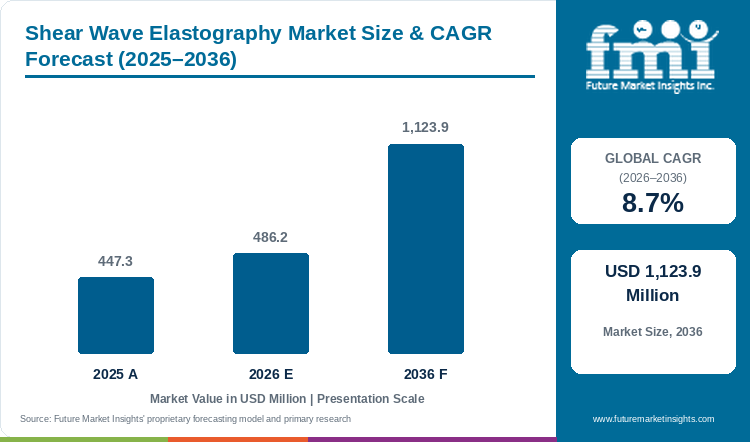
Posting USD 447.3 Million in 2025 alongside a 2026 estimate of USD 486.2 Million, the global shear wave elastography sector is expected to expand at an 8.7% annual pace to hit a forecast USD 1,123.9 Million in 2036.
Non-invasive quantification of hepatic parenchymal stiffness in kilopascals is rapidly replacing percutaneous core needle biopsies across hepatology clinics, corroborated by a December 2025 National Library of Medicine clinical study confirming that focused shear wave elastography accurately stratifies fibrosis in metabolic steatotic liver disease without surgical bleeding risks [1]. Because radiologists require real-time color elasticity maps overlaid on grayscale B-mode anatomy to avoid hepatic vessels and rib shadows, 2D shear wave elastography is expected to claim 41.2% of technology demand in 2026 alongside elastography imaging software upgrades. Per FMI projections, worldwide shear wave elastography expenditure moves from USD 447.3 Million during 2025 toward an estimated 2026 base of USD 486.2 Million and an anticipated 2036 target of USD 1,123.9 Million on an 8.7% CAGR that delivers USD 637.7 Million in net expansion. Inter-platform kilopascal cutoff variances across ultrasound transducer manufacturers and uneven outpatient billing codes nevertheless force independent diagnostic centers to verify phantom cross-calibration before routine deployment.
Key Market Trends & Insights
- By technology: 2D shear wave elastography is expected to capture 41.2% of 2026 technology sales because color-coded propagation maps help radiologists avoid vascular structures and rib shadows.
- By application: Liver fibrosis and steatosis assessment is projected to command 58.3% of 2026 application revenue on the back of non-invasive MASLD and MASH pharmacological screening.
- By product: Integrated ultrasound systems are anticipated to hold 56.4% of 2026 product turnover since hospital radiology suites share multi-purpose carts across abdominal and vascular schedules.
- By end user: Hospital radiology departments are predicted to capture 46.2% of 2026 end user spending on the strength of inpatient hepatology referrals and centralized imaging budgets.
Regional Highlights
- Highest country growth rate: Saudi Arabia is projected to top key shear wave elastography markets by recording an anticipated 10.8% yearly growth trajectory to 2036 under Vision 2030 metabolic screening rollouts.
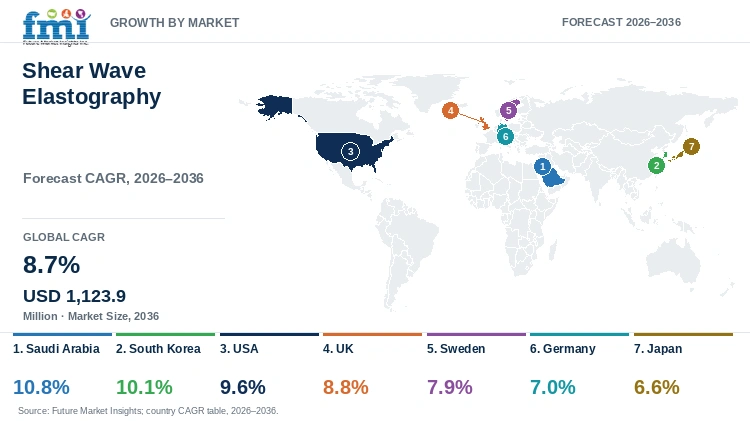
- Subsequent country trajectories: South Korean hepatology centers are expected to expand at 10.1% yearly ahead of forecast American (9.6%) and British (8.8%) clinics, as Swedish (7.9%) together with German (7.0%) orders are predicted to exceed mature Japanese replacement demand at 6.6%.
Market Size & Forecast
Table 1: Market Size and Forecast for the Shear Wave Elastography Market (USD million and CAGR percentage), 2025 to 2036
| Metric | Value |
|---|---|
| 2025 Market Size | USD 447.3 Million |
| Estimated Market Size in 2026 | USD 486.2 Million |
| Projected Market Size by 2036 | USD 1,123.9 Million |
| CAGR, 2026 to 2036 | 8.7% |
| Added Revenue, 2026 to 2036 | USD 637.7 Million |
Clinical practice guidelines across North America and Europe increasingly recommend non-invasive hepatic stiffness measurement within structured clinical pathways before prescribing targeted steatohepatitis therapies. In its updated practice guidelines on non-invasive liver disease assessments, the American Association for the Study of Liver Diseases endorses ultrasound elastography to stage hepatic fibrosis and steatosis in metabolic liver disease [2]. Consequently, outpatient digestive health networks are pairing cart-based shear wave packages with transient elastography device units to screen high-BMI diabetic cohorts. Ultrasound vendors that include automated propagation quality maps and attenuation parameters win hospital radiology tenders because clinicians need reproducible longitudinal tracking.
Clinical Liver Diagnostic Center Throughput and Elastography Sizing
Table 2: Clinical Liver Diagnostic Throughput and Elastography Indicators for the Shear Wave Elastography Market (USD Million and operational ranges), mixed historical and forecast years from 2025 to 2036
| Metric | 2025 | 2026 | 2036 |
|---|---|---|---|
| Market size (USD Million) | 447.3 | 486.2 | 1,123.9 |
| Active clinical hepatology elastography suites (thousand sites) | 6.2 to 9.5 | 6.8 to 10.4 | 16.5 to 25.0 |
| Average elastography examination duration (minutes) | 12 to 20 | 10 to 16 | 5 to 8 |
| Annualized liver biopsy avoidance cost savings per clinic (USD) | 180,000 to 340,000 | 210,000 to 390,000 | 580,000 to 1,150,000 |
Operational note: Suite figures cover accredited hospital radiology and gastroenterology units performing quantitative liver stiffness examinations. Examination durations encompass patient positioning and ten-acquisition stiffness reporting, while cost savings reflect avoided percutaneous core liver biopsies and post-biopsy hemorrhage observation.
Diagnostic Imaging Platform & Software Upgrade Procurement Sizing
Hospital radiology procurement committees invest in multi-purpose ultrasound consoles capable of executing quantitative shear wave elastography alongside routine abdominal Doppler scans. Chief radiologists benchmark candidate systems on deep-penetration acoustic push-pulse stability in obese patients and inter-operator interquartile range reproducibility. Tertiary hepatology centers also integrate quantitative stiffness modules into broader liver disease diagnostics and liver fibrosis treatment monitoring pathways.
Table 3: Diagnostic Imaging Platform Procurement Indicators for the Shear Wave Elastography Market (USD and units), mixed historical and forecast years from 2025 to 2036
| Metric | 2025 | 2026 | 2036 |
|---|---|---|---|
| Commercial elastography ultrasound systems shipped globally (units) | 12,400 | 13,850 | 36,200 |
| Average selling price per integrated elastography ultrasound (USD) | 115,000 to 185,000 | 112,000 to 178,000 | 85,000 to 135,000 |
| Software upgrade license fee for shear wave package (USD) | 18,500 to 32,000 | 17,200 to 29,500 | 10,500 to 18,000 |
| Standalone transient elastography device placement price (USD) | 45,000 to 82,000 | 43,000 to 78,000 | 28,000 to 52,000 |
Table 4: Elastography Sector Procurement Indicators for the Shear Wave Elastography Market (USD Million and percentages), 2026
| Metric | Value | Basis |
|---|---|---|
| Market size, 2026 | USD 486.2 Million | 2026 market estimate |
| 2D shear wave elastography revenue, 2026 | USD 200.3 Million | 41.2% technology share |
| Liver fibrosis and steatosis application revenue, 2026 | USD 283.5 Million | 58.3% application share |
| Integrated ultrasound systems revenue, 2026 | USD 274.2 Million | 56.4% product share |
Analyst Perspective
"Quantitative shear wave elastography replaces invasive percutaneous liver biopsies by giving hepatologists real-time kilopascal stiffness and attenuation maps during standard abdominal scans. Harmonizing cross-vendor kilopascal cutoff thresholds across transducer platforms remains essential for universal outpatient payer coverage."
- Anurag Sharma, Principal Consultant, Future Market Insights.
How is the shear wave elastography market segmented?
The shear wave elastography market is segmented by technology, application, product, end user, and region. In 2026, 2D shear wave elastography is expected to claim 41.2%, liver fibrosis and steatosis assessment is projected at 58.3%, integrated ultrasound systems are anticipated to secure 56.4%, and hospitals are estimated to account for 46.2%.
By technology: 2D shear wave elastography, vibration-controlled transient elastography (VCTE), point shear wave elastography, and 3D shear wave elastography.
By application: liver fibrosis and steatosis assessment, breast imaging, thyroid imaging, musculoskeletal imaging, and prostate imaging.
By product: integrated ultrasound systems, standalone elastography devices, and software upgrades.
By end user: hospitals, hepatology and gastroenterology clinics, diagnostic imaging centers, and academic and research institutes.
Why Does 2D Shear Wave Elastography Lead the Technology Category?
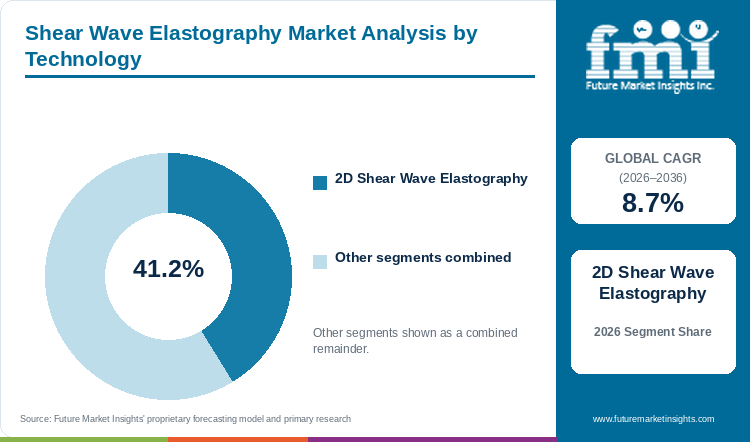
2D shear wave elastography is expected to claim 41.2% of technology revenue in 2026, reinforced by real-time anatomical stiffness mapping.
Table 5: Technology Share for the Shear Wave Elastography Market (percentage share), 2026
| Technology | Share (2026) |
|---|---|
| 2D Shear Wave Elastography | 41.2% |
| Other Segments Combined | 58.8%* |
| Total | 100.0% |
*Note: Residual portion across the other technology options equating to 100.0% during 2026.
Table 6: Technology Leadership and Market Growth for the Shear Wave Elastography Market (segment and CAGR percentage), 2026 to 2036
| Metric | Value |
|---|---|
| Global CAGR (2026 to 2036) | 8.7% |
| Leading Segment | 2D Shear Wave Elastography |
| Leading Segment Share (2026) | 41.2% |
Source: Future Market Insights analysis
Generating a two-dimensional color elastogram over live grayscale B-mode anatomy allows sonographers to place regions of interest away from hepatic veins and bile ducts, which is why 2D shear wave elastography is forecast to represent 41.2% of 2026 technology revenue. Blind or single-point stiffness measurements frequently suffer from rib-shadow reverberation and respiratory motion artifacts that force repeat acquisitions. Academic medical centers also coordinate quantitative tissue stiffness research alongside broader diagnostic imaging programs in pulmonary fibrosis biomarkers and cystic fibrosis therapeutics studies to evaluate systemic organ remodeling. Real-time wave-propagation confidence maps further shorten operator learning curves across general radiology suites.
- Visualizing shear wave propagation quality over live B-mode anatomy is anticipated to enable 2D shear wave elastography to capture 41.2% of 2026 technology sales.
- In November 2025, Canon Medical Systems Corporation secured FDA 510(k) clearance for Aplio i-series ultrasound innovations featuring automated shear wave and attenuation imaging [3].
What Places Liver Fibrosis and Steatosis Assessment First in Application?
Liver fibrosis and steatosis assessment is projected to capture 58.3% of application volume during 2026, aided by metabolic hepatology triage.
Surging adult prevalence of metabolic dysfunction-associated steatotic liver disease requires non-invasive fibrosis staging to identify F2 and F3 patients eligible for antifibrotic pharmacotherapy. Pairing shear wave kilopascal stiffness with ultrasound attenuation coefficients lets hepatologists quantify both collagen scarring and hepatic fat infiltration during a single ten-minute exam, so liver fibrosis and steatosis assessment is anticipated to claim 58.3% of 2026 application demand. Clinical research centers also explore acoustic elastography alongside systemic organ assessment and myelofibrosis mf treatment and idiopathic pulmonary fibrosis management protocols to track longitudinal fibrotic regression. Avoiding inpatient liver biopsy hospitalization saves healthcare payers thousands of dollars per screened metabolic patient.
- Routine metabolic liver triage and antifibrotic drug monitoring are expected to keep liver fibrosis and steatosis assessment at 58.3% of 2026 application volume.
- Echosens SA announced in November 2025 that the U.S. Food and Drug Administration accepted its Letter of Intent to qualify FibroScan liver stiffness as a clinical trial biomarker [4].
How Do Integrated Ultrasound Systems Retain the Largest Product Share?
Integrated ultrasound systems are projected to hold 56.4% of product demand for 2026, benefiting from multi-departmental radiology sharing.
Hospital radiology administrators favor cart-based diagnostic consoles that combine 2D shear wave elastography with conventional abdominal B-mode and color Doppler imaging on one shared hardware platform. Whereas standalone transient elastography units serve only dedicated liver clinics, an integrated radiology cart generates revenue across hepatology and oncology as well as obstetrics schedules. Multi-specialty hospital imaging departments also coordinate ultrasound fleet investments alongside progressive pulmonary fibrosis ppf treatment and radiation induced fibrosis treatment evaluations to assess post-radiation soft-tissue induration. Higher daily scanner utilization shortens capital payback cycles and is forecast to give integrated ultrasound systems 56.4% of 2026 product sales.
- Multi-departmental scanner utilization across abdominal and small-parts imaging is predicted to give integrated ultrasound systems 56.4% of 2026 product revenue.
- Koninklijke Philips NV released its Auto ElastQ automated 2D shear wave quantification software on EPIQ and Affiniti cart platforms in February 2025 [5].
Why Do Hospitals Lead the End User Breakdown?
Hospitals are predicted to contribute 46.2% of end user sales in 2026, accompanied by specialist hepatology referral pathways.
Tertiary inpatient centers house the multidisciplinary hepatology and transplant surgery teams alongside interventional radiologists who manage decompensated cirrhosis and focal breast or thyroid lesions. Because hospital imaging departments maintain the capital equipment budgets required to procure USD 120,000 to USD 180,000 ultrasound consoles equipped with multi-frequency curved and linear shear wave transducers, hospitals are estimated to capture 46.2% of 2026 end user expenditure. Centralized picture archiving and electronic health record networks also allow hospital radiologists to compare serial kilopascal stiffness maps against serum fibrosis scores and cross-sectional CT or MR studies.
- Tertiary hepatology referral concentration and multi-transducer capital budgets are expected to give hospitals a 46.2% share of 2026 end user sales.
- In October 2025, Siemens Healthineers AG introduced deep abdominal shear wave elastography enhancements on its ACUSON Sequoia hospital radiology platform [6].
What are the drivers, restraints, and opportunities in the shear wave elastography market?
Growing MASLD screening mandates and antifibrotic drug monitoring are projected to accelerate shear wave elastography orders through 2036, whereas cross-vendor kilopascal cutoff variance and outpatient reimbursement caps restrain primary care uptake.
- Driver: Widespread metabolic steatotic liver disease prevalence and newly approved MASH pharmacotherapies require non-invasive kilopascal stiffness staging in place of surgical biopsies.
- Restraint: Inter-manufacturer shear wave velocity variances and inconsistent outpatient insurance reimbursement codes create clinical interpretation and billing friction.
- Opportunity: Expanding automated shear wave presets into BI-RADS breast lesion and TI-RADS thyroid nodule characterization opens high-margin multi-organ upgrade demand.
Growth Analysis and Future Potential: Metabolic Liver Disease Surge and Biopsy Avoidance Catalysts
Replacing invasive core needle liver biopsies with quantitative acoustic elastography serves as the primary clinical engine expanding scanner installations worldwide. International liver elastography guidelines updated by WFUMB during May 2025 standardized acquisition protocols and kilopascal staging cutoffs across clinical practices [7]. Percutaneous liver biopsy carries risks of intraperitoneal bleeding and sampling error because a needle specimen represents only a tiny fraction of total hepatic parenchyma. In contrast, 2D shear wave elastography interrogates a much larger hepatic tissue volume while displaying real-time propagation stability maps.
Risk Assessment and Operational Hurdles: Cross-Platform Calibration Variances and Reimbursement Gaps
Measurement discordance across competing ultrasound vendor algorithms and uneven outpatient billing coverage create procurement hesitation among independent imaging centers. Different manufacturers utilize distinct acoustic push-pulse frequencies and shear wave group-velocity calculations, which can yield slightly different kilopascal readings on the same fibrotic liver. In November 2025, the Society of Radiologists in Ultrasound published its updated consensus statement emphasizing standardized phantom calibration and vendor-neutral cutoff reporting for diffuse liver disease [8]. Statutory and commercial health insurers in several markets still bundle elastography software acquisitions into standard abdominal ultrasound fees unless dedicated CPT or national procedure codes are documented.
Commercial Opportunity Analysis: Multi-Organ Diagnostic Expansion and Artificial Intelligence Automation
Extending linear-array shear wave elastography into outpatient breast oncology and endocrinology clinics is anticipated to create a major software licensing opportunity for ultrasound manufacturers. February 2026 updates to American College of Radiology Appropriateness Criteria reaffirmed ultrasound shear wave elastography for non-invasive chronic liver and multi-organ parenchymal assessment [9]. Adding quantitative kilopascal stiffness overlays to standard B-mode breast scans helps radiologists downgrade benign-appearing BI-RADS 4A fibroadenomas and avoid unnecessary core needle biopsies. Similarly, automated AI region-of-interest placement reduces inter-operator variance during thyroid nodule and Achilles tendon stiffness evaluations.
Shear Wave Elastography Market by Country (2026 to 2036)
Saudi Arabian health cluster investments are projected to top national growth at a 10.8% annual clip between 2026 and 2036, surpassing anticipated gains in South Korean hospitals at 10.1% and U.S. hepatology networks at 9.6% ahead of expected British (8.8%) and Swedish (7.9%) demand, and German (7.0%) alongside Japanese (6.6%) installations are forecast to progress at a measured pace. National trajectories reflect metabolic liver screening mandates and statutory ultrasound reimbursement structures.
Table 7: Country CAGR and Primary Growth Levers for the Shear Wave Elastography Market (CAGR percentage and operational drivers), 2026 to 2036
| Country | CAGR (2026 to 2036) | Primary Growth Lever |
|---|---|---|
| Saudi Arabia | 10.8% | Vision 2030 healthcare transformation programs and national metabolic screening rollouts across regional health clusters |
| South Korea | 10.1% | Updated KASL clinical practice guidelines and rapid integration of ARFI software across university medical centers |
| USA | 9.6% | FDA qualification of MASH surrogate endpoints and outpatient digestive health clinic elastography network expansions |
| UK | 8.8% | NHS chronic liver disease care modernization and general radiology shared-service shear wave equipment deployments |
| Sweden | 7.9% | Universal healthcare access and academic medical center research partnerships in metabolic fatty liver disease |
| Germany | 7.0% | Domestic gastroenterology society quality guidelines and specialized university hospital liver disease research collaborations |
| Japan | 6.6% | Aging demographic surveillance requirements and municipal hospital non-invasive chronic hepatitis management |
Source: Future Market Insights analysis
Saudi Arabia Shear Wave Elastography Market Outlook (2026 to 2036)
Unlike mature Western markets driven by incremental software upgrades on existing carts, Saudi Arabia is building greenfield hepatology and metabolic screening capacity across newly corporatized Ministry of Health clusters under Vision 2030. In November 2025, epidemiological investigators documented high metabolic dysfunction-associated steatotic liver disease prevalence across Saudi adult cohorts, reinforcing the need for non-invasive fibrosis triage [10]. As tertiary medical cities in Riyadh and Jeddah equip radiology and diabetes clinics with 2D shear wave platforms, Saudi revenue is forecast to grow 10.8% annually through 2036. Shortages of certified abdominal sonographers outside major metropolitan centers still slow secondary hospital utilization, prompting vendors to bundle automated AI propagation-map software into turnkey cluster tenders.
Key takeaway: In Saudi Arabia, Vision 2030 metabolic screening programs and automated propagation-quality software are expected to drive rapid tertiary and regional hospital adoption.
South Korea Shear Wave Elastography Market Outlook (2026 to 2036)
In September 2025, the Korean Association for the Study of the Liver updated its non-invasive fibrosis staging guidelines to recommend acoustic radiation force and transient elastography for high-risk metabolic cohorts [11]. South Korea stands apart from global peers through its high-throughput corporate and national health-checkup centers (Geongang Geomjin) that screen millions of asymptomatic adults annually for viral hepatitis B and fatty liver disease. Metropolitan university hospitals and executive health-screening centers are anticipated to expand South Korean shear wave elastography sales at a 10.1% yearly pace until 2036. Tight National Health Insurance Service reimbursement ceilings on repeat scans nevertheless constrain standalone console purchases by smaller clinics, so vendors sell modular software license upgrades onto existing abdominal ultrasound fleets.
Key takeaway: In South Korea, KASL guideline endorsements and modular software license upgrades across metropolitan hospital fleets are projected to sustain double-digit annual growth.
USA Shear Wave Elastography Market Outlook (2026 to 2036)
Guided by FMI's outlook, U.S. shear wave elastography demand is forecast to advance 9.6% annually from 2026 to 2036 as hepatology practices screen patients for antifibrotic therapy eligibility. What differentiates the United States from statutory health systems is the commercial rollout of FDA-approved MASH pharmacotherapies that require non-invasive F2 and F3 fibrosis staging before private insurers authorize drug coverage. During August 2025, U.S. Food and Drug Administration reviewers accepted a Letter of Intent to qualify liver stiffness measurement by vibration-controlled transient elastography as a reasonably likely surrogate endpoint in MASH clinical trials [12]. Commercial payer prior-authorization rules and inter-vendor kilopascal threshold differences still create billing friction, leading manufacturers to embed standardized CPT 91200 reporting templates directly into console software.
Key takeaway: In the USA, FDA biomarker qualification steps and MASH therapy patient stratification are expected to fuel strong demand across outpatient digestive health networks.
UK Shear Wave Elastography Market Outlook (2026 to 2036)
Whereas private gastroenterology practices drive testing in North America, the United Kingdom routes chronic liver triage through community-based NHS Community Diagnostic Centres linked to primary care FIB-4 blood pathways. Updated UK NICE Guideline NG49 recommendations published in July 2026 on metabolic dysfunction-associated steatotic liver disease emphasized non-invasive assessment for advanced liver fibrosis [13]. Expanding secondary triage across NHS hospital trusts and regional diagnostic hubs is expected to boost British shear wave elastography turnover by 8.8% per annum through 2036. Multi-month NHS capital procurement cycles and sonographer vacancy rates across regional trusts nonetheless slow standalone unit installations, encouraging suppliers to offer shared-service radiology consoles with five-minute automated liver protocols.
Key takeaway: In the UK, updated NICE NG49 fibrosis assessment pathways and NHS Community Diagnostic Centres are anticipated to support steady radiology fleet upgrades.
Sweden Shear Wave Elastography Market Outlook (2026 to 2036)
In January 2025, clinical hepatology investigators in Stockholm and Linkoping published multi-center validation studies demonstrating the diagnostic accuracy of 2D shear wave elastography for hepatic fibrosis stratification [14]. Sweden's county-council healthcare model is distinct because tax-funded regional authorities integrate non-invasive liver stiffness screening directly into longitudinal national diabetes registries rather than episodic private referrals. Widespread clinical adoption across university hospital gastroenterology and endocrinology units is estimated to lift Swedish shear wave elastography demand by 7.9% yearly from 2026 to 2036. Rigorous health-economic evaluations by Sweden's twenty-one regional healthcare councils still prolong public tender cycles for premium ultrasound upgrades, requiring vendors to document avoided inpatient liver biopsy admissions.
Key takeaway: In Sweden, academic diabetic liver screening registries and county health-economic validation are projected to support disciplined integration of 2D shear wave platforms.
Germany Shear Wave Elastography Market Outlook (2026 to 2036)
Backed by multi-organ breast and hepatic imaging across tertiary hospitals, German shear wave elastography sales are expected to progress at a 7.0% annual rate until 2036. Unlike markets where ultrasound is performed primarily by technicians, German internal medicine and gastroenterology specialists conduct hands-on diagnostic sonography themselves under strict DEGUM and DGVS quality guidelines. Updated clinical practice guidelines from the German DGVS in November 2025 recommended non-invasive shear wave elastography for longitudinal MASLD fibrosis staging across hospital hepatology units [15]. Separate Einheitlicher Bewertungsmaßstab outpatient reimbursement restrictions for statutory health insurance patients still limit standalone device purchases by office-based internists, so manufacturers bundle automated IQ/median reliability indicators and multi-organ linear probes for hospital radiology departments.
Key takeaway: In Germany, DGVS clinical guideline updates and tertiary university hospital radiology upgrades are forecast to support reliable demand for multi-organ elastography consoles.
Japan Shear Wave Elastography Market Outlook (2026 to 2036)
Japan's diagnostic ultrasound market differs from Western greenfield adoption because municipal and university hospitals already operate a dense installed base of premium carts used for six-month hepatocellular carcinoma surveillance in elderly patients. Clinical guidance from the Japan Society of Hepatology during April 2025 endorsed non-invasive ultrasound elastography and shear wave dispersion imaging for elderly chronic hepatitis and MASLD cohorts [16]. Routine multiparametric liver exams across municipal and university hospitals are projected to lift Japanese shear wave elastography revenue by 6.6% each year through 2036. High existing cart saturation and biennial Ministry of Health reimbursement price revisions nevertheless cap unit volume growth, prompting domestic manufacturers to commercialize endoscopic ultrasound elastography and high-frame-rate attenuation upgrades.
Key takeaway: In Japan, universal insurance coverage for chronic liver surveillance and multiparametric dispersion upgrades are anticipated to support steady hospital replacement demand.
Full report country CAGRs cover: North America; Latin America; Western Europe; Eastern Europe; East Asia; South Asia and Pacific; Middle East and Africa.
Who are the notable companies in the shear wave elastography market?
Echosens SA, Siemens Healthineers AG, GE HealthCare Technologies Inc., Koninklijke Philips N.V., Canon Medical Systems Corporation, Mindray Bio-Medical Electronics Co., Ltd., Samsung Medison Co., Ltd., FUJIFILM Healthcare Corporation, and Esaote S.p.A. are the notable companies in the shear wave elastography market.
Competitive differentiation in quantitative ultrasound elastography centers on deep-abdominal push-pulse penetration and real-time wave-propagation confidence maps alongside multi-parametric steatosis attenuation grading. Dedicated non-invasive hepatology specialist Echosens SA anchors point-of-care liver clinics worldwide with its standardized FibroScan vibration-controlled transient elastography and controlled attenuation parameter platforms. Radiology console manufacturers including Siemens Healthineers and GE HealthCare alongside Koninklijke Philips NV and Canon Medical Systems embed high-frame-rate 2D shear wave and dispersion packages onto flagship ultrasound carts. Meanwhile, configurable clinical ultrasound builders Mindray Bio-Medical Electronics and Samsung Medison together with FUJIFILM Healthcare and Esaote SpA supply versatile cart and endoscopic shear wave systems.
- Dedicated Non-Invasive Hepatology Specialists: Echosens SA commercializes standalone and guided vibration-controlled transient elastography systems tailored for outpatient liver fibrosis and steatosis staging.
- Multinational Diagnostic Imaging Giants: Siemens Healthineers and GE HealthCare alongside Koninklijke Philips NV and Canon Medical Systems supply premium 2D shear wave radiology consoles.
- Configurable Clinical Ultrasound Developers: Mindray Bio-Medical Electronics and Samsung Medison together with FUJIFILM Healthcare and Esaote SpA build multi-specialty cart and endoscopic elastography platforms.
Competitive Benchmarking: Shear Wave Elastography Market
Table 8: Competitive Benchmarking for the Shear Wave Elastography Market (qualitative capability ratings), 2026
| Company | Shear Wave Technology Depth | Multi-Organ Exam Portfolio | Automated Quality Guidance | Global Hospital Reach |
|---|---|---|---|---|
| Echosens SA | High | Medium | High | High |
| Siemens Healthineers AG | High | High | High | High |
| GE HealthCare Technologies Inc. | High | High | High | High |
| Koninklijke Philips N.V. | High | High | High | High |
| Canon Medical Systems Corporation | High | High | High | High |
| Mindray Bio-Medical Electronics Co., Ltd. | High | High | Medium | High |
| Samsung Medison Co., Ltd. | Medium | High | Medium | High |
| FUJIFILM Healthcare Corporation | High | High | Medium | High |
| Esaote S.p.A. | Medium | Medium | Medium | Medium |
Scoring basis: Shear Wave Technology Depth earns a High mark when a vendor provides real-time 2D quantitative kilopascal stiffness mapping paired with steatosis attenuation or viscosity dispersion metrics. Multi-Organ Exam Portfolio reflects cleared clinical presets spanning hepatic and breast as well as thyroid and musculoskeletal probes. Automated Quality Guidance evaluates real-time propagation stability maps and motion-artifact rejection, while Global Hospital Reach measures direct radiology sales and field-engineering support across Western and Asian healthcare systems.
Key Developments in the Shear Wave Elastography Market
- Canon Medical Systems Corporation and Olympus Corporation introduced the Aplio i800 EUS premium endoscopic ultrasound system in the United States during May 2026 featuring integrated shear wave elastography and attenuation imaging [17].
- Updated clinical best-practice guidance for FibroScan Guided VCTE systems incorporating automated hepatic localization and stiffness quality indicators was published by Echosens SA in April 2026 [18].
- During December 2025, LOGIQ E10 series radiology consoles from GE HealthCare received expanded 2D shear wave elastography and ultrasound-guided fat fraction packages [19].
Key Players in the Shear Wave Elastography Market
Dedicated Non-Invasive Hepatology Specialists
- Echosens SA
Multinational Diagnostic Imaging Giants
- Siemens Healthineers AG
- GE HealthCare Technologies Inc.
- Koninklijke Philips N.V.
- Canon Medical Systems Corporation
Configurable Clinical Ultrasound Developers
- Mindray Bio-Medical Electronics Co., Ltd.
- Samsung Medison Co., Ltd.
- FUJIFILM Healthcare Corporation
- Esaote S.p.A.
Shear Wave Elastography Market - Report Scope
Table 9: Report Scope for the Shear Wave Elastography Market (coverage fields and definitions), 2026 to 2036
| Coverage field | Report scope |
|---|---|
| Market breakdown | Technology; Application; Product; End User; Region |
| Quantitative Units | USD Million |
| Market Definition | Includes manufacturer revenue from commercial ultrasound consoles equipped with quantitative shear wave elastography (2D-SWE, pSWE, 3D-SWE), standalone vibration-controlled transient elastography (VCTE) devices, and dedicated elastography software upgrade licenses. Category Scope Note: Excludes standard B-mode and color Doppler ultrasound consoles sold without elastography modules, qualitative strain-only elastography software, magnetic resonance elastography (MRE) bore hardware, percutaneous biopsy needles, and hospital patient examination fees. |
| Regions Covered | North America; Latin America; Western Europe; Eastern Europe; East Asia; South Asia and Pacific; Middle East and Africa |
| Countries Covered | Saudi Arabia, South Korea, USA, UK, Sweden, Germany, Japan, and additional countries in the full report |
| Key Companies Covered | Echosens SA, Siemens Healthineers AG, GE HealthCare Technologies Inc., Koninklijke Philips N.V., Canon Medical Systems Corporation, Mindray Bio-Medical Electronics Co., Ltd., Samsung Medison Co., Ltd., FUJIFILM Healthcare Corporation, Esaote S.p.A. |
| Forecast Period | 2026 to 2036 |
| Approach | Primary and secondary research with market triangulation. |
Shear Wave Elastography Market - Research Methodology
Table 10: Research Methodology for the Shear Wave Elastography Market (research methods and approach), 2026 edition
| Method | Approach |
|---|---|
| Primary Research | Primary interviews were conducted with clinical hepatologists, abdominal and breast radiologists, hospital radiology procurement directors, and ultrasound product managers to validate software attachment rates and kilopascal calibration standards. |
| Secondary Research | Secondary research encompassed AASLD, WFUMB, SRU, and NICE clinical practice guidelines, FDA 510(k) and biomarker qualification filings, peer-reviewed elastography trials, and corporate financial disclosures. |
| Market Sizing and Forecasting | Market sizing and forecasting for the 2026 to 2036 period were developed through hospital radiology console installation models, standalone hepatology clinic placements, and installed-base software license upgrade rates. |
| Data Triangulation and Validation | Estimates are cross-checked against national MASLD/MASH epidemiology registries, outpatient liver elastography CPT procedure claims, and vendor shipment reports while excluding non-elastography B-mode consoles. |
| Country Forecasting Model | Country-level CAGRs are calibrated against the 8.7% global projection using national metabolic steatotic liver disease prevalence, antifibrotic drug prescription volumes, statutory CPT/EBM reimbursement codes, and public hospital imaging modernization budgets. |
| Operational Benchmark Traceability | Operational benchmarks in Tables 2, 3, and 4 (active hepatology elastography suites, exam durations, biopsy avoidance savings, and software upgrade license fees) are synthesized from AASLD/WFUMB clinical guidelines, NICE NG49 economic evaluations, and hospital radiology tender benchmarks. |
Shear Wave Elastography Market by Segments
Shear Wave Elastography Market segmented by Technology:
- 2D Shear Wave Elastography
- Vibration-Controlled Transient Elastography (VCTE)
- Point Shear Wave Elastography
- 3D Shear Wave Elastography
Shear Wave Elastography Market segmented by Application:
- Liver Fibrosis and Steatosis Assessment
- Breast Imaging
- Thyroid Imaging
- Musculoskeletal Imaging
- Prostate Imaging
Shear Wave Elastography Market segmented by Product:
- Integrated Ultrasound Systems
- Standalone Elastography Devices
- Software Upgrades
Shear Wave Elastography Market segmented by End User:
- Hospitals
- Hepatology and Gastroenterology Clinics
- Diagnostic Imaging Centers
- Academic and Research Institutes
Shear Wave Elastography Market by Region
- North America
- United States
- Canada
- Latin America
- Brazil
- Mexico
- Argentina
- Chile
- Western Europe
- Germany
- France
- United Kingdom
- Italy
- Spain
- Benelux
- Nordics
- Eastern Europe
- Poland
- Czech Republic
- Romania
- Hungary
- East Asia
- China
- Japan
- South Korea
- South Asia and Pacific
- India
- ASEAN
- Australia and New Zealand
- Middle East and Africa
- GCC Countries
- South Africa
- Türkiye
- Israel
Research Sources and Bibliography
- [1] Cormack, J. M., Lee, H. O., Chao, Y. H., Kim, K., & Behari, J. (2025, December 01). Focused Shear Wave Elastography to Assess Liver Fibrosis in Metabolic Dysfunction-Associated Steatotic Liver Disease. Gastro Hep Advances, 5(3), 100855.
- [2] American Association for the Study of Liver Diseases (AASLD). (2024). AASLD Practice Guideline on Noninvasive Liver Disease Assessments of Hepatic Fibrosis and Steatosis. Hepatology.
- [3] Canon Medical Systems Corporation. (2025, November 26). Canon Medical Secures FDA Clearance for Ultrasound Innovations on Aplio i-series. Canon Medical Systems USA Newsroom.
- [4] Echosens SA. (2025, November 06). Statement on the acceptance by the FDA of Echosens' Letter of Intent for Drug Development Tool (DDT). Echosens Clinical Newsroom.
- [5] Koninklijke Philips N.V. (2025, February 28). Release of Auto ElastQ software delivering automated 2D shear wave quantification on EPIQ and Affiniti ultrasound systems. Philips Healthcare Press.
- [6] Siemens Healthineers AG. (2025, October 08). ACUSON Sequoia ultrasound platform enhancements for deep abdominal shear wave liver stiffness imaging. Siemens Healthineers Press Room.
- [7] World Federation for Ultrasound in Medicine and Biology (WFUMB). (2025, May 20). Guidelines and recommendations on the clinical use of liver ultrasound elastography: Technical considerations and cutoffs. Ultrasound in Medicine & Biology.
- [8] Society of Radiologists in Ultrasound (SRU). (2025, November 18). Consensus statement update on shear wave elastography for the evaluation of diffuse liver disease. Radiology.
- [9] American College of Radiology (ACR). (2026, February 12). ACR Appropriateness Criteria: Chronic Liver Disease and Noninvasive Fibrosis Assessment. American College of Radiology.
- [10] National Center for Biotechnology Information (NCBI). (2025, November 03). Prevalence and Risk Factors of Metabolic Dysfunction-Associated Steatotic Liver Disease in Saudi Arabia. JMIR Diabetes / PubMed Central.
- [11] Korean Association for the Study of the Liver (KASL). (2025, September 10). Clinical practice guidelines for noninvasive fibrosis staging in metabolic dysfunction-associated steatotic liver disease. Clinical and Molecular Hepatology.
- [12] U.S. Food and Drug Administration (FDA). (2025, August 27). FDA Accepts Proposal for Reasonably Likely Surrogate Endpoint for MASH with Moderate-to-Advanced Liver Fibrosis. U.S. Food and Drug Administration Drug Alerts and Statements.
- [13] National Institute for Health and Care Excellence (NICE). (2026, July 31). Assessment for Advanced Liver Fibrosis in People with MASLD (NICE Guideline NG49). National Institute for Health and Care Excellence.
- [14] National Center for Biotechnology Information (NCBI). (2025, January 09). Liver Elastography for Liver Fibrosis Stratification: A Multi-Center Comparison of Shear Wave Platforms. PubMed Central.
- [15] German Society for Gastroenterology, Digestive and Metabolic Diseases (DGVS). (2025, November 24). Clinical practice guideline: Non-invasive diagnosis and monitoring of metabolic dysfunction-associated steatotic liver disease. Zeitschrift fur Gastroenterologie.
- [16] Japan Society of Hepatology (JSH). (2025, April 20). Evidence-based clinical practice guidelines for metabolic dysfunction-associated steatohepatitis and ultrasound elastography. Hepatology Research.
- [17] Canon Medical Systems Corporation. (2026, May 01). Olympus and Canon Introduce the Aplio i800 EUS Premium Ultrasound System in the U.S. Canon Medical Systems USA Newsroom.
- [18] Echosens SA. (2026, April 07). Best Practice Review: Liver Examination with FibroScan Guided VCTE and Clinical Insights. Echosens Medical Publications.
- [19] GE HealthCare Technologies Inc. (2025, December 18). LOGIQ E10 series 2D shear wave elastography and ultrasound-guided fat fraction integrations. GE HealthCare Press Room.
- [20] Mindray Bio-Medical Electronics Co., Ltd. (2026, January 25). Resona 7 and Hepatus shear wave elastography multi-frequency acoustic radiation force validation. Mindray Medical Devices.
- [21] FUJIFILM Healthcare Corporation. (2025, October 22). ARIETTA ultrasound system shear wave elastography integrations for endoscopic and abdominal examinations. Fujifilm Healthcare Corporate News.
This bibliography is provided for reader reference and is not exhaustive. The full report contains the complete reference list and detailed citations.
This Report Answers
- How large is the shear wave elastography market in 2026 and what is forecast for 2036?
- Which metabolic liver pathologies and drug approvals accelerate elastography console orders?
- Why does 2D shear wave elastography represent the leading technology segment in 2026?
- Why do integrated ultrasound systems dominate the product breakdown globally?
- How do growth rates compare across Saudi Arabia, South Korea, the USA, the UK, Sweden, Germany, and Japan?
- Which diagnostic imaging companies manufacture commercial shear wave elastography platforms?
- What cross-vendor kilopascal calibration and reimbursement hurdles restrict clinic adoption?
- What deep-abdominal penetration and propagation-map benchmarks must buyers verify before purchasing?
Frequently Asked Questions
How big is the shear wave elastography market in 2026, and what is forecast for 2036?
As per FMI, global shear wave elastography revenue is estimated at USD 486.2 Million in 2026 (rising from USD 447.3 Million in 2025) and is projected to reach USD 1,123.9 Million by 2036 as hepatology clinics replace surgical liver biopsies.
What is the CAGR for the shear wave elastography market from 2026 to 2036?
Worldwide equipment and software license turnover is anticipated to advance at an 8.7% compound annual pace between 2026 and 2036, yielding an expected USD 637.7 Million in incremental revenue.
Which technology segment leads the shear wave elastography market?
2D shear wave elastography is projected to capture 41.2% of 2026 technology sales because real-time color stiffness maps overlaid on B-mode anatomy avoid blood vessels and rib shadows.
Which product leads the shear wave elastography market?
Integrated ultrasound systems are expected to secure 56.4% of 2026 product demand since hospital radiology departments share cart consoles across abdominal, vascular, and breast schedules.
Which country has a notable growth outlook from 2026 to 2036?
FMI finds that Saudi Arabia is forecast to top national growth rates at a 10.8% CAGR from 2026 to 2036, driven by Vision 2030 metabolic liver screening rollouts across regional health clusters.
Who are the key players in the market?
Leading suppliers include Echosens SA, Siemens Healthineers AG, GE HealthCare Technologies Inc., Koninklijke Philips N.V., Canon Medical Systems Corporation, Mindray Bio-Medical Electronics Co., Ltd., Samsung Medison Co., Ltd., FUJIFILM Healthcare Corporation, and Esaote S.p.A.
Preview the report firsthand - request a free sample
Get SampleGet the brochure for pricing and purchase details.
Get PDFTable of Content
- Key Takeaways
- Market Size and CAGR
- Top Growth Driver
- Fastest Growing Segment
- Leading Region
- Key Companies
- Emerging Opportunities
- Executive Summary
- Global Market Outlook
- Demand-side Trends
- Supply-side Trends
- Technology Roadmap Analysis
- Analysis and Recommendations
- Analyst Perspective (What is happening? Why now? What should investors know?)
- Key Questions Answered
- How large is the market?
- What is the CAGR?
- What are key trends?
- Which region dominates?
- Who are the leaders?
- Market Overview
- Market Coverage / Taxonomy
- Market Definition / Scope / Limitations
- Research Methodology
- Chapter Orientation
- Analytical Lens and Working Hypotheses
- Market Structure, Signals, and Trend Drivers
- Benchmarking and Cross-market Comparability
- Market Sizing, Forecasting, and Opportunity Mapping
- Research Design and Evidence Framework
- Desk Research Programme (Secondary Evidence)
- Expert Input and Fieldwork (Primary Evidence)
- Tooling, Models, and Reference Databases
- Data Engineering and Model Build
- Quality Assurance and Audit Trail
- Market Background
- Market Dynamics (Drivers, Restraints, Opportunity, Trends)
- Scenario Forecast (Optimistic, Likely, Conservative)
- Impact Analysis
- AI Impact
- Sustainability Impact
- Regulatory Impact
- Technology Impact
- Consumer / Buyer Analysis
- Purchase Drivers
- Adoption Barriers
- Buyer Journey
- Opportunity Map Analysis
- Product Life Cycle Analysis
- Supply Chain Analysis
- Investment Feasibility Matrix
- Value Chain Analysis
- PESTLE and Porter's Analysis
- Regulatory Landscape
- Regional Parent Market Outlook
- Production and Consumption Statistics
- Import and Export Statistics
- Global Market Analysis and Forecast, 2021 to 2036
- Historical Market Size Value (USD Million) Analysis, 2021 to 2025
- Current and Future Market Size Value (USD Million) Projections, 2026 to 2036
- Y-o-Y Growth Trend Analysis
- Absolute $ Opportunity Analysis
- Global Market Pricing Analysis, 2021 to 2036
- Global Market Analysis and Forecast, By Technology, 2021 to 2036
- Introduction / Key Findings
- Historical Market Size Value (USD Million) Analysis By Technology, 2021 to 2025
- Current and Future Market Size Value (USD Million) Analysis and Forecast By Technology, 2026 to 2036
- 2D Shear Wave Elastography
- Vibration-Controlled Transient Elastography (VCTE)
- Point Shear Wave Elastography
- 3D Shear Wave Elastography
- Y-o-Y Growth Trend Analysis By Technology, 2021 to 2025
- Absolute $ Opportunity Analysis By Technology, 2026 to 2036
- Global Market Analysis and Forecast, By Application, 2021 to 2036
- Introduction / Key Findings
- Historical Market Size Value (USD Million) Analysis By Application, 2021 to 2025
- Current and Future Market Size Value (USD Million) Analysis and Forecast By Application, 2026 to 2036
- Liver Fibrosis and Steatosis Assessment
- Breast Imaging
- Thyroid Imaging
- Musculoskeletal Imaging
- Prostate Imaging
- Y-o-Y Growth Trend Analysis By Application, 2021 to 2025
- Absolute $ Opportunity Analysis By Application, 2026 to 2036
- Global Market Analysis and Forecast, By Product, 2021 to 2036
- Introduction / Key Findings
- Historical Market Size Value (USD Million) Analysis By Product, 2021 to 2025
- Current and Future Market Size Value (USD Million) Analysis and Forecast By Product, 2026 to 2036
- Integrated Ultrasound Systems
- Standalone Elastography Devices
- Software Upgrades
- Y-o-Y Growth Trend Analysis By Product, 2021 to 2025
- Absolute $ Opportunity Analysis By Product, 2026 to 2036
- Global Market Analysis and Forecast, By End User, 2021 to 2036
- Introduction / Key Findings
- Historical Market Size Value (USD Million) Analysis By End User, 2021 to 2025
- Current and Future Market Size Value (USD Million) Analysis and Forecast By End User, 2026 to 2036
- Hospitals
- Hepatology and Gastroenterology Clinics
- Diagnostic Imaging Centers
- Academic and Research Institutes
- Y-o-Y Growth Trend Analysis By End User, 2021 to 2025
- Absolute $ Opportunity Analysis By End User, 2026 to 2036
- Global Market Analysis and Forecast, By Region, 2021 to 2036
- Introduction
- Historical Market Size Value (USD Million) Analysis By Region, 2021 to 2025
- Current Market Size Value (USD Million) Analysis and Forecast By Region, 2026 to 2036
- North America
- Latin America
- Western Europe
- Eastern Europe
- East Asia
- South Asia and Pacific
- Middle East and Africa
- Market Attractiveness Analysis By Region
- North America Market Analysis and Forecast, By Country, 2021 to 2036
- Historical Market Size Value (USD Million) Trend Analysis By Market Taxonomy, 2021 to 2025
- Market Size Value (USD Million) Forecast By Market Taxonomy, 2026 to 2036
- By Country
- United States
- Canada
- By Technology
- By Application
- By Product
- By End User
- By Country
- Market Attractiveness Analysis
- By Country
- By Technology
- By Application
- By Product
- By End User
- Key Takeaways
- Latin America Market Analysis and Forecast, By Country
- Historical Market Size Value (USD Million) Trend Analysis By Market Taxonomy, 2021 to 2025
- Market Size Value (USD Million) Forecast By Market Taxonomy, 2026 to 2036
- By Country
- Brazil
- Mexico
- Argentina
- Chile
- By Technology
- By Application
- By Product
- By End User
- By Country
- Market Attractiveness Analysis
- By Country
- By Technology
- By Application
- By Product
- By End User
- Key Takeaways
- Western Europe Market Analysis and Forecast, By Country
- Historical Market Size Value (USD Million) Trend Analysis By Market Taxonomy, 2021 to 2025
- Market Size Value (USD Million) Forecast By Market Taxonomy, 2026 to 2036
- By Country
- Germany
- France
- United Kingdom
- Italy
- Spain
- Benelux
- Nordics
- By Technology
- By Application
- By Product
- By End User
- By Country
- Market Attractiveness Analysis
- By Country
- By Technology
- By Application
- By Product
- By End User
- Key Takeaways
- Eastern Europe Market Analysis and Forecast, By Country
- Historical Market Size Value (USD Million) Trend Analysis By Market Taxonomy, 2021 to 2025
- Market Size Value (USD Million) Forecast By Market Taxonomy, 2026 to 2036
- By Country
- Poland
- Czech Republic
- Romania
- Hungary
- By Technology
- By Application
- By Product
- By End User
- By Country
- Market Attractiveness Analysis
- By Country
- By Technology
- By Application
- By Product
- By End User
- Key Takeaways
- East Asia Market Analysis and Forecast, By Country
- Historical Market Size Value (USD Million) Trend Analysis By Market Taxonomy, 2021 to 2025
- Market Size Value (USD Million) Forecast By Market Taxonomy, 2026 to 2036
- By Country
- China
- Japan
- South Korea
- By Technology
- By Application
- By Product
- By End User
- By Country
- Market Attractiveness Analysis
- By Country
- By Technology
- By Application
- By Product
- By End User
- Key Takeaways
- South Asia and Pacific Market Analysis and Forecast, By Country
- Historical Market Size Value (USD Million) Trend Analysis By Market Taxonomy, 2021 to 2025
- Market Size Value (USD Million) Forecast By Market Taxonomy, 2026 to 2036
- By Country
- India
- ASEAN
- Australia and New Zealand
- By Technology
- By Application
- By Product
- By End User
- By Country
- Market Attractiveness Analysis
- By Country
- By Technology
- By Application
- By Product
- By End User
- Key Takeaways
- Middle East and Africa Market Analysis and Forecast, By Country
- Historical Market Size Value (USD Million) Trend Analysis By Market Taxonomy, 2021 to 2025
- Market Size Value (USD Million) Forecast By Market Taxonomy, 2026 to 2036
- By Country
- GCC Countries
- South Africa
- Türkiye
- Israel
- By Technology
- By Application
- By Product
- By End User
- By Country
- Market Attractiveness Analysis
- By Country
- By Technology
- By Application
- By Product
- By End User
- Key Takeaways
- Key Countries Market Analysis
- United States
- Pricing Analysis
- Market Share Analysis, 2025
- By Technology
- By Application
- By Product
- By End User
- Canada
- Pricing Analysis
- Market Share Analysis, 2025
- By Technology
- By Application
- By Product
- By End User
- Mexico
- Pricing Analysis
- Market Share Analysis, 2025
- By Technology
- By Application
- By Product
- By End User
- Brazil
- Pricing Analysis
- Market Share Analysis, 2025
- By Technology
- By Application
- By Product
- By End User
- Chile
- Pricing Analysis
- Market Share Analysis, 2025
- By Technology
- By Application
- By Product
- By End User
- Germany
- Pricing Analysis
- Market Share Analysis, 2025
- By Technology
- By Application
- By Product
- By End User
- United Kingdom
- Pricing Analysis
- Market Share Analysis, 2025
- By Technology
- By Application
- By Product
- By End User
- Italy
- Pricing Analysis
- Market Share Analysis, 2025
- By Technology
- By Application
- By Product
- By End User
- Spain
- Pricing Analysis
- Market Share Analysis, 2025
- By Technology
- By Application
- By Product
- By End User
- France
- Pricing Analysis
- Market Share Analysis, 2025
- By Technology
- By Application
- By Product
- By End User
- India
- Pricing Analysis
- Market Share Analysis, 2025
- By Technology
- By Application
- By Product
- By End User
- ASEAN
- Pricing Analysis
- Market Share Analysis, 2025
- By Technology
- By Application
- By Product
- By End User
- Australia and New Zealand
- Pricing Analysis
- Market Share Analysis, 2025
- By Technology
- By Application
- By Product
- By End User
- China
- Pricing Analysis
- Market Share Analysis, 2025
- By Technology
- By Application
- By Product
- By End User
- Japan
- Pricing Analysis
- Market Share Analysis, 2025
- By Technology
- By Application
- By Product
- By End User
- South Korea
- Pricing Analysis
- Market Share Analysis, 2025
- By Technology
- By Application
- By Product
- By End User
- Poland
- Pricing Analysis
- Market Share Analysis, 2025
- By Technology
- By Application
- By Product
- By End User
- Hungary
- Pricing Analysis
- Market Share Analysis, 2025
- By Technology
- By Application
- By Product
- By End User
- Türkiye
- Pricing Analysis
- Market Share Analysis, 2025
- By Technology
- By Application
- By Product
- By End User
- South Africa
- Pricing Analysis
- Market Share Analysis, 2025
- By Technology
- By Application
- By Product
- By End User
- Saudi Arabia
- Pricing Analysis
- Market Share Analysis, 2025
- By Technology
- By Application
- By Product
- By End User
- Sweden
- Pricing Analysis
- Market Share Analysis, 2025
- By Technology
- By Application
- By Product
- By End User
- United States
- Market Structure Analysis
- Competition Dashboard
- Competition Benchmarking
- Market Share Analysis of Top Players
- By Regional
- By Technology
- By Application
- By Product
- By End User
- Emerging Startups
- Innovation Benchmarking
- Competition Analysis
- Competition Deep Dive
- Echosens SA
- Overview
- Product Portfolio
- Profitability by Market Segments
- Sales Footprint
- Strategy Overview
- Marketing Strategy
- Product Strategy
- Channel Strategy
- Siemens Healthineers AG
- GE HealthCare Technologies Inc.
- Koninklijke Philips N.V.
- Canon Medical Systems Corporation
- Mindray Bio-Medical Electronics Co., Ltd.
- Samsung Medison Co., Ltd.
- FUJIFILM Healthcare Corporation
- Esaote S.p.A.
- Echosens SA
- Case Studies
- Success Stories
- Recent Developments
- Competition Deep Dive
- Assumptions & Acronyms Used


