

- Market Size (2026)
- USD 147.2 Mn
- Forecast (2036)
- USD 320.7 Mn
- CAGR (2026 to 2036)
- 8.1%
How big is Simit Market in 2026?
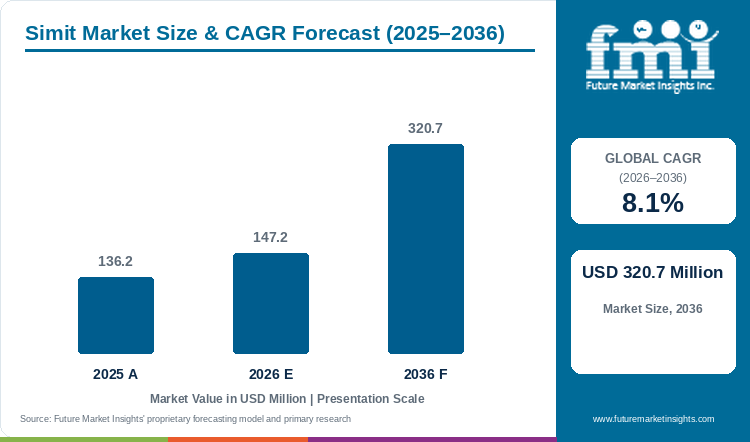
Starting from USD 136.2 million in 2025, the simit market valuation advanced to USD 147.2 million in 2026, with projections pointing toward USD 320.7 million by 2036 at a CAGR of 8.1%.
Simit consumption moves with storefront geography, because the sesame-ring bread is a breakfast counter ritual that travels only where bakery-cafe real estate carries it. Simit Sarayi opened outlets at Dubai Golden Mile in April 2026, Marassi Galleria Bahrain in July 2026 and a 335-square-meter gourmet concept inside Makkah Clock Royal Tower in August 2026 to place the product where pilgrimage and mall footfall already eat it [3] [18] [12]. The global simit market was valued at USD 136.2 million in 2025 and is estimated to reach USD 147.2 million in 2026. The market is projected to reach USD 320.7 million by 2036, expanding at a compound annual growth rate (CAGR) of 8.1% between 2026 and 2036. Classic original rings are projected to capture 36.0% of 2026 demand on recognizable braided geometry and toasted sesame aroma that anchor counter sales without menu education. That retail-network dependency keeps simit ahead of the broader bakery products market at 4.5% CAGR only where Turkish cafe franchising expands, since the format monetizes footfall rather than freezer logistics [2]. Grocery formats face a harder test, as packaged rings compete with local sesame breads at commodity pricing in every export market they enter. Franchise capital therefore sets the demand ceiling, and operators holding prime mall and pilgrimage locations convert a street food into a repeat breakfast occasion through 2036.
Key Market Trends & Insights
- By product type: Classic / Original rings are projected to capture 36.0% in 2026 because recognizable braided geometry and toasted sesame aroma anchor consumer trial.
- By claim / nature: Conventional formulations are estimated to command 53.0% in 2026 as commercial bakeries prioritize authentic wheat crumb elasticity and accessible unit pricing.
- By format: Frozen units are expected to concentrate 30.0% in 2026 because shock-frozen par-baked rings decouple centralized dough twisting from store-level oven finishing.
- By packaging format: Multipack configurations are forecast to generate 34.0% in 2026 owing to planned household breakfast consumption across organized grocery channels.
- By sales channel: Supermarkets & Hypermarkets are anticipated to account for 40.0% in 2026 through multi-temperature aisle merchandising and in-store bakery bake-off programs.
Regional Highlights
- Top national expansion: The UAE is projected to lead evaluated country growth at a 9.4% CAGR through 2036 under record hospitality footfall and Turkish bakery café franchising.
- Broader country progression: Saudi Arabia is expected to expand at a 9.1% CAGR ahead of South Korea at 8.8% and the USA at 8.5%, while Japan is forecast to advance at a 7.1% CAGR.
Market Size & Forecast
Table 1: Market Size and Forecast for the Simit Market (USD million and CAGR percentage), 2025 to 2036
| Metric | Value |
|---|---|
| 2025 Market Size | USD 136.2 million |
| Estimated Market Size in 2026 | USD 147.2 million |
| Projected Market Size by 2036 | USD 320.7 million |
| CAGR, 2026 to 2036 | 8.1% |
| Added Revenue, 2026 to 2036 | USD 173.5 million |
Organized grocery chains and travel-hub café operators face a persistent trade-off between same-hour crust crispness and end-of-day staling shrink. When bakeries ship fully baked ambient rings over long distances, moisture migration from the soft wheat crumb into the toasted sesame coat softens the exterior within six hours. In September 2026, a longitudinal analysis of 24,761 U.S. food recall records published in Foods documented 6,717 allergen recall events and 55 dedicated sesame recalls across bakery and spice lines [2]. so commercial buyers require segregated sesame-coating lines with par-baked bread freezing protocols before approving national supermarket listings.
Production-Volume and Unit-Output Sizing
Table 2: Production-Volume and Unit-Output Sizing for the Simit Market (USD million and operational ranges), 2025 to 2036
| Metric | 2025 | 2026 | 2036 |
|---|---|---|---|
| Market size (USD million) | 136.2 | 147.2 | 320.7 |
| Commercial simit volume (thousand metric tons) | 34.0 to 38.5 | 36.8 to 41.6 | 78.0 to 88.5 |
| Annual ring output (million units, 100g to 120g) | 310.0 to 350.0 | 335.0 to 378.0 | 710.0 to 805.0 |
| Average wholesale realization per ring (USD) | 0.39 to 0.44 | 0.39 to 0.44 | 0.40 to 0.45 |
Operational note: Volume and unit ranges apply standard 100-gram to 120-gram finished ring weights and 18% to 22% toasted sesame seed coating pickup against wholesale bakery price realizations.
Industrial simit production lines must synchronize dough strand twisting with hot-dip or cold-dip grape molasses dosing so sesame seeds adhere uniformly during deck-oven baking. Centralized commissaries partner with artisan bread distributors to ship shock-frozen rings that finish in twelve minutes at retail bake-off counters.
Per Capita & Retail Bakery Outlet Sizing
Table 3: Per Capita and Outlet Spending Indicators for the Simit Market (USD), 2025 to 2036
| Metric | 2025 | 2026 | 2036 |
|---|---|---|---|
| World population (billion) | 8.2 | 8.3 | 9.0 |
| Spend per 1,000 people (USD) | 16.6 | 17.7 | 35.6 |
| Annual revenue per active retail outlet (USD thousand) | 4.8 to 5.6 | 5.1 to 5.9 | 8.2 to 9.6 |
| Organized grocery & bake-off channel share (%) | 54.0% to 58.0% | 56.0% to 60.0% | 66.0% to 70.0% |
Table 4: Retail & Foodservice Channel Spending Indicators for the Simit Market (USD and percentages), 2026
| Metric | Value | Institutional Reference Basis |
|---|---|---|
| Market size, 2026 | USD 147.2 million | 2026 global revenue baseline |
| Active retail & café bake-off points | 26,500 outlets | Supermarkets, ethnic grocers & franchise cafés |
| Market spend per outlet | USD 5,554.7 | Annualized wholesale simit procurement |
| Supermarkets & Hypermarkets revenue, 2026 | USD 58.9 million | 40.0% sales channel allocation |
Preserving toasted sesame aroma across multi-day grocery distribution requires pairing moisture-barrier films with controlled headspace humidity. Packaged flatbread manufacturers integrate micro-perforated bread bags that prevent condensation soggy crusts while containing loose sesame seeds inside sealed retail packs.
Analyst Perspective
"International simit expansion succeeds only when producers solve the six-hour crust-softening wall through shock-frozen par-baked rings and verified sesame allergen containment. Suppliers that pair authentic molasses-dipped crust snap with supermarket-ready barcode traceability and zero cross-contact liability will secure recurring multi-country grocery listings."
- Nandini Roy Choudhury, Principal Consultant, Future Market Insights.
How is the simit market segmented?
The simit market is segmented by product type, claim / nature, format, packaging format, and sales channel. In 2026, Classic / Original is projected at 36.0%, Conventional at 53.0%, Frozen at 30.0%, Multipack at 34.0%, and Supermarkets & Hypermarkets at 40.0%.
By product type: Classic / Original, Whole Grain & Seeded, Flavored & Filled, Mini & Snacking Formats, and Premium / Artisan.
By claim / nature: Conventional, Clean Label, Organic, Gluten-Free, and High-Protein / Fortified.
By format: Frozen, Fresh, Ambient Packaged, Chilled, and Par-Baked / Thaw-and-Serve.
By packaging format: Multipack, Single-Serve, Family / Loaf Pack, and Bulk Foodservice.
By sales channel: Supermarkets & Hypermarkets, Artisan & Specialty Bakeries, Convenience & Forecourt, Online & DTC, and Foodservice Distributors.
Why does Classic / Original lead the product type category?
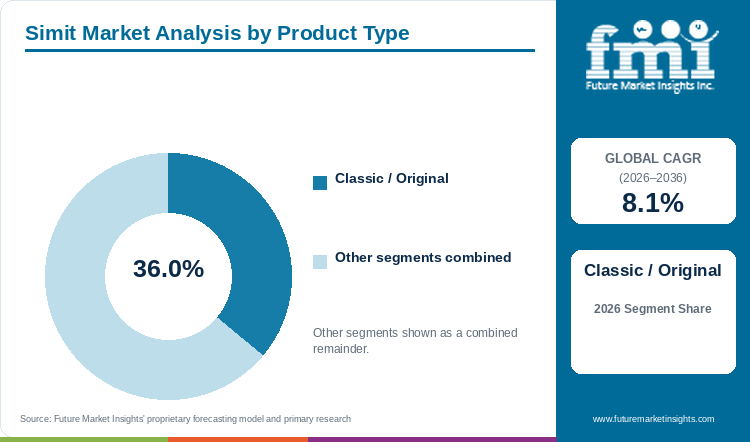
Classic / Original rings are projected to capture 36.0% of product type demand in 2026, anchored by authentic molasses-sesame crust identity.
Table 5: Product Type Share for the Simit Market (percentage share), 2026
| Product Type | Share (2026) |
|---|---|
| Classic / Original | 36.0% |
| Other Segments Combined | 64.0%* |
| Total | 100.0% |
*Note: Remaining product type categories sum to 100.0% of 2026 global simit market valuation.
Table 6: Product Type Leadership and Market Growth for the Simit Market (segment and CAGR percentage), 2026 to 2036
| Metric | Value |
|---|---|
| Global CAGR (2026 to 2036) | 8.1% |
| Leading Segment | Classic / Original |
Standard 100-gram to 120-gram braided rings dipped in grape pekmez and coated with roasted white sesame seeds establish the sensory benchmark against which international buyers evaluate Turkish bakery imports. Retailers introducing Mediterranean items with bagels favor the classic unfilled ring because single-component dough avoids dairy or meat filling spoilage during ambient display.
- Classic / Original is projected to secure 36.0% of product type revenue in 2026 because unstuffed sesame rings simplify bake-off handling and allergen labeling across export markets.
- Simit Sarayı expanded its international store network on April 30, 2026 by opening its Dubai Golden Mile outlet, anchoring its overseas café menu with classic freshly baked simit rings [3].
What sustains Conventional leadership in the claim / nature segment?
Conventional formulations are estimated to secure 53.0% of the claim / nature category in 2026, supported by standard wheat flour rheology and cost efficiency.
Traditional refined wheat flour and baker's yeast provide the tensile gluten strength required to roll and twist twin dough ropes without tearing on automated forming tables. While specialty buyers test clean label bread variants, mainstream bakeries retain conventional recipes because gluten-free or organic sesame substitutions double raw ingredient costs and still require identical sesame allergen isolation.
- Conventional options are estimated to command 53.0% of the claim / nature segment in 2026 as high-throughput bakeries prioritize strand extensibility and accessible retail price points.
- A May 2026 analytical study in Frontiers in Allergy demonstrated that baking at 185 degrees Celsius for 15 minutes reduced detectable Ses i 1 sesame allergen concentration from 43 micrograms per gram in dough to 24 micrograms per gram in baked bread with 2.2-fold to 4.3-fold intra-piece variation, confirming that conventional simit lines require dedicated allergen validation [4].
How does Frozen lead the format category?
Frozen formats are expected to command 30.0% of format volume in 2026, enabling long-distance export and store-level oven finishing.
Shock-freezing par-baked or unbaked twisted rings at minus 18 degrees Celsius allows Turkish and European commissaries to supply distant supermarkets without operating local dough-mixing kitchens. Integrating frozen simit into existing frozen dough distribution networks lets store staff bake small batches every four hours to maintain peak crust crunch.
- Frozen products are expected to hold 30.0% of format sales in 2026 because centralized freezing eliminates daily artisan labor at satellite retail bakeries.
- Food scientists at Yildiz Technical University reported in July 2026 that par-baking traditional Turkish breads for 7 to 9 minutes at 220 degrees Celsius prior to 30-day frozen storage preserved volatile aroma compounds and retarded crumb firming [1].
Why does Multipack lead the packaging format category?
Multipack configurations are forecast to generate 34.0% of packaging format revenue in 2026, driven by household breakfast stocking.
Four-count and six-count thermoformed trays and gusseted poly bags allow supermarkets to raise average basket value while giving households a convenient weekday breakfast staple. Engineered barrier films protect toasted sesame coatings from mechanical abrasion inside shopping carts and preserve interior crumb softness across multi-day home storage.
- Multipack formats are forecast to account for 34.0% of packaging format demand in 2026 as suburban grocery shoppers shift simit consumption from street snacking to home toaster preparation.
- A May 2026 bakery formulation study in Foods evaluating 9.85% to 29.55% sesame inclusion demonstrated that sesame lipids plasticize dough matrices and modulate baked hardness between 8.44 Newtons and 18.97 Newtons, guiding moisture-barrier film selection for multipack bakery goods [5].
What gives Supermarkets & Hypermarkets the leading position in sales channel?
Supermarkets & Hypermarkets are anticipated to account for 40.0% of sales channel turnover in 2026, anchored by in-store bake-off counters and frozen cases.
National grocery chains consolidate consumer reach by merchandising warm bake-off simit in fresh bakery bins with take-home multipacks in frozen ethnic food aisles. Securing supermarket shelf space requires automated metal detection, GS1 barcode compliance, and documented sesame cross-contact prevention across shared slicing and bagging lines.
- Supermarkets & Hypermarkets are anticipated to capture 40.0% of sales channel revenue in 2026 because organized grocers combine immediate bake-off impulse sales with planned freezer replenishment.
- An August 2025 wheat-allergen review in Food Chemistry: X noted that global wheat production reached 792.2 million metric tons with gliadin comprising 40% to 50% and glutenin 30% to 40% of wheat proteins, reinforcing strict retailer specification audits for wheat and sesame bakery lines [6].
What are the drivers, restraints, and opportunities in the simit market?
In the simit market, international Turkish café franchising and frozen bake-off logistics are projected to expand retail volume whereas sesame allergen cross-contact liabilities restrain shared-line production and flavored or mini formats unlock travel-hub catering.
- Driver: Overseas expansion of Turkish bakery café chains and ethnic grocery aisles converts simit into a year-round breakfast and travel-hub staple.
- Restraint: Mandatory sesame allergen segregation and rapid crust softening under humid storage delay listings on shared industrial bakery lines.
- Opportunity: Shock-frozen par-baked rings and filled gourmet variants enable hotels, airports, and supermarkets to serve warm simit with minimal kitchen labor.
Growth Analysis and Future Potential: Qualitative Demand Catalysts
International travel retail and diaspora grocery networks are transforming simit from a localized street food into a standardized commercial bakery item. When consumers encounter freshly baked sesame rings at airport concourses and mall cafés, repeat household demand spills over into supermarket bake-off counters with everything bagel seasoning bakery snacks. In September 2025, Simit Sarayı announced that its four stores at Dalaman Airport served a record 145,000 visitors during the first eight months of 2025 [7]. High-volume transit exposure validates commercial sell-through across diverse international traveler demographics and encourages regional grocers to stock frozen take-home packs.
Risk Assessment of the Simit Market: Operational and Formulation Friction
Cross-contact allergen liability on multi-product baking lines represents the primary operational barrier restricting contract manufacturing of sesame-coated rings. Loose roasted sesame seeds detach on proofing belts and cooling spirals, forcing shared bakeries either to build isolated rooms or to ban sesame entirely. In September 2026, a systematic review of 250 oral food challenges published in Clinical and Translational Allergy established that the lowest observed eliciting dose for sesame is just 2.5 milligrams of sesame protein (roughly five sesame seeds) and the ED01 threshold is 0.8 milligrams (one to two seeds) [8]. Industrial bakeries producing refrigerated dough products consequently enforce strict line-clearance testing before accepting private-label simit tenders.
Commercial Opportunity Analysis: Formulation Differentiation and Value-Add Formats
Bakery processors capture higher unit margins by pairing shock-frozen par-baked rings with filled and seeded flavor extensions that extend daypart sales beyond morning coffee. Incorporating hazelnut cocoa spread, chia seeds, or whole-grain sourdough starters allows café operators to position simit as an afternoon snack with Mediterranean sourdough starter cultures artisan breads. In June 2026, Simit Sarayı relaunched its Çoko Simit chocolate-filled ring and Chia Simit across its store network to target afternoon snacking occasions [9]. Suppliers that combine pre-proofed frozen convenience with verified reheating instructions enable hospitality buyers to minimize counter waste while broadening menu variety.
Simit Market by Country (2026 to 2036)
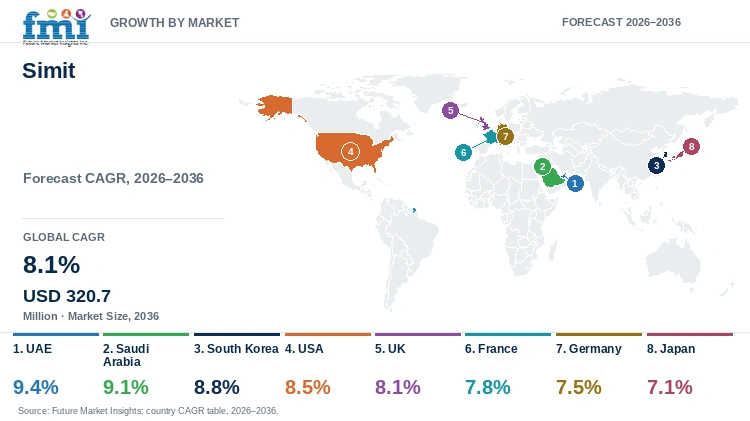
As per FMI, the UAE is projected to lead simit market expansion across evaluated countries at a 9.4% CAGR through 2036, whereas Japan is forecast to progress at a 7.1% CAGR. Commercial realization across Middle Eastern hospitality hubs, East Asian café chains, and Western supermarket networks depends on frozen bake-off supply reliability and compliant sesame allergen labeling.
Table 7: Country CAGR and Primary Growth Levers for the Simit Market (CAGR percentage and operational drivers), 2026 to 2036
| Country | CAGR (2026 to 2036) | Primary Growth Lever |
|---|---|---|
| UAE | 9.4% | Record international tourism footfall and franchise mall café expansion |
| Saudi Arabia | 9.1% | Pilgrimage hospitality catering and gourmet Turkish bakery store rollouts |
| South Korea | 8.8% | Specialty café bakery experimentation and wheat-based snacking shift |
| USA | 8.5% | Mediterranean grocery merchandising and strict FASTER Act sesame compliance |
| UK | 8.1% | London specialty bakery cafés and supermarket ethnic aisle listings |
| France | 7.8% | Artisan boulangerie snacking diversification and frozen bake-off supply |
| Germany | 7.5% | Established Turkish diaspora grocery listings across REWE and EDEKA |
| Japan | 7.1% | Imported frozen bakery boutique trials under strict port inspection rules |
Source: Future Market Insights analysis
UAE Simit Market Outlook (2026 to 2036)
Commercial simit demand in the UAE is projected to expand at a leading 9.4% CAGR through 2036 across shopping mall cafés, hotel breakfast buffets, and premium supermarkets. Unlike European markets where packaged grocery drives volume, Emirati adoption is anchored by high-traffic hospitality venues and franchise Turkish bakery storefronts. In February 2026, the Dubai Department of Economy and Tourism reported that Dubai welcomed a record 19.59 million international overnight visitors in 2025 across 154,264 hotel rooms operating at 80.7% average occupancy [10]. Simit Sarayı capitalized on this footfall by opening its Dubai Golden Mile outlet in April 2026, while local distributors rely on frozen par-baked shipments to maintain warm counter availability.
Key takeaway: In the UAE, record hotel occupancy and franchise mall café openings are projected to sustain leading demand for fresh and bake-off simit rings.
Saudi Arabia Simit Market Outlook (2026 to 2036)
Whereas Emirati consumption clusters in coastal resort malls, Saudi Arabia channels demand through holy-city hospitality complexes and expanding domestic wheat-milling infrastructure. Market value in Saudi Arabia is expected to climb at a 9.1% CAGR from 2026 to 2036 across Makkah, Riyadh, and Jeddah foodservice corridors. In April 2026, the USDA Foreign Agricultural Service forecast Saudi wheat imports for marketing year 2026/27 to rise 2% to 3.5 million metric tons to supply expanding local bakery processing [11]. Simit Sarayı reinforced high-volume pilgrimage catering in August 2026 by opening a 335-square-meter gourmet store inside Makkah Clock Royal Tower to serve international hotel guests and local retail shoppers [12].
Key takeaway: In Saudi Arabia, religious tourism catering and domestic flour-milling expansion are expected to accelerate commercial simit store and bake-off growth.
South Korea Simit Market Outlook (2026 to 2036)
In contrast to Middle Eastern franchise cafés, South Korea integrates sesame bread rings through trend-driven metropolitan coffee chains and department store food halls. In April 2026, the USDA Foreign Agricultural Service reported that per capita rice consumption in South Korea continues to decline in favor of wheat-based bakery foods, with Korean wheat-based food exports exceeding USD 1.5 billion in calendar year 2025 [13]. Sales of simit in South Korea are forecast to advance at an 8.8% CAGR through 2036 across Seoul and Busan specialty bakeries. Because Korean consumers favor softer crumb textures and compact portions, importers supply mini frozen par-baked rings paired with cream-cheese spreads.
Key takeaway: In South Korea, rising wheat-bakery consumption and café menu rotation are forecast to drive adoption of mini and filled simit formats.
USA Simit Market Outlook (2026 to 2036)
Unlike single-banner European grocery markets, demand in the USA divides between Mediterranean specialty grocers in metropolitan corridors and mainstream supermarket in-store bakeries. Federal enforcement under the FASTER Act requires strict sesame allergen labeling and line isolation, illustrated when the U.S. Food and Drug Administration issued an allergy alert on October 22, 2026 for undeclared sesame in WinCo Foods hoagie rolls across four western states [14]. Because cross-contact recalls carry severe financial penalties, American co-packers restrict simit production to dedicated sesame lines such as Kontos Foods and Toufayan Bakeries facilities. Commercial simit valuation in the USA is anticipated to progress at an 8.5% CAGR through 2036.
Key takeaway: In the USA, strict federal sesame allergen enforcement and Mediterranean grocery expansion are anticipated to favor dedicated sesame-certified bakery lines.
UK Simit Market Outlook (2026 to 2036)
Simit expenditure in the UK is estimated to grow at an 8.1% CAGR between 2026 and 2036 across London bakery cafés, independent ethnic grocers, and supermarket bake-off fixtures. What distinguishes the UK from continental Europe is the concentration of Turkish café chains in Greater London with high clinical awareness of sesame allergy under Natasha's Law. A September 2026 clinical synthesis in Clinical and Translational Allergy noted that 17% of sesame-allergic patients in the UK experience potentially life-threatening systemic anaphylactic reactions following accidental dietary exposure [8]. so British grocery buyers require BRCGS-certified allergen segregation and sealed moisture-barrier multipack film before listing frozen or ambient simit with private-label Mediterranean flatbreads.
Key takeaway: In the UK, strict prepacked allergen labeling laws and London café demand are estimated to make certified allergen-segregated packaging mandatory for grocery listings.
France Simit Market Outlook (2026 to 2036)
Whereas British volume flows through large supermarket chains, France retains a highly fragmented artisanal baking sector that evaluates imported bread rings on crust blistering and crumb chew. French simit revenue is slated to expand at a 7.8% CAGR over the 2026 to 2036 window across urban snacking counters and hypermarket ethnic bays. In September 2026, the USDA Foreign Agricultural Service reported that large general food retailers kept anchoring French food retail while specialized stores and commercial artisans widened private-label bakery programs [15]. Suppliers targeting French hypermarkets pair shock-frozen par-baked rings with recyclable mono-material bags compliant with national AGEC circular packaging rules.
Key takeaway: In France, strong artisan bakery share and national packaging waste laws are slated to guide demand toward par-baked frozen rings in recyclable film.
Germany Simit Market Outlook (2026 to 2036)
Germany anchors European volume with the continent's largest Turkish diaspora and a mature domestic manufacturing base supplying both fresh regional routes and nationwide frozen grocery cases. In September 2026, the USDA Foreign Agricultural Service documented that German retail food sales reached USD 323.8 billion with agricultural imports rising to USD 172.4 billion with expanding private-label bakery assortments [16]. Demand for simit in Germany is likely to increase at a 7.5% CAGR through 2036 across REWE, EDEKA, and discount bake-off stations. Domestic specialists such as Karataş Backwaren compete on automated bake-off crust consistency and verified multi-day shelf-life stability across national grocery depots rather than novelty positioning.
Key takeaway: In Germany, established supermarket bake-off stations and domestic Turkish bakery production are likely to sustain steady volume across organized retail.
Japan Simit Market Outlook (2026 to 2036)
Unlike Western European markets with large established Mediterranean communities, Japan treats simit as a curated artisanal bakery import sold through Tokyo and Osaka metropolitan bakery boutiques and luxury hotel breakfast buffets. In March 2026, the USDA Foreign Agricultural Service analyzed Japanese marketing year 2026/27 wheat import tender structures and domestic milling allocations governing specialty bakery flour costs [17]. Because Ministry of Health, Labour and Welfare port inspections require exhaustive additive and allergen documentation for imported frozen dough, Japanese specialty foodservice importers favor small-batch frozen par-baked shipments with extended twelve-month freezer stability. Japanese simit sales are predicted to advance at a 7.1% CAGR from 2026 to 2036.
Key takeaway: In Japan, strict import food sanitation checks and compact boutique bakery counters are predicted to favor certified frozen par-baked simit shipments.
Full report country CAGRs cover: North America; Latin America; Western Europe; Eastern Europe; East Asia; South Asia and Pacific; Middle East and Africa.
Who are the notable companies in the simit market?
Gruma, Mission Foods, Ole Mexican Foods, Toufayan Bakeries, Kontos Foods, FGF Brands, Signature Flatbreads, Angel Bakeries, Grupo Bimbo, and Europastry are the notable companies evaluated for adjacent and specialty bakery capabilities in the simit market.
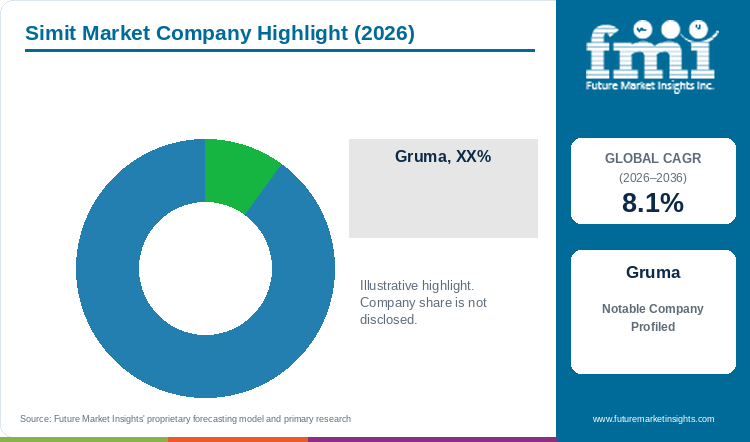
FMI analysis indicates that the evaluated competitive set represents adjacent industrial flatbread, specialty bakery, and frozen dough platforms with dedicated Turkish simit café operators such as Simit Sarayı and German producer Karataş Backwaren (Mr. Simit). Multinational grain processors including Gruma and Grupo Bimbo operate high-speed packaged flatbread networks, whereas Mediterranean bakeries such as Kontos Foods and Toufayan Bakeries specialize in hearth breads with distinct sesame allergen policies. Frozen bakery specialists FGF Brands and Europastry maintain shock-freezing and bake-off distribution infrastructure applicable to international ring replenishment.
- Industrial Packaged-Bread and Tortilla Networks: Gruma, Mission Foods, Ole Mexican Foods, and Grupo Bimbo operate multi-plant ambient and chilled bakery distribution networks across North America and Europe.
- Mediterranean Flatbread and Specialty-Bakery Platforms: Toufayan Bakeries, Kontos Foods, Signature Flatbreads, and Angel Bakeries produce hearth-baked pitas, naans, and specialty breads under documented allergen controls.
- Frozen and Foodservice Bakery Platforms: FGF Brands and Europastry engineer shock-frozen par-baked breads and pastries for supermarket in-store bakeries and foodservice operators.
Competitive Benchmarking: Simit Market
Table 8: Competitive Benchmarking for the Simit Market (qualitative capability ratings), 2026
| Company | Simit SKU Evidence | Frozen-Bread Capability | Retail/Foodservice Access | Geographic Reach |
|---|---|---|---|---|
| Gruma | Unscored | Unscored | High | Global packaged-food reach via Mission Foods; adjacent flatbread portfolio |
| Mission Foods | Unscored | Unscored | High | USA, Europe, and export flatbread channels; adjacent bakery capability |
| Ole Mexican Foods | Unscored | Unscored | Medium | USA packaged grocery networks; adjacent tortilla and bakery lines |
| Toufayan Bakeries | Unscored | Unscored | Medium | USA pita, bagel, and specialty bread retail distribution |
| Kontos Foods | Unscored | Unscored | Medium | USA retail and foodservice Mediterranean flatbreads; sesame-certified lines |
| FGF Brands | Unscored | High | High | North American commercial bakery and frozen foodservice distribution |
| Signature Flatbreads | Unscored | Unscored | High | UK grocery and India bakery manufacturing footprint |
| Angel Bakeries | Low | High | Medium | Israel and North America frozen pita exports; strict sesame-exclusion policy |
| Grupo Bimbo | Unscored | High | High | 35-country industrial bakery network across retail and foodservice |
| Europastry | Unscored | High | High | European, North American, and Asian frozen bakery manufacturing |
Scoring basis: Simit SKU Evidence evaluates publicly documented simit ring production within the defined revenue boundary, whereas Frozen-Bread Capability assesses verified shock-frozen or par-baked distribution infrastructure. Retail/Foodservice Access reflects documented grocery and hospitality route-to-market breadth, with Low indicating an explicit operational constraint such as Angel Bakeries' published facility-wide sesame exclusion policy.
Key Developments in the Simit Market
- Simit Sarayı expanded its international franchise store footprint on April 30, 2026 by opening a new outlet at Dubai Golden Mile in the UAE, extending its cross-border Turkish bakery café network [3].
- Simit Sarayı inaugurated a next-generation store at Marassi Galleria Mall in Bahrain on July 23, 2026, pairing freshly baked classic simit with contemporary mall café seating [18].
- Simit Sarayı opened its first overseas Gourmet concept store spanning 335 square meters inside Makkah Clock Royal Tower in Saudi Arabia on August 18, 2026 to serve high-density pilgrimage hospitality traffic [12].
Key Players in the Simit Market
Industrial Packaged-Bread and Tortilla Networks
- Gruma
- Mission Foods
- Ole Mexican Foods
- Grupo Bimbo
Mediterranean Flatbread and Specialty-Bakery Platforms
- Toufayan Bakeries
- Kontos Foods
- Signature Flatbreads
- Angel Bakeries
Frozen and Foodservice Bakery Platforms
- FGF Brands
- Europastry
Simit Market - Report Scope
Table 9: Report Scope for the Simit Market (coverage fields and definitions), 2026 to 2036
| Coverage field | Report scope |
|---|---|
| Market breakdown | Product Type; Claim / Nature; Format; Packaging Format; Sales Channel |
| Quantitative Units | USD Million |
| Market Definition | Includes commercial wholesale and retail supplier revenue from simit (Turkish pekmez-dipped sesame bread rings) across Classic / Original, Whole Grain & Seeded, Flavored & Filled, Mini & Snacking Formats, and Premium / Artisan lines. Category Scope Note: Excludes boiled North American-style bagels, unseeded hearth pitas, soft pretzels, and non-simit café beverage or meal receipts. |
| Regions Covered | North America; Latin America; Western Europe; Eastern Europe; East Asia; South Asia and Pacific; Middle East and Africa |
| Countries Covered | UAE, Saudi Arabia, South Korea, USA, UK, France, Germany, Japan, and additional countries in the full report |
| Key Companies Covered | Gruma, Mission Foods, Ole Mexican Foods, Toufayan Bakeries, Kontos Foods, FGF Brands, Signature Flatbreads, Angel Bakeries, Grupo Bimbo, Europastry |
| Forecast Period | 2026 to 2036 |
| Approach | Primary and secondary research with top-down and bottom-up market triangulation. |
Simit Market - Research Methodology
Table 10: Research Methodology for the Simit Market (research methods and approach), 2026 edition
| Method | Approach |
|---|---|
| Primary Research | Structured interviews with industrial flatbread and par-baked bakery production directors, Turkish café franchise operators, supermarket in-store bakery buyers, and allergen quality-assurance managers across Europe, the Middle East, and North America. |
| Secondary Research | Analysis of corporate annual reports, USDA FAS Grain and Retail Foods Annual filings, PubMed and PMC bakery rheology and sesame allergen studies, and FDA and European Commission allergen recall databases. |
| Market Sizing and Forecasting | Top-down parent artisan bread and bakery products baselines reconciled against bottom-up ring output (100g to 120g unit weights, 18% to 22% sesame pickup) and active retail and café bake-off outlet counts from 2026 to 2036. |
| Country Forecasting Model | Econometric country projections weight Turkish diaspora demographics, international tourist arrivals, supermarket bake-off fixture penetration, and statutory sesame allergen compliance costs across eight national markets. |
| Operational Benchmark Traceability | Production-volume and outlet spending indicators in Tables 2, 3, and 4 trace to Foods par-baking trials, Dubai Department of Economy and Tourism visitor registries, and USDA FAS national retail food assessments. |
| Data Triangulation and Validation | Demand estimates are cross-checked against commercial flour-milling allocations, sesame seed import volumes, and franchise store receipts while excluding non-simit flatbreads, boiled bagels, and café beverage sales. |
Simit Market by Segments
Simit Market segmented by Product Type:
- Classic / Original
- Whole Grain & Seeded
- Flavored & Filled
- Mini & Snacking Formats
- Premium / Artisan
Simit Market segmented by Claim / Nature:
- Conventional
- Clean Label
- Organic
- Gluten-Free
- High-Protein / Fortified
Simit Market segmented by Format:
- Frozen
- Fresh
- Ambient Packaged
- Chilled
- Par-Baked / Thaw-and-Serve
Simit Market segmented by Packaging Format:
- Multipack
- Single-Serve
- Family / Loaf Pack
- Bulk Foodservice
Simit Market segmented by Sales Channel:
- Supermarkets & Hypermarkets
- Artisan & Specialty Bakeries
- Convenience & Forecourt
- Online & DTC
- Foodservice Distributors
Simit Market by Region
- North America
- United States
- Canada
- Latin America
- Brazil
- Mexico
- Argentina
- Chile
- Western Europe
- Germany
- France
- United Kingdom
- Italy
- Spain
- Benelux
- Nordics
- Eastern Europe
- Poland
- Czech Republic
- Romania
- Hungary
- East Asia
- China
- Japan
- South Korea
- South Asia and Pacific
- India
- ASEAN
- Australia and New Zealand
- Middle East and Africa
- GCC Countries
- South Africa
- Türkiye
- Israel
Research Sources and Bibliography
- [1] Yilmaz, S., Bekiroglu, H., & Ozulku, G. (2026, July 4). The Effect of the Partial Baking Method on the Quality, Volatile Compounds Profile, and Glycemic Index of Some Traditional Turkish Bread Types. Foods, 15(13), 2392.
- [2] Zhang, W., Wong, C. W. Y., & Schaneberg, B. (2026, September 2). Microbiological Hazards, Not Undeclared Allergens, Dominate United States Food Recalls: An Analysis of 24,761 Product Recall Records, 2013-2025. Foods, 15(17), 3115 (PubMed PMID 42737358).
- [3] Simit Sarayı. (2026, April 30). Simit Sarayı, yeni mağaza ağı ile yurtdışında büyümesini sürdürüyor. Simit Sarayı Corporate Newsroom.
- [4] Bermingham, M. D., Meredith, R. T., Mills, H., Maddocks, S., Chapman, M. D., Blaxland, J. A., & Oliver, M. A. (2026, May 21). Baking results in impaired detection of clinically relevant food allergens. Frontiers in Allergy, 7, 1796342 (PubMed PMID 42253474).
- [5] Oboulbiga, E. B., Tapsoba, F. W.-b., Petraru, A., Ursachi, F., Parkouda, C., & Codina, G. G. (2026, May 4). Technological Properties and Quality Characteristics of Non-Gluten Biscuits Based on Sorghum Flour and Enriched with Sesame and Moringa. Foods, 15(9), 1593 (PubMed PMID 42121536).
- [6] Jiang, N., Wang, Y., Sun, Y., Gao, Z., Liu, D., & Chitrakar, B. (2025, August 5). Allergens from wheat and wheat products: A comprehensive review on allergy mechanisms and modifications. Food Chemistry: X, 29, 102871 (PubMed PMID 40823125).
- [7] Simit Sarayı. (2025, September 22). Simit Sarayı, Dalaman'da 145 bin kişi ile rekor kırdı. Simit Sarayı Corporate Newsroom.
- [8] Zielinska, J., Kunkiel, K., Krupa-Laska, A., Kulus, M., & Grzela, K. (2026, September 29). Sesame Immunotherapy: A Systematic Review and Narrative Synthesis. Clinical and Translational Allergy, 16(10), e70206 (PubMed PMID 42808451).
- [9] Simit Sarayı. (2026, June 4). Simit Sarayı'nın sevilen lezzetleri geri döndü. Simit Sarayı Corporate Newsroom.
- [10] Dubai Department of Economy and Tourism. (2026, February 9). Dubai Welcomes 19.59 Million Visitors in Third Record Year. Government of Dubai Media Office.
- [11] USDA Foreign Agricultural Service. (2026, April 6). Saudi Arabia: Grain and Feed Annual. U.S. Department of Agriculture GAIN Report SA2026-0002.
- [12] Simit Sarayı. (2026, August 18). Simit Sarayı'nın yurt dışındaki ilk 'Gurme' konsepti mağazası Mekke Tower'da açıldı. Simit Sarayı Corporate Newsroom.
- [13] USDA Foreign Agricultural Service. (2026, April 14). South Korea: Grain and Feed Annual. U.S. Department of Agriculture GAIN Report KS2026-0007.
- [14] U.S. Food and Drug Administration. (2026, October 22). WinCo Foods LLC Issues Allergy Alert on Undeclared Sesame in Hoagie Rolls. U.S. Department of Health and Human Services.
- [15] USDA Foreign Agricultural Service. (2026, September 30). France: Retail Foods Annual. U.S. Department of Agriculture GAIN Report FR2026-0005.
- [16] USDA Foreign Agricultural Service. (2026, September 25). Germany: Retail Foods Annual. U.S. Department of Agriculture GAIN Report GM2026-0011.
- [17] USDA Foreign Agricultural Service. (2026, March 18). Japan: Grain and Feed Annual. U.S. Department of Agriculture GAIN Report JA2026-0012.
- [18] Simit Sarayı. (2026, July 23). Simit Sarayı'ndan Bahreyn'e Yeni Nesil Mağaza Deneyimi. Simit Sarayı Corporate Newsroom.
- [19] Europastry. (2026, March 25). Europastry continues to grow and reaches €1.63 billion in revenue in 2025, an 8% increase compared to 2024. Europastry Corporate Press Room.
- [20] Bimbo Bakeries USA. (2026, May 15). Grupo Bimbo Releases 2025 Annual Report. Grupo Bimbo S.A.B. de C.V. Newsroom.
- [21] METRO Inc. (2026, July 16). METRO and FGF Brands Enter into a Strategic Partnership for Premiere Moisson's Commercial Bakery Manufacturing Operations. CNW Group / PR Newswire.
- [22] Luparelli, A., De Angelis, E., Pilolli, R., Lambertini, F., Suman, M., & Monaci, L. (2025, February 20). Mass Spectrometry-Based Method for Multiple Allergens Control: Application to Bakery Goods. Foods, 14(5), 726 (PubMed PMID 40077429).
- [23] U.S. Food and Drug Administration. (2026, August 19). Prince Bakery Inc Issues Allergy Alert on Undeclared Milk and Sesame in Prince Bakery Breads. U.S. Department of Health and Human Services.
This bibliography is provided for reader reference and is not exhaustive. The full report contains the complete reference list and detailed citations.
This Report Answers
- How large is the simit market in 2026 and what is forecast for 2036?
- Which hospitality and retail bake-off pressures support demand for simit?
- Why does Classic / Original lead the product type category?
- Why does Conventional lead the claim / nature category globally?
- How do growth rates differ across the UAE, Saudi Arabia, South Korea, and the USA?
- Which leading companies supply relevant flatbread and frozen bakery categories today?
- What limits adoption or shared-line contract baking in the simit market?
- What should grocery buyers evaluate before listing a frozen or packaged simit?
Frequently Asked Questions
How big is the simit market in 2026, and what is forecast for 2036?
According to FMI, the global simit market value reached USD 136.2 million in 2025 and rose to USD 147.2 million in 2026. The industry valuation is forecast to hit USD 320.7 million by 2036 as supermarkets and travel-hub cafés expand shock-frozen bake-off counters.
What is the CAGR for the simit market from 2026 to 2036?
Future Market Insights projects an 8.1% CAGR between 2026 and 2036, generating USD 173.5 million in incremental value across retail and hospitality channels.
Which product type segment leads the simit market?
Classic / Original rings are projected to capture 36.0% of product type demand in 2026 because pekmez-dipped sesame crusts establish authentic sensory identity and simplify bake-off handling.
Which claim / nature segment leads the simit market?
Conventional formulations are estimated to secure 53.0% of the claim / nature category in 2026 as commercial bakeries rely on standard wheat gluten elasticity for rope twisting and accessible pricing.
Which country has a notable growth outlook during the assessment period?
The UAE is projected to lead national growth at a 9.4% CAGR through 2036, supported by record international visitor arrivals and Turkish bakery café franchising.
Who are the key players evaluated in the market?
Gruma, Mission Foods, Ole Mexican Foods, Toufayan Bakeries, Kontos Foods, FGF Brands, Signature Flatbreads, Angel Bakeries, Grupo Bimbo, and Europastry lead commercial supply across adjacent flatbread and frozen bakery platforms.
Preview the report firsthand - request a free sample
Get SampleGet the brochure for pricing and purchase details.
Get PDFTable of Content
- Key Takeaways
- Market Size and CAGR
- Top Growth Driver
- Fastest Growing Segment
- Leading Region
- Key Companies
- Emerging Opportunities
- Executive Summary
- Global Market Outlook
- Demand-side Trends
- Supply-side Trends
- Technology Roadmap Analysis
- Analysis and Recommendations
- Analyst Perspective (What is happening? Why now? What should investors know?)
- Key Questions Answered
- How large is the market?
- What is the CAGR?
- What are key trends?
- Which region dominates?
- Who are the leaders?
- Market Overview
- Market Coverage / Taxonomy
- Market Definition / Scope / Limitations
- Research Methodology
- Chapter Orientation
- Analytical Lens and Working Hypotheses
- Market Structure, Signals, and Trend Drivers
- Benchmarking and Cross-market Comparability
- Market Sizing, Forecasting, and Opportunity Mapping
- Research Design and Evidence Framework
- Desk Research Programme (Secondary Evidence)
- Expert Input and Fieldwork (Primary Evidence)
- Tooling, Models, and Reference Databases
- Data Engineering and Model Build
- Quality Assurance and Audit Trail
- Market Background
- Market Dynamics (Drivers, Restraints, Opportunity, Trends)
- Scenario Forecast (Optimistic, Likely, Conservative)
- Impact Analysis
- AI Impact
- Sustainability Impact
- Regulatory Impact
- Technology Impact
- Consumer / Buyer Analysis
- Purchase Drivers
- Adoption Barriers
- Buyer Journey
- Opportunity Map Analysis
- Product Life Cycle Analysis
- Supply Chain Analysis
- Investment Feasibility Matrix
- Value Chain Analysis
- PESTLE and Porter's Analysis
- Regulatory Landscape
- Regional Parent Market Outlook
- Production and Consumption Statistics
- Import and Export Statistics
- Global Market Analysis and Forecast, 2021 to 2036
- Historical Market Size Value (USD Million) Analysis, 2021 to 2025
- Current and Future Market Size Value (USD Million) Projections, 2026 to 2036
- Y-o-Y Growth Trend Analysis
- Absolute $ Opportunity Analysis
- Global Market Pricing Analysis, 2021 to 2036
- Global Market Analysis and Forecast, By Product Type, 2021 to 2036
- Introduction / Key Findings
- Historical Market Size Value (USD Million) Analysis By Product Type, 2021 to 2025
- Current and Future Market Size Value (USD Million) Analysis and Forecast By Product Type, 2026 to 2036
- Classic / Original
- Whole Grain & Seeded
- Flavored & Filled
- Mini & Snacking Formats
- Premium / Artisan
- Y-o-Y Growth Trend Analysis By Product Type, 2021 to 2025
- Absolute $ Opportunity Analysis By Product Type, 2026 to 2036
- Global Market Analysis and Forecast, By Claim / Nature, 2021 to 2036
- Introduction / Key Findings
- Historical Market Size Value (USD Million) Analysis By Claim / Nature, 2021 to 2025
- Current and Future Market Size Value (USD Million) Analysis and Forecast By Claim / Nature, 2026 to 2036
- Conventional
- Clean Label
- Organic
- Gluten-Free
- High-Protein / Fortified
- Y-o-Y Growth Trend Analysis By Claim / Nature, 2021 to 2025
- Absolute $ Opportunity Analysis By Claim / Nature, 2026 to 2036
- Global Market Analysis and Forecast, By Format, 2021 to 2036
- Introduction / Key Findings
- Historical Market Size Value (USD Million) Analysis By Format, 2021 to 2025
- Current and Future Market Size Value (USD Million) Analysis and Forecast By Format, 2026 to 2036
- Frozen
- Fresh
- Ambient Packaged
- Chilled
- Par-Baked / Thaw-and-Serve
- Y-o-Y Growth Trend Analysis By Format, 2021 to 2025
- Absolute $ Opportunity Analysis By Format, 2026 to 2036
- Global Market Analysis and Forecast, By Packaging Format, 2021 to 2036
- Introduction / Key Findings
- Historical Market Size Value (USD Million) Analysis By Packaging Format, 2021 to 2025
- Current and Future Market Size Value (USD Million) Analysis and Forecast By Packaging Format, 2026 to 2036
- Multipack
- Single-Serve
- Family / Loaf Pack
- Bulk Foodservice
- Y-o-Y Growth Trend Analysis By Packaging Format, 2021 to 2025
- Absolute $ Opportunity Analysis By Packaging Format, 2026 to 2036
- Global Market Analysis and Forecast, By Sales Channel, 2021 to 2036
- Introduction / Key Findings
- Historical Market Size Value (USD Million) Analysis By Sales Channel, 2021 to 2025
- Current and Future Market Size Value (USD Million) Analysis and Forecast By Sales Channel, 2026 to 2036
- Supermarkets & Hypermarkets
- Artisan & Specialty Bakeries
- Convenience & Forecourt
- Online & DTC
- Foodservice Distributors
- Y-o-Y Growth Trend Analysis By Sales Channel, 2021 to 2025
- Absolute $ Opportunity Analysis By Sales Channel, 2026 to 2036
- Global Market Analysis and Forecast, By Region, 2021 to 2036
- Introduction
- Historical Market Size Value (USD Million) Analysis By Region, 2021 to 2025
- Current Market Size Value (USD Million) Analysis and Forecast By Region, 2026 to 2036
- North America
- Latin America
- Western Europe
- Eastern Europe
- East Asia
- South Asia and Pacific
- Middle East and Africa
- Market Attractiveness Analysis By Region
- North America Market Analysis and Forecast, By Country, 2021 to 2036
- Historical Market Size Value (USD Million) Trend Analysis By Market Taxonomy, 2021 to 2025
- Market Size Value (USD Million) Forecast By Market Taxonomy, 2026 to 2036
- By Country
- United States
- Canada
- By Product Type
- By Claim / Nature
- By Format
- By Packaging Format
- By Sales Channel
- By Country
- Market Attractiveness Analysis
- By Country
- By Product Type
- By Claim / Nature
- By Format
- By Packaging Format
- By Sales Channel
- Key Takeaways
- Latin America Market Analysis and Forecast, By Country
- Historical Market Size Value (USD Million) Trend Analysis By Market Taxonomy, 2021 to 2025
- Market Size Value (USD Million) Forecast By Market Taxonomy, 2026 to 2036
- By Country
- Brazil
- Mexico
- Argentina
- Chile
- By Product Type
- By Claim / Nature
- By Format
- By Packaging Format
- By Sales Channel
- By Country
- Market Attractiveness Analysis
- By Country
- By Product Type
- By Claim / Nature
- By Format
- By Packaging Format
- By Sales Channel
- Key Takeaways
- Western Europe Market Analysis and Forecast, By Country
- Historical Market Size Value (USD Million) Trend Analysis By Market Taxonomy, 2021 to 2025
- Market Size Value (USD Million) Forecast By Market Taxonomy, 2026 to 2036
- By Country
- Germany
- France
- United Kingdom
- Italy
- Spain
- Benelux
- Nordics
- By Product Type
- By Claim / Nature
- By Format
- By Packaging Format
- By Sales Channel
- By Country
- Market Attractiveness Analysis
- By Country
- By Product Type
- By Claim / Nature
- By Format
- By Packaging Format
- By Sales Channel
- Key Takeaways
- Eastern Europe Market Analysis and Forecast, By Country
- Historical Market Size Value (USD Million) Trend Analysis By Market Taxonomy, 2021 to 2025
- Market Size Value (USD Million) Forecast By Market Taxonomy, 2026 to 2036
- By Country
- Poland
- Czech Republic
- Romania
- Hungary
- By Product Type
- By Claim / Nature
- By Format
- By Packaging Format
- By Sales Channel
- By Country
- Market Attractiveness Analysis
- By Country
- By Product Type
- By Claim / Nature
- By Format
- By Packaging Format
- By Sales Channel
- Key Takeaways
- East Asia Market Analysis and Forecast, By Country
- Historical Market Size Value (USD Million) Trend Analysis By Market Taxonomy, 2021 to 2025
- Market Size Value (USD Million) Forecast By Market Taxonomy, 2026 to 2036
- By Country
- China
- Japan
- South Korea
- By Product Type
- By Claim / Nature
- By Format
- By Packaging Format
- By Sales Channel
- By Country
- Market Attractiveness Analysis
- By Country
- By Product Type
- By Claim / Nature
- By Format
- By Packaging Format
- By Sales Channel
- Key Takeaways
- South Asia and Pacific Market Analysis and Forecast, By Country
- Historical Market Size Value (USD Million) Trend Analysis By Market Taxonomy, 2021 to 2025
- Market Size Value (USD Million) Forecast By Market Taxonomy, 2026 to 2036
- By Country
- India
- ASEAN
- Australia and New Zealand
- By Product Type
- By Claim / Nature
- By Format
- By Packaging Format
- By Sales Channel
- By Country
- Market Attractiveness Analysis
- By Country
- By Product Type
- By Claim / Nature
- By Format
- By Packaging Format
- By Sales Channel
- Key Takeaways
- Middle East and Africa Market Analysis and Forecast, By Country
- Historical Market Size Value (USD Million) Trend Analysis By Market Taxonomy, 2021 to 2025
- Market Size Value (USD Million) Forecast By Market Taxonomy, 2026 to 2036
- By Country
- GCC Countries
- South Africa
- Türkiye
- Israel
- By Product Type
- By Claim / Nature
- By Format
- By Packaging Format
- By Sales Channel
- By Country
- Market Attractiveness Analysis
- By Country
- By Product Type
- By Claim / Nature
- By Format
- By Packaging Format
- By Sales Channel
- Key Takeaways
- Key Countries Market Analysis
- United States
- Pricing Analysis
- Market Share Analysis, 2025
- By Product Type
- By Claim / Nature
- By Format
- By Packaging Format
- By Sales Channel
- Canada
- Pricing Analysis
- Market Share Analysis, 2025
- By Product Type
- By Claim / Nature
- By Format
- By Packaging Format
- By Sales Channel
- Mexico
- Pricing Analysis
- Market Share Analysis, 2025
- By Product Type
- By Claim / Nature
- By Format
- By Packaging Format
- By Sales Channel
- Brazil
- Pricing Analysis
- Market Share Analysis, 2025
- By Product Type
- By Claim / Nature
- By Format
- By Packaging Format
- By Sales Channel
- Chile
- Pricing Analysis
- Market Share Analysis, 2025
- By Product Type
- By Claim / Nature
- By Format
- By Packaging Format
- By Sales Channel
- Germany
- Pricing Analysis
- Market Share Analysis, 2025
- By Product Type
- By Claim / Nature
- By Format
- By Packaging Format
- By Sales Channel
- United Kingdom
- Pricing Analysis
- Market Share Analysis, 2025
- By Product Type
- By Claim / Nature
- By Format
- By Packaging Format
- By Sales Channel
- Italy
- Pricing Analysis
- Market Share Analysis, 2025
- By Product Type
- By Claim / Nature
- By Format
- By Packaging Format
- By Sales Channel
- Spain
- Pricing Analysis
- Market Share Analysis, 2025
- By Product Type
- By Claim / Nature
- By Format
- By Packaging Format
- By Sales Channel
- France
- Pricing Analysis
- Market Share Analysis, 2025
- By Product Type
- By Claim / Nature
- By Format
- By Packaging Format
- By Sales Channel
- India
- Pricing Analysis
- Market Share Analysis, 2025
- By Product Type
- By Claim / Nature
- By Format
- By Packaging Format
- By Sales Channel
- ASEAN
- Pricing Analysis
- Market Share Analysis, 2025
- By Product Type
- By Claim / Nature
- By Format
- By Packaging Format
- By Sales Channel
- Australia and New Zealand
- Pricing Analysis
- Market Share Analysis, 2025
- By Product Type
- By Claim / Nature
- By Format
- By Packaging Format
- By Sales Channel
- China
- Pricing Analysis
- Market Share Analysis, 2025
- By Product Type
- By Claim / Nature
- By Format
- By Packaging Format
- By Sales Channel
- Japan
- Pricing Analysis
- Market Share Analysis, 2025
- By Product Type
- By Claim / Nature
- By Format
- By Packaging Format
- By Sales Channel
- South Korea
- Pricing Analysis
- Market Share Analysis, 2025
- By Product Type
- By Claim / Nature
- By Format
- By Packaging Format
- By Sales Channel
- Poland
- Pricing Analysis
- Market Share Analysis, 2025
- By Product Type
- By Claim / Nature
- By Format
- By Packaging Format
- By Sales Channel
- Hungary
- Pricing Analysis
- Market Share Analysis, 2025
- By Product Type
- By Claim / Nature
- By Format
- By Packaging Format
- By Sales Channel
- Türkiye
- Pricing Analysis
- Market Share Analysis, 2025
- By Product Type
- By Claim / Nature
- By Format
- By Packaging Format
- By Sales Channel
- South Africa
- Pricing Analysis
- Market Share Analysis, 2025
- By Product Type
- By Claim / Nature
- By Format
- By Packaging Format
- By Sales Channel
- UAE
- Pricing Analysis
- Market Share Analysis, 2025
- By Product Type
- By Claim / Nature
- By Format
- By Packaging Format
- By Sales Channel
- Saudi Arabia
- Pricing Analysis
- Market Share Analysis, 2025
- By Product Type
- By Claim / Nature
- By Format
- By Packaging Format
- By Sales Channel
- United States
- Market Structure Analysis
- Competition Dashboard
- Competition Benchmarking
- Market Share Analysis of Top Players
- By Regional
- By Product Type
- By Claim / Nature
- By Format
- By Packaging Format
- By Sales Channel
- Emerging Startups
- Innovation Benchmarking
- Competition Analysis
- Competition Deep Dive
- Gruma
- Overview
- Product Portfolio
- Profitability by Market Segments
- Sales Footprint
- Strategy Overview
- Marketing Strategy
- Product Strategy
- Channel Strategy
- Mission Foods
- Ole Mexican Foods
- Toufayan Bakeries
- Kontos Foods
- FGF Brands
- Signature Flatbreads
- Angel Bakeries
- Grupo Bimbo
- Europastry
- Gruma
- Case Studies
- Success Stories
- Recent Developments
- Competition Deep Dive
- Assumptions & Acronyms Used


