

- Market Size (2026)
- USD 504.4 Mn
- Forecast (2036)
- USD 1151.0 Mn
- CAGR (2026 to 2036)
- 8.6%
How Big is the Bread Bags Market in 2026?
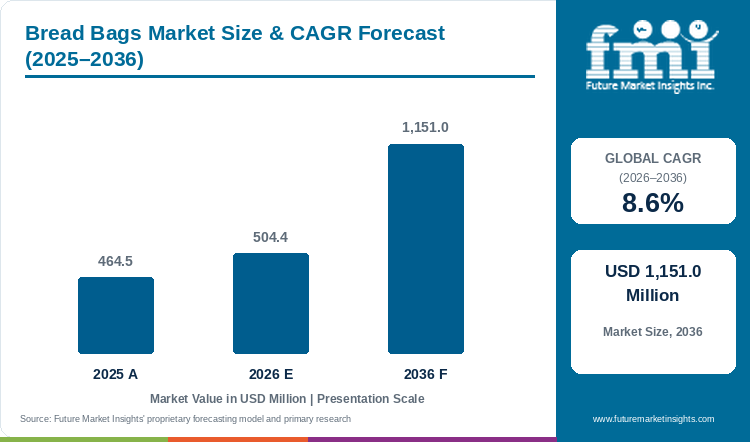
Bakeries and retailers will spend USD 504.4 Million on bread bags in 2026, against USD 464.5 Million in 2025. An 8.6% CAGR will take the market to USD 1,151.0 Million by 2036.
Sales of bread bags are projected to rise at 8.6% CAGR between 2026 and 2036, as per FMI. Industry value grows from USD 464.5 Million in 2025 to USD 504.4 Million in 2026 and is projected to reach USD 1,151.0 Million by 2036, adding USD 646.6 Million over the forecast decade.
Increasing sale of packaged bread through supermarkets and in-store bakeries is supporting the demand for bread bags, though bread consumption per person is flat in mature markets. US per capita flour consumption fell to 126.6 pounds in 2025, the lowest level in 39 years, according to USDA figures [1]. Due to this, bag volume will grow mainly with population and with the shift from loose to bagged bread, and higher value per bag will carry a larger part of revenue growth. Industrial bakeries are expected to hold 48% of demand by end use in 2026, as continuous bagging lines consume standardized bags in large quantities. Increasing use of coated paper and recycle-ready mono-PE films is also raising the average price of each bag.
Demand for bread bags is developing at different speeds across countries. The UAE is projected at 10.2% CAGR, owing to expanding retail bakery sales across Gulf supermarkets, and Japan is forecast at 7.9% through 2036 on mature sorting systems. In the UK, PackUK set 2025 to 2026 base fees at £196 per tonne for paper and card, £423 per tonne for plastic and £461 per tonne for fibre-based composite [2]. UK bakeries are therefore comparing bag materials on fee exposure as well as unit price. However, line speed, shelf life and clean wicket release will decide which material receives the regular order.
Adjacent bakery packaging categories are also widening the opportunity for bag converters. Sales in the resealable bread packaging market are projected to rise from USD 672.8 Million in 2026 to USD 1,777.1 Million by 2036 at 10.2% CAGR, as reclosable features add value to each loaf pack. Demand for paper-based bakery wraps is estimated to increase at 6.4% CAGR, from USD 391.6 Million to USD 728.2 Million, and the PE film market is expected to grow at a slower 2.3%.
During the forecast period, adoption of coated paper and mono-PE bread bags is expected to increase as bakeries write packaging specifications around EPR fees. FMI predicts that converters supplying these formats for existing wicket lines will receive a larger share of new orders, owing to lower conversion cost at the bakery.
Key Takeaways
- Notable companies in the bread bags market include Amcor, Mondi Group, ProAmpac, Novolex, Smurfit Westrock, Kwik Lok, Sabert and Vegware.
- Based on bag type, LDPE bags are projected to account for 39% in 2026, owing to moisture protection and full-speed running on installed bagging lines.
- By material, paper & board is estimated to hold 37% in 2026, as paper and card carry the lowest UK EPR base fee among bread bag substrates.
- The UAE is projected at 10.2% CAGR through 2036, followed by Saudi Arabia at 9.9%, as Gulf retail bakery sales keep increasing bagged bread volume.
Analyst Perspective
“Recyclable bread bags running at full speed on existing wicket lines will receive the larger share of new bakery contracts. Converters proving line speed, shelf life and lower EPR fee exposure on one specification will convert trials into multi-year supply.”
- Nandini Roy Choudhury, Principal Consultant, Future Market Insights
How is the Bread Bags Market Segmented?
The bread bags market is segmented into bag type, material, bakery application, function, end use and region.
As per FMI, the market is segmented by bag type into LDPE bags, paper bags, compostable films, and woven and specialty bags. By material, the market is segmented into paper and board, plastic films, compostable and bio-based materials, and aluminium and specialty materials. By bakery application, the market is segmented into bread and rolls, cakes and pastry, cookies and biscuits, and frozen bakery. By function, the market is segmented into primary packaging, secondary packaging, transit and returnable packaging, and active or shelf-life extension packaging. By end use, the market is segmented into industrial bakeries, in-store bakery and retail, and artisan and foodservice. The regional analysis covers seven regions and more than 25 countries.
Why Do LDPE Bags Lead the Bread Bags Market by Bag Type?
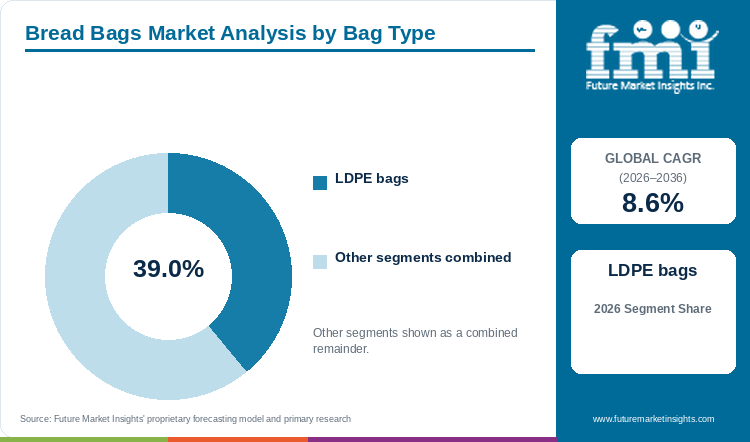
By bag type, LDPE bags will account for 39% of market share in 2026.
Increasing sale of packaged loaves from automated bakeries is supporting the demand for LDPE bags in bread packing. Polyethylene film keeps loaves soft, pulls off wicket pins without tearing and keeps up with top machine speeds, owing to which large bakeries continue to order LDPE formats for daily runs. Paper bags are growing at a slower pace, as coated barrier grades and slower packing are needed to give equal freshness. Compostable films cost more per unit, and collection for composting exists in only a few countries. Woven and specialty bags are bought in fewer units, mostly for premium or reusable packs. However, higher EPR charges on plastic will decide the pace of switching to recycle-ready mono-PE film within this format.
- LDPE bags are projected to account for 39% of demand by bag type in 2026, owing to moisture protection and clean wicket release on high-speed lines.
- In May 2026, ProAmpac presented wicketted bread bags built for speed and performance on semi or fully automated packing lines [3].
Why Does Paper & Board Lead the Bread Bags Market by Material?
Based on material, paper & board will account for 37% of market share in 2026.
Bakeries are buying more fibre-based packs to cut producer-responsibility costs, supporting the demand for bread bags made from paper & board. In the UK, fibre packaging is charged the smallest EPR base fee of any bread bag substrate, and households can recycle paper through kerbside bins, owing to which bakery buyers are moving more volume into fibre. Plastic films are growing at a slower pace, as UK charges per tonne are higher for film than for fibre. Compostable and bio-based materials rely on certified composting sites, and aluminium and specialty materials serve mostly frozen and long-life goods. Converters are building new fibre capacity across the paper bags market to supply this switch. However, the coating needed to hold moisture in a fresh loaf will decide the fee band applied to each paper bag.
- Paper & board is estimated to hold 37% of demand by material in 2026, supported by lower EPR fee exposure and kerbside paper recovery.
- In October 2025, ProAmpac acquired the bag converting operations of International Paper in California, Oregon and Texas under the Fiberization of Packaging initiative [4].
Why Do Bread & Rolls Lead the Bread Bags Market by Bakery Application?
In 2026, bread & rolls will account for 38% of market share by bakery application.
Supermarkets and in-store bakeries sell fresh loaves and rolls every day, supporting the demand for bread bags in this application. Fresh bread goes stale within days, owing to which bakers pack small batches often and use more bags for each tonne baked than other bakery products. Italy alone sold 1.1 million tonnes of bread through retail bakery sections, with consumption at 41 kg per capita [5]. Cakes and pastry go mostly into rigid trays, and cookies and biscuits are packed in flow-wrap film. Frozen bakery uses fewer bags, as cartons and freezer packs take most of the volume. Converters are also creating paper loaf packs, a trend covered in the fiber-based bakery wraps market. However, crust feel and moisture control will decide the bag material suited to each type of bread.
- Bread & rolls are expected to account for 38% of demand by bakery application in 2026, owing to daily production for supermarket and in-store bakery shelves.
Why Does Primary Packaging Lead the Bread Bags Market by Function?
By function, primary packaging will account for 57% of market share in 2026.
Every packed loaf on a retail shelf needs one primary bag, supporting the demand for bread bags in this function. The inner bag holds the bread, carries the brand print, recloses after opening and keeps freshness, owing to which bakeries put most of the packaging budget into this layer. Secondary packaging is growing at a slower pace, as outer bundling of finished packs uses cheaper grades. Transit and returnable formats go through many delivery cycles, so buyers replace few units each year. Active shelf-life formats add a cost premium that mainly long-haul goods can absorb. Material changes are expected to start with the bag in contact with the bread, a pattern seen across the flexible plastic packaging market. However, new shelf-life trials will decide the speed of any material change in primary bags.
- Primary packaging is projected to hold 57% of demand by function in 2026, supported by direct product contact, branding and reclosure needs.
Why Do Industrial Bakeries Lead the Bread Bags Market by End Use?
Based on end use, industrial bakeries will account for 48% of market share in 2026.
Increasing automation at large plant bakeries is supporting the demand for bread bags in industrial bakeries. A factory line bags and closes loaves around the clock, owing to which a single site orders uniform bags in very large numbers. In-store bakery and retail buyers place smaller orders with frequent print changes, so each order carries lower volume. Artisan and foodservice outlets buy paper bags in small lots from wholesale distributors. However, test runs on the wicket, bagging and closing machines will decide the timing of any supplier switch at a large plant.
- Industrial bakeries are estimated to hold 48% of demand by end use in 2026, owing to continuous production on automated bagging and closing lines.
- In September 2025, Kwik Lok debuted the 872 Plus bag closing machine at IBIE 2025, designed with fewer parts, reduced maintenance and higher output [6].
What are the Drivers, Restraints, and Opportunities in the Bread Bags Market?
According to FMI, EPR fees and plastic rules are pushing bakeries to review bag materials, line qualification is slowing conversion, and coated paper or mono-PE bags for existing equipment will open the largest revenue pool till 2036.
- Driver: Producer-responsibility fees are pricing plastic, paper and composite bread bags differently, due to which material choice has become part of the bakery packaging budget.
- Restraint: Replacement bags need to hold moisture and run at full line speed, and failed trials can delay conversion for many bakeries.
- Opportunity: Recyclable paper, recycle-ready film and certified compostable bags designed for existing wicket and closing equipment can open new supply contracts.
Home-delivery bakery brands are also testing new bag formats along with regulation-led changes. In April 2026, Modern Milkman introduced a home-compostable single-layer bread bag made with Treetop Biopak [7]. Increasing use of compostable bags will require resin and certification capacity from the biodegradable packaging market, projected to grow from USD 11.1 Billion in 2026 to USD 22.4 Billion by 2036.
Key challenges in the bread bags market remain at the bakery line, as a bag tearing on the wicket or failing a shelf-life test can stop conversion. Suppliers providing barrier data, machine trials and closure testing together are expected to shorten the route to repeat orders.
Which Country CAGRs are Profiled in the Bread Bags Market?
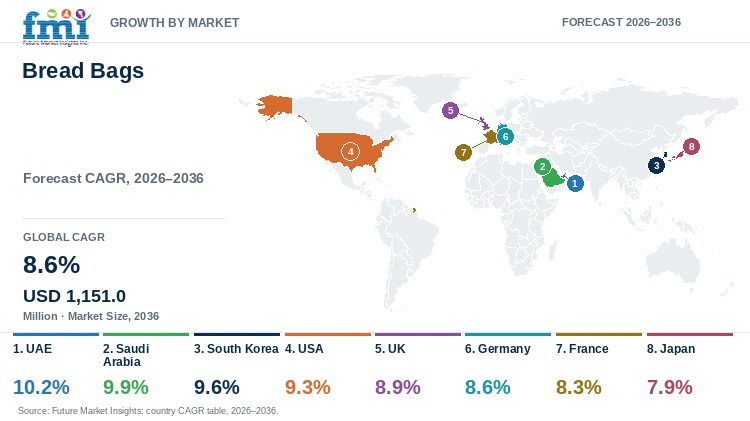
| Country | CAGR, 2026 to 2036 |
|---|---|
| UAE | 10.2% |
| Saudi Arabia | 9.9% |
| South Korea | 9.6% |
| USA | 9.3% |
| UK | 8.9% |
| Germany | 8.6% |
| France | 8.3% |
| Japan | 7.9% |
How do Country-level CAGRs Compare in the Bread Bags Market?
Demand for bread bags across the eight profiled countries ranges from 10.2% CAGR in the UAE to 7.9% in Japan, as per FMI's analysis. The UAE, Saudi Arabia, South Korea and the USA are projected at 9.3% or above, and the UK, Germany and France are expected to grow between 8.3% and 8.9%. Mature bread markets in the slower group will continue to hold larger bag revenue through 2036.
- UAE leads at 10.2%, with retail bakery growth set to increase bagged bread volumes.
- Saudi Arabia follows at 9.9%, with food-contact documentation guiding supplier choice.
- Packaging grade labeling will carry South Korea to a 9.6% growth rate.
- Growth of 9.3% in the USA will track state producer-responsibility rules.
- Demand for bread bags in the UK will rise at 8.9% under material-based EPR fees for packaging.
- Germany grows at 8.6% as PPWR conformity enters supplier qualification.
- France will expand at 8.3% under single-use plastic reduction targets.
- Japan grows slowest at 7.9%, guided by mature sorting and recycling systems.
Beyond these eight profiles, the full report carries CAGR estimates for seven regions and more than 25 national and grouped markets.
Country Outlook
- The UAE is projected at 10.2% CAGR, the fastest in the profiled group, owing to Gulf retail expansion. Dubai's single-use product rules exempt thin plastic bag rolls used for bread, due to which film formats are expected to keep volume.
- Saudi Arabia is forecast at 9.9% CAGR, and food-contact declarations against national and Gulf standards are acting as the first filter for suppliers. Early documentation is expected to speed up supplier approval.
- A formal grading system is reshaping South Korean bag design, with demand expanding at a 9.6% CAGR. Packaging material and structure grade labeling standards took effect on July 20, 2026 [8].
- Demand for bread bags in the USA, on a 9.3% CAGR till 2036, is shaped by state producer-responsibility programs. California's permanent SB 54 regulations were approved and took effect from May 1, 2026 [9].
- Fee transparency is changing bag procurement in the UK, a market growing at an 8.9% CAGR. Paper and card carry a £196 per tonne base fee against £423 for plastic [2].
- Germany will grow at an 8.6% CAGR as documentation enters supplier selection. The PPWR and the national implementation act replaced the previous Packaging Act on August 12, 2026 [10].
- Plastic reduction targets frame French bakery packaging, with demand set on an 8.3% CAGR. The environment ministry keeps a 2040 phase-out objective for single-use plastic packaging [11].
- Japan is projected at 7.9%, the slowest in the group, as mature sorting rules favour single-material bread bags with removable windows and closures.
Who are the Notable Companies in the Bread Bags Market?
Amcor, Mondi Group, Sealed Air, ProAmpac, Smurfit Westrock and Novolex are among the notable companies profiled by FMI across film, paper and bakery bag supply.
Bread bags are supplied by a mix of global flexible packaging groups, paper converters and closure specialists, due to which supply remains moderately fragmented. Film converters are receiving orders on machinability, wicket release and print quality, and paper converters are offering barrier coatings with lower fee exposure. The fibre side is consolidating, as ProAmpac added kraft paper bag converting plants from International Paper in October 2025 [4]. New suppliers need food-contact approval, wicket tooling and line trials before the first order, and bakeries repeat machine and shelf-life tests before changing a bag source. Owing to this, approved suppliers keep accounts for long periods. However, each newly qualified paper or mono-PE bag gives retailers a second approved source, and competition is expected to increase in EPR markets through 2036.
- Flexible Film and Barrier Systems: Amcor, Mondi Group, Sealed Air and ProAmpac supply barrier films, coated papers and wicketted bags for automated bakery lines.
- Paper and Bakery Bag Conversion: Smurfit Westrock, Novolex and Detmold Group convert paper substrates and bakery bags for retail and in-store bakery buyers.
- Closure, Bakery-Account and Compostable Specialists: Kwik Lok, Sabert and Vegware cover bag closing systems, multi-substrate bakery packaging and compostable formats, and Sabert announced a paper and molded fibre portfolio showcase for IDDBA 2026 in May 2026 [12].
Competitive Benchmarking
| Company | Direct Bread-Bag Format Depth | Automated Bakery-Line Compatibility | Circular-Material Breadth | Geographic Reach |
|---|---|---|---|---|
| Amcor | High | High | High | Global consumer-packaging reach |
| Mondi Group | High | High | High | Europe-led with international packaging operations |
| Sealed Air | Medium | High | Medium | Global food-packaging operations |
| Smurfit Westrock | Medium | Low | High | North America, Europe and other regions |
| Novolex | High | High | High | North America with bakery and foodservice channels |
| Kwik Lok | Low | High | Low | North America and Europe with international bakery customers |
| ProAmpac | High | High | High | North America and Europe |
| Sabert | Low | Low | High | North America, Europe and China |
| Detmold Group | Medium | Low | High | Australia and selected international markets |
| Vegware | Medium | Low | Medium | UK and selected international foodservice markets |
Scoring basis: Direct Bread-Bag Format Depth rates public evidence of bakery bag formats, Automated Bakery-Line Compatibility rates documented wicket, bagging or closure integration, and Circular-Material Breadth rates recyclable, paper or compostable options. High reflects broad documented capability, Medium a narrower proven range, and Low limited public documentation or an adjacent role.
Key Developments
- In September 2025, Kwik Lok debuted the 872 Plus bag closing machine at IBIE 2025, built with fewer parts and lower maintenance for higher output in bakery packing [6].
- In October 2025, ProAmpac acquired the kraft paper bag converting operations of International Paper in California, Oregon and Texas to support the Fiberization of Packaging initiative [4].
- In April 2026, Modern Milkman introduced a home-compostable single-layer bread bag made with Treetop Biopak, rolled out across freshly baked bread at no added cost [7].
Key Players
Flexible Film and Barrier Systems
- Amcor
- Mondi Group
- Sealed Air
- ProAmpac
Paper and Bakery Bag Conversion
- Smurfit Westrock
- Novolex
- Detmold Group
Closure, Bakery-Account and Compostable Specialists
- Kwik Lok
- Sabert
- Vegware
Report Scope and Methodology
| Coverage field | Report scope |
|---|---|
| Market breakdown | 5 categories plus region: Bag Type (LDPE bags, Paper bags, Compostable films, Woven & specialty), Material (Paper & board, Plastic films, Compostable / bio-based, Aluminium & specialty), Bakery Application (Bread & rolls, Cakes & pastry, Cookies & biscuits, Frozen bakery), Function (Primary packaging, Secondary packaging, Transit & returnable, Active / shelf-life extension), End Use (Industrial bakeries, In-store bakery & retail, Artisan & foodservice), and Region |
| Quantitative units | USD Million |
| Market definition | Revenue from bread bags sold within the stated bag type, material, bakery application, function and end-use segments. The definition excludes the value of bread or other finished bakery products, separately sold closures or equipment, rigid bakery containers, and adjacent or substitute packaging. |
| Regions covered | North America, Latin America, Western Europe, Eastern Europe, East Asia, South Asia and Pacific, Middle East and Africa |
| Countries covered | More than 25 countries and country groups, including the USA, Germany, France, the UK, Saudi Arabia, the UAE, Japan and South Korea |
| Key companies profiled | A few of the notable companies out of many players covered in the study: Amcor, Mondi Group, Sealed Air, Smurfit Westrock, Novolex, Kwik Lok, ProAmpac, Sabert, Detmold Group and Vegware |
| Forecast period | 2026 to 2036 |
| Approach | A hybrid bottom-up and top-down model built by FMI reconciles supplier revenue, bakery packaging consumption, material mix and buyer demand within the defined revenue boundary. |
Research Methodology
| Method | Approach |
|---|---|
| Primary research | Interviews with bag converters, film and paper suppliers, closure equipment makers, bakery packaging and procurement teams, and distributors test purchase criteria, line qualification steps, switching costs and pricing. |
| Desk research | The analysis reviews packaging regulations, EPR fee schedules, company announcements, product documentation, trade references and technical standards, retaining sources that are recent and relevant to bread bags. |
| Market sizing and forecasting | The sizing framework combines bag consumption, bakery production intensity, material mix, replacement and conversion activity and country operating conditions. Forecasts consider regulation, material economics, automation compatibility and adoption barriers. |
| Data validation | Estimates are cross-checked across source types and buyer-side operating logic. Downstream bakery product value, adjacent packaging revenue and unsupported company rankings are excluded to avoid double counting. |
Bread Bags Market by Segments
Bread Bags Market Segmented by Bag Type
- LDPE bags
- Paper bags
- Compostable films
- Woven & specialty
Bread Bags Market Segmented by Material
- Paper & board
- Plastic films
- Compostable / bio-based
- Aluminium & specialty
Bread Bags Market Segmented by Bakery Application
- Bread & rolls
- Cakes & pastry
- Cookies & biscuits
- Frozen bakery
Bread Bags Market Segmented by Function
- Primary packaging
- Secondary packaging
- Transit & returnable
- Active / shelf-life extension
Bread Bags Market Segmented by End Use
- Industrial bakeries
- In-store bakery & retail
- Artisan & foodservice
Bread Bags Market Segmented by Region
- North America
- Latin America
- Western Europe
- Eastern Europe
- East Asia
- South Asia and Pacific
- Middle East and Africa
Research Sources and Bibliography
- [1] Baking Business (2026, April 20). Key flour consumption metric turns lower again.
- [2] Department for Environment, Food & Rural Affairs (2025, June 30). Extended Producer Responsibility for Packaging: 2025 base fees.
- [3] ProAmpac (2026, May 15). Freshness You Can Count On, Slice After Slice.
- [4] Business Wire (2025, October 17). ProAmpac Acquires International Paper's Bag Converting Operations.
- [5] Il Sole 24 Ore (2026, June 29). The return of bread and baked goods: the bakery section is the fastest-growing section in supermarkets.
- [6] Kwik Lok (2025, September 2). Kwik Lok Debuts New 872 Plus at IBIE 2025.
- [7] Packaging Europe (2026, April 15). Modern Milkman introduces home-compostable bread bag.
- [8] Korea Ministry of Government Legislation (2026, July 20). Packaging Material and Structure Grade Labeling Standards.
- [9] California Department of Resources Recycling and Recovery (2026, May 12). Notice of SB 54 Plastic Pollution Prevention and Packaging Producer Responsibility Act Permanent Regulations Final OAL Approval.
- [10] Zentrale Stelle Verpackungsregister (2026, August 12). PPWR and German Packaging Law Implementation Act (VerpackDG): what is changing for you.
- [11] French Ministry for Ecological Transition (2026, June 10). Pollution plastique.
- [12] Sabert (2026, May 19). Sabert to Showcase Multi-Substrate Sustainable Food Packaging Portfolio at IDDBA 2026.
This bibliography is provided for reader reference and is not exhaustive. The full report contains the complete reference list and detailed citations.
This Report Answers
- What will the Bread Bags Market size be in 2026, and what value will the market reach by 2036?
- What effect will flat per-capita bread consumption and rising bakery packaging volume have on bag revenue?
- Why will LDPE bags hold the leading position within the Bag Type category in 2026?
- In what ways will EPR fees and plastic rules move bakeries between film, paper and compostable bags?
- Why will bread & rolls, primary packaging and industrial bakeries anchor demand across the other categories?
- Which growth rates will the UAE, Saudi Arabia, South Korea, the USA, the UK, Germany, France and Japan post till 2036?
- Which line speed, shelf-life and closure checks will slow substitution between plastic and paper bags?
- What will bakery procurement teams need to verify before qualifying a new bread bag supplier?
Frequently Asked Questions
How Big Is the Bread Bags Market Expected to Be in 2026?
Bread bag sales will reach USD 504.4 Million in 2026, up from USD 464.5 Million in 2025, as FMI estimates show. Revenue will rise to USD 1,151.0 Million by 2036 as bakeries convert bag specifications under EPR and plastic rules.
What Is the CAGR of the Bread Bags Market from 2026 to 2036?
The market will grow at an 8.6% CAGR from 2026 to 2036. Value per bag will rise faster than loaf volume, as barrier papers, recycle-ready films and line qualification add cost and value to each specification.
Which Bag Type Holds the Largest Share of the Bread Bags Market?
LDPE bags will lead with 39% of market share by bag type in 2026. Moisture protection, clean wicket release and full line speed on existing equipment will support the position.
Which Material Leads the Bread Bags Market?
Paper & board will account for 37% of market share by material in 2026. Lower EPR fees for paper and card and wide kerbside paper collection will support the lead.
Which Country Is Expected to Grow Fastest in the Bread Bags Market?
The UAE will grow fastest at a 10.2% CAGR till 2036, followed by Saudi Arabia at 9.9% and South Korea at 9.6%. Japan will post the slowest rate of the eight profiled countries at 7.9%.
What Notable Restraint Affects the Bread Bags Market?
Key challenges will come from line qualification, since a replacement bag will need to hold moisture, release cleanly from the wicket and close reliably at full speed. A failed trial will delay a material switch even with a clear fee advantage.
Which Are the Key Companies in the Bread Bags Market?
Amcor, Mondi Group, Sealed Air, Smurfit Westrock, Novolex, Kwik Lok, ProAmpac, Sabert, Detmold Group and Vegware rank among the notable companies covered by FMI. The report assigns each company to one of three supplier groups.
Preview the report firsthand - request a free sample
Get SampleGet the brochure for pricing and purchase details.
Get PDFTable of Content
- Key Takeaways
- Market Size and CAGR
- Top Growth Driver
- Fastest Growing Segment
- Leading Region
- Key Companies
- Emerging Opportunities
- Executive Summary
- Global Market Outlook
- Demand-side Trends
- Supply-side Trends
- Technology Roadmap Analysis
- Analysis and Recommendations
- Analyst Perspective (What is happening? Why now? What should investors know?)
- Key Questions Answered
- How large is the market?
- What is the CAGR?
- What are key trends?
- Which region dominates?
- Who are the leaders?
- Market Overview
- Market Coverage / Taxonomy
- Market Definition / Scope / Limitations
- Research Methodology
- Chapter Orientation
- Analytical Lens and Working Hypotheses
- Market Structure, Signals, and Trend Drivers
- Benchmarking and Cross-market Comparability
- Market Sizing, Forecasting, and Opportunity Mapping
- Research Design and Evidence Framework
- Desk Research Programme (Secondary Evidence)
- Expert Input and Fieldwork (Primary Evidence)
- Tooling, Models, and Reference Databases
- Data Engineering and Model Build
- Quality Assurance and Audit Trail
- Market Background
- Market Dynamics (Drivers, Restraints, Opportunity, Trends)
- Scenario Forecast (Optimistic, Likely, Conservative)
- Impact Analysis
- AI Impact
- Sustainability Impact
- Regulatory Impact
- Technology Impact
- Consumer / Buyer Analysis
- Purchase Drivers
- Adoption Barriers
- Buyer Journey
- Opportunity Map Analysis
- Product Life Cycle Analysis
- Supply Chain Analysis
- Investment Feasibility Matrix
- Value Chain Analysis
- PESTLE and Porter's Analysis
- Regulatory Landscape
- Regional Parent Market Outlook
- Production and Consumption Statistics
- Import and Export Statistics
- Global Market Analysis and Forecast, 2021 to 2036
- Historical Market Size Value (USD Million) Analysis, 2021 to 2025
- Current and Future Market Size Value (USD Million) Projections, 2026 to 2036
- Y-o-Y Growth Trend Analysis
- Absolute $ Opportunity Analysis
- Global Market Pricing Analysis, 2021 to 2036
- Global Market Analysis and Forecast, By Bag Type, 2021 to 2036
- Introduction / Key Findings
- Historical Market Size Value (USD Million) Analysis By Bag Type, 2021 to 2025
- Current and Future Market Size Value (USD Million) Analysis and Forecast By Bag Type, 2026 to 2036
- LDPE bags
- Paper bags
- Compostable films
- Woven & specialty
- Y-o-Y Growth Trend Analysis By Bag Type, 2021 to 2025
- Absolute $ Opportunity Analysis By Bag Type, 2026 to 2036
- Global Market Analysis and Forecast, By Material, 2021 to 2036
- Introduction / Key Findings
- Historical Market Size Value (USD Million) Analysis By Material, 2021 to 2025
- Current and Future Market Size Value (USD Million) Analysis and Forecast By Material, 2026 to 2036
- Paper & board
- Plastic films
- Compostable / bio-based
- Aluminium & specialty
- Y-o-Y Growth Trend Analysis By Material, 2021 to 2025
- Absolute $ Opportunity Analysis By Material, 2026 to 2036
- Global Market Analysis and Forecast, By Bakery Application, 2021 to 2036
- Introduction / Key Findings
- Historical Market Size Value (USD Million) Analysis By Bakery Application, 2021 to 2025
- Current and Future Market Size Value (USD Million) Analysis and Forecast By Bakery Application, 2026 to 2036
- Bread & rolls
- Cakes & pastry
- Cookies & biscuits
- Frozen bakery
- Y-o-Y Growth Trend Analysis By Bakery Application, 2021 to 2025
- Absolute $ Opportunity Analysis By Bakery Application, 2026 to 2036
- Global Market Analysis and Forecast, By Function, 2021 to 2036
- Introduction / Key Findings
- Historical Market Size Value (USD Million) Analysis By Function, 2021 to 2025
- Current and Future Market Size Value (USD Million) Analysis and Forecast By Function, 2026 to 2036
- Primary packaging
- Secondary packaging
- Transit & returnable
- Active / shelf-life extension
- Y-o-Y Growth Trend Analysis By Function, 2021 to 2025
- Absolute $ Opportunity Analysis By Function, 2026 to 2036
- Global Market Analysis and Forecast, By End Use, 2021 to 2036
- Introduction / Key Findings
- Historical Market Size Value (USD Million) Analysis By End Use, 2021 to 2025
- Current and Future Market Size Value (USD Million) Analysis and Forecast By End Use, 2026 to 2036
- Industrial bakeries
- In-store bakery & retail
- Artisan & foodservice
- Y-o-Y Growth Trend Analysis By End Use, 2021 to 2025
- Absolute $ Opportunity Analysis By End Use, 2026 to 2036
- Global Market Analysis and Forecast, By Region, 2021 to 2036
- Introduction
- Historical Market Size Value (USD Million) Analysis By Region, 2021 to 2025
- Current Market Size Value (USD Million) Analysis and Forecast By Region, 2026 to 2036
- North America
- Latin America
- Western Europe
- Eastern Europe
- East Asia
- South Asia and Pacific
- Middle East and Africa
- Market Attractiveness Analysis By Region
- North America Market Analysis and Forecast, By Country, 2021 to 2036
- Historical Market Size Value (USD Million) Trend Analysis By Market Taxonomy, 2021 to 2025
- Market Size Value (USD Million) Forecast By Market Taxonomy, 2026 to 2036
- By Country
- By Bag Type
- By Material
- By Bakery Application
- By Function
- By End Use
- Market Attractiveness Analysis
- By Country
- By Bag Type
- By Material
- By Bakery Application
- By Function
- By End Use
- Key Takeaways
- Latin America Market Analysis and Forecast, By Country
- Historical Market Size Value (USD Million) Trend Analysis By Market Taxonomy, 2021 to 2025
- Market Size Value (USD Million) Forecast By Market Taxonomy, 2026 to 2036
- By Country
- By Bag Type
- By Material
- By Bakery Application
- By Function
- By End Use
- Market Attractiveness Analysis
- By Country
- By Bag Type
- By Material
- By Bakery Application
- By Function
- By End Use
- Key Takeaways
- Western Europe Market Analysis and Forecast, By Country
- Historical Market Size Value (USD Million) Trend Analysis By Market Taxonomy, 2021 to 2025
- Market Size Value (USD Million) Forecast By Market Taxonomy, 2026 to 2036
- By Country
- By Bag Type
- By Material
- By Bakery Application
- By Function
- By End Use
- Market Attractiveness Analysis
- By Country
- By Bag Type
- By Material
- By Bakery Application
- By Function
- By End Use
- Key Takeaways
- Eastern Europe Market Analysis and Forecast, By Country
- Historical Market Size Value (USD Million) Trend Analysis By Market Taxonomy, 2021 to 2025
- Market Size Value (USD Million) Forecast By Market Taxonomy, 2026 to 2036
- By Country
- By Bag Type
- By Material
- By Bakery Application
- By Function
- By End Use
- Market Attractiveness Analysis
- By Country
- By Bag Type
- By Material
- By Bakery Application
- By Function
- By End Use
- Key Takeaways
- East Asia Market Analysis and Forecast, By Country
- Historical Market Size Value (USD Million) Trend Analysis By Market Taxonomy, 2021 to 2025
- Market Size Value (USD Million) Forecast By Market Taxonomy, 2026 to 2036
- By Country
- By Bag Type
- By Material
- By Bakery Application
- By Function
- By End Use
- Market Attractiveness Analysis
- By Country
- By Bag Type
- By Material
- By Bakery Application
- By Function
- By End Use
- Key Takeaways
- South Asia and Pacific Market Analysis and Forecast, By Country
- Historical Market Size Value (USD Million) Trend Analysis By Market Taxonomy, 2021 to 2025
- Market Size Value (USD Million) Forecast By Market Taxonomy, 2026 to 2036
- By Country
- By Bag Type
- By Material
- By Bakery Application
- By Function
- By End Use
- Market Attractiveness Analysis
- By Country
- By Bag Type
- By Material
- By Bakery Application
- By Function
- By End Use
- Key Takeaways
- Middle East and Africa Market Analysis and Forecast, By Country
- Historical Market Size Value (USD Million) Trend Analysis By Market Taxonomy, 2021 to 2025
- Market Size Value (USD Million) Forecast By Market Taxonomy, 2026 to 2036
- By Country
- By Bag Type
- By Material
- By Bakery Application
- By Function
- By End Use
- Market Attractiveness Analysis
- By Country
- By Bag Type
- By Material
- By Bakery Application
- By Function
- By End Use
- Key Takeaways
- Key Countries Market Analysis
- UAE
- Pricing Analysis
- Market Share Analysis, 2025
- By Bag Type
- By Material
- By Bakery Application
- By Function
- By End Use
- Saudi Arabia
- Pricing Analysis
- Market Share Analysis, 2025
- By Bag Type
- By Material
- By Bakery Application
- By Function
- By End Use
- South Korea
- Pricing Analysis
- Market Share Analysis, 2025
- By Bag Type
- By Material
- By Bakery Application
- By Function
- By End Use
- USA
- Pricing Analysis
- Market Share Analysis, 2025
- By Bag Type
- By Material
- By Bakery Application
- By Function
- By End Use
- UK
- Pricing Analysis
- Market Share Analysis, 2025
- By Bag Type
- By Material
- By Bakery Application
- By Function
- By End Use
- Germany
- Pricing Analysis
- Market Share Analysis, 2025
- By Bag Type
- By Material
- By Bakery Application
- By Function
- By End Use
- France
- Pricing Analysis
- Market Share Analysis, 2025
- By Bag Type
- By Material
- By Bakery Application
- By Function
- By End Use
- Japan
- Pricing Analysis
- Market Share Analysis, 2025
- By Bag Type
- By Material
- By Bakery Application
- By Function
- By End Use
- UAE
- Market Structure Analysis
- Competition Dashboard
- Competition Benchmarking
- Market Share Analysis of Top Players
- By Regional
- By Bag Type
- By Material
- By Bakery Application
- By Function
- By End Use
- Emerging Startups
- Innovation Benchmarking
- Competition Analysis
- Competition Deep Dive
- Amcor
- Overview
- Product Portfolio
- Profitability by Market Segments
- Sales Footprint
- Strategy Overview
- Marketing Strategy
- Product Strategy
- Channel Strategy
- Mondi Group
- Sealed Air
- Smurfit Westrock
- Novolex
- Kwik Lok
- ProAmpac
- Sabert
- Detmold Group
- Vegware
- Amcor
- Case Studies
- Success Stories
- Recent Developments
- Competition Deep Dive
- Assumptions & Acronyms Used


