
- Market Size (2026)
- USD 17595.0 Mn
- Forecast (2036)
- USD 26044.9 Mn
- CAGR (2026 to 2036)
- 4.0%
How big is the Small Arms and Light Weapons Market in 2026?
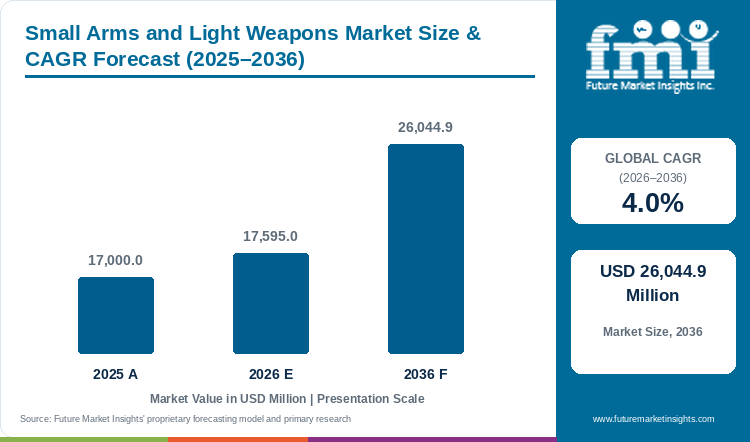
FMI expects the global small arms and light weapons market to reach USD 26,044.9 million by 2036, growing at 4.0% a year from 2026 to 2036. The market was valued at USD 17,000.0 million in 2025. FMI estimates USD 17,595.0 million for 2026.
Small Arms and Light Weapons Market Size and Forecast
Table 1: Small Arms and Light Weapons Market Size and Forecast
| Market size and forecast | Value |
|---|---|
| Market size in 2025 | USD 17,000.0 million |
| Estimated market size in 2026 | USD 17,595.0 million |
| Projected market size by 2036 | USD 26,044.9 million |
| CAGR from 2026 to 2036 | 4.0% |
Source: Future Market Insights analysis of the small arms and light weapons market, 2026.
Military replacement orders and commercial firearms consolidation are creating different revenue paths. In May 2025, Heckler & Koch received Germany's official first delivery order for the G95A1 and KA1 programme after a procurement process begun in 2017. That sequence shows how institutional demand converts through long qualification and contracting periods. Consumer-facing manufacturers must separately maintain competitive product ranges and dealer availability. Smith & Wesson completed its acquisition of Savage Arms on 21 October 2026, adding a hunting-rifle and shotgun business to its portfolio.
The forecast therefore separates the size of the civilian business from the faster expansion of military revenue. Military share rises from 30.0% in 2026 to 33.8% in 2036. Licensing, product eligibility and export authorisation determine which orders a manufacturer can serve. Revenue growth also exceeds unit growth, making the mix of contract products commercially significant. The report covers new weapons. The adjacent ammunition market, used-firearm resale and separately priced maintenance services are excluded.
Key Market Trends & Insights
- Domestic production partnerships influence access to public contracts. FN Herstal and Kalyani Strategic Systems signed a September 2026 memorandum to evaluate Indian manufacturing and a potential joint venture.
- Acquiring industrial capacity does not always preserve an acquired brand. Ruger bought Anderson Manufacturing assets in July 2025 and announced that the Anderson brand and its firearm products would be discontinued. Capacity integration can therefore expand an incumbent's production options while reducing the number of independent labels.
- Long support arrangements can favour an established manufacturer during a replacement decision. FN UK's September 2025 British contract covers upgrades and through-life support over ten years. Its service value is outside this report's new-weapon total, but the agreement illustrates the importance of continuity after initial delivery.
Regional Highlights
- India, China and Saudi Arabia are gaining share of global revenue. FMI projects India at 6.8% against 5.0% in 2026, China at 6.7% against 6.0% in 2026 and Saudi Arabia at 2.5% against 2.0% in 2026 by 2036.
- Revenue rises in the United States, Russia and Canada while each loses global share. FMI projects the United States at 44.5% against 48.0% in 2026, Russia at 3.7% against 4.0% in 2026 and Canada at 2.8% against 3.0% in 2026 by 2036.
Analyst Perspective
“Military procurement will contribute a larger proportion of revenue by 2036, while the civilian channel remains the main source of sales. Manufacturers serving both must manage separate demand signals. Institutional tenders reward delivery assurance and documented compliance. Commercial distribution requires a saleable product mix and disciplined inventory commitments. A stronger military order position does not automatically resolve weak retail sell-through.”
- Rahul Pandita, Principal Consultant, FMI
How is the Small Arms and Light Weapons Market segmented?
- By product: Pistols and revolvers, Rifles and carbines, Shotguns, Machine guns and submachine guns, and Light weapons.
- By end user: Civilian, Military, and Law enforcement.
- By operating action: Semi-Automatic, Manual-Action, and Selective-Fire and Automatic.
- By region: North America, Latin America, Western Europe, Eastern Europe, East Asia, South Asia, Middle East, and the Rest of world aggregate.
Why does the Rifles and carbines segment lead by Product in the Small Arms and Light Weapons Market in 2026?
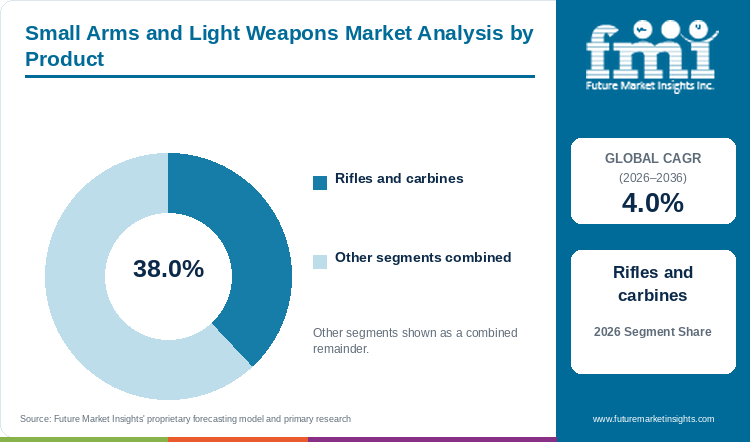
The Rifles and carbines segment holds 38.0% of the Small Arms and Light Weapons Market by product in 2026.
Rifles and carbines combine institutional replacement demand with hunting and sporting purchases. Their leading share therefore has a broader commercial base than a military-only category. The projected share reaches 39.7% in 2036 as revenue grows at 4.5% annually over the forecast period.
The 2026 share equals USD 6,686.1 million of the USD 17,595.0 million market. At the projected 2036 share of 39.7%, rifles and carbines reach USD 10,339.8 million. That is 1.5 times the 2026 value.
The supplier implication is a need to distinguish confirmed institutional production from commercial inventory. Tender exposure can provide scheduled work, whereas consumer products depend on dealer reordering. A producer with both channels must reserve capacity against actual commitments and avoid treating an uncalled framework as guaranteed annual output.
Pistols and revolvers, Shotguns, Machine guns and submachine guns and Light weapons together hold the remaining 62.0% by product.
Table 2: Product, 2026 Share
| Leading Share | 2026 market share |
|---|---|
| Rifles and carbines | 38.0% |
| All Other Segments Combined Share | 62.0% |
Source: Future Market Insights analysis of the small arms and light weapons market, 2026.
Why does the Civilian segment lead by End User in the Small Arms and Light Weapons Market in 2026?
The Civilian segment holds 58.0% of the Small Arms and Light Weapons Market by end user in 2026.
Civilian sales span several product groups and a wider set of purchase occasions than a single national equipment programme. Hunting and sporting rifles, shotguns and handguns create a sizeable commercial base where permitted by local law. Beretta Holding's brand portfolio includes Beretta, Benelli, Sako, Tikka and Stoeger, illustrating the breadth of the hunting and sporting offer. The wider hunting equipment and accessories market includes adjacent retail categories beyond the new firearms assessed here.
The civilian share declines to 53.9% by 2036 even though its revenue increases. Its 3.2% forecast CAGR is below military demand's 5.3%. Civilian revenue rises from USD 10,205.1 million in 2026 to USD 14,038.2 million in 2036.
National eligibility rules remain decisive. Canada's March 2025 prohibition added 179 firearm makes and models and restricted their sale and import, subject to specified exceptions. Authorised product ranges therefore differ by country. The commercial advantage lies in maintaining an authorised range for the destination and avoiding inventory commitments based solely on another market's sales experience.
Military and Law enforcement together hold the remaining 42.0% by end user.
Table 3: End User, 2026 Share
| Leading Share | 2026 market share |
|---|---|
| Civilian | 58.0% |
| All Other Segments Combined Share | 42.0% |
Source: Future Market Insights analysis of the small arms and light weapons market, 2026.
Why does the Semi-Automatic segment lead by Operating Action in the Small Arms and Light Weapons Market in 2026?
The Semi-Automatic segment holds 57.0% of the Small Arms and Light Weapons Market by operating action in 2026.
Semi-automatic action leads because civilian purchases concentrate on pistols and carbines that fire once for each trigger pull. Civilian buyers hold 58.0% by end user. Many military and police issue weapons are also semi-automatic or can fire in that mode.
Manual-action weapons, including bolt, pump, lever and break designs, serve hunting and sporting buyers whose purchases follow licensing and season cycles. Weapons capable of automatic fire are procured through state programmes. Orders follow programme releases and acceptance milestones.
FMI's 2026 assessment values Semi-Automatic at USD 10,029.2 million. A supplier's exposure to action type depends on the jurisdictions it can lawfully serve, so the same weapon family may face different commercial limits across markets. Programme buyers and civilian buyers should therefore be planned separately.
Manual-Action and Selective-Fire and Automatic together hold the remaining 43.0% by operating action.
Table 4: Operating Action, 2026 Share
| Leading Share | 2026 market share |
|---|---|
| Semi-Automatic | 57.0% |
| All Other Segments Combined Share | 43.0% |
Source: Future Market Insights analysis of the small arms and light weapons market, 2026.
What are the key drivers restraints and opportunities?
Equipment replacement supports institutional purchasing. Product restrictions and export controls limit access to individual markets. Local production agreements offer a route to participate in national procurement programmes where the necessary approvals and contracts are secured.
Driver
Multi-year replacement programmes convert an existing installed base into new-product orders after qualification and budget approval.
Restraint
Licensing, sanctions and changes in product classification can restrict a manufacturer's available customers independently of production capacity.
Opportunity
Local industrial partnerships can align an international supplier's offer with a government's domestic production objectives.
How do purchasing rules and qualification affect small arms and light weapons market demand?
The institutional opportunity is strongest where replacement demand has progressed into an actual procurement programme. France's scheduled HK416F introduction demonstrates why delivery phasing matters over several years. FMI expects military revenue to rise from USD 5,278.5 million in 2026 to USD 8,803.2 million in 2036. Law-enforcement revenue grows from USD 2,111.4 million to USD 3,199.9 million over the same period.
These buyer groups can support different supplier economics. A large national replacement order concentrates volume and creates an extended commitment. Police purchasing may involve separate agencies and a more fragmented tender calendar. The separate less lethal ammunition market also serves policing budgets, but its consumable revenue is outside this weapon valuation. A producer's opportunity follows the contracts it can lawfully pursue and deliver.
What limits reliable small arms and light weapons market supply and quality?
The most direct risk is loss of market eligibility. Canada's 2025 product prohibition demonstrates how a classification decision can remove specified items from ordinary sale. Internationally, OFAC's guidance states that new transactions by US persons with Kalashnikov Concern are prohibited. Those restrictions affect reachable revenue and counterparty selection. A lower factory price does not restore access.
Demand risk also sits in commercial inventories. Taurus's 2025 results show divergent domestic and export performance. Manufacturers with substantial export exposure face the possibility that healthy home-country sales coexist with weaker orders abroad. FMI therefore treats product mix, lawful destination access and channel inventory as separate considerations. Acquisition activity can improve an offer but also adds integration commitments at a time when end-market demand may remain uneven. Civilian firearm demand is examined further in FMI's firearms market.
Where can suppliers win additional business in the small arms and light weapons market?
Local participation offers a commercially relevant opening where the purchasing authority values domestic capability. In April 2025, India's Technology Development Board announced financial assistance for dvipa Defence's rifle development and commercialisation project, including an intended domestic manufacturing and quality-assurance unit.
International groups can address the same requirement through partnerships. FN Herstal's September 2026 memorandum with Kalyani concerns evaluation of local manufacturing and a possible alliance or joint venture. A supplier must still convert cooperation into an approved industrial arrangement and contracted deliveries. The opportunity is therefore specific: secure a defined role in an eligible programme, with clear responsibility for production and support.
Small Arms and Light Weapons Market by Country (2026 to 2036)
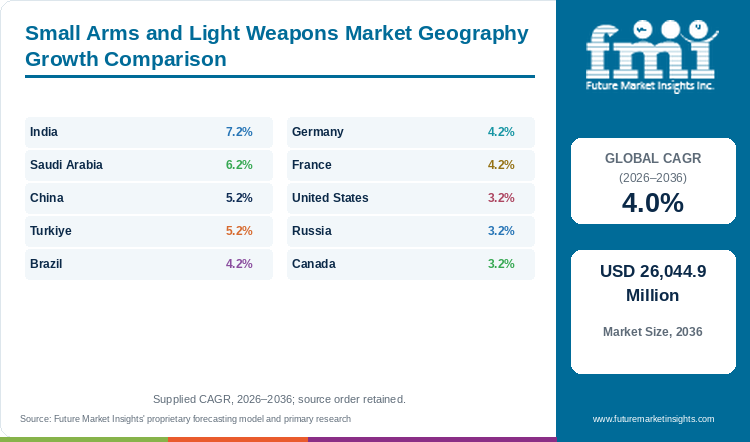
Table 5: Small Arms and Light Weapons Market Country Growth Forecast
| Country | CAGR, 2026 to 2036 |
|---|---|
| India | 7.2% |
| Saudi Arabia | 6.2% |
| China | 5.2% |
| Turkiye | 5.2% |
| Brazil | 4.2% |
| Germany | 4.2% |
| France | 4.2% |
| United States | 3.2% |
| Russia | 3.2% |
| Canada | 3.2% |
Source: Future Market Insights analysis of the small arms and light weapons market, 2026.
India
Domestic industrial participation is becoming central to India's supplier competition. The Technology Development Board's April 2025 support for dvipa Defence addresses development, testing and commercialisation of an indigenous rifle programme. In September 2026, an international manufacturer and Kalyani Strategic Systems separately agreed to evaluate local manufacturing cooperation. The two initiatives represent different routes into the same policy setting. One supports an Indian developer and the other explores an international industrial partnership.
India records the strongest forecast growth among the individually assessed countries at 7.2% CAGR from 2026 to 2036. FMI expects revenue to rise from USD 879.8 million to USD 1,767.7 million. Its share increases from 5.0% to 6.8%. The forecast covers domestic market demand and excludes factory value, technology agreements and exports.
A manufacturer's commercial prospects depend on the stage reached by its particular programme. Development support precedes any procurement award, and announced industrial ambitions precede completed deliveries.
FMI's reading is that local capability will influence the eligible supplier set and the allocation of programme responsibilities. International brands need a credible domestic proposition where required by the purchasing authority. Indian developers need to convert a technical programme into qualification and repeatable contractual supply. The market's faster growth creates room for several approaches, with actual purchasing decisions determining the eventual revenue split.
Saudi Arabia
Local industrial participation is a defining feature of Saudi Arabia's defence purchasing policy. GAMI reports military-spending localisation of 27.3% for 2025 and a goal of more than 50.0% by 2030. Those measures cover the wider military sector.
Saudi small arms and light weapons revenue is projected at USD 351.9 million in 2026 and USD 643.7 million in 2036. FMI forecasts a 6.2% CAGR over 2026 to 2036, the second-highest national rate in this comparison. The country's global share rises from 2.0% to 2.5%. The commercial opportunity is smaller in base-year value than the largest markets but grows more rapidly. Growth of USD 291.8 million leaves Saudi Arabia fifth among the ten named countries. Saudi Arabia holds tenth place by 2026 revenue.
For an international producer, the relevant issue is the industrial role attached to a proposed sale. An arrangement may involve local commercial representation, support or an approved manufacturing partnership. The actual requirements depend on the purchasing authority and programme. A defence-wide localisation ambition is context for supplier selection and does not allocate procurement.
FMI expects participation decisions to reflect the credibility and scope of a supplier's local commitment. An announced partnership with no defined operating role offers less commercial visibility than a contracted arrangement. At the same time, the cost of establishing local capacity needs a realistic order base.
China
China represents USD 1,055.7 million of small arms and light weapons revenue in 2026, with FMI projecting USD 1,756.5 million by 2036. A 5.2% CAGR over 2026 to 2036 raises its global share from 6.0% to 6.7%. Domestic institutional purchasing is central to the national opportunity. Chinese-origin exports are attributed to their destination markets and excluded from China's domestic revenue. Over the decade, revenue in China grows 1.7 times and the global total 1.5 times.
The country's arms-control policy places significant emphasis on state authorisation. The government's November 2025 white paper states that arms trade cooperation is conducted with sovereign states and requires end-user and end-use documentation. It also requires China's prior consent for any onward transfer. These conditions make the identity and responsibilities of the authorised purchaser commercially important throughout an export relationship.
FMI sees domestic supply relationships and procurement eligibility as stronger determinants of the national opportunity than an assumed expansion of open retail participation. Institutional orders tend to be concentrated in defined programmes. A manufacturer serving that business must align production commitments with the actual purchasing authority's requirements. The resulting commercial position differs from a distributor assembling a broad consumer assortment across independent retail accounts.
The growth outlook consequently rests on institutional demand within a controlled market structure. Suppliers' export relationships create a separate stream with their own country allocations and authorisations.
Turkiye
Export-oriented manufacturing is an important feature of Turkiye's supply base, alongside domestic demand. Tisas describes an extensive international sales business and identifies exports as a major part of its production activity. This gives the company exposure to several destination markets, each with its own distribution arrangements and purchasing conditions. Its production business therefore extends beyond Turkish customers.
FMI projects revenue attributed to Turkiye to rise from USD 527.9 million in 2026 to USD 878.2 million in 2036. The forecast CAGR stands at 5.2% over 2026 to 2036. Global revenue share moves from 3.0% to 3.4%. The country is therefore expanding faster than the overall market within this outlook.
The commercial interpretation involves two distinct decisions for manufacturers. Domestic institutional and civilian buyers create orders within the national market. Overseas distributor relationships create export exposure and depend on each destination's eligibility rules. A plant serving both needs to match production commitments to those different channels.
Specialist manufacturers such as Tisas compete alongside the largest multinational groups through established export relationships. International sales require a commercially supportable product range and reliable local representation. For domestic demand, the relevant question is how authorised customer orders convert into delivery. Overseas distribution can sustain a manufacturer's wider business while Turkish accounts follow their own purchasing schedule, creating different commitments for capacity and working capital.
Brazil
Brazil's firearms administration changed in July 2025 when the Federal Police began assuming responsibility for the registration and oversight of collectors, sport shooters and hunters. Its June 2025 notice describes a phased transfer of functions from Army Command, including purchase authorisations and retail oversight. The change affects transaction processing and channel administration.
The market reaches USD 527.9 million in 2026 and is forecast at USD 798.1 million in 2036. FMI projects a 4.2% CAGR between 2026 and 2036. Brazil holds 3.0% of global revenue in the base year. Its domestic opportunity should be distinguished from the export activity of Brazilian manufacturers. Brazil records a USD 270.2 million increase, joint sixth of the ten. The gain of USD 270.2 million equals 3.2% of the global increase of USD 8,449.9 million.
Taurus's March 2026 results provide a useful example of that distinction. In 2025, domestic revenue rose while export revenue contracted. Foreign-exchange exposure and destination-market conditions can produce a different outcome from the home-country sales cycle.
For domestic dealers and manufacturers, the commercial priority is maintaining a product offer that can move through the applicable registration and purchase process. Administrative changes may affect the timing of orders and working capital even where the underlying buyer requirement is unchanged. FMI expects growth to come through lawful civilian distribution and institutional purchasing, with completed transactions giving the clearest signal.
Germany
Germany provides a clear example of institutional procurement that has progressed from a long selection process into serial delivery. The first G95A1 and KA1 delivery order was announced in May 2025. Its release says the Europe-wide tender began in 2017 and the procurement process was legally concluded in 2023. The timing illustrates why an announced requirement and a revenue-producing delivery order belong to different stages of the commercial cycle.
FMI forecasts German revenue of USD 527.9 million in 2026 and USD 798.1 million in 2036. The market expands at 4.2% CAGR over 2026 to 2036. Its global revenue share increases slightly from 3.0% to 3.1%. The national figures describe domestic demand and exclude export sales of German manufacturers. In the small arms and light weapons market Germany adds USD 270.2 million, ranking joint sixth for increase.
An established domestic supplier benefits commercially when qualification and programme continuity support repeatable ordering. That position still depends on contract execution. Acceptance, budget releases and the mix of new supply and support influence the actual timing of recognised revenue.
Germany also has commercial sporting and hunting activity alongside the military programme. FMI regards the evidenced transition into ordered serial supply as the more concrete near-term institutional signal. Competitors need to assess the remaining eligible procurement opportunities and their own local support arrangements.
France
France's army describes a long implementation period for replacing the FAMAS with the HK416F. The official equipment page states that first deliveries began in 2017 and the programme runs through 2028. That schedule provides a concrete context for institutional demand during the opening years of this forecast.
The French small arms and light weapons market is forecast to grow at 4.2% CAGR from 2026 to 2036. FMI expects revenue to progress from USD 527.9 million to USD 798.1 million. Its global share is 3.0% in 2026 and 3.1% in 2036. The ten-year outlook includes purchasing beyond the identified rifle programme while retaining the distinction between new weapons and separately priced support.
France also illustrates the separation of domestic demand from supplier nationality. A German manufacturer can supply a French military programme, while the revenue is attributed to the French customer market. Counting the same shipment as both German and French demand would inflate the country total. This report uses the buyer location consistently.
Commercial distribution adds a different route to market. One manufacturing group lists Humbert as a French distributor of hunting and sporting firearms. Such distribution capability supports commercial reach, while institutional contracts follow separate tenders. FMI sees national growth as a combination of scheduled public purchasing and eligible commercial sales. The relative contribution changes with programme timing, so suppliers should assess the contract calendar alongside the performance of their distributor channel.
United States
Commercial distribution gives the United States a different revenue base from countries centred on state procurement. The national market accounts for USD 8,445.6 million in 2026. FMI forecasts a 3.2% CAGR from 2026 to 2036, with sales reaching USD 11,593.3 million. Its global share moderates from 48.0% to 44.5% as several smaller markets expand faster. The United States grows at 3.2% a year, 0.8 points slower than the global rate. The United States holds first place by 2026 revenue.
Manufacturers are reshaping the offer within this large commercial channel. The completed October 2026 Savage transaction adds an established long-gun business to the acquirer's portfolio. Ruger's 2025 Anderson asset purchase follows a different approach: the acquired industrial assets are being integrated without continuation of the Anderson label. The first expands a brand portfolio and the second changes the use of manufacturing resources.
FMI sees assortment and inventory discipline as the central commercial issue. A wider catalogue can increase the number of dealer accounts served, but the benefit depends on whether products are reordered at sustainable prices. Institutional opportunities sit alongside that retail cycle and should be evaluated on their own contracting schedules. Suppliers with strong consumer brands must also retain delivery and support resources when entering larger public tenders. The forecast supports continued US scale, with procurement decisions and channel performance determining which producers capture it.
Russia
Restrictions on cross-border business make Russia's demand outlook commercially distinct from the wider global market. OFAC's published guidance prohibits new transactions by US persons with Kalashnikov Concern. Its wider guidance also addresses sanctions exposure for non-US parties supporting Russia's military-industrial complex. Those statements concern sanctions authorities and carry no measure of Russian weapon consumption.
The Russian small arms and light weapons market is forecast by FMI to expand at 3.2% CAGR from 2026 to 2036. Revenue progresses from USD 703.8 million to USD 966.1 million, while global share moves from 4.0% to 3.7%. A smaller global share is consistent with positive national revenue growth when other countries expand more quickly.
For commercial analysis, domestic purchasing must be separated from the ability of an overseas business to serve that demand. A manufacturer may face a customer requirement that it cannot lawfully address. A Russian manufacturer's internationally available customer base is therefore restricted by jurisdiction. A strong domestic position gives no automatic access to overseas distributors or institutional accounts.
FMI gives particular weight to the distinction between new production, inventory transfers and repair activity. These activities have different economic meanings for manufacturers. A transfer of existing stock changes the user without necessarily creating a new-production order. Repair spending similarly supports an installed base while falling outside this new-weapon valuation. Purchasing and industrial output therefore require separate interpretation within the national outlook.
Canada
Canada's civilian restrictions and institutional orders are pulling its product mix in different directions. Public Safety Canada's March 2025 announcement prohibited a further 179 makes and models, restricting their sale and import subject to stated exceptions. Yet GLOCK announced an April 2026 contract to supply the Royal Canadian Mounted Police through cooperation with RAMPART Corp. The examples concern different buyer channels. A restriction on specified civilian products can coexist with a new public procurement award.
For a manufacturer, that separation changes how inventory and commercial resources are committed. A retail catalogue needs to fit the authorised product range. A police programme requires its own qualification process and delivery relationship. GLOCK's announcement describes a competitive evaluation before selection, giving a concrete institutional purchasing signal. The resulting account follows the agency's delivery programme, with a different ordering pattern from independent dealer replenishment.
FMI expects Canadian revenue to increase from USD 527.9 million in 2026 to USD 724.6 million in 2036. The outlook represents a 3.2% CAGR from 2026 to 2036, with global share moderating from 3.0% to 2.8%. Demand encompasses eligible commercial sales and institutional purchasing within the new-weapon boundary.
Local distribution is another part of access. One firearms group identifies Stoeger Canada as its importer and distributor across commercial, law-enforcement and military products. That organisation can serve different customer groups while maintaining the distinction between their purchasing conditions. FMI sees the Canadian opportunity in this selective combination of authorised retail assortment and specific public contracts.
Who are the notable companies in the Small Arms and Light Weapons Market?
Notable companies in the Small Arms and Light Weapons Market include Sig Sauer, Glock, Beretta Holding, FN Herstal and Smith & Wesson.
The competitive set contains several different commercial structures. Sig Sauer serves military, law-enforcement and commercial customers and describes a wider group of firearms businesses. Beretta Holding brings together multiple hunting and sporting brands alongside defence-oriented activities. FN Herstal operates within FN Browning Group, whose October 2026 acquisition of Accuracy International expands its rifle business and UK industrial presence. Smith & Wesson and Sturm Ruger have separately used acquisitions to broaden their commercial portfolios or production resources.
The relevant business boundary differs across the groups. Some sell ammunition, optics or other products excluded from this market. Colt CZ Group's reporting separates firearms and ammunition activities, giving a clearer view of those different revenue sources. Taurus combines Brazilian operations with substantial international sales. Kalashnikov Concern remains relevant to Russian supply but is subject to sanctions that restrict counterparty access.
Glock's April 2026 RCMP award illustrates a specialist handgun supplier's institutional role. Daniel Defense describes its Black Creek manufacturing operation and rifle business, while Tisas adds a Turkish export-oriented position. These participants compete through different ranges and customer relationships. The addressable account depends on the product and purchasing authority, with distribution and contract execution shaping the opportunity.
Broad commercial and institutional portfolios: Sig Sauer, Beretta Holding, FN Herstal, Smith & Wesson, Sturm Ruger, and Colt CZ Group.
National and specialist supply positions: Glock, Heckler & Koch, Taurus Armas, Kalashnikov Concern, Daniel Defense, and Tisas.
Key Developments in the Small Arms and Light Weapons Market
- On 21 October 2026, Smith & Wesson completed its acquisition of Savage Arms. The transaction adds an established long-gun business and broadens its commercial product coverage.
- On 30 October 2026, FN Browning Group completed its acquisition of Accuracy International. The acquired company continues under its own name, extending the group's rifle portfolio and UK manufacturing presence.
Key Players in the Small Arms and Light Weapons Market
- Sig Sauer
- Glock
- Beretta Holding
- FN Herstal
- Smith & Wesson
- Sturm Ruger
- Heckler & Koch
- Taurus Armas
- Colt CZ Group
- Kalashnikov Concern
- Daniel Defense
- Tisas
Small Arms and Light Weapons Market Report Scope
Table 6: Small Arms and Light Weapons Market Report Scope
| Coverage field | Report scope |
|---|---|
| Market definition | New small arms and light weapons sold to military, law-enforcement and civilian buyers. |
| Included products | Pistols, revolvers, rifles, carbines, shotguns, machine guns, submachine guns and light weapons, including grenade launchers and portable anti-tank weapons. |
| Exclusions | Ammunition, used-weapon resale, separately priced maintenance and repair, and wider platforms or unrelated defence equipment. |
| Quantitative Units | USD million |
| Volume basis | Million new weapon units. Average 2026 realisation expressed in USD per unit. |
| Market breakdown | Product and end user. |
| Individual countries | United States, China, India, Russia, Brazil, Canada, Germany, Turkiye, France and Saudi Arabia. |
| Additional geography | Rest of world residual aggregate. |
| Competitive coverage | The twelve named participants, with business scope and transaction status considered individually. |
| Operating Action coverage | Semi-Automatic, Manual-Action, Selective-Fire and Automatic. |
Source: Future Market Insights analysis of the small arms and light weapons market, 2026.
Small Arms and Light Weapons Market Research Methodology
The assessment combines FMI's numerical outlook with secondary review of procurement statements, regulations and company disclosures. Market boundaries separate new weapons from ammunition, resale and support activity. Country revenue follows the buyer market, while company analysis identifies relevant business scope and transaction status. The review checks the consistency of the forecast period, numerical units, segment complements and geographic coverage. External evidence supports the commercial interpretation without replacing the market's revenue and shipment forecasts with unrelated defence-budget or corporate totals.
Small Arms and Light Weapons Market by Segments
Small Arms and Light Weapons Market segmented by Product:
- Pistols and revolvers
- Rifles and carbines
- Shotguns
- Machine guns and submachine guns
- Light weapons
Small Arms and Light Weapons Market segmented by End User:
- Civilian
- Military
- Law enforcement
Small Arms and Light Weapons Market segmented by Operating Action:
- Semi-Automatic
- Manual-Action
- Selective-Fire and Automatic
Small Arms and Light Weapons Market by Region
- North America
- United States
- Canada
- Latin America
- Brazil
- Western Europe
- Germany
- France
- Eastern Europe
- Russia
- East Asia
- China
- South Asia
- India
- Middle East
- Turkiye
- Saudi Arabia
- Rest of world
- Residual aggregate covering all other destinations
Research Sources and Bibliography
- Beretta Holding. (Accessed 2026, November 9). Iconic brands.
- Beretta Holding. (Accessed 2026, November 9). International footprint.
- Brazil Federal Police. (2025, June 23; updated 2026, October 27). PF assumirá atribuições relacionadas a CACs a partir de 1º de julho.
- Colt CZ Group. (2026). Annual Financial Report for 2025, business and markets sections. https://www.coltczgroup.com/file/1917
- Daniel Defense. (Accessed 2026, November 9). Who We Are.
- FN Herstal. (2025, September 18). FN UK awarded 10-year contract by UK Ministry of Defence. https://fnherstal.com/en/news/fn-uk-awarded-10-year-contract-by-uk-ministry-of-defence/
- FN Herstal. (2026, September 3). Kalyani Strategic Systems partners with FN Herstal to build small arms and counter-UAS capability in India. https://fnherstal.com/en/news/kalyani-strategic-systems-partners-with-fn-herstal-to-build-small-arms-and-counter-uas-capability-in-india/
- FN Herstal. (2026, October 30). Accuracy International joins FN Browning Group. https://fnherstal.com/en/news/accuracy-international-joins-fn-browning-group/
- French Ministry of the Armed Forces. (Accessed 2026, November 9). HK 416 F. https://www.defense.gouv.fr/terre/nos-materiels/nos-equipements-terre/nos-armes/hk-416-f
- General Authority for Military Industries. (Accessed 2026, November 9). GAMI Announces Military Spending Localization Rate Reached 27.30% in 2025. https://www.gami.gov.sa/ar/node/662
- GLOCK. (2026, April 28). GLOCK Awarded Royal Canadian Mounted Police Contract. https://us.glock.com/en/press-release/news-page/royal-canadian-mounted-police-contract
- Government of India, Press Information Bureau. (2025, April 17). Technology Development Board supports dvipa Defence India in strengthening small arms manufacturing. https://www.pib.gov.in/PressReleasePage.aspx?PRID=2122388&lang=2®=3
- Heckler & Koch. (2025, May 16). New standard assault rifle for the German Armed Forces. https://www.heckler-koch.com/en/News/Pressemitteilungen%20En/2025/Bundeswehr%20commissions%20first%20delivery%20of%20the%20new%20standard%20assault%20rifle%20G95A1%20-%20KA1%20from%20Heckler%20-%20Koch
- Public Safety Canada. (2025, March 7). Government of Canada prohibits additional assault-style firearms. https://www.canada.ca/en/public-safety-canada/news/2025/03/government-of-canada-prohibits-additional-assault-style-firearms.html
- Sig Sauer. (Accessed 2026, November 9). History. https://www.sigsauer.com/history
- Smith & Wesson Brands. (2026, October 21). Smith & Wesson Acquires Savage Arms. https://ir.smith-wesson.com/news-releases/news-release-details/smith-wesson-acquires-savage-arms
- State Council Information Office of China. (2025, November 27). China's Arms Control, Disarmament, and Nonproliferation in the New Era. Ministry of Foreign Affairs. https://www.mfa.gov.cn/eng/xw/wjbxw/202511/t20251127_11761653.html
- Sturm, Ruger & Company. (2025, July 1). Sturm, Ruger & Company, Inc. Announces Asset Purchase of Anderson Manufacturing. https://www.ruger.com/news/2025-07-01.html
- Taurus Armas. (2026, March 24). Fourth Quarter and Full Year 2025 Results. https://ri.taurusarmas.com.br/Download.aspx?Arquivo=GhAyJqKtk3QaoL+yYr%2FknQ%3D%3D&linguagem=en
- Tisas. (Accessed 2026, November 9). TİSAŞ Exports High-Tech Firearms to 65 Countries. https://tisasarms.com/en/news/tisas-exports-high-tech-firearms-to-65-countries
- US Department of the Treasury, Office of Foreign Assets Control. (Accessed 2026, November 9). Frequently Asked Question 1092: Support for Russia's military-industrial complex. https://ofac.treasury.gov/faqs/1092
- US Department of the Treasury, Office of Foreign Assets Control. (Accessed 2026, November 9). Frequently Asked Question 374: Kalashnikov Concern products. https://ofac.treasury.gov/faqs/374
Table of Content
- Key Takeaways
- Market Size and CAGR
- Top Growth Driver
- Fastest Growing Segment
- Leading Region
- Key Companies
- Emerging Opportunities
- Executive Summary
- Global Market Outlook
- Demand-side Trends
- Supply-side Trends
- Technology Roadmap Analysis
- Analysis and Recommendations
- Analyst Perspective (What is happening? Why now? What should investors know?)
- Key Questions Answered
- How large is the market?
- What is the CAGR?
- What are key trends?
- Which region dominates?
- Who are the leaders?
Read More...
- Market Overview
- Market Coverage / Taxonomy
- Market Definition / Scope / Limitations
- Research Methodology
- Chapter Orientation
- Analytical Lens and Working Hypotheses
- Market Structure, Signals, and Trend Drivers
- Benchmarking and Cross-market Comparability
- Market Sizing, Forecasting, and Opportunity Mapping
- Research Design and Evidence Framework
- Desk Research Programme (Secondary Evidence)
- Expert Input and Fieldwork (Primary Evidence)
- Tooling, Models, and Reference Databases
- Data Engineering and Model Build
- Quality Assurance and Audit Trail
- Market Background
- Market Dynamics (Drivers, Restraints, Opportunity, Trends)
- Scenario Forecast (Optimistic, Likely, Conservative)
- Impact Analysis
- AI Impact
- Sustainability Impact
- Regulatory Impact
- Technology Impact
- Consumer / Buyer Analysis
- Purchase Drivers
- Adoption Barriers
- Buyer Journey
- Opportunity Map Analysis
- Product Life Cycle Analysis
- Supply Chain Analysis
- Investment Feasibility Matrix
- Value Chain Analysis
- PESTLE and Porter's Analysis
- Regulatory Landscape
- Regional Parent Market Outlook
- Production and Consumption Statistics
- Import and Export Statistics
- Global Market Analysis and Forecast, 2021 to 2036
- Historical Market Size Value (USD Million) Analysis, 2021 to 2025
- Current and Future Market Size Value (USD Million) Projections, 2026 to 2036
- Y-o-Y Growth Trend Analysis
- Absolute $ Opportunity Analysis
- Global Market Pricing Analysis, 2021 to 2036
- Global Market Analysis and Forecast, By Product, 2021 to 2036
- Introduction / Key Findings
- Historical Market Size Value (USD Million) Analysis By Product, 2021 to 2025
- Current and Future Market Size Value (USD Million) Analysis and Forecast By Product, 2026 to 2036
- Pistols and revolvers
- Rifles and carbines
- Shotguns
- Machine guns and submachine guns
- Light weapons
- Y-o-Y Growth Trend Analysis By Product, 2021 to 2025
- Absolute $ Opportunity Analysis By Product, 2026 to 2036
- Global Market Analysis and Forecast, By End User, 2021 to 2036
- Introduction / Key Findings
- Historical Market Size Value (USD Million) Analysis By End User, 2021 to 2025
- Current and Future Market Size Value (USD Million) Analysis and Forecast By End User, 2026 to 2036
- Civilian
- Military
- Law enforcement
- Y-o-Y Growth Trend Analysis By End User, 2021 to 2025
- Absolute $ Opportunity Analysis By End User, 2026 to 2036
- Global Market Analysis and Forecast, By Operating Action, 2021 to 2036
- Introduction / Key Findings
- Historical Market Size Value (USD Million) Analysis By Operating Action, 2021 to 2025
- Current and Future Market Size Value (USD Million) Analysis and Forecast By Operating Action, 2026 to 2036
- Semi-Automatic
- Manual-Action
- Selective-Fire and Automatic
- Y-o-Y Growth Trend Analysis By Operating Action, 2021 to 2025
- Absolute $ Opportunity Analysis By Operating Action, 2026 to 2036
- Global Market Analysis and Forecast, By Region, 2021 to 2036
- Introduction
- Historical Market Size Value (USD Million) Analysis By Region, 2021 to 2025
- Current Market Size Value (USD Million) Analysis and Forecast By Region, 2026 to 2036
- North America
- Latin America
- Western Europe
- Eastern Europe
- East Asia
- South Asia
- Middle East
- Market Attractiveness Analysis By Region
- North America Market Analysis and Forecast, By Country, 2021 to 2036
- Historical Market Size Value (USD Million) Trend Analysis By Market Taxonomy, 2021 to 2025
- Market Size Value (USD Million) Forecast By Market Taxonomy, 2026 to 2036
- By Country
- United States
- Canada
- By Product
- By End User
- By Operating Action
- By Country
- Market Attractiveness Analysis
- By Country
- By Product
- By End User
- By Operating Action
- Key Takeaways
- Latin America Market Analysis and Forecast, By Country
- Historical Market Size Value (USD Million) Trend Analysis By Market Taxonomy, 2021 to 2025
- Market Size Value (USD Million) Forecast By Market Taxonomy, 2026 to 2036
- By Country
- Brazil
- By Product
- By End User
- By Operating Action
- By Country
- Market Attractiveness Analysis
- By Country
- By Product
- By End User
- By Operating Action
- Key Takeaways
- Western Europe Market Analysis and Forecast, By Country
- Historical Market Size Value (USD Million) Trend Analysis By Market Taxonomy, 2021 to 2025
- Market Size Value (USD Million) Forecast By Market Taxonomy, 2026 to 2036
- By Country
- Germany
- France
- By Product
- By End User
- By Operating Action
- By Country
- Market Attractiveness Analysis
- By Country
- By Product
- By End User
- By Operating Action
- Key Takeaways
- Eastern Europe Market Analysis and Forecast, By Country
- Historical Market Size Value (USD Million) Trend Analysis By Market Taxonomy, 2021 to 2025
- Market Size Value (USD Million) Forecast By Market Taxonomy, 2026 to 2036
- By Country
- Russia
- By Product
- By End User
- By Operating Action
- By Country
- Market Attractiveness Analysis
- By Country
- By Product
- By End User
- By Operating Action
- Key Takeaways
- East Asia Market Analysis and Forecast, By Country
- Historical Market Size Value (USD Million) Trend Analysis By Market Taxonomy, 2021 to 2025
- Market Size Value (USD Million) Forecast By Market Taxonomy, 2026 to 2036
- By Country
- China
- By Product
- By End User
- By Operating Action
- By Country
- Market Attractiveness Analysis
- By Country
- By Product
- By End User
- By Operating Action
- Key Takeaways
- South Asia Market Analysis and Forecast, By Country
- Historical Market Size Value (USD Million) Trend Analysis By Market Taxonomy, 2021 to 2025
- Market Size Value (USD Million) Forecast By Market Taxonomy, 2026 to 2036
- By Country
- India
- By Product
- By End User
- By Operating Action
- By Country
- Market Attractiveness Analysis
- By Country
- By Product
- By End User
- By Operating Action
- Key Takeaways
- Middle East Market Analysis and Forecast, By Country
- Historical Market Size Value (USD Million) Trend Analysis By Market Taxonomy, 2021 to 2025
- Market Size Value (USD Million) Forecast By Market Taxonomy, 2026 to 2036
- By Country
- Turkiye
- Saudi Arabia
- Rest of world
- Residual aggregate covering all other destinations
- By Product
- By End User
- By Operating Action
- By Country
- Market Attractiveness Analysis
- By Country
- By Product
- By End User
- By Operating Action
- Key Takeaways
- Key Countries Market Analysis
- United States
- Pricing Analysis
- Market Share Analysis, 2025
- By Product
- By End User
- By Operating Action
- Canada
- Pricing Analysis
- Market Share Analysis, 2025
- By Product
- By End User
- By Operating Action
- Brazil
- Pricing Analysis
- Market Share Analysis, 2025
- By Product
- By End User
- By Operating Action
- Germany
- Pricing Analysis
- Market Share Analysis, 2025
- By Product
- By End User
- By Operating Action
- France
- Pricing Analysis
- Market Share Analysis, 2025
- By Product
- By End User
- By Operating Action
- India
- Pricing Analysis
- Market Share Analysis, 2025
- By Product
- By End User
- By Operating Action
- China
- Pricing Analysis
- Market Share Analysis, 2025
- By Product
- By End User
- By Operating Action
- Russia
- Pricing Analysis
- Market Share Analysis, 2025
- By Product
- By End User
- By Operating Action
- Saudi Arabia
- Pricing Analysis
- Market Share Analysis, 2025
- By Product
- By End User
- By Operating Action
- Turkiye
- Pricing Analysis
- Market Share Analysis, 2025
- By Product
- By End User
- By Operating Action
- United States
- Market Structure Analysis
- Competition Dashboard
- Competition Benchmarking
- Market Share Analysis of Top Players
- By Regional
- By Product
- By End User
- By Operating Action
- Emerging Startups
- Innovation Benchmarking
- Competition Analysis
- Competition Deep Dive
- Sig Sauer
- Overview
- Product Portfolio
- Profitability by Market Segments
- Sales Footprint
- Strategy Overview
- Marketing Strategy
- Product Strategy
- Channel Strategy
- Beretta Holding
- FN Herstal
- Smith & Wesson
- Sturm Ruger
- Heckler & Koch
- Taurus Armas
- Colt CZ Group
- Kalashnikov Concern
- Tisas
- Glock
- Daniel Defense
- Sig Sauer
- Case Studies
- Success Stories
- Recent Developments
- Competition Deep Dive
- Assumptions & Acronyms Used
List of Tables
- Table 1: Global Market Value (USD Million) Forecast by Region, 2021 to 2036
- Table 2: Global Market Value (USD Million) Forecast by Product, 2021 to 2036
- Table 3: Global Market Value (USD Million) Forecast by End User, 2021 to 2036
- Table 4: Global Market Value (USD Million) Forecast by Operating Action, 2021 to 2036
- Table 5: North America Market Value (USD Million) Forecast by Country, 2021 to 2036
- Table 6: North America Market Value (USD Million) Forecast by Product, 2021 to 2036
- Table 7: North America Market Value (USD Million) Forecast by End User, 2021 to 2036
- Table 8: North America Market Value (USD Million) Forecast by Operating Action, 2021 to 2036
- Table 9: Latin America Market Value (USD Million) Forecast by Country, 2021 to 2036
- Table 10: Latin America Market Value (USD Million) Forecast by Product, 2021 to 2036
- Table 11: Latin America Market Value (USD Million) Forecast by End User, 2021 to 2036
- Table 12: Latin America Market Value (USD Million) Forecast by Operating Action, 2021 to 2036
- Table 13: Western Europe Market Value (USD Million) Forecast by Country, 2021 to 2036
- Table 14: Western Europe Market Value (USD Million) Forecast by Product, 2021 to 2036
- Table 15: Western Europe Market Value (USD Million) Forecast by End User, 2021 to 2036
- Table 16: Western Europe Market Value (USD Million) Forecast by Operating Action, 2021 to 2036
- Table 17: Eastern Europe Market Value (USD Million) Forecast by Country, 2021 to 2036
- Table 18: Eastern Europe Market Value (USD Million) Forecast by Product, 2021 to 2036
- Table 19: Eastern Europe Market Value (USD Million) Forecast by End User, 2021 to 2036
- Table 20: Eastern Europe Market Value (USD Million) Forecast by Operating Action, 2021 to 2036
- Table 21: East Asia Market Value (USD Million) Forecast by Country, 2021 to 2036
- Table 22: East Asia Market Value (USD Million) Forecast by Product, 2021 to 2036
- Table 23: East Asia Market Value (USD Million) Forecast by End User, 2021 to 2036
- Table 24: East Asia Market Value (USD Million) Forecast by Operating Action, 2021 to 2036
- Table 25: South Asia Market Value (USD Million) Forecast by Country, 2021 to 2036
- Table 26: South Asia Market Value (USD Million) Forecast by Product, 2021 to 2036
- Table 27: South Asia Market Value (USD Million) Forecast by End User, 2021 to 2036
- Table 28: South Asia Market Value (USD Million) Forecast by Operating Action, 2021 to 2036
- Table 29: Middle East Market Value (USD Million) Forecast by Country, 2021 to 2036
- Table 30: Middle East Market Value (USD Million) Forecast by Product, 2021 to 2036
- Table 31: Middle East Market Value (USD Million) Forecast by End User, 2021 to 2036
- Table 32: Middle East Market Value (USD Million) Forecast by Operating Action, 2021 to 2036
List of Figures
- Figure 1: Global Market Pricing Analysis
- Figure 2: Global Market Value (USD Million) Forecast 2021-2036
- Figure 3: Global Market Value Share and BPS Analysis by Product, 2026 and 2036
- Figure 4: Global Market Y-o-Y Growth Comparison by Product, 2026-2036
- Figure 5: Global Market Attractiveness Analysis by Product
- Figure 6: Global Market Value Share and BPS Analysis by End User, 2026 and 2036
- Figure 7: Global Market Y-o-Y Growth Comparison by End User, 2026-2036
- Figure 8: Global Market Attractiveness Analysis by End User
- Figure 9: Global Market Value Share and BPS Analysis by Operating Action, 2026 and 2036
- Figure 10: Global Market Y-o-Y Growth Comparison by Operating Action, 2026-2036
- Figure 11: Global Market Attractiveness Analysis by Operating Action
- Figure 12: Global Market Value (USD Million) Share and BPS Analysis by Region, 2026 and 2036
- Figure 13: Global Market Y-o-Y Growth Comparison by Region, 2026-2036
- Figure 14: Global Market Attractiveness Analysis by Region
- Figure 15: North America Market Incremental Dollar Opportunity, 2026-2036
- Figure 16: Latin America Market Incremental Dollar Opportunity, 2026-2036
- Figure 17: Western Europe Market Incremental Dollar Opportunity, 2026-2036
- Figure 18: Eastern Europe Market Incremental Dollar Opportunity, 2026-2036
- Figure 19: East Asia Market Incremental Dollar Opportunity, 2026-2036
- Figure 20: South Asia Market Incremental Dollar Opportunity, 2026-2036
- Figure 21: Middle East Market Incremental Dollar Opportunity, 2026-2036
- Figure 22: North America Market Value Share and BPS Analysis by Country, 2026 and 2036
- Figure 23: North America Market Value Share and BPS Analysis by Product, 2026 and 2036
- Figure 24: North America Market Y-o-Y Growth Comparison by Product, 2026-2036
- Figure 25: North America Market Attractiveness Analysis by Product
- Figure 26: North America Market Value Share and BPS Analysis by End User, 2026 and 2036
- Figure 27: North America Market Y-o-Y Growth Comparison by End User, 2026-2036
- Figure 28: North America Market Attractiveness Analysis by End User
- Figure 29: North America Market Value Share and BPS Analysis by Operating Action, 2026 and 2036
- Figure 30: North America Market Y-o-Y Growth Comparison by Operating Action, 2026-2036
- Figure 31: North America Market Attractiveness Analysis by Operating Action
- Figure 32: Latin America Market Value Share and BPS Analysis by Country, 2026 and 2036
- Figure 33: Latin America Market Value Share and BPS Analysis by Product, 2026 and 2036
- Figure 34: Latin America Market Y-o-Y Growth Comparison by Product, 2026-2036
- Figure 35: Latin America Market Attractiveness Analysis by Product
- Figure 36: Latin America Market Value Share and BPS Analysis by End User, 2026 and 2036
- Figure 37: Latin America Market Y-o-Y Growth Comparison by End User, 2026-2036
- Figure 38: Latin America Market Attractiveness Analysis by End User
- Figure 39: Latin America Market Value Share and BPS Analysis by Operating Action, 2026 and 2036
- Figure 40: Latin America Market Y-o-Y Growth Comparison by Operating Action, 2026-2036
- Figure 41: Latin America Market Attractiveness Analysis by Operating Action
- Figure 42: Western Europe Market Value Share and BPS Analysis by Country, 2026 and 2036
- Figure 43: Western Europe Market Value Share and BPS Analysis by Product, 2026 and 2036
- Figure 44: Western Europe Market Y-o-Y Growth Comparison by Product, 2026-2036
- Figure 45: Western Europe Market Attractiveness Analysis by Product
- Figure 46: Western Europe Market Value Share and BPS Analysis by End User, 2026 and 2036
- Figure 47: Western Europe Market Y-o-Y Growth Comparison by End User, 2026-2036
- Figure 48: Western Europe Market Attractiveness Analysis by End User
- Figure 49: Western Europe Market Value Share and BPS Analysis by Operating Action, 2026 and 2036
- Figure 50: Western Europe Market Y-o-Y Growth Comparison by Operating Action, 2026-2036
- Figure 51: Western Europe Market Attractiveness Analysis by Operating Action
- Figure 52: Eastern Europe Market Value Share and BPS Analysis by Country, 2026 and 2036
- Figure 53: Eastern Europe Market Value Share and BPS Analysis by Product, 2026 and 2036
- Figure 54: Eastern Europe Market Y-o-Y Growth Comparison by Product, 2026-2036
- Figure 55: Eastern Europe Market Attractiveness Analysis by Product
- Figure 56: Eastern Europe Market Value Share and BPS Analysis by End User, 2026 and 2036
- Figure 57: Eastern Europe Market Y-o-Y Growth Comparison by End User, 2026-2036
- Figure 58: Eastern Europe Market Attractiveness Analysis by End User
- Figure 59: Eastern Europe Market Value Share and BPS Analysis by Operating Action, 2026 and 2036
- Figure 60: Eastern Europe Market Y-o-Y Growth Comparison by Operating Action, 2026-2036
- Figure 61: Eastern Europe Market Attractiveness Analysis by Operating Action
- Figure 62: East Asia Market Value Share and BPS Analysis by Country, 2026 and 2036
- Figure 63: East Asia Market Value Share and BPS Analysis by Product, 2026 and 2036
- Figure 64: East Asia Market Y-o-Y Growth Comparison by Product, 2026-2036
- Figure 65: East Asia Market Attractiveness Analysis by Product
- Figure 66: East Asia Market Value Share and BPS Analysis by End User, 2026 and 2036
- Figure 67: East Asia Market Y-o-Y Growth Comparison by End User, 2026-2036
- Figure 68: East Asia Market Attractiveness Analysis by End User
- Figure 69: East Asia Market Value Share and BPS Analysis by Operating Action, 2026 and 2036
- Figure 70: East Asia Market Y-o-Y Growth Comparison by Operating Action, 2026-2036
- Figure 71: East Asia Market Attractiveness Analysis by Operating Action
- Figure 72: South Asia Market Value Share and BPS Analysis by Country, 2026 and 2036
- Figure 73: South Asia Market Value Share and BPS Analysis by Product, 2026 and 2036
- Figure 74: South Asia Market Y-o-Y Growth Comparison by Product, 2026-2036
- Figure 75: South Asia Market Attractiveness Analysis by Product
- Figure 76: South Asia Market Value Share and BPS Analysis by End User, 2026 and 2036
- Figure 77: South Asia Market Y-o-Y Growth Comparison by End User, 2026-2036
- Figure 78: South Asia Market Attractiveness Analysis by End User
- Figure 79: South Asia Market Value Share and BPS Analysis by Operating Action, 2026 and 2036
- Figure 80: South Asia Market Y-o-Y Growth Comparison by Operating Action, 2026-2036
- Figure 81: South Asia Market Attractiveness Analysis by Operating Action
- Figure 82: Middle East Market Value Share and BPS Analysis by Country, 2026 and 2036
- Figure 83: Middle East Market Value Share and BPS Analysis by Product, 2026 and 2036
- Figure 84: Middle East Market Y-o-Y Growth Comparison by Product, 2026-2036
- Figure 85: Middle East Market Attractiveness Analysis by Product
- Figure 86: Middle East Market Value Share and BPS Analysis by End User, 2026 and 2036
- Figure 87: Middle East Market Y-o-Y Growth Comparison by End User, 2026-2036
- Figure 88: Middle East Market Attractiveness Analysis by End User
- Figure 89: Middle East Market Value Share and BPS Analysis by Operating Action, 2026 and 2036
- Figure 90: Middle East Market Y-o-Y Growth Comparison by Operating Action, 2026-2036
- Figure 91: Middle East Market Attractiveness Analysis by Operating Action
- Figure 92: Global Market - Tier Structure Analysis
- Figure 93: Global Market - Company Share Analysis
Frequently Asked Questions
How big is the small arms and light weapons market in 2026?
FMI estimates the market at USD 17,595.0 million in 2026, up from USD 17,000.0 million in 2025. It is forecast to reach USD 26,044.9 million by 2036 at a 4.0% CAGR.
Which product leads the small arms and light weapons market in 2026?
Rifles and carbines leads by product with 38.0% in 2026. All other segments together hold 62.0%.
Which end user and operating action lead in 2026?
Civilian holds 58.0% by end user and Semi-Automatic holds 57.0% by operating action in FMI's 2026 assessment.
Which market is forecast to grow fastest through 2036?
India has the highest forecast CAGR at 7.2% during 2026 to 2036, followed by Saudi Arabia at 6.2%.
Does the valuation include ammunition and support contracts?
The valuation covers new small arms and light weapons. Ammunition, used-weapon resale and separately priced maintenance or upgrades are excluded.
Preview the report firsthand - request a free sample
Get SampleGet the brochure for pricing and purchase details.
Get PDF
