

- Market Size (2026)
- USD 19.8 Mn
- Forecast (2036)
- USD 111.8 Mn
- CAGR (2026 to 2036)
- 18.9%
How big is Sonogenetic Neuromodulation Systems Market in 2026?
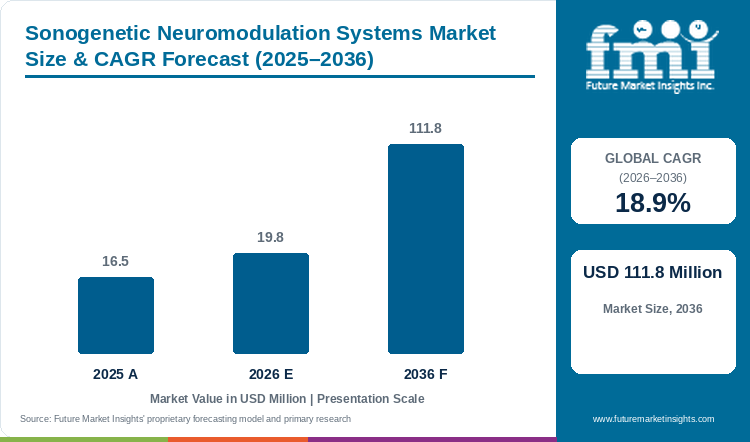
Global sonogenetic neuromodulation systems valuation moves from USD 16.5 million during 2025 to USD 19.8 million estimated in 2026, compounding at 18.9% per year to hit USD 111.8 million projected by 2036.
Translational neurobiology institutes are pairing genetically encoded mechanosensitive ion channels with focused acoustic arrays in mammalian models to stimulate deep brain and peripheral circuits without implanted wires or cranial optical fibers. On April 7, 2026, the Salk Institute for Biological Studies received a federal ARPA-H award worth up to 41.3 million dollars over 5.5 years to develop ultrasound-responsive proteins and wearable delivery hardware along with the preclinical evidence needed to move sonogenetics into clinical trials [1]. According to FMI, global sonogenetic neuromodulation systems valuation totaled USD 16.5 million during 2025 and is estimated at USD 19.8 million for 2026 across preclinical research consoles and R&D grant awards, whereas an 18.9% CAGR through 2036 is anticipated to bring industry valuation to USD 111.8 million and yield USD 92.0 million in net valuation growth. Prestin, MscL & TRPA1 Ultrasound-Gated AAV Vectors lead at a projected 62.5% construct share for 2026 across laboratories evaluating targeted neurostimulation therapy devices, whilst skull acoustic attenuation and IND-enabling toxicology still precede human clinical trials.
Key Market Trends & Insights
- By mechanosensitive ion channel construct: Prestin, MscL & TRPA1 Ultrasound-Gated AAV Vectors command a projected 62.5% construct share for 2026 owing to sub-megapascal acoustic activation thresholds and cell-specific promoter compatibility.
- By ultrasound transducer architecture: Wearable Conformable Phased-Array Transcranial Patch (0.5 - 2 MHz) arrays are estimated to secure a 58.4% share of 2026 hardware demand driven by electronic phase-aberration correction across intact temporal bone windows.
- By neurological & sensory indication: Cortical Visual Prosthesis & Blindness Restoration takes an expected 46.8% share among indications in 2026 because ophthalmic consortia test millimeter-scale primary visual cortex stimulation in primate blindness models.
- By imaging modality integration: Biplane C-Arm Fluoroscopy + 3D CBCT Roadmapping is forecast to hold 67.8% of 2026 imaging demand supported by sub-millimeter stereotactic co-registration of skull bone thickness and vascular anatomy.
- By hospital ownership model: Outright Capital Equipment Purchase + Disposables is anticipated to capture 59.4% of 2026 ownership demand enabled by translational neurosurgery grant budgets and recurring single-patient acoustic coupling hydrogels.
Regional Highlights
- East Asian and Alpine translational leadership: Japanese neuro-translation centers post a projected 19.9% annual pace to 2036 above Swiss institutes (19.6%) and German university clinics (19.4%) fueled by national brain-mapping grants and holographic ultrasound engineering.
- North American and Western European translational programs: United States research consortia register a forecast 18.6% annual clip under ARPA-H preclinical sonogenetics funding whereas French centers (18.2%) and British hubs (18.0%) advance primate visual restoration and transcranial ultrasound neuromodulation studies.
Market Size & Forecast
Table 1: Sonogenetic Neuromodulation 2025 Baseline, 2026 Estimate, and 2036 Valuation Trajectory
| Metric | Value |
|---|---|
| 2025 Market Size | USD 16.5 million |
| Estimated Market Size in 2026 | USD 19.8 million |
| Projected Market Size by 2036 | USD 111.8 million |
| CAGR, 2026 to 2036 | 18.9% |
| Added Market Value, 2026 to 2036 | USD 92.0 million |
Unlike optogenetic stimulation that requires invasive intracranial fiber-optic cannulas due to rapid tissue light scattering, low-intensity focused ultrasound penetrates 4 to 8 centimeters into deep cerebral nuclei with millimeter spatial resolution. In June 2026, a clinical translation review in Theranostics documented how acoustic radiation force triggers conformational gating across engineered MscL-G22S and Prestin(N548S, V715G) proteins at safe mechanical indices below 0.71 without thermal tissue damage [2]. As a result, translational neurosurgery teams combining programmable phased-array acoustic emitters with adeno-associated viral vector packaging can selectively excite or hyperpolarize genetically targeted basal ganglia and visual cortex circuits.
Translational Neuro-Acoustic Console and AAV Kit Sizing
Table 2: Installed Neuro-Acoustic Console Fleet, Annual Vector Kits, and Hardware Pricing
| Metric | 2025 | 2026 | 2036 |
|---|---|---|---|
| Market size (USD million) | 16.5 | 19.8 | 111.8 |
| Preclinical & translational sonogenetic consoles installed (units) | 115 to 135 | 140 to 165 | 780 to 910 |
| Annual preclinical & GLP sonogenetic vector/coupling kit assays | 1,450 to 1,720 | 1,780 to 2,100 | 11,200 to 13,400 |
| Average capital console & phased-array ASP (USD thousand) | 92.0 to 118.0 | 94.0 to 120.0 | 102.0 to 132.0 |
Operational note: Installed console counts and assay ranges reflect university neurobiology laboratories and ARPA-H or ERC translational consortia as well as IND-enabling GLP primate suites rather than routine patient-facing hospital procedures.
Multi-element 256-channel and 512-channel acoustic beamformers synchronize microsecond phase delays across wearable or epidural piezoceramic arrays to project 3D acoustic holograms onto transduced cortical columns. In addition to this, translational investigators evaluate bidirectional ultrasound read-write architectures paired with implantable brain-computer interface systems to decode functional neurovascular flow during experimental closed-loop neuromodulation.
Per Capita & Neurosurgery Center Sizing
Table 3: Population Neuro-Acoustic Intensity, Center Allocation, and Clinical Suite Ratio
| Metric | 2025 | 2026 | 2036 |
|---|---|---|---|
| World population (billion) | 8.2 | 8.3 | 9.0 |
| Market value per 1,000 people (USD) | 2.0 | 2.4 | 12.4 |
| Annual system & disposable valuation per neuro-center (USD thousand) | 118.0 to 142.0 | 124.0 to 148.0 | 158.0 to 192.0 |
| Non-human primate & IND-enabling GLP translational suite share (%) | 34.0% to 38.0% | 37.0% to 42.0% | 64.0% to 71.0% |
Table 4: Active Focused Ultrasound Center Registry and 2026 Construct-Transducer Split
| Metric | Value | Institutional Reference Basis |
|---|---|---|
| Market size, 2026 | USD 19.8 million | 2026 global sonogenetic neuromodulation baseline |
| Preclinical sonogenetic & translational FUS labs | 155 centers | Global focused ultrasound & sonogenetics registry |
| Prestin, MscL & TRPA1 vector share, 2026 | 62.5% (USD 12.4 million allocation) | 62.5% ion channel construct allocation |
| Wearable conformable patch share, 2026 | 58.4% (USD 11.6 million allocation) | 58.4% transducer architecture allocation |
Neuro-interventional suites calibrate peak negative acoustic pressure between 0.1 and 0.6 megapascals using hydrophone-verified beam maps so ultrasonic bursts open mechanosensitive channels without inducing inertial microbubble cavitation. Hospital biomedical engineering teams consequently integrate programmable transmit-receive beamformers with diagnostic and therapeutic ultrasound systems to monitor real-time tissue temperature and power Doppler perfusion.
Analyst Perspective
"Sonogenetic neuromodulation is transitioning from rodent proof-of-concept rigs into multi-institution ARPA-H and European Research Council clinical translation programs. Equipment developers that combine wearable 0.5-to-2 MHz phased-array acoustic patches with oligomerized Prestin or low-threshold MscL AAV9 kits will capture early neuro-ophthalmology and movement-disorder center budgets."
- Anurag Sharma, Principal Consultant, Future Market Insights.
How is the sonogenetic neuromodulation systems market segmented?
The sonogenetic neuromodulation systems market is segmented by mechanosensitive ion channel construct, ultrasound transducer architecture, neurological & sensory indication, imaging modality integration, hospital ownership model, and region. In 2026, Prestin, MscL & TRPA1 Ultrasound-Gated AAV Vectors are projected at 62.5%, Wearable Conformable Phased-Array Transcranial Patch (0.5 - 2 MHz) at 58.4%, Cortical Visual Prosthesis & Blindness Restoration at 46.8%, Biplane C-Arm Fluoroscopy + 3D CBCT Roadmapping at 67.8%, and Outright Capital Equipment Purchase + Disposables at 59.4%.
By mechanosensitive ion channel construct: Prestin, MscL & TRPA1 Ultrasound-Gated AAV Vectors, and Piezo1 & Two-Pore Potassium (K2P) Engineered Channels.
By ultrasound transducer architecture: Wearable Conformable Phased-Array Transcranial Patch (0.5 - 2 MHz), and Epidural / Sub-Cranial Micro-Ultrasound Matrix Array.
By neurological & sensory indication: Cortical Visual Prosthesis & Blindness Restoration, Deep-Brain Parkinson's & Refractory Epilepsy Modulation, and Non-Invasive Cardiac Pacemaking & Pain Blockade.
By imaging modality integration: Biplane C-Arm Fluoroscopy + 3D CBCT Roadmapping, and Single-Plane Angio Suite Integration.
By hospital ownership model: Outright Capital Equipment Purchase + Disposables, and Usage-Based Lease / Per-Procedure Placement.
Why do Prestin, MscL & TRPA1 Ultrasound-Gated AAV Vectors lead the mechanosensitive ion channel construct category?
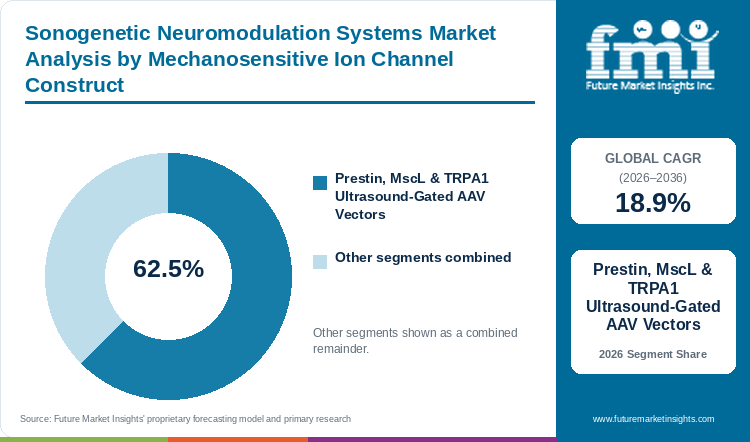
Prestin, MscL & TRPA1 Ultrasound-Gated AAV Vectors lead at a projected 62.5% construct share for 2026 via compact AAV9 packaging.
Table 5: Prestin, MscL, TRPA1, Piezo1, and K2P Channel Construct Split in 2026
| Mechanosensitive Ion Channel Construct | Share (2026) |
|---|---|
| Prestin, MscL & TRPA1 Ultrasound-Gated AAV Vectors | 62.5% |
| Piezo1 & Two-Pore Potassium (K2P) Engineered Channels | 37.5%* |
| Total | 100.0% |
*Note: Remaining construct category share totals 100.0% of the category in 2026.
Table 6: Primary Sonogenetic Viral Construct Segment and Ten-Year Compound Pace
| Metric | Value |
|---|---|
| Global CAGR (2026 to 2036) | 18.9% |
| Leading Segment | Prestin, MscL & TRPA1 Ultrasound-Gated AAV Vectors |
Bacterial large-conductance MscL-G22S mutants (~0.4 kilobases), mammalian outer-hair-cell Prestin (~2.2 kilobases), and human TRPA1 (~3.3 kilobases) fit comfortably inside the 4.7-kilobase packaging ceiling of recombinant AAV9 and AAV9.7m8 vectors with neuron-specific human synapsin or CaMKII promoters. In contrast, native Piezo1 channels span roughly 7.6 kilobases and require lipid nanoparticles or dual-vector splitting that lowers transduction efficiency. Viral vector cores supporting precision cardiovascular gene therapies also manufacture high-titer sonogenetic AAV cassettes for preclinical myocardial pacing studies.
- Prestin, MscL & TRPA1 Ultrasound-Gated AAV Vectors command a projected 62.5% construct share in 2026 because engineered MscL-I92G/I96G and hsTRPA1 channels open reliably at low acoustic pressures between 0.05 and 0.50 megapascals.
- In January 2026, researchers at National Tsing Hua University reported in Theranostics (PMC12846731) that the engineered mouse variant Prestin(N548S, V715G) enhanced membrane oligomerization and triggered strong c-Fos cortical activation under 0.5 MHz transcranial ultrasound at 0.5 MPa [3].
Why does Wearable Conformable Phased-Array Transcranial Patch (0.5 - 2 MHz) define the largest transducer architecture segment?
Wearable Conformable Phased-Array Transcranial Patch (0.5 - 2 MHz) systems register an estimated 58.4% transducer share in 2026.
Acoustic frequencies between 0.5 and 2.0 megahertz allow ultrasonic waves to traverse temporal and parietal skull plates with minimal thermal absorption while preserving focal spot diameters of 1.5 to 4.0 millimeters. Flexible conformable patches and lightweight neuronavigated headsets eliminate heavy water-bath helmets and craniotomy windows in free-moving animal models and future investigational human cohorts. Translational neurophysiology labs already operating transcranial Doppler ultrasound devices can calibrate conformable phased-array patches across temporal acoustic windows.
- Wearable Conformable Phased-Array Transcranial Patch (0.5 - 2 MHz) hardware registers an estimated 58.4% transducer-architecture share in 2026 since non-surgical acoustic patches avoid dura-mater infection risks.
- In March 2026, Sonic Concepts acquired exclusive rights to foundational ultrasound neuromodulation patents to expand its NeuroFUS PRO transcranial phased-array transducer portfolio across clinical research centers [4].
What keeps Cortical Visual Prosthesis & Blindness Restoration ahead by neurological & sensory indication?
Cortical Visual Prosthesis & Blindness Restoration takes an expected 46.8% indication share during 2026 through contactless V1 cortical projection.
Patients who lose retinal ganglion cells and optic-nerve conductivity from advanced glaucoma or ocular trauma cannot benefit from sub-retinal microchips and require direct stimulation of the primary visual cortex (V1). Intracortical silicon micro-electrode arrays in V1 suffer from glial scar encapsulation within 12 to 24 months, whereas contactless ultrasonic matrix arrays project patterned acoustic frames onto MscL-transduced V1 neurons with millisecond frame rates. Ophthalmic and neuro-prosthetic consortia developing closed-loop brain-computer interface platforms therefore direct their largest translational grants toward sonogenetic visual interfaces.
- In 2026, Cortical Visual Prosthesis & Blindness Restoration takes an expected 46.8% indication share owing to major European and U.S. translational grants targeting contactless cortical vision restoration.
- In August 2025, European Union CORDIS filings updated milestones for the EUR 7.82 million Horizon Europe ERC project NeuroSonoGene (ID 101118744) led by Inserm and Sorbonne University in partnership with the University of Milan to demonstrate patterned sonogenetic visual restoration in the non-human primate visual cortex [5].
Why does Biplane C-Arm Fluoroscopy + 3D CBCT Roadmapping lead the imaging modality integration category?
Biplane C-Arm Fluoroscopy + 3D CBCT Roadmapping records a forecast 67.8% imaging-integration share in 2026 through skull acoustic modeling.
Accurate sonogenetic neuromodulation requires both stereotactic AAV vector infusion into deep brain nuclei and precise acoustic phase correction across heterogeneous skull diploë bone. Biplane flat-panel C-arm fluoroscopy combined with 3D cone-beam computed tomography (CBCT) provides high-resolution bone density maps in Houndsfield units directly inside the hybrid neuro-interventional operating room without transferring the patient to a diagnostic MRI magnet. Acoustic simulation software converts these 3D CBCT skull voxel maps into real-time phase-delay tables that prevent focal spot distortion.
- For 2026, Biplane C-Arm Fluoroscopy + 3D CBCT Roadmapping records a forecast 67.8% imaging-integration share attributable to real-time skull phase-aberration calculation during vector and transducer alignment.
- In June 2026, the Focused Ultrasound Foundation's April 2026 Meeting Roundup highlighted 20 SBMT neurotechnology presentations covering wearable bioadhesive ultrasound transducers at UT Austin and noninvasive sonogenetic pacemakers at Harvard University [6].
What gives Outright Capital Equipment Purchase + Disposables the leading position in hospital ownership model?
Outright Capital Equipment Purchase + Disposables achieves an anticipated 59.4% ownership-model share for 2026 through grant capital budgets.
Academic medical centers and Focused Research Organizations procure sonogenetic neuromodulation consoles using dedicated federal and philanthropic capital equipment grants from ARPA-H and the European Research Council. Grant accounting rules strongly favor outright capital purchase of programmable 256-channel beamformers and optical neuronavigation cameras paired with recurring orders for sterile acoustic coupling pads and viral vector kits. Usage-based leasing remains secondary until routine outpatient reimbursement codes are established.
- Outright Capital Equipment Purchase + Disposables achieves an anticipated 59.4% ownership-model share in 2026 because university neuroengineering departments fund console acquisitions through multi-year capital research awards.
- In March 2025, the Focused Ultrasound Foundation published its Verasonics research profile noting that programmable Vantage and Vantage NXT ultrasound platforms have been cited in more than 4,600 peer-reviewed scientific publications globally [7].
What are the drivers, restraints, and opportunities in the sonogenetic neuromodulation systems market?
Within the sonogenetic neuromodulation systems market, non-surgical deep-brain circuit targeting and translational grants propel adoption whereas AAV capsid size limits restrain large-channel delivery and microbubble-assisted blood-brain barrier opening creates clinical opportunities.
- Driver: Non-invasive millimeter-precision activation of genetically sensitized subthalamic and cortical neurons eliminates intracranial lead-fracture and battery-replacement surgeries.
- Restraint: Adeno-associated viral packaging limits (~4.7 kb), neutralizing anti-AAV antibodies, and skull acoustic attenuation delay Phase II human regulatory clearance.
- Opportunity: Focused-ultrasound blood-brain barrier sonoporation paired with oligomerized Prestin and K2P inhibitory channels enables incisionless gene delivery and bidirectional circuit control.
Growth Analysis and Future Potential: Qualitative Demand Catalysts
Conventional movement-disorder and stroke rehabilitation surgeries utilizing deep-brain neurostimulation pulse generators require burr-hole craniotomies and carry hemorrhage and lead-migration risks that deter over 85% of eligible patients. While general non-genetic transcranial focused-ultrasound devices stimulate bulk brain tissue, preclinical sonogenetic neuromodulation restricts responsiveness solely to neurons genetically equipped with engineered Prestin or MscL channels. In November 2025, NaviFUS Corporation presented National Taiwan University Hospital clinical trial data at AOCCN 2025 showing that five days of non-genetic neuronavigation-guided focused ultrasound improved Fugl-Meyer upper-limb motor recovery without cerebral microbleeds [8]. Acoustic beam-steering validation from non-genetic clinical focused-ultrasound trials provides the hardware foundation for emerging sonogenetic platforms.
Risk Assessment of the Sonogenetic Neuromodulation Systems Market: Operational and Formulation Friction
Clinical translation of sonogenetics requires co-optimizing both a biologics gene-therapy vector and a Class III or De Novo active acoustic medical device under combined FDA CBER and CDRH oversight. Large mechanosensitive proteins such as Piezo1 exceed single-AAV packaging capacity, while patients with pre-existing neutralizing antibodies against AAV9 often require direct stereotactic intracerebral infusion using stereotactic neurosurgical targeting frames. A December 2025 translational review by University of Southern California investigators in Neural Regeneration Research (PMC11974640) highlighted that off-target activation of endogenous mechanosensitive ion channels and variable viral transduction remain key hurdles requiring sub-millimeter acoustic parameter calibration [9]. High GMP viral vector batch costs and long-term toxicology follow-up requirements consequently restrict early installations to tier-one academic medical centers.
Commercial Opportunity Analysis: Formulation Differentiation and Value-Add Formats
Hardware engineers are designing incisionless preclinical workflows that use microbubble-assisted low-intensity focused ultrasound to transiently open the blood-brain barrier for intravenous AAV delivery before using the same phased-array transducer for targeted neuromodulation. Biomedical engineers who combine closed-loop electroencephalography and continuous epilepsy monitoring equipment with wearable ultrasound arrays aim to enable future automated seizure suppression via inhibitory K2P or GABAergic Prestin channels. In August 2026, NaviFUS Corporation published a randomized sham-controlled Epilepsia crossover trial at Taipei Veterans General Hospital showing that non-genetic neuronavigation-guided focused ultrasound across 12 drug-resistant epilepsy patients reduced monthly seizure frequency by 14 percentage points without tissue injury [10]. Vendors offering dual-mode BBB gene-delivery and neuromodulation consoles can supply both preclinical sonogenetics labs and non-genetic focused-ultrasound trials.
Sonogenetic Neuromodulation Systems Market by Country (2026 to 2036)
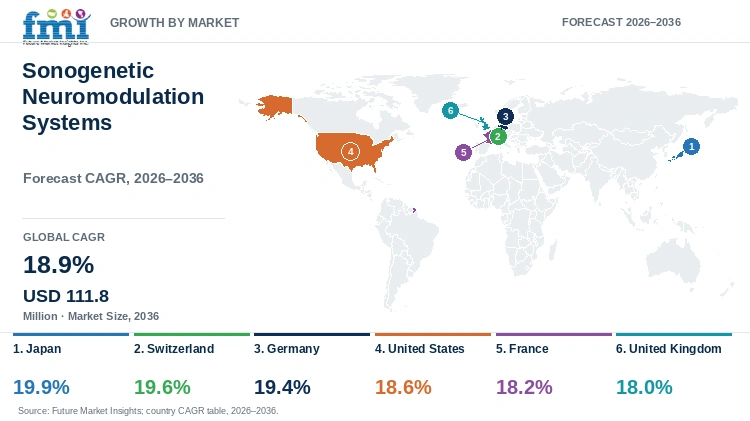
Japanese neuro-translation centers post a projected 19.9% CAGR to 2036 in sonogenetic neuromodulation systems, ahead of Swiss (19.6%) and German (19.4%) deployments.
In FMI's six-country neuro-acoustic model through 2036, Japanese translational laboratories lead growth at 19.9% per year ahead of Swiss institutes (19.6%) and German university centers (19.4%), whereas United States research consortia expand at 18.6% annually ahead of French (18.2%) and British (18.0%) hubs. Expedited regenerative-medicine regulatory frameworks in Japan as well as Swiss holographic array engineering and German connectomic research networks support preclinical and IND-enabling equipment demand. Meanwhile, federal ARPA-H and European Research Council grants fund North American and Western European preclinical validation.
Table 7: Six-Country Neuro-Acoustic Growth Rates and Translational Program Catalysts
| Country | CAGR (2026 to 2036) | Primary Growth Lever |
|---|---|---|
| Japan | 19.9% | PMDA Sakigake regenerative-medicine gene therapy pathway and non-aqueous PU+TEGDME sonogenetic coupling pads |
| Switzerland | 19.6% | ETH Zurich and University of Zurich 512-element transcranial holographic ultrasound array engineering |
| Germany | 19.4% | Charité Berlin and BMBF translational connectomic and low-intensity transcranial ultrasound clinical networks |
| United States | 18.6% | USD 41.3M ARPA-H Salk sonogenetics program, Forest Neurotech FRO, and FDA Breakthrough Device pathways |
| France | 18.2% | EUR 7.82M Horizon Europe ERC NeuroSonoGene primate cortical visual restoration consortium in Paris |
| United Kingdom | 18.0% | UKRI Neuromod+ network and University of Plymouth BRIC/CENTUS dorsal anterior cingulate pain modulation trials |
Source: Future Market Insights analysis
Japan Sonogenetic Neuromodulation Systems Market Outlook (2026 to 2036)
Japan combines PMDA regenerative-medicine regulatory consultation pathways for AAV gene therapies with domestic piezoelectric transducer and acoustic coupling materials engineering. In July 2026, investigators from Kurume University School of Medicine and Japan Probe Co., Ltd. published a preclinical study in the Journal of Neuroscience Methods (PMID 41796708) validating a bubble-resistant non-aqueous coupling pad composed of 45% polyurethane and 55% tetraethylene glycol dimethyl ether for MscL-M22S sonogenetic cortical stimulation in rodents [11]. Across the 2026 to 2036 timeframe, Japanese research and translational procurement of sonogenetic neuromodulation systems climbs at a projected 19.9% per year as Tokyo and Osaka laboratories pair transcranial arrays with solid-gel coupling interfaces for motor and sensory studies.
Key takeaway: In Japan, PMDA translational gene-therapy pathways and solid non-aqueous acoustic coupling interfaces underpin a projected 19.9% yearly expansion to 2036.
Switzerland Sonogenetic Neuromodulation Systems Market Outlook (2026 to 2036)
Switzerland serves as Europe's premier micro-engineering hub for multi-focal holographic ultrasound arrays and functional optoacoustic neuroimaging. In October 2025, researchers at ETH Zurich and the University of Zurich demonstrated a 512-transducer transcranial holographic ultrasound hood published in Nature Biomedical Engineering that simultaneously activates three to five distinct brain network nodes at reduced acoustic intensity [12]. Across the decade to 2036, Swiss academic and hospital adoption of sonogenetic neuromodulation systems advances 19.6% yearly as translational neurotechnology spin-offs in Zurich and Lausanne integrate 512-channel holographic beamformers with mechanosensitive ion-channel vectors for refractory epilepsy and Parkinson's network modulation. Simultaneous optoacoustic imaging further verifies circuit engagement during acoustic stimulation.
Key takeaway: In Switzerland, ETH Zurich's 512-channel holographic ultrasound array engineering is forecast to drive 19.6% annual growth across multi-site sonogenetic research systems.
Germany Sonogenetic Neuromodulation Systems Market Outlook (2026 to 2036)
University movement-disorder and clinical neurophysiology departments in Berlin and Munich anchor continental European research into non-invasive deep-brain ultrasound protocols. During April 2026, neurology investigators at Charité-Universitätsmedizin Berlin co-authored the International Federation of Clinical Neurophysiology handbook chapter in Clinical Neurophysiology Practice (PMC13094473) establishing low-intensity transcranial focused ultrasound as a primary non-invasive analogue to connectomic deep-brain stimulation [13]. Throughout the 2026 to 2036 forecast window, German university deployments of sonogenetic neuromodulation systems are projected to rise 19.4% annually as translational neurosurgery laboratories combine 3D CBCT skull-aberration roadmapping with preclinical Prestin and MscL viral vector assays. Federal BMBF neurotechnology research clusters also fund multi-site research console and vector kit placements.
Key takeaway: In Germany, Charité Berlin connectomic neuromodulation protocols and hybrid neuro-interventional suite upgrades underpin an anticipated 19.4% annual gain.
United States Sonogenetic Neuromodulation Systems Market Outlook (2026 to 2036)
The United States commands the largest capital base for sonogenetic neuromodulation systems through federal ARPA-H awards and Focused Research Organizations. In May 2026, the Focused Ultrasound Foundation detailed ARPA-H's dual federal neuro-acoustic awards combining the 41.3-million-dollar Salk Institute preclinical sonogenetics consortium (developing protein tools and wearable delivery hardware to reach clinical trials) with the 139.4-million-dollar EVIDENT non-genetic behavioral-health ultrasound program [14]. From 2026 to 2036, United States research center procurement of sonogenetic neuromodulation systems is projected to increase 18.6% per annum as consortium labs at Salk Institute and MIT along with Duke University and UC San Diego generate IND-enabling preclinical evidence for future FDA investigational trials.
Key takeaway: In the United States, the USD 41.3 million ARPA-H Salk translation consortium and CMUT ultrasound-on-chip arrays are expected to anchor 18.6% annual market expansion.
France Sonogenetic Neuromodulation Systems Market Outlook (2026 to 2036)
France leads European translational research into sonogenetic cortical visual restoration and functional ultrasound brain-machine interfaces through the Institut de la Vision and Inserm in Paris. From July 22 to 24, 2026, Paris hosted the International Transcranial Ultrasonic Stimulation Safety and Standards Consortium Focused Ultrasound Neuromodulation Symposium (FUN 2026) co-organized with the Focused Ultrasound Foundation to align acoustic dosing and cortical targeting standards [15]. Throughout the 2026 to 2036 timeframe, French institutional procurement of sonogenetic neuromodulation systems is forecast to expand 18.2% per year as Parisian and Lyon laboratories test epidural and transcranial matrix arrays in non-human primate visual restoration cohorts under the Horizon Europe NeuroSonoGene grant.
Key takeaway: In France, Institut de la Vision and Inserm cortical visual prosthesis trials under the NeuroSonoGene grant are slated to drive 18.2% annual valuation growth.
United Kingdom Sonogenetic Neuromodulation Systems Market Outlook (2026 to 2036)
Dedicated national neurotechnology networks and non-invasive transcranial ultrasound studies support neuro-acoustic equipment demand across the United Kingdom. In May 2026, investigators at the University of Plymouth Brain Research and Imaging Centre and the University of Exeter published a human study in Nature Communications funded by the UKRI Neuromod+ network showing that non-genetic multi-focal transcranial ultrasound stimulation of the dorsal anterior cingulate cortex reduced pain perception 28 to 55 minutes post-application [16]. Through the 2036 forecast horizon, British university procurement of sonogenetic and neuro-acoustic systems is projected to advance 18.0% per annum across Plymouth and Oxford along with London laboratories adapting transcranial arrays for preclinical sonogenetic channel gating.
Key takeaway: In the United Kingdom, Neuromod+ clinical translation hubs and dorsal anterior cingulate pain modulation trials are predicted to sustain 18.0% yearly growth.
Full report country CAGRs cover: North America; Latin America; Western Europe; Eastern Europe; East Asia; South Asia and Pacific; Middle East and Africa.
Who are the notable companies in the sonogenetic neuromodulation systems market?
Forest Neurotech (Arbor Neuroscience), Butterfly Network, Inc., Cordance Medical, Sonic Concepts, Inc., Insightec Ltd., NaviFUS Corporation, Salk Institute / SoftSonics Sonogenetics Licensing Ventures, and Verasonics, Inc. are the notable companies in the sonogenetic neuromodulation systems market.
FMI analysis indicates that the competitive ecosystem in sonogenetic neuromodulation systems bridges preclinical molecular ion-channel licensing ventures with programmable research ultrasound and general focused-ultrasound hardware manufacturers. Salk Institute and its ARPA-H translational startup SonoNeu (with SoftSonics Ventures) control foundational intellectual property covering Prestin and MscL as well as TRPA1 sonogenetic actuators now in preclinical mammalian validation. Forest Neurotech (Arbor Neuroscience) and Butterfly Network develop semiconductor capacitive micromachined ultrasonic transducer (CMUT) neural arrays, whereas Sonic Concepts and Verasonics supply NeuroFUS transducers and programmable Vantage NXT beamformers to university sonogenetics laboratories. Separately, clinical non-genetic focused-ultrasound manufacturers Insightec (Exablate Neuro thermal ablation) and NaviFUS along with Cordance Medical provide neuronavigated transcranial helmets and blood-brain barrier opening platforms that serve as acoustic delivery predicates.
- Ultrasound-On-Chip & Programmable Research Beamforming Platforms: Forest Neurotech (Arbor Neuroscience) and Butterfly Network as well as Verasonics and Sonic Concepts supply CMUT neural arrays and programmable research beamformers for preclinical sonogenetics.
- General Clinical Focused-Ultrasound & BBB Delivery Predicate Systems: Insightec and NaviFUS along with Cordance Medical manufacture non-genetic clinical transcranial helmets and blood-brain barrier opening platforms adaptable for viral vector delivery.
- Sonogenetic Ion-Channel & AAV Vector Translational Ventures: Salk Institute / SoftSonics Sonogenetics Licensing Ventures (including ARPA-H translational startup SonoNeu) develop ultrasound-gated Prestin and MscL gene-therapy cassettes.
Competitive Benchmarking: Sonogenetic Neuromodulation Systems Market
Table 8: Sonogenetic Hardware and Ion-Channel Developer Capability Matrix
| Company | Phased-Array & Beamforming Tech | Sonogenetic Vector / BBB Compatibility | Clinical & Translational Access | Geographic Reach |
|---|---|---|---|---|
| Forest Neurotech (Arbor Neuroscience) | High | High | High | Medium |
| Butterfly Network, Inc. | High | Medium | High | High |
| Cordance Medical | High | High | High | Medium |
| Sonic Concepts, Inc. | High | High | High | High |
| Insightec Ltd. | High | High | High | High |
| NaviFUS Corporation | High | High | High | Medium |
| Salk Institute / SoftSonics Ventures | Medium | High | High | Medium |
| Verasonics, Inc. | High | High | High | High |
Technical assessment note: Capability tiers evaluate 0.5-to-2.0 MHz multi-element phased-array beam steering and compatibility with AAV-delivered mechanosensitive ion channels or microbubble blood-brain barrier opening across neurosurgery research centers.
Key Developments in the Sonogenetic Neuromodulation Systems Market
- Butterfly Network and Focused Research Organization Forest Neurotech (now operating as Arbor Neuroscience) advanced their 5-year, 20-million-dollar co-development agreement utilizing semiconductor Ultrasound-on-Chip MEMS arrays for whole-brain neural interfaces [17].
- Insightec Ltd. secured U.S. FDA approval in July 2025 for staged bilateral pallidothalamic tractotomy on its Exablate Neuro focused-ultrasound helmet platform across 197 global treatment centers including 84 in the United States [18].
- Verasonics, Inc. updated its Extended Transmit and 1,000-Watt HIFU configuration for the Vantage NXT 256 and 128 Research Ultrasound Systems in August 2026 to support 250 kHz to 8.0 MHz long-duration neuromodulation and BBB opening bursts [19].
Key Players in the Sonogenetic Neuromodulation Systems Market
Ultrasound-On-Chip & Programmable Beamforming Hardware Platforms
- Forest Neurotech (Arbor Neuroscience)
- Butterfly Network, Inc.
- Sonic Concepts, Inc.
- Verasonics, Inc.
General Clinical Focused-Ultrasound & BBB Delivery Predicate Systems
- Insightec Ltd.
- NaviFUS Corporation
- Cordance Medical
Sonogenetic Ion-Channel & AAV Vector Translational Ventures
- Salk Institute / SoftSonics Sonogenetics Licensing Ventures
Sonogenetic Neuromodulation Systems Market - Report Scope
Table 9: Sonogenetic Neuromodulation Taxonomy Boundaries and Clinical Coverage
| Coverage field | Report scope |
|---|---|
| Market breakdown | Mechanosensitive Ion Channel Construct; Ultrasound Transducer Architecture; Neurological & Sensory Indication; Imaging Modality Integration; Hospital Ownership Model; Region |
| Quantitative Units | USD Million |
| Market Definition | Includes preclinical and translational research ultrasound beamformers, wearable/epidural phased-array transducers, R&D grant hardware deployments (ARPA-H, ERC NeuroSonoGene), and paired sonogenetic AAV/coupling kits (Prestin, MscL, TRPA1, Piezo1, and K2P constructs). Category Scope Note: Clearly separates preclinical sonogenetic gene-plus-ultrasound platforms from general non-genetic clinical focused-ultrasound devices (such as Insightec Exablate Neuro thermal ablation helmets and NaviFUS non-genetic TUS consoles, which are profiled only for transcranial beamforming and BBB vector-delivery hardware); excludes wired electrical DBS implants and routine diagnostic obstetric ultrasound scanners. |
| Regions Covered | North America; Latin America; Western Europe; Eastern Europe; East Asia; South Asia and Pacific; Middle East and Africa |
| Countries Covered | Japan, Switzerland, Germany, United States, France, United Kingdom, and additional countries in the full report |
| Key Companies Covered | Forest Neurotech (Arbor Neuroscience), Butterfly Network, Inc., Cordance Medical, Sonic Concepts, Inc., Insightec Ltd., NaviFUS Corporation, Salk Institute / SoftSonics Sonogenetics Licensing Ventures, Verasonics, Inc. |
| Forecast Period | 2026 to 2036 |
| Approach | Primary and secondary research with top-down and bottom-up market triangulation. |
Sonogenetic Neuromodulation Systems Market - Research Methodology
Table 10: Neurosurgery Investigator Interviews, Grant Audits, and Sizing Validation
| Method | Approach |
|---|---|
| Primary Research | Structured interviews with functional neurosurgeons, sonogenetics principal investigators, ultrasonic phased-array acoustic engineers, and viral vector core directors across the United States, France, Switzerland, Germany, the UK, and Japan. |
| Secondary Research | Analysis of ARPA-H Award D26AC50003-00 and Horizon Europe ERC Grant 101118744 disclosures, Focused Ultrasound Foundation registries, PubMed Central and Theranostics sonogenetics studies, and corporate releases from Verasonics, Sonic Concepts, NaviFUS, Insightec, Cordance Medical, and Forest Neurotech. |
| Market Sizing and Forecasting | Top-down preclinical neuro-acoustic grant and research equipment budgets (ARPA-H Award D26AC50003-00, ERC Grant 101118744) reconciled against bottom-up programmable research ultrasound console placements and preclinical AAV/coupling kit assays from 2026 to 2036, separated from general non-genetic clinical FUS ablation revenue. |
| Country Forecasting Model | Econometric country projections weight government neurotechnology grant disbursements, active clinical and primate translational trials, and regulatory breakthrough pathways across six national healthcare systems. |
| Operational Benchmark Traceability | Console installation and neurosurgery center valuation indicators in Tables 2, 3, and 4 trace to Focused Ultrasound Foundation site registries, ARPA-H and CORDIS project budgets, and Verasonics/Sonic Concepts academic installation disclosures. |
| Data Triangulation and Validation | Valuation estimates are cross-checked against multi-channel research ultrasound transceiver shipments and translational neurosurgery grant allocations without double counting thermal HIFU ablation consoles or conventional electrical DBS implants. |
Sonogenetic Neuromodulation Systems Market by Segments
Sonogenetic Neuromodulation Systems Market segmented by Mechanosensitive Ion Channel Construct:
- Prestin, MscL & TRPA1 Ultrasound-Gated AAV Vectors
- Piezo1 & Two-Pore Potassium (K2P) Engineered Channels
Sonogenetic Neuromodulation Systems Market segmented by Ultrasound Transducer Architecture:
- Wearable Conformable Phased-Array Transcranial Patch (0.5 - 2 MHz)
- Epidural / Sub-Cranial Micro-Ultrasound Matrix Array
Sonogenetic Neuromodulation Systems Market segmented by Neurological & Sensory Indication:
- Cortical Visual Prosthesis & Blindness Restoration
- Deep-Brain Parkinson's & Refractory Epilepsy Modulation
- Non-Invasive Cardiac Pacemaking & Pain Blockade
Sonogenetic Neuromodulation Systems Market segmented by Imaging Modality Integration:
- Biplane C-Arm Fluoroscopy + 3D CBCT Roadmapping
- Single-Plane Angio Suite Integration
Sonogenetic Neuromodulation Systems Market segmented by Hospital Ownership Model:
- Outright Capital Equipment Purchase + Disposables
- Usage-Based Lease / Per-Procedure Placement
Sonogenetic Neuromodulation Systems Market by Region
- North America
- United States
- Canada
- Latin America
- Brazil
- Mexico
- Argentina
- Western Europe
- Germany
- France
- United Kingdom
- Switzerland
- Netherlands
- Italy
- Spain
- Eastern Europe
- Poland
- Czech Republic
- Hungary
- East Asia
- Japan
- China
- South Korea
- Taiwan
- South Asia and Pacific
- Australia
- Singapore
- India
- Middle East and Africa
- Israel
- Saudi Arabia
- UAE
Research Sources and Bibliography
- [1] Salk Institute for Biological Studies. (2026, April 07). Salk Institute to lead ARPA-H project with up to $41.3M to advance sonogenetics as a noninvasive therapeutic. Salk Institute News Releases.
- [2] Yu, X., Pu, M., Wang, R., & Ran, H. (2026, June 04). Sonogenetics for precision medicine: from molecular toolkit to clinical translation. Theranostics, 16(13), 7345-7366.
- [3] Wang, H.-C., Phan, T.-N., Chen, T.-H., Lin, Y., Hsu, N., Fan, C.-H., Chiang, P.-H., Chen, C.-H., Yeh, C.-K., & Lin, Y.-C. (2026, January 01). Enhancing prestin oligomerization for superior sonogenetics - PMC. Theranostics, 16(7), 3321-3337 (PubMed Central PMC12846731).
- [4] Sonic Concepts, Inc. (2026, March 02). Latest News - Sonic Concepts. Sonic Concepts, Inc.
- [5] European Commission CORDIS / Institut National de la Santé et de la Recherche Médicale (Inserm). (2025, August 15). A sonogenetic brain-machine interface for neurosciences and visual restoration. European Commission Horizon Europe CORDIS (Grant ID 101118744).
- [6] Focused Ultrasound Foundation. (2026, June 11). April 2026 Meeting Roundup - Focused Ultrasound Foundation. Focused Ultrasound Foundation.
- [7] Focused Ultrasound Foundation. (2025, March 11). Company Profile: Verasonics - Focused Ultrasound Foundation. Focused Ultrasound Foundation.
- [8] NaviFUS Corporation. (2025, November 26). NaviFUS Presents Promising Stroke Rehabilitation Data at AOCCN 2025. NaviFUS Clinical News.
- [9] Ji, J., Gong, C., Lu, G., Zhang, J., Liu, B., Liu, X., Lin, J., Wang, P., Thomas, B. B., Humayun, M. S., & Zhou, Q. (2025, December 01). Potential of ultrasound stimulation and sonogenetics in vision restoration: a narrative review - PMC. Neural Regeneration Research, 20(12), 3501-3516 (PubMed Central PMC11974640).
- [10] NaviFUS Corporation. (2026, August 10). NaviFUS Clinical Trial Published in Epilepsia. NaviFUS Clinical News.
- [11] Murai, Y., Tanaka, Y., Yamashita, M., Kawakami, Y., Shioda, S., Takenoya, F., Osawa, M., & Yoshida, F. (2026, July 15). Evaluation of a stable non-aqueous coupling medium for transcranial ultrasonic stimulation and sonogenetics. Journal of Neuroscience Methods, 431, 110729 (PubMed PMID 41796708).
- [12] ETH Zurich. (2025, October 03). Researchers use ultrasound holograms to influence brain networks | ETH Zurich. ETH Zurich Corporate Communications.
- [13] Neumann, W.-J., & Darmani, G. (2026, April 10). Translational prospectives for deep brain stimulation and low-intensity focused ultrasound neuromodulation: IFCN Handbook chapter - PMC. Clinical Neurophysiology Practice, 11, 294-307 (PubMed Central PMC13094473).
- [14] Focused Ultrasound Foundation. (2026, May 29). ARPA-H Supports Focused Ultrasound Projects in Sonogenetics and Behavioral Health - Focused Ultrasound Foundation. Focused Ultrasound Foundation.
- [15] Focused Ultrasound Foundation. (2026, July 22). Focused Ultrasound Neuromodulation Symposium (FUN) 2026 - Focused Ultrasound Foundation. Focused Ultrasound Foundation.
- [16] University of Plymouth. (2026, May 13). Ultrasound has potential to alter how the brain responds to pain - University of Plymouth. University of Plymouth Brain Research and Imaging Centre (BRIC).
- [17] Butterfly Network, Inc. (2026, January 15). Butterfly Network Announces Co-Development Agreement with Forest Neurotech. Butterfly Network Press Releases.
- [18] Insightec Ltd. (2025, July 08). FDA approves staged bilateral Parkinson's care | Insightec. Insightec Newsroom.
- [19] Verasonics, Inc. (2026, August 18). Extended Transmit | Transmit Software - Verasonics. Verasonics Biomedical Research.
- [20] NaviFUS Corporation. (2025, February 20). NaviFUS Corp. Leverages Taiwan's Advanced Chip Technology to Lead Non-Invasive Precision Medicine for Brain Disorders. NaviFUS Press Releases.
- [21] Focused Ultrasound Foundation. (2025, October 10). New Focused Ultrasound Neuromodulation Device for Brain Treatments Developed in UK - Focused Ultrasound Foundation. Focused Ultrasound Foundation.
This bibliography is provided for reader reference and is not exhaustive. The full report contains the complete reference list and detailed citations.
This Report Answers
- How large is the sonogenetic neuromodulation systems market in 2026 and what is forecast for 2036?
- Which federal brain-initiative grants and non-surgical neuromodulation advantages drive demand?
- Why do Prestin, MscL & TRPA1 Ultrasound-Gated AAV Vectors lead the construct category?
- Why does Wearable Conformable Phased-Array Transcranial Patch (0.5 - 2 MHz) lead the transducer category?
- How do growth rates differ across Japan, Switzerland, Germany, the United States, France, and the UK?
- Which hardware and gene-therapy ventures supply sonogenetic neuromodulation systems today?
- What viral-vector packaging and skull-attenuation hurdles restrain clinical adoption?
- What acoustic and imaging parameters should neurosurgery departments evaluate before purchasing?
Frequently Asked Questions
How big is the sonogenetic neuromodulation systems market in 2026, and what is forecast for 2036?
Global sonogenetic neuromodulation systems valuation stands at an estimated USD 19.8 million for 2026 (comprising preclinical research ultrasound consoles and AAV ion-channel kits plus ARPA-H/ERC grant hardware) after recording USD 16.5 million during 2025, and is projected to reach USD 111.8 million in 2036 as preclinical validation progresses into first-in-human trials.
What is the CAGR for the sonogenetic neuromodulation systems market from 2026 to 2036?
An 18.9% compound annual growth rate is forecast by FMI from 2026 to 2036, yielding USD 92.0 million in net annual valuation expansion across preclinical neurobiology laboratories and translational neuro-interventional centers.
Which mechanosensitive ion channel construct segment leads the market?
Prestin, MscL & TRPA1 Ultrasound-Gated AAV Vectors lead at a projected 62.5% construct share in 2026 owing to compact coding sequences that package inside single AAV9 capsids.
Which ultrasound transducer architecture segment leads the market?
Wearable Conformable Phased-Array Transcranial Patch (0.5 - 2 MHz) hardware registers an estimated 58.4% transducer-architecture share in 2026 because electronic beam steering penetrates temporal skull windows without craniotomy.
Which country has a notable growth outlook during the assessment period?
Japan is projected to record a leading 19.9% CAGR through 2036, supported by PMDA Sakigake gene-therapy consultation pathways and solid non-aqueous ultrasonic coupling hydrogels.
Who are the key players in the market?
Forest Neurotech (Arbor Neuroscience), Butterfly Network, Cordance Medical, Sonic Concepts, Insightec, NaviFUS Corporation, Salk Institute / SoftSonics Ventures, and Verasonics supply hardware and vector platforms.
Preview the report firsthand - request a free sample
Get SampleGet the brochure for pricing and purchase details.
Get PDFTable of Content
- Key Takeaways
- Market Size and CAGR
- Top Growth Driver
- Fastest Growing Segment
- Leading Region
- Key Companies
- Emerging Opportunities
- Executive Summary
- Global Market Outlook
- Demand-side Trends
- Supply-side Trends
- Technology Roadmap Analysis
- Analysis and Recommendations
- Analyst Perspective (What is happening? Why now? What should investors know?)
- Key Questions Answered
- How large is the market?
- What is the CAGR?
- What are key trends?
- Which region dominates?
- Who are the leaders?
- Market Overview
- Market Coverage / Taxonomy
- Market Definition / Scope / Limitations
- Research Methodology
- Chapter Orientation
- Analytical Lens and Working Hypotheses
- Market Structure, Signals, and Trend Drivers
- Benchmarking and Cross-market Comparability
- Market Sizing, Forecasting, and Opportunity Mapping
- Research Design and Evidence Framework
- Desk Research Programme (Secondary Evidence)
- Expert Input and Fieldwork (Primary Evidence)
- Tooling, Models, and Reference Databases
- Data Engineering and Model Build
- Quality Assurance and Audit Trail
- Market Background
- Market Dynamics (Drivers, Restraints, Opportunity, Trends)
- Scenario Forecast (Optimistic, Likely, Conservative)
- Impact Analysis
- AI Impact
- Sustainability Impact
- Regulatory Impact
- Technology Impact
- Consumer / Buyer Analysis
- Purchase Drivers
- Adoption Barriers
- Buyer Journey
- Opportunity Map Analysis
- Product Life Cycle Analysis
- Supply Chain Analysis
- Investment Feasibility Matrix
- Value Chain Analysis
- PESTLE and Porter's Analysis
- Regulatory Landscape
- Regional Parent Market Outlook
- Production and Consumption Statistics
- Import and Export Statistics
- Global Market Analysis and Forecast, 2021 to 2036
- Historical Market Size Value (USD Million) Analysis, 2021 to 2025
- Current and Future Market Size Value (USD Million) Projections, 2026 to 2036
- Y-o-Y Growth Trend Analysis
- Absolute $ Opportunity Analysis
- Global Market Pricing Analysis, 2021 to 2036
- Global Market Analysis and Forecast, By Mechanosensitive Ion Channel Construct, 2021 to 2036
- Introduction / Key Findings
- Historical Market Size Value (USD Million) Analysis By Mechanosensitive Ion Channel Construct, 2021 to 2025
- Current and Future Market Size Value (USD Million) Analysis and Forecast By Mechanosensitive Ion Channel Construct, 2026 to 2036
- Prestin, MscL & TRPA1 Ultrasound-Gated AAV Vectors
- Piezo1 & Two-Pore Potassium (K2P) Engineered Channels
- Y-o-Y Growth Trend Analysis By Mechanosensitive Ion Channel Construct, 2021 to 2025
- Absolute $ Opportunity Analysis By Mechanosensitive Ion Channel Construct, 2026 to 2036
- Global Market Analysis and Forecast, By Ultrasound Transducer Architecture, 2021 to 2036
- Introduction / Key Findings
- Historical Market Size Value (USD Million) Analysis By Ultrasound Transducer Architecture, 2021 to 2025
- Current and Future Market Size Value (USD Million) Analysis and Forecast By Ultrasound Transducer Architecture, 2026 to 2036
- Wearable Conformable Phased-Array Transcranial Patch (0.5 - 2 MHz)
- Epidural / Sub-Cranial Micro-Ultrasound Matrix Array
- Y-o-Y Growth Trend Analysis By Ultrasound Transducer Architecture, 2021 to 2025
- Absolute $ Opportunity Analysis By Ultrasound Transducer Architecture, 2026 to 2036
- Global Market Analysis and Forecast, By Neurological & Sensory Indication, 2021 to 2036
- Introduction / Key Findings
- Historical Market Size Value (USD Million) Analysis By Neurological & Sensory Indication, 2021 to 2025
- Current and Future Market Size Value (USD Million) Analysis and Forecast By Neurological & Sensory Indication, 2026 to 2036
- Cortical Visual Prosthesis & Blindness Restoration
- Deep-Brain Parkinson's & Refractory Epilepsy Modulation
- Non-Invasive Cardiac Pacemaking & Pain Blockade
- Y-o-Y Growth Trend Analysis By Neurological & Sensory Indication, 2021 to 2025
- Absolute $ Opportunity Analysis By Neurological & Sensory Indication, 2026 to 2036
- Global Market Analysis and Forecast, By Imaging Modality Integration, 2021 to 2036
- Introduction / Key Findings
- Historical Market Size Value (USD Million) Analysis By Imaging Modality Integration, 2021 to 2025
- Current and Future Market Size Value (USD Million) Analysis and Forecast By Imaging Modality Integration, 2026 to 2036
- Biplane C-Arm Fluoroscopy + 3D CBCT Roadmapping
- Single-Plane Angio Suite Integration
- Y-o-Y Growth Trend Analysis By Imaging Modality Integration, 2021 to 2025
- Absolute $ Opportunity Analysis By Imaging Modality Integration, 2026 to 2036
- Global Market Analysis and Forecast, By Hospital Ownership Model, 2021 to 2036
- Introduction / Key Findings
- Historical Market Size Value (USD Million) Analysis By Hospital Ownership Model, 2021 to 2025
- Current and Future Market Size Value (USD Million) Analysis and Forecast By Hospital Ownership Model, 2026 to 2036
- Outright Capital Equipment Purchase + Disposables
- Usage-Based Lease / Per-Procedure Placement
- Y-o-Y Growth Trend Analysis By Hospital Ownership Model, 2021 to 2025
- Absolute $ Opportunity Analysis By Hospital Ownership Model, 2026 to 2036
- Global Market Analysis and Forecast, By Region, 2021 to 2036
- Introduction
- Historical Market Size Value (USD Million) Analysis By Region, 2021 to 2025
- Current Market Size Value (USD Million) Analysis and Forecast By Region, 2026 to 2036
- North America
- Latin America
- Western Europe
- Eastern Europe
- East Asia
- South Asia and Pacific
- Middle East and Africa
- Market Attractiveness Analysis By Region
- North America Market Analysis and Forecast, By Country, 2021 to 2036
- Historical Market Size Value (USD Million) Trend Analysis By Market Taxonomy, 2021 to 2025
- Market Size Value (USD Million) Forecast By Market Taxonomy, 2026 to 2036
- By Country
- United States
- Canada
- By Mechanosensitive Ion Channel Construct
- By Ultrasound Transducer Architecture
- By Neurological & Sensory Indication
- By Imaging Modality Integration
- By Hospital Ownership Model
- By Country
- Market Attractiveness Analysis
- By Country
- By Mechanosensitive Ion Channel Construct
- By Ultrasound Transducer Architecture
- By Neurological & Sensory Indication
- By Imaging Modality Integration
- By Hospital Ownership Model
- Key Takeaways
- Latin America Market Analysis and Forecast, By Country
- Historical Market Size Value (USD Million) Trend Analysis By Market Taxonomy, 2021 to 2025
- Market Size Value (USD Million) Forecast By Market Taxonomy, 2026 to 2036
- By Country
- Brazil
- Mexico
- Argentina
- By Mechanosensitive Ion Channel Construct
- By Ultrasound Transducer Architecture
- By Neurological & Sensory Indication
- By Imaging Modality Integration
- By Hospital Ownership Model
- By Country
- Market Attractiveness Analysis
- By Country
- By Mechanosensitive Ion Channel Construct
- By Ultrasound Transducer Architecture
- By Neurological & Sensory Indication
- By Imaging Modality Integration
- By Hospital Ownership Model
- Key Takeaways
- Western Europe Market Analysis and Forecast, By Country
- Historical Market Size Value (USD Million) Trend Analysis By Market Taxonomy, 2021 to 2025
- Market Size Value (USD Million) Forecast By Market Taxonomy, 2026 to 2036
- By Country
- Germany
- France
- United Kingdom
- Switzerland
- Netherlands
- Italy
- Spain
- By Mechanosensitive Ion Channel Construct
- By Ultrasound Transducer Architecture
- By Neurological & Sensory Indication
- By Imaging Modality Integration
- By Hospital Ownership Model
- By Country
- Market Attractiveness Analysis
- By Country
- By Mechanosensitive Ion Channel Construct
- By Ultrasound Transducer Architecture
- By Neurological & Sensory Indication
- By Imaging Modality Integration
- By Hospital Ownership Model
- Key Takeaways
- Eastern Europe Market Analysis and Forecast, By Country
- Historical Market Size Value (USD Million) Trend Analysis By Market Taxonomy, 2021 to 2025
- Market Size Value (USD Million) Forecast By Market Taxonomy, 2026 to 2036
- By Country
- Poland
- Czech Republic
- Hungary
- By Mechanosensitive Ion Channel Construct
- By Ultrasound Transducer Architecture
- By Neurological & Sensory Indication
- By Imaging Modality Integration
- By Hospital Ownership Model
- By Country
- Market Attractiveness Analysis
- By Country
- By Mechanosensitive Ion Channel Construct
- By Ultrasound Transducer Architecture
- By Neurological & Sensory Indication
- By Imaging Modality Integration
- By Hospital Ownership Model
- Key Takeaways
- East Asia Market Analysis and Forecast, By Country
- Historical Market Size Value (USD Million) Trend Analysis By Market Taxonomy, 2021 to 2025
- Market Size Value (USD Million) Forecast By Market Taxonomy, 2026 to 2036
- By Country
- Japan
- China
- South Korea
- Taiwan
- By Mechanosensitive Ion Channel Construct
- By Ultrasound Transducer Architecture
- By Neurological & Sensory Indication
- By Imaging Modality Integration
- By Hospital Ownership Model
- By Country
- Market Attractiveness Analysis
- By Country
- By Mechanosensitive Ion Channel Construct
- By Ultrasound Transducer Architecture
- By Neurological & Sensory Indication
- By Imaging Modality Integration
- By Hospital Ownership Model
- Key Takeaways
- South Asia and Pacific Market Analysis and Forecast, By Country
- Historical Market Size Value (USD Million) Trend Analysis By Market Taxonomy, 2021 to 2025
- Market Size Value (USD Million) Forecast By Market Taxonomy, 2026 to 2036
- By Country
- Australia
- Singapore
- India
- By Mechanosensitive Ion Channel Construct
- By Ultrasound Transducer Architecture
- By Neurological & Sensory Indication
- By Imaging Modality Integration
- By Hospital Ownership Model
- By Country
- Market Attractiveness Analysis
- By Country
- By Mechanosensitive Ion Channel Construct
- By Ultrasound Transducer Architecture
- By Neurological & Sensory Indication
- By Imaging Modality Integration
- By Hospital Ownership Model
- Key Takeaways
- Middle East and Africa Market Analysis and Forecast, By Country
- Historical Market Size Value (USD Million) Trend Analysis By Market Taxonomy, 2021 to 2025
- Market Size Value (USD Million) Forecast By Market Taxonomy, 2026 to 2036
- By Country
- Israel
- Saudi Arabia
- UAE
- By Mechanosensitive Ion Channel Construct
- By Ultrasound Transducer Architecture
- By Neurological & Sensory Indication
- By Imaging Modality Integration
- By Hospital Ownership Model
- By Country
- Market Attractiveness Analysis
- By Country
- By Mechanosensitive Ion Channel Construct
- By Ultrasound Transducer Architecture
- By Neurological & Sensory Indication
- By Imaging Modality Integration
- By Hospital Ownership Model
- Key Takeaways
- Key Countries Market Analysis
- United States
- Pricing Analysis
- Market Share Analysis, 2025
- By Mechanosensitive Ion Channel Construct
- By Ultrasound Transducer Architecture
- By Neurological & Sensory Indication
- By Imaging Modality Integration
- By Hospital Ownership Model
- Canada
- Pricing Analysis
- Market Share Analysis, 2025
- By Mechanosensitive Ion Channel Construct
- By Ultrasound Transducer Architecture
- By Neurological & Sensory Indication
- By Imaging Modality Integration
- By Hospital Ownership Model
- Mexico
- Pricing Analysis
- Market Share Analysis, 2025
- By Mechanosensitive Ion Channel Construct
- By Ultrasound Transducer Architecture
- By Neurological & Sensory Indication
- By Imaging Modality Integration
- By Hospital Ownership Model
- Brazil
- Pricing Analysis
- Market Share Analysis, 2025
- By Mechanosensitive Ion Channel Construct
- By Ultrasound Transducer Architecture
- By Neurological & Sensory Indication
- By Imaging Modality Integration
- By Hospital Ownership Model
- Germany
- Pricing Analysis
- Market Share Analysis, 2025
- By Mechanosensitive Ion Channel Construct
- By Ultrasound Transducer Architecture
- By Neurological & Sensory Indication
- By Imaging Modality Integration
- By Hospital Ownership Model
- United Kingdom
- Pricing Analysis
- Market Share Analysis, 2025
- By Mechanosensitive Ion Channel Construct
- By Ultrasound Transducer Architecture
- By Neurological & Sensory Indication
- By Imaging Modality Integration
- By Hospital Ownership Model
- Italy
- Pricing Analysis
- Market Share Analysis, 2025
- By Mechanosensitive Ion Channel Construct
- By Ultrasound Transducer Architecture
- By Neurological & Sensory Indication
- By Imaging Modality Integration
- By Hospital Ownership Model
- Spain
- Pricing Analysis
- Market Share Analysis, 2025
- By Mechanosensitive Ion Channel Construct
- By Ultrasound Transducer Architecture
- By Neurological & Sensory Indication
- By Imaging Modality Integration
- By Hospital Ownership Model
- France
- Pricing Analysis
- Market Share Analysis, 2025
- By Mechanosensitive Ion Channel Construct
- By Ultrasound Transducer Architecture
- By Neurological & Sensory Indication
- By Imaging Modality Integration
- By Hospital Ownership Model
- India
- Pricing Analysis
- Market Share Analysis, 2025
- By Mechanosensitive Ion Channel Construct
- By Ultrasound Transducer Architecture
- By Neurological & Sensory Indication
- By Imaging Modality Integration
- By Hospital Ownership Model
- China
- Pricing Analysis
- Market Share Analysis, 2025
- By Mechanosensitive Ion Channel Construct
- By Ultrasound Transducer Architecture
- By Neurological & Sensory Indication
- By Imaging Modality Integration
- By Hospital Ownership Model
- Japan
- Pricing Analysis
- Market Share Analysis, 2025
- By Mechanosensitive Ion Channel Construct
- By Ultrasound Transducer Architecture
- By Neurological & Sensory Indication
- By Imaging Modality Integration
- By Hospital Ownership Model
- South Korea
- Pricing Analysis
- Market Share Analysis, 2025
- By Mechanosensitive Ion Channel Construct
- By Ultrasound Transducer Architecture
- By Neurological & Sensory Indication
- By Imaging Modality Integration
- By Hospital Ownership Model
- Poland
- Pricing Analysis
- Market Share Analysis, 2025
- By Mechanosensitive Ion Channel Construct
- By Ultrasound Transducer Architecture
- By Neurological & Sensory Indication
- By Imaging Modality Integration
- By Hospital Ownership Model
- Hungary
- Pricing Analysis
- Market Share Analysis, 2025
- By Mechanosensitive Ion Channel Construct
- By Ultrasound Transducer Architecture
- By Neurological & Sensory Indication
- By Imaging Modality Integration
- By Hospital Ownership Model
- Switzerland
- Pricing Analysis
- Market Share Analysis, 2025
- By Mechanosensitive Ion Channel Construct
- By Ultrasound Transducer Architecture
- By Neurological & Sensory Indication
- By Imaging Modality Integration
- By Hospital Ownership Model
- United States
- Market Structure Analysis
- Competition Dashboard
- Competition Benchmarking
- Market Share Analysis of Top Players
- By Regional
- By Mechanosensitive Ion Channel Construct
- By Ultrasound Transducer Architecture
- By Neurological & Sensory Indication
- By Imaging Modality Integration
- By Hospital Ownership Model
- Emerging Startups
- Innovation Benchmarking
- Competition Analysis
- Competition Deep Dive
- Forest Neurotech (Arbor Neuroscience)
- Overview
- Product Portfolio
- Profitability by Market Segments
- Sales Footprint
- Strategy Overview
- Marketing Strategy
- Product Strategy
- Channel Strategy
- Butterfly Network, Inc.
- Cordance Medical
- Sonic Concepts, Inc.
- Insightec Ltd.
- NaviFUS Corporation
- Salk Institute / SoftSonics Ventures
- Verasonics, Inc.
- Salk Institute / SoftSonics Sonogenetics Licensing Ventures
- Forest Neurotech (Arbor Neuroscience)
- Case Studies
- Success Stories
- Recent Developments
- Competition Deep Dive
- Assumptions & Acronyms Used


