

- Industry Size (2026)
- USD 56.6 Bn
- Forecast (2036)
- USD 106.3 Bn
- CAGR (2026 to 2036)
- 6.5%
Corrosion Protection Coatings & Acid Proof Lining Market Size, Market Forecast and Outlook By FMI
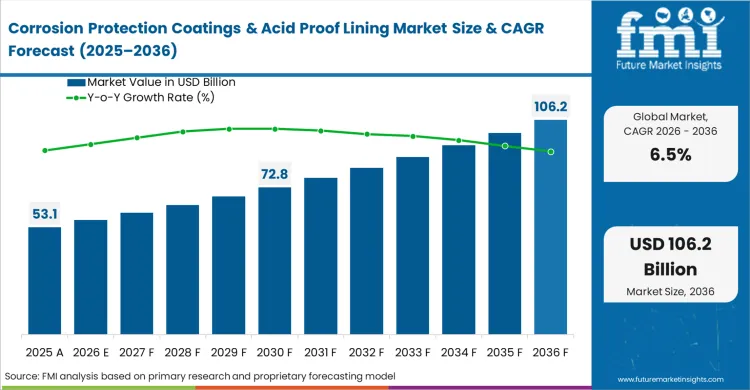
In 2025, the corrosion protection coatings and acid proof lining market was valued at USD 53.1 billion. Based on Future Market Insights' analysis, demand is estimated to reach USD 56.6 billion in 2026 and USD 99.8 billion by 2035, before rising further to approximately USD 106.3 billion by 2036. This trajectory reflects a CAGR of 6.5% during the forecast period.
Absolute dollar growth of more than USD 49.7 billion between 2026 and 2036 signals a market expanding at an accelerated pace, underpinned by aging infrastructure renewal cycles, expansion of process industries in emerging economies, and tightening environmental and safety regulations that mandate corrosion control. The value uplift reflects both volume growth from industrial capacity additions and a mix shift toward higher-performance coatings capable of withstanding extreme temperatures, pressures, and chemical exposures.
Summary of Corrosion Protection Coatings & Acid Proof Lining Market
- Demand Drivers in the Market
- Aging infrastructure in developed economies requiring rehabilitation of bridges, pipelines, water treatment plants, and storage tanks, with corrosion control extending asset life by decades at fraction of replacement cost.
- Expansion of process industries in emerging economies, including refineries, petrochemical complexes, and chemical plants that require corrosion protection and acid proof linings for process equipment, storage tanks, and secondary containment .
- Stringent safety and environmental regulations mandating corrosion control to prevent leaks, spills, and catastrophic failures that could harm personnel, communities, and ecosystems.
- Key Segments Analyzed in the FMI Report
- Resin Type: Epoxy dominates due to exceptional adhesion, chemical resistance, and mechanical properties, making it the preferred resin for demanding applications including tank linings, pipeline coatings, and industrial flooring.
- End-use Industry: Oil & Gas leads as the largest consumer, with upstream production, midstream transportation, and downstream refining all requiring extensive corrosion protection across wells, pipelines, storage tanks, and process equipment.
- Analyst Opinion at FMI
- Nikhil Kaitwade, principal consultant for Chemicals & Materials at Future Market Insights observes: "Corrosion control is ultimately an economic calculation: the cost of coating application versus the cost of asset replacement and lost production. In cyclical industries like oil and gas, maintenance spending on existing assets often proves more resilient than capital expenditure on new builds. Suppliers positioned to serve the installed base with high-performance, field-applied coatings capture value through industry downturns."
- Strategic Implications/Executive Takeaways
- Prioritize epoxy and polyurethane formulations for the oil and gas value chain, from upstream well casings to downstream tank farms, where corrosion risk is highest and coating failure consequences most severe.
- Align product portfolios with maintenance and repair applications through rapid-cure, low-temperature, and surface-tolerant formulations that facilitate field application without extensive surface preparation.
- Build technical service capabilities that help customers develop corrosion management programs, conduct condition assessments, and specify appropriate coating systems for specific service environments.
- Methodology
- The market view is grounded in primary input from corrosion engineers, industrial maintenance managers, and coatings formulators, and in technical and policy sources focused on corrosion control standards and infrastructure asset management, avoiding reliance on secondary market research reports from competing providers.
North America, Europe, and Asia-Pacific account for the bulk of incremental revenues through 2036, but the underlying demand logic is distinct in each region. In North America, rehabilitation of aging water and wastewater infrastructure, pipeline networks, and power generation assets drives coating consumption.
In Europe, stringent environmental regulations governing industrial emissions and chemical handling favor high-performance, low-VOC lining systems. Across Asia-Pacific, massive investments in refining, petrochemicals, and marine infrastructure generate the highest growth rates, with China, India, and Southeast Asia as primary demand centers.
Corrosion Protection Coatings & Acid Proof Lining Market Definition
Corrosion protection coatings are barrier materials applied to metal and concrete surfaces to prevent electrochemical degradation caused by moisture, oxygen, and electrolytes. Acid proof linings are specialized systems designed to withstand direct contact with concentrated acids, alkalis, and solvents in chemical processing environments. For this report, the market covers organic and inorganic coating and lining systems used in oil and gas production and refining, marine vessels and offshore structures, chemical processing plants, power generation facilities, water and wastewater treatment infrastructure, and general industrial applications.
Corrosion Protection Coatings & Acid Proof Lining Market Inclusions
The report provides a comprehensive analysis of the corrosion protection coatings and acid proof lining market, covering global and regional market sizes in value terms and a 10-year forecast from 2026 to 2036. It includes segmental breakdowns by resin type, technology, and end-use industry, across core regions including North America, Latin America, Western Europe, Eastern Europe, East Asia, South Asia & Pacific, and the Middle East & Africa.
Corrosion Protection Coatings & Acid Proof Lining Market Exclusions
The scope excludes temporary corrosion preventatives such as oils and greases that are not intended as long-term coatings. It also omits cathodic protection systems that prevent corrosion through electrochemical means rather than barrier coatings. Very low-volume, custom-formulated coatings for specialized restoration or research applications that do not contribute meaningfully to global revenue pools are likewise outside the quantified scope.
Corrosion Protection Coatings & Acid Proof Lining Market Research Methodology
- Primary research: Structured interviews were conducted with corrosion engineers, maintenance managers in refineries and chemical plants, marine coating specifiers, and infrastructure project managers, alongside coatings formulators and raw material suppliers on performance requirements, specification criteria, and regional procurement patterns.
- Desk research: Technical documentation and application guides from major corrosion protection coating manufacturers, together with industry standards from NACE International and SSPC, and government publications on infrastructure condition assessments, were assessed to benchmark performance and to align market modeling with the latest data on industrial capacity additions and infrastructure spending.
- Market-sizing and forecasting: A hybrid top-down and bottom-up modeling framework was applied, reconstructing coating demand from refinery throughput, chemical production volumes, marine vessel construction, power generation capacity, and water infrastructure investment, then validating outputs against publicly available data from government statistical agencies and industry associations.
- Data validation and update cycle: Model outputs undergo consistency checks across regions, resin types, technologies, and end-use industries, with iterative calibration using new corrosion control regulations, infrastructure funding bills, and emerging data on industrial project pipelines.
Segmental Analysis
Corrosion Protection Coatings & Acid Proof Lining Market Analysis by Resin Type
Based on FMI's corrosion protection coatings and acid proof lining market assessment, Epoxy resins constitute the leading segment, reflecting their dominance in demanding industrial applications. Epoxy coatings provide exceptional adhesion to metal and concrete substrates, outstanding chemical resistance, and high mechanical strength. These properties make them the preferred choice for tank linings, pipeline coatings, industrial flooring, and secondary containment where chemical exposure and mechanical stress are severe .
Polyurethane topcoats follow in significance, providing UV stability and gloss retention for exterior applications where appearance and weatherability matter. Alkyd resins maintain share in less demanding atmospheric exposure applications where cost sensitivity outweighs performance requirements. Acrylic coatings serve general industrial applications with good weatherability at moderate cost. Chlorinated rubber provides chemical resistance in specific applications, though environmental concerns have reduced usage.
Corrosion Protection Coatings & Acid Proof Lining Market Analysis by Technology
Solvent-borne coatings have historically dominated corrosion protection applications due to their ability to form dense, continuous films with excellent barrier properties. However, tightening VOC regulations are driving transition toward water-borne and high-solids formulations that achieve comparable performance with lower environmental impact . Water-borne epoxy systems now serve many industrial maintenance applications where solvent-borne versions previously prevailed.
Powder coatings provide solvent-free application with excellent film uniformity for factory-applied coatings on pipes, rebar, and industrial components. High-solids liquid coatings reduce VOC content while maintaining application properties of conventional solvent-borne systems. Each technology segment serves specific application requirements based on performance needs, regulatory constraints, and application conditions.
Corrosion Protection Coatings & Acid Proof Lining Market Analysis by End-use Industry
Oil & Gas represents the largest end-use industry segment, consuming corrosion protection coatings across the entire value chain. Upstream operations require coatings for wellheads, flow lines, and production equipment exposed to sour crude, brine, and harsh environments. Midstream pipelines require internal and external coatings for corrosion prevention and flow efficiency. Downstream refineries and petrochemical plants require high-performance coatings and acid proof linings for process vessels, storage tanks, and secondary containment .
Marine applications include new vessel construction and maintenance coatings for hulls, ballast tanks, and cargo holds, where saltwater exposure creates severe corrosion risk. Chemical Processing requires acid proof linings for reactors, storage tanks, and piping handling corrosive chemicals. Power Generation facilities require coatings for cooling water systems, flue gas desulfurization units, and structural steel. Water & Wastewater Treatment infrastructure requires coatings for clarifiers, digesters, and piping exposed to corrosive biological and chemical environments.
Corrosion Protection Coatings & Acid Proof Lining Market Drivers, Restraints, Opportunities and Trends
Drivers
Infrastructure Rehabilitation and Replacement
Much of the world's industrial and public infrastructure was built in the mid-20th century and is now reaching the end of its design life. Bridges, pipelines, water treatment plants, and storage tanks require extensive rehabilitation, with corrosion control as a primary intervention strategy. The American Society of Civil Engineers consistently grades U.S. infrastructure poorly, driving federal and state investment in repairs that include corrosion protection coatings . Similar dynamics exist across Europe and Asia.
Process Industry Expansion in Emerging Economies
Rapid industrialization in Asia, the Middle East, and Latin America creates new demand for corrosion protection in refineries, chemical plants, and manufacturing facilities. Countries including China, India, Saudi Arabia, and Brazil continue to invest in domestic processing capacity to meet growing demand for fuels, chemicals, and manufactured goods . Each new facility requires comprehensive corrosion protection for process equipment, storage, and civil structures.
Safety and Environmental Regulation
Regulatory agencies worldwide mandate corrosion control to prevent releases of hazardous materials. The U.S. Pipeline and Hazardous Materials Safety Administration requires integrity management programs including corrosion protection for hazardous liquid and gas pipelines. The EPA's Spill Prevention, Control, and Countermeasure regulations require secondary containment with appropriate coatings. Similar requirements in Europe under the Seveso III Directive and in other industrial regions drive coating consumption .
Restraints
Application Quality and Surface Preparation Requirements
Corrosion protection coating performance depends critically on proper surface preparation and application. Inadequate blasting, poor environmental conditions during application, or insufficient film thickness can lead to premature coating failure and accelerated corrosion. Skilled applicator shortages in some regions limit project execution capability and can result in performance issues that damage coating supplier reputations .
Raw Material Price Volatility
Epoxy resins, polyurethane precursors, and zinc dust (for zinc-rich primers) are subject to price fluctuations driven by crude oil markets and metal prices. This volatility challenges manufacturer pricing strategies and margin management, particularly for long-term supply agreements with fixed pricing. Supply chain disruptions can affect availability of critical raw materials.
Opportunities
High-Performance Coatings for Extreme Environments
Development of coatings capable of withstanding extreme temperatures, pressures, and chemical exposures creates opportunities in demanding applications. Refractory linings for high-temperature process equipment, coatings for deepwater offshore production, and linings for sour crude processing where hydrogen sulfide creates severe corrosion risk all require advanced formulations that command premium pricing.
Digital Corrosion Management Integration
Integration of sensors and monitoring capabilities into coating systems enables real-time assessment of coating condition and corrosion activity. Smart coatings that detect and report coating damage or substrate corrosion before visible deterioration occurs align with predictive maintenance strategies in industrial facilities. These technologies create value through reduced inspection costs and prevention of unplanned outages.
Regional Analysis
.webp "Top Country Growth Comparison Corrosion Protection Coatings & Acid Proof Lining Market Cagr (2026 2036)")
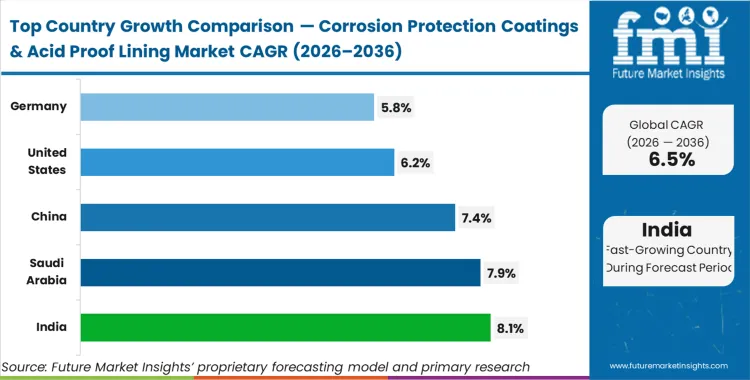
| Countries | Value CAGR (2026 to 2036) |
|---|---|
| United States | 6.2% |
| Germany | 5.8% |
| China | 7.4% |
| India | 8.1% |
| Saudi Arabia | 7.9% |
Source: Future Market Insights analysis, supported by proprietary forecasting model and primary research
United States
The United States corrosion protection coatings and acid proof lining market is projected to grow at a 6.2% CAGR from 2026 to 2036, driven by infrastructure rehabilitation needs and sustained oil and gas activity. The American Society of Civil Engineers' Infrastructure Report Card consistently highlights needs for investment in bridges, drinking water systems, and wastewater treatment, all requiring corrosion protection.
Pipeline integrity programs under PHMSA regulations drive coating demand for both transmission and distribution systems. Refinery and chemical plant maintenance spending supports industrial coating consumption.
Germany
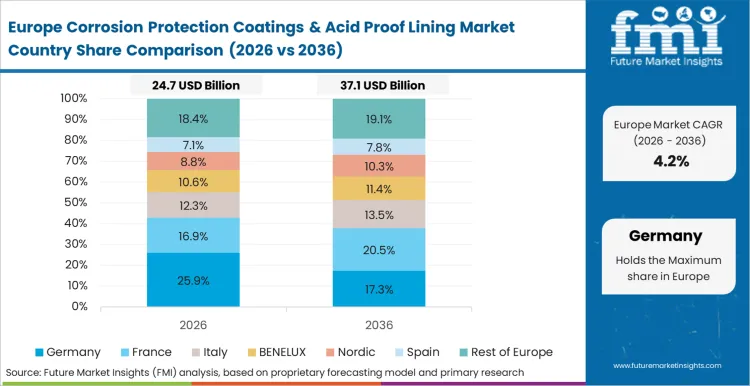
Germany's market is forecast to grow at a 5.8% CAGR from 2026 to 2036, reflecting the country's strong industrial base and rigorous environmental standards. Chemical industry production, automotive manufacturing, and power generation facilities all require corrosion protection.
Stringent regulations under the Industrial Emissions Directive drive adoption of high-performance, low-VOC coating systems. Infrastructure maintenance including bridges and water treatment plants adds demand.
China
China's corrosion protection coatings and acid proof lining market is expected to grow at a 7.4% CAGR from 2026 to 2036. Massive refining and petrochemical capacity additions, steel production, and manufacturing expansion create substantial coating demand. Environmental enforcement tightening drives adoption of higher-performance systems.
Coastal infrastructure and marine development require corrosion protection for structures exposed to saltwater. Government infrastructure investment including water treatment and transportation networks adds demand.
India
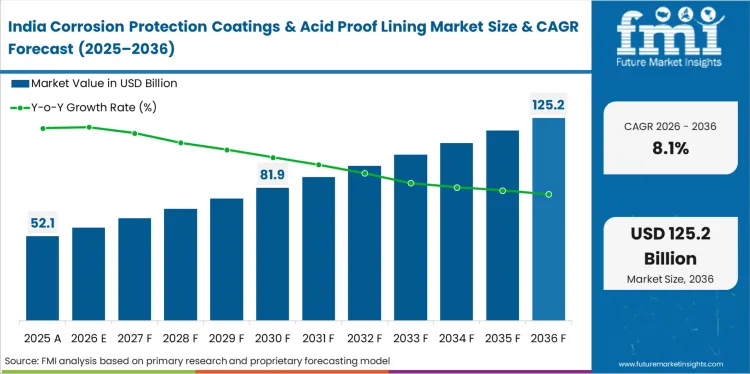
India's market is projected to expand at an 8.1% CAGR from 2026 to 2036, the highest among key countries. Rapid industrialization under Make in India and expansion of refining capacity create substantial coating demand. Infrastructure investment in ports, bridges, and water treatment facilities requires corrosion protection.
Coastal locations with high humidity and salt exposure increase corrosion risk and coating requirements. Growing awareness of corrosion control benefits drives specification of higher-performance systems.
Saudi Arabia
Saudi Arabia's corrosion protection coatings and acid proof lining market is forecast to grow at a 7.9% CAGR from 2026 to 2036, driven by the kingdom's dominant oil and gas industry and industrial diversification efforts. Upstream production facilities, pipelines, and refineries require extensive corrosion protection in harsh desert and marine environments.
New industrial cities and manufacturing developments under Vision 2030 create additional demand. Desalination plants providing water supply require corrosion-resistant coatings for severe service conditions.
Competitive Aligners for Market Players
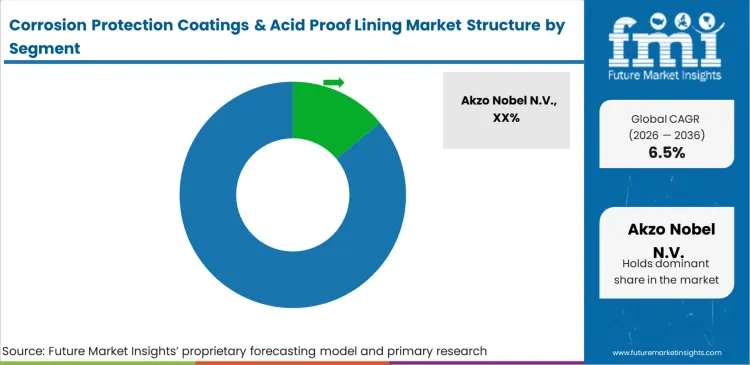
The corrosion protection coatings and acid proof lining market features a mix of global diversified coatings manufacturers and specialized industrial coating companies with deep application expertise. Competitive positioning hinges on formulation performance in severe service conditions, technical service capabilities, regulatory compliance support, and relationships with engineering, procurement, and construction firms and asset owners.
Leading players such as Akzo Nobel, PPG Industries, Sherwin-Williams, and Hempel leverage their global manufacturing footprints, extensive product portfolios, and technical service networks to serve multinational oil and gas, marine, and industrial customers. Their scale provides advantages in raw material procurement and R&D investment.
Specialty players including Jotun, RPM International, and Kansai Paint maintain strong positions through focus on specific end-use industries or regions. Regional manufacturers serve local markets with cost-competitive products and relationships with domestic customers.
From a strategic perspective, differentiation is moving beyond basic coating formulation toward demonstrable capability in three areas. These include application engineering support that helps customers specify appropriate systems and optimize application parameters; corrosion management program development that extends asset life and reduces total cost of ownership; and regulatory compliance documentation that demonstrates conformance with increasingly stringent environmental and safety standards.
Key Developments
- Akzo Nobel has expanded its International portfolio of marine and protective coatings with new epoxy formulations offering enhanced corrosion resistance and faster recoat times. The company's digital tools support coating specification and asset management for shipowners and industrial facility operators.
- PPG Industries has developed high-performance coating systems for the energy sector, including linings for renewable fuel storage and corrosion protection for carbon capture infrastructure. These formulations address emerging applications as energy transition progresses.
- Hempel has introduced new tank lining technologies with enhanced chemical resistance for the storage of aggressive feedstocks and intermediates in chemical processing. The company's technical service includes application support and quality assurance for critical lining projects.
Key Players Profiled
- Akzo Nobel N.V.
- PPG Industries, Inc.
- The Sherwin-Williams Company
- Hempel A/S
- Jotun A/S
- RPM International Inc.
- Kansai Paint Co., Ltd.
- Nippon Paint Holdings Co., Ltd.
- Axalta Coating Systems, Ltd.
- BASF SE
- Sika AG
- Carboline Company
- Tnemec Company, Inc.
- Chugoku Marine Paints, Ltd.
- KCC Corporation
Scope of the Report
| Metric | Value |
|---|---|
| Quantitative Units | USD 56.6 billion (2026) to approximately USD 106.3 billion (2036), at a CAGR of 6.5%, with 2025 historic value of USD 53.1 billion |
| Market Definition | Corrosion protection coatings are barrier materials applied to metal and concrete surfaces to prevent electrochemical degradation; acid proof linings are specialized systems designed to withstand direct contact with concentrated acids, alkalis, and solvents in chemical processing environments. |
| Resin Type Segmentation | Epoxy; Polyurethane; Alkyd; Acrylic; Chlorinated Rubber; Others |
| Technology Coverage | Solvent-borne; Water-borne; Powder Coatings |
| End-use Industry Coverage | Oil & Gas; Marine; Chemical Processing; Power Generation; Water & Wastewater Treatment; Infrastructure; Others |
| Regions Covered | North America, Latin America, Western Europe, Eastern Europe, East Asia, South Asia & Pacific, Middle East & Africa |
| Countries Covered | United States, Germany, China, India, Saudi Arabia |
| Key Companies Profiled | Akzo Nobel N.V.; PPG Industries, Inc.; The Sherwin-Williams Company; Hempel A/S; Jotun A/S; RPM International Inc.; Kansai Paint Co., Ltd.; Nippon Paint Holdings Co., Ltd.; Axalta Coating Systems, Ltd.; BASF SE; Sika AG; Carboline Company; Tnemec Company, Inc.; Chugoku Marine Paints, Ltd.; KCC Corporation |
| Forecast Period | 2026 to 2036 |
| Approach | Hybrid top-down and bottom-up market modeling validated through primary interviews with corrosion engineers, industrial maintenance managers, and coatings formulators, supported by benchmarking against industrial capacity data, infrastructure condition assessments, and regulatory compliance requirements. |
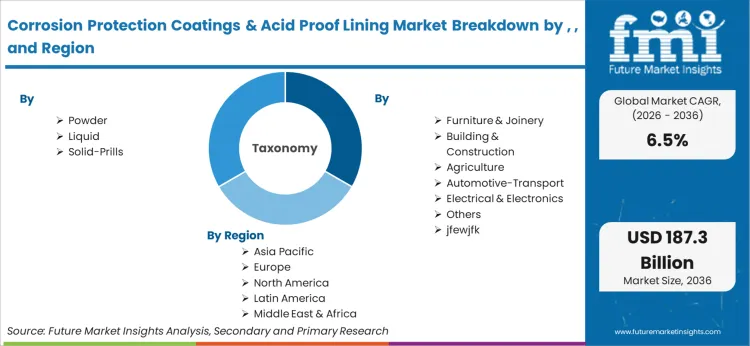
Corrosion Protection Coatings & Acid Proof Lining Market Analysis by Segments
Resin Type:
- Epoxy
- Polyurethane
- Alkyd
- Acrylic
- Chlorinated Rubber
- Others
Technology:
- Solvent-borne
- Water-borne
- Powder Coatings
End-use Industry:
- Oil & Gas
- Marine
- Chemical Processing
- Power Generation
- Water & Wastewater Treatment
- Infrastructure
- Others
Region:
- North America
- Latin America
- Western Europe
- Eastern Europe
- East Asia
- South Asia & Pacific
- Middle East & Africa
Bibliography
- NACE International. (2024). International Measures of Prevention, Application, and Economics of Corrosion Technologies Study. IMPACT.
- American Society of Civil Engineers. (2025). Infrastructure Report Card. ASCE.
- USA Department of Transportation, Pipeline and Hazardous Materials Safety Administration. (2025). Pipeline integrity management regulations. PHMSA.
- European Commission. (2024). Seveso III Directive: Control of major-accident hazards involving dangerous substances. EC.
- International Association of Oil & Gas Producers. (2025). Corrosion management in upstream operations. IOGP.
- World Corrosion Organization. (2024). Economic impact of corrosion. WCO.
- American Water Works Association. (2025). Corrosion control for drinking water infrastructure. AWWA.
- Society for Protective Coatings. (2024). Surface preparation and coating application standards. SSPC.
- International Maritime Organization. (2025). Performance standard for protective coatings. IMO.
- USA Environmental Protection Agency. (2024). Spill Prevention, Control, and Countermeasure Rule. EPA.
- International Energy Agency. (2025). Oil and gas industry investment outlook. IEA.
- Organization of the Petroleum Exporting Countries. (2025). World Oil Outlook. OPEC.
- Government of India, Ministry of Petroleum and Natural Gas. (2025). Indian petroleum and natural gas statistics. MPNG.
- Saudi Arabian General Investment Authority. (2025). Industrial investment opportunities. SAGIA.
- National Bureau of Statistics of China. (2025). China statistical yearbook on industry. China Statistics Press.
This bibliography is provided for reader reference and is not exhaustive. The full report contains the complete reference list and detailed citations.
This Report Addresses
- Market intelligence to enable structured strategic decision-making across corrosion protection coating manufacturers, industrial asset owners, and industry investors.
- Market size estimation and 10-year revenue forecasts from 2026 to 2036, including validated CAGR and absolute dollar opportunity sizing.
- Growth opportunity mapping across Resin Type, Technology, End-use Industry, and regional demand pockets, with emphasis on epoxy systems and oil & gas industry consumption patterns.
- Segment and regional forecasting covering epoxy coatings and industrial maintenance applications, alongside end-use-specific demand trajectories across oil and gas, marine, and infrastructure sectors.
- Competition strategy assessment, including formulation expertise, technical service capabilities, and buyer leverage dynamics shaping sourcing decisions.
- Product and technology tracking focused on high-performance systems for extreme environments, surface-tolerant coatings, and smart corrosion monitoring integration.
- Regional industrial activity analysis covering refining capacity additions, chemical plant construction, infrastructure investment, and pipeline development influencing corrosion coating procurement.
- Report delivery in PDF, Excel, and presentation-ready formats to support executive planning, capacity investment decisions, and competitive benchmarking.
Frequently Asked Questions
What is the size of the global corrosion protection coatings and acid proof lining market in 2025 and how fast is it expected to grow through 2036?
The global corrosion protection coatings and acid proof lining market is valued at USD 53.1 billion in 2025 and is projected to grow at a 6.5% CAGR, reaching about USD 56.6 billion in 2026 and approximately USD 106.3 billion by 2036.
Why does Epoxy dominate the resin type segment?
Epoxy resins lead due to exceptional adhesion to metal and concrete substrates, outstanding chemical resistance, and high mechanical strength, making them the preferred choice for tank linings, pipeline coatings, industrial flooring, and secondary containment in demanding industrial environments.
What drives Oil & Gas as the largest end-use industry?
Oil & Gas consumes the largest volume of corrosion protection coatings across upstream production facilities, midstream pipelines, and downstream refineries and petrochemical plants, where corrosion risk is highest and coating failure consequences most severe.
How do infrastructure rehabilitation needs affect market growth?
Aging infrastructure in developed economies requires extensive rehabilitation of bridges, pipelines, water treatment plants, and storage tanks. Corrosion control coatings extend asset life by decades at fraction of replacement cost, driving sustained demand from public works projects.
What role do safety and environmental regulations play?
Regulatory agencies mandate corrosion control to prevent releases of hazardous materials. PHMSA pipeline integrity rules, EPA spill prevention requirements, and the EU Seveso III Directive all require corrosion protection, creating non-discretionary coating demand.
Why is India's corrosion protection coatings market projected to grow at an 8.1% CAGR?
India's 8.1% CAGR reflects rapid industrialization under Make in India, refining capacity expansion, infrastructure investment in ports and bridges, and coastal locations with high humidity increasing corrosion risk, driving coating demand .
What drives Saudi Arabia's 7.9% growth forecast?
Saudi Arabia's 7.9% CAGR reflects dominant oil and gas industry requiring extensive corrosion protection in harsh desert and marine environments, new industrial cities under Vision 2030, and desalination plants requiring corrosion-resistant coatings for severe service .
How does China's 7.4% CAGR reflect market dynamics?
China's 7.4% CAGR is driven by massive refining and petrochemical capacity additions, steel production, manufacturing expansion, environmental enforcement driving higher-performance systems adoption, and coastal infrastructure requiring saltwater corrosion protection .
What factors contribute to the United States' 6.2% growth?
The United States' 6.2% CAGR reflects infrastructure rehabilitation needs, pipeline integrity programs under PHMSA regulations, refinery and chemical plant maintenance spending, and sustained oil and gas activity driving coating demand .
Why does Germany's market grow at a 5.8% CAGR?
Germany's 5.8% CAGR reflects strong industrial base, chemical industry production, automotive manufacturing, power generation facilities, and stringent regulations under Industrial Emissions Directive driving adoption of high-performance, low-VOC coating systems .
How are leading manufacturers like Akzo Nobel positioning in the market?
Akzo Nobel expands its marine and protective coatings portfolio with new epoxy formulations offering enhanced corrosion resistance and faster recoat times, supported by digital tools for coating specification and asset management .
What is PPG Industries' strategic focus?
PPG develops high-performance coating systems for the energy sector, including linings for renewable fuel storage and corrosion protection for carbon capture infrastructure, addressing emerging applications as energy transition progresses .
How do raw material price fluctuations affect the market?
Epoxy resins, polyurethane precursors, and zinc dust are subject to price fluctuations driven by crude oil and metal markets. Volatility challenges manufacturer pricing strategies and margin management for long-term supply agreements .
What opportunities exist in high-performance coatings for extreme environments?
Development of coatings for extreme temperatures, pressures, and chemical exposures creates opportunities in demanding applications: refractory linings for high-temperature equipment, deepwater offshore coatings, and sour crude processing linings .
How do digital corrosion management technologies create value?
Integration of sensors into coating systems enables real-time condition monitoring, detecting damage before visible deterioration. Smart coatings align with predictive maintenance strategies, reducing inspection costs and preventing unplanned outages .
What are the main technical barriers in corrosion coating application?
Performance depends critically on proper surface preparation and application. Inadequate blasting, poor environmental conditions, or insufficient film thickness can lead to premature failure. Skilled applicator shortages limit project execution capability .
How does the marine industry contribute to market demand?
Marine applications include new vessel construction and maintenance coatings for hulls, ballast tanks, and cargo holds, where saltwater exposure creates severe corrosion risk. IMO performance standards specify coating requirements .
What opportunities exist in water infrastructure rehabilitation?
Aging water and wastewater treatment plants require extensive coating rehabilitation for clarifiers, digesters, and piping exposed to corrosive biological and chemical environments. EPA Drinking Water State Revolving Fund provides funding for these projects .
Preview the report firsthand - request a free sample
Get SampleGet the brochure for pricing and purchase details.
Get PDFTable of Content
- Executive Summary
- Global Market Outlook
- Demand-side Trends
- Supply-side Trends
- Technology Roadmap Analysis
- Analysis and Recommendations
- Market Overview
- Market Coverage / Taxonomy
- Market Definition / Scope / Limitations
- Research Methodology
- Chapter Orientation
- Analytical Lens and Working Hypotheses
- Market Structure, Signals, and Trend Drivers
- Benchmarking and Cross-market Comparability
- Market Sizing, Forecasting, and Opportunity Mapping
- Research Design and Evidence Framework
- Desk Research Programme (Secondary Evidence)
- Company Annual and Sustainability Reports
- Peer-reviewed Journals and Academic Literature
- Corporate Websites, Product Literature, and Technical Notes
- Earnings Decks and Investor Briefings
- Statutory Filings and Regulatory Disclosures
- Technical White Papers and Standards Notes
- Trade Journals, Industry Magazines, and Analyst Briefs
- Conference Proceedings, Webinars, and Seminar Materials
- Government Statistics Portals and Public Data Releases
- Press Releases and Reputable Media Coverage
- Specialist Newsletters and Curated Briefings
- Sector Databases and Reference Repositories
- FMI Internal Proprietary Databases and Historical Market Datasets
- Subscription Datasets and Paid Sources
- Social Channels, Communities, and Digital Listening Inputs
- Additional Desk Sources
- Expert Input and Fieldwork (Primary Evidence)
- Primary Modes
- Qualitative Interviews and Expert Elicitation
- Quantitative Surveys and Structured Data Capture
- Blended Approach
- Why Primary Evidence is Used
- Field Techniques
- Interviews
- Surveys
- Focus Groups
- Observational and In-context Research
- Social and Community Interactions
- Stakeholder Universe Engaged
- C-suite Leaders
- Board Members
- Presidents and Vice Presidents
- R&D and Innovation Heads
- Technical Specialists
- Domain Subject-matter Experts
- Scientists
- Physicians and Other Healthcare Professionals
- Governance, Ethics, and Data Stewardship
- Research Ethics
- Data Integrity and Handling
- Primary Modes
- Tooling, Models, and Reference Databases
- Desk Research Programme (Secondary Evidence)
- Data Engineering and Model Build
- Data Acquisition and Ingestion
- Cleaning, Normalisation, and Verification
- Synthesis, Triangulation, and Analysis
- Quality Assurance and Audit Trail
- Market Background
- Market Dynamics
- Drivers
- Restraints
- Opportunity
- Trends
- Scenario Forecast
- Demand in Optimistic Scenario
- Demand in Likely Scenario
- Demand in Conservative Scenario
- Opportunity Map Analysis
- Product Life Cycle Analysis
- Supply Chain Analysis
- Investment Feasibility Matrix
- Value Chain Analysis
- PESTLE and Porter’s Analysis
- Regulatory Landscape
- Regional Parent Market Outlook
- Production and Consumption Statistics
- Import and Export Statistics
- Market Dynamics
- Global Market Analysis 2021 to 2025 and Forecast, 2026 to 2036
- Historical Market Size Value (USD Billion) Analysis, 2021 to 2025
- Current and Future Market Size Value (USD Billion) Projections, 2026 to 2036
- Y-o-Y Growth Trend Analysis
- Absolute $ Opportunity Analysis
- Global Market Pricing Analysis 2021 to 2025 and Forecast 2026 to 2036
- Introduction / Key Findings
- Global Market Analysis 2021 to 2025 and Forecast 2026 to 2036, By Region
- Introduction
- Historical Market Size Value (USD Billion) Analysis By Region, 2021 to 2025
- Current Market Size Value (USD Billion) Analysis and Forecast By Region, 2026 to 2036
- North America
- Latin America
- Western Europe
- Eastern Europe
- East Asia
- South Asia and Pacific
- Middle East & Africa
- Market Attractiveness Analysis By Region
- North America Market Analysis 2021 to 2025 and Forecast 2026 to 2036, By Country
- Historical Market Size Value (USD Billion) Trend Analysis By Market Taxonomy, 2021 to 2025
- Market Size Value (USD Billion) Forecast By Market Taxonomy, 2026 to 2036
- By Country
- USA
- Canada
- Mexico
- Market Attractiveness Analysis
- By Country
- Key Takeaways
- By Country
- Latin America Market Analysis 2021 to 2025 and Forecast 2026 to 2036, By Country
- Historical Market Size Value (USD Billion) Trend Analysis By Market Taxonomy, 2021 to 2025
- Market Size Value (USD Billion) Forecast By Market Taxonomy, 2026 to 2036
- By Country
- Brazil
- Chile
- Rest of Latin America
- Market Attractiveness Analysis
- By Country
- Key Takeaways
- By Country
- Western Europe Market Analysis 2021 to 2025 and Forecast 2026 to 2036, By Country
- Historical Market Size Value (USD Billion) Trend Analysis By Market Taxonomy, 2021 to 2025
- Market Size Value (USD Billion) Forecast By Market Taxonomy, 2026 to 2036
- By Country
- Germany
- UK
- Italy
- Spain
- France
- Nordic
- BENELUX
- Rest of Western Europe
- Market Attractiveness Analysis
- By Country
- Key Takeaways
- By Country
- Eastern Europe Market Analysis 2021 to 2025 and Forecast 2026 to 2036, By Country
- Historical Market Size Value (USD Billion) Trend Analysis By Market Taxonomy, 2021 to 2025
- Market Size Value (USD Billion) Forecast By Market Taxonomy, 2026 to 2036
- By Country
- Russia
- Poland
- Hungary
- Balkan & Baltic
- Rest of Eastern Europe
- Market Attractiveness Analysis
- By Country
- Key Takeaways
- By Country
- East Asia Market Analysis 2021 to 2025 and Forecast 2026 to 2036, By Country
- Historical Market Size Value (USD Billion) Trend Analysis By Market Taxonomy, 2021 to 2025
- Market Size Value (USD Billion) Forecast By Market Taxonomy, 2026 to 2036
- By Country
- China
- Japan
- South Korea
- Market Attractiveness Analysis
- By Country
- Key Takeaways
- By Country
- South Asia and Pacific Market Analysis 2021 to 2025 and Forecast 2026 to 2036, By Country
- Historical Market Size Value (USD Billion) Trend Analysis By Market Taxonomy, 2021 to 2025
- Market Size Value (USD Billion) Forecast By Market Taxonomy, 2026 to 2036
- By Country
- India
- ASEAN
- Australia & New Zealand
- Rest of South Asia and Pacific
- Market Attractiveness Analysis
- By Country
- Key Takeaways
- By Country
- Middle East & Africa Market Analysis 2021 to 2025 and Forecast 2026 to 2036, By Country
- Historical Market Size Value (USD Billion) Trend Analysis By Market Taxonomy, 2021 to 2025
- Market Size Value (USD Billion) Forecast By Market Taxonomy, 2026 to 2036
- By Country
- Kingdom of Saudi Arabia
- Other GCC Countries
- Turkiye
- South Africa
- Other African Union
- Rest of Middle East & Africa
- Market Attractiveness Analysis
- By Country
- Key Takeaways
- By Country
- Key Countries Market Analysis
- USA
- Pricing Analysis
- Market Share Analysis, 2025
- Canada
- Pricing Analysis
- Market Share Analysis, 2025
- Mexico
- Pricing Analysis
- Market Share Analysis, 2025
- Brazil
- Pricing Analysis
- Market Share Analysis, 2025
- Chile
- Pricing Analysis
- Market Share Analysis, 2025
- Germany
- Pricing Analysis
- Market Share Analysis, 2025
- UK
- Pricing Analysis
- Market Share Analysis, 2025
- Italy
- Pricing Analysis
- Market Share Analysis, 2025
- Spain
- Pricing Analysis
- Market Share Analysis, 2025
- France
- Pricing Analysis
- Market Share Analysis, 2025
- India
- Pricing Analysis
- Market Share Analysis, 2025
- ASEAN
- Pricing Analysis
- Market Share Analysis, 2025
- Australia & New Zealand
- Pricing Analysis
- Market Share Analysis, 2025
- China
- Pricing Analysis
- Market Share Analysis, 2025
- Japan
- Pricing Analysis
- Market Share Analysis, 2025
- South Korea
- Pricing Analysis
- Market Share Analysis, 2025
- Russia
- Pricing Analysis
- Market Share Analysis, 2025
- Poland
- Pricing Analysis
- Market Share Analysis, 2025
- Hungary
- Pricing Analysis
- Market Share Analysis, 2025
- Kingdom of Saudi Arabia
- Pricing Analysis
- Market Share Analysis, 2025
- Turkiye
- Pricing Analysis
- Market Share Analysis, 2025
- South Africa
- Pricing Analysis
- Market Share Analysis, 2025
- USA
- Market Structure Analysis
- Competition Dashboard
- Competition Benchmarking
- Market Share Analysis of Top Players
- By Regional
- Competition Analysis
- Competition Deep Dive
- Akzo Nobel N.V.
- Overview
- Product Portfolio
- Profitability by Market Segments (Product/Age /Sales Channel/Region)
- Sales Footprint
- Strategy Overview
- Marketing Strategy
- Product Strategy
- Channel Strategy
- PPG Industries, Inc.
- The Sherwin-Williams Company
- Hempel A/S
- Jotun A/S
- RPM International Inc.
- Kansai Paint Co., Ltd.
- Akzo Nobel N.V.
- Competition Deep Dive
- Assumptions & Acronyms Used


