

- Industry Size (2026)
- USD 1.5 Bn
- Forecast (2036)
- USD 3.9 Bn
- CAGR (2026 to 2036)
- 9.9%
Demand for Medical Tourism in South Korea Forecast and Outlook 2026 to 2036
Revenue generated from medical tourism activities in South Korea is projected to be valued at USD 1.5 billion in 2026. This dynamic sector is likely to reach USD 3.9 billion by 2036, advancing at a compound annual growth rate of 9.9%. South Korea has solidified its reputation as a premier destination for advanced clinical procedures, particularly in the fields of cosmetic surgery, dermatology, and complex cancer treatments. The convergence of cutting-edge robotic surgery technology with highly skilled medical professionals allows the nation to offer care comparable to the United States or Germany but at a significantly lower cost structure.
Growth is anchored in the "Smart Hospital" initiatives promoted by the government, which streamline the patient journey from pre-arrival tele-consultation to post-discharge monitoring. Ease of entry is facilitating this expansion, with specialized medical visas and fast-track immigration lanes for patients becoming standard policy. The global popularity of Korean culture, or "Hallyu," acts as a powerful marketing funnel, drawing younger demographics for aesthetic procedures while establishing trust in the country's broader technological capabilities.
Quick Stats for Demand for Medical Tourism in South Korea
- Industry Value (2026): USD 1.5 Billion
- Industry Forecast Value (2036): USD 3.9 Billion
- Industry Forecast CAGR: 9.9%
- Leading Treatment Type: Cosmetic Treatment (38.5%)
- Leading Tourist Type: International (65.0%)
- Leading Service Provider: Private (75.0%)
- Key Growth Regions: Jeju, South Gyeongsang, South Jeolla, North Jeolla
- Key Players: MedRetreat, Healthbase, Apollo Hospitals, KPJ Healthcare Berhad, Klinikum Medical Link
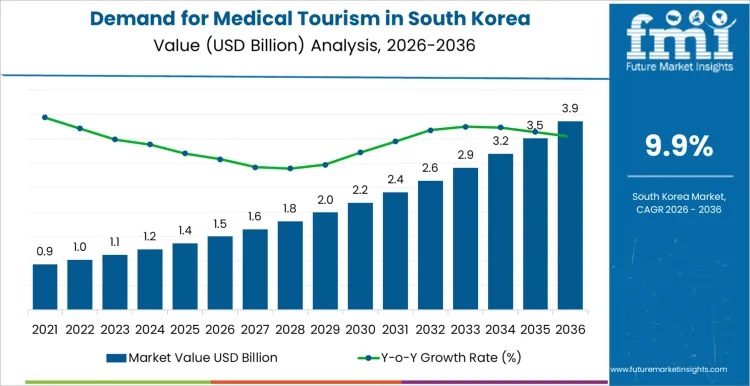
Technological integration is redefining the patient experience through AI-driven diagnostics and blockchain-secured medical records. Major hospitals in Seoul and Busan are implementing concierge-style digital platforms that handle everything from appointment scheduling to accommodation and translation services. This digital-first approach aligns with the expectations of the modern independent traveler, who increasingly prefers to curate their own medical journeys rather than relying on traditional package tours.
Demand for Medical Tourism in South Korea Key Takeaways
| Metric | Value |
|---|---|
| Industry Size (2026) | USD 1.5 Billion |
| Industry Value (2036) | USD 3.9 Billion |
| CAGR (2026 to 2036) | 9.9% |
What Factors Are Cementing Korea's Status as a Global Healthcare Hub?
A primary catalyst is the relentless pursuit of technological superiority in medical procedures. South Korean hospitals boast some of the highest densities of robotic surgical systems per capita, attracting patients seeking minimally invasive treatments with shorter recovery times. Government support plays a crucial role; policies aiming to attract 700,000 foreign patients annually have led to the creation of "Medical Streets" in major cities, where translation services and tax refund centers are ubiquitous. The seamless integration of wellness tourism with clinical care allows patients to combine health checkups with leisure activities, significantly enhancing the overall value proposition compared to competitor nations.
How is the Sector Structured Across Key Segments?
The sector is segmented to address the varied medical needs of global patients, ranging from elective enhancements to critical life-saving interventions. It is primarily categorized by treatment type, reflecting the clinical specialty. The tourist type segment distinguishes between domestic medical travelers and international visitors. Each segment plays a vital role, where cosmetic procedures drive high volume and cardiovascular treatments drive high value.
Why Does Cosmetic Treatment Lead the Industry?
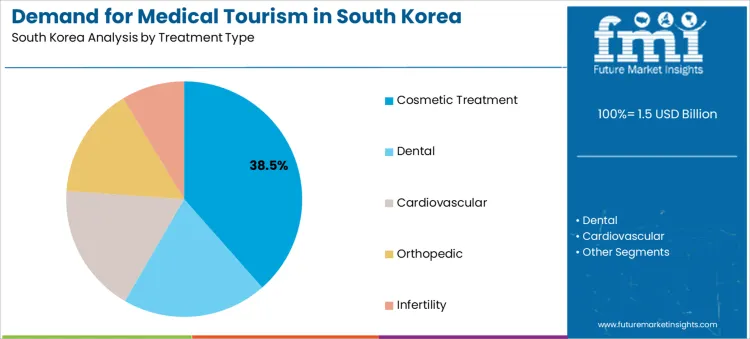
Cosmetic Treatment commands a 38.5% share of the sector. This dominance is attributed to South Korea's unparalleled global reputation as the "Plastic Surgery Capital of the World." Clinics in Gangnam and across Seoul offer specialized procedures that are often unavailable or prohibitively expensive elsewhere. The influence of K-Pop and Korean drama celebrities sets beauty standards across Asia, driving a constant stream of patients seeking facial contouring, blepharoplasty, and anti-aging treatments. Continuous innovation in non-surgical aesthetic techniques ensures high repeat visits.
Why Are International Tourists the Primary Revenue Source?
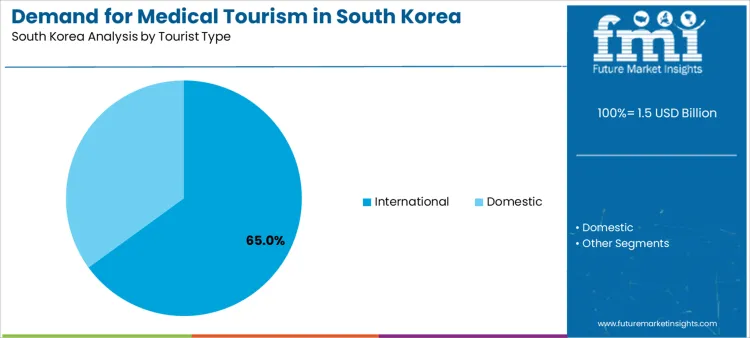
International tourists account for 65.0% of the industry volume. While domestic intrabound medical tourism exists, foreign patients generate significantly higher revenue due to longer stays and higher spending on ancillary services. Patients from China, the United States, and Russia flock to Korea for its distinct combination of high-tech care and affordability. The expiration of patents on certain medical technologies in the West drives patients to Korea where newer, better alternatives are readily available.
How Do Private Providers Maintain Dominance?
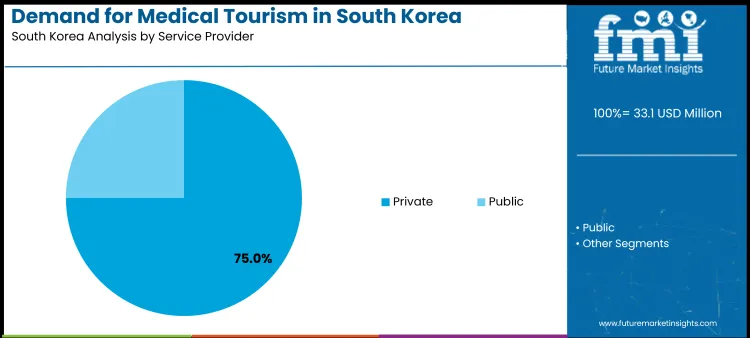
Private healthcare providers hold a 75.0% share of the service provider segment. South Korea's healthcare system relies heavily on private university hospitals and specialized clinics that compete fiercely on quality and patient experience. These institutions invest heavily in international accreditation (JCI) and multi-lingual staff to cater specifically to foreign nationals. Public hospitals, while excellent, primarily serve the local population under the National Health Insurance scheme, leaving the premium medical tourism segment to agile private entities.
Is the Independent Traveler Segment Growing?
The Independent Traveler segment is witnessing rapid adoption. Digital platforms and booking apps allow patients to research doctors, compare prices, and read reviews without the need for a traditional agency. This shift is empowered by better information transparency and direct marketing by hospitals. Younger patients, in particular, prefer the flexibility of booking their own flights and accommodations, utilizing travel and tourism apps to customize their recovery period with local sightseeing.
Will Wellness Integration Redefine Recovery?
A significant trend is the blurring of lines between clinical treatment and holistic wellness. Hospitals are partnering with luxury resorts and spas to offer post-operative recovery packages that include traditional Korean medicine (Hanbang), meditation, and nutritional therapy. This holistic approach appeals to the growing wellness tourism demographic seeking stress relief alongside physical treatment. Facilities offering these hybrid experiences are seeing higher patient satisfaction scores and longer average lengths of stay.
Do Language Barriers Pose a Risk?
The most significant restraint is the lingering language and cultural barrier in non-metropolitan areas. While top-tier Seoul hospitals are fully equipped for international patients, smaller clinics in regional hubs may lack sufficient translation support or understanding of diverse cultural needs (e.g., Halal food for Middle Eastern patients). Miscommunication regarding medical outcomes or billing can lead to disputes that damage the national reputation. Overcoming this requires sustained investment in medical interpreter training and standardized consent forms in multiple languages.
How Can Data Security Enhance Trust?
The emerging field of traveler identity protection services presents a frontier of opportunity. Medical tourists are increasingly concerned about the privacy of their health records and personal data when traveling abroad. Providers who implement blockchain-based patient records and offer robust travelers identity protection services can differentiate themselves as safe havens for sensitive procedures. This focus on digital security is becoming a critical decision factor for high-profile clients and corporate executives.
How is the Medical Tourism Landscape Evolving Across South Korea's Regions?
The regional sphere shows a distinct pattern where the capital concentrates on complex surgeries, while coastal and island regions focus on rehabilitation and wellness. High-growth areas are characterizing their development by establishing specialized "Medical Zones." As distinct provinces leverage their natural assets, the utilization of medical services is becoming tailored to promote healing and relaxation.
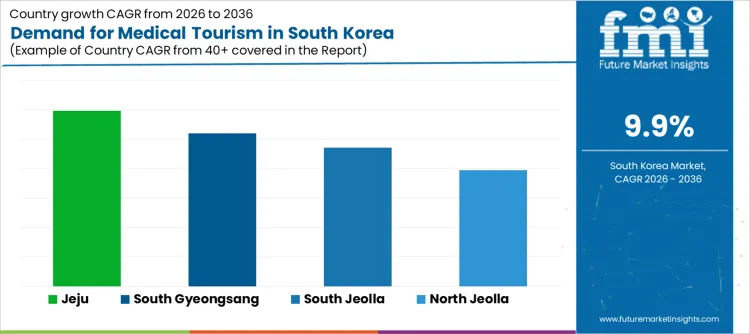
| Region | CAGR (2026 to 2036) |
|---|---|
| Jeju | 11.9% |
| South Gyeongsang | 10.4% |
| South Jeolla | 9.4% |
| North Jeolla | 7.9% |
Why is Visa-Free Entry Driving Growth in Jeju?
Adoption of medical services in Jeju is projected to expand at a CAGR of 11.9%. As a special self-governing province, Jeju offers a visa-free entry policy for citizens of many countries who otherwise require a visa for the mainland. This accessibility, combined with the island's reputation as a healing paradise, drives demand for cosmetic surgery, health checkups, and rehabilitation retreats. The "Healthcare Town" project has concentrated state-of-the-art facilities amidst scenic surroundings, creating a perfect environment for discreet recovery and long-term wellness stays.
How is Industrial Precision Influencing South Gyeongsang?
Sales of medical packages in South Gyeongsang are likely to reach a CAGR of 10.4%. The region, known for its heavy industry, is leveraging its engineering prowess to develop a hub for robotic surgery and orthopedic rehabilitation. Major hospitals in cities like Busan (neighboring region) and Changwon are attracting patients from Russia and Central Asia for joint replacements and spinal surgeries. The availability of direct flights and ferry connections makes it an accessible alternative to Seoul for outbound medical tourism from nearby nations.
What Role Does Traditional Medicine Play in South Jeolla?
The medical travel sector in South Jeolla is anticipated to rise at a CAGR of 9.4%. Known for its pristine environment and agricultural bounty, this region is positioning itself as a center for integrative medicine. The demand is driven by the "K-Wellness" trend, combining Western diagnostics with traditional Korean therapies (acupuncture, herbal medicine). Specialized centers here focus on chronic disease management and immune system boosting, attracting older demographics looking for preventative care rather than invasive surgery.
How is North Jeolla Targeting Niche Specialties?
Deployment of specialized care in North Jeolla is expected to increase at a CAGR of 7.9%. The region is developing niche expertise in food therapy and lifestyle medicine, capitalizing on its designation as a UNESCO City of Gastronomy. Hospitals are collaborating with local food researchers to offer dietary treatment programs for diabetes and obesity. This unique angle appeals to international patients seeking lifestyle correction programs that are scientifically backed but culturally immersive.
Competition Analysis
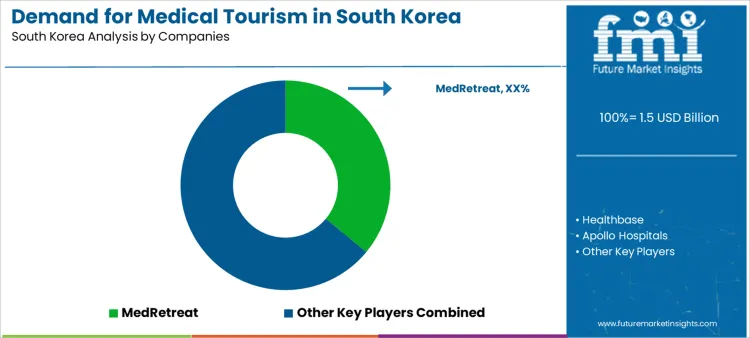
What Strategies Define Leadership in Medical Facilitation?
The competitive landscape is dominated by MedRetreat, which holds a commanding 36.0% share of the facilitation sector. Their strategy focuses on an end-to-end "concierge medicine" model, offering all-inclusive packages that bundle surgery, luxury accommodation, and private nursing. By vetting surgeons rigorously and offering price guarantees, they eliminate the uncertainty that often plagues medical travel. Competitors like Healthbase are responding by enhancing their digital platforms to offer virtual consultations and 3D simulations of cosmetic outcomes before the patient even books a flight.
How Are Hospitals Creating Global Brand Equity?
Leading providers like Apollo Hospitals (through regional partnerships) and KPJ Healthcare are establishing international patient centers staffed with native speakers of target languages. A key trend is the pursuit of "Smart Hospital" certification, using 5G and AI to showcase technological superiority. Joint ventures between Korean clinics and international hotel chains are creating "Meditels"-facilities that blend hospital-grade care with five-star hotel amenities. This blurring of industries ensures that patients receive clinical excellence without sacrificing comfort, cementing South Korea's position as a premium destination.
Key Companies
- MedRetreat
- Healthbase
- Apollo Hospitals (Strategic Partnerships)
- KPJ Healthcare Berhad (Regional Offices)
- Klinikum Medical Link
- Asan Medical Center
- Samsung Medical Center
- Seoul National University Hospital
- JK Plastic Surgery Center
- ID Hospital
Scope of Report
| Items | Values |
|---|---|
| Quantitative Units | USD Billion |
| Treatment Type | Cosmetic Treatment, Dental Treatment, Cardiovascular Treatment, Orthopedic Treatment, Infertility Treatment |
| Age Group | Less than 15 years, 15 - 25 years, 26 - 35 years, 36 - 45 years, 46 - 55 years |
| Tourist Type | Domestic, International |
| Service Provider | Public, Private |
| Traveler Type | Independent Traveler, Tour Group, Package Traveler |
| Regions Covered | Jeju, South Gyeongsang, South Jeolla, North Jeolla |
| Key Companies Profiled | MedRetreat, Healthbase, Apollo Hospitals, KPJ Healthcare, and others. |
Demand for Medical Tourism in South Korea by Segments
By Treatment Type:
- Cosmetic Treatment
- Dental Treatment
- Cardiovascular Treatment
- Orthopedic Treatment
- Infertility Treatment
By Age Group:
- Less than 15 years
- 15 - 25 years
- 26 - 35 years
- 36 - 45 years
- 46 - 55 years
By Tourist Type:
- Domestic
- International
By Service Provider:
- Public
- Private
By Traveler Type:
- Independent Traveler
- Tour Group
- Package Traveler
By Region:
- Jeju
- South Gyeongsang
- South Jeolla
- North Jeolla
Bibliography
- Korea Health Industry Development Institute. (2025, January 22). 2023 survey report on foreign patients’ experience and satisfaction with Korean medical services. Korea Health Industry Development Institute, Republic of Korea.
- Korea Health Industry Development Institute. (2025, October 23). 2024 statistics analysis report on the attraction of foreign patients. Korea Health Industry Development Institute, Republic of Korea.
- Ministry of Health and Welfare. (2025, March 18). Medical Korea 2025: AI-powered personalized healthcare for the future. Ministry of Health and Welfare, Republic of Korea.
- Korea Tourism Organization. (2025, September 30). Korean dermatology clinics as the center of K-beauty and medical tourism. Korea Tourism Organization, Republic of Korea.
- Incheon International Airport Corporation. (2024). Incheon Airport aviation statistics. Incheon International Airport Corporation, Republic of Korea.
Frequently Asked Questions
How big is the demand for medical tourism in south korea in 2026?
The demand for medical tourism in south korea is estimated to be valued at USD 1.5 billion in 2026.
What will be the size of medical tourism in south korea in 2036?
The market size for the medical tourism in south korea is projected to reach USD 3.9 billion by 2036.
How much will be the demand for medical tourism in south korea growth between 2026 and 2036?
The demand for medical tourism in south korea is expected to grow at a 9.9% CAGR between 2026 and 2036.
What are the key product types in the medical tourism in south korea?
The key product types in medical tourism in south korea are 0.25, 0.2, 0.1 and 0.065.
Which 0.65 segment is expected to contribute significant share in the medical tourism in south korea in 2026?
In terms of 0.65, 0.35 segment is expected to command 0.0% share in the medical tourism in south korea in 2026.
Preview the report firsthand - request a free sample
Get SampleGet the brochure for pricing and purchase details.
Get PDFTable of Content
- Executive Summary
- South Korea Market Outlook
- Demand-side Trends
- Supply-side Trends
- Technology Roadmap Analysis
- Analysis and Recommendations
- Market Overview
- Market Coverage / Taxonomy
- Market Definition / Scope / Limitations
- Market Background
- Market Dynamics
- Drivers
- Restraints
- Opportunity
- Trends
- Scenario Forecast
- Demand in Optimistic Scenario
- Demand in Likely Scenario
- Demand in Conservative Scenario
- Opportunity Map Analysis
- Product Life Cycle Analysis
- Supply Chain Analysis
- Investment Feasibility Matrix
- Value Chain Analysis
- PESTLE and Porter’s Analysis
- Regulatory Landscape
- Regional Parent Market Outlook
- Production and Consumption Statistics
- Import and Export Statistics
- Market Dynamics
- South Korea Market Analysis 2021 to 2025 and Forecast, 2026 to 2036
- Historical Market Size Value (USD Million) Analysis, 2021 to 2025
- Current and Future Market Size Value (USD Million) Projections, 2026 to 2036
- Y-o-Y Growth Trend Analysis
- Absolute $ Opportunity Analysis
- South Korea Market Pricing Analysis 2021 to 2025 and Forecast 2026 to 2036
- South Korea Market Analysis 2021 to 2025 and Forecast 2026 to 2036, By 0.385
- Introduction / Key Findings
- Historical Market Size Value (USD Million) Analysis By 0.385 , 2021 to 2025
- Current and Future Market Size Value (USD Million) Analysis and Forecast By 0.385 , 2026 to 2036
- 0.25
- 0.2
- 0.1
- 0.065
- 0.25
- Y-o-Y Growth Trend Analysis By 0.385 , 2021 to 2025
- Absolute $ Opportunity Analysis By 0.385 , 2026 to 2036
- South Korea Market Analysis 2021 to 2025 and Forecast 2026 to 2036, By 0.65
- Introduction / Key Findings
- Historical Market Size Value (USD Million) Analysis By 0.65, 2021 to 2025
- Current and Future Market Size Value (USD Million) Analysis and Forecast By 0.65, 2026 to 2036
- 0.35
- 0.35
- Y-o-Y Growth Trend Analysis By 0.65, 2021 to 2025
- Absolute $ Opportunity Analysis By 0.65, 2026 to 2036
- South Korea Market Analysis 2021 to 2025 and Forecast 2026 to 2036, By 0.75
- Introduction / Key Findings
- Historical Market Size Value (USD Million) Analysis By 0.75, 2021 to 2025
- Current and Future Market Size Value (USD Million) Analysis and Forecast By 0.75, 2026 to 2036
- 0.25
- 0.25
- Y-o-Y Growth Trend Analysis By 0.75, 2021 to 2025
- Absolute $ Opportunity Analysis By 0.75, 2026 to 2036
- Market Structure Analysis
- Competition Dashboard
- Competition Benchmarking
- Market Share Analysis of Top Players
- By Regional
- By 0.385
- By 0.65
- By 0.75
- Competition Analysis
- Competition Deep Dive
- Competition Deep Dive
- Assumptions & Acronyms Used
- Research Methodology


