

- Market Size (2026)
- USD 1.9 Bn
- Forecast (2036)
- USD 4.2 Bn
- CAGR (2026 to 2036)
- 8.4%
How big is Starch Blend Resins Market in 2026?
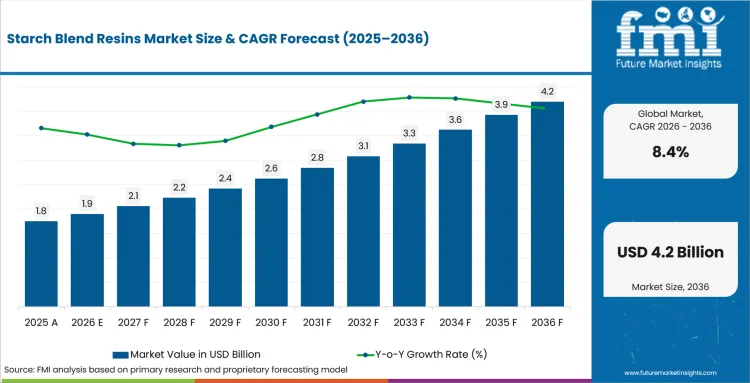
USD 1.9 billion in 2026 and USD 4.2 billion by 2036 at an 8.4% CAGR.
Demand for starch blend resins is projected to expand at 8.4% CAGR between 2026 and 2036, increasing valuation from USD 1.9 billion in 2026 to USD 4.2 billion by 2036. Bioplastics packaging provides the clearest commercial route through film and molded-product equipment already used to evaluate renewable compounds. European Bioplastics reported that packaging represented 41.3% or 0.95 million tonnes of global bioplastics production capacity in December 2025. The sizeable packaging base gives starch-blend producers a practical starting point for qualification across recurring production programs.
Starch increases renewable content but also absorbs moisture during storage and processing across commercial production programs. Compounders balance starch with polylactic acid or other biodegradable polyesters and then document drying limits and dispersion settings across longer extrusion or molding runs. Disposal claims remain commercially useful across territories with accepted collection and treatment routes for the finished format.
Key Takeaways of Starch Blend Resins Market
- Packaging processors are expanding starch-blend trials through extrusion and molding equipment already used for conventional resins.
- Starch / PLA blends are projected to account for 31.0% share in 2026 due to balanced stiffness and film formation.
- Corn is estimated to hold 38.0% share in 2026 owing to mature refining capacity and consistent industrial quality.
- Flexible packaging films are forecast to represent 34.0% share in 2026 driven by recurring bag and liner volumes.
- Moisture sensitivity and uneven composting acceptance extend qualification across several manufacturing plants and sales territories.
- Novamont, FKuR, Cardia Bioplastics, Plantic Technologies, Biome Bioplastics, BASF, TotalEnergies Corbion and Roquette compete through distinct formulation roles.
Analyst Perspective
"Starch blend resins win specifications by balancing renewable content against moisture control during commercial processing. Producers need drying limits and disposal guidance that remain valid through longer runs and regional launches."
- Nikhil Kaitwade, Principal Consultant, Future Market Insights
How is the Starch Blend Resins Market segmented?
The starch blend resins industry is segmented by resin blend, starch source, application, biodegradability claim, sales channel and region.
The starch blend resins market is segmented by resin blend, starch source, application, biodegradability claim, sales channel and region. Resin blend covers starch / PLA, starch / PBAT, starch / PHA, starch / PBS and thermoplastic starch blends. Starch sources include corn, potato, tapioca, wheat and other biomass processed for consistent commercial formulations. Applications include flexible packaging films, shopping or compost bags, foodservice ware, agricultural mulch films and injection molded products. Claims distinguish compostable, biodegradable and bio-based non-compostable products across compounders, resin producers, film producers and distributors.
What makes starch / PLA blends central to the resin blend category?
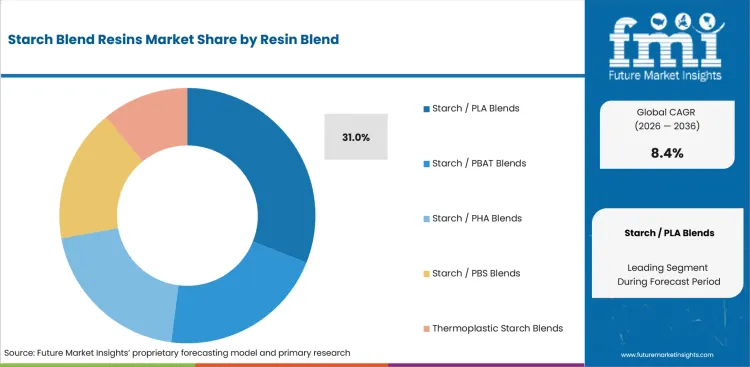
Starch / PLA formulations combine thermoplastic starch with a stiffer polyester that improves shape retention across film and molded-product processing. The pairing reduces the moisture weakness associated with higher starch loading while preserving renewable content across commercial applications.
- Starch / PLA blends are set to lead the resin blend category with 31.0% share in 2026 due to balanced stiffness and practical film formation.
- Film manufacturers favor this blend through manageable extrusion settings, yet longer production runs require documented drying limits and seal performance across each approved gauge. Documented process controls also support qualification against comparable biodegradable polymers used in film and molded applications.
How does corn influence selection within the starch source category?
Corn offers consistent industrial starch chemistry for compounds that need predictable film formation and rapid composting behavior. FKuR documents non-GMO corn starch in its Ceroflex thermoplastic starch compounds for bags and films processed on existing equipment.
- By starch source, corn is estimated to hold 38.0% in 2026 owing to mature refining capacity and established regional supply for film and molded-product manufacturers.
- Resin producers value repeatable starch quality across large conversion programs, although harvest-linked pricing and food-crop scrutiny complicate multi-year sourcing agreements. Contract terms therefore need feedstock specifications that remain consistent across regional biodegradable packaging programs and supply contracts.
How do film manufacturers evaluate flexible packaging films?
Flexible packaging films use starch blends in shopping bags and organics liners that depend on steady gauge control throughout high-volume blown-film production. Thin gauges also magnify small changes in moisture content during continuous high-speed commercial line operation.
- Flexible packaging films are likely to capture 34.0% share in 2026 attributable to low material use across recurring packaging volumes.
- Plant engineers must confirm moisture control and seal strength at commercial line speeds across several approved gauges. Cardia documents a thermoplastic starch and biodegradable polyester resin for blown films including bags and overwrap applications within flexible plastic packaging programs.
What supports compostable materials within the biodegradability claim category?
Compostable claims require a defined test route that connects laboratory performance with the disposal system named on each product label. Commercial approval therefore depends on certification evidence and local treatment acceptance across the intended sales territory.
- The biodegradability claim category is forecast to be led by compostable materials at 56.0% share in 2026 due to recognized certification routes.
- Foodservice and organics programs select certified materials for residue-contaminated items, although local facilities may reject formats that disrupt normal treatment cycles. Regional compostable food packaging launches therefore need disposal instructions linked to actual collection and processing routes.
What are the drivers, restraints and opportunities in the Starch Blend Resins Market?
Driver: Existing equipment supports lower-risk trials. Restraint: Moisture absorption narrows processing windows. Opportunity: Joint trials align formulation limits with disposal routes.
- Driver: Familiar production equipment lets processors test starch blends without replacing core extrusion or molding assets.
- Restraint: Moisture absorption can reduce mechanical consistency and require tighter handling throughout commercial production runs.
- Opportunity: Joint formulation and line trials connect processing stability with the disposal route required for each application.
Packaging and agricultural processors can introduce packaging bioplastics through assets already used for conventional resins. Regular orders depend on stable drying and feeding procedures across complete commercial production runs at several plants.
Starch absorbs moisture during storage and can alter viscosity or strength throughout commercial extrusion programs. Manufacturing teams need tighter handling controls across facilities with different climates and material-storage practices during regular production.
Joint resin and line trials establish formulation limits during commercial specification development for regional purchasing programs. The same program confirms disposal claims by territory and reduces repeated approval work across several product launches.
Which country CAGRs are profiled in the Starch Blend Resins Market?
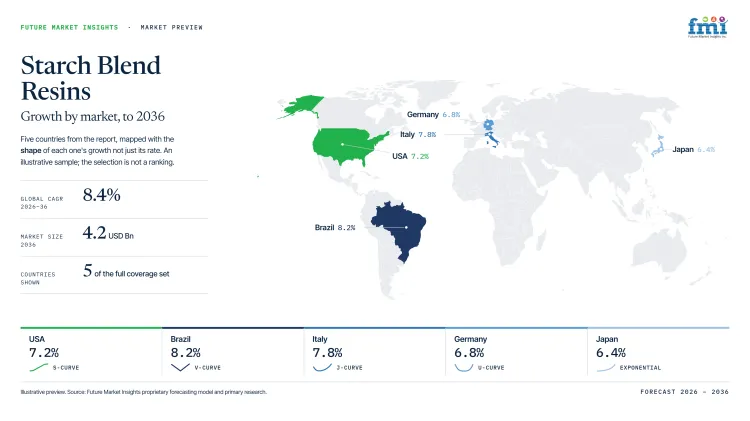
| Country | CAGR |
|---|---|
| United States | 7.2% |
| Germany | 6.8% |
| Japan | 6.4% |
| Italy | 7.8% |
| Brazil | 8.2% |
How do country-level CAGRs compare in the Starch Blend Resins Market?
The profiled country CAGRs span 1.8 percentage points and form three practical commercial bands across the forecast period. Relative spacing reflects different disposal rules and technical support networks rather than uniform differences in addressable demand.
- Brazil and Italy form the upper band despite different import exposure and regulatory pathways for compostable applications.
- Italy sits near the United States although national packaging rules concentrate demand through a narrower approval route.
- The United States and Germany occupy the middle band through different labeling systems and municipal disposal practices.
- Germany and Japan remain closely spaced despite contrasting collection rules and domestic material qualification methods.
- Japan completes the displayed range through cautious scale-up and detailed traceability across established packaging networks.
Comparable CAGRs can produce different market entry conditions through local certification systems and service networks. Coverage spans North America, Latin America, Europe, East Asia, South Asia and Pacific, plus Middle East and Africa.
Country-wise Analysis
- California requires compostable plastics to meet specific labeling and certification rules before film producers can present them as compostable in retail channels. The United States starch blend resins sector is projected to record 7.2% CAGR during the assessment period, shaped by established testing laboratories and regional compound distribution. CalRecycle requires ASTM D6400-19 compliance and prescribed color or logo identifiers on qualifying compostable bags sold through statewide retail or foodservice channels. Statewide requirements provide a clear approval route yet separate state rules raise artwork costs and complicate nationwide launches for national packaging groups serving retailers through several regional distribution networks.
- German packaging programs distinguish renewable feedstock content from disposal eligibility under national collection rules and municipal decisions on compostable organic-waste bags used in local collection contracts. Germany's starch blend resins outlook is anticipated to advance at 6.8% CAGR over the assessment period, supported by defined certification routes and regional technical service. The German Environment Agency directs bio-based packaging into the yellow collection system and restricts compostable collection bags to approved formats for organic waste. Compounders gain a clear certification route yet municipal acceptance varies across service areas and requires local disposal guidance for every regional contract and customer training program.
- Japanese packaging developers use controlled production qualification and material traceability for food packaging or agricultural products that require repeatable performance across domestic production plants and distribution networks. In Japan, starch blend resin demand is predicted to advance at 6.4% CAGR through 2036, influenced by disciplined qualification practices and established domestic packaging networks. The Ministry of the Environment targets approximately two million tonnes of bio-based plastics by 2030 under its national introduction roadmap. The policy supports structured application trials yet each production line requires separate checks for moisture response and disposal instructions during qualification for commercial volume orders across domestic packaging programs. food packaging
- Italian packaging manufacturers plan sustainable packaging investments around established organics collection experience and the unsettled national rules for selected single-use packaging across national retail and foodservice distribution channels. Adoption of starch blend resins in Italy is estimated to expand at 7.8% CAGR through 2036, aided by domestic bioplastics expertise and experienced converting networks. The European Commission received Italy's April 2026 draft that would require selected packaging to satisfy biodegradability and compostability conditions. The proposal gives producers a planning signal yet unresolved exemptions make inventory commitments difficult for distributors serving foodservice and retail customers across several regions and contract periods.
- Brazilian starch-blend commercialization depends on converting agricultural feedstock research into reliable resin production and technical service beyond major southern industrial centers and coastal import hubs. By 2036, Brazil is projected to grow at 8.2% CAGR, driven by agricultural feedstocks and an active public research base. Brazil's patent office reported in June 2026 that resident applicants ranked second for bioplastics filings while natural-polymer production remained negligible across current domestic industrial activity. The research base supports local formulation work yet import dependence and long service distances increase trial costs for smaller packaging plants that need rapid troubleshooting across dispersed production clusters.
Who are the notable companies in the Starch Blend Resins Market?
Novamont, BASF, FKuR, Plantic Technologies, Cardia Bioplastics, Biome Bioplastics, TotalEnergies Corbion and Roquette are the notable companies shaping this market.
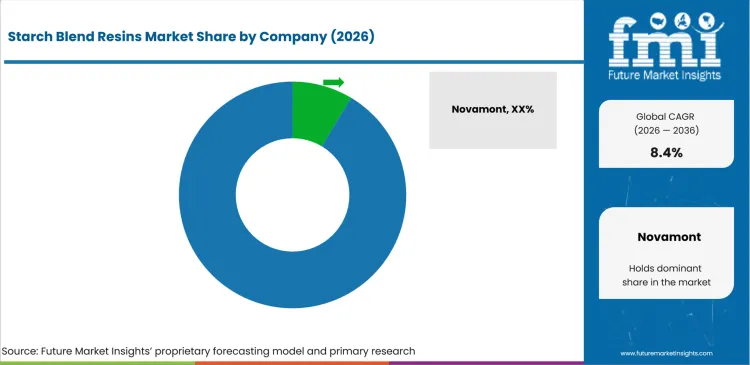
The field remains moderately fragmented as finished starch compounds compete with starch-derived barriers and polyester inputs used at different formulation stages. Entry depends on proving moisture control across target equipment and documenting an end-of-life route that applies within each sales territory.
- Novamont, FKuR and Cardia Bioplastics (a Myeco Group Ltd brand, formerly SECOS Group Ltd) compete through finished starch compounds for flexible films and molded applications.
- Plantic Technologies and Biome Bioplastics address barrier packaging and specialty performance through distinct plant-based formulation platforms.
- BASF, TotalEnergies Corbion and Roquette support compound design through compostable polymers, starch inputs and application documentation for multilayer flexible packaging development.
Competitive Benchmarking: Starch Blend Resins Market
| Company | Starch-Blend Formulation | Compostability Evidence | Film Processing Support | Geographic Reach |
|---|---|---|---|---|
| Novamont | High | High | High | Global |
| BASF | Low | High | High | Global |
| FKuR | High | High | High | Global and regional partners |
| Plantic Technologies | High | High | High | Australia, Europe, North America and Japan |
| Cardia Bioplastics | High | High | High | Asia Pacific, Europe and the Americas |
| Biome Bioplastics | Low | High | High | Europe and selected exports |
| TotalEnergies Corbion | Low | High | High | Global |
| Roquette | Low | Medium | Low | Global |
Formulation rates High for several blends, Medium for one route and Low for component-only evidence. Compostability rates High for multiple certifications, Medium for one pathway and Low for input-only certification. Film support rates High for several routes, Medium for one route and Low for input-only guidance.
Key Developments in the Starch Blend Resins Market
- In April 2026, Roquette obtained ISCC PLUS certification for native starch and bio-succinic acid used in biodegradable polyester and bioplastic supply chains.
- In April 2026, BASF expanded its ecovio portfolio with home-compostable grades for extrusion coating and flexible-film lamination.
- In November 2025, Kuraray introduced PLANTIC starch-derived barrier material in mandarin boxes through laminated corrugated packaging.
- In November 2025, Novamont secured EU conformity for MATER-BI mulch film under the fertilizer regulation.
Starch Blend Resins Market - Report Scope
| Coverage field | Report scope |
|---|---|
| Market breakdown | By resin blend, starch source, application, biodegradability claim, sales channel and region. |
| Quantitative Units | Revenue in USD billion and CAGR in %. |
| Market Definition | The market covers commercially traded starch-containing thermoplastic resin compounds and compatible blend systems sold for packaging, agriculture, foodservice and molded-product applications. |
| Regions Covered | North America, Latin America, Western Europe, Eastern Europe, East Asia, South Asia and Pacific, Middle East and Africa. |
| Countries Covered | United States, Germany, Japan, Italy, Brazil, and more than twenty-five additional countries in the full report. |
| Key Companies Profiled | Novamont, BASF, FKuR, Plantic Technologies, Cardia Bioplastics, Biome Bioplastics, TotalEnergies Corbion and Roquette. |
| Forecast Period | 2026-2036. |
| Approach | Primary and secondary research with market triangulation. |
Starch Blend Resins Market - Research Methodology
| Method | Approach |
|---|---|
| Primary Research | FMI analysts gathered input from manufacturers, service providers, technology developers, distributors, end users, procurement teams, and subject-matter experts. Interviews examined purchasing decisions, product or service evaluation, adoption barriers, approval requirements, pricing considerations, and expectations for technical or commercial support. Respondents were also asked what evidence is required before a trial, pilot, or initial order develops into regular purchasing. |
| Desk Research | Desk research covered government statistics, regulatory publications, trade data, industry associations, technical literature, standards, company filings, product information, and official corporate announcements. Sources were reviewed for relevance, publication date, geographic coverage, and consistency with the defined market scope. Claims relating to performance, applications, approvals, capacity, investment, and commercial activity were retained only when supported by credible public evidence. |
| Market Sizing and Forecasting | The market model combined the baseline value with historical performance, segment structure, pricing and volume indicators, adoption levels, company participation, and country-level demand conditions. Forecast assumptions considered economic activity, investment trends, regulatory developments, technology adoption, purchasing cycles, supply availability, and barriers to wider market use. Segment and regional estimates were reconciled before the final market total was calculated. |
| Data Validation | Estimates were checked against multiple independent indicators, including public data, company activity, trade patterns, industry developments, and findings from primary interviews. Validation also tested whether products, services, applications, and company revenues fell within the defined market boundaries. Adjacent categories, unsupported claims, overlapping revenues, and activities without direct market relevance were excluded to reduce double counting and maintain consistency across segments and countries. |
Starch Blend Resins Market by Segments
Starch Blend Resins Market segmented by Resin Blend:
- Starch / PLA Blends
- Starch / PBAT Blends
- Starch / PHA Blends
- Starch / PBS Blends
- Thermoplastic Starch Blends
Starch Blend Resins Market segmented by Starch Source:
- Corn
- Potato
- Tapioca
- Wheat
- Other Biomass
Starch Blend Resins Market segmented by Application:
- Flexible Packaging Films
- Shopping / Compost Bags
- Foodservice Ware
- Agricultural Mulch Films
- Injection Molded Products
Starch Blend Resins Market segmented by Biodegradability Claim:
- Compostable
- Biodegradable
- Bio-based Non-compostable
Starch Blend Resins Market segmented by Sales Channel:
- Compounders
- Resin Producers
- Converters / Film Producers
- Distributors
Starch Blend Resins Market by Region:
- North America
- United States
- Canada
- Latin America
- Brazil
- Chile
- Mexico
- Rest of Latin America
- Western Europe
- Germany
- United Kingdom
- Italy
- Spain
- France
- Nordics
- Benelux
- Rest of Western Europe
- Eastern Europe
- Russia
- Poland
- Hungary
- Balkan and Baltic States
- Rest of Eastern Europe
- East Asia
- China
- Japan
- South Korea
- South Asia and Pacific
- India
- ASEAN
- Australia and New Zealand
- Rest of South Asia and Pacific
- Middle East and Africa
- Kingdom of Saudi Arabia
- Other GCC Countries
- Türkiye
- South Africa
- Other African Union Countries
- Rest of Middle East and Africa
Research Sources and Bibliography
- European Bioplastics e.V. (2025, December 2). EUBP presents the Results of the 2025 Market Data Report.
- BASF. (2026, April 29). New ecovio® portfolio for flexible packaging: multiple barrier options combined with organic or paper recycling.
- Novamont. (2025, November 6). MATER-BI MULCH FILM CERTIFIED AS AN INORGANIC SOIL IMPROVER UNDER EU REGULATION.
- Kuraray Co., Ltd. (2025, November 21). バイオマス由来のガスバリア材〈PLANTIC®〉がみかん箱に初採用.
- Roquette. (2026, April 30). ISCC PLUS Certification Achieved for Three Sustainable Products.
- Novamont. (n.d.). Mater-Bi - biodegradable and compostable bioplastics. Retrieved August 3, 2026.
- California Department of Resources Recycling and Recovery. (n.d.). Truth-in-Labeling Laws: Protecting California Consumers from False Marketing Claims. Retrieved August 3, 2026.
- Instituto Nacional da Propriedade Industrial. (2026, June 3). INPI divulga estudo sobre inovação no setor de bioplásticos.
- Ministry of the Environment, Government of Japan. (2021, January). Roadmap for Bioplastics Introduction.
- European Commission. (2026, April 1). Proposal for a technical regulation laying down biodegradability and compostability requirements for certain single-use plastic packaging.
- German Environment Agency. (2023, August 15). Biobasierte und biologisch abbaubare Kunststoffe.
- FKuR Kunststoff GmbH. (n.d.). Ceroflex®. Retrieved August 3, 2026.
- Cardia Bioplastics. (2021, March). Cardia Compostable B-F12 [Technical data sheet].
- Biome Technologies plc. (n.d.). Biome Bioplastics. Retrieved August 3, 2026.
- TotalEnergies Corbion. (n.d.). Flexible packaging. Retrieved August 3, 2026.
This bibliography is provided for reader reference and is not exhaustive. The full report contains the complete reference list and detailed citations.
This Report Answers
- How large is the starch blend resins market in 2026 and 2036?
- Which operating conditions support starch blend resin demand?
- Which resin blend holds the largest 2026 share?
- How does starch source influence compound selection?
- Which application accounts for the largest 2026 share?
- How do profiled country growth rates differ?
- Which companies serve the starch blend resins market?
- What limits wider starch blend resin adoption?
- How should manufacturers compare resin blends?
Frequently Asked Questions
How big is the Starch Blend Resins Market in 2026?
The starch blend resins market is valued at USD 1.9 billion in 2026 and is forecast to reach USD 4.2 billion by 2036. Growth is supported by bioplastics packaging processors expanding trials through extrusion and molding equipment already used to evaluate renewable compound formulations.
What is the CAGR of the Starch Blend Resins Market from 2026 to 2036?
The starch blend resins market grows at a CAGR of 8.4% between 2026 and 2036, supported by packaging processors testing starch blends on existing extrusion and molding assets without replacing core production equipment, extending qualification across flexible films and molded-product applications.
Which resin blend leads the Starch Blend Resins Market?
Starch / PLA blends lead the starch blend resins market with a 31.0% share in 2026, because the pairing combines thermoplastic starch with a stiffer polyester that improves shape retention while balancing stiffness and film formation across commercial packaging and molded-product processing.
How much will the Starch Blend Resins Market add between 2026 and 2036?
The starch blend resins market is set to add USD 2.3 billion between 2026 and 2036, growing from USD 1.9 billion to USD 4.2 billion as packaging processors expand starch-blend qualification across flexible films, foodservice ware, agricultural mulch films and molded-product applications worldwide.
Who are the leading companies in the Starch Blend Resins Market?
The starch blend resins market is led by 8 companies, including Novamont, FKuR, Cardia Bioplastics, Plantic Technologies, Biome Bioplastics, BASF, TotalEnergies Corbion and Roquette, competing through starch-blend formulation, compostability evidence and film-processing support across packaging and agricultural applications.
Preview the report firsthand - request a free sample
Get SampleGet the brochure for pricing and purchase details.
Get PDFTable of Content
- Key Takeaways
- Market Size and CAGR
- Top Growth Driver
- Fastest Growing Segment
- Leading Region
- Key Companies
- Emerging Opportunities
- Executive Summary
- Global Market Outlook
- Demand-side Trends
- Supply-side Trends
- Technology Roadmap Analysis
- Analysis and Recommendations
- Analyst Perspective (What is happening? Why now? What should investors know?)
- Key Questions Answered
- How large is the market?
- What is the CAGR?
- What are key trends?
- Which region dominates?
- Who are the leaders?
- Market Overview
- Market Coverage / Taxonomy
- Market Definition / Scope / Limitations
- Research Methodology
- Chapter Orientation
- Analytical Lens and Working Hypotheses
- Market Structure, Signals, and Trend Drivers
- Benchmarking and Cross-market Comparability
- Market Sizing, Forecasting, and Opportunity Mapping
- Research Design and Evidence Framework
- Desk Research Programme (Secondary Evidence)
- Expert Input and Fieldwork (Primary Evidence)
- Tooling, Models, and Reference Databases
- Data Engineering and Model Build
- Quality Assurance and Audit Trail
- Market Background
- Market Dynamics (Drivers, Restraints, Opportunity, Trends)
- Scenario Forecast (Optimistic, Likely, Conservative)
- Impact Analysis
- AI Impact
- Sustainability Impact
- Regulatory Impact
- Technology Impact
- Consumer / Buyer Analysis
- Purchase Drivers
- Adoption Barriers
- Buyer Journey
- Opportunity Map Analysis
- Product Life Cycle Analysis
- Supply Chain Analysis
- Investment Feasibility Matrix
- Value Chain Analysis
- PESTLE and Porter's Analysis
- Regulatory Landscape
- Regional Parent Market Outlook
- Production and Consumption Statistics
- Import and Export Statistics
- Global Market Analysis and Forecast, 2021 to 2036
- Historical Market Size Value (USD Billion) Analysis, 2021 to 2025
- Current and Future Market Size Value (USD Billion) Projections, 2026 to 2036
- Y-o-Y Growth Trend Analysis
- Absolute $ Opportunity Analysis
- Global Market Pricing Analysis, 2021 to 2036
- Global Market Analysis and Forecast, By Resin Blend, 2021 to 2036
- Introduction / Key Findings
- Historical Market Size Value (USD Billion) Analysis By Resin Blend, 2021 to 2025
- Current and Future Market Size Value (USD Billion) Analysis and Forecast By Resin Blend, 2026 to 2036
- Starch / PLA Blends
- Starch / PBAT Blends
- Starch / PHA Blends
- Starch / PBS Blends
- Thermoplastic Starch Blends
- Starch / PLA Blends
- Y-o-Y Growth Trend Analysis By Resin Blend, 2021 to 2025
- Absolute $ Opportunity Analysis By Resin Blend, 2026 to 2036
- Global Market Analysis and Forecast, By Starch Source, 2021 to 2036
- Introduction / Key Findings
- Historical Market Size Value (USD Billion) Analysis By Starch Source, 2021 to 2025
- Current and Future Market Size Value (USD Billion) Analysis and Forecast By Starch Source, 2026 to 2036
- Corn
- Potato
- Tapioca
- Wheat
- Other Biomass
- Corn
- Y-o-Y Growth Trend Analysis By Starch Source, 2021 to 2025
- Absolute $ Opportunity Analysis By Starch Source, 2026 to 2036
- Global Market Analysis and Forecast, By Application, 2021 to 2036
- Introduction / Key Findings
- Historical Market Size Value (USD Billion) Analysis By Application, 2021 to 2025
- Current and Future Market Size Value (USD Billion) Analysis and Forecast By Application, 2026 to 2036
- Flexible Packaging Films
- Shopping / Compost Bags
- Foodservice Ware
- Agricultural Mulch Films
- Injection Molded Products
- Flexible Packaging Films
- Y-o-Y Growth Trend Analysis By Application, 2021 to 2025
- Absolute $ Opportunity Analysis By Application, 2026 to 2036
- Global Market Analysis and Forecast, By Biodegradability Claim, 2021 to 2036
- Introduction / Key Findings
- Historical Market Size Value (USD Billion) Analysis By Biodegradability Claim, 2021 to 2025
- Current and Future Market Size Value (USD Billion) Analysis and Forecast By Biodegradability Claim, 2026 to 2036
- Compostable
- Biodegradable
- Bio-based Non-compostable
- Compostable
- Y-o-Y Growth Trend Analysis By Biodegradability Claim, 2021 to 2025
- Absolute $ Opportunity Analysis By Biodegradability Claim, 2026 to 2036
- Global Market Analysis and Forecast, By Sales Channel, 2021 to 2036
- Introduction / Key Findings
- Historical Market Size Value (USD Billion) Analysis By Sales Channel, 2021 to 2025
- Current and Future Market Size Value (USD Billion) Analysis and Forecast By Sales Channel, 2026 to 2036
- Compounders
- Resin Producers
- Converters / Film Producers
- Distributors
- Compounders
- Y-o-Y Growth Trend Analysis By Sales Channel, 2021 to 2025
- Absolute $ Opportunity Analysis By Sales Channel, 2026 to 2036
- Global Market Analysis and Forecast, By Region, 2021 to 2036
- Introduction
- Historical Market Size Value (USD Billion) Analysis By Region, 2021 to 2025
- Current Market Size Value (USD Billion) Analysis and Forecast By Region, 2026 to 2036
- North America
- Latin America
- Western Europe
- Eastern Europe
- East Asia
- South Asia and Pacific
- Middle East & Africa
- Market Attractiveness Analysis By Region
- North America Market Analysis and Forecast, By Country, 2021 to 2036
- Historical Market Size Value (USD Billion) Trend Analysis By Market Taxonomy, 2021 to 2025
- Market Size Value (USD Billion) Forecast By Market Taxonomy, 2026 to 2036
- By Country
- USA
- Canada
- By Resin Blend
- By Starch Source
- By Application
- By Biodegradability Claim
- By Sales Channel
- By Country
- Market Attractiveness Analysis
- By Country
- By Resin Blend
- By Starch Source
- By Application
- By Biodegradability Claim
- By Sales Channel
- Key Takeaways
- Latin America Market Analysis and Forecast, By Country
- Historical Market Size Value (USD Billion) Trend Analysis By Market Taxonomy, 2021 to 2025
- Market Size Value (USD Billion) Forecast By Market Taxonomy, 2026 to 2036
- By Country
- Brazil
- Mexico
- Chile
- Rest of Latin America
- By Resin Blend
- By Starch Source
- By Application
- By Biodegradability Claim
- By Sales Channel
- By Country
- Market Attractiveness Analysis
- By Country
- By Resin Blend
- By Starch Source
- By Application
- By Biodegradability Claim
- By Sales Channel
- Key Takeaways
- Western Europe Market Analysis and Forecast, By Country
- Historical Market Size Value (USD Billion) Trend Analysis By Market Taxonomy, 2021 to 2025
- Market Size Value (USD Billion) Forecast By Market Taxonomy, 2026 to 2036
- By Country
- Germany
- UK
- Italy
- Spain
- France
- Nordic
- BENELUX
- Rest of Western Europe
- By Resin Blend
- By Starch Source
- By Application
- By Biodegradability Claim
- By Sales Channel
- By Country
- Market Attractiveness Analysis
- By Country
- By Resin Blend
- By Starch Source
- By Application
- By Biodegradability Claim
- By Sales Channel
- Key Takeaways
- Eastern Europe Market Analysis and Forecast, By Country
- Historical Market Size Value (USD Billion) Trend Analysis By Market Taxonomy, 2021 to 2025
- Market Size Value (USD Billion) Forecast By Market Taxonomy, 2026 to 2036
- By Country
- Russia
- Poland
- Hungary
- Balkan & Baltic
- Rest of Eastern Europe
- By Resin Blend
- By Starch Source
- By Application
- By Biodegradability Claim
- By Sales Channel
- By Country
- Market Attractiveness Analysis
- By Country
- By Resin Blend
- By Starch Source
- By Application
- By Biodegradability Claim
- By Sales Channel
- Key Takeaways
- East Asia Market Analysis and Forecast, By Country
- Historical Market Size Value (USD Billion) Trend Analysis By Market Taxonomy, 2021 to 2025
- Market Size Value (USD Billion) Forecast By Market Taxonomy, 2026 to 2036
- By Country
- China
- Japan
- South Korea
- By Resin Blend
- By Starch Source
- By Application
- By Biodegradability Claim
- By Sales Channel
- By Country
- Market Attractiveness Analysis
- By Country
- By Resin Blend
- By Starch Source
- By Application
- By Biodegradability Claim
- By Sales Channel
- Key Takeaways
- South Asia and Pacific Market Analysis and Forecast, By Country
- Historical Market Size Value (USD Billion) Trend Analysis By Market Taxonomy, 2021 to 2025
- Market Size Value (USD Billion) Forecast By Market Taxonomy, 2026 to 2036
- By Country
- India
- ASEAN
- Australia & New Zealand
- Rest of South Asia and Pacific
- By Resin Blend
- By Starch Source
- By Application
- By Biodegradability Claim
- By Sales Channel
- By Country
- Market Attractiveness Analysis
- By Country
- By Resin Blend
- By Starch Source
- By Application
- By Biodegradability Claim
- By Sales Channel
- Key Takeaways
- Middle East & Africa Market Analysis and Forecast, By Country
- Historical Market Size Value (USD Billion) Trend Analysis By Market Taxonomy, 2021 to 2025
- Market Size Value (USD Billion) Forecast By Market Taxonomy, 2026 to 2036
- By Country
- Kingdom of Saudi Arabia
- Other GCC Countries
- Türkiye
- South Africa
- Other African Union
- Rest of Middle East & Africa
- By Resin Blend
- By Starch Source
- By Application
- By Biodegradability Claim
- By Sales Channel
- By Country
- Market Attractiveness Analysis
- By Country
- By Resin Blend
- By Starch Source
- By Application
- By Biodegradability Claim
- By Sales Channel
- Key Takeaways
- Key Countries Market Analysis
- USA
- Pricing Analysis
- Market Share Analysis, 2025
- By Resin Blend
- By Starch Source
- By Application
- By Biodegradability Claim
- By Sales Channel
- Canada
- Pricing Analysis
- Market Share Analysis, 2025
- By Resin Blend
- By Starch Source
- By Application
- By Biodegradability Claim
- By Sales Channel
- Mexico
- Pricing Analysis
- Market Share Analysis, 2025
- By Resin Blend
- By Starch Source
- By Application
- By Biodegradability Claim
- By Sales Channel
- Brazil
- Pricing Analysis
- Market Share Analysis, 2025
- By Resin Blend
- By Starch Source
- By Application
- By Biodegradability Claim
- By Sales Channel
- Chile
- Pricing Analysis
- Market Share Analysis, 2025
- By Resin Blend
- By Starch Source
- By Application
- By Biodegradability Claim
- By Sales Channel
- Germany
- Pricing Analysis
- Market Share Analysis, 2025
- By Resin Blend
- By Starch Source
- By Application
- By Biodegradability Claim
- By Sales Channel
- UK
- Pricing Analysis
- Market Share Analysis, 2025
- By Resin Blend
- By Starch Source
- By Application
- By Biodegradability Claim
- By Sales Channel
- Italy
- Pricing Analysis
- Market Share Analysis, 2025
- By Resin Blend
- By Starch Source
- By Application
- By Biodegradability Claim
- By Sales Channel
- Spain
- Pricing Analysis
- Market Share Analysis, 2025
- By Resin Blend
- By Starch Source
- By Application
- By Biodegradability Claim
- By Sales Channel
- France
- Pricing Analysis
- Market Share Analysis, 2025
- By Resin Blend
- By Starch Source
- By Application
- By Biodegradability Claim
- By Sales Channel
- India
- Pricing Analysis
- Market Share Analysis, 2025
- By Resin Blend
- By Starch Source
- By Application
- By Biodegradability Claim
- By Sales Channel
- ASEAN
- Pricing Analysis
- Market Share Analysis, 2025
- By Resin Blend
- By Starch Source
- By Application
- By Biodegradability Claim
- By Sales Channel
- Australia & New Zealand
- Pricing Analysis
- Market Share Analysis, 2025
- By Resin Blend
- By Starch Source
- By Application
- By Biodegradability Claim
- By Sales Channel
- China
- Pricing Analysis
- Market Share Analysis, 2025
- By Resin Blend
- By Starch Source
- By Application
- By Biodegradability Claim
- By Sales Channel
- Japan
- Pricing Analysis
- Market Share Analysis, 2025
- By Resin Blend
- By Starch Source
- By Application
- By Biodegradability Claim
- By Sales Channel
- South Korea
- Pricing Analysis
- Market Share Analysis, 2025
- By Resin Blend
- By Starch Source
- By Application
- By Biodegradability Claim
- By Sales Channel
- Russia
- Pricing Analysis
- Market Share Analysis, 2025
- By Resin Blend
- By Starch Source
- By Application
- By Biodegradability Claim
- By Sales Channel
- Poland
- Pricing Analysis
- Market Share Analysis, 2025
- By Resin Blend
- By Starch Source
- By Application
- By Biodegradability Claim
- By Sales Channel
- Hungary
- Pricing Analysis
- Market Share Analysis, 2025
- By Resin Blend
- By Starch Source
- By Application
- By Biodegradability Claim
- By Sales Channel
- Kingdom of Saudi Arabia
- Pricing Analysis
- Market Share Analysis, 2025
- By Resin Blend
- By Starch Source
- By Application
- By Biodegradability Claim
- By Sales Channel
- Türkiye
- Pricing Analysis
- Market Share Analysis, 2025
- By Resin Blend
- By Starch Source
- By Application
- By Biodegradability Claim
- By Sales Channel
- South Africa
- Pricing Analysis
- Market Share Analysis, 2025
- By Resin Blend
- By Starch Source
- By Application
- By Biodegradability Claim
- By Sales Channel
- USA
- Market Structure Analysis
- Competition Dashboard
- Competition Benchmarking
- Market Share Analysis of Top Players
- By Regional
- By Resin Blend
- By Starch Source
- By Application
- By Biodegradability Claim
- By Sales Channel
- Emerging Startups
- Innovation Benchmarking
- Competition Analysis
- Competition Deep Dive
- Novamont
- Overview
- Product Portfolio
- Profitability by Market Segments
- Sales Footprint
- Strategy Overview
- Marketing Strategy
- Product Strategy
- Channel Strategy
- BASF
- Biome Bioplastics
- FKuR
- Plantic Technologies
- Cardia Bioplastics
- Roquette
- TotalEnergies Corbion
- Mitsubishi Chemical
- Kingfa
- Novamont
- Case Studies
- Success Stories
- Recent Developments
- Competition Deep Dive
- Assumptions & Acronyms Used


