

- Market Size (2026)
- USD 266.1 Mn
- Forecast (2036)
- USD 454.5 Mn
- CAGR (2026 to 2036)
- 5.5%
How Big is the Sugarcane Bio-Based Tubes Market in 2026?
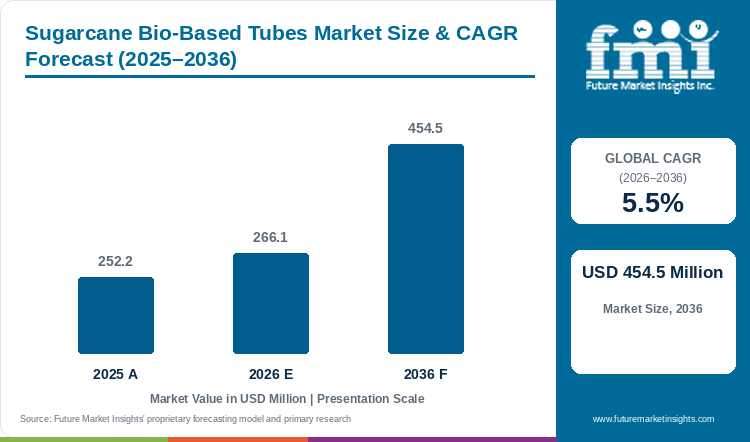
Brand spending on sugarcane bio-based tubes reaches USD 266.1 Million in 2026, compared with USD 252.2 Million in 2025, and FMI expects a 5.5% CAGR to carry the total to USD 454.5 Million by 2036.
Adoption of sugarcane bio-based tubes is projected to increase at 5.5% CAGR between 2026 and 2036, according to a recently updated report by FMI. Industry value is estimated at USD 266.1 Million in 2026, up from USD 252.2 Million in 2025, and is projected to reach USD 454.5 Million by 2036. The decade will add USD 188.4 Million of new revenue for tube converters, green resin suppliers and closure makers.
Increasing resin conversion by beauty brands inside existing tube formats is supporting the demand for sugarcane bio-based tubes, though green resin comes from a narrow supply base. Braskem increased output at Triunfo, Brazil, to 275,000 tons a year in May 2025, up from 200,000 tons at launch in 2010 [1]. Due to this, tube converters are competing with film, bottle and cap makers for the same green resin, and converters holding multi-year contracts will turn brand trials into volume orders first. As per opportunity analysis by FMI, skincare brands and the 15-50 ml band will take a larger part of new sales, as face creams and serums absorb the resin premium with little effect on pack cost. The EU Packaging and Packaging Waste Regulation entered into application on 12 August 2026 and sets 2030 for recycled content in plastic packaging and recyclability of all packaging [2]. As a result, orders for renewable and recycled packs are expected to arrive in a compressed window. However, tax rules treating renewable PE as virgin plastic will decide whether a bio-only tube stays cost-competitive.
Adjacent beauty packaging categories are also opening wider sales for the same converters. Sales in the bio-based PE skincare tubes market are forecast to increase from USD 383.6 Million in 2026 to USD 970.5 Million by 2036 at 9.7% CAGR, a USD 586.9 Million opportunity for tube converters. Growth is slower in closures, as the laminated tube closure market is expected to grow from USD 150.0 Million to USD 220.0 Million at 3.7% CAGR. Standard components will continue to hold the largest share of sales, as brands are preferring a resin switch inside proven tube formats. During the forecast period, sales are expected to rise fastest for hybrid tubes pairing a sugarcane PE sleeve with a PCR closure, owing to brand goals for carbon and recycled content in one pack.
Key Takeaways
- Notable companies in the sugarcane bio-based tubes market include Amcor, Berry Global, Albea, Quadpack, HCP Packaging, Aptar, Silgan Holdings, APC Packaging, Baralan and Gerresheimer.
- Based on product type, standard components are projected to account for 44% in 2026, owing to low switching risk on existing filling lines, and plastics & PCR resins are estimated at 39% by material.
- By capacity, the 15-50 ml band is expected to hold 35% in 2026, as face creams and serums absorb the resin premium, and skincare brands are projected to account for 33% by end use.
- The UAE is projected at 6.8% CAGR through 2036, followed by Saudi Arabia at 6.5%, as premium beauty retail in the Gulf is asking for documented lower-impact materials.
Analyst Perspective
“Hybrid tubes combining a sugarcane-derived PE sleeve, a PCR closure and a thinner wall will offer the largest revenue opportunity in this market through 2036. Converters documenting renewable content, recycled content and leak performance on one pack, with secured resin allocation from Brazil, will turn skincare trials into multi-year supply contracts.”
- Nandini Roy Choudhury, Principal Consultant, Future Market Insights
How is the Sugarcane Bio-Based Tubes Market Segmented?
The sugarcane bio-based tubes market is segmented into product type, material, capacity, decoration, end use and region.
The market is segmented by product type into standard components, sustainable & refill formats, premium decorated and custom engineered tubes. By material, the market is segmented into plastics & PCR resins, glass, paper & board, and aluminium & specialty. By capacity, the market is segmented into below 15 ml, 15-50 ml, 50-150 ml and above 150 ml. By decoration, the market is segmented into standard, printed & decorated, premium finishes, and smart / connected. By end use, the market is segmented into skincare brands, color cosmetics, hair & body, and fragrance. The regional analysis covers seven regions and more than 25 countries.
Why Do Standard Components Lead the Sugarcane Bio-Based Tubes Market by Product Type?
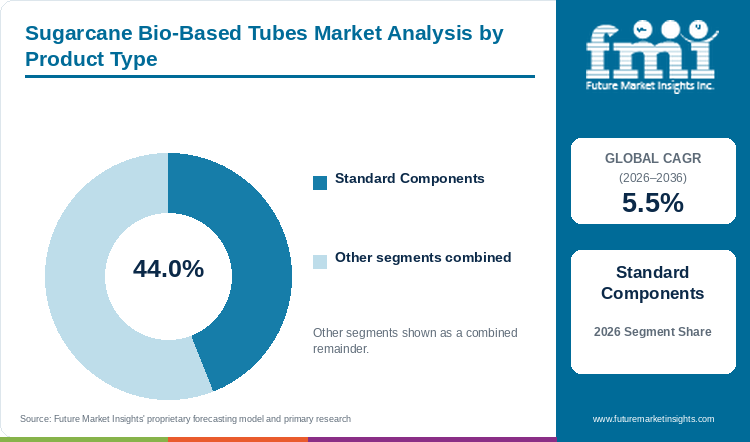
In 2026, standard components will account for 44% of market share by product type.
Increasing brand pledges to cut fossil plastic in beauty packaging are supporting the demand for sugarcane bio-based tubes in standard components. Packaging teams can change resin on an approved tube and leave neck, shoulder and cap designs untouched, owing to which standard parts open most switching projects. Refill-focused sustainable formats are growing at a slower pace, as consumers and fillers need time to adopt new pumps and refill steps. Decorated premium tubes call for repeat artwork and coating trials on each bio-based sleeve. Custom engineered designs face dedicated mold spend and longer sign-off timelines. However, pack integrity testing on thinner sleeves or new caps will decide the speed at which standard formats reach full production.
- Standard components are projected to account for 44% of demand by product type in 2026, supported by low switching risk on existing tube filling lines.
- In June 2025, Amcor confirmed that a thinner Bulldog tube sleeve stayed compatible with existing caps and shoulders without changes to filling processes [3].
Why Do Plastics & PCR Resins Lead the Sugarcane Bio-Based Tubes Market by Material?
By material, plastics & PCR resins will account for 39% of market share in 2026.
Tube converters prefer polymer sleeves for sugarcane conversion, as plant-based PE runs on existing extrusion and welding lines with good bounce-back and sealing performance. Brands want renewable content with no new filling equipment, owing to which plastics & PCR resins lead material choice, according to the latest FMI report. Jars and droppers sold next to a tube use glass in small volumes, since a rigid wall gives no squeeze. Board-based paper tubes are growing at a slower pace, as creams and serums still call for a plastic film inside the board. Aluminium and specialty formats serve a narrow group of formulas needing a high barrier, with recycling handled through another stream. Green PE capacity is also growing in the bio-based polyethylene market. However, access to green resin from one narrow source will decide the conversion speed of each tube maker.
- Plastics & PCR resins are estimated to hold 39% of demand by material in 2026, owing to polymer sleeves running on existing tube conversion lines.
- In May 2025, Braskem reported that green ethylene output at Triunfo had reached 275,000 tons a year after expansion [1].
Why Does the 15-50 ml Band Lead the Sugarcane Bio-Based Tubes Market by Capacity?
Based on capacity, the 15-50 ml band will account for 35% of market share in 2026.
Skincare brands are launching more renewable-pack facial products, supporting the demand for sugarcane bio-based tubes in the 15-50 ml band. A compact face cream or serum earns a high price per milliliter, owing to which brand owners absorb the green resin surcharge with minor change to total packaging spend. Sample and travel sizes below 15 ml generate modest sales for each tube. Body and hand care earn thinner margins, so 50-150 ml packs are growing at a slower pace on premium resin. Brands plan to move large tubes above 150 ml after skincare programs have validated the material, a sequence documented by the cosmetic tubes market. However, the yearly count of eco-pack facial launches will decide orders in this size range.
- The 15-50 ml band is projected to account for 35% of demand by capacity in 2026, owing to face care, serum and targeted treatment launches in renewable packs.
Why Does Standard Decoration Lead the Sugarcane Bio-Based Tubes Market by Decoration?
In 2026, standard decoration will account for 43% of market share by decoration.
Standard decoration is widely used in renewable tube programs, as brands moving to sugarcane PE keep artwork similar to the current pack. A familiar print route spares brands another recycling review and extra press changeovers, owing to which converters quote plain standard print on most switching orders. Printed and decorated tubes are growing at a slower pace, as each extra coating or ink layer requires bond testing on fresh sleeve stock. Premium finishes raise per-tube cost and prompt recycling questions from brand teams. Smart and connected tubes stay in pilot batches, as every embedded part needs a separate sign-off. However, recycler guidance on tinted and printed packs will decide spending on decorated bio-PE tubes.
- Standard decoration is expected to hold 43% of demand by decoration in 2026, supported by fewer line changes during material conversion.
- In July 2025, Japan's METI published design certification criteria under which PE or PP cosmetic containers stay uncolored or white, and container bodies carry no print unless laser printing is used [4].
Why Do Skincare Brands Lead the Sugarcane Bio-Based Tubes Market by End Use?
By end use, skincare brands will account for 33% of market share in 2026.
Skincare brands are buying more renewable tubes, as dosing control and product protection make the squeeze pack standard for creams, sunscreens and treatments. Published carbon goals give skincare buying teams a reason to pay a premium for plant-based feedstock, owing to which this group places the largest orders, as seen across the sugarcane packaging market. Color cosmetics account for smaller volumes, mainly small fills over a narrow product range. Hair and body lines are growing at a slower pace, as larger packs face strict cost targets. Fragrance relies mostly on glass bottles and orders few tubes. However, recycled-content targets will decide the split between bio-only sleeves and hybrid PCR packs for skincare buyers.
- Skincare brands are projected to account for 33% of demand by end use in 2026, owing to tube-friendly formulas and public sustainability commitments.
- Bulldog Skincare has used certified sugarcane-derived biopolymer since 2017, and the June 2025 Amcor redesign combined that biopolymer with more than 62% PCR plastic [3].
What are the Drivers, Restraints, and Opportunities in the Sugarcane Bio-Based Tubes Market?
As per FMI's analysis, brand decarbonization targets will drive renewable PE tubes, recycled-content rules will slow bio-only switches, and hybrid packs with PCR closures will open the most valuable pool till 2036.
- Driver: Beauty brands are reducing fossil feedstock in tubes without changing converting lines or PE recycling routes, due to which sugarcane PE is entering existing tube specifications.
- Restraint: Renewable PE counts as virgin plastic under recycled-content taxes, and the cost case for a bio-only switch is weaker as a result.
- Opportunity: Sugarcane PE sleeves paired with PCR closures and downgauged walls can help brands meet carbon and circularity targets in one pack.
Recycled-content policy in the UK and Europe is creating key challenges for sugarcane bio-based tubes. UK Plastic Packaging Tax applies to plastic packaging components containing less than 30% recycled plastic, and renewable origin does not count toward that threshold [5]. Hybrid packs are addressing this gap, as Bulldog tubes already combine sugarcane biopolymer with more than 62% PCR plastic and a thinner sleeve [3]. Hybrid designs of this type are expected to set the commercial standard, and growth in the bioplastics for packaging market will keep renewable resin in brand specifications.
Which Country CAGRs are Profiled in the Sugarcane Bio-Based Tubes Market?
| Country | CAGR, 2026 to 2036 |
|---|---|
| UAE | 6.8% |
| Saudi Arabia | 6.5% |
| South Korea | 6.2% |
| USA | 5.9% |
| UK | 5.5% |
| Germany | 5.2% |
| France | 4.9% |
| Japan | 4.6% |
How do Country-level CAGRs Compare in the Sugarcane Bio-Based Tubes Market?
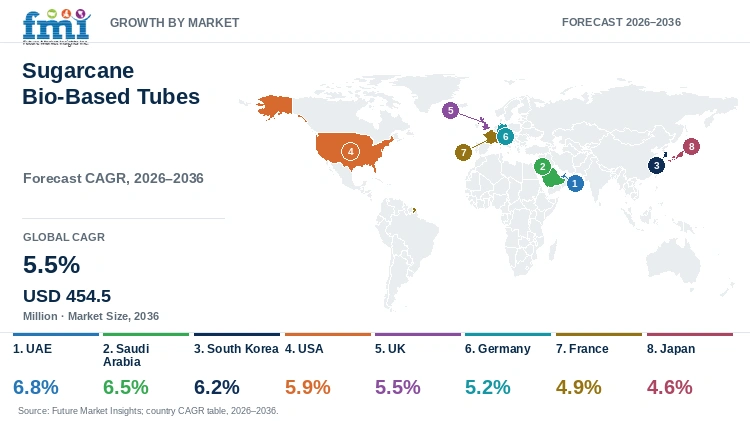
According to FMI's report, demand for sugarcane bio-based tubes is projected to grow fastest in the UAE at 6.8% and slowest in Japan at 4.6%. Growth rates across the eight profiled countries span 2.2 percentage points. The UAE, Saudi Arabia and South Korea are expected to grow above 6%, and France and Japan are forecast below 5%. A country lower in this ranking can still carry a bigger revenue base for tube converters.
- Demand in the Gulf is projected to rise fastest, with the UAE at 6.8% and Saudi Arabia at 6.5%, as premium beauty retail asks for documented lower-impact materials.
- South Korea will grow at 6.2% as the government prepares recycled-content targets for cosmetic and food containers [6].
- Japan will grow slowest at 4.6%, with design certification criteria favoring uncolored, recyclable PE and PP packs.
Brand owners planning regional tube rollouts will find growth rates for seven regions and over 25 national or grouped markets in the full study, beyond these eight country profiles.
Country Outlook
- Premium retail and travel channels are supporting the demand for sugarcane tubes in the UAE, the fastest market in the profiled group at 6.8% CAGR through 2036. Single-use plastic rules are raising expectations for documented lower-impact materials, and suppliers proving renewable content without loss of finish quality will hold the stronger procurement case.
- Brand-level sustainability programs will drive Saudi Arabian adoption at a 6.5% CAGR through 2036. Vision 2030 links waste management to circular-economy investment, and converters offering traceable bio-based PE with reliable regional lead times will gain ground first.
- South Korea plans to cut naphtha-based virgin plastic use by over 30% by 2030 and will set recycled-content targets for cosmetic and food containers [6]. Renewable carbon alone will not meet such targets, due to which demand for tubes in South Korea, projected at 6.2% CAGR, will favor suppliers blending renewable sleeves with PCR-compatible closures.
- California is setting the design benchmark for national US tube programs. CalRecycle approved SB 54 regulations in May 2026, targeting a 25% cut in covered material use, a 65% recycling rate and full recyclability or compostability of single-use packaging by 2032 [7]. Multi-state brands pairing sugarcane PE with lightweighting will set demand for tubes in the USA on a 5.9% CAGR path.
- Tax design limits the case for bio-only tubes in the UK, a market set to grow at a 5.5% CAGR till 2036. Plastic Packaging Tax applies to components with less than 30% recycled plastic, so a sugarcane PE sleeve without PCR stays taxable [5]. Suppliers offering renewable sleeves with recycled closures in one specification will see faster approvals.
- Germany's 5.2% CAGR will draw on a mature collection system that rewards packs fitting established PE streams. Dual systems recycled around 5.5 million tonnes of packaging waste in 2024, and plastic packaging reached a 70% material recycling rate [8]. Sugarcane PE sorts as conventional PE, keeping compliance friction low for brand owners.
- Brand owners in France face reuse, refill and lighter-pack pressure from the anti-waste and circular-economy law, and demand for tubes in France is projected to advance at 4.9% CAGR. Skincare and color-cosmetics brands will ask for evidence on pack weight and sortability before accepting a renewable feedstock claim.
- Japan grows slowest among the profiled countries at 4.6%, yet policy support for biomass plastics remains strong. METI published design certification criteria for household cosmetic containers in July 2025, favoring uncolored or white PE and PP bodies with separable caps [4]. Precise material identification will turn renewable-carbon claims into orders.
Who are the Notable Companies in the Sugarcane Bio-Based Tubes Market?
Amcor with Berry Global, Albea, Quadpack and HCP Packaging compete on qualified tube conversion, Aptar, Silgan Holdings and APC Packaging contest the PCR closure layer, and Baralan and Gerresheimer supply premium components around the pack.
Braskem runs the 275,000-ton green ethylene base behind I'm green polyethylene, due to which a single resin source supplies most renewable content for sugarcane bio-based tubes and holds the strongest pricing power [1]. Tube converters below this resin tier are moderately consolidated and compete on validated pack performance, and Amcor ran squeeze, print and leak trials before cutting Bulldog sleeve thickness [3]. Each completed brand trial is building loyalty for the converter, as a new supplier needs to rebuild the full qualification record before a skincare label moves volume. Consolidation is increasing in the converter tier, with Berry Global now part of Amcor and Silgan adding the Weener dispensing network. Closure suppliers are also adding recycled options, as Aptar added four e-commerce closures in PCR versions in July 2026 [9]. However, recycled-content rules will push brands to buy sleeve and PCR closure together as one audited pack, and competition in the closure layer is expected to increase through 2036.
- Tube and Squeezable-Pack Platforms: Amcor, Berry Global, Albea, Quadpack and HCP Packaging convert tube sleeves and tottles, and Amcor combined sugarcane biopolymer with PCR plastic in Bulldog tubes [3].
- Dispensing, Closure and Custom-Component Platforms: Aptar, Silgan Holdings and APC Packaging supply closures, dispensing systems and custom beauty packs, with Aptar offering PCR versions of e-commerce closures [9].
- Premium Rigid and Beauty-Component Ecosystems: Baralan and Gerresheimer add premium rigid components, accessories and decoration for coordinated brand packaging.
Competitive Benchmarking
| Company | Tube & Squeezable Pack Capability | Renewable / Recycled Material Options | Dispensing & Closure Integration | Geographic Reach |
|---|---|---|---|---|
| Amcor | High | High | High | Americas, Europe and Asia-Pacific |
| Berry Global | High | High | High | North America, Europe and Asia-Pacific, within Amcor |
| Albea | High | High | High | Global tube network across multiple regions |
| Quadpack | High | High | Medium | Europe, USA and Asia-Pacific |
| HCP Packaging | High | Medium | High | Asia and other major beauty markets |
| Aptar | Low | Medium | High | North America, Latin America, EMEA and Asia |
| Silgan Holdings | Low | Medium | High | Americas, Europe and Asia |
| APC Packaging | Medium | Medium | Medium | USA base with international beauty programs |
| Baralan | Low | Medium | Medium | More than 70 countries |
| Gerresheimer | Low | Medium | Medium | More than 40 sites in 16 countries |
Scoring basis: Tube & Squeezable Pack Capability scores documented commercial tube or tottle capability. Renewable / Recycled Material Options scores documented renewable or PCR material choices. Dispensing & Closure Integration scores tube-relevant closures or dispensing systems. A High rating reflects broad evidence of capability, a Medium rating reflects a narrower proven range, and a Low rating reflects thin public records. Geographic Reach covers plants or sales networks evidenced in an October 2026 review.
Key Developments
- In May 2025, Braskem reported that green ethylene capacity for I'm green bio-based polyethylene at Triunfo, Brazil, had reached 275,000 tons a year, up from 200,000 tons at launch in 2010 [1].
- In June 2025, Amcor cut the wall thickness of 50 mm Bulldog tube sleeves by more than 16%, saving 8.5 tonnes of plastic a year after squeeze, print and leak trials [3].
- In July 2026, Aptar added four e-commerce-ready closures for beauty, personal care and home care, all tested to Amazon ISTA-6 and offered in PCR versions [9].
Key Players
Tube and Squeezable-Pack Platforms
- Amcor
- Berry Global
- Albea
- Quadpack
- HCP Packaging
Dispensing, Closure and Custom-Component Platforms
- Aptar
- Silgan Holdings
- APC Packaging
Premium Rigid and Beauty-Component Ecosystems
- Baralan
- Gerresheimer
Report Scope and Methodology
| Coverage field | Report scope |
|---|---|
| Market breakdown | Product Type (Standard components, Sustainable & refill formats, Premium decorated, Custom engineered), Material (Plastics & PCR resins, Glass, Paper & board, Aluminium & specialty), Capacity (15-50 ml, Below 15 ml, 50-150 ml, Above 150 ml), Decoration (Standard, Printed & decorated, Premium finishes, Smart / connected), End Use (Skincare brands, Color cosmetics, Hair & body, Fragrance), and Region |
| Quantitative units | USD Million |
| Market definition | Revenue from sugarcane bio-based tube packaging and tube-led primary packaging configurations sold within the defined segmentation. The definition excludes downstream cosmetic or personal-care formulation revenue and standalone bottles, jars, pumps and closures not sold as part of a tube-led pack. |
| Regions covered | North America, Latin America, Western Europe, Eastern Europe, East Asia, South Asia and Pacific, Middle East and Africa |
| Countries covered | The UAE, Saudi Arabia, South Korea, the USA, the UK, Germany, France and Japan, within a wider set of over 25 national and grouped markets |
| Key companies profiled | Amcor, Berry Global, Albea, Quadpack, HCP Packaging, Aptar, Silgan Holdings, APC Packaging, Baralan and Gerresheimer, selected from a broader supplier base serving beauty tube programs |
| Forecast period | 2026 to 2036 |
| Approach | A triangulated framework used by FMI combines primary interviews with secondary research and reconciles segment, country and supplier revenue signals within the defined tube scope. |
Research Methodology
| Method | Approach |
|---|---|
| Primary research | Beauty brand packaging teams, tube converters, resin suppliers, closure and dispensing makers, distributors and procurement staff are interviewed on purchase drivers, approval steps, pricing and the test records a brand asks for before moving a trial tube into repeat orders. |
| Desk research | The analysis reviews regulatory publications, government statistics, company announcements, product documentation and technical literature, retaining sources that are relevant, recent and consistent with the defined tube scope. |
| Market sizing and forecasting | Sizing starts from the baseline value and layers in segment mix, tube price and volume signals, supplier participation and demand by country. Forecasts weigh packaging regulation, resin supply, brand sustainability programs and purchasing cycles. |
| Data validation | Interview findings, public data and supplier activity serve as cross-checks on every estimate. Formulation revenue, standalone components, double-counted revenue and unverified claims are stripped out before the final tube totals are reconciled. |
Sugarcane Bio-Based Tubes Market by Segments
Sugarcane Bio-Based Tubes Market Segmented by Product Type
- Standard Components
- Sustainable & Refill Formats
- Premium Decorated
- Custom Engineered
Sugarcane Bio-Based Tubes Market Segmented by Material
- Plastics & PCR Resins
- Glass
- Paper & Board
- Aluminium & Specialty
Sugarcane Bio-Based Tubes Market Segmented by Capacity
- 15-50 ml
- Below 15 ml
- 50-150 ml
- Above 150 ml
Sugarcane Bio-Based Tubes Market Segmented by Decoration
- Standard
- Printed & Decorated
- Premium Finishes
- Smart / Connected
Sugarcane Bio-Based Tubes Market Segmented by End Use
- Skincare Brands
- Color Cosmetics
- Hair & Body
- Fragrance
Sugarcane Bio-Based Tubes Market Segmented by Region
- North America
- Latin America
- Western Europe
- Eastern Europe
- East Asia
- South Asia and Pacific
- Middle East and Africa
Research Sources and Bibliography
- [1] Braskem (2025, May 6). Celebrating 15 Years of I'm green bio-based with operation rates above nameplate capacity after expansion.
- [2] European Commission (2026, August 11). New EU rules on packaging enter into application.
- [3] Amcor (2025, June 10). Amcor achieves over 16% plastic reduction in flexible tubes for Bulldog.
- [4] Packaging Europe (2025, September 10). Japan reveals certification criteria for PET bottles, cosmetics and more.
- [5] HM Revenue & Customs (2026, February 12). Plastic Packaging Tax: steps to take.
- [6] Korea.net (2026, April 28). Acceleration of plastic-free policy eyes 30% drop in use by 2030.
- [7] Packaging Dive (2026, May). At long last, California publishes SB 54 EPR rules.
- [8] German Environment Agency (2026, January 27). Facts against myths: Packaging waste recycling in Germany is working.
- [9] Aptar (2026, July 8). Aptar Closures strengthens portfolio of e-commerce-ready closures for beauty, personal care and home care applications.
This bibliography is provided for reader reference and is not exhaustive. The full report contains the complete reference list and detailed citations.
This Report Answers
- What will brand owners spend on sugarcane bio-based tubes in 2026, and what size will the category reach by 2036?
- Which brand decarbonization goals and packaging rules will keep sugarcane-derived tubes in beauty packaging specifications?
- Why will brands converting to renewable resin favor standard components over other product types in 2026?
- Why will Plastics & PCR resins lead the Material category?
- Why will the 15-50 ml band and skincare brands anchor demand by capacity and end use?
- Which of the UAE, Saudi Arabia, South Korea, the USA, the UK, Germany, France and Japan will see the fastest tube conversions till 2036?
- To what extent will recycled-content thresholds slow bio-only tube conversions through 2036?
- What will brands need to verify before converting a tube program to sugarcane-derived polyethylene?
Frequently Asked Questions
How Big Is the Sugarcane Bio-Based Tubes Market Expected to Be in 2026?
Sugarcane bio-based tubes will generate USD 266.1 Million in 2026, against USD 252.2 Million in 2025, based on FMI estimates. Beauty brands converting tube sleeves to renewable polyethylene will take the category to USD 454.5 Million by 2036.
What Is the CAGR of the Sugarcane Bio-Based Tubes Market from 2026 to 2036?
Beauty brands will expand sugarcane tube purchases at a 5.5% CAGR between 2026 and 2036. Volume shifts only after squeeze, print and leak tests pass on the new resin, so final-pack qualification governs the rate of growth.
Which Product Type Holds the Largest Share of the Sugarcane Bio-Based Tubes Market?
Standard components will lead with 44% of market share by product type in 2026. Familiar neck finishes, caps and filling interfaces will keep requalification work low for converting brands.
Which Material Leads the Sugarcane Bio-Based Tubes Market?
Plastics & PCR resins will take 39% of market share by material in 2026. Flexible polymer sleeves will remain the closest match for squeezability, sealing and tube conversion.
Which Country Is Expected to Grow Fastest in the Sugarcane Bio-Based Tubes Market?
UAE beauty brands and retailers will increase demand for tubes at the quickest pace, a 6.8% CAGR till 2036, with Saudi Arabia next at 6.5% and South Korea at 6.2%. Demand for tubes in Japan, shaped by strict design certification for cosmetic containers, will post the lowest rate of the eight profiled countries at 4.6%.
What Notable Restraint Affects the Sugarcane Bio-Based Tubes Market?
Key challenges will come from recycled-content rules that treat renewable PE as virgin plastic. A bio-only tube will stay exposed to the UK Plastic Packaging Tax and similar measures unless PCR components are added to the pack.
Which Are the Key Companies in the Sugarcane Bio-Based Tubes Market?
Beauty brands sourcing sugarcane tubes will meet Amcor, Berry Global, Albea, Quadpack, HCP Packaging, Aptar, Silgan Holdings, APC Packaging, Baralan and Gerresheimer in FMI's supplier coverage. These suppliers are grouped by tube conversion, closures and dispensing, or premium beauty components.
Preview the report firsthand - request a free sample
Get SampleGet the brochure for pricing and purchase details.
Get PDFTable of Content
- Key Takeaways
- Market Size and CAGR
- Top Growth Driver
- Fastest Growing Segment
- Leading Region
- Key Companies
- Emerging Opportunities
- Executive Summary
- Global Market Outlook
- Demand-side Trends
- Supply-side Trends
- Technology Roadmap Analysis
- Analysis and Recommendations
- Analyst Perspective (What is happening? Why now? What should investors know?)
- Key Questions Answered
- How large is the market?
- What is the CAGR?
- What are key trends?
- Which region dominates?
- Who are the leaders?
- Market Overview
- Market Coverage / Taxonomy
- Market Definition / Scope / Limitations
- Research Methodology
- Chapter Orientation
- Analytical Lens and Working Hypotheses
- Market Structure, Signals, and Trend Drivers
- Benchmarking and Cross-market Comparability
- Market Sizing, Forecasting, and Opportunity Mapping
- Research Design and Evidence Framework
- Desk Research Programme (Secondary Evidence)
- Expert Input and Fieldwork (Primary Evidence)
- Tooling, Models, and Reference Databases
- Data Engineering and Model Build
- Quality Assurance and Audit Trail
- Market Background
- Market Dynamics (Drivers, Restraints, Opportunity, Trends)
- Scenario Forecast (Optimistic, Likely, Conservative)
- Impact Analysis
- AI Impact
- Sustainability Impact
- Regulatory Impact
- Technology Impact
- Consumer / Buyer Analysis
- Purchase Drivers
- Adoption Barriers
- Buyer Journey
- Opportunity Map Analysis
- Product Life Cycle Analysis
- Supply Chain Analysis
- Investment Feasibility Matrix
- Value Chain Analysis
- PESTLE and Porter's Analysis
- Regulatory Landscape
- Regional Parent Market Outlook
- Production and Consumption Statistics
- Import and Export Statistics
- Global Market Analysis and Forecast, 2021 to 2036
- Historical Market Size Value (USD Million) Analysis, 2021 to 2025
- Current and Future Market Size Value (USD Million) Projections, 2026 to 2036
- Y-o-Y Growth Trend Analysis
- Absolute $ Opportunity Analysis
- Global Market Pricing Analysis, 2021 to 2036
- Global Market Analysis and Forecast, By Product Type, 2021 to 2036
- Introduction / Key Findings
- Historical Market Size Value (USD Million) Analysis By Product Type, 2021 to 2025
- Current and Future Market Size Value (USD Million) Analysis and Forecast By Product Type, 2026 to 2036
- Standard Components
- Sustainable & Refill Formats
- Premium Decorated
- Custom Engineered
- Y-o-Y Growth Trend Analysis By Product Type, 2021 to 2025
- Absolute $ Opportunity Analysis By Product Type, 2026 to 2036
- Global Market Analysis and Forecast, By Material, 2021 to 2036
- Introduction / Key Findings
- Historical Market Size Value (USD Million) Analysis By Material, 2021 to 2025
- Current and Future Market Size Value (USD Million) Analysis and Forecast By Material, 2026 to 2036
- Plastics & PCR Resins
- Glass
- Paper & Board
- Aluminium & Specialty
- Y-o-Y Growth Trend Analysis By Material, 2021 to 2025
- Absolute $ Opportunity Analysis By Material, 2026 to 2036
- Global Market Analysis and Forecast, By Capacity, 2021 to 2036
- Introduction / Key Findings
- Historical Market Size Value (USD Million) Analysis By Capacity, 2021 to 2025
- Current and Future Market Size Value (USD Million) Analysis and Forecast By Capacity, 2026 to 2036
- 15-50 ml
- Below 15 ml
- 50-150 ml
- Above 150 ml
- Y-o-Y Growth Trend Analysis By Capacity, 2021 to 2025
- Absolute $ Opportunity Analysis By Capacity, 2026 to 2036
- Global Market Analysis and Forecast, By Decoration, 2021 to 2036
- Introduction / Key Findings
- Historical Market Size Value (USD Million) Analysis By Decoration, 2021 to 2025
- Current and Future Market Size Value (USD Million) Analysis and Forecast By Decoration, 2026 to 2036
- Standard
- Printed & Decorated
- Premium Finishes
- Smart / Connected
- Y-o-Y Growth Trend Analysis By Decoration, 2021 to 2025
- Absolute $ Opportunity Analysis By Decoration, 2026 to 2036
- Global Market Analysis and Forecast, By End Use, 2021 to 2036
- Introduction / Key Findings
- Historical Market Size Value (USD Million) Analysis By End Use, 2021 to 2025
- Current and Future Market Size Value (USD Million) Analysis and Forecast By End Use, 2026 to 2036
- Skincare Brands
- Color Cosmetics
- Hair & Body
- Fragrance
- Y-o-Y Growth Trend Analysis By End Use, 2021 to 2025
- Absolute $ Opportunity Analysis By End Use, 2026 to 2036
- Global Market Analysis and Forecast, By Region, 2021 to 2036
- Introduction
- Historical Market Size Value (USD Million) Analysis By Region, 2021 to 2025
- Current Market Size Value (USD Million) Analysis and Forecast By Region, 2026 to 2036
- North America
- Latin America
- Western Europe
- Eastern Europe
- East Asia
- South Asia and Pacific
- Middle East and Africa
- Market Attractiveness Analysis By Region
- North America Market Analysis and Forecast, By Country, 2021 to 2036
- Historical Market Size Value (USD Million) Trend Analysis By Market Taxonomy, 2021 to 2025
- Market Size Value (USD Million) Forecast By Market Taxonomy, 2026 to 2036
- By Country
- By Product Type
- By Material
- By Capacity
- By Decoration
- By End Use
- Market Attractiveness Analysis
- By Country
- By Product Type
- By Material
- By Capacity
- By Decoration
- By End Use
- Key Takeaways
- Latin America Market Analysis and Forecast, By Country
- Historical Market Size Value (USD Million) Trend Analysis By Market Taxonomy, 2021 to 2025
- Market Size Value (USD Million) Forecast By Market Taxonomy, 2026 to 2036
- By Country
- By Product Type
- By Material
- By Capacity
- By Decoration
- By End Use
- Market Attractiveness Analysis
- By Country
- By Product Type
- By Material
- By Capacity
- By Decoration
- By End Use
- Key Takeaways
- Western Europe Market Analysis and Forecast, By Country
- Historical Market Size Value (USD Million) Trend Analysis By Market Taxonomy, 2021 to 2025
- Market Size Value (USD Million) Forecast By Market Taxonomy, 2026 to 2036
- By Country
- By Product Type
- By Material
- By Capacity
- By Decoration
- By End Use
- Market Attractiveness Analysis
- By Country
- By Product Type
- By Material
- By Capacity
- By Decoration
- By End Use
- Key Takeaways
- Eastern Europe Market Analysis and Forecast, By Country
- Historical Market Size Value (USD Million) Trend Analysis By Market Taxonomy, 2021 to 2025
- Market Size Value (USD Million) Forecast By Market Taxonomy, 2026 to 2036
- By Country
- By Product Type
- By Material
- By Capacity
- By Decoration
- By End Use
- Market Attractiveness Analysis
- By Country
- By Product Type
- By Material
- By Capacity
- By Decoration
- By End Use
- Key Takeaways
- East Asia Market Analysis and Forecast, By Country
- Historical Market Size Value (USD Million) Trend Analysis By Market Taxonomy, 2021 to 2025
- Market Size Value (USD Million) Forecast By Market Taxonomy, 2026 to 2036
- By Country
- By Product Type
- By Material
- By Capacity
- By Decoration
- By End Use
- Market Attractiveness Analysis
- By Country
- By Product Type
- By Material
- By Capacity
- By Decoration
- By End Use
- Key Takeaways
- South Asia and Pacific Market Analysis and Forecast, By Country
- Historical Market Size Value (USD Million) Trend Analysis By Market Taxonomy, 2021 to 2025
- Market Size Value (USD Million) Forecast By Market Taxonomy, 2026 to 2036
- By Country
- By Product Type
- By Material
- By Capacity
- By Decoration
- By End Use
- Market Attractiveness Analysis
- By Country
- By Product Type
- By Material
- By Capacity
- By Decoration
- By End Use
- Key Takeaways
- Middle East and Africa Market Analysis and Forecast, By Country
- Historical Market Size Value (USD Million) Trend Analysis By Market Taxonomy, 2021 to 2025
- Market Size Value (USD Million) Forecast By Market Taxonomy, 2026 to 2036
- By Country
- By Product Type
- By Material
- By Capacity
- By Decoration
- By End Use
- Market Attractiveness Analysis
- By Country
- By Product Type
- By Material
- By Capacity
- By Decoration
- By End Use
- Key Takeaways
- Key Countries Market Analysis
- UAE
- Pricing Analysis
- Market Share Analysis, 2025
- By Product Type
- By Material
- By Capacity
- By Decoration
- By End Use
- Saudi Arabia
- Pricing Analysis
- Market Share Analysis, 2025
- By Product Type
- By Material
- By Capacity
- By Decoration
- By End Use
- South Korea
- Pricing Analysis
- Market Share Analysis, 2025
- By Product Type
- By Material
- By Capacity
- By Decoration
- By End Use
- USA
- Pricing Analysis
- Market Share Analysis, 2025
- By Product Type
- By Material
- By Capacity
- By Decoration
- By End Use
- UK
- Pricing Analysis
- Market Share Analysis, 2025
- By Product Type
- By Material
- By Capacity
- By Decoration
- By End Use
- Germany
- Pricing Analysis
- Market Share Analysis, 2025
- By Product Type
- By Material
- By Capacity
- By Decoration
- By End Use
- France
- Pricing Analysis
- Market Share Analysis, 2025
- By Product Type
- By Material
- By Capacity
- By Decoration
- By End Use
- Japan
- Pricing Analysis
- Market Share Analysis, 2025
- By Product Type
- By Material
- By Capacity
- By Decoration
- By End Use
- UAE
- Market Structure Analysis
- Competition Dashboard
- Competition Benchmarking
- Market Share Analysis of Top Players
- By Regional
- By Product Type
- By Material
- By Capacity
- By Decoration
- By End Use
- Emerging Startups
- Innovation Benchmarking
- Competition Analysis
- Competition Deep Dive
- Amcor
- Overview
- Product Portfolio
- Profitability by Market Segments
- Sales Footprint
- Strategy Overview
- Marketing Strategy
- Product Strategy
- Channel Strategy
- Berry Global
- Albea
- Quadpack
- HCP Packaging
- Aptar
- Silgan Holdings
- APC Packaging
- Baralan
- Gerresheimer
- Amcor
- Case Studies
- Success Stories
- Recent Developments
- Competition Deep Dive
- Assumptions & Acronyms Used


