

- Market Size (2026)
- USD 105.8 Bn
- Forecast (2036)
- USD 248.2 Bn
- CAGR (2026 to 2036)
- 8.9%
How big is Sustainable Drug Manufacturing Market in 2026?
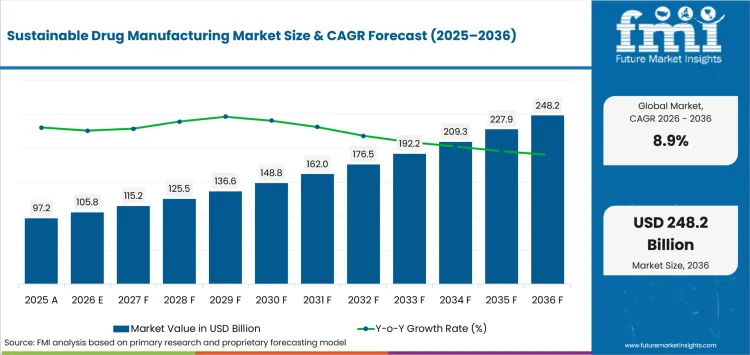
USD 105.8 billion in 2026 and USD 248.2 billion by 2036 at an 8.9% CAGR.
Sales are estimated to rise at 8.9% CAGR through 2036, from USD 105.8 billion in 2026 to USD 248.2 billion by 2036. Sustainability objectives are becoming more closely integrated with pharmaceutical production requirements as manufacturers seek to improve resource efficiency without compromising product quality. The WHO's June 2026 draft guidance incorporates environmental performance indicators into GMP systems, bringing energy, water, and resource considerations into validated manufacturing environments. Equipment suppliers and drug manufacturers increasingly need to demonstrate both operational efficiency and regulatory compliance within production processes.
How these objectives are pursued varies across national innovation and regulatory frameworks. The United Kingdom is promoting greener manufacturing through coordinated public-sector initiatives. UK Research and Innovation identified eight Grand Challenge projects in November 2025 focused on sustainable medicines manufacturing. These programs encourage shared development of lower-impact production technologies across the industry. In contrast, USA manufacturers more commonly advance sustainability through sponsor-led qualification programs, placing validation activities within individual continuous manufacturing strategies and facility-specific implementation plans.
Key Takeaways of Sustainable Drug Manufacturing Market
- Manufacturers place energy, water, solvent and waste measures inside validated process development and commercial capital decisions.
- Small molecules are projected at 58.0% in 2026 owing to direct control over route design and solvent selection.
- Continuous manufacturing is estimated at 31.0% in 2026 attributable to connected operations that reduce intermediate material losses.
- Tablets are forecast at 30.0% in 2026 supported by mature solid-dose infrastructure and integrated processing routes.
- Validated comparability restrains adoption as process changes require revised controls, stability evidence and regulatory review.
- AstraZeneca plc, Pfizer Inc., Novartis AG, Roche Holding AG, Merck & Co., Inc., GSK plc, Sanofi and Lonza Group AG comprise the notable players in the industry.
Analyst Perspective
"Manufacturers should compare lower-impact routes by process mass intensity, validation burden and transferability across registered sites. Commercial value comes from solvent and energy reductions that preserve release performance and avoid repeated regulatory work."
- Anurag Sharma, Principal Consultant, Future Market Insights
How is the Sustainable Drug Manufacturing Market segmented?
The sustainable drug manufacturing market is segmented by product type, process type, formulation, end user, technology and region.
The market covers product type, process type, formulation, end user, technology and region. Product types include small molecules, biosimilars, generic drugs and vaccines. Process types include continuous manufacturing, green chemistry, single-use bioprocessing systems and AI-driven quality assurance. Formulations cover tablets, injectables, capsules and topical or transdermal products. End users include pharmaceutical companies and contract manufacturers. Technologies cover green synthesis, continuous production, energy efficiency and circular manufacturing.
How do Small molecules shape demand within the Product type category?
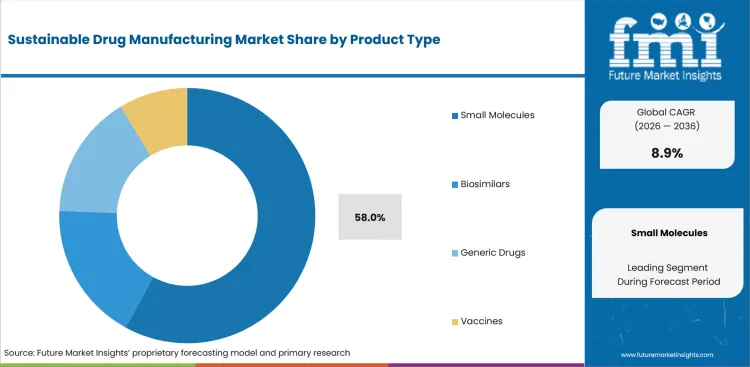
Small-molecule manufacturing exposes solvent use and reaction efficiency alongside purification losses during development, letting process chemists compare pharmaceutical solvents and catalysts before commercial controls make later changes costly.
- By product type, small molecules are estimated to hold 58.0% in 2026 owing to measurable efficiency gains across API synthesis and drug-product processing.
- Process teams compare material intensity beside yield and impurity control during scale-up so early route changes reduce validation work across registered operations.
What makes Continuous manufacturing central to the Process type category?
Continuous production connects material flow and residence time with monitoring across one train, reducing intermediate holding but requiring product-specific disturbance recovery.
- In 2026, continuous manufacturing is expected to lead the process type category with 31.0% share as connected operations reduce work-in-process exposure.
- Sponsors align residence-time models with process controls and at-line quality testing during product-specific regulatory preparation, preserving validation for new launches or conversions from batch manufacturing.
How do Pharmaceutical companies shape demand within the End-user category?
Pharmaceutical companies control route selection, regulatory submissions and network standards from development through commercial supply. Their capital decisions determine whether resource measures remain local trials or become requirements across approved sites.
- Pharmaceutical companies are set to lead the end-user category with 69.0% share in 2026 due to direct responsibility for validation and lifecycle management.
- Early technical engagement tests how connected controls fit each product strategy across smart factory systems, leaving sponsors responsible for evidence transfer and dependable release performance at every approved site.
Why do Tablets lead demand within the Formulation category?
Tablet production uses mature blending, compression and coating operations to expose energy demand and material losses across solid-dose equipment during commercial scale-up.
- Based on formulation, tablets are projected to account for 30.0% in 2026 due to broad commercial use and compatibility with integrated solid-dose processing.
- Continuous direct compression reduces holding steps and intermediate losses but requires control of blend uniformity, dissolution and disturbance recovery for commercial adoption.
What are the drivers, restraints and opportunities in the Sustainable Drug Manufacturing Market?
Regulatory metrics strengthen process governance, comparability work limits retrofits and early route design offers the clearest path to lower resource intensity.
- Driver: Regulators and manufacturers are formalizing measures for energy, water, materials, emissions and production waste inside pharmaceutical quality systems.
- Restraint: Established products require science-based comparability for any replacement of approved equipment or registered operating parameters.
- Opportunity: Early development can combine green chemistry, digital control and single-use bioreactors before resource-intensive routes become fixed.
Environmental Metrics Enter Process Governance
Manufacturers compare energy, water and material intensity beside yield or cycle time so GMP integration can assess capital projects against validated performance.
Comparability Work Slows Retrofitted Processes
Retrofitting an approved product can trigger revised controls and site comparability studies that reduce the economic value of modest resource savings.
Early Route Design Reduces Locked-In Resource Use
Early route design uses process mass intensity to compare solvent demand and purification losses, directing medical waste management and digital monitoring toward changes that preserve yield and release performance.
Which country CAGRs are profiled in the Sustainable Drug Manufacturing Market?
| Country | CAGR |
|---|---|
| United Kingdom | 9.0% |
| Germany | 8.8% |
| United States | 8.7% |
| Canada | 8.6% |
| Japan | 8.4% |
How do country-level CAGRs compare in the Sustainable Drug Manufacturing Market?
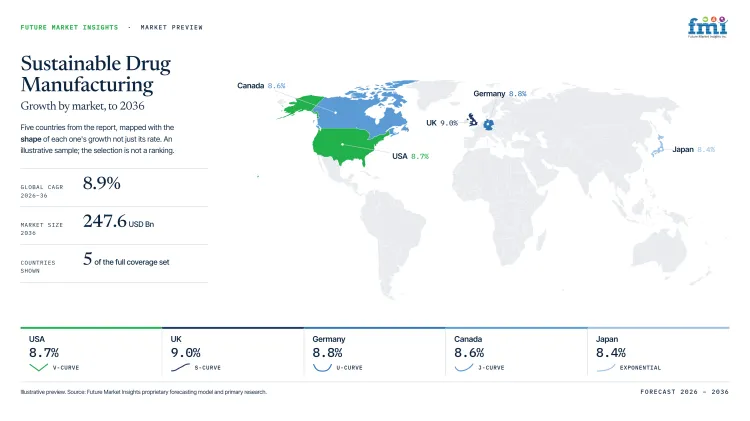
The forecasts span 0.6 percentage points between the United Kingdom and Japan, but similar CAGRs do not establish market size across different regulatory and scale-up routes.
- The United Kingdom is forecast at 9.0% as demonstration programs connect technical development with industrial partners.
- Germany is projected at 8.8% as advanced manufacturing initiatives strengthen industrial adoption and production capabilities.
- The United States is projected at 8.7% as FDA engagement supports product-specific advanced manufacturing pathways.
- Canada is anticipated at 8.6% as research hubs strengthen translation although utilization remains project dependent.
- Japan is estimated at 8.4% as government-backed manufacturing initiatives support modernization and technology integration.
Comparable CAGRs can produce different entry conditions owing to national approval routes and manufacturing infrastructure. The full report extends analysis across seven FMI regions and more than twenty national markets.
- The United Kingdom is likely to emerge as one of the steady markets, with sustainable drug manufacturing demand advancing at a 9.0% CAGR through 2036. Regulatory agencies are taking a more active role in preparing manufacturers for modern production approaches. The MHRA Innovation Office began supporting novel manufacturing processes in July 2026, providing developers with an early pathway for scientific and regulatory engagement. Demonstration facilities and collaborative projects offer opportunities to evaluate lower-impact production methods before commercial adoption. Sponsors must nevertheless demonstrate measurable process improvements and establish a clear transition path from pilot programs to licensed manufacturing.
- Germany is on course to expand at an 8.8% CAGR by 2036 as regulatory support and advanced manufacturing infrastructure encourage production innovation. National research programs and industry collaborations are strengthening capabilities for modern pharmaceutical manufacturing. Demonstration facilities and collaborative projects offer opportunities to evaluate lower-impact production methods before commercial adoption. Manufacturers must nevertheless demonstrate measurable process improvements and establish a clear transition path from development programs to licensed manufacturing.
- The United States is positioned to grow at an 8.7% CAGR over the forecast period because manufacturers can engage regulators during the development of advanced production technologies. FDA's FRAME initiative includes continuous manufacturing and artificial intelligence among its key focus areas. Early interaction supports evaluation of process changes before large-scale implementation. Resource-efficiency gains alone are rarely sufficient to justify adoption, as sponsors must also demonstrate product quality, comparability, and manufacturing consistency across commercial operations.
- Canada's market is likely to advance at an 8.6% CAGR during the assessment period, benefiting from coordinated research and biomanufacturing initiatives. Five national research hubs connect life-science innovation with workforce development and domestic production capabilities. The network creates opportunities to move sustainable manufacturing concepts toward commercial application. Market adoption remains highly project dependent, making technology-transfer expertise and access to experienced contract manufacturing partners important considerations for scale-up activities.
- Japan is expected to register 8.4% CAGR growth through 2036, supported by national efforts to modernize pharmaceutical production and strengthen advanced manufacturing capabilities. Government programs and research institutions contribute technical expertise during process development and evaluation. Industry partnerships provide opportunities to assess lower-impact production methods before broader commercial adoption. Expansion remains dependent on workforce availability and effective technology-transfer strategies tailored to individual manufacturing applications.
Who are the notable companies in the Sustainable Drug Manufacturing Market?
AstraZeneca plc, Pfizer Inc., Novartis AG, Roche Holding AG, Merck & Co., Inc., GSK plc, Sanofi and Lonza Group AG are the notable companies serving this market.
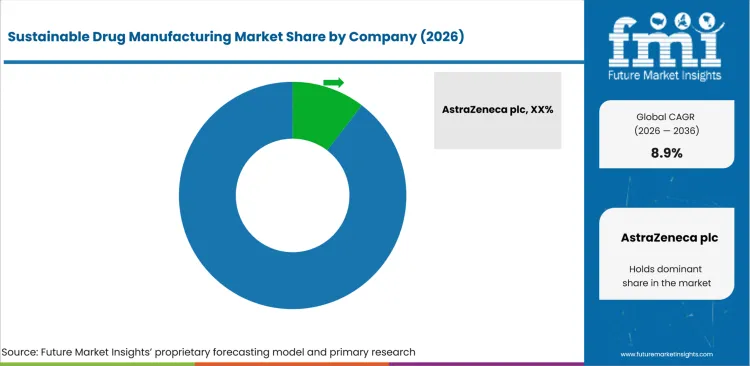
The field combines global drug manufacturers with one large CDMO, and entry requires validated redesign plus resource data for technology transfer across registered networks.
- AstraZeneca plc, Pfizer Inc., Novartis AG and Merck & Co., Inc. document route-design or solvent-efficiency methods across small-molecule manufacturing networks.
- Roche Holding AG, GSK plc and Sanofi connect facility energy programs with product-specific manufacturing or eco-design controls.
- Lonza Group AG applies sustainable-design standards and renewable electricity arrangements across customer manufacturing assets globally.
Competitive Benchmarking: Sustainable Drug Manufacturing Market
| Company | Sustainable Process Design | Low-Carbon Operations | Circular Resource Management | Geographic Reach |
|---|---|---|---|---|
| AstraZeneca plc | High | High | Medium | Global |
| Pfizer Inc. | High | High | High | Global |
| Novartis AG | High | High | High | Global |
| Roche Holding AG | Medium | High | High | Global |
| Merck & Co., Inc. | High | High | Medium | Global |
| GSK plc | Medium | High | Medium | Global |
| Sanofi | High | High | Medium | Global |
| Lonza Group AG | Medium | High | High | Global |
Scoring basis: Sustainable process design receives High for portfolio-wide methods, Medium for selected programs and Low for one documented route. Low-carbon operations receive High for network targets, Medium for selected sites and Low for one intervention. Circular management receives High for repeatable systems, Medium for limited programs and Low for one verified practice. Geographic reach describes verified operating regions, and missing official evidence receives no rating in the table.
Key Developments in the Sustainable Drug Manufacturing Market
- In February 2026, Roche inaugurated a biomass heating plant at Penzberg using residual forest wood to supply process steam for CustomBiotech production and reduce fossil-energy exposure.
- In January 2026, Lonza reported renewable electricity for all purchased power across its United States sites and operations in Europe and China.
- In May 2025, Sanofi confirmed that medicines and vaccines used eco-design and life-cycle assessment informed manufacturing choices before regulatory submission.
Key Players in the Sustainable Drug Manufacturing Market
Integrated Pharmaceutical Manufacturing Platforms
- AstraZeneca plc
- Pfizer Inc.
- Novartis AG
- Roche Holding AG
Diversified Drug and Vaccine Manufacturers
- Merck & Co., Inc.
- GSK plc
- Sanofi
Contract Manufacturing Platform
- Lonza Group AG
Sustainable Drug Manufacturing Market - Report Scope
| Coverage field | Report scope |
|---|---|
| Market breakdown | By product type, process type, formulation, end user, technology and region. |
| Quantitative Units | USD Billion. |
| Market Definition | Commercial drug manufacturing processes, technologies and services that reduce environmental impact while maintaining pharmaceutical quality, regulatory compliance and continuity of supply. |
| Regions Covered | North America, Latin America, Europe, East Asia, South Asia and Pacific, and Middle East and Africa. |
| Countries Covered | South Korea, United Kingdom, Australia, United States, Canada, and 20+ countries included in the full report. |
| Key Companies Profiled | AstraZeneca plc, Pfizer Inc., Novartis AG, Roche Holding AG, Merck & Co., Inc., GSK plc, Sanofi and Lonza Group AG. |
| Forecast Period | 2026 to 2036. |
| Approach | Primary and secondary research with market triangulation. |
Sustainable Drug Manufacturing Market - Research Methodology
| Method | Approach |
|---|---|
| Primary Research | FMI analysts gathered input from manufacturers, service providers, technology developers, distributors, end users, procurement teams, and subject-matter experts. Interviews examined purchasing decisions, product or service evaluation, adoption barriers, approval requirements, pricing considerations, and expectations for technical or commercial support. Respondents were also asked what evidence is required before a trial, pilot, or initial order develops into regular purchasing. |
| Desk Research | Desk research covered government statistics, regulatory publications, trade data, industry associations, technical literature, standards, company filings, product information, and official corporate announcements. Sources were reviewed for relevance, publication date, geographic coverage, and consistency with the defined market scope. Claims relating to performance, applications, approvals, capacity, investment, and commercial activity were retained only when supported by credible public evidence. |
| Market Sizing and Forecasting | The market model combined the baseline value with historical performance, segment structure, pricing and volume indicators, adoption levels, company participation, and country-level demand conditions. Forecast assumptions considered economic activity, investment trends, regulatory developments, technology adoption, purchasing cycles, supply availability, and barriers to wider market use. Segment and regional estimates were reconciled before the final market total was calculated. |
| Data Validation | Estimates were checked against multiple independent indicators, including public data, company activity, trade patterns, industry developments, and findings from primary interviews. Validation also tested whether products, services, applications, and company revenues fell within the defined market boundaries. Adjacent categories, unsupported claims, overlapping revenues, and activities without direct market relevance were excluded to reduce double counting and maintain consistency across segments and countries. |
Sustainable Drug Manufacturing Market by Segments
Sustainable Drug Manufacturing Market segmented by Product Type:
- Small Molecules
- API-Based Small Molecules
- Green-Synthesized Small Molecules
- Biosimilars
- Sustainable Biologics
- Low-Carbon Biosimilars
- Generic Drugs
- Green Generic Drug Manufacturing
- Sustainable API Production
- Vaccines
- Sustainable Vaccine Manufacturing
- Low-Waste Vaccine Production
Sustainable Drug Manufacturing Market segmented by Process Type:
- Continuous Manufacturing
- Continuous API Manufacturing
- Continuous Drug Product Manufacturing
- Green Chemistry
- Green Solvents
- Catalyst & Reaction Optimization
- Single-Use Systems
- Single-Use Bioreactors
- Single-Use Filtration Systems
- AI-Driven Quality Assurance
- AI Process Monitoring
- Predictive Quality Analytics
Sustainable Drug Manufacturing Market segmented by Formulation:
- Tablets
- Sustainable Tablet Manufacturing
- Eco-Friendly Excipients
- Injectables
- Sustainable Injectable Manufacturing
- Low-Waste Sterile Processing
- Capsules
- Biodegradable Capsule Materials
- Sustainable Capsule Production
- Topical & Transdermal
- Sustainable Topical Formulations
- Eco-Friendly Transdermal Systems
Sustainable Drug Manufacturing Market segmented by End User:
- Pharmaceutical Companies
- Integrated Drug Manufacturers
- Specialty Pharmaceutical Companies
- Contract Drug Manufacturing Organizations
- Contract Development & Manufacturing Organizations
- Contract Manufacturing Organizations
Sustainable Drug Manufacturing Market segmented by Technology:
- Green Chemistry & Sustainable Synthesis
- Green Solvents
- Bio-Based Feedstocks
- Continuous Manufacturing
- Continuous API Production
- Continuous Drug Product Manufacturing
- Renewable Energy & Energy Efficiency
- Renewable-Powered Manufacturing
- Energy-Efficient Facilities
- Waste Reduction & Circular Manufacturing
- Solvent Recovery
- Waste Recycling & Valorization
Sustainable Drug Manufacturing Market by Region:
- North America
- United States
- Canada
- Mexico
- Latin America
- Brazil
- Chile
- Rest of Latin America
- Western Europe
- Germany
- United Kingdom
- Italy
- Spain
- France
- Nordics
- Benelux
- Rest of Western Europe
- Eastern Europe
- Russia
- Poland
- Hungary
- Balkan and Baltic States
- Rest of Eastern Europe
- East Asia
- China
- Japan
- South Korea
- South Asia and Pacific
- India
- ASEAN
- Australia and New Zealand
- Rest of South Asia and Pacific
- Middle East and Africa
- Kingdom of Saudi Arabia
- Other GCC Countries
- Türkiye
- South Africa
- Other African Union Countries
- Rest of Middle East and Africa
Research Sources and Bibliography
- World Health Organization. (2026, June). QAS/26.998: Points to consider on the integration of environmental sustainability strategies and metrics into pharmaceutical manufacturing.
- UK Research and Innovation. (2025, November 18). £54 million for medicines manufacturing growth and sustainability.
- Ministry of Food and Drug Safety, Republic of Korea. (2026, March 27). 2025 pharmaceutical continuous manufacturing tablet models and foundational technology results.
- Medicines and Healthcare products Regulatory Agency. (2026, July 6). MHRA Innovation Office.
- Australian Government Department of Industry, Science and Resources. (2024, April 15). Medical Science Co-investment Plan.
- USA Food and Drug Administration. (2026, July). CDER’s Framework for Regulatory Advanced Manufacturing Evaluation (FRAME) Initiative.
- Innovation, Science and Economic Development Canada. (2026). Innovation, Science and Economic Development Canada’s 2026-27 Departmental Plan.
- AstraZeneca. (2026, June). Sustainable science - from the lab to the patient.
- Pfizer Inc. (2026, June 2). Pfizer’s 2025 Impact Report highlights progress across patients, planet and responsible business.
- Novartis AG. (2026, February 4). Report on Nonfinancial Matters 2025.
- Merck & Co., Inc. (2025, August 18). Merck publishes Purpose for Progress Impact Report 2024/2025.
- Roche. (2026, February). Sustainable energy supply: Roche in Penzberg inaugurates a new biomass heating plant.
- GSK plc. (2026, March 5). Annual Report 2025.
- Sanofi. (2025, May 22). How Eco-Design Makes for a Healthier and More Sustainable World.
- Lonza Group AG. (2026, April 1). Lonza publishes 2025 Annual and Sustainability Reports.
- Lonza Group AG. (2026, January 28). Lonza Delivers Strong Profitable Growth in Full-Year 2025 and Successfully Completes Vacaville Site Integration.
This bibliography is provided for reader reference and is not exhaustive. The full report contains the complete reference list and detailed citations.
This Report Answers
- How large is the market in 2026 and 2036?
- Why do small molecules hold 58.0%?
- How does continuous manufacturing change process control?
- Why do tablets hold 30.0%?
- Why do country growth routes differ?
- Which companies form the competitive set?
- What limits lower-impact process conversion?
- How should manufacturers compare process capabilities?
Frequently Asked Questions
How big is the Sustainable Drug Manufacturing Market in 2026?
The Sustainable Drug Manufacturing Market is estimated at USD 105.8 billion worldwide in 2026. The Sustainable Drug Manufacturing Market is forecast to reach USD 248.2 billion by 2036 as manufacturers connect resource measures with validated controls and dependable supply.
What is the CAGR of the Sustainable Drug Manufacturing Market from 2026 to 2036?
The Sustainable Drug Manufacturing Market is projected to expand at 8.9% CAGR from 2026 to 2036. The Sustainable Drug Manufacturing Market forecast reflects lower-resource processes that preserve regulatory comparability, product quality and dependable performance across approved sites.
Which product type segment leads the Sustainable Drug Manufacturing Market?
Small molecules are projected to hold 58.0% of the global product type category in 2026. The Sustainable Drug Manufacturing Market position reflects direct control over route selection, solvent use and purification during development and transfer.
Which process type segment leads the Sustainable Drug Manufacturing Market?
Continuous manufacturing is estimated to account for 31.0% of the global process type category in 2026. The Sustainable Drug Manufacturing Market uses connected material flow and monitoring to reduce intermediate holding while maintaining validated controls across approved sites.
Which companies are active in the Sustainable Drug Manufacturing Market?
The Sustainable Drug Manufacturing Market includes AstraZeneca plc, Pfizer Inc., Novartis AG, Roche Holding AG, Merck & Co., Inc., GSK plc, Sanofi and Lonza Group AG.
Preview the report firsthand - request a free sample
Get SampleGet the brochure for pricing and purchase details.
Get PDFTable of Content
- Key Takeaways
- Market Size and CAGR
- Top Growth Driver
- Fastest Growing Segment
- Leading Region
- Key Companies
- Emerging Opportunities
- Executive Summary
- Global Market Outlook
- Demand-side Trends
- Supply-side Trends
- Technology Roadmap Analysis
- Analysis and Recommendations
- Analyst Perspective (What is happening? Why now? What should investors know?)
- Key Questions Answered
- How large is the market?
- What is the CAGR?
- What are key trends?
- Which region dominates?
- Who are the leaders?
- Market Overview
- Market Coverage / Taxonomy
- Market Definition / Scope / Limitations
- Research Methodology
- Chapter Orientation
- Analytical Lens and Working Hypotheses
- Market Structure, Signals, and Trend Drivers
- Benchmarking and Cross-market Comparability
- Market Sizing, Forecasting, and Opportunity Mapping
- Research Design and Evidence Framework
- Desk Research Programme (Secondary Evidence)
- Expert Input and Fieldwork (Primary Evidence)
- Tooling, Models, and Reference Databases
- Data Engineering and Model Build
- Quality Assurance and Audit Trail
- Market Background
- Market Dynamics (Drivers, Restraints, Opportunity, Trends)
- Scenario Forecast (Optimistic, Likely, Conservative)
- Impact Analysis
- AI Impact
- Sustainability Impact
- Regulatory Impact
- Technology Impact
- Consumer / Buyer Analysis
- Purchase Drivers
- Adoption Barriers
- Buyer Journey
- Opportunity Map Analysis
- Product Life Cycle Analysis
- Supply Chain Analysis
- Investment Feasibility Matrix
- Value Chain Analysis
- PESTLE and Porter's Analysis
- Regulatory Landscape
- Regional Parent Market Outlook
- Production and Consumption Statistics
- Import and Export Statistics
- Global Market Analysis and Forecast, 2021 to 2036
- Historical Market Size Value (USD Billion) Analysis, 2021 to 2025
- Current and Future Market Size Value (USD Billion) Projections, 2026 to 2036
- Y-o-Y Growth Trend Analysis
- Absolute $ Opportunity Analysis
- Global Market Pricing Analysis, 2021 to 2036
- Global Market Analysis and Forecast, By Product Type, 2021 to 2036
- Introduction / Key Findings
- Historical Market Size Value (USD Billion) Analysis By Product Type, 2021 to 2025
- Current and Future Market Size Value (USD Billion) Analysis and Forecast By Product Type, 2026 to 2036
- Small Molecules
- API-Based Small Molecules
- Green-Synthesized Small Molecules
- Biosimilars
- Sustainable Biologics
- Low-Carbon Biosimilars
- Generic Drugs
- Green Generic Drug Manufacturing
- Sustainable API Production
- Vaccines
- Sustainable Vaccine Manufacturing
- Low-Waste Vaccine Production
- Small Molecules
- Y-o-Y Growth Trend Analysis By Product Type, 2021 to 2025
- Absolute $ Opportunity Analysis By Product Type, 2026 to 2036
- Global Market Analysis and Forecast, By Process Type, 2021 to 2036
- Introduction / Key Findings
- Historical Market Size Value (USD Billion) Analysis By Process Type, 2021 to 2025
- Current and Future Market Size Value (USD Billion) Analysis and Forecast By Process Type, 2026 to 2036
- Continuous Manufacturing
- Continuous API Manufacturing
- Continuous Drug Product Manufacturing
- Green Chemistry
- Green Solvents
- Catalyst & Reaction Optimization
- Single-Use Systems
- Single-Use Bioreactors
- Single-Use Filtration Systems
- AI-Driven Quality Assurance
- AI Process Monitoring
- Predictive Quality Analytics
- Continuous Manufacturing
- Y-o-Y Growth Trend Analysis By Process Type, 2021 to 2025
- Absolute $ Opportunity Analysis By Process Type, 2026 to 2036
- Global Market Analysis and Forecast, By Formulation, 2021 to 2036
- Introduction / Key Findings
- Historical Market Size Value (USD Billion) Analysis By Formulation, 2021 to 2025
- Current and Future Market Size Value (USD Billion) Analysis and Forecast By Formulation, 2026 to 2036
- Tablets
- Sustainable Tablet Manufacturing
- Eco-Friendly Excipients
- Injectables
- Sustainable Injectable Manufacturing
- Low-Waste Sterile Processing
- Capsules
- Biodegradable Capsule Materials
- Sustainable Capsule Production
- Topical & Transdermal
- Sustainable Topical Formulations
- Eco-Friendly Transdermal Systems
- Tablets
- Y-o-Y Growth Trend Analysis By Formulation, 2021 to 2025
- Absolute $ Opportunity Analysis By Formulation, 2026 to 2036
- Global Market Analysis and Forecast, By End User, 2021 to 2036
- Introduction / Key Findings
- Historical Market Size Value (USD Billion) Analysis By End User, 2021 to 2025
- Current and Future Market Size Value (USD Billion) Analysis and Forecast By End User, 2026 to 2036
- Pharmaceutical Companies
- Integrated Drug Manufacturers
- Specialty Pharmaceutical Companies
- Contract Drug Manufacturing Organizations
- Contract Development & Manufacturing Organizations
- Contract Manufacturing Organizations
- Pharmaceutical Companies
- Y-o-Y Growth Trend Analysis By End User, 2021 to 2025
- Absolute $ Opportunity Analysis By End User, 2026 to 2036
- Global Market Analysis and Forecast, By Technology, 2021 to 2036
- Introduction / Key Findings
- Historical Market Size Value (USD Billion) Analysis By Technology, 2021 to 2025
- Current and Future Market Size Value (USD Billion) Analysis and Forecast By Technology, 2026 to 2036
- Green Chemistry & Sustainable Synthesis
- Green Solvents
- Bio-Based Feedstocks
- Continuous Manufacturing
- Continuous API Production
- Continuous Drug Product Manufacturing
- Renewable Energy & Energy Efficiency
- Renewable-Powered Manufacturing
- Energy-Efficient Facilities
- Waste Reduction & Circular Manufacturing
- Solvent Recovery
- Waste Recycling & Valorization
- Green Chemistry & Sustainable Synthesis
- Y-o-Y Growth Trend Analysis By Technology, 2021 to 2025
- Absolute $ Opportunity Analysis By Technology, 2026 to 2036
- Global Market Analysis and Forecast, By Region, 2021 to 2036
- Introduction
- Historical Market Size Value (USD Billion) Analysis By Region, 2021 to 2025
- Current Market Size Value (USD Billion) Analysis and Forecast By Region, 2026 to 2036
- North America
- Latin America
- Western Europe
- Eastern Europe
- East Asia
- South Asia and Pacific
- Middle East & Africa
- Market Attractiveness Analysis By Region
- North America Market Analysis and Forecast, By Country, 2021 to 2036
- Historical Market Size Value (USD Billion) Trend Analysis By Market Taxonomy, 2021 to 2025
- Market Size Value (USD Billion) Forecast By Market Taxonomy, 2026 to 2036
- By Country
- USA
- Canada
- By Product Type
- By Process Type
- By Formulation
- By End User
- By Technology
- By Country
- Market Attractiveness Analysis
- By Country
- By Product Type
- By Process Type
- By Formulation
- By End User
- By Technology
- Key Takeaways
- Latin America Market Analysis and Forecast, By Country
- Historical Market Size Value (USD Billion) Trend Analysis By Market Taxonomy, 2021 to 2025
- Market Size Value (USD Billion) Forecast By Market Taxonomy, 2026 to 2036
- By Country
- Brazil
- Mexico
- Chile
- Rest of Latin America
- By Product Type
- By Process Type
- By Formulation
- By End User
- By Technology
- By Country
- Market Attractiveness Analysis
- By Country
- By Product Type
- By Process Type
- By Formulation
- By End User
- By Technology
- Key Takeaways
- Western Europe Market Analysis and Forecast, By Country
- Historical Market Size Value (USD Billion) Trend Analysis By Market Taxonomy, 2021 to 2025
- Market Size Value (USD Billion) Forecast By Market Taxonomy, 2026 to 2036
- By Country
- Germany
- UK
- Italy
- Spain
- France
- Nordic
- BENELUX
- Rest of Western Europe
- By Product Type
- By Process Type
- By Formulation
- By End User
- By Technology
- By Country
- Market Attractiveness Analysis
- By Country
- By Product Type
- By Process Type
- By Formulation
- By End User
- By Technology
- Key Takeaways
- Eastern Europe Market Analysis and Forecast, By Country
- Historical Market Size Value (USD Billion) Trend Analysis By Market Taxonomy, 2021 to 2025
- Market Size Value (USD Billion) Forecast By Market Taxonomy, 2026 to 2036
- By Country
- Russia
- Poland
- Hungary
- Balkan & Baltic
- Rest of Eastern Europe
- By Product Type
- By Process Type
- By Formulation
- By End User
- By Technology
- By Country
- Market Attractiveness Analysis
- By Country
- By Product Type
- By Process Type
- By Formulation
- By End User
- By Technology
- Key Takeaways
- East Asia Market Analysis and Forecast, By Country
- Historical Market Size Value (USD Billion) Trend Analysis By Market Taxonomy, 2021 to 2025
- Market Size Value (USD Billion) Forecast By Market Taxonomy, 2026 to 2036
- By Country
- China
- Japan
- South Korea
- By Product Type
- By Process Type
- By Formulation
- By End User
- By Technology
- By Country
- Market Attractiveness Analysis
- By Country
- By Product Type
- By Process Type
- By Formulation
- By End User
- By Technology
- Key Takeaways
- South Asia and Pacific Market Analysis and Forecast, By Country
- Historical Market Size Value (USD Billion) Trend Analysis By Market Taxonomy, 2021 to 2025
- Market Size Value (USD Billion) Forecast By Market Taxonomy, 2026 to 2036
- By Country
- India
- ASEAN
- Australia & New Zealand
- Rest of South Asia and Pacific
- By Product Type
- By Process Type
- By Formulation
- By End User
- By Technology
- By Country
- Market Attractiveness Analysis
- By Country
- By Product Type
- By Process Type
- By Formulation
- By End User
- By Technology
- Key Takeaways
- Middle East & Africa Market Analysis and Forecast, By Country
- Historical Market Size Value (USD Billion) Trend Analysis By Market Taxonomy, 2021 to 2025
- Market Size Value (USD Billion) Forecast By Market Taxonomy, 2026 to 2036
- By Country
- Kingdom of Saudi Arabia
- Other GCC Countries
- Türkiye
- South Africa
- Other African Union
- Rest of Middle East & Africa
- By Product Type
- By Process Type
- By Formulation
- By End User
- By Technology
- By Country
- Market Attractiveness Analysis
- By Country
- By Product Type
- By Process Type
- By Formulation
- By End User
- By Technology
- Key Takeaways
- Key Countries Market Analysis
- USA
- Pricing Analysis
- Market Share Analysis, 2025
- By Product Type
- By Process Type
- By Formulation
- By End User
- By Technology
- Canada
- Pricing Analysis
- Market Share Analysis, 2025
- By Product Type
- By Process Type
- By Formulation
- By End User
- By Technology
- Mexico
- Pricing Analysis
- Market Share Analysis, 2025
- By Product Type
- By Process Type
- By Formulation
- By End User
- By Technology
- Brazil
- Pricing Analysis
- Market Share Analysis, 2025
- By Product Type
- By Process Type
- By Formulation
- By End User
- By Technology
- Chile
- Pricing Analysis
- Market Share Analysis, 2025
- By Product Type
- By Process Type
- By Formulation
- By End User
- By Technology
- Germany
- Pricing Analysis
- Market Share Analysis, 2025
- By Product Type
- By Process Type
- By Formulation
- By End User
- By Technology
- UK
- Pricing Analysis
- Market Share Analysis, 2025
- By Product Type
- By Process Type
- By Formulation
- By End User
- By Technology
- Italy
- Pricing Analysis
- Market Share Analysis, 2025
- By Product Type
- By Process Type
- By Formulation
- By End User
- By Technology
- Spain
- Pricing Analysis
- Market Share Analysis, 2025
- By Product Type
- By Process Type
- By Formulation
- By End User
- By Technology
- France
- Pricing Analysis
- Market Share Analysis, 2025
- By Product Type
- By Process Type
- By Formulation
- By End User
- By Technology
- India
- Pricing Analysis
- Market Share Analysis, 2025
- By Product Type
- By Process Type
- By Formulation
- By End User
- By Technology
- ASEAN
- Pricing Analysis
- Market Share Analysis, 2025
- By Product Type
- By Process Type
- By Formulation
- By End User
- By Technology
- Australia & New Zealand
- Pricing Analysis
- Market Share Analysis, 2025
- By Product Type
- By Process Type
- By Formulation
- By End User
- By Technology
- China
- Pricing Analysis
- Market Share Analysis, 2025
- By Product Type
- By Process Type
- By Formulation
- By End User
- By Technology
- Japan
- Pricing Analysis
- Market Share Analysis, 2025
- By Product Type
- By Process Type
- By Formulation
- By End User
- By Technology
- South Korea
- Pricing Analysis
- Market Share Analysis, 2025
- By Product Type
- By Process Type
- By Formulation
- By End User
- By Technology
- Russia
- Pricing Analysis
- Market Share Analysis, 2025
- By Product Type
- By Process Type
- By Formulation
- By End User
- By Technology
- Poland
- Pricing Analysis
- Market Share Analysis, 2025
- By Product Type
- By Process Type
- By Formulation
- By End User
- By Technology
- Hungary
- Pricing Analysis
- Market Share Analysis, 2025
- By Product Type
- By Process Type
- By Formulation
- By End User
- By Technology
- Kingdom of Saudi Arabia
- Pricing Analysis
- Market Share Analysis, 2025
- By Product Type
- By Process Type
- By Formulation
- By End User
- By Technology
- Türkiye
- Pricing Analysis
- Market Share Analysis, 2025
- By Product Type
- By Process Type
- By Formulation
- By End User
- By Technology
- South Africa
- Pricing Analysis
- Market Share Analysis, 2025
- By Product Type
- By Process Type
- By Formulation
- By End User
- By Technology
- USA
- Market Structure Analysis
- Competition Dashboard
- Competition Benchmarking
- Market Share Analysis of Top Players
- By Regional
- By Product Type
- By Process Type
- By Formulation
- By End User
- By Technology
- Emerging Startups
- Innovation Benchmarking
- Competition Analysis
- Competition Deep Dive
- AstraZeneca plc
- Overview
- Product Portfolio
- Profitability by Market Segments
- Sales Footprint
- Strategy Overview
- Marketing Strategy
- Product Strategy
- Channel Strategy
- Pfizer Inc.
- Novartis AG
- Roche Holding AG
- Merck & Co., Inc.
- GSK plc
- Sanofi
- Johnson & Johnson
- Eli Lilly and Company
- Lonza Group AG
- Others
- AstraZeneca plc
- Case Studies
- Success Stories
- Recent Developments
- Competition Deep Dive
- Assumptions & Acronyms Used


