

- Market Size (2026)
- USD 12.5 Bn
- Forecast (2036)
- USD 33.6 Bn
- CAGR (2026 to 2036)
- 10.4%
How big is Sustainable Fashion Market in 2026?
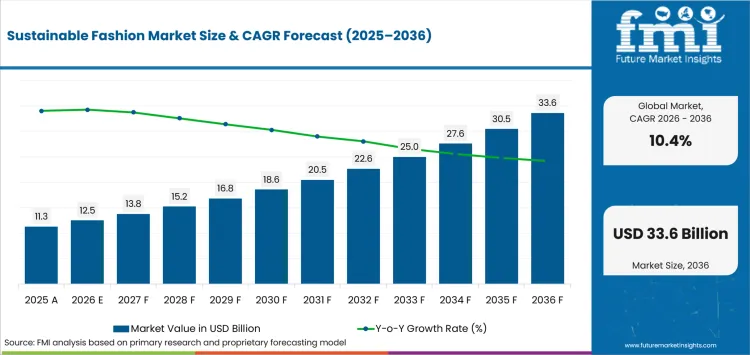
USD 12.5 billion in 2026 and USD 33.6 billion by 2036 at a 10.4% CAGR.
Sustainable fashion demand is projected to expand at 10.4% CAGR between 2026 and 2036, increasing valuation from USD 12.5 billion to USD 33.6 billion. Regulatory initiatives are placing greater emphasis on product transparency, durability, and circularity across apparel value chains. The European Commission included textiles and apparel among the first product groups targeted under Ecodesign requirements in April 2025. These requirements encourage manufacturers to document composition and circularity attributes more consistently, creating additional demand for traceable and sustainability-focused fashion products.
Post-consumer textile collection systems are becoming a more important factor in sustainable fashion adoption as brands face increasing pressure to improve circularity outcomes. South Korea has a coordinated national route for clothing recovery, while the United States relies more heavily on state-led implementation. South Korea operates a coordinated national framework for clothing recovery, providing a more structured route for sorting and material recirculation. A Korean government program announced in July 2026 targets sorting accuracy above 95% for discarded clothing through AI-based classification. Higher sorting efficiency can improve textile recovery rates and support the supply of recyclable materials for circular fashion initiatives.
Key Takeaways of Sustainable Fashion Market
- Product rules and textile stewardship systems increase demand for fashion products supported by auditable composition, durability and recovery records.
- Apparel is projected to represent 54.0% of product type demand in 2026 owing to recurring collections across daily and performance wear.
- Recycled materials are estimated to account for 53.0% share in 2026 because established fiber systems accept qualified recovered inputs.
- Offline channels are forecast to hold 63.0% of distribution demand in 2026 as customers compare fit, fabric feel and construction directly.
- Higher material costs and incomplete chain-of-custody records can delay collection approval or restrict environmental claims across commercial ranges.
- NIKE, Inc., adidas AG, PUMA SE, H&M Group, Levi Strauss & Co., lululemon athletica inc., Inditex, S.A. and VF Corporation serve the market.
Analyst Perspective
“A sustainable fashion claim earns commercial value only when the finished garment carries the same evidence as its individual fibers and components. Brands should compare material performance, traceability and recovery access together because weakness in any one area can delay approval or limit repeat orders.”
- Rahul Pandita, Principal Consultant, Future Market Insights
How is the Sustainable Fashion Market segmented?
The sustainable fashion market is segmented by product type, material, end user, distribution channel, sustainability practice and region.
The sustainable fashion market is segmented by product type, material, end user, distribution channel, sustainability practice and region. Product type covers apparel, footwear, accessories and jewelry, while material includes recycled, organic, natural and certified responsible options. End users comprise women, men and children, distribution separates offline and online routes and sustainability practice covers materials, ethical manufacturing, circular fashion and low-impact production.
Why does apparel lead demand within the product type category?
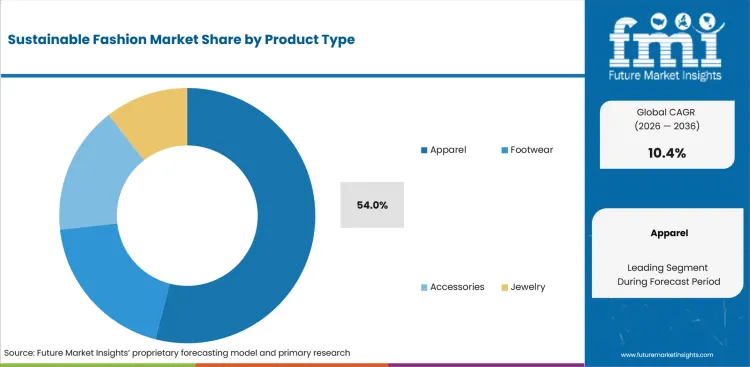
Apparel gives brands frequent collection cycles for introducing verified fibers across daily wear and performance ranges. Footwear and accessories require separate qualification because fabrics interact with foams, coatings and hardware during product approval.
- Based on product type, apparel is projected to account for 54.0% in 2026 due to recurring purchases across several price points.
- Design teams can replace fabrics within established silhouettes without rebuilding every component for each seasonal range. Commercial expansion depends on repeatable color, fit and care performance from approved mills serving sustainable footwear programs across recurring seasonal production.
What supports demand for recycled materials within the material category?
Recycled polyester and nylon fit established spinning and finishing systems used across high-volume apparel collections and repeated seasonal production. Brands approve these inputs only after chain-of-custody records match repeated strength, shade and processing results.
- The material category is forecast to be led by recycled materials at 53.0% share in 2026 owing to established synthetic-fiber processing.
- adidas reported that recycled polyester represented 99% of its polyester use during 2025 across product lines. That scale makes certification and mill consistency central to sourcing decisions, while vegan clothing ranges need separate evidence for every component and production stage.
How do customers evaluate offline channels within the distribution category?
Physical stores let customers compare fit, fabric feel and finishing quality during the purchase decision. Store teams can also explain repair or take-back routes beside the material claim during direct customer evaluation.
- In 2026, offline channels are expected to lead distribution with 63.0% share due to direct inspection of fit and construction.
- Retailers also gain return and care information from staff interactions across physical locations for future collection planning. Online channels remain necessary for reach, but product pages must carry the same material, care, return and service evidence used during direct in-store explanation.
What role do sustainable materials play within sustainability practice?
Material substitution gives product teams a visible specification that can be traced across sourcing and production. The claim remains credible only if records cover the complete garment and every material component.
- Sustainable materials are set to lead sustainability practice with 39.0% share in 2026 attributable to product-level specification and supporting records.
- Reliable textile recycling also requires composition data that sorters can use without damaging recoverable fibers. Ethical manufacturing and low-impact production remain separate approval tests because recycled content does not verify labor conditions or factory controls and energy performance.
What are the drivers, restraints and opportunities in the Sustainable Fashion Market?
Ecodesign and stewardship rules raise evidence requirements, complex material construction increases approval costs and circular services extend product revenue.
- Driver: Product rules make composition, durability and claim records part of commercial approval across major fashion markets.
- Restraint: Blended materials and variable recovered fibers increase testing costs during short global collection calendars.
- Opportunity: Repair, resale and textile-to-textile agreements support revenue beyond the initial product sale and recurring customer engagement.
Product Rules Raise Evidence Requirements
European product rules place composition and durability records closer to market access decisions for textile collections. Circular fashion rental operators also need consistent claims across owned products and returned inventory, so weak documentation can delay collection approval or narrow retail wording.
Material Complexity Increases Approval Costs
Blends, trims and coatings complicate fiber recovery and require extra testing across repeated production runs. Online clothing rental services expose weak colorfastness during frequent cleaning cycles, which raises sampling costs and delays approval for complex recovered materials.
Repair and Recycling Extend Revenue
Apparel re-commerce gives brands a direct reason to design garments for documented repair and resale. Second-hand fashion condition data can improve durability standards, while consistent grading and accessible repair services support recurring fiber contracts.
Which country CAGRs are profiled in the Sustainable Fashion Market?
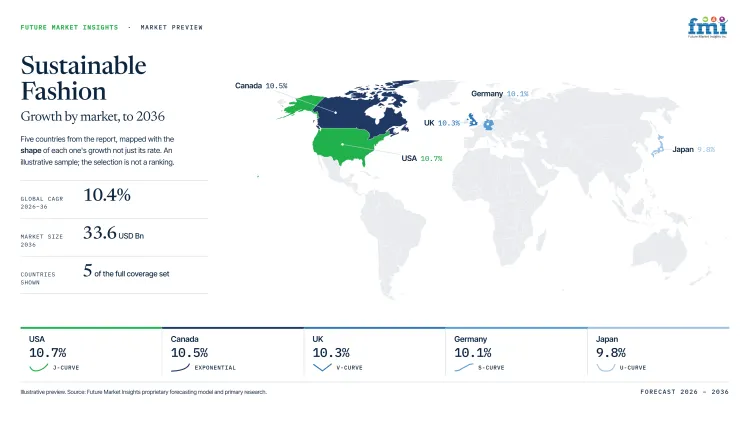
| Country | CAGR |
|---|---|
| South Korea | 11.4% |
| United States | 10.7% |
| Canada | 10.5% |
| United Kingdom | 10.3% |
| Australia | 10.2% |
How do country-level CAGRs compare in the Sustainable Fashion Market?
The country range spans 1.2 percentage points between South Korea and Australia across the approved forecast set. The spacing reflects differences in stewardship execution, claim control and recovery capacity rather than present market size.
- South Korea gains pace from national sorting research and domestic work on clothing-grade recovered fibers for repeat production.
- The United States combines broad brand activity with state stewardship rules that vary across sales territories.
- Canada develops shared textile standards while collection and processing capacity remain uneven across provincial recovery systems.
- The United Kingdom requires retailers to substantiate environmental claims across stores, websites and marketplaces during campaign approval.
- Australia advances clothing stewardship across a dispersed market with higher collection costs outside major cities.
Comparable CAGRs can produce different market entry conditions. The full report provides country-level CAGR analysis across North America, Latin America, Europe, East Asia, South Asia and Pacific, and the Middle East and Africa.
Country-wise Analysis
- South Korea is linking automated sorting research with domestic fiber recovery so mills can test cleaner feedstock across apparel programs and regional finishing networks serving national brands and large sportswear programs. Adoption of sustainable fashion in South Korea is estimated to expand at 11.4% CAGR through 2036, supported by a July 2026 national program targeting sorting accuracy above 95% for discarded clothing and textile waste. The program improves access to separated material, yet mixed trims and color variation require local spinners to prove strength and shade consistency before recovered fibers enter repeat seasonal orders across domestic retail and export collections.
- California now requires covered apparel producers to join an approved responsibility organization that coordinates collection and recovery across stores plus digital channels serving nationally distributed product portfolios, regional retailer networks and wholesale distribution partners. By 2036, the United States is projected to grow at 10.7% CAGR owing to formal return routes plus clearer responsibility and approved collection partners across participating California retail and collection systems. CalRecycle reports that Californians discard about 1.2 million tons of textiles each year, yet national brands need separate compliance plans because comparable obligations do not apply uniformly across other states or nationwide retail sales territories.
- Canada is coordinating retailers and recyclers through national groups that develop shared sorting methods plus material definitions for provincial collection programs and commercial processors serving apparel categories and charitable collection networks. Canada’s sustainable fashion outlook is anticipated to advance at 10.5% CAGR over the assessment period, aided by common specifications that reduce differences between participating retailers and recovery partners during recurring collection cycles. A February 2024 federal workshop identified the Canadian Circular Textiles Consortium as a platform with 100 stakeholders, but limited domestic processing requires consolidated traceable volumes before recurring fiber orders become dependable for local mills and national retail contracts.
- United Kingdom retailers must align environmental claims with evidence held across websites plus physical labels and marketplace listings used for the same product range and seasonal campaign across national retail chains. Sustainable fashion sales in the United Kingdom are forecast to expand at 10.3% CAGR by 2036, supported by established retail and resale channels that extend product use across major cities. The Competition and Markets Authority advised 17 prominent brands to review claims in September 2024, so commercial teams need one evidence chain across every channel to avoid delayed campaigns and possible enforcement under consumer law plus campaign relabeling costs.
- Australia uses voluntary clothing stewardship to encourage durable design plus repair and stronger collection routes across a dispersed retail system with long transport distances between stores, regional service providers and repair routes. The Australian sustainable fashion sector is projected to record 10.2% CAGR during the assessment period, supported by organized reuse and take-back programs among participating brands plus retailers and repair partners nationwide. The environment department retained clothing textiles among five priority products in August 2025, although voluntary participation and uneven regional coverage weaken collection economics outside major urban markets and established sorting corridors serving returned garments and regional stores.
Who are the notable companies in the Sustainable Fashion Market?
NIKE, Inc., adidas AG, PUMA SE, H&M Group, Levi Strauss & Co., lululemon athletica inc., Inditex, S.A. and VF Corporation are profiled.
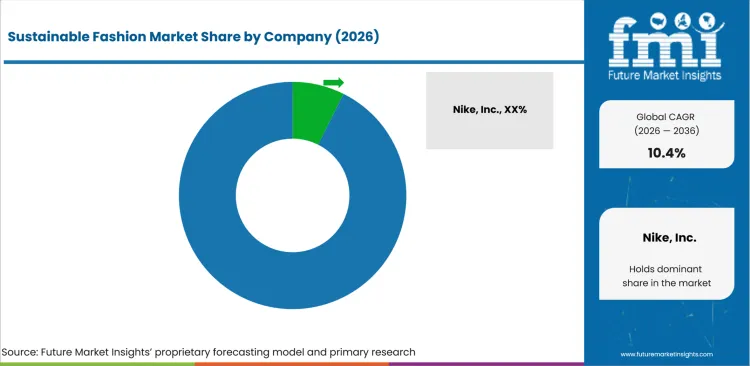
The competitive field combines global sportswear groups, multi-brand retailers and denim or performance specialists across several consumer categories. Entry depends on verified material records, repeatable product quality and repair or recovery services that work beyond isolated pilots.
- NIKE, Inc., adidas AG and PUMA SE pair high-volume sportswear ranges with recycled-material programs and documented performance requirements.
- H&M Group, Inditex, S.A. and VF Corporation use broad brand portfolios to scale preferred materials across several apparel categories.
- Levi Strauss & Co. emphasizes denim durability and repair, while lululemon athletica inc. combines performance apparel with resale and recycled-fiber agreements.
Competitive Benchmarking: Sustainable Fashion Market
| Company | Material Evidence Depth | Circular Service Coverage | Product Category Breadth | Geographic Reach |
|---|---|---|---|---|
| NIKE, Inc. | Medium | Medium | High | Global |
| adidas AG | High | Medium | High | Global |
| PUMA SE | High | High | High | Global |
| H&M Group | High | High | Medium | Global |
| Levi Strauss & Co. | Medium | High | Medium | Global |
| lululemon athletica inc. | Medium | High | Medium | Global |
| Inditex, S.A. | High | High | Medium | Global |
| VF Corporation | High | Medium | High | Global |
Key Developments in the Sustainable Fashion Market
- In October 2025, NIKE, Inc. introduced Aero-FIT elite performance apparel made from 100% textile waste for federation football kits scheduled to debut during 2026.
- In June 2025, H&M Group signed a multi-year Circulose sourcing agreement for textile-waste pulp that is intended to replace a substantial share of virgin viscose.
- In March 2025, PUMA SE signed a multi-year RE&UP collaboration covering recycled cotton fibers and polyester chips for expanded textile-to-textile apparel production.
Key Players in the Sustainable Fashion Market
Sportswear Platforms
- NIKE, Inc.
- adidas AG
- PUMA SE
- lululemon athletica inc.
Multi-Brand Retailers
- H&M Group
- Inditex, S.A.
- VF Corporation
Durability Specialists
- Levi Strauss & Co.
Sustainable Fashion Market - Report Scope
| Coverage field | Report scope |
|---|---|
| Market breakdown | By product type, material, end user, distribution channel, sustainability practice and region. |
| Quantitative Units | Revenue in USD billion and CAGR in %. |
| Market Definition | Commercial apparel, footwear, accessories and jewelry positioned through verified recycled, organic, certified, ethical, circular or lower-impact practices. |
| Regions Covered | North America, Latin America, Europe, East Asia, South Asia and Pacific and Middle East and Africa. |
| Countries Covered | South Korea, United States, Canada, United Kingdom, Australia, and 20+ countries included in the full report. |
| Key Companies Profiled | NIKE, Inc., adidas AG, PUMA SE, H&M Group, Levi Strauss & Co., lululemon athletica inc., Inditex, S.A. and VF Corporation. |
| Forecast Period | 2026 to 2036. |
| Approach | Primary and secondary research with market triangulation. |
Sustainable Fashion Market - Research Methodology
| Method | Approach |
|---|---|
| Primary Research | FMI analysts gathered input from manufacturers, service providers, technology developers, distributors, end users, procurement teams, and subject-matter experts. Interviews examined purchasing decisions, product or service evaluation, adoption barriers, approval requirements, pricing considerations, and expectations for technical or commercial support. Respondents were also asked what evidence is required before a trial, pilot, or initial order develops into regular purchasing. |
| Desk Research | Desk research covered government statistics, regulatory publications, trade data, industry associations, technical literature, standards, company filings, product information, and official corporate announcements. Sources were reviewed for relevance, publication date, geographic coverage, and consistency with the defined market scope. Claims relating to performance, applications, approvals, capacity, investment, and commercial activity were retained only when supported by credible public evidence. |
| Market Sizing and Forecasting | The market model combined the baseline value with historical performance, segment structure, pricing and volume indicators, adoption levels, company participation, and country-level demand conditions. Forecast assumptions considered economic activity, investment trends, regulatory developments, technology adoption, purchasing cycles, supply availability, and barriers to wider market use. Segment and regional estimates were reconciled before the final market total was calculated. |
| Data Validation | Estimates were checked against multiple independent indicators, including public data, company activity, trade patterns, industry developments, and findings from primary interviews. Validation also tested whether products, services, applications, and company revenues fell within the defined market boundaries. Adjacent categories, unsupported claims, overlapping revenues, and activities without direct market relevance were excluded to reduce double counting and maintain consistency across segments and countries. |
Sustainable Fashion Market by Segments
Sustainable Fashion Market segmented by Product Type:
- Apparel
- Sustainable Clothing
- Eco-Friendly Activewear
- Footwear
- Sustainable Sneakers
- Eco-Friendly Shoes
- Accessories
- Sustainable Bags
- Fashion Accessories
- Jewelry
- Ethically Sourced Jewelry
- Lab-Grown Jewelry
Sustainable Fashion Market segmented by Material:
- Recycled Materials
- Recycled Polyester
- Recycled Nylon
- Organic and Natural Materials
- Organic Cotton
- Hemp and Linen
- Responsible Wool
- Certified Responsible Materials
- Certified Leather
- Traceable Cellulosic Fibers
Sustainable Fashion Market segmented by End User:
- Women
- Men
- Kids or Children
Sustainable Fashion Market segmented by Distribution Channel:
- Offline
- Specialty Fashion Stores
- Branded Retail Stores
- Online
- E-Commerce Marketplaces
- Brand-Owned Online Stores
Sustainable Fashion Market segmented by Sustainability Practice:
- Sustainable Materials
- Recycled Materials
- Organic and Natural Fibers
- Ethical and Responsible Manufacturing
- Fair Labor Practices
- Responsible Supply Chains
- Circular Fashion
- Resale and Rental
- Repair and Take-Back
- Low-Impact Production
- Water-Efficient Processing
- Lower-Carbon Manufacturing
Sustainable Fashion Market by Region:
- North America
- United States
- Canada
- Mexico
- Latin America
- Brazil
- Chile
- Rest of Latin America
- Western Europe
- Germany
- United Kingdom
- Italy
- Spain
- France
- Nordics
- Benelux
- Rest of Western Europe
- Eastern Europe
- Russia
- Poland
- Hungary
- Balkan and Baltic States
- Rest of Eastern Europe
- East Asia
- China
- Japan
- South Korea
- South Asia and Pacific
- India
- ASEAN
- Australia and New Zealand
- Rest of South Asia and Pacific
- Middle East and Africa
- Kingdom of Saudi Arabia
- Other GCC Countries
- Türkiye
- South Africa
- Other African Union Countries
- Rest of Middle East and Africa
Research Sources and Bibliography
- European Commission. (2025, April 16). Ecodesign for Sustainable Products and Energy Labelling Working Plan 2025-2030.
- Ministry of Climate, Energy and Environment, Republic of Korea. (2026, July 2). Discarded Clothing and Tires to Return as Valuable Resource Materials.
- California Department of Resources Recycling and Recovery. (2026). Textile Stewardship.
- Environment and Climate Change Canada. (2024, February 7). Opportunities for circularity in apparel textiles in Canada.
- Competition and Markets Authority. (2024, September 18). Greenwashing: CMA issues tailored guide for fashion brands.
- Department of Climate Change, Energy, the Environment and Water. (2025, August 22). Minister’s product stewardship priority list.
- adidas AG. (2026). Annual Report 2025: Metrics and Targets.
- NIKE, Inc. (2025, October 23). Nike Unveils Aero-FIT Performance Apparel Innovation: Cooling Technology for a Hotter World.
- PUMA SE. (2026). Annual Report 2025: Resource Use and Circular Economy.
- H&M Group. (2026, March 26). H & M Hennes & Mauritz AB publishes its Annual and Sustainability Report 2025.
- Levi Strauss & Co. (2026). Circular Economy.
- lululemon athletica inc. (2025, June 11). lululemon and Samsara Eco Announce 10-Year Plan to Advance Recycled Material Portfolio.
- Inditex, S.A. (2026). Annual Report 2025: Our Drivers.
- VF Corporation. (2025). FY2025 Environmental & Social Responsibility Report.
- H&M Group. (2025, June 27). H&M Group signs strategic sourcing partnership with Circulose.
- PUMA SE. (2025, March 26). PUMA and RE&UP Announce Multi-Year Collaboration to Scale Textile-to-Textile Recycling.
This bibliography is provided for reader reference and is not exhaustive. The full report contains the complete reference list and detailed citations
This Report Answers
- How do product rules change evidence requirements for sustainable fashion collections?
- Why does apparel account for 54.0% of product type demand during 2026?
- How do recycled materials enter established spinning and finishing systems?
- Why do offline channels remain central to fit, fabric and construction evaluation?
- Which material combinations and data gaps delay collection approval?
- How do country growth rates reflect different stewardship, sorting and claim-control routes?
- Which company capabilities matter beyond unit price during supplier comparison?
- Where do repair, resale and textile-to-textile agreements extend commercial revenue?
Frequently Asked Questions
How big is the Sustainable Fashion Market in 2026?
The sustainable fashion market is estimated at USD 12.5 billion in 2026 and is projected to reach USD 33.6 billion by 2036. Growth is driven by increasing adoption of verified materials, circular fashion initiatives, and sustainable production practices.
What is the CAGR of the Sustainable Fashion Market from 2026 to 2036?
The sustainable fashion market is projected to grow at a CAGR of 10.4% between 2026 and 2036. Expansion is supported by stricter sustainability regulations, growing use of recycled fibers, and rising demand for repair and recycling services.
Which product type is projected to account for 54.0% of the Sustainable Fashion Market?
Apparel is projected to account for 54.0% of the market in 2026. Its leading share is driven by frequent product launches and the growing integration of sustainable materials across clothing categories.
Which profiled country is projected to grow at 11.4% CAGR through 2036?
South Korea is projected to expand at a CAGR of 11.4% through 2036. Growth is supported by investments in textile recycling infrastructure and advanced fiber recovery technologies.
Which companies are active in the Sustainable Fashion Market?
Key companies operating in the market include NIKE, adidas, PUMA, H&M Group, Levi Strauss, lululemon, Inditex, and VF Corporation. These companies are investing in sustainable materials, circular fashion programs, and product recycling initiatives.
Preview the report firsthand - request a free sample
Get SampleGet the brochure for pricing and purchase details.
Get PDFTable of Content
- Key Takeaways
- Market Size and CAGR
- Top Growth Driver
- Fastest Growing Segment
- Leading Region
- Key Companies
- Emerging Opportunities
- Executive Summary
- Global Market Outlook
- Demand-side Trends
- Supply-side Trends
- Technology Roadmap Analysis
- Analysis and Recommendations
- Analyst Perspective (What is happening? Why now? What should investors know?)
- Key Questions Answered
- How large is the market?
- What is the CAGR?
- What are key trends?
- Which region dominates?
- Who are the leaders?
- Market Overview
- Market Coverage / Taxonomy
- Market Definition / Scope / Limitations
- Research Methodology
- Chapter Orientation
- Analytical Lens and Working Hypotheses
- Market Structure, Signals, and Trend Drivers
- Benchmarking and Cross-market Comparability
- Market Sizing, Forecasting, and Opportunity Mapping
- Research Design and Evidence Framework
- Desk Research Programme (Secondary Evidence)
- Expert Input and Fieldwork (Primary Evidence)
- Tooling, Models, and Reference Databases
- Data Engineering and Model Build
- Quality Assurance and Audit Trail
- Market Background
- Market Dynamics (Drivers, Restraints, Opportunity, Trends)
- Scenario Forecast (Optimistic, Likely, Conservative)
- Impact Analysis
- AI Impact
- Sustainability Impact
- Regulatory Impact
- Technology Impact
- Consumer / Buyer Analysis
- Purchase Drivers
- Adoption Barriers
- Buyer Journey
- Opportunity Map Analysis
- Product Life Cycle Analysis
- Supply Chain Analysis
- Investment Feasibility Matrix
- Value Chain Analysis
- PESTLE and Porter's Analysis
- Regulatory Landscape
- Regional Parent Market Outlook
- Production and Consumption Statistics
- Import and Export Statistics
- Global Market Analysis and Forecast, 2021 to 2036
- Historical Market Size Value (USD Billion) Analysis, 2021 to 2025
- Current and Future Market Size Value (USD Billion) Projections, 2026 to 2036
- Y-o-Y Growth Trend Analysis
- Absolute $ Opportunity Analysis
- Global Market Pricing Analysis, 2021 to 2036
- Global Market Analysis and Forecast, By Product Type, 2021 to 2036
- Introduction / Key Findings
- Historical Market Size Value (USD Billion) Analysis By Product Type, 2021 to 2025
- Current and Future Market Size Value (USD Billion) Analysis and Forecast By Product Type, 2026 to 2036
- Apparel
- Sustainable Clothing
- Eco-Friendly Activewear
- Footwear
- Sustainable Sneakers
- Eco-Friendly Casual Footwear
- Accessories
- Sustainable Bags
- Eco-Friendly Fashion Accessories
- Jewelry
- Recycled Jewelry
- Ethically Sourced Jewelry
- Apparel
- Y-o-Y Growth Trend Analysis By Product Type, 2021 to 2025
- Absolute $ Opportunity Analysis By Product Type, 2026 to 2036
- Global Market Analysis and Forecast, By Material, 2021 to 2036
- Introduction / Key Findings
- Historical Market Size Value (USD Billion) Analysis By Material, 2021 to 2025
- Current and Future Market Size Value (USD Billion) Analysis and Forecast By Material, 2026 to 2036
- Recycled Materials
- Recycled Polyester
- Recycled Nylon
- Organic & Natural Materials
- Organic Cotton
- Hemp & Linen
- Certified Responsible Materials
- Responsible Wool
- Certified Leather
- Recycled Materials
- Y-o-Y Growth Trend Analysis By Material, 2021 to 2025
- Absolute $ Opportunity Analysis By Material, 2026 to 2036
- Global Market Analysis and Forecast, By End User, 2021 to 2036
- Introduction / Key Findings
- Historical Market Size Value (USD Billion) Analysis By End User, 2021 to 2025
- Current and Future Market Size Value (USD Billion) Analysis and Forecast By End User, 2026 to 2036
- Women
- Women's Apparel
- Women's Footwear & Accessories
- Men
- Men's Apparel
- Men's Footwear & Accessories
- Kids - Children
- Children's Apparel
- Children's Footwear & Accessories
- Women
- Y-o-Y Growth Trend Analysis By End User, 2021 to 2025
- Absolute $ Opportunity Analysis By End User, 2026 to 2036
- Global Market Analysis and Forecast, By Distribution Channel, 2021 to 2036
- Introduction / Key Findings
- Historical Market Size Value (USD Billion) Analysis By Distribution Channel, 2021 to 2025
- Current and Future Market Size Value (USD Billion) Analysis and Forecast By Distribution Channel, 2026 to 2036
- Offline
- Specialty Fashion Stores
- Branded Retail Stores
- Online
- E-commerce Marketplaces
- Brand-Owned Online Stores
- Offline
- Y-o-Y Growth Trend Analysis By Distribution Channel, 2021 to 2025
- Absolute $ Opportunity Analysis By Distribution Channel, 2026 to 2036
- Global Market Analysis and Forecast, By Sustainability Practice, 2021 to 2036
- Introduction / Key Findings
- Historical Market Size Value (USD Billion) Analysis By Sustainability Practice, 2021 to 2025
- Current and Future Market Size Value (USD Billion) Analysis and Forecast By Sustainability Practice, 2026 to 2036
- Sustainable Materials
- Recycled Materials
- Organic & Natural Fibers
- Ethical & Responsible Manufacturing
- Fair Labor Practices
- Responsible Supply Chains
- Circular Fashion
- Clothing Resale
- Repair & Upcycling
- Low-Impact Production
- Water-Efficient Manufacturing
- Low-Carbon Production
- Sustainable Materials
- Y-o-Y Growth Trend Analysis By Sustainability Practice, 2021 to 2025
- Absolute $ Opportunity Analysis By Sustainability Practice, 2026 to 2036
- Global Market Analysis and Forecast, By Region, 2021 to 2036
- Introduction
- Historical Market Size Value (USD Billion) Analysis By Region, 2021 to 2025
- Current Market Size Value (USD Billion) Analysis and Forecast By Region, 2026 to 2036
- North America
- Latin America
- Western Europe
- Eastern Europe
- East Asia
- South Asia and Pacific
- Middle East & Africa
- Market Attractiveness Analysis By Region
- North America Market Analysis and Forecast, By Country, 2021 to 2036
- Historical Market Size Value (USD Billion) Trend Analysis By Market Taxonomy, 2021 to 2025
- Market Size Value (USD Billion) Forecast By Market Taxonomy, 2026 to 2036
- By Country
- USA
- Canada
- By Product Type
- By Material
- By End User
- By Distribution Channel
- By Sustainability Practice
- By Country
- Market Attractiveness Analysis
- By Country
- By Product Type
- By Material
- By End User
- By Distribution Channel
- By Sustainability Practice
- Key Takeaways
- Latin America Market Analysis and Forecast, By Country
- Historical Market Size Value (USD Billion) Trend Analysis By Market Taxonomy, 2021 to 2025
- Market Size Value (USD Billion) Forecast By Market Taxonomy, 2026 to 2036
- By Country
- Brazil
- Mexico
- Chile
- Rest of Latin America
- By Product Type
- By Material
- By End User
- By Distribution Channel
- By Sustainability Practice
- By Country
- Market Attractiveness Analysis
- By Country
- By Product Type
- By Material
- By End User
- By Distribution Channel
- By Sustainability Practice
- Key Takeaways
- Western Europe Market Analysis and Forecast, By Country
- Historical Market Size Value (USD Billion) Trend Analysis By Market Taxonomy, 2021 to 2025
- Market Size Value (USD Billion) Forecast By Market Taxonomy, 2026 to 2036
- By Country
- Germany
- UK
- Italy
- Spain
- France
- Nordic
- BENELUX
- Rest of Western Europe
- By Product Type
- By Material
- By End User
- By Distribution Channel
- By Sustainability Practice
- By Country
- Market Attractiveness Analysis
- By Country
- By Product Type
- By Material
- By End User
- By Distribution Channel
- By Sustainability Practice
- Key Takeaways
- Eastern Europe Market Analysis and Forecast, By Country
- Historical Market Size Value (USD Billion) Trend Analysis By Market Taxonomy, 2021 to 2025
- Market Size Value (USD Billion) Forecast By Market Taxonomy, 2026 to 2036
- By Country
- Russia
- Poland
- Hungary
- Balkan & Baltic
- Rest of Eastern Europe
- By Product Type
- By Material
- By End User
- By Distribution Channel
- By Sustainability Practice
- By Country
- Market Attractiveness Analysis
- By Country
- By Product Type
- By Material
- By End User
- By Distribution Channel
- By Sustainability Practice
- Key Takeaways
- East Asia Market Analysis and Forecast, By Country
- Historical Market Size Value (USD Billion) Trend Analysis By Market Taxonomy, 2021 to 2025
- Market Size Value (USD Billion) Forecast By Market Taxonomy, 2026 to 2036
- By Country
- China
- Japan
- South Korea
- By Product Type
- By Material
- By End User
- By Distribution Channel
- By Sustainability Practice
- By Country
- Market Attractiveness Analysis
- By Country
- By Product Type
- By Material
- By End User
- By Distribution Channel
- By Sustainability Practice
- Key Takeaways
- South Asia and Pacific Market Analysis and Forecast, By Country
- Historical Market Size Value (USD Billion) Trend Analysis By Market Taxonomy, 2021 to 2025
- Market Size Value (USD Billion) Forecast By Market Taxonomy, 2026 to 2036
- By Country
- India
- ASEAN
- Australia & New Zealand
- Rest of South Asia and Pacific
- By Product Type
- By Material
- By End User
- By Distribution Channel
- By Sustainability Practice
- By Country
- Market Attractiveness Analysis
- By Country
- By Product Type
- By Material
- By End User
- By Distribution Channel
- By Sustainability Practice
- Key Takeaways
- Middle East & Africa Market Analysis and Forecast, By Country
- Historical Market Size Value (USD Billion) Trend Analysis By Market Taxonomy, 2021 to 2025
- Market Size Value (USD Billion) Forecast By Market Taxonomy, 2026 to 2036
- By Country
- Kingdom of Saudi Arabia
- Other GCC Countries
- Türkiye
- South Africa
- Other African Union
- Rest of Middle East & Africa
- By Product Type
- By Material
- By End User
- By Distribution Channel
- By Sustainability Practice
- By Country
- Market Attractiveness Analysis
- By Country
- By Product Type
- By Material
- By End User
- By Distribution Channel
- By Sustainability Practice
- Key Takeaways
- Key Countries Market Analysis
- USA
- Pricing Analysis
- Market Share Analysis, 2025
- By Product Type
- By Material
- By End User
- By Distribution Channel
- By Sustainability Practice
- Canada
- Pricing Analysis
- Market Share Analysis, 2025
- By Product Type
- By Material
- By End User
- By Distribution Channel
- By Sustainability Practice
- Mexico
- Pricing Analysis
- Market Share Analysis, 2025
- By Product Type
- By Material
- By End User
- By Distribution Channel
- By Sustainability Practice
- Brazil
- Pricing Analysis
- Market Share Analysis, 2025
- By Product Type
- By Material
- By End User
- By Distribution Channel
- By Sustainability Practice
- Chile
- Pricing Analysis
- Market Share Analysis, 2025
- By Product Type
- By Material
- By End User
- By Distribution Channel
- By Sustainability Practice
- Germany
- Pricing Analysis
- Market Share Analysis, 2025
- By Product Type
- By Material
- By End User
- By Distribution Channel
- By Sustainability Practice
- UK
- Pricing Analysis
- Market Share Analysis, 2025
- By Product Type
- By Material
- By End User
- By Distribution Channel
- By Sustainability Practice
- Italy
- Pricing Analysis
- Market Share Analysis, 2025
- By Product Type
- By Material
- By End User
- By Distribution Channel
- By Sustainability Practice
- Spain
- Pricing Analysis
- Market Share Analysis, 2025
- By Product Type
- By Material
- By End User
- By Distribution Channel
- By Sustainability Practice
- France
- Pricing Analysis
- Market Share Analysis, 2025
- By Product Type
- By Material
- By End User
- By Distribution Channel
- By Sustainability Practice
- India
- Pricing Analysis
- Market Share Analysis, 2025
- By Product Type
- By Material
- By End User
- By Distribution Channel
- By Sustainability Practice
- ASEAN
- Pricing Analysis
- Market Share Analysis, 2025
- By Product Type
- By Material
- By End User
- By Distribution Channel
- By Sustainability Practice
- Australia & New Zealand
- Pricing Analysis
- Market Share Analysis, 2025
- By Product Type
- By Material
- By End User
- By Distribution Channel
- By Sustainability Practice
- China
- Pricing Analysis
- Market Share Analysis, 2025
- By Product Type
- By Material
- By End User
- By Distribution Channel
- By Sustainability Practice
- Japan
- Pricing Analysis
- Market Share Analysis, 2025
- By Product Type
- By Material
- By End User
- By Distribution Channel
- By Sustainability Practice
- South Korea
- Pricing Analysis
- Market Share Analysis, 2025
- By Product Type
- By Material
- By End User
- By Distribution Channel
- By Sustainability Practice
- Russia
- Pricing Analysis
- Market Share Analysis, 2025
- By Product Type
- By Material
- By End User
- By Distribution Channel
- By Sustainability Practice
- Poland
- Pricing Analysis
- Market Share Analysis, 2025
- By Product Type
- By Material
- By End User
- By Distribution Channel
- By Sustainability Practice
- Hungary
- Pricing Analysis
- Market Share Analysis, 2025
- By Product Type
- By Material
- By End User
- By Distribution Channel
- By Sustainability Practice
- Kingdom of Saudi Arabia
- Pricing Analysis
- Market Share Analysis, 2025
- By Product Type
- By Material
- By End User
- By Distribution Channel
- By Sustainability Practice
- Türkiye
- Pricing Analysis
- Market Share Analysis, 2025
- By Product Type
- By Material
- By End User
- By Distribution Channel
- By Sustainability Practice
- South Africa
- Pricing Analysis
- Market Share Analysis, 2025
- By Product Type
- By Material
- By End User
- By Distribution Channel
- By Sustainability Practice
- USA
- Market Structure Analysis
- Competition Dashboard
- Competition Benchmarking
- Market Share Analysis of Top Players
- By Regional
- By Product Type
- By Material
- By End User
- By Distribution Channel
- By Sustainability Practice
- Emerging Startups
- Innovation Benchmarking
- Competition Analysis
- Competition Deep Dive
- Nike, Inc.
- Overview
- Product Portfolio
- Profitability by Market Segments
- Sales Footprint
- Strategy Overview
- Marketing Strategy
- Product Strategy
- Channel Strategy
- Adidas AG
- PUMA SE
- H&M Group
- Levi Strauss & Co.
- Patagonia, Inc.
- Burberry Group plc
- Lululemon Athletica Inc.
- Inditex, S.A.
- VF Corporation
- Others
- Nike, Inc.
- Case Studies
- Success Stories
- Recent Developments
- Competition Deep Dive
- Assumptions & Acronyms Used


