

- Industry Size (2026)
- USD 3909.2 Mn
- Forecast (2036)
- USD 7762.1 Mn
- CAGR (2026 to 2036)
- 7.10%
Topical Ostomy Products Market Forecast and Outlook 2026 to 2036
The topical ostomy products market is valued at USD 3,909.2 million in 2026 and is projected to reach USD 7,762.1 million by 2036, growing at a CAGR of 7.10%. Pricing power is defended through broad, integrated product portfolios that cover barrier care, skin protection, and adhesive management, making single-vendor sourcing operationally attractive for hospitals and home-care providers. Entry barriers remain high due to regulatory requirements, the need for clinical validation, and the importance of long-standing relationships with wound and ostomy care specialists. At the same time, fragmentation persists at the margins, driven by regional suppliers and niche brands offering specialized formulations or cost-focused alternatives for price-sensitive markets. Switching costs for buyers are moderate but meaningful, as patient familiarity, caregiver training, and formulary alignment discourage frequent brand changes. Between 2026 and 2036, competitive advantage will remain concentrated among suppliers that balance portfolio depth, clinical credibility, and distribution reach rather than those competing purely on unit pricing.
Quick Stats for Topical Ostomy Products Market
- Topical Ostomy Products Market Value (2026): USD 3,909.2 Million
- Topical Ostomy Products Market Forecast Value (2036): USD 7,762.1 Million
- Topical Ostomy Products Market Forecast CAGR (2026-2036): 7.10%
- Leading Product Type in Topical Ostomy Products Market: Barrier Creams & Films (55% share)
- Key Growth Regions in Topical Ostomy Products Market: Asia Pacific, Europe, North America, Latin America, Middle East & Africa
- Top Key Players in Topical Ostomy Products Market: Coloplast, Convatec, Hollister, 3M, Smith & Nephew
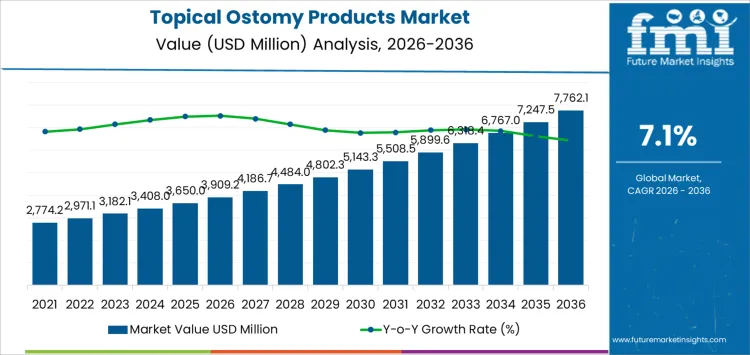
Topical Ostomy Products Market Key Takeaways
| Metric | Value |
|---|---|
| Topical Ostomy Products Market Value (2026) | USD 3,909.2 Million |
| Topical Ostomy Products Market Forecast Value (2036) | USD 7,762.1 Million |
| Topical Ostomy Products Market Forecast CAGR (2026-2036) | 7.10% |
How are Patient Adherence and Formulary Decisions Driving the Topical Ostomy Products Market?
The topical ostomy products market is being shaped by growing emphasis on peristomal skin health and long-term patient adherence. Skin complications remain a leading cause of discomfort, appliance leakage, and unplanned clinical visits among ostomy patients. As a result, clinicians and caregivers increasingly rely on barrier creams, protective films, powders, and skin-conditioning formulations to prevent irritation and maintain seal integrity. For manufacturers, value creation is tied to demonstrable skin protection outcomes and compatibility with a wide range of ostomy appliances.
Procurement dynamics are increasingly influenced by formulary consolidation and total cost of care considerations. Hospitals, home-care providers, and payers are evaluating topical products based on frequency of use, compatibility across pouching systems, and impact on downstream complications rather than unit price alone. Suppliers offering standardized, evidence-supported topical portfolios that reduce product switching and simplify caregiver training are gaining stronger access to institutional contracts and long-term supply agreements.
Product differentiation and channel strategy are also shaping market expansion. Demand is rising for alcohol-free, residue-free, and silicone-based formulations that support sensitive skin and frequent appliance changes. Growth in home healthcare and aging populations is increasing reliance on pharmacy and direct-to-consumer channels, pushing manufacturers to invest in patient education, packaging usability, and subscription-based distribution models. For suppliers, competitive advantage in the topical ostomy products market increasingly depends on clinical credibility, formulary alignment, and the ability to support consistent patient outcomes across care settings.
How Is The Topical Ostomy Products Market Structured By Product And Application?
The topical ostomy products market is segmented by product and application, reflecting how skin intensity and pouching system performance influence product selection care. By product, barrier creams and films represent the leading category, as they are routinely used to protect peristomal skin from moisture, effluent, and adhesive-related irritation. Other products include powders and pastes, adhesive sprays and removers, and skin barrier wipes that support specific care needs. By application, peristomal skin protection forms the primary demand area, while leakage management and infection prevention address ongoing clinical and home-care requirements across ostomy patients.
Why Do Barrier Creams And Films Lead Product Adoption In The Topical Ostomy Products Market?
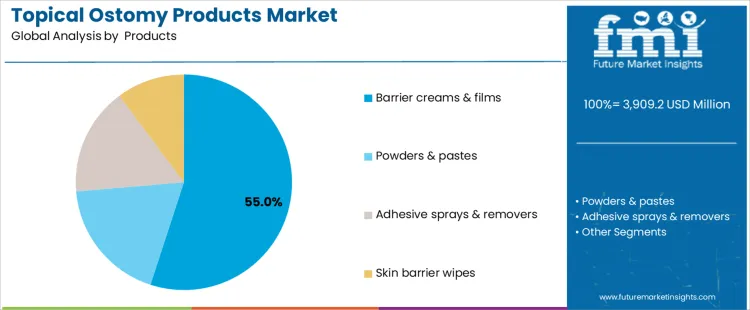
Barrier creams and films account for 55% share of the topical ostomy products market because they provide continuous protection against skin breakdown caused by prolonged contact with bodily fluids and adhesives. These products create a protective layer that maintains skin integrity without interfering with pouch adhesion. Clinicians and caregivers prefer barrier creams and films for routine use due to ease of application and compatibility with different ostomy systems. Their role in reducing irritation and discomfort improves patient adherence to care regimens. For manufacturers, this category benefits from frequent reapplication and repeat purchasing. These functional and usage-driven factors explain why barrier creams and films remain the leading product type.
Why Does Peristomal Skin Protection Dominate Application Demand?
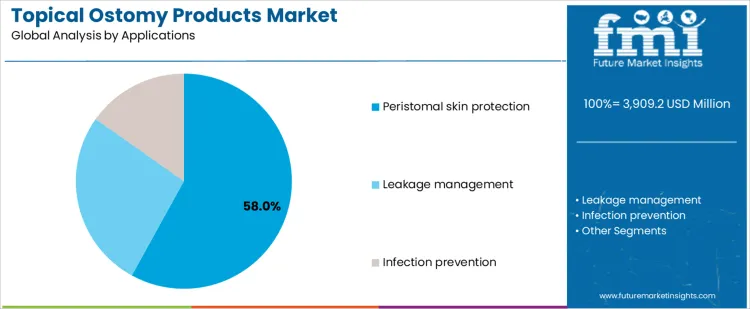
Peristomal skin protection holds 58% share of the topical ostomy products market because maintaining healthy skin around the stoma is critical for effective ostomy management. Skin irritation can lead to pouch leakage, discomfort, and increased risk of complications. Patients and healthcare providers prioritize preventive care to avoid escalation into infections or chronic skin damage. Topical products used for peristomal protection support longer pouch wear time and improved quality of life. High prevalence of long-term ostomy care drives continuous demand for protective solutions. These clinical priorities and daily care requirements explain why peristomal skin protection remains the dominant application segment.
What are the Key Dynamics of the Topical Ostomy Products Market?
The topical ostomy products market is driven by the rising prevalence of ostomies due to colorectal cancer, inflammatory bowel disease, diverticulitis, and other gastrointestinal conditions requiring surgical diversion. Topical ostomy products including skin barriers, adhesive removers, barrier wipes, stoma powders, protective creams, and moisture-repelling sprays are essential for managing peristomal skin integrity, reducing irritation, and supporting appliance adherence. For manufacturers and suppliers, product performance (skin compatibility, adhesion reliability), ease of use, and clinician endorsement influence procurement by hospitals, home-care providers, and specialty retailers. Training resources and customer support help differentiate brands in a market focused on long-term, daily patient use.
How Are Patient Care Trends And Product Innovation Shaping The Market?
Patient care trends and product innovation are shaping the topical ostomy products market by prioritizing skin health, comfort, and convenience. Manufacturers are developing gentler, hypoallergenic formulations that support sensitive peristomal skin and reduce irritation from frequent pouch changes. Advances in delivery formats such as pre-moistened barrier wipes, quick-dry sprays, and low-residue powders improve user experience and reduce application time. Digital patient education tools, instructional content, and telehealth support help caregivers and patients optimize their routines, increasing product adherence. For suppliers, providing robust clinical evidence and collaborating with stoma care nurses enhances product credibility and expands use across care settings.
Why Do Reimbursement, Education, And Standardization Challenges Restrain Market Growth?
Reimbursement, education, and standardization challenges restrain growth in the topical ostomy products market. Variability in insurance coverage for topical skin care products especially barrier creams and specialty wipes can limit patient access and shift costs to out-of-pocket expenses. Limited awareness of best-practice application techniques among patients and caregivers can reduce product effectiveness, leading to inconsistent outcomes and perceptions. Lack of standardized clinical guidelines for peristomal skin management across care settings increases variability in product selection and use. These factors can slow adoption of premium formulations and reduce volume stability for manufacturers and distributors.
What is The Country-Level Overview and Growth Outlook for the Topical Ostomy Products Market?
The topical ostomy products market is expanding as long-term ostomy care increasingly shifts toward outpatient and home-based management. These products, including barrier creams, pastes, powders, wipes, and protective films, play a critical role in maintaining peristomal skin condition, improving appliance adhesion, and reducing complications. Country-level growth varies based on ostomy patient prevalence, access to specialized care, reimbursement structures, and availability of trained clinicians. Mature markets emphasize clinical validation, patient comfort, and standardized care pathways, while higher-growth regions focus on expanding access, affordability, and education-driven adoption. Market value is driven by repeat usage, chronic care needs, and product differentiation focused on skin protection and ease of use. For manufacturers and distributors, competitiveness depends on portfolio breadth, distribution reach, and clinician engagement.
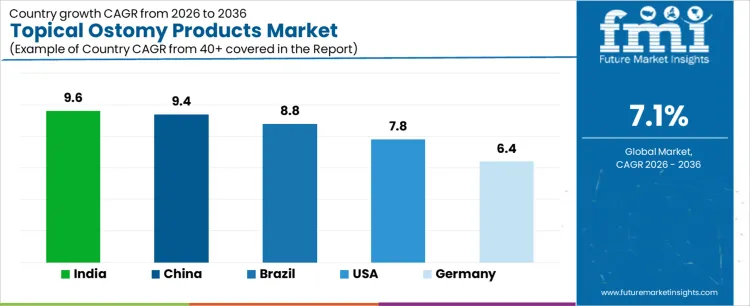
| Country | CAGR (%) |
|---|---|
| India | 9.6 |
| China | 9.4 |
| Brazil | 8.8 |
| United States | 7.8 |
| Germany | 6.4 |
How Is The United States Maintaining Steady Demand For Topical Ostomy Products?
The topical ostomy products market in the United States is growing at a CAGR of 7.8% during 2026-2036, supported by a large ostomy patient population and well-established home healthcare infrastructure. Demand is driven by long-term ostomy management needs related to colorectal cancer, inflammatory bowel disease, and urological conditions. Patients and clinicians prioritize skin protection, leakage prevention, and comfort during extended wear. Adoption is centered on advanced barrier creams, powders, wipes, and sealants designed to reduce irritation and maintain peristomal skin integrity. Procurement decisions are influenced by clinical evidence, reimbursement coverage, brand familiarity, and ease of patient self-use. Home care providers and wound ostomy continence nurses play a significant role in product selection. Market value is driven by repeat purchases, chronic use patterns, and product differentiation based on comfort and skin compatibility. The USA represents a mature market where growth depends on incremental product improvement and strong clinician endorsement.
Why Is Brazil A Fast-Growing Market For Topical Ostomy Care Products?
Brazil’s topical ostomy products market is expanding at a CAGR of 8.8% during 2026-2036, driven by improving access to ostomy care and growing awareness among patients and healthcare professionals. Demand is concentrated in urban hospitals, specialty clinics, and home care settings. Patients prioritize affordability, ease of application, and effectiveness in preventing skin irritation. Topical products such as barrier pastes, protective films, and skin cleansers are increasingly used to improve comfort and appliance adherence. Procurement decisions are influenced by public healthcare budgets, distributor availability, and clinician familiarity. Training initiatives by manufacturers and associations support wider adoption. Market growth is reinforced by rising diagnosis rates of gastrointestinal disorders and expanding outpatient care. Brazil represents a growth-oriented market where success depends on cost-effective product portfolios, strong distribution networks, and consistent clinical performance.
Why Is China Experiencing Rapid Expansion In Topical Ostomy Products?
China’s topical ostomy products market is growing at a CAGR of 9.4% during 2026-2036, supported by increasing surgical procedures and expanding chronic disease management. Adoption is led by large hospitals and specialized care centers managing post-surgical ostomy patients. Patients and clinicians focus on skin protection, infection prevention, and improved wear time of ostomy appliances. Topical products are increasingly used as part of standardized ostomy care protocols. Procurement decisions favor suppliers with local manufacturing, regulatory approvals, and reliable supply chains. Training programs and patient education initiatives are expanding to support higher usage. Market value is driven by growing patient volumes and integration of topical products into routine care pathways. China represents a volume-driven market where supplier success depends on availability, consistency, and alignment with hospital procurement systems.
Why Is India Emerging As A High-Growth Market For Topical Ostomy Products?
India’s topical ostomy products market is projected to grow at a CAGR of 9.6% during 2026-2036, driven by rising surgical interventions and improved awareness of ostomy care. Adoption is expanding across private hospitals, specialty clinics, and home care settings. Patients prioritize affordability, ease of use, and relief from skin irritation caused by prolonged appliance wear. Topical barriers, powders, and cleansers are increasingly recommended to improve comfort and reduce complications. Procurement cycles are relatively short, allowing rapid adoption of new products. Training support from clinicians and manufacturers is improving usage consistency. Market value is driven by increasing patient numbers, repeat product consumption, and expanding access to care. India represents a fast-growing market where pricing flexibility, local availability, and education-driven adoption shape competitiveness.
How Is Germany Maintaining A Conservative Ostomy Care Product Market?
Germany’s topical ostomy products market is growing at a CAGR of 6.4% during the forecast period, characterized by structured care pathways and strong clinical oversight. Adoption is guided by evidence-based protocols and reimbursement frameworks. Patients and clinicians emphasize skin compatibility, clinical efficacy, and long-term safety. Topical products are typically integrated into comprehensive ostomy management plans supervised by specialized nurses. Procurement decisions involve hospital committees and insurance providers, resulting in longer evaluation cycles. Market value accrues to suppliers offering clinically validated products, detailed documentation, and consistent quality. Germany represents a mature market where growth is steady and driven by medical rigor rather than rapid expansion.
How Are Companies Competing in the Topical Ostomy Products Market?
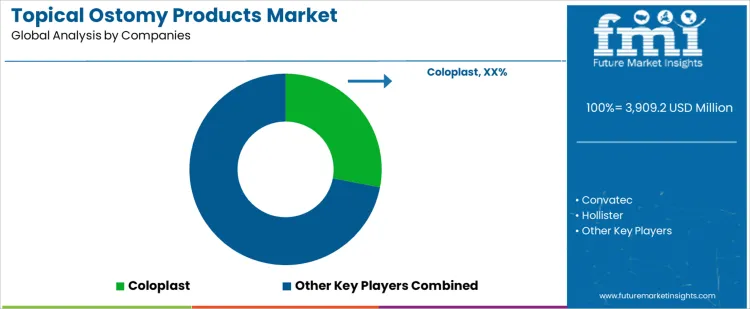
Competition in the topical ostomy products market is driven by product efficacy, skin compatibility, and documented clinical support that matter to clinicians, patients, and procurement teams. Coloplast positions its topical ostomy care solutions with official product materials that emphasize gentle skin adhesion, moisture management, and barrier protection. Brochures highlight formulations designed for compromised peristomal skin, supported by clinician guidance on application techniques and patient outcomes.
Convatec competes through a broad portfolio of barrier films, skin protectants, and adhesive enhancers detailed in technical guides focused on skin health and leak prevention. Its literature underlines product compatibility with a range of pouching systems and validated skin tolerance in sensitive patient populations. Hollister differentiates via engineered topical products that are detailed in official resources for their hypoallergenic formulations and ease of use, with documentation that stresses long-wear comfort and reduced irritation in everyday stoma care routines.
Large diversified healthcare suppliers bring additional performance claims. 3M markets its topical ostomy solutions backed by brochures that emphasize advanced adhesion science and breathable films aimed at extended wear. Product literature highlights compatibility with standard ostomy barriers and emphasis on secure adhesion during active lifestyles. Smith & Nephew competes by aligning its skin care adjuncts with wound management expertise, presenting materials that focus on skin barrier reinforcement and moisture balance under occlusive conditions common in ostomy care.
Others in the market include specialist brands and regional suppliers offering niche topical formulations, odor-control adjuncts, and sensitive skin-friendly options. These products are supported by specification sheets outlining ingredient profiles, recommended use cases, and dermatological testing results. Across all players, differentiation is established through brochure-verified skin compatibility, clinical support framing, and ease of integration into existing ostomy care routines rather than pricing alone.
Key Players in Topical Ostomy Products Market
- Coloplast
- Convatec
- Hollister
- 3M
- Smith & Nephew
- Others
Scope of Report
| Attribute | Description |
|---|---|
| Quantitative Unit | USD Million |
| Products | Barrier Creams & Films, Powders & Pastes, Adhesive Sprays & Removers, Skin Barrier Wipes |
| Applications | Peristomal Skin Protection, Leakage Management, Infection Prevention |
| Countries Covered | China, Japan, South Korea, India, Australia & New Zealand, ASEAN, Rest of Asia Pacific, Germany, United Kingdom, France, Italy, Spain, Nordic, BENELUX, Rest of Europe, United States, Canada, Mexico, Brazil, Chile, Rest of Latin America, Kingdom of Saudi Arabia, Other GCC Countries, Turkey, South Africa, Other African Union, Rest of Middle East & Africa |
| Regions Covered | Asia Pacific, Europe, North America, Latin America, Middle East & Africa |
| Key Companies Profiled | Coloplast, ConvaTec, Hollister Incorporated, 3M Company, Smith & Nephew plc, Others |
| Additional Attributes | Dollar sales by product type and application are evaluated across hospital, home-care, and long-term ostomy management settings. The report includes country-level demand assessment, growth projections for 2026-2036, analysis of peristomal skin protection performance, evaluation of leakage control effectiveness, competitive benchmarking of manufacturers, and assessment of reimbursement-driven adoption trends across global ostomy care markets. |
Topical Ostomy Products Market by Key Segments
Products:
- Barrier creams & films
- Powders & pastes
- Adhesive sprays & removers
- Skin barrier wipes
Applications:
- Peristomal skin protection
- Leakage management
- Infection prevention
Region:
- Asia Pacific
- China
- Japan
- South Korea
- India
- Australia & New Zealand
- ASEAN
- Rest of Asia Pacific
- Europe
- Germany
- United Kingdom
- France
- Italy
- Spain
- Nordic
- BENELUX
- Rest of Europe
- North America
- United States
- Canada
- Mexico
- Latin America
- Brazil
- Chile
- Rest of Latin America
- Middle East & Africa
- Kingdom of Saudi Arabia
- Other GCC Countries
- Turkey
- South Africa
- Other African Union
- Rest of Middle East & Africa
Bibliography
- American Gastroenterological Association. (2025). AGA clinical practice guideline on the management of gastroesophageal reflux disease. Gastroenterology.
- Katz, P. O., & Dunbar, K. B. (2024). Over-the-counter use of proton pump inhibitors: Appropriate use and misuse. Alimentary Pharmacology & Therapeutics.
- Mermelstein, J., & Chait, M. M. (2025). The evolving landscape of acid suppression therapy for gastroesophageal reflux disease. Journal of Clinical Gastroenterology.
- World Health Organization. (2024). WHO model list of essential medicines: Gastrointestinal medicines and rational use. World Health Organization.
- Organisation for Economic Co-operation and Development. (2024). Health system impacts of self-care and non-prescription medicines in advanced economies. OECD Publishing.
Frequently Asked Questions
How big is the topical ostomy products market in 2026?
The global topical ostomy products market is estimated to be valued at USD 3,909.2 million in 2026.
What will be the size of topical ostomy products market in 2036?
The market size for the topical ostomy products market is projected to reach USD 7,762.1 million by 2036.
How much will be the topical ostomy products market growth between 2026 and 2036?
The topical ostomy products market is expected to grow at a 7.1% CAGR between 2026 and 2036.
What are the key product types in the topical ostomy products market?
The key product types in topical ostomy products market are barrier creams & films, powders & pastes, adhesive sprays & removers and skin barrier wipes.
Which applications segment to contribute significant share in the topical ostomy products market in 2026?
In terms of applications, peristomal skin protection segment to command 58.0% share in the topical ostomy products market in 2026.
Preview the report firsthand - request a free sample
Get SampleGet the brochure for pricing and purchase details.
Get PDFTable of Content
- Executive Summary
- Global Market Outlook
- Demand-side Trends
- Supply-side Trends
- Technology Roadmap Analysis
- Analysis and Recommendations
- Market Overview
- Market Coverage / Taxonomy
- Market Definition / Scope / Limitations
- Market Background
- Market Dynamics
- Drivers
- Restraints
- Opportunity
- Trends
- Scenario Forecast
- Demand in Optimistic Scenario
- Demand in Likely Scenario
- Demand in Conservative Scenario
- Opportunity Map Analysis
- Product Life Cycle Analysis
- Supply Chain Analysis
- Investment Feasibility Matrix
- Value Chain Analysis
- PESTLE and Porter’s Analysis
- Regulatory Landscape
- Regional Parent Market Outlook
- Production and Consumption Statistics
- Import and Export Statistics
- Market Dynamics
- Global Market Analysis 2021 to 2025 and Forecast, 2026 to 2036
- Historical Market Size Value (USD Million) Analysis, 2021 to 2025
- Current and Future Market Size Value (USD Million) Projections, 2026 to 2036
- Y-o-Y Growth Trend Analysis
- Absolute $ Opportunity Analysis
- Global Market Pricing Analysis 2021 to 2025 and Forecast 2026 to 2036
- Global Market Analysis 2021 to 2025 and Forecast 2026 to 2036, By Products
- Introduction / Key Findings
- Historical Market Size Value (USD Million) Analysis By Products , 2021 to 2025
- Current and Future Market Size Value (USD Million) Analysis and Forecast By Products , 2026 to 2036
- Barrier creams & films
- Powders & pastes
- Adhesive sprays & removers
- Skin barrier wipes
- Barrier creams & films
- Y-o-Y Growth Trend Analysis By Products , 2021 to 2025
- Absolute $ Opportunity Analysis By Products , 2026 to 2036
- Global Market Analysis 2021 to 2025 and Forecast 2026 to 2036, By Applications
- Introduction / Key Findings
- Historical Market Size Value (USD Million) Analysis By Applications, 2021 to 2025
- Current and Future Market Size Value (USD Million) Analysis and Forecast By Applications, 2026 to 2036
- Peristomal skin protection
- Leakage management
- Infection prevention
- Peristomal skin protection
- Y-o-Y Growth Trend Analysis By Applications, 2021 to 2025
- Absolute $ Opportunity Analysis By Applications, 2026 to 2036
- Global Market Analysis 2021 to 2025 and Forecast 2026 to 2036, By Region
- Introduction
- Historical Market Size Value (USD Million) Analysis By Region, 2021 to 2025
- Current Market Size Value (USD Million) Analysis and Forecast By Region, 2026 to 2036
- North America
- Latin America
- Western Europe
- Eastern Europe
- East Asia
- South Asia and Pacific
- Middle East & Africa
- Market Attractiveness Analysis By Region
- North America Market Analysis 2021 to 2025 and Forecast 2026 to 2036, By Country
- Historical Market Size Value (USD Million) Trend Analysis By Market Taxonomy, 2021 to 2025
- Market Size Value (USD Million) Forecast By Market Taxonomy, 2026 to 2036
- By Country
- USA
- Canada
- Mexico
- By Products
- By Applications
- By Country
- Market Attractiveness Analysis
- By Country
- By Products
- By Applications
- Key Takeaways
- Latin America Market Analysis 2021 to 2025 and Forecast 2026 to 2036, By Country
- Historical Market Size Value (USD Million) Trend Analysis By Market Taxonomy, 2021 to 2025
- Market Size Value (USD Million) Forecast By Market Taxonomy, 2026 to 2036
- By Country
- Brazil
- Chile
- Rest of Latin America
- By Products
- By Applications
- By Country
- Market Attractiveness Analysis
- By Country
- By Products
- By Applications
- Key Takeaways
- Western Europe Market Analysis 2021 to 2025 and Forecast 2026 to 2036, By Country
- Historical Market Size Value (USD Million) Trend Analysis By Market Taxonomy, 2021 to 2025
- Market Size Value (USD Million) Forecast By Market Taxonomy, 2026 to 2036
- By Country
- Germany
- UK
- Italy
- Spain
- France
- Nordic
- BENELUX
- Rest of Western Europe
- By Products
- By Applications
- By Country
- Market Attractiveness Analysis
- By Country
- By Products
- By Applications
- Key Takeaways
- Eastern Europe Market Analysis 2021 to 2025 and Forecast 2026 to 2036, By Country
- Historical Market Size Value (USD Million) Trend Analysis By Market Taxonomy, 2021 to 2025
- Market Size Value (USD Million) Forecast By Market Taxonomy, 2026 to 2036
- By Country
- Russia
- Poland
- Hungary
- Balkan & Baltic
- Rest of Eastern Europe
- By Products
- By Applications
- By Country
- Market Attractiveness Analysis
- By Country
- By Products
- By Applications
- Key Takeaways
- East Asia Market Analysis 2021 to 2025 and Forecast 2026 to 2036, By Country
- Historical Market Size Value (USD Million) Trend Analysis By Market Taxonomy, 2021 to 2025
- Market Size Value (USD Million) Forecast By Market Taxonomy, 2026 to 2036
- By Country
- China
- Japan
- South Korea
- By Products
- By Applications
- By Country
- Market Attractiveness Analysis
- By Country
- By Products
- By Applications
- Key Takeaways
- South Asia and Pacific Market Analysis 2021 to 2025 and Forecast 2026 to 2036, By Country
- Historical Market Size Value (USD Million) Trend Analysis By Market Taxonomy, 2021 to 2025
- Market Size Value (USD Million) Forecast By Market Taxonomy, 2026 to 2036
- By Country
- India
- ASEAN
- Australia & New Zealand
- Rest of South Asia and Pacific
- By Products
- By Applications
- By Country
- Market Attractiveness Analysis
- By Country
- By Products
- By Applications
- Key Takeaways
- Middle East & Africa Market Analysis 2021 to 2025 and Forecast 2026 to 2036, By Country
- Historical Market Size Value (USD Million) Trend Analysis By Market Taxonomy, 2021 to 2025
- Market Size Value (USD Million) Forecast By Market Taxonomy, 2026 to 2036
- By Country
- Kingdom of Saudi Arabia
- Other GCC Countries
- Turkiye
- South Africa
- Other African Union
- Rest of Middle East & Africa
- By Products
- By Applications
- By Country
- Market Attractiveness Analysis
- By Country
- By Products
- By Applications
- Key Takeaways
- Key Countries Market Analysis
- USA
- Pricing Analysis
- Market Share Analysis, 2025
- By Products
- By Applications
- Canada
- Pricing Analysis
- Market Share Analysis, 2025
- By Products
- By Applications
- Mexico
- Pricing Analysis
- Market Share Analysis, 2025
- By Products
- By Applications
- Brazil
- Pricing Analysis
- Market Share Analysis, 2025
- By Products
- By Applications
- Chile
- Pricing Analysis
- Market Share Analysis, 2025
- By Products
- By Applications
- Germany
- Pricing Analysis
- Market Share Analysis, 2025
- By Products
- By Applications
- UK
- Pricing Analysis
- Market Share Analysis, 2025
- By Products
- By Applications
- Italy
- Pricing Analysis
- Market Share Analysis, 2025
- By Products
- By Applications
- Spain
- Pricing Analysis
- Market Share Analysis, 2025
- By Products
- By Applications
- France
- Pricing Analysis
- Market Share Analysis, 2025
- By Products
- By Applications
- India
- Pricing Analysis
- Market Share Analysis, 2025
- By Products
- By Applications
- ASEAN
- Pricing Analysis
- Market Share Analysis, 2025
- By Products
- By Applications
- Australia & New Zealand
- Pricing Analysis
- Market Share Analysis, 2025
- By Products
- By Applications
- China
- Pricing Analysis
- Market Share Analysis, 2025
- By Products
- By Applications
- Japan
- Pricing Analysis
- Market Share Analysis, 2025
- By Products
- By Applications
- South Korea
- Pricing Analysis
- Market Share Analysis, 2025
- By Products
- By Applications
- Russia
- Pricing Analysis
- Market Share Analysis, 2025
- By Products
- By Applications
- Poland
- Pricing Analysis
- Market Share Analysis, 2025
- By Products
- By Applications
- Hungary
- Pricing Analysis
- Market Share Analysis, 2025
- By Products
- By Applications
- Kingdom of Saudi Arabia
- Pricing Analysis
- Market Share Analysis, 2025
- By Products
- By Applications
- Turkiye
- Pricing Analysis
- Market Share Analysis, 2025
- By Products
- By Applications
- South Africa
- Pricing Analysis
- Market Share Analysis, 2025
- By Products
- By Applications
- USA
- Market Structure Analysis
- Competition Dashboard
- Competition Benchmarking
- Market Share Analysis of Top Players
- By Regional
- By Products
- By Applications
- Competition Analysis
- Competition Deep Dive
- Coloplast
- Overview
- Product Portfolio
- Profitability by Market Segments (Product/Age /Sales Channel/Region)
- Sales Footprint
- Strategy Overview
- Marketing Strategy
- Product Strategy
- Channel Strategy
- Convatec
- Hollister
- 3M
- Smith & Nephew
- Others
- Coloplast
- Competition Deep Dive
- Assumptions & Acronyms Used
- Research Methodology


