

- Industry Size (2025)
- USD 520.0 Mn
- Forecast (2035)
- USD 931.2 Mn
- CAGR (2025 to 2035)
- 6.0%
Medical Adhesive-Related Skin Injury Treatment Market Forecast and Outlook 2025 to 2035
Global medical adhesive-related skin injury (MARSI) treatment market is projected to reach USD 931.2 million by 2035, reflecting an absolute increase of USD 411.2 million from its USD 520.0 million valuation in 2025. Growing at a 6.0% CAGR, the market is expected to expand nearly 1.8× through 2035. Expansion is driven by rising hospital-acquired skin injury burden, increasing chronic wound cases, and growing reliance on medical adhesives across acute and long-term care environments. Despite strong momentum, limited clinical awareness, underreporting of MARSI incidence, and cost constraints for advanced barrier products may restrict adoption in emerging regions.
As hospitals prioritize prevention of avoidable complications, MARSI management is gaining clinical importance. Adhesive-related injuries during device fixation, dressing changes, and postoperative wound care highlight the need for structured protection protocols and specialized barrier formulations. Evidence shows 30-50% reduction in MARSI incidence when advanced skin-prep strategies and atraumatic adhesives are used. Aging and diabetic populations with fragile skin further elevate demand for MARSI-specific solutions. Technological advancements in silicone-based adhesives, atraumatic dressings, hydrophilic barriers, and polymer protectants offer gentle removal, moisture balance, epidermal protection, and antimicrobial benefits.
Quick Stats for Medical Adhesive-Related Skin Injury Treatment Market
- Medical Adhesive-Related Skin Injury Treatment Market Value (2025): USD 520.0 million
- Medical Adhesive-Related Skin Injury Treatment Market Forecast Value (2035): USD 931.2 million
- Medical Adhesive-Related Skin Injury Treatment Market Forecast CAGR: 6.0%
- Leading Market Segment: Barrier films & sprays 28% share
- Key Growth Regions: North America, Europe, and Asia Pacific
- Top Players: Smith & Nephew, ConvaTec, Mölnlycke, Hollister, Coloplast
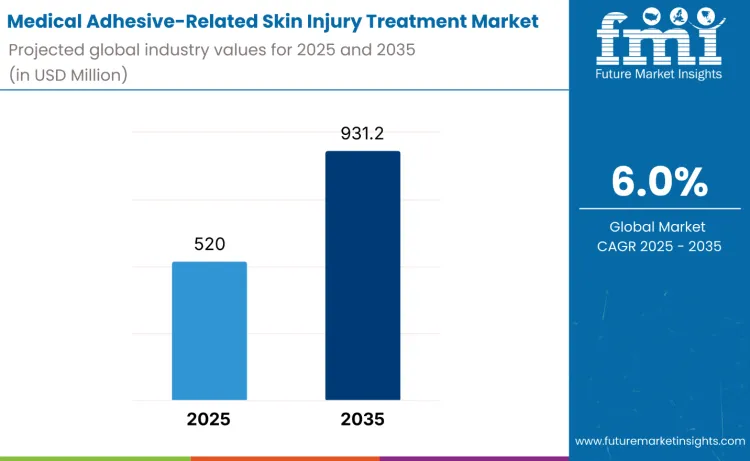
Government-led patient safety programs, accreditation frameworks, and nursing education initiatives are strengthening market adoption. Hospitals and long-term care centers are integrating MARSI assessment tools, risk scoring, and structured removal training into routine workflows. Collaboration between wound-care specialists, dermatologists, and device manufacturers is promoting prevention bundles and skin-health pathways. The rise of home healthcare and postoperative tele-rehabilitation increases demand for gentle adhesive solutions that support safe, independent care for high-risk patients, reinforcing long-term market growth.
Medical Adhesive-Related Skin Injury Treatment Market Year-over-Year Forecast (2025 to 2035)
Between 2025 and 2030, the medical adhesive-related skin injury treatment market is expected to grow from USD 520.0 million to USD 695.9 million, increasing by USD 175.9 million and accounting for 42.8% of the decade-long expansion. Growth is driven by a stronger focus on skin-integrity preservation, wider adoption of atraumatic adhesives, and integration of structured skin-protection bundles across hospitals and long-term care. Advances in silicone adhesives, polymer protectants, and barrier films support reduced epidermal stripping, while patient-safety training and cross-functional clinical partnerships enhance protocol standardization.
From 2030 to 2035, the market is projected to rise from USD 695.9 million to USD 931.2 million, representing an increase of USD 235.3 million, or 57.2% of total growth. This phase will see broader use of skin-friendly adhesives, antimicrobial barrier dressings, and moisture-control technologies tailored for oncology, geriatric, critical-care, and post-operative patients. Regulatory focus on harm reduction and increasing investment in home healthcare and tele-rehabilitation will further boost adoption across institutional and home-care settings.
Medical Adhesive-Related Skin Injury Treatment Market Key Takeaways
| Metric | Value |
|---|---|
| Market Value (2025) | USD 520.0 million |
| Market Forecast Value (2035) | USD 931.2 million |
| Forecast CAGR (2025 to 2035) | 6.0% |
Why Is the Medical Adhesive-Related Skin Injury Treatment Market Growing Worldwide?
The medical adhesive-related skin injury treatment market grows by enhancing patient safety and reducing preventable skin trauma across acute, post-acute, and home-care settings. Structured MARSI prevention protocols show 30-50% reductions in injury incidence when barrier films, silicone-based tapes, and atraumatic removal methods are used. Rising prevalence of fragile-skin populations, including elderly, oncology, critical-care, and diabetic patients, drives demand for advanced skin-protective products and evidence-based pathways that prevent epidermal stripping and tissue damage during routine care.
Healthcare systems are increasingly focused on harm reduction, regulatory compliance, and staff education, strengthening adoption of MARSI protocols across hospitals, long-term care facilities, and ambulatory clinics. Government-supported wound-care training, improved documentation, and expanding home-care and post-surgical recovery models boost demand for gentle adhesives and protective barriers. Limited awareness in certain regions and cost barriers for premium silicone and polymer films may restrict adoption in resource-constrained settings.
How Is the Medical Adhesive-Related Skin Injury (MARSI) Treatment Market Segmented by Product Type, Application, and End User?
By product type, the market includes barrier films and sprays, adhesive removers and cleansers, protective dressings, topical therapeutics, and education and training solutions aimed at improving prevention and clinical handling practices. Based on application, the market is categorized into hospital-based prevention programs, treatment of MARSI cases, home-care prevention, and long-term care facility use. End-user segmentation covers hospitals and wound clinics, long-term care facilities, retail pharmacies supplying preventive skin products, and home-care environments. Regionally, the market is divided into Asia Pacific, Europe, North America, Latin America, and Middle East & Africa.
Barrier Films & Sprays Represent the Leading Product Category
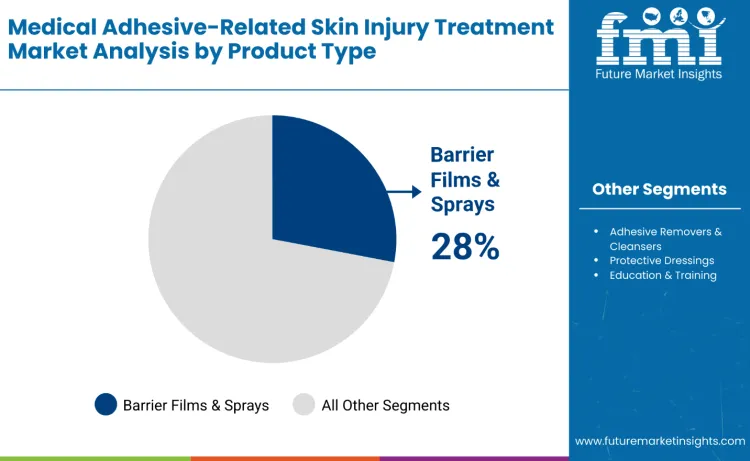
The barrier films & sprays segment leads the MARSI treatment market with 28% revenue share in 2025, driven by polymer barrier films, silicone sprays, and breathable coatings that protect fragile skin from adhesive trauma, friction, and tape-removal injuries. Adhesive removers & cleansers hold 20%, while protective dressings represent 22% with silicone atraumatic interfaces. Topical therapeutics account for 15%, and education & training contribute 15%, underscoring clinician competency needs. Barrier films dominate due to proactive skin protection, moisture resistance, device compatibility, and fast-dry application that supports high-volume clinical workflows.
By Application, Hospital-Based Prevention Programs Account for the Largest Market Share
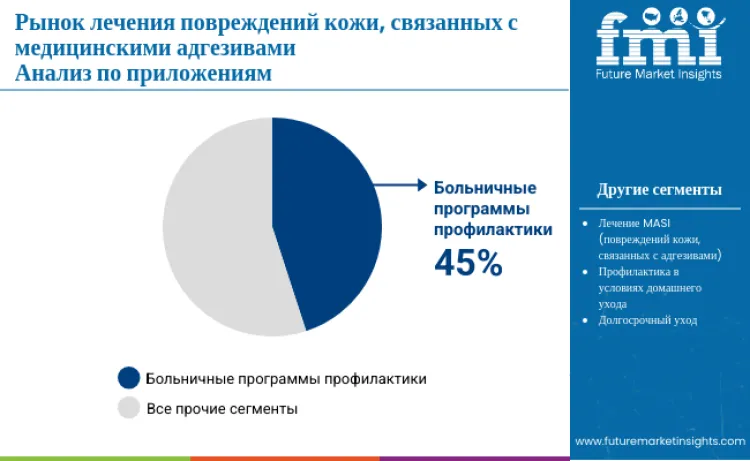
Hospital-based MARSI prevention programs lead the market with 45% revenue share in 2025, driven by use of barrier films, protective dressings, gentle adhesives, and removal agents across ICUs, surgical wards, oncology units, and neonatal care. Treatment of MARSI cases accounts for 25%, supported by rising clinical recognition and use of topical therapies and restorative dressings. Home-care prevention holds 15%, while long-term care facilities represent 15% due to fragile-skin populations. Leadership is reinforced by high device use in critical settings, strong quality-of-care standards, nurse education, formulary prioritization, and early-intervention benefits that reduce injury severity and cost.
By End User, Hospitals & Wound Clinics Account for the Largest Market Share
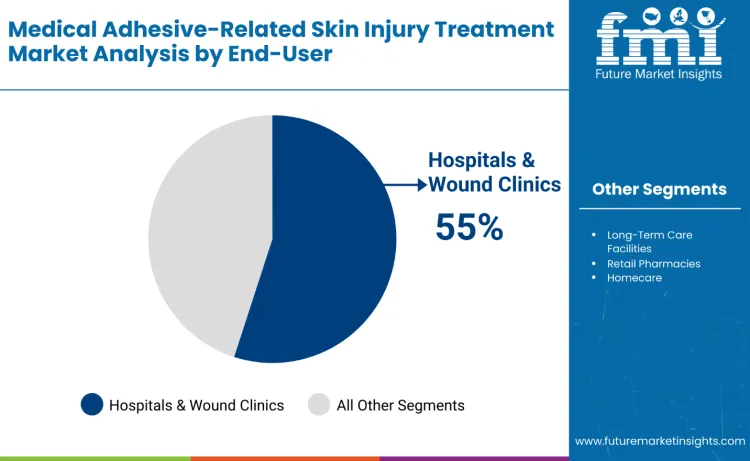
Hospitals and wound clinics lead the MARSI treatment market with 55% revenue share in 2025, driven by high adhesive use, fragile-skin risk, and strong adoption of barrier films, atraumatic dressings, and removal solutions across acute care, oncology, NICU, ICU, and surgical settings. Long-term care facilities hold 20%, supported by aging populations and chronic device use. Retail pharmacies represent 15%, while homecare accounts for 10%, reflecting rising outpatient and post-discharge skin-protection needs. Hospital dominance is reinforced by high-acuity environments, standardized prevention protocols, centralized procurement, and expanding clinical education programs that reduce MARSI incidence.
What Are the Major Drivers, Restraints, and Emerging Trends Influencing the Medical Adhesive-Related Skin Injury Treatment Market?
The MARSI treatment market is driven by rising patient-safety priorities, evolving clinical standards, and increasing vulnerability among aging and chronic-disease populations. With 10-30% of hospitalized or long-term-care patients experiencing adhesive-related trauma, demand is rising for silicone-based adhesives, barrier protectants, and structured prevention protocols that reduce epidermal stripping and complications. Growth is reinforced by higher acuity populations, including oncology, diabetic, and ICU patients, who require atraumatic adhesives for wound care and device securement. Expanding global quality-improvement and accreditation initiatives further accelerate MARSI-prevention bundle adoption and clinician training.
What Restraints Limit Adoption in the Medical Adhesive-Related Skin Injury Treatment Market?
Market restraints include cost sensitivity in resource-limited settings, as silicone dressings and barrier films can cost 30-60% more than traditional adhesives. Variable clinician awareness and inconsistent documentation lead to under-reporting of MARSI events, reducing investment in prevention programs. Workflow adjustments and staff training requirements create implementation challenges in facilities with high patient loads or limited wound-care specialization. Reimbursement variability and procurement cultures focused on lowest unit-cost purchasing further hinder uptake of premium atraumatic adhesive technologies designed to reduce total-care burden and downstream complications.
What Emerging Trends Are Shaping the Future of the Medical Adhesive-Related Skin Injury Treatment Market?
Key trends show rapid adoption across North America, Europe, and modernizing Asian healthcare systems as standardized skin-integrity protocols and nursing education programs become routine. Innovation is advancing toward silicone-gentle adhesives, breathable protective films, polymer skin barriers, and antimicrobial-coated dressings to reduce trauma and infection risk. Vascular-access stabilization techniques and improved dressing-removal practices are elevating bedside standards. Growth in home-care and remote monitoring supports demand for extended-wear, low-trauma adhesives. Competitive pressures are increasing as general wound-care and tape manufacturers enter MARSI-focused segments, driving pricing and innovation shifts.
How Are Leading Countries Driving Growth in the Medical Adhesive-Related Skin Injury Treatment Market?
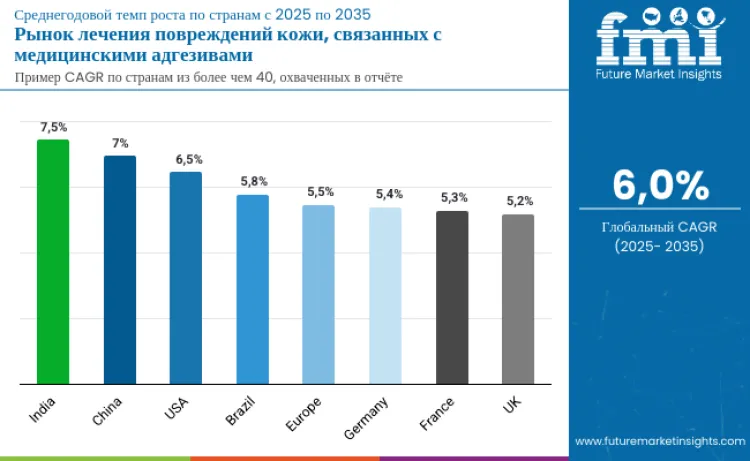
| Country | CAGR (2025 to 2035) |
|---|---|
| USA | 6.5% |
| Brazil | 5.8% |
| China | 7.0% |
| India | 7.5% |
| Europe | 5.5% |
| Germany | 5.4% |
| France | 5.3% |
| UK | 5.2% |
The MARSI treatment market is expanding globally, led by the United States with a 6.5% growth rate supported by strong patient-safety mandates and advanced wound-care infrastructure. Europe grows at 5.5%, with Germany at 5.4%, France at 5.3%, and the UK at 5.2%, driven by structured skin-integrity protocols and national wound-care initiatives. In Asia-Pacific, China advances at 7.0% and India at 7.5%, fueled by hospital modernization and preventive-care expansion, while Japan shows steady progress. Brazil grows at 5.8% as Latin America strengthens vascular-access and complication-prevention practices. North America and Europe anchor clinical leadership, while Asia and emerging markets accelerate adoption.
The report covers an in-depth analysis of 40+ countries top-performing countries are highlighted below.
How Are Hospital Modernization and Patient Safety Programs Accelerating MARSI Market Growth in China?
China shows strong MARSI market potential, growing at a 7.0% CAGR through 2035, driven by nationwide healthcare reforms, tertiary hospital expansion, and rising adherence to skin-integrity standards. Major hubs such as Beijing, Shanghai, Guangzhou, and Chengdu are integrating MARSI prevention into vascular access, post-operative care, and infusion workflows. Demand is reinforced by an aging population, higher chronic-wound incidence, and broad adoption of silicone dressings, barrier films, and atraumatic removal practices. Domestic manufacturers are expanding production, while government-backed nursing education and digital training programs strengthen MARSI awareness and prevention competency across acute-care settings.
Why Are Patient-Safety & Nursing Skill Development Programs Enhancing MARSI Adoption in India?
India’s MARSI treatment market is expanding rapidly, growing at a 7.5% CAGR through 2035, driven by national patient-safety initiatives, nursing-skill development programs, and private hospital growth. Major hubs such as Delhi-NCR, Mumbai, Bengaluru, Hyderabad, and Chennai are adopting silicone-based adhesives, barrier films, and atraumatic removal protocols to reduce device-related skin trauma in elderly, oncology, and critical-care patients. Strengthened accreditation norms, digital learning platforms, and government-supported competency programs are accelerating MARSI awareness. Rising home-healthcare and post-acute care also boost demand for gentle skin-protection technologies suited for fragile-skin populations across India’s expanding care continuum.
How Do Clinical Quality Standards and Nursing Excellence Sustain Market Leadership in Germany?
The MARSI treatment market in Germany is set to grow at a 5.4% CAGR through 2035, supported by strong clinical quality systems, advanced wound-care adoption, and structured nurse-training frameworks. Major hubs such as Berlin, Munich, Hamburg, and Frankfurt lead implementation of silicone-based dressings, barrier protectants, and standardized removal practices across vascular access, post-operative care, and wound-care workflows. German clinicians prioritize durability, patient comfort, and protocol compatibility, driving demand for premium atraumatic solutions. Growth is reinforced by university hospital programs, education-industry partnerships, strong distribution networks, and integration of MARSI-prevention elements within perioperative and oncology care pathways aligned with European safety standards.
Why Is Growing Healthcare Infrastructure and Private Hospital Expansion Fueling MARSI Market Demand in Brazil?
Sales of MARSI treatment in Brazil are expanding rapidly, growing at a 5.8% CAGR through 2035, driven by rising patient-safety awareness, advanced wound-care adoption, and hospital modernization across São Paulo, Rio de Janeiro, Brasília, and Porto Alegre. Private hospitals and specialty clinics are integrating silicone-based dressings, barrier products, and structured skin-integrity protocols to reduce adhesive-related trauma, particularly for oncology, diabetic, and elderly patients. Local procurement networks and partnerships with global wound-care manufacturers are improving access across acute, long-term, and home-care settings. Nursing associations and clinical training programs are further strengthening nationwide adoption of atraumatic adhesive solutions.
How Do Advanced Patient-Safety Systems Strengthen MARSI Market Performance in the United States?
The MARSI treatment market in USA shows mature adoption, growing at a 6.5% CAGR through 2035, supported by strong clinical governance, evidence-based wound-care protocols, and advanced patient-safety programs. Major systems in California, Texas, New York, and Florida widely implement silicone dressings, barrier films, and atraumatic removal practices for high-acuity patients. Accreditation requirements, nursing-driven bundles, and integration into vascular access and perioperative pathways reinforce steady expansion. Robust clinician education, reimbursement support, and strong participation from USA wound-care manufacturers further standardize MARSI prevention. High expectations for gentle removal, moisture control, and comfort sustain preference for premium silicone-based solutions.
How Is Clinical Governance Expansion Supporting MARSI Market Growth in the United Kingdom?
Healthcare hubs in London, Manchester, Birmingham, and Edinburgh are accelerating MARSI prevention through NHS trusts, private hospitals, and advanced wound-care units. The UK market grows at a 5.2% CAGR through 2035, supported by national patient-safety frameworks, skin-integrity programs, and nursing-led standards aligned with NICE and European guidance. Hospitals and long-term care facilities increasingly adopt silicone adhesives, barrier films, and atraumatic removal techniques for elderly, oncology, and surgical patients. Partnerships with universities, professional bodies, and wound-care suppliers strengthen training and evidence-based protocols, while sustainable procurement priorities drive preference for reliable, skin-friendly adhesive technologies with proven safety.
How Are Patient-Safety & Wound-Care Initiatives Advancing MARSI Market Expansion Across Europe?
The MARSI treatment market in Europe is expected to grow from USD 156.0 million in 2025 to USD 260.7 million by 2035, registering a 5.27% CAGR. Germany leads with 21% share in 2025, moderating to 20% by 2035, supported by strong governance and advanced wound-care standards across Berlin, Munich, and Hamburg. France holds 18% in 2025, shifting to 17% by 2035, driven by oncology and geriatric adoption, while Italy maintains 12.5% through the period.
Spain accounts for 11% in 2025, easing to 10.5% by 2035 as chronic-care infrastructure expands. The Rest of Western Europe grows from 22% to 24%, driven by rising MARSI awareness and modernization across Nordic, Central, and Eastern European systems.
Advanced Skin-Integrity Standards Drive Premium MARSI Adoption in Japan
MARSI treatment market in Japan reflects a mature, quality-driven clinical landscape, marked by advanced use of silicone-based dressings, atraumatic adhesive systems, and protective barrier films across tertiary hospitals, oncology centers, and long-term care facilities. Precision-focused nursing practice and strong patient-comfort expectations drive demand for premium solutions designed for fragile-skin protection, surgical recovery, and vascular-access care. Collaboration between domestic device innovators and hospital networks supports continual product refinement and widespread adoption of evidence-based adhesive protocols.
Healthcare systems in Tokyo, Osaka, and other major hubs demonstrate highly structured MARSI prevention practices, prioritizing gentle removal, moisture balance, and biocompatibility. These advanced clinical approaches align with Japan’s elevated standards for elderly and oncology care, reinforcing sustained market demand for high-performance, atraumatic adhesive technologies.
International Clinical Expertise and Local Partnerships Strengthen MARSI Adoption in South Korea
The MARSI treatment market in South Korea is expanding with increasing participation from global wound-care and adhesive-technology providers, supported by strong clinical-training infrastructure and hospital-driven quality-improvement initiatives. Healthcare systems across the country are adopting silicone-based adhesives, barrier films, and atraumatic removal protocols to better support fragile-skin, oncology, and high-acuity patient groups. Major university hospitals and cancer centers in Seoul, Busan, and Daegu are integrating MARSI-prevention pathways aligned with international guidelines and structured nursing-education programs.
Local distributors are strengthening market access through partnerships with multinational manufacturers, offering Korean-language clinical support, tailored training, and hospital service programs. Collaboration between global device companies and Korean wound-care societies is fostering hybrid adoption models that merge international innovation with domestic nursing expertise and hospital quality-improvement priorities.
How Competitive Is the Global Medical Adhesive-Related Skin Injury Treatment Market and What Defines Its Structure?
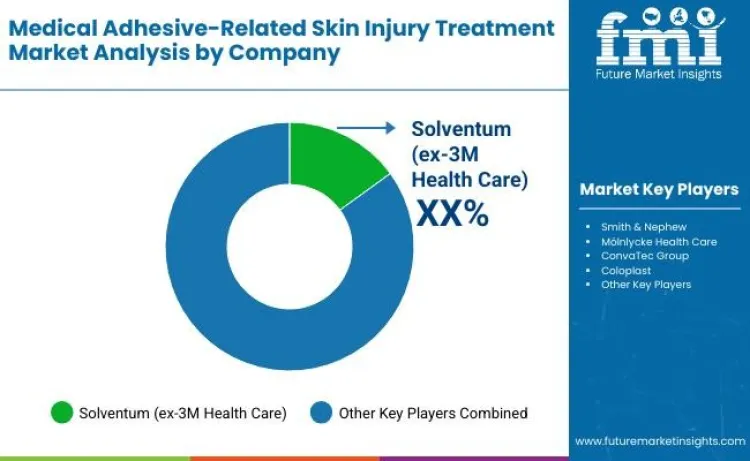
The global MARSI treatment market is shaped by a moderately consolidated group of specialized wound-care and skin-protection manufacturers, with a small cluster of leading companies holding a significant share of worldwide revenue. These leaders benefit from strong clinical reputations, established hospital procurement relationships, and portfolios centered on adhesive-friendly dressings, barrier films, and skin-protective technologies designed for both prevention and treatment across acute and post-acute settings. Competition is driven by clinical performance, material innovation, biocompatibility, wear-time reliability, and comprehensive clinician-education programs rather than pricing. Smith & Nephew, ConvaTec, and Mölnlycke maintain notable advantage through advanced silicone interfaces, polymer barrier platforms, and evidence-aligned MARSI prevention frameworks.
Challenger brands such as Hollister and Coloplast leverage extensive ostomy and continence-care expertise to expand their presence in protective films, hydrocolloid dressings, and gentle adhesive-release technologies, supporting adoption across hospitals, wound clinics, and home-care environments. Emerging regional manufacturers in Asia-Pacific and Latin America introduce additional competitive pressure through cost-efficient silicone dressings, barrier sprays, and atraumatic adhesive pads suited for tender-driven procurement landscapes. Success in this market increasingly depends on integrating skin-integrity science, patient-comfort design, nurse-training platforms, and standardized MARSI-prevention pathways aligned with global safety and quality-care expectations.
Key Players in the Medical Adhesive-Related Skin Injury Treatment Market
- Smith & Nephew
- ConvaTec
- Molnlycke
- Hollister
- Coloplast
- Others
Scope of the Report
| Items | Values |
|---|---|
| Quantitative Units | USD 520.0 million |
| Product Type | Barrier films & sprays, Adhesive removers & cleansers, Protective dressings, Topical therapeutics, Education & training |
| Application | Prevention in hospitals, Treatment of MARSI, Homecare prevention, Long-term care |
| End User | Hospitals & Wound clinics, Long-term care facilities, Retail pharmacies, Homecare |
| Regions Covered | Asia Pacific, Europe, North America, Latin America, Middle East & Africa |
| Country Covered | China, India, Germany, Brazil, USA, UK, Japan, and 40+ countries |
| Key Companies Profiled | Smith & Nephew, ConvaTec, Molnlycke, Hollister, Coloplast, Others |
| Additional Attributes | Dollar sales by silicone dressings, barrier films, adhesive removers, hydrocolloids, and atraumatic tapes across acute, post-acute, long-term, and home-care settings, with regional uptake in North America, Europe, and Asia-Pacific driven by gentle-adhesive innovation, wear-time performance, fragile-skin suitability, and nurse-led education protocols. |
Medical Adhesive-Related Skin Injury Treatment Market by Segments
Product Type
- Barrier films & sprays
- Adhesive removers & cleansers
- Protective dressings
- Topical therapeutics
- Education & training
Application:
- Prevention in hospitals
- Treatment of MARSI
- Homecare prevention
- Long-term care
End User:
- Hospitals & Wound clinics
- Long-term care facilities
- Retail pharmacies
- Homecare
Region:
- Asia Pacific
- China
- India
- Japan
- South Korea
- Vietnam
- Australia & New Zealand
- ASEAN
- Rest of Asia Pacific
- Europe
- Germany
- United Kingdom
- France
- Italy
- Spain
- Netherlands
- Nordic
- BENELUX
- Rest of Europe
- North America
- United States
- Canada
- Mexico
- Latin America
- Brazil
- Argentina
- Rest of Latin America
- Middle East & Africa
- Kingdom of Saudi Arabia
- Other GCC Countries
- Turkey
- South Africa
- Other African Union
- Rest of Middle East & Africa
Frequently Asked Questions
How big is the medical adhesive-related skin injury treatment market in 2025?
The global medical adhesive-related skin injury treatment market is valued at USD 520.0 million in 2025.
What will be the size of the medical adhesive-related skin injury treatment market in 2035?
The market is projected to reach USD 931.2 million by 2035.
How fast will the medical adhesive-related skin injury treatment market grow between 2025 and 2035?
The market will grow at a CAGR of 6.0% from 2025 to 2035.
Which product type leads the medical adhesive-related skin injury treatment market in 2025?
Barrier films and sprays lead the market with a 28% share in 2025.
Who are the major players in the medical adhesive-related skin injury treatment market?
Key players include Smith & Nephew, ConvaTec, Mölnlycke, Hollister, and Coloplast.
Preview the report firsthand - request a free sample
Get SampleGet the brochure for pricing and purchase details.
Get PDFTable of Content
- Executive Summary
- Regional Level Market Outlook
- Demand-side Trends
- Supply-side Trends
- Technology Roadmap Analysis
- Analysis and Recommendations
- Market Overview
- Market Coverage / Taxonomy
- Market Definition / Scope / Limitations
- Market Background
- Market Dynamics
- Drivers
- Restraints
- Opportunity
- Trends
- Scenario Forecast
- Demand in Optimistic Scenario
- Demand in Likely Scenario
- Demand in Conservative Scenario
- Opportunity Assessment
- Market Trade Assessment
- Products Market Assessment
- Investment Feasibility Matrix
- Value Chain Analysis
- Participants and their Roles
- Profit Margin Analysis
- Operating Margins By Region
- PESTLE and Porter’s Analysis
- Regulatory Landscape
- By Key Regions
- By Key Countries
- Regional Parent Market Outlook
- Product Launches & Development
- Technological Innovation
- Market Dynamics
- Regional Level Market Analysis 2020-2024 and Forecast, 2025-2035
- Historical Market Size USD Million & Units Analysis, 2020-2024
- Current and Future Market Size USD Million & Units Projections, 2025-2035
- Y-o-Y Growth Trend Analysis
- Absolute $ Opportunity Analysis
- Regional Level Market Analysis 2020-2024 and Forecast 2025-2035, By Product Type
- Introduction / Key Findings
- Historical Market Size USD Million & Units Analysis By Product Type, 2020-2024
- Current and Future Market Size USD Million & Units Analysis and Forecast By Product Type, 2025-2035
- Barrier films & sprays
- Adhesive removers & cleansers
- Protective dressings
- Topical therapeutics
- Education & training
- Y-o-Y Growth Trend Analysis By Product Type, 2020-2024
- Absolute $ Opportunity Analysis By Product Type, 2025-2035
- Regional Level Market Analysis 2020-2024 and Forecast 2025-2035, By Application
- Introduction / Key Findings
- Historical Market Size USD Million & Units Analysis By Application, 2020-2024
- Current and Future Market Size USD Million & Units Analysis and Forecast By Application, 2025-2035
- Prevention in hospitals
- Treatment of MASI
- Homecare prevention
- Long-term care
- Y-o-Y Growth Trend Analysis By Application, 2020-2024
- Absolute $ Opportunity Analysis By Application, 2025-2035
- Regional Level Market Analysis 2020-2024 and Forecast 2025-2035, By End User
- Introduction / Key Findings
- Historical Market Size USD Million & Units Analysis By End User, 2020-2024
- Current and Future Market Size USD Million & Units Analysis and Forecast By End User, 2025-2035
- Hospitals & Wound clinics
- Long-term care facilities
- Retail pharmacies
- Homecare
- Y-o-Y Growth Trend Analysis By End User, 2020-2024
- Absolute $ Opportunity Analysis By End User, 2025-2035
- Regional Level Market Analysis 2020-2024 and Forecast 2025-2035, By Region
- Introduction
- Historical Market Size USD Million & Units Analysis By Region, 2020-2024
- Current Market Size USD Million & Units Analysis and Forecast By Region, 2025-2035
- North America
- Latin America
- East Asia
- South Asia
- Western Europe
- Eastern Europe
- Middle East & Africa
- Market Attractiveness Analysis By Region
- North America Market Analysis 2020-2024 and Forecast 2025-2035, By Country
- Historical Market Size USD Million & Units Trend Analysis By Market Taxonomy, 2020-2024
- Market Size USD Million & Units Forecast By Market Taxonomy, 2025-2035
- By Country
- USA
- Canada
- Mexico
- By Product Type
- By Application
- By End User
- By Country
- Market Attractiveness Analysis
- By Country
- By Product Type
- By Application
- By End User
- Key Takeaways
- Latin America Market Analysis 2020-2024 and Forecast 2025-2035, By Country
- Historical Market Size USD Million & Units Trend Analysis By Market Taxonomy, 2020-2024
- Market Size USD Million & Units Forecast By Market Taxonomy, 2025-2035
- By Country
- Brazil
- Argentina
- Rest of Latin America
- By Product Type
- By Application
- By End User
- By Country
- Market Attractiveness Analysis
- By Country
- By Product Type
- By Application
- By End User
- Key Takeaways
- East Asia Market Analysis 2020-2024 and Forecast 2025-2035, By Country
- Historical Market Size USD Million & Units Trend Analysis By Market Taxonomy, 2020-2024
- Market Size USD Million & Units Forecast By Market Taxonomy, 2025-2035
- By Country
- China
- Japan
- South Korea
- By Product Type
- By Application
- By End User
- By Country
- Market Attractiveness Analysis
- By Country
- By Product Type
- By Application
- By End User
- Key Takeaways
- South Asia Market Analysis 2020-2024 and Forecast 2025-2035, By Country
- Historical Market Size USD Million & Units Trend Analysis By Market Taxonomy, 2020-2024
- Market Size USD Million & Units Forecast By Market Taxonomy, 2025-2035
- By Country
- India
- ASEAN Countries
- Australia & New Zealand
- Rest of South Asia
- By Product Type
- By Application
- By End User
- By Country
- Market Attractiveness Analysis
- By Country
- By Product Type
- By Application
- By End User
- Key Takeaways
- Western Europe Market Analysis 2020-2024 and Forecast 2025-2035, By Country
- Historical Market Size USD Million & Units Trend Analysis By Market Taxonomy, 2020-2024
- Market Size USD Million & Units Forecast By Market Taxonomy, 2025-2035
- By Country
- Germany
- UK
- France
- Italy
- Spain
- BENELUX
- Nordic Countries
- Rest of Western Europe
- By Product Type
- By Application
- By End User
- By Country
- Market Attractiveness Analysis
- By Country
- By Product Type
- By Application
- By End User
- Key Takeaways
- Eastern Europe Market Analysis 2020-2024 and Forecast 2025-2035, By Country
- Historical Market Size USD Million & Units Trend Analysis By Market Taxonomy, 2020-2024
- Market Size USD Million & Units Forecast By Market Taxonomy, 2025-2035
- By Country
- Russia
- Hungary
- Poland
- Rest of Eastern Europe
- By Product Type
- By Application
- By End User
- By Country
- Market Attractiveness Analysis
- By Country
- By Product Type
- By Application
- By End User
- Key Takeaways
- Middle East & Africa Market Analysis 2020-2024 and Forecast 2025-2035, By Country
- Historical Market Size USD Million & Units Trend Analysis By Market Taxonomy, 2020-2024
- Market Size USD Million & Units Forecast By Market Taxonomy, 2025-2035
- By Country
- Saudi Arabia
- Other GCC Countries
- Türkiye
- South Africa
- Rest of MEA
- By Product Type
- By Application
- By End User
- By Country
- Market Attractiveness Analysis
- By Country
- By Product Type
- By Application
- By End User
- Key Takeaways
- Market Structure Analysis
- Competition Dashboard
- Competition Benchmarking
- Market Share Analysis of Top Players
- By Regional
- By Product Type
- By Application
- By End User
- Competition Analysis
- Competition Deep Dive
- Smith & Nephew
- Overview
- Product Portfolio
- Key Financials
- Key Developments
- Global/Regional Footprint
- Strategy Overview
- Marketing Strategy
- SWOT
- Analyst Comment
- ConvaTec
- Overview
- Product Portfolio
- Key Financials
- Key Developments
- Global/Regional Footprint
- Strategy Overview
- Marketing Strategy
- SWOT
- Analyst Comment
- Molnlycke
- Overview
- Product Portfolio
- Key Financials
- Key Developments
- Global/Regional Footprint
- Strategy Overview
- Marketing Strategy
- SWOT
- Analyst Comment
- Hollister
- Overview
- Product Portfolio
- Key Financials
- Key Developments
- Global/Regional Footprint
- Strategy Overview
- Marketing Strategy
- SWOT
- Analyst Comment
- Coloplast
- Overview
- Product Portfolio
- Key Financials
- Key Developments
- Global/Regional Footprint
- Strategy Overview
- Marketing Strategy
- SWOT
- Analyst Comment
- Smith & Nephew
- Competition Deep Dive
- Assumptions & Acronyms Used
- Research Methodology


