

- Market Size (2026)
- USD 292.5 Mn
- Forecast (2036)
- USD 924.8 Mn
- CAGR (2026 to 2036)
- 12.2%
How big is Trail-Running Nutrition Market in 2026?
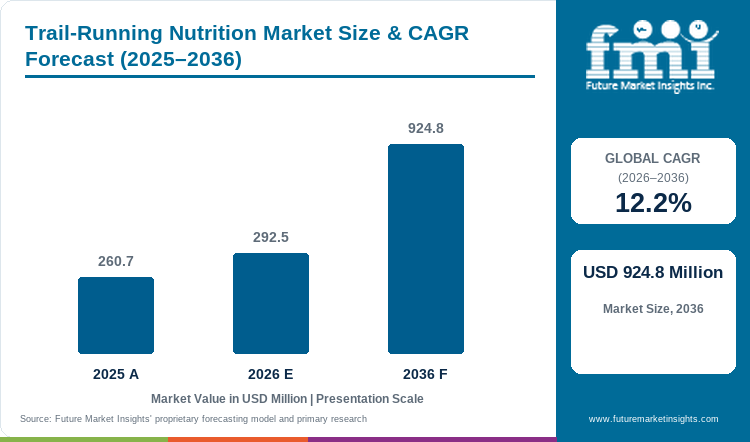
USD 292.5 Million in 2026 and USD 924.8 Million by 2036 at a 12.2% CAGR.
Sales of trail-running nutrition are estimated to grow at 12.2% from USD 292.5 million in 2026 to USD 924.8 million by 2036. The market was valued at USD 260.7 million in 2025. Demand expands because trail nutrition is rarely a one-time race purchase. Runners test intake during training, adjust it for distance and temperature, and replenish products as a target event approaches. The UTMB World Series now connects events across multiple continents and an extensive network of qualifying and indexed races, creating a progression system in which one event can lead into the next training block.
Trail demand also differs from the broader sports nutrition market because runners must work within carried-water capacity, pack space and aid-station spacing. Portable formats tracked in the energy gel product market can provide concentrated fuel between stations, while products associated with the electrolyte drinks market address fluid and sodium requirements. The commercial value comes from assembling these formats into a plan that can be rehearsed before race day and repeated without changing the runner's routine.
Key Takeaways
- Formal race progression supports repeat demand because each training block creates another period of product testing and replenishment.
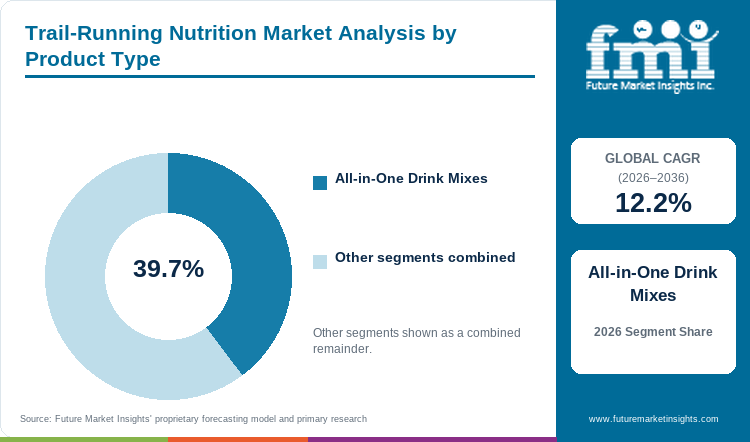
- All-in-One Drink Mixes lead Product Type with 39.7% share, reflecting the value of combining carbohydrate and electrolytes in one carried liquid system.
- Sub-Ultra (Up to Marathon) represents 49.7% of Race Distance revenue, giving suppliers access to the broadest entry and repeat-racing base.
- Gastrointestinal tolerance remains a material restraint because carbohydrate concentration and product combinations have to be tested individually during prolonged exercise.
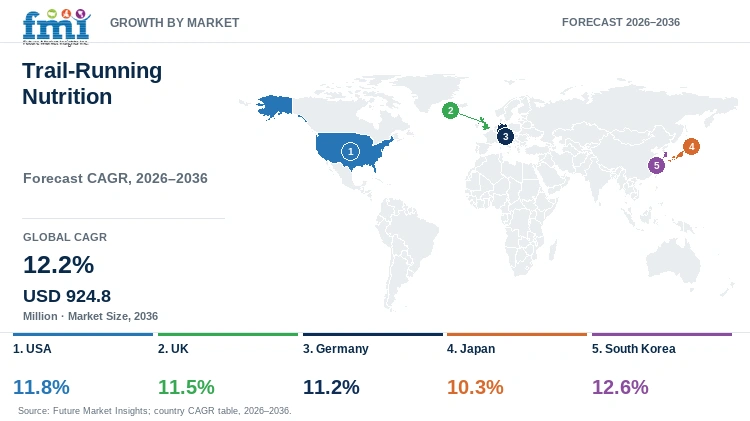
- South Korea records the fastest CAGR among the profiled countries at 12.6% from 2026 to 2036.
- Tailwind Nutrition, Spring Energy, GU Energy, Näak, Maurten, Honey Stinger, Skratch Labs, and Precision Fuel & Hydration compete through different combinations of liquid fuel, portable formats and race-planning support.
Analyst Perspective
Trail-running nutrition will be won during training rather than at the race expo. A product can offer strong carbohydrate or electrolyte specifications, but repeat revenue depends on whether the runner can tolerate it for several hours and then obtain the same system when conditions matter. Brands that connect trial packs, clear hourly guidance and dependable race-day availability can turn one event preparation cycle into a longer customer relationship.
- Nandini Roy Choudhury, Principal Consultant, Future Market Insights
How is the trail-running nutrition market segmented?
The market is evaluated by Product Type, Race Distance, Dietary Profile, Form, and Sales Channel.
Product Type includes All-in-One Drink Mixes, Energy Gels & Purees, Waffles & Solid Fuel, Electrolyte Capsules, and Others. Race Distance covers Sub-Ultra (Up to Marathon), 50K-100K, 100 Mile+, and Others. Dietary Profile includes Real-Food / Natural, Vegan, and Conventional Sports. Form covers Powders, Gels, Solids, and Others. Sales Channel includes Online / DTC, Specialty Sports Stores, Supermarkets & Hypermarkets, Pharmacies, and Others.
Why do All-in-One Drink Mixes lead demand within the Product Type category?
All-in-One Drink Mixes reduce the number of separate fueling actions required while a runner is moving. Carbohydrate and electrolytes can be placed in the same flask, with intake tied to a known bottle volume rather than a sequence of wrappers or capsules. This is particularly useful when technical terrain makes eating difficult or aid stations are widely spaced. Tailwind Nutrition's High Carb Fuel, launched in 2025, combines carbohydrate and electrolytes in a drink format, illustrating how suppliers are increasing the amount of fuel that can be delivered through one liquid routine.
- All-in-One Drink Mixes account for 39.7% of Product Type revenue in 2026.
- Their advantage is strongest where a runner wants to combine regular drinking with planned carbohydrate intake without adding another handling step.
Why does Sub-Ultra (Up to Marathon) lead demand within the Race Distance category?
Sub-Ultra events provide a wider entry point than 50K, 100K or 100-mile races. Participants can race more frequently and usually face lower recovery and logistics burdens than athletes targeting the longest ultras. That produces a broad customer pool that still needs structured pre-race fueling, hydration and portable nutrition. Mt.FUJI100 reinforced this middle-distance pathway in 2025 when it introduced the 40.2-kilometer ASUMI40k alongside its longer races.
- Sub-Ultra (Up to Marathon) represents 49.7% of Race Distance revenue in 2026.
- Suppliers can use shorter trail races as an entry point for starter bundles, then expand the same runner into larger plans as race duration increases.
Why does Real-Food / Natural lead demand within the Dietary Profile category?
Real-Food / Natural products address a problem that becomes more visible as race duration rises: runners may become tired of consuming one flavor or texture repeatedly. Waffles, softer foods and products built around recognizable ingredients can provide texture rotation while remaining portable. Honey Stinger expanded this type of offer in February 2025 with three peanut-butter energy-waffle variants designed for portable fueling.
- Real-Food / Natural holds 51.9% of Dietary Profile revenue in 2026.
- The segment performs best when familiar-food cues are paired with packability and clear nutrition information rather than positioned as an alternative to performance planning.
Why do Powders lead demand within the Form category?
Powders give runners control over the concentration placed in each flask and allow several servings to be packed without carrying multiple ready-to-drink containers. The same product can be mixed differently for a short training session, a hot race or a longer route with fewer water points. This creates overlap with the wider sports drink market and functional beverage market, but trail use places more emphasis on carried weight, refill timing and bottle-level dosing. Skratch Labs expanded its drink-mix formats and flavor range in March 2026, including new Sports Hydration Drink Mix variants.
- Powders account for 48.3% of Form revenue in 2026.
- Flexible mixing supports different bottle sizes and weather conditions, but suppliers must make serving instructions simple enough to use away from home.
Why does Online / DTC lead demand within the Sales Channel category?
Online / DTC suits a category where runners compare carbohydrate content, sodium levels and serving instructions before committing to a race plan. Direct channels also allow brands to sell bundles that combine more than one format and replenish them between long training sessions. Event partnerships strengthen that model by connecting online planning to products available on course. Näak currently links its product offer with UTMB World Series events, while Maurten's 2026 event pages explicitly encourage athletes to practice during training with products that will be available during races.
- Online / DTC represents 49.0% of Sales Channel revenue in 2026.
- Channel performance depends on timely delivery because a product arriving after the final long training session may miss the runner's last realistic tolerance test.
What are the drivers, restraints and opportunities in the Trail-Running Nutrition Market?
Formal race progression creates repeat fueling cycles, gastrointestinal variability slows commitment, and training-to-race continuity creates an opportunity for higher retention.
- Driver: Expanding race systems turn successive training blocks and events into recurring nutrition purchases.
- Restraint: Gastrointestinal response can invalidate an otherwise suitable product after several hours of use.
- Opportunity: Race-specific bundles and on-course continuity can convert experimentation during training into repeat purchasing.
How does formal race progression create repeat demand?
The commercial driver is the sequence of training and competition rather than race-day consumption alone. A runner preparing for a 25K may later move to a 50K or 100K, increasing total hours of intake and changing the amount of nutrition that must be carried. UTMB's current global structure spans events in North America, Europe, Asia, South America, Oceania and Africa, giving runners multiple paths into longer distances. Each new target creates another period in which products are bought, tested and replenished.
This progression also makes the category more valuable than a single-event purchase would suggest. A product that becomes part of the runner's training routine can remain in the plan as event duration grows, while additional formats are added for texture or concentrated energy.
Why does gastrointestinal tolerance constrain product adoption?
Trail nutrition has a delayed product-fit test. Flavor, concentration and texture may seem acceptable during a short session but fail after several hours of sustained intake. A 2025 systematic review found gastrointestinal symptoms during endurance exercise to be influenced by multiple nutritional factors and concluded that mitigation needs an individualized approach.
The issue is visible in current ultra-running evidence. A 2026 study of runners at the 2025 Western States Endurance Run found that 96% had tested their strategies during training. Gastrointestinal symptoms were still reported by 63% of finishers and 38% of runners who dropped out. This makes small trial formats, concentration guidance and realistic training use commercially important. A runner who cannot tolerate a product late in an event has little reason to reorder it for the next race.
Where is the strongest commercial opportunity?
The strongest opportunity is to reduce the gap between the nutrition system used in training and what the runner can obtain on race day. GU Energy extended its Western States partnership through 2029 in June 2025 and provides nutrition support for both the training camp and the race. That creates continuity between preparation and competition rather than forcing a last-minute product change.
Suppliers can apply the same model through race-specific bundles, aid-station information and delivery schedules timed to major training blocks. The commercial payoff is retention. Once a runner has invested several long sessions in testing a system, reliable availability raises the cost of switching immediately before an event.
Which country CAGRs are profiled in the Trail-Running Nutrition Market?
| Country | CAGR |
|---|---|
| USA | 11.8% |
| UK | 11.5% |
| Germany | 11.2% |
| Japan | 10.3% |
| South Korea | 12.6% |
How do country-level CAGRs compare in the Trail-Running Nutrition Market?
The five profiled countries span 2.3 percentage points, from South Korea at 12.6% to Japan at 10.3%. USA follows at 11.8%, while UK and Germany form a narrow middle band at 11.5% and 11.2%. The rate differences are useful for pacing market development, but the way revenue is captured differs more sharply than the CAGR spread suggests.
- South Korea exceeds USA by 0.8 percentage points and combines fast category growth with a large destination-event audience.
- USA exceeds UK by 0.3 percentage points, making training continuity and retention more important than the small numerical growth-rate difference.
- UK exceeds Germany by 0.3 percentage points, although the two markets present different terrain, event and channel conditions.
- Germany exceeds Japan by 0.9 percentage points, with Germany offering strong expo visibility and Japan providing a multi-distance international race platform.
- Japan remains above 10% CAGR and can still support substantial category expansion despite recording the lowest rate among the five profiled countries.
Country-wise Analysis
- USA: Demand for Trail-Running Nutrition in USA is forecast to rise at 11.8% CAGR from 2026 to 2036. The Western States ecosystem demonstrates why the market rewards systems that survive repeated testing. GU Energy's sponsorship extension runs through 2029 and includes support around the training camp and race. Separately, research based on the 2025 race found that 96% of surveyed runners tested their nutrition and heat strategies during training. Suppliers therefore benefit when product education starts weeks before an event rather than at packet pickup.
- UK: Demand for Trail-Running Nutrition in UK is forecast to expand at 11.5% CAGR from 2026 to 2036. Eryri by UTMB requires mandatory kit because mountain conditions can change rapidly, and race regulations expect runners to carry their own food and fluids between aid stations. This puts a premium on products that deliver sufficient nutrition without consuming unnecessary pack space. It also makes water dependence an important buying consideration because runners need to know what must be carried between stations.
- Germany: Sales of Trail-Running Nutrition in Germany are estimated to increase at 11.2% CAGR from 2026 to 2036. Zugspitz Ultra Trail by UTMB describes an event with more than 5,000 athletes, around 50 exhibitors and seven distances ranging from 16 kilometers to 100 miles. That combination gives nutrition brands access to runners with very different consumption requirements in one event environment. Expo sampling can introduce a product, while the distance ladder creates room to expand the same buyer into higher-volume race plans.
- Japan: Adoption of Trail-Running Nutrition in Japan is forecast to advance at 10.3% CAGR from 2026 to 2036. Mt.FUJI100's 2025 program brought approximately 3,800 participants across three races and added the 40.2-kilometer ASUMI40k beside 70.2-kilometer and 168-kilometer events. The multi-distance structure gives suppliers a practical way to separate introductory bundles from high-volume ultra plans while remaining visible within one race ecosystem.
- South Korea: Demand for Trail-Running Nutrition in South Korea is projected to grow at 12.6% CAGR from 2026 to 2036, the fastest pace among the profiled countries. UTMB World Series reported nearly 5,000 runners for TransJeju in October 2025, with 63% of the field from Korea and 96% from Asia. The event therefore combines a substantial domestic runner base with regional traffic, creating a strong setting for event sampling followed by online replenishment.
Who are the notable companies in the Trail-Running Nutrition Market?
Tailwind Nutrition, Spring Energy, GU Energy, Näak, Maurten, Honey Stinger, Skratch Labs, and Precision Fuel & Hydration are the notable companies profiled in this market.
Competition is organized around the architecture of the runner's plan. Tailwind Nutrition and Skratch Labs use powder-led systems as an anchor. Maurten combines drink and hydrogel products with event access. GU Energy and Näak span several portable formats and use race partnerships to stay close to endurance athletes. Precision Fuel & Hydration combines products with planning support, while Spring Energy and Honey Stinger provide portable formats built around familiar food textures and ingredients.
- Drink-led fuel systems: Tailwind Nutrition, Maurten, and Skratch Labs compete for bottle or flask share and then extend into complementary formats.
- Multi-format planning platforms: GU Energy, Näak, and Precision Fuel & Hydration connect a broader assortment with race guidance or event access.
- Portable food-led formats: Spring Energy and Honey Stinger compete through gels, waffles and other carry-friendly products that provide texture alternatives during long efforts.
Competitive Benchmarking: Trail-Running Nutrition Market
| Company | Drink-System Integration | Portable Format Breadth | Planning & Event Support | Geographic Reach |
|---|---|---|---|---|
| Tailwind Nutrition | High | Medium | Medium | North America with international DTC and specialty access |
| Spring Energy | Medium | High | Low | United States with online distribution |
| GU Energy | High | High | High | North America with broad international distribution |
| Näak | High | High | High | North America, Europe and UTMB-linked international event access |
| Maurten | High | Medium | High | Europe, North America and international endurance-event channels |
| Honey Stinger | Medium | High | Medium | North America with international online reach |
| Skratch Labs | High | High | Medium | North America with international specialty distribution |
| Precision Fuel & Hydration | High | High | High | Europe, North America and international DTC and event access |
Drink-System Integration compares the extent to which a supplier combines liquid carbohydrate, hydration or electrolyte functions. Portable Format Breadth considers gels, waffles, solids, purees, capsules and other carry formats. Planning & Event Support reflects structured guidance, athlete support or on-course access. High indicates broad capability across the criterion, while Medium represents a narrower but meaningful position.
Key Developments in the Trail-Running Nutrition Market
- In March 2026, Skratch Labs expanded its hydration, fueling and recovery lineup with new flavors and format options. The launch included four Sports Hydration Drink Mix flavors and additional portable options, broadening the number of ways athletes can build a repeatable training routine.
- In June 2025, GU Energy extended its Western States 100 sponsorship through 2029. The agreement includes nutrition support for the training camp and race together with athlete education, giving the brand repeated contact with runners before race day.
- In April 2025, Tailwind Nutrition launched High Carb Fuel, an all-in-one drink format combining carbohydrate with electrolytes. The launch strengthens the role of liquid systems for athletes who want to reduce the number of separate fueling actions during endurance activity.
Key Players in the Trail-Running Nutrition Market
Drink-Led Integrated Fuel Systems
- Tailwind Nutrition
- Maurten
- Skratch Labs
Multi-Format Race and Planning Platforms
- GU Energy
- Näak
- Precision Fuel & Hydration
Portable Real-Food Fuel Specialists
- Spring Energy
- Honey Stinger
Trail-Running Nutrition Market - Report Scope
| Coverage field | Report scope |
|---|---|
| Market breakdown | Product Type; Race Distance; Dietary Profile; Form; Sales Channel |
| Quantitative Units | USD Million |
| Market Definition | Revenue includes brand-level sales of formulated nutrition products used for trail-running training and competition within the defined segmentation universe. It excludes race fees, hydration hardware, coaching, general meals, recovery-only products and retailer margin. |
| Regions Covered | North America; Latin America; Western Europe; Eastern Europe; East Asia; South Asia and Pacific; Middle East and Africa |
| Countries Covered | USA, UK, Germany, Japan, South Korea and more than twenty-five additional countries in the full report |
| Key Companies Profiled | Tailwind Nutrition, Spring Energy, GU Energy, Näak, Maurten, Honey Stinger, Skratch Labs, Precision Fuel & Hydration |
| Forecast Period | 2026 to 2036 |
| Approach | FMI combines product revenue, pricing, channel conditions, repeat-purchase patterns, race participation signals and country-level adoption conditions in its market assessment. |
Trail-Running Nutrition Market - Research Methodology
| Method | Approach |
|---|---|
| Primary Research | Interviews and market discussions cover product formulation, brand strategy, distribution, specialty retail, race organization, coaching, sports nutrition and trail-running purchase behavior. |
| Desk Research | The research reviews current sports-nutrition literature, race-system materials, event rules, company product information, recent company developments and relevant public business information. |
| Market Sizing and Forecasting | Product assortment, pricing, repeat-purchase frequency, race participation, channel reach and country adoption conditions are used to assess the 2025 base and 2026 to 2036 outlook. |
| Data Validation | Market signals are compared across independent evidence types and checked against the defined trail-running nutrition revenue boundary. |
Trail-Running Nutrition Market by Segments
Trail-Running Nutrition Market segmented by Product Type:
- All-in-One Drink Mixes
- Energy Gels & Purees
- Waffles & Solid Fuel
- Electrolyte Capsules
- Others
Trail-Running Nutrition Market segmented by Race Distance:
- Sub-Ultra (Up to Marathon)
- 50K-100K
- 100 Mile+
- Others
Trail-Running Nutrition Market segmented by Dietary Profile:
- Real-Food / Natural
- Vegan
- Conventional Sports
Trail-Running Nutrition Market segmented by Form:
- Powders
- Gels
- Solids
- Others
Trail-Running Nutrition Market segmented by Sales Channel:
- Online / DTC
- Specialty Sports Stores
- Supermarkets & Hypermarkets
- Pharmacies
- Others
Trail-Running Nutrition Market by Region:
- North America
- United States
- Canada
- Latin America
- Brazil
- Mexico
- Argentina
- Chile
- Western Europe
- Germany
- France
- United Kingdom
- Italy
- Spain
- Benelux
- Nordics
- Eastern Europe
- Poland
- Czech Republic
- Romania
- Hungary
- East Asia
- China
- Japan
- South Korea
- South Asia and Pacific
- India
- ASEAN
- Australia and New Zealand
- Middle East and Africa
- GCC Countries
- South Africa
- Türkiye
- Israel
Research Sources and Bibliography
- UTMB World Series. About the UTMB World Series. Accessed 2026.
- Mougin, Loïs, et al. (2026, June 3). Heat Preparation and Nutrition Strategies for a 100-Mile Ultramarathon in Extreme Heat: A Questionnaire Study at the Western States Endurance Run. Journal of Science and Medicine in Sport.
- Mlinaric, Janez and Nina Mohorko (2025, July 11). Nutritional Strategies for Minimizing Gastrointestinal Symptoms during Endurance Exercise: Systematic Review of the Literature. Journal of the International Society of Sports Nutrition.
- GU Energy Labs (2025, June 25). GU Energy Extends Western States Sponsorship to 2029.
- Tailwind Nutrition (2025). Tailwind Nutrition Launches High Carb Fuel.
- Honey Stinger (2025, February 11). Honey Stinger Launches New, First Ever Peanut Butter Energy Waffles.
- Skratch Labs (2026, March 25). Skratch Labs Introduces New Flavors and Formats Across Hydration, Recovery, and Fueling Lines.
- Mt.FUJI100 (2025, April 15). Mt. FUJI 100 2025 to Welcome 3,800 Athletes with New 40km Race.
- UTMB World Series (2025). Upcoming Events in October 2025, including TransJeju.
- Zugspitz Ultra Trail by UTMB. Germany's Largest Trail Running Event. Accessed 2026.
- Eryri by UTMB. Mandatory Kit and Race Regulations. Accessed 2026.
- IRONMAN (2025, December 10). Precision Fuel & Hydration Becomes the Official Hydration Partner of the IRONMAN and IRONMAN 70.3 Global Series Beginning in 2026.
- Näak. UTMB World Series Partnership. Accessed 2026.
- Maurten. Events and On-Course Fueling. Accessed 2026.
This bibliography is provided for reader reference and is not exhaustive. The full report contains the complete reference list and detailed citations.
This Report Answers
- What is the Trail-Running Nutrition Market size in 2025, 2026 and 2036?
- What supports a 12.2% CAGR from 2026 to 2036?
- Why do All-in-One Drink Mixes lead the Product Type category?
- How does Sub-Ultra participation create repeat nutrition demand?
- Why do Real-Food / Natural products and Powders hold leading positions?
- How do growth rates differ across USA, UK, Germany, Japan and South Korea?
- Which companies compete through drink systems, portable fuel and planning support?
- How do gastrointestinal tolerance and race-day availability affect repeat purchasing?
Frequently Asked Questions
What is the Trail-Running Nutrition Market worth in 2026?
The Trail-Running Nutrition Market is valued at USD 292.5 million in 2026, up from USD 260.7 million in 2025. It is forecast to reach USD 924.8 million by 2036.
What is the forecast CAGR for the Trail-Running Nutrition Market?
The market is projected to expand at a 12.2% CAGR from 2026 to 2036.
Which Product Type leads the Trail-Running Nutrition Market?
All-in-One Drink Mixes lead Product Type with 39.7% share in 2026. Their commercial advantage comes from combining hydration and fueling in one flask-based routine.
Which profiled country has the fastest forecast growth?
South Korea records the highest CAGR among the five profiled countries at 12.6% from 2026 to 2036.
Who are the notable companies in the Trail-Running Nutrition Market?
Notable companies include Tailwind Nutrition, Spring Energy, GU Energy, Näak, Maurten, Honey Stinger, Skratch Labs, and Precision Fuel & Hydration.
What is the main restraint on repeat purchasing?
Gastrointestinal tolerance is a major restraint because the suitability of a carbohydrate concentration, ingredient system or texture may become clear only after prolonged exercise. This makes repeated testing during training central to purchase retention.
Preview the report firsthand - request a free sample
Get SampleGet the brochure for pricing and purchase details.
Get PDFTable of Content
- Key Takeaways
- Market Size and CAGR
- Top Growth Driver
- Fastest Growing Segment
- Leading Region
- Key Companies
- Emerging Opportunities
- Executive Summary
- Global Market Outlook
- Demand-side Trends
- Supply-side Trends
- Technology Roadmap Analysis
- Analysis and Recommendations
- Analyst Perspective (What is happening? Why now? What should investors know?)
- Key Questions Answered
- How large is the market?
- What is the CAGR?
- What are key trends?
- Which region dominates?
- Who are the leaders?
- Market Overview
- Market Coverage / Taxonomy
- Market Definition / Scope / Limitations
- Research Methodology
- Chapter Orientation
- Analytical Lens and Working Hypotheses
- Market Structure, Signals, and Trend Drivers
- Benchmarking and Cross-market Comparability
- Market Sizing, Forecasting, and Opportunity Mapping
- Research Design and Evidence Framework
- Desk Research Programme (Secondary Evidence)
- Expert Input and Fieldwork (Primary Evidence)
- Tooling, Models, and Reference Databases
- Data Engineering and Model Build
- Quality Assurance and Audit Trail
- Market Background
- Market Dynamics (Drivers, Restraints, Opportunity, Trends)
- Scenario Forecast (Optimistic, Likely, Conservative)
- Impact Analysis
- AI Impact
- Sustainability Impact
- Regulatory Impact
- Technology Impact
- Consumer / Buyer Analysis
- Purchase Drivers
- Adoption Barriers
- Buyer Journey
- Opportunity Map Analysis
- Product Life Cycle Analysis
- Supply Chain Analysis
- Investment Feasibility Matrix
- Value Chain Analysis
- PESTLE and Porter's Analysis
- Regulatory Landscape
- Regional Parent Market Outlook
- Production and Consumption Statistics
- Import and Export Statistics
- Global Market Analysis and Forecast, 2021 to 2036
- Historical Market Size Value (USD Million) Analysis, 2021 to 2025
- Current and Future Market Size Value (USD Million) Projections, 2026 to 2036
- Y-o-Y Growth Trend Analysis
- Absolute $ Opportunity Analysis
- Global Market Pricing Analysis, 2021 to 2036
- Global Market Analysis and Forecast, By Product Type, 2021 to 2036
- Introduction / Key Findings
- Historical Market Size Value (USD Million) Analysis By Product Type, 2021 to 2025
- Current and Future Market Size Value (USD Million) Analysis and Forecast By Product Type, 2026 to 2036
- All-in-One Drink Mixes
- Energy Gels & Purees
- Waffles & Solid Fuel
- Electrolyte Capsules
- Others
- Y-o-Y Growth Trend Analysis By Product Type, 2021 to 2025
- Absolute $ Opportunity Analysis By Product Type, 2026 to 2036
- Global Market Analysis and Forecast, By Race Distance, 2021 to 2036
- Introduction / Key Findings
- Historical Market Size Value (USD Million) Analysis By Race Distance, 2021 to 2025
- Current and Future Market Size Value (USD Million) Analysis and Forecast By Race Distance, 2026 to 2036
- Sub-Ultra (Up to Marathon)
- 50K-100K
- 100 Mile+
- Others
- Y-o-Y Growth Trend Analysis By Race Distance, 2021 to 2025
- Absolute $ Opportunity Analysis By Race Distance, 2026 to 2036
- Global Market Analysis and Forecast, By Dietary Profile, 2021 to 2036
- Introduction / Key Findings
- Historical Market Size Value (USD Million) Analysis By Dietary Profile, 2021 to 2025
- Current and Future Market Size Value (USD Million) Analysis and Forecast By Dietary Profile, 2026 to 2036
- Real-Food / Natural
- Vegan
- Conventional Sports
- Y-o-Y Growth Trend Analysis By Dietary Profile, 2021 to 2025
- Absolute $ Opportunity Analysis By Dietary Profile, 2026 to 2036
- Global Market Analysis and Forecast, By Form, 2021 to 2036
- Introduction / Key Findings
- Historical Market Size Value (USD Million) Analysis By Form, 2021 to 2025
- Current and Future Market Size Value (USD Million) Analysis and Forecast By Form, 2026 to 2036
- Powders
- Gels
- Solids
- Others
- Y-o-Y Growth Trend Analysis By Form, 2021 to 2025
- Absolute $ Opportunity Analysis By Form, 2026 to 2036
- Global Market Analysis and Forecast, By Sales Channel, 2021 to 2036
- Introduction / Key Findings
- Historical Market Size Value (USD Million) Analysis By Sales Channel, 2021 to 2025
- Current and Future Market Size Value (USD Million) Analysis and Forecast By Sales Channel, 2026 to 2036
- Online / DTC
- Specialty Sports Stores
- Supermarkets & Hypermarkets
- Pharmacies
- Others
- Y-o-Y Growth Trend Analysis By Sales Channel, 2021 to 2025
- Absolute $ Opportunity Analysis By Sales Channel, 2026 to 2036
- Global Market Analysis and Forecast, By Region, 2021 to 2036
- Introduction
- Historical Market Size Value (USD Million) Analysis By Region, 2021 to 2025
- Current Market Size Value (USD Million) Analysis and Forecast By Region, 2026 to 2036
- North America
- Latin America
- Western Europe
- Eastern Europe
- East Asia
- South Asia and Pacific
- Middle East and Africa
- Market Attractiveness Analysis By Region
- North America Market Analysis and Forecast, By Country, 2021 to 2036
- Historical Market Size Value (USD Million) Trend Analysis By Market Taxonomy, 2021 to 2025
- Market Size Value (USD Million) Forecast By Market Taxonomy, 2026 to 2036
- By Country
- United States
- Canada
- By Product Type
- By Race Distance
- By Dietary Profile
- By Form
- By Sales Channel
- By Country
- Market Attractiveness Analysis
- By Country
- By Product Type
- By Race Distance
- By Dietary Profile
- By Form
- By Sales Channel
- Key Takeaways
- Latin America Market Analysis and Forecast, By Country
- Historical Market Size Value (USD Million) Trend Analysis By Market Taxonomy, 2021 to 2025
- Market Size Value (USD Million) Forecast By Market Taxonomy, 2026 to 2036
- By Country
- Brazil
- Mexico
- Argentina
- Chile
- By Product Type
- By Race Distance
- By Dietary Profile
- By Form
- By Sales Channel
- By Country
- Market Attractiveness Analysis
- By Country
- By Product Type
- By Race Distance
- By Dietary Profile
- By Form
- By Sales Channel
- Key Takeaways
- Western Europe Market Analysis and Forecast, By Country
- Historical Market Size Value (USD Million) Trend Analysis By Market Taxonomy, 2021 to 2025
- Market Size Value (USD Million) Forecast By Market Taxonomy, 2026 to 2036
- By Country
- Germany
- France
- United Kingdom
- Italy
- Spain
- Benelux
- Nordics
- By Product Type
- By Race Distance
- By Dietary Profile
- By Form
- By Sales Channel
- By Country
- Market Attractiveness Analysis
- By Country
- By Product Type
- By Race Distance
- By Dietary Profile
- By Form
- By Sales Channel
- Key Takeaways
- Eastern Europe Market Analysis and Forecast, By Country
- Historical Market Size Value (USD Million) Trend Analysis By Market Taxonomy, 2021 to 2025
- Market Size Value (USD Million) Forecast By Market Taxonomy, 2026 to 2036
- By Country
- Poland
- Czech Republic
- Romania
- Hungary
- By Product Type
- By Race Distance
- By Dietary Profile
- By Form
- By Sales Channel
- By Country
- Market Attractiveness Analysis
- By Country
- By Product Type
- By Race Distance
- By Dietary Profile
- By Form
- By Sales Channel
- Key Takeaways
- East Asia Market Analysis and Forecast, By Country
- Historical Market Size Value (USD Million) Trend Analysis By Market Taxonomy, 2021 to 2025
- Market Size Value (USD Million) Forecast By Market Taxonomy, 2026 to 2036
- By Country
- China
- Japan
- South Korea
- By Product Type
- By Race Distance
- By Dietary Profile
- By Form
- By Sales Channel
- By Country
- Market Attractiveness Analysis
- By Country
- By Product Type
- By Race Distance
- By Dietary Profile
- By Form
- By Sales Channel
- Key Takeaways
- South Asia and Pacific Market Analysis and Forecast, By Country
- Historical Market Size Value (USD Million) Trend Analysis By Market Taxonomy, 2021 to 2025
- Market Size Value (USD Million) Forecast By Market Taxonomy, 2026 to 2036
- By Country
- India
- ASEAN
- Australia and New Zealand
- By Product Type
- By Race Distance
- By Dietary Profile
- By Form
- By Sales Channel
- By Country
- Market Attractiveness Analysis
- By Country
- By Product Type
- By Race Distance
- By Dietary Profile
- By Form
- By Sales Channel
- Key Takeaways
- Middle East and Africa Market Analysis and Forecast, By Country
- Historical Market Size Value (USD Million) Trend Analysis By Market Taxonomy, 2021 to 2025
- Market Size Value (USD Million) Forecast By Market Taxonomy, 2026 to 2036
- By Country
- GCC Countries
- South Africa
- Türkiye
- Israel
- By Product Type
- By Race Distance
- By Dietary Profile
- By Form
- By Sales Channel
- By Country
- Market Attractiveness Analysis
- By Country
- By Product Type
- By Race Distance
- By Dietary Profile
- By Form
- By Sales Channel
- Key Takeaways
- Key Countries Market Analysis
- United States
- Pricing Analysis
- Market Share Analysis, 2025
- By Product Type
- By Race Distance
- By Dietary Profile
- By Form
- By Sales Channel
- Canada
- Pricing Analysis
- Market Share Analysis, 2025
- By Product Type
- By Race Distance
- By Dietary Profile
- By Form
- By Sales Channel
- Mexico
- Pricing Analysis
- Market Share Analysis, 2025
- By Product Type
- By Race Distance
- By Dietary Profile
- By Form
- By Sales Channel
- Brazil
- Pricing Analysis
- Market Share Analysis, 2025
- By Product Type
- By Race Distance
- By Dietary Profile
- By Form
- By Sales Channel
- Chile
- Pricing Analysis
- Market Share Analysis, 2025
- By Product Type
- By Race Distance
- By Dietary Profile
- By Form
- By Sales Channel
- Germany
- Pricing Analysis
- Market Share Analysis, 2025
- By Product Type
- By Race Distance
- By Dietary Profile
- By Form
- By Sales Channel
- United Kingdom
- Pricing Analysis
- Market Share Analysis, 2025
- By Product Type
- By Race Distance
- By Dietary Profile
- By Form
- By Sales Channel
- Italy
- Pricing Analysis
- Market Share Analysis, 2025
- By Product Type
- By Race Distance
- By Dietary Profile
- By Form
- By Sales Channel
- Spain
- Pricing Analysis
- Market Share Analysis, 2025
- By Product Type
- By Race Distance
- By Dietary Profile
- By Form
- By Sales Channel
- France
- Pricing Analysis
- Market Share Analysis, 2025
- By Product Type
- By Race Distance
- By Dietary Profile
- By Form
- By Sales Channel
- India
- Pricing Analysis
- Market Share Analysis, 2025
- By Product Type
- By Race Distance
- By Dietary Profile
- By Form
- By Sales Channel
- ASEAN
- Pricing Analysis
- Market Share Analysis, 2025
- By Product Type
- By Race Distance
- By Dietary Profile
- By Form
- By Sales Channel
- Australia and New Zealand
- Pricing Analysis
- Market Share Analysis, 2025
- By Product Type
- By Race Distance
- By Dietary Profile
- By Form
- By Sales Channel
- China
- Pricing Analysis
- Market Share Analysis, 2025
- By Product Type
- By Race Distance
- By Dietary Profile
- By Form
- By Sales Channel
- Japan
- Pricing Analysis
- Market Share Analysis, 2025
- By Product Type
- By Race Distance
- By Dietary Profile
- By Form
- By Sales Channel
- South Korea
- Pricing Analysis
- Market Share Analysis, 2025
- By Product Type
- By Race Distance
- By Dietary Profile
- By Form
- By Sales Channel
- Poland
- Pricing Analysis
- Market Share Analysis, 2025
- By Product Type
- By Race Distance
- By Dietary Profile
- By Form
- By Sales Channel
- Hungary
- Pricing Analysis
- Market Share Analysis, 2025
- By Product Type
- By Race Distance
- By Dietary Profile
- By Form
- By Sales Channel
- Türkiye
- Pricing Analysis
- Market Share Analysis, 2025
- By Product Type
- By Race Distance
- By Dietary Profile
- By Form
- By Sales Channel
- South Africa
- Pricing Analysis
- Market Share Analysis, 2025
- By Product Type
- By Race Distance
- By Dietary Profile
- By Form
- By Sales Channel
- United States
- Market Structure Analysis
- Competition Dashboard
- Competition Benchmarking
- Market Share Analysis of Top Players
- By Regional
- By Product Type
- By Race Distance
- By Dietary Profile
- By Form
- By Sales Channel
- Emerging Startups
- Innovation Benchmarking
- Competition Analysis
- Competition Deep Dive
- Tailwind Nutrition
- Overview
- Product Portfolio
- Profitability by Market Segments
- Sales Footprint
- Strategy Overview
- Marketing Strategy
- Product Strategy
- Channel Strategy
- Spring Energy
- GU Energy
- Näak
- Maurten
- Honey Stinger
- Skratch Labs
- Precision Fuel & Hydration
- Tailwind Nutrition
- Case Studies
- Success Stories
- Recent Developments
- Competition Deep Dive
- Assumptions & Acronyms Used


