

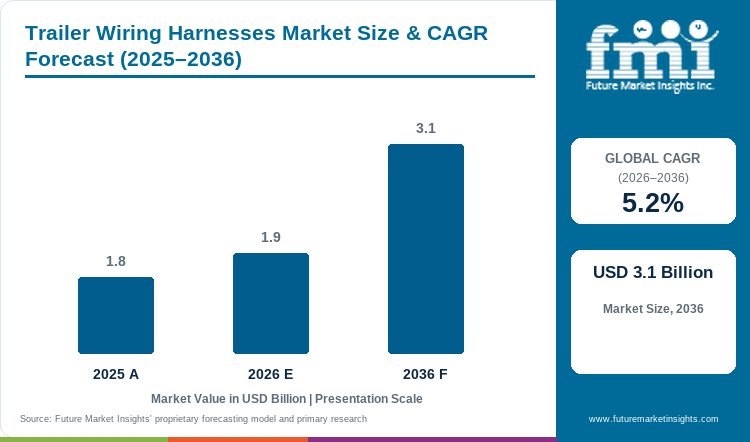
- Market Size (2026)
- USD 1.9 Bn
- Forecast (2036)
- USD 3.1 Bn
- CAGR (2026 to 2036)
- 5.2%
How big is Trailer Wiring Harnesses Market in 2026?
USD 1.9 billion in 2026 and USD 3.1 billion by 2036 at a 5.2% CAGR.
Demand for trailer wiring harnesses is projected to expand at a 5.2% CAGR from 2026 to 2036, raising valuation from USD 1.9 billion to USD 3.1 billion. The market was valued at USD 1.8 billion in 2025. NHTSA recall 26V059 identified 312,365 Ram 1500 vehicles whose trailer tow modules could lose trailer lighting or trailer brakes. That scale makes electrical continuity commercially important because one tow-system fault can disable several regulated trailer functions and force immediate repair before normal towing resumes.
Country demand diverges where freight fleets concentrate trailer use and service exposure across national road networks. Mexico is projected at 5.9% CAGR compared with Germany at 4.5% through 2036 under FMI's authorized forecast. SICT reported that semi-trailers represented 99.4% of Mexican federal trailing units in 2025, giving wiring suppliers a concentrated service base built around high-use tractor-semitrailer combinations. Germany's mature freight environment places greater commercial value on replacement reliability and documented compatibility across established service channels.
Key Takeaways
- Trailer wiring demand is supported by regulated lighting and braking functions that keep electrical reliability tied to roadworthiness and fleet uptime.
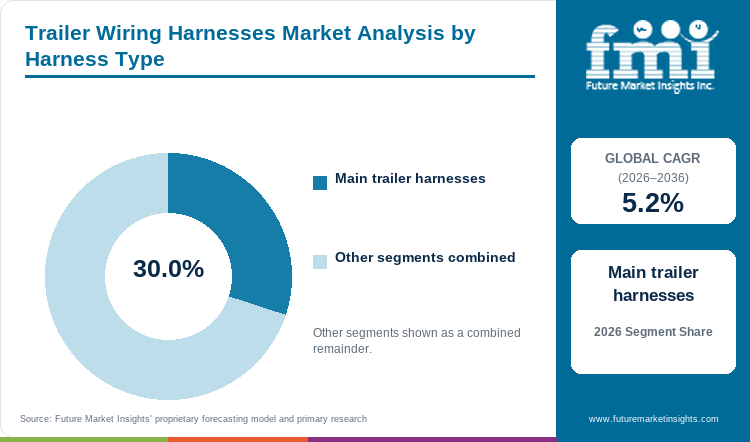
- By harness type, main trailer harnesses are estimated to hold 30.0% in 2026 owing to one assembly serving several trailer circuits.
- Semi-trailers are set to represent 29.0% of trailer type in 2026 due to intensive freight use and repeated coupling exposure.
- In 2026, the 7-way blade segment is expected to hold 36.0% of connector demand because one interface carries several towing functions.
- Water intrusion and routing damage can turn inexpensive wiring faults into warranty work or unplanned downtime for commercial trailer operators.
- Some of the key players in this market include Peterson Manufacturing, CURT, Tekonsha, Bargman, Wesbar, Phillips Industries, Pollak, Optronics International, Grote Industries, and Molex.
Analyst Perspective
"Trailer wiring should be evaluated by failure exposure and installation time before unit price becomes decisive. Commercial value rises where sealed interfaces reduce diagnostic work and the electrical backbone accepts added sensors without weakening routine serviceability."
- Nikhil Kaitwade, Principal Consultant, Future Market Insights
How is the trailer wiring harnesses market segmented?
The trailer wiring harnesses market is segmented by harness type, trailer type, connector, sales channel, end use, and region.
The trailer wiring harnesses market is segmented by harness type, trailer type, connector, sales channel, end use and region. Harness type covers main trailer, lighting, brake, ABS/EBS and custom OEM harnesses while trailer type covers semi-trailers, utility, cargo, RV - camper and boat trailers. Connector, sales-channel and end-use classifications distinguish the stated formats, purchasing routes and operating applications used throughout the report.
What makes main trailer harnesses central to the harness type category?
Main harnesses carry power and signals from the trailer nose toward several downstream electrical loads. Builders reduce field splicing by protecting branch architecture before lamps or sensors are installed across repeat trailer platforms. Additional electrical content therefore raises the value of a main harness that technicians can diagnose without disturbing unrelated circuits.
- By harness type, the main trailer harnesses segment is estimated to hold 30.0% in 2026 owing to one assembly serving several electrical functions.
- In February 2026, Optronics International launched a new USA Harness dump-trailer wiring kit alongside its Co27 charger as one factory-ready electrical package. The launch ties digital harness architecture to OEM routing decisions because trailer builders can specify charging, lighting and protected power paths together.
Why do semi-trailers account for 29.0% of trailer type demand?
Semi-trailers operate long duty cycles and repeatedly expose electrical connections to coupling movement and road contamination. That operating pattern makes harness durability commercially visible for semi-trailer systems serving freight fleets. Long equipment lives also keep replacement demand active after original wiring ages or suffers localized damage.
- Semi-trailers are projected to hold 29.0% of trailer type demand in 2026 because high utilization increases electrical maintenance exposure.
- Poland's central vehicle register recorded 2,994 new goods semi-trailer registrations during March 2025 across the national fleet. That official monthly count links first-fit and replacement electrical demand to a continuing flow of newly registered trailing equipment.
How does the 7-way blade format sustain the connector category?
The 7-way blade interface carries lighting plus brake-control and auxiliary circuits through one towing connection. Compatibility across tractor-trailer electrical interfaces protects replacement access without forcing fleets to redesign familiar towing architectures. Service value rises when technicians can replace a damaged cable or connection while retaining the established trailer electrical layout.
- In 2026, the 7-way blade segment is expected to hold 36.0% of connector demand because one interface carries several towing functions.
- In February 2026, Phillips Connect introduced TrailerID to confirm the connected trailer through the physical tractor-trailer connection. The system combines integrated hardware and software so pairing data can move into compliance and dispatch workflows plus billing records. Standardized multi-circuit interfaces gain added commercial value when fleets expect one connection point to support conventional circuits and verified digital trailer identity.
What supports trailer OEMs in the sales channel category?
Trailer OEM engineers can set branch lengths and sealing points before frames enter repeat production. Factory release lets planned trailer wiring follow brackets and lamp positions before repetitive assembly begins. Design-stage coordination reduces field splicing and gives service teams a consistent electrical route for each trailer platform.
- By sales channel, trailer OEMs are forecast to represent 38.0% in 2026 driven by design-stage control over routing and connector interfaces.
- In January 2026, Phillips Industries opened a 67,000-square-foot Cincinnati distribution center designed to move fast-moving commercial vehicle aftermarket products closer to customers. The facility strengthens fulfillment capacity for trailer electrical parts while keeping replacement-channel availability tied to one operating network.
What drives commercial freight in the end use category?
Commercial freight makes electrical downtime visible because failed lighting can remove a trailer from normal dispatch. Operators using fleet management systems can standardize replacement parts and schedule repair work across larger equipment pools. High annual mileage also increases exposure to road spray and repeated connector handling during commercial service.
- Commercial freight is anticipated to account for 31.0% of end use in 2026 attributable to high utilization and electrical downtime costs.
- FMCSA's 2025 commercial-zone dataset recorded 32,772 inoperable required-lamp violations across 319,945 inspections. That violation volume makes freight-fleet electrical maintenance economically visible because a failed lighting circuit can create roadside downtime instead of deferred workshop repair.
What are the drivers, restraints and opportunities in the trailer wiring harnesses market?
Regulated electrical functions and fleet uptime support demand while water intrusion limits reliability and network-ready harness designs open higher-content opportunities.
- Driver: Commercial trailers require operable lighting and braking circuits because electrical faults can stop dispatch or trigger roadside repair work.
- Restraint: Water ingress and installation errors can disable trailer lighting while adding warranty labor and safety exposure for manufacturers or fleets.
- Opportunity: Sealed modular harnesses can provide controlled connection points for sensors and data devices without replacing the conventional lighting backbone.
Commercial fleets pay for harness reliability because required lighting circuits remain part of roadside compliance. FMCSA recorded 2,714 violations in its 2025 national roadside dataset where all required lamps on a towed vehicle were inoperative because no electrical connection existed. That failure mode directly links harness continuity with dispatch readiness and roadside out-of-service exposure.
Water intrusion remains a practical restraint because trailer wiring and tow connections operate close to road spray and repeated mechanical movement. NHTSA campaign 25V893 covered 51,587 Hyundai Tucson vehicles fitted with an optional tow-hitch wiring harness that could admit water and short the control module. The recall shows how inadequate sealing can turn a low-cost electrical fault into warranty work and immediate safety exposure.
Higher electrical content increases harness value where trailer safety electronics share protected power and communication routes. NHTSA recall 26V104 identified 405 warranty claims potentially related to integrated trailer relay module communication loss by February 2026. That failure pattern raises the commercial value of diagnosable interfaces because added trailer functions still depend on reliable electrical continuity.
Which country CAGRs are profiled in the trailer wiring harnesses market?
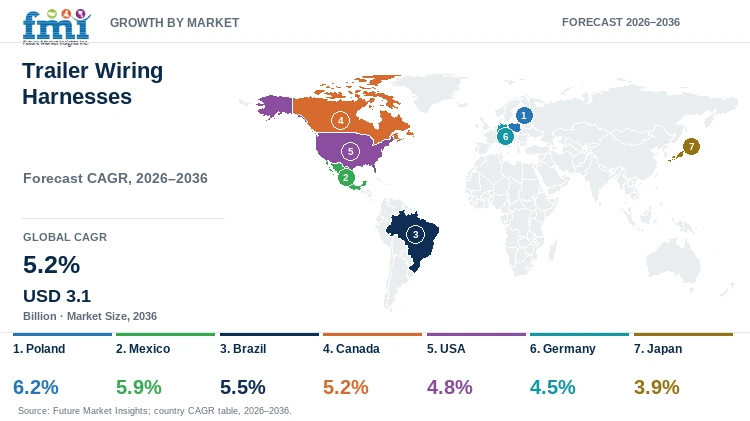
| Country | CAGR |
|---|---|
| Poland | 6.2% |
| Mexico | 5.9% |
| Brazil | 5.5% |
| Canada | 5.2% |
| USA | 4.8% |
| Germany | 4.5% |
| Japan | 3.9% |
How do country-level CAGRs compare in the trailer wiring harnesses market?
Seven forecasts span 2.3 percentage points between Poland at 6.2% and Japan at 3.9% through 2036. Poland and Mexico form the upper group, with Brazil and Canada in the middle. USA and Germany follow before Japan because rates describe growth rather than current market size.
- Poland combines an established trailer-manufacturing base with intermodal freight activity that keeps workshop demand sensitive to cargo cycles.
- Mexico concentrates federal freight in tractor-semitrailer combinations, making regional electrical stocking important along long-haul corridors and border routes.
- Brazil relies heavily on road freight, so distributor reach can influence repair delays far from major manufacturing and service centers.
- Canada pairs North American connector conventions with winter contamination, raising the service value of sealed terminals and corrosion-resistant junctions.
- USA channel depth supports factory fitment and broad replacement access, but extensive vehicle variation increases application-data requirements for installers.
- Germany’s toll-road freight activity supports an active replacement base within a mature environment that expects documented technical compatibility.
- Japan’s mature fleet rewards precise fitment and controlled inventory because broad catalog expansion carries higher stocking risk for distributors.
Similar growth rates can produce different revenue routes because installed equipment, freight intensity and service coverage change replacement frequency. The full report provides country-level CAGR analysis across North America, Latin America, Western Europe, Eastern Europe, East Asia, South Asia and Pacific and the Middle East and Africa.
Country-wise Analysis
- Mexico's freight industry remains heavily concentrated in tractor-semitrailer combinations serving domestic and cross-border transport corridors. Electrical systems experience repeated operating cycles because trailers remain active across high-utilization freight routes. SICT counted 503,408 three-axle tractor units within the regulated federal freight fleet during 2025. Sales of trailer wiring harnesses in Mexico are forecast to rise at a 5.9% CAGR during the assessment period, supported by a large equipment base that requires recurring trailer electrical service. Standardized connections become increasingly valuable because maintenance networks must support high-use vehicles across multiple freight regions.
- Freight movement across Brazil continues to depend heavily on road transport over long operating distances. Electrical replacement components must remain accessible because service interruptions can become more disruptive when repair support is not readily available. ANTT recorded 2.846 million RNTRC-associated vehicles in December 2025. The total represented an annual increase of 8.95%. Growing fleet activity increases exposure to routine electrical wear across commercial transport operations. An estimated 5.5% CAGR is projected for the Brazilian trailer wiring harness sector between 2026 and 2036 as operators continue prioritizing dependable trailer connectivity throughout extensive road networks.
- Canadian trailer operators routinely work across long service routes and severe winter conditions. Environmental exposure increases the importance of sealed electrical systems that can maintain reliable circuit performance throughout the year. Transport Canada's TSD No. 108 Revision 8 became effective on April 1, 2025 for road vehicles including trailers. Compliance requirements continue shaping specification decisions across trailer lighting and electrical systems. The Canadian trailer wiring harness sector is likely to climb at a 5.2% CAGR during the forecast period because operators continue favoring compliant and durable electrical configurations. Remote operating locations can still extend replacement timelines outside major service centers.
- Trailer wiring demand in the United States spans both OEM vehicle programs and a large replacement market. Extensive service coverage supports recurring replacement activity across commercial transport and towing applications. USA Census Bureau data identified 170,286 employer establishments within NAICS 484 truck transportation across the national service economy. Commercial uptake of trailer wiring harnesses in the United States is anticipated to advance at a 4.8% CAGR over the assessment period with growth tied to broad service accessibility and recurring maintenance demand. Vehicle variation continues increasing the importance of accurate fitment information across installation and distribution channels.
- Germany's mature freight environment places strong emphasis on compatibility across replacement parts and connected vehicle systems. Electrical components must integrate reliably with existing vehicle architectures because fleet operators place considerable weight on system continuity. Destatis reported truck toll mileage growth of 0.6% month over month during August 2026. The measure was also 2.0% above the prior-year period. Active heavy-truck movement sustains continuing replacement exposure across trailer fleets. Documentation-led replacement activity is expected to help Germany register a 4.5% CAGR through 2036 as operators continue prioritizing dependable trailer electrical performance. Vehicle telematics are increasing interface requirements without reducing the need for reliable electrical connections.
Who are the notable companies in the trailer wiring harnesses market?
Peterson Manufacturing, CURT, Tekonsha, Bargman, Wesbar, Phillips Industries, Pollak, Optronics International, Grote Industries, and Molex are notable companies serving this market.
Competitive outlook separate independent trailer-electrical specialists from larger groups that own established towing brands. Lippert's 2025 annual filing identifies CURT as a towing-products subsidiary serving automotive and trailer channels. Tekonsha, Bargman and Wesbar identify Flex-N-Gate as their current registered brand owner while Pollak remains within Standard Motor Products. Peterson Manufacturing, Phillips Industries, Optronics International, Grote Industries and Molex remain separately identifiable suppliers within the stated company set.
- Towing fitment and replacement access: Peterson Manufacturing and CURT serve alongside the Flex-N-Gate brands Tekonsha, Bargman and Wesbar.
- Commercial trailer electrical systems: Phillips Industries and Grote Industries address lighting and power delivery while Pollak serves heavy-duty connector applications.
- Integrated harness and connectivity: Optronics International supplies custom trailer harnesses while Molex addresses sealed power and data interfaces for higher electrical content.
Competitive Benchmarking: Trailer Wiring Harnesses Market
| Company | Trailer Harness Breadth | Sealed / Harsh-Environment Connectivity | Smart / Networked Trailer Readiness | Geographic Reach |
|---|---|---|---|---|
| Peterson Manufacturing | High | High | Medium | North America with commercial vehicle distribution |
| CURT | High | Medium | Low | North America |
| Tekonsha | Medium | Medium | Low | North America under Flex-N-Gate ownership |
| Bargman | Medium | Medium | Low | North America under Flex-N-Gate ownership |
| Wesbar | Low | Medium | Low | North America under Flex-N-Gate ownership |
| Phillips Industries | High | High | High | United States, Mexico and international fleet supply |
| Pollak | Medium | High | Low | North America |
| Optronics International | High | High | Medium | North America with international manufacturing |
| Grote Industries | High | High | High | North America, Europe and Asia |
| Molex | Medium | High | High | Global transportation markets |
Scoring uses documented trailer electrical scope and buyer-relevant official evidence rather than broad corporate reputation. High breadth requires several verified trailer electrical routes, while Medium reflects narrower coverage and Low identifies one route. High harsh-environment capability requires sealing evidence for connectors or harness interfaces in demanding vehicle service. High smart-trailer readiness requires a networked trailer platform, while lower scores indicate narrower participation.
Key Developments in the Trailer Wiring Harnesses Market
- In February 2026, Peterson Manufacturing joined Mighty Auto Parts' Heavy Duty Program and expanded distributor access to heavy-duty lighting and wiring harness systems. The launch gives fleets and installers another supported channel for stocked electrical replacement products across commercial trailer applications.
- In January 2026, Grote Industries launched its Safety Circuit Roadshow at Heavy Duty Aftermarket Week for direct fleet and distributor demonstrations of connected safety systems. The deployment brings trailer lighting and safety architectures into working customer environments where integration and serviceability can be evaluated before wider adoption.
- In March 2026, Phillips Connect expanded trailer intelligence across roadside safety plus brake and liftgate systems through new equipment collaborations. The development moves trailer electrical monitoring beyond isolated devices by distributing operating signals across maintenance and safety workflows. Harness suppliers gain a clearer interface opportunity as fleets add connected functions without abandoning established trailer electrical systems.
Key Players in the Trailer Wiring Harnesses Market
Towing Fitment and Replacement Specialists
- Peterson Manufacturing
- CURT
- Tekonsha
- Bargman
- Wesbar
Commercial Trailer Electrical Specialists
- Phillips Industries
- Pollak
- Grote Industries
Integrated Harness and Connectivity Suppliers
- Optronics International
- Molex
Trailer Wiring Harnesses Market - Report Scope
| Coverage field | Report scope |
|---|---|
| Market breakdown | By harness type, trailer type, connector, sales channel, end use, and region. |
| Quantitative Units | USD billion. |
| Market Definition | Revenue from trailer wiring harness assemblies sold within the defined trailer electrical scope. Finished trailers, tow vehicles, and stand-alone adjacent electronics are excluded. |
| Regions Covered | North America, Latin America, Western Europe, Eastern Europe, East Asia, South Asia and Pacific, and Middle East and Africa. |
| Countries Covered | Poland, Mexico, Brazil, Canada, USA, Germany, Japan, and 20+ countries included in the full report. |
| Key Companies Profiled | Peterson Manufacturing, CURT, Tekonsha, Bargman, Wesbar, Phillips Industries, Pollak, Optronics International, Grote Industries, Molex. |
| Forecast Period | 2026 to 2036. |
| Approach | Primary and secondary research with market triangulation. |
Trailer Wiring Harnesses Market - Research Methodology
| Method | Approach |
|---|---|
| Primary Research | FMI analysts gathered input from manufacturers, service providers, technology developers, distributors, end users, procurement teams, and subject-matter experts. Interviews examined purchasing decisions, product or service evaluation, adoption barriers, approval requirements, pricing considerations, and expectations for technical or commercial support. Respondents were also asked what evidence is required before a trial, pilot, or initial order develops into regular purchasing. |
| Desk Research | Desk research covered government statistics, regulatory publications, trade data, industry associations, technical literature, standards, company filings, product information, and official corporate announcements. Sources were reviewed for relevance, publication date, geographic coverage, and consistency with the defined market scope. Claims relating to performance, applications, approvals, capacity, investment, and commercial activity were retained only when supported by credible public evidence. |
| Market Sizing and Forecasting | The market model combined the baseline value with historical performance, segment structure, pricing and volume indicators, adoption levels, company participation, and country-level demand conditions. Forecast assumptions considered economic activity, investment trends, regulatory developments, technology adoption, purchasing cycles, supply availability, and barriers to wider market use. Segment and regional estimates were reconciled before the final market total was calculated. |
| Data Validation | Estimates were checked against multiple independent indicators, including public data, company activity, trade patterns, industry developments, and findings from primary interviews. Validation also tested whether products, services, applications, and company revenues fell within the defined market boundaries. Adjacent categories, unsupported claims, overlapping revenues, and activities without direct market relevance were excluded to reduce double counting and maintain consistency across segments and countries. |
Trailer Wiring Harnesses Market by Segments
Trailer Wiring Harnesses Market segmented by Harness Type:
- Main trailer harnesses
- Lighting harnesses
- Brake wiring harnesses
- ABS/EBS harnesses
- Custom OEM harnesses
Trailer Wiring Harnesses Market segmented by Trailer Type:
- Semi-trailers
- Utility trailers
- Cargo trailers
- RV - camper trailers
- Boat trailers
Trailer Wiring Harnesses Market segmented by Connector:
- 7-way blade
- 4-way flat
- Heavy-duty sealed connectors
- 6-way round
- 5-way flat
Trailer Wiring Harnesses Market segmented by Sales Channel:
- Trailer OEMs
- Aftermarket distributors
- Fleet maintenance
- E-commerce - catalog
Trailer Wiring Harnesses Market segmented by End Use:
- Commercial freight
- Utility - recreation
- Construction fleets
- Agriculture
- Rental fleets
Trailer Wiring Harnesses Market by Region:
- North America
- United States
- Canada
- Latin America
- Brazil
- Mexico
- Argentina
- Chile
- Western Europe
- Germany
- France
- United Kingdom
- Italy
- Spain
- Benelux
- Nordics
- Eastern Europe
- Poland
- Czech Republic
- Romania
- Hungary
- East Asia
- China
- Japan
- South Korea
- South Asia and Pacific
- India
- ASEAN
- Australia and New Zealand
- Middle East and Africa
- GCC Countries
- South Africa
- Türkiye
- Israel
Research Sources and Bibliography
- National Highway Traffic Safety Administration. (2026, February 13). Part 573 Safety Recall Report 26V104: Integrated trailer relay module software may cause loss of trailer lighting.
- Secretaría de Infraestructura, Comunicaciones y Transportes. (2026). Estadística Básica del Autotransporte Federal 2025.
- Trucks, Parts, Service. (2026, May 26). Judge balks at First Brands Chapter 11 reorganization approval; Horizon North America sale to a Flex-N-Gate subsidiary approved.
- Phillips Connect. (2026, February 13). Phillips Connect TrailerID turns trailer pairing into an operational advantage.
- Centralna Ewidencja Pojazdów i Kierowców. (2026). Pojazdy zarejestrowane w 2025 roku.
- Tekonsha. (2026). Current official brand pages identifying Flex-N-Gate as registered brand owner.
- Optronics International. (2026, February 25). Optronics unveils first-of-its-kind Co27 DC-DC battery charger to eliminate chronic trailer battery failure.
- Federal Motor Carrier Safety Administration. (2025). Commercial Zone Violations: Calendar Year 2025.
- Federal Motor Carrier Safety Administration. (2025). Roadside Inspection Violations: All required lamps on towed vehicle inoperative due to no electrical connection.
- National Highway Traffic Safety Administration. (2025, December 23). Safety Recall Acknowledgement 25V893: Tow hitch wiring harness may short circuit.
- Statistics Poland. (2026, August 31). Intermodal transport in Poland in 2025.
- USA Census Bureau. (2026). NAICS 484 Truck Transportation profile.
- Federal Statistical Office of Germany. (2026, September 9). Truck toll mileage index in August 2026.
- Transport Canada. (2025, April 1). Technical Standards Document No. 108, Revision 8.
- Agência Nacional de Transportes Terrestres. (2026). RNTRC vehicle data and 2025 road-freight yearbook.
- Japan Trucking Association. (2026). 2025 commercial truck safety statistics and vehicle-base summary.
- Peterson Manufacturing. (2026, March 4). Peterson Manufacturing partners with Mighty Auto Parts to launch a Heavy Duty Program.
- Phillips Industries. (2026, January 16). Phillips Industries announces the operational launch of its Cincinnati distribution center.
- Peterson Manufacturing. (2026, March 11). Engineering out failure: The Genesis truck and trailer light.
- Grote Industries. (2026, January 20). Grote Industries debuts new Safety Circuit Roadshow truck at Heavy Duty Aftermarket Week 2026.
- Pro-Vision. (2026, March 16). Pro-Vision and Phillips Industries collaborate to improve rear visibility for commercial fleets.
- LCI Industries. (2026, February 26). Annual Report on Form 10-K for year ended December 31, 2025.
- Standard Motor Products. (2026). Current brand portfolio including Pollak.
- Phillips Connect. (2026, March 14). Phillips Connect expands trailer intelligence across roadside, brake and liftgate systems.
- Molex. (2026, June 30). Molex delivers next-generation HSAutoLink G automotive Ethernet connector system to address rising ADAS/compute demands and zonal architectures.
This bibliography is provided for reader reference and is not exhaustive. The full report contains the complete reference list and detailed citations
This Report Answers
- How large is the trailer wiring harnesses market in 2026 and what value is projected by 2036?
- Which regulated trailer functions and freight operating conditions keep wiring demand tied to vehicle uptime?
- Why do main trailer harnesses account for 30.0% of harness type demand during 2026?
- How does semi-trailer utilization change replacement economics for exposed wiring and connector assemblies over time?
- Why does the 7-way blade retain 36.0% of connector demand within the stated 2026 mix?
- How do the seven stated country growth rates compare during the 2026 to 2036 forecast period?
- Which companies serve towing fitment, commercial trailer electrical systems and custom harness applications in this market?
- Which sealing and installation conditions can raise lifetime service cost for trailer wiring harnesses in commercial use?
Frequently Asked Questions
How big is the trailer wiring harnesses market in 2026?
The trailer wiring harnesses market is valued at USD 1.9 billion in 2026 and is projected to reach USD 3.1 billion by 2036. Regulated lighting and braking circuits plus commercial replacement activity support continued demand for protected electrical connections.
What is the CAGR of the trailer wiring harnesses market from 2026 to 2036?
The trailer wiring harnesses market is projected to grow at a CAGR of 5.2% between 2026 and 2036. Commercial trailer utilization and replacement of exposed electrical connections provide the principal growth support.
Which harness type leads the trailer wiring harnesses market?
The main trailer harnesses segment is expected to hold 30.0% of the trailer wiring harnesses market in 2026, attributable to one assembly serving several circuits. Added sensors increase the value of a protected backbone with controlled service points for field maintenance.
Which trailer type leads the trailer wiring harnesses market?
The semi-trailers segment is expected to hold 29.0% of the trailer wiring harnesses market in 2026, driven by intensive freight use and repeated coupling exposure. Long equipment service lives sustain replacement activity for harnesses and connectors during commercial operation.
Which countries are projected to record the country growth comparison in the trailer wiring harnesses market?
Poland is projected to grow at 6.2% CAGR, followed by Mexico at 5.9% and Brazil at 5.5% through 2036. Freight structure and service distance determine how each rate converts into factory or replacement orders.
Which companies are active in the trailer wiring harnesses market?
Key companies operating in the trailer wiring harnesses market include Peterson Manufacturing, CURT, Tekonsha, Bargman, Wesbar, Phillips Industries, Pollak, Optronics International, Grote Industries and Molex. Their roles span towing fitment, commercial trailer electrical systems and higher-content vehicle connectivity in multiple sales channels.
Preview the report firsthand - request a free sample
Get SampleGet the brochure for pricing and purchase details.
Get PDFTable of Content
- Key Takeaways
- Market Size and CAGR
- Top Growth Driver
- Fastest Growing Segment
- Leading Region
- Key Companies
- Emerging Opportunities
- Executive Summary
- Global Market Outlook
- Demand-side Trends
- Supply-side Trends
- Technology Roadmap Analysis
- Analysis and Recommendations
- Analyst Perspective (What is happening? Why now? What should investors know?)
- Key Questions Answered
- How large is the market?
- What is the CAGR?
- What are key trends?
- Which region dominates?
- Who are the leaders?
- Market Overview
- Market Coverage / Taxonomy
- Market Definition / Scope / Limitations
- Research Methodology
- Chapter Orientation
- Analytical Lens and Working Hypotheses
- Market Structure, Signals, and Trend Drivers
- Benchmarking and Cross-market Comparability
- Market Sizing, Forecasting, and Opportunity Mapping
- Research Design and Evidence Framework
- Desk Research Programme (Secondary Evidence)
- Expert Input and Fieldwork (Primary Evidence)
- Tooling, Models, and Reference Databases
- Data Engineering and Model Build
- Quality Assurance and Audit Trail
- Market Background
- Market Dynamics (Drivers, Restraints, Opportunity, Trends)
- Scenario Forecast (Optimistic, Likely, Conservative)
- Impact Analysis
- AI Impact
- Sustainability Impact
- Regulatory Impact
- Technology Impact
- Consumer / Buyer Analysis
- Purchase Drivers
- Adoption Barriers
- Buyer Journey
- Opportunity Map Analysis
- Product Life Cycle Analysis
- Supply Chain Analysis
- Investment Feasibility Matrix
- Value Chain Analysis
- PESTLE and Porter's Analysis
- Regulatory Landscape
- Regional Parent Market Outlook
- Production and Consumption Statistics
- Import and Export Statistics
- Global Market Analysis and Forecast, 2021 to 2036
- Historical Market Size Value (USD Billion) Analysis, 2021 to 2025
- Current and Future Market Size Value (USD Billion) Projections, 2026 to 2036
- Y-o-Y Growth Trend Analysis
- Absolute $ Opportunity Analysis
- Global Market Pricing Analysis, 2021 to 2036
- Global Market Analysis and Forecast, By Harness Type, 2021 to 2036
- Introduction / Key Findings
- Historical Market Size Value (USD Billion) Analysis By Harness Type, 2021 to 2025
- Current and Future Market Size Value (USD Billion) Analysis and Forecast By Harness Type, 2026 to 2036
- Main trailer harnesses
- Lighting harnesses
- Brake wiring harnesses
- ABS/EBS harnesses
- Custom OEM harnesses
- Y-o-Y Growth Trend Analysis By Harness Type, 2021 to 2025
- Absolute $ Opportunity Analysis By Harness Type, 2026 to 2036
- Global Market Analysis and Forecast, By Trailer Type, 2021 to 2036
- Introduction / Key Findings
- Historical Market Size Value (USD Billion) Analysis By Trailer Type, 2021 to 2025
- Current and Future Market Size Value (USD Billion) Analysis and Forecast By Trailer Type, 2026 to 2036
- Semi-trailers
- Utility trailers
- Cargo trailers
- RV - camper trailers
- Boat trailers
- Y-o-Y Growth Trend Analysis By Trailer Type, 2021 to 2025
- Absolute $ Opportunity Analysis By Trailer Type, 2026 to 2036
- Global Market Analysis and Forecast, By Connector, 2021 to 2036
- Introduction / Key Findings
- Historical Market Size Value (USD Billion) Analysis By Connector, 2021 to 2025
- Current and Future Market Size Value (USD Billion) Analysis and Forecast By Connector, 2026 to 2036
- 7-way blade
- 4-way flat
- Heavy-duty sealed connectors
- 6-way round
- 5-way flat
- Y-o-Y Growth Trend Analysis By Connector, 2021 to 2025
- Absolute $ Opportunity Analysis By Connector, 2026 to 2036
- Global Market Analysis and Forecast, By Sales Channel, 2021 to 2036
- Introduction / Key Findings
- Historical Market Size Value (USD Billion) Analysis By Sales Channel, 2021 to 2025
- Current and Future Market Size Value (USD Billion) Analysis and Forecast By Sales Channel, 2026 to 2036
- Trailer OEMs
- Aftermarket distributors
- Fleet maintenance
- E-commerce - catalog
- Y-o-Y Growth Trend Analysis By Sales Channel, 2021 to 2025
- Absolute $ Opportunity Analysis By Sales Channel, 2026 to 2036
- Global Market Analysis and Forecast, By End Use, 2021 to 2036
- Introduction / Key Findings
- Historical Market Size Value (USD Billion) Analysis By End Use, 2021 to 2025
- Current and Future Market Size Value (USD Billion) Analysis and Forecast By End Use, 2026 to 2036
- Commercial freight
- Utility - recreation
- Construction fleets
- Agriculture
- Rental fleets
- Y-o-Y Growth Trend Analysis By End Use, 2021 to 2025
- Absolute $ Opportunity Analysis By End Use, 2026 to 2036
- Global Market Analysis and Forecast, By Region, 2021 to 2036
- Introduction
- Historical Market Size Value (USD Billion) Analysis By Region, 2021 to 2025
- Current Market Size Value (USD Billion) Analysis and Forecast By Region, 2026 to 2036
- North America
- Latin America
- Western Europe
- Eastern Europe
- East Asia
- South Asia and Pacific
- Middle East and Africa
- Market Attractiveness Analysis By Region
- North America Market Analysis and Forecast, By Country, 2021 to 2036
- Historical Market Size Value (USD Billion) Trend Analysis By Market Taxonomy, 2021 to 2025
- Market Size Value (USD Billion) Forecast By Market Taxonomy, 2026 to 2036
- By Country
- United States
- Canada
- By Harness Type
- By Trailer Type
- By Connector
- By Sales Channel
- By End Use
- By Country
- Market Attractiveness Analysis
- By Country
- By Harness Type
- By Trailer Type
- By Connector
- By Sales Channel
- By End Use
- Key Takeaways
- Latin America Market Analysis and Forecast, By Country
- Historical Market Size Value (USD Billion) Trend Analysis By Market Taxonomy, 2021 to 2025
- Market Size Value (USD Billion) Forecast By Market Taxonomy, 2026 to 2036
- By Country
- Brazil
- Mexico
- Argentina
- Chile
- By Harness Type
- By Trailer Type
- By Connector
- By Sales Channel
- By End Use
- By Country
- Market Attractiveness Analysis
- By Country
- By Harness Type
- By Trailer Type
- By Connector
- By Sales Channel
- By End Use
- Key Takeaways
- Western Europe Market Analysis and Forecast, By Country
- Historical Market Size Value (USD Billion) Trend Analysis By Market Taxonomy, 2021 to 2025
- Market Size Value (USD Billion) Forecast By Market Taxonomy, 2026 to 2036
- By Country
- Germany
- France
- United Kingdom
- Italy
- Spain
- Benelux
- Nordics
- By Harness Type
- By Trailer Type
- By Connector
- By Sales Channel
- By End Use
- By Country
- Market Attractiveness Analysis
- By Country
- By Harness Type
- By Trailer Type
- By Connector
- By Sales Channel
- By End Use
- Key Takeaways
- Eastern Europe Market Analysis and Forecast, By Country
- Historical Market Size Value (USD Billion) Trend Analysis By Market Taxonomy, 2021 to 2025
- Market Size Value (USD Billion) Forecast By Market Taxonomy, 2026 to 2036
- By Country
- Poland
- Czech Republic
- Romania
- Hungary
- By Harness Type
- By Trailer Type
- By Connector
- By Sales Channel
- By End Use
- By Country
- Market Attractiveness Analysis
- By Country
- By Harness Type
- By Trailer Type
- By Connector
- By Sales Channel
- By End Use
- Key Takeaways
- East Asia Market Analysis and Forecast, By Country
- Historical Market Size Value (USD Billion) Trend Analysis By Market Taxonomy, 2021 to 2025
- Market Size Value (USD Billion) Forecast By Market Taxonomy, 2026 to 2036
- By Country
- China
- Japan
- South Korea
- By Harness Type
- By Trailer Type
- By Connector
- By Sales Channel
- By End Use
- By Country
- Market Attractiveness Analysis
- By Country
- By Harness Type
- By Trailer Type
- By Connector
- By Sales Channel
- By End Use
- Key Takeaways
- South Asia and Pacific Market Analysis and Forecast, By Country
- Historical Market Size Value (USD Billion) Trend Analysis By Market Taxonomy, 2021 to 2025
- Market Size Value (USD Billion) Forecast By Market Taxonomy, 2026 to 2036
- By Country
- India
- ASEAN
- Australia and New Zealand
- By Harness Type
- By Trailer Type
- By Connector
- By Sales Channel
- By End Use
- By Country
- Market Attractiveness Analysis
- By Country
- By Harness Type
- By Trailer Type
- By Connector
- By Sales Channel
- By End Use
- Key Takeaways
- Middle East and Africa Market Analysis and Forecast, By Country
- Historical Market Size Value (USD Billion) Trend Analysis By Market Taxonomy, 2021 to 2025
- Market Size Value (USD Billion) Forecast By Market Taxonomy, 2026 to 2036
- By Country
- GCC Countries
- South Africa
- Türkiye
- Israel
- By Harness Type
- By Trailer Type
- By Connector
- By Sales Channel
- By End Use
- By Country
- Market Attractiveness Analysis
- By Country
- By Harness Type
- By Trailer Type
- By Connector
- By Sales Channel
- By End Use
- Key Takeaways
- Key Countries Market Analysis
- United States
- Pricing Analysis
- Market Share Analysis, 2025
- By Harness Type
- By Trailer Type
- By Connector
- By Sales Channel
- By End Use
- Canada
- Pricing Analysis
- Market Share Analysis, 2025
- By Harness Type
- By Trailer Type
- By Connector
- By Sales Channel
- By End Use
- Mexico
- Pricing Analysis
- Market Share Analysis, 2025
- By Harness Type
- By Trailer Type
- By Connector
- By Sales Channel
- By End Use
- Brazil
- Pricing Analysis
- Market Share Analysis, 2025
- By Harness Type
- By Trailer Type
- By Connector
- By Sales Channel
- By End Use
- Chile
- Pricing Analysis
- Market Share Analysis, 2025
- By Harness Type
- By Trailer Type
- By Connector
- By Sales Channel
- By End Use
- Germany
- Pricing Analysis
- Market Share Analysis, 2025
- By Harness Type
- By Trailer Type
- By Connector
- By Sales Channel
- By End Use
- United Kingdom
- Pricing Analysis
- Market Share Analysis, 2025
- By Harness Type
- By Trailer Type
- By Connector
- By Sales Channel
- By End Use
- Italy
- Pricing Analysis
- Market Share Analysis, 2025
- By Harness Type
- By Trailer Type
- By Connector
- By Sales Channel
- By End Use
- Spain
- Pricing Analysis
- Market Share Analysis, 2025
- By Harness Type
- By Trailer Type
- By Connector
- By Sales Channel
- By End Use
- France
- Pricing Analysis
- Market Share Analysis, 2025
- By Harness Type
- By Trailer Type
- By Connector
- By Sales Channel
- By End Use
- India
- Pricing Analysis
- Market Share Analysis, 2025
- By Harness Type
- By Trailer Type
- By Connector
- By Sales Channel
- By End Use
- ASEAN
- Pricing Analysis
- Market Share Analysis, 2025
- By Harness Type
- By Trailer Type
- By Connector
- By Sales Channel
- By End Use
- Australia and New Zealand
- Pricing Analysis
- Market Share Analysis, 2025
- By Harness Type
- By Trailer Type
- By Connector
- By Sales Channel
- By End Use
- China
- Pricing Analysis
- Market Share Analysis, 2025
- By Harness Type
- By Trailer Type
- By Connector
- By Sales Channel
- By End Use
- Japan
- Pricing Analysis
- Market Share Analysis, 2025
- By Harness Type
- By Trailer Type
- By Connector
- By Sales Channel
- By End Use
- South Korea
- Pricing Analysis
- Market Share Analysis, 2025
- By Harness Type
- By Trailer Type
- By Connector
- By Sales Channel
- By End Use
- Poland
- Pricing Analysis
- Market Share Analysis, 2025
- By Harness Type
- By Trailer Type
- By Connector
- By Sales Channel
- By End Use
- Hungary
- Pricing Analysis
- Market Share Analysis, 2025
- By Harness Type
- By Trailer Type
- By Connector
- By Sales Channel
- By End Use
- Türkiye
- Pricing Analysis
- Market Share Analysis, 2025
- By Harness Type
- By Trailer Type
- By Connector
- By Sales Channel
- By End Use
- South Africa
- Pricing Analysis
- Market Share Analysis, 2025
- By Harness Type
- By Trailer Type
- By Connector
- By Sales Channel
- By End Use
- United States
- Market Structure Analysis
- Competition Dashboard
- Competition Benchmarking
- Market Share Analysis of Top Players
- By Regional
- By Harness Type
- By Trailer Type
- By Connector
- By Sales Channel
- By End Use
- Emerging Startups
- Innovation Benchmarking
- Competition Analysis
- Competition Deep Dive
- Peterson Manufacturing
- Overview
- Product Portfolio
- Profitability by Market Segments
- Sales Footprint
- Strategy Overview
- Marketing Strategy
- Product Strategy
- Channel Strategy
- CURT
- Tekonsha
- Bargman
- Wesbar
- Phillips Industries
- Pollak
- Optronics International
- Grote Industries
- Molex
- Peterson Manufacturing
- Case Studies
- Success Stories
- Recent Developments
- Competition Deep Dive
- Assumptions & Acronyms Used


