

- Market Size (2026)
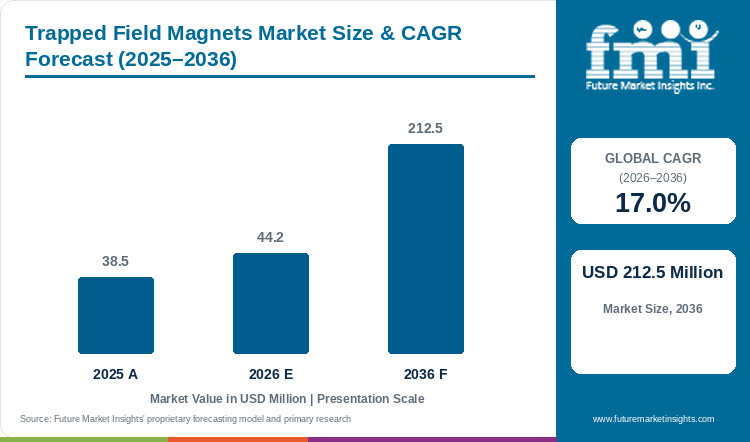
- USD 44.2 Mn
- Forecast (2036)
- USD 212.5 Mn
- CAGR (2026 to 2036)
- 17.0%
How big is Trapped Field Magnets Market in 2026?
Across 2025, trapped field magnets sales totaled USD 38.5 million, with estimated 2026 revenue of USD 44.2 million slated to compound at a projected 17.0% CAGR and reach an anticipated USD 212.5 million by the close of 2036.
Conventional sintered neodymium-iron-boron permanent magnets hit a physical ferromagnetic saturation ceiling near 1.4 Tesla, whereas Faraday Factory Japan LLC demonstrated in June 2025 that its MIRAI rare-earth barium copper oxide superconductor sustains an engineering current density of 1,000 amperes per square millimeter at 20 Kelvin and 20 Tesla [1]. Pinning quantized magnetic vortices inside melt-textured rare-earth cuprate crystals allows a solid superconducting puck to trap 3 to 17 Tesla without continuous current leads, which is why Single-Grain REBCO (GdBCO / YBCO) Bulks are forecast to represent 58.6% of superconducting bulk material revenue in 2026 alongside superconducting quantum and cryogenic hardware. Supported by megawatt electric aircraft motor testbeds and cryogen-free desktop NMR spectrometers, global trapped field magnets outlays stood at USD 38.5 million in 2025 before reaching an estimated 2026 total of USD 44.2 million and are slated to attain USD 212.5 million during 2036. Over this ten-year forecast window, worldwide revenue is expected to expand at a 17.0% CAGR, expanding annual market turnover by an anticipated USD 168.3 million between the 2026 baseline and 2036.
Key Market Trends & Insights
- By superconducting bulk material: Single-Grain REBCO (GdBCO / YBCO) Bulks are forecast to represent 58.6% of 2026 bulk material sales because silver-doped gadolinium and yttrium cuprate monoliths sustain high critical current densities at 20 to 50 Kelvin.
- By magnetization technique: Pulsed-Field Magnetization (PFM) is projected to capture a 64.2% portion of 2026 magnetization demand since millisecond capacitor-bank pulses charge pucks directly inside assembled motor rotors without external superconducting coils.
- By cryogenic cooling architecture: Conduction-Cooled Cryocooler (20-50 K) is estimated to collect 53.0% of 2026 cooling outlays by replacing boil-off liquid cryogens with closed-cycle Stirling and Gifford-McMahon cold heads.
- By mobility & industrial application: High-Power-Density Electric Aircraft & eVTOL Motors are anticipated to reach 41.8% of 2026 application revenue as megawatt aviation demonstrators use trapped-flux rotors to surpass 20 kW/kg.
Regional Highlights
- Fastest-growing European hub: British HTS magnet builders are projected to lead major superconducting economies with an 18.6% annual growth clip through 2036 via Oxfordshire fusion spin-outs and Cambridge bulk superconductor engineering.
- East Asian superconducting industrial base: South Korean demand is anticipated to rise 18.1% annually while Japanese output is forecast to expand 16.4% per year across maglev levitation and single-grain GdBCO crystal foundries.
- North American and German cryo-propulsion programs: American defense and aero programs are expected to climb 16.6% per annum compared with a predicted 15.9% annual gain in Germany as naval propulsion pods and Saxon melt-textured bulk plants scale.
Market Size & Forecast
Table 1: Market Size and Forecast for the Trapped Field Magnets Market (USD million and CAGR percentage), 2025 to 2036
| Metric | Value |
|---|---|
| Market Value (2025) | USD 38.5 million |
| Estimated Market Size in 2026 | USD 44.2 million |
| Projected Market Size by 2036 | USD 212.5 million |
| CAGR (2026 to 2036) | 17.0% |
| Absolute Dollar Opportunity (2026 to 2036) | USD 168.3 million |
Breakthroughs in critical current density across commercial REBCO tapes and shrink-fit stainless-steel ring reinforcement are accelerating trapped field magnet deployment beyond laboratory cryostats. In September 2026, Tokamak Energy Ltd. completed its 14-month Demo4 campaign across 44 wound REBCO coils at 13.7 Tesla under 150 megapascals of compressive stress [2]; while DC-driven fusion coils lie outside the remanent trapped-field puck scope, this upstream REBCO tape qualification directly informs mechanical reinforcement for stacked-tape trapped-field annuli. Stacking die-cut coated-conductor tape annuli or encapsulating single-grain GdBCO pucks with engineered superconducting wire and bulk materials prevents tensile Lorentz cracking above 10 Tesla. Consequently, marine propulsion primes and benchtop NMR spectrometer builders are expected to transition from persistent-mode wound coils to solid trapped-flux pucks that eliminate current-lead heat leak.
Cryogenic Puck Shipments and Trapped Flux Sizing
Table 2: Superconducting Puck Shipments and Trapped Flux Indicators for the Trapped Field Magnets Market (USD million, pucks/stacks, and Tesla metrics), mixed historical and forecast years from 2025 to 2036
| Metric | 2025 | 2026 | 2036 |
|---|---|---|---|
| Market size (USD million) | 38.5 | 44.2 | 212.5 |
| Commercial trapped-field bulk pucks & tape stacks (units) | 6,800 to 7,600 | 7,800 to 8,700 | 39,500 to 44,200 |
| Operational trapped surface flux density at 20-50 K (Tesla) | 3.5 to 11.5 | 4.0 to 12.5 | 6.0 to 16.5 |
| Average realized price per encapsulated TFM module (USD) | 5,050 to 5,650 | 5,080 to 5,660 | 4,800 to 5,380 |
Operational note: Shipment and unit-value figures reflect commercial deliveries of single-grain REBCO bulk discs alongside stacked REBCO tape annuli reinforced with shrink-fit metallic or carbon-fiber rings.
Because magnetic energy density scales with the square of magnetic flux density, a 5-Tesla trapped field magnet is estimated to store nearly 13 times more magnetic energy per unit volume than a 1.4-Tesla neodymium magnet. In September 2026, ASG Superconductors S.p.A. and Italy's INFN LASA group unveiled a 5-plus-Tesla and 1-megajoule REBCO magnet at the Applied Superconductivity Conference in Pittsburgh [3], which validates adjacent conduction-cooled cryostat engineering for composite REBCO trapped-flux modules. Replacing conventional specialty magnetic flux materials with silver-doped GdBCO pucks allows synchronous motor designers to eliminate ferromagnetic stator teeth and use lightweight air-gap windings. Each puck is precision-machined and shrink-fitted into a high-strength steel or titanium collar to counteract electromagnetic hoop stress during magnetization.
Aviation Propulsion & Compact NMR System Sizing
Table 3: Program and Cryogenic Module Spending Indicators for the Trapped Field Magnets Market (USD and physical metrics), mixed historical and forecast years from 2025 to 2036
| Metric | 2025 | 2026 | 2036 |
|---|---|---|---|
| Active superconducting motor, maglev & compact MRI/NMR programs | 48 | 56 | 195 |
| Average annual TFM expenditure per active program (USD thousand) | 802 | 789 | 1,090 |
| Typical single-grain REBCO puck diameter range (millimeters) | 30 to 80 | 30 to 100 | 45 to 140 |
| Flux creep decay rate under sub-cooled operation (% per decade) | 0.8 to 2.2 | 0.7 to 2.0 | 0.4 to 1.2 |
Table 4: Segment Revenue and Operational Benchmark Traceability for the Trapped Field Magnets Market (USD million and percentages), 2026
| Benchmark Indicator | Reported / Modeled Value | Institutional Reference Basis |
|---|---|---|
| Market size, 2026 | USD 44.2 million | Validated 2026 baseline valuation |
| Single-Grain REBCO Bulks revenue, 2026 | USD 25.9 million | 58.6% bulk material share |
| Pulsed-Field Magnetization (PFM) revenue, 2026 | USD 28.4 million | 64.2% magnetization technique share |
| Conduction-Cooled Cryocooler (20-50 K) revenue, 2026 | USD 23.4 million | 53.0% cooling architecture share |
Integrating trapped field magnets into rotating machinery eliminates the fragile cryogenic rotary joints and high-current slip brushes required by DC-wound superconducting field coils. Once cooled below its critical temperature and charged by a brief electromagnetic pulse, the bulk superconductor acts as a self-contained permanent magnet inside high-performance magnet assemblies. Sub-cooling the magnetized puck by 3 to 5 Kelvin after charging is expected to suppress thermally activated vortex creep, stabilizing the trapped air-gap field across multi-day flight or analytical NMR runs.
Analyst Perspective
"Trapped field magnets break the 2-Tesla saturation ceiling of rare-earth magnets without requiring continuous rotor excitation current leads. Vendors mastering multi-pulse in-situ magnetization and shrink-fit mechanical reinforcement are projected to lead commercial electric aviation and portable MRI adoption."
- Sudip Saha, Co-founder, FMI
How is the trapped field magnets market segmented?
The trapped field magnets market is segmented by superconducting bulk material, magnetization technique, cryogenic cooling architecture, mobility & industrial application, and region. In 2026, Single-Grain REBCO (GdBCO / YBCO) Bulks is projected at 58.6%, Pulsed-Field Magnetization (PFM) at 64.2%, Conduction-Cooled Cryocooler (20-50 K) at 53.0%, and High-Power-Density Electric Aircraft & eVTOL Motors at 41.8%.
By superconducting bulk material: Single-Grain REBCO (GdBCO / YBCO) Bulks, Stacked REBCO Coated Conductor Tape Annuli, and Magnesium Diboride (MgB2) Cryogenic Bulks.
By magnetization technique: Pulsed-Field Magnetization (PFM), Field-Cooled Magnetization (FCM), and Flux-Jump Assisted Multi-Pulse PFM.
By cryogenic cooling architecture: Conduction-Cooled Cryocooler (20-50 K), Liquid Hydrogen Cooled (20 K Co-Propulsion), and Liquid Nitrogen Cooled (65-77 K).
By mobility & industrial application: High-Power-Density Electric Aircraft & eVTOL Motors, Marine Podded Superconducting Propulsion, Maglev & High-Speed Rail Levitation Flux Sources, and Compact Desktop NMR & Portable MRI Systems.
Why Do Single-Grain REBCO (GdBCO / YBCO) Bulks Lead Superconducting Bulk Materials?
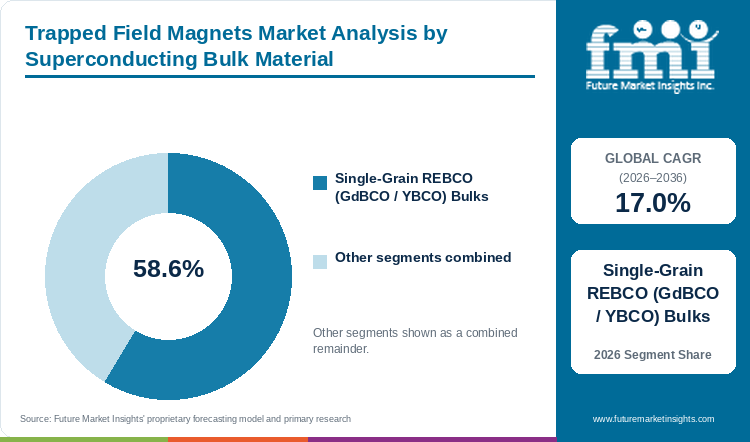
Single-Grain REBCO (GdBCO / YBCO) Bulks represent 58.6% of 2026 superconducting bulk material revenue, backed by superior vortex pinning.
Table 5: Superconducting Bulk Material Share for the Trapped Field Magnets Market (percentage share), 2026
| Superconducting Bulk Material Segment | Share (2026) |
|---|---|
| Single-Grain REBCO (GdBCO / YBCO) Bulks | 58.6% |
| Other Segments Combined | 41.4%* |
| Total | 100.0% |
*Note: Combined share of remaining superconducting bulk material categories totaling 100.0% of 2026 market demand.
Table 6: Superconducting Bulk Material Leadership and Market Growth for the Trapped Field Magnets Market (segment and CAGR percentage), 2026 to 2036
| Metric | Value |
|---|---|
| Global CAGR (2026 to 2036) | 17.0% |
| Leading Segment | Single-Grain REBCO (GdBCO / YBCO) Bulks |
Growing gadolinium or yttrium barium copper oxide as a single macroscopic crystal domain from a samarium-barium-copper-oxide seed eliminates high-angle grain boundaries that otherwise choke off macroscopic supercurrent loops. Dispersing nanoscale RE-211 nonsuperconducting precipitates throughout the RE-123 matrix creates dense pinning centers that lock magnetic vortices in place up to 17 Tesla at 29 Kelvin. When integrated into industrial electric motor rotors and magnetic bearings, silver-alloyed GdBCO discs provide three-dimensional field symmetry and lower cost per puck than laser-slit stacked REBCO tape annuli. Magnesium diboride bulks offer zero rare-earth content and uniform machinability, yet their 39-Kelvin critical temperature restricts operation to below 25 Kelvin.
- Eliminating grain-boundary weak links while sustaining 3-to-17-Tesla trapped fields leaves Single-Grain REBCO (GdBCO / YBCO) Bulks forecast to collect 58.6% of 2026 material revenue.
- Adelwitz Technologiezentrum GmbH (ATZ) grows seeded single-grain melt-textured YBCO and GdBCO bulk superconductors in Torgau capable of trapping up to 17 Tesla at 20 to 30 Kelvin for motors and magnetic bearings [4].
How Does Pulsed-Field Magnetization (PFM) Capture the Majority of Magnetization Technique Adoption?
Pulsed-Field Magnetization (PFM) accounts for 64.2% of 2026 magnetization technique adoption, stemming from compact in-situ copper solenoid charging.
Charging a superconducting puck via field-cooled magnetization requires immersing the entire rotor inside an external 10-Tesla superconducting solenoid before cooling, which is impractical inside an assembled aircraft or ship motor. Pulsed-field magnetization solves this integration barrier by discharging a capacitor bank through a compact copper stator winding or split vortex coil over 10 to 50 milliseconds after the rotor is already cooled. Using copper stator coils inside heavy-duty traction motor windings to re-magnetize REBCO rotor poles in situ allows operators to restore full field strength after any maintenance warm-up cycle. Multi-step cooling and tailored pulse waveforms limit adiabatic viscous flux-motion heating during the charging pulse.
- Allowing in-situ rotor charging without external superconducting background magnets leaves Pulsed-Field Magnetization (PFM) predicted to command 64.2% of 2026 magnetization technique share.
- In November 2025, Tokamak Energy Ltd. demonstrated 11.8-Tesla operation at 30 Kelvin in its Demo4 wound-coil testbed, validating upstream 2G REBCO tape current density for stacked-tape aviation motor pucks and maglev flux sources [5].
What Places Conduction-Cooled Cryocoolers (20-50 K) Ahead in Cryogenic Cooling Architectures?
Conduction-Cooled Cryocooler (20-50 K) collects 53.0% of 2026 cryogenic cooling architecture outlays, aided by cryogen-free closed-cycle operation.
Operating a single-grain REBCO bulk at 30 to 45 Kelvin via a flexible copper thermal strap connected to a closed-cycle Stirling or pulse-tube cryocooler triples its trapped magnetic field compared with 77-Kelvin liquid nitrogen immersion. At the same time, closed-cycle conduction cooling eliminates liquid helium dewars and boil-off vent plumbing inside hospital imaging suites and commuter aircraft nacelles. While liquid-hydrogen-cooled rotors at 20 Kelvin serve cryogenic aircraft testbeds, conduction-cooled cryocoolers integrate directly into preclinical and compact MRI cryostats using standard electrical bus power. Liquid nitrogen cooling at 65 to 77 Kelvin remains popular in educational maglev tracks and low-field magnetic separators where 1.5-to-3-Tesla flux is sufficient.
- Delivering 5-to-12-Tesla trapped fields without liquid cryogen replenishment positions Conduction-Cooled Cryocooler (20-50 K) for a projected 53.0% portion of 2026 cooling architecture spending.
- In July 2025, the 29th International Conference on Magnet Technology (MT29) in Boston convened dedicated technical sessions on Bulk and Permanent Magnets alongside pulsed-field magnetization and conduction-cooled MgB2 systems [6].
Why Do High-Power-Density Electric Aircraft & eVTOL Motors Lead Mobility & Industrial Applications?
High-Power-Density Electric Aircraft & eVTOL Motors reach 41.8% of 2026 mobility & industrial application spending, benefiting from megawatt rotor lightness.
Electrifying regional turboprops and narrow-body aircraft requires 2-to-10-megawatt propulsion motors that achieve specific power densities above 20 kilowatts per kilogram and 99% electromagnetic efficiency. Replacing heavy rare-earth rotor poles with 4-to-8-Tesla REBCO trapped field magnets cuts rotor diameter and mass by more than half while eliminating continuous rotor exciter losses. In parallel, naval podded propulsion drives and compact cryogen-free desktop NMR spectrometers provide high-value commercial revenue streams for bulk and stacked-tape TFM fabricators. Aerospace R&D programs fund the largest multi-puck rotor arrays, often installing 24 to 48 precision-ground GdBCO segments per synchronous rotor.
- Multi-puck megawatt aviation rotor demonstrators and eVTOL propulsion programs leave High-Power-Density Electric Aircraft & eVTOL Motors forecast to reach 41.8% of 2026 application revenue.
- In June 2025, Tokamak Energy Ltd. and Furukawa Electric Group agreed to establish a joint operational base in Japan to manufacture REBCO high-temperature superconducting magnets for fusion and zero-emission aircraft motors [7].
What are the drivers, restraints, and opportunities in the trapped field magnets market?
Throughout the trapped field magnets market, megawatt electric aviation rotors and cryogen-free desktop NMR systems are projected to drive rapid adoption through 2036, whereas adiabatic temperature spikes during pulsed magnetization and ceramic brittle fracture risks restrain mass deployment.
- Driver: Megawatt-class electric aircraft propulsion and cryogen-free benchtop NMR/MRI analyzers require 3-to-15-Tesla solid-state flux sources that are expected to outperform NdFeB magnets.
- Restraint: Rapid magnetic flux penetration during pulsed-field charging generates localized Joule heating and tensile Lorentz stresses that can crack unreinforced ceramic bulks.
- Opportunity: Stacking high-yield REBCO coated-conductor tape annuli and integrating 20-Kelvin liquid-hydrogen co-cooling is projected to create fracture-tough rotors for zero-emission aviation.
Growth Analysis and Future Potential: Qualitative Demand Catalysts
Pharmaceutical quality-control laboratories and aerospace propulsion consortia are adopting trapped field magnets to achieve multi-Tesla magnetic fields inside compact, cryogen-free footprints. In October 2026, ASG Superconductors S.p.A. joined CERN and INFN leadership at the ESSRI 2026 forum in Salerno to highlight Italy's IRIS superconducting magnet and 1-gigawatt zero-loss energy transmission test infrastructure [8]. Inside diagnostic magnetic resonance imaging systems and benchtop NMR spectrometers, hollow cylindrical GdBCO and MgB2 bulks trap uniform 1.5-to-4.7-Tesla fields without requiring 1,000 liters of liquid helium. Similarly, synchronous aircraft and naval motors use trapped-flux rotor poles to double air-gap shear stress without iron stator teeth.
Risk Assessment of the Trapped Field Magnets Market: Operational and Formulation Friction
Single-grain REBCO monoliths are brittle oxide ceramics with low intrinsic tensile strength around 30 to 50 megapascals, making them vulnerable to mechanical cleavage when outward Lorentz forces peak above 10 Tesla. Furthermore, during pulsed-field magnetization, rapid vortex motion across the crystal generates adiabatic thermal spikes that lower critical current density and limit trapped flux to roughly half of the field-cooled ceiling. In May 2026, the ITER Organization commissioned its Magnet Cold Test Facility in France after cooling a 330-tonne wound coil to 4 Kelvin over 12 days [9], providing adjacent cryogenic instrumentation benchmarks even though DC-driven fusion coils remain separate from remanent trapped-field pucks. Clinical and aerospace integrators building portable point-of-care MRI scanners must also budget for redundant cryocooler cold heads so a single compressor fault does not trigger a thermal demagnetization quench.
Commercial Opportunity Analysis: Formulation Differentiation and Value-Add Formats
Punching circular rings from commercial copper-and-Hastelloy-stabilized REBCO coated conductor tapes and stacking them into composite trapped-field pucks eliminates the 14-day batch crystal growth bottleneck of melt-textured bulks. Because each 50-micrometer tape layer contains a ductile metallic substrate, stacked-tape annuli are estimated to withstand tensile hoop stresses exceeding 600 megapascals and dissipate pulse heat rapidly in the radial direction. In October 2025, Tokamak Energy Ltd. signed a strategic high-temperature superconducting magnet collaboration with Gauss Fusion to industrialize modular HTS magnet design and manufacturing across Europe [10]. Sharing coated-conductor tape lines with superconducting fault current limiters and active multi-pulse PFM controllers allows motor builders to guarantee repeatable 8-to-12-Tesla rotor charging.
Trapped Field Magnets Market by Country (2026 to 2036)
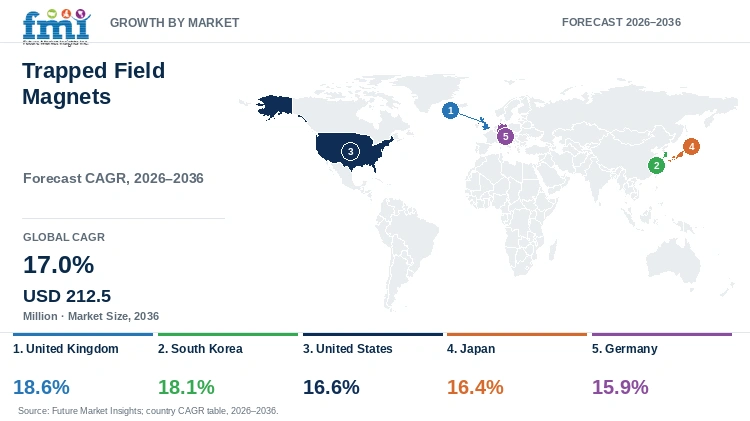
British HTS magnet and aviation programs are projected to outpace major international trapped field magnets markets at an 18.6% yearly clip through 2036, trailed by South Korean maglev and mobility investments anticipated at 18.1%. American naval and aero demonstrators are forecast to expand 16.6% per year while Japanese single-grain crystal foundries (estimated at 16.4%) and German bulk bearing builders (predicted at 15.9%) scale commercial output.
Table 7: Country CAGR and Primary Growth Levers for the Trapped Field Magnets Market (CAGR percentage and operational drivers), 2026 to 2036
| Country | CAGR (2026 to 2036) | Primary Growth Lever |
|---|---|---|
| United Kingdom | 18.6% | Oxfordshire HTS magnet commercialization, STEP fusion supply chain, and Cambridge bulk REBCO R&D |
| South Korea | 18.1% | Superconducting maglev transit, K-UAM aviation motors, and high-field NMR/fusion research |
| United States | 16.6% | Defense naval podded propulsion, NASA/ARPA-E electric aircraft motors, and portable MRI systems |
| Japan | 16.4% | World-scale QMG single-grain GdBCO bulk foundries, MIRAI HTS tape production, and maglev rail |
| Germany | 15.9% | Saxon melt-textured REBCO bulk manufacturing, hydrogen-cooled aero motors, and magnetic bearings |
Source: Future Market Insights analysis
United Kingdom Trapped Field Magnets Market Outlook (2026 to 2036)
Unlike overseas markets that rely on long-batch melt-grown ceramic crystals, the United Kingdom uniquely pioneers composite stacked REBCO coated-conductor tape annuli spun out of Oxfordshire fusion magnet builders and University of Cambridge superconductivity laboratories. In April 2026, Tokamak Energy Ltd. was awarded a GBP 70 million contract through March 2029 as Magnet Systems Partner for the UK government's STEP fusion programme at West Burton [11]. Technology spillover from stacked-tape HTS manufacturing into zero-emission aircraft motors is projected to lift British trapped field magnets revenue by 18.6% each year between 2026 and 2036. Because domestic motor builders still import raw GdBCO preforms, Oxfordshire firms are automating laser-slitting of ductile stacked-tape pucks.
Key takeaway: In the United Kingdom, STEP fusion HTS industrialization and stacked-tape aviation motor spin-outs are projected to sustain an 18.6% annual climb until 2036.
South Korea Trapped Field Magnets Market Outlook (2026 to 2036)
South Korea differs from Western aviation-centric markets because domestic trapped field magnet demand is anchored by high-gradient magnetic separation systems inside semiconductor wafer fabs alongside silent naval podded propulsion drives and frictionless maglev transit corridors. Trade and industry officials in Seoul expanded South Korea's future mobility and advanced materials R&D budget in November 2025 alongside KRW 936 billion in 2026 clean-mobility funding [12]. Backed by domestic coated-conductor tape capacity and naval propulsion testbeds, South Korean trapped field magnets turnover is anticipated to rise 18.1% annually until 2036. To overcome high imported 20-Kelvin pulse-tube cryocooler costs, Korean research institutes and industrial motor OEMs are co-developing split-coil multi-pulse PFM charging units in Changwon.
Key takeaway: In South Korea, semiconductor magnetic separation and naval propulsion testbeds are anticipated to underpin an 18.1% annual expansion pace to 2036.
United States Trapped Field Magnets Market Outlook (2026 to 2036)
What makes the United States distinct from European and Asian markets is the dominance of defense naval propulsion and national-laboratory superconducting magnet programs paired with ultra-high-field NMR and portable MRI scanners for research hospitals. Federal science officials at Energy.gov committed USD 159 million toward Genesis Mission Phase II research during October 2026, funding Oak Ridge National Laboratory's functional quantum magnets work and Commonwealth Fusion Systems' SPARC magnet digital twin [13]. Defense naval procurement and biomedical scanner deployments are projected to boost American trapped field magnets turnover by 16.6% per year from 2026 to 2036. Facing limited domestic melt-growth furnace capacity, American primes are qualifying stacked REBCO tape cartridges from New York.
Key takeaway: In the United States, DOE Genesis Mission magnet programs and superconducting propulsion contracts are forecast to sustain a 16.6% annual growth pace.
Japan Trapped Field Magnets Market Outlook (2026 to 2036)
Whereas Western nations focus on downstream motor integration, Japan uniquely serves as the upstream metallurgical foundry of the global market by producing large single-grain gadolinium-barium-copper-oxide QMG monoliths and ultra-high-current 2G REBCO tapes exported worldwide. METI aviation policymakers in Tokyo revised Japan's Advanced Air Mobility Roadmap during March 2026 to accelerate commercial electric and hybrid-electric aircraft deployment starting between 2027 and 2028 [14]. Continuous domestic crystal foundry upgrades alongside high-resolution benchtop NMR spectrometer exports are estimated to expand Japanese trapped field magnets procurement by 16.4% annually over the decade to 2036. To alleviate 300-hour batch furnace bottlenecks, Japanese crystal growers are introducing multi-seed buffer layers and automated oxygen-annealing kilns.
Key takeaway: In Japan, upstream single-grain QMG bulk crystal foundries and high-current REBCO tape exports are envisioned to drive a 16.4% CAGR through 2036.
Germany Trapped Field Magnets Market Outlook (2026 to 2036)
Germany's market is uniquely differentiated by specialized Saxon melt-textured bulk foundries in Torgau and Dresden that supply custom-machined superconducting rings for frictionless industrial flywheel storage alongside high-current industrial busbars and liquid-hydrogen aviation motor testbeds. In June 2025, Faraday Factory Japan LLC commenced delivery of REBCO high-temperature superconductor tapes to Germany's Vision Electric Super Conductors GmbH to build a 600-meter, 200,000-ampere superconducting busbar for a Hamburg aluminum smelter [15]. Growing industrial adoption of frictionless superconducting magnetic bearings and kinetic flywheel storage units is predicted to lift German trapped field magnets revenue by 15.9% per annum through 2036. To offset high cleanroom electricity tariffs, German bulk specialists manufacture turnkey cryocooled bearing cartridges for export.
Key takeaway: In Germany, Saxon melt-textured bulk superconductor foundries and industrial superconducting installations are predicted to deliver a 15.9% annual advance until 2036.
Full report country CAGRs cover: North America; Latin America; Western Europe; Eastern Europe; East Asia; South Asia and Pacific; Middle East and Africa.
Who are the notable companies in the trapped field magnets market?
Nippon Steel Corporation, CAN SUPERCONDUCTORS, s.r.o., Faraday Factory Japan LLC, Tokamak Energy Ltd., ASG Superconductors S.p.A., Adelwitz Technologiezentrum GmbH (ATZ), Furukawa Electric Co., Ltd. (SuperPower Inc.), and Evico GmbH are the notable companies in the trapped field magnets market.
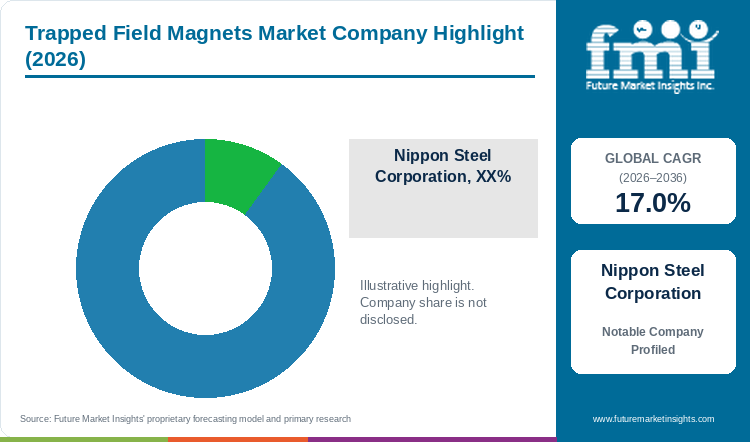
Supplier specialization across the trapped field magnets sector divides into three distinct technological tiers: single-grain melt-textured bulk crystal foundries, REBCO coated-conductor tape and stacked-annulus builders, and full-system superconducting magnet integrators. Single-grain bulk crystal pioneers including Nippon Steel Corporation and CAN SUPERCONDUCTORS, s.r.o. alongside Adelwitz Technologiezentrum GmbH (ATZ) and Evico GmbH grow top-seeded GdBCO and YBCO monoliths with shrink-fit steel reinforcement. Coated-conductor tape manufacturers led by Faraday Factory Japan LLC and Furukawa Electric Co., Ltd. (via SuperPower Inc.) supply high-pinning-force REBCO tapes used in composite stacked-tape trapped field magnets. Meanwhile, Tokamak Energy Ltd. and ASG Superconductors S.p.A. engineer complete conduction-cooled MgB2 and REBCO magnet systems for electric propulsion and diagnostic imaging.
- Single-Grain REBCO Bulk Crystal Foundries: Nippon Steel Corporation and CAN SUPERCONDUCTORS, s.r.o. alongside Adelwitz Technologiezentrum GmbH (ATZ) and Evico GmbH manufacture top-seeded melt-grown GdBCO and YBCO pucks.
- REBCO Coated-Conductor Tape & Stacked-Puck Producers: Faraday Factory Japan LLC and Furukawa Electric Co., Ltd. (SuperPower Inc.) produce high-critical-current 2G HTS tapes for fracture-resistant stacked-annulus magnets.
- Superconducting Magnet & Propulsion System Integrators: Tokamak Energy Ltd. and ASG Superconductors S.p.A. design and build complete cryocooled REBCO and MgB2 magnet assemblies for aviation propulsion and MRI systems.
Competitive Benchmarking: Trapped Field Magnets Market
Table 8: Competitive Benchmarking for the Trapped Field Magnets Market (qualitative capability ratings), 2026
| Company | Peak Trapped Field (>10 T) | Bulk / Tape Crystal Purity | Cryo-Mechanical Reinforcement | Geographic Reach |
|---|---|---|---|---|
| Nippon Steel Corporation | High | High | High | High |
| CAN SUPERCONDUCTORS, s.r.o. | High | High | High | High |
| Faraday Factory Japan LLC | Medium | High | Medium | High |
| Tokamak Energy Ltd. | Medium | High | High | High |
| ASG Superconductors S.p.A. | Medium | Medium | High | High |
| Adelwitz Technologiezentrum (ATZ) | High | High | High | Medium |
| Furukawa Electric (SuperPower) | Medium | High | Medium | High |
| Evico GmbH | High | High | High | Medium |
Scoring basis: Peak Trapped Field (>10 T) achieves a High designation only where a producer manufactures remanently magnetized single-grain REBCO bulk discs or levitation pucks trapping up to 10-17 Tesla at 20 to 30 Kelvin, whereas Medium denotes upstream 2G REBCO tape suppliers and wound-coil magnet integrators whose conductors serve as feedstock or adjacent cryogenic systems. Bulk / Tape Crystal Purity reflects c-axis orientation uniformity and nanoscale flux-pinning precipitate dispersion across 30-to-100-millimeter discs or kilometer-length REBCO tapes. Cryo-Mechanical Reinforcement evaluates shrink-fit stainless-steel banding paired with carbon-fiber overwrapping for pulsed-field survival.
Key Developments in the Trapped Field Magnets Market
- In July 2026, ASG Superconductors S.p.A. and INFN launched the EUR 5.8 million SURE project to test 20-Kelvin magnesium-diboride superconducting hardware at Frascati National Laboratory, advancing rare-earth-free MgB2 cryostat engineering [16].
- In April 2025, Bruker Corporation unveiled a 1.3-gigahertz NMR system using a 30.5-Tesla wound magnet with a ReBCO insert, expanding commercial demand for high-homogeneity ReBCO tape feedstock [17].
- In July 2026, CERN powered its 11.3-Tesla HiLumi LHC superconducting magnet string to 16,230 amperes without a training quench, validating high-stress cryogenic insulation and quench-protection methods applicable to high-field magnet modules [18].
Key Players in the Trapped Field Magnets Market
Single-Grain REBCO Bulk Crystal Foundries
- Nippon Steel Corporation
- CAN SUPERCONDUCTORS, s.r.o.
- Adelwitz Technologiezentrum GmbH (ATZ)
- Evico GmbH
REBCO Coated-Conductor Tape & Stacked-Puck Producers
- Faraday Factory Japan LLC
- Furukawa Electric Co., Ltd. (SuperPower Inc.)
Superconducting Magnet & Propulsion System Integrators
- Tokamak Energy Ltd.
- ASG Superconductors S.p.A.
Trapped Field Magnets Market - Report Scope
Table 9: Report Scope for the Trapped Field Magnets Market (coverage fields and definitions), 2026 to 2036
| Coverage field | Report scope |
|---|---|
| Market breakdown | Superconducting Bulk Material; Magnetization Technique; Cryogenic Cooling Architecture; Mobility & Industrial Application; Region |
| Quantitative Units | USD Million |
| Market Definition | Includes B2B factory-gate revenue from single-grain melt-textured REBCO (GdBCO/YBCO) bulk discs, stacked REBCO coated-conductor tape annuli, and bulk MgB2 cylinders engineered to operate as magnetized trapped-flux permanent magnet equivalents, including their shrink-fit mechanical collars and integrated PFM/cryocooler cartridges. Category Scope Note: Excludes conventional sintered NdFeB/SmCo permanent magnets, DC current-driven wound LTS/HTS MRI and fusion coils, and non-cryogenic automotive thermal coolant valves or actuators. |
| Regions Covered | North America; Latin America; Western Europe; Eastern Europe; East Asia; South Asia and Pacific; Middle East and Africa |
| Countries Covered | United Kingdom, South Korea, United States, Japan, Germany, and additional countries in the full report |
| Key Companies Covered | Nippon Steel Corporation, CAN SUPERCONDUCTORS, s.r.o., Faraday Factory Japan LLC, Tokamak Energy Ltd., ASG Superconductors S.p.A., Adelwitz Technologiezentrum GmbH (ATZ), Furukawa Electric Co., Ltd. (SuperPower Inc.), Evico GmbH |
| Forecast Period | 2026 to 2036 |
| Approach | Primary and secondary research with rigorous market triangulation. |
Trapped Field Magnets Market - Research Methodology
Table 10: Research Methodology for the Trapped Field Magnets Market (research methods and approach), 2026 edition
| Method | Approach |
|---|---|
| Primary Research | Primary interviews were conducted with top-seeded melt-growth crystal foundry directors, REBCO coated-conductor tape engineers, superconducting aviation motor designers, naval propulsion program managers, and benchtop NMR builders to validate puck pricing, trapped Tesla ratings, and PFM charging yields. |
| Secondary Research | Secondary research included Applied Superconductivity Conference (ASC) and MT29 technical proceedings, CERN and ITER superconducting test reports, U.S. DOE and METI Japan energy disclosures, and verified corporate press releases. |
| Market Sizing and Forecasting | Market sizing and forecasting for 2026 to 2036 were developed using top-down and bottom-up models reconciling melt-growth furnace and HTS tape capacities, pucks per megawatt motor rotor, compact NMR/MRI shipments, and average module selling prices. |
| Data Triangulation and Validation | Data is validated against commercial REBCO tape output, single-grain GdBCO foundry batch capacities, and government aero/marine demonstrator budgets while quarantining out-of-scope non-cryogenic actuators and conventional rare-earth magnets. |
| Country Forecasting Model | Country-level CAGRs are projected via FMI's superconducting materials econometric model, calibrating national trajectories against the 17.0% global baseline using national fusion and electric-aviation R&D grants, domestic HTS tape/bulk foundry capacity, and maglev transit investments. |
| Operational Benchmark Traceability | Operational benchmarks (trapped-field puck shipments, operational Tesla ratings at 20-50 K, and flux creep decay rates) represent modeled estimates synthesized from IEEE Transactions on Applied Superconductivity, MT29/ASC benchmarks, and manufacturer datasheets. |
Trapped Field Magnets Market by Segments
Trapped Field Magnets Market segmented by Superconducting Bulk Material:
- Single-Grain REBCO (GdBCO / YBCO) Bulks
- Stacked REBCO Coated Conductor Tape Annuli
- Magnesium Diboride (MgB2) Cryogenic Bulks
Trapped Field Magnets Market segmented by Magnetization Technique:
- Pulsed-Field Magnetization (PFM)
- Field-Cooled Magnetization (FCM)
- Flux-Jump Assisted Multi-Pulse PFM
Trapped Field Magnets Market segmented by Cryogenic Cooling Architecture:
- Conduction-Cooled Cryocooler (20-50 K)
- Liquid Hydrogen Cooled (20 K Co-Propulsion)
- Liquid Nitrogen Cooled (65-77 K)
Trapped Field Magnets Market segmented by Mobility & Industrial Application:
- High-Power-Density Electric Aircraft & eVTOL Motors
- Marine Podded Superconducting Propulsion
- Maglev & High-Speed Rail Levitation Flux Sources
- Compact Desktop NMR & Portable MRI Systems
Trapped Field Magnets Market by Region
- North America
- United States
- Canada
- Latin America
- Brazil
- Mexico
- Argentina
- Chile
- Western Europe
- Germany
- France
- United Kingdom
- Italy
- Spain
- Benelux
- Nordics
- Eastern Europe
- Poland
- Czech Republic
- Romania
- Hungary
- East Asia
- China
- Japan
- South Korea
- South Asia and Pacific
- India
- ASEAN
- Australia and New Zealand
- Middle East and Africa
- GCC Countries
- South Africa
- Türkiye
- Israel
Research Sources and Bibliography
- [1] Faraday Factory Japan LLC. (2025, June 29). 'MIRAI' HTS tape with 1,000A/mm2, Je(20K,20T) developed. Faraday Factory Japan LLC.
- [2] Tokamak Energy Ltd. (2026, September 09). Tokamak Energy completes world-leading fusion magnet campaign, validating technology for commercial HTS systems. Tokamak Energy Ltd.
- [3] ASG Superconductors S.p.A. (2026, September 12). ASG Superconductors News Unveiled one of Europe's most powerful high-temperature superconducting magnets. ASG Superconductors S.p.A.
- [4] Adelwitz Technologiezentrum GmbH (ATZ). (2026, January 15). melt-textured HTS for strong magnetic fields - ATZ. Adelwitz Technologiezentrum GmbH.
- [5] Tokamak Energy Ltd. (2025, November 19). Tokamak Energy announces fusion power plant magnet technology breakthrough - Tokamak Energy. Tokamak Energy Ltd.
- [6] CERN Indico / MT29 Organizing Committee. (2025, July 01). MT29 Abstracts and Technical Program (1-6 July 2025) · Indico. 29th International Conference on Magnet Technology (CERN Indico).
- [7] Tokamak Energy Ltd. & Furukawa Electric Group. (2025, June 19). Tokamak Energy and Furukawa Electric Group advance partnership toward limitless fusion energy - Tokamak Energy. Tokamak Energy Ltd.
- [8] ASG Superconductors S.p.A. (2026, October 02). ASG Superconductors Paving the way towards zero-loss energy transmission at ESSRI 2026. ASG Superconductors S.p.A.
- [9] ITER Organization. (2026, May 21). World's largest superconducting magnet test facility now operational at ITER. ITER Organization.
- [10] Tokamak Energy Ltd. (2025, October 07). Tokamak Energy signs strategic HTS collaboration with Gauss Fusion. Tokamak Energy Ltd.
- [11] Tokamak Energy Ltd. (2026, April 14). Tokamak Energy named Magnet Systems Partner for STEP Fusion programme - Tokamak Energy. Tokamak Energy Ltd.
- [12] Ministry of Trade, Industry and Resources (MOTIR). (2025, November 14). K-Mobility Drives the Future of Innovation. Ministry of Trade, Industry and Resources Republic of Korea.
- [13] U.S. Department of Energy. (2026, October 08). Energy Department Announces New Genesis Mission Awards to Advance Super Intelligence for Science. U.S. Department of Energy.
- [14] Ministry of Economy, Trade and Industry (METI). (2026, March 27). Advanced Air Mobility Roadmap Revised. Ministry of Economy, Trade and Industry Japan.
- [15] Faraday Factory Japan LLC. (2025, June 09). FFJ started deliver of HTS tapes to Vision Electric Super Conductors GmbH. Faraday Factory Japan LLC.
- [16] ASG Superconductors S.p.A. (2026, July 21). ASG Superconductors AN ITALIAN ZERO-LOSS SUPERCONDUCTING CABLE FOR THE DATA CENTRES OF THE FUTURE. ASG Superconductors S.p.A.
- [17] Bruker Corporation. (2025, April 07). Bruker Corporation - Bruker Announces First-of-a-kind 1.3 GHz High-Resolution NMR System. Bruker Corporation.
- [18] European Organization for Nuclear Research (CERN). (2026, July 21). HiLumi LHC: new magnets reach full power - Home | CERN. European Organization for Nuclear Research (CERN).
- [19] CAN SUPERCONDUCTORS, s.r.o. (2026, September 15). News and Highlights | CAN Superconductors. CAN SUPERCONDUCTORS, s.r.o.
- [20] evico GmbH. (2025, March 14). evico GmbH: SupraUnit. evico GmbH.
This bibliography is provided for reader reference and is not exhaustive. The full report contains the complete reference list and detailed citations.
This Report Answers
- How large is the trapped field magnets market in 2026 and what is forecast for 2036?
- Why do electric aviation and compact NMR designers replace NdFeB with trapped field magnets?
- Why do Single-Grain REBCO (GdBCO / YBCO) Bulks lead superconducting bulk materials?
- Why does Pulsed-Field Magnetization (PFM) account for the largest magnetization share?
- How do national growth rates compare across the UK, South Korea, the US, Japan, and Germany?
- Which companies supply single-grain REBCO bulks, stacked HTS tapes, and MgB2 magnets?
- How do Lorentz tensile fracture and adiabatic pulse heating restrict trapped flux density?
- What cryogenic and mechanical specifications should buyers audit before procuring TFM pucks?
Frequently Asked Questions
How big is the trapped field magnets market in 2026, and what is forecast for 2036?
Worldwide trapped field magnets revenue is estimated at USD 44.2 million in 2026 (up from USD 38.5 million in 2025) and is forecast to hit USD 212.5 million by 2036 as superconducting aviation motors and cryogen-free NMR analyzers scale.
What is the forecast CAGR for the trapped field magnets market from 2026 to 2036?
Based on FMI analysis, the market is projected to expand at a 17.0% CAGR between 2026 and 2036, lifting annual market revenue by an expected USD 168.3 million between 2026 and 2036 across bulk REBCO and stacked-tape magnet modules.
Which superconducting bulk material segment leads the market in 2026?
Single-Grain REBCO (GdBCO / YBCO) Bulks are forecast to represent 58.6% of 2026 bulk material revenue because top-seeded melt-grown crystals trap 3 to 17 Tesla of magnetic flux without grain-boundary weak links.
Which magnetization technique holds the largest share in 2026?
Pulsed-Field Magnetization (PFM) is projected to account for 64.2% of 2026 magnetization adoption by enabling millisecond in-situ rotor charging via compact copper coils inside assembled motors.
Which country records the fastest CAGR through 2036?
FMI estimates that the United Kingdom is projected to lead major national markets with an 18.6% CAGR from 2026 to 2036, ahead of South Korea (anticipated at 18.1%) and the United States (forecast at 16.6%).
Who are the notable companies in the trapped field magnets market?
Significant market players include Nippon Steel Corporation, CAN SUPERCONDUCTORS, s.r.o., Faraday Factory Japan LLC, Tokamak Energy Ltd., ASG Superconductors S.p.A., Adelwitz Technologiezentrum GmbH (ATZ), Furukawa Electric Co., Ltd. (SuperPower Inc.), and Evico GmbH.
Preview the report firsthand - request a free sample
Get SampleGet the brochure for pricing and purchase details.
Get PDFTable of Content
- Key Takeaways
- Market Size and CAGR
- Top Growth Driver
- Fastest Growing Segment
- Leading Region
- Key Companies
- Emerging Opportunities
- Executive Summary
- Global Market Outlook
- Demand-side Trends
- Supply-side Trends
- Technology Roadmap Analysis
- Analysis and Recommendations
- Analyst Perspective (What is happening? Why now? What should investors know?)
- Key Questions Answered
- How large is the market?
- What is the CAGR?
- What are key trends?
- Which region dominates?
- Who are the leaders?
- Market Overview
- Market Coverage / Taxonomy
- Market Definition / Scope / Limitations
- Research Methodology
- Chapter Orientation
- Analytical Lens and Working Hypotheses
- Market Structure, Signals, and Trend Drivers
- Benchmarking and Cross-market Comparability
- Market Sizing, Forecasting, and Opportunity Mapping
- Research Design and Evidence Framework
- Desk Research Programme (Secondary Evidence)
- Expert Input and Fieldwork (Primary Evidence)
- Tooling, Models, and Reference Databases
- Data Engineering and Model Build
- Quality Assurance and Audit Trail
- Market Background
- Market Dynamics (Drivers, Restraints, Opportunity, Trends)
- Scenario Forecast (Optimistic, Likely, Conservative)
- Impact Analysis
- AI Impact
- Sustainability Impact
- Regulatory Impact
- Technology Impact
- Consumer / Buyer Analysis
- Purchase Drivers
- Adoption Barriers
- Buyer Journey
- Opportunity Map Analysis
- Product Life Cycle Analysis
- Supply Chain Analysis
- Investment Feasibility Matrix
- Value Chain Analysis
- PESTLE and Porter's Analysis
- Regulatory Landscape
- Regional Parent Market Outlook
- Production and Consumption Statistics
- Import and Export Statistics
- Global Market Analysis and Forecast, 2021 to 2036
- Historical Market Size Value (USD Million) Analysis, 2021 to 2025
- Current and Future Market Size Value (USD Million) Projections, 2026 to 2036
- Y-o-Y Growth Trend Analysis
- Absolute $ Opportunity Analysis
- Global Market Pricing Analysis, 2021 to 2036
- Global Market Analysis and Forecast, By Superconducting Bulk Material, 2021 to 2036
- Introduction / Key Findings
- Historical Market Size Value (USD Million) Analysis By Superconducting Bulk Material, 2021 to 2025
- Current and Future Market Size Value (USD Million) Analysis and Forecast By Superconducting Bulk Material, 2026 to 2036
- Single-Grain REBCO (GdBCO / YBCO) Bulks
- Stacked REBCO Coated Conductor Tape Annuli
- Magnesium Diboride (MgB2) Cryogenic Bulks
- Y-o-Y Growth Trend Analysis By Superconducting Bulk Material, 2021 to 2025
- Absolute $ Opportunity Analysis By Superconducting Bulk Material, 2026 to 2036
- Global Market Analysis and Forecast, By Magnetization Technique, 2021 to 2036
- Introduction / Key Findings
- Historical Market Size Value (USD Million) Analysis By Magnetization Technique, 2021 to 2025
- Current and Future Market Size Value (USD Million) Analysis and Forecast By Magnetization Technique, 2026 to 2036
- Pulsed-Field Magnetization (PFM)
- Field-Cooled Magnetization (FCM)
- Flux-Jump Assisted Multi-Pulse PFM
- Y-o-Y Growth Trend Analysis By Magnetization Technique, 2021 to 2025
- Absolute $ Opportunity Analysis By Magnetization Technique, 2026 to 2036
- Global Market Analysis and Forecast, By Cryogenic Cooling Architecture, 2021 to 2036
- Introduction / Key Findings
- Historical Market Size Value (USD Million) Analysis By Cryogenic Cooling Architecture, 2021 to 2025
- Current and Future Market Size Value (USD Million) Analysis and Forecast By Cryogenic Cooling Architecture, 2026 to 2036
- Conduction-Cooled Cryocooler (20-50 K)
- Liquid Hydrogen Cooled (20 K Co-Propulsion)
- Liquid Nitrogen Cooled (65-77 K)
- Y-o-Y Growth Trend Analysis By Cryogenic Cooling Architecture, 2021 to 2025
- Absolute $ Opportunity Analysis By Cryogenic Cooling Architecture, 2026 to 2036
- Global Market Analysis and Forecast, By Mobility & Industrial Application, 2021 to 2036
- Introduction / Key Findings
- Historical Market Size Value (USD Million) Analysis By Mobility & Industrial Application, 2021 to 2025
- Current and Future Market Size Value (USD Million) Analysis and Forecast By Mobility & Industrial Application, 2026 to 2036
- High-Power-Density Electric Aircraft & eVTOL Motors
- Marine Podded Superconducting Propulsion
- Maglev & High-Speed Rail Levitation Flux Sources
- Compact Desktop NMR & Portable MRI Systems
- Y-o-Y Growth Trend Analysis By Mobility & Industrial Application, 2021 to 2025
- Absolute $ Opportunity Analysis By Mobility & Industrial Application, 2026 to 2036
- Global Market Analysis and Forecast, By Region, 2021 to 2036
- Introduction
- Historical Market Size Value (USD Million) Analysis By Region, 2021 to 2025
- Current Market Size Value (USD Million) Analysis and Forecast By Region, 2026 to 2036
- North America
- Latin America
- Western Europe
- Eastern Europe
- East Asia
- South Asia and Pacific
- Middle East and Africa
- Market Attractiveness Analysis By Region
- North America Market Analysis and Forecast, By Country, 2021 to 2036
- Historical Market Size Value (USD Million) Trend Analysis By Market Taxonomy, 2021 to 2025
- Market Size Value (USD Million) Forecast By Market Taxonomy, 2026 to 2036
- By Country
- United States
- Canada
- By Superconducting Bulk Material
- By Magnetization Technique
- By Cryogenic Cooling Architecture
- By Mobility & Industrial Application
- By Country
- Market Attractiveness Analysis
- By Country
- By Superconducting Bulk Material
- By Magnetization Technique
- By Cryogenic Cooling Architecture
- By Mobility & Industrial Application
- Key Takeaways
- Latin America Market Analysis and Forecast, By Country
- Historical Market Size Value (USD Million) Trend Analysis By Market Taxonomy, 2021 to 2025
- Market Size Value (USD Million) Forecast By Market Taxonomy, 2026 to 2036
- By Country
- Brazil
- Mexico
- Argentina
- Chile
- By Superconducting Bulk Material
- By Magnetization Technique
- By Cryogenic Cooling Architecture
- By Mobility & Industrial Application
- By Country
- Market Attractiveness Analysis
- By Country
- By Superconducting Bulk Material
- By Magnetization Technique
- By Cryogenic Cooling Architecture
- By Mobility & Industrial Application
- Key Takeaways
- Western Europe Market Analysis and Forecast, By Country
- Historical Market Size Value (USD Million) Trend Analysis By Market Taxonomy, 2021 to 2025
- Market Size Value (USD Million) Forecast By Market Taxonomy, 2026 to 2036
- By Country
- Germany
- France
- United Kingdom
- Italy
- Spain
- Benelux
- Nordics
- By Superconducting Bulk Material
- By Magnetization Technique
- By Cryogenic Cooling Architecture
- By Mobility & Industrial Application
- By Country
- Market Attractiveness Analysis
- By Country
- By Superconducting Bulk Material
- By Magnetization Technique
- By Cryogenic Cooling Architecture
- By Mobility & Industrial Application
- Key Takeaways
- Eastern Europe Market Analysis and Forecast, By Country
- Historical Market Size Value (USD Million) Trend Analysis By Market Taxonomy, 2021 to 2025
- Market Size Value (USD Million) Forecast By Market Taxonomy, 2026 to 2036
- By Country
- Poland
- Czech Republic
- Romania
- Hungary
- By Superconducting Bulk Material
- By Magnetization Technique
- By Cryogenic Cooling Architecture
- By Mobility & Industrial Application
- By Country
- Market Attractiveness Analysis
- By Country
- By Superconducting Bulk Material
- By Magnetization Technique
- By Cryogenic Cooling Architecture
- By Mobility & Industrial Application
- Key Takeaways
- East Asia Market Analysis and Forecast, By Country
- Historical Market Size Value (USD Million) Trend Analysis By Market Taxonomy, 2021 to 2025
- Market Size Value (USD Million) Forecast By Market Taxonomy, 2026 to 2036
- By Country
- China
- Japan
- South Korea
- By Superconducting Bulk Material
- By Magnetization Technique
- By Cryogenic Cooling Architecture
- By Mobility & Industrial Application
- By Country
- Market Attractiveness Analysis
- By Country
- By Superconducting Bulk Material
- By Magnetization Technique
- By Cryogenic Cooling Architecture
- By Mobility & Industrial Application
- Key Takeaways
- South Asia and Pacific Market Analysis and Forecast, By Country
- Historical Market Size Value (USD Million) Trend Analysis By Market Taxonomy, 2021 to 2025
- Market Size Value (USD Million) Forecast By Market Taxonomy, 2026 to 2036
- By Country
- India
- ASEAN
- Australia and New Zealand
- By Superconducting Bulk Material
- By Magnetization Technique
- By Cryogenic Cooling Architecture
- By Mobility & Industrial Application
- By Country
- Market Attractiveness Analysis
- By Country
- By Superconducting Bulk Material
- By Magnetization Technique
- By Cryogenic Cooling Architecture
- By Mobility & Industrial Application
- Key Takeaways
- Middle East and Africa Market Analysis and Forecast, By Country
- Historical Market Size Value (USD Million) Trend Analysis By Market Taxonomy, 2021 to 2025
- Market Size Value (USD Million) Forecast By Market Taxonomy, 2026 to 2036
- By Country
- GCC Countries
- South Africa
- Türkiye
- Israel
- By Superconducting Bulk Material
- By Magnetization Technique
- By Cryogenic Cooling Architecture
- By Mobility & Industrial Application
- By Country
- Market Attractiveness Analysis
- By Country
- By Superconducting Bulk Material
- By Magnetization Technique
- By Cryogenic Cooling Architecture
- By Mobility & Industrial Application
- Key Takeaways
- Key Countries Market Analysis
- United States
- Pricing Analysis
- Market Share Analysis, 2025
- By Superconducting Bulk Material
- By Magnetization Technique
- By Cryogenic Cooling Architecture
- By Mobility & Industrial Application
- Canada
- Pricing Analysis
- Market Share Analysis, 2025
- By Superconducting Bulk Material
- By Magnetization Technique
- By Cryogenic Cooling Architecture
- By Mobility & Industrial Application
- Mexico
- Pricing Analysis
- Market Share Analysis, 2025
- By Superconducting Bulk Material
- By Magnetization Technique
- By Cryogenic Cooling Architecture
- By Mobility & Industrial Application
- Brazil
- Pricing Analysis
- Market Share Analysis, 2025
- By Superconducting Bulk Material
- By Magnetization Technique
- By Cryogenic Cooling Architecture
- By Mobility & Industrial Application
- Chile
- Pricing Analysis
- Market Share Analysis, 2025
- By Superconducting Bulk Material
- By Magnetization Technique
- By Cryogenic Cooling Architecture
- By Mobility & Industrial Application
- Germany
- Pricing Analysis
- Market Share Analysis, 2025
- By Superconducting Bulk Material
- By Magnetization Technique
- By Cryogenic Cooling Architecture
- By Mobility & Industrial Application
- United Kingdom
- Pricing Analysis
- Market Share Analysis, 2025
- By Superconducting Bulk Material
- By Magnetization Technique
- By Cryogenic Cooling Architecture
- By Mobility & Industrial Application
- Italy
- Pricing Analysis
- Market Share Analysis, 2025
- By Superconducting Bulk Material
- By Magnetization Technique
- By Cryogenic Cooling Architecture
- By Mobility & Industrial Application
- Spain
- Pricing Analysis
- Market Share Analysis, 2025
- By Superconducting Bulk Material
- By Magnetization Technique
- By Cryogenic Cooling Architecture
- By Mobility & Industrial Application
- France
- Pricing Analysis
- Market Share Analysis, 2025
- By Superconducting Bulk Material
- By Magnetization Technique
- By Cryogenic Cooling Architecture
- By Mobility & Industrial Application
- India
- Pricing Analysis
- Market Share Analysis, 2025
- By Superconducting Bulk Material
- By Magnetization Technique
- By Cryogenic Cooling Architecture
- By Mobility & Industrial Application
- ASEAN
- Pricing Analysis
- Market Share Analysis, 2025
- By Superconducting Bulk Material
- By Magnetization Technique
- By Cryogenic Cooling Architecture
- By Mobility & Industrial Application
- Australia and New Zealand
- Pricing Analysis
- Market Share Analysis, 2025
- By Superconducting Bulk Material
- By Magnetization Technique
- By Cryogenic Cooling Architecture
- By Mobility & Industrial Application
- China
- Pricing Analysis
- Market Share Analysis, 2025
- By Superconducting Bulk Material
- By Magnetization Technique
- By Cryogenic Cooling Architecture
- By Mobility & Industrial Application
- Japan
- Pricing Analysis
- Market Share Analysis, 2025
- By Superconducting Bulk Material
- By Magnetization Technique
- By Cryogenic Cooling Architecture
- By Mobility & Industrial Application
- South Korea
- Pricing Analysis
- Market Share Analysis, 2025
- By Superconducting Bulk Material
- By Magnetization Technique
- By Cryogenic Cooling Architecture
- By Mobility & Industrial Application
- Poland
- Pricing Analysis
- Market Share Analysis, 2025
- By Superconducting Bulk Material
- By Magnetization Technique
- By Cryogenic Cooling Architecture
- By Mobility & Industrial Application
- Hungary
- Pricing Analysis
- Market Share Analysis, 2025
- By Superconducting Bulk Material
- By Magnetization Technique
- By Cryogenic Cooling Architecture
- By Mobility & Industrial Application
- Türkiye
- Pricing Analysis
- Market Share Analysis, 2025
- By Superconducting Bulk Material
- By Magnetization Technique
- By Cryogenic Cooling Architecture
- By Mobility & Industrial Application
- South Africa
- Pricing Analysis
- Market Share Analysis, 2025
- By Superconducting Bulk Material
- By Magnetization Technique
- By Cryogenic Cooling Architecture
- By Mobility & Industrial Application
- United States
- Market Structure Analysis
- Competition Dashboard
- Competition Benchmarking
- Market Share Analysis of Top Players
- By Regional
- By Superconducting Bulk Material
- By Magnetization Technique
- By Cryogenic Cooling Architecture
- By Mobility & Industrial Application
- Emerging Startups
- Innovation Benchmarking
- Competition Analysis
- Competition Deep Dive
- Nippon Steel Corporation
- Overview
- Product Portfolio
- Profitability by Market Segments
- Sales Footprint
- Strategy Overview
- Marketing Strategy
- Product Strategy
- Channel Strategy
- CAN SUPERCONDUCTORS, s.r.o.
- Faraday Factory Japan LLC
- Tokamak Energy Ltd.
- ASG Superconductors S.p.A.
- Adelwitz Technologiezentrum (ATZ)
- Furukawa Electric (SuperPower)
- Evico GmbH
- Adelwitz Technologiezentrum GmbH (ATZ)
- Furukawa Electric Co., Ltd. (SuperPower Inc.)
- Nippon Steel Corporation
- Case Studies
- Success Stories
- Recent Developments
- Competition Deep Dive
- Assumptions & Acronyms Used


