

- Industry Size (2026)
- USD 1.24 Bn
- Forecast (2036)
- USD 1.80 Bn
- CAGR (2026 to 2036)
- 3.70%
Demand for Fruit Juice Packaging in USA Size, Market Forecast and Outlook By FMI
The demand for fruit juice packaging in USA was valued at USD 1.20 billion in 2025, projected to reach USD 1.24 billion in 2026, and is forecast to expand to USD 1.80 billion by 2036 at a 3.70% CAGR. Growing cold-pressed juice and premium smoothie consumption, expanding single-serve grab-and-go beverage purchasing, and the shift toward lightweight plastic and paperboard packaging from glass are sustaining packaging material demand across the USA fruit juice industry. HPP-compatible packaging formats enabling cold-pressed juice shelf life extension without thermal processing are creating a premium packaging category that commands higher per-unit material values.
The absolute dollar opportunity of approximately USD 550 million over the forecast period reflects the parallel growth of premium juice segment packaging innovation and mainstream juice category format optimization. rPET bottle adoption driven by state-level recycled content mandates is creating material reformulation procurement cycles as beverage companies transition from virgin to post-consumer recycled resin. Multi-serve family size juice packaging in paperboard carton formats generates steady base demand anchored to grocery channel distribution.
The West region sets the pace at a 4.3% CAGR, driven by the highest cold-pressed juice consumption and premium beverage packaging demand concentration. The South follows at 3.8% supported by growing juice consumption and grocery retail channel expansion. The Northeast maintains 3.4% driven by premium juice brand concentration and health-conscious consumer segments. The Midwest registers 3.0% with mainstream juice packaging demand.
Summary of Demand for Fruit Juice Packaging in USA
- Demand for Fruit Juice Packaging in USA Definition
- Fruit juice packaging in USA encompasses PET bottles, paperboard cartons, glass, cans, and pouches across single-serve to family-size capacities for grocery, convenience, and foodservice juice and smoothie distribution.
- Demand Drivers in the Market
- HPP-compatible packaging formats enabling cold-pressed juice shelf life extension without thermal processing create a premium category commanding higher per-unit packaging material values above conventional pasteurized juice containers.
- State-level recycled content mandates driving rPET bottle adoption create material reformulation procurement cycles as beverage companies transition from virgin to post-consumer recycled resin.
- Single-serve grab-and-go juice consumption growth in convenience and grocery store perimeter sections sustains demand for compact PET bottle and pouch formats optimized for impulse purchase display.
- Key Segments Analyzed in the FMI Report
- Up to 250 ml by Capacity: 40.7% share in 2026, reflecting single-serve grab-and-go consumption patterns that generate the highest unit volume demand across convenience and grocery perimeter channels.
- Plastic by Material Type: 63.8% share in 2026, as PET bottle dominance in single-serve and multi-serve juice packaging reflects the material lightweight, shatter resistance, and recycling infrastructure compatibility advantages.
- West: 4.3% compound growth driven by highest cold-pressed juice consumption and premium beverage packaging demand concentration.
- Analyst Opinion at FMI
- Nandini Roy Choudhury, Principal Analyst, Packaging, at FMI benefits the USA fruit juice packaging market is navigating simultaneous premiumization and sustainability mandates where cold-pressed juice brands demand HPP-compatible packaging innovation while state regulations mandate rPET content thresholds that affect bottle cost structures. Converters who develop HPP-rated rPET bottles that satisfy both premium product and recycled content requirements capture the highest-value procurement contracts. The critical supply chain risk centers on food-grade rPET resin availability, as multiple beverage categories compete for limited post-consumer recycled resin supply, creating allocation constraints during periods of simultaneous mandate compliance deadlines.
- Strategic Implications / Executive Takeaways
- Packaging converters must develop HPP-rated rPET bottles combining cold-pressed juice compatibility with state recycled content mandate compliance to capture premium juice brand procurement.
- Juice brands must evaluate total packaging system costs including rPET resin premium, HPP processing compatibility, and shelf life performance when specifying next-generation sustainable packaging.
- Resin suppliers must expand food-grade rPET production capacity to serve the converging demand from juice, water, and carbonated beverage categories all facing recycled content compliance deadlines.
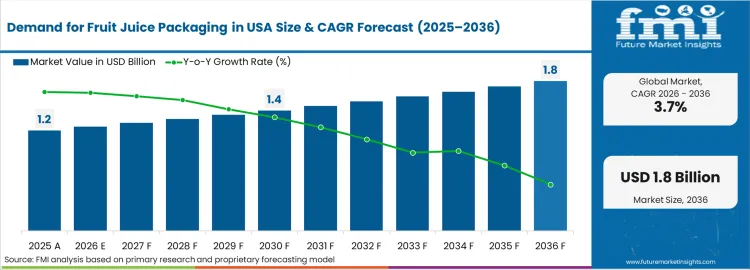
Demand for Fruit Juice Packaging in USA Key Takeaways
| Metric | Details |
|---|---|
| Industry Size (2026) | USD 1.24 Billion |
| Industry Value (2036) | USD 1.80 Billion |
| CAGR (2026-2036) | 3.70% |
Source: Future Market Insights, 2026
Demand for Fruit Juice Packaging in USA Definition
Fruit juice packaging for the USA market encompasses primary packaging materials and formats designed to contain, preserve, and dispense fruit juice, vegetable juice, cold-pressed juice, and smoothie products across retail grocery, convenience, and foodservice distribution channels. Packaging formats include PET and HDPE plastic bottles, liquid paperboard cartons, glass bottles, aluminum cans, and flexible pouches across single-serve through multi-serve capacity ranges.
Demand for Fruit Juice Packaging in USA Inclusions
Market scope includes PET and HDPE juice bottles, rPET recycled content bottles, liquid paperboard cartons, glass bottles, aluminum cans, aseptic brick packs, and flexible juice pouches. Coverage spans single-serve up to 250 ml through family-size above 1000 ml capacities across fruit juice, vegetable juice, cold-pressed, and smoothie applications.
Demand for Fruit Juice Packaging in USA Exclusions
Carbonated beverage packaging, water bottle packaging, dairy beverage containers, and alcoholic beverage packaging are excluded. Filling and processing equipment fall outside analytical parameters.
Demand for Fruit Juice Packaging in USA Research Methodology
- Primary Research: Analysts engaged with juice brand packaging procurement directors, grocery retail beverage category managers, and packaging converter sales executives to map format selection and material specification triggers.
- Desk Research: Data collection phases aggregated beverage production statistics, state-level recycled content mandate timelines, and grocery retail beverage packaging category sales data.
- Market-Sizing and Forecasting: Baseline values derive from a bottom-up aggregation of juice packaging unit consumption multiplied by average material prices across capacity and material categories, applying USA-specific juice consumption and rPET adoption curves.
- Data Validation and Update Cycle: Projections are tested against publicly reported beverage packaging revenues from leading packaging companies and material suppliers.
Why is the Demand for Fruit Juice Packaging in USA Growing?
The demand for fruit juice packaging in the USA is growing as beverage producers respond to consumer preferences for convenience, freshness, and portability. Single serve bottles, pouches, and on the go formats enable consumers to enjoy juice in varied environments, including workplaces, schools, and outdoor settings. As brand owners seek to differentiate their products and extend shelf appeal, packaging formats become key components of value creation.
Changes in processing and distribution are also influencing requirements for juice packaging. Retailers and online channels demand reliability and ease of handling; packaging must protect product quality, support logistics efficiency, and deliver user convenience. Materials and closures are being chosen to maintain flavour integrity, prevent leakage, and support rapid shelf turnaround.
Innovation in materials, formats and printing is further enhancing packaging performance. Lightweight bottles, resealable caps, clear windows and high definition graphics are becoming more common in juice applications. Packaging suppliers are designing formats that support smaller home consumption sizes, multi packs and premium offerings. As beverage portfolios expand to include blends, functional ingredients and exotic flavours, the packaging must keep pace. With these factors at play, the demand for fruit juice packaging in the USA is anticipated to rise steadily through 2035.
What is the Segment-Wise Analysis of Demand for Fruit Juice Packaging in USA?
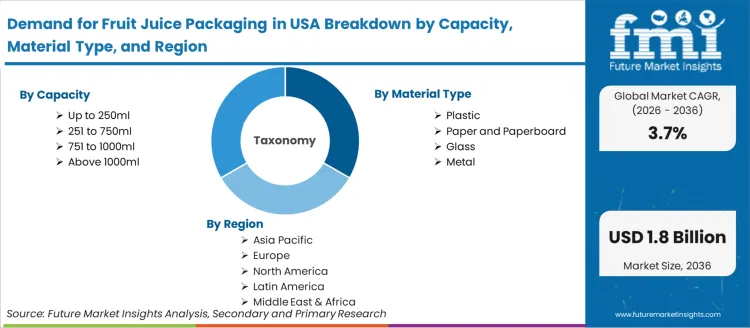
Demand for fruit juice packaging in the USA is segmented by material type, application, capacity, and opening type. By material type, demand is divided into plastic, paper and paperboard, glass, and metal, with plastic holding the largest share at 63.8%. The demand is also segmented by application, including fruit juice, vegetable juice, cold pressed juice, and smoothies, with fruit juice leading the demand at 45.0%. In terms of capacity, demand is divided into up to 250ml, 251 to 750ml, 751 to 1000ml, and above 1000ml. Regarding opening type, demand is divided into cap opening, clip opening, straw hole opening, and lid opening. Regionally, demand is divided into West USA, South USA, Northeast USA, and Midwest USA.
How Does Plastic Lead the Material Type Demand for Fruit Juice Packaging?
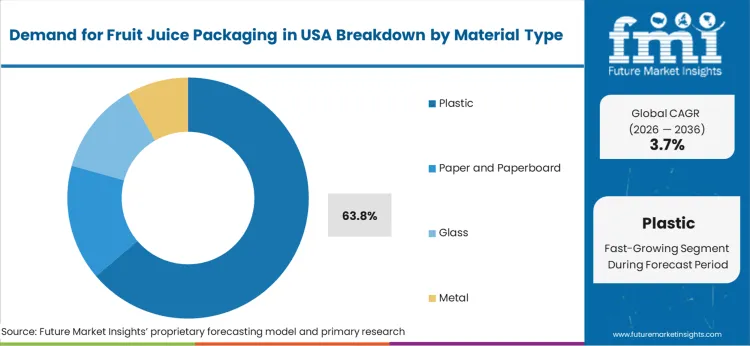
Plastic accounts for 63.8% of the demand for fruit juice packaging in the USA. Plastic packaging is favored for its lightweight nature, durability, and versatility. It is easier to transport and store compared to heavier alternatives like glass or metal, which makes it the preferred choice for manufacturers. Plastic packaging offers a wide range of customization options, including different shapes, sizes, and designs, making it suitable for various fruit juice products.
The affordability of plastic, combined with its ability to preserve the freshness and quality of fruit juice, has contributed to its dominant share in the packaging industry. Plastic packaging is also highly convenient for consumers, as it is easy to handle, open, and consume. While resource efficiency concerns about plastic waste continue to grow, innovations in recyclable and biodegradable plastics are helping address these issues, ensuring that plastic packaging remains a leading choice in the fruit juice industry.
Why Does Fruit Juice Lead the Application Demand for Fruit Juice Packaging?
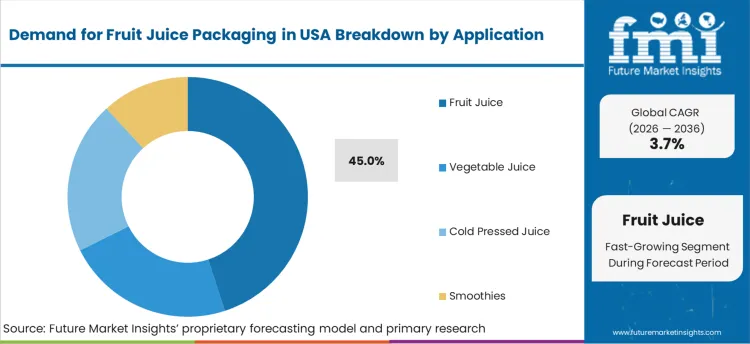
Fruit juice accounts for 45.0% of the demand for fruit juice packaging in the USA. Fruit juice is one of the most widely consumed beverages, with a strong demand across various consumer segments, including health-conscious individuals and those seeking natural, refreshing drinks. The growing focus on healthy, vitamin-rich beverages has driven the demand for fruit juices, further contributing to the need for effective and efficient packaging solutions.
Packaging plays a key role in preserving the freshness, taste, and nutritional value of fruit juices, and the demand for attractive, convenient, and functional packaging solutions continues to rise. The rise in on-the-go consumption and the increasing availability of fruit juices in various retail formats, from supermarkets to convenience stores, has made packaging more important than ever in maintaining product integrity. As the demand for fruit juices continues to grow, the packaging sector will continue to meet these needs with innovative and consumer-friendly solutions.
What are the Key Trends, Drivers and Restraints in the Demand for Fruit Juice Packaging in USA?
Key drivers include growing consumer demand for ready to drink and single serve beverages, increasing preference for natural, organic and functional juices which require eye catching and safe packaging, and rising focus on resource efficiency leading to innovation in recyclable, lightweight and eco friendly packaging materials. Restraints include high cost of premium packaging formats, pressure on packaging material supply chains (e.g., PET, aluminium, paperboard) which can raise lead times and costs, regulatory and food contact safety requirements that limit material choices, and competition from alternative beverage formats (such as bottled water or plant based drinks) that may divert packaging investment.
Why is Demand for Fruit Juice Packaging Growing in USA?
In USA, demand for fruit juice packaging is growing because beverage producers are responding to consumer demand for convenient, on the go formats like small bottles, pouches or cartons that suit busy lifestyles. The surge in premium, organic and functional juice offerings means brands now rely on distinctive packaging to communicate quality, natural ingredients and resource efficiency credentials. Online retail growth has increased need for robust packaging that withstands shipping while remaining attractive on shelf. Changing consumption patterns, including juice as a health accessory rather than simply a refreshment, are driving higher demand for advanced packaging formats aligned with brand image and logistics.
How are Technological Innovations Driving Growth of Fruit Juice Packaging in USA?
Technological innovations are fueling growth of fruit juice packaging in USA by introducing materials and formats that improve performance, aesthetics and resource efficiency. Examples include lightweight PET and plant based plastics that reduce environmental footprint, pouches with spouts or resealable caps for convenience, barrier coatings that extend shelf life without preservatives, and smart labels or QR codes to tell brand stories or trace origin. Automation in packaging lines and digital printing allow smaller batch customisation and faster time to industry. These advances allow juice brands to differentiate, meet consumer expectations for resource efficiency and functionality, and optimise supply chain efficiency all reinforcing packaging demand.
What are the Key Challenges Limiting Adoption of Fruit Juice Packaging in USA?
One major challenge is cost premium, innovative materials, barrier technologies or custom shapes raise packaging cost, which may reduce margins for juice manufacturers. Another challenge is supply chain complexity, sourcing new materials, ensuring food contact safety and achieving recycling compatibility add time and risk. Regulatory compliance (e.g., food contact approvals, labelling, recycling laws) can restrict material choices and slow innovation. Also, changing legacy production lines to handle new formats involves capital investment and operational disruption. Competition from other beverage categories may limit packaging upgrades when juice producers focus instead on pricing or ingredient innovation.
What is the Regional Demand Outlook for Fruit Juice Packaging in USA?
.webp "Top Country Growth Comparison Demand For Fruit Juice Packaging In Usa Cagr (2026 2036)")
| Region | CAGR (%) |
|---|---|
| West | 4.3 |
| South | 3.8 |
| Northeast | 3.4 |
| Midwest | 3.0 |
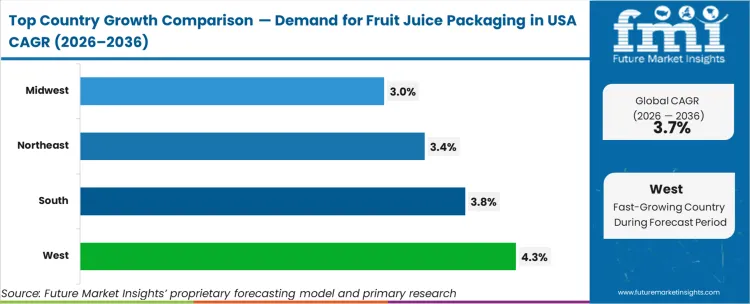
Demand for fruit juice packaging in USA is increasing across all regions, with the West leading at a 4.3% CAGR. This growth is driven by the region’s strong consumer demand for health-conscious beverages and the adoption of eco-friendly packaging solutions. The South follows with a 3.8% CAGR, supported by the region's growing beverage industry and rising preference for natural, healthy drink options. The Northeast shows a 3.4% CAGR, driven by high urban demand for convenient, ready-to-drink products. The Midwest experiences moderate growth at 3.0%, with increasing interest in fresh and healthy beverage options.
What is Driving Demand for Fruit Juice Packaging in the West of USA?
The West is experiencing the highest demand for fruit juice packaging in USA, with a 4.3% CAGR. This growth is driven by the region's strong consumer preference for health-conscious beverages, with an increasing shift toward fresh, natural juices. Cities like Los Angeles, San Francisco, and Seattle are hubs for the wellness movement, where consumers are increasingly choosing fruit juices as part of their healthier lifestyle. The West’s demand for eco-friendly packaging solutions is another key factor, as many consumers are opting for eco-friendly, recyclable packaging in response to growing environmental concerns. As the demand for ready-to-drink juices rises, packaging companies are adopting innovative solutions to meet consumer expectations for convenience and quality.
In addition to consumer trends, the West’s robust retail and e-commerce sectors have played a significant role in driving growth. Retailers are expanding their product offerings, including cold-pressed juices, organic juices, and other healthy beverage options, all of which require specialized packaging. With continued interest in health and resource efficiency, the West is expected to lead the way in the expansion of fruit juice packaging in USA.
How is Demand for Fruit Juice Packaging Growing in the South of USA?
The South is seeing strong demand for fruit juice packaging in USA, with a 3.8% CAGR. The region’s growth is fueled by an expanding beverage sector, with increasing consumer demand for healthier drink options. States like Texas, Florida, and Georgia are witnessing an uptick in fruit juice consumption, as more people choose natural beverages over sugary alternatives. The South’s large and diverse population, coupled with rising health awareness, has created a strong industry for packaged fruit juices, which are seen as convenient and nutritious options.
As consumer preferences continue to shift toward natural and organic products, the demand for fruit juice packaging has risen accordingly. This includes a growing interest in eco-friendly packaging solutions, which are becoming a key selling point for brands. The South’s warm climate also drives demand for refreshing beverages like fruit juices, especially during the summer months. Retailers and manufacturers are responding to this demand by offering a wider variety of fruit juice products, which is further driving the need for specialized, eco-friendly packaging. As the industry continues to grow, the South is expected to see a steady increase in fruit juice packaging demand.
What is Driving Demand for Fruit Juice Packaging in the Northeast of USA?
The Northeast is experiencing steady demand for fruit juice packaging in USA, with a 3.4% CAGR. This growth is driven by the region’s dense urban population, with cities like New York, Boston, and Philadelphia serving as major centers for ready-to-drink beverages. The Northeast has a well-established industry for convenience foods and drinks, and fruit juices are becoming an increasingly popular option for busy consumers looking for a quick, healthy beverage. As more people opt for fresh, natural juices over sugary sodas, packaging solutions that preserve the freshness and quality of these drinks are in high demand.
The Northeast’s focus on health and wellness is also driving demand for fruit juice packaging, as consumers become more conscious of their nutritional choices. The region has seen a rise in organic and cold-pressed juices, which require specialized packaging to maintain quality and shelf life. Retailers in the Northeast are responding by expanding their beverage offerings, making fruit juices more accessible to consumers. As demand for healthy, convenient options grows, the need for innovative and eco-friendly fruit juice packaging will continue to rise in the Northeast.
How is Demand for Fruit Juice Packaging Growing in the Midwest of USA?
The Midwest is experiencing moderate demand for fruit juice packaging in USA, with a 3.0% CAGR. This growth is driven by the increasing consumer preference for fresh, healthy beverages, with fruit juices being seen as a convenient and nutritious option. States like Illinois, Michigan, and Ohio have witnessed a rise in health-conscious consumers seeking alternatives to sugary drinks. As more people adopt healthier lifestyles, the demand for fruit juices packaged in convenient, portable formats has increased.
The Midwest’s growing focus on health and wellness, coupled with a strong retail presence, has created a favorable environment for fruit juice packaging growth. As the industry for fresh and organic juices expands, packaging companies are responding with solutions that ensure product freshness and longer shelf life. The rise of online shopping has made it easier for consumers to access a wide range of juice products, further fueling the demand for fruit juice packaging. While the growth rate is slower than in other regions, the Midwest is seeing a steady rise in the demand for fruit juice packaging, driven by changing consumer habits and increased health awareness.
What is the Competitive Landscape of USA Fruit Juice Packaging Demand?
In the USA, demand for fruit juice packaging is driven by broader growth in ready to drink beverages, evolving consumer preferences for healthier, convenient options, and the need for packaging that both preserves freshness and supports brand appeal. Materials such as paperboard cartons, plastic bottles, pouches, and metal cans are commonly used, and packaging formats that enable on the go consumption or extended shelf life see higher uptake. Industry growth is supported by rising consumer awareness of functional beverages and by changing retail and e commerce channels that favor single serve and portable formats.
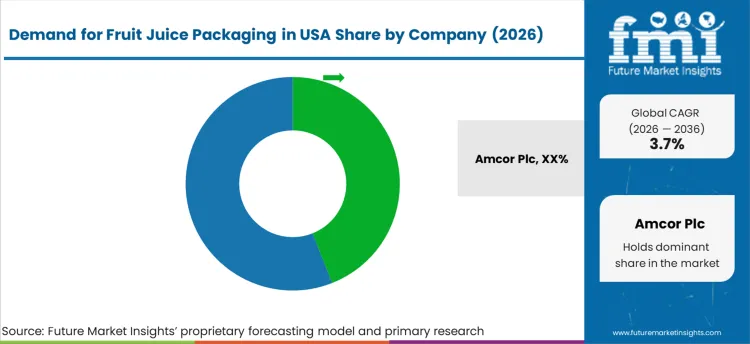
Key suppliers active in the USA fruit juice packaging space include Amcor Plc with a 44.1% share, Ball Corporation, Smurfit Kappa Group, Tetra Laval International S.A., and DS Smith Plc. These companies differentiate through breadth of material offerings (plastic, metal, paperboard, carton), global scale of production and logistics networks, ability to deliver innovative packaging formats (for example high barrier cartons, aseptic pouches, lightweight bottles), and collaboration with beverage brands on design and branding. Their strong positioning gives them advantages in servicing large beverage producers and optimized supply chains.
The competitive landscape is influenced by several forces. One driver is the need for packaging that supports consumer convenience, portability, shelf stability, and brand differentiation. Another driver is innovation in design, materials, and formats that reduce weight, improve functionality, and enhance presentation. At the same time, challenges include pressure on costs of raw materials and logistics, regulatory and compliance requirements for food grade packaging, and shifting consumer attitudes that drive frequent refresh of packaging. Firms that can offer flexible manufacturing, fast new format introduction, strong design support, and integrated service are likely to maintain strong positions in the USA fruit juice packaging segment.
Key Players in USA Fruit Juice Packaging Demand
- Amcor Plc
- Ball Corporation
- Smurfit Kappa Group
- Tetra Laval International S.A.
- DS Smith Plc.
Scope of the Report
| Metric | Value |
|---|---|
| Quantitative Units | USD 1.24 Billion to USD 1.80 Billion, at a CAGR of 3.70% |
| Market Definition | Fruit juice packaging in USA encompasses PET bottles, paperboard cartons, glass, cans, and pouches across single-serve to family-size capacities for grocery, convenience, and foodservice juice and smoothie distribution. |
| Segmentation | Capacity: Up to 250 ml, 251 to 750 ml, 751 to 1000 ml, and Above 1000 ml; Material Type: Plastic, Paper and Paperboard, Glass, and Metal; Application: Fruit Juice, Vegetable Juice, Cold Pressed Juice, and Smoothies |
| Regions Covered | West, South, Northeast, Midwest |
| Key Companies Profiled | Amcor Plc, Ball Corporation, Smurfit Kappa Group, Tetra Laval International S.A., DS Smith Plc. |
| Forecast Period | 2026 to 2036 |
| Approach | Forecasting models apply a bottom-up methodology starting with installed base metrics and projecting conversion rates to technology adoption. |
USA Fruit Juice Packaging Demand by Key Segments
Capacity:
- Up to 250ml
- 251 to 750ml
- 751 to 1000ml
- Above 1000ml
Material Type:
- Plastic
- Paper and Paperboard
- Glass
- Metal
Opening Type:
- Cap Opening
- Clip Opening
- Straw Hole Opening
- Lid Opening
Application:
- Fruit Juice
- Vegetable Juice
- Cold Pressed Juice
- Smoothies
Region:
- West USA
- South USA
- Northeast USA
- Midwest USA
Bibliography
- USA Environmental Protection Agency. (2024). Recycled Content Requirements: State-Level Packaging Material Mandates Summary. EPA.
- Juice Products Association. (2024). USA Juice Industry: Packaging Format and Material Consumption Report. JPA.
- Association of Plastic Recyclers. (2024). Post-Consumer Resin Market: Food-Grade rPET Supply and Demand Assessment. APR.
- USA Food and Drug Administration. (2024). Food Contact Notification: Recycled PET Resin for Juice Packaging Applications. FDA.
- Beverage Marketing Corporation. (2024). USA Juice Market: Volume, Value, and Packaging Trend Analysis. BMC.
- California Department of Resources Recycling and Recovery. (2024). SB 54: Recycled Content Requirements for Beverage Containers. CalRecycle.
This bibliography is provided for reader reference. The full FMI report contains the complete reference list with primary research documentation.
This Report Addresses
- Market sizing and quantitative forecast metrics detailing juice packaging unit consumption and revenues across capacity, material, and application categories through 2036.
- Segmentation analysis mapping rPET adoption velocity and HPP-compatible packaging format development across premium and mainstream juice segments.
- Regional deployment intelligence comparing premium cold-pressed juice packaging demand in the West against mainstream grocery channel consumption in the South and Midwest.
- Regulatory compliance assessment analyzing state recycled content mandates and FDA food contact notification requirements affecting juice packaging material specification.
- Competitive posture evaluation tracking PET bottle converters against paperboard carton manufacturers in juice packaging format competition.
- Capital project strategic guidance defining the rPET sourcing and HPP compatibility requirements for juice packaging converters targeting premium brand procurement.
- Supply chain vulnerability analysis identifying food-grade rPET allocation constraints and barrier performance factors in recycled material juice packaging.
- Custom data delivery formats encompassing interactive dashboards, raw Excel datasets, and comprehensive PDF narrative reports.
Frequently Asked Questions
How large is the demand for Fruit Juice Packaging in USA in 2026?
Demand is estimated to be valued at USD 1.24 billion in 2026.
What will be the market size by 2036?
Market size is projected to reach USD 1.79 billion by 2036.
What is the expected CAGR between 2026 and 2036?
Demand is expected to grow at a CAGR of 3.70% between 2026 and 2036.
Which Capacity is poised to lead by 2026?
Up to 250 ml accounts for 40.7% share reflecting single-serve grab-and-go consumption dominance.
How is Plastic positioned by Material Type in 2026?
Plastic represents 63.8% share through PET bottle dominance in lightweight, shatter-resistant juice packaging.
What is driving demand in the West?
Highest cold-pressed juice consumption and premium packaging demand fuel the fastest growth at 4.3% CAGR through 2036.
What is included in the scope of this report?
The market covers PET, rPET, HDPE bottles, paperboard cartons, glass, cans, and pouches for fruit juice, vegetable juice, cold-pressed, and smoothies.
What is excluded from the scope of this report?
Carbonated drink, water, dairy, alcoholic beverage packaging, and filling equipment are excluded.
Preview the report firsthand - request a free sample
Get SampleGet the brochure for pricing and purchase details.
Get PDFTable of Content
- Executive Summary
- Global Market Outlook
- Demand-side Trends
- Supply-side Trends
- Technology Roadmap Analysis
- Analysis and Recommendations
- Market Overview
- Market Coverage / Taxonomy
- Market Definition / Scope / Limitations
- Research Methodology
- Chapter Orientation
- Analytical Lens and Working Hypotheses
- Market Structure, Signals, and Trend Drivers
- Benchmarking and Cross-market Comparability
- Market Sizing, Forecasting, and Opportunity Mapping
- Research Design and Evidence Framework
- Desk Research Programme (Secondary Evidence)
- Company Annual and Sustainability Reports
- Peer-reviewed Journals and Academic Literature
- Corporate Websites, Product Literature, and Technical Notes
- Earnings Decks and Investor Briefings
- Statutory Filings and Regulatory Disclosures
- Technical White Papers and Standards Notes
- Trade Journals, Industry Magazines, and Analyst Briefs
- Conference Proceedings, Webinars, and Seminar Materials
- Government Statistics Portals and Public Data Releases
- Press Releases and Reputable Media Coverage
- Specialist Newsletters and Curated Briefings
- Sector Databases and Reference Repositories
- FMI Internal Proprietary Databases and Historical Market Datasets
- Subscription Datasets and Paid Sources
- Social Channels, Communities, and Digital Listening Inputs
- Additional Desk Sources
- Expert Input and Fieldwork (Primary Evidence)
- Primary Modes
- Qualitative Interviews and Expert Elicitation
- Quantitative Surveys and Structured Data Capture
- Blended Approach
- Why Primary Evidence is Used
- Field Techniques
- Interviews
- Surveys
- Domain Subject-matter Experts
- Scientists
- Physicians and Other Healthcare Professionals
- Governance, Ethics, and Data Stewardship
- Research Ethics
- Data Integrity and Handling
- Primary Modes
- Tooling, Models, and Reference Databases
- Desk Research Programme (Secondary Evidence)
- Data Engineering and Model Build
- Data Acquisition and Ingestion
- Cleaning, Normalisation, and Verification
- Synthesis, Triangulation, and Analysis
- Quality Assurance and Audit Trail
- Market Background
- Market Dynamics
- Drivers
- Restraints
- Opportunity
- Trends
- Scenario Forecast
- Demand in Optimistic Scenario
- Demand in Likely Scenario
- Demand in Conservative Scenario
- Opportunity Map Analysis
- Product Life Cycle Analysis
- Supply Chain Analysis
- Investment Feasibility Matrix
- Value Chain Analysis
- PESTLE and Porter’s Analysis
- Regulatory Landscape
- Regional Parent Market Outlook
- Production and Consumption Statistics
- Import and Export Statistics
- Market Dynamics
- Global Market Analysis 2021 to 2025 and Forecast, 2026 to 2036
- Historical Market Size Value (USD Million) Analysis, 2021 to 2025
- Current and Future Market Size Value (USD Million) Projections, 2026 to 2036
- Y-o-Y Growth Trend Analysis
- Absolute $ Opportunity Analysis
- Global Market Pricing Analysis 2021 to 2025 and Forecast 2026 to 2036
- Global Market Analysis 2021 to 2025 and Forecast 2026 to 2036, By Capacity
- Introduction / Key Findings
- Historical Market Size Value (USD Million) Analysis By Capacity , 2021 to 2025
- Current and Future Market Size Value (USD Million) Analysis and Forecast By Capacity , 2026 to 2036
- Up to 250ml
- 251 to 750ml
- 751 to 1000ml
- Above 1000ml
- Up to 250ml
- Y-o-Y Growth Trend Analysis By Capacity , 2021 to 2025
- Absolute $ Opportunity Analysis By Capacity , 2026 to 2036
- Global Market Analysis 2021 to 2025 and Forecast 2026 to 2036, By Material Type
- Introduction / Key Findings
- Historical Market Size Value (USD Million) Analysis By Material Type, 2021 to 2025
- Current and Future Market Size Value (USD Million) Analysis and Forecast By Material Type, 2026 to 2036
- Plastic
- Paper and Paperboard
- Glass
- Metal
- Plastic
- Y-o-Y Growth Trend Analysis By Material Type, 2021 to 2025
- Absolute $ Opportunity Analysis By Material Type, 2026 to 2036
- Global Market Analysis 2021 to 2025 and Forecast 2026 to 2036, By Opening Type
- Introduction / Key Findings
- Historical Market Size Value (USD Million) Analysis By Opening Type, 2021 to 2025
- Current and Future Market Size Value (USD Million) Analysis and Forecast By Opening Type, 2026 to 2036
- Cap Opening
- Clip Opening
- Straw Hole Opening
- Lid Opening
- Cap Opening
- Y-o-Y Growth Trend Analysis By Opening Type, 2021 to 2025
- Absolute $ Opportunity Analysis By Opening Type, 2026 to 2036
- Global Market Analysis 2021 to 2025 and Forecast 2026 to 2036, By Application
- Introduction / Key Findings
- Historical Market Size Value (USD Million) Analysis By Application, 2021 to 2025
- Current and Future Market Size Value (USD Million) Analysis and Forecast By Application, 2026 to 2036
- Fruit Juice
- Vegetable Juice
- Cold Pressed Juice
- Smoothies
- Fruit Juice
- Y-o-Y Growth Trend Analysis By Application, 2021 to 2025
- Absolute $ Opportunity Analysis By Application, 2026 to 2036
- Global Market Analysis 2021 to 2025 and Forecast 2026 to 2036, By Region
- Introduction
- Historical Market Size Value (USD Million) Analysis By Region, 2021 to 2025
- Current Market Size Value (USD Million) Analysis and Forecast By Region, 2026 to 2036
- North America
- Latin America
- Western Europe
- Eastern Europe
- East Asia
- South Asia and Pacific
- Middle East & Africa
- Market Attractiveness Analysis By Region
- North America Market Analysis 2021 to 2025 and Forecast 2026 to 2036, By Country
- Historical Market Size Value (USD Million) Trend Analysis By Market Taxonomy, 2021 to 2025
- Market Size Value (USD Million) Forecast By Market Taxonomy, 2026 to 2036
- By Country
- USA
- Canada
- Mexico
- By Capacity
- By Material Type
- By Opening Type
- By Application
- By Country
- Market Attractiveness Analysis
- By Country
- By Capacity
- By Material Type
- By Opening Type
- By Application
- Key Takeaways
- Latin America Market Analysis 2021 to 2025 and Forecast 2026 to 2036, By Country
- Historical Market Size Value (USD Million) Trend Analysis By Market Taxonomy, 2021 to 2025
- Market Size Value (USD Million) Forecast By Market Taxonomy, 2026 to 2036
- By Country
- Brazil
- Chile
- Rest of Latin America
- By Capacity
- By Material Type
- By Opening Type
- By Application
- By Country
- Market Attractiveness Analysis
- By Country
- By Capacity
- By Material Type
- By Opening Type
- By Application
- Key Takeaways
- Western Europe Market Analysis 2021 to 2025 and Forecast 2026 to 2036, By Country
- Historical Market Size Value (USD Million) Trend Analysis By Market Taxonomy, 2021 to 2025
- Market Size Value (USD Million) Forecast By Market Taxonomy, 2026 to 2036
- By Country
- Germany
- UK
- Italy
- Spain
- France
- Nordic
- BENELUX
- Rest of Western Europe
- By Capacity
- By Material Type
- By Opening Type
- By Application
- By Country
- Market Attractiveness Analysis
- By Country
- By Capacity
- By Material Type
- By Opening Type
- By Application
- Key Takeaways
- Eastern Europe Market Analysis 2021 to 2025 and Forecast 2026 to 2036, By Country
- Historical Market Size Value (USD Million) Trend Analysis By Market Taxonomy, 2021 to 2025
- Market Size Value (USD Million) Forecast By Market Taxonomy, 2026 to 2036
- By Country
- Russia
- Poland
- Hungary
- Balkan & Baltic
- Rest of Eastern Europe
- By Capacity
- By Material Type
- By Opening Type
- By Application
- By Country
- Market Attractiveness Analysis
- By Country
- By Capacity
- By Material Type
- By Opening Type
- By Application
- Key Takeaways
- East Asia Market Analysis 2021 to 2025 and Forecast 2026 to 2036, By Country
- Historical Market Size Value (USD Million) Trend Analysis By Market Taxonomy, 2021 to 2025
- Market Size Value (USD Million) Forecast By Market Taxonomy, 2026 to 2036
- By Country
- China
- Japan
- South Korea
- By Capacity
- By Material Type
- By Opening Type
- By Application
- By Country
- Market Attractiveness Analysis
- By Country
- By Capacity
- By Material Type
- By Opening Type
- By Application
- Key Takeaways
- South Asia and Pacific Market Analysis 2021 to 2025 and Forecast 2026 to 2036, By Country
- Historical Market Size Value (USD Million) Trend Analysis By Market Taxonomy, 2021 to 2025
- Market Size Value (USD Million) Forecast By Market Taxonomy, 2026 to 2036
- By Country
- India
- ASEAN
- Australia & New Zealand
- Rest of South Asia and Pacific
- By Capacity
- By Material Type
- By Opening Type
- By Application
- By Country
- Market Attractiveness Analysis
- By Country
- By Capacity
- By Material Type
- By Opening Type
- By Application
- Key Takeaways
- Middle East & Africa Market Analysis 2021 to 2025 and Forecast 2026 to 2036, By Country
- Historical Market Size Value (USD Million) Trend Analysis By Market Taxonomy, 2021 to 2025
- Market Size Value (USD Million) Forecast By Market Taxonomy, 2026 to 2036
- By Country
- Kingdom of Saudi Arabia
- Other GCC Countries
- Turkiye
- South Africa
- Other African Union
- Rest of Middle East & Africa
- By Capacity
- By Material Type
- By Opening Type
- By Application
- By Country
- Market Attractiveness Analysis
- By Country
- By Capacity
- By Material Type
- By Opening Type
- By Application
- Key Takeaways
- Key Countries Market Analysis
- USA
- Pricing Analysis
- Market Share Analysis, 2025
- By Capacity
- By Material Type
- By Opening Type
- By Application
- Canada
- Pricing Analysis
- Market Share Analysis, 2025
- By Capacity
- By Material Type
- By Opening Type
- By Application
- Mexico
- Pricing Analysis
- Market Share Analysis, 2025
- By Capacity
- By Material Type
- By Opening Type
- By Application
- Brazil
- Pricing Analysis
- Market Share Analysis, 2025
- By Capacity
- By Material Type
- By Opening Type
- By Application
- Chile
- Pricing Analysis
- Market Share Analysis, 2025
- By Capacity
- By Material Type
- By Opening Type
- By Application
- Germany
- Pricing Analysis
- Market Share Analysis, 2025
- By Capacity
- By Material Type
- By Opening Type
- By Application
- UK
- Pricing Analysis
- Market Share Analysis, 2025
- By Capacity
- By Material Type
- By Opening Type
- By Application
- Italy
- Pricing Analysis
- Market Share Analysis, 2025
- By Capacity
- By Material Type
- By Opening Type
- By Application
- Spain
- Pricing Analysis
- Market Share Analysis, 2025
- By Capacity
- By Material Type
- By Opening Type
- By Application
- France
- Pricing Analysis
- Market Share Analysis, 2025
- By Capacity
- By Material Type
- By Opening Type
- By Application
- India
- Pricing Analysis
- Market Share Analysis, 2025
- By Capacity
- By Material Type
- By Opening Type
- By Application
- ASEAN
- Pricing Analysis
- Market Share Analysis, 2025
- By Capacity
- By Material Type
- By Opening Type
- By Application
- Australia & New Zealand
- Pricing Analysis
- Market Share Analysis, 2025
- By Capacity
- By Material Type
- By Opening Type
- By Application
- China
- Pricing Analysis
- Market Share Analysis, 2025
- By Capacity
- By Material Type
- By Opening Type
- By Application
- Japan
- Pricing Analysis
- Market Share Analysis, 2025
- By Capacity
- By Material Type
- By Opening Type
- By Application
- South Korea
- Pricing Analysis
- Market Share Analysis, 2025
- By Capacity
- By Material Type
- By Opening Type
- By Application
- Russia
- Pricing Analysis
- Market Share Analysis, 2025
- By Capacity
- By Material Type
- By Opening Type
- By Application
- Poland
- Pricing Analysis
- Market Share Analysis, 2025
- By Capacity
- By Material Type
- By Opening Type
- By Application
- Hungary
- Pricing Analysis
- Market Share Analysis, 2025
- By Capacity
- By Material Type
- By Opening Type
- By Application
- Kingdom of Saudi Arabia
- Pricing Analysis
- Market Share Analysis, 2025
- By Capacity
- By Material Type
- By Opening Type
- By Application
- Turkiye
- Pricing Analysis
- Market Share Analysis, 2025
- By Capacity
- By Material Type
- By Opening Type
- By Application
- South Africa
- Pricing Analysis
- Market Share Analysis, 2025
- By Capacity
- By Material Type
- By Opening Type
- By Application
- USA
- Market Structure Analysis
- Competition Dashboard
- Competition Benchmarking
- Market Share Analysis of Top Players
- By Regional
- By Capacity
- By Material Type
- By Opening Type
- By Application
- Competition Analysis
- Competition Deep Dive
- Amcor Plc
- Overview
- Product Portfolio
- Profitability by Market Segments (Product/Age /Sales Channel/Region)
- Sales Footprint
- Strategy Overview
- Marketing Strategy
- Product Strategy
- Channel Strategy
- Ball Corporation
- Smurfit Kappa Group
- Tetra Laval International S.A.
- DS Smith Plc.
- Amcor Plc
- Competition Deep Dive
- Assumptions & Acronyms Used


