

- Market Size (2026)
- USD 206.3 Mn
- Forecast (2036)
- USD 326.6 Mn
- CAGR (2026 to 2036)
- 4.7%
How big is the Upcycled Fruit Enzyme Actives Market in 2026?
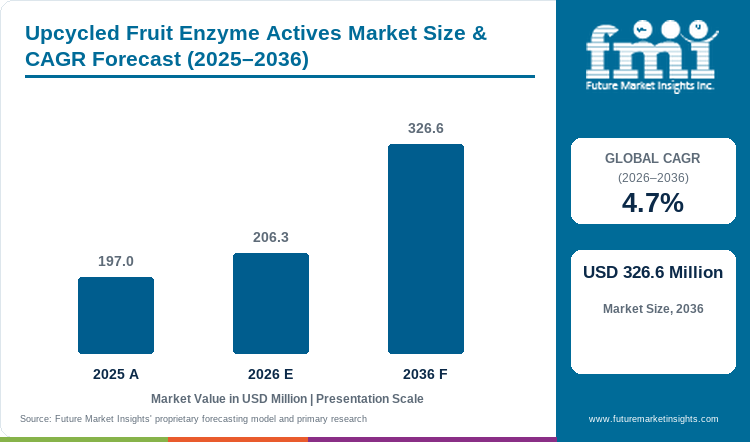
USD 206.3 Million in 2026 and USD 326.6 Million by 2036 at a 4.7% CAGR.
Demand for Upcycled Fruit Enzyme Actives is estimated at USD 206.3 Million in 2026 and is forecast to reach USD 326.6 Million by 2036, growing at a CAGR of 4.7%. The market was valued at USD 197.0 Million in 2025. Commercial demand depends on converting fruit-processing side streams into cosmetic actives with repeatable specifications, safety documentation and usable efficacy evidence. Symrise introduced Cellexora MD in March 2026 using upcycled organic Italian apple side streams, showing how circular feedstock can be paired with stability and clinical support for premium skincare. The purchasing threshold remains performance-led: a side-stream origin creates commercial value only after the ingredient meets the formulation and documentation standards applied to other cosmetic actives.
Country adoption depends on the qualification system around the finished cosmetic and its claims. In the USA, MoCRA registration and product-listing obligations increase the value of complete supplier documentation. Germany and France operate under the EU cosmetics framework, while Great Britain maintains a separate notification and safety regime. Saudi Arabia and the UAE add local listing or registration requirements for imported cosmetics, and South Korea maintains a formal pathway for functional-cosmetic claims. These differences change launch timing. Ingredient demand converts into a purchase when the supplier can demonstrate batch consistency, regulatory usability and claim support before the finished formula is locked.
Key Takeaways
- The market is estimated at USD 206.3 Million in 2026 and is forecast to reach USD 326.6 Million by 2036 at a 4.7% CAGR.
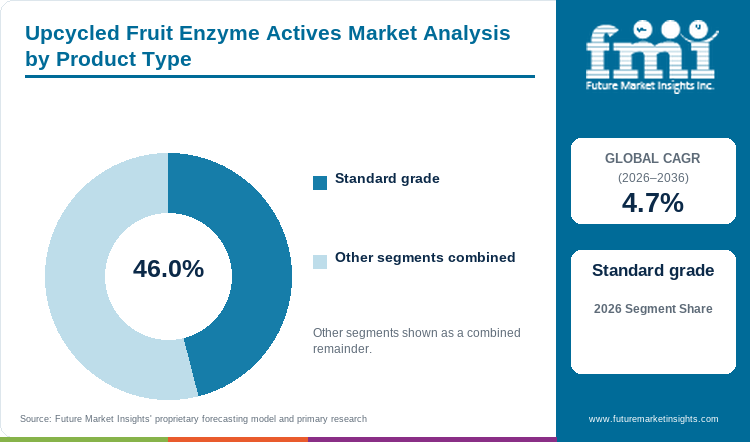
- Standard grade is projected to account for 46.0% of Product Type demand in 2026.
- Hydration & barrier is estimated at 27.0% of Function demand in 2026.
- Facial skincare is forecast to represent 38.0% of Application demand in 2026.
- UAE records the highest country CAGR shown at 6.1% from 2026 to 2036, followed by South Korea at 5.8% and Saudi Arabia at 5.5%.
- Qualification risk centers on feedstock variability, batch consistency, safety documentation and the evidence required for finished-product claims.
- Current first-party evidence is strongest among suppliers that directly document upcycled fruit side streams, including Symrise, Givaudan, BASF, Clariant, Evonik, Croda and specialist active developers.
Analyst Perspective
Commercial value comes from making an irregular side stream behave like a routine cosmetic raw material. Suppliers need reliable feedstock provenance and reproducible active content, then enough application support for a brand to use the ingredient without adding avoidable qualification work. Circular sourcing attracts attention, but specification control and evidence determine repeat orders.
- Rahul Pandita, Principal Analyst at Future Market Insights
How is the Upcycled Fruit Enzyme Actives Market segmented?
The Upcycled Fruit Enzyme Actives Market is segmented by Product Type, Function, Application, Grade, Sales Channel and Region.
Product Type reflects how standardized or customized the active is when supplied to a formulator. Function identifies the primary cosmetic benefit, while Application shows the finished-product category in which the active is used. Grade reflects certification or qualification requirements. Sales Channel identifies whether technical selling occurs directly with brands or through intermediaries. Across these axes, the commercial requirement is consistent: variable fruit-derived feedstock must be converted into a stable ingredient that can pass formulation, safety and repeat-manufacturing checks.
Why does Standard grade lead the Product Type category?
Standard grade serves the broadest formulation base because it emphasizes repeatable specification control without requiring every brief to carry a specialist certification or clinical-grade cost structure. Fruit side-stream variability therefore has to be absorbed by the supplier before the material reaches brand R&D. This qualification logic is also central to the broader upcycled cosmetic ingredients market, where recovered inputs need routine cosmetic performance and documentation before they can scale.
- Standard grade represents 46.0% of Product Type revenue in 2026, reflecting the widest balance of specification control, application flexibility and cost-in-use.
- BASF reported in April 2019 that its Rambutan Program used defined extraction routes and standardized active-matter specifications for bioactives derived from rambutan peel, leaves and seeds.
Why does Hydration & barrier lead the Function category?
Hydration and barrier support fits frequent-use skincare and gives formulators a familiar efficacy target for upcycled fruit materials. Givaudan provides a direct example through Omegablue, which uses upcycled wild bilberry seeds left after fruit processing and is positioned around dryness and lipid-barrier repair. These use cases also sit within the wider personal care ingredient market, where formulation compatibility and repeatable benefit remain the main purchasing tests.
- Hydration & barrier holds 27.0% of Function revenue in 2026, supported by recurring use in moisturizers, repair products and sensitive-skin formulations.
- Givaudan announced in March 2021 that Omegablue is produced from upcycled bilberry seeds and is positioned to improve hydration while supporting lipid-barrier repair.
Why does Facial skincare lead the Application category?
Facial skincare gives active suppliers a strong setting for measurable claims and differentiated ingredient stories. Brands in serums and creams routinely compare dosage, stability and visible benefit before a new active is approved. Symrise used this route for Cellexora MD, an upcycled apple-side-stream active developed for premium skincare. The qualification model overlaps with the cosmeceutical ingredients market, where technical evidence has to justify the ingredient within a claim-led formulation.
- Facial skincare accounts for 38.0% of Application revenue in 2026, reflecting the concentration of active-led product concepts in serums, creams and treatment formats.
- Symrise announced in March 2026 that Cellexora MD uses upcycled organic Italian apple side streams and combines the sourcing story with stability and clinical support for premium skincare.
How does Standard cosmetic grade shape the Grade category?
Standard cosmetic grade provides the baseline documentation needed for mainstream formulation, while natural, organic or clinical grades add narrower certification requirements. The distinction matters because the finished cosmetic still has to pass its market-specific safety assessment and claims review. Suppliers therefore gain an advantage when ingredient identity and specification data can move cleanly into customer files. This is especially relevant in the natural cosmetics market, where sourcing claims have to coexist with ordinary safety and performance requirements.
- Current Clariant Eosidin documentation identifies an upcycled Citrus unshiu origin from Jeju and lists COSMOS approval alongside skin-barrier positioning, illustrating how specialized qualification can add value beyond a standard cosmetic specification.
How does Direct to brands shape the Sales Channel category?
Direct engagement is useful when a brand needs to review provenance, recommended use level, stability and claim evidence before the formula is fixed. Distributors remain important for local coverage, while contract manufacturers can influence selection when they own formulation work. The technical-selling requirement is similar to the broader enzymes market, where process control and application support affect whether a specialty ingredient moves from trial to routine use.
- Croda’s current Heliami Pomegranate EC documentation identifies upcycled pomegranate pericarps sourced in France, providing direct evidence of a fruit-side-stream cosmetic active within its Beauty Actives portfolio.
What are the drivers, restraints and opportunities in the Upcycled Fruit Enzyme Actives Market?
Circular sourcing supports demand when performance is proven, while qualification burden slows adoption and standardized high-value actives create the clearest route to growth.
- Driver: Brands are seeking differentiated fruit-derived actives that combine measurable cosmetic benefit with credible use of side-stream material.
- Restraint: Variable fruit side streams must be converted into stable specifications with traceability, safety documentation and repeatable quality before brands can qualify them.
- Opportunity: Suppliers can increase value through standardized actives, certified grades and application support that reduce qualification work for brand R&D teams.
Demand is strongest when an upcycled origin supports an existing formulation need. Givaudan and Symrise provide direct fruit-side-stream examples in barrier care and premium facial skincare. Their commercial relevance comes from pairing provenance with a defined cosmetic benefit and a usable technical package. The demand mechanism is therefore practical: brand teams gain a differentiated sourcing story, while formulators receive an active that can be assessed against familiar stability, dosage and efficacy criteria.
Qualification remains the main restraint because fruit-processing residues are not automatically cosmetic-ready raw materials. Suppliers need to control identity, microbiological quality and batch variation before a brand can rely on the ingredient in a finished-product safety assessment. MoCRA obligations in the USA and the EU cosmetic safety framework apply at finished-product level, but both increase the value of complete supplier dossiers. An incomplete ingredient file shifts work back to the brand and can delay formula approval even when early laboratory performance is acceptable.
The clearest opportunity is to move from a basic recovered extract to a standardized active with defined composition, easier formulation and stronger claim support. Symrise’s Cellexora MD shows one route through a tightly characterized apple-side-stream active. Mibelle Biochemistry, Akott Evolution and Access Naturals provide further examples of fruit residues being converted into cosmetic actives through controlled extraction and development. Suppliers can capture more value when feedstock agreements, conversion control and application science are managed as one qualification system.
Which country CAGRs are compared in the Upcycled Fruit Enzyme Actives Market?
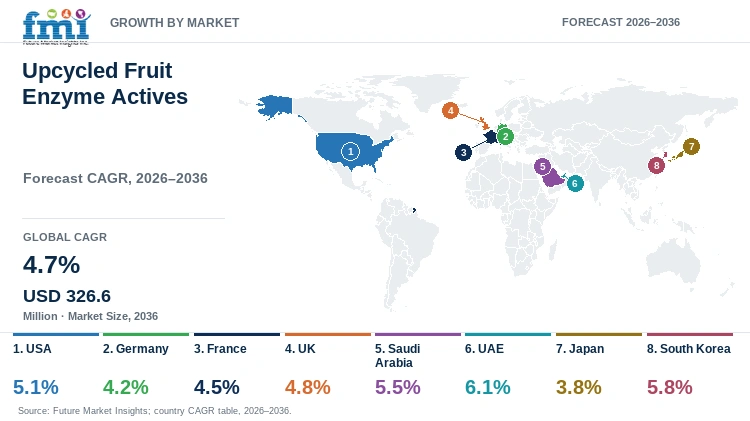
| Country | CAGR |
|---|---|
| USA | 5.1% |
| Germany | 4.2% |
| France | 4.5% |
| UK | 4.8% |
| Saudi Arabia | 5.5% |
| UAE | 6.1% |
| Japan | 3.8% |
| South Korea | 5.8% |
How do country-level CAGRs compare in the Upcycled Fruit Enzyme Actives Market?
The country CAGRs span 2.3 percentage points, from 6.1% in the UAE to 3.8% in Japan from 2026 to 2036. UAE, South Korea and Saudi Arabia form the upper band at 5.5% to 6.1%. USA, UK and France range from 4.5% to 5.1%, while Germany and Japan are at 4.2% and 3.8%. These rates compare forecast pace, not absolute market size. Supplier economics still depend on the local formulation base, compliance burden and time required to qualify a new active.
- UAE at 6.1% is 0.3 percentage points above South Korea at 5.8%. Both are fast-growth markets, but supplier entry depends on different registration and claims pathways.
- Saudi Arabia at 5.5% is 0.4 percentage points above USA at 5.1%. The small forecast gap does not remove the need for local listing support in Saudi Arabia or complete product documentation in the USA.
- UK at 4.8% is 0.3 percentage points above France at 4.5%. Great Britain and the EU use separate cosmetic compliance systems, so the same ingredient dossier may still require market-specific execution.
- Germany at 4.2% is 0.4 percentage points above Japan at 3.8%. Both mature beauty markets reward specification consistency and evidence that lowers formulation-change risk.
CAGR should not be treated as a proxy for absolute opportunity. A slower-growing country can still support meaningful ingredient volumes when it has a large cosmetics manufacturing base or premium skincare demand. Market attractiveness also depends on certification needs, route-to-market cost and the time required for a supplier to move from sample to approved production ingredient.
Country-wise Analysis
- Demand for Upcycled Fruit Enzyme Actives in USA is forecast to expand at 5.1% CAGR from 2026 to 2036. FDA reported 16,398 active cosmetic-facility registrations and 1,298,361 active product listings as of June 30, 2026. That scale makes consistent ingredient identity and reusable safety documentation commercially important. Suppliers need stable specifications, traceable feedstock records and evidence that brand safety teams can incorporate without reconstructing the ingredient file.
- Demand for Upcycled Fruit Enzyme Actives in Germany is forecast to rise at 4.2% CAGR from 2026 to 2036. IKW reported that German skin and face care sales increased 11.1% in 2025 and that e-commerce was the fastest-growing channel. A mature formulation base creates demand for actives, but qualification resources remain finite. Suppliers therefore need clear efficacy-per-dose, EU-ready documentation and dependable regional supply before a customer has reason to replace an established ingredient.
- Demand for Upcycled Fruit Enzyme Actives in France is forecast to expand at 4.5% CAGR from 2026 to 2036. In January 2024, fifteen cosmetics companies and suppliers launched the TRASCE consortium with FEBEA support to improve supply-chain traceability. Upcycled fruit actives fit this direction when suppliers can document side-stream origin and conversion steps across the chain of custody. Provenance therefore needs to be auditable rather than presented only as a marketing story.
- Demand for Upcycled Fruit Enzyme Actives in UK is forecast to rise at 4.8% CAGR from 2026 to 2036. The Office for Product Safety and Standards reported 861,686 cosmetic notifications and 24,112 registered Responsible Persons in Great Britain as of May 28, 2026. Ingredient suppliers add value when specifications and safety support can move cleanly into the customer Product Information File while remaining aligned with EU-facing formulations where possible.
- Demand for Upcycled Fruit Enzyme Actives in Saudi Arabia is forecast to expand at 5.5% CAGR from 2026 to 2036. SFDA guidance requires cosmetic products to be listed through the national electronic system before import or trade, and updated GSO 1943:2024 and GSO 2528:2024 technical requirements were adopted in June 2025. Suppliers therefore need ingredient documentation that can move from brand to local representative without creating avoidable rework during listing.
- Demand for Upcycled Fruit Enzyme Actives in UAE is forecast to rise at 6.1% CAGR from 2026 to 2036. Dubai Municipality reported in October 2025 that nearly 13,000 establishments were engaged in cosmetics and consumer-products trade, while Dubai entry points handled more than 90% of UAE imports and more than 500,000 imported products were monitored. This scale rewards concise dossiers and close coordination with local brand or importer teams.
- Demand for Upcycled Fruit Enzyme Actives in Japan is forecast to expand at 3.8% CAGR from 2026 to 2036. The Japan Cosmetic Industry Association reported 2024 cosmetic shipments of JPY 1.3745 trillion, with skincare accounting for 44.5% of shipment value. The large skincare base supports active demand, while a mature market raises the cost of changing a successful formula. Suppliers need stable composition and locally usable documentation that reduces switching risk.
- Demand for Upcycled Fruit Enzyme Actives in South Korea is forecast to rise at 5.8% CAGR from 2026 to 2036. MFDS reported in May 2026 that 2025 cosmetics exports reached USD 11.4 billion and that South Korea became the world’s second-largest cosmetics exporter by export value. Export-oriented product cycles create room for differentiated actives, but suppliers still need reproducible evidence and reliable supply that can support rapid development without weakening the claims file.
Who are the notable companies in the Upcycled Fruit Enzyme Actives Market?
Givaudan, Symrise, BASF, Clariant, Evonik, Croda, Mibelle Biochemistry, Akott Evolution, Access Naturals, and The Upcycled Beauty Company are notable suppliers with direct public evidence of upcycled fruit-side-stream actives or fruit-derived cosmetic ingredients within the defined market boundary.
Competition is best assessed by direct evidence of fruit side-stream use and the supplier’s ability to convert that material into a repeatable cosmetic ingredient. Givaudan, Symrise, BASF, Clariant, Evonik and Croda bring global active-ingredient or formulation platforms with documented fruit-upcycling examples. Mibelle Biochemistry, Akott Evolution, Access Naturals and The Upcycled Beauty Company add specialist products built around citrus peel, pomegranate by-products, grape skin and other recovered fruit fractions. Buyers compare provenance, specification control, efficacy support and scale-up assistance rather than company size alone.
- Global active-ingredient platforms: Givaudan, Symrise, BASF, Clariant, Evonik and Croda combine documented fruit-side-stream inputs with established beauty-ingredient development or application support.
- Specialist fruit-upcycling suppliers: Mibelle Biochemistry, Akott Evolution, Access Naturals and The Upcycled Beauty Company provide direct examples of citrus, pomegranate, grape and other fruit residues converted into cosmetic actives.
- Commercial differentiation depends on whether the supplier can reproduce the active specification, support claims and maintain feedstock provenance as the customer moves from sample to production.
Competitive Benchmarking: Upcycled Fruit Enzyme Actives Market
| Company | Documented Upcycled Fruit Input | Relevant Active / Product Evidence | Qualification / Application Support | Market Role |
|---|---|---|---|---|
| Givaudan | Wild bilberry seeds and other fruit side streams | Omegablue; additional fruit-derived Active Beauty ingredients | Published efficacy and formulation evidence | Global Active Beauty platform |
| Symrise | Organic Italian apple side streams | Cellexora MD | Stability, water solubility and clinical support | Global Scent & Care platform |
| BASF | Rambutan peel, leaves and seeds | Nephydrat, Nephoria and Rambuvital | Standardized active matter and COSMOS positioning | Global Care Chemicals platform |
| Clariant | Upcycled unripe Citrus unshiu from Jeju | Eosidin | COSMOS and skin-barrier positioning | Global personal care platform |
| Evonik | Baby apple and raspberry pomace side streams | Upcycled botanical extracts through Botanica | Controlled extraction and specifications | Global specialty ingredients platform |
| Croda | Upcycled pomegranate pericarps | Heliami Pomegranate EC | COSMOS organic positioning and formulation support | Global Beauty Actives platform |
| Mibelle Biochemistry | Chios mandarin peel paste / citrus side streams | CALMandrin and MelanoGray | Efficacy data with COSMOS / NATRUE positioning | Specialist cosmetic active supplier |
| Akott Evolution | Pomegranate juice by-products and grape skins | ITALINE P and ITALINE G | Clinical or in-vitro support by product | Specialist active developer |
| Access Naturals | Pomegranate peel and other fruit processing residues | Active Up.P and upcycled extract range | Controlled extraction and cosmetic-grade dossiers | Specialist botanical supplier |
| The Upcycled Beauty Company | Fruit processing leftovers | NECTA oils and TONIQ actives including berry and cherry inputs | Upcycled-focused portfolio and formulation support | Specialist circular beauty supplier |
Benchmarking reflects current first-party product evidence for fruit-side-stream inputs, relevant cosmetic actives and supplier support. It does not assign market share or revenue rank, and it does not imply that every listed product is produced through an enzymatic conversion route.
Key Developments in the Upcycled Fruit Enzyme Actives Market
- In March 2026, Symrise launched Cellexora MD using upcycled organic Italian apple side streams. The company positions the ingredient as a natural-origin plant-derived vesicle system with stability and clinical support for premium skincare.
- In June 2026, Croda commissioned its Guangzhou Hub to expand Beauty Actives formulation support and customer co-creation in China. The investment is broader than upcycled fruit actives, but it strengthens the technical route to market for differentiated botanical ingredients in Asia.
- In March 2021, Givaudan launched Omegablue from upcycled wild bilberry seeds left after fruit processing. The ingredient uses supercritical carbon dioxide processing and is positioned around hydration, soothing and lipid-barrier repair.
- In April 2019, BASF launched three Rambutan Program bioactives using rambutan peel, leaves and seeds from a managed supply chain in Vietnam. BASF documented standardized active-matter content and COSMOS approval, providing an early commercial reference for converting botanical side streams into repeatable cosmetic specifications.
Key Players in the Upcycled Fruit Enzyme Actives Market
Global Active-Ingredient Platforms
- Givaudan
- Symrise
- BASF
- Clariant
- Evonik
- Croda
Specialist Fruit-Side-Stream Active Suppliers
- Mibelle Biochemistry
- Akott Evolution
- Access Naturals
- The Upcycled Beauty Company
Upcycled Fruit Enzyme Actives Market - Report Scope
| Coverage field | Report scope |
|---|---|
| Market breakdown | Product Type; Function; Application; Grade; Sales Channel |
| Quantitative Units | USD Million |
| Market Definition | Revenue from standardized cosmetic active ingredients produced from upcycled fruit side streams and sold within the stated segmentation universe. The scope includes fruit-derived active systems created through extraction, enzyme-assisted processing, fermentation, biotransformation or other controlled conversion routes. Finished cosmetics, conventional non-upcycled fruit extracts and adjacent non-fruit actives are excluded. |
| Regions Covered | North America; Latin America; Western Europe; Eastern Europe; East Asia; South Asia and Pacific; Middle East and Africa |
| Countries Covered | USA, Germany, France, UK, Saudi Arabia, UAE, Japan, South Korea, and more than twenty-five additional countries in the full report |
| Key Companies Profiled | Givaudan; Symrise; BASF; Clariant; Evonik; Croda; Mibelle Biochemistry; Akott Evolution; Access Naturals; The Upcycled Beauty Company |
| Forecast Period | 2026 to 2036 |
| Approach | Hybrid bottom-up and top-down sizing using supplier activity, application demand, channel structure and country adoption conditions within the defined ingredient boundary. |
Upcycled Fruit Enzyme Actives Market - Research Methodology
| Method | Approach |
|---|---|
| Primary Research | Structured discussions with ingredient manufacturers, distributors, brand R&D teams, contract manufacturers and technical specialists assess specification requirements, qualification steps, application fit and purchasing criteria. |
| Desk Research | Cosmetics regulations, official statistics, supplier technical material, company filings and first-party announcements are reviewed for evidence relevant to the defined ingredient boundary, country conditions and supplier activity. |
| Market Sizing and Forecasting | Ingredient-level revenue is assessed across the stated segmentation structure and reconciled with application demand, channel participation, country growth conditions and supplier activity. Forecast assumptions consider qualification cycles, regulation, formulation adoption and side-stream standardization. |
| Data Validation | Market totals and segment logic are cross-checked against independent evidence where possible. Finished-product revenue, conventional non-upcycled fruit extracts, non-fruit substitutes and unsupported company-share claims are excluded from the defined market. |
Upcycled Fruit Enzyme Actives Market by Segments
Upcycled Fruit Enzyme Actives Market segmented by Product Type:
- Standard grade
- High-purity / clinical grade
- Natural & certified grade
- Customized systems
Upcycled Fruit Enzyme Actives Market segmented by Function:
- Hydration & barrier
- Anti-aging
- Brightening
- Soothing & sensitive
- UV & protection
Upcycled Fruit Enzyme Actives Market segmented by Application:
- Facial skincare
- Body care
- Haircare
- Color cosmetics
- Suncare
Upcycled Fruit Enzyme Actives Market segmented by Grade:
- Standard cosmetic grade
- COSMOS / natural certified
- Pharma & clinical grade
- Organic certified
Upcycled Fruit Enzyme Actives Market segmented by Sales Channel:
- Direct to brands
- Specialty distributors
- Contract manufacturers
- Online B2B
Upcycled Fruit Enzyme Actives Market by Region:
- North America
- United States
- Canada
- Latin America
- Brazil
- Mexico
- Argentina
- Chile
- Western Europe
- Germany
- France
- United Kingdom
- Italy
- Spain
- Benelux
- Nordics
- Eastern Europe
- Poland
- Czech Republic
- Romania
- Hungary
- East Asia
- China
- Japan
- South Korea
- South Asia and Pacific
- India
- ASEAN
- Australia and New Zealand
- Middle East and Africa
- GCC Countries
- South Africa
- Türkiye
- Israel
Research Sources and Bibliography
- USA Food and Drug Administration (2026). Registration & Listing of Cosmetic Product Facilities and Products.
- European Parliament and Council (2009). Regulation (EC) No 1223/2009 on cosmetic products.
- IKW - The German Cosmetic, Toiletry, Perfumery and Detergent Association (2025). Market Data: Renewed Growth for the Beauty and Home Care Industry.
- FEBEA - Fédération des Entreprises de la Beauté (2024). Lancement du consortium TRASCE.
- Office for Product Safety and Standards (2026). New data on UK cosmetic product safety notifications.
- Saudi Food and Drug Authority (2025). Cosmetic product listing guidance and updated GSO cosmetic technical requirements.
- Dubai Municipality (2025). Product safety at Beautyworld Middle East 2025.
- Japan Cosmetic Industry Association (2025). Cosmetic Shipments.
- Ministry of Food and Drug Safety, Republic of Korea (2026). 2025 cosmetics trade and export statistics.
- Symrise (2026). Cellexora MD premium skincare ingredient announcement.
- Givaudan Active Beauty (2021). Omegablue upcycled skin-repair ingredient announcement.
- BASF (2019). Rambutan Program bioactives announcement.
- Clariant (2026). Eosidin product documentation.
- Evonik. Upcycled Botanical Extracts.
- Croda. Heliami Pomegranate EC product documentation.
- Mibelle Biochemistry. CALMandrin and MelanoGray product documentation.
- Akott Evolution. ITALINE P and ITALINE G product documentation.
- Access Naturals. Upcycled fruit extract and Active Up.P product documentation.
- The Upcycled Beauty Company. Upcycled beauty ingredient portfolio.
This bibliography is provided for reader reference and is not exhaustive. The full report contains the complete reference list and detailed citations.
This Report Answers
- What is the Upcycled Fruit Enzyme Actives Market size in 2026 and what value is forecast for 2036?
- Which sourcing, formulation and regulatory conditions support demand for upcycled fruit enzyme actives?
- Why does Standard grade hold the leading position within Product Type?
- How does Hydration & barrier influence formulation demand?
- Why does Facial skincare hold the leading position within Application?
- How do growth rates differ across USA, Germany, France, UK, Saudi Arabia, UAE, Japan and South Korea?
- Which companies have direct public evidence of upcycled fruit-side-stream cosmetic actives?
- How do feedstock variability and qualification burden limit adoption?
- What should brand R&D and procurement teams evaluate before approving an upcycled fruit-derived active?
Frequently Asked Questions
What is driving growth in the Upcycled Fruit Enzyme Actives Market?
Growth is driven by demand for cosmetic actives that combine useful performance with documented recovery of fruit side streams. Revenue expands when suppliers convert variable biological material into repeatable ingredients with formulation support and evidence for familiar skincare claims.
Who are the key players in the Upcycled Fruit Enzyme Actives Market?
Key companies with direct public evidence include Givaudan, Symrise, BASF, Clariant, Evonik, Croda, Mibelle Biochemistry, Akott Evolution, Access Naturals and The Upcycled Beauty Company. Their relevance comes from documented fruit side streams, cosmetic active development, qualification support or a combination of these capabilities.
What notable restraint affects the Upcycled Fruit Enzyme Actives Market?
The main restraint is the qualification burden created by variable fruit side streams. Brands need consistent ingredient identity, microbiological control, safety support and repeatable performance before an upcycled concept becomes an approved production ingredient.
Why should executives track the Upcycled Fruit Enzyme Actives Market?
The category is relevant because it tests whether circular sourcing can meet the same technical thresholds as conventional cosmetic actives. Executives should track suppliers that can scale feedstock control and evidence, since those capabilities determine which side-stream concepts can move into repeat production.
What business problem does the Upcycled Fruit Enzyme Actives Market address?
The market creates a higher-value route for fruit-processing side streams by converting them into standardized cosmetic actives. The business problem is turning variable biological material into a stable specification that can support defined skincare functions without adding excessive formulation or compliance risk.
What should brand R&D and procurement teams evaluate in the Upcycled Fruit Enzyme Actives Market?
Teams should evaluate feedstock provenance, batch-to-batch specification, active-content control, safety documentation, formulation compatibility and claim substantiation. The selected grade must also fit target-market requirements, and the supplier must be able to scale production without changing the ingredient profile.
What limits return on investment in the Upcycled Fruit Enzyme Actives Market?
Return is reduced when qualification work cannot be reused across formulations or when supply variability forces reformulation. Low dosage efficiency, certification expense and repeated stability work can also offset the commercial value of an upcycled sourcing story.
What supports long-term commercial confidence in the Upcycled Fruit Enzyme Actives Market?
Long-term confidence is supported by documented commercial examples in which fruit side streams have been converted into repeatable cosmetic actives with defined benefits. The outlook is stronger where suppliers also provide traceability, specification control and formulation support that make repeat orders practical. Key Players
Preview the report firsthand - request a free sample
Get SampleGet the brochure for pricing and purchase details.
Get PDFTable of Content
- Key Takeaways
- Market Size and CAGR
- Top Growth Driver
- Fastest Growing Segment
- Leading Region
- Key Companies
- Emerging Opportunities
- Executive Summary
- Global Market Outlook
- Demand-side Trends
- Supply-side Trends
- Technology Roadmap Analysis
- Analysis and Recommendations
- Analyst Perspective (What is happening? Why now? What should investors know?)
- Key Questions Answered
- How large is the market?
- What is the CAGR?
- What are key trends?
- Which region dominates?
- Who are the leaders?
- Market Overview
- Market Coverage / Taxonomy
- Market Definition / Scope / Limitations
- Research Methodology
- Chapter Orientation
- Analytical Lens and Working Hypotheses
- Market Structure, Signals, and Trend Drivers
- Benchmarking and Cross-market Comparability
- Market Sizing, Forecasting, and Opportunity Mapping
- Research Design and Evidence Framework
- Desk Research Programme (Secondary Evidence)
- Expert Input and Fieldwork (Primary Evidence)
- Tooling, Models, and Reference Databases
- Data Engineering and Model Build
- Quality Assurance and Audit Trail
- Market Background
- Market Dynamics (Drivers, Restraints, Opportunity, Trends)
- Scenario Forecast (Optimistic, Likely, Conservative)
- Impact Analysis
- AI Impact
- Sustainability Impact
- Regulatory Impact
- Technology Impact
- Consumer / Buyer Analysis
- Purchase Drivers
- Adoption Barriers
- Buyer Journey
- Opportunity Map Analysis
- Product Life Cycle Analysis
- Supply Chain Analysis
- Investment Feasibility Matrix
- Value Chain Analysis
- PESTLE and Porter's Analysis
- Regulatory Landscape
- Regional Parent Market Outlook
- Production and Consumption Statistics
- Import and Export Statistics
- Global Market Analysis and Forecast, 2021 to 2036
- Historical Market Size Value (USD Million) Analysis, 2021 to 2025
- Current and Future Market Size Value (USD Million) Projections, 2026 to 2036
- Y-o-Y Growth Trend Analysis
- Absolute $ Opportunity Analysis
- Global Market Pricing Analysis, 2021 to 2036
- Global Market Analysis and Forecast, By Product Type, 2021 to 2036
- Introduction / Key Findings
- Historical Market Size Value (USD Million) Analysis By Product Type, 2021 to 2025
- Current and Future Market Size Value (USD Million) Analysis and Forecast By Product Type, 2026 to 2036
- Standard grade
- High-purity / clinical grade
- Natural & certified grade
- Customized systems
- Y-o-Y Growth Trend Analysis By Product Type, 2021 to 2025
- Absolute $ Opportunity Analysis By Product Type, 2026 to 2036
- Global Market Analysis and Forecast, By Function, 2021 to 2036
- Introduction / Key Findings
- Historical Market Size Value (USD Million) Analysis By Function, 2021 to 2025
- Current and Future Market Size Value (USD Million) Analysis and Forecast By Function, 2026 to 2036
- Hydration & barrier
- Anti-aging
- Brightening
- Soothing & sensitive
- UV & protection
- Y-o-Y Growth Trend Analysis By Function, 2021 to 2025
- Absolute $ Opportunity Analysis By Function, 2026 to 2036
- Global Market Analysis and Forecast, By Application, 2021 to 2036
- Introduction / Key Findings
- Historical Market Size Value (USD Million) Analysis By Application, 2021 to 2025
- Current and Future Market Size Value (USD Million) Analysis and Forecast By Application, 2026 to 2036
- Facial skincare
- Body care
- Haircare
- Color cosmetics
- Suncare
- Y-o-Y Growth Trend Analysis By Application, 2021 to 2025
- Absolute $ Opportunity Analysis By Application, 2026 to 2036
- Global Market Analysis and Forecast, By Grade, 2021 to 2036
- Introduction / Key Findings
- Historical Market Size Value (USD Million) Analysis By Grade, 2021 to 2025
- Current and Future Market Size Value (USD Million) Analysis and Forecast By Grade, 2026 to 2036
- Standard cosmetic grade
- COSMOS / natural certified
- Pharma & clinical grade
- Organic certified
- Y-o-Y Growth Trend Analysis By Grade, 2021 to 2025
- Absolute $ Opportunity Analysis By Grade, 2026 to 2036
- Global Market Analysis and Forecast, By Sales Channel, 2021 to 2036
- Introduction / Key Findings
- Historical Market Size Value (USD Million) Analysis By Sales Channel, 2021 to 2025
- Current and Future Market Size Value (USD Million) Analysis and Forecast By Sales Channel, 2026 to 2036
- Direct to brands
- Specialty distributors
- Contract manufacturers
- Online B2B
- Y-o-Y Growth Trend Analysis By Sales Channel, 2021 to 2025
- Absolute $ Opportunity Analysis By Sales Channel, 2026 to 2036
- Global Market Analysis and Forecast, By Region, 2021 to 2036
- Introduction
- Historical Market Size Value (USD Million) Analysis By Region, 2021 to 2025
- Current Market Size Value (USD Million) Analysis and Forecast By Region, 2026 to 2036
- North America
- Latin America
- Western Europe
- Eastern Europe
- East Asia
- South Asia and Pacific
- Middle East and Africa
- Market Attractiveness Analysis By Region
- North America Market Analysis and Forecast, By Country, 2021 to 2036
- Historical Market Size Value (USD Million) Trend Analysis By Market Taxonomy, 2021 to 2025
- Market Size Value (USD Million) Forecast By Market Taxonomy, 2026 to 2036
- By Country
- United States
- Canada
- By Product Type
- By Function
- By Application
- By Grade
- By Sales Channel
- By Country
- Market Attractiveness Analysis
- By Country
- By Product Type
- By Function
- By Application
- By Grade
- By Sales Channel
- Key Takeaways
- Latin America Market Analysis and Forecast, By Country
- Historical Market Size Value (USD Million) Trend Analysis By Market Taxonomy, 2021 to 2025
- Market Size Value (USD Million) Forecast By Market Taxonomy, 2026 to 2036
- By Country
- Brazil
- Mexico
- Argentina
- Chile
- By Product Type
- By Function
- By Application
- By Grade
- By Sales Channel
- By Country
- Market Attractiveness Analysis
- By Country
- By Product Type
- By Function
- By Application
- By Grade
- By Sales Channel
- Key Takeaways
- Western Europe Market Analysis and Forecast, By Country
- Historical Market Size Value (USD Million) Trend Analysis By Market Taxonomy, 2021 to 2025
- Market Size Value (USD Million) Forecast By Market Taxonomy, 2026 to 2036
- By Country
- Germany
- France
- United Kingdom
- Italy
- Spain
- Benelux
- Nordics
- By Product Type
- By Function
- By Application
- By Grade
- By Sales Channel
- By Country
- Market Attractiveness Analysis
- By Country
- By Product Type
- By Function
- By Application
- By Grade
- By Sales Channel
- Key Takeaways
- Eastern Europe Market Analysis and Forecast, By Country
- Historical Market Size Value (USD Million) Trend Analysis By Market Taxonomy, 2021 to 2025
- Market Size Value (USD Million) Forecast By Market Taxonomy, 2026 to 2036
- By Country
- Poland
- Czech Republic
- Romania
- Hungary
- By Product Type
- By Function
- By Application
- By Grade
- By Sales Channel
- By Country
- Market Attractiveness Analysis
- By Country
- By Product Type
- By Function
- By Application
- By Grade
- By Sales Channel
- Key Takeaways
- East Asia Market Analysis and Forecast, By Country
- Historical Market Size Value (USD Million) Trend Analysis By Market Taxonomy, 2021 to 2025
- Market Size Value (USD Million) Forecast By Market Taxonomy, 2026 to 2036
- By Country
- China
- Japan
- South Korea
- By Product Type
- By Function
- By Application
- By Grade
- By Sales Channel
- By Country
- Market Attractiveness Analysis
- By Country
- By Product Type
- By Function
- By Application
- By Grade
- By Sales Channel
- Key Takeaways
- South Asia and Pacific Market Analysis and Forecast, By Country
- Historical Market Size Value (USD Million) Trend Analysis By Market Taxonomy, 2021 to 2025
- Market Size Value (USD Million) Forecast By Market Taxonomy, 2026 to 2036
- By Country
- India
- ASEAN
- Australia and New Zealand
- By Product Type
- By Function
- By Application
- By Grade
- By Sales Channel
- By Country
- Market Attractiveness Analysis
- By Country
- By Product Type
- By Function
- By Application
- By Grade
- By Sales Channel
- Key Takeaways
- Middle East and Africa Market Analysis and Forecast, By Country
- Historical Market Size Value (USD Million) Trend Analysis By Market Taxonomy, 2021 to 2025
- Market Size Value (USD Million) Forecast By Market Taxonomy, 2026 to 2036
- By Country
- GCC Countries
- South Africa
- Türkiye
- Israel
- By Product Type
- By Function
- By Application
- By Grade
- By Sales Channel
- By Country
- Market Attractiveness Analysis
- By Country
- By Product Type
- By Function
- By Application
- By Grade
- By Sales Channel
- Key Takeaways
- Key Countries Market Analysis
- United States
- Pricing Analysis
- Market Share Analysis, 2025
- By Product Type
- By Function
- By Application
- By Grade
- By Sales Channel
- Canada
- Pricing Analysis
- Market Share Analysis, 2025
- By Product Type
- By Function
- By Application
- By Grade
- By Sales Channel
- Mexico
- Pricing Analysis
- Market Share Analysis, 2025
- By Product Type
- By Function
- By Application
- By Grade
- By Sales Channel
- Brazil
- Pricing Analysis
- Market Share Analysis, 2025
- By Product Type
- By Function
- By Application
- By Grade
- By Sales Channel
- Chile
- Pricing Analysis
- Market Share Analysis, 2025
- By Product Type
- By Function
- By Application
- By Grade
- By Sales Channel
- Germany
- Pricing Analysis
- Market Share Analysis, 2025
- By Product Type
- By Function
- By Application
- By Grade
- By Sales Channel
- United Kingdom
- Pricing Analysis
- Market Share Analysis, 2025
- By Product Type
- By Function
- By Application
- By Grade
- By Sales Channel
- Italy
- Pricing Analysis
- Market Share Analysis, 2025
- By Product Type
- By Function
- By Application
- By Grade
- By Sales Channel
- Spain
- Pricing Analysis
- Market Share Analysis, 2025
- By Product Type
- By Function
- By Application
- By Grade
- By Sales Channel
- France
- Pricing Analysis
- Market Share Analysis, 2025
- By Product Type
- By Function
- By Application
- By Grade
- By Sales Channel
- India
- Pricing Analysis
- Market Share Analysis, 2025
- By Product Type
- By Function
- By Application
- By Grade
- By Sales Channel
- ASEAN
- Pricing Analysis
- Market Share Analysis, 2025
- By Product Type
- By Function
- By Application
- By Grade
- By Sales Channel
- Australia and New Zealand
- Pricing Analysis
- Market Share Analysis, 2025
- By Product Type
- By Function
- By Application
- By Grade
- By Sales Channel
- China
- Pricing Analysis
- Market Share Analysis, 2025
- By Product Type
- By Function
- By Application
- By Grade
- By Sales Channel
- Japan
- Pricing Analysis
- Market Share Analysis, 2025
- By Product Type
- By Function
- By Application
- By Grade
- By Sales Channel
- South Korea
- Pricing Analysis
- Market Share Analysis, 2025
- By Product Type
- By Function
- By Application
- By Grade
- By Sales Channel
- Poland
- Pricing Analysis
- Market Share Analysis, 2025
- By Product Type
- By Function
- By Application
- By Grade
- By Sales Channel
- Hungary
- Pricing Analysis
- Market Share Analysis, 2025
- By Product Type
- By Function
- By Application
- By Grade
- By Sales Channel
- Türkiye
- Pricing Analysis
- Market Share Analysis, 2025
- By Product Type
- By Function
- By Application
- By Grade
- By Sales Channel
- South Africa
- Pricing Analysis
- Market Share Analysis, 2025
- By Product Type
- By Function
- By Application
- By Grade
- By Sales Channel
- Saudi Arabia
- Pricing Analysis
- Market Share Analysis, 2025
- By Product Type
- By Function
- By Application
- By Grade
- By Sales Channel
- UAE
- Pricing Analysis
- Market Share Analysis, 2025
- By Product Type
- By Function
- By Application
- By Grade
- By Sales Channel
- United States
- Market Structure Analysis
- Competition Dashboard
- Competition Benchmarking
- Market Share Analysis of Top Players
- By Regional
- By Product Type
- By Function
- By Application
- By Grade
- By Sales Channel
- Emerging Startups
- Innovation Benchmarking
- Competition Analysis
- Competition Deep Dive
- Givaudan
- Overview
- Product Portfolio
- Profitability by Market Segments
- Sales Footprint
- Strategy Overview
- Marketing Strategy
- Product Strategy
- Channel Strategy
- Symrise
- BASF
- Clariant
- Evonik
- Croda
- Mibelle Biochemistry
- Akott Evolution
- Access Naturals
- The Upcycled Beauty Company
- Givaudan
- Case Studies
- Success Stories
- Recent Developments
- Competition Deep Dive
- Assumptions & Acronyms Used


