

- Market Size (2026)
- USD 217.3 Mn
- Forecast (2036)
- USD 505.1 Mn
- CAGR (2026 to 2036)
- 8.8%
How big is Enzyme-Active Soy Flour Market in 2026?
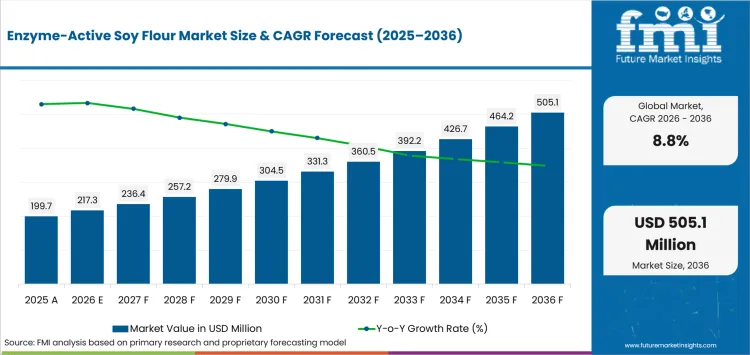
USD 217.3 million in 2026 and USD 505.1 million by 2036 at an 8.8% CAGR.
Demand for enzyme-active soy flour is projected to expand at an 8.8% CAGR between 2026 and 2036, increasing valuation from USD 217.3 million to USD 505.1 million. Industrial bread plants use the ingredient at low dosage because controlled oxidation can improve dough handling without changing mixing equipment. GoodMills Innovation introduced SNOW SPELT in April 2026 with on-site technical support for bread and rolls, a current example of functional flour commercialized by proving line performance.
Country conversion depends on bakery channel structure and documentation for minor functional ingredients. Insee reported in June 2026 that boulangeries-patisseries represented 8.1% of French food retail value in 2025, giving flour specialists a dense trial channel. France therefore rewards technical coverage among many bakery accounts, whereas stronger allergen or identity rules put more weight on records before plant testing.
Key Takeaways
- Demand comes from bakeries using native lipoxygenase activity to adjust dough handling and crumb color in existing flour-based production.
- Standard milling grade is projected to hold 37.0% in 2026 because its specification profile fits routine industrial qualification.
- Powder - dry is estimated at 44.0% share in 2026 owing to its fit with flour metering and premixes.
- Bread and rolls are anticipated to represent 43.0% in 2026, with oxidative dough strengthening most useful in yeast-leavened lines.
- Flavor formation and soy allergen controls can extend trials, and identity-preserved claims add segregation work before approval.
- Key players in the enzyme-active soy flour market include Ardent Mills, ADM, Bay State Milling, Limagrain Ingredients, GoodMills Group, King Arthur Baking, Bob's Red Mill, Doves Farm, Manildra Group, and Scoular.
Analyst Perspective
"Commercial value depends on a bakery proving repeatable activity on its own flour before it approves regular supply. Stronger offers pair activity control with allergen records and traceable sourcing, then use application support to shorten plant qualification."
- Nandini Roy Choudhury, Principal Consultant, Future Market Insights
How is the enzyme-active soy flour market segmented?
The market is segmented by Grade, Form, Application, Claim, Sales Channel, and Region.
Grade covers standard milling, fine - patisserie, organic certified, and identity-preserved specialty supply. Form includes powder - dry, liquid, paste - semi-solid, and granules - pieces. Applications cover bread and rolls, cakes and muffins, biscuits and cookies, viennoiserie and pastry, and other bakery and snacks. Claim includes conventional, clean label, organic, and non-GMO - identity preserved. Sales channels cover direct industrial bakeries, ingredient distributors, foodservice and artisan supply, and online B2B.
What makes standard milling grade central to the grade category?
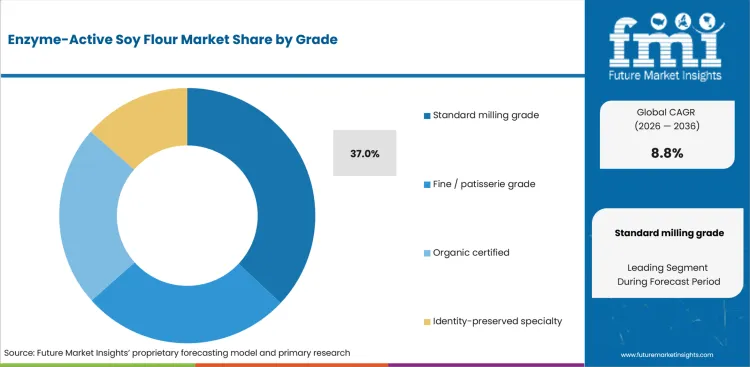
Standard milling grade suits industrial bread plants that need a defined activity range without premium claim controls. It fits existing dry-ingredient handling, so trials can focus on dough response and lot consistency instead of new equipment during routine production repeatedly.
- Standard milling grade represents 37.0% of the 2026 market because its specification balance fits routine bakery qualification.
- In July 2025, Ardent Mills agreed to acquire Stone Mill, which processes identity-preserved grain and provides microbial reduction. The transaction explains why controlled grain handling has commercial value for bakeries that require tighter raw-material records before approval.
Why does powder - dry lead the form category?
Powder - dry product fits flour silos, minor-ingredient stations, and premix systems already installed in industrial bakeries. Low-dose use favors a format that can be weighed with other dry improvers without adding tanks or paste-handling equipment during repeated daily shifts.
- Powder - dry holds 44.0% of the 2026 market owing to its fit with existing flour metering and premix operations.
- In March 2026, GoodMills Innovation introduced low-dust process flour that reduces fine particles and extends cleaning intervals. The release addresses a practical plant requirement: dry flour ingredients must meter cleanly and avoid unnecessary housekeeping during production.
How do bread and rolls lead the application category?
Bread and rolls give enzyme-active soy flour its clearest production role because dough strength and crumb color are visible at line speed. Cakes and pastry use different fat systems, changing the value of oxidative flour treatment.
- Bread and rolls account for 43.0% of the 2026 market due to the direct link between lipoxygenase activity, dough tolerance, and crumb appearance.
- Ardent Mills launched Cocoa Replace in May 2025 after bakery manufacturers sought a flour-based reformulation tool. The company used sensory trials in finished foods, matching the qualification path needed before bakery ingredients enter commercial recipes.
What supports conventional supply in the claim category?
Conventional supply reaches the widest set of industrial recipes because commercial trials can start with function, cost, and lot consistency before a premium sourcing claim is added. Organic and non-GMO - identity preserved grades require tighter segregation and documentary control at each production site.
- Conventional is set to hold 56.0% in 2026, with broader raw-material sourcing reducing claim-specific qualification work for routine bakery programs.
- FDA's January 2025 allergen-labeling guidance retains soybeans among the major food allergens. Conventional material therefore needs accurate ingredient declarations and cross-contact controls even without organic or non-GMO positioning during plant approval.
Why does direct to industrial bakeries lead the sales channel category?
Direct industrial supply suits a low-dose functional flour because a bakery often needs samples, activity specifications, certificates, and line-trial feedback before regular orders begin. Distributors extend reach, but large plants usually need faster technical exchange during formal qualification programs onsite.
- Direct to industrial bakeries captures 50.0% of the 2026 market because plant trials and specification review favor direct technical contact.
- ADM opened Central Lab-Milling in October 2025 to mill, analyze, and bake wheat in support of 31 North American facilities. Laboratory feedback at that scale lets ingredient teams interpret line results faster during bakery qualification.
What are the drivers, restraints and opportunities in the Enzyme-Active Soy Flour Market?
Industrial bakeries value low-dose flour-based oxidation for dough handling, but flavor and allergen controls narrow qualification as claim-ready soy sourcing differentiates higher-value specialty grades.
- Driver: Bread plants need repeatable dough handling and crumb appearance without adding a capital-intensive processing step.
- Restraint: Soy allergen duties and flavor risk can lengthen trials or block a technically workable formulation.
- Opportunity: Standardized activity paired with traceable soy sourcing can support clean-label, organic, and non-GMO bakery programs.
Commercial bakeries gain value from small process improvements because high-volume bread lines repeat the same formulation many times. The USA Census Bureau lists 2,842 employer establishments in commercial bakeries, giving functional-flour companies a broad installed base for controlled trials. Enzyme-active soy flour fits that route because dry dosing can be tested against dough tolerance and line consistency before regular purchasing begins.
Formulation approval can fail despite a useful dough response because soy introduces allergen controls and a narrow flavor tolerance. The UK Food Standards Agency updated allergen guidance in March 2025 and requires food businesses to manage 14 regulated allergens, including soy. Bakery plants therefore need cross-contact records and controlled lipoxygenase activity before a technically workable flour becomes a regular production input.
Claim-ready supply has its clearest route where non-GMO verification already influences how food companies describe ingredients to customers. VLOG reported in March 2026 that sales of foods carrying Germany's Ohne GenTechnik seal increased 6.1% during 2025. Enzyme-active soy flour can enter that route if identity-preserved sourcing and activity specifications are documented together, because clean-label ingredients still need bakery performance proof.
Which country CAGRs are profiled in the Enzyme-Active Soy Flour Market?
| Country | CAGR |
|---|---|
| UAE | 10.1% |
| Saudi Arabia | 9.8% |
| South Korea | 9.4% |
| USA | 9.1% |
| France | 8.8% |
| UK | 8.5% |
| Germany | 8.2% |
| Japan | 7.9% |
How do country-level CAGRs compare in the Enzyme-Active Soy Flour Market?
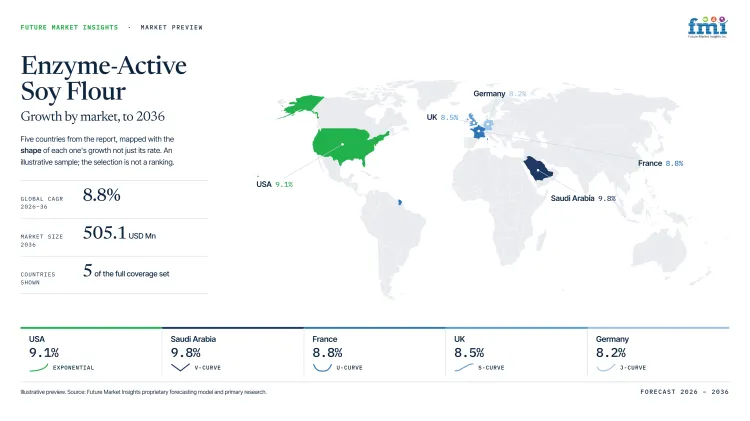
The eight forecasts span 2.2 percentage points, with UAE and Saudi Arabia forming the upper band and Japan setting the lower bound. Gulf growth follows food-processing investment and importer-led qualification. South Korea and the USA benefit from dense manufacturing bases, whereas mature bakery markets put greater weight on documentation and recipe fit.
- UAE pairs localization with technical importers.
- Saudi Arabia relies on distributor documentation.
- South Korea has dense processing clusters.
- USA has scale and incumbent treatments.
- France pairs artisan density with bread rules.
- UK uses large manufacturer quality systems.
- Germany faces cost and claim scrutiny.
- Japan ties approval to wheat specifications.
The full report provides country-level CAGR analysis across North America, Latin America, Western Europe, Eastern Europe, East Asia, South Asia and Pacific, and the Middle East and Africa.
Country-wise Analysis
- Industrial bread plants in the USA qualify functional flour by specification review and line trials, with soy allergen records entering the same approval file as enzyme activity. Demand for enzyme-active soy flour is forecast to rise at 9.1% CAGR over the assessment period, aided by dry handling and centralized technical purchasing that can standardize trials among plants. USDA NASS reported in August 2025 that second-quarter flour production reached 103 million hundredweight, giving new ingredients many trial points but exposing them to established treatments, so repeat orders depend on consistent activity data and allergen records before reliable full commercial approval.
- German bakery programs put unusual weight on ingredient identity and claim documentation, particularly in premium bread lines that use simpler labels as a selling point. Destatis reported in January 2026 that 2025 wholesale prices for sugar, confectionery, and bakery products rose 14.7% from 2024, increasing cost scrutiny during reformulation and making segregation expenses harder to absorb. Germany is projected to record 8.2% CAGR through 2036, with identity-preserved sourcing opening premium routes but testing and chain-of-custody work raise costs, so companies must prove enzyme performance without adding avoidable complexity to recipe approval and routine production planning at larger plants.
- French ingredient sales serve a dense network of independent bakeries and centralized industrial plants, so account coverage is more fragmented than in markets dominated by large chains. Insee counted 50,122 bakery and pastry establishments in 2025, giving flour specialists a broad trial base and increasing the service cost of supplying technical guidance to smaller professional accounts. Enzyme-active soy flour sales in France are forecast to expand at 8.8% CAGR during the forecast period, but qualification stays recipe-specific and dosing tolerance is narrow, favoring companies that pair controlled enzyme activity with practical formulation support and reliable local account coverage.
- UK flour qualification operates inside large food-manufacturing quality systems, so a low-dose soy ingredient has to fit existing specifications, allergen procedures, and high-throughput production schedules. The UK is anticipated to post 8.5% CAGR by 2036 because industrial bakeries can test dry functional ingredients within established technical channels, though extra documentation can slow approval. The Office for National Statistics reported in July 2026 that food manufacturing accounted for 22.9% of UK manufacturers' product sales in 2025, confirming the large processing base and favoring companies that can work with distributors or direct bakery contacts without creating a second documentation system.
- Saudi bakery buying is concentrated among industrial food producers, large bakery chains, and importers that must translate technical records into locally usable specifications before a new ingredient reaches the line. GASTAT reported in November 2025 that manufacturing of food products rose 6.9% month on month in September, a current measure of processing activity that increases trial opportunities without sizing this niche. Demand for enzyme-active soy flour is predicted to advance at 9.8% CAGR through 2036, aided by established import routes, but conversion depends on distributors that coordinate allergen records, samples, and bread-line trials instead of handling inventory alone.
- UAE ingredient sales often pass through importers serving industrial bakeries, hospitality kitchens, and regional food manufacturers, making distributor technical competence part of the approval process. In May 2026, the Ministry of Industry and Advanced Technology said a food-localization policy could support up to 200 factories and target a 15% to 30% increase in local production capacity, expanding the pool of plants that may evaluate imported functional ingredients. The UAE is forecast to grow at 10.1% CAGR over the assessment period, but entries convert more reliably if importer coverage includes clear allergen statements, shelf-handling records, and practical bakery trial support.
- Japanese bakeries manage minor functional ingredients against tightly specified imported wheat classes, so changes in bread-wheat cost or quality can alter trial priorities before the ingredient specification changes. Enzyme-active soy flour demand in Japan is projected to expand at 7.9% CAGR during the assessment period, supported by disciplined milling and formulation control but slowed by conservative approval cycles. Japan's Ministry of Agriculture reduced the government selling price for imported wheat by 4.0% for October 2025, including bread-oriented classes, giving mills some input-cost relief but leaving companies responsible for accurate activity ranges and Japanese-language ingredient documentation before regular purchasing.
- South Korean food manufacturers operate in concentrated processing clusters with demanding documentation standards, giving technical ingredient companies a practical entry route once a local partner can manage sampling and plant trials. MAFRA reported in July 2025 that the number of Korean food and beverage manufacturing businesses rose 3.5% year on year, broadening the account base despite identity and allergen checks for imported soy ingredients. South Korea is estimated to post 9.4% CAGR by 2036, driven by local manufacturing depth and responsive distribution, but entrants need consistent enzyme specifications and follow-up because a soy-flour offer is easy to substitute.
Who are the notable companies in the Enzyme-Active Soy Flour Market?
Ardent Mills, ADM, Bay State Milling, Limagrain Ingredients, GoodMills Group, King Arthur Baking, Bob's Red Mill, Doves Farm, Manildra Group, and Scoular are the notable companies serving this market.
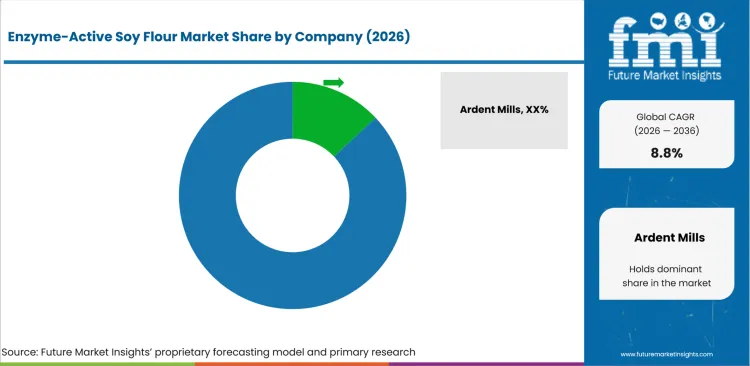
Competition is split among soy sourcing platforms, industrial millers, functional-flour developers, and specialty bakery brands. Entry requires activity control, allergen records, claim documentation, and bakery evidence before regular supply.
- Ardent Mills, ADM, and Bay State Milling bring milling scale, laboratory support, and specialty-grain control.
- Limagrain Ingredients and GoodMills Group focus on functional cereal ingredients and bakery formulation work.
- King Arthur Baking, Bob's Red Mill, Doves Farm, Manildra Group, and Scoular extend specialty flour, claim-ready sourcing, and soy-channel reach.
Competitive Benchmarking: Enzyme-Active Soy Flour Market
| Company | Soy & Specialty Grain Sourcing | Bakery Formulation Support | Claim-Ready Traceability | Geographic Reach |
|---|---|---|---|---|
| Ardent Mills | Medium | High | High | North America |
| ADM | High | High | High | Global |
| Bay State Milling | Medium | High | Medium | North America |
| Limagrain Ingredients | Medium | High | High | Europe and international markets |
| GoodMills Group | Low | High | High | Europe and international markets |
| King Arthur Baking | Low | Medium | Medium | USA |
| Bob's Red Mill | Low | Medium | Medium | USA and selected international channels |
| Doves Farm | Low | Medium | High | UK and international retail |
| Manildra Group | Medium | High | High | Australia, Asia and North America |
| Scoular | High | Medium | High | North America and international markets |
Scoring basis: High sourcing requires documented soy or broad specialty-grain control, Medium indicates narrower controlled sourcing, and Low no broad public soy platform. High formulation requires industrial bakery development evidence, Medium narrower application support, and Low limited public proof. High traceability requires explicit organic, non-GMO, or identity-preserved controls, Medium general quality records, and Low limited claim evidence.
Key Developments in the Enzyme-Active Soy Flour Market
- In August 2026, Scoular announced a soybean dehuller for its Covington, Ohio facility to serve food and beverage customers using identity-preserved, non-GMO, and organic soybeans.
- In April 2026, GoodMills Innovation introduced GOOD NatureRelax for industrial and artisan bakery dough handling, adding a clean-label wheat-based tool for production stability.
- In March 2025, King Arthur Baking launched Buttermilk Biscuit Flour Blend as a specialty flour formulated for simpler biscuit preparation.
Key Players in the Enzyme-Active Soy Flour Market
Industrial Milling and Soy Platforms
- Ardent Mills
- ADM
- Bay State Milling
Functional Flour and Bakery Ingredient Specialists
- Limagrain Ingredients
- GoodMills Group
Specialty Bakery Channels
- King Arthur Baking
- Bob's Red Mill
- Doves Farm
Industrial Ingredient and Soy Sourcing Platforms
- Manildra Group
- Scoular
Enzyme-Active Soy Flour Market - Report Scope
| Coverage field | Report scope |
|---|---|
| Market breakdown | Grade; Form; Application; Claim; Sales Channel; Region |
| Quantitative Units | USD million. |
| Market Definition | Revenue includes enzyme-active soy flour sold within the defined grade, form, application, claim, and sales-channel universe. It excludes heat-inactivated soy flour, isolated enzymes sold outside the named product, adjacent substitute ingredients, and downstream bakery revenue. |
| Regions Covered | North America; Latin America; Western Europe; Eastern Europe; East Asia; South Asia and Pacific; Middle East and Africa. |
| Countries Covered | USA, Germany, France, UK, Saudi Arabia, UAE, Japan, South Korea, and more than twenty-five additional countries in the full report. |
| Key Companies Profiled | Ardent Mills, ADM, Bay State Milling, Limagrain Ingredients, GoodMills Group, King Arthur Baking, Bob's Red Mill, Doves Farm, Manildra Group, Scoular. |
| Forecast Period | 2026 to 2036. |
| Approach | A hybrid bottom-up and top-down sizing approach reconciles supplier revenue logic, bakery applications, pricing, channel structure, and country demand while excluding adjacent categories and downstream finished-product revenue. |
Enzyme-Active Soy Flour Market - Research Methodology
| Method | Approach |
|---|---|
| Primary Research | FMI analysts gathered input from manufacturers, service providers, technology developers, distributors, end users, procurement teams, and subject-matter experts. Interviews examined purchasing decisions, product or service evaluation, adoption barriers, approval requirements, pricing considerations, and expectations for technical or commercial support. Respondents were also asked what evidence is required before a trial, pilot, or initial order develops into regular purchasing. |
| Desk Research | Desk research covered government statistics, regulatory publications, trade data, industry associations, technical literature, standards, company filings, product information, and official corporate announcements. Sources were reviewed for relevance, publication date, geographic coverage, and consistency with the defined market scope. Claims relating to performance, applications, approvals, capacity, investment, and commercial activity were retained only when supported by credible public evidence. |
| Market Sizing and Forecasting | The market model combined the baseline value with historical performance, segment structure, pricing and volume indicators, adoption levels, company participation, and country-level demand conditions. Forecast assumptions considered economic activity, investment trends, regulatory developments, technology adoption, purchasing cycles, supply availability, and barriers to wider market use. Segment and regional estimates were reconciled before the final market total was calculated. |
| Data Validation | Estimates were checked against multiple independent indicators, including public data, company activity, trade patterns, industry developments, and findings from primary interviews. Validation also tested whether products, services, applications, and company revenues fell within the defined market boundaries. Adjacent categories, unsupported claims, overlapping revenues, and activities without direct market relevance were excluded to reduce double counting and maintain consistency across segments and countries. |
Enzyme-Active Soy Flour Market by Segments
Enzyme-Active Soy Flour Market segmented by Grade:
- Standard milling grade
- Fine - patisserie grade
- Organic certified
- Identity-preserved specialty
Enzyme-Active Soy Flour Market segmented by Form:
- Powder - dry
- Liquid
- Paste - semi-solid
- Granules - pieces
Enzyme-Active Soy Flour Market segmented by Application:
- Bread and rolls
- Cakes and muffins
- Biscuits and cookies
- Viennoiserie and pastry
- Other bakery and snacks
Enzyme-Active Soy Flour Market segmented by Claim:
- Conventional
- Clean label
- Organic
- Non-GMO - identity preserved
Enzyme-Active Soy Flour Market segmented by Sales Channel:
- Direct to industrial bakeries
- Ingredient distributors
- Foodservice and artisan supply
- Online B2B
Enzyme-Active Soy Flour Market by Region:
- North America
- United States
- Canada
- Latin America
- Brazil
- Mexico
- Argentina
- Chile
- Western Europe
- Germany
- France
- United Kingdom
- Italy
- Spain
- Benelux
- Nordics
- Eastern Europe
- Poland
- Czech Republic
- Romania
- Hungary
- East Asia
- China
- Japan
- South Korea
- South Asia and Pacific
- India
- ASEAN
- Australia and New Zealand
- Middle East and Africa
- GCC Countries
- South Africa
- Türkiye
- Israel
Research Sources and Bibliography
- GoodMills Innovation. (2026, April 9). Lighter, finer, milder: wholemeal reimagined.
- Institut national de la statistique et des études économiques (Insee). (2026, June 18). Parts de marché du commerce de détail selon la forme de vente: Données annuelles 2025.
- Ardent Mills. (2025, July 31). Ardent Mills enters agreement to acquire Stone Mill in North Dakota, expanding emerging nutrition portfolio.
- GoodMills Innovation. (2026, March 2). Low-dust process flour from GoodMills Innovation reduces fine particle content, extends cleaning intervals and improves workplace safety.
- Ardent Mills. (2025, May 14). Ardent Mills introduces Cocoa Replace to address cost and supply instability.
- USA Food and Drug Administration. (2025, January 6). FDA Releases Allergen, Food Safety, and Plant-Based Alternative Labeling Guidances.
- ADM. (2025, October 14). ADM advances quality capabilities with opening of new Central Lab-Milling.
- USA Census Bureau. (n.d.). 311812: Commercial bakeries - Census Bureau Profile.
- Food Standards Agency. (2025, March 14). Allergen guidance for food businesses.
- Verband Lebensmittel ohne Gentechnik. (2026, March 25). 'Ohne Gentechnik' market grows to over 18 billion euros.
- USA Department of Agriculture, National Agricultural Statistics Service. (2025, August 1). Flour Milling Products.
- German Federal Statistical Office (Destatis). (2026, January 15). Wholesale prices in December 2025: +1.2% on December 2024.
- Institut national de la statistique et des études économiques (Insee). (2026, August 27). Dossier complet - France entière.
- Office for National Statistics. (2026, July 24). UK manufacturers' sales by product: 2025.
- General Authority for Statistics. (2025, November). Industrial Production Index - September 2025.
- UAE Ministry of Industry and Advanced Technology. (2026, May 20). Make it in the Emirates concludes largest edition yet.
- Ministry of Agriculture, Forestry and Fisheries of Japan. (2025, September 10). Revision of the government selling price for imported wheat.
- Ministry of Agriculture, Food and Rural Affairs of the Republic of Korea. (2025, July 31). The Result of the Survey on the Korean Food Industry for the Year 2024.
- Scoular. (2026, August 3). Growing demand drives Scoular soybean dehuller expansion in Ohio.
- GoodMills Innovation. (2026, April 27). Stable processes, relaxed doughs: GOOD NatureRelax.
- King Arthur Baking Company. (2025, March 5). King Arthur Baking Company expands flour line with the launch of Buttermilk Biscuit Flour Blend.
- Bay State Milling. (2025, November 3). Not All Fiber is Created Equal.
- Bob's Red Mill. (2025, May 14). Are Bob's Red Mill products non-GMO?
- Doves Farm. (n.d.). Accreditations.
- Manildra Group. (2025, July 9). Sustainably Circular Manufacturing.
- ADM. (2026, May 20). ADM advances protein innovation with new ingredient solutions.
- Limagrain Ingredients. (2025, October 29). Limagrain Ingredients at FIE 2025: driving plant-based and responsible innovation.
- Ardent Mills. (2026, February 20). Ardent Mills Dark Cocoa Replace expands growing line of cocoa replacers.
- GoodMills Innovation. (2026, August 25). Enrichment, naturalness and process efficiency: GoodMills Innovation to present contemporary solutions for the baking trade at südback 2026.
- Bob's Red Mill. (2026, August 19). Bob's Red Mill introduces perfected formula for Gluten Free 1-to-1 Baking Flour with improved taste and texture.
- GoodMills Innovation. (2026, May 22). SNACKMAXX Masa Flours: Authentic corn flavour and process reliability for snack applications.
- King Arthur Baking Company. (2026, April 21). King Arthur Baking taps celebrations, gluten-free demand, and everyday ease with five new mixes this spring.
This bibliography is provided for reader reference and is not exhaustive. The full report contains the complete reference list and detailed citations.
This Report Answers
- How large is the market through 2036?
- What supports the 8.8% forecast CAGR?
- Why does standard milling grade lead?
- Why does powder - dry fit bakeries?
- Why do bread and rolls lead?
- How do allergen and flavor risks affect approval?
- Which countries have the highest CAGRs?
- How do local bakery systems affect conversion?
- Which companies are active in this market?
- What matters before flour approval?
Frequently Asked Questions
How big is the enzyme-active soy flour market in 2026?
The enzyme-active soy flour market is valued at USD 217.3 million in 2026 and is projected to reach USD 505.1 million by 2036. Growth is driven by low-dose dough conditioning in commercial bread production.
What is the CAGR of the enzyme-active soy flour market from 2026 to 2036?
The enzyme-active soy flour market is projected to grow at a CAGR of 8.8% between 2026 and 2036. Expansion is tied to repeatable enzyme activity and dry handling in existing bakery dosing systems.
Which grade leads the enzyme-active soy flour market?
The standard milling grade segment is expected to hold 37.0% of the enzyme-active soy flour market in 2026, driven by routine industrial specifications. Broader sourcing also limits claim-specific qualification work.
Which countries are projected to record the highest growth in the enzyme-active soy flour market?
UAE is projected to grow at 10.1% CAGR, followed by Saudi Arabia at 9.8% and South Korea at 9.4% through 2036. Their outlooks align with food-processing investment and importer or distributor support.
Which companies are active in the enzyme-active soy flour market?
Key companies operating in the market include Ardent Mills, ADM, Bay State Milling, Limagrain Ingredients, GoodMills Group, King Arthur Baking, Bob's Red Mill, Doves Farm, Manildra Group, and Scoular. Their positions differ by soy sourcing, milling control, application support, and channel reach.
Preview the report firsthand - request a free sample
Get SampleGet the brochure for pricing and purchase details.
Get PDFTable of Content
- Key Takeaways
- Market Size and CAGR
- Top Growth Driver
- Fastest Growing Segment
- Leading Region
- Key Companies
- Emerging Opportunities
- Executive Summary
- Global Market Outlook
- Demand-side Trends
- Supply-side Trends
- Technology Roadmap Analysis
- Analysis and Recommendations
- Analyst Perspective (What is happening? Why now? What should investors know?)
- Key Questions Answered
- How large is the market?
- What is the CAGR?
- What are key trends?
- Which region dominates?
- Who are the leaders?
- Market Overview
- Market Coverage / Taxonomy
- Market Definition / Scope / Limitations
- Research Methodology
- Chapter Orientation
- Analytical Lens and Working Hypotheses
- Market Structure, Signals, and Trend Drivers
- Benchmarking and Cross-market Comparability
- Market Sizing, Forecasting, and Opportunity Mapping
- Research Design and Evidence Framework
- Desk Research Programme (Secondary Evidence)
- Expert Input and Fieldwork (Primary Evidence)
- Tooling, Models, and Reference Databases
- Data Engineering and Model Build
- Quality Assurance and Audit Trail
- Market Background
- Market Dynamics (Drivers, Restraints, Opportunity, Trends)
- Scenario Forecast (Optimistic, Likely, Conservative)
- Impact Analysis
- AI Impact
- Sustainability Impact
- Regulatory Impact
- Technology Impact
- Consumer / Buyer Analysis
- Purchase Drivers
- Adoption Barriers
- Buyer Journey
- Opportunity Map Analysis
- Product Life Cycle Analysis
- Supply Chain Analysis
- Investment Feasibility Matrix
- Value Chain Analysis
- PESTLE and Porter's Analysis
- Regulatory Landscape
- Regional Parent Market Outlook
- Production and Consumption Statistics
- Import and Export Statistics
- Global Market Analysis and Forecast, 2021 to 2036
- Historical Market Size Value (USD Million) Analysis, 2021 to 2025
- Current and Future Market Size Value (USD Million) Projections, 2026 to 2036
- Y-o-Y Growth Trend Analysis
- Absolute $ Opportunity Analysis
- Global Market Pricing Analysis, 2021 to 2036
- Global Market Analysis and Forecast, By Grade, 2021 to 2036
- Introduction / Key Findings
- Historical Market Size Value (USD Million) Analysis By Grade, 2021 to 2025
- Current and Future Market Size Value (USD Million) Analysis and Forecast By Grade, 2026 to 2036
- Standard milling grade
- Fine / patisserie grade
- Organic certified
- Identity-preserved specialty
- Standard milling grade
- Y-o-Y Growth Trend Analysis By Grade, 2021 to 2025
- Absolute $ Opportunity Analysis By Grade, 2026 to 2036
- Global Market Analysis and Forecast, By Form, 2021 to 2036
- Introduction / Key Findings
- Historical Market Size Value (USD Million) Analysis By Form, 2021 to 2025
- Current and Future Market Size Value (USD Million) Analysis and Forecast By Form, 2026 to 2036
- Powder / dry
- Liquid
- Paste / semi-solid
- Granules / pieces
- Powder / dry
- Y-o-Y Growth Trend Analysis By Form, 2021 to 2025
- Absolute $ Opportunity Analysis By Form, 2026 to 2036
- Global Market Analysis and Forecast, By Application, 2021 to 2036
- Introduction / Key Findings
- Historical Market Size Value (USD Million) Analysis By Application, 2021 to 2025
- Current and Future Market Size Value (USD Million) Analysis and Forecast By Application, 2026 to 2036
- Bread & rolls
- Cakes & muffins
- Biscuits & cookies
- Viennoiserie & pastry
- Other bakery & snacks
- Bread & rolls
- Y-o-Y Growth Trend Analysis By Application, 2021 to 2025
- Absolute $ Opportunity Analysis By Application, 2026 to 2036
- Global Market Analysis and Forecast, By Claim, 2021 to 2036
- Introduction / Key Findings
- Historical Market Size Value (USD Million) Analysis By Claim, 2021 to 2025
- Current and Future Market Size Value (USD Million) Analysis and Forecast By Claim, 2026 to 2036
- Conventional
- Clean label
- Organic
- Non-GMO / identity preserved
- Conventional
- Y-o-Y Growth Trend Analysis By Claim, 2021 to 2025
- Absolute $ Opportunity Analysis By Claim, 2026 to 2036
- Global Market Analysis and Forecast, By Sales Channel, 2021 to 2036
- Introduction / Key Findings
- Historical Market Size Value (USD Million) Analysis By Sales Channel, 2021 to 2025
- Current and Future Market Size Value (USD Million) Analysis and Forecast By Sales Channel, 2026 to 2036
- Direct to industrial bakeries
- Ingredient distributors
- Foodservice & artisan supply
- Online B2B
- Direct to industrial bakeries
- Y-o-Y Growth Trend Analysis By Sales Channel, 2021 to 2025
- Absolute $ Opportunity Analysis By Sales Channel, 2026 to 2036
- Global Market Analysis and Forecast, By Region, 2021 to 2036
- Introduction
- Historical Market Size Value (USD Million) Analysis By Region, 2021 to 2025
- Current Market Size Value (USD Million) Analysis and Forecast By Region, 2026 to 2036
- North America
- Latin America
- Western Europe
- Eastern Europe
- East Asia
- South Asia and Pacific
- Middle East & Africa
- Market Attractiveness Analysis By Region
- North America Market Analysis and Forecast, By Country, 2021 to 2036
- Historical Market Size Value (USD Million) Trend Analysis By Market Taxonomy, 2021 to 2025
- Market Size Value (USD Million) Forecast By Market Taxonomy, 2026 to 2036
- By Country
- USA
- Canada
- By Grade
- By Form
- By Application
- By Claim
- By Sales Channel
- By Country
- Market Attractiveness Analysis
- By Country
- By Grade
- By Form
- By Application
- By Claim
- By Sales Channel
- Key Takeaways
- Latin America Market Analysis and Forecast, By Country
- Historical Market Size Value (USD Million) Trend Analysis By Market Taxonomy, 2021 to 2025
- Market Size Value (USD Million) Forecast By Market Taxonomy, 2026 to 2036
- By Country
- Brazil
- Mexico
- Chile
- Rest of Latin America
- By Grade
- By Form
- By Application
- By Claim
- By Sales Channel
- By Country
- Market Attractiveness Analysis
- By Country
- By Grade
- By Form
- By Application
- By Claim
- By Sales Channel
- Key Takeaways
- Western Europe Market Analysis and Forecast, By Country
- Historical Market Size Value (USD Million) Trend Analysis By Market Taxonomy, 2021 to 2025
- Market Size Value (USD Million) Forecast By Market Taxonomy, 2026 to 2036
- By Country
- Germany
- UK
- Italy
- Spain
- France
- Nordic
- BENELUX
- Rest of Western Europe
- By Grade
- By Form
- By Application
- By Claim
- By Sales Channel
- By Country
- Market Attractiveness Analysis
- By Country
- By Grade
- By Form
- By Application
- By Claim
- By Sales Channel
- Key Takeaways
- Eastern Europe Market Analysis and Forecast, By Country
- Historical Market Size Value (USD Million) Trend Analysis By Market Taxonomy, 2021 to 2025
- Market Size Value (USD Million) Forecast By Market Taxonomy, 2026 to 2036
- By Country
- Russia
- Poland
- Hungary
- Balkan & Baltic
- Rest of Eastern Europe
- By Grade
- By Form
- By Application
- By Claim
- By Sales Channel
- By Country
- Market Attractiveness Analysis
- By Country
- By Grade
- By Form
- By Application
- By Claim
- By Sales Channel
- Key Takeaways
- East Asia Market Analysis and Forecast, By Country
- Historical Market Size Value (USD Million) Trend Analysis By Market Taxonomy, 2021 to 2025
- Market Size Value (USD Million) Forecast By Market Taxonomy, 2026 to 2036
- By Country
- China
- Japan
- South Korea
- By Grade
- By Form
- By Application
- By Claim
- By Sales Channel
- By Country
- Market Attractiveness Analysis
- By Country
- By Grade
- By Form
- By Application
- By Claim
- By Sales Channel
- Key Takeaways
- South Asia and Pacific Market Analysis and Forecast, By Country
- Historical Market Size Value (USD Million) Trend Analysis By Market Taxonomy, 2021 to 2025
- Market Size Value (USD Million) Forecast By Market Taxonomy, 2026 to 2036
- By Country
- India
- ASEAN
- Australia & New Zealand
- Rest of South Asia and Pacific
- By Grade
- By Form
- By Application
- By Claim
- By Sales Channel
- By Country
- Market Attractiveness Analysis
- By Country
- By Grade
- By Form
- By Application
- By Claim
- By Sales Channel
- Key Takeaways
- Middle East & Africa Market Analysis and Forecast, By Country
- Historical Market Size Value (USD Million) Trend Analysis By Market Taxonomy, 2021 to 2025
- Market Size Value (USD Million) Forecast By Market Taxonomy, 2026 to 2036
- By Country
- Kingdom of Saudi Arabia
- Other GCC Countries
- Türkiye
- South Africa
- Other African Union
- Rest of Middle East & Africa
- By Grade
- By Form
- By Application
- By Claim
- By Sales Channel
- By Country
- Market Attractiveness Analysis
- By Country
- By Grade
- By Form
- By Application
- By Claim
- By Sales Channel
- Key Takeaways
- Key Countries Market Analysis
- USA
- Pricing Analysis
- Market Share Analysis, 2025
- By Grade
- By Form
- By Application
- By Claim
- By Sales Channel
- Canada
- Pricing Analysis
- Market Share Analysis, 2025
- By Grade
- By Form
- By Application
- By Claim
- By Sales Channel
- Mexico
- Pricing Analysis
- Market Share Analysis, 2025
- By Grade
- By Form
- By Application
- By Claim
- By Sales Channel
- Brazil
- Pricing Analysis
- Market Share Analysis, 2025
- By Grade
- By Form
- By Application
- By Claim
- By Sales Channel
- Chile
- Pricing Analysis
- Market Share Analysis, 2025
- By Grade
- By Form
- By Application
- By Claim
- By Sales Channel
- Germany
- Pricing Analysis
- Market Share Analysis, 2025
- By Grade
- By Form
- By Application
- By Claim
- By Sales Channel
- UK
- Pricing Analysis
- Market Share Analysis, 2025
- By Grade
- By Form
- By Application
- By Claim
- By Sales Channel
- Italy
- Pricing Analysis
- Market Share Analysis, 2025
- By Grade
- By Form
- By Application
- By Claim
- By Sales Channel
- Spain
- Pricing Analysis
- Market Share Analysis, 2025
- By Grade
- By Form
- By Application
- By Claim
- By Sales Channel
- France
- Pricing Analysis
- Market Share Analysis, 2025
- By Grade
- By Form
- By Application
- By Claim
- By Sales Channel
- India
- Pricing Analysis
- Market Share Analysis, 2025
- By Grade
- By Form
- By Application
- By Claim
- By Sales Channel
- ASEAN
- Pricing Analysis
- Market Share Analysis, 2025
- By Grade
- By Form
- By Application
- By Claim
- By Sales Channel
- Australia & New Zealand
- Pricing Analysis
- Market Share Analysis, 2025
- By Grade
- By Form
- By Application
- By Claim
- By Sales Channel
- China
- Pricing Analysis
- Market Share Analysis, 2025
- By Grade
- By Form
- By Application
- By Claim
- By Sales Channel
- Japan
- Pricing Analysis
- Market Share Analysis, 2025
- By Grade
- By Form
- By Application
- By Claim
- By Sales Channel
- South Korea
- Pricing Analysis
- Market Share Analysis, 2025
- By Grade
- By Form
- By Application
- By Claim
- By Sales Channel
- Russia
- Pricing Analysis
- Market Share Analysis, 2025
- By Grade
- By Form
- By Application
- By Claim
- By Sales Channel
- Poland
- Pricing Analysis
- Market Share Analysis, 2025
- By Grade
- By Form
- By Application
- By Claim
- By Sales Channel
- Hungary
- Pricing Analysis
- Market Share Analysis, 2025
- By Grade
- By Form
- By Application
- By Claim
- By Sales Channel
- Kingdom of Saudi Arabia
- Pricing Analysis
- Market Share Analysis, 2025
- By Grade
- By Form
- By Application
- By Claim
- By Sales Channel
- Türkiye
- Pricing Analysis
- Market Share Analysis, 2025
- By Grade
- By Form
- By Application
- By Claim
- By Sales Channel
- South Africa
- Pricing Analysis
- Market Share Analysis, 2025
- By Grade
- By Form
- By Application
- By Claim
- By Sales Channel
- USA
- Market Structure Analysis
- Competition Dashboard
- Competition Benchmarking
- Market Share Analysis of Top Players
- By Regional
- By Grade
- By Form
- By Application
- By Claim
- By Sales Channel
- Emerging Startups
- Innovation Benchmarking
- Competition Analysis
- Competition Deep Dive
- Ardent Mills
- Overview
- Product Portfolio
- Profitability by Market Segments
- Sales Footprint
- Strategy Overview
- Marketing Strategy
- Product Strategy
- Channel Strategy
- ADM
- Bay State Milling
- Limagrain Ingredients
- GoodMills Group
- King Arthur Baking
- Bob's Red Mill
- Doves Farm
- Manildra Group
- Scoular
- Ardent Mills
- Case Studies
- Success Stories
- Recent Developments
- Competition Deep Dive
- Assumptions & Acronyms Used


