

- Market Size (2026)
- USD 46.1 Bn
- Forecast (2036)
- USD 77.1 Bn
- CAGR (2026 to 2036)
- 5.0%
How big is Energy Drinks Market in 2026?
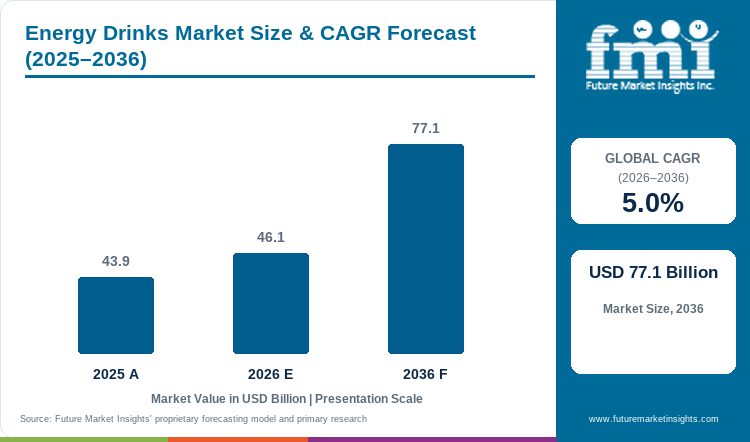
USD 46.1 Billion in 2026 and USD 77.1 Billion by 2036 at a 5.0% CAGR.
Demand for energy drinks is projected to expand at a 5.0% CAGR from 2026 to 2036, growing from USD 43.9 Billion in 2025 to USD 46.1 Billion in 2026, and reaching USD 77.1 Billion by 2036. Growth is being supported by zero-sugar reformulation, flavor rotation, and wider distribution, but new launches only create durable revenue when retailers can maintain cold availability and replenish fast-moving SKUs. Celsius Holdings reported in August 2026 that cold-vault and permanent cooler placements require retailer capital and labor, showing why shelf execution can be as important as the launch itself.
Country conversion differs because regulation and route-to-market economics vary. England confirmed in July 2026 that sales of high-caffeine energy drinks to under-16s will be prohibited from April 2027, subject to Parliamentary approval. Japan continues to show a different growth route, with localized flavor launches supported by domestic beverage partners. These differences make assortment planning, pack size, and channel execution central to market expansion.
Key Takeaways
- Zero-sugar choice, flavor innovation, and wider chilled availability support trial and repeat purchasing.
- Alcoholic Energy Drinks represent 52.0% of demand in 2026.
- Non-Organic accounts for 70.0% of demand in 2026, supported by wider sourcing and formulation flexibility.
- Caffeine-related age restrictions can narrow the addressable consumer base and increase retail compliance work.
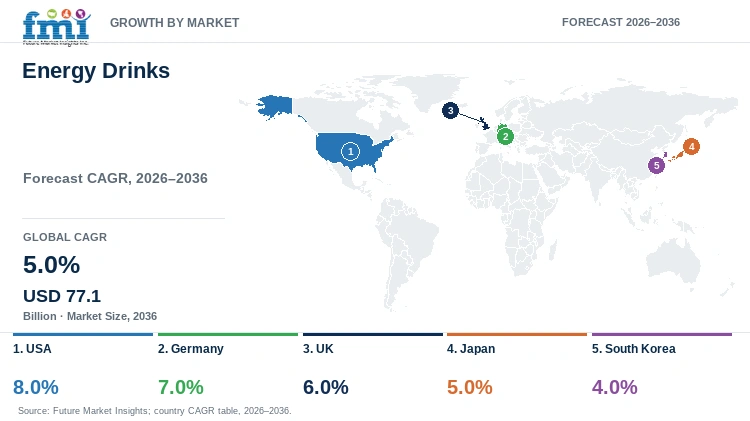
- The USA is forecast to grow at 8.0% CAGR, followed by Germany at 7.0% from 2026 to 2036.
- Red Bull GmbH, Monster Beverage Corporation, PepsiCo Inc., Celsius Holdings Inc., and Keurig Dr Pepper Inc. remain prominent participants.
Analyst Perspective
A new flavor or formulation can generate trial, but repeat revenue depends on shelf availability, clear consumer positioning, and a route to market that keeps the product in stock. Energy drink brands that coordinate innovation with distribution are better placed to sustain retailer support.
- Nandini Roy Choudhury, Principal Consultant, Future Market Insights
How is the energy drinks market segmented?
The energy drinks market is segmented by Product Type and Nature.
Product Type comprises Alcoholic Energy Drinks and Non-Alcoholic Energy Drinks. Nature comprises Non-Organic and Organic. The market covers packaged ready-to-drink beverages sold with an energy positioning, including products distributed through modern retail, convenience stores, foodservice, and other permitted channels.
Why do Alcoholic Energy Drinks lead demand within the Product Type category?
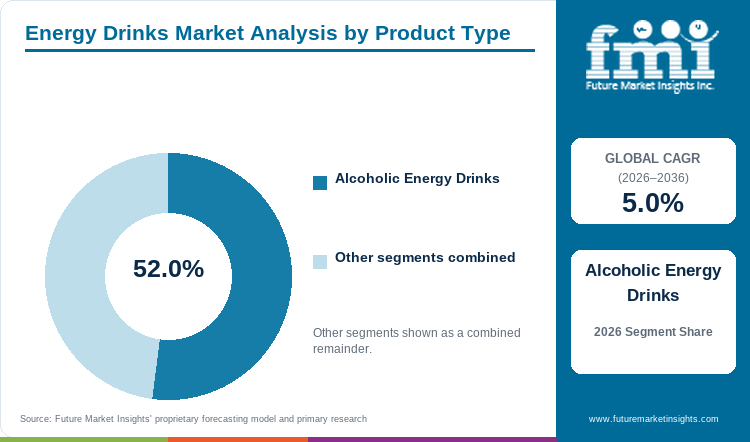
Alcoholic Energy Drinks account for the larger Product Type share in the approved market structure. Demand is tied to adult consumption occasions where an alcohol-containing product can be lawfully formulated and sold. The segment therefore depends on adult-channel access, retailer controls, and local product rules more heavily than Non-Alcoholic Energy Drinks. Suppliers also need packaging and merchandising that clearly separate the adult proposition from mainstream energy-drink shelves.
- Alcoholic Energy Drinks hold a 52.0% share in 2026.
- Commercial performance depends on legal availability, adult-channel access, and disciplined retail execution.
Why does Non-Organic lead demand within the Nature category?
Non-Organic products give manufacturers more flexibility in ingredient sourcing, sweetener choice, and price positioning. Organic products require additional certification and labeling controls, which can narrow sourcing options and raise documentation needs. This makes conventional formulations easier to scale across mass retail and convenience channels where price, taste, and availability remain central purchase factors. Demand for organic drinks remains relevant, but certification adds another operating layer.
- Non-Organic represents 70.0% of the market in 2026.
- Wider sourcing flexibility supports broader price points and faster formulation changes across mainstream channels.
What are the drivers, restraints and opportunities in the energy drinks market?
Zero-sugar choice supports trial, caffeine-related restrictions affect selling conditions, and smaller formats widen adult consumption occasions.
- Driver: zero-sugar beverages widen choice for consumers seeking energy products without sugar.
- Restraint: caffeine-related age restrictions can reduce access for younger consumers and increase point-of-sale compliance work.
- Opportunity: smaller drink cans can support trial, portion control, and additional consumption occasions.
Zero-sugar innovation is becoming a larger part of portfolio design. Red Bull introduced a reformulated Red Bull Zero in the USA in January 2025, giving retailers another zero-sugar option alongside Red Bull Sugarfree. The commercial test is whether the added choice grows the category or simply shifts purchasing between SKUs, so retailers continue to focus on productivity per cooler door and repeat movement.
Regulation is also shaping channel economics. England confirmed in July 2026 that high-caffeine energy drinks containing more than 150 mg of caffeine per litre will be subject to an under-16 sales ban from April 2027, subject to Parliamentary approval. Retailers will need suitable checkout controls, while brands will need clear adult-oriented positioning for affected products.
Which country CAGRs are profiled in the energy drinks market?
| Country | CAGR |
|---|---|
| USA | 8.0% |
| Germany | 7.0% |
| UK | 6.0% |
| Japan | 5.0% |
| South Korea | 4.0% |
How do country-level CAGRs compare in the energy drinks market?
The USA is expected to grow at 8.0% CAGR from 2026 to 2036, followed by Germany at 7.0%. The UK is projected at 6.0%, Japan at 5.0%, and South Korea at 4.0%. The growth routes differ because distribution systems, caffeine policy, and local flavor preferences shape how brands build repeat demand.
Country-wise Analysis
- USA: The USA is expected to grow at a CAGR of 8.0% from 2026 to 2036. Distribution scale remains a major commercial lever. Celsius Holdings reported in August 2026 that its portfolio was still integrating Alani Nu and Rockstar Energy into a broader PepsiCo-led distribution system. At the same time, cooler and cold-vault expansion requires retailer investment, so national reach depends on both distributor coverage and physical shelf execution.
- Germany: Germany is projected to grow at a CAGR of 7.0% from 2026 to 2036. Product communication around caffeine remains important in a mature retail market. The EDKAR study published in August 2025 kept attention on high energy-drink consumption among adolescents, reinforcing the value of clear caffeine information and responsible positioning. Brands that combine familiar flavor with transparent product information are better placed to maintain retailer confidence.
- UK: The UK is forecast to grow at a CAGR of 6.0% from 2026 to 2036. In England, the government confirmed in July 2026 that sales of high-caffeine energy drinks to under-16s will be prohibited from April 2027, subject to Parliamentary approval. The measure will apply to shops, vending machines, and online sellers. Suppliers will need to align packaging, retail controls, and adult-oriented marketing with the new selling environment.
- Japan: Japan is projected to record a CAGR of 5.0% from 2026 to 2036. Localized flavor development remains an important route to shelf renewal. In June 2026, Asahi announced Monster Bad Apple for the Japanese market, using a dry apple flavor and a market-specific launch approach. Such releases allow global energy brands to refresh assortments without relying on a single global flavor strategy.
- South Korea: South Korea is expected to grow at a CAGR of 4.0% from 2026 to 2036. Caffeine awareness is increasingly visible in retail communication. In June 2025, the Ministry of Food and Drug Safety published participating stores for a youth caffeine-reduction campaign that included major convenience-store chains. Clear caffeine information and disciplined merchandising can therefore influence retailer acceptance as brands expand.
Who are the notable companies in the energy drinks market?
Red Bull GmbH, Monster Beverage Corporation, PepsiCo Inc., Celsius Holdings Inc., and Keurig Dr Pepper Inc. are the notable companies profiled in this market.
Competition is shaped by brand strength, portfolio breadth, and distribution control. Red Bull GmbH operates a focused master-brand model. Monster Beverage Corporation manages a broad energy portfolio across multiple product families. Celsius Holdings Inc. now combines CELSIUS, Alani Nu, and Rockstar Energy in the USA and Canada. PepsiCo Inc. participates through Sting Energy and its distribution role for the Celsius portfolio in North America. Keurig Dr Pepper Inc. combines GHOST Energy with a large US refreshment distribution platform.
- Red Bull GmbH and Monster Beverage Corporation compete through established energy brands and frequent product extensions.
- Celsius Holdings Inc. manages CELSIUS, Alani Nu, and Rockstar Energy in the USA and Canada.
- PepsiCo Inc. and Keurig Dr Pepper Inc. use large beverage distribution systems to expand energy-brand availability.
Competitive Benchmarking: Energy Drinks Market
| Company | Energy brand breadth | Zero-sugar energy choice | Owned energy production | Geographic Reach |
|---|---|---|---|---|
| Red Bull GmbH | Medium | High | Unscored | Sold in 178 countries at year-end 2025 |
| Monster Beverage Corporation | High | High | High | International distribution across multiple regions |
| PepsiCo Inc. | High | High | Unscored | Sting Energy available in 34 markets in May 2025 |
| Celsius Holdings Inc. | High | High | Medium | North America, Nordic markets, and selected European and Pacific expansion markets |
| Keurig Dr Pepper Inc. | High | Medium | Unscored | Large US refreshment network with energy-brand distribution |
Brand breadth reflects the number and diversity of energy platforms operated by each company. Zero-sugar choice reflects current energy products positioned without sugar. Owned energy production refers to direct manufacturing capability where disclosed, while geographic reach reflects current commercial footprint rather than market share.
Key Developments in the Energy Drinks Market
- In August 2026, Celsius Holdings reported continued integration of Alani Nu and Rockstar Energy across its multi-brand portfolio, with PepsiCo distribution supporting broader channel access in North America.
- In February 2026, Keurig Dr Pepper introduced 8.4-ounce GHOST Energy cans alongside its 16-ounce range, widening pack-size choice for trial and smaller consumption occasions.
- In January 2025, Red Bull launched a reformulated Red Bull Zero across the USA, adding another zero-sugar option to its core energy portfolio.
Key Players in the Energy Drinks Market
Global energy-brand operators
- Red Bull GmbH
- Monster Beverage Corporation
Multi-brand energy portfolio owner
- Celsius Holdings Inc.
Beverage distribution and brand platforms
- PepsiCo Inc.
- Keurig Dr Pepper Inc.
Energy Drinks Market - Report Scope
| Coverage field | Report scope |
|---|---|
| Market breakdown | Product Type; Nature; Region |
| Quantitative Units | USD Billion |
| Market Definition | Net product revenue from packaged ready-to-drink energy beverages within Alcoholic Energy Drinks and Non-Alcoholic Energy Drinks, classified as Non-Organic or Organic. Exclusions include upstream ingredients and concentrates, ordinary coffee, soft drinks, sports-hydration beverages, supplements and powders, unrelated ready-to-drink alcoholic beverages, and downstream cocktail resale revenue. |
| Regions Covered | North America; Latin America; Western Europe; Eastern Europe; East Asia; South Asia and Pacific; Middle East and Africa |
| Countries Covered | USA; Germany; UK; Japan; South Korea |
| Key Companies Profiled | Red Bull GmbH; Monster Beverage Corporation; PepsiCo Inc.; Celsius Holdings Inc.; Keurig Dr Pepper Inc. |
| Forecast Period | 2026 to 2036 |
| Approach | Primary and secondary research with market triangulation |
Energy Drinks Market - Research Methodology
| Method | Approach |
|---|---|
| Primary Research | FMI analysts gathered input from manufacturers, distributors, retailers, procurement teams, and subject-matter experts. Interviews examined purchasing decisions, product evaluation, channel access, pricing, replenishment, and expectations for commercial support. |
| Desk Research | Desk research covered government publications, regulatory material, industry literature, company filings, product information, and official corporate announcements. |
| Market Sizing and Forecasting | Market sizing combined the baseline value with segment structure, pricing and volume indicators, company participation, and country-level demand conditions. Forecast assumptions considered economic activity, regulation, product innovation, route-to-market changes, and supply availability. |
| Data Validation | Estimates were checked against multiple market indicators and reconciled across segments and regions to maintain a consistent market scope. |
Energy Drinks Market by Segments
Energy Drinks Market segmented by Product Type:
- Alcoholic Energy Drinks
- Non-Alcoholic Energy Drinks
Energy Drinks Market segmented by Nature:
- Non-Organic
- Organic
Energy Drinks Market by Region:
- North America
- United States
- Canada
- Latin America
- Brazil
- Mexico
- Argentina
- Chile
- Western Europe
- Germany
- France
- United Kingdom
- Italy
- Spain
- Benelux
- Nordics
- Eastern Europe
- Poland
- Czech Republic
- Romania
- Hungary
- East Asia
- China
- Japan
- South Korea
- South Asia and Pacific
- India
- ASEAN
- Australia and New Zealand
- Middle East and Africa
- GCC Countries
- South Africa
- Türkiye
- Israel
Research Sources and Bibliography
- Celsius Holdings Inc. (2026, August 6). Celsius Holdings Reports Second Quarter 2026 Financial Results.
- Department of Health and Social Care (2026, July 16). Banning the Sale of High-Caffeine Energy Drinks to Children: Consultation Outcome.
- U.S. Department of Agriculture, Agricultural Marketing Service (2026, June). Labeling Requirements for the U.S. Organic Market.
- Red Bull (2025, January 6). New Year, New Taste: Red Bull Zero Launches Nationwide.
- Menzel, J., et al. (2025, August 23). Chronic High Consumption of Energy Drinks and Cardiovascular Risk in Adolescents: Results of the EDKAR Study.
- Asahi Soft Drinks Co., Ltd. (2026, June 3). Monster Bad Apple Launches June 30: A Dry Apple-Flavored Energy Drink.
- Ministry of Food and Drug Safety, South Korea (2025, June 16). Participating Stores in the 2025 Youth Caffeine Reduction Campaign.
- Monster Beverage Corporation (2026, February 27). Annual Report on Form 10-K for the Year Ended December 31, 2025.
- Celsius Holdings Inc. and PepsiCo Inc. (2025, August 29). Celsius Holdings and PepsiCo Strengthen Long-Term Strategic Partnership.
- Keurig Dr Pepper Inc. (2026, February 18). Keurig Dr Pepper Announces Flavorful New Innovation Across Its Refreshment Portfolio.
- Keurig Dr Pepper Inc. (2026, February 24). Keurig Dr Pepper Reports Q4 and Full Year 2025 Results and Provides 2026 Outlook.
- PepsiCo Inc. (2025, May 27). PepsiCo Announces Worldwide Official Partnership with Formula 1.
- Red Bull. Red Bull Company: Giving Wiiings to People & Ideas.
This Report Answers
- How large is the energy drinks market in 2025 and 2026, and what value is forecast for 2036?
- What is the expected market CAGR from 2026 to 2036?
- Why do Alcoholic Energy Drinks lead the Product Type category?
- Why does Non-Organic lead the Nature category?
- Which market forces support zero-sugar and smaller-format energy drinks?
- How do the profiled country growth rates and selling conditions differ?
- Which companies own major energy brands or provide large distribution platforms?
- What commercial factors determine whether product launches convert into repeat retail sales?
Frequently Asked Questions
How big is the energy drinks market in 2026 and what is forecast for 2036?
The market is estimated at USD 46.1 Billion in 2026 and projected to reach USD 77.1 Billion by 2036. The 2025 market value is USD 43.9 Billion.
What is the energy drinks market CAGR from 2026 to 2036?
The energy drinks market is projected to expand at a 5.0% CAGR from 2026 to 2036.
Which Product Type segment leads the energy drinks market?
Alcoholic Energy Drinks lead Product Type with a 52.0% share in 2026. The segment serves adult consumption occasions and depends strongly on local rules governing alcohol-containing formulations and retail access.
Which Nature segment leads the energy drinks market?
Non-Organic leads Nature with a 70.0% share in 2026. Wider sourcing and formulation flexibility support broader mainstream distribution.
Which profiled countries have the highest energy drinks market growth rates?
The USA at 8.0% and Germany at 7.0% have the highest profiled CAGRs from 2026 to 2036, followed by the UK at 6.0%, Japan at 5.0%, and South Korea at 4.0%.
Which companies are active in the energy drinks market?
The profiled companies are Red Bull GmbH, Monster Beverage Corporation, PepsiCo Inc., Celsius Holdings Inc., and Keurig Dr Pepper Inc. Their roles span energy-brand ownership, product development, manufacturing, and beverage distribution.
Preview the report firsthand - request a free sample
Get SampleGet the brochure for pricing and purchase details.
Get PDFTable of Content
- Key Takeaways
- Market Size and CAGR
- Top Growth Driver
- Fastest Growing Segment
- Leading Region
- Key Companies
- Emerging Opportunities
- Executive Summary
- Global Market Outlook
- Demand-side Trends
- Supply-side Trends
- Technology Roadmap Analysis
- Analysis and Recommendations
- Analyst Perspective (What is happening? Why now? What should investors know?)
- Key Questions Answered
- How large is the market?
- What is the CAGR?
- What are key trends?
- Which region dominates?
- Who are the leaders?
- Market Overview
- Market Coverage / Taxonomy
- Market Definition / Scope / Limitations
- Research Methodology
- Chapter Orientation
- Analytical Lens and Working Hypotheses
- Market Structure, Signals, and Trend Drivers
- Benchmarking and Cross-market Comparability
- Market Sizing, Forecasting, and Opportunity Mapping
- Research Design and Evidence Framework
- Desk Research Programme (Secondary Evidence)
- Expert Input and Fieldwork (Primary Evidence)
- Tooling, Models, and Reference Databases
- Data Engineering and Model Build
- Quality Assurance and Audit Trail
- Market Background
- Market Dynamics (Drivers, Restraints, Opportunity, Trends)
- Scenario Forecast (Optimistic, Likely, Conservative)
- Impact Analysis
- AI Impact
- Sustainability Impact
- Regulatory Impact
- Technology Impact
- Consumer / Buyer Analysis
- Purchase Drivers
- Adoption Barriers
- Buyer Journey
- Opportunity Map Analysis
- Product Life Cycle Analysis
- Supply Chain Analysis
- Investment Feasibility Matrix
- Value Chain Analysis
- PESTLE and Porter's Analysis
- Regulatory Landscape
- Regional Parent Market Outlook
- Production and Consumption Statistics
- Import and Export Statistics
- Global Market Analysis and Forecast, 2021 to 2036
- Historical Market Size Value (USD Billion) Analysis, 2021 to 2025
- Current and Future Market Size Value (USD Billion) Projections, 2026 to 2036
- Y-o-Y Growth Trend Analysis
- Absolute $ Opportunity Analysis
- Global Market Pricing Analysis, 2021 to 2036
- Global Market Analysis and Forecast, By Product Type, 2021 to 2036
- Introduction / Key Findings
- Historical Market Size Value (USD Billion) Analysis By Product Type, 2021 to 2025
- Current and Future Market Size Value (USD Billion) Analysis and Forecast By Product Type, 2026 to 2036
- Alcoholic Energy Drinks
- Non-Alcoholic Energy Drinks
- Y-o-Y Growth Trend Analysis By Product Type, 2021 to 2025
- Absolute $ Opportunity Analysis By Product Type, 2026 to 2036
- Global Market Analysis and Forecast, By Nature, 2021 to 2036
- Introduction / Key Findings
- Historical Market Size Value (USD Billion) Analysis By Nature, 2021 to 2025
- Current and Future Market Size Value (USD Billion) Analysis and Forecast By Nature, 2026 to 2036
- Non-Organic
- Organic
- Y-o-Y Growth Trend Analysis By Nature, 2021 to 2025
- Absolute $ Opportunity Analysis By Nature, 2026 to 2036
- Global Market Analysis and Forecast, By Region, 2021 to 2036
- Introduction
- Historical Market Size Value (USD Billion) Analysis By Region, 2021 to 2025
- Current Market Size Value (USD Billion) Analysis and Forecast By Region, 2026 to 2036
- North America
- Latin America
- Western Europe
- Eastern Europe
- East Asia
- South Asia and Pacific
- Middle East and Africa
- Market Attractiveness Analysis By Region
- North America Market Analysis and Forecast, By Country, 2021 to 2036
- Historical Market Size Value (USD Billion) Trend Analysis By Market Taxonomy, 2021 to 2025
- Market Size Value (USD Billion) Forecast By Market Taxonomy, 2026 to 2036
- By Country
- United States
- Canada
- By Product Type
- By Nature
- By Country
- Market Attractiveness Analysis
- By Country
- By Product Type
- By Nature
- Key Takeaways
- Latin America Market Analysis and Forecast, By Country
- Historical Market Size Value (USD Billion) Trend Analysis By Market Taxonomy, 2021 to 2025
- Market Size Value (USD Billion) Forecast By Market Taxonomy, 2026 to 2036
- By Country
- Brazil
- Mexico
- Argentina
- Chile
- By Product Type
- By Nature
- By Country
- Market Attractiveness Analysis
- By Country
- By Product Type
- By Nature
- Key Takeaways
- Western Europe Market Analysis and Forecast, By Country
- Historical Market Size Value (USD Billion) Trend Analysis By Market Taxonomy, 2021 to 2025
- Market Size Value (USD Billion) Forecast By Market Taxonomy, 2026 to 2036
- By Country
- Germany
- France
- United Kingdom
- Italy
- Spain
- Benelux
- Nordics
- By Product Type
- By Nature
- By Country
- Market Attractiveness Analysis
- By Country
- By Product Type
- By Nature
- Key Takeaways
- Eastern Europe Market Analysis and Forecast, By Country
- Historical Market Size Value (USD Billion) Trend Analysis By Market Taxonomy, 2021 to 2025
- Market Size Value (USD Billion) Forecast By Market Taxonomy, 2026 to 2036
- By Country
- Poland
- Czech Republic
- Romania
- Hungary
- By Product Type
- By Nature
- By Country
- Market Attractiveness Analysis
- By Country
- By Product Type
- By Nature
- Key Takeaways
- East Asia Market Analysis and Forecast, By Country
- Historical Market Size Value (USD Billion) Trend Analysis By Market Taxonomy, 2021 to 2025
- Market Size Value (USD Billion) Forecast By Market Taxonomy, 2026 to 2036
- By Country
- China
- Japan
- South Korea
- By Product Type
- By Nature
- By Country
- Market Attractiveness Analysis
- By Country
- By Product Type
- By Nature
- Key Takeaways
- South Asia and Pacific Market Analysis and Forecast, By Country
- Historical Market Size Value (USD Billion) Trend Analysis By Market Taxonomy, 2021 to 2025
- Market Size Value (USD Billion) Forecast By Market Taxonomy, 2026 to 2036
- By Country
- India
- ASEAN
- Australia and New Zealand
- By Product Type
- By Nature
- By Country
- Market Attractiveness Analysis
- By Country
- By Product Type
- By Nature
- Key Takeaways
- Middle East and Africa Market Analysis and Forecast, By Country
- Historical Market Size Value (USD Billion) Trend Analysis By Market Taxonomy, 2021 to 2025
- Market Size Value (USD Billion) Forecast By Market Taxonomy, 2026 to 2036
- By Country
- GCC Countries
- South Africa
- Türkiye
- Israel
- By Product Type
- By Nature
- By Country
- Market Attractiveness Analysis
- By Country
- By Product Type
- By Nature
- Key Takeaways
- Key Countries Market Analysis
- United States
- Pricing Analysis
- Market Share Analysis, 2025
- By Product Type
- By Nature
- Canada
- Pricing Analysis
- Market Share Analysis, 2025
- By Product Type
- By Nature
- Mexico
- Pricing Analysis
- Market Share Analysis, 2025
- By Product Type
- By Nature
- Brazil
- Pricing Analysis
- Market Share Analysis, 2025
- By Product Type
- By Nature
- Chile
- Pricing Analysis
- Market Share Analysis, 2025
- By Product Type
- By Nature
- Germany
- Pricing Analysis
- Market Share Analysis, 2025
- By Product Type
- By Nature
- United Kingdom
- Pricing Analysis
- Market Share Analysis, 2025
- By Product Type
- By Nature
- Italy
- Pricing Analysis
- Market Share Analysis, 2025
- By Product Type
- By Nature
- Spain
- Pricing Analysis
- Market Share Analysis, 2025
- By Product Type
- By Nature
- France
- Pricing Analysis
- Market Share Analysis, 2025
- By Product Type
- By Nature
- India
- Pricing Analysis
- Market Share Analysis, 2025
- By Product Type
- By Nature
- ASEAN
- Pricing Analysis
- Market Share Analysis, 2025
- By Product Type
- By Nature
- Australia and New Zealand
- Pricing Analysis
- Market Share Analysis, 2025
- By Product Type
- By Nature
- China
- Pricing Analysis
- Market Share Analysis, 2025
- By Product Type
- By Nature
- Japan
- Pricing Analysis
- Market Share Analysis, 2025
- By Product Type
- By Nature
- South Korea
- Pricing Analysis
- Market Share Analysis, 2025
- By Product Type
- By Nature
- Poland
- Pricing Analysis
- Market Share Analysis, 2025
- By Product Type
- By Nature
- Hungary
- Pricing Analysis
- Market Share Analysis, 2025
- By Product Type
- By Nature
- Türkiye
- Pricing Analysis
- Market Share Analysis, 2025
- By Product Type
- By Nature
- South Africa
- Pricing Analysis
- Market Share Analysis, 2025
- By Product Type
- By Nature
- United States
- Market Structure Analysis
- Competition Dashboard
- Competition Benchmarking
- Market Share Analysis of Top Players
- By Regional
- By Product Type
- By Nature
- Emerging Startups
- Innovation Benchmarking
- Competition Analysis
- Competition Deep Dive
- Red Bull GmbH
- Overview
- Product Portfolio
- Profitability by Market Segments
- Sales Footprint
- Strategy Overview
- Marketing Strategy
- Product Strategy
- Channel Strategy
- Monster Beverage Corporation
- PepsiCo Inc.
- Celsius Holdings Inc.
- Keurig Dr Pepper Inc.
- Red Bull GmbH
- Case Studies
- Success Stories
- Recent Developments
- Competition Deep Dive
- Assumptions & Acronyms Used


