

- Market Size (2026)
- USD 2.9 Bn
- Forecast (2036)
- USD 6.2 Bn
- CAGR (2026 to 2036)
- 8.1%
How big is Vehicle Blindspot Cameras Market in 2026?
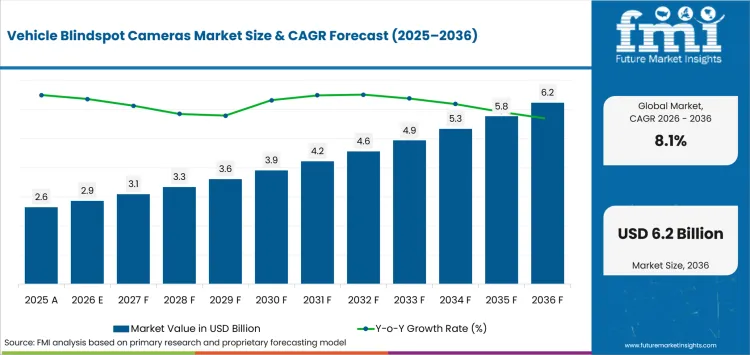
USD 2.9 Billion in 2026 and USD 6.2 Billion by 2036 at an 8.1% CAGR.
Vehicle Blindspot Cameras revenue is projected to rise from USD 2.9 billion in 2026 to USD 6.2 billion by 2036 at an 8.1% CAGR. Vehicle blindspot cameras are becoming a more established part of vehicle safety and ADAS architecture rather than remaining a convenience feature. The EU General Safety Regulation has strengthened indirect-vision and blind-spot requirements for relevant vehicle categories, while NHTSA maintains detailed rear-visibility testing procedures for camera systems in the USA. These requirements raise expectations around field of view, image quality, display performance and environmental durability, making camera integration a more formal part of vehicle development.
Commercial value increases when the same exterior camera can support several functions. Passenger vehicles can reuse camera feeds for lane-change assistance, parking and low-speed perception, while commercial fleets use side visibility to reduce exposure around vulnerable road users. Adoption therefore depends on more than camera availability. Suppliers need validated image performance, reliable integration with vehicle displays and compute, consistent diagnostics and service support that fits the economics of each vehicle program.
Key Takeaways
- Vehicle safety rules, ADAS integration and reuse of exterior camera feeds across several driving functions are turning blindspot cameras into recurring vehicle-platform content.
- Side-view cameras are projected to lead Camera Type with 28.0% share in 2026 because lateral coverage directly addresses adjacent-lane and vehicle-flank visibility gaps.
- CMOS camera modules are projected to lead Technology with 31.0% share in 2026 because compact packaging and mature automotive image-sensor economics support high-volume exterior use.
- Passenger cars are projected to lead Vehicle Type with 42.0% share in 2026 as OEM platforms reuse camera imagery across safety, parking and low-speed functions.
- OEM fitment is projected to lead Sales Channel with 48.0% share in 2026 because factory integration controls mounting geometry, wiring, calibration and display interfaces before production.
- ADAS safety is projected to lead End Use with 39.0% share in 2026 as camera feeds increasingly support active warning and perception rather than passive viewing alone.
- Vehicle-level qualification remains the main restraint, while AI object detection and camera-radar fusion create an opportunity to raise camera value through active perimeter perception.
- Magna International, Valeo, Bosch, Continental, Denso, Aptiv, Gentex, Ficosa, Hyundai Mobis and Stoneridge are notable companies serving the market.
Analyst Perspective
"Vehicle blindspot cameras create more value when a single exterior vision architecture can support lane-change, parking and low-speed safety functions without multiplying integration work. Suppliers that combine robust optics with diagnostics, perception software and platform-level calibration are better positioned to convert camera content into repeat OEM nominations and fleet programs."
- Nikhil Kaitwade, Principal Consultant, Future Market Insights
How is the Vehicle Blindspot Cameras Market segmented?
The Vehicle Blindspot Cameras Market is segmented by Camera Type, Technology, Vehicle Type, Sales Channel, End Use and Region.
Camera Type separates the viewing positions that address side, rear-quarter and trailer blind areas, while Technology distinguishes the imaging and perception architecture. Vehicle Type captures packaging and duty-cycle differences, Sales Channel separates factory integration from retrofit routes, and End Use distinguishes safety intervention from parking, fleet and towing visibility. These categories also overlap with the wider automotive cameras ecosystem because one validated image stream can serve several vehicle functions when mounting geometry, processing and display paths are engineered together.
Why do Side-view cameras lead the Camera Type category?
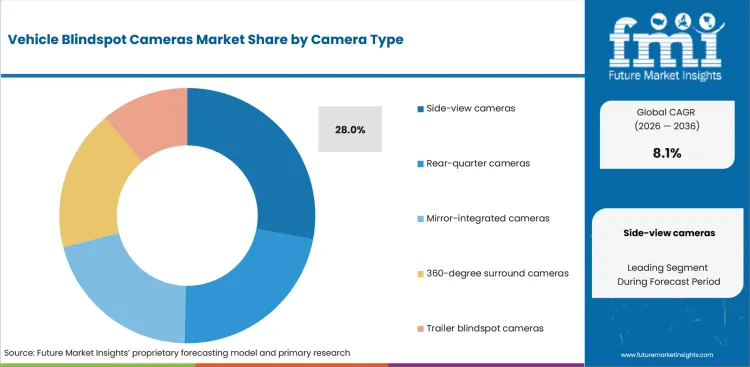
Side-view cameras sit close to the problem that defines this market: lateral areas that mirrors or direct vision can leave partly obscured. Their mounting position can support lane-change awareness, vulnerable-road-user monitoring and low-speed maneuvering without requiring a complete surround-view architecture. That makes the camera position useful to dedicated blind spot detection and broader vehicle-vision packages, while image reuse across several functions improves the case for factory fitment.
- Side-view cameras hold a 28.0% share in 2026 because lateral coverage directly addresses visibility gaps around adjacent lanes and vehicle flanks.
- Magna ClearView combines cameras, mirrors, electronics and software to improve side and rearward visibility. Its hybrid exterior approach illustrates how camera feeds can supplement or replace conventional sightlines while preserving an OEM-integrated vehicle architecture.
Why do CMOS camera modules lead the Technology category?
CMOS camera modules match automotive purchasing priorities because they combine compact packaging with mature sensor economics and scalable integration. Blindspot functions need stable exposure, high dynamic range and temperature tolerance as well as resolution. CMOS modules also provide the image source for higher-value perception software and other ADAS sensors, which makes module qualification and image-pipeline control more important than the sensor component alone.
- CMOS camera modules hold a 31.0% share in 2026 because their packaging and cost structure align with high-volume exterior automotive vision applications.
- Ficosa reported in December 2025 that it had surpassed 30 million automotive cameras produced since 2014. The production milestone shows the manufacturing scale available to automotive camera modules and the importance of repeatable quality across multiple vehicle programs.
Why do Passenger cars lead the Vehicle Type category?
Passenger cars combine large repeatable OEM platform volumes with a broad set of functions that can consume blindspot-camera imagery. A side or surround camera can support lane-change assistance, parking visualization and low-speed object awareness on the same vehicle. This reuse fits broader ADAS systems strategies in which camera, radar and compute are packaged across several trims and vehicle platforms.
- Passenger cars hold a 42.0% share in 2026 because high OEM volumes and multi-function camera reuse support repeatable fitment across vehicle platforms.
- Bosch stated in April 2025 that its modular ADAS product family would enter passenger-car production in China from mid-2025 and that a next-generation multi-purpose camera formed part of the portfolio. The approach illustrates how cameras are increasingly sourced as part of scalable ADAS hardware and software packages.
Why does OEM fitment lead the Sales Channel category?
OEM fitment leads because exterior safety cameras are easiest to validate when engineered into the vehicle before production. Factory integration controls mounting geometry, wiring, displays, calibration and software interfaces. It also lets an automaker coordinate blindspot, surround-view and back-up cameras within a common electrical architecture, while retrofit programs must work around existing mirrors, displays and vehicle networks.
- OEM fitment holds a 48.0% share in 2026 because vehicle-level validation and assembly integration reduce deployment uncertainty compared with post-sale installation.
- Valeo announced in April 2026 that its Sanand facility in India had opened an HD Surround-View Camera assembly line for high-volume manufacturing of next-generation vision systems for major OEMs. The investment connects camera demand directly with factory vehicle programs and localized automotive production.
Why does ADAS safety lead the End Use category?
ADAS safety leads because the camera image is increasingly consumed by a warning or perception function rather than used only as a passive parking view. Blindspot monitoring can combine visual information with radar or other sensors to improve object classification around the vehicle. Parking assistance, fleet safety and towing visibility remain important adjacent uses, but ADAS safety has the broadest path to recurring OEM content because one perception architecture can support warning, lane-change and low-speed safety functions across multiple vehicle programs.
- ADAS safety holds a 39.0% share in 2026 because camera data can support active warning and perception functions across a broader set of driving conditions.
- Aptiv announced in October 2025 that its PULSE sensor combines surround-view camera and short-range radar data. The architecture illustrates the move toward near-field sensor fusion that can extend a camera from visualization into active object perception while reducing separate sensor complexity.
What are the drivers, restraints and opportunities in the Vehicle Blindspot Cameras Market?
Safety regulation and ADAS packaging support demand, while vehicle-level qualification and integration costs slow deployment, and AI-enabled sensor fusion opens higher-value perimeter-perception applications.
- Driver: Regulation and OEM safety programs are moving blindspot visibility into vehicle-level ADAS specifications.
- Restraint: Camera-monitor and blindspot systems must pass field-of-view, durability and vehicle-integration requirements before deployment.
- Opportunity: AI object detection and camera-radar fusion can extend camera value from passive viewing into active perimeter perception.
Regulation is becoming a direct demand driver because it changes what OEMs must deliver at the vehicle level. Regulation (EU) 2019/2144 and related UN blind-spot provisions place greater emphasis on indirect vision and vulnerable-road-user detection for relevant vehicle categories. This encourages automakers and Tier-1 suppliers to integrate lateral visibility into broader ADAS architectures, creating more opportunities for camera modules that can support both regulated safety functions and adjacent driver-assistance features.
The main restraint is vehicle-level qualification. Once an exterior camera feeds a safety function or replaces a conventional viewing path, the system must meet requirements for field of view, durability and display performance. NHTSA’s FMVSS No. 111 procedures illustrate how validation extends beyond the camera itself to mounting, diagnostics and system behavior. Retrofit installations face additional complexity because vehicle geometry and electrical interfaces vary across the installed fleet.
The opportunity is to make blindspot cameras part of a broader perception system. Aptiv’s PULSE architecture combines surround-view camera and short-range radar data, while Hyundai Mobis has demonstrated parking systems that combine surround-view cameras with ultrasonic sensing. Sensor fusion can improve object detection around the vehicle and convert camera feeds from passive viewing into active warning and control functions. Suppliers that combine optics with perception software and calibration support can capture more value than stand-alone camera hardware.
Which country CAGRs are profiled in the Vehicle Blindspot Cameras Market?
| Country | CAGR |
|---|---|
| South Korea | 9.0% |
| USA | 7.7% |
| Japan | 6.8% |
| Mexico | 8.3% |
| Germany | 7.1% |
| Brazil | 8.0% |
| Poland | 7.4% |
How do country-level CAGRs compare in the Vehicle Blindspot Cameras Market?
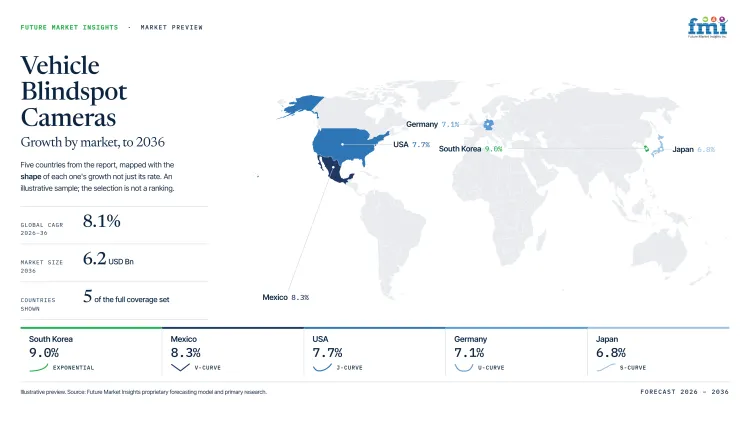
The seven profiled countries span a 2.2 percentage-point CAGR range from 2026 to 2036. South Korea sits at the upper end with 9.0%, followed by Mexico at 8.3% and Brazil at 8.0%. USA and Poland form a middle band at 7.7% and 7.4%, while Germany and Japan are forecast at 7.1% and 6.8%. The spacing describes the expected pace of market expansion, not absolute country revenue or the size of the installed vehicle fleet.
- South Korea combines fast electronics adoption with fleet safety programs that can translate camera-based blindspot functions into repeat vehicle installations.
- USA combines a large OEM and commercial-vehicle base with detailed rear-visibility testing, making validation and compliance central to camera-system scaling.
- Japan pairs mature ADAS engineering with strict installation discipline, which supports capable systems but places a premium on calibration and diagnostic integrity.
- Mexico combines a major vehicle manufacturing base with mixed-age fleets, supporting both factory and retrofit routes while keeping cost and installation simplicity important.
- Germany operates within the EU safety framework and a mature OEM sourcing environment where type approval, software integration and repeat platform nominations shape adoption.
- Brazil combines OEM and fleet demand with regulated transport categories that explicitly recognize camera-monitor equipment as an indirect-vision option.
- Poland combines EU safety policy with substantial road-freight activity, creating room for both newer vehicle-platform content and fleet-oriented camera installations.
Regional coverage extends across North America, Latin America, Western Europe, Eastern Europe, East Asia, South Asia and Pacific, and the Middle East and Africa, with country-level conditions assessed within the relevant vehicle production, fleet and safety context.
Country-wise Analysis
- South Korea: Demand for Vehicle Blindspot Cameras in South Korea is forecast to expand at 9.0% CAGR from 2026 to 2036. Korea Transportation Safety Authority reported in September 2025 that Coupang and its logistics affiliate had installed blind-spot detection devices on all of their operating large trucks during the prior year. The cited system uses an exterior camera to detect pedestrians or vehicles when the turn signal is activated, with an in-cab monitor and audible warning. The example shows how fleet safety programs can create direct demand for camera hardware, warning logic and service support once the installation is standardized.
- USA: Demand for Vehicle Blindspot Cameras in USA is forecast to expand at 7.7% CAGR from 2026 to 2036. NHTSA's current FMVSS No. 111 laboratory procedure provides a concrete qualification route for rear-visibility camera systems, including field-of-view and environmental durability checks. That regulatory engineering culture favors suppliers that can document image performance, mounting integrity and display behavior across vehicle configurations. The broad installed vehicle base also preserves a retrofit opportunity, although fleet economics depend on downtime, installation consistency and serviceability.
- Japan: Demand for Vehicle Blindspot Cameras in Japan is forecast to expand at 6.8% CAGR from 2026 to 2036. Japan's Ministry of Land, Infrastructure, Transport and Tourism has identified lane-change assistance and broader ADAS fitment as part of its vehicle-safety direction. In April 2026, MLIT also listed a recall involving incorrectly installed left-side blind-spot radar on 38 medium-duty fire trucks, where installation error could disable the function. The episode is a useful reminder that safety-system value depends on correct integration and diagnostics, which also applies to camera-based blindspot architectures.
- Mexico: Demand for Vehicle Blindspot Cameras in Mexico is forecast to expand at 8.3% CAGR from 2026 to 2036. Mexico's NOM-194-SE-2021 establishes formal safety-device requirements for new light vehicles, reinforcing a structured compliance environment around vehicle safety equipment even though a blindspot camera is not the only sensing route. Mexico's large vehicle manufacturing footprint gives OEM-ready camera modules a direct sourcing path, while a mixed-age fleet supports selected aftermarket and fleet-retrofit demand. Suppliers need cost control and installation designs that can scale across varied vehicle architectures.
- Germany: Demand for Vehicle Blindspot Cameras in Germany is forecast to expand at 7.1% CAGR from 2026 to 2036. Germany operates inside the EU General Safety Regulation framework and retains a deep new-vehicle engineering and sourcing base. The Federal Motor Transport Authority maintains detailed 2025 new passenger-car registration data, illustrating the recurring platform activity through which camera systems enter production fleets. Mature electrical architectures create a strong foundation for advanced vision, but supplier approval still depends on image quality, diagnostics, software integration and repeatable vehicle-level validation.
- Brazil: Demand for Vehicle Blindspot Cameras in Brazil is forecast to expand at 8.0% CAGR from 2026 to 2036. CONTRAN Resolution No. 924 recognizes rearview mirrors, camera-monitor equipment or equivalent devices within requirements for school transport, with implementation timing extending to vehicles in production or circulation from January 2026 under the consolidated framework. The rule gives camera-monitor technology a clear compliance-sensitive use case. Commercial success still depends on rugged hardware, installer training and documentation because operating conditions and vehicle diversity can raise service complexity.
- Poland: Demand for Vehicle Blindspot Cameras in Poland is forecast to expand at 7.4% CAGR from 2026 to 2036. Statistics Poland reported in June 2026 that road freight transport increased 8.8% in 2025, indicating an active commercial-vehicle operating base. The European Commission also reported in March 2026 that Poland recorded a 12% reduction in road deaths in 2025 and was among the countries then on track toward the EU 2030 reduction objective. Fleet activity plus ongoing road-safety pressure supports camera opportunities, while older vehicle diversity makes standardized retrofit kits and service procedures important.
Who are the notable companies in the Vehicle Blindspot Cameras Market?
Magna International, Valeo, Bosch, Continental, Denso, Aptiv, Gentex, Ficosa, Hyundai Mobis and Stoneridge
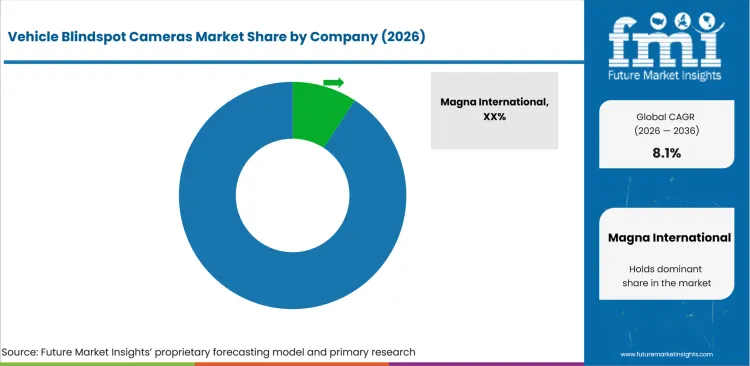
The market includes broad ADAS suppliers alongside automotive-vision specialists and camera-monitor companies. Buyers assess how well each supplier covers exterior visibility, integrates with radar or ultrasonic sensing, connects to displays, supports digital-mirror functions, and manages diagnostics and OEM validation. Large ADAS suppliers can bundle cameras with compute and perception software, while specialist vision companies are better suited to focused applications such as mirror replacement, trailer visibility and commercial-vehicle blindspot coverage.
- Full-stack ADAS and sensor-fusion suppliers: Bosch, Continental, Denso and Aptiv.
- Integrated camera and digital-mirror vision suppliers: Magna International, Gentex, Ficosa and Stoneridge.
- OEM-scale surround-view integrators: Valeo and Hyundai Mobis.
Competitive Benchmarking: Vehicle Blindspot Cameras Market
| Company | Exterior vision breadth | Sensor-fusion adjacency | Digital mirror / display | Program footprint |
|---|---|---|---|---|
| Magna International | Broad | Broad | Broad | Global OEM programs |
| Valeo | Broad | Broad | Focused | Global OEM programs |
| Bosch | Broad | Broad | Focused | Global OEM programs |
| Continental | Broad | Broad | Focused | Global OEM and aftermarket |
| Denso | Focused | Broad | Focused | Japan and global OEM programs |
| Aptiv | Broad | Broad | Focused | Global OEM programs |
| Gentex | Focused | Limited | Broad | Global OEM rear-vision programs |
| Ficosa | Broad | Focused | Broad | Europe, Asia and Africa production |
| Hyundai Mobis | Broad | Broad | Focused | South Korea and global OEM programs |
| Stoneridge | Focused | Focused | Broad | Commercial vehicles in North America and Europe |
Benchmark labels compare the breadth visible in current first-party product and program materials. "Broad" indicates multiple documented exterior-vision or integration routes, "Focused" indicates a strong but narrower public product position, and "Limited" indicates that sensor-fusion adjacency is not a central part of the reviewed public positioning. The table is a capability benchmark, not a market-share ranking, and program footprint describes public operating reach rather than revenue leadership.
Key Developments in the Vehicle Blindspot Cameras Market
- In July 2026, Stoneridge announced its largest MirrorEye Camera Monitor System bus and coach program to date. The MirrorEye MP II platform includes Blind Spot Information System and Moving Off Information System functions, along with digital video output for recording and analysis.
- In April 2026, Valeo inaugurated a new HD Surround-View Camera production line at its Sanand facility in Gujarat, India. The line is intended for high-volume manufacturing of next-generation vision camera systems for major OEMs in India.
- In January 2026, Gentex presented its next-generation Full Display Mirror with Dynamic View Assist. The system uses an 8 MP rear camera and can automatically widen the digital view at low speeds to show vehicles in blind spots.
- In December 2025, Ficosa announced that it had produced more than 30 million automotive cameras since entering the business in 2014. The company manufactures cameras across several regions and continues to expand camera-monitor and 360-degree vision applications.
- In October 2025, Aptiv introduced its PULSE sensor architecture combining surround-view camera data with short-range radar. The system is designed for near-field perception and can support parking and other short-range sensing applications while reducing separate sensor complexity.
- In April 2025, Bosch presented a modular ADAS product family that includes a next-generation multifunction camera.
Key Players in the Vehicle Blindspot Cameras Market
Full-Stack ADAS and Sensor-Fusion Suppliers
- Bosch
- Continental
- Denso
- Aptiv
Integrated Camera and Digital-Mirror Vision Suppliers
- Magna International
- Gentex
- Ficosa
- Stoneridge
OEM-Scale Surround-View Integrators
- Valeo
- Hyundai Mobis
Vehicle Blindspot Cameras Market - Report Scope
| Coverage field | Report scope |
|---|---|
| Market breakdown | Camera Type, Technology, Vehicle Type, Sales Channel, End Use and Region |
| Quantitative Units | USD Billion |
| Market Definition | Revenue includes automotive blindspot-visibility camera hardware and dedicated camera-monitor modules sold through the defined OEM, Tier-1, aftermarket and fleet routes. Associated control or display hardware is included only when sold as part of the blindspot-camera system. Complete vehicles, stand-alone radar, stand-alone ultrasonic or LiDAR systems, conventional mirrors without cameras and unrelated downstream finished-product revenue are excluded. |
| Regions Covered | North America; Latin America; Western Europe; Eastern Europe; East Asia; South Asia and Pacific; Middle East and Africa |
| Countries Covered | South Korea, USA, Japan, Mexico, Germany, Brazil, Poland and more than twenty-five additional countries in the full report |
| Key Companies Profiled | Magna International, Valeo, Bosch, Continental, Denso, Aptiv, Gentex, Ficosa, Hyundai Mobis, Stoneridge |
| Forecast Period | 2026 to 2036 |
| Approach | A hybrid bottom-up and top-down sizing approach reconciles camera-module fitment, vehicle production, retrofit demand and supplier-channel activity while excluding adjacent sensing categories outside the defined revenue boundary. |
Vehicle Blindspot Cameras Market - Research Methodology
| Method | Approach |
|---|---|
| Primary Research | Industry assumptions are tested against feedback from vehicle OEM procurement teams, Tier-1 ADAS suppliers, fleet safety managers, installers and technical specialists. Discussion themes cover fitment decisions, integration burden, pricing, serviceability, qualification and replacement cycles. |
| Desk Research | Analysis reviews government safety rules, type-approval material, national transport statistics, standards, peer-reviewed or technical literature, company filings and first-party product and manufacturing announcements. |
| Market Sizing and Forecasting | Sizing considers camera-module fitment, vehicle production, aftermarket and fleet retrofit demand, technology migration and channel structure across the 2026 to 2036 forecast period. Forecast assumptions account for regulatory timing, platform adoption, integration costs and replacement demand. |
| Data Validation | Quantitative estimates are triangulated across vehicle-production indicators, fitment assumptions, supplier activity and primary feedback. Scope checks exclude unrelated sensing systems and downstream vehicle value to avoid double counting. |
Vehicle Blindspot Cameras Market by Segments
Vehicle Blindspot Cameras Market segmented by Camera Type:
- Side-view cameras
- Rear-quarter cameras
- Mirror-integrated cameras
- 360-degree surround cameras
- Trailer blindspot cameras
Vehicle Blindspot Cameras Market segmented by Technology:
- CMOS camera modules
- HDR cameras
- Night-vision assisted cameras
- AI object detection cameras
- Camera-radar fusion
Vehicle Blindspot Cameras Market segmented by Vehicle Type:
- Passenger cars
- Commercial vehicles
- Buses
- Off-highway vehicles
- Electric vehicles
Vehicle Blindspot Cameras Market segmented by Sales Channel:
- OEM fitment
- Aftermarket kits
- Fleet retrofit programs
- Tier-1 ADAS supply
Vehicle Blindspot Cameras Market segmented by End Use:
- ADAS safety
- Parking assistance
- Fleet safety
- Towing / trailer visibility
Vehicle Blindspot Cameras Market by Region:
- North America
- United States
- Canada
- Latin America
- Brazil
- Mexico
- Argentina
- Chile
- Western Europe
- Germany
- France
- United Kingdom
- Italy
- Spain
- Benelux
- Nordics
- Eastern Europe
- Poland
- Czech Republic
- Romania
- Hungary
- East Asia
- China
- Japan
- South Korea
- South Asia and Pacific
- India
- ASEAN
- Australia and New Zealand
- Middle East and Africa
- GCC Countries
- South Africa
- Türkiye
- Israel
Research Sources and Bibliography
- European Parliament and Council. (2019, November 27; consolidated 2026). Regulation (EU) 2019/2144 on type-approval requirements for motor vehicles and systems as regards general safety.
- United Nations Economic Commission for Europe. (2020). UN Regulation No. 151: Blind Spot Information Systems for the Detection of Bicycles.
- USA National Highway Traffic Safety Administration. (2026). Laboratory Test Procedure for FMVSS No. 111, Rear Visibility.
- Korea Transportation Safety Authority. (2025, September 30). Truck blind-spot warning marking and camera-based detection initiative with the National Police Agency, Coupang and Coupang Logistics Service.
- Ministry of Land, Infrastructure, Transport and Tourism, Japan. (2021, June 28). The Future of Vehicle Safety for a Traffic Accident-Free Society.
- Ministry of Land, Infrastructure, Transport and Tourism, Japan. (2026, April 20). Vehicle Safety / Pollution Recall Campaign No. 5805.
- Secretaría de Economía, Mexico. (2022, October 3). NOM-194-SE-2021, Safety devices for new light vehicles: requirements and specifications.
- Conselho Nacional de Trânsito, Brazil. (2022, March 28). Resolution CONTRAN No. 924.
- European Commission, Directorate-General for Mobility and Transport. (2026, March 24). EU road deaths drop by 3% in 2025.
- Statistics Poland. (2026, June 2). Transport of goods and passengers in 2025.
- German Federal Motor Transport Authority / GovData. (2026, January 8 update). FZ 10 - Year 2025 - New registrations of passenger cars by makes and model series.
- Magna International. (2023, January 18). Magna launches ClearView vision technology on Ram 2500 and 3500.
- Valeo. (2026, April 7). Valeo inaugurates new assembly line for vision camera manufacturing at Sanand facility, Gujarat.
- Bosch. (2025, April 23). Auto Shanghai: Bosch presents new software and hardware for assisted and automated driving.
- Continental. (2024). Major product range expansion includes multifunctional camera modules and blind-spot radar for automotive aftermarket applications.
- DENSO. (2025). Integrated Report 2025.
- Aptiv. (2025, October 21). Aptiv unveils Gen 8 radars to power the future of ADAS.
- Gentex Corporation. (2026, January 6). Gentex to highlight new automotive tech at CES 2026.
- Ficosa. (2025, December 17). Ficosa surpasses 30 million cameras produced over the last eleven years.
- Hyundai Mobis. (2023, September 19). Hyundai Mobis develops one-touch automated parking through self-learned pathway.
- Stoneridge. (2026, July 27). Stoneridge announces major MirrorEye Camera Monitor System bus and coach program.
This bibliography is provided for reader reference and is not exhaustive. The full report contains the complete reference list and detailed citations.
This Report Answers
- Which vehicle-safety, ADAS and fleet-risk mechanisms support demand for vehicle blindspot cameras?
- Why do side-view cameras remain central to lateral visibility and lane-change applications?
- How do CMOS imaging, high dynamic range and sensor fusion change vehicle integration requirements?
- Why does factory fitment remain commercially important compared with aftermarket installation?
- How do adoption conditions differ across South Korea, USA, Japan, Mexico, Germany, Brazil and Poland?
- Which companies combine exterior cameras with ADAS, digital-mirror or surround-view capabilities?
- What qualification, calibration, display and service factors can slow camera-system deployment?
- How can suppliers increase camera value through perception software and multi-function vehicle architectures?
Frequently Asked Questions
How big is the Vehicle Blindspot Cameras Market in 2026?
The Vehicle Blindspot Cameras Market is valued at USD 2.9 Billion in 2026 and is forecast to reach USD 6.2 Billion by 2036 as exterior camera content expands across safety, parking and vehicle-vision applications.
What is the CAGR of the Vehicle Blindspot Cameras Market from 2026 to 2036?
The Vehicle Blindspot Cameras Market is forecast to expand at 8.1% CAGR from 2026 to 2036.
Which Camera Type segment leads the Vehicle Blindspot Cameras Market?
Side-view cameras lead the Camera Type category with 28.0% share in 2026 because their lateral mounting position directly addresses adjacent-lane and vehicle-flank visibility gaps.
How much will the Vehicle Blindspot Cameras Market add between 2026 and 2036?
The market is expected to add approximately USD 3.4 Billion between 2026 and 2036, based on the difference between the USD 2.9 Billion 2026 value and the USD 6.2 Billion 2036 value before publication rounding.
Which companies are active in the Vehicle Blindspot Cameras Market?
Magna International, Valeo, Bosch, Continental, Denso, Aptiv, Gentex, Ficosa, Hyundai Mobis and Stoneridge are notable companies active across exterior cameras, ADAS integration, surround-view systems and digital-mirror architectures.
Preview the report firsthand - request a free sample
Get SampleGet the brochure for pricing and purchase details.
Get PDFTable of Content
- Key Takeaways
- Market Size and CAGR
- Top Growth Driver
- Fastest Growing Segment
- Leading Region
- Key Companies
- Emerging Opportunities
- Executive Summary
- Global Market Outlook
- Demand-side Trends
- Supply-side Trends
- Technology Roadmap Analysis
- Analysis and Recommendations
- Analyst Perspective (What is happening? Why now? What should investors know?)
- Key Questions Answered
- How large is the market?
- What is the CAGR?
- What are key trends?
- Which region dominates?
- Who are the leaders?
- Market Overview
- Market Coverage / Taxonomy
- Market Definition / Scope / Limitations
- Research Methodology
- Chapter Orientation
- Analytical Lens and Working Hypotheses
- Market Structure, Signals, and Trend Drivers
- Benchmarking and Cross-market Comparability
- Market Sizing, Forecasting, and Opportunity Mapping
- Research Design and Evidence Framework
- Desk Research Programme (Secondary Evidence)
- Expert Input and Fieldwork (Primary Evidence)
- Tooling, Models, and Reference Databases
- Data Engineering and Model Build
- Quality Assurance and Audit Trail
- Market Background
- Market Dynamics (Drivers, Restraints, Opportunity, Trends)
- Scenario Forecast (Optimistic, Likely, Conservative)
- Impact Analysis
- AI Impact
- Sustainability Impact
- Regulatory Impact
- Technology Impact
- Consumer / Buyer Analysis
- Purchase Drivers
- Adoption Barriers
- Buyer Journey
- Opportunity Map Analysis
- Product Life Cycle Analysis
- Supply Chain Analysis
- Investment Feasibility Matrix
- Value Chain Analysis
- PESTLE and Porter's Analysis
- Regulatory Landscape
- Regional Parent Market Outlook
- Production and Consumption Statistics
- Import and Export Statistics
- Global Market Analysis and Forecast, 2021 to 2036
- Historical Market Size Value (USD Billion) Analysis, 2021 to 2025
- Current and Future Market Size Value (USD Billion) Projections, 2026 to 2036
- Y-o-Y Growth Trend Analysis
- Absolute $ Opportunity Analysis
- Global Market Pricing Analysis, 2021 to 2036
- Global Market Analysis and Forecast, By Camera Type, 2021 to 2036
- Introduction / Key Findings
- Historical Market Size Value (USD Billion) Analysis By Camera Type, 2021 to 2025
- Current and Future Market Size Value (USD Billion) Analysis and Forecast By Camera Type, 2026 to 2036
- Side-view cameras
- Rear-quarter cameras
- Mirror-integrated cameras
- 360-degree surround cameras
- Trailer blindspot cameras
- Side-view cameras
- Y-o-Y Growth Trend Analysis By Camera Type, 2021 to 2025
- Absolute $ Opportunity Analysis By Camera Type, 2026 to 2036
- Global Market Analysis and Forecast, By Technology, 2021 to 2036
- Introduction / Key Findings
- Historical Market Size Value (USD Billion) Analysis By Technology, 2021 to 2025
- Current and Future Market Size Value (USD Billion) Analysis and Forecast By Technology, 2026 to 2036
- CMOS camera modules
- HDR cameras
- Night-vision assisted cameras
- AI object detection cameras
- Camera-radar fusion
- CMOS camera modules
- Y-o-Y Growth Trend Analysis By Technology, 2021 to 2025
- Absolute $ Opportunity Analysis By Technology, 2026 to 2036
- Global Market Analysis and Forecast, By Vehicle Type, 2021 to 2036
- Introduction / Key Findings
- Historical Market Size Value (USD Billion) Analysis By Vehicle Type, 2021 to 2025
- Current and Future Market Size Value (USD Billion) Analysis and Forecast By Vehicle Type, 2026 to 2036
- Passenger cars
- Commercial vehicles
- Buses
- Off-highway vehicles
- Electric vehicles
- Passenger cars
- Y-o-Y Growth Trend Analysis By Vehicle Type, 2021 to 2025
- Absolute $ Opportunity Analysis By Vehicle Type, 2026 to 2036
- Global Market Analysis and Forecast, By Sales Channel, 2021 to 2036
- Introduction / Key Findings
- Historical Market Size Value (USD Billion) Analysis By Sales Channel, 2021 to 2025
- Current and Future Market Size Value (USD Billion) Analysis and Forecast By Sales Channel, 2026 to 2036
- OEM fitment
- Aftermarket kits
- Fleet retrofit programs
- Tier-1 ADAS supply
- OEM fitment
- Y-o-Y Growth Trend Analysis By Sales Channel, 2021 to 2025
- Absolute $ Opportunity Analysis By Sales Channel, 2026 to 2036
- Global Market Analysis and Forecast, By End Use, 2021 to 2036
- Introduction / Key Findings
- Historical Market Size Value (USD Billion) Analysis By End Use, 2021 to 2025
- Current and Future Market Size Value (USD Billion) Analysis and Forecast By End Use, 2026 to 2036
- ADAS safety
- Parking assistance
- Fleet safety
- Towing / trailer visibility
- ADAS safety
- Y-o-Y Growth Trend Analysis By End Use, 2021 to 2025
- Absolute $ Opportunity Analysis By End Use, 2026 to 2036
- Global Market Analysis and Forecast, By Region, 2021 to 2036
- Introduction
- Historical Market Size Value (USD Billion) Analysis By Region, 2021 to 2025
- Current Market Size Value (USD Billion) Analysis and Forecast By Region, 2026 to 2036
- North America
- Latin America
- Western Europe
- Eastern Europe
- East Asia
- South Asia and Pacific
- Middle East & Africa
- Market Attractiveness Analysis By Region
- North America Market Analysis and Forecast, By Country, 2021 to 2036
- Historical Market Size Value (USD Billion) Trend Analysis By Market Taxonomy, 2021 to 2025
- Market Size Value (USD Billion) Forecast By Market Taxonomy, 2026 to 2036
- By Country
- USA
- Canada
- By Camera Type
- By Technology
- By Vehicle Type
- By Sales Channel
- By End Use
- By Country
- Market Attractiveness Analysis
- By Country
- By Camera Type
- By Technology
- By Vehicle Type
- By Sales Channel
- By End Use
- Key Takeaways
- Latin America Market Analysis and Forecast, By Country
- Historical Market Size Value (USD Billion) Trend Analysis By Market Taxonomy, 2021 to 2025
- Market Size Value (USD Billion) Forecast By Market Taxonomy, 2026 to 2036
- By Country
- Brazil
- Mexico
- Chile
- Rest of Latin America
- By Camera Type
- By Technology
- By Vehicle Type
- By Sales Channel
- By End Use
- By Country
- Market Attractiveness Analysis
- By Country
- By Camera Type
- By Technology
- By Vehicle Type
- By Sales Channel
- By End Use
- Key Takeaways
- Western Europe Market Analysis and Forecast, By Country
- Historical Market Size Value (USD Billion) Trend Analysis By Market Taxonomy, 2021 to 2025
- Market Size Value (USD Billion) Forecast By Market Taxonomy, 2026 to 2036
- By Country
- Germany
- UK
- Italy
- Spain
- France
- Nordic
- BENELUX
- Rest of Western Europe
- By Camera Type
- By Technology
- By Vehicle Type
- By Sales Channel
- By End Use
- By Country
- Market Attractiveness Analysis
- By Country
- By Camera Type
- By Technology
- By Vehicle Type
- By Sales Channel
- By End Use
- Key Takeaways
- Eastern Europe Market Analysis and Forecast, By Country
- Historical Market Size Value (USD Billion) Trend Analysis By Market Taxonomy, 2021 to 2025
- Market Size Value (USD Billion) Forecast By Market Taxonomy, 2026 to 2036
- By Country
- Russia
- Poland
- Hungary
- Balkan & Baltic
- Rest of Eastern Europe
- By Camera Type
- By Technology
- By Vehicle Type
- By Sales Channel
- By End Use
- By Country
- Market Attractiveness Analysis
- By Country
- By Camera Type
- By Technology
- By Vehicle Type
- By Sales Channel
- By End Use
- Key Takeaways
- East Asia Market Analysis and Forecast, By Country
- Historical Market Size Value (USD Billion) Trend Analysis By Market Taxonomy, 2021 to 2025
- Market Size Value (USD Billion) Forecast By Market Taxonomy, 2026 to 2036
- By Country
- China
- Japan
- South Korea
- By Camera Type
- By Technology
- By Vehicle Type
- By Sales Channel
- By End Use
- By Country
- Market Attractiveness Analysis
- By Country
- By Camera Type
- By Technology
- By Vehicle Type
- By Sales Channel
- By End Use
- Key Takeaways
- South Asia and Pacific Market Analysis and Forecast, By Country
- Historical Market Size Value (USD Billion) Trend Analysis By Market Taxonomy, 2021 to 2025
- Market Size Value (USD Billion) Forecast By Market Taxonomy, 2026 to 2036
- By Country
- India
- ASEAN
- Australia & New Zealand
- Rest of South Asia and Pacific
- By Camera Type
- By Technology
- By Vehicle Type
- By Sales Channel
- By End Use
- By Country
- Market Attractiveness Analysis
- By Country
- By Camera Type
- By Technology
- By Vehicle Type
- By Sales Channel
- By End Use
- Key Takeaways
- Middle East & Africa Market Analysis and Forecast, By Country
- Historical Market Size Value (USD Billion) Trend Analysis By Market Taxonomy, 2021 to 2025
- Market Size Value (USD Billion) Forecast By Market Taxonomy, 2026 to 2036
- By Country
- Kingdom of Saudi Arabia
- Other GCC Countries
- Türkiye
- South Africa
- Other African Union
- Rest of Middle East & Africa
- By Camera Type
- By Technology
- By Vehicle Type
- By Sales Channel
- By End Use
- By Country
- Market Attractiveness Analysis
- By Country
- By Camera Type
- By Technology
- By Vehicle Type
- By Sales Channel
- By End Use
- Key Takeaways
- Key Countries Market Analysis
- USA
- Pricing Analysis
- Market Share Analysis, 2025
- By Camera Type
- By Technology
- By Vehicle Type
- By Sales Channel
- By End Use
- Canada
- Pricing Analysis
- Market Share Analysis, 2025
- By Camera Type
- By Technology
- By Vehicle Type
- By Sales Channel
- By End Use
- Mexico
- Pricing Analysis
- Market Share Analysis, 2025
- By Camera Type
- By Technology
- By Vehicle Type
- By Sales Channel
- By End Use
- Brazil
- Pricing Analysis
- Market Share Analysis, 2025
- By Camera Type
- By Technology
- By Vehicle Type
- By Sales Channel
- By End Use
- Chile
- Pricing Analysis
- Market Share Analysis, 2025
- By Camera Type
- By Technology
- By Vehicle Type
- By Sales Channel
- By End Use
- Germany
- Pricing Analysis
- Market Share Analysis, 2025
- By Camera Type
- By Technology
- By Vehicle Type
- By Sales Channel
- By End Use
- UK
- Pricing Analysis
- Market Share Analysis, 2025
- By Camera Type
- By Technology
- By Vehicle Type
- By Sales Channel
- By End Use
- Italy
- Pricing Analysis
- Market Share Analysis, 2025
- By Camera Type
- By Technology
- By Vehicle Type
- By Sales Channel
- By End Use
- Spain
- Pricing Analysis
- Market Share Analysis, 2025
- By Camera Type
- By Technology
- By Vehicle Type
- By Sales Channel
- By End Use
- France
- Pricing Analysis
- Market Share Analysis, 2025
- By Camera Type
- By Technology
- By Vehicle Type
- By Sales Channel
- By End Use
- India
- Pricing Analysis
- Market Share Analysis, 2025
- By Camera Type
- By Technology
- By Vehicle Type
- By Sales Channel
- By End Use
- ASEAN
- Pricing Analysis
- Market Share Analysis, 2025
- By Camera Type
- By Technology
- By Vehicle Type
- By Sales Channel
- By End Use
- Australia & New Zealand
- Pricing Analysis
- Market Share Analysis, 2025
- By Camera Type
- By Technology
- By Vehicle Type
- By Sales Channel
- By End Use
- China
- Pricing Analysis
- Market Share Analysis, 2025
- By Camera Type
- By Technology
- By Vehicle Type
- By Sales Channel
- By End Use
- Japan
- Pricing Analysis
- Market Share Analysis, 2025
- By Camera Type
- By Technology
- By Vehicle Type
- By Sales Channel
- By End Use
- South Korea
- Pricing Analysis
- Market Share Analysis, 2025
- By Camera Type
- By Technology
- By Vehicle Type
- By Sales Channel
- By End Use
- Russia
- Pricing Analysis
- Market Share Analysis, 2025
- By Camera Type
- By Technology
- By Vehicle Type
- By Sales Channel
- By End Use
- Poland
- Pricing Analysis
- Market Share Analysis, 2025
- By Camera Type
- By Technology
- By Vehicle Type
- By Sales Channel
- By End Use
- Hungary
- Pricing Analysis
- Market Share Analysis, 2025
- By Camera Type
- By Technology
- By Vehicle Type
- By Sales Channel
- By End Use
- Kingdom of Saudi Arabia
- Pricing Analysis
- Market Share Analysis, 2025
- By Camera Type
- By Technology
- By Vehicle Type
- By Sales Channel
- By End Use
- Türkiye
- Pricing Analysis
- Market Share Analysis, 2025
- By Camera Type
- By Technology
- By Vehicle Type
- By Sales Channel
- By End Use
- South Africa
- Pricing Analysis
- Market Share Analysis, 2025
- By Camera Type
- By Technology
- By Vehicle Type
- By Sales Channel
- By End Use
- USA
- Market Structure Analysis
- Competition Dashboard
- Competition Benchmarking
- Market Share Analysis of Top Players
- By Regional
- By Camera Type
- By Technology
- By Vehicle Type
- By Sales Channel
- By End Use
- Emerging Startups
- Innovation Benchmarking
- Competition Analysis
- Competition Deep Dive
- Magna International
- Overview
- Product Portfolio
- Profitability by Market Segments
- Sales Footprint
- Strategy Overview
- Marketing Strategy
- Product Strategy
- Channel Strategy
- Valeo
- Bosch
- Continental
- Denso
- Aptiv
- Gentex
- Ficosa
- Hyundai Mobis
- Stoneridge
- Magna International
- Case Studies
- Success Stories
- Recent Developments
- Competition Deep Dive
- Assumptions & Acronyms Used


