

- Market Size (2026)
- USD 520.7 Mn
- Forecast (2036)
- USD 941.3 Mn
- CAGR (2026 to 2036)
- 6.1%
How big is Vehicle Intercom Systems Market in 2026?
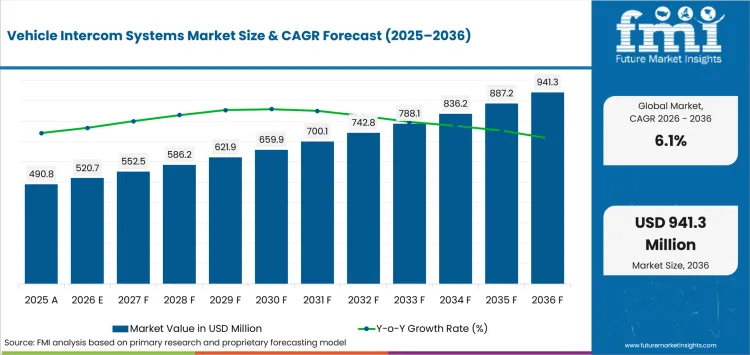
USD 520.7 million in 2026 and USD 941.3 million by 2036 at a 6.1% CAGR.
Demand for vehicle intercom systems is projected to expand at 6.1% CAGR between 2026 and 2036. Military communications require vehicle crews to exchange local audio without losing access to tactical radio networks. Bittium launched MissionNet in June 2026 to place crew voice and data on the same tactical IP architecture. That design direction increases the value of intercom hardware that fits existing radios and vehicle electronics without creating a separate communications layer.
Fleet demand also differs by vehicle replacement cycles and the operating rules attached to public-safety assets. The UAE illustrates how fire truck requirements can set installation points during fleet configuration. The GCAA current eAIP lists three CAT 9 firefighting vehicles at Al Maktoum International and three additional major firefighting vehicles for maintenance or breakdown resilience. Such fleet structures reward systems that can be documented for fitment and serviced without taking response vehicles out of duty for long periods.
Key Takeaways of Vehicle Intercom Systems Market
- High-noise emergency and defense vehicles require clear crew speech while operators retain immediate access to external radio channels.
- By system type, crew communication systems are estimated to hold 26.0% in 2026 owing to full-duplex local speech that limits routine external radio use.
- In 2026, emergency vehicles are expected to lead vehicle type with 27.0% share because response crews need clear speech in noisy multi-seat cabs.
- Headsets are projected to hold 27.0% share in 2026 due to microphone placement and attenuation at occupied crew positions.
- Radio compatibility and vehicle-specific fitment can lengthen qualification cycles whenever control units and harnesses differ from installed fleet architectures.
- Some of the key players in this market include Bittium Corporation, INVISIO AB, Savox Communications, WB Group, CEOTRONICS AG, Thales Group, L3Harris Technologies, and Elbit Systems Ltd.
Analyst Perspective
"Vehicle intercom offers should be judged on installed speech performance and radio control instead of headset or control-unit price in isolation. Commercial value depends on interface coverage and field-replaceable crew hardware that technicians can service without taking the vehicle out of duty."
- Nikhil Kaitwade, Principal Consultant, Future Market Insights
How is the Vehicle Intercom Systems Market segmented?
The vehicle intercom systems market is segmented by system type, vehicle type, component, sales channel, application, and region.
Market taxonomy covers system type, vehicle type, component, sales channel, application, and region. System types include crew communication, wired, wireless, noise-cancelling, and integrated radio-intercom systems. Vehicle types include emergency, military, motorsport, construction, and specialty fleet vehicles. Components cover headsets, control units, push-to-talk modules, cables or harnesses, and amplifiers. Sales channels include specialty vehicle OEMs, fleet upfitters, defense procurement, and aftermarket installers. Applications comprise crew coordination, emergency response, driver-spotter communication, and racing communication.
What supports Specialty Vehicle OEMs in the Sales Channel category?
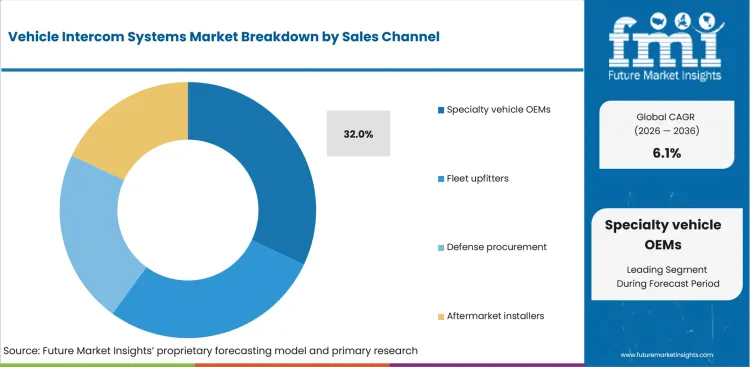
Specialty vehicle OEMs can route power, audio cabling, control units, and radio interfaces before a vehicle enters service. Elbit Systems announced a tank-upgrade contract in May 2026 that includes communications and situational-awareness integration. The armored vehicle channel therefore rewards communication packages engineered alongside other electronic subsystems.
- Factory-stage integration places specialty vehicle OEMs at an estimated 32.0% of 2026 revenue by reducing later harness changes and preserving access to installed electronics.
- Early engineering also lets vehicle builders document mounting positions and service routes before delivery. Fleet upfitters stay important for mixed fleets where existing radios or cab layouts differ by vehicle generation.
What makes Crew Communication Systems central to the System Type category?
Crew communication systems keep local conversation off external radio channels while operators retain radio control. In November 2025, INVISIO documented an order covering mounted and dismounted communication systems for a European defense customer. The tactical communications requirement extends beyond cabin speech toward coordinated access to vehicle radio networks.
- Crew communication systems are estimated to hold 26.0% of 2026 revenue because full-duplex local speech handles the main coordination task inside moving vehicles.
- Fleet engineers compare audio routing with radio-interface behavior and expansion paths during qualification. Mounted systems gain purchase support when additional crew stations can be integrated without redesigning the whole communication architecture.
Why do Emergency Vehicles lead the Vehicle Type category?
Emergency crews must exchange instructions over sirens and engine noise while monitoring dispatch channels. A June 2025 European Acoustics Association study surveyed about 500 firefighters and found only 39% were satisfied with received-speech clarity. That critical communications gap keeps intelligibility and hearing protection near the center of apparatus communication specifications.
- Emergency vehicles are projected to represent 27.0% of 2026 revenue because response crews need clear local speech during fast operational transitions inside noisy apparatus.
- Departments also evaluate service access and radio compatibility because an intercom fault can remove an otherwise usable vehicle from frontline duty. Installation quality therefore carries commercial weight beside nominal audio performance.
How do Headsets shape the Component category?
Headsets determine whether routed audio reaches the user clearly under engine noise and protective equipment. Savox announced an APAC order in April 2026 covering about 8,000 TRICS C2 communication hubs and Noise-COM 100 headsets. The defense communication systems interface therefore includes hearing protection and speech capture at the crew position.
- Headsets are anticipated to capture 27.0% of 2026 revenue because microphone placement and attenuation determine communication performance at each occupied position.
- Replacement purchases occur even with installed control hardware because cushions, microphones, connectors, and helmet fit carry different service lives. Standardized interfaces make these component refreshes easier to manage.
What are the drivers, restraints and opportunities in the Vehicle Intercom Systems Market?
High-noise fleet operations sustain demand, interface qualification slows conversion, and modular architectures reduce vehicle rework during installed-fleet upgrades.
- Driver: New response and defense vehicles provide scheduled installation windows for crew audio, radio interfaces, and push-to-talk controls.
- Restraint: Intercom replacement can stall if radio protocols or harness layouts differ from the installed vehicle configuration and require fresh qualification.
- Opportunity: Modular wired and wireless architectures reduce vehicle rework by preserving external radio control and service access during fleet upgrades.
Fleet Renewal Defines Planned Installation Windows
Vehicle replacement gives communication hardware a defined engineering window during pre-service build. Fire and Rescue NSW introduced five new fire trucks in July 2025 with updated technology and safety systems, which makes fleet management decisions relevant to intercom timing because cab electronics can be specified with the vehicle. Intercom vendors gain a clearer order path by working with apparatus builders while wiring and console layouts remain open for communication hardware.
Interface Qualification Extends the Sales Cycle
A vehicle intercom must fit radios and cab wiring while preserving push-to-talk logic and power requirements inside one installed package. CISA issued its Emergency Communications System Lifecycle Planning Guide in July 2025 and treats acquisition as distinct from later implementation and sustainment work. That lifecycle makes compatibility evidence commercially important because one failed interface can force redesign or extend downtime during fleet replacement.
Modular Architectures Widen Retrofit Options
Retrofit opportunities improve if intercom upgrades preserve installed vehicle electronics and avoid complete cab rewiring. Savox and Insta signed a July 2025 collaboration focused on integrated audio and vehicle environments with interoperability as a stated requirement. That work places vehicle-to-vehicle communication and local crew audio inside one integration problem, so revenue concentrates on upgrades that preserve radio control and reduce vehicle downtime.
Which country CAGRs are profiled in the Vehicle Intercom Systems Market?
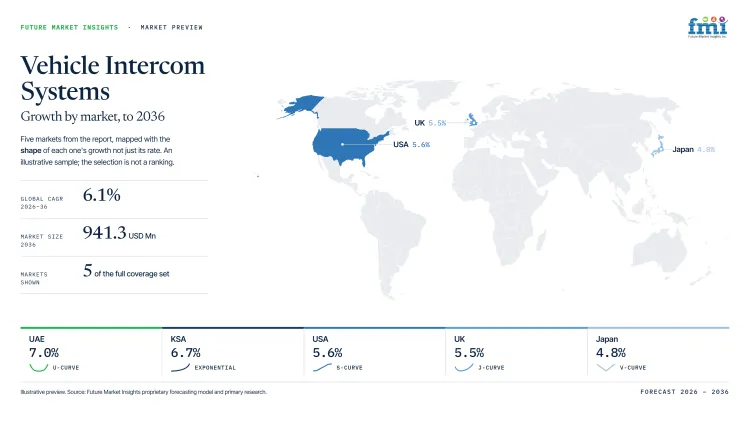
| Country | CAGR |
|---|---|
| UAE | 7.0% |
| KSA | 6.7% |
| USA | 5.6% |
| UK | 5.5% |
| Japan | 4.8% |
How do country-level CAGRs compare in the Vehicle Intercom Systems Market?
The five forecasts span 1.5 percentage points from UAE at 7.0% to UK at 5.5%. UAE and Saudi Arabia form the upper Gulf group because fleet standards shape qualification. Australia occupies the middle position through state emergency and defense programs. USA and UK follow as installed communications estates increase retrofit and migration work.
- UAE favors documented airport-response configurations that reduce tolerance for improvised cab changes.
- Saudi Arabia links fleet readiness to local maintenance access and manufacturer quality credentials.
- Japan presents a more mature market, with demand centered on selective modernization, reliability, and measured fleet replacement cycles.
- USA offers replacement volume alongside interface complexity from multi-generation public-safety fleets.
- UK conversion depends on ESN migration timing and vehicle-device integration in established fleets.
The five markets demand different sales-engineering workloads and service obligations despite their close forecast growth rates. The full report provides country-level CAGR analysis across North America, Latin America, Europe, East Asia, South Asia, Oceania and the Middle East and Africa.
Country-wise Analysis
- Airport fire and rescue operators in the UAE work within fixed response categories and vehicle inventories that leave little room for undocumented cab changes. Vehicle intercom systems demand in UAE is forecast to rise at a 7.0% CAGR through 2036 as upgraded response fleets must fit formal operating configurations and current airport response rules. The GCAA issued CAR AGA Part VFI in May 2025 with a discrete communication-link requirement between rescue services and response vehicles. Local integrators benefit from clear interface records, but radio routing and harness differences still create qualification friction during vehicle acceptance and later service.
- Saudi Arabia’s civil-defense fleets are procured under rules that tie readiness to local maintenance access and documented equipment standards. The Civil Defense regulation updated in January 2026 requires a Kingdom-based authorized agent or body to provide maintenance and spare parts for covered fire vehicles. Vehicle intercom systems demand in Saudi Arabia is projected to record a 6.7% CAGR through 2036 because ongoing security and emergency-fleet requirements support installations. Overseas manufacturers without service partners face a narrower route from specification to accepted installation and sustained support.
- Japan's mature emergency, defense, and industrial vehicle base creates a more measured replacement environment than the higher-growth Gulf markets. The Japan vehicle intercom systems market is forecast to expand at a 4.8% CAGR through 2036, supported by selective fleet modernization, reliability-focused communications upgrades, and demand for durable vehicle-mounted communication equipment. Suppliers with strong integration capabilities and dependable long-term support can benefit from replacement and modernization programs.
- US public-safety fleets operate beside a nationwide broadband system that supports growing dedicated coverage and a large installed base of response vehicles. FirstNet Authority materials in September 2025 recorded one thousand new Band 14 sites launched during 2024 and 2025. Those sites strengthen the local communications base while leaving agencies with many radio and harness configurations to support during fleet replacement. In the USA, vehicle intercom systems demand is estimated to advance at a 5.8% CAGR through 2036 as agencies modernize serviceable fleet electronics. Repeatable interface kits reduce engineering effort in large multi-generation fleets where rewiring downtime remains a material purchasing concern.
- British emergency services are preparing vehicle communications for the national transition from Airwave toward the Emergency Services Network. The UK vehicle intercom systems market is anticipated to advance at a 5.5% CAGR through 2036 as agencies align cab devices with the new mission-critical service and phased fleet migration schedules. The Home Office stated in February 2025 that ESN users operate equipment in 45,000 vehicles. That phased-upgrade route requires dependable support for legacy radio interfaces and newer devices so fleets can retain otherwise serviceable vehicles during hardware replacement.
Who are the notable companies in the Vehicle Intercom Systems Market?
Bittium Corporation, INVISIO AB, Savox Communications, WB Group, CEOTRONICS AG, Thales Group, L3Harris Technologies, and Elbit Systems Ltd. are the notable companies serving this market.
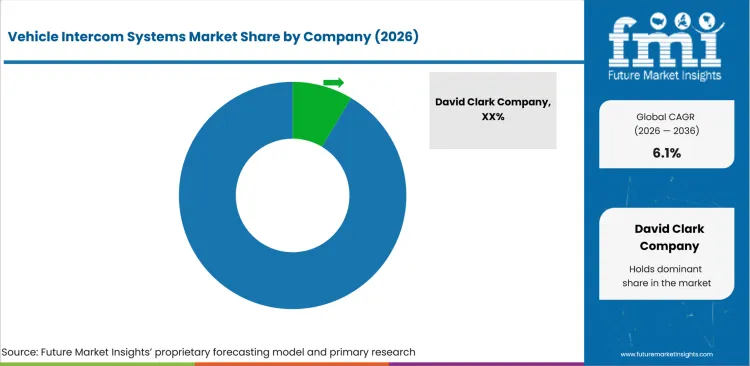
Competition is fragmented between vehicle-intercom specialists, tactical-radio companies, and defense electronics groups with integration access to vehicle programs. Entry barriers come from interface engineering and qualification records because high-frequency military communications equipment must operate beside crew audio without creating conflicting control paths or avoidable service burdens.
- Bittium Corporation, INVISIO AB, Savox Communications, and WB Group compete around mounted crew communication with links to tactical radio networks.
- CEOTRONICS AG and Thales Group emphasize protected audio, control interfaces, and vehicle communication infrastructure for defense or public-safety users.
- L3Harris Technologies and Elbit Systems Ltd. bring radio portfolios and network integration that can place vehicle intercom functions inside wider tactical architectures.
Competitive Benchmarking: Vehicle Intercom Systems Market
| Company | Vehicle Intercom Integration | Radio / PTT Interoperability | Networked or Modular Deployment | Geographic Reach |
|---|---|---|---|---|
| Bittium Corporation | High | High | High | Europe and international defence programmes |
| INVISIO AB | High | High | High | Europe, North America and Asia |
| Savox Communications | High | High | High | Europe, Asia and international channels |
| WB Group | High | High | Medium | Europe and several dozen export countries |
| CEOTRONICS AG | Medium | High | High | Europe-led defence and public-safety channels |
| Thales Group | High | High | High | Global defence programmes |
| L3Harris Technologies | High | High | High | Global defence programmes |
| Elbit Systems Ltd. | Medium | High | High | Europe, Middle East and international programmes |
Scoring basis: High vehicle-intercom integration requires multiple current mounted functions or programs, Medium requires one documented mounted route, and Low identifies one narrow route. High radio or PTT interoperability requires multiple documented interface types, while Medium requires one. High networked or modular deployment requires multiple scalable configurations, Medium identifies one modular extension, and Low identifies one fixed configuration. Ratings use official 2025-2026 company announcements and filings reviewed for exact-market fit.
Key Developments in the Vehicle Intercom Systems Market
- In May 2026, L3Harris Technologies introduced the MC-3000I Mobile Command Intercom for vehicle crews with Falcon radio integration and production shipments scheduled from the third quarter.
- In September 2025, WB Group signed a cooperation agreement with PGZ to expand industrial and technological cooperation, including joint R&D initiatives involving vehicle communication and combat-management technologies such as FONET and TOPAZ.
- In March 2025, Savox Communications started a Northern European cooperation program to integrate its IMP intercom system into existing military vehicle fleets.
Key Players in the Vehicle Intercom Systems Market
Mounted Intercom and Crew Communication Specialists
- Bittium Corporation
- INVISIO AB
- Savox Communications
- WB Group
Protected Audio and Vehicle Network Providers
- CEOTRONICS AG
- Thales Group
Tactical Radio and Network Integration Providers
- L3Harris Technologies
- Elbit Systems Ltd.
Vehicle Intercom Systems Market - Report Scope
| Coverage field | Report scope |
|---|---|
| Market breakdown | By system type, vehicle type, component, sales channel, application, and region. |
| Quantitative Units | USD Million. |
| Market Definition | Vehicle-mounted intercom hardware and integrated crew communication systems used for local speech, radio access, and related audio control in emergency, military, motorsport, construction, and specialty fleet vehicles. |
| Regions Covered | North America, Latin America, Europe, East Asia, South Asia and Pacific, and Middle East and Africa. |
| Countries Covered | UAE, Saudi Arabia, Australia, USA, UK, and 20+ countries included in the full report. |
| Key Companies Profiled | Bittium Corporation, INVISIO AB, Savox Communications, WB Group, CEOTRONICS AG, Thales Group, L3Harris Technologies, Elbit Systems Ltd. |
| Forecast Period | 2026 to 2036. |
| Approach | Primary and secondary research with market triangulation. |
Vehicle Intercom Systems Market - Research Methodology
| Method | Approach |
|---|---|
| Primary Research | FMI analysts gathered input from manufacturers, service providers, technology developers, distributors, end users, procurement teams, and subject-matter experts. Interviews examined purchasing decisions, product or service evaluation, adoption barriers, approval requirements, pricing considerations, and expectations for technical or commercial support. Respondents were also asked what evidence is required before a trial, pilot, or initial order develops into regular purchasing. |
| Desk Research | Desk research covered government statistics, regulatory publications, trade data, industry associations, technical literature, standards, company filings, product information, and official corporate announcements. Sources were reviewed for relevance, publication date, geographic coverage, and consistency with the defined market scope. Claims relating to performance, applications, approvals, capacity, investment, and commercial activity were retained only when supported by credible public evidence. |
| Market Sizing and Forecasting | The market model combined the baseline value with historical performance, segment structure, pricing and volume indicators, adoption levels, company participation, and country-level demand conditions. Forecast assumptions considered economic activity, investment trends, regulatory developments, technology adoption, purchasing cycles, supply availability, and barriers to wider market use. Segment and regional estimates were reconciled before the final market total was calculated. |
| Data Validation | Estimates were checked against multiple independent indicators, including public data, company activity, trade patterns, industry developments, and findings from primary interviews. Validation also tested whether products, services, applications, and company revenues fell within the defined market boundaries. Adjacent categories, unsupported claims, overlapping revenues, and activities without direct market relevance were excluded to reduce double counting and maintain consistency across segments and countries. |
Vehicle Intercom Systems Market by Segments
Vehicle Intercom Systems Market segmented by System Type:
- Crew Communication Systems
- Wired Intercom Systems
- Wireless Intercom Systems
- Noise-Cancelling Intercoms
- Integrated Radio-Intercom Systems
Vehicle Intercom Systems Market segmented by Vehicle Type:
- Emergency Vehicles
- Military Vehicles
- Motorsport Vehicles
- Construction Vehicles
- Specialty Fleet Vehicles
Vehicle Intercom Systems Market segmented by Component:
- Headsets
- Control Units
- Push-to-Talk Modules
- Cables / Harnesses
- Amplifiers
Vehicle Intercom Systems Market segmented by Sales Channel:
- Specialty Vehicle OEMs
- Fleet Upfitters
- Defense Procurement
- Aftermarket Installers
Vehicle Intercom Systems Market segmented by Application:
- Crew Coordination
- Emergency Response
- Driver-Spotter Communication
- Racing Communication
Vehicle Intercom Systems Market by Region:
- North America
- United States
- Canada
- Latin America
- Brazil
- Mexico
- Argentina
- Chile
- Western Europe
- Germany
- France
- United Kingdom
- Italy
- Spain
- Benelux
- Nordics
- Eastern Europe
- Poland
- Czech Republic
- Romania
- Hungary
- East Asia
- China
- Japan
- South Korea
- South Asia and Pacific
- India
- ASEAN
- Australia and New Zealand
- Middle East and Africa
- GCC Countries
- South Africa
- Türkiye
- Israel
Research Sources and Bibliography
- Bittium Corporation. (2026, June 12). Bittium’s military vehicle intercom just joined the battlefield network.
- General Civil Aviation Authority. (2026, July 23). OMDW - Dubai / Al Maktoum International.
- INVISIO AB. (2025, November 6). INVISIO secures order for Intercom and Dismounted Soldier systems.
- European Acoustics Association. (2025, June). A survey and evaluation method for speech intelligibility of firefighting radios considering the environment of the fire site.
- Savox Communications. (2026, April 28). Savox wins new APAC contract for TRICS C2 communication hubs and Noise-COM 100 headsets.
- Elbit Systems Ltd. (2026, May 28). Elbit Systems awarded a contract for tank upgrades from an international customer.
- Fire and Rescue NSW. (2025, July 25). Protection of NSW communities boosted with more than 200 new firefighters and five new fire trucks.
- Cybersecurity and Infrastructure Security Agency. (2025, July). Emergency Communications System Lifecycle Planning Guide.
- Savox Communications. (2025, July 7). Savox and Insta launch collaboration - aiming to develop integrated audio and vehicle solutions.
- General Civil Aviation Authority. (2025, May 29). CAR AGA Part VFI Issue 01: Vertical Flight Infrastructures.
- Saudi Civil Defense. (2026, January 1). Regulation of private fire and rescue teams.
- Australian Government Department of Defence. (2025, March). Portfolio Budget Statements 2025-26: Defence Portfolio Appendices.
- First Responder Network Authority. (2025, September). Combined Board and Committees Meeting Presentation.
- Home Office. (2025, February 17). Emergency Services Network: overview.
- L3Harris Technologies. (2026, May 28). Mobile Mission Communications, Simplified: The L3Harris MC-3000I Mobile Command Intercom.
- WB Group. (2025, September 3). WBG-PGZ agreement - a historic milestone for the Polish defense industry.
- Savox Communications. (2025, March 6). Savox Communications initiates cooperation deal with a Northern European customer for advanced audio and intercom command system.
- CEOTRONICS AG. (2025, February 26). European customer orders CEOTRONICS products for approx. € 1 million.
- Savox Communications. (2025, May 6). Savox Communications unveils new tactical communication platform with launch of TRICS Ci4.
- Bittium Corporation. (2025, June 3). Bittium to supply armed forces of a European country with a tactical communications solution based on Bittium Tough SDR radios.
- Thales Group. (2025, March 31). Thales to provide hybrid networking kits for French Army vehicles.
- Elbit Systems Ltd. (2026, June 8). Elbit Systems Sweden successfully completes one of Europe’s largest live field-demonstrations of a digitalized land force network.
- Bittium Corporation. (2026, May 11). Bittium’s tactical communications network expands across the Croatian Armed Forces.
- INVISIO AB. (2026, July 17). INVISIO Interim Report January-June 2026: Strong revenue and significant strategic progress.
- Savox Communications. (2026, June 12). Savox Communications launches next-generation military system to transform fragmented battlefield data into actionable awareness.
- WB Group. (2025, April 18). Further deliveries of the FONET-NAVY system.
- CEOTRONICS AG. (2025, December 17). Received third SmG request.
- Thales Group. (2025, September 10). DSEI 2025: Thales wins with Malaysia its first export contract for land-based High-Frequency XL radio systems.
- L3Harris Technologies. (2025, March 31). L3Harris, Dutch Ministry of Defence sign FOXTROT long-term agreement.
- Elbit Systems Ltd. (2026, June 10). Elbit Systems expands its E-LynX SDR family with a new unified connectivity capability linking soldiers and unmanned platforms.
- Thales Nederland. (2025, December 23). Defensie en Thales sluiten raamovereenkomst vanuit programma FOXTROT voor toekomstbestendige Command-and-Control IT-systemen.
- WB Group. (2026, June 29). WB GROUP and Saab deepen their cooperation to strengthen NATO’s Eastern Flank.
- Savox Communications. (2025, September 12). Savox Communications and Nokia announce agreement to explore joint development of tactical communications solutions.
This bibliography is provided for reader reference and is not exhaustive. The full report contains the complete reference list and detailed citations
This Report Answers
- How large is the vehicle intercom systems market in 2026 and 2036?
- Which operating conditions are increasing demand for installed crew communication?
- Which system type accounts for 26.0% of revenue in 2026?
- Why do emergency vehicles represent 27.0% of the vehicle type category?
- How do headset requirements affect vehicle intercom replacement decisions?
- How do country growth rates differ among UAE, Saudi Arabia, Australia, USA, and UK?
- Which companies provide mounted intercom, protected audio, and tactical network integration?
- What interface and qualification requirements can delay vehicle intercom installation?
- Where do modular and networked architectures provide practical retrofit opportunities?
Frequently Asked Questions
How big is the vehicle intercom systems market in 2026?
The vehicle intercom systems market is valued at USD 520.7 million in 2026 and is projected to reach USD 941.3 million by 2036. Fleet renewal and the need for clear crew audio with external radio access underpin the forecast.
What is the CAGR of the vehicle intercom systems market from 2026 to 2036?
The vehicle intercom systems market is projected to grow at a CAGR of 6.1% between 2026 and 2036. Emergency fleet replacement and defense upgrades support retrofits that add interoperable crew audio to existing fleets.
Which system type leads the vehicle intercom systems market?
The crew communication systems segment is expected to hold 26.0% of the vehicle intercom systems market in 2026, driven by full-duplex local speech that reduces routine use of external radio channels. Integrated radio access strengthens its role in multi-seat emergency and defense vehicles.
Which vehicle type leads the vehicle intercom systems market?
The emergency vehicles segment is expected to hold 27.0% of the vehicle intercom systems market in 2026, attributable to high cabin noise and time-sensitive crew coordination. Response fleets also need immediate radio access while operators remain focused on vehicle or scene tasks.
How much value will the vehicle intercom systems market add between 2026 and 2036?
The vehicle intercom systems market is expected to add USD 420.6 million in value between 2026 and 2036. New-vehicle fitment and selective replacement of ageing hardware that no longer matches fleet radio architectures account for the increase.
Which countries are projected to record the highest growth in the vehicle intercom systems market?
UAE is projected to grow at 7.0% CAGR, followed by Saudi Arabia at 6.7% and Australia at 6.2% through 2036. Growth is supported by emergency and defense fleet programs that provide defined communication-system installation windows.
Which companies are active in the vehicle intercom systems market?
Key companies operating in the market include Bittium Corporation, INVISIO AB, Savox Communications, WB Group, CEOTRONICS AG, Thales Group, L3Harris Technologies, and Elbit Systems Ltd. These companies compete through mounted integration, radio interoperability, protected audio, and networked communication architectures.
Preview the report firsthand - request a free sample
Get SampleGet the brochure for pricing and purchase details.
Get PDFTable of Content
- Key Takeaways
- Market Size and CAGR
- Top Growth Driver
- Fastest Growing Segment
- Leading Region
- Key Companies
- Emerging Opportunities
- Executive Summary
- Global Market Outlook
- Demand-side Trends
- Supply-side Trends
- Technology Roadmap Analysis
- Analysis and Recommendations
- Analyst Perspective (What is happening? Why now? What should investors know?)
- Key Questions Answered
- How large is the market?
- What is the CAGR?
- What are key trends?
- Which region dominates?
- Who are the leaders?
- Market Overview
- Market Coverage / Taxonomy
- Market Definition / Scope / Limitations
- Research Methodology
- Chapter Orientation
- Analytical Lens and Working Hypotheses
- Market Structure, Signals, and Trend Drivers
- Benchmarking and Cross-market Comparability
- Market Sizing, Forecasting, and Opportunity Mapping
- Research Design and Evidence Framework
- Desk Research Programme (Secondary Evidence)
- Expert Input and Fieldwork (Primary Evidence)
- Tooling, Models, and Reference Databases
- Data Engineering and Model Build
- Quality Assurance and Audit Trail
- Market Background
- Market Dynamics (Drivers, Restraints, Opportunity, Trends)
- Scenario Forecast (Optimistic, Likely, Conservative)
- Impact Analysis
- AI Impact
- Sustainability Impact
- Regulatory Impact
- Technology Impact
- Consumer / Buyer Analysis
- Purchase Drivers
- Adoption Barriers
- Buyer Journey
- Opportunity Map Analysis
- Product Life Cycle Analysis
- Supply Chain Analysis
- Investment Feasibility Matrix
- Value Chain Analysis
- PESTLE and Porter's Analysis
- Regulatory Landscape
- Regional Parent Market Outlook
- Production and Consumption Statistics
- Import and Export Statistics
- Global Market Analysis and Forecast, 2021 to 2036
- Historical Market Size Value (USD Million) Analysis, 2021 to 2025
- Current and Future Market Size Value (USD Million) Projections, 2026 to 2036
- Y-o-Y Growth Trend Analysis
- Absolute $ Opportunity Analysis
- Global Market Pricing Analysis, 2021 to 2036
- Global Market Analysis and Forecast, By System Type, 2021 to 2036
- Introduction / Key Findings
- Historical Market Size Value (USD Million) Analysis By System Type, 2021 to 2025
- Current and Future Market Size Value (USD Million) Analysis and Forecast By System Type, 2026 to 2036
- Wired intercom systems
- Wireless intercom systems
- Crew communication systems
- Noise-cancelling intercoms
- Integrated radio-intercom systems
- Wired intercom systems
- Y-o-Y Growth Trend Analysis By System Type, 2021 to 2025
- Absolute $ Opportunity Analysis By System Type, 2026 to 2036
- Global Market Analysis and Forecast, By Vehicle Type, 2021 to 2036
- Introduction / Key Findings
- Historical Market Size Value (USD Million) Analysis By Vehicle Type, 2021 to 2025
- Current and Future Market Size Value (USD Million) Analysis and Forecast By Vehicle Type, 2026 to 2036
- Emergency vehicles
- Military vehicles
- Motorsport vehicles
- Construction vehicles
- Specialty fleet vehicles
- Emergency vehicles
- Y-o-Y Growth Trend Analysis By Vehicle Type, 2021 to 2025
- Absolute $ Opportunity Analysis By Vehicle Type, 2026 to 2036
- Global Market Analysis and Forecast, By Component, 2021 to 2036
- Introduction / Key Findings
- Historical Market Size Value (USD Million) Analysis By Component, 2021 to 2025
- Current and Future Market Size Value (USD Million) Analysis and Forecast By Component, 2026 to 2036
- Headsets
- Control units
- Push-to-talk modules
- Cables / harnesses
- Amplifiers
- Headsets
- Y-o-Y Growth Trend Analysis By Component, 2021 to 2025
- Absolute $ Opportunity Analysis By Component, 2026 to 2036
- Global Market Analysis and Forecast, By Sales Channel, 2021 to 2036
- Introduction / Key Findings
- Historical Market Size Value (USD Million) Analysis By Sales Channel, 2021 to 2025
- Current and Future Market Size Value (USD Million) Analysis and Forecast By Sales Channel, 2026 to 2036
- Specialty vehicle OEMs
- Fleet upfitters
- Defense procurement
- Aftermarket installers
- Specialty vehicle OEMs
- Y-o-Y Growth Trend Analysis By Sales Channel, 2021 to 2025
- Absolute $ Opportunity Analysis By Sales Channel, 2026 to 2036
- Global Market Analysis and Forecast, By Application, 2021 to 2036
- Introduction / Key Findings
- Historical Market Size Value (USD Million) Analysis By Application, 2021 to 2025
- Current and Future Market Size Value (USD Million) Analysis and Forecast By Application, 2026 to 2036
- Crew coordination
- Driver-spotter communication
- Emergency response
- Racing communication
- Crew coordination
- Y-o-Y Growth Trend Analysis By Application, 2021 to 2025
- Absolute $ Opportunity Analysis By Application, 2026 to 2036
- Global Market Analysis and Forecast, By Region, 2021 to 2036
- Introduction
- Historical Market Size Value (USD Million) Analysis By Region, 2021 to 2025
- Current Market Size Value (USD Million) Analysis and Forecast By Region, 2026 to 2036
- North America
- Latin America
- Western Europe
- Eastern Europe
- East Asia
- South Asia and Pacific
- Middle East & Africa
- Market Attractiveness Analysis By Region
- North America Market Analysis and Forecast, By Country, 2021 to 2036
- Historical Market Size Value (USD Million) Trend Analysis By Market Taxonomy, 2021 to 2025
- Market Size Value (USD Million) Forecast By Market Taxonomy, 2026 to 2036
- By Country
- USA
- Canada
- By System Type
- By Vehicle Type
- By Component
- By Sales Channel
- By Application
- By Country
- Market Attractiveness Analysis
- By Country
- By System Type
- By Vehicle Type
- By Component
- By Sales Channel
- By Application
- Key Takeaways
- Latin America Market Analysis and Forecast, By Country
- Historical Market Size Value (USD Million) Trend Analysis By Market Taxonomy, 2021 to 2025
- Market Size Value (USD Million) Forecast By Market Taxonomy, 2026 to 2036
- By Country
- Brazil
- Mexico
- Chile
- Rest of Latin America
- By System Type
- By Vehicle Type
- By Component
- By Sales Channel
- By Application
- By Country
- Market Attractiveness Analysis
- By Country
- By System Type
- By Vehicle Type
- By Component
- By Sales Channel
- By Application
- Key Takeaways
- Western Europe Market Analysis and Forecast, By Country
- Historical Market Size Value (USD Million) Trend Analysis By Market Taxonomy, 2021 to 2025
- Market Size Value (USD Million) Forecast By Market Taxonomy, 2026 to 2036
- By Country
- Germany
- UK
- Italy
- Spain
- France
- Nordic
- BENELUX
- Rest of Western Europe
- By System Type
- By Vehicle Type
- By Component
- By Sales Channel
- By Application
- By Country
- Market Attractiveness Analysis
- By Country
- By System Type
- By Vehicle Type
- By Component
- By Sales Channel
- By Application
- Key Takeaways
- Eastern Europe Market Analysis and Forecast, By Country
- Historical Market Size Value (USD Million) Trend Analysis By Market Taxonomy, 2021 to 2025
- Market Size Value (USD Million) Forecast By Market Taxonomy, 2026 to 2036
- By Country
- Russia
- Poland
- Hungary
- Balkan & Baltic
- Rest of Eastern Europe
- By System Type
- By Vehicle Type
- By Component
- By Sales Channel
- By Application
- By Country
- Market Attractiveness Analysis
- By Country
- By System Type
- By Vehicle Type
- By Component
- By Sales Channel
- By Application
- Key Takeaways
- East Asia Market Analysis and Forecast, By Country
- Historical Market Size Value (USD Million) Trend Analysis By Market Taxonomy, 2021 to 2025
- Market Size Value (USD Million) Forecast By Market Taxonomy, 2026 to 2036
- By Country
- China
- Japan
- South Korea
- By System Type
- By Vehicle Type
- By Component
- By Sales Channel
- By Application
- By Country
- Market Attractiveness Analysis
- By Country
- By System Type
- By Vehicle Type
- By Component
- By Sales Channel
- By Application
- Key Takeaways
- South Asia and Pacific Market Analysis and Forecast, By Country
- Historical Market Size Value (USD Million) Trend Analysis By Market Taxonomy, 2021 to 2025
- Market Size Value (USD Million) Forecast By Market Taxonomy, 2026 to 2036
- By Country
- India
- ASEAN
- Australia & New Zealand
- Rest of South Asia and Pacific
- By System Type
- By Vehicle Type
- By Component
- By Sales Channel
- By Application
- By Country
- Market Attractiveness Analysis
- By Country
- By System Type
- By Vehicle Type
- By Component
- By Sales Channel
- By Application
- Key Takeaways
- Middle East & Africa Market Analysis and Forecast, By Country
- Historical Market Size Value (USD Million) Trend Analysis By Market Taxonomy, 2021 to 2025
- Market Size Value (USD Million) Forecast By Market Taxonomy, 2026 to 2036
- By Country
- Kingdom of Saudi Arabia
- Other GCC Countries
- Türkiye
- South Africa
- Other African Union
- Rest of Middle East & Africa
- By System Type
- By Vehicle Type
- By Component
- By Sales Channel
- By Application
- By Country
- Market Attractiveness Analysis
- By Country
- By System Type
- By Vehicle Type
- By Component
- By Sales Channel
- By Application
- Key Takeaways
- Key Countries Market Analysis
- USA
- Pricing Analysis
- Market Share Analysis, 2025
- By System Type
- By Vehicle Type
- By Component
- By Sales Channel
- By Application
- Canada
- Pricing Analysis
- Market Share Analysis, 2025
- By System Type
- By Vehicle Type
- By Component
- By Sales Channel
- By Application
- Mexico
- Pricing Analysis
- Market Share Analysis, 2025
- By System Type
- By Vehicle Type
- By Component
- By Sales Channel
- By Application
- Brazil
- Pricing Analysis
- Market Share Analysis, 2025
- By System Type
- By Vehicle Type
- By Component
- By Sales Channel
- By Application
- Chile
- Pricing Analysis
- Market Share Analysis, 2025
- By System Type
- By Vehicle Type
- By Component
- By Sales Channel
- By Application
- Germany
- Pricing Analysis
- Market Share Analysis, 2025
- By System Type
- By Vehicle Type
- By Component
- By Sales Channel
- By Application
- UK
- Pricing Analysis
- Market Share Analysis, 2025
- By System Type
- By Vehicle Type
- By Component
- By Sales Channel
- By Application
- Italy
- Pricing Analysis
- Market Share Analysis, 2025
- By System Type
- By Vehicle Type
- By Component
- By Sales Channel
- By Application
- Spain
- Pricing Analysis
- Market Share Analysis, 2025
- By System Type
- By Vehicle Type
- By Component
- By Sales Channel
- By Application
- France
- Pricing Analysis
- Market Share Analysis, 2025
- By System Type
- By Vehicle Type
- By Component
- By Sales Channel
- By Application
- India
- Pricing Analysis
- Market Share Analysis, 2025
- By System Type
- By Vehicle Type
- By Component
- By Sales Channel
- By Application
- ASEAN
- Pricing Analysis
- Market Share Analysis, 2025
- By System Type
- By Vehicle Type
- By Component
- By Sales Channel
- By Application
- Australia & New Zealand
- Pricing Analysis
- Market Share Analysis, 2025
- By System Type
- By Vehicle Type
- By Component
- By Sales Channel
- By Application
- China
- Pricing Analysis
- Market Share Analysis, 2025
- By System Type
- By Vehicle Type
- By Component
- By Sales Channel
- By Application
- Japan
- Pricing Analysis
- Market Share Analysis, 2025
- By System Type
- By Vehicle Type
- By Component
- By Sales Channel
- By Application
- South Korea
- Pricing Analysis
- Market Share Analysis, 2025
- By System Type
- By Vehicle Type
- By Component
- By Sales Channel
- By Application
- Russia
- Pricing Analysis
- Market Share Analysis, 2025
- By System Type
- By Vehicle Type
- By Component
- By Sales Channel
- By Application
- Poland
- Pricing Analysis
- Market Share Analysis, 2025
- By System Type
- By Vehicle Type
- By Component
- By Sales Channel
- By Application
- Hungary
- Pricing Analysis
- Market Share Analysis, 2025
- By System Type
- By Vehicle Type
- By Component
- By Sales Channel
- By Application
- Kingdom of Saudi Arabia
- Pricing Analysis
- Market Share Analysis, 2025
- By System Type
- By Vehicle Type
- By Component
- By Sales Channel
- By Application
- Türkiye
- Pricing Analysis
- Market Share Analysis, 2025
- By System Type
- By Vehicle Type
- By Component
- By Sales Channel
- By Application
- South Africa
- Pricing Analysis
- Market Share Analysis, 2025
- By System Type
- By Vehicle Type
- By Component
- By Sales Channel
- By Application
- USA
- Market Structure Analysis
- Competition Dashboard
- Competition Benchmarking
- Market Share Analysis of Top Players
- By Regional
- By System Type
- By Vehicle Type
- By Component
- By Sales Channel
- By Application
- Emerging Startups
- Innovation Benchmarking
- Competition Analysis
- Competition Deep Dive
- David Clark Company
- Overview
- Product Portfolio
- Profitability by Market Segments
- Sales Footprint
- Strategy Overview
- Marketing Strategy
- Product Strategy
- Channel Strategy
- Rugged Radios
- PCI Race Radios
- Peltor / 3M
- Savox Communications
- Setcom Corporation
- Autocom
- Terraphone
- Firecom
- David Clark Company
- Case Studies
- Success Stories
- Recent Developments
- Competition Deep Dive
- Assumptions & Acronyms Used


