

- Market Size (2026)
- USD 58.2 Bn
- Forecast (2036)
- USD 155.2 Bn
- CAGR (2026 to 2036)
- 10.3%
Military Communications Market Size, Market Forecast and Outlook By FMI
Summary of the Military Communications Market
- Demand and Growth Drivers
- Multi-domain operations doctrine adoption across NATO and allied forces is driving procurement of integrated communication systems that connect air, land, sea, space, and cyber domains in real-time battlefield networks.
- Satellite communications modernization through LEO constellation programs including Starlink, SDA Transport Layer, and national military satellite programs is creating procurement cycles for new terminals and ground infrastructure.
- Electronic warfare threats and contested communication environments are accelerating investment in resilient, jam-resistant, and frequency-agile military communication systems.
- Product and Segment View
- ISR (Intelligence, Surveillance and Reconnaissance) holds 58.0% of the application segment in 2026, reflecting the communication intensive nature of modern ISR operations that require high bandwidth, low latency data links between sensors, platforms, and command centers.
- Systems account for 53.0% of the component segment, driven by integrated communication platform procurement including radios, terminals, network equipment, and signal processing systems.
- Air Force applications represent a significant procurement category as airborne communication systems require specialized equipment for beyond line of sight, satellite, and tactical data link connectivity.
- Geography and Competitive Outlook
- China is expected to register a CAGR of 9.3% through 2036, driven by military modernization programs, indigenous defense communication system development, and space-based communication infrastructure expansion.
- The USA at 8.9% reflects sustained defense spending, JADC2 (Joint All-Domain Command and Control) investment, and satellite communication modernization programs.
- L3Harris Technologies leads through comprehensive tactical and strategic military communication portfolios spanning radios, terminals, network systems, and electronic warfare capabilities.
- Analyst Opinion
- 'Military communications demand is being reshaped by multi-domain operations requirements that demand real-time data sharing across all military branches and coalition partners. Companies that can deliver interoperable, resilient, and software-defined communication platforms are positioned to capture the largest procurement programs,' says Sudip Saha, Managing Director at FMI.
- The market is shifting from hardware-centric radio procurement toward software-defined networking platforms that enable rapid capability upgrades without hardware replacement.
- Adoption of commercial satellite communication services including LEO broadband is transforming military connectivity by providing high bandwidth, global coverage at costs significantly below dedicated military satellite systems.
- Demand is further shaped by the growing emphasis on electronic warfare resilience, where communication systems must operate effectively in contested electromagnetic environments with jamming, spoofing, and interception threats.
Key Takeaways, Market Size, and Forecast
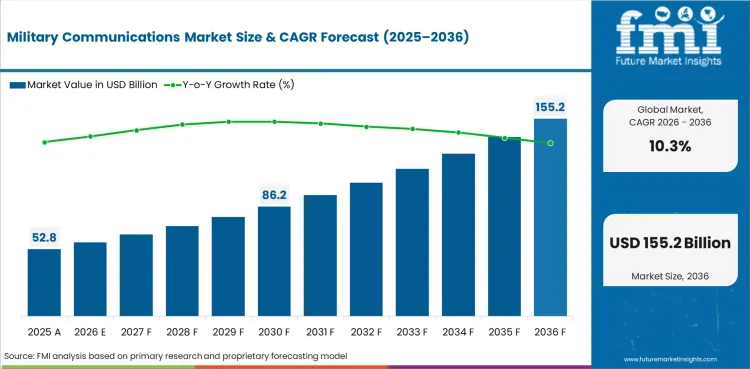
- The military communications market was valued at USD 52.8 billion in 2025.
- The market is projected to reach USD 58.2 billion in 2026 and USD 155.2 billion by 2036, growing at a CAGR of 10.3%.
- By 2036, the Military Communications Market is expected to be worth USD 155.2 billion.
- From 2026 to 2036, the market is projected to expand at a CAGR of 10.3%.
- The market is projected to create an incremental opportunity of USD 96.99 billion between 2026 and 2036.
- In 2026, Intelligence, Surveillance and Reconnaissance are expected to account for 58.0% of the application segment, driven by expanding ISR mission requirements including multi-domain operations, satellite communications modernization, and real-time battlefield data integration mandates.
- Systems will dominate with a 53.0% share.
- Intelligence, Surveillance & Reconnaissance will lead with a 58.0% share.
- China (9.3%) and USA (8.9%) are two of the fastest growing markets in the world.
Military Communications Market Definition
The Military Communications Market covers communication systems, equipment, and services used by armed forces for tactical, strategic, and operational information exchange. Products include tactical radios, satellite communication terminals, network management systems, electronic warfare communication systems, command and control platforms, and ISR data link systems across air, land, naval, and space force applications.
Military Communications Market Inclusions
Market scope includes products classified by component (systems, services), application (intelligence surveillance and reconnaissance, situational awareness, command and control), end user (air force, land force, naval force), and deployment (fixed communication systems, mobile communication systems). Revenue coverage spans 2026 to 2036.
Military Communications Market Exclusions
The scope does not include civilian emergency communication systems, commercial telecommunications infrastructure, or non-communication military electronics including radar, electronic countermeasures hardware without communication function, or weapons guidance systems.
Military Communications Market Research Methodology
- Primary Research: FMI analysts conducted interviews with industry participants, technology providers, and end users across key markets.
- Desk Research: Combined data from industry associations, regulatory filings, and manufacturer disclosures.
- Market Sizing and Forecasting: Bottom up aggregation across segments and regions with top down validation against industry benchmarks.
- Data Validation: Cross checked quarterly against industry production data, procurement records, and manufacturer disclosures.
Why is the Military Communications Market Growing?
- JADC2 and equivalent multi-domain command programs in the USA, UK, and allied nations are driving procurement of communication systems that enable real-time data sharing between aircraft, ships, ground forces, satellites, and cyber operations centers.
- LEO satellite constellation deployment is transforming military communication architectures by providing high bandwidth, low latency connectivity that supplements or replaces traditional GEO military satellite systems at lower cost per connection.
Demand for military communications reflects the fundamental shift in warfare toward information-centric, networked operations where communication superiority determines operational effectiveness. Modern military doctrine requires real-time sharing of sensor data, intelligence, targeting information, and command directives across all military domains simultaneously. This requirement drives procurement of communication systems with higher bandwidth, lower latency, broader interoperability, and stronger resilience than previous generation equipment.
The satellite communication segment is experiencing significant transformation as commercial LEO constellations provide military grade connectivity at price points and coverage levels that dedicated military satellite systems cannot match. Programs including the US Space Development Agency Transport Layer, UK Skynet, and commercial MILSATCOM partnerships are reshaping procurement from custom satellite terminals toward commercial-standard equipment with military security overlays.
Electronic warfare resilience has become a defining procurement requirement as peer adversary capabilities in jamming, signal interception, and network attack create contested electromagnetic environments. Military communication systems must now incorporate frequency hopping, spread spectrum, directional antennas, and cognitive radio capabilities that maintain connectivity under active electronic attack. This requirement drives technology sophistication and increases system cost per unit.
Market Segmentation Analysis
- ISR holds 58.0% of the application segment, reflecting the bandwidth intensive data sharing requirements of modern intelligence, surveillance, and reconnaissance operations across manned and unmanned platforms.
- Systems account for 53.0% of component demand, driven by integrated communication platform procurement including software-defined radios, satellite terminals, and network management equipment.
The Military Communications Market is segmented by component, application, end user, and deployment. ISR dominates application demand. Systems lead the component segment through integrated platform procurement.
Insights into the ISR Application Segment
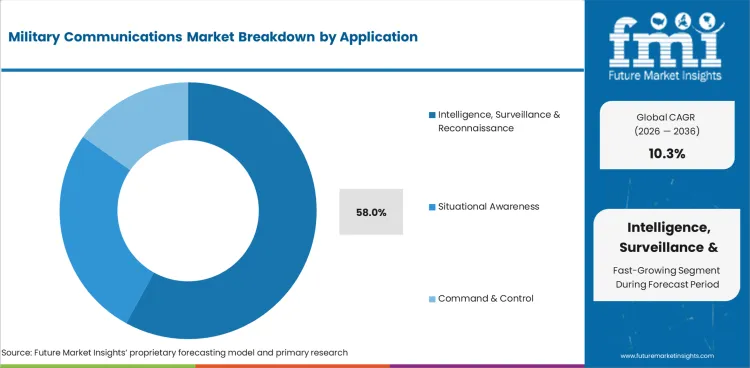
In 2026, ISR is expected to represent 58.0% of the application segment. Modern ISR operations generate massive data volumes from full-motion video, synthetic aperture radar, signals intelligence, and multi-spectral imagery that must be transmitted in real-time to analysts and decision makers.
Growth reflects the expanding deployment of unmanned aerial systems, space-based ISR platforms, and ground sensor networks that increase the volume and velocity of ISR data requiring communication system support.
Insights into the Systems Component Segment
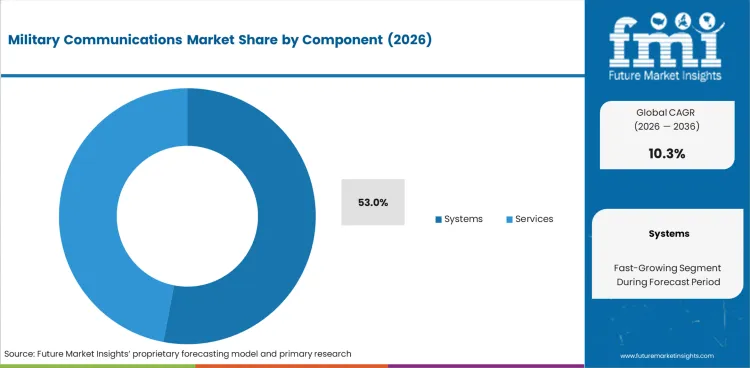
Systems account for 53.0% of the component segment in 2026. This category covers communication hardware platforms including tactical radios, satellite communication terminals, network switches and routers, signal processing equipment, and antenna systems.
Growth reflects technology refresh cycles as armed forces replace legacy analog and narrowband digital systems with software-defined, wideband platforms capable of supporting multi-domain operations data requirements.
Military Communications Market Drivers, Restraints, and Opportunities
- Multi-domain operations doctrine and ISR data requirements create sustained demand for high bandwidth, resilient military communication systems.
- Procurement timelines and defense budget cycles create variable demand patterns that can delay program execution despite sustained long term growth.
- Commercial satellite and software-defined networking technologies are reducing costs while improving capabilities, expanding the addressable market.
The Military Communications Market is shaped by operational doctrine evolution, technology advancement, and defense spending priorities. Growth is supported by multi-domain operations requirements, while budget cycles and procurement timelines create demand variability.
Multi-Domain Operations Requirements
Demand is shaped by the doctrinal shift toward multi-domain operations that require real-time communication connectivity across air, land, sea, space, and cyber domains. Programs including US JADC2, UK MDTP, and NATO DIANA drive procurement of interoperable, high bandwidth communication systems.
Defense Budget and Procurement Variability
Growth is moderated by defense budget cycles, program delays, and procurement competition that create annual variability in communication system spending despite strong long term demand trends. Multi-year program structures provide visibility but are subject to political and fiscal adjustment.
Commercial Technology Adoption
Adoption of commercial satellite services, software-defined networking, and cloud-based command systems is reducing military communication costs while improving capabilities, expanding the addressable market by making advanced connectivity affordable for a broader range of military units and applications.
Analysis of Military Communications Market By Key Countries
.webp "Top Country Growth Comparison Military Communications Market Cagr (2026 2036)")
| Country | CAGR |
|---|---|
| China | 9.3% |
| USA | 8.9% |
| South Korea | 8.7% |
| UK | 8.5% |
| Germany | 8.4% |
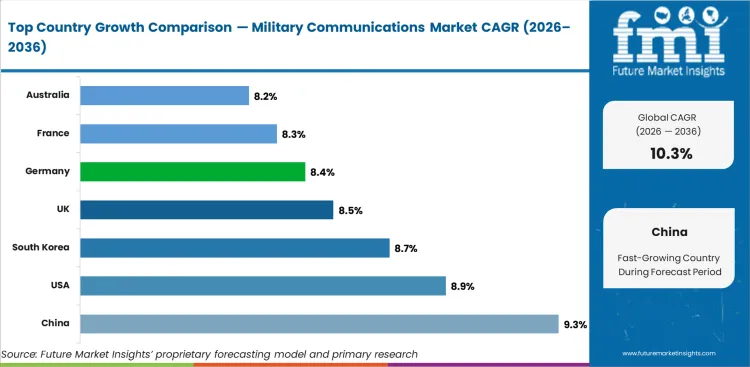
- China leads with 9.3% through 2036, driven by military modernization, indigenous communication system development, and space-based infrastructure expansion.
- The USA at 8.9% reflects JADC2 investment, satellite communication modernization, and sustained defense communication spending.
- South Korea (8.7%) and UK (8.5%) show growth driven by allied interoperability requirements and national defense modernization programs.
The global Military Communications Market is projected to grow at a CAGR of 10.3% from 2026 to 2036. The analysis covers more than 30 countries, with the primary markets listed below.
Demand Outlook for Military Communications Market in China
China is expected to grow at 9.3% through 2036, driven by PLA modernization programs, indigenous military communication system development, and Beidou satellite constellation integration with tactical communication platforms.
- PLA modernization creates large scale communication system procurement across all military branches.
- Indigenous development reduces foreign technology dependency in military communication systems.
- Beidou satellite integration provides sovereign positioning and communication capabilities.
Future Outlook for Military Communications Market in the United States
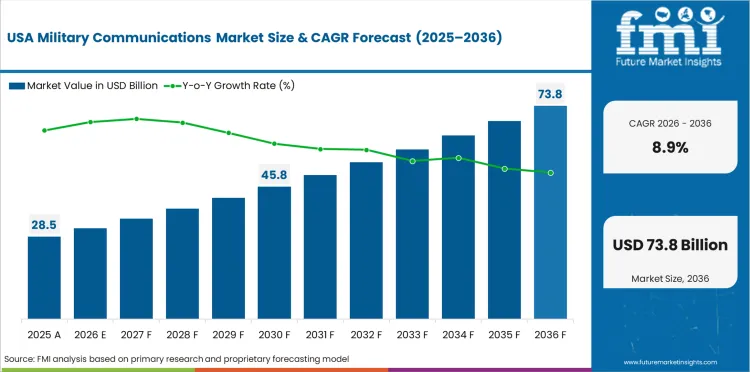
The USA is expected to grow at 8.9% through 2036, reflecting JADC2 program investment, satellite communication modernization through SDA and commercial partnerships, and tactical radio fleet recapitalization.
- JADC2 program drives procurement of multi-domain communication and data sharing platforms.
- Satellite communication modernization creates terminal and ground infrastructure procurement.
- Tactical radio recapitalization sustains software-defined radio procurement across ground and airborne platforms.
Opportunity Analysis of Military Communications Market in South Korea
South Korea is expected to grow at 8.7% through 2036, driven by defense modernization, inter-Korean threat response requirements, and growing interoperability with US and allied communication systems.
- Defense modernization sustains communication system upgrades across Korean military forces.
- Threat environment requirements drive investment in resilient, jam-resistant communication platforms.
- Allied interoperability drives adoption of compatible communication standards and equipment.
In-depth Analysis of Military Communications Market in the United Kingdom
The UK is expected to grow at 8.5% through 2036, supported by MDTP (Multi-Domain Task and Purpose) investment, Skynet satellite modernization, and NATO interoperability requirements.
- MDTP program drives integrated military communication platform procurement.
- Skynet satellite modernization creates terminal and ground infrastructure demand.
- NATO interoperability requirements sustain procurement of compatible communication systems.
Sales Analysis of Military Communications Market in Germany
Germany is expected to grow at 8.4% through 2036, reflecting Bundeswehr modernization, NATO commitment increases, and European defense communication program participation.
- Bundeswehr modernization drives tactical and strategic communication system upgrades.
- NATO commitment increases support growing defense communication investment.
- European defense programs create collaborative communication system procurement opportunities.
Competitive Landscape and Strategic Positioning
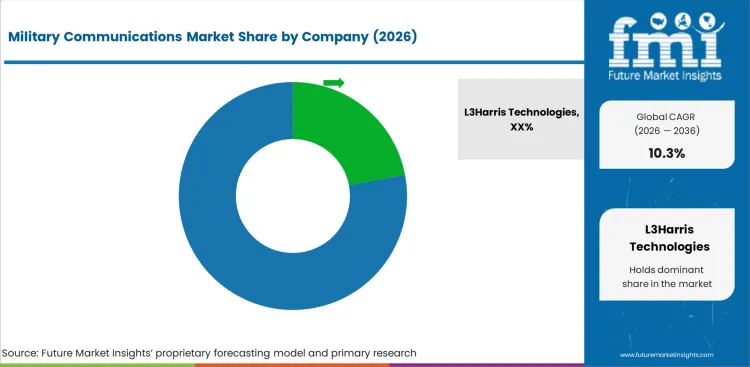
- L3Harris Technologies leads through comprehensive tactical and strategic military communication portfolios spanning radios, satellite terminals, network systems, and electronic warfare capabilities across all military domains.
- Northrop Grumman, Thales Group, and BAE Systems maintain strong positions through specialized communication and electronic warfare platforms with established government contract relationships.
- Raytheon Technologies, General Dynamics, and Lockheed Martin provide integrated defense communication solutions within broader platform programs.
L3Harris Technologies maintains a leading position through its comprehensive military communication portfolio spanning tactical radios (Falcon series), satellite communication terminals, airborne communication systems, and network management platforms deployed across US and allied armed forces. Northrop Grumman provides communication and ISR system integration with particular strength in airborne and space-based platforms.
Thales Group delivers military communication systems for European and allied forces with established positions in tactical radios, satellite communication, and network-centric warfare platforms. BAE Systems provides electronic warfare, communication, and signals intelligence systems. Raytheon Technologies delivers integrated defense communication through its Collins Aerospace division.
General Dynamics provides ground force tactical communication systems. Lockheed Martin integrates communication capabilities within platform programs including F-35 and satellite systems. Leonardo provides European military communication systems.
Barriers to entry include national security clearance requirements, classified technology access, long procurement cycles extending 5 to 10 years, established prime contractor relationships, and the technical complexity of military grade communication systems operating in contested environments. Strategic priorities include software-defined radio platform development, LEO satellite terminal integration, electronic warfare resilient communication, and multi-domain interoperability solutions.
Key Companies in the Military Communications Market
Key global companies leading the military communications market include:
- L3Harris Technologies, Northrop Grumman, Thales Group maintain leadership through established market presence, broad capabilities, and global infrastructure.
- BAE Systems, Raytheon Technologies, General Dynamics, Lockheed Martin have established strong positions through specialized capabilities and focused expertise.
- Leonardo S.p.A., Cobham Limited, Rohde and Schwarz, Viasat Inc are among the emerging players gaining traction through technology advancement and focused innovation.
Competitive Benchmarking: Military Communications Market
| Company | Communication Portfolio | Defense Contract Access | Technology Capability | Geographic Coverage |
|---|---|---|---|---|
| L3Harris Technologies | High | Strong | High | USA, Global |
| Northrop Grumman | High | Strong | High | USA, Global |
| Thales Group | High | Strong | High | Europe, Global |
| BAE Systems | High | Strong | High | UK, Global |
| Raytheon Technologies | High | Strong | High | USA, Global |
| General Dynamics | Medium | Strong | High | USA, Global |
| Lockheed Martin | Medium | Strong | High | USA, Global |
| Leonardo S.p.A. | Medium | Strong | Medium | Europe |
| Rohde and Schwarz | Medium | Moderate | High | Europe, Global |
Source: Future Market Insights competitive analysis, 2026.
Key Players in the Military Communications Market
Major Global Players
- L3Harris Technologies
- Northrop Grumman
- Thales Group
- BAE Systems
- Raytheon Technologies
- General Dynamics
- Lockheed Martin
Emerging Players/Startups
- Leonardo S.p.A.
- Cobham Limited
- Rohde and Schwarz
- Viasat Inc
- Collins Aerospace
Report Scope and Coverage
| Metric | Value |
|---|---|
| Quantitative Units | USD 58.24 billion to USD 155.23 billion, at a CAGR of 10.3% |
| Market Definition | The Military Communications Market covers communication systems, equipment, and services used by armed forces for tactical, strategic, and operational information exchange across all military domains. |
| Regions Covered | North America, Latin America, Europe, East Asia, South Asia and Pacific, Middle East and Africa |
| Countries Covered | USA, UK, Germany, China, South Korea, Japan, France, Australia, Italy, 30 plus countries |
| Key Companies Profiled | L3Harris Technologies, Northrop Grumman, Thales Group, BAE Systems, Raytheon Technologies, General Dynamics, Lockheed Martin, Leonardo S.p.A., Cobham Limited, Rohde and Schwarz, Viasat Inc |
| Forecast Period | 2026 to 2036 |
| Approach | Hybrid bottom up and top down methodology starting with verified transaction data, projecting adoption velocity across segments and regions. |
Segmentation
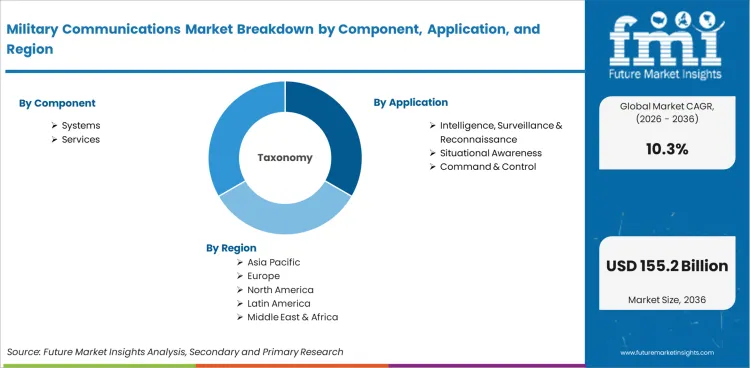
Military Communications Market Segmented by Component:
- Systems
- Services
Military Communications Market Segmented by Application:
- Intelligence, Surveillance & Reconnaissance
- Situational Awareness
- Command & Control
Military Communications Market Segmented by End User:
- Air Force
- Land Force
- Naval Force
Military Communications Market Segmented by Deployment:
- Fixed Communication Systems
- Mobile Communication Systems
Military Communications Market by Region:
- North America
- USA
- Canada
- Mexico
- Latin America
- Brazil
- Chile
- Rest of Latin America
- Western Europe
- Germany
- UK
- Italy
- Spain
- France
- Nordic
- BENELUX
- Rest of Western Europe
- Eastern Europe
- Russia
- Poland
- Hungary
- Balkan & Baltic
- Rest of Eastern Europe
- East Asia
- China
- Japan
- South Korea
- South Asia and Pacific
- India
- ASEAN
- Australia & New Zealand
- Rest of South Asia and Pacific
- Middle East & Africa
- Kingdom of Saudi Arabia
- Other GCC Countries
- Turkiye
- South Africa
- Other African Union
- Rest of Middle East & Africa
Research Sources and Bibliography
- 1. USA Department of Defense. (2025). DoD JADC2 Implementation Strategy Report. DoD.
- 2. North Atlantic Treaty Organization. (2025). NATO Communication and Information Systems Strategy. NATO.
- 3. U.K. Ministry of Defence. (2025). MOD Defence Digital Strategy and Multi-Domain Integration Report. MOD.
- 4. International Telecommunication Union. (2025). ITU Radio Regulations for Military Frequency Allocations. ITU.
- 5. European Defence Agency. (2025). EDA Military Communication Capability Development Plan. EDA.
This bibliography is provided for reader reference. The full Future Market Insights report contains the complete reference list with publication dates, URLs, and supporting data for all cited works.
This Report Answers
- Estimating market size and revenue projections from 2026 to 2036.
- Segmentation by component, application, end user, and deployment.
- Regional insights covering more than 30 markets.
- Analysis of tactical radio, satellite communication, and network system technologies.
- Competitive landscape assessment including defense contract access and technology capability benchmarking.
- Growth opportunities in JADC2, satellite modernization, and electronic warfare resilient communication.
- Supply chain and defense industrial base evaluation.
- Data delivery in PDF and Excel formats.
Frequently Asked Questions
What is the global market demand for Military Communications in 2026?
In 2026, the global Military Communications Market is expected to be worth USD 58.24 billion, reflecting sustained defense spending on multi-domain communication systems, satellite infrastructure modernization, and tactical radio fleet recapitalization across major military powers and allied forces.
How big will the Military Communications Market be in 2036?
By 2036, the market is expected to reach USD 155.23 billion, supported by JADC2 and equivalent multi-domain programs, LEO satellite communication deployment, electronic warfare resilient system procurement, and defense modernization across NATO, Indo-Pacific, and emerging military powers.
How much is demand expected to grow between 2026 and 2036?
Between 2026 and 2036, demand is expected to grow at a CAGR of 10.3%, driven by multi-domain operations doctrine adoption requiring connected battlefield networks, satellite communication modernization through LEO constellations, and growing electronic warfare threats demanding resilient communication systems.
Which application segment is expected to lead in 2026?
ISR is expected to hold 58.0% of the application segment in 2026, reflecting the communication intensive nature of modern intelligence, surveillance, and reconnaissance operations that generate massive data volumes requiring high bandwidth, low latency transmission between sensors, platforms, and command centers.
What is driving demand in China?
China is expected to grow at 9.3% through 2036, driven by comprehensive PLA military modernization programs, indigenous defense communication system development reducing foreign technology dependency, and Beidou satellite constellation integration with tactical military platforms.
What is driving demand in the USA?
The USA is expected to grow at 8.9% through 2036, reflecting JADC2 program investment creating multi-domain communication procurement, SDA and commercial satellite modernization, tactical radio recapitalization, and sustained defense spending on communication infrastructure.
What does this report mean by Military Communications Market definition?
The market covers communication systems, equipment, and services used by armed forces for information exchange including tactical radios, satellite terminals, network management platforms, electronic warfare communication systems, and command and control data link infrastructure across air, land, naval, and space force applications.
How does FMI validate the forecast?
Forecasting models use a hybrid bottom up and top down approach, starting with verified defense budget allocations, program of record procurement data, and contract award analysis, validating against global defense spending statistics, military force structure assessments, and defense industry manufacturer disclosures.
Preview the report firsthand - request a free sample
Get SampleGet the brochure for pricing and purchase details.
Get PDFTable of Content
- Executive Summary
- Global Market Outlook
- Demand-side Trends
- Supply-side Trends
- Technology Roadmap Analysis
- Analysis and Recommendations
- Market Overview
- Market Coverage / Taxonomy
- Market Definition / Scope / Limitations
- Research Methodology
- Chapter Orientation
- Analytical Lens and Working Hypotheses
- Market Structure, Signals, and Trend Drivers
- Benchmarking and Cross-market Comparability
- Market Sizing, Forecasting, and Opportunity Mapping
- Research Design and Evidence Framework
- Desk Research Programme (Secondary Evidence)
- Company Annual and Sustainability Reports
- Peer-reviewed Journals and Academic Literature
- Corporate Websites, Product Literature, and Technical Notes
- Earnings Decks and Investor Briefings
- Statutory Filings and Regulatory Disclosures
- Technical White Papers and Standards Notes
- Trade Journals, Industry Magazines, and Analyst Briefs
- Conference Proceedings, Webinars, and Seminar Materials
- Government Statistics Portals and Public Data Releases
- Press Releases and Reputable Media Coverage
- Specialist Newsletters and Curated Briefings
- Sector Databases and Reference Repositories
- FMI Internal Proprietary Databases and Historical Market Datasets
- Subscription Datasets and Paid Sources
- Social Channels, Communities, and Digital Listening Inputs
- Additional Desk Sources
- Expert Input and Fieldwork (Primary Evidence)
- Primary Modes
- Qualitative Interviews and Expert Elicitation
- Quantitative Surveys and Structured Data Capture
- Blended Approach
- Why Primary Evidence is Used
- Field Techniques
- Interviews
- Surveys
- Focus Groups
- Observational and In-context Research
- Social and Community Interactions
- Stakeholder Universe Engaged
- C-suite Leaders
- Board Members
- Presidents and Vice Presidents
- R&D and Innovation Heads
- Technical Specialists
- Domain Subject-matter Experts
- Scientists
- Physicians and Other Healthcare Professionals
- Governance, Ethics, and Data Stewardship
- Research Ethics
- Data Integrity and Handling
- Primary Modes
- Tooling, Models, and Reference Databases
- Desk Research Programme (Secondary Evidence)
- Data Engineering and Model Build
- Data Acquisition and Ingestion
- Cleaning, Normalisation, and Verification
- Synthesis, Triangulation, and Analysis
- Quality Assurance and Audit Trail
- Market Background
- Market Dynamics
- Drivers
- Restraints
- Opportunity
- Trends
- Scenario Forecast
- Demand in Optimistic Scenario
- Demand in Likely Scenario
- Demand in Conservative Scenario
- Opportunity Map Analysis
- Product Life Cycle Analysis
- Supply Chain Analysis
- Investment Feasibility Matrix
- Value Chain Analysis
- PESTLE and Porter’s Analysis
- Regulatory Landscape
- Regional Parent Market Outlook
- Production and Consumption Statistics
- Import and Export Statistics
- Market Dynamics
- Global Market Analysis 2021 to 2025 and Forecast, 2026 to 2036
- Historical Market Size Value (USD Million) Analysis, 2021 to 2025
- Current and Future Market Size Value (USD Million) Projections, 2026 to 2036
- Y-o-Y Growth Trend Analysis
- Absolute $ Opportunity Analysis
- Global Market Pricing Analysis 2021 to 2025 and Forecast 2026 to 2036
- Global Market Analysis 2021 to 2025 and Forecast 2026 to 2036, By Component
- Introduction / Key Findings
- Historical Market Size Value (USD Million) Analysis By Component, 2021 to 2025
- Current and Future Market Size Value (USD Million) Analysis and Forecast By Component, 2026 to 2036
- Systems
- Services
- Systems
- Y-o-Y Growth Trend Analysis By Component, 2021 to 2025
- Absolute $ Opportunity Analysis By Component, 2026 to 2036
- Global Market Analysis 2021 to 2025 and Forecast 2026 to 2036, By Application
- Introduction / Key Findings
- Historical Market Size Value (USD Million) Analysis By Application, 2021 to 2025
- Current and Future Market Size Value (USD Million) Analysis and Forecast By Application, 2026 to 2036
- Intelligence, Surveillance & Reconnaissance
- Situational Awareness
- Command & Control
- Intelligence, Surveillance & Reconnaissance
- Y-o-Y Growth Trend Analysis By Application, 2021 to 2025
- Absolute $ Opportunity Analysis By Application, 2026 to 2036
- Global Market Analysis 2021 to 2025 and Forecast 2026 to 2036, By End User
- Introduction / Key Findings
- Historical Market Size Value (USD Million) Analysis By End User, 2021 to 2025
- Current and Future Market Size Value (USD Million) Analysis and Forecast By End User, 2026 to 2036
- Air Force
- Land Force
- Naval Force
- Air Force
- Y-o-Y Growth Trend Analysis By End User, 2021 to 2025
- Absolute $ Opportunity Analysis By End User, 2026 to 2036
- Global Market Analysis 2021 to 2025 and Forecast 2026 to 2036, By Deployment
- Introduction / Key Findings
- Historical Market Size Value (USD Million) Analysis By Deployment, 2021 to 2025
- Current and Future Market Size Value (USD Million) Analysis and Forecast By Deployment, 2026 to 2036
- Fixed Communication Systems
- Mobile Communication Systems
- Fixed Communication Systems
- Y-o-Y Growth Trend Analysis By Deployment, 2021 to 2025
- Absolute $ Opportunity Analysis By Deployment, 2026 to 2036
- Global Market Analysis 2021 to 2025 and Forecast 2026 to 2036, By Region
- Introduction
- Historical Market Size Value (USD Million) Analysis By Region, 2021 to 2025
- Current Market Size Value (USD Million) Analysis and Forecast By Region, 2026 to 2036
- North America
- Latin America
- Western Europe
- Eastern Europe
- East Asia
- South Asia and Pacific
- Middle East & Africa
- Market Attractiveness Analysis By Region
- North America Market Analysis 2021 to 2025 and Forecast 2026 to 2036, By Country
- Historical Market Size Value (USD Million) Trend Analysis By Market Taxonomy, 2021 to 2025
- Market Size Value (USD Million) Forecast By Market Taxonomy, 2026 to 2036
- By Country
- USA
- Canada
- Mexico
- By Component
- By Application
- By End User
- By Deployment
- By Country
- Market Attractiveness Analysis
- By Country
- By Component
- By Application
- By End User
- By Deployment
- Key Takeaways
- Latin America Market Analysis 2021 to 2025 and Forecast 2026 to 2036, By Country
- Historical Market Size Value (USD Million) Trend Analysis By Market Taxonomy, 2021 to 2025
- Market Size Value (USD Million) Forecast By Market Taxonomy, 2026 to 2036
- By Country
- Brazil
- Chile
- Rest of Latin America
- By Component
- By Application
- By End User
- By Deployment
- By Country
- Market Attractiveness Analysis
- By Country
- By Component
- By Application
- By End User
- By Deployment
- Key Takeaways
- Western Europe Market Analysis 2021 to 2025 and Forecast 2026 to 2036, By Country
- Historical Market Size Value (USD Million) Trend Analysis By Market Taxonomy, 2021 to 2025
- Market Size Value (USD Million) Forecast By Market Taxonomy, 2026 to 2036
- By Country
- Germany
- UK
- Italy
- Spain
- France
- Nordic
- BENELUX
- Rest of Western Europe
- By Component
- By Application
- By End User
- By Deployment
- By Country
- Market Attractiveness Analysis
- By Country
- By Component
- By Application
- By End User
- By Deployment
- Key Takeaways
- Eastern Europe Market Analysis 2021 to 2025 and Forecast 2026 to 2036, By Country
- Historical Market Size Value (USD Million) Trend Analysis By Market Taxonomy, 2021 to 2025
- Market Size Value (USD Million) Forecast By Market Taxonomy, 2026 to 2036
- By Country
- Russia
- Poland
- Hungary
- Balkan & Baltic
- Rest of Eastern Europe
- By Component
- By Application
- By End User
- By Deployment
- By Country
- Market Attractiveness Analysis
- By Country
- By Component
- By Application
- By End User
- By Deployment
- Key Takeaways
- East Asia Market Analysis 2021 to 2025 and Forecast 2026 to 2036, By Country
- Historical Market Size Value (USD Million) Trend Analysis By Market Taxonomy, 2021 to 2025
- Market Size Value (USD Million) Forecast By Market Taxonomy, 2026 to 2036
- By Country
- China
- Japan
- South Korea
- By Component
- By Application
- By End User
- By Deployment
- By Country
- Market Attractiveness Analysis
- By Country
- By Component
- By Application
- By End User
- By Deployment
- Key Takeaways
- South Asia and Pacific Market Analysis 2021 to 2025 and Forecast 2026 to 2036, By Country
- Historical Market Size Value (USD Million) Trend Analysis By Market Taxonomy, 2021 to 2025
- Market Size Value (USD Million) Forecast By Market Taxonomy, 2026 to 2036
- By Country
- India
- ASEAN
- Australia & New Zealand
- Rest of South Asia and Pacific
- By Component
- By Application
- By End User
- By Deployment
- By Country
- Market Attractiveness Analysis
- By Country
- By Component
- By Application
- By End User
- By Deployment
- Key Takeaways
- Middle East & Africa Market Analysis 2021 to 2025 and Forecast 2026 to 2036, By Country
- Historical Market Size Value (USD Million) Trend Analysis By Market Taxonomy, 2021 to 2025
- Market Size Value (USD Million) Forecast By Market Taxonomy, 2026 to 2036
- By Country
- Kingdom of Saudi Arabia
- Other GCC Countries
- Turkiye
- South Africa
- Other African Union
- Rest of Middle East & Africa
- By Component
- By Application
- By End User
- By Deployment
- By Country
- Market Attractiveness Analysis
- By Country
- By Component
- By Application
- By End User
- By Deployment
- Key Takeaways
- Key Countries Market Analysis
- USA
- Pricing Analysis
- Market Share Analysis, 2025
- By Component
- By Application
- By End User
- By Deployment
- Canada
- Pricing Analysis
- Market Share Analysis, 2025
- By Component
- By Application
- By End User
- By Deployment
- Mexico
- Pricing Analysis
- Market Share Analysis, 2025
- By Component
- By Application
- By End User
- By Deployment
- Brazil
- Pricing Analysis
- Market Share Analysis, 2025
- By Component
- By Application
- By End User
- By Deployment
- Chile
- Pricing Analysis
- Market Share Analysis, 2025
- By Component
- By Application
- By End User
- By Deployment
- Germany
- Pricing Analysis
- Market Share Analysis, 2025
- By Component
- By Application
- By End User
- By Deployment
- UK
- Pricing Analysis
- Market Share Analysis, 2025
- By Component
- By Application
- By End User
- By Deployment
- Italy
- Pricing Analysis
- Market Share Analysis, 2025
- By Component
- By Application
- By End User
- By Deployment
- Spain
- Pricing Analysis
- Market Share Analysis, 2025
- By Component
- By Application
- By End User
- By Deployment
- France
- Pricing Analysis
- Market Share Analysis, 2025
- By Component
- By Application
- By End User
- By Deployment
- India
- Pricing Analysis
- Market Share Analysis, 2025
- By Component
- By Application
- By End User
- By Deployment
- ASEAN
- Pricing Analysis
- Market Share Analysis, 2025
- By Component
- By Application
- By End User
- By Deployment
- Australia & New Zealand
- Pricing Analysis
- Market Share Analysis, 2025
- By Component
- By Application
- By End User
- By Deployment
- China
- Pricing Analysis
- Market Share Analysis, 2025
- By Component
- By Application
- By End User
- By Deployment
- Japan
- Pricing Analysis
- Market Share Analysis, 2025
- By Component
- By Application
- By End User
- By Deployment
- South Korea
- Pricing Analysis
- Market Share Analysis, 2025
- By Component
- By Application
- By End User
- By Deployment
- Russia
- Pricing Analysis
- Market Share Analysis, 2025
- By Component
- By Application
- By End User
- By Deployment
- Poland
- Pricing Analysis
- Market Share Analysis, 2025
- By Component
- By Application
- By End User
- By Deployment
- Hungary
- Pricing Analysis
- Market Share Analysis, 2025
- By Component
- By Application
- By End User
- By Deployment
- Kingdom of Saudi Arabia
- Pricing Analysis
- Market Share Analysis, 2025
- By Component
- By Application
- By End User
- By Deployment
- Turkiye
- Pricing Analysis
- Market Share Analysis, 2025
- By Component
- By Application
- By End User
- By Deployment
- South Africa
- Pricing Analysis
- Market Share Analysis, 2025
- By Component
- By Application
- By End User
- By Deployment
- USA
- Market Structure Analysis
- Competition Dashboard
- Competition Benchmarking
- Market Share Analysis of Top Players
- By Regional
- By Component
- By Application
- By End User
- By Deployment
- Competition Analysis
- Competition Deep Dive
- L3Harris Technologies
- Overview
- Product Portfolio
- Profitability by Market Segments (Product/Age /Sales Channel/Region)
- Sales Footprint
- Strategy Overview
- Marketing Strategy
- Product Strategy
- Channel Strategy
- Northrop Grumman
- Thales Group
- BAE Systems
- Raytheon Technologies
- General Dynamics
- Lockheed Martin
- Leonardo S.p.A.
- Cobham Limited
- Rohde & Schwarz
- Viasat Inc
- L3Harris Technologies
- Competition Deep Dive
- Assumptions & Acronyms Used


