

- Market Size (2026)
- USD 520.6 Mn
- Forecast (2036)
- USD 856.1 Mn
- CAGR (2026 to 2036)
- 5.1%
How big is Vehicle Roof Hatches Market in 2026?
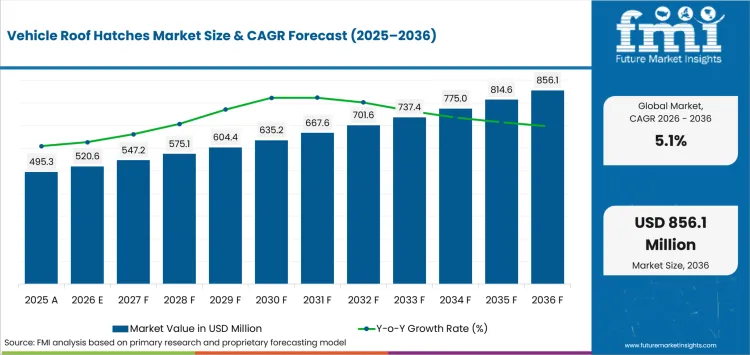
USD 520.6 million in 2026 and USD 856.1 million by 2036 at a 5.1% CAGR.
Demand for vehicle roof hatches is projected to expand at 5.1% CAGR between 2026 and 2036, increasing valuation from USD 520.6 million in 2026 to USD 856.1 million by 2036. Bus production and fleet renewal increase factory specification because emergency roof exits enter vehicle architecture before final certification. The Federal Transit Administration committed nearly USD 390 million in February 2026 for 34 transit projects that include almost 200 new buses. Those projects establish new factory decisions for roof apertures and later replacement work for release hardware.
Country demand follows different vehicle production cycles even though safety requirements remain a common purchasing condition. ACEA reported in January 2026 that EU bus registrations rose 7.5% during 2025 to 38,238 units. Germany increased 28% while Italy fell 15.9% during the same period which widened country-level build divergence. Roof-hatch orders therefore depend on local build pipelines and approved automotive glass choices as much as the global forecast rate.
Key Takeaways of Vehicle Roof Hatches Market
- Bus safety rules and fleet renewal keep emergency roof exits within recurring vehicle design and replacement decisions across regulated transport fleets.
- The emergency escape hatches segment is likely to capture 34.0% share in 2026 attributable to formal egress rules that preserve roof exits on applicable passenger vehicles.
- By vehicle type, buses are forecast to represent 32.0% in 2026 driven by passenger transport designs that allocate roof space to emergency and airflow functions.
- Aluminum frames are projected to hold 24.0% share in 2026 owing to low mass and stable latch interfaces that support roof integration.
- Platform-specific roof curvature and sealing requirements restrain substitution because poorly matched units can increase qualification time and installation risk.
- Some of the key players in this market include HAPPICH GmbH, Spheros, Eberspächer, Airxcel / Maxxair, Webasto, Daimler Truck / Mercedes-Benz Special Trucks, ZIEGLER, and John Cockerill Defense.
Analyst Perspective
"Vehicle engineers should compare roof hatches by approved cutout geometry and sealing performance rather than unit price alone. The stronger commercial offer preserves emergency release across service life while simplifying ventilation upgrades and replacement work on the same roof aperture."
- Nikhil Kaitwade, Principal Consultant, Future Market Insights
How is the Vehicle Roof Hatches Market segmented?
The vehicle roof hatches market is segmented by hatch type, vehicle type, material, sales channel, function and region.
Market taxonomy covers hatch type, vehicle type, material, sales channel, function and region for analysis. Hatch types include emergency escape hatches, ventilation roof hatches, access hatches, transparent roof hatches and powered roof hatches. Vehicle types cover buses, RVs, emergency vehicles, specialty commercial vehicles and armored vehicles. Materials include aluminum frame, polycarbonate glazing, composite frame, tempered glass and steel frame. Sales channels cover vehicle OEMs, bus body builders, aftermarket retrofit and specialty upfitters. Functions include emergency exit, cabin ventilation, roof access and natural lighting.
Why do emergency escape hatches lead demand within the hatch type category?
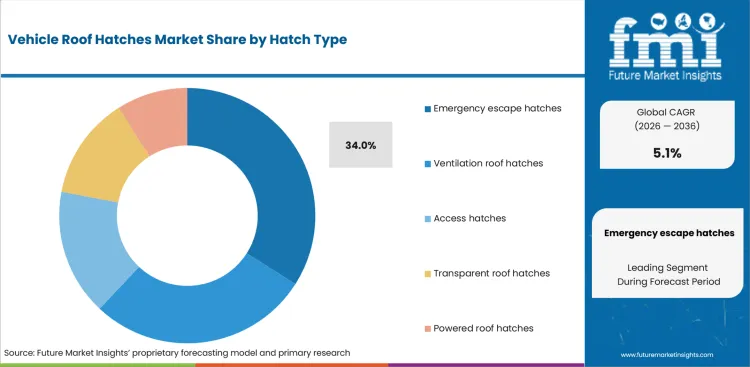
Emergency escape hatches carry a defined evacuation duty that daily ventilation products cannot replace during routine passenger service. Powered variants can also place roof control electronics inside the same compliance review before series approval begins.
- Based on hatch type, emergency escape hatches are projected to account for 34.0% in 2026 due to formal egress rules preserving required roof exits on applicable passenger vehicles.
- India’s transport ministry reported in February 2026 that one inspected sleeper coach carried one roof hatch instead of two required hatches. The finding keeps roof-exit quantity and placement inside formal vehicle fitness checks for sleeper coach operators.
Why do buses lead demand within the vehicle type category?
Bus roofs provide an escape route that remains separate from side doors while also carrying ventilation equipment on many platforms. New bus output therefore creates recurring specification points for compatible openings across successive model-year programs.
- In 2026, buses are expected to lead vehicle type demand with 32.0% share because passenger transport designs routinely allocate roof space to emergency and airflow functions.
- ACEA reported in July 2026 that EU bus sales rose 22.7% during the first half of 2026 to 22,590 units. Higher assembly volume expands factory demand for roof openings and related installation hardware across active assembly plants.
Why do aluminum frames lead demand within the material category?
Aluminum frames suit roof assemblies that need controlled mass with stable interfaces for seals and latches. Stable extruded sections also support hinges and powered roof drives without adding unnecessary mass around the aperture.
- By material, aluminum frames are estimated to hold 24.0% in 2026 owing to stiffness and corrosion resistance supporting durable moving interfaces at restrained roof mass.
- HAPPICH reported in February 2025 that its IATF 16949 certified Adana plant uses nine assembly lines for components serving about 2,500 buses annually. IATF-based production controls therefore remain central to repeatable roof-component fitment across serial bus production programs.
Why do vehicle OEMs lead demand within the sales channel category?
Factory integration resolves cutout dimensions and sealing before a roof opening reaches series production on approved platforms. Specialty vehicle conversion programs favor approved apertures before the body reaches final completion and certification.
- Vehicle OEMs are set to lead the sales channel category with 38.0% share in 2026 due to factory approval reducing structural and electrical fitment risk.
- ZIEGLER reported in March 2025 that its new HLF-W firefighting vehicle uses a Z-Cab XL with roof hatches on a Volvo FMX chassis. The installation shows how roof access is specified inside the completed vehicle program before fleet delivery begins.
What are the drivers, restraints and opportunities in the Vehicle Roof Hatches Market?
Safety-linked fleet renewal supports demand while roof validation limits substitution and an aging bus base expands replacement opportunities for compatible hatch assemblies.
- Driver: Public bus investment creates new vehicle builds and refurbishment programs that require approved roof apertures across applicable fleet specifications.
- Restraint: Roof cutouts interact with structural strength and water sealing so replacement units need platform-specific dimensions before installation can proceed.
- Opportunity: Suppliers can earn replacement revenue by matching legacy apertures while offering ventilation or powered functions within established roof geometry.
Fleet Renewal Keeps New Specification Points Active
New bus programs generate roof-hatch specification work as engineers resolve emergency exits and ventilation openings before vehicle approval. In November 2025 the Federal Transit Administration awarded USD 2 billion across 165 projects expected to deliver about 2,400 buses. Factory-fit demand follows those vehicle orders while refurbishment programs extend compatible hatch requirements into established fleets with recurring parts and service needs.
Vehicle Approval Extends the Integration Cycle
Roof cutouts require more validation than interior trim because sealing and body strength depend on the surrounding vehicle structure. DVSA guidance published in December 2025 requires approval for newly built or radically altered buses and coaches in Great Britain. Supporting conformity evidence can lengthen conversion work if a replacement hatch changes established dimensions and can delay workshop release across body-builder programs.
Installed Fleets Support Compatible Replacement Platforms
Installed bus fleets support replacement revenue because damaged lids and worn mechanisms often need to fit existing roof cutouts. ACEA reported in May 2026 that about 700,000 buses operate on EU roads and their average age is 12.2 years. Older platforms reward interchangeable assemblies that restore ventilation or emergency operation without roof rework while worn latch and hinge mechanisms underline the need for stable moving interfaces across high-cycle apertures.
Which country CAGRs are profiled in the Vehicle Roof Hatches Market?
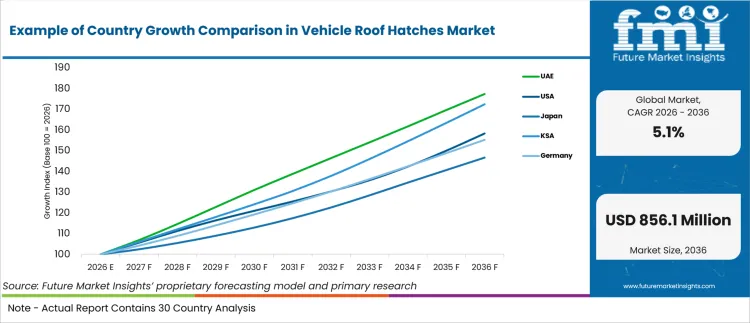
| Country | CAGR |
|---|---|
| UAE | 6.2% |
| Saudi Arabia | 5.9% |
| United Kingdom | 5.5% |
| Canada | 5.2% |
| United States | 4.9% |
How do country-level CAGRs compare in the Vehicle Roof Hatches Market?
The countries span a 1.3 percentage-point range between the UAE and the United States. Gulf markets form the upper growth band as fleet expansion meets heat and dust conditions. The United Kingdom and Canada occupy the middle range while the United States follows on replacement demand from mature fleets.
- UAE growth reflects Dubai fleet purchases requiring heat-tolerant seals and maintenance support for daily service.
- Saudi Arabia rewards inspection-ready bus equipment that local workshops maintain across long hot operating routes.
- United Kingdom demand depends on approval records and replacement compatibility across fleets with recurring inspections.
- Canada places extra weight on cold-weather seals and accessible replacement parts across dispersed school-bus fleets.
- United States demand reflects fleet funding alongside replacement needs for roof apertures across transit systems.
The full report provides country-level CAGR analysis across North America, Latin America, Europe, East Asia, South Asia, Oceania and the Middle East and Africa.
Country-wise Analysis
- Dubai bus fleets operate under intense heat and dust while local integrators support installation across school and public transport programs. By 2036, the UAE is projected to grow at 6.2% CAGR driven by new bus purchases that increase factory roof-aperture work under persistent thermal exposure. Dubai RTA reported in January 2026 that the first 250 vehicles had arrived under a 735-bus contract tailored to local operating conditions. That procurement pipeline gives roof-hatch manufacturers direct access to new platforms but faster seal aging raises service risk across daily fleet use. Companies with documented fitment and nearby replacement parts are better placed to protect uptime without forcing structural rework during maintenance.
- Saudi school-transport fleets run long hot routes that punish roof seals and emergency-release hardware while local body builders provide repair capacity near major fleet bases. Saudi Press Agency reported in August 2025 that the Transport General Authority requires specified safety equipment plus regular maintenance and inspection for student-transport vehicles. The Saudi Arabian vehicle roof hatches sector is projected to record 5.9% CAGR during the assessment period owing to formal transport oversight that keeps emergency access inside service routines. Persistent heat and dust increase sealing risk across repeated opening cycles and can shorten maintenance intervals for heavily used vehicles. Manufacturers that provide corrosion-resistant hardware with traceable parts and workshop support can shorten repair time without weakening inspection readiness.
- British bus operators manage roof equipment inside a mature fleet with formal approval duties and recurring roadworthiness checks across established local service networks. The Department for Transport reported that 30,558 buses served local operators in England during March 2025 and the fleet increased 2% from the prior year. Vehicle roof hatch sales in the United Kingdom are forecast to expand at 5.5% CAGR by 2036 attributable to selective fleet renewal and replacement work across older cutout geometries. Established engineering channels make approval documentation easier to obtain but mixed vehicle ages complicate direct hatch interchangeability during replacement work. Manufacturers that preserve approved dimensions can reduce structural rework and workshop downtime across replacement programs.
- Canadian school-bus fleets operate across wide temperature ranges that place unusual demands on roof seals and release hardware across dispersed maintenance territories. Housing, Infrastructure and Communities Canada reported in March 2026 that Transdev Canada already operated more than 100 electric school buses before further Ontario fleet electrification. Adoption of vehicle roof hatches in Canada is estimated to expand at 5.2% CAGR through 2036 supported by fleet renewal that increases specification work for all-weather mechanisms. Provincial service networks provide recurring access to fleet maintenance but cold-weather cycling can expose weak seals and latches. Common aperture dimensions and corrosion-resistant hardware can shorten workshop time across regional replacement programs and reduce inventory complexity for service operators.
- Transit agencies manage a large installed bus base while federal programs fund replacement and facility modernization across extensive service territories. In the United States, vehicle roof hatch demand is predicted to advance at 4.9% CAGR through 2036 underpinned by new buses and fleet rehabilitation that create separate purchase points. The Federal Transit Administration announced USD 610 million in July 2026 for bus infrastructure programs including about USD 589 million for low-emission and no-emission projects. Nationwide parts channels help maintain older apertures but platform-specific roof curvature limits direct interchangeability across fleets. Manufacturers that match legacy cutouts and document release performance can convert federal fleet investment into factory and replacement orders without reopening roof structures.
Who are the notable companies in the Vehicle Roof Hatches Market?
HAPPICH GmbH, Spheros, Eberspächer, Airxcel / Maxxair, Webasto, Daimler Truck / Mercedes-Benz Special Trucks, ZIEGLER, and John Cockerill Defense are the notable companies serving this market.
Competition spans component specialists and vehicle integrators because roof-hatch architecture varies sharply by vehicle class. HAPPICH GmbH and Spheros address commercial-vehicle roof components while Airxcel / Maxxair and Eberspächer emphasize RV ventilation. Daimler Truck and ZIEGLER integrate hatches inside specialty vehicles while John Cockerill Defense covers protected access. Webasto serves transparent and openable roofs where caravan programs provide adjacent lessons for moving aperture systems. Entry barriers therefore depend on verified fitment evidence and dependable service reach rather than corporate scale alone.
- Commercial-vehicle roof specialists include HAPPICH GmbH and Spheros with established bus component and ventilation exposure.
- Roof ventilation specialists include Airxcel / Maxxair and Eberspächer with current rooftop airflow systems for RV or truck applications.
- Specialty vehicle integrators include Daimler Truck / Mercedes-Benz Special Trucks and ZIEGLER for firefighting vehicles while John Cockerill Defense serves armored access and Webasto covers transparent openable roofs.
Competitive Benchmarking: Vehicle Roof Hatches Market
| Company | Current Roof Integration | Function Breadth | Eligible Vehicle Fitment | Geographic Reach |
|---|---|---|---|---|
| HAPPICH GmbH | High | High | High | Europe and Türkiye commercial vehicle programs |
| Spheros | High | High | High | Europe, Asia, Americas and Australasia |
| Eberspächer | High | Medium | Medium | Global truck and commercial vehicle markets |
| Airxcel / Maxxair | High | Medium | Medium | North America and Europe RV channels |
| Webasto | High | High | Medium | Europe and Asia with global automotive roof-system operations |
| Daimler Truck / Mercedes-Benz Special Trucks | High | Low | Low | Europe and global special-truck markets |
| ZIEGLER | High | Medium | Low | Europe with international firefighting vehicle sales |
| John Cockerill Defense | High | High | Low | Europe and international defense vehicle programs |
Key Developments in the Vehicle Roof Hatches Market
- In May 2026, Eberspächer launched its new Cooltronic 2000 G3 Hatch and 1600 G3 Hatch parking coolers for direct integration into truck roof hatches.
- In June 2026, HAPPICH GmbH presented lightweight roof hatches for ventilation and weight reduction at Busworld Türkiye 2026.
- In October 2025, Airxcel / Maxxair launched three RV ventilation products including the Maxxfan Pivot and Maxxfan Deluxe 11-inch system.
Key Players in the Vehicle Roof Hatches Market
Commercial Vehicle Roof Components
- HAPPICH GmbH
- Spheros
- Eberspächer
RV Ventilation and Openable Roof Systems
- Airxcel / Maxxair
- Webasto
Specialty and Protected Vehicle Integration
- Daimler Truck / Mercedes-Benz Special Trucks
- ZIEGLER
- John Cockerill Defense
Vehicle Roof Hatches Market - Report Scope
| Coverage field | Report scope |
|---|---|
| Market breakdown | By hatch type, vehicle type, material, sales channel, function and region. |
| Quantitative Units | Revenue in USD million and CAGR in %. |
| Market Definition | Vehicle roof hatches used for emergency egress, ventilation, roof access and natural lighting across buses, RVs and specialty commercial vehicles. |
| Regions Covered | North America, Latin America, Europe, East Asia, South Asia and Pacific and Middle East and Africa. |
| Countries Covered | UAE, Saudi Arabia, United Kingdom, Canada, United States, and 20+ countries included in the full report. |
| Key Companies Profiled | HAPPICH GmbH, Spheros, Eberspächer, Airxcel / Maxxair, Webasto, Daimler Truck / Mercedes-Benz Special Trucks, ZIEGLER, John Cockerill Defense. |
| Forecast Period | 2026 to 2036. |
| Approach | Primary and secondary research with market triangulation. |
Vehicle Roof Hatches Market - Research Methodology
| Method | Approach |
|---|---|
| Primary Research | FMI analysts gathered input from manufacturers, service providers, technology developers, distributors, end users, procurement teams, and subject-matter experts. Interviews examined purchasing decisions, product or service evaluation, adoption barriers, approval requirements, pricing considerations, and expectations for technical or commercial support. Respondents were also asked what evidence is required before a trial, pilot, or initial order develops into regular purchasing. |
| Desk Research | Desk research covered government statistics, regulatory publications, trade data, industry associations, technical literature, standards, company filings, product information, and official corporate announcements. Sources were reviewed for relevance, publication date, geographic coverage, and consistency with the defined market scope. Claims relating to performance, applications, approvals, capacity, investment, and commercial activity were retained only when supported by credible public evidence. |
| Market Sizing and Forecasting | The market model combined the baseline value with historical performance, segment structure, pricing and volume indicators, adoption levels, company participation, and country-level demand conditions. Forecast assumptions considered economic activity, investment trends, regulatory developments, technology adoption, purchasing cycles, supply availability, and barriers to wider market use. Segment and regional estimates were reconciled before the final market total was calculated. |
| Data Validation | Estimates were checked against multiple independent indicators, including public data, company activity, trade patterns, industry developments, and findings from primary interviews. Validation also tested whether products, services, applications, and company revenues fell within the defined market boundaries. Adjacent categories, unsupported claims, overlapping revenues, and activities without direct market relevance were excluded to reduce double counting and maintain consistency across segments and countries. |
Vehicle Roof Hatches Market by Segments
Vehicle Roof Hatches Market segmented by Hatch Type:
- Emergency escape hatches
- Ventilation roof hatches
- Access hatches
- Transparent roof hatches
- Powered roof hatches
Vehicle Roof Hatches Market segmented by Vehicle Type:
- Buses
- RVs
- Emergency vehicles
- Specialty commercial vehicles
- Armored vehicles
Vehicle Roof Hatches Market segmented by Material:
- Aluminum frame
- Polycarbonate glazing
- Composite frame
- Tempered glass
- Steel frame
Vehicle Roof Hatches Market segmented by Sales Channel:
- Vehicle OEMs
- Bus body builders
- Aftermarket retrofit
- Specialty upfitters
Vehicle Roof Hatches Market segmented by Function:
- Emergency exit
- Cabin ventilation
- Roof access
- Natural lighting
Vehicle Roof Hatches Market by Region:
- North America
- United States
- Canada
- Latin America
- Brazil
- Mexico
- Chile
- Rest of Latin America
- Western Europe
- Germany
- United Kingdom
- Italy
- Spain
- France
- Nordics
- Benelux
- Rest of Western Europe
- Eastern Europe
- Russia
- Poland
- Hungary
- Balkan and Baltic States
- Rest of Eastern Europe
- East Asia
- China
- Japan
- South Korea
- South Asia and Pacific
- India
- ASEAN
- Australia and New Zealand
- Rest of South Asia and Pacific
- Middle East and Africa
- Kingdom of Saudi Arabia
- Other GCC Countries
- Türkiye
- South Africa
- Other African Union Countries
- Rest of Middle East and Africa
Research Sources and Bibliography
- Federal Transit Administration. (2026, February 20). Federal Transit Administration Invests Nearly $390 Million to Revitalize America’s Aging Transit Bus Infrastructure.
- European Automobile Manufacturers’ Association. (2026, January 29). New commercial vehicle registrations: vans -8.8%, trucks -6.2%, buses +7.5% in 2025.
- Press Information Bureau, Ministry of Road Transport & Highways. (2026, February 11). SAFETY STANDARDS IN BUSES AND FIRE INCIDENTS.
- European Automobile Manufacturers’ Association. (2026, July 29). New commercial vehicle registrations: vans +1.9%, trucks +9.8%, buses +22.7% in H1 2026.
- HAPPICH GmbH. (2025, February 25). HAPPICH Otomotiv - Quality Certified by IATF 16949:2016.
- ZIEGLER. (2025, March 5). ZIEGLER delivers first HLF-W 4×4 with forest fire package to safety region Noord-en Oost-Gelderland.
- Federal Transit Administration. (2025, November 20). Trump’s Transportation Secretary Sean P. Duffy Invests $2 Billion in Modernizing America’s Transit Bus Infrastructure.
- Driver and Vehicle Standards Agency. (2025, December 15). Apply for Individual Vehicle Approval (IVA): buses and coaches.
- European Automobile Manufacturers’ Association. (2026, May 6). Fact sheet: buses.
- Roads and Transport Authority. (2026, January 18). Receiving 250 New Low-Carbon Emission Buses.
- Saudi Press Agency. (2025, August 23). TGA Stresses Compliance with Safety Standards for Student Transport Vehicles.
- Department for Transport. (2025, November 26). Annual bus statistics: year ending March 2025 (revised).
- Housing, Infrastructure and Communities Canada. (2026, March 24). Federal government and Transdev Canada invest in electric transit future.
- Federal Transit Administration. (2026, July 27). Trump’s Transportation Department to Invest $610 Million to Modernize USA Bus Infrastructure and Make More Family Friendly.
- Eberspächer. (2026, May 11). Eberspaecher further develops Cooltronic for cooling the truck driver’s cab.
- HAPPICH GmbH. (2026, April 30). HAPPICH at Busworld Türkiye 2026 - Innovations for the Mobility of Tomorrow.
- Airxcel. (2025, October 24). Enhancing RV Comfort with Innovation in Ventilation.
- Spheros. (2025, July). Spheros Expands Operations in Suzhou, China.
- Eberspächer. (2025, September 9). Eberspaecher presents a world premiere: Comprehensive portfolio of bus air-conditioning systems using propane.
- Daimler Truck. (2026, June 1). Mercedes-Benz Trucks at INTERSCHUTZ 2026: Robust Vehicle Solutions from Arocs to Zetros.
- John Cockerill. (2026, June 14). John Cockerill Defense at Eurosatory : When Expertise Comes Together, Capabilities Multiply.
- Webasto. (2025, March 18). Mahindra & Webasto Launch "Infinity Roof" for BE 6 & XEV 9e.
- HAPPICH GmbH. (2026, February 2). HAPPICH now covers all production series sizes in lightweight solutions.
- Airxcel. (2026, July 14). Maxxair Launches RVTI Level 3 Training for Maxxfan and Maxxair Ventilation Systems.
- National Highway Traffic Safety Administration. (2025, July 30). Nix Coach Interiors, LLC-Receipt of Petition for Temporary Exemption From Shoulder Belt Requirements for Side-Facing Seats on Motorcoaches.
This bibliography is provided for reader reference and is not exhaustive. The full report contains the complete reference list and detailed citations.
This Report Answers
- How large is the vehicle roof hatches market in 2026 and what value is projected for 2036?
- Which bus renewal and safety conditions support demand for vehicle roof hatches?
- Why do emergency escape hatches hold the leading hatch type share in 2026?
- How does bus production influence factory roof-hatch specification and replacement demand?
- Why do aluminum frames retain the leading material position across vehicle roof hatch assemblies?
- How do growth rates differ across the five profiled country markets through 2036?
- Which roof integration and sealing constraints create the greatest qualification friction?
- How do the eight profiled companies differ across ventilation and specialty vehicle applications?
- What should vehicle engineers evaluate before approving a new or replacement roof hatch?
Frequently Asked Questions
How big is the Vehicle Roof Hatches Market in 2026?
The vehicle roof hatches market is expected to be valued at USD 520.6 million in 2026. Bus renewal and safety-linked roof apertures are projected to support expansion toward USD 856.1 million by 2036.
What is the CAGR of the Vehicle Roof Hatches Market from 2026 to 2036?
The vehicle roof hatches market is projected to expand at a 5.1% CAGR between 2026 and 2036. Recurring OEM specification and replacement demand are expected to support growth across bus and specialty vehicle platforms.
Which hatch type leads the Vehicle Roof Hatches Market?
The emergency escape hatches segment is expected to hold 34.0% of the vehicle roof hatches market in 2026, driven by formal egress requirements on applicable passenger transport vehicles. Fleet approval keeps the function tied to roof design instead of discretionary comfort content during qualification.
Which companies are active in the Vehicle Roof Hatches Market?
Key companies active in the vehicle roof hatches market include HAPPICH GmbH and Spheros alongside Eberspächer and Airxcel / Maxxair. Webasto and Daimler Truck / Mercedes-Benz Special Trucks also participate with ZIEGLER and John Cockerill Defense.
Preview the report firsthand - request a free sample
Get SampleGet the brochure for pricing and purchase details.
Get PDFTable of Content
- Key Takeaways
- Market Size and CAGR
- Top Growth Driver
- Fastest Growing Segment
- Leading Region
- Key Companies
- Emerging Opportunities
- Executive Summary
- Global Market Outlook
- Demand-side Trends
- Supply-side Trends
- Technology Roadmap Analysis
- Analysis and Recommendations
- Analyst Perspective (What is happening? Why now? What should investors know?)
- Key Questions Answered
- How large is the market?
- What is the CAGR?
- What are key trends?
- Which region dominates?
- Who are the leaders?
- Market Overview
- Market Coverage / Taxonomy
- Market Definition / Scope / Limitations
- Research Methodology
- Chapter Orientation
- Analytical Lens and Working Hypotheses
- Market Structure, Signals, and Trend Drivers
- Benchmarking and Cross-market Comparability
- Market Sizing, Forecasting, and Opportunity Mapping
- Research Design and Evidence Framework
- Desk Research Programme (Secondary Evidence)
- Expert Input and Fieldwork (Primary Evidence)
- Tooling, Models, and Reference Databases
- Data Engineering and Model Build
- Quality Assurance and Audit Trail
- Market Background
- Market Dynamics (Drivers, Restraints, Opportunity, Trends)
- Scenario Forecast (Optimistic, Likely, Conservative)
- Impact Analysis
- AI Impact
- Sustainability Impact
- Regulatory Impact
- Technology Impact
- Consumer / Buyer Analysis
- Purchase Drivers
- Adoption Barriers
- Buyer Journey
- Opportunity Map Analysis
- Product Life Cycle Analysis
- Supply Chain Analysis
- Investment Feasibility Matrix
- Value Chain Analysis
- PESTLE and Porter's Analysis
- Regulatory Landscape
- Regional Parent Market Outlook
- Production and Consumption Statistics
- Import and Export Statistics
- Global Market Analysis and Forecast, 2021 to 2036
- Historical Market Size Value (USD Million) Analysis, 2021 to 2025
- Current and Future Market Size Value (USD Million) Projections, 2026 to 2036
- Y-o-Y Growth Trend Analysis
- Absolute $ Opportunity Analysis
- Global Market Pricing Analysis, 2021 to 2036
- Global Market Analysis and Forecast, By By Hatch Type, 2021 to 2036
- Introduction / Key Findings
- Historical Market Size Value (USD Million) Analysis By By Hatch Type, 2021 to 2025
- Current and Future Market Size Value (USD Million) Analysis and Forecast By By Hatch Type, 2026 to 2036
- Emergency escape hatches
- Ventilation roof hatches
- Access hatches
- Transparent roof hatches
- Powered roof hatches
- Emergency escape hatches
- Y-o-Y Growth Trend Analysis By By Hatch Type, 2021 to 2025
- Absolute $ Opportunity Analysis By By Hatch Type, 2026 to 2036
- Global Market Analysis and Forecast, By By Vehicle Type, 2021 to 2036
- Introduction / Key Findings
- Historical Market Size Value (USD Million) Analysis By By Vehicle Type, 2021 to 2025
- Current and Future Market Size Value (USD Million) Analysis and Forecast By By Vehicle Type, 2026 to 2036
- Buses
- RVs
- Emergency vehicles
- Armored vehicles
- Specialty commercial vehicles
- Buses
- Y-o-Y Growth Trend Analysis By By Vehicle Type, 2021 to 2025
- Absolute $ Opportunity Analysis By By Vehicle Type, 2026 to 2036
- Global Market Analysis and Forecast, By By Material, 2021 to 2036
- Introduction / Key Findings
- Historical Market Size Value (USD Million) Analysis By By Material, 2021 to 2025
- Current and Future Market Size Value (USD Million) Analysis and Forecast By By Material, 2026 to 2036
- Aluminum frame
- Composite frame
- Polycarbonate glazing
- Tempered glass
- Steel frame
- Aluminum frame
- Y-o-Y Growth Trend Analysis By By Material, 2021 to 2025
- Absolute $ Opportunity Analysis By By Material, 2026 to 2036
- Global Market Analysis and Forecast, By By Sales Channel, 2021 to 2036
- Introduction / Key Findings
- Historical Market Size Value (USD Million) Analysis By By Sales Channel, 2021 to 2025
- Current and Future Market Size Value (USD Million) Analysis and Forecast By By Sales Channel, 2026 to 2036
- Vehicle OEMs
- Bus body builders
- Aftermarket retrofit
- Specialty upfitters
- Vehicle OEMs
- Y-o-Y Growth Trend Analysis By By Sales Channel, 2021 to 2025
- Absolute $ Opportunity Analysis By By Sales Channel, 2026 to 2036
- Global Market Analysis and Forecast, By By Function, 2021 to 2036
- Introduction / Key Findings
- Historical Market Size Value (USD Million) Analysis By By Function, 2021 to 2025
- Current and Future Market Size Value (USD Million) Analysis and Forecast By By Function, 2026 to 2036
- Emergency exit
- Cabin ventilation
- Roof access
- Natural lighting
- Emergency exit
- Y-o-Y Growth Trend Analysis By By Function, 2021 to 2025
- Absolute $ Opportunity Analysis By By Function, 2026 to 2036
- Global Market Analysis and Forecast, By Region, 2021 to 2036
- Introduction
- Historical Market Size Value (USD Million) Analysis By Region, 2021 to 2025
- Current Market Size Value (USD Million) Analysis and Forecast By Region, 2026 to 2036
- North America
- Latin America
- Western Europe
- Eastern Europe
- East Asia
- South Asia and Pacific
- Middle East & Africa
- Market Attractiveness Analysis By Region
- North America Market Analysis and Forecast, By Country, 2021 to 2036
- Historical Market Size Value (USD Million) Trend Analysis By Market Taxonomy, 2021 to 2025
- Market Size Value (USD Million) Forecast By Market Taxonomy, 2026 to 2036
- By Country
- USA
- Canada
- By By Hatch Type
- By By Vehicle Type
- By By Material
- By By Sales Channel
- By By Function
- By Country
- Market Attractiveness Analysis
- By Country
- By By Hatch Type
- By By Vehicle Type
- By By Material
- By By Sales Channel
- By By Function
- Key Takeaways
- Latin America Market Analysis and Forecast, By Country
- Historical Market Size Value (USD Million) Trend Analysis By Market Taxonomy, 2021 to 2025
- Market Size Value (USD Million) Forecast By Market Taxonomy, 2026 to 2036
- By Country
- Brazil
- Mexico
- Chile
- Rest of Latin America
- By By Hatch Type
- By By Vehicle Type
- By By Material
- By By Sales Channel
- By By Function
- By Country
- Market Attractiveness Analysis
- By Country
- By By Hatch Type
- By By Vehicle Type
- By By Material
- By By Sales Channel
- By By Function
- Key Takeaways
- Western Europe Market Analysis and Forecast, By Country
- Historical Market Size Value (USD Million) Trend Analysis By Market Taxonomy, 2021 to 2025
- Market Size Value (USD Million) Forecast By Market Taxonomy, 2026 to 2036
- By Country
- Germany
- UK
- Italy
- Spain
- France
- Nordic
- BENELUX
- Rest of Western Europe
- By By Hatch Type
- By By Vehicle Type
- By By Material
- By By Sales Channel
- By By Function
- By Country
- Market Attractiveness Analysis
- By Country
- By By Hatch Type
- By By Vehicle Type
- By By Material
- By By Sales Channel
- By By Function
- Key Takeaways
- Eastern Europe Market Analysis and Forecast, By Country
- Historical Market Size Value (USD Million) Trend Analysis By Market Taxonomy, 2021 to 2025
- Market Size Value (USD Million) Forecast By Market Taxonomy, 2026 to 2036
- By Country
- Russia
- Poland
- Hungary
- Balkan & Baltic
- Rest of Eastern Europe
- By By Hatch Type
- By By Vehicle Type
- By By Material
- By By Sales Channel
- By By Function
- By Country
- Market Attractiveness Analysis
- By Country
- By By Hatch Type
- By By Vehicle Type
- By By Material
- By By Sales Channel
- By By Function
- Key Takeaways
- East Asia Market Analysis and Forecast, By Country
- Historical Market Size Value (USD Million) Trend Analysis By Market Taxonomy, 2021 to 2025
- Market Size Value (USD Million) Forecast By Market Taxonomy, 2026 to 2036
- By Country
- China
- Japan
- South Korea
- By By Hatch Type
- By By Vehicle Type
- By By Material
- By By Sales Channel
- By By Function
- By Country
- Market Attractiveness Analysis
- By Country
- By By Hatch Type
- By By Vehicle Type
- By By Material
- By By Sales Channel
- By By Function
- Key Takeaways
- South Asia and Pacific Market Analysis and Forecast, By Country
- Historical Market Size Value (USD Million) Trend Analysis By Market Taxonomy, 2021 to 2025
- Market Size Value (USD Million) Forecast By Market Taxonomy, 2026 to 2036
- By Country
- India
- ASEAN
- Australia & New Zealand
- Rest of South Asia and Pacific
- By By Hatch Type
- By By Vehicle Type
- By By Material
- By By Sales Channel
- By By Function
- By Country
- Market Attractiveness Analysis
- By Country
- By By Hatch Type
- By By Vehicle Type
- By By Material
- By By Sales Channel
- By By Function
- Key Takeaways
- Middle East & Africa Market Analysis and Forecast, By Country
- Historical Market Size Value (USD Million) Trend Analysis By Market Taxonomy, 2021 to 2025
- Market Size Value (USD Million) Forecast By Market Taxonomy, 2026 to 2036
- By Country
- Kingdom of Saudi Arabia
- Other GCC Countries
- Türkiye
- South Africa
- Other African Union
- Rest of Middle East & Africa
- By By Hatch Type
- By By Vehicle Type
- By By Material
- By By Sales Channel
- By By Function
- By Country
- Market Attractiveness Analysis
- By Country
- By By Hatch Type
- By By Vehicle Type
- By By Material
- By By Sales Channel
- By By Function
- Key Takeaways
- Key Countries Market Analysis
- USA
- Pricing Analysis
- Market Share Analysis, 2025
- By By Hatch Type
- By By Vehicle Type
- By By Material
- By By Sales Channel
- By By Function
- Canada
- Pricing Analysis
- Market Share Analysis, 2025
- By By Hatch Type
- By By Vehicle Type
- By By Material
- By By Sales Channel
- By By Function
- Mexico
- Pricing Analysis
- Market Share Analysis, 2025
- By By Hatch Type
- By By Vehicle Type
- By By Material
- By By Sales Channel
- By By Function
- Brazil
- Pricing Analysis
- Market Share Analysis, 2025
- By By Hatch Type
- By By Vehicle Type
- By By Material
- By By Sales Channel
- By By Function
- Chile
- Pricing Analysis
- Market Share Analysis, 2025
- By By Hatch Type
- By By Vehicle Type
- By By Material
- By By Sales Channel
- By By Function
- Germany
- Pricing Analysis
- Market Share Analysis, 2025
- By By Hatch Type
- By By Vehicle Type
- By By Material
- By By Sales Channel
- By By Function
- UK
- Pricing Analysis
- Market Share Analysis, 2025
- By By Hatch Type
- By By Vehicle Type
- By By Material
- By By Sales Channel
- By By Function
- Italy
- Pricing Analysis
- Market Share Analysis, 2025
- By By Hatch Type
- By By Vehicle Type
- By By Material
- By By Sales Channel
- By By Function
- Spain
- Pricing Analysis
- Market Share Analysis, 2025
- By By Hatch Type
- By By Vehicle Type
- By By Material
- By By Sales Channel
- By By Function
- France
- Pricing Analysis
- Market Share Analysis, 2025
- By By Hatch Type
- By By Vehicle Type
- By By Material
- By By Sales Channel
- By By Function
- India
- Pricing Analysis
- Market Share Analysis, 2025
- By By Hatch Type
- By By Vehicle Type
- By By Material
- By By Sales Channel
- By By Function
- ASEAN
- Pricing Analysis
- Market Share Analysis, 2025
- By By Hatch Type
- By By Vehicle Type
- By By Material
- By By Sales Channel
- By By Function
- Australia & New Zealand
- Pricing Analysis
- Market Share Analysis, 2025
- By By Hatch Type
- By By Vehicle Type
- By By Material
- By By Sales Channel
- By By Function
- China
- Pricing Analysis
- Market Share Analysis, 2025
- By By Hatch Type
- By By Vehicle Type
- By By Material
- By By Sales Channel
- By By Function
- Japan
- Pricing Analysis
- Market Share Analysis, 2025
- By By Hatch Type
- By By Vehicle Type
- By By Material
- By By Sales Channel
- By By Function
- South Korea
- Pricing Analysis
- Market Share Analysis, 2025
- By By Hatch Type
- By By Vehicle Type
- By By Material
- By By Sales Channel
- By By Function
- Russia
- Pricing Analysis
- Market Share Analysis, 2025
- By By Hatch Type
- By By Vehicle Type
- By By Material
- By By Sales Channel
- By By Function
- Poland
- Pricing Analysis
- Market Share Analysis, 2025
- By By Hatch Type
- By By Vehicle Type
- By By Material
- By By Sales Channel
- By By Function
- Hungary
- Pricing Analysis
- Market Share Analysis, 2025
- By By Hatch Type
- By By Vehicle Type
- By By Material
- By By Sales Channel
- By By Function
- Kingdom of Saudi Arabia
- Pricing Analysis
- Market Share Analysis, 2025
- By By Hatch Type
- By By Vehicle Type
- By By Material
- By By Sales Channel
- By By Function
- Türkiye
- Pricing Analysis
- Market Share Analysis, 2025
- By By Hatch Type
- By By Vehicle Type
- By By Material
- By By Sales Channel
- By By Function
- South Africa
- Pricing Analysis
- Market Share Analysis, 2025
- By By Hatch Type
- By By Vehicle Type
- By By Material
- By By Sales Channel
- By By Function
- USA
- Market Structure Analysis
- Competition Dashboard
- Competition Benchmarking
- Market Share Analysis of Top Players
- By Regional
- By By Hatch Type
- By By Vehicle Type
- By By Material
- By By Sales Channel
- By By Function
- Emerging Startups
- Innovation Benchmarking
- Competition Analysis
- Competition Deep Dive
- Dometic
- Overview
- Product Portfolio
- Profitability by Market Segments
- Sales Footprint
- Strategy Overview
- Marketing Strategy
- Product Strategy
- Channel Strategy
- Hollandia / Webasto
- Happich
- Lippert
- Bomar / Pompanette
- Transpec
- Ventline
- Horton Automatics
- Motion Windows
- Dometic
- Case Studies
- Success Stories
- Recent Developments
- Competition Deep Dive
- Assumptions & Acronyms Used


