
- Market Size (2026)
- USD 3672.0 Mn
- Forecast (2036)
- USD 4934.9 Mn
- CAGR (2026 to 2036)
- 3.0%
How big is the Very Large Gas Carrier Market in 2026?
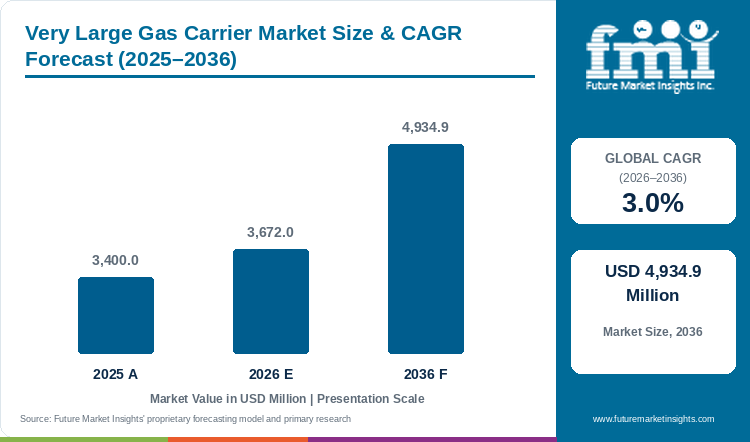
Revenue in the global very large gas carrier market is forecast to rise to USD 4,934.9 million by 2036 at a CAGR of 3.0% between 2026 and 2036. The market was valued at USD 3,400.0 million in 2025, with USD 3,672.0 million estimated for 2026.
Very Large Gas Carrier Market Size and Forecast
Table 1: Very Large Gas Carrier Market Size and Forecast
| Market size and forecast | Value |
|---|---|
| Market size in 2025 | USD 3,400.0 million |
| Estimated market size in 2026 | USD 3,672.0 million |
| Projected market size by 2036 | USD 4,934.9 million |
| CAGR from 2026 to 2036 | 3.0% |
Source: Future Market Insights analysis of the very large gas carrier market, 2026.
Shipowners are reserving delivery capacity several years before the ships enter service. BW LPG signed for eight 90,000-cubic-metre Panamax newbuildings in May 2026 for about USD 940.0 million, with deliveries expected from early 2029 through the second quarter of 2030. Dorian LPG's June 2026 agreement placed a single 90,000-cubic-metre ship at approximately USD 115.0 million for July 2029 delivery. These commitments make yard availability and the timing of fleet replacement more useful measures of newbuilding demand than a single quarter's freight earnings.
Conventional Fuel Oil holds 55.0% of 2026 delivery revenue, while the future order mix increasingly contains LPG dual-fuel designs. FMI expects future revenue to depend on the delivered specification and successful completion of these programmes. Charter hire, secondhand sales and standalone engine conversions remain separate from the new-vessel total.
Key Market Trends & Insights
- Cargo demand is changing direction as well as growing. The US Energy Information Administration reported that American propane exports to China fell 19.0% in the first half of 2026, despite higher total US exports. A yard's customer therefore needs route flexibility as well as cargo capacity.
- Shipbuilders are altering structural details within established LPG designs. HD Hyundai Samho reported its first LPG-carrier delivery with Hybrid Vertical Support in February 2026. The system changes how the tanks are restrained and illustrates a competition based on engineering content within an existing ship class.
- Delivered ammonia-carrying capability is becoming more visible. Samho handed over the 93,000-cubic-metre Jane Maersk in July 2026. Its ability to carry ammonia or LPG is a cargo characteristic and should be assessed separately from the fuel burnt by its engines.
Regional Highlights
- India, China and the United Arab Emirates widen their share of global revenue. FMI projects India at 8.2% against 7.0% in 2026, China at 15.0% against 14.0% in 2026 and the United Arab Emirates at 8.5% against 8.0% in 2026 by 2036.
- Share slips for Japan, Singapore and Norway as revenue grows. FMI projects Japan from 12.0% to 11.1%, Singapore from 14.0% to 13.6% and Norway from 9.0% to 8.7% over the same period.
Analyst Perspective
“Newbuilding demand is most durable when the delivery date matches a funded cargo programme and the vessel retains useful trading options. A high freight market can support the investment decision, but it cannot bring a ship forward from a yard slot several years away. Builders with a demonstrated delivery record and a clearly priced fuel specification have a stronger commercial offer than a design whose future conversion cost remains open.”
- Nikhil Kaitwade, Principal Consultant, FMI
How is the Very Large Gas Carrier Market segmented?
- By cargo system: Fully Refrigerated LPG, Ethane and Ethylene Capable, and Ammonia Capable.
- By fuel type: Conventional Fuel Oil, LPG Dual-Fuel, and Ammonia and Methanol Ready.
- By capacity: Below 85,000 Cubic Metres, 85,000 to 95,000 Cubic Metres, and Above 95,000 Cubic Metres.
- By region: Southeast Asia, East Asia, Northern Europe, Southern Europe, Middle East, South Asia, North America, and Rest of world.
Why does the Fully Refrigerated LPG segment lead by Cargo System in the Very Large Gas Carrier Market in 2026?
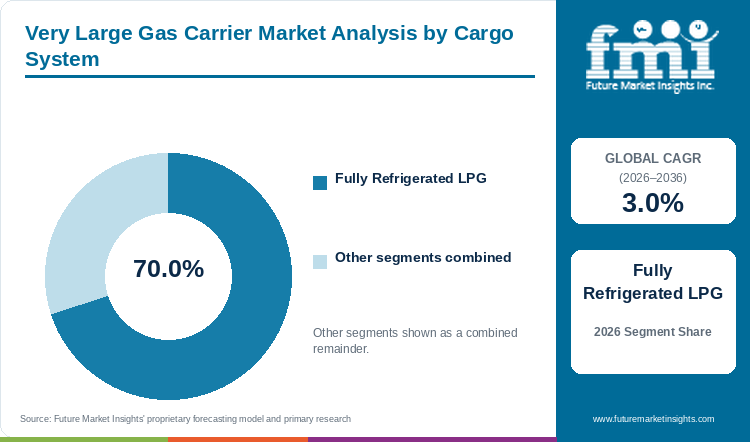
The Fully Refrigerated LPG segment holds 70.0% of the Very Large Gas Carrier Market by cargo system in 2026.
The scale of established LPG trade gives this category the leading delivery-revenue base. Import programmes need continuing transport availability, while owners must decide when additional ships are preferable to retaining or buying existing tonnage. The commercial link is visible in India's agreement for 2.2 million tonnes per year of US Gulf LPG for the 2026 contract year. Such supply arrangements support a shipping requirement, and additional ship orders depend on owner fleet decisions.
FMI forecasts Fully Refrigerated LPG revenue of USD 2,907.7 million in 2036. Its share declines to 58.9% as the other cargo specifications expand. Ethane and Ethylene Capable revenue grows at 5.2% annually, while Ammonia Capable grows at 8.2%. These differences suggest a broader design mix across the delivery cycle.
The competitive consequence is a need to maintain repeatable LPG construction while developing credible references in the newer cargo categories. Jiangnan's work for AW Shipping includes both ethane and ammonia designs. A yard's ability to show the relevant containment and cargo-handling experience matters more than a general claim to build gas ships. LNG construction is a related capability, but it belongs outside this report's cargo boundary.
Ethane and Ethylene Capable and Ammonia Capable together hold the remaining 30.0% by cargo system.
Table 2: Cargo System, 2026 Share
| Leading Share | 2026 market share |
|---|---|
| Fully Refrigerated LPG | 70.0% |
| All Other Segments Combined Share | 30.0% |
Source: Future Market Insights analysis of the very large gas carrier market, 2026.
Why does the Conventional Fuel Oil segment lead by Fuel Type in the Very Large Gas Carrier Market in 2026?
The Conventional Fuel Oil segment holds 55.0% of the Very Large Gas Carrier Market by fuel type in 2026.
The delivery mix contains the consequences of investment decisions made earlier. It therefore changes more slowly than a list of recent orders. Conventional Fuel Oil remains the leading category in 2026 but FMI forecasts its revenue declining at a 2.7% annual rate to USD 1,531.0 million in 2036. Its share falls to 31.0%. LPG Dual-Fuel reaches 47.5% by the end of the period, making the leading fuel position a changing commercial outcome.
Delivered equipment provides a firmer test of this transition than fuel-readiness descriptions. MOL received the 88,000-cubic-metre Energia Grandeur from Samho in January 2026. The ship uses LPG dual-fuel propulsion and carries a shaft generator. Its specification shows that the investment decision extends beyond choosing an engine label. Owners are buying a defined combination of installed machinery and expected service performance.
The marine propulsion engine market is consequently relevant to vessel specifications, and separate engine sales sit outside this market's vessel values. Suppliers need to distinguish an installed dual-fuel system from a readiness allowance for a later conversion. Those choices carry different initial prices, commissioning obligations and future expenditure. Treating them as equivalent would obscure the reason buyers pay different prices for ships of similar cargo capacity.
LPG Dual-Fuel and Ammonia and Methanol Ready together hold the remaining 45.0% by fuel type.
Table 3: Fuel Type, 2026 Share
| Leading Share | 2026 market share |
|---|---|
| Conventional Fuel Oil | 55.0% |
| All Other Segments Combined Share | 45.0% |
Source: Future Market Insights analysis of the very large gas carrier market, 2026.
Why does the 85,000 to 95,000 Cubic Metres segment lead by Capacity in the Very Large Gas Carrier Market in 2026?
The 85,000 to 95,000 Cubic Metres segment holds 70.0% of the Very Large Gas Carrier Market by capacity in 2026.
This size band accommodates several commercial designs with different trading characteristics. Dorian's 90,000-cubic-metre newbuilding was specified to use the old Panama Canal locks. NYK's planned ammonia service for JERA uses an approximately 87,000-cubic-metre design. Both sit inside the leading band, yet the relevant dimensions and service requirements differ.
The band retains a 68.8% share in FMI's 2036 outlook, with revenue of USD 3,393.8 million. The Above 95,000 Cubic Metres category grows at 4.8% annually as larger designs gain a greater role. Buyers still need a cargo programme suited to the additional capacity. The contract price of a larger vessel is easier to defend when a charter or integrated supply arrangement supports its utilization.
For shipbuilders, maintaining a successful series in the leading band can support repeat orders and engineering continuity. Expansion into larger ships adds another requirement for demonstrated cargo performance. The relevant distinction is between a repeatable production design and a larger concept still progressing through approvals. An approval in principle establishes a design-stage milestone, while delivery establishes a different level of commercial evidence.
Below 85,000 Cubic Metres and Above 95,000 Cubic Metres together hold the remaining 30.0% by capacity.
Table 4: Capacity, 2026 Share
| Leading Share | 2026 market share |
|---|---|
| 85,000 to 95,000 Cubic Metres | 70.0% |
| All Other Segments Combined Share | 30.0% |
Source: Future Market Insights analysis of the very large gas carrier market, 2026.
What are the key drivers restraints and opportunities?
Longer-distance gas trade and fleet renewal support newbuilding commitments. Delivery-slot timing and uncertain future fuel costs constrain purchasing. Contracted ammonia and ethane chains offer additional demand for specialized vessels.
Driver
Gas supply programmes and renewal of existing fleets create a requirement for ships with specified delivery dates and cargo performance.
Restraint
Owners commit capital years before service begins, exposing the purchase to changes in freight earnings, cargo availability and propulsion economics.
Opportunity
A shipyard can win higher-value work by delivering the cargo and fuel specification required by an industrial supply chain, with clear responsibility for testing and completion.
How do purchasing rules and qualification affect very large gas carrier market demand?
The strongest support for additional ships is a transport requirement that extends beyond an immediate freight-market disruption. NYK's June 2026 agreement with JERA secured two large ammonia carriers for a supply chain planned around fiscal 2029. This links vessel purchasing to the intended start of energy consumption. The timing matters because a carrier delivered too early needs alternative employment, while a late ship can disrupt the customer's logistics.
Fleet renewal is a separate source of orders. BW LPG's eight-ship commitment and Dorian's series of 2026 contracts show established operators reserving future capacity. Renewal can change the fuel and cargo mix even when the increase in annual vessel deliveries is modest. FMI's 2.0% volume CAGR therefore sits alongside a more substantial change in the composition of revenue. The adjacent large gas carrier segment is covered in FMI's LGC and VLGC LPG shipyard carrier market.
What limits reliable very large gas carrier market supply and quality?
An owner buying a ship for service several years ahead must evaluate more than the current spot freight rate. Delivery schedules, financing commitments and the intended charter start are connected. Replacing an existing vessel also involves a decision about when to sell it and how much operating capacity to retain during construction.
Fuel policy adds another uncertainty. IMO's September 2026 schedule placed further Net-Zero Framework negotiations later in the year. Builders can price the equipment included in a contract more clearly than they can guarantee the future cost of a particular fuel. Commercial comparisons need to preserve that distinction.
Where can suppliers win additional business in the very large gas carrier market?
Ammonia and ethane programmes create an opportunity for yards with relevant delivery references. The opportunity depends on actual cargo development and technical acceptance. The green ammonia market provides context for emerging cargo chains, but this vessel assessment includes ammonia regardless of its production route.
Cargo use and propulsion also have separate approval implications. The IMO framework allows ammonia cargo to be used as fuel on qualifying gas carriers subject to Administration acceptance and safety requirements. A shipyard that defines the installed system, testing responsibilities and limits of future conversion work can offer a more assessable contract. Detailed marine fuel injection systems form part of that equipment discussion. Their component revenue remains inside the complete vessel price when included in the new ship.
Very Large Gas Carrier Market by Country (2026 to 2036)
Table 5: Very Large Gas Carrier Market Country Growth Forecast
| Country | CAGR, 2026 to 2036 |
|---|---|
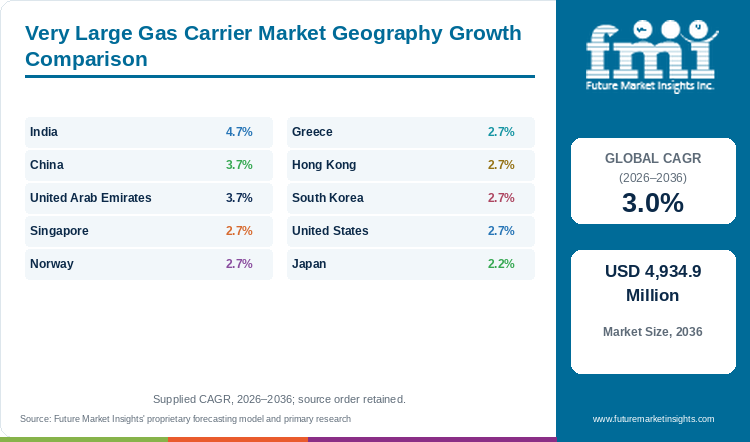
| India | 4.7% |
| China | 3.7% |
| United Arab Emirates | 3.7% |
| Singapore | 2.7% |
| Norway | 2.7% |
| Greece | 2.7% |
| Hong Kong | 2.7% |
| South Korea | 2.7% |
| United States | 2.7% |
| Japan | 2.2% |
Source: Future Market Insights analysis of the very large gas carrier market, 2026.
India
India's diversification of LPG supply changes the shipping requirement even before a new vessel is ordered. In November 2025, the Ministry of Petroleum and Natural Gas announced a structured agreement for approximately 2.2 million tonnes per year from the US Gulf Coast for the 2026 contract year. The longer supply connection places additional attention on voyage duration and reliable ship availability.
India has the highest growth rate among the locations in this outlook. FMI forecasts a CAGR of 4.7% from 2026 to 2036, taking revenue from USD 257.0 million to USD 405.9 million. Its share rises from 7.0% to 8.2%. The underlying commercial argument combines an import requirement with the gradual renewal of the fleet serving it.
Existing-vessel purchases can meet part of that requirement. BW LPG's July 2025 announcement described financing for two modern VLGC acquisitions by BW LPG India. These transfers fall outside newbuilding revenue. Their relevance is that an operator may choose immediate capacity and a lower construction-time exposure before committing to a new ship. This makes the relationship between import growth and ship deliveries uneven across years. Builders seeking Indian demand need to understand the intended charter arrangement and the owner's alternative access to existing tonnage. A dependable import programme supports employment, while the investment decision still depends on vessel price and delivery timing. FMI expects the newbuilding opportunity to expand as these fleet and sourcing decisions develop together.
China
China combines a gas-carrier construction base with industrial relationships that connect ship orders to chemical supply. The programme for AW Shipping illustrates the distinction. The buyer is a venture between ADNOC L&S and Wanhua Chemical, while the yard is in China and the ships serve international cargo chains. The Chinese industrial connection therefore extends beyond the location where a completed vessel is registered.
The country's market revenue is forecast at USD 737.8 million in 2036, representing a 3.7% CAGR from 2026 to 2036. China starts at USD 514.1 million and a 14.0% share. Its growth exceeds the global rate in FMI's outlook. Supporting the commercial interpretation, ADNOC L&S marked a first ammonia-carrier delivery from the yard in July 2026. Its share of global revenue rises from 14.0% to 15.0%. Revenue in China climbs by USD 223.7 million, first among the ten.
The investment challenge is to convert engineering breadth into a dependable construction series. Bureau Veritas separately approved an electric-propelled ammonia-carrier concept from the same yard in principle in September 2026. Buyers need to distinguish those stages when comparing offers. The same discipline applies across Chinese yards. LNG carriers, ammonia-ready crude tankers and LPG carriers belong to different cargo markets. FMI expects stronger commercial positions to accrue to yards with demonstrable references in the precise cargo specification being purchased, together with a delivery schedule that suits the owner's intended charter.
United Arab Emirates
The UAE provides a particularly clear example of an industrial shipping programme linked to a foreign yard. AW Shipping's 2024 contracts with the yard covered large ethane and ammonia vessels, combining ADNOC L&S' maritime operations with Wanhua Chemical's industrial relationship. The programme continued to produce visible delivery evidence in July 2026, when ADNOC L&S marked the first large ammonia-carrier delivery. This establishes a purchasing sequence from contract commitment to a completed asset.
FMI forecasts a 3.7% CAGR for the UAE from 2026 to 2036. Its market revenue rises from USD 293.8 million to USD 421.6 million. The projected share reaches 8.5%, compared with 8.0% in 2026. The country's opportunity is tied to the ability of industrial sponsors and shipping operators to coordinate fleet investment with the cargo business that the ships are intended to serve.
ADNOC L&S' July announcement also included a separate LNG-carrier order. Those LNG ships are outside this assessment, even though they share the same corporate buyer and construction relationship. Adding all announced gas-shipping expenditure together would overstate the relevant newbuilding opportunity. A yard serving UAE customers instead needs to isolate the precise ethane, LPG or ammonia contract and its completion schedule. Commercial certainty also differs between a vessel already delivered and one still being built for a future cargo chain. FMI expects that programme discipline, supported by an identifiable customer relationship, to be more informative than broad fleet-investment headlines when assessing the UAE market.
Singapore
Singapore's role in this market extends beyond the volume of LPG consumed locally. Shipping companies based there place orders and arrange employment for vessels serving international routes. BW LPG's May 2026 announcement was issued from Singapore and covered eight 90,000-cubic-metre ships scheduled for delivery in 2029 and 2030. The scale and timing of that series make corporate fleet planning a more relevant local demand indicator than a simple comparison with domestic gas consumption.
FMI projects a 2.7% CAGR for Singapore from 2026 to 2036. Revenue rises from USD 514.1 million to USD 669.8 million. Its 14.0% share in the opening year equals China's share. Singapore's commercial importance also appears in NYK Bulkship (Asia)'s agreement with JERA. The Singapore-based entity is providing ships for an ammonia movement between the United States and Japan. Its 2.7% CAGR runs 0.3 percentage points below the 3.0% global rate.
These arrangements place different decisions in the same corporate location. Fleet owners select delivery dates and financing, while an industrial charterer specifies a service requirement. Shipyards seeking repeat business need to understand which party controls the cargo commitment and which carries the residual-value exposure. FMI expects the market to remain sensitive to the willingness of internationally active owners to reserve newbuilding capacity before the replacement vessels begin earning revenue.
Norway
The Norwegian market is closely connected to international shipping capital and fleet ownership structures. An Oslo listing or Norwegian banking relationship reflects financing and ownership and not the place of construction. BW LPG's July 2025 financing announcement identifies DNB and other international banks among the lenders supporting fleet transactions and refinancing. The commercial importance lies in the availability and terms of capital for ship investment, including the decision between a new vessel and an existing asset.
At a CAGR of 2.7% from 2026 to 2036, FMI forecasts Norwegian market revenue rising from USD 330.5 million to USD 430.6 million. Its share moderates from 9.0% to 8.7%. The outlook is consistent with continuing investment participation. Shipbuilding production and country demand remain distinct measures throughout the assessment.
The 2025 financing also covered vessels acquired from the former Avance Gas fleet. Those purchases were secondhand transactions and are excluded from this market's delivery revenue. They remain commercially relevant because a well-financed acquisition can satisfy a fleet requirement that might otherwise produce a newbuilding order. Owners evaluate the price and expected service life of an existing ship against the longer wait and different specification of a new one. The Norwegian commercial argument is therefore about capital allocation across alternatives. Yards compete for a future investment commitment, while lenders assess the borrower's wider shipping business and the assets supporting the loan. FMI expects the ability to sustain that financing through the construction period to remain a material influence on demand.
Greece
Greek shipping's international employment pattern makes domestic gas consumption an incomplete measure of the country's vessel-purchasing opportunity. The Union of Greek Shipowners' 2025 to 2026 report lists 157 LPG carriers in the Greek-owned fleet, representing 11.0% of the global LPG-carrier fleet by vessel number. This broader category includes ships outside the capacity boundary of the present assessment. That fleet still forms a substantial ownership base for future renewal decisions.
FMI assigns Greece a 2.7% CAGR for 2026 to 2036. Revenue increases from USD 293.8 million to USD 382.8 million. The 2026 share is 8.0%. Owners participating in this market typically evaluate the ship's international earning potential and eventual sale value alongside its original purchase price. The key commercial question is when a more efficient or more flexible design justifies replacing a vessel that can still find employment.
Dorian's June 2026 announcement identifies an Athens office alongside offices in Stamford and Copenhagen. Its international footprint shows that company incorporation, management activity and vessel flag give different country measures. For builders, Greek shipping relationships require an offer that remains credible across a range of potential charters. Price competitiveness matters, but so do the contract's fuel-system commitments and the eventual buyer pool for the completed ship. A highly specialized design may secure a particular industrial service while carrying a different residual-value exposure from a more broadly employable LPG carrier. FMI expects owners to balance these considerations as renewal programmes proceed.
Hong Kong
Hong Kong's contribution is most usefully examined through its shipping and registration services. The Marine Department launched new green-maritime incentives in June 2026, including a registration scheme for vessels using specified green fuels as their primary propulsion fuel. That definition matters for gas-carrier procurement. Carrying a fuel as cargo, being technically ready for a later conversion and already operating on an eligible fuel are different commercial positions.
The market outlook for Hong Kong advances at a CAGR of 2.7% from 2026 to 2036. FMI projects revenue of USD 220.3 million in 2026 and USD 287.1 million in 2036. The profile concerns a shipping jurisdiction and purchasing environment. A 2.7% CAGR leaves Hong Kong 0.3 points below the 3.0% global pace.
The new registration scheme offers an annual HKD 60,000.0 incentive for an eligible ship, within the scheme's conditions. This is a modest item beside a new large gas carrier's capital price. Its greater analytical value is the clarity it requires about the actual propulsion arrangement. The published list includes LNG, methanol, ammonia and hydrogen, so eligibility of an LPG dual-fuel vessel for that registration incentive needs checking. Owners and yards need to assess the precise qualifying equipment and operating conditions. FMI expects Hong Kong's commercial relevance to depend on how its shipping services support international fleet choices.
South Korea
South Korea participates on both sides of a gas-carrier transaction. Its yards build for foreign owners, while domestic shipping companies also invest in gas tonnage. KSS Line's May 2026 quarterly filing records a commitment for three 90,000-cubic-metre VLGCs with HD Hyundai Heavy Industries following its April board decision. The record is useful because it identifies a Korean purchasing company separately from the much broader export orderbooks of Korean shipyards.
FMI estimates South Korean demand at USD 183.6 million in 2026 and USD 239.2 million in 2036, a 2.7% CAGR over the forecast period. Equating the two would give a misleading account of a construction industry that serves international customers across many vessel types. The CAGR for South Korea is 2.7%, which runs 0.3 points below the 3.0% worldwide rate. On 2026 revenue, South Korea stands ninth in the ten-country set.
Delivery performance provides a second local competitive point. Samho's July 2026 delivery of its first very large ammonia carrier shows progression beyond an order announcement. The yard's February LPG-carrier structural development represents a separate engineering distinction. Together, these examples show how builders compete within the same overall capacity band through cargo specification and construction execution. For a Korean owner, the commercial test remains the vessel's intended employment and financing. FMI expects the country's opportunity to remain a combination of selective domestic fleet investment and a much larger, separately measured shipbuilding export business.
United States
American export growth supplies a substantial commercial reason for long-distance LPG transport. EIA reported US propane exports averaging 2.0 million barrels per day in the first half of 2026, up 11.0% from a year earlier. That flow creates shipping employment across international routes.
The United States outlook grows at a 2.7% CAGR between 2026 and 2036. FMI projects revenue of USD 146.9 million in 2026 and USD 191.4 million in 2036. Its 4.0% starting share is therefore compatible with a much larger role in the cargo origin of the world's gas-carrier fleet. Commodity production and country newbuilding demand measure different activities. The market adds USD 44.5 million over the decade, and its 2.7% CAGR runs 0.3 percentage points below the 3.0% global rate.
Dorian's November 2026 results show how operating economics and replacement decisions can interact. The company reported strong quarterly freight earnings while confirming August contracts for three dual-fuel Panamax ships from Hanwha Ocean for 2030 delivery. The new vessels will arrive after a construction interval, so the investment is exposed to the market conditions at that later date. In the meantime, owners can sell existing ships and rebalance employment. FMI expects the US-related opportunity to depend on sustained export access and fleet investment by companies managing international shipping businesses. A temporary surge in export volumes or freight earnings describes current conditions, while construction orders follow the future delivery schedule.
Japan
Japan's emerging fuel-ammonia procurement creates a defined timing requirement for large gas transport. NYK announced a June 2026 time-charter agreement with JERA for two ships intended to move low-carbon ammonia from Louisiana to Hekinan. The power-station programme was scheduled around fiscal 2029. The vessel requirement is consequently connected to an identified destination and intended consumption date, giving the purchasing discussion more substance than a general projection of ammonia demand.
The Japan outlook advances at a 2.2% CAGR between 2026 and 2036. FMI estimates revenue at USD 440.6 million in 2026 and USD 546.9 million by 2036. Growth below the global average still allows the specification mix to change. A mature purchasing base can replace ships with more complex designs while adding few delivered vessels.
MOL's Energia Grandeur provides another view of the Japanese shipping chain. Its group company in Singapore ordered the vessel from Samho, and the delivered ship entered a charter arrangement with a TotalEnergies subsidiary. This separates the shipping group's national identity from the construction country and commercial charter counterparty. For yards, the relevant commercial work includes coordinating the approved vessel specification with the owner's financing and the charterer's start date. A missed delivery window can create a different exposure from a modest difference in contract price. Japan's market therefore rewards delivery performance and an accurate understanding of the particular industrial or energy customer behind the transport requirement.
Who are the notable companies in the Very Large Gas Carrier Market?
Notable companies in the Very Large Gas Carrier Market include HD Hyundai Heavy Industries, Hanwha Ocean, Jiangnan Shipyard, HD Hyundai Samho Heavy Industries, currently HD Hyundai Samho and Dalian Shipbuilding Industry Company.
HD Hyundai Heavy Industries, Hanwha Ocean, Jiangnan Shipyard and HD Hyundai Samho Heavy Industries have identifiable connections to the LPG, ammonia or ethane construction programmes considered here. The relevant competitive evidence includes an owner naming the contracted yard and an announced delivery of a completed ship. HD Hyundai Samho Heavy Industries is referred to as HD Hyundai Samho in current company material. It shares the wider HD Hyundai group with HD Hyundai Heavy Industries, so these construction sites should not be treated as unrelated economic owners.
Dalian Shipbuilding Industry Company and Qingdao Beihai Shipbuilding belong in a wider shipbuilding comparison. Their documented references include Dalian's LNG work and Beihai-built crude tankers in CMB.TECH's fleet. Neither category is included in the present vessel revenue boundary. Their engineering activity may be relevant to adjacent competition, but it does not establish a comparable completed VLGC programme.
Competition between direct builders is best assessed against the buyer's required cargo and delivery window. A yard with a repeat LPG series has a different reference base from one demonstrating a new ammonia concept. The latter can expand future bidding options, while the former supports an immediate assessment of production experience. FMI does not assign numerical company market shares from these qualitative differences.
Key Developments in the Very Large Gas Carrier Market
- On 30 May 2026, BW LPG announced an agreement with HD Hyundai Heavy Industries for eight 90,000-cubic-metre Panamax newbuildings at approximately USD 940.0 million, subject to final technical specifications. Deliveries were expected from early 2029 to the second quarter of 2030.
- On 27 July 2026, HD Hyundai Samho announced delivery of the 93,000-cubic-metre Jane Maersk, its first very large ammonia carrier. The completed vessel can transport ammonia or LPG.
Key Players in the Very Large Gas Carrier Market
- HD Hyundai Heavy Industries
- Hanwha Ocean
- Jiangnan Shipyard
- HD Hyundai Samho Heavy Industries, currently HD Hyundai Samho
- Dalian Shipbuilding Industry Company
- Qingdao Beihai Shipbuilding
Very Large Gas Carrier Market Report Scope
Table 6: Very Large Gas Carrier Market Report Scope
| Coverage field | Report scope |
|---|---|
| Market definition | New gas-carrier vessels above 60,000 cubic metres delivered for LPG, ammonia and ethane transport. |
| Revenue boundary | Complete vessel contract delivery prices. |
| Excluded activity | LNG carriers, smaller gas ships, secondhand vessel transactions, charter-service revenue and standalone retrofits or equipment sales. |
| Quantitative Units | USD million |
| Volume basis | Annual new-vessel delivery outlook in vessels. |
| Segmentation | Cargo System, Fuel Type and Capacity. |
| Country and jurisdiction coverage | Singapore, China, Japan, Norway, Greece, United Arab Emirates, India, Hong Kong, South Korea and United States |
| Companies covered | HD Hyundai Heavy Industries, Hanwha Ocean, Jiangnan Shipyard, Dalian Shipbuilding Industry Company, HD Hyundai Samho Heavy Industries and Qingdao Beihai Shipbuilding. Direct and adjacent roles are distinguished. |
Source: Future Market Insights analysis of the very large gas carrier market, 2026.
Very Large Gas Carrier Market Research Methodology
The assessment examines FMI's new-vessel outlook alongside shipowner disclosures, shipyard delivery records, energy statistics and maritime authority material. Company comparisons distinguish operating references, construction commitments and design-stage approvals. The market boundary includes vessels above 60,000 cubic metres for LPG, ammonia and ethane cargoes. Values exclude LNG ships, resale transactions, charter services and standalone conversion work.
Very Large Gas Carrier Market by Segments
Very Large Gas Carrier Market segmented by Cargo System:
- Fully Refrigerated LPG
- Ethane and Ethylene Capable
- Ammonia Capable
Very Large Gas Carrier Market segmented by Fuel Type:
- Conventional Fuel Oil
- LPG Dual-Fuel
- Ammonia and Methanol Ready
Very Large Gas Carrier Market segmented by Capacity:
- Below 85,000 Cubic Metres
- 85,000 to 95,000 Cubic Metres
- Above 95,000 Cubic Metres
Very Large Gas Carrier Market by Region
- North America
- United States
- Southeast Asia
- Singapore
- East Asia
- China
- Japan
- Hong Kong
- South Korea
- Northern Europe
- Norway
- Southern Europe
- Greece
- Middle East
- United Arab Emirates
- South Asia
- India
- Rest of world
- Aggregate of other markets
Research Sources and Bibliography
- ADNOC Logistics & Services. (2024, July 23). ADNOC L&S Joint Venture Awards USD 1.9 billion in Contracts for Very Large Ethane Carriers and Very Large Ammonia Carriers.
- ADNOC Logistics & Services. (2026, July 10). ADNOC L&S Expands LNG Fleet with Order for Four New Carriers. Includes the separate first VLAC delivery.
- BW LPG. (2025, July 17). BW LPG successfully closes two key financing facilities.
- BW LPG. (2026, May 30). BW LPG enters into agreement for eight 90,000 cbm Panamax newbuildings with Hyundai Heavy Industries. SEC Exhibit 99.1.
- Bureau Veritas Marine & Offshore. (2026, September 14). Jiangnan Shipyard's Electric Propelled Very Large Ammonia Carrier Receives AiP from Bureau Veritas. https://marine-offshore.bureauveritas.com/newsroom/jiangnan-shipyards-electric-propelled-very-large-ammonia-carrier-receives-aip-bureau-0
- China Classification Society. (2025, September 26). Naming and delivery of the first 175,000-cubic-metre SEA SPIRIT LNG carrier built by Dalian Shipbuilding. https://www.ccs.org.cn/ccswz/articleDetail?id=202509260946632996
- CMB.TECH. (Accessed 2026, November 9). CMB.TECH fleet. Atrebates entry: 2026-built VLCC, Qingdao Beihai Shipbuilding. https://cmb.tech/fleet
- Dorian LPG. (2026, June 23). Dorian LPG Ltd. Announces VLGC Newbuilding Contract, Forward Chartering Estimates and Memorandums of Agreement to Sell Three VLGCs. SEC Exhibit 99.1. https://www.sec.gov/Archives/edgar/data/1596993/000159699326000028/lpg-20260623xex99d1.htm
- Dorian LPG. (2026, November 5). Dorian LPG Ltd. Announces Second Quarter Fiscal Year 2027 Financial Results. SEC Exhibit 99.1. https://www.sec.gov/Archives/edgar/data/1596993/000159699326000055/lpg-ex99d1.htm
- HD Hyundai Samho. (2026, February 5). World's First Delivery of LPG Carrier with HVS Technology. https://www.hd-samho.com/eng/bbs/news/view.do?n=152&pg=2&seek=&selKeyword=
- HD Hyundai Samho. (2026, July 27). First Ammonia Carrier Delivery Solidifies Position in Next-Gen Shipping. https://www.hd-samho.com/eng/bbs/news/view.do?n=155&pg=1
- Hong Kong Marine Department. (2026, June 12). Marine Department to launch two new incentive schemes in relation to green maritime fuel-related vessels to promote green transformation of shipping industry. https://www.info.gov.hk/gia/general/202606/12/P2026061200257.htm
- IMO GreenVoyage2050. (Accessed 2026, November 9). Alternative marine fuels: Regulatory mapping. Ammonia cargo-as-fuel provisions and Resolution MSC.566(109). https://greenvoyage2050.imo.org/alternative-marine-fuels-regulatory-mapping/
- International Maritime Organization. (Accessed 2026, November 9). International Code for the Construction and Equipment of Ships Carrying Liquefied Gases in Bulk. https://www.imo.org/en/ourwork/environment/pages/igccode.aspx
- International Maritime Organization. (2026, September 1). Intersessional Working Group on GHG Emissions from ships meets in London, 1-4 September. Official IMO newsroom. https://imo-newsroom.prgloo.com/news/intersessional-working-group-on-ghg-emissions-from-ships-meets-in-london-1-4-september
- KSS Line. (2026, May 15). First-quarter 2026 report. Korea Exchange filing, subsequent vessel-construction commitment. https://kind.krx.co.kr/external/2026/05/15/000282/20260515000519/11013.htm
- Ministry of Petroleum & Natural Gas, India. (2025, November 17). India Concludes First-Ever Major LPG Import Deal with US. Press Information Bureau, release 2190755. https://www.pib.gov.in/PressReleasePage.aspx?PRID=2190755&lang=2®=48
- Mitsui O.S.K. Lines. (2026, February 6). MOL Takes Delivery of LPG-powered Newbuilding LPG Carrier Energia Grandeur to Serve Total. https://www.mol.co.jp/en/pr/2026/26014.html
- NYK Line. (2026, June 18). NYK Group Signs Time-Charter Contract with JERA for Low-Carbon Ammonia Transportation. https://www.nyk.com/english/news/2026/20260618_01.html
- Union of Greek Shipowners. (2026, May 26). Annual Report 2025-2026, Hellenic Shipping Moves the World. Fleet composition section. https://annualreport2526.ugs.gr/2026
- US Energy Information Administration. (2026, October 1). U.S. exports of propane reached records in the first half of 2026. https://www.eia.gov/todayinenergy/detail.php?id=68244
Table of Content
- Key Takeaways
- Market Size and CAGR
- Top Growth Driver
- Fastest Growing Segment
- Leading Region
- Key Companies
- Emerging Opportunities
- Executive Summary
- Global Market Outlook
- Demand-side Trends
- Supply-side Trends
- Technology Roadmap Analysis
- Analysis and Recommendations
- Analyst Perspective (What is happening? Why now? What should investors know?)
- Key Questions Answered
- How large is the market?
- What is the CAGR?
- What are key trends?
- Which region dominates?
- Who are the leaders?
Read More...
- Market Overview
- Market Coverage / Taxonomy
- Market Definition / Scope / Limitations
- Research Methodology
- Chapter Orientation
- Analytical Lens and Working Hypotheses
- Market Structure, Signals, and Trend Drivers
- Benchmarking and Cross-market Comparability
- Market Sizing, Forecasting, and Opportunity Mapping
- Research Design and Evidence Framework
- Desk Research Programme (Secondary Evidence)
- Expert Input and Fieldwork (Primary Evidence)
- Tooling, Models, and Reference Databases
- Data Engineering and Model Build
- Quality Assurance and Audit Trail
- Market Background
- Market Dynamics (Drivers, Restraints, Opportunity, Trends)
- Scenario Forecast (Optimistic, Likely, Conservative)
- Impact Analysis
- AI Impact
- Sustainability Impact
- Regulatory Impact
- Technology Impact
- Consumer / Buyer Analysis
- Purchase Drivers
- Adoption Barriers
- Buyer Journey
- Opportunity Map Analysis
- Product Life Cycle Analysis
- Supply Chain Analysis
- Investment Feasibility Matrix
- Value Chain Analysis
- PESTLE and Porter's Analysis
- Regulatory Landscape
- Regional Parent Market Outlook
- Production and Consumption Statistics
- Import and Export Statistics
- Global Market Analysis and Forecast, 2021 to 2036
- Historical Market Size Value (USD Million) Analysis, 2021 to 2025
- Current and Future Market Size Value (USD Million) Projections, 2026 to 2036
- Y-o-Y Growth Trend Analysis
- Absolute $ Opportunity Analysis
- Global Market Pricing Analysis, 2021 to 2036
- Global Market Analysis and Forecast, By Cargo System, 2021 to 2036
- Introduction / Key Findings
- Historical Market Size Value (USD Million) Analysis By Cargo System, 2021 to 2025
- Current and Future Market Size Value (USD Million) Analysis and Forecast By Cargo System, 2026 to 2036
- Fully Refrigerated LPG
- Ethane and Ethylene Capable
- Ammonia Capable
- Y-o-Y Growth Trend Analysis By Cargo System, 2021 to 2025
- Absolute $ Opportunity Analysis By Cargo System, 2026 to 2036
- Global Market Analysis and Forecast, By Fuel Type, 2021 to 2036
- Introduction / Key Findings
- Historical Market Size Value (USD Million) Analysis By Fuel Type, 2021 to 2025
- Current and Future Market Size Value (USD Million) Analysis and Forecast By Fuel Type, 2026 to 2036
- Conventional Fuel Oil
- LPG Dual-Fuel
- Ammonia and Methanol Ready
- Y-o-Y Growth Trend Analysis By Fuel Type, 2021 to 2025
- Absolute $ Opportunity Analysis By Fuel Type, 2026 to 2036
- Global Market Analysis and Forecast, By Capacity, 2021 to 2036
- Introduction / Key Findings
- Historical Market Size Value (USD Million) Analysis By Capacity, 2021 to 2025
- Current and Future Market Size Value (USD Million) Analysis and Forecast By Capacity, 2026 to 2036
- Below 85,000 Cubic Metres
- 85,000 to 95,000 Cubic Metres
- Above 95,000 Cubic Metres
- Y-o-Y Growth Trend Analysis By Capacity, 2021 to 2025
- Absolute $ Opportunity Analysis By Capacity, 2026 to 2036
- Global Market Analysis and Forecast, By Region, 2021 to 2036
- Introduction
- Historical Market Size Value (USD Million) Analysis By Region, 2021 to 2025
- Current Market Size Value (USD Million) Analysis and Forecast By Region, 2026 to 2036
- North America
- East Asia
- Middle East
- South Asia
- Market Attractiveness Analysis By Region
- North America Market Analysis and Forecast, By Country, 2021 to 2036
- Historical Market Size Value (USD Million) Trend Analysis By Market Taxonomy, 2021 to 2025
- Market Size Value (USD Million) Forecast By Market Taxonomy, 2026 to 2036
- By Country
- United States
- Southeast Asia
- Singapore
- By Cargo System
- By Fuel Type
- By Capacity
- By Country
- Market Attractiveness Analysis
- By Country
- By Cargo System
- By Fuel Type
- By Capacity
- Key Takeaways
- East Asia Market Analysis and Forecast, By Country
- Historical Market Size Value (USD Million) Trend Analysis By Market Taxonomy, 2021 to 2025
- Market Size Value (USD Million) Forecast By Market Taxonomy, 2026 to 2036
- By Country
- China
- Japan
- Hong Kong
- South Korea
- Northern Europe
- Norway
- Southern Europe
- Greece
- By Cargo System
- By Fuel Type
- By Capacity
- By Country
- Market Attractiveness Analysis
- By Country
- By Cargo System
- By Fuel Type
- By Capacity
- Key Takeaways
- Middle East Market Analysis and Forecast, By Country
- Historical Market Size Value (USD Million) Trend Analysis By Market Taxonomy, 2021 to 2025
- Market Size Value (USD Million) Forecast By Market Taxonomy, 2026 to 2036
- By Country
- United Arab Emirates
- By Cargo System
- By Fuel Type
- By Capacity
- By Country
- Market Attractiveness Analysis
- By Country
- By Cargo System
- By Fuel Type
- By Capacity
- Key Takeaways
- South Asia Market Analysis and Forecast, By Country
- Historical Market Size Value (USD Million) Trend Analysis By Market Taxonomy, 2021 to 2025
- Market Size Value (USD Million) Forecast By Market Taxonomy, 2026 to 2036
- By Country
- India
- Rest of world
- Aggregate of other markets
- By Cargo System
- By Fuel Type
- By Capacity
- By Country
- Market Attractiveness Analysis
- By Country
- By Cargo System
- By Fuel Type
- By Capacity
- Key Takeaways
- Key Countries Market Analysis
- United States
- Pricing Analysis
- Market Share Analysis, 2025
- By Cargo System
- By Fuel Type
- By Capacity
- India
- Pricing Analysis
- Market Share Analysis, 2025
- By Cargo System
- By Fuel Type
- By Capacity
- China
- Pricing Analysis
- Market Share Analysis, 2025
- By Cargo System
- By Fuel Type
- By Capacity
- Japan
- Pricing Analysis
- Market Share Analysis, 2025
- By Cargo System
- By Fuel Type
- By Capacity
- South Korea
- Pricing Analysis
- Market Share Analysis, 2025
- By Cargo System
- By Fuel Type
- By Capacity
- United Arab Emirates
- Pricing Analysis
- Market Share Analysis, 2025
- By Cargo System
- By Fuel Type
- By Capacity
- Singapore
- Pricing Analysis
- Market Share Analysis, 2025
- By Cargo System
- By Fuel Type
- By Capacity
- Norway
- Pricing Analysis
- Market Share Analysis, 2025
- By Cargo System
- By Fuel Type
- By Capacity
- Greece
- Pricing Analysis
- Market Share Analysis, 2025
- By Cargo System
- By Fuel Type
- By Capacity
- Hong Kong
- Pricing Analysis
- Market Share Analysis, 2025
- By Cargo System
- By Fuel Type
- By Capacity
- United States
- Market Structure Analysis
- Competition Dashboard
- Competition Benchmarking
- Market Share Analysis of Top Players
- By Regional
- By Cargo System
- By Fuel Type
- By Capacity
- Emerging Startups
- Innovation Benchmarking
- Competition Analysis
- Competition Deep Dive
- HD Hyundai Heavy Industries
- Overview
- Product Portfolio
- Profitability by Market Segments
- Sales Footprint
- Strategy Overview
- Marketing Strategy
- Product Strategy
- Channel Strategy
- Hanwha Ocean
- Jiangnan Shipyard
- Dalian Shipbuilding Industry Company
- HD Hyundai Samho Heavy Industries
- Qingdao Beihai Shipbuilding
- HD Hyundai Samho Heavy Industries, currently HD Hyundai Samho
- HD Hyundai Heavy Industries
- Case Studies
- Success Stories
- Recent Developments
- Competition Deep Dive
- Assumptions & Acronyms Used
List of Tables
- Table 1: Global Market Value (USD Million) Forecast by Region, 2021 to 2036
- Table 2: Global Market Value (USD Million) Forecast by Cargo System, 2021 to 2036
- Table 3: Global Market Value (USD Million) Forecast by Fuel Type, 2021 to 2036
- Table 4: Global Market Value (USD Million) Forecast by Capacity, 2021 to 2036
- Table 5: North America Market Value (USD Million) Forecast by Country, 2021 to 2036
- Table 6: North America Market Value (USD Million) Forecast by Cargo System, 2021 to 2036
- Table 7: North America Market Value (USD Million) Forecast by Fuel Type, 2021 to 2036
- Table 8: North America Market Value (USD Million) Forecast by Capacity, 2021 to 2036
- Table 9: East Asia Market Value (USD Million) Forecast by Country, 2021 to 2036
- Table 10: East Asia Market Value (USD Million) Forecast by Cargo System, 2021 to 2036
- Table 11: East Asia Market Value (USD Million) Forecast by Fuel Type, 2021 to 2036
- Table 12: East Asia Market Value (USD Million) Forecast by Capacity, 2021 to 2036
- Table 13: Middle East Market Value (USD Million) Forecast by Country, 2021 to 2036
- Table 14: Middle East Market Value (USD Million) Forecast by Cargo System, 2021 to 2036
- Table 15: Middle East Market Value (USD Million) Forecast by Fuel Type, 2021 to 2036
- Table 16: Middle East Market Value (USD Million) Forecast by Capacity, 2021 to 2036
- Table 17: South Asia Market Value (USD Million) Forecast by Country, 2021 to 2036
- Table 18: South Asia Market Value (USD Million) Forecast by Cargo System, 2021 to 2036
- Table 19: South Asia Market Value (USD Million) Forecast by Fuel Type, 2021 to 2036
- Table 20: South Asia Market Value (USD Million) Forecast by Capacity, 2021 to 2036
List of Figures
- Figure 1: Global Market Pricing Analysis
- Figure 2: Global Market Value (USD Million) Forecast 2021-2036
- Figure 3: Global Market Value Share and BPS Analysis by Cargo System, 2026 and 2036
- Figure 4: Global Market Y-o-Y Growth Comparison by Cargo System, 2026-2036
- Figure 5: Global Market Attractiveness Analysis by Cargo System
- Figure 6: Global Market Value Share and BPS Analysis by Fuel Type, 2026 and 2036
- Figure 7: Global Market Y-o-Y Growth Comparison by Fuel Type, 2026-2036
- Figure 8: Global Market Attractiveness Analysis by Fuel Type
- Figure 9: Global Market Value Share and BPS Analysis by Capacity, 2026 and 2036
- Figure 10: Global Market Y-o-Y Growth Comparison by Capacity, 2026-2036
- Figure 11: Global Market Attractiveness Analysis by Capacity
- Figure 12: Global Market Value (USD Million) Share and BPS Analysis by Region, 2026 and 2036
- Figure 13: Global Market Y-o-Y Growth Comparison by Region, 2026-2036
- Figure 14: Global Market Attractiveness Analysis by Region
- Figure 15: North America Market Incremental Dollar Opportunity, 2026-2036
- Figure 16: East Asia Market Incremental Dollar Opportunity, 2026-2036
- Figure 17: Middle East Market Incremental Dollar Opportunity, 2026-2036
- Figure 18: South Asia Market Incremental Dollar Opportunity, 2026-2036
- Figure 19: North America Market Value Share and BPS Analysis by Country, 2026 and 2036
- Figure 20: North America Market Value Share and BPS Analysis by Cargo System, 2026 and 2036
- Figure 21: North America Market Y-o-Y Growth Comparison by Cargo System, 2026-2036
- Figure 22: North America Market Attractiveness Analysis by Cargo System
- Figure 23: North America Market Value Share and BPS Analysis by Fuel Type, 2026 and 2036
- Figure 24: North America Market Y-o-Y Growth Comparison by Fuel Type, 2026-2036
- Figure 25: North America Market Attractiveness Analysis by Fuel Type
- Figure 26: North America Market Value Share and BPS Analysis by Capacity, 2026 and 2036
- Figure 27: North America Market Y-o-Y Growth Comparison by Capacity, 2026-2036
- Figure 28: North America Market Attractiveness Analysis by Capacity
- Figure 29: East Asia Market Value Share and BPS Analysis by Country, 2026 and 2036
- Figure 30: East Asia Market Value Share and BPS Analysis by Cargo System, 2026 and 2036
- Figure 31: East Asia Market Y-o-Y Growth Comparison by Cargo System, 2026-2036
- Figure 32: East Asia Market Attractiveness Analysis by Cargo System
- Figure 33: East Asia Market Value Share and BPS Analysis by Fuel Type, 2026 and 2036
- Figure 34: East Asia Market Y-o-Y Growth Comparison by Fuel Type, 2026-2036
- Figure 35: East Asia Market Attractiveness Analysis by Fuel Type
- Figure 36: East Asia Market Value Share and BPS Analysis by Capacity, 2026 and 2036
- Figure 37: East Asia Market Y-o-Y Growth Comparison by Capacity, 2026-2036
- Figure 38: East Asia Market Attractiveness Analysis by Capacity
- Figure 39: Middle East Market Value Share and BPS Analysis by Country, 2026 and 2036
- Figure 40: Middle East Market Value Share and BPS Analysis by Cargo System, 2026 and 2036
- Figure 41: Middle East Market Y-o-Y Growth Comparison by Cargo System, 2026-2036
- Figure 42: Middle East Market Attractiveness Analysis by Cargo System
- Figure 43: Middle East Market Value Share and BPS Analysis by Fuel Type, 2026 and 2036
- Figure 44: Middle East Market Y-o-Y Growth Comparison by Fuel Type, 2026-2036
- Figure 45: Middle East Market Attractiveness Analysis by Fuel Type
- Figure 46: Middle East Market Value Share and BPS Analysis by Capacity, 2026 and 2036
- Figure 47: Middle East Market Y-o-Y Growth Comparison by Capacity, 2026-2036
- Figure 48: Middle East Market Attractiveness Analysis by Capacity
- Figure 49: South Asia Market Value Share and BPS Analysis by Country, 2026 and 2036
- Figure 50: South Asia Market Value Share and BPS Analysis by Cargo System, 2026 and 2036
- Figure 51: South Asia Market Y-o-Y Growth Comparison by Cargo System, 2026-2036
- Figure 52: South Asia Market Attractiveness Analysis by Cargo System
- Figure 53: South Asia Market Value Share and BPS Analysis by Fuel Type, 2026 and 2036
- Figure 54: South Asia Market Y-o-Y Growth Comparison by Fuel Type, 2026-2036
- Figure 55: South Asia Market Attractiveness Analysis by Fuel Type
- Figure 56: South Asia Market Value Share and BPS Analysis by Capacity, 2026 and 2036
- Figure 57: South Asia Market Y-o-Y Growth Comparison by Capacity, 2026-2036
- Figure 58: South Asia Market Attractiveness Analysis by Capacity
- Figure 59: Global Market - Tier Structure Analysis
- Figure 60: Global Market - Company Share Analysis
Frequently Asked Questions
How big is the very large gas carrier market in 2026?
FMI estimates the market at USD 3,672.0 million in 2026, up from USD 3,400.0 million in 2025. It is forecast to reach USD 4,934.9 million by 2036 at a 3.0% CAGR.
Which cargo system leads the very large gas carrier market in 2026?
Fully Refrigerated LPG leads by cargo system with 70.0% in 2026. All other segments together hold 30.0%.
Which fuel type and capacity lead in 2026?
Conventional Fuel Oil holds 55.0% by fuel type and 85,000 to 95,000 Cubic Metres holds 70.0% by capacity in FMI's 2026 assessment.
Which market is forecast to grow fastest through 2036?
India has the highest forecast CAGR at 4.7% during 2026 to 2036, followed by China and United Arab Emirates at 3.7%.
Does a newbuilding announcement immediately enter market revenue?
This assessment values vessels at contract delivery prices in the delivery year. An order announced in 2026 for a ship scheduled in 2029 contributes to future construction activity, while its vessel delivery revenue belongs to the later delivery period.
Preview the report firsthand - request a free sample
Get SampleGet the brochure for pricing and purchase details.
Get PDF
