

- Market Size (2026)
- USD 2.6 Bn
- Forecast (2036)
- USD 9.5 Bn
- CAGR (2026 to 2036)
- 13.8%
How big is the Viral Sensitizers Market in 2026?
USD 2.6 billion in 2026 and USD 9.5 billion by 2036 at 13.8% CAGR.
Demand for viral sensitizers is projected to expand at 13.8% CAGR between 2026 and 2036, increasing valuation from USD 2.6 billion in 2026 to USD 9.6 billion by 2036. Qualified cell culture media and viral vector development programs enlarge the operating base that needs repeatable upstream productivity.
Regulated programs also require a defensible route from laboratory improvement into commercial manufacturing control systems. The FDA reported in January 2026 that CBER had approved close to 50 cell and gene therapies during the preceding decade. Each additional licensed program increases recurring demand for controlled upstream inputs that remain documented across manufacturing changes.
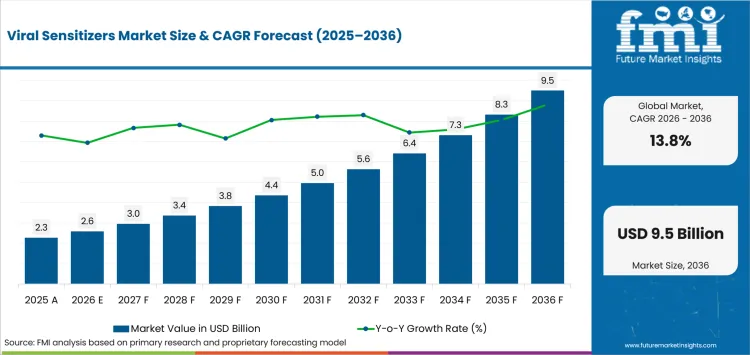
Key Takeaways of Viral Sensitizers Market
- Manufacturers use viral sensitizers to improve recoverable output from established processes without immediately adding another production train.
- Synthetic sensitizers are projected to represent 58.0% in 2026, supported by reproducible dosing and controlled raw-material documentation.
- Viral vaccines are estimated to account for 35.0% in 2026, due to repeatable amplification across scheduled manufacturing campaigns.
- Pharmaceutical companies are forecast to hold 39.0% in 2026, owing to integrated process development and quality oversight.
- Cell-virus specificity restrains adoption since yield gains must survive purification and formal comparability review across production platforms.
- Virica Biotech Inc., FUJIFILM Biosciences, Thermo Fisher Scientific Inc., Merck KGaA, Sartorius AG, Charles River Laboratories International, Inc., Lonza Group Ltd. and OXB serve the market through sensitizers, upstream systems or viral manufacturing support.
Analyst Perspective
"Viral sensitizers earn commercial value once higher output remains acceptable through purification and potency testing at production scale. Process teams should compare cell-virus coverage with residual-control evidence and transfer support, then decide whether one screening result supports a reusable platform."
- Anurag Sharma, Principal Consultant, Future Market Insights
How is the Viral Sensitizers Market segmented?
The market is segmented by product type, application, end user, distribution channel, application area and region.
Product type covers synthetic sensitizers, natural sensitizers and hybrid or other sensitizers used across controlled viral processes. Applications cover viral vaccines, viral vectors, oncolytic viral therapies and antiviral drug development, while end users include pharmaceutical companies, biotechnology companies, research institutes and contract research organizations. Distribution channels include direct sales, specialty distributors, online platforms and other routes, while application areas cover viral vector manufacturing, viral vaccine manufacturing, oncolytic virus manufacturing and other virotherapeutics.
Why do synthetic sensitizers hold the largest share within the product type category?
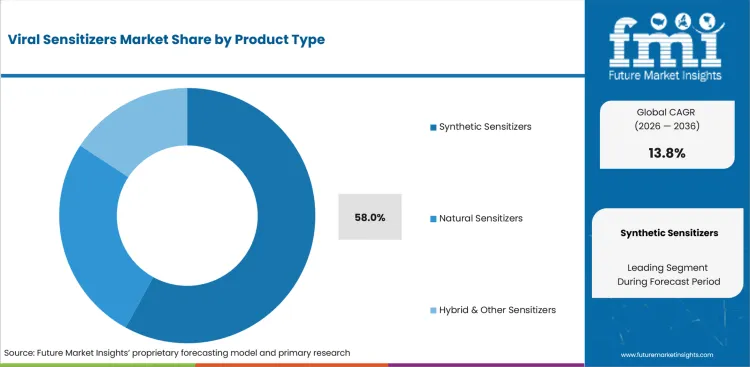
Synthetic sensitizers provide defined chemistry and timed dosing for studies that compare viral output with untreated controls. Their repeatable composition supports controlled screening within bioprocessing systems without replacing the established producer cell.
- By product type, synthetic sensitizers are estimated to hold 58.0% in 2026 owing to reproducible dosing and clearer raw-material documentation during manufacturing changes.
- Manufacturers prefer upstream inputs that enter an approved development package with traceable specifications and documented control across scale transfer. Merck completed its Mirus Bio acquisition in August 2024 to add GMP transfection reagents and strengthen viral-vector bioprocessing across research and commercial manufacturing programs.
Why do viral vaccines retain the largest share within the application category?
Viral vaccine production requires repeatable amplification from seed preparation through harvest and purification under controlled manufacturing conditions. Virica reported in July 2025 that small-molecule sensitizers raised Zika vaccine titers sevenfold across three cell lines, giving program teams a practical screening benchmark.
- In 2026, viral vaccines are expected to lead application with 35.0% share because established vaccine production platforms need predictable output across scheduled manufacturing campaigns.
- Campaign managers compare recoverable output with infectivity and antigen quality during scheduled production across qualified manufacturing platforms. Each sensitizer candidate also needs product-specific potency and clearance evidence to secure manufacturing approval across the intended vaccine platform.
How do pharmaceutical companies support demand within the end user category?
Pharmaceutical companies connect process development with quality systems and biologics contract manufacturing across regulated programs. Their approval authority allows yield gains to be assessed beside potency, impurities and supply continuity.
- Based on end user, pharmaceutical companies are projected to account for 39.0% in 2026 due to direct control over specifications and manufacturing changes.
- Sponsors need evidence routes that preserve control without repeating unnecessary development work across regulated programs. FDA issued final CMC flexibility guidance in May 2026 while confirming applicable quality requirements, so sponsors can use measured process changes without removing responsibility for sensitizer qualification.
What supports viral vector manufacturing demand within the application area category?
Viral vector manufacturing links upstream yield with research batches and clinical doses, so formulation research must address a defined serotype and producer-cell system. A Canadian contribution announced in May 2024 funded small-molecule formulations for enhanced AAV production under a UKRI biomanufacturing project and broadened testing activity.
- The application area is forecast to be led by viral vector manufacturing at 34.0% share in 2026 due to intensive process development across AAV and adenoviral workflows.
- Vector developers compare scalable yield improvement with potency, residual clearance and downstream recovery during transfer. Commercial adoption depends on serotype-specific evidence that remains valid across the intended production scale and purification route.
What are the drivers, restraints and opportunities in the Viral Sensitizers Market?
Driver: Manufacturers need more recoverable virus from qualified assets. Restraint: Cell-virus specificity requires product-level potency and impurity controls. Opportunity: Integrated screening can shorten formulation development and documented scale transfer.
- Driver: Manufacturers seek higher usable viral yield from qualified production assets ahead of funding another manufacturing train.
- Restraint: Sensitizers can alter impurity profiles and require product-specific qualification across downstream operations and release testing.
- Opportunity: Integrated formulation screening can produce transferable packages for regulated vaccine and vector manufacturing programs.
Additional production suites require capital and lengthy validation, so viral manufacturers seek more recoverable output from qualified assets. Better batch productivity protects campaign schedules across cell and gene therapy manufacturing programs with limited vector supply and fixed commercial launch plans.
A sensitizer can change cell state or impurity carryover even if viral titer improves during upstream testing. Process teams use viral safety testing and residual assays to confirm acceptable potency and clearance through purification and product release for each program.
Integrated biomanufacturing methods combine formulation experiments with assays that identify transferable conditions during early development. OXB reported in April 2026 that its fast-track AAV and lentiviral service can reduce the path to GMP manufacturing by as much as nine months for selected programs.
Which country CAGRs are profiled in the Viral Sensitizers Market?
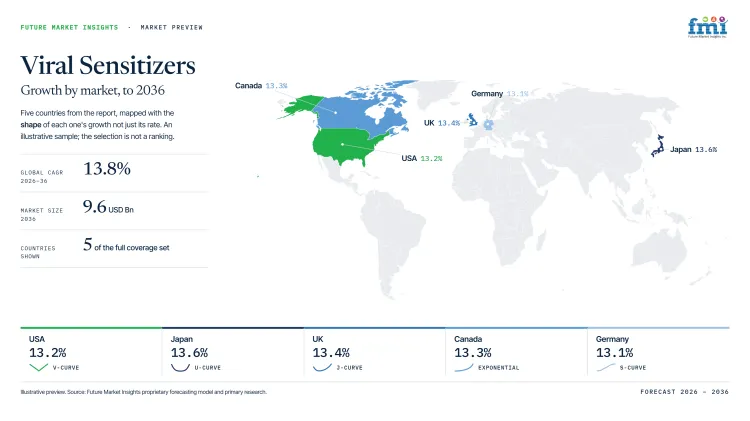
| Country | CAGR |
|---|---|
| South Korea | 14.7% |
| USA | 13.2% |
| Japan | 13.6% |
| Australia | 13.5% |
| UK | 13.4% |
| Canada | 13.3% |
| Germany | 13.1% |
How do country-level CAGRs compare in the Viral Sensitizers Market?
The profiled country range spans 1.4 percentage points and describes forecast pace without measuring current revenue or installed manufacturing depth.
- South Korea reflects biofoundry investment that broadens automated formulation screening across domestic biomanufacturing and advanced-therapy programs.
- Japan combines established regulatory review with domestic process-development capacity that supports advanced-therapy manufacturing and formal product assessment.
- Australia benefits from new viral-vector infrastructure although specialist services remain concentrated around major health precincts.
- The UK uses shared manufacturing hubs that support academic translation, process development and clinical-grade viral-vector supply programs.
- Canada combines public research support with an expanding domestic route for process development and pilot manufacturing.
Comparable CAGRs can produce different market entry conditions. The full report provides country-level CAGR analysis across North America, Latin America, Europe, East Asia, South Asia and Pacific, and the Middle East and Africa.
Country-wise Analysis
- South Korean biomanufacturing programs use public biofoundries to automate formulation screening across advanced-therapy projects and academic production networks, giving development teams repeatable methods for transfer into licensed manufacturing facilities with fixed manufacturing controls. The South Korean viral sensitizers sector is projected to record 14.7% CAGR during the assessment period, supported by national investment in standardized synthetic-biology infrastructure and automated experimental capacity for regulated development programs nationwide. The Synthetic Biology Promotion Act took effect in April 2026 and established support for biofoundries and standardization, although routine clinical or commercial supply requires product-specific methods and impurity controls across each regulated viral platform.
- Japanese advanced-therapy programs follow a formal review route that links manufacturing quality assessment with environmental evaluation across product development, technology transfer and preparations for licensed commercial production through domestic and imported manufacturing routes. PMDA's June 2024 webinar addressed quality review and environmental risk assessment for cell and gene therapy products, giving development teams a local review route while imported additives require local documentation and platform-specific clearance evidence. Japan's viral sensitizers market outlook is anticipated to advance at 13.6% CAGR over the assessment period, shaped by established domestic process-development expertise and formal review requirements for advanced therapies across licensed production sites.
- Australian vector programs depend on specialist production capability concentrated around major health precincts that connect laboratory studies with regulated process development and manufacturing-scale transfer through domestic production routes across early clinical and commercial programs. Viral sensitizer sales in Australia are forecast to expand at 13.5% CAGR by 2036, reinforced by new domestic process-development capacity for regulated vaccine and gene-therapy programs and commercial transfer requirements under national oversight. Sydney Children's Hospitals Network reported in October 2025 that its viral-vector facility operated with dedicated process-development laboratories, although projects outside eastern research centers face longer service distances and constrained specialist schedules during qualification.
- United Kingdom gene-therapy programs use shared innovation hubs that connect academic development with clinical-grade vector manufacturing, quality assurance and specialist process support during translation of rare-disease candidates across national networks and scheduled campaigns. The February 2025 Rare Diseases Action Plan confirmed that Gene Therapy Innovation Hubs provide process development and clinical-grade viral-vector manufacturing, although specialist capacity can lengthen scheduling and evidence preparation for purchases entering fixed campaigns. Adoption of viral sensitizers in the UK is estimated to expand at 13.4% CAGR through 2036, aided by national infrastructure serving translational programs and clinical manufacturing needs across shared facilities under national oversight.
- Ontario provides a domestic viral-vector route that connects process design with pilot manufacturing, giving emerging vaccine and gene-therapy programs a practical local setting for formulation testing and transfer across domestic development networks in Canada. Canada is estimated to post 13.3% CAGR over the forecast period, driven by expanding local process-development capacity and continued public support for biotechnology facilities serving domestic vaccine and gene-therapy programs through commercial transfer. The Federal Economic Development Agency for Southern Ontario reported in October 2025 that a 5,145-square-foot Concord facility supports viral-vector development although sponsors outside major clusters face longer service routes and limited release expertise.
Who are the notable companies in the Viral Sensitizers Market?
Virica Biotech Inc., FUJIFILM Biosciences, Thermo Fisher Scientific Inc., Merck KGaA, Sartorius AG, Charles River Laboratories International, Inc., Lonza Group Ltd. and OXB are the notable companies serving this market.
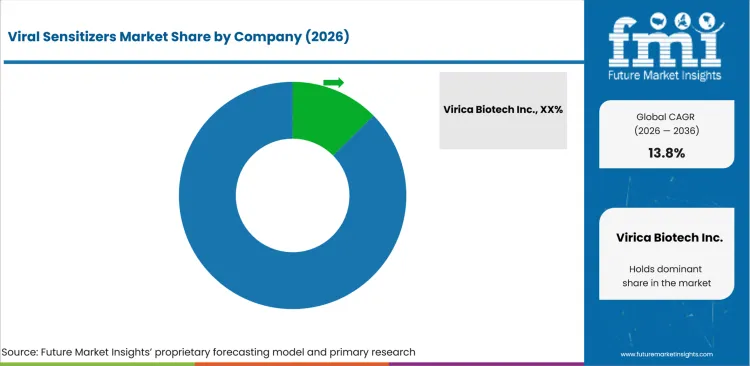
The competitive field is concentrated around a specialist sensitizer developer and larger upstream-platform groups with global production support. Entry barriers remain high across viral sensitizers owing to requirements for direct yield evidence, impurity assessment and viral vector analytics during manufacturing qualification.
- Virica Biotech Inc. and FUJIFILM Biosciences compete through dedicated enhancer chemistry and defined HEK293 media integration.
- Thermo Fisher Scientific Inc., Merck KGaA and Sartorius AG provide integrated production systems or GMP-grade upstream inputs.
- Charles River Laboratories International, Inc., Lonza Group Ltd. and OXB compete through process development, analytics and regulated vector manufacturing.
Competitive Benchmarking: Viral Sensitizers Market
| Company | Enhancer or upstream productivity tools | Viral platform coverage | Qualification and scale-up support | Geographic Reach |
|---|---|---|---|---|
| Virica Biotech Inc. | High | High | High | North America and selected international programs |
| FUJIFILM Biosciences | High | Medium | High | Global |
| Thermo Fisher Scientific Inc. | High | Medium | High | Global |
| Merck KGaA | Medium | High | High | Global |
| Sartorius AG | Medium | Medium | High | Global |
| Charles River Laboratories International, Inc. | Low | High | High | North America and Europe |
| Lonza Group Ltd. | Medium | High | High | North America, Europe and Asia |
| OXB | Medium | High | High | Europe and North America |
Key Developments in the Viral Sensitizers Market
- In April 2026, Virica Biotech Inc. launched Viric.AI to combine active learning with iterative experiments for adenovirus enhancer discovery and biomanufacturing formulation work.
- In April 2026, Virica Biotech Inc. and FUJIFILM Biosciences began a Canada-Japan program to develop an off-the-shelf enhancer-media solution for AAV production in the BalanCD HEK293 system.
- In September 2025, FUJIFILM Biosciences launched BalanCD HEK293 Perfusion A medium for high-density and perfusion production of AAV and lentiviral vectors.
Key Players in the Viral Sensitizers Market
Dedicated viral sensitizer and enhancer platforms
- Virica Biotech Inc.
Media, transfection and upstream process platforms
- FUJIFILM Biosciences
- Thermo Fisher Scientific Inc.
- Merck KGaA
- Sartorius AG
Viral vector process development and manufacturing platforms
- Charles River Laboratories International, Inc.
- Lonza Group Ltd.
- OXB
Viral Sensitizers Market - Report Scope
| Coverage field | Report scope |
|---|---|
| Market breakdown | By product type, application, end user, distribution channel, application area and region. |
| Quantitative Units | Revenue in USD billion and CAGR in %. |
| Market Definition | Viral sensitizer compounds, formulations and integrated solutions used to improve vaccine, vector, oncolytic and antiviral production. |
| Regions Covered | North America, Latin America, Europe, East Asia, South Asia and Pacific, and Middle East and Africa. |
| Countries Covered | South Korea, Japan, Australia, UK, Canada and 20+ countries included in the full report. |
| Key Companies Profiled | Virica Biotech Inc., FUJIFILM Biosciences, Thermo Fisher Scientific Inc., Merck KGaA, Sartorius AG, Charles River Laboratories International, Inc., Lonza Group Ltd. and OXB. |
| Forecast Period | 2026 to 2036. |
| Approach | Primary and secondary research with market triangulation. |
Viral Sensitizers Market - Research Methodology
| Method | Approach |
|---|---|
| Primary Research | FMI analysts gathered input from manufacturers, service providers, technology developers, distributors, end users, procurement teams, and subject-matter experts. Interviews examined purchasing decisions, product or service evaluation, adoption barriers, approval requirements, pricing considerations, and expectations for technical or commercial support. Respondents were also asked what evidence is required before a trial, pilot, or initial order develops into regular purchasing. |
| Desk Research | Desk research covered government statistics, regulatory publications, trade data, industry associations, technical literature, standards, company filings, product information, and official corporate announcements. Sources were reviewed for relevance, publication date, geographic coverage, and consistency with the defined market scope. Claims relating to performance, applications, approvals, capacity, investment, and commercial activity were retained only when supported by credible public evidence. |
| Market Sizing and Forecasting | The market model combined the baseline value with historical performance, segment structure, pricing and volume indicators, adoption levels, company participation, and country-level demand conditions. Forecast assumptions considered economic activity, investment trends, regulatory developments, technology adoption, purchasing cycles, supply availability, and barriers to wider market use. Segment and regional estimates were reconciled before the final market total was calculated. |
| Data Validation | Estimates were checked against multiple independent indicators, including public data, company activity, trade patterns, industry developments, and findings from primary interviews. Validation also tested whether products, services, applications, and company revenues fell within the defined market boundaries. Adjacent categories, unsupported claims, overlapping revenues, and activities without direct market relevance were excluded to reduce double counting and maintain consistency across segments and countries. |
Viral Sensitizers Market by Segments
Viral Sensitizers Market segmented by product type:
- Synthetic Sensitizers
- Small Molecule Sensitizers
- Chemically Synthesized Enhancers
- Natural Sensitizers
- Natural Compound-Based Sensitizers
- Biologically Derived Sensitizers
- Hybrid & Other Sensitizers
- Combination Sensitizers
- Experimental Sensitizers
Viral Sensitizers Market segmented by application:
- Viral Vaccines
- Viral Vaccine Manufacturing
- Recombinant Viral Vaccines
- Viral Vectors
- Gene Therapy Vectors
- Gene-Modified Cell Therapy Vectors
- Oncolytic Viral Therapies
- Oncolytic Virus Production
- Cancer Immunotherapy Applications
- Antiviral Drug Development
- Antiviral Screening
- Antiviral Therapeutic Research
Viral Sensitizers Market segmented by end user:
- Pharmaceutical Companies
- Vaccine Manufacturers
- Antiviral Drug Developers
- Biotechnology Companies
- Gene Therapy Developers
- Oncolytic Virus Developers
- Research Institutes
- Academic Research Centers
- Government Research Institutes
- Contract Research Organizations
- Viral Research CROs
- Bioprocess Development CROs
Viral Sensitizers Market segmented by distribution channel:
- Direct Sales
- Direct Manufacturer Sales
- Long-Term Research Agreements
- Specialty Distributors
- Biotechnology Distributors
- Laboratory Reagent Distributors
- Online Platforms
- Online Research Reagent Portals
- Direct E-Commerce Platforms
- Others
- Research Collaborations
- Third-Party Resellers
Viral Sensitizers Market segmented by application area:
- Viral Vector Manufacturing
- Adeno-Associated Virus (AAV) Vectors
- Adenoviral Vectors
- Viral Vaccine Manufacturing
- Viral Vector Vaccines
- Live Attenuated Vaccines
- Oncolytic Virus Manufacturing
- Oncolytic Adenoviruses
- Oncolytic Herpesviruses
- Other Virotherapeutics
- Viral Immunotherapies
- Research-Grade Viral Products
Viral Sensitizers Market by Region:
- North America
- United States
- Canada
- Latin America
- Brazil
- Chile
- Mexico
- Rest of Latin America
- Western Europe
- Germany
- United Kingdom
- Italy
- Spain
- France
- Nordics
- Benelux
- Rest of Western Europe
- Eastern Europe
- Russia
- Poland
- Hungary
- Balkan and Baltic States
- Rest of Eastern Europe
- East Asia
- China
- Japan
- South Korea
- South Asia and Pacific
- India
- ASEAN
- Australia and New Zealand
- Rest of South Asia and Pacific
- Middle East and Africa
- Kingdom of Saudi Arabia
- Other GCC Countries
- Türkiye
- South Africa
- Other African Union Countries
- Rest of Middle East and Africa
Research Sources and Bibliography
- USA Food and Drug Administration. (2026, January 11). FDA Increases Flexibility on Requirements for Cell and Gene Therapies to Advance Innovation.
- Merck KGaA. (2024, August 1). MilliporeSigma Announces Closing of Mirus Bio Acquisition, Bolstering Viral Vector Bioprocessing Offering.
- Virica Biotech Inc. (2025, July 17). Optimization of Zika Vaccine Production Using Small-Molecule Viral Sensitizers to Enhance Yields.
- USA Food and Drug Administration. (2026, May). Chemistry, Manufacturing, and Controls Flexibilities for Developing Human Cellular and Gene Therapy Products for a Biologics License Application Guidance for Industry.
- National Research Council Canada. (2024, May 1). UKRI Biomanufacturing - 10100745 - Viral Enhancers - Development of small molecule formulations for enhanced production of AAV.
- OXB. (2026, April 13). OXB launches fast-track offering for AAV and lentiviral vector platforms, accelerating viral vector development and manufacture.
- Korea Ministry of Government Legislation. (2025, April 22). Synthetic Biology Promotion Act.
- Pharmaceuticals and Medical Devices Agency. (2024, June 28). PMDA-ATC Review of Cell therapy and Gene therapy products Webinar 2024 for PPWG member states.
- Sydney Children's Hospitals Network. (2025, October 28). Establishing the Viral Vector Manufacturing Facility.
- Department of Health and Social Care. (2025, February 28). England Rare Diseases Action Plan 2025: main report.
- Federal Economic Development Agency for Southern Ontario. (2025, October 16). Government of Canada celebrates opening of new biotech facility in Concord.
- Virica Biotech Inc. (2026, April 23). Virica Launches Viric.AI to Accelerate Biomanufacturing Optimization.
- Virica Biotech Inc. (2026, April 8). Virica Biotech and FUJIFILM Biosciences Collaborate Under the Canada-Japan Co-Innovation Program to Advance AAV Production Enhancers.
- FUJIFILM Biosciences. (2025, September 15). FUJIFILM Biosciences Introduces BalanCD HEK293 Perfusion A Medium to Enable Gene Therapy Production.
- Thermo Fisher Scientific Inc. (n.d.). Lentivirus production for cell and gene therapy. Retrieved August 4, 2026, from Thermo Fisher Scientific.
- Sartorius AG. (2025, September 18). Sartorius expands production of key components for cell and gene therapies in France.
- Charles River Laboratories International, Inc. (2024, May 30). Charles River Launches Viral Vector Tech Transfer Program to Safeguard Gene Therapy Development.
- Lonza Group Ltd. (2026, May 12). Lonza Expands AAV Offering with Xcite AAV Stable Producer Cell Line Platform to Industrialize Viral Vector Manufacturing.
- OXB. (2026, March 18). OXB enters into licensing agreement with Viral Vector Manufacturing Facility, providing access to its AAV and LV viral vector platforms.
This bibliography is provided for reader reference and is not exhaustive. The full report contains the complete reference list and detailed citations
This Report Answers
- How large is the viral sensitizers market in 2026 and 2036?
- Which product type accounts for the largest viral sensitizers market share in 2026?
- Why do viral vaccines lead the application category during 2026?
- How do pharmaceutical companies shape recurring sensitizer purchasing across regulated programs?
- Which operating condition slows adoption of new viral sensitizer formulations?
- How do profiled country growth routes differ across viral sensitizer programs?
- Which companies provide sensitizers, upstream systems and regulated manufacturing support?
- How should manufacturers compare viral sensitizer options during process development?
Frequently Asked Questions
How big is the viral sensitizers market in 2026?
Around USD 2.6 billion is the estimated viral sensitizers market value in 2026 across vaccine and vector production programs. Manufacturers assess each formulation through cell-virus studies as usable yield improvements must remain consistent during purification, scale transfer and formal quality testing.
What is the CAGR of the viral sensitizers market from 2026 to 2036?
A 13.8% CAGR is projected for the viral sensitizers market between 2026 and 2036 as regulated viral production expands. Growth depends on formulation packages that combine screening evidence with process documentation and technical support for controlled transfer across distinct production platforms.
Which product type leads the viral sensitizers market?
Synthetic sensitizers account for an estimated 58.0% of the viral sensitizers market by product type in 2026. Defined composition and timed dosing support repeatable screening as manufacturers approve material specifications, impurity controls and controlled scale transfer across regulated programs worldwide.
How much value is the viral sensitizers market expected to add by 2036?
Approximately USD 7.0 billion is expected to be added to the viral sensitizers market between 2026 and 2036. Commercial gains require formulations that improve recoverable output without introducing additional potency concerns, residual risks or impurity burdens during purification and release review.
Which companies are active in the viral sensitizers market?
Active companies serve the viral sensitizers market through dedicated sensitizers, upstream production systems or regulated vector-manufacturing support. Virica Biotech provides the specialist platform while FUJIFILM Biosciences, Thermo Fisher, Merck, Sartorius, Charles River, Lonza and OXB provide adjacent implementation capabilities.
Preview the report firsthand - request a free sample
Get SampleGet the brochure for pricing and purchase details.
Get PDFTable of Content
- Key Takeaways
- Market Size and CAGR
- Top Growth Driver
- Fastest Growing Segment
- Leading Region
- Key Companies
- Emerging Opportunities
- Executive Summary
- Global Market Outlook
- Demand-side Trends
- Supply-side Trends
- Technology Roadmap Analysis
- Analysis and Recommendations
- Analyst Perspective (What is happening? Why now? What should investors know?)
- Key Questions Answered
- How large is the market?
- What is the CAGR?
- What are key trends?
- Which region dominates?
- Who are the leaders?
- Market Overview
- Market Coverage / Taxonomy
- Market Definition / Scope / Limitations
- Research Methodology
- Chapter Orientation
- Analytical Lens and Working Hypotheses
- Market Structure, Signals, and Trend Drivers
- Benchmarking and Cross-market Comparability
- Market Sizing, Forecasting, and Opportunity Mapping
- Research Design and Evidence Framework
- Desk Research Programme (Secondary Evidence)
- Expert Input and Fieldwork (Primary Evidence)
- Tooling, Models, and Reference Databases
- Data Engineering and Model Build
- Quality Assurance and Audit Trail
- Market Background
- Market Dynamics (Drivers, Restraints, Opportunity, Trends)
- Scenario Forecast (Optimistic, Likely, Conservative)
- Impact Analysis
- AI Impact
- Sustainability Impact
- Regulatory Impact
- Technology Impact
- Consumer / Buyer Analysis
- Purchase Drivers
- Adoption Barriers
- Buyer Journey
- Opportunity Map Analysis
- Product Life Cycle Analysis
- Supply Chain Analysis
- Investment Feasibility Matrix
- Value Chain Analysis
- PESTLE and Porter's Analysis
- Regulatory Landscape
- Regional Parent Market Outlook
- Production and Consumption Statistics
- Import and Export Statistics
- Global Market Analysis and Forecast, 2021 to 2036
- Historical Market Size Value (USD Billion) Analysis, 2021 to 2025
- Current and Future Market Size Value (USD Billion) Projections, 2026 to 2036
- Y-o-Y Growth Trend Analysis
- Absolute $ Opportunity Analysis
- Global Market Pricing Analysis, 2021 to 2036
- Global Market Analysis and Forecast, By Product Type, 2021 to 2036
- Introduction / Key Findings
- Historical Market Size Value (USD Billion) Analysis By Product Type, 2021 to 2025
- Current and Future Market Size Value (USD Billion) Analysis and Forecast By Product Type, 2026 to 2036
- Synthetic Sensitizers
- Small Molecule Sensitizers
- Chemically Synthesized Enhancers
- Natural Sensitizers
- Natural Compound-Based Sensitizers
- Biologically Derived Sensitizers
- Hybrid & Other Sensitizers
- Combination Sensitizers
- Experimental Sensitizers
- Synthetic Sensitizers
- Y-o-Y Growth Trend Analysis By Product Type, 2021 to 2025
- Absolute $ Opportunity Analysis By Product Type, 2026 to 2036
- Global Market Analysis and Forecast, By Application, 2021 to 2036
- Introduction / Key Findings
- Historical Market Size Value (USD Billion) Analysis By Application, 2021 to 2025
- Current and Future Market Size Value (USD Billion) Analysis and Forecast By Application, 2026 to 2036
- Viral Vaccines
- Viral Vaccine Manufacturing
- Recombinant Viral Vaccines
- Viral Vectors
- Gene Therapy Vectors
- Gene-Modified Cell Therapy Vectors
- Oncolytic Viral Therapies
- Oncolytic Virus Production
- Cancer Immunotherapy Applications
- Antiviral Drug Development
- Antiviral Screening
- Antiviral Therapeutic Research
- Viral Vaccines
- Y-o-Y Growth Trend Analysis By Application, 2021 to 2025
- Absolute $ Opportunity Analysis By Application, 2026 to 2036
- Global Market Analysis and Forecast, By End User, 2021 to 2036
- Introduction / Key Findings
- Historical Market Size Value (USD Billion) Analysis By End User, 2021 to 2025
- Current and Future Market Size Value (USD Billion) Analysis and Forecast By End User, 2026 to 2036
- Pharmaceutical Companies
- Vaccine Manufacturers
- Antiviral Drug Developers
- Biotechnology Companies
- Gene Therapy Developers
- Oncolytic Virus Developers
- Research Institutes
- Academic Research Centers
- Government Research Institutes
- Contract Research Organizations
- Viral Research CROs
- Bioprocess Development CROs
- Pharmaceutical Companies
- Y-o-Y Growth Trend Analysis By End User, 2021 to 2025
- Absolute $ Opportunity Analysis By End User, 2026 to 2036
- Global Market Analysis and Forecast, By Distribution Channel, 2021 to 2036
- Introduction / Key Findings
- Historical Market Size Value (USD Billion) Analysis By Distribution Channel, 2021 to 2025
- Current and Future Market Size Value (USD Billion) Analysis and Forecast By Distribution Channel, 2026 to 2036
- Direct Sales
- Direct Manufacturer Sales
- Long-Term Research Agreements
- Specialty Distributors
- Biotechnology Distributors
- Laboratory Reagent Distributors
- Online Platforms
- Online Research Reagent Portals
- Direct E-Commerce Platforms
- Others
- Research Collaborations
- Third-Party Resellers
- Direct Sales
- Y-o-Y Growth Trend Analysis By Distribution Channel, 2021 to 2025
- Absolute $ Opportunity Analysis By Distribution Channel, 2026 to 2036
- Global Market Analysis and Forecast, By Application Area, 2021 to 2036
- Introduction / Key Findings
- Historical Market Size Value (USD Billion) Analysis By Application Area, 2021 to 2025
- Current and Future Market Size Value (USD Billion) Analysis and Forecast By Application Area, 2026 to 2036
- Viral Vector Manufacturing
- Adeno-Associated Virus (AAV) Vectors
- Adenoviral Vectors
- Viral Vaccine Manufacturing
- Viral Vector Vaccines
- Live Attenuated Vaccines
- Oncolytic Virus Manufacturing
- Oncolytic Adenoviruses
- Oncolytic Herpesviruses
- Other Virotherapeutics
- Viral Immunotherapies
- Research-Grade Viral Products
- Viral Vector Manufacturing
- Y-o-Y Growth Trend Analysis By Application Area, 2021 to 2025
- Absolute $ Opportunity Analysis By Application Area, 2026 to 2036
- Global Market Analysis and Forecast, By Region, 2021 to 2036
- Introduction
- Historical Market Size Value (USD Billion) Analysis By Region, 2021 to 2025
- Current Market Size Value (USD Billion) Analysis and Forecast By Region, 2026 to 2036
- North America
- Latin America
- Western Europe
- Eastern Europe
- East Asia
- South Asia and Pacific
- Middle East & Africa
- Market Attractiveness Analysis By Region
- North America Market Analysis and Forecast, By Country, 2021 to 2036
- Historical Market Size Value (USD Billion) Trend Analysis By Market Taxonomy, 2021 to 2025
- Market Size Value (USD Billion) Forecast By Market Taxonomy, 2026 to 2036
- By Country
- USA
- Canada
- By Product Type
- By Application
- By End User
- By Distribution Channel
- By Application Area
- By Country
- Market Attractiveness Analysis
- By Country
- By Product Type
- By Application
- By End User
- By Distribution Channel
- By Application Area
- Key Takeaways
- Latin America Market Analysis and Forecast, By Country
- Historical Market Size Value (USD Billion) Trend Analysis By Market Taxonomy, 2021 to 2025
- Market Size Value (USD Billion) Forecast By Market Taxonomy, 2026 to 2036
- By Country
- Brazil
- Mexico
- Chile
- Rest of Latin America
- By Product Type
- By Application
- By End User
- By Distribution Channel
- By Application Area
- By Country
- Market Attractiveness Analysis
- By Country
- By Product Type
- By Application
- By End User
- By Distribution Channel
- By Application Area
- Key Takeaways
- Western Europe Market Analysis and Forecast, By Country
- Historical Market Size Value (USD Billion) Trend Analysis By Market Taxonomy, 2021 to 2025
- Market Size Value (USD Billion) Forecast By Market Taxonomy, 2026 to 2036
- By Country
- Germany
- UK
- Italy
- Spain
- France
- Nordic
- BENELUX
- Rest of Western Europe
- By Product Type
- By Application
- By End User
- By Distribution Channel
- By Application Area
- By Country
- Market Attractiveness Analysis
- By Country
- By Product Type
- By Application
- By End User
- By Distribution Channel
- By Application Area
- Key Takeaways
- Eastern Europe Market Analysis and Forecast, By Country
- Historical Market Size Value (USD Billion) Trend Analysis By Market Taxonomy, 2021 to 2025
- Market Size Value (USD Billion) Forecast By Market Taxonomy, 2026 to 2036
- By Country
- Russia
- Poland
- Hungary
- Balkan & Baltic
- Rest of Eastern Europe
- By Product Type
- By Application
- By End User
- By Distribution Channel
- By Application Area
- By Country
- Market Attractiveness Analysis
- By Country
- By Product Type
- By Application
- By End User
- By Distribution Channel
- By Application Area
- Key Takeaways
- East Asia Market Analysis and Forecast, By Country
- Historical Market Size Value (USD Billion) Trend Analysis By Market Taxonomy, 2021 to 2025
- Market Size Value (USD Billion) Forecast By Market Taxonomy, 2026 to 2036
- By Country
- China
- Japan
- South Korea
- By Product Type
- By Application
- By End User
- By Distribution Channel
- By Application Area
- By Country
- Market Attractiveness Analysis
- By Country
- By Product Type
- By Application
- By End User
- By Distribution Channel
- By Application Area
- Key Takeaways
- South Asia and Pacific Market Analysis and Forecast, By Country
- Historical Market Size Value (USD Billion) Trend Analysis By Market Taxonomy, 2021 to 2025
- Market Size Value (USD Billion) Forecast By Market Taxonomy, 2026 to 2036
- By Country
- India
- ASEAN
- Australia & New Zealand
- Rest of South Asia and Pacific
- By Product Type
- By Application
- By End User
- By Distribution Channel
- By Application Area
- By Country
- Market Attractiveness Analysis
- By Country
- By Product Type
- By Application
- By End User
- By Distribution Channel
- By Application Area
- Key Takeaways
- Middle East & Africa Market Analysis and Forecast, By Country
- Historical Market Size Value (USD Billion) Trend Analysis By Market Taxonomy, 2021 to 2025
- Market Size Value (USD Billion) Forecast By Market Taxonomy, 2026 to 2036
- By Country
- Kingdom of Saudi Arabia
- Other GCC Countries
- Türkiye
- South Africa
- Other African Union
- Rest of Middle East & Africa
- By Product Type
- By Application
- By End User
- By Distribution Channel
- By Application Area
- By Country
- Market Attractiveness Analysis
- By Country
- By Product Type
- By Application
- By End User
- By Distribution Channel
- By Application Area
- Key Takeaways
- Key Countries Market Analysis
- USA
- Pricing Analysis
- Market Share Analysis, 2025
- By Product Type
- By Application
- By End User
- By Distribution Channel
- By Application Area
- Canada
- Pricing Analysis
- Market Share Analysis, 2025
- By Product Type
- By Application
- By End User
- By Distribution Channel
- By Application Area
- Mexico
- Pricing Analysis
- Market Share Analysis, 2025
- By Product Type
- By Application
- By End User
- By Distribution Channel
- By Application Area
- Brazil
- Pricing Analysis
- Market Share Analysis, 2025
- By Product Type
- By Application
- By End User
- By Distribution Channel
- By Application Area
- Chile
- Pricing Analysis
- Market Share Analysis, 2025
- By Product Type
- By Application
- By End User
- By Distribution Channel
- By Application Area
- Germany
- Pricing Analysis
- Market Share Analysis, 2025
- By Product Type
- By Application
- By End User
- By Distribution Channel
- By Application Area
- UK
- Pricing Analysis
- Market Share Analysis, 2025
- By Product Type
- By Application
- By End User
- By Distribution Channel
- By Application Area
- Italy
- Pricing Analysis
- Market Share Analysis, 2025
- By Product Type
- By Application
- By End User
- By Distribution Channel
- By Application Area
- Spain
- Pricing Analysis
- Market Share Analysis, 2025
- By Product Type
- By Application
- By End User
- By Distribution Channel
- By Application Area
- France
- Pricing Analysis
- Market Share Analysis, 2025
- By Product Type
- By Application
- By End User
- By Distribution Channel
- By Application Area
- India
- Pricing Analysis
- Market Share Analysis, 2025
- By Product Type
- By Application
- By End User
- By Distribution Channel
- By Application Area
- ASEAN
- Pricing Analysis
- Market Share Analysis, 2025
- By Product Type
- By Application
- By End User
- By Distribution Channel
- By Application Area
- Australia & New Zealand
- Pricing Analysis
- Market Share Analysis, 2025
- By Product Type
- By Application
- By End User
- By Distribution Channel
- By Application Area
- China
- Pricing Analysis
- Market Share Analysis, 2025
- By Product Type
- By Application
- By End User
- By Distribution Channel
- By Application Area
- Japan
- Pricing Analysis
- Market Share Analysis, 2025
- By Product Type
- By Application
- By End User
- By Distribution Channel
- By Application Area
- South Korea
- Pricing Analysis
- Market Share Analysis, 2025
- By Product Type
- By Application
- By End User
- By Distribution Channel
- By Application Area
- Russia
- Pricing Analysis
- Market Share Analysis, 2025
- By Product Type
- By Application
- By End User
- By Distribution Channel
- By Application Area
- Poland
- Pricing Analysis
- Market Share Analysis, 2025
- By Product Type
- By Application
- By End User
- By Distribution Channel
- By Application Area
- Hungary
- Pricing Analysis
- Market Share Analysis, 2025
- By Product Type
- By Application
- By End User
- By Distribution Channel
- By Application Area
- Kingdom of Saudi Arabia
- Pricing Analysis
- Market Share Analysis, 2025
- By Product Type
- By Application
- By End User
- By Distribution Channel
- By Application Area
- Türkiye
- Pricing Analysis
- Market Share Analysis, 2025
- By Product Type
- By Application
- By End User
- By Distribution Channel
- By Application Area
- South Africa
- Pricing Analysis
- Market Share Analysis, 2025
- By Product Type
- By Application
- By End User
- By Distribution Channel
- By Application Area
- USA
- Market Structure Analysis
- Competition Dashboard
- Competition Benchmarking
- Market Share Analysis of Top Players
- By Regional
- By Product Type
- By Application
- By End User
- By Distribution Channel
- By Application Area
- Emerging Startups
- Innovation Benchmarking
- Competition Analysis
- Competition Deep Dive
- Virica Biotech Inc.
- Overview
- Product Portfolio
- Profitability by Market Segments
- Sales Footprint
- Strategy Overview
- Marketing Strategy
- Product Strategy
- Channel Strategy
- Thermo Fisher Scientific Inc.
- Merck KGaA
- FUJIFILM Irvine Scientific
- Sartorius AG
- Charles River Laboratories
- Cytiva
- Gilead Sciences, Inc.
- Pfizer Inc.
- Roche Holding AG
- Others
- Virica Biotech Inc.
- Case Studies
- Success Stories
- Recent Developments
- Competition Deep Dive
- Assumptions & Acronyms Used


