

- Market Size (2026)
- USD 3.0 Bn
- Forecast (2036)
- USD 29.8 Bn
- CAGR (2026 to 2036)
- 25.8%
How big is the Voice Cloning Market in 2026?
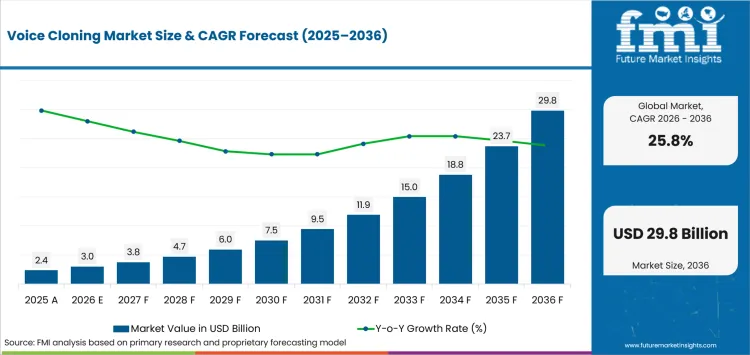
USD 3.0 billion in 2026 and USD 29.8 billion by 2036 at a 25.8% CAGR.
Demand for voice cloning is projected to expand at 25.8% CAGR between 2026 and 2036. Revenue is forecast to increase from USD 3.0 billion in 2026 to USD 29.8 billion by 2036 as approved voices enter recurring media and conversational workflows.
Fraud exposure has made identity controls a core approval condition for customer-facing synthetic speech systems. The FBI reported in April 2026 that 22,364 AI-related complaints caused nearly USD 893 million in 2025 losses and included voice clones among scam tactics. Banks and service operators therefore require consent records and traceable outputs before identifiable synthetic voices enter live customer channels.
Key Takeaways of Voice Cloning Market
- Rights-cleared voice models reduce repeated recording across approved scripts and support recurring media production and customer-service updates.
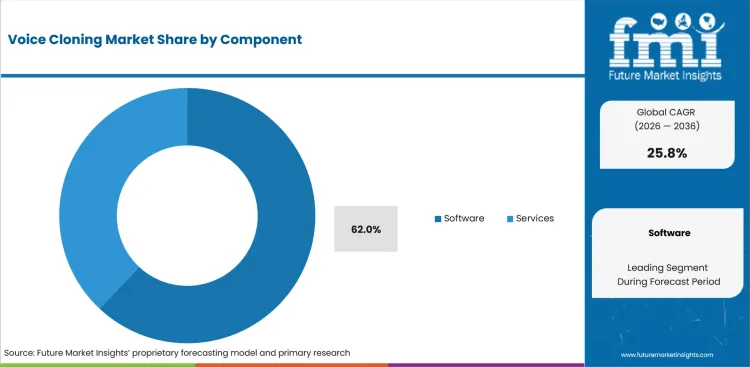
- Software is projected to represent 62.0% share in 2026 owing to reusable synthesis across editing and embedded speech applications.
- Cloud-based deployment is estimated at 68.0% share in 2026 due to centralized updates and scalable access across distributed production teams.
- Media and entertainment is forecast to capture 27.0% share in 2026 driven by localization and character continuity across release formats.
- Unauthorized cloning expands fraud and digital-replica exposure that delays approval for identifiable voices in customer-facing systems.
- Eleven Labs Inc., Microsoft Corporation, Google LLC, OpenAI Group PBC, Descript, Inc., Resemble AI Inc., LOVO, Inc. and Murf Inc. are the notable companies serving this market.
Analyst Perspective
“A cloned voice becomes commercially useful once its consent record travels with every localized script and API call. Media groups and regulated service operators should compare revocation speed and output traceability before judging naturalness or cost.”
- Sudip saha , Principal Consultant, Future Market Insights
How is the Voice Cloning Market segmented?
The voice cloning industry is segmented by component, deployment, application, industry vertical, end user and region.
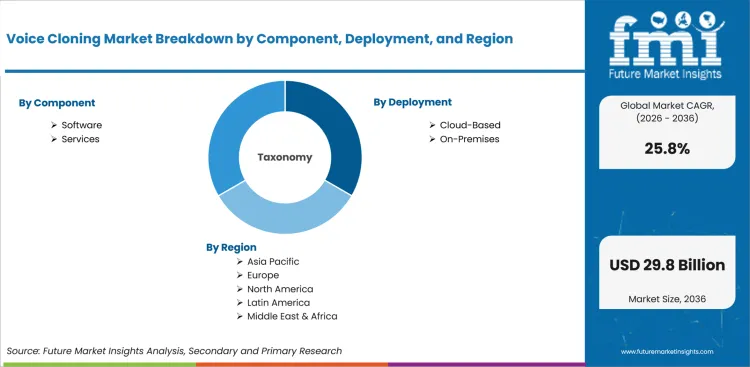
The voice cloning market is segmented by component, deployment, application, industry vertical, end user, and region. Component covers software, AI voice cloning platforms and voice synthesis software; services cover custom voice development and voice cloning APIs. Deployment covers cloud-based SaaS platforms and cloud APIs; on-premises options include enterprise voice systems and private infrastructure. Application includes media and entertainment for film, television, music and audiobooks; gaming for characters and interactive titles; advertising and marketing for voice advertising and personalized campaigns; and conversational AI and virtual assistants for AI assistants, chatbots and customer service. Industry vertical covers media and entertainment; IT and telecommunications; BFSI; and healthcare, with subsegments spanning film, audio, AI platforms, telecommunication services, banking, insurance, voice restoration and healthcare assistants. End user covers large and medium-sized enterprises; YouTubers, podcasters and independent creators; production studios and publishers; and universities and AI research laboratories.
Why does software hold the largest share within the component category?
Software combines speaker enrollment with model training and editing inside one reusable layer for approved voice identities. Its interfaces also connect custom speech with AI platform infrastructure used across media production and customer applications.
- Based on component, software is projected to account for 62.0% in 2026 due to repeated use across editing and embedded speech applications.
- Studios often revise approved dialogue without rebuilding talent agreements or recording schedules for every language version. Custom development services remain necessary for model tuning and rights documentation across complex enterprise implementations. In February 2025, Resemble AI launched Rapid Voice Clone 2.0 with generation and localization from a twenty-second audio sample.
Why does cloud-based deployment retain the largest share within the deployment category?
Cloud delivery centralizes model updates and permissions for teams working across several locations and application groups. Shared cloud computing services also absorb uneven dialogue volumes without dedicated inference systems at every operating site.
- By deployment, cloud-based models are forecast to represent 68.0% in 2026 driven by browser access and APIs that scale across variable production loads.
- Data location now affects deployment selection across regulated customer systems and multilingual service operations worldwide. In July 2025, ElevenLabs introduced India data residency with local storage and inference for enterprise accounts. Domestic processing supports centralized delivery without moving identifiable voice data beyond national or contractual boundaries.
How does media and entertainment support demand within the application category?
Studios need localized dialogue and character continuity without returning the original performer for every approved revision. Governed voices connect these requirements with media production systems that preserve authorization across scripts and release formats. In March 2026, ElevenLabs announced a Bookwire partnership for audio production across more than twelve languages.
- Media and entertainment is set to lead the application category with 27.0% share in 2026 due to frequent localization across film and audio production.
- Commercial publishing catalogs turn existing text rights into multilingual narration revenue through established distribution. The workflow gives publishers a repeatable release path across more than twelve languages and links synthetic narration with rights management, established sales channels and recurring audio production.
What supports enterprise demand within the end user category?
Enterprises combine large audio volumes with formal approval requirements across customer service and internal media programs. Microsoft updated its personal voice guidance in October 2025 and requires explicit consent for every created voice. Centralized voice assistant applications connect each identity with permissions and revocation procedures across several business units.
- In 2026, enterprises are expected to lead the end user category with 43.0% share because recurring applications require centralized governance.
- Permission records gain commercial importance as one voice moves across departments and several customer-facing channels. Centralized controls support wider enterprise use through shared governance across separate applications and release teams, while individual creators manage narrower projects and simpler rights administration.
What are the drivers, restraints and opportunities in the Voice Cloning Market?
Authorized voice reuse shortens production cycles, impersonation exposure extends legal review and consent-linked records support accountable deployment in sensitive customer interactions.
- Driver: Authorized voice models reduce repeated recording across approved scripts and preserve vocal identity through localization and recurring customer-service updates without returning the original performer for every controlled revision.
- Restraint: Unauthorized cloning raises fraud and digital-replica exposure for banks and media groups, so legal review expands around speaker permission and incident response before identifiable voices enter live operations.
- Opportunity: Consent-linked enrollment and output provenance support accountable synthetic speech across regulated contact centers and public information systems that require clear authorization and auditable model access.
Authorized models let studios revise approved dialogue without another complete recording session, while content creation workflows reuse the same governed identity across language versions. Production records preserve the script and release conditions attached to every generated line across approved channels.
Impersonation risk directly affects banks and customer-service operators once an identifiable voice enters public channels. Biometric identity controls therefore need recorded permission and restricted model access across employee accounts and external processors that handle voice data.
Consent-linked enrollment gives regulated organizations a practical route for accountable synthetic speech across sensitive interactions. In September 2025, ElevenLabs and AILAS introduced authenticated voice IDs that record owner knowledge and permitted use terms. Speech analytics records can then connect each output with approved access and later model revocation.
Which country CAGRs are profiled in the Voice Cloning Market?
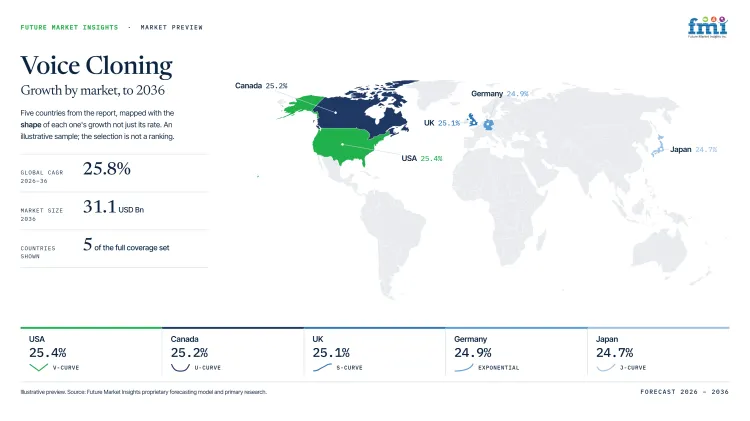
| Country | CAGR |
|---|---|
| Japan | 24.7% |
| United States | 25.4% |
| Canada | 25.2% |
| United Kingdom | 25.1% |
| Germany | 24.9% |
How do country-level CAGRs compare in the Voice Cloning Market?
The country comparison spans 0.7 percentage points and reveals three distinct growth groups across the Voice Cloning Market. The United States and Canada form the upper tier with a 0.2-point difference, while the United Kingdom and Germany create a closely aligned middle group separated by 0.2 percentage points. Japan remains at the lower end with a 0.2-point gap from Germany.
- The United States leads the comparison at a 25.4% CAGR through 2036, supported by mature cloud infrastructure and evolving state-level rules governing consent and incident procedures across customer-facing voice-cloning deployments.
- Canada follows at a 25.2% CAGR, remaining 0.2 percentage points below the United States. Bilingual production demand and expectations around express consent and retention of sensitive biometric information shape market conditions.
- The United Kingdom records a 25.1% CAGR, only 0.1 percentage point below Canada. Lawful biometric processing and attribution measures for synthetic audio influence market entry and commercial deployment.
- Germany grows at a 24.9% CAGR, remaining 0.2 percentage points below the United Kingdom. European Union transparency requirements and enterprise assessments of permissions and multilingual quality influence adoption.
- Japan records a 24.7% CAGR, creating a 0.2-percentage-point gap from Germany. Strong domestic-language media demand and evolving approaches to synthetic-content governance shape commercial voice-cloning applications.
- Comparable CAGRs can still produce different market conditions. Differences in biometric-data rules, consent requirements, synthetic-content labeling, transparency obligations, language demand and enterprise compliance practices influence market entry and deployment across countries. The full report provides country-level CAGR analysis across North America, Latin America, Europe, East Asia, South Asia and Pacific, and the Middle East and Africa.
Country-wise Analysis
- South Korea is estimated to post 27.1% CAGR over the forecast period, supported by Korean-language media production and interactive entertainment demand. The Ministry of Science and ICT issued transparency guidelines in January 2026 that set prior notice and labels for specified AI content. International platforms must adapt disclosure and consent records without delaying domestic dubbing and game releases.
- Voice cloning demand in the United States is forecast to rise at 25.4% CAGR over the forecast period, driven by mature cloud and media development capacity. In May 2025, the FBI warned that AI-generated voice messages impersonated senior officials and targeted personal accounts. State publicity and biometric rules therefore extend consent and incident planning across national commercial deployments.
- Canada’s voice cloning outlook is anticipated to advance at 25.2% CAGR over the assessment period, reinforced by bilingual customer operations and media production. In August 2025, Canada’s privacy commissioner said sensitive biometric information generally requires clear express consent. Data minimization and breach-response duties extend governance across external processing and national multilingual service agreements.
- The United Kingdom voice cloning sector is projected to record 25.1% CAGR during the assessment period, supported by established publishing and broadcast services. Ofcom reviewed watermarking, provenance metadata and AI labels in its July 2025 technical attribution toolkit. Media groups still need lawful processing and speaker-rights documentation across production agreements and international content licensing.
- Voice cloning sales in Germany are forecast to expand at 24.9% CAGR by 2036, shaped by multilingual integration across enterprise and public communication. In July 2026, the European Commission confirmed that Article 50 transparency duties apply from August 2026. Platforms must align output marking and model access across regional deployments that distribute identifiable synthetic speech.
Who are the notable companies in the Voice Cloning Market?
Eleven Labs Inc., Microsoft Corporation, Google LLC, OpenAI Group PBC, Descript, Inc., Resemble AI Inc., LOVO, Inc. and Murf Inc. are the notable companies serving this market.
Competition remains fragmented across dedicated voice platforms and large cloud groups serving different production routes. Entry is accessible for narrow language functions, yet recurring enterprise revenue requires consent controls and dependable integration that smaller generative AI providers often need time to establish.
- Eleven Labs Inc., Resemble AI Inc. and Murf Inc. compete through custom voice creation and API delivery for recurring enterprise speech applications.
- Microsoft Corporation, Google LLC and OpenAI Group PBC connect approved custom voices with broader cloud and real-time model services.
- Descript, Inc. and LOVO, Inc. focus on creator editing and media production workflows that combine voice generation with project tools.
Competitive Benchmarking: Voice Cloning Market
| Company | Voice Cloning Modes | Speaker Authorization Controls | Deployment and API Delivery | Geographic Reach |
|---|---|---|---|---|
| Eleven Labs Inc. | High | High | High | Global |
| Microsoft Corporation | Medium | High | High | Global |
| Google LLC | Medium | High | High | Global |
| OpenAI Group PBC | Low | High | High | Global |
| Descript, Inc. | Medium | High | Low | Global online |
| Resemble AI Inc. | High | High | High | Global |
| LOVO, Inc. | Medium | Medium | Medium | Global online |
| Murf Inc. | Medium | High | High | Global |
Key Developments in the Voice Cloning Market
- In September 2025, Microsoft made Voice Live API generally available for real-time speech-to-speech experiences through one managed interface in Azure AI Foundry.
- In June 2025, Murf launched WebSocket streaming for its text-to-speech API through a persistent bidirectional connection designed for live support and narration.
- In April 2025, Google Cloud introduced Chirp 3 Instant Custom Voice through an allowlist with custom voice creation from ten seconds of audio input.
Key Players in the Voice Cloning Market
Dedicated voice cloning platforms
- Eleven Labs Inc.
- Resemble AI Inc.
- LOVO, Inc.
- Murf Inc.
Cloud and general AI platforms
- Microsoft Corporation
- Google LLC
- OpenAI Group PBC
Creator production and editing platform
- Descript, Inc.
Voice Cloning Market - Report Scope
| Coverage field | Report scope |
|---|---|
| Market breakdown | By component, deployment, application, industry vertical, end user and region. |
| Quantitative Units | Revenue in USD billion and CAGR in %. |
| Market Definition | Software and services that create, synthesize, manage or deploy authorized digital replicas of identifiable human voices. |
| Regions Covered | North America, Latin America, Europe, East Asia, South Asia and Pacific, and Middle East and Africa. |
| Countries Covered | South Korea, United States, Canada, United Kingdom, Germany and 20+ countries included in the full report. |
| Key Companies Profiled | Eleven Labs Inc., Microsoft Corporation, Google LLC, OpenAI Group PBC, Descript, Inc., Resemble AI Inc., LOVO, Inc. and Murf Inc. |
| Forecast Period | 2026 to 2036. |
| Approach | Primary and secondary research with market triangulation. |
Voice Cloning Market - Research Methodology
| Method | Approach |
|---|---|
| Primary Research | FMI analysts gathered input from manufacturers, service providers, technology developers, distributors, end users, procurement teams, and subject-matter experts. Interviews examined purchasing decisions, product or service evaluation, adoption barriers, approval requirements, pricing considerations, and expectations for technical or commercial support. Respondents were also asked what evidence is required before a trial, pilot, or initial order develops into regular purchasing. |
| Desk Research | Desk research covered government statistics, regulatory publications, trade data, industry associations, technical literature, standards, company filings, product information, and official corporate announcements. Sources were reviewed for relevance, publication date, geographic coverage, and consistency with the defined market scope. Claims relating to performance, applications, approvals, capacity, investment, and commercial activity were retained only when supported by credible public evidence. |
| Market Sizing and Forecasting | The market model combined the baseline value with historical performance, segment structure, pricing and volume indicators, adoption levels, company participation, and country-level demand conditions. Forecast assumptions considered economic activity, investment trends, regulatory developments, technology adoption, purchasing cycles, supply availability, and barriers to wider market use. Segment and regional estimates were reconciled before the final market total was calculated. |
| Data Validation | Estimates were checked against multiple independent indicators, including public data, company activity, trade patterns, industry developments, and findings from primary interviews. Validation also tested whether products, services, applications, and company revenues fell within the defined market boundaries. Adjacent categories, unsupported claims, overlapping revenues, and activities without direct market relevance were excluded to reduce double counting and maintain consistency across segments and countries. |
Voice Cloning Market by Segments
Voice Cloning Market segmented by Component:
- Software
- AI voice cloning platforms
- Voice synthesis software
- Services
- Custom voice development
- Voice cloning API services
Voice Cloning Market segmented by Deployment:
- Cloud-based
- SaaS voice cloning platforms
- Cloud APIs
- On-premises
- Enterprise voice systems
- Private infrastructure
Voice Cloning Market segmented by Application:
- Media and entertainment
- Film and television
- Music and audiobooks
- Gaming
- Game characters
- Interactive gaming
- Advertising and marketing
- Voice advertising
- Personalized marketing
- Conversational AI and virtual assistants
- AI assistants
- Chatbots and customer service
Voice Cloning Market segmented by Industry Vertical:
- Media and entertainment
- Film and television
- Music and audio
- IT and telecommunications
- AI platforms
- Telecommunication services
- BFSI
- Banking
- Insurance
- Healthcare
- Voice restoration
- Healthcare assistants
Voice Cloning Market segmented by End User:
- Enterprises
- Large enterprises
- Medium-sized enterprises
- Content creators and individual users
- YouTubers and podcasters
- Independent creators
- Media and entertainment companies
- Production studios
- Publishers
- Research and academic institutions
- Universities
- AI research laboratories
Voice Cloning Market by Region:
- North America
- United States
- Canada
- Latin America
- Brazil
- Chile
- Mexico
- Rest of Latin America
- Western Europe
- Germany
- United Kingdom
- Italy
- Spain
- France
- Nordics
- Benelux
- Rest of Western Europe
- Eastern Europe
- Russia
- Poland
- Hungary
- Balkan and Baltic States
- Rest of Eastern Europe
- East Asia
- China
- Japan
- South Korea
- South Asia and Pacific
- India
- ASEAN
- Australia and New Zealand
- Rest of South Asia and Pacific
- Middle East and Africa
- Kingdom of Saudi Arabia
- Other GCC Countries
- Türkiye
- South Africa
- Other African Union Countries
- Rest of Middle East and Africa
Research Sources and Bibliography
- Federal Bureau of Investigation. (2026, April 6). Cryptocurrency and AI Scams Bilk Americans of Billions.
- Ahmed, Z. (2025, February 25). Rapid Voice Cloning 2.0: New Voice Cloning Model with Unmatched Accuracy. Resemble AI.
- ElevenLabs. (2025, July 30). Introducing India Data Residency.
- Shue, M., & McDermott, J. (2026, March 6). Bookwire and ElevenLabs partner to bring ebooks to audio. ElevenLabs.
- Microsoft. (2025, October 24). What is personal voice for text to speech?
- Tamura, H. J. (2025, September 18). ElevenLabs and AILAS launch voice ID system to protect actors from AI misuse. ElevenLabs.
- Ministry of Science and ICT, Republic of Korea. (2026, January 22). MSIT Releases Guidelines on Ensuring AI Transparency.
- Federal Bureau of Investigation. (2025, May 15). Senior USA Officials Impersonated in Malicious Messaging Campaign.
- Office of the Privacy Commissioner of Canada. (2025, August 11). Guidance for processing biometrics - for businesses.
- Ofcom. (2025, July 11). Deepfake Defences 2 - The Attribution Toolkit.
- European Commission. (2026, July 20). Guidelines on transparency obligations for providers and deployers of AI systems.
- ElevenLabs. (2026). Professional Voice Cloning. Retrieved August 4, 2026.
- Google Cloud. (2026, July 22). Chirp 3: Instant Custom Voice.
- OpenAI. (2026). Audio | OpenAI API Reference. Retrieved August 4, 2026.
- Descript. (2026). Ultra-realistic voice cloning with Overdub. Retrieved August 4, 2026.
- Resemble AI. (2026). Secure Voice Creation and Cloning. Retrieved August 4, 2026.
- LOVO AI. (2026). AI Voice Cloning For Creators & Professionals. Retrieved August 4, 2026.
- Murf. (2026). Terms of Service. Retrieved August 4, 2026.
- Liao, Q. (2025, September 30). Upgrade your voice agent with Azure AI Voice Live API. Microsoft.
- Murf. (2025, June 16). WebSocket Streaming for TTS API.
This bibliography is provided for reader reference and is not exhaustive. The full report contains the complete reference list and detailed citations.
This Report Answers
- How large is the Voice Cloning Market in 2026 and 2036?
- Which component accounts for the largest Voice Cloning Market share in 2026?
- Why does cloud-based deployment retain the largest share within its category?
- How does media and entertainment shape current voice cloning demand?
- What slows adoption of identifiable synthetic voices across customer-facing systems?
- How do country growth rates differ across the five profiled markets?
- Which companies provide custom voice creation and related delivery support?
- How should organizations compare voice cloning platforms during commercial evaluation?
Frequently Asked Questions
How big is the Voice Cloning Market in 2026?
USD 3.0 billion represents the voice cloning market value in 2026 across software and service revenue. Authorized model creation and controlled delivery support recurring commercial use as the market is forecast to reach USD 29.8 billion by 2036.
What is the CAGR of the Voice Cloning Market from 2026 to 2036?
A 25.8% CAGR is projected for the voice cloning market between 2026 and 2036. Expanding media and conversational workloads support the rate across multilingual customer operations although consent verification and impersonation controls remain necessary for recurring enterprise deployment.
Which component leads the Voice Cloning Market?
Software is estimated to accounts for 62.0% by component in 2026 due to reusable enrollment and synthesis across commercial applications. Specialist services support custom tuning and rights documentation during complex implementations that connect talent agreements with production systems.
Which deployment model leads the Voice Cloning Market?
Cloud-based deployment is set to account for 68.0% share by deployment category in 2026. Centralized updates and scalable APIs support distributed audio workloads while on-premises systems remain necessary for restricted networks and sensitive voice assets.
Who are the leading companies in the Voice Cloning Market?
Notable companies serving the voice cloning market include Eleven Labs Inc., Microsoft Corporation, Google LLC, OpenAI Group PBC, Descript, Inc., Resemble AI Inc., LOVO, Inc. and Murf Inc. Their roles cover dedicated cloning and cloud delivery alongside creator editing for authorized commercial workflows.
Preview the report firsthand - request a free sample
Get SampleGet the brochure for pricing and purchase details.
Get PDFTable of Content
- Key Takeaways
- Market Size and CAGR
- Top Growth Driver
- Fastest Growing Segment
- Leading Region
- Key Companies
- Emerging Opportunities
- Executive Summary
- Global Market Outlook
- Demand-side Trends
- Supply-side Trends
- Technology Roadmap Analysis
- Analysis and Recommendations
- Analyst Perspective (What is happening? Why now? What should investors know?)
- Key Questions Answered
- How large is the market?
- What is the CAGR?
- What are key trends?
- Which region dominates?
- Who are the leaders?
- Market Overview
- Market Coverage / Taxonomy
- Market Definition / Scope / Limitations
- Research Methodology
- Chapter Orientation
- Analytical Lens and Working Hypotheses
- Market Structure, Signals, and Trend Drivers
- Benchmarking and Cross-market Comparability
- Market Sizing, Forecasting, and Opportunity Mapping
- Research Design and Evidence Framework
- Desk Research Programme (Secondary Evidence)
- Expert Input and Fieldwork (Primary Evidence)
- Tooling, Models, and Reference Databases
- Data Engineering and Model Build
- Quality Assurance and Audit Trail
- Market Background
- Market Dynamics (Drivers, Restraints, Opportunity, Trends)
- Scenario Forecast (Optimistic, Likely, Conservative)
- Impact Analysis
- AI Impact
- Sustainability Impact
- Regulatory Impact
- Technology Impact
- Consumer / Buyer Analysis
- Purchase Drivers
- Adoption Barriers
- Buyer Journey
- Opportunity Map Analysis
- Product Life Cycle Analysis
- Supply Chain Analysis
- Investment Feasibility Matrix
- Value Chain Analysis
- PESTLE and Porter's Analysis
- Regulatory Landscape
- Regional Parent Market Outlook
- Production and Consumption Statistics
- Import and Export Statistics
- Global Market Analysis and Forecast, 2021 to 2036
- Historical Market Size Value (USD Billion) Analysis, 2021 to 2025
- Current and Future Market Size Value (USD Billion) Projections, 2026 to 2036
- Y-o-Y Growth Trend Analysis
- Absolute $ Opportunity Analysis
- Global Market Pricing Analysis, 2021 to 2036
- Global Market Analysis and Forecast, By Component, 2021 to 2036
- Introduction / Key Findings
- Historical Market Size Value (USD Billion) Analysis By Component, 2021 to 2025
- Current and Future Market Size Value (USD Billion) Analysis and Forecast By Component, 2026 to 2036
- Software
- AI Voice Cloning Platforms
- Voice Synthesis Software
- Services
- Custom Voice Development
- Voice Cloning API Services
- Software
- Y-o-Y Growth Trend Analysis By Component, 2021 to 2025
- Absolute $ Opportunity Analysis By Component, 2026 to 2036
- Global Market Analysis and Forecast, By Deployment, 2021 to 2036
- Introduction / Key Findings
- Historical Market Size Value (USD Billion) Analysis By Deployment, 2021 to 2025
- Current and Future Market Size Value (USD Billion) Analysis and Forecast By Deployment, 2026 to 2036
- Cloud-Based
- SaaS Voice Cloning Platforms
- Cloud APIs
- On-Premises
- Enterprise Voice Systems
- Private Infrastructure
- Cloud-Based
- Y-o-Y Growth Trend Analysis By Deployment, 2021 to 2025
- Absolute $ Opportunity Analysis By Deployment, 2026 to 2036
- Global Market Analysis and Forecast, By Application, 2021 to 2036
- Introduction / Key Findings
- Historical Market Size Value (USD Billion) Analysis By Application, 2021 to 2025
- Current and Future Market Size Value (USD Billion) Analysis and Forecast By Application, 2026 to 2036
- Media & Entertainment
- Film & Television
- Music & Audiobooks
- Gaming
- Game Characters
- Interactive Gaming
- Advertising & Marketing
- Voice Advertising
- Personalized Marketing
- Conversational AI & Virtual Assistants
- AI Assistants
- Chatbots & Customer Service
- Media & Entertainment
- Y-o-Y Growth Trend Analysis By Application, 2021 to 2025
- Absolute $ Opportunity Analysis By Application, 2026 to 2036
- Global Market Analysis and Forecast, By Industry Vertical, 2021 to 2036
- Introduction / Key Findings
- Historical Market Size Value (USD Billion) Analysis By Industry Vertical, 2021 to 2025
- Current and Future Market Size Value (USD Billion) Analysis and Forecast By Industry Vertical, 2026 to 2036
- Media & Entertainment
- Film & Television
- Music & Audio
- IT & Telecommunications
- AI Platforms
- Telecommunication Services
- BFSI
- Banking
- Insurance
- Healthcare
- Voice Restoration
- Healthcare Assistants
- Media & Entertainment
- Y-o-Y Growth Trend Analysis By Industry Vertical, 2021 to 2025
- Absolute $ Opportunity Analysis By Industry Vertical, 2026 to 2036
- Global Market Analysis and Forecast, By End User, 2021 to 2036
- Introduction / Key Findings
- Historical Market Size Value (USD Billion) Analysis By End User, 2021 to 2025
- Current and Future Market Size Value (USD Billion) Analysis and Forecast By End User, 2026 to 2036
- Enterprises
- Large Enterprises
- Medium-Sized Enterprises
- Content Creators & Individual Users
- YouTubers & Podcasters
- Independent Creators
- Media & Entertainment Companies
- Production Studios
- Publishers
- Research & Academic Institutions
- Universities
- AI Research Laboratories
- Enterprises
- Y-o-Y Growth Trend Analysis By End User, 2021 to 2025
- Absolute $ Opportunity Analysis By End User, 2026 to 2036
- Global Market Analysis and Forecast, By Region, 2021 to 2036
- Introduction
- Historical Market Size Value (USD Billion) Analysis By Region, 2021 to 2025
- Current Market Size Value (USD Billion) Analysis and Forecast By Region, 2026 to 2036
- North America
- Latin America
- Western Europe
- Eastern Europe
- East Asia
- South Asia and Pacific
- Middle East & Africa
- Market Attractiveness Analysis By Region
- North America Market Analysis and Forecast, By Country, 2021 to 2036
- Historical Market Size Value (USD Billion) Trend Analysis By Market Taxonomy, 2021 to 2025
- Market Size Value (USD Billion) Forecast By Market Taxonomy, 2026 to 2036
- By Country
- USA
- Canada
- By Component
- By Deployment
- By Application
- By Industry Vertical
- By End User
- By Country
- Market Attractiveness Analysis
- By Country
- By Component
- By Deployment
- By Application
- By Industry Vertical
- By End User
- Key Takeaways
- Latin America Market Analysis and Forecast, By Country
- Historical Market Size Value (USD Billion) Trend Analysis By Market Taxonomy, 2021 to 2025
- Market Size Value (USD Billion) Forecast By Market Taxonomy, 2026 to 2036
- By Country
- Brazil
- Mexico
- Chile
- Rest of Latin America
- By Component
- By Deployment
- By Application
- By Industry Vertical
- By End User
- By Country
- Market Attractiveness Analysis
- By Country
- By Component
- By Deployment
- By Application
- By Industry Vertical
- By End User
- Key Takeaways
- Western Europe Market Analysis and Forecast, By Country
- Historical Market Size Value (USD Billion) Trend Analysis By Market Taxonomy, 2021 to 2025
- Market Size Value (USD Billion) Forecast By Market Taxonomy, 2026 to 2036
- By Country
- Germany
- UK
- Italy
- Spain
- France
- Nordic
- BENELUX
- Rest of Western Europe
- By Component
- By Deployment
- By Application
- By Industry Vertical
- By End User
- By Country
- Market Attractiveness Analysis
- By Country
- By Component
- By Deployment
- By Application
- By Industry Vertical
- By End User
- Key Takeaways
- Eastern Europe Market Analysis and Forecast, By Country
- Historical Market Size Value (USD Billion) Trend Analysis By Market Taxonomy, 2021 to 2025
- Market Size Value (USD Billion) Forecast By Market Taxonomy, 2026 to 2036
- By Country
- Russia
- Poland
- Hungary
- Balkan & Baltic
- Rest of Eastern Europe
- By Component
- By Deployment
- By Application
- By Industry Vertical
- By End User
- By Country
- Market Attractiveness Analysis
- By Country
- By Component
- By Deployment
- By Application
- By Industry Vertical
- By End User
- Key Takeaways
- East Asia Market Analysis and Forecast, By Country
- Historical Market Size Value (USD Billion) Trend Analysis By Market Taxonomy, 2021 to 2025
- Market Size Value (USD Billion) Forecast By Market Taxonomy, 2026 to 2036
- By Country
- China
- Japan
- South Korea
- By Component
- By Deployment
- By Application
- By Industry Vertical
- By End User
- By Country
- Market Attractiveness Analysis
- By Country
- By Component
- By Deployment
- By Application
- By Industry Vertical
- By End User
- Key Takeaways
- South Asia and Pacific Market Analysis and Forecast, By Country
- Historical Market Size Value (USD Billion) Trend Analysis By Market Taxonomy, 2021 to 2025
- Market Size Value (USD Billion) Forecast By Market Taxonomy, 2026 to 2036
- By Country
- India
- ASEAN
- Australia & New Zealand
- Rest of South Asia and Pacific
- By Component
- By Deployment
- By Application
- By Industry Vertical
- By End User
- By Country
- Market Attractiveness Analysis
- By Country
- By Component
- By Deployment
- By Application
- By Industry Vertical
- By End User
- Key Takeaways
- Middle East & Africa Market Analysis and Forecast, By Country
- Historical Market Size Value (USD Billion) Trend Analysis By Market Taxonomy, 2021 to 2025
- Market Size Value (USD Billion) Forecast By Market Taxonomy, 2026 to 2036
- By Country
- Kingdom of Saudi Arabia
- Other GCC Countries
- Türkiye
- South Africa
- Other African Union
- Rest of Middle East & Africa
- By Component
- By Deployment
- By Application
- By Industry Vertical
- By End User
- By Country
- Market Attractiveness Analysis
- By Country
- By Component
- By Deployment
- By Application
- By Industry Vertical
- By End User
- Key Takeaways
- Key Countries Market Analysis
- USA
- Pricing Analysis
- Market Share Analysis, 2025
- By Component
- By Deployment
- By Application
- By Industry Vertical
- By End User
- Canada
- Pricing Analysis
- Market Share Analysis, 2025
- By Component
- By Deployment
- By Application
- By Industry Vertical
- By End User
- Mexico
- Pricing Analysis
- Market Share Analysis, 2025
- By Component
- By Deployment
- By Application
- By Industry Vertical
- By End User
- Brazil
- Pricing Analysis
- Market Share Analysis, 2025
- By Component
- By Deployment
- By Application
- By Industry Vertical
- By End User
- Chile
- Pricing Analysis
- Market Share Analysis, 2025
- By Component
- By Deployment
- By Application
- By Industry Vertical
- By End User
- Germany
- Pricing Analysis
- Market Share Analysis, 2025
- By Component
- By Deployment
- By Application
- By Industry Vertical
- By End User
- UK
- Pricing Analysis
- Market Share Analysis, 2025
- By Component
- By Deployment
- By Application
- By Industry Vertical
- By End User
- Italy
- Pricing Analysis
- Market Share Analysis, 2025
- By Component
- By Deployment
- By Application
- By Industry Vertical
- By End User
- Spain
- Pricing Analysis
- Market Share Analysis, 2025
- By Component
- By Deployment
- By Application
- By Industry Vertical
- By End User
- France
- Pricing Analysis
- Market Share Analysis, 2025
- By Component
- By Deployment
- By Application
- By Industry Vertical
- By End User
- India
- Pricing Analysis
- Market Share Analysis, 2025
- By Component
- By Deployment
- By Application
- By Industry Vertical
- By End User
- ASEAN
- Pricing Analysis
- Market Share Analysis, 2025
- By Component
- By Deployment
- By Application
- By Industry Vertical
- By End User
- Australia & New Zealand
- Pricing Analysis
- Market Share Analysis, 2025
- By Component
- By Deployment
- By Application
- By Industry Vertical
- By End User
- China
- Pricing Analysis
- Market Share Analysis, 2025
- By Component
- By Deployment
- By Application
- By Industry Vertical
- By End User
- Japan
- Pricing Analysis
- Market Share Analysis, 2025
- By Component
- By Deployment
- By Application
- By Industry Vertical
- By End User
- South Korea
- Pricing Analysis
- Market Share Analysis, 2025
- By Component
- By Deployment
- By Application
- By Industry Vertical
- By End User
- Russia
- Pricing Analysis
- Market Share Analysis, 2025
- By Component
- By Deployment
- By Application
- By Industry Vertical
- By End User
- Poland
- Pricing Analysis
- Market Share Analysis, 2025
- By Component
- By Deployment
- By Application
- By Industry Vertical
- By End User
- Hungary
- Pricing Analysis
- Market Share Analysis, 2025
- By Component
- By Deployment
- By Application
- By Industry Vertical
- By End User
- Kingdom of Saudi Arabia
- Pricing Analysis
- Market Share Analysis, 2025
- By Component
- By Deployment
- By Application
- By Industry Vertical
- By End User
- Türkiye
- Pricing Analysis
- Market Share Analysis, 2025
- By Component
- By Deployment
- By Application
- By Industry Vertical
- By End User
- South Africa
- Pricing Analysis
- Market Share Analysis, 2025
- By Component
- By Deployment
- By Application
- By Industry Vertical
- By End User
- USA
- Market Structure Analysis
- Competition Dashboard
- Competition Benchmarking
- Market Share Analysis of Top Players
- By Regional
- By Component
- By Deployment
- By Application
- By Industry Vertical
- By End User
- Emerging Startups
- Innovation Benchmarking
- Competition Analysis
- Competition Deep Dive
- ElevenLabs
- Overview
- Product Portfolio
- Profitability by Market Segments
- Sales Footprint
- Strategy Overview
- Marketing Strategy
- Product Strategy
- Channel Strategy
- Microsoft Corporation
- Google LLC
- Amazon Web Services, Inc.
- OpenAI
- Descript, Inc.
- Resemble AI
- LOVO AI
- Murf AI
- PlayHT
- Others
- ElevenLabs
- Case Studies
- Success Stories
- Recent Developments
- Competition Deep Dive
- Assumptions & Acronyms Used


