

- Industry Size (2025)
- USD 3.3 Bn
- Forecast (2035)
- USD 13.2 Bn
- CAGR (2025 to 2035)
- 14.7%
Speech and Voice Analytics Market Size and Share Forecast Outlook 2025 to 2035
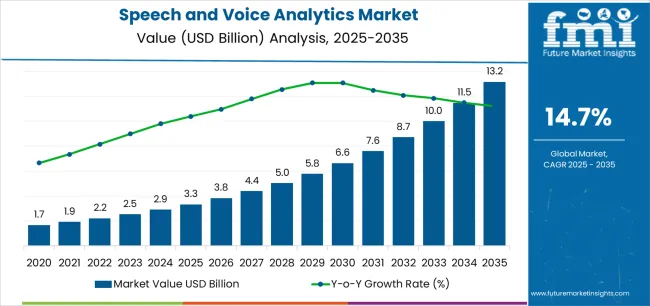
The Speech and Voice Analytics market is witnessing strong expansion fueled by the rising emphasis on customer experience optimization, real-time data processing, and the growing integration of AI-powered communication systems. Organizations are increasingly leveraging speech analytics to gain actionable insights from voice interactions, improve compliance, and enhance service quality across customer-facing functions.
The adoption of advanced natural language processing and sentiment analysis technologies has further elevated the precision and efficiency of these solutions, enabling better understanding of customer intent and behavior. The surge in omnichannel communication platforms and the demand for scalable voice intelligence systems are supporting the market’s continued growth.
Additionally, the ongoing digital transformation across enterprises, coupled with the increasing use of cloud-based analytics and voice-enabled virtual assistants, is driving innovation in this space As businesses focus on data-driven decision-making and automation, the market is poised to experience consistent growth across sectors such as BFSI, healthcare, retail, and telecommunications.
Quick Stats for Speech and Voice Analytics Market
- Speech and Voice Analytics Market Industry Value (2025): USD 3.3 billion
- Speech and Voice Analytics Market Forecast Value (2035): USD 13.2 billion
- Speech and Voice Analytics Market Forecast CAGR: 14.7%
- Leading Segment in Speech and Voice Analytics Market in 2025: Solutions (65.0%)
- Key Growth Region in Speech and Voice Analytics Market: North America, Asia-Pacific, Europe
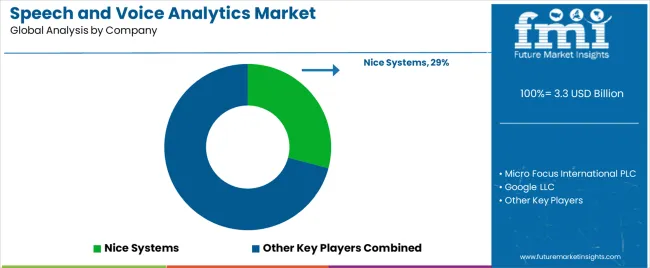
- Top Key Players in Speech and Voice Analytics Market: Nice Systems, Micro Focus International PLC, Google LLC, Amazon Web Services (AWS), Genesys Telecommunications, Avaya Inc, Verint System Inc, CallMiner, Nexidia, Calabrio
| Metric | Value |
|---|---|
| Speech and Voice Analytics Market Estimated Value in (2025E) | USD 3.3 billion |
| Speech and Voice Analytics Market Forecast Value in (2035F) | USD 13.2 billion |
| Forecast CAGR (2025 to 2035) | 14.7% |
Segmental Analysis
The market is segmented by Component, Deployment, Enterprise Size, and Vertical and region. By Component, the market is divided into Solutions and Services. In terms of Deployment, the market is classified into Cloud-based and On-Premise. Based on Enterprise Size, the market is segmented into Very Large Enterprises (1,000+ employees), Large Enterprises (500-999 employees), Medium-sized Enterprise (100-499 employees), Small Enterprises (10-99 employees), and Small Offices (1-9 employees). By Vertical, the market is divided into BFSI, IT & Telecom, Media & Entertainment, Healthcare And Life Sciences, Retail And E-commerce, Travel And Hospitality, Government And Defense, and Others. Regionally, the market is classified into North America, Latin America, Western Europe, Eastern Europe, Balkan & Baltic Countries, Russia & Belarus, Central Asia, East Asia, South Asia & Pacific, and the Middle East & Africa.
Insights into the Solutions Component Segment
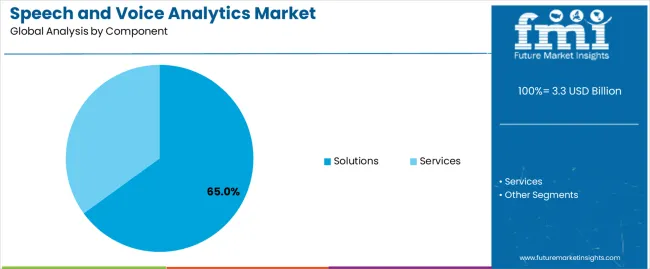
The solutions segment is projected to hold 65.0% of the Speech and Voice Analytics market revenue share in 2025, making it the leading component category. The segment’s dominance is being driven by the increasing deployment of advanced analytics platforms designed to process and interpret large volumes of voice data in real time.
Organizations have increasingly prioritized speech analytics solutions to identify customer pain points, optimize agent performance, and ensure compliance with communication regulations. The growing demand for automated insights derived from voice interactions is reinforcing the need for robust and scalable solutions over services.
Continuous improvements in AI and machine learning models have expanded the analytical capabilities of these solutions, enabling deeper insights and faster decision-making Furthermore, enterprises are favoring integrated analytics platforms that combine speech recognition, sentiment detection, and predictive intelligence within a single framework, further boosting the segment’s growth.
Insights into the Cloud-based Deployment Segment
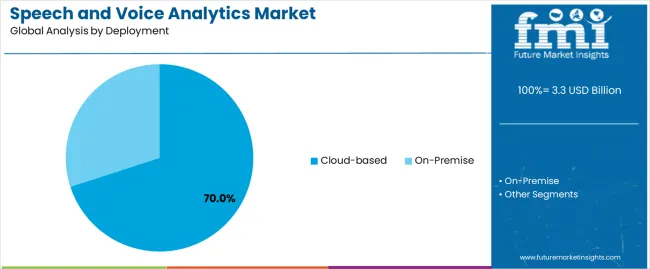
The cloud-based segment is expected to capture 70.0% of the Speech and Voice Analytics market revenue share in 2025, positioning it as the dominant deployment model. This leadership is attributed to the increasing enterprise preference for scalable, cost-effective, and easily deployable solutions that support remote access and global operations. Cloud-based deployment has enabled real-time data analytics and faster implementation cycles, providing flexibility and reducing infrastructure costs.
The segment’s growth is further supported by the integration of speech analytics with cloud communication systems and contact center-as-a-service platforms. Enhanced data security, automatic updates, and seamless scalability offered by cloud environments have strengthened enterprise confidence in this model.
Additionally, the growing adoption of hybrid work models and the demand for centralized monitoring across dispersed teams have accelerated the shift toward cloud-based platforms This transition aligns with broader enterprise digitalization strategies, driving long-term sustainability and innovation in the speech analytics ecosystem.
Insights into the Very Large Enterprises (1,000+ employees) Segment
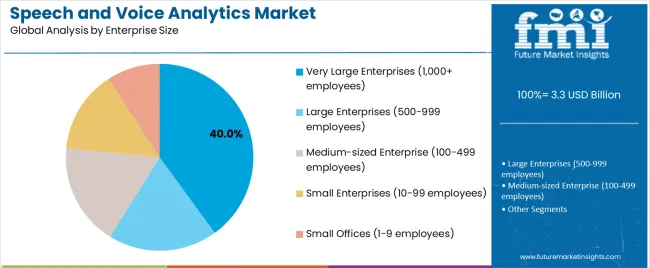
The very large enterprises segment is anticipated to account for 40.0% of the Speech and Voice Analytics market revenue in 2025, making it the leading enterprise size category. The segment’s prominence is influenced by the vast communication volumes and complex operational structures of large organizations, which demand advanced analytics capabilities for effective customer engagement management.
These enterprises are focusing on speech analytics to derive meaningful insights from customer interactions, optimize workforce productivity, and improve service delivery across global operations. The availability of substantial financial and technological resources has facilitated early adoption of sophisticated analytics platforms capable of handling multi-channel voice data at scale.
Additionally, large enterprises are leveraging speech analytics for regulatory compliance, risk mitigation, and data-driven decision-making to enhance competitive advantage The growing focus on customer retention, coupled with the integration of AI-driven analytics within enterprise communication frameworks, continues to drive the dominance of this segment in the market.
Semi-annual Market Update for Speech and Voice Analytics Market
This below table presents the expected CAGR for the Global speech and voice analytics market over several semi-annual periods spanning from 2025 to 2035. In the first half (H1) of the year from 2025 to 2035, the industry is predicted to surge at a CAGR of 14.5%, followed by a considerably lower growth rate of 14.1% in the second half (H2) of the same year.
| Particular | Value CAGR |
|---|---|
| H1, 2025 | 14.5% (2025 to 2035) |
| H2, 2025 | 14.1% (2025 to 2035) |
| H1, 2025 | 14.3% (2025 to 2035) |
| H2, 2025 | 14.9% (2025 to 2035) |
Moving into the subsequent period, from H1 2025 to H2 2035, the CAGR is projected to hold at 14.3% in the first half from 2025-2035 and remain considerably increase at 14.9% in the second half 2025-2035. In the first half (H1) 2025-2035 the market witnessed a decrease of 20 BPS while in the second half (H2) 2025-2035 the market witnessed an increase of 80 BPS.
Top Speech and Voice Analytics Market Dynamics and Industry Trends
High Demand of Improved Customer Experience
Various companies are utilizing speech analytics to interpret customer interactions into deeper insights. This allows them to solve issues in the better manner and develop customized solutions according to the market needs. Leading telecom companies like Verizon and AT&T are integrating the advanced voice analytics components to enhance understanding of customer sentiment over calls. This enables them to solve complaints rapidly and improve their service quality.
In the finance sector, major banks like HSBC and Bank of America are highly investing into speech analytics to improve their customer services. HSBC started using voice biometrics in their customer service in 2025. This improved security and made identification easier, which helped customers have a smoother time. Bank of America uses similar technology called Erica.
It's a virtual-assistant that uses AI and speech analytics to give personalized financial advice. This makes talking with the bank more useful and interesting for customers.
Retailers are also adopting the technology to improve their customer experiences. Walmart started leveraging the technology in 2025 to analyze customer feedback and enhance their service strategies.
Now, Walmart is able to provide personalized solutions by understanding the customer needs more precisely. This is resulting in higher customer satisfaction and increased loyalty.
The healthcare field has jumped on the voice analytics bandwagon to boost patient experience. Hospitals and telehealth providers are using this technology to check patient emotions and stress levels during visits resulting in more caring and successful treatment.
Compliance and Risk Management Issues are Pushing Businesses to Adopt Speech and Voice Analytics
Businesses in many fields are using these tools more and more to follow regulations and reduce risks associated with non-compliance, fraud and other security risks.
Take 2025, for example. Banks and other financial institutions started using voice analysis extensively to follow the new MiFID II rules in Europe. These rules state that banks must record and check all conversations with clients to ensure transparent trading. Voice analysis tools have been key to monitoring and saving these conversations, helping companies avoid huge penalties.
The HIPPA regulations in the US are impacting healthcare industry. These rules require strict protection of patient data. In 2025, hospitals and telemedicine providers stepped up their use of voice analytics. This was done to keep an eye on patient interactions and ensure their security.
Global anti-money laundering regulations are also increasing the demand of speech and voice analytics. In 2025, banks and financial institutions used these tools to spot odd patterns and conversations that might point to fraud. This hands-on approach lets organizations tackle potential risks before they turn into big legal or money problems.
These examples show how following regulations and managing risks aren't just pushing people to use speech and voice analytics - they're needed for it. As the regulations keep changing, companies will need more advanced tools to analyze data. These tools will help them deal with all the complex issues and reduce risks.
Different Languages and Accents Might Lower the Market Growth
Accents and dialects from different regions can cause mix-ups or wrong transcriptions, which has an impact on how reliable the analytics results are. A good example is the complexities faced by various voice recognition systems in processing English speakers who aren't native or have regional accents in places like India or the UK.
This problem came to light in 2025 when several voice assistants couldn't recognize or respond to commands spoken in regional British accents. This sparked a lot of criticism about whether these technologies were inclusive enough.
Companies need voice analytics tools to handle many languages and accents. However, most systems work best with American English. This means they're less accurate with other languages or ways of speaking. This problem can have a big impact on businesses in markets where people speak different languages. When speech recognition isn't accurate, it can cause mix-ups, unsatisfied customers, and even legal trouble if important instructions are misunderstood.
The issue gets worse when there's not enough for regional languages. For instance, in 2025, research showed that voice recognition systems weren't as good at handling African American Vernacular English (AAVE) and other minority dialects. This raised questions about whether these technologies are fair and inclusive.
These problems highlight the need to develop more advanced and inclusive voice analytics tools that can handle a wider range of languages and accents. Companies are trying to make their algorithms better, but as of 2025, the market still has big obstacles to overcome when it comes to language and accent differences.
Comparison of Historical vs Future Outlook on Changing Consumer Trends for Speech and Voice Analytics Industry
The speech and voice analytics market went through notable fluctuations and technological advancements in the historical period. The industry was valued at a valuation of USD 1,515.7 million in 2020 to reach USD 2,553.1 million in 2025 with a CAGR of 13.9% from 2020 to 2025.
During pandemic, the increased use of remote systems and restrictions on physical interactions emphasized the emergence of speech and voice analytics. The vendors started providing advanced speech analytics solutions to cater several industries
Speech and voice analytics market witnessed a considerable growth during the forecasting period between 2025 and 2035. The market reached the valuation of USD 2,909.4 million in 2035 from USD 11,444.8 million in 2025 with the CAGR of 14.7%.
The focus on speech analytics is rising rapidly as retail and finance sector evolve. The demand of voice and speech analytics is highlighted in these industries and is expected to continue to rise.
Key Speech and Voice Analytics Market Players and Concentration
Tier 1 companies in the market have global presence in the market and these companies invest highly in research and development. The companies in this bracket provide solutions across verticals. These companies include Verint Systems, Nice Ltd, Google LLC, AWS among others and hold around 35%-40% market share.
Tier 2 vendors in the global speech and voice analytics market provide their services to mid-sized companies and these companies focus on innovative solutions.
The companies in the market hold decent amount of market share but lesser than tier-1 vendors. These companies are CallMiner, Avaya Inc, Genesys among others. These companies hold around 25%-30% share in the global market.
Tier 3 companies represent 30% to 40% of share of total speech and voice analytics industry. These vendors focus on the market expansion and providing customer specific solutions. The vendors in the bracket includes Nexidia, Calabrio among others.
Analysis of Top Countries Adopting, Deploying, and Utilizing Speech and Voice Analytics
The below country-wise market analysis of the speech and voice analytics explains the recent developments and different government approaches in the market. The analysis also gives an idea of the country’s expected progress in the market landscape.
The data describes key highlights, growth factors, and CAGRs of these countries.
| Countries | CAGR from 2025 to 2035 |
|---|---|
| India | 17.4 % |
| China | 15.8 % |
| USA | 14.9 % |
| Germany | 12.2 % |
High Number of Language in India is Attracting Companies to Develop Diverse Voice Analytics Models
The Indian government is pushing for digital abilities through initiatives like “Digital India”. This is supporting the expanding scope of voice technologies. India has more than 22 official languages and very large chunk of non-english speakers.
Thus, the demand of localized speech analytics in the country is rising. This attracts companies to develop AI models that can handle diverse linguistic abilities.
Several tech companies in India, like Uniphore and Gnani.ai, improved their speech analytics platforms in 2025 for Indian languages and dialects. This helps better communication in areas such as customer service, healthcare, and banking.
Uniphore acquired Jacada in 2025, which helped them become more advanced in AI-driven voice analytics. It allows them to offer better solutions to clients around the world while also meeting the specific needs of the Indian market.
Focus on AI Development in China
Technology companies like Baidu, Alibaba, and Tencent are investing highly in AI-driven speech technologies. They're using a lot of training data to make speech recognition more accurate and capable. The focus on AI development in China is leading to a lot of innovation in speech recognition.
A standout example is Baidu's rollout of its improved speech recognition platform in 2025. This platform showed big steps forward in how it processes and understands natural language, while managing different Chinese dialects.
Also, as more people in China start using voice assistants and smart devices, owing to the growth of the Internet of Things (IoT), there's a bigger need for cutting-edge voice analytics.
China's healthcare industry has started to use voice analytics to spot health issues. Startups like iFlytek have come up with voice-based tools to diagnose illnesses, which got a lot of attraction in 2025. Voice analytics has also become part of public services, like projects to make cities smarter.
Established Technology Sector Support the Market Growth in USA
The rise of remote work is accelerating the use of voice analytics in call centers and virtual meetings. As per FMI analysis, more than 85% companies will be implementing voice analytics by 2035 in technology sector. Businesses are leveraging these tools to ensure compliance at the same time, monitoring the employees also.
Technology giants such as Google and Microsoft are also incorporating advanced voice analytics features into their platforms.
This is also supporting the market growth of voice and speech analytics. The rapid expansion and adopting in the country showcases the leadership of USA in the market.
Speech and Voice Analytics Industry Analysis by Top Investment Segments
The below section provides the category wise insights in the market with recent developments and future projections.
Solutions Segment Lead in the Market
| Segment | Solutions (Component) |
|---|---|
| Value Share (2025) | 63.8% |
A large number of call centers across the world use speech analytics systems for a range of purposes such as agent performance management and compliance management, to take over market intelligence, and customer experience management.
The market is likely to become mature as against services segment, due to the increased use. The market provides a diverse array of solutions; consequently, services are required to handle these solutions and assist firms in improving their business processes in order to thrive in this competitive terrain.
According to a survey conducted by Indian Institute of Technology in 2025, more than 70% of call centers are actively using speech and voice analytics.
Cloud-based Deployment to Accelerate the Market Growth
| Segment | Cloud-based (Deployment) |
|---|---|
| Value Share (2025) | 52.9% |
The advent of cloud deployment options for speech analytics systems has increased demand across several industries including BFSI, IT, telecom, and media & entertainment.
Cloud-based solutions are being offered by new companies to provide cost-effective solutions to SMEs. As per MIT Technology, cloud investments account for more than 56% of all investments in technology businesses.
It provides enterprises with operational efficiencies and real-time implementation simplicity as compared to on-premises deployment. It also has various advantages, including lower operational expenses, a simpler implementation procedure, and more flexibility in terms of linked resources.
Leading Suppliers of Speech and Voice Analytics
The speech and voice analytics market is becoming more competitive with the increase in the use of technology among various industries. Companies are focusing on AI development, real-time insights delivery and multi-language support integration to establish themselves.
Rapid advancements in natural language processing (NLP) and ML is driving innovation as competitors provide more accurate and nuanced analysis of voice data.
Vendors are also differentiating themselves in the form of industry-specific solutions. These vendors are offering more and more customized solutions in order to meet the unique demands of healthcare, finance and customer service industries.
Recent Market Developments
- In December 2025, Nice announced that the company has completed the acquisition of LiveVox. With the integration of LiveVox’s AI capabilities and CXone, the company will provide an interaction-centric platform.
- In February 2025, Bharti Airtel announced an AI-based solution development to improve customer experience for its contact centres. The company also announced that this solution will be developed in collaboration with Nvidia.
- In January 2025, Genesys announced that the company has entered in a strategic collaboration agreement with AWS. This agreement is made to help businesses develop exceptional experiences through technologies and automated solutions.
- In June 2025, Aural Analytics Inc., formed a partnership with Koneska to enhance the capabilities of its platform. This will also streamline its research and innovations capabilities.
Leading Speech and Voice Analytics Producers by Market Share
- Micro Focus International PLC
- Google LLC
- Amazon Web Services (AWS)
- Genesys Telecommunications
- Avaya Inc
- Verint System Inc
- CallMiner
- Nexidia
- Nice Systems
- Calabrio
Top Segments Studied in the Speech and Voice Analytics Market Research Report
By Component:
The industry includes is segregated into Solutions and Services.
By Deployment:
The segment is divided into cloud and on premise.
By Enterprise Size:
Small Offices (1-9 employees), Small Enterprises (10-99 employees), Medium-sized Enterprise (100-499 employees), Large Enterprises (500-999 employees) and Very Large Enterprises (1,000+ employees) are segmented in this category.
By Vertical:
BFSI, IT & Telecom, Media & Entertainment, Healthcare and Life Sciences, Retail and E-commerce, Travel and Hospitality, Government and Defense and Others are segmented in this category.
By Region:
A regional analysis has been carried out in key countries of North America, Latin America, East Asia, South Asia & Pacific Western Europe, Eastern Europe and Middle East and Africa (MEA).
Frequently Asked Questions
How big is the speech and voice analytics market in 2025?
The global speech and voice analytics market is estimated to be valued at USD 3.3 billion in 2025.
What will be the size of speech and voice analytics market in 2035?
The market size for the speech and voice analytics market is projected to reach USD 13.2 billion by 2035.
How much will be the speech and voice analytics market growth between 2025 and 2035?
The speech and voice analytics market is expected to grow at a 14.7% CAGR between 2025 and 2035.
What are the key product types in the speech and voice analytics market?
The key product types in speech and voice analytics market are solutions and services.
Which deployment segment to contribute significant share in the speech and voice analytics market in 2025?
In terms of deployment, cloud-based segment to command 70.0% share in the speech and voice analytics market in 2025.
Preview the report firsthand - request a free sample
Get SampleGet the brochure for pricing and purchase details.
Get PDFTable of Content
- Executive Summary
- Global Market Outlook
- Demand-side Trends
- Supply-side Trends
- Technology Roadmap Analysis
- Analysis and Recommendations
- Market Overview
- Market Coverage / Taxonomy
- Market Definition / Scope / Limitations
- Market Background
- Market Dynamics
- Drivers
- Restraints
- Opportunity
- Trends
- Scenario Forecast
- Demand in Optimistic Scenario
- Demand in Likely Scenario
- Demand in Conservative Scenario
- Opportunity Map Analysis
- Product Life Cycle Analysis
- Supply Chain Analysis
- Investment Feasibility Matrix
- Value Chain Analysis
- PESTLE and Porter’s Analysis
- Regulatory Landscape
- Regional Parent Market Outlook
- Production and Consumption Statistics
- Import and Export Statistics
- Market Dynamics
- Global Market Analysis 2020 to 2025 and Forecast, 2025 to 2035
- Historical Market Size Value (USD Million) Analysis, 2020 to 2025
- Current and Future Market Size Value (USD Million) Projections, 2025 to 2035
- Y-o-Y Growth Trend Analysis
- Absolute $ Opportunity Analysis
- Global Market Pricing Analysis 2020 to 2025 and Forecast 2025 to 2035
- Global Market Analysis 2020 to 2025 and Forecast 2025 to 2035, By Component
- Introduction / Key Findings
- Historical Market Size Value (USD Million) Analysis By Component , 2020 to 2025
- Current and Future Market Size Value (USD Million) Analysis and Forecast By Component , 2025 to 2035
- Solutions
- Services
- Y-o-Y Growth Trend Analysis By Component , 2020 to 2025
- Absolute $ Opportunity Analysis By Component , 2025 to 2035
- Global Market Analysis 2020 to 2025 and Forecast 2025 to 2035, By Deployment
- Introduction / Key Findings
- Historical Market Size Value (USD Million) Analysis By Deployment, 2020 to 2025
- Current and Future Market Size Value (USD Million) Analysis and Forecast By Deployment, 2025 to 2035
- Cloud-based
- On-Premise
- Y-o-Y Growth Trend Analysis By Deployment, 2020 to 2025
- Absolute $ Opportunity Analysis By Deployment, 2025 to 2035
- Global Market Analysis 2020 to 2025 and Forecast 2025 to 2035, By Enterprise Size
- Introduction / Key Findings
- Historical Market Size Value (USD Million) Analysis By Enterprise Size, 2020 to 2025
- Current and Future Market Size Value (USD Million) Analysis and Forecast By Enterprise Size, 2025 to 2035
- Very Large Enterprises (1,000+ employees)
- Large Enterprises (500-999 employees)
- Medium-sized Enterprise (100-499 employees)
- Small Enterprises (10-99 employees)
- Small Offices (1-9 employees)
- Y-o-Y Growth Trend Analysis By Enterprise Size, 2020 to 2025
- Absolute $ Opportunity Analysis By Enterprise Size, 2025 to 2035
- Global Market Analysis 2020 to 2025 and Forecast 2025 to 2035, By Vertical
- Introduction / Key Findings
- Historical Market Size Value (USD Million) Analysis By Vertical, 2020 to 2025
- Current and Future Market Size Value (USD Million) Analysis and Forecast By Vertical, 2025 to 2035
- BFSI
- IT & Telecom
- Media & Entertainment
- Healthcare And Life Sciences
- Retail And E-commerce
- Travel And Hospitality
- Government And Defense
- Others
- Y-o-Y Growth Trend Analysis By Vertical, 2020 to 2025
- Absolute $ Opportunity Analysis By Vertical, 2025 to 2035
- Global Market Analysis 2020 to 2025 and Forecast 2025 to 2035, By Region
- Introduction
- Historical Market Size Value (USD Million) Analysis By Region, 2020 to 2025
- Current Market Size Value (USD Million) Analysis and Forecast By Region, 2025 to 2035
- North America
- Latin America
- Western Europe
- Eastern Europe
- East Asia
- South Asia and Pacific
- Middle East & Africa
- Market Attractiveness Analysis By Region
- North America Market Analysis 2020 to 2025 and Forecast 2025 to 2035, By Country
- Historical Market Size Value (USD Million) Trend Analysis By Market Taxonomy, 2020 to 2025
- Market Size Value (USD Million) Forecast By Market Taxonomy, 2025 to 2035
- By Country
- USA
- Canada
- Mexico
- By Component
- By Deployment
- By Enterprise Size
- By Vertical
- By Country
- Market Attractiveness Analysis
- By Country
- By Component
- By Deployment
- By Enterprise Size
- By Vertical
- Key Takeaways
- Latin America Market Analysis 2020 to 2025 and Forecast 2025 to 2035, By Country
- Historical Market Size Value (USD Million) Trend Analysis By Market Taxonomy, 2020 to 2025
- Market Size Value (USD Million) Forecast By Market Taxonomy, 2025 to 2035
- By Country
- Brazil
- Chile
- Rest of Latin America
- By Component
- By Deployment
- By Enterprise Size
- By Vertical
- By Country
- Market Attractiveness Analysis
- By Country
- By Component
- By Deployment
- By Enterprise Size
- By Vertical
- Key Takeaways
- Western Europe Market Analysis 2020 to 2025 and Forecast 2025 to 2035, By Country
- Historical Market Size Value (USD Million) Trend Analysis By Market Taxonomy, 2020 to 2025
- Market Size Value (USD Million) Forecast By Market Taxonomy, 2025 to 2035
- By Country
- Germany
- UK
- Italy
- Spain
- France
- Nordic
- BENELUX
- Rest of Western Europe
- By Component
- By Deployment
- By Enterprise Size
- By Vertical
- By Country
- Market Attractiveness Analysis
- By Country
- By Component
- By Deployment
- By Enterprise Size
- By Vertical
- Key Takeaways
- Eastern Europe Market Analysis 2020 to 2025 and Forecast 2025 to 2035, By Country
- Historical Market Size Value (USD Million) Trend Analysis By Market Taxonomy, 2020 to 2025
- Market Size Value (USD Million) Forecast By Market Taxonomy, 2025 to 2035
- By Country
- Russia
- Poland
- Hungary
- Balkan & Baltic
- Rest of Eastern Europe
- By Component
- By Deployment
- By Enterprise Size
- By Vertical
- By Country
- Market Attractiveness Analysis
- By Country
- By Component
- By Deployment
- By Enterprise Size
- By Vertical
- Key Takeaways
- East Asia Market Analysis 2020 to 2025 and Forecast 2025 to 2035, By Country
- Historical Market Size Value (USD Million) Trend Analysis By Market Taxonomy, 2020 to 2025
- Market Size Value (USD Million) Forecast By Market Taxonomy, 2025 to 2035
- By Country
- China
- Japan
- South Korea
- By Component
- By Deployment
- By Enterprise Size
- By Vertical
- By Country
- Market Attractiveness Analysis
- By Country
- By Component
- By Deployment
- By Enterprise Size
- By Vertical
- Key Takeaways
- South Asia and Pacific Market Analysis 2020 to 2025 and Forecast 2025 to 2035, By Country
- Historical Market Size Value (USD Million) Trend Analysis By Market Taxonomy, 2020 to 2025
- Market Size Value (USD Million) Forecast By Market Taxonomy, 2025 to 2035
- By Country
- India
- ASEAN
- Australia & New Zealand
- Rest of South Asia and Pacific
- By Component
- By Deployment
- By Enterprise Size
- By Vertical
- By Country
- Market Attractiveness Analysis
- By Country
- By Component
- By Deployment
- By Enterprise Size
- By Vertical
- Key Takeaways
- Middle East & Africa Market Analysis 2020 to 2025 and Forecast 2025 to 2035, By Country
- Historical Market Size Value (USD Million) Trend Analysis By Market Taxonomy, 2020 to 2025
- Market Size Value (USD Million) Forecast By Market Taxonomy, 2025 to 2035
- By Country
- Kingdom of Saudi Arabia
- Other GCC Countries
- Turkiye
- South Africa
- Other African Union
- Rest of Middle East & Africa
- By Component
- By Deployment
- By Enterprise Size
- By Vertical
- By Country
- Market Attractiveness Analysis
- By Country
- By Component
- By Deployment
- By Enterprise Size
- By Vertical
- Key Takeaways
- Key Countries Market Analysis
- USA
- Pricing Analysis
- Market Share Analysis, 2025
- By Component
- By Deployment
- By Enterprise Size
- By Vertical
- Canada
- Pricing Analysis
- Market Share Analysis, 2025
- By Component
- By Deployment
- By Enterprise Size
- By Vertical
- Mexico
- Pricing Analysis
- Market Share Analysis, 2025
- By Component
- By Deployment
- By Enterprise Size
- By Vertical
- Brazil
- Pricing Analysis
- Market Share Analysis, 2025
- By Component
- By Deployment
- By Enterprise Size
- By Vertical
- Chile
- Pricing Analysis
- Market Share Analysis, 2025
- By Component
- By Deployment
- By Enterprise Size
- By Vertical
- Germany
- Pricing Analysis
- Market Share Analysis, 2025
- By Component
- By Deployment
- By Enterprise Size
- By Vertical
- UK
- Pricing Analysis
- Market Share Analysis, 2025
- By Component
- By Deployment
- By Enterprise Size
- By Vertical
- Italy
- Pricing Analysis
- Market Share Analysis, 2025
- By Component
- By Deployment
- By Enterprise Size
- By Vertical
- Spain
- Pricing Analysis
- Market Share Analysis, 2025
- By Component
- By Deployment
- By Enterprise Size
- By Vertical
- France
- Pricing Analysis
- Market Share Analysis, 2025
- By Component
- By Deployment
- By Enterprise Size
- By Vertical
- India
- Pricing Analysis
- Market Share Analysis, 2025
- By Component
- By Deployment
- By Enterprise Size
- By Vertical
- ASEAN
- Pricing Analysis
- Market Share Analysis, 2025
- By Component
- By Deployment
- By Enterprise Size
- By Vertical
- Australia & New Zealand
- Pricing Analysis
- Market Share Analysis, 2025
- By Component
- By Deployment
- By Enterprise Size
- By Vertical
- China
- Pricing Analysis
- Market Share Analysis, 2025
- By Component
- By Deployment
- By Enterprise Size
- By Vertical
- Japan
- Pricing Analysis
- Market Share Analysis, 2025
- By Component
- By Deployment
- By Enterprise Size
- By Vertical
- South Korea
- Pricing Analysis
- Market Share Analysis, 2025
- By Component
- By Deployment
- By Enterprise Size
- By Vertical
- Russia
- Pricing Analysis
- Market Share Analysis, 2025
- By Component
- By Deployment
- By Enterprise Size
- By Vertical
- Poland
- Pricing Analysis
- Market Share Analysis, 2025
- By Component
- By Deployment
- By Enterprise Size
- By Vertical
- Hungary
- Pricing Analysis
- Market Share Analysis, 2025
- By Component
- By Deployment
- By Enterprise Size
- By Vertical
- Kingdom of Saudi Arabia
- Pricing Analysis
- Market Share Analysis, 2025
- By Component
- By Deployment
- By Enterprise Size
- By Vertical
- Turkiye
- Pricing Analysis
- Market Share Analysis, 2025
- By Component
- By Deployment
- By Enterprise Size
- By Vertical
- South Africa
- Pricing Analysis
- Market Share Analysis, 2025
- By Component
- By Deployment
- By Enterprise Size
- By Vertical
- USA
- Market Structure Analysis
- Competition Dashboard
- Competition Benchmarking
- Market Share Analysis of Top Players
- By Regional
- By Component
- By Deployment
- By Enterprise Size
- By Vertical
- Competition Analysis
- Competition Deep Dive
- Nice Systems
- Overview
- Product Portfolio
- Profitability by Market Segments (Product/Age /Sales Channel/Region)
- Sales Footprint
- Strategy Overview
- Marketing Strategy
- Product Strategy
- Channel Strategy
- Micro Focus International PLC
- Google LLC
- Amazon Web Services (AWS)
- Genesys Telecommunications
- Avaya Inc
- Verint System Inc
- CallMiner
- Nexidia
- Calabrio
- Nice Systems
- Competition Deep Dive
- Assumptions & Acronyms Used
- Research Methodology


