

- Market Size (2026)
- USD 1.5 Bn
- Forecast (2036)
- USD 2.8 Bn
- CAGR (2026 to 2036)
- 6.7%
How big is Water Blocking Tape Market in 2026?
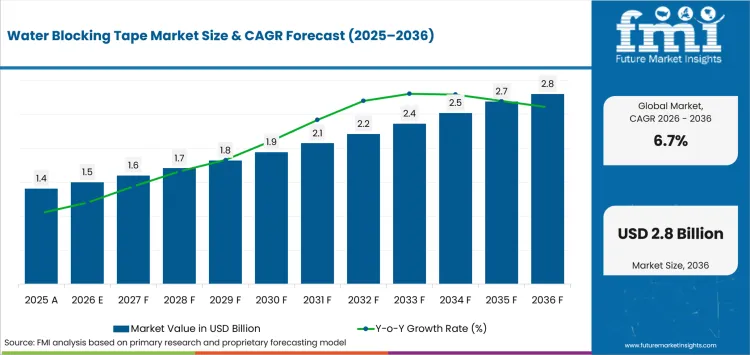
USD 1.5 billion in 2026 and USD 2.8 billion by 2036 at a 6.7% CAGR.
Water blocking tape sales are projected to rise from USD 1.5 billion in 2026 to USD 2.8 billion by 2036 at a 6.7% CAGR, as investments in communications and power networks support cable production worldwide. Manufacturers of fiber-optic cables require reliable moisture-management materials to maintain performance over long installation distances. The Fiber Broadband Association reported that operators passed 10.3 million additional USA homes with fiber during 2024. The continued expansion of fiber infrastructure creates a direct demand pathway for water-blocking tapes, which are incorporated into cable designs to prevent moisture intrusion and support long-term network durability.
Telecom builds favor lightweight dry constructions while transmission projects place greater weight on electrical behavior and long service life. European optical fiber coverage therefore changes the addressable cable mix without proving tape revenue by itself. The European Commission reported in June 2026 that FTTP reached 74.1% of EU27 households by mid-2025, increasing the installed network base served by qualified optical cable designs.
Key Takeaways of Water Blocking Tape Market
- Cable manufacturers generate recurring water blocking tape orders once a qualified construction fixes the tape inside its bill of materials.
- Based on tape type, semi-conductive water blocking tape is projected to account for 31.0% in 2026 due to combined moisture control and electrical continuity.
- The polypropylene nonwoven segment is likely to capture 34.0% of material demand in 2026 attributable to lightweight carrier control during absorbent coating and slitting.
- By cable type, fiber optic cables are forecast to represent 33.0% in 2026 driven by dry constructions that reduce gel handling during routine assembly.
- Tape substitutions remain slow as cable manufacturers recheck swelling and electrical behavior during qualification of revised materials for power or telecom constructions.
- Lantor, Geca Tapes, Fori Group, Nantong Siber Communication, Ekstel, Chase Corporation, Loypos Corporation and Freudenberg Performance Materials are the notable companies in this report.
Analyst Perspective
“Water blocking tape selection starts with the cable layer since conductor screens and optical cores impose different failure risks. Cable manufacturers protect production continuity by favoring grades that repeat swelling, resistance and reel behavior across qualification lots.”
- Nikhil Kaitwade, Principal Consultant, Future Market Insights
How is the Water Blocking Tape Market segmented?
The market is analyzed by tape type, material, cable type, application and sales channel.
Tape type includes non-conductive, semi-conductive, swellable yarn-backed, laminated and high-strength armored cable tapes used across varied cable constructions. Material covers polyester nonwoven, polypropylene nonwoven, SAP-coated fabric, copper or aluminum laminated and hybrid textile tape. Cable type spans power, fiber optic, submarine, telecom copper and specialty industrial cables serving different transmission and communication requirements. Applications cover conductor shielding, cable core wrapping, sheath water blocking, armor bedding and optical tube protection. Sales channels include cable OEM direct, tape converters, distributors and project or submarine supply across routine and project-based purchasing routes.
Why does semi-conductive water blocking tape lead the tape type category?
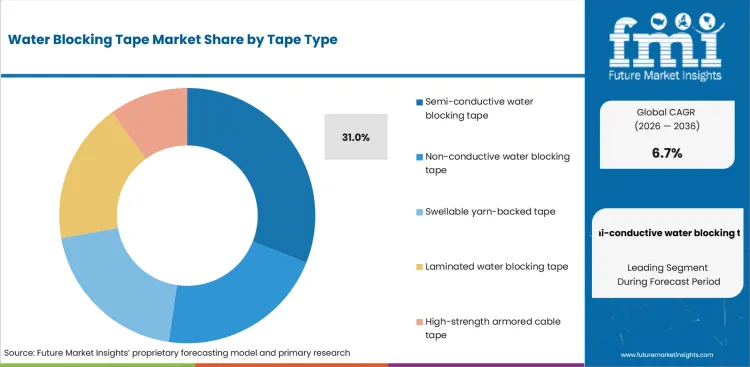
Semi-conductive grades combine moisture control with electrical continuity beside screened conductors, so one material change affects two qualification conditions. EPD International validated Loypos Corporation's LST-22130SW in February 2025 for moisture barriers between conductors and conductor shields, confirming this tape type's exact power-cable position.
- The tape type category is forecast to be led by semi-conductive water blocking tape at 31.0% share in 2026 due to its dual electrical and moisture-control role.
- Cable manufacturers compare surface resistance with swelling and dimensional stability during qualification near conductor screens. The combined test burden links tape approval to cable accessories and termination performance across the finished system.
Why does polypropylene nonwoven lead the material category?
Polypropylene nonwoven provides a lightweight carrier for superabsorbent chemistry and remains flexible during longitudinal placement or wrapping. Tape producers must control basis weight and surface uniformity as coating variation changes swelling response and line behavior.
- By material, polypropylene nonwoven is estimated to hold 34.0% in 2026 owing to carrier economics suited to high-volume absorbent coating and precise tape slitting.
- Stable properties in nonwoven fabrics are required for consistent absorbent coating on the cable line. Freudenberg Performance Materials stated in February 2026 that its cable tape product range includes semi-conductive and non-conductive water-blocking tapes for power, data, and specialty cable applications.
Why do fiber optic cables lead the cable type category?
Fiber optic cable plants favor dry moisture barriers since gel removal adds handling time during preparation and field access. Corning reported in May 2025 that its RPX Long-Span Ribbon Cables use a gel-free design to reduce cable-preparation labor in broadband deployment.
- In 2026, fiber optic cables are expected to lead cable type with 33.0% share because dry swellable constructions simplify assembly and later cable access.
- Compact optical cable designs leave little room for excess bulk, so manufacturers balance swelling speed against low thickness. Material companies serving specialty tapes compete on clean handling and repeatable line application alongside water uptake.
Why does conductor shielding lead the application category?
Conductor shielding places water-blocking material beside an electrically controlled interface, so coating consistency must hold across production lots. A suitable tape has to block longitudinal moisture without disturbing field continuity around the conductor screen at line speed.
- Conductor shielding is set to lead the application category with 29.0% share in 2026 due to moisture protection requiring controlled resistance beside screened conductors.
- Power-cable engineers require a documented moisture-control and electrical-continuity route to approve screened materials. EPD International validated Loypos Corporation's copper-wire-inserted semi-conductive woven water blocking tape in February 2025 for this function in high-voltage cable constructions.
What are the drivers, restraints and opportunities in the Water Blocking Tape Market?
Grid reinforcement and fiber deployment increase qualified tape consumption, while material validation slows switching and subsea programs require higher-specification constructions.
- Driver: New fiber routes and transmission projects add cable kilometers that require qualified longitudinal moisture barriers inside finished constructions.
- Restraint: Cable manufacturers repeat laboratory and line checks to qualify an alternative tape for replacement in an established production design.
- Opportunity: Subsea and high-voltage cable programs require tapes that combine water response with electrical and mechanical control across long manufacturing runs.
Cable Deployment Converts Network Expansion into Repeat Orders
New cable installation becomes recurring tape demand once a dry moisture barrier is fixed inside an approved construction. Nexans reported in August 2025 that fiber-optic element production had started for the 104-kilometer Malta-Sicily subsea interconnector. Combined power and communications cables therefore widen the tape specification set as serial submarine cables manufacturing begins.
Qualification Work Slows Material Switching
Tape substitutions can change thickness and mechanical behavior inside an approved cable even if two products show similar swelling results. Cable manufacturers therefore run laboratory checks and production trials to qualify a replacement tape for a medium-voltage cable construction. NKT powered up a Karlskrona high-voltage cable testing facility in September 2025, illustrating the wider system-level testing burden surrounding material changes.
Deep-Water Cable Designs Require Higher-Specification Tapes
Deep-water cable programs justify higher-specification tapes as repair exposure increases the cost of inconsistent moisture and electrical performance. Nexans began the western Tyrrhenian Link installation in September 2025 for two 500 kV HVDC cables totaling about 970 kilometers, giving qualified semi-conductive and salt-water grades a recurring material route across long manufacturing runs.
Which country CAGRs are profiled in the Water Blocking Tape Market?
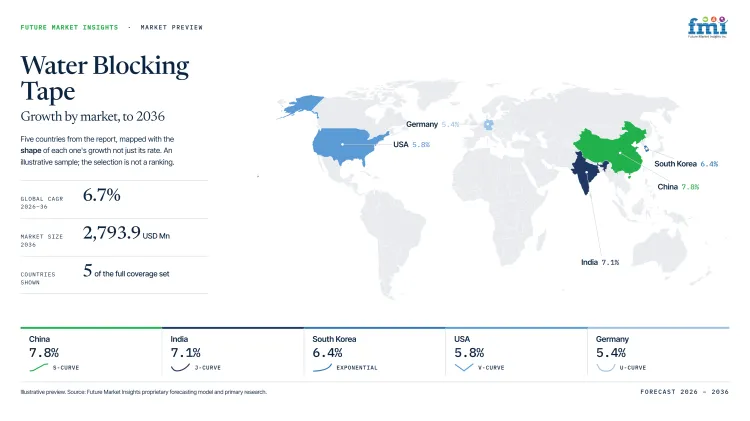
| Country | CAGR |
|---|---|
| South Korea | 6.4% |
| USA | 5.8% |
| Italy | 5.6% |
| Germany | 5.4% |
| Japan | 5.0% |
How do country-level CAGRs compare in the Water Blocking Tape Market?
The five profiled forecasts occupy a narrow 1.4 percentage-point band, yet their order routes divide into three commercial groups for tape makers. South Korea centers on export-led power-cable manufacturing, the USA and Italy depend on project conversion, and Germany plus Japan face mature qualification conditions that slow material switching.
- South Korea links export finance to power-cable manufacturers pursuing overseas approvals.
- USA broadband awards remain technology-neutral, making fiber conversion depend on each winning project.
- Italy combines authorized transmission projects with submarine interconnectors and long cable campaigns.
- Germany's electricity highways concentrate demand in qualification-heavy underground and HVDC cable designs.
- Japan pairs advanced optical research with mature networks that demand compatibility with established cable designs.
Similar rates therefore conceal different purchase timing and qualification burdens for tape manufacturers.
The full report provides country-level CAGR analysis across North America, Latin America, Europe, East Asia, South Asia, Oceania and the Middle East and Africa.
Country-wise Analysis
- South Korean tape purchasing is closely tied to export-oriented power-cable factories that qualify semi-conductive materials against overseas customer standards and use domestic manufacturing depth for rapid sample cycles. The South Korean water blocking tape sector is projected to record 6.4% CAGR during the assessment period, aided by export financing that improves order access without removing technical approval work. MOTIE reported in February 2025 that K-SURE would offer power-cable exporters preferential loan limits up to double normal levels and insurance discounts up to 20 percent, leaving tape manufacturers to compete on stable electrical properties and documentation across repeated production lots.
- USA water blocking tape orders come from utility programs and broadband projects that follow different technical rules across states, creating separate qualification routes for power and communications cable manufacturers nationwide. Water blocking tape demand in the USA is forecast to rise at 5.8% CAGR over the forecast period, supported by infrastructure work but limited by technology-neutral broadband selection. NTIA announced in July 2025 that all 56 eligible states and territories could begin the BEAD Benefit of the Bargain subgrantee round, leaving tape companies to prove construction fit for awards that convert into fiber cable production and recurring moisture-barrier orders.
- Italian water blocking tape demand is concentrated around transmission upgrades and subsea interconnectors that require stable material performance across long cable manufacturing campaigns, giving established project schedules unusual visibility into future tape calls. Terna reported in June 2025 that roughly 90% of projects in its updated industrial plan were authorized and about 80% had supply contracts, yet new material sources face long subsea qualification cycles and project-specific delivery windows. Water blocking tape sales in Italy are forecast to expand at 5.6% CAGR by 2036, supported by contracted grid execution while dependable reel quality remains essential for scheduled high-voltage production.
- German cable procurement places unusual weight on documented performance as major underground transmission projects require coordinated engineering records for serial production, making reproducible resistance and swelling data central to qualification. Bundesnetzagentur reported in January 2026 that roughly 2,000 kilometers of power lines were approved during 2025 and procedures finished for four major electricity highways, providing a clearer current project pipeline for domestic cable factories. By 2036, Germany is projected to grow at 5.4% CAGR, supported by high-voltage grid reinforcement while long material approval cycles continue to favor tape manufacturers with stable test records and repeatable production data nationwide.
- Japanese cable demand combines mature installed networks with advanced optical development, so water blocking tape companies win targeted programs by proving compatibility with established cable designs instead of relying on broad greenfield construction. Adoption of water blocking tape in Japan is estimated to expand at 5.0% CAGR through 2036, aided by higher-capacity optical work but constrained by strict engineering qualification. NICT reported in May 2025 that a standard-diameter 19-core optical fiber transmitted 1.02 petabits per second across 1,808 kilometers, reinforcing the need for compact cable materials that do not interfere with high-density optical construction or repeatable line processing.
Who are the notable companies in the Water Blocking Tape Market?
Lantor, Geca Tapes, Fori Group, Nantong Siber Communication, Ekstel, Chase Corporation, Loypos Corporation and Freudenberg Performance Materials are the notable companies serving this market.
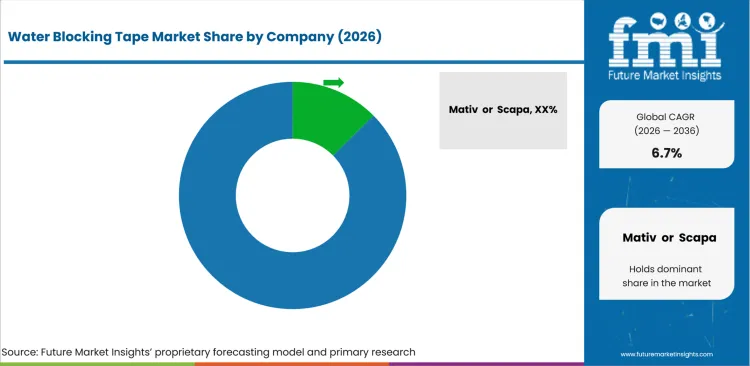
Competition is fragmented across integrated nonwoven producers, specialist swellable-tape manufacturers and strand-blocking material companies serving different cable layers. Entry becomes difficult once a grade enters an OEM qualification record as replacement can trigger new testing across cable termination systems and complete cable assemblies.
- Integrated nonwoven and tape manufacturers: Lantor, Geca Tapes, Freudenberg Performance Materials and Ekstel combine water-blocking ranges with in-house material or converting control.
- Configurable cable-material specialists: Fori Group and Nantong Siber Communication serve cable manufacturers with water-blocking tape or yarn programs tailored to defined power and optical constructions.
- Strand-blocking and woven-tape specialists: Chase Corporation and Loypos Corporation compete in conductor moisture protection that requires controlled electrical behavior beside screened power-cable layers.
Competitive Benchmarking: Water Blocking Tape Market
| Company | Water-Blocking Range Breadth | High-Spec Cable Qualification Fit | Cable-OEM Integration Support | Geographic Reach |
|---|---|---|---|---|
| Lantor | High | Medium | High | Europe and international cable markets |
| Geca Tapes | High | High | High | France-based production with global cable shipments |
| Fori Group | Medium | Medium | High | Europe and international cable markets |
| Nantong Siber Communication | Medium | Medium | Medium | China and export optical-cable markets |
| Ekstel | Medium | Medium | High | Europe and international cable markets |
| Chase Corporation | Medium | High | Medium | North America and Europe |
| Loypos Corporation | Medium | High | Medium | South Korea and global power-cable markets |
| Freudenberg Performance Materials | High | High | High | Europe, Asia and North America |
Key Developments in the Water Blocking Tape Market
- In July 2025, Chase Corporation launched A162HF with a 35% higher melt index and lower processing temperatures for medium-voltage strand blocking.
- In April 2025, Fori Group detailed a project adding space and technology for a new lamination and impregnation line serving its cable program.
- In February 2025, Loypos Corporation's heavy-weight semi-conductive woven water blocking tape received a valid International EPD for global and South Korean use.
Key Players in the Water Blocking Tape Market
Integrated Nonwoven and Tape Manufacturers
- Lantor
- Geca Tapes
- Freudenberg Performance Materials
- Ekstel
Cable-Material and Strand-Blocking Specialists
- Fori Group
- Nantong Siber Communication
- Chase Corporation
- Loypos Corporation
Water Blocking Tape Market - Report Scope
| Coverage field | Report scope |
|---|---|
| Market breakdown | By tape type, material, cable type, application, sales channel and region. |
| Quantitative Units | Revenue in USD million and CAGR in %. |
| Market Definition | Commercial water-blocking tapes used inside power, fiber optic, submarine, telecom copper and specialty industrial cable constructions. |
| Regions Covered | North America, Latin America, Europe, East Asia, South Asia and Pacific, and Middle East and Africa. |
| Countries Covered | South Korea, USA, Italy, Germany, Japan, and 20+ countries included in the full report. |
| Key Companies Profiled | Lantor, Geca Tapes, Fori Group, Nantong Siber Communication, Ekstel, Chase Corporation, Loypos Corporation and Freudenberg Performance Materials. |
| Forecast Period | 2026 to 2036. |
| Approach | Primary and secondary research with market triangulation. |
Water Blocking Tape Market - Research Methodology
| Method | Approach |
|---|---|
| Primary Research | FMI analysts gathered input from manufacturers, service providers, technology developers, distributors, end users, procurement teams, and subject-matter experts. Interviews examined purchasing decisions, product or service evaluation, adoption barriers, approval requirements, pricing considerations, and expectations for technical or commercial support. Respondents were also asked what evidence is required before a trial, pilot, or initial order develops into regular purchasing. |
| Desk Research | Desk research covered government statistics, regulatory publications, trade data, industry associations, technical literature, standards, company filings, product information, and official corporate announcements. Sources were reviewed for relevance, publication date, geographic coverage, and consistency with the defined market scope. Claims relating to performance, applications, approvals, capacity, investment, and commercial activity were retained only when supported by credible public evidence. |
| Market Sizing and Forecasting | The market model combined the baseline value with historical performance, segment structure, pricing and volume indicators, adoption levels, company participation, and country-level demand conditions. Forecast assumptions considered economic activity, investment trends, regulatory developments, technology adoption, purchasing cycles, supply availability, and barriers to wider market use. Segment and regional estimates were reconciled before the final market total was calculated. |
| Data Validation | Estimates were checked against multiple independent indicators, including public data, company activity, trade patterns, industry developments, and findings from primary interviews. Validation also tested whether products, services, applications, and company revenues fell within the defined market boundaries. Adjacent categories, unsupported claims, overlapping revenues, and activities without direct market relevance were excluded to reduce double counting and maintain consistency across segments and countries. |
Water Blocking Tape Market by Segments
Water Blocking Tape Market segmented by Tape Type:
- Non-conductive water blocking tape
- Semi-conductive water blocking tape
- Swellable yarn-backed tape
- Laminated water blocking tape
- High-strength armored cable tape
Water Blocking Tape Market segmented by Material:
- Polyester nonwoven
- Polypropylene nonwoven
- SAP-coated fabric
- Copper / aluminum laminated
- Hybrid textile tape
Water Blocking Tape Market segmented by Cable Type:
- Power cables
- Fiber optic cables
- Submarine cables
- Telecom copper cables
- Specialty industrial cables
Water Blocking Tape Market segmented by Application:
- Conductor shielding
- Cable core wrapping
- Sheath water blocking
- Armor bedding
- Optical tube protection
Water Blocking Tape Market segmented by Sales Channel:
- Cable OEM direct
- Tape converters
- Distributors
- Project / submarine supply
Water Blocking Tape Market by Region:
- North America
- United States
- Canada
- Latin America
- Brazil
- Mexico
- Chile
- Rest of Latin America
- Western Europe
- Germany
- United Kingdom
- Italy
- Spain
- France
- Nordics
- Benelux
- Rest of Western Europe
- Eastern Europe
- Russia
- Poland
- Hungary
- Balkan and Baltic States
- Rest of Eastern Europe
- East Asia
- China
- Japan
- South Korea
- South Asia and Pacific
- India
- ASEAN
- Australia and New Zealand
- Rest of South Asia and Pacific
- Middle East and Africa
- Kingdom of Saudi Arabia
- Other GCC Countries
- Türkiye
- South Africa
- Other African Union Countries
- Rest of Middle East and Africa
Research Sources and Bibliography
- Fiber Broadband Association. (2025, January 23). Fiber Broadband Association Reports Record Fiber-To-The-Home Deployment in 2024.
- European Commission. (2026, June 17). Digital Decade 2026 - Connectivity Coverage in Europe 2025 report.
- EPD International. (2025, February 19). EPD-IES-0018669:003 Semi-conductive Woven Water Blocking Tape(LST-22130SW).
- Freudenberg Performance Materials. (2026, February 12). Freudenberg to return to Wire Düsseldorf.
- Corning Incorporated. (2025, May 28). Corning Showcases Transformative Fiber Broadband Solutions at Fiber Connect 2025.
- EPD International. (2025, February 19). EPD-IES-0017875:003 Semi-conductive Woven Water blocking Tape(Copper Wire Inserted Rayon Water Blocking Tape).
- Nexans. (2025, August 14). Nexans advances key stage in Malta-Sicily Interconnector project.
- NKT. (2025, September 10). NKT expands capabilities with new facility for power cable testing.
- Nexans. (2025, September 16). High-voltage subsea cable installation for Tyrrhenian Link connecting Sicily and Sardinia.
- Ministry of Trade, Industry and Resources, Republic of Korea. (2025, February 4). K-Grid Export Alliance kicks into high gear, eyeing global power grid market.
- National Telecommunications and Information Administration. (2025, July 21). All 56 States and Territories Receive Approval to Begin “Benefit of the Bargain” Round under the BEAD Program.
- Terna. (2025, June 25). Terna updates its industrial plan: 17.7 billion euros in investments over five years.
- Bundesnetzagentur. (2026, January 2). Energy transition clears crucial hurdle - significant progress in electricity grid expansion in 2025.
- National Institute of Information and Communications Technology. (2025, May 29). World Record Achieved in Transmission Capacity and Distance: With 19-core Optical Fiber with Standard Cladding Diameter - 1,808 km Transmission of 1.02 Petabits per Second.
- Chase Corporation. (2025, July 16). Chase BlH₂Ock® High-Flow Strand-Block Technology.
- Fori Group. (2025, April 21). Projekt: »NOVA PROIZVODNA LINIJA ZA LAMINACIJO«.
- EPD International. (2025, February 19). EPD-IES-0018670:003 Additional Semi-conductive Woven Water Blocking Tape(Heavy Weight).
- Prysmian. (2025, May 14). PRYSMIAN’S TRANSMISSION BUSINESS STRENGTHENED AS ITS STATE-OF- THE-ART PRYSMIAN MONNA LISA SUBMARINE CABLE LAYING VESSEL AND SUBMARINE CABLES’ FACTORY EXPANSION IN FINLAND ARE UNVEILED.
- NKT. (2025, January 28). Investments in additional capacity in the medium-voltage power cable business completed at two out of three sites.
- Sumitomo Electric Industries, Ltd. (2025, February 10). SUMITOMO ELECTRIC UK POWER CABLES marks Key Milestone in Construction at the Port of Nigg.
This bibliography is provided for reader reference and is not exhaustive. The full report contains the complete reference list and detailed citations.
This Report Answers
- What is the water blocking tape market size in 2026 and what value is forecast by 2036?
- Which cable deployment conditions convert infrastructure projects into recurring water blocking tape orders?
- Why does semi-conductive water blocking tape hold the leading tape type position in 2026?
- How does polypropylene nonwoven affect coating consistency and cable-line qualification?
- Why do fiber optic cables account for the largest cable type share in 2026?
- How do forecast CAGRs differ across South Korea, USA, Italy, Germany and Japan?
- Which qualification requirements slow material switching across power and telecom cable constructions?
- How do notable companies differ in water-blocking range breadth and cable-OEM integration support?
- What should cable manufacturers compare beyond unit price before approving a new water blocking tape?
Frequently Asked Questions
How big is the Water Blocking Tape Market in 2026?
The water blocking tape market is valued at USD 1.5 billion in 2026 and is projected to reach USD 2.8 billion by 2036. Growth is driven by increasing demand for moisture-protection materials in power and fiber-optic cable manufacturing.
What is the CAGR of the Water Blocking Tape Market from 2026 to 2036?
The water blocking tape market is projected to grow at a CAGR of 6.7% between 2026 and 2036. Expansion is supported by new cable infrastructure projects and continued adoption of qualified water-blocking solutions.
Which tape type leads the Water Blocking Tape Market?
Semi-conductive water blocking tape is projected to account for 31.0% of the market in 2026. Its leading share is supported by its ability to provide both moisture protection and electrical continuity in power cable applications.
Which material leads the Water Blocking Tape Market?
Polypropylene nonwoven is projected to account for 34.0% of the market in 2026. Its dominance is driven by lightweight performance, process efficiency, and suitability for high-volume cable manufacturing.
Which companies are active in the Water Blocking Tape Market?
Key companies operating in the market include Lantor, Geca Tapes, Fori Group, Nantong Siber Communication, Ekstel, Chase Corporation, Loypos Corporation, and Freudenberg Performance Materials. These companies compete through product performance, application expertise, and support for power and optical cable manufacturers.
Preview the report firsthand - request a free sample
Get SampleGet the brochure for pricing and purchase details.
Get PDFTable of Content
- Key Takeaways
- Market Size and CAGR
- Top Growth Driver
- Fastest Growing Segment
- Leading Region
- Key Companies
- Emerging Opportunities
- Executive Summary
- Global Market Outlook
- Demand-side Trends
- Supply-side Trends
- Technology Roadmap Analysis
- Analysis and Recommendations
- Analyst Perspective (What is happening? Why now? What should investors know?)
- Key Questions Answered
- How large is the market?
- What is the CAGR?
- What are key trends?
- Which region dominates?
- Who are the leaders?
- Market Overview
- Market Coverage / Taxonomy
- Market Definition / Scope / Limitations
- Research Methodology
- Chapter Orientation
- Analytical Lens and Working Hypotheses
- Market Structure, Signals, and Trend Drivers
- Benchmarking and Cross-market Comparability
- Market Sizing, Forecasting, and Opportunity Mapping
- Research Design and Evidence Framework
- Desk Research Programme (Secondary Evidence)
- Expert Input and Fieldwork (Primary Evidence)
- Tooling, Models, and Reference Databases
- Data Engineering and Model Build
- Quality Assurance and Audit Trail
- Market Background
- Market Dynamics (Drivers, Restraints, Opportunity, Trends)
- Scenario Forecast (Optimistic, Likely, Conservative)
- Impact Analysis
- AI Impact
- Sustainability Impact
- Regulatory Impact
- Technology Impact
- Consumer / Buyer Analysis
- Purchase Drivers
- Adoption Barriers
- Buyer Journey
- Opportunity Map Analysis
- Product Life Cycle Analysis
- Supply Chain Analysis
- Investment Feasibility Matrix
- Value Chain Analysis
- PESTLE and Porter's Analysis
- Regulatory Landscape
- Regional Parent Market Outlook
- Production and Consumption Statistics
- Import and Export Statistics
- Global Market Analysis and Forecast, 2021 to 2036
- Historical Market Size Value (USD Million) Analysis, 2021 to 2025
- Current and Future Market Size Value (USD Million) Projections, 2026 to 2036
- Y-o-Y Growth Trend Analysis
- Absolute $ Opportunity Analysis
- Global Market Pricing Analysis, 2021 to 2036
- Global Market Analysis and Forecast, By Product Type, 2021 to 2036
- Introduction / Key Findings
- Historical Market Size Value (USD Million) Analysis By Product Type, 2021 to 2025
- Current and Future Market Size Value (USD Million) Analysis and Forecast By Product Type, 2026 to 2036
- Non-conductive water blocking tape
- Semi-conductive water blocking tape
- Swellable yarn-backed tape
- Laminated water blocking tape
- High-strength armored cable tape
- Non-conductive water blocking tape
- Y-o-Y Growth Trend Analysis By Product Type, 2021 to 2025
- Absolute $ Opportunity Analysis By Product Type, 2026 to 2036
- Global Market Analysis and Forecast, By Material Type, 2021 to 2036
- Introduction / Key Findings
- Historical Market Size Value (USD Million) Analysis By Material Type, 2021 to 2025
- Current and Future Market Size Value (USD Million) Analysis and Forecast By Material Type, 2026 to 2036
- Polyester nonwoven
- Polypropylene nonwoven
- SAP-coated fabric
- Copper or aluminum laminated
- Hybrid textile tape
- Polyester nonwoven
- Y-o-Y Growth Trend Analysis By Material Type, 2021 to 2025
- Absolute $ Opportunity Analysis By Material Type, 2026 to 2036
- Global Market Analysis and Forecast, By Cable Type, 2021 to 2036
- Introduction / Key Findings
- Historical Market Size Value (USD Million) Analysis By Cable Type, 2021 to 2025
- Current and Future Market Size Value (USD Million) Analysis and Forecast By Cable Type, 2026 to 2036
- Power cables
- Fiber optic cables
- Submarine cables
- Telecom copper cables
- Specialty industrial cables
- Power cables
- Y-o-Y Growth Trend Analysis By Cable Type, 2021 to 2025
- Absolute $ Opportunity Analysis By Cable Type, 2026 to 2036
- Global Market Analysis and Forecast, By Application, 2021 to 2036
- Introduction / Key Findings
- Historical Market Size Value (USD Million) Analysis By Application, 2021 to 2025
- Current and Future Market Size Value (USD Million) Analysis and Forecast By Application, 2026 to 2036
- Cable core wrapping
- Conductor shielding
- Sheath water blocking
- Armor bedding
- Optical tube protection
- Cable core wrapping
- Y-o-Y Growth Trend Analysis By Application, 2021 to 2025
- Absolute $ Opportunity Analysis By Application, 2026 to 2036
- Global Market Analysis and Forecast, By Sales Channel, 2021 to 2036
- Introduction / Key Findings
- Historical Market Size Value (USD Million) Analysis By Sales Channel, 2021 to 2025
- Current and Future Market Size Value (USD Million) Analysis and Forecast By Sales Channel, 2026 to 2036
- Cable OEM direct
- Tape converters
- Distributors
- Project or submarine supply
- Cable OEM direct
- Y-o-Y Growth Trend Analysis By Sales Channel, 2021 to 2025
- Absolute $ Opportunity Analysis By Sales Channel, 2026 to 2036
- Global Market Analysis and Forecast, By Region, 2021 to 2036
- Introduction
- Historical Market Size Value (USD Million) Analysis By Region, 2021 to 2025
- Current Market Size Value (USD Million) Analysis and Forecast By Region, 2026 to 2036
- North America
- Latin America
- Western Europe
- Eastern Europe
- East Asia
- South Asia and Pacific
- Middle East & Africa
- Market Attractiveness Analysis By Region
- North America Market Analysis and Forecast, By Country, 2021 to 2036
- Historical Market Size Value (USD Million) Trend Analysis By Market Taxonomy, 2021 to 2025
- Market Size Value (USD Million) Forecast By Market Taxonomy, 2026 to 2036
- By Country
- USA
- Canada
- By Product Type
- By Material Type
- By Cable Type
- By Application
- By Sales Channel
- By Country
- Market Attractiveness Analysis
- By Country
- By Product Type
- By Material Type
- By Cable Type
- By Application
- By Sales Channel
- Key Takeaways
- Latin America Market Analysis and Forecast, By Country
- Historical Market Size Value (USD Million) Trend Analysis By Market Taxonomy, 2021 to 2025
- Market Size Value (USD Million) Forecast By Market Taxonomy, 2026 to 2036
- By Country
- Brazil
- Mexico
- Chile
- Rest of Latin America
- By Product Type
- By Material Type
- By Cable Type
- By Application
- By Sales Channel
- By Country
- Market Attractiveness Analysis
- By Country
- By Product Type
- By Material Type
- By Cable Type
- By Application
- By Sales Channel
- Key Takeaways
- Western Europe Market Analysis and Forecast, By Country
- Historical Market Size Value (USD Million) Trend Analysis By Market Taxonomy, 2021 to 2025
- Market Size Value (USD Million) Forecast By Market Taxonomy, 2026 to 2036
- By Country
- Germany
- UK
- Italy
- Spain
- France
- Nordic
- BENELUX
- Rest of Western Europe
- By Product Type
- By Material Type
- By Cable Type
- By Application
- By Sales Channel
- By Country
- Market Attractiveness Analysis
- By Country
- By Product Type
- By Material Type
- By Cable Type
- By Application
- By Sales Channel
- Key Takeaways
- Eastern Europe Market Analysis and Forecast, By Country
- Historical Market Size Value (USD Million) Trend Analysis By Market Taxonomy, 2021 to 2025
- Market Size Value (USD Million) Forecast By Market Taxonomy, 2026 to 2036
- By Country
- Russia
- Poland
- Hungary
- Balkan & Baltic
- Rest of Eastern Europe
- By Product Type
- By Material Type
- By Cable Type
- By Application
- By Sales Channel
- By Country
- Market Attractiveness Analysis
- By Country
- By Product Type
- By Material Type
- By Cable Type
- By Application
- By Sales Channel
- Key Takeaways
- East Asia Market Analysis and Forecast, By Country
- Historical Market Size Value (USD Million) Trend Analysis By Market Taxonomy, 2021 to 2025
- Market Size Value (USD Million) Forecast By Market Taxonomy, 2026 to 2036
- By Country
- China
- Japan
- South Korea
- By Product Type
- By Material Type
- By Cable Type
- By Application
- By Sales Channel
- By Country
- Market Attractiveness Analysis
- By Country
- By Product Type
- By Material Type
- By Cable Type
- By Application
- By Sales Channel
- Key Takeaways
- South Asia and Pacific Market Analysis and Forecast, By Country
- Historical Market Size Value (USD Million) Trend Analysis By Market Taxonomy, 2021 to 2025
- Market Size Value (USD Million) Forecast By Market Taxonomy, 2026 to 2036
- By Country
- India
- ASEAN
- Australia & New Zealand
- Rest of South Asia and Pacific
- By Product Type
- By Material Type
- By Cable Type
- By Application
- By Sales Channel
- By Country
- Market Attractiveness Analysis
- By Country
- By Product Type
- By Material Type
- By Cable Type
- By Application
- By Sales Channel
- Key Takeaways
- Middle East & Africa Market Analysis and Forecast, By Country
- Historical Market Size Value (USD Million) Trend Analysis By Market Taxonomy, 2021 to 2025
- Market Size Value (USD Million) Forecast By Market Taxonomy, 2026 to 2036
- By Country
- Kingdom of Saudi Arabia
- Other GCC Countries
- Türkiye
- South Africa
- Other African Union
- Rest of Middle East & Africa
- By Product Type
- By Material Type
- By Cable Type
- By Application
- By Sales Channel
- By Country
- Market Attractiveness Analysis
- By Country
- By Product Type
- By Material Type
- By Cable Type
- By Application
- By Sales Channel
- Key Takeaways
- Key Countries Market Analysis
- USA
- Pricing Analysis
- Market Share Analysis, 2025
- By Product Type
- By Material Type
- By Cable Type
- By Application
- By Sales Channel
- Canada
- Pricing Analysis
- Market Share Analysis, 2025
- By Product Type
- By Material Type
- By Cable Type
- By Application
- By Sales Channel
- Mexico
- Pricing Analysis
- Market Share Analysis, 2025
- By Product Type
- By Material Type
- By Cable Type
- By Application
- By Sales Channel
- Brazil
- Pricing Analysis
- Market Share Analysis, 2025
- By Product Type
- By Material Type
- By Cable Type
- By Application
- By Sales Channel
- Chile
- Pricing Analysis
- Market Share Analysis, 2025
- By Product Type
- By Material Type
- By Cable Type
- By Application
- By Sales Channel
- Germany
- Pricing Analysis
- Market Share Analysis, 2025
- By Product Type
- By Material Type
- By Cable Type
- By Application
- By Sales Channel
- UK
- Pricing Analysis
- Market Share Analysis, 2025
- By Product Type
- By Material Type
- By Cable Type
- By Application
- By Sales Channel
- Italy
- Pricing Analysis
- Market Share Analysis, 2025
- By Product Type
- By Material Type
- By Cable Type
- By Application
- By Sales Channel
- Spain
- Pricing Analysis
- Market Share Analysis, 2025
- By Product Type
- By Material Type
- By Cable Type
- By Application
- By Sales Channel
- France
- Pricing Analysis
- Market Share Analysis, 2025
- By Product Type
- By Material Type
- By Cable Type
- By Application
- By Sales Channel
- India
- Pricing Analysis
- Market Share Analysis, 2025
- By Product Type
- By Material Type
- By Cable Type
- By Application
- By Sales Channel
- ASEAN
- Pricing Analysis
- Market Share Analysis, 2025
- By Product Type
- By Material Type
- By Cable Type
- By Application
- By Sales Channel
- Australia & New Zealand
- Pricing Analysis
- Market Share Analysis, 2025
- By Product Type
- By Material Type
- By Cable Type
- By Application
- By Sales Channel
- China
- Pricing Analysis
- Market Share Analysis, 2025
- By Product Type
- By Material Type
- By Cable Type
- By Application
- By Sales Channel
- Japan
- Pricing Analysis
- Market Share Analysis, 2025
- By Product Type
- By Material Type
- By Cable Type
- By Application
- By Sales Channel
- South Korea
- Pricing Analysis
- Market Share Analysis, 2025
- By Product Type
- By Material Type
- By Cable Type
- By Application
- By Sales Channel
- Russia
- Pricing Analysis
- Market Share Analysis, 2025
- By Product Type
- By Material Type
- By Cable Type
- By Application
- By Sales Channel
- Poland
- Pricing Analysis
- Market Share Analysis, 2025
- By Product Type
- By Material Type
- By Cable Type
- By Application
- By Sales Channel
- Hungary
- Pricing Analysis
- Market Share Analysis, 2025
- By Product Type
- By Material Type
- By Cable Type
- By Application
- By Sales Channel
- Kingdom of Saudi Arabia
- Pricing Analysis
- Market Share Analysis, 2025
- By Product Type
- By Material Type
- By Cable Type
- By Application
- By Sales Channel
- Türkiye
- Pricing Analysis
- Market Share Analysis, 2025
- By Product Type
- By Material Type
- By Cable Type
- By Application
- By Sales Channel
- South Africa
- Pricing Analysis
- Market Share Analysis, 2025
- By Product Type
- By Material Type
- By Cable Type
- By Application
- By Sales Channel
- USA
- Market Structure Analysis
- Competition Dashboard
- Competition Benchmarking
- Market Share Analysis of Top Players
- By Regional
- By Product Type
- By Material Type
- By Cable Type
- By Application
- By Sales Channel
- Emerging Startups
- Innovation Benchmarking
- Competition Analysis
- Competition Deep Dive
- Mativ or Scapa
- Overview
- Product Portfolio
- Profitability by Market Segments
- Sales Footprint
- Strategy Overview
- Marketing Strategy
- Product Strategy
- Channel Strategy
- Chase Corporation
- Lantor
- Geca Tapes
- Star Materials
- Fori Group
- Gepco
- Nantong Siber Communication
- Unitape
- Ekstel
- Mativ or Scapa
- Case Studies
- Success Stories
- Recent Developments
- Competition Deep Dive
- Assumptions & Acronyms Used


