

- Market Size (2026)
- USD 248.5 Mn
- Forecast (2036)
- USD 445.0 Mn
- CAGR (2026 to 2036)
- 6.0%
How big is Watts Linkage Suspensions Market in 2026?
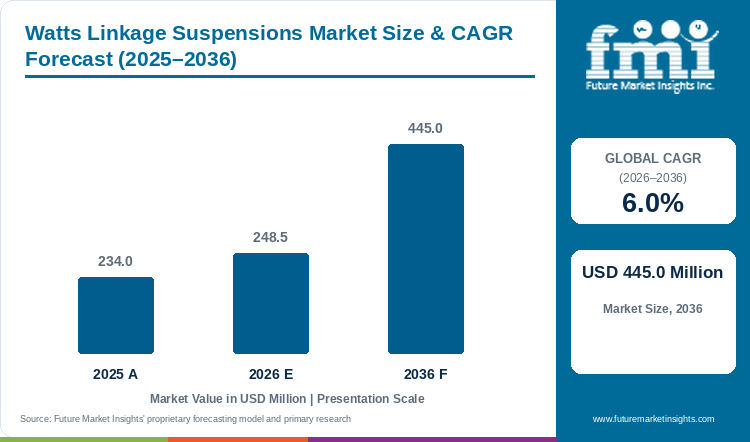
The global watts linkage suspensions market valuation was valued at USD 234.0 million in 2025 to USD 248.5 million in 2026 and is estimated to reach USD 445.0 million by 2036, expanding at a 6.0% CAGR during the forecast period.
Added traction-battery weight in electric commercial vans and compact cars is forcing automakers to upgrade rear lateral axle stability without absorbing the high tooling cost of five-link independent subframes. When a delivery van carries 450 kilograms of battery cells, a conventional Panhard rod forces the rear axle to swing in a lateral arc over bumps, which accelerates tire wear and causes rear sway. For instance, in February 2026, Magna International reported USD 1.31 billion in 2025 pre-tax operating income while supplying rear twist-axle and linkage assemblies to more than 3.2 million vehicles annually to meet this chassis stabilization demand [1]. Because commercial van builders need straight vertical wheel travel without losing underfloor cargo space, Axle-Housing Mounted Pivot Bell-Crank is estimated to secure 58.2% of central bell-crank mounting location demand in 2026 across automotive suspension systems. Global watts linkage suspensions market value is estimated to move from USD 234.0 million in 2025 to USD 248.5 million in 2026 and reach USD 445.0 million by 2036, progressing at a 6.0% CAGR to create USD 196.5 million in incremental annual value. However, extended battery trays projecting behind the rear axle centerline frequently restrict cross-car tie-rod clearance on short-wheelbase hatchbacks.
Key Market Trends & Insights
- By central bell-crank mounting location: Axle-Housing Mounted Pivot Bell-Crank is estimated to secure 58.2% in 2026 because direct differential-cover mounting prevents spare-tire well intrusion on commercial vans.
- By link rod metallurgy: Forged High-Strength Microalloyed Steel Links are projected to capture 64.5% in 2026 to provide high cyclic tension-compression endurance under payload cornering.
- By bushing elastomer type: Void-Tuned Natural Rubber / HNBR NVH Bushings are expected to command 69.0% in 2026 owing to high-frequency road-rumble attenuation in quiet electric cabins.
- By vehicle application: Electric & ICE Light Commercial Vans & Pickups is predicted to account for 51.4% in 2026 under high roof-load roll stability requirements across parcel delivery fleets.
Regional Highlights
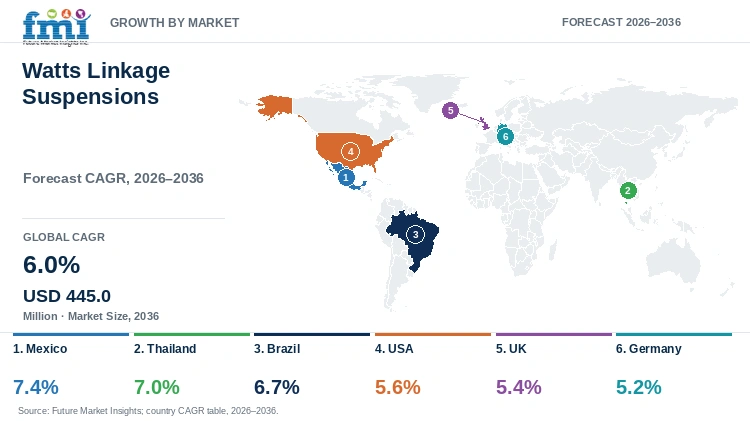
- Top national expansion: Mexico is slated to pace country demand at a 7.4% CAGR through 2036 through export-focused light commercial van and pickup chassis stamping plants.
- Broader country progression: Thailand is predicted to grow at 7.0% CAGR ahead of Brazil at 6.7% and the USA at 5.6%, whereas the UK and Germany are estimated to record 5.4% and 5.2% annual rates.
Market Size & Forecast
Table 1: Market Size and Forecast for the Watts Linkage Suspensions Market (USD million and CAGR percentage), 2025 to 2036
| Metric | Value |
|---|---|
| 2025 Market Size | USD 234.0 million |
| Estimated Market Size in 2026 | USD 248.5 million |
| Projected Market Size by 2036 | USD 445.0 million |
| CAGR, 2026 to 2036 | 6.0% |
| Added Revenue, 2026 to 2036 | USD 196.5 million |
Consolidation among global driveline and metal-forming suppliers is reshaping how automakers source rear axle guidance linkages between 2026 and 2036. Rather than buying loose tie rods and bell-crank brackets from separate machine shops, vehicle manufacturers now award bundled contracts for complete rear twist-beam and live-axle modules. To capture these integrated chassis awards, in January 2025, American Axle & Manufacturing (AAM) announced a USD 1.44 billion cash-and-stock combination with Dowlais Group plc to unite metal-formed suspension components and driveline hardware across internal-combustion and electric platforms [2]. This shift toward single-source axle modules strengthens demand for three-piece Watts linkages paired with automotive suspension control arms.
Commercial-Fleet and Axle-Guidance Unit Sizing
Table 2: Commercial-Fleet and Axle-Guidance Unit Sizing for the Watts Linkage Suspensions Market (USD million and operational ranges), 2025 to 2036
| Metric | 2025 | 2026 | 2036 |
|---|---|---|---|
| Market size (USD million) | 234.0 | 248.5 | 445.0 |
| Equipped vehicle output (million units) | 2.85 to 3.10 | 3.00 to 3.28 | 5.15 to 5.65 |
| Shipped lateral link rods (million units) | 5.70 to 6.20 | 6.00 to 6.56 | 10.30 to 11.30 |
| Average OEM assembly price per vehicle (USD) | 75.5 to 82.1 | 75.8 to 82.8 | 78.8 to 86.4 |
Operational note: Equipped vehicle and link-rod volumes reflect one central bell-crank pivot and two equal-length lateral tie rods per rear axle across light commercial vans and twist-beam passenger cars.
Higher commercial fleet tire-replacement expenses are a key operational factor expanding equipped vehicle volumes from 3.00 million units in 2026 to 5.15 million units by 2036. High-roof parcel delivery vans suffer rapid outer-shoulder tire scrubbing when unguided rear twist beams deflect under cornering torque. Fleet procurement officers therefore specify factory-fitted Watts bell-cranks equipped with control arm and suspension joint bearings to lock rear toe angles and extend tire service life.
Per-Vehicle & Assembly Spending Indicators
Table 3: Per-Vehicle and Assembly Spending Indicators for the Watts Linkage Suspensions Market (USD and percentages), 2025 to 2036
| Metric | 2025 | 2026 | 2036 |
|---|---|---|---|
| Global light vehicle & LCV output (million units) | 91.4 | 93.2 | 108.5 |
| Watts linkage spend per 1,000 vehicles built (USD) | 2,560.2 | 2,666.3 | 4,101.4 |
| Bell-crank & dual-rod kit cost range (USD) | 68.0 to 94.0 | 70.0 to 96.0 | 74.0 to 102.0 |
| OEM factory-fit contract share (%) | 83.0% to 86.0% | 84.0% to 87.0% | 87.0% to 90.0% |
Table 4: Platform & Chassis-Assembly Spending Indicators for the Watts Linkage Suspensions Market (USD and percentages), 2026
| Metric | Value | Institutional Reference Basis |
|---|---|---|
| Market size, 2026 | USD 248.5 million | 2026 global revenue baseline |
| Active vehicle platforms using Watts linkages | 48 platforms | Global LCV, twist-beam car & performance axle registry |
| Average annual linkage spend per platform | USD 5.2 million | Annualized Tier-1 linkage assembly billing |
| Light commercial van & pickup allocation, 2026 | USD 127.7 million | 51.4% vehicle application segment share |
Upward progression in per-vehicle kit pricing from USD 70.0–96.0 in 2026 to USD 74.0–102.0 by 2036 reflects OEM demand for acoustic isolation in electric vans. Rigid suspension joints transmit road noise directly into unibody floors when internal combustion engine masking noise is absent. Tier-1 suppliers command higher kit prices by tuning void-molded elastomer bushings and integrating them with air suspension system components on commercial utility chassis.
Analyst Perspective
"Battery-electric light commercial vans and compact EVs face a sharp trade-off between underfloor battery volume and rear lateral stability. Tier-1 chassis manufacturers supplying forged microalloyed steel Watts linkages with HNBR hydro-bushings enable automakers to preserve flat cargo floors while matching multi-link cornering precision."
- Nikhil Kaitwade, Principal Consultant, Future Market Insights.
How is the watts linkage suspensions market segmented?
The watts linkage suspensions market is segmented by central bell-crank mounting location, link rod metallurgy, bushing elastomer type, and vehicle application. In 2026, Axle-Housing Mounted Pivot Bell-Crank is projected at 58.2%, Forged High-Strength Microalloyed Steel Links at 64.5%, Void-Tuned Natural Rubber / HNBR NVH Bushings at 69.0%, and Electric & ICE Light Commercial Vans & Pickups at 51.4%.
By central bell-crank mounting location: Axle-Housing Mounted Pivot Bell-Crank and Chassis-Subframe Mounted Pivot Bell-Crank.
By link rod metallurgy: Forged High-Strength Microalloyed Steel Links, Tubular 6061-T6 / 7075 Aluminum Alloy Links, and Chromoly Spherical-Bearing Motorsport Links.
By bushing elastomer type: Void-Tuned Natural Rubber / HNBR NVH Bushings and Polyurethane & PTFE-Lined Spherical Heim Joints.
By vehicle application: Electric & ICE Light Commercial Vans & Pickups, Twist-Beam Passenger Cars (Opel/GM Z-Link Class), and Performance Track Cars & Heavy SUVs.
Why does Axle-Housing Mounted Pivot Bell-Crank lead the central bell-crank mounting location category?
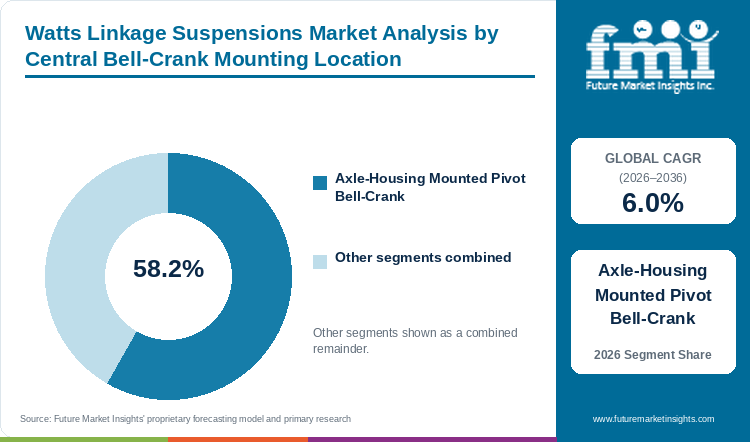
Axle-Housing Mounted Pivot Bell-Crank is estimated to command 58.2% of the central bell-crank mounting location category in 2026 through direct differential-cover mounting and constant roll-center height.
Table 5: Central Bell-Crank Mounting Location Share for the Watts Linkage Suspensions Market (percentage share), 2026
| Central Bell-Crank Mounting Location | Share (2026) |
|---|---|
| Axle-Housing Mounted Pivot Bell-Crank | 58.2% |
| Other Segments Combined | 41.8%* |
| Total | 100.0% |
*Calculated as the balance remaining after deducting the leading segment's reported share from 100.0%.
Table 6: Central Bell-Crank Mounting Location Leadership and Market Growth for the Watts Linkage Suspensions Market (segment and CAGR percentage), 2026 to 2036
| Metric | Value |
|---|---|
| Global CAGR (2026 to 2036) | 6.0% |
| Leading Segment | Axle-Housing Mounted Pivot Bell-Crank |
Flat rear cargo-floor clearance without roll-center migration under heavy pallet loads explains why commercial van OEMs prefer axle-housing mounted bell-cranks over chassis-subframe brackets. Subframe-mounted pivots require a deep crossmember hanging below the trunk floor, which collides with spare-tire wells and rear step bumpers. Direct attachment of the bell-crank trunnion to automotive axle carriers allows the roll center to move vertically with the axle and keeps handling predictable whether a van is empty or fully loaded.
- Axle-Housing Mounted Pivot Bell-Crank is projected to capture 58.2% of central bell-crank mounting location revenue in 2026 because axle-mounted trunnions maintain linear roll-steer geometry across commercial van duty cycles.
- For instance, an October 2025 vehicle suspension review by Mei and co-authors in MDPI Actuators confirmed that geometrically constrained linkage mechanisms directly govern vertical wheel-load stability and roll-center migration during cornering [3].
Why does Forged High-Strength Microalloyed Steel Links define the largest link rod metallurgy segment?
Forged High-Strength Microalloyed Steel Links are projected to secure 64.5% of link rod metallurgy demand in 2026 owing to high compressive buckling strength and air-cooled forging efficiency.
Compressive column-buckling risk during pothole and curb strikes is the primary factor keeping forged microalloyed steel links ahead of tubular aluminum rods. When a 3.5-tonne delivery van strikes a curb, one lateral tie rod absorbs severe compressive shock that can bend thin-walled aluminum tubes. Vanadium-niobium microalloyed forging steels deliver 900-megapascal buckling resistance without costly heat-treatment furnace cycles, which reduces piece cost across automotive axles production programs.
- Forged High-Strength Microalloyed Steel Links are expected to hold 64.5% of the link rod metallurgy segment in 2026 by delivering 25% lower piece cost than extruded 7075 aluminum tubes.
- To support this demand, Gestamp Automoción, S.A. documented in its March 2026 Management Report for 2025 (EUR 11,348.6 million consolidated revenue) expanded deployment of advanced high-strength steel forgings and stampings in rear chassis structures [4].
What keeps Void-Tuned Natural Rubber / HNBR NVH Bushings ahead by bushing elastomer type?
Void-Tuned Natural Rubber / HNBR NVH Bushings are expected to generate 69.0% of bushing elastomer type sales in 2026 by combining high radial stiffness with electric cabin noise isolation.
Warranty penalties from cabin booming noise and joint squeaks explain why OEMs specify void-tuned natural rubber and HNBR bushings over polyurethane or metallic Heim joints. Without engine noise in electric vans, 80 to 250 hertz tire-cavity vibration travels straight through hard polyurethane joints into the cabin floor. Asymmetric voids molded into HNBR rubber sleeves provide stiff lateral wheel control while damping vertical articulation noise without requiring periodic grease maintenance.
- Void-Tuned Natural Rubber / HNBR NVH Bushings are forecast to account for 69.0% of bushing elastomer type demand in 2026 since sealed elastomer sleeves operate maintenance-free across 150,000-mile fleet warranties.
- In fact, a December 2025 study by Apostol et al. in MDPI Journal of Composites Science demonstrated that engineered torsion bushings with internal core topology accommodate up to 60 degrees of rotational twist while preserving radial load stiffness [5].
Why does Electric & ICE Light Commercial Vans & Pickups lead the vehicle application category?
Electric & ICE Light Commercial Vans & Pickups is predicted to represent 51.4% of the vehicle application category in 2026 under parcel-delivery fleet electrification and leaf-spring lateral stabilization.
Rapid expansion of last-mile e-commerce delivery fleets and 1-tonne utility pickups is the core demand driver for the vehicle application category. Tall parcel vans and leaf-sprung pickups experience severe lateral body roll and axle wind-up under highway crosswinds. Addition of a rear Watts linkage stabilizes high roof loads without raising cargo-bed step-in height across USA automotive composite leaf springs fleet conversions.
- In 2026, Electric & ICE Light Commercial Vans & Pickups is anticipated to capture 51.4% of vehicle application sales owing to commercial van fleet replacements in Europe and North America.
- For example, in September 2026, Türkmen et al. published a multi-objective optimization study in MDPI Engineering Proceedings confirming that reinforced heavy-duty suspension linkage connections significantly reduce multi-axial fatigue stress under commercial payload cycles [6].
What are the drivers, restraints, and opportunities in the watts linkage suspensions market?
In the watts linkage suspensions market, heavy battery-electric commercial van roll-stability requirements and coupled torsion-beam upgrades drive adoption whereas underfloor battery-pack packaging clashes restrain short-wheelbase fitment and lightweight aluminum-composite hybrid links create premium OEM opportunities.
- Driver: Elevated curb weights in battery-electric vans and twist-beam cars compel OEMs to add Watts linkages that prevent lateral rear-axle deflection.
- Restraint: Longitudinal traction-battery enclosures extending behind the rear axle centerline limit cross-car packaging space for bell-crank tie rods.
- Opportunity: Substitution of solid steel tie rods with swaged 6061-T6 aluminum tubes and overmolded thermoplastic bell-cranks cuts unsprung axle mass by 35%.
Growth Analysis and Future Potential: Qualitative Demand Catalysts
Cost avoidance on electric platform conversions is propelling OEM adoption of Watts linkages across compact cars and commercial vans. Conversion of a torsion-beam or leaf-sprung vehicle to a five-link independent rear suspension requires expensive new unibody floor stampings, whereas a bolt-on Watts linkage absorbs 80% of lateral cornering forces using existing body hardpoints. In June 2025, for instance, American Axle & Manufacturing (AAM) secured new business to supply rear e-Beam axles and electric drive units for Scout Motors' SUV and pickup truck launch [7]. Nexteer Automotive also reported record first-half 2026 revenue of USD 2.3 billion and USD 3.3 billion in customer bookings in August 2026 as OEMs scaled electrified chassis and motion-control programs [8]. Automakers pairing Watts linkages with automotive composite leaf springs achieve multi-link handling stability at a fraction of the capital tooling cost.
Risk Assessment of the Watts Linkage Suspensions Market: Operational and Engineering Friction
Competition for underbody packaging space against rear-mounted electric motors and extended battery packs is the primary restraint limiting Watts linkage fitment on compact EVs. When a skateboard chassis places a coaxial traction motor directly between the rear wheels, straight lateral tie rods cannot pass across the axle centerline without bent geometries that induce parasitic flex. In October 2026, a systematic review by Omotoso et al. in MDPI World Electric Vehicle Journal highlighted that complex multi-material EV chassis geometries elevate tooling validation expense and galvanic corrosion risk unless specialized e-coatings are applied [9]. Fleet maintenance managers also face bearing seizure risks when road de-icing salts penetrate central bell-crank trunnions near active stabilizer bar actuators.
Commercial Opportunity Analysis: Architecture Differentiation and Value-Add Formats
Pre-aligned rear axle module supply with lightweight aluminum-and-steel hybrid links offers Tier-1 manufacturers a clear path to expand operating margins. Delivery of a hydroformed twist beam with a factory-torqued Watts bell-crank and automotive hollow stabilizer bars saves OEM final assembly plants 45 seconds of underbody bolting and laser alignment time per vehicle. To capitalize on this trend, Martinrea International Inc. detailed in its March 2026 investor presentation how hybrid steel-and-aluminum lightweight chassis structures expand margins across North America light truck and EV programs [10].
Watts Linkage Suspensions Market by Country (2026 to 2036)
Mexico is projected to pace watts linkage suspensions expansion across major automotive manufacturing countries at a 7.4% CAGR through 2036, whereas Germany is estimated to record a 5.2% yearly rate. Regional divergence between Latin America and Southeast Asia as well as North America and Western Europe reflects light commercial van export concentration and domestic one-tonne pickup suspension architectures.
Table 7: Country CAGR and Primary Growth Levers for the Watts Linkage Suspensions Market (CAGR percentage and operational drivers), 2026 to 2036
| Country | CAGR (2026 to 2036) | Primary Growth Lever |
|---|---|---|
| Mexico | 7.4% | Export-oriented commercial electric van and pickup chassis assembly in Coahuila and Guanajuato |
| Thailand | 7.0% | One-tonne electric and diesel pickup rear suspension upgrades across Rayong export corridors |
| Brazil | 6.7% | Urban e-delivery truck and light commercial fleet expansion led by Volkswagen and Stellantis |
| USA | 5.6% | Last-mile electric delivery van fleets and heavy-duty pickup aftermarket Watts link conversions |
| UK | 5.4% | Zero-emission commercial van grant deployments and Vauxhall Z-Link / motorsport fabrication |
| Germany | 5.2% | Astra Z-Link passenger car replacement demand and next-generation e-transporter chassis programs |
Source: Future Market Insights analysis
Mexico Watts Linkage Suspensions Market Outlook (2026 to 2036)
Relocation of full-size electric delivery van and pickup truck assembly to Coahuila and Guanajuato is driving Tier-1 suspension forging investments in Mexico. Revenue from watts linkage suspensions in Mexico is forecast to record a 7.4% CAGR through 2036, attributable to nearshored commercial van and pickup chassis production supplying USA and Canada fleets. For instance, in May 2026, F-TECH INC. reported FY2026 consolidated net sales of JPY 294.6 billion while expanding automated EV suspension link line efficiency across its North America subsidiaries [11]. Even so, rising industrial electricity tariffs and skilled die-maintenance labor shortages in northern Mexico pressure Tier-1 hot-forging margins.
Key takeaway: In Mexico, nearshored North America electric cargo van platforms and Tier-1 forging hubs are forecast to drive leading 7.4% annual growth.
Thailand Watts Linkage Suspensions Market Outlook (2026 to 2036)
Procurement of watts linkage suspensions in Thailand is projected to grow at a 7.0% annual rate from 2026 to 2036 because one-tonne electric and diesel pickup plants in Rayong are upgrading rear lateral stability for export markets. Pickup manufacturers in Thailand face intense pressure to eliminate rear-axle hop on leaf-sprung utility trucks exported to Europe and Australia. In April 2025, for example, Isuzu Motors Limited commenced mass production of its 1-tonne D-MAX EV pickup truck in Thailand featuring newly developed front and rear e-Axles with 1,010-kilogram payload and 3,500-kilogram towing capacity [12]. Local Board of Investment EV tax incentives reward domestic forging of microalloyed steel tie rods, although price competition from imported chassis parts restrains aftermarket pricing in Thailand.
Key takeaway: In Thailand, export-oriented one-tonne pickup electrification and rear lateral-stability upgrades are projected to sustain 7.0% yearly growth.
Brazil Watts Linkage Suspensions Market Outlook (2026 to 2036)
Frequent suspension fatigue failures caused by uneven urban pavement and cobblestone delivery routes in Sao Paulo and Rio de Janeiro create steady OEM and replacement demand in Brazil. To serve urban logistics fleets, Volkswagen Caminhões e Ônibus and Stellantis South America have scaled domestic assembly of electric and flex-fuel urban delivery vehicles in Resende and Betim [13]. In Brazil, watts linkage suspensions turnover is predicted to advance at a 6.7% yearly pace through 2036, reinforced by e-commerce parcel fleet modernization and heavy-duty HNBR bushing replacements. High import tariffs on specialty steel bars force Gestamp and Benteler plants in Brazil to rely on domestic mills, which limits adoption of pricier tubular aluminum links.
Key takeaway: In Brazil, urban electric delivery truck assembly and severe-duty road durability requirements are predicted to propel localized linkage manufacturing.
USA Watts Linkage Suspensions Market Outlook (2026 to 2036)
Demand in the USA is anchored by two distinct buyer groups: commercial walk-in parcel van fleets and heavy-duty three-quarter-ton pickup owners retrofitting rear linkages to stop fifth-wheel trailer sway. In July 2026, Magna International reported Q2 2026 sales of USD 11.0 billion and raised its full-year 2026 net income outlook as North America truck and commercial chassis programs expanded [14]. Between 2026 and 2036, watts linkage suspensions sales in the USA are estimated to rise at a 5.6% CAGR owing to walk-in electric delivery van deployments and heavy-duty pickup towing-stability retrofits. On the passenger car side, however, automaker migration toward five-link independent rear subframes on midsize crossovers caps passenger-car linkage volume in the USA.
Key takeaway: In the USA, commercial e-delivery fleet deployments and heavy-duty pickup towing stability kits are estimated to anchor steady demand.
UK Watts Linkage Suspensions Market Outlook (2026 to 2036)
Government purchase subsidies for zero-emission commercial vans and a large installed parc of Vauxhall Z-Link passenger cars sustain OEM and replacement demand across the UK. In September 2026, the UK Office for Zero Emission Vehicles and Department for Transport updated the Zero Emission Van and Truck Grant eligibility rules supporting commercial electric fleet registrations across England and Wales as well as Scotland and Northern Ireland [15]. Demand for watts linkage suspensions in the UK is anticipated to expand at a 5.4% annual rate through 2036, enabled by zero-emission commercial van grants and Vauxhall Z-Link aftermarket bushing replacements. Low domestic passenger-car assembly volumes still keep UK suppliers focused on commercial van upfitting and PTFE-lined motorsport linkages.
Key takeaway: In the UK, zero-emission grocery delivery van fleets and specialist motorsport chassis engineering are anticipated to support 5.4% annual expansion.
Germany Watts Linkage Suspensions Market Outlook (2026 to 2036)
High-speed Autobahn lane-change stability standards compel automakers in Germany to reinforce coupled torsion-beam rear axles on compact electric crossovers and municipal vans with Watts linkages. In March 2026, for instance, BENTELER International Austria GmbH published its 2025 Annual Report confirming resilient operational profitability across its Automotive Components division despite flat European passenger car build rates [16]. Through 2036, watts linkage suspensions expenditure in Germany is expected to progress at a 5.2% yearly clip driven by Autobahn lateral-stability validation on compact electric crossovers and Lemförder aftermarket replacement kits. Stagnant domestic internal-combustion car production in Germany nevertheless moderates overall volume growth.
Key takeaway: In Germany, compact EV torsion-beam stabilization and Lemförder aftermarket replacement cycles are expected to sustain mature market growth.
Full report country CAGRs cover: North America; Latin America; Western Europe; Eastern Europe; East Asia; South Asia and Pacific; Middle East and Africa.
Who are the notable companies in the watts linkage suspensions market?
Benteler International AG, Magna International Inc. (Cosma International), Gestamp Automoción, S.A., ZF Friedrichshafen AG (Lemförder Chassis Links), Martinrea International Inc., Yorozu Corporation, and F-TECH INC. are the notable companies in the watts linkage suspensions market.
OEM sourcing across the watts linkage suspensions supply chain divides between global structural axle-module integrators and precision suspension link or build-to-order specialists. Multinational structural groups hydroform and stamp complete rear twist-beam and rigid axle assemblies with factory-bolted Watts bell-cranks. Link and elastomer specialists forge microalloyed steel tie rods and vulcanize void-tuned HNBR bushings, while build-to-order suspension suppliers serve pickup and van plants across Japan and Thailand as well as North America.
- Global Structural Chassis & Axle Module Integrators: Benteler International AG, Magna International Inc. (Cosma International), and Gestamp Automoción, S.A. supply complete rear axle beams with factory-integrated Watts linkages.
- Precision Suspension Link & Elastomer Specialists: ZF Friedrichshafen AG (Lemförder Chassis Links) and Martinrea International Inc. manufacture forged steel and aluminum lateral tie rods and NVH elastomer bushings.
- Asia-Pacific Build-to-Order Suspension Specialists: Yorozu Corporation and F-TECH INC. engineer high-strength stamped and tubular rear suspension links and twist-beam assemblies across Asia and Americas plants.
Competitive Benchmarking: Watts Linkage Suspensions Market
Table 8: Competitive Benchmarking for the Watts Linkage Suspensions Market (qualitative capability ratings), 2026
| Company | Bell-Crank & Axle Integration | Microalloyed Steel & Aluminum Forging | NVH Bushing & Joint Engineering | Geographic Reach |
|---|---|---|---|---|
| Benteler International AG | High | High | Medium | High |
| Magna International Inc. (Cosma International) | High | High | Medium | High |
| Gestamp Automoción, S.A. | High | High | Medium | High |
| ZF Friedrichshafen AG (Lemförder Chassis Links) | Medium | High | High | High |
| Martinrea International Inc. | High | High | Medium | Medium |
| Yorozu Corporation | High | Medium | High | Medium |
| F-TECH INC. | High | Medium | Medium | Medium |
Scoring basis: Capability tiers evaluate documented engineering capacity in complete rear twist-beam plus Watts bell-crank assembly and microalloyed steel forging as well as void-tuned HNBR bushing vulcanization and multi-continent JIT plant proximity.
Key Developments in the Watts Linkage Suspensions Market
- BENTELER International Austria GmbH published its 2025 Annual Report in March 2026 confirming resilient operational profitability across its Automotive Components division while scaling twist-beam and rear axle linkage production [16].
- Gestamp Automoción, S.A. reported EUR 11,348.6 million in 2025 group revenue in its March 2026 Management Report while scaling advanced high-strength steel (AHSS) rear axle and chassis linkage solutions [4].
- Magna International Inc. reported Q4 and full-year 2025 financial results in February 2026 and raised its 2026 outlook in July 2026 on strong Body Exteriors & Structures chassis demand across 3.2 million annual vehicles [1, 14, 18].
- YOROZU Corporation and F-TECH INC. expanded their FY2026 EV suspension link and rear beam manufacturing operations across Japan and Thailand as well as North America [11, 17, 19].
Key Players in the Watts Linkage Suspensions Market
Global Structural Chassis & Axle Module Integrators
- Benteler International AG
- Magna International Inc. (Cosma International)
- Gestamp Automoción, S.A.
Precision Suspension Link & Elastomer Specialists
- ZF Friedrichshafen AG (Lemförder Chassis Links)
- Martinrea International Inc.
Asia-Pacific Build-to-Order Suspension Specialists
- Yorozu Corporation
- F-TECH INC.
Watts Linkage Suspensions Market - Report Scope
Table 9: Report Scope for the Watts Linkage Suspensions Market (coverage fields and definitions), 2026 to 2036
| Coverage field | Report scope |
|---|---|
| Market breakdown | Central Bell-Crank Mounting Location; Link Rod Metallurgy; Bushing Elastomer Type; Vehicle Application |
| Quantitative Units | USD Million |
| Market Definition | Includes commercial OEM and aftermarket supplier revenue from complete automotive Watts linkage suspension assemblies, central vertical pivot bell-cranks, dual lateral tie rods, trunnion pivot bolts, and pre-installed elastomer or spherical Heim bushings. Category Scope Note: Excludes single-bar Panhard rods, five-link independent suspension control arms, standalone shock absorbers, and non-automotive industrial steam linkages. |
| Regions Covered | North America; Latin America; Western Europe; Eastern Europe; East Asia; South Asia and Pacific; Middle East and Africa |
| Countries Covered | Mexico, Thailand, Brazil, USA, UK, Germany, and additional countries in the full report |
| Key Companies Covered | Benteler International AG, Magna International Inc. (Cosma International), Gestamp Automoción, S.A., ZF Friedrichshafen AG (Lemförder Chassis Links), Martinrea International Inc., Yorozu Corporation, F-TECH INC. |
| Forecast Period | 2026 to 2036 |
| Approach | Primary and secondary research with top-down and bottom-up market triangulation. |
Watts Linkage Suspensions Market - Research Methodology
Table 10: Research Methodology for the Watts Linkage Suspensions Market (research methods and approach), 2026 edition
| Method | Approach |
|---|---|
| Primary Research | Structured interviews with OEM commercial-van chassis engineers, Tier-1 forging plant directors, elastomer NVH bushing formulators, and fleet maintenance managers to validate bell-crank kit pricing and lateral stiffness specifications. |
| Secondary Research | Analysis of Tier-1 corporate annual reports (Benteler, Magna, Gestamp, Martinrea, Yorozu, F-TECH), MDPI Actuators and Composites Science suspension studies, and UK Department for Transport commercial EV filings. |
| Market Sizing and Forecasting | Top-down global rear axle and suspension linkage capital expenditure models reconciled against bottom-up equipped light commercial van, twist-beam car, and performance SUV build volumes from 2026 to 2036. |
| Country Forecasting Model | Econometric country projections weight light commercial electric van assembly, one-tonne pickup export capacity, and aftermarket Z-Link replacement parcs across six national automotive markets. |
| Operational Benchmark Traceability | Fleet-unit and per-vehicle spending indicators in Tables 2, 3, and 4 trace to Magna Cosma twist-axle production disclosures, Benteler and Gestamp financial filings, and peer-reviewed fatigue optimization benchmarks. |
| Data Triangulation and Validation | Demand estimates are cross-checked against Tier-1 chassis division billings and OEM platform BOM audits after purging out-of-scope closure hardware and standalone Panhard bars. |
Watts Linkage Suspensions Market by Segments
Watts Linkage Suspensions Market segmented by Central Bell-Crank Mounting Location:
- Axle-Housing Mounted Pivot Bell-Crank
- Chassis-Subframe Mounted Pivot Bell-Crank
Watts Linkage Suspensions Market segmented by Link Rod Metallurgy:
- Forged High-Strength Microalloyed Steel Links
- Tubular 6061-T6 / 7075 Aluminum Alloy Links
- Chromoly Spherical-Bearing Motorsport Links
Watts Linkage Suspensions Market segmented by Bushing Elastomer Type:
- Void-Tuned Natural Rubber / HNBR NVH Bushings
- Polyurethane & PTFE-Lined Spherical Heim Joints
Watts Linkage Suspensions Market segmented by Vehicle Application:
- Electric & ICE Light Commercial Vans & Pickups
- Twist-Beam Passenger Cars (Opel/GM Z-Link Class)
- Performance Track Cars & Heavy SUVs
Watts Linkage Suspensions Market by Region
- North America
- USA
- Canada
- Latin America
- Brazil
- Mexico
- Argentina
- Chile
- Western Europe
- Germany
- France
- UK
- Italy
- Spain
- Benelux
- Nordics
- Eastern Europe
- Poland
- Czech Republic
- Romania
- Hungary
- East Asia
- China
- Japan
- South Korea
- South Asia and Pacific
- India
- Thailand & ASEAN
- Australia and New Zealand
- Middle East and Africa
- GCC Countries
- South Africa
- Türkiye
- Israel
Research Sources and Bibliography
- [1] Magna International Inc. (2026, February 13). Magna Announces Fourth Quarter 2025 Results and Provides 2026 Outlook. Magna International Newsroom.
- [2] American Axle & Manufacturing Holdings, Inc. (AAM). (2025, January 29). AAM Announces Combination with Dowlais for $1.44 Billion in Cash and Stock. American Axle & Manufacturing Newsroom.
- [3] Mei, Y., Wang, R., Ding, R., & Jiang, Y. (2025, October 5). Classification Evolution, Control Strategy Innovation, and Future Challenges of Vehicle Suspension Systems: A Review. MDPI Actuators, 14(10), 485.
- [4] Gestamp Automoción, S.A. (2026, March 15). Management Report 2025 - Gestamp. Gestamp Corporate Publications.
- [5] Apostol, D. A., Constantinescu, D. M., Sorohan, Ș., & Vasile, A. (2025, December 31). Design of an Additively Manufactured Torsion Bushing with a Gyroid Core Topology. MDPI Journal of Composites Science, 10(1), 8.
- [6] Türkmen, C. M., Doğaner, F., Baybaş, C., & Akavioğlu, H. (2026, September 6). Multi-Objective Optimization of Heavy-Duty V-Arm Suspension Connection Problems Using ANN-Assisted Hybrid Metaheuristic Algorithms. MDPI Engineering Proceedings, 154(1), 50.
- [7] American Axle & Manufacturing Holdings, Inc. (AAM). (2025, June 11). AAM Secures New Business to Support Scout Motors' Iconic SUV and Truck Launch. American Axle & Manufacturing Newsroom.
- [8] Nexteer Automotive. (2026, August 12). Nexteer Reports Record First-Half 2026 Results - Nexteer. Nexteer Automotive News Releases.
- [9] Omotoso, S. O., Yeboah, Y., Buertey, J. T. I., & Agyepong-Kodua, K. (2026, October 18). A Systematic Review of Alternative Manufacturing Process Selection for Sustainable Electric Vehicle Production. MDPI World Electric Vehicle Journal, 17(10), 542.
- [10] Martinrea International Inc. (2026, March 9). INVESTOR PRESENTATION - Martinrea International. Martinrea International Inc.
- [11] F-TECH INC. (2026, May 15). Fiscal Year Ending March , 2026 Financial Results. F-TECH INC.
- [12] Isuzu Motors Limited. (2025, April 29). Isuzu begins production of D-MAX EV pickup truck in Thailand ー Mass production of new model to target key European markets ー | Newsroom | ISUZU MOTORS LIMITED. Isuzu Motors Limited Official Newsroom.
- [13] Volkswagen Caminhões e Ônibus. (2026, January 20). Volkswagen Caminhões e Ônibus - VW Caminhões e Ônibus. TRATON Group.
- [14] Magna International Inc. (2026, July 31). PRESS RELEASE - Magna International. Magna International Second Quarter Report 2026.
- [15] Office for Zero Emission Vehicles & Department for Transport (GOV.UK). (2026, September 15). Zero emission van and truck grant: eligibility and applications - GOV.UK. UK Government Official Publications.
- [16] BENTELER International Austria GmbH. (2026, March 12). ANNUAL REPORT - Benteler. BENTELER Group Annual Report 2025.
- [17] YOROZU Corporation. (2026, May 20). Brief Report of Financial Results | YOROZU. YOROZU Corporation IR Library.
- [18] Magna International Inc. (2026, April 10). Chassis Systems - Magna International. Magna International.
- [19] YOROZU Corporation. (2026, April 15). Products | YOROZU. YOROZU Corporation.
- [20] ZF Friedrichshafen AG. (2026, October 8). ZF Annual Report 2025 - ZF. ZF Group.
- [21] F.tech Inc. (2026, August 6). Archives of IR reports - F.tech Inc.. F-TECH INC.
This bibliography is provided for reader reference and is not exhaustive. The full report contains the complete reference list and detailed citations.
This Report Answers
- How large is the watts linkage suspensions market in 2026 and what is forecast for 2036?
- Which commercial EV van roll-stability and twist-beam pressures support demand for watts linkage suspensions?
- Why does Axle-Housing Mounted Pivot Bell-Crank lead the central bell-crank mounting location category?
- Why does Forged High-Strength Microalloyed Steel Links lead the link rod metallurgy category globally?
- How do growth rates differ across Mexico and Thailand as well as Brazil and the USA?
- Which leading companies supply rear axle beams, bell-cranks, and lateral tie rods today?
- What limits underbody packaging or supplier switching in the watts linkage suspensions market?
- What should OEM chassis buyers evaluate before nominating a watts linkage suspension supplier?
Frequently Asked Questions
How big is the watts linkage suspensions market in 2026, and what is forecast for 2036?
Global watts linkage suspensions revenue is estimated to reach USD 248.5 million in 2026 from USD 234.0 million in 2025. Sales are forecast to hit USD 445.0 million by 2036 as commercial electric vans and twist-beam cars upgrade lateral axle guidance.
What is the CAGR for the watts linkage suspensions market from 2026 to 2036?
Compound annual growth is projected at 6.0% over the 2026 to 2036 forecast window, yielding USD 196.5 million in added annual revenue across OEM and aftermarket channels.
Which central bell-crank mounting location segment leads the watts linkage suspensions market?
Axle-Housing Mounted Pivot Bell-Crank is estimated to command 58.2% of central bell-crank mounting location demand in 2026 because direct differential-cover mounting preserves underfloor cargo volume.
Which link rod metallurgy segment leads the watts linkage suspensions market?
Forged High-Strength Microalloyed Steel Links are projected to capture 64.5% of the link rod metallurgy category in 2026 to withstand high buckling fatigue loads under curb impacts.
Which country has a notable growth outlook during the assessment period?
Mexico is slated to pace national expansion at a 7.4% CAGR through 2036 through Coahuila and Guanajuato commercial electric van and pickup chassis assembly.
Who are the key players in the market?
Benteler International AG, Magna International Inc. (Cosma International), and Gestamp Automoción, S.A. lead global supply. ZF Friedrichshafen AG (Lemförder Chassis Links) and Martinrea International Inc. as well as Yorozu Corporation and F-TECH INC. also anchor OEM production.
Preview the report firsthand - request a free sample
Get SampleGet the brochure for pricing and purchase details.
Get PDFTable of Content
- Key Takeaways
- Market Size and CAGR
- Top Growth Driver
- Fastest Growing Segment
- Leading Region
- Key Companies
- Emerging Opportunities
- Executive Summary
- Global Market Outlook
- Demand-side Trends
- Supply-side Trends
- Technology Roadmap Analysis
- Analysis and Recommendations
- Analyst Perspective (What is happening? Why now? What should investors know?)
- Key Questions Answered
- How large is the market?
- What is the CAGR?
- What are key trends?
- Which region dominates?
- Who are the leaders?
- Market Overview
- Market Coverage / Taxonomy
- Market Definition / Scope / Limitations
- Research Methodology
- Chapter Orientation
- Analytical Lens and Working Hypotheses
- Market Structure, Signals, and Trend Drivers
- Benchmarking and Cross-market Comparability
- Market Sizing, Forecasting, and Opportunity Mapping
- Research Design and Evidence Framework
- Desk Research Programme (Secondary Evidence)
- Expert Input and Fieldwork (Primary Evidence)
- Tooling, Models, and Reference Databases
- Data Engineering and Model Build
- Quality Assurance and Audit Trail
- Market Background
- Market Dynamics (Drivers, Restraints, Opportunity, Trends)
- Scenario Forecast (Optimistic, Likely, Conservative)
- Impact Analysis
- AI Impact
- Sustainability Impact
- Regulatory Impact
- Technology Impact
- Consumer / Buyer Analysis
- Purchase Drivers
- Adoption Barriers
- Buyer Journey
- Opportunity Map Analysis
- Product Life Cycle Analysis
- Supply Chain Analysis
- Investment Feasibility Matrix
- Value Chain Analysis
- PESTLE and Porter's Analysis
- Regulatory Landscape
- Regional Parent Market Outlook
- Production and Consumption Statistics
- Import and Export Statistics
- Global Market Analysis and Forecast, 2021 to 2036
- Historical Market Size Value (USD Million) Analysis, 2021 to 2025
- Current and Future Market Size Value (USD Million) Projections, 2026 to 2036
- Y-o-Y Growth Trend Analysis
- Absolute $ Opportunity Analysis
- Global Market Pricing Analysis, 2021 to 2036
- Global Market Analysis and Forecast, By Central Bell-Crank Mounting Location, 2021 to 2036
- Introduction / Key Findings
- Historical Market Size Value (USD Million) Analysis By Central Bell-Crank Mounting Location, 2021 to 2025
- Current and Future Market Size Value (USD Million) Analysis and Forecast By Central Bell-Crank Mounting Location, 2026 to 2036
- Axle-Housing Mounted Pivot Bell-Crank
- Chassis-Subframe Mounted Pivot Bell-Crank
- Y-o-Y Growth Trend Analysis By Central Bell-Crank Mounting Location, 2021 to 2025
- Absolute $ Opportunity Analysis By Central Bell-Crank Mounting Location, 2026 to 2036
- Global Market Analysis and Forecast, By Link Rod Metallurgy, 2021 to 2036
- Introduction / Key Findings
- Historical Market Size Value (USD Million) Analysis By Link Rod Metallurgy, 2021 to 2025
- Current and Future Market Size Value (USD Million) Analysis and Forecast By Link Rod Metallurgy, 2026 to 2036
- Forged High-Strength Microalloyed Steel Links
- Tubular 6061-T6 / 7075 Aluminum Alloy Links
- Chromoly Spherical-Bearing Motorsport Links
- Y-o-Y Growth Trend Analysis By Link Rod Metallurgy, 2021 to 2025
- Absolute $ Opportunity Analysis By Link Rod Metallurgy, 2026 to 2036
- Global Market Analysis and Forecast, By Bushing Elastomer Type, 2021 to 2036
- Introduction / Key Findings
- Historical Market Size Value (USD Million) Analysis By Bushing Elastomer Type, 2021 to 2025
- Current and Future Market Size Value (USD Million) Analysis and Forecast By Bushing Elastomer Type, 2026 to 2036
- Void-Tuned Natural Rubber / HNBR NVH Bushings
- Polyurethane & PTFE-Lined Spherical Heim Joints
- Y-o-Y Growth Trend Analysis By Bushing Elastomer Type, 2021 to 2025
- Absolute $ Opportunity Analysis By Bushing Elastomer Type, 2026 to 2036
- Global Market Analysis and Forecast, By Vehicle Application, 2021 to 2036
- Introduction / Key Findings
- Historical Market Size Value (USD Million) Analysis By Vehicle Application, 2021 to 2025
- Current and Future Market Size Value (USD Million) Analysis and Forecast By Vehicle Application, 2026 to 2036
- Electric & ICE Light Commercial Vans & Pickups
- Twist-Beam Passenger Cars (Opel/GM Z-Link Class)
- Performance Track Cars & Heavy SUVs
- Y-o-Y Growth Trend Analysis By Vehicle Application, 2021 to 2025
- Absolute $ Opportunity Analysis By Vehicle Application, 2026 to 2036
- Global Market Analysis and Forecast, By Region, 2021 to 2036
- Introduction
- Historical Market Size Value (USD Million) Analysis By Region, 2021 to 2025
- Current Market Size Value (USD Million) Analysis and Forecast By Region, 2026 to 2036
- North America
- Latin America
- Western Europe
- Eastern Europe
- East Asia
- South Asia and Pacific
- Middle East and Africa
- Market Attractiveness Analysis By Region
- North America Market Analysis and Forecast, By Country, 2021 to 2036
- Historical Market Size Value (USD Million) Trend Analysis By Market Taxonomy, 2021 to 2025
- Market Size Value (USD Million) Forecast By Market Taxonomy, 2026 to 2036
- By Country
- USA
- Canada
- By Central Bell-Crank Mounting Location
- By Link Rod Metallurgy
- By Bushing Elastomer Type
- By Vehicle Application
- By Country
- Market Attractiveness Analysis
- By Country
- By Central Bell-Crank Mounting Location
- By Link Rod Metallurgy
- By Bushing Elastomer Type
- By Vehicle Application
- Key Takeaways
- Latin America Market Analysis and Forecast, By Country
- Historical Market Size Value (USD Million) Trend Analysis By Market Taxonomy, 2021 to 2025
- Market Size Value (USD Million) Forecast By Market Taxonomy, 2026 to 2036
- By Country
- Brazil
- Mexico
- Argentina
- Chile
- By Central Bell-Crank Mounting Location
- By Link Rod Metallurgy
- By Bushing Elastomer Type
- By Vehicle Application
- By Country
- Market Attractiveness Analysis
- By Country
- By Central Bell-Crank Mounting Location
- By Link Rod Metallurgy
- By Bushing Elastomer Type
- By Vehicle Application
- Key Takeaways
- Western Europe Market Analysis and Forecast, By Country
- Historical Market Size Value (USD Million) Trend Analysis By Market Taxonomy, 2021 to 2025
- Market Size Value (USD Million) Forecast By Market Taxonomy, 2026 to 2036
- By Country
- Germany
- France
- UK
- Italy
- Spain
- Benelux
- Nordics
- By Central Bell-Crank Mounting Location
- By Link Rod Metallurgy
- By Bushing Elastomer Type
- By Vehicle Application
- By Country
- Market Attractiveness Analysis
- By Country
- By Central Bell-Crank Mounting Location
- By Link Rod Metallurgy
- By Bushing Elastomer Type
- By Vehicle Application
- Key Takeaways
- Eastern Europe Market Analysis and Forecast, By Country
- Historical Market Size Value (USD Million) Trend Analysis By Market Taxonomy, 2021 to 2025
- Market Size Value (USD Million) Forecast By Market Taxonomy, 2026 to 2036
- By Country
- Poland
- Czech Republic
- Romania
- Hungary
- By Central Bell-Crank Mounting Location
- By Link Rod Metallurgy
- By Bushing Elastomer Type
- By Vehicle Application
- By Country
- Market Attractiveness Analysis
- By Country
- By Central Bell-Crank Mounting Location
- By Link Rod Metallurgy
- By Bushing Elastomer Type
- By Vehicle Application
- Key Takeaways
- East Asia Market Analysis and Forecast, By Country
- Historical Market Size Value (USD Million) Trend Analysis By Market Taxonomy, 2021 to 2025
- Market Size Value (USD Million) Forecast By Market Taxonomy, 2026 to 2036
- By Country
- China
- Japan
- South Korea
- By Central Bell-Crank Mounting Location
- By Link Rod Metallurgy
- By Bushing Elastomer Type
- By Vehicle Application
- By Country
- Market Attractiveness Analysis
- By Country
- By Central Bell-Crank Mounting Location
- By Link Rod Metallurgy
- By Bushing Elastomer Type
- By Vehicle Application
- Key Takeaways
- South Asia and Pacific Market Analysis and Forecast, By Country
- Historical Market Size Value (USD Million) Trend Analysis By Market Taxonomy, 2021 to 2025
- Market Size Value (USD Million) Forecast By Market Taxonomy, 2026 to 2036
- By Country
- India
- Thailand & ASEAN
- Australia and New Zealand
- By Central Bell-Crank Mounting Location
- By Link Rod Metallurgy
- By Bushing Elastomer Type
- By Vehicle Application
- By Country
- Market Attractiveness Analysis
- By Country
- By Central Bell-Crank Mounting Location
- By Link Rod Metallurgy
- By Bushing Elastomer Type
- By Vehicle Application
- Key Takeaways
- Middle East and Africa Market Analysis and Forecast, By Country
- Historical Market Size Value (USD Million) Trend Analysis By Market Taxonomy, 2021 to 2025
- Market Size Value (USD Million) Forecast By Market Taxonomy, 2026 to 2036
- By Country
- GCC Countries
- South Africa
- Türkiye
- Israel
- By Central Bell-Crank Mounting Location
- By Link Rod Metallurgy
- By Bushing Elastomer Type
- By Vehicle Application
- By Country
- Market Attractiveness Analysis
- By Country
- By Central Bell-Crank Mounting Location
- By Link Rod Metallurgy
- By Bushing Elastomer Type
- By Vehicle Application
- Key Takeaways
- Key Countries Market Analysis
- USA
- Pricing Analysis
- Market Share Analysis, 2025
- By Central Bell-Crank Mounting Location
- By Link Rod Metallurgy
- By Bushing Elastomer Type
- By Vehicle Application
- Canada
- Pricing Analysis
- Market Share Analysis, 2025
- By Central Bell-Crank Mounting Location
- By Link Rod Metallurgy
- By Bushing Elastomer Type
- By Vehicle Application
- Mexico
- Pricing Analysis
- Market Share Analysis, 2025
- By Central Bell-Crank Mounting Location
- By Link Rod Metallurgy
- By Bushing Elastomer Type
- By Vehicle Application
- Brazil
- Pricing Analysis
- Market Share Analysis, 2025
- By Central Bell-Crank Mounting Location
- By Link Rod Metallurgy
- By Bushing Elastomer Type
- By Vehicle Application
- Chile
- Pricing Analysis
- Market Share Analysis, 2025
- By Central Bell-Crank Mounting Location
- By Link Rod Metallurgy
- By Bushing Elastomer Type
- By Vehicle Application
- Germany
- Pricing Analysis
- Market Share Analysis, 2025
- By Central Bell-Crank Mounting Location
- By Link Rod Metallurgy
- By Bushing Elastomer Type
- By Vehicle Application
- UK
- Pricing Analysis
- Market Share Analysis, 2025
- By Central Bell-Crank Mounting Location
- By Link Rod Metallurgy
- By Bushing Elastomer Type
- By Vehicle Application
- Italy
- Pricing Analysis
- Market Share Analysis, 2025
- By Central Bell-Crank Mounting Location
- By Link Rod Metallurgy
- By Bushing Elastomer Type
- By Vehicle Application
- Spain
- Pricing Analysis
- Market Share Analysis, 2025
- By Central Bell-Crank Mounting Location
- By Link Rod Metallurgy
- By Bushing Elastomer Type
- By Vehicle Application
- France
- Pricing Analysis
- Market Share Analysis, 2025
- By Central Bell-Crank Mounting Location
- By Link Rod Metallurgy
- By Bushing Elastomer Type
- By Vehicle Application
- India
- Pricing Analysis
- Market Share Analysis, 2025
- By Central Bell-Crank Mounting Location
- By Link Rod Metallurgy
- By Bushing Elastomer Type
- By Vehicle Application
- Australia and New Zealand
- Pricing Analysis
- Market Share Analysis, 2025
- By Central Bell-Crank Mounting Location
- By Link Rod Metallurgy
- By Bushing Elastomer Type
- By Vehicle Application
- China
- Pricing Analysis
- Market Share Analysis, 2025
- By Central Bell-Crank Mounting Location
- By Link Rod Metallurgy
- By Bushing Elastomer Type
- By Vehicle Application
- Japan
- Pricing Analysis
- Market Share Analysis, 2025
- By Central Bell-Crank Mounting Location
- By Link Rod Metallurgy
- By Bushing Elastomer Type
- By Vehicle Application
- South Korea
- Pricing Analysis
- Market Share Analysis, 2025
- By Central Bell-Crank Mounting Location
- By Link Rod Metallurgy
- By Bushing Elastomer Type
- By Vehicle Application
- Poland
- Pricing Analysis
- Market Share Analysis, 2025
- By Central Bell-Crank Mounting Location
- By Link Rod Metallurgy
- By Bushing Elastomer Type
- By Vehicle Application
- Hungary
- Pricing Analysis
- Market Share Analysis, 2025
- By Central Bell-Crank Mounting Location
- By Link Rod Metallurgy
- By Bushing Elastomer Type
- By Vehicle Application
- Türkiye
- Pricing Analysis
- Market Share Analysis, 2025
- By Central Bell-Crank Mounting Location
- By Link Rod Metallurgy
- By Bushing Elastomer Type
- By Vehicle Application
- South Africa
- Pricing Analysis
- Market Share Analysis, 2025
- By Central Bell-Crank Mounting Location
- By Link Rod Metallurgy
- By Bushing Elastomer Type
- By Vehicle Application
- Thailand
- Pricing Analysis
- Market Share Analysis, 2025
- By Central Bell-Crank Mounting Location
- By Link Rod Metallurgy
- By Bushing Elastomer Type
- By Vehicle Application
- USA
- Market Structure Analysis
- Competition Dashboard
- Competition Benchmarking
- Market Share Analysis of Top Players
- By Regional
- By Central Bell-Crank Mounting Location
- By Link Rod Metallurgy
- By Bushing Elastomer Type
- By Vehicle Application
- Emerging Startups
- Innovation Benchmarking
- Competition Analysis
- Competition Deep Dive
- Benteler International AG
- Overview
- Product Portfolio
- Profitability by Market Segments
- Sales Footprint
- Strategy Overview
- Marketing Strategy
- Product Strategy
- Channel Strategy
- Magna International Inc. (Cosma International)
- Gestamp Automoción, S.A.
- ZF Friedrichshafen AG (Lemförder Chassis Links)
- Martinrea International Inc.
- Yorozu Corporation
- F-TECH INC.
- Benteler International AG
- Case Studies
- Success Stories
- Recent Developments
- Competition Deep Dive
- Assumptions & Acronyms Used


