

- Market Size (2026)
- USD 118.0 Mn
- Forecast (2036)
- USD 287.1 Mn
- CAGR (2026 to 2036)
- 9.3%
Welding Cobot Fume Capture Integration Market Size, Market Forecast and Outlook By FMI
USD 118.0 million in 2026 and USD 287.1 million by 2036 at a 9.3% CAGR.
The welding cobot fume capture integration industry value is forecast to rise from USD 108.0 million in 2025 to USD 287.1 million by 2036 at 9.3% CAGR as fabrication shops combine compact welding automation with source-capture extraction. Welding applications are forecast to represent 72.0% share in 2026, led by direct exposure control needs around repeated arc cycles. Collaborative Robots are expected to secure 62.0% share in 2026, driven by hand-guided programming and lower installation complexity for small batch metal fabrication.
Summary of the Welding Cobot Fume Capture Integration Market
| Market Signal | Commercial Impact |
|---|---|
| Demand and Growth Drivers | Demand for welding cobot fume capture integration is increasing as fabricators prioritize compact automation and workplace safety.
|
| Product and Segment View | Welding applications, collaborative robots, and the 5–20 kg payload class lead their respective segment categories.
|
| Geography and Growth Outlook | China and India are expected to remain the key growth markets for welding cobot fume capture integration.
|
| Competitive Landscape | Competition is increasingly centered on integrated robotic welding solutions and proven fume extraction performance.
|
| Analyst Perspective | Welding cobot fume capture integration is evolving from an optional safety feature into a prerequisite for cell approval and deployment.
- Nikhil Kaitwade, Principal Consultant for Industrial Automation at FMI |
Industry outlook is shaped by safety limits and skilled labor pressure. United States workplace rules set a hexavalent chromium action level of 2.5 micrograms per cubic meter and a permissible exposure limit of 5 micrograms per cubic meter. Global operational industrial robot stock reached 4,664,000 units in 2024, up 9% from the prior year. United States labor projections also show 45,600 welder and brazer openings per year across 2024 to 2034. Combined pressure supports demand for cells that document capture performance and reduce manual welding dependence.
Which factors support expansion in the welding cobot fume capture integration market?
Finished cell revenue, integrated extraction packages, and service contracts support market value across robotic welding channels.
- Market value is supported by cobot welding cell revenue before filter replacements and airflow service add recurring sales.
- Supplier pricing reflects robot payload along with table design and site commissioning effort.
- Revenue improves as fabricators move from manual extraction arms toward robot-ready source capture built into welding cell quotes.
- Buyer trust rises as integrators document airflow checks and torch maintenance instructions.
Why is the welding cobot fume capture integration market growing?
Adult factory automation teams are treating welding fume capture as a required part of robotic cell approval rather than a later accessory choice.
Compact cobot stations need extraction following the arc without blocking fixtures or disturbing shielding gas. Global robot installations are expected to rise to 575,000 units in 2025 and surpass 700,000 units by 2028, creating a larger installed base for welding-adjacent safety packages. Fume capture suppliers can convert this automation base into demand by showing torch stability and filter service access during pilot welding cycles.
Market Segmentation Analysis
How is the welding cobot fume capture integration market segmented?
Welding cobot fume capture integration industry is segmented by robot type, payload, application, end-use industry, and fume capture type.
- Welding applications are projected to secure 72.0% share in 2026, reflected by repeated arc exposure and buyer preference for extraction around fixed weld programs.
- Collaborative Robots are expected to account for 62.0% share in 2026, backed by hand-guided teaching and easier adoption among high-mix fabrication shops.
- Payload class 5-20 kg is anticipated to hold 54.0% share in 2026 due to most cobot MIG torches and extraction hoses being managed without oversizing the arm.
- On-Torch Extraction is forecast to represent 46.5% share in 2026 since buyers prefer source capture staying close to the weld and reduces dependence on overhead duct systems.
- Metals are predicted to account for 38.5% share in 2026 as general fabrication shops and repair workshops need compact safety upgrades around repeat welding.
Why do welding applications dominate the welding cobot fume capture integration market?
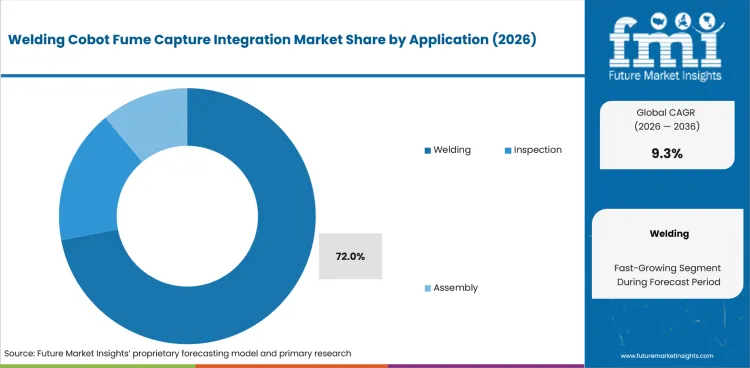
- Welding applications are projected to account for 72.0% share in 2026, driven by direct fume creation at the arc and buyer need to combine weld repeatability with exposure control.
- Inspection and machine tending uses generate lower fume exposure, making extraction integration less central to purchase approval.
Which robot type leads the welding cobot fume capture integration market?
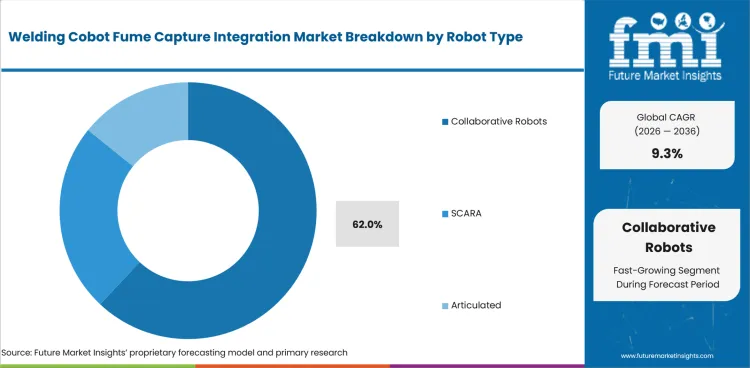
- Collaborative Robots are expected to hold 62.0% share in 2026, reflected by compact guarding needs and practical adoption among small fabrication shops.
- Articulated robots gain share in higher-volume cells. Larger fixtures and enclosures often shift extraction design toward custom engineering.
Which payload class leads the welding cobot fume capture integration market?
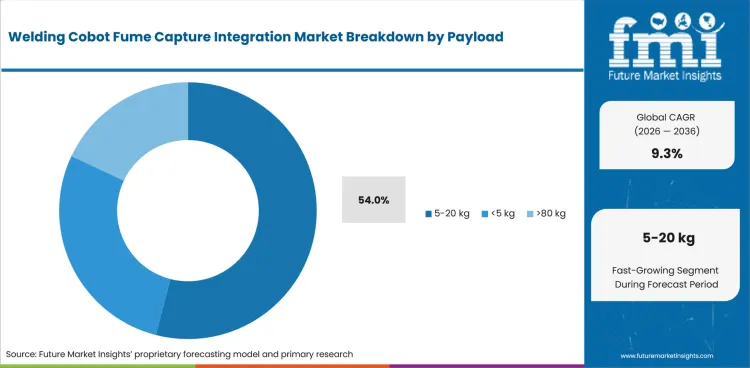
- Payload class 5-20 kg is anticipated to represent 54.0% share in 2026 as MIG torch mass and extraction hose load generally stay inside this range.
- Payloads above 20-80 kg serve heavier welding tools and fixtures, with higher robot cost limiting adoption among smaller metalworking buyers.
Which fume capture type leads the welding cobot fume capture integration market?
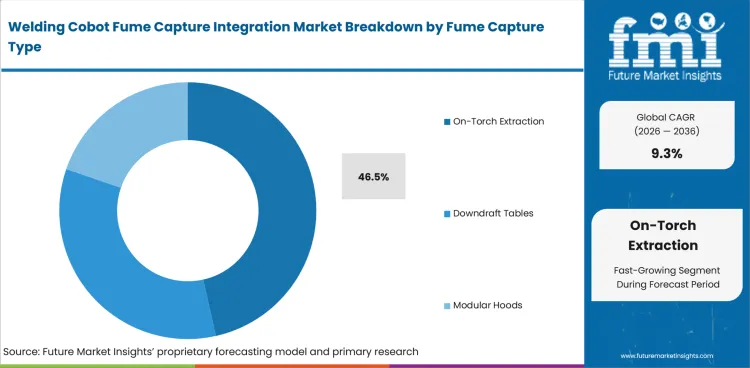
- On-Torch Extraction is forecast to secure 46.5% share in 2026 since source capture near the weld reduces dependence on large hoods and supports compact cell layouts.
- Downdraft tables and modular hoods gain use in fixtures with repeat part placement. Airflow design needs careful validation around weld access.
Which end-use industry leads the welding cobot fume capture integration market?
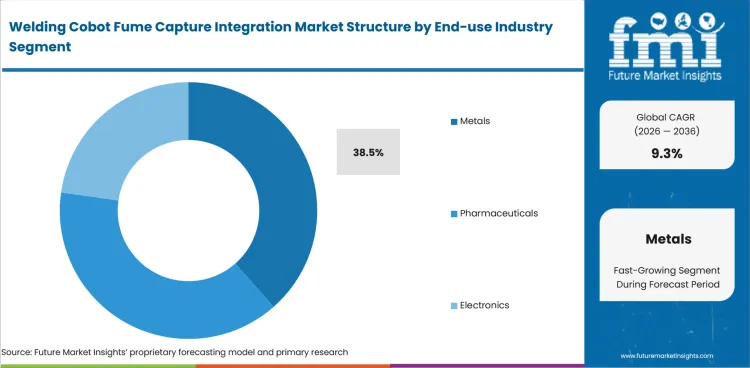
- Metals are projected to account for 38.5% share in 2026, led by fabrication shops handling frequent welding programs and requiring practical fume control around repeat batches.
- Automotive and electronics buyers add specialized demand through supplier cells. General metal fabrication remains the core volume base for compact welding extraction.
What are the driver, restraints, and opportunities in the welding cobot fume capture integration market?
Cell-level safety review supports adoption while integration cost and service discipline can limit rollout speed.
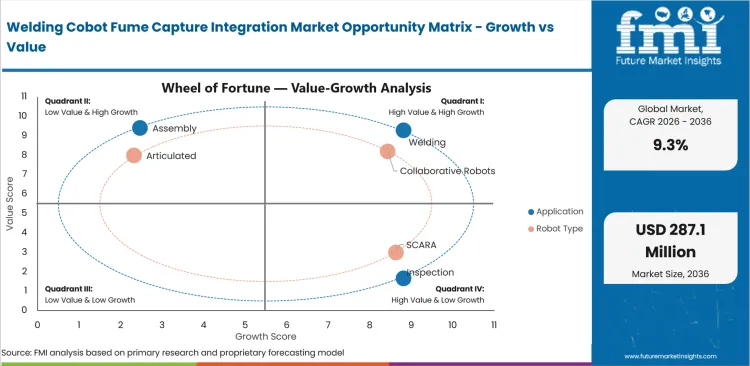
- Driver: Fabricators are combining cobot welding with source capture to reduce separate equipment selection and simplify operator acceptance.
- Restraint: Poor hose routing and airflow validation can delay cell sign-off even after the robot weld path is ready.
- Opportunity: Suppliers are likely to build recurring revenue through torch consumables and operator refresher training.
Cobot Welding Cell Demand Outlook
Demand outlook is strengthened by factory automation scale and safety-driven welding cell design. Industrial robot installations reached 542,000 units in 2024, while Asia accounted for 74% of new deployments. Large installed bases make integrators more willing to package fume extraction with robots and tables. Welding cobot suppliers are anticipated to raise acceptance by documenting extraction performance alongside weld quality and cycle repeatability.
Integration Cost and Examination Pressure
Integration pressure remains a restraint as extraction hardware needs service proof after installation. A 2024 workplace enforcement notice cited on-tool welding extraction not examined and tested within the previous 14 months. Small workshops can delay upgrades if inspection records and filter maintenance add unfamiliar administrative burden. Suppliers are expected to reduce hesitation through clear service intervals and installer training.
On-Torch and Table Package Opportunity
Opportunity is strongest in projects using robot-ready extraction hardware to reduce shop-floor redesign. European robot installations reached 85,000 units in 2024, with the European Union accounting for 67,800 units. Suppliers serving this installed base can offer on-torch capture and mobile filtration as staged packages. Service contracts tied to airflow checks and filter change planning can support value after the initial cell sale.
Which countries are growing fastest in the welding cobot fume capture integration market?
China 10.7% CAGR, India 10.2% CAGR, South Korea 9.6% CAGR, United States 8.9% CAGR, Germany 8.6% CAGR, Japan 8.4% CAGR, United Kingdom 8.1% CAGR, and France 7.9% CAGR through 2036.
.webp "Top Country Growth Comparison Welding Cobot Fume Capture Integration Market Cagr (2026 2036)")
| Country | CAGR |
|---|---|
| China | 10.7% |
| India | 10.2% |
| South Korea | 9.6% |
| United States | 8.9% |
| Germany | 8.6% |
| Japan | 8.4% |
| United Kingdom | 8.1% |
| France | 7.9% |
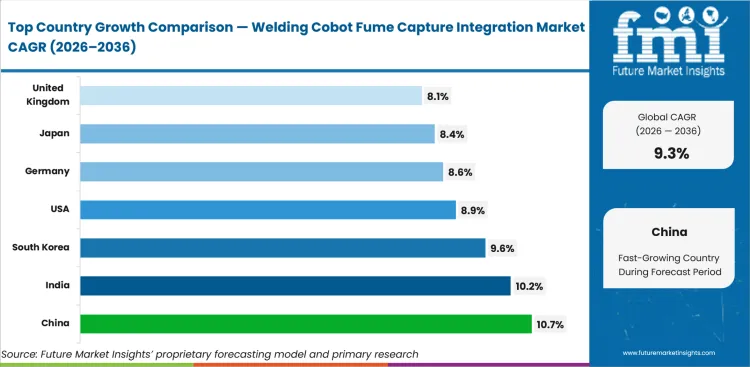
Source: Future Market Insights, 2026.
How do country-level CAGRs compare in the welding cobot fume capture integration market?
China leads country expansion while France records a steadier outlook among profiled markets.
- China is set to record 10.7% CAGR by 2036, reflecting robot scale and local automation supply.
- India is expected to expand at 10.2% CAGR by 2036, driven by automotive supplier demand and compact fabrication-cell modernization.
- South Korea is anticipated to rise at 9.6% CAGR through 2036, led by high robot density and source-capture welding automation.
- United States is estimated to grow at 8.9% CAGR by 2036 through integrator-led cobot welding packages.
- Germany is likely to scale at 8.6% CAGR through 2036 influenced by welding equipment depth and premium extraction packages.
- Japan is projected to advance at 8.4% CAGR by 2036 due to compact plant layouts and source-capture cell design.
- United Kingdom is expected to grow at 8.1% CAGR through 2036 driven by LEV inspection discipline and extraction demand.
- France is forecast to record 7.9% CAGR by 2036, backed by regional metalworking clusters and selective cobot welding upgrades.
How is the welding cobot fume capture integration market performing in China?
A 10.7% CAGR through 2036 reflects high robot deployment and strong local automation support.
Country Market Snapshot Table
| Parameter | Value |
|---|---|
| Market Size in 2025 (Value) | USD 31.0 million |
| Market Size in 2026 (Value) | USD 34.3 million |
| Market Forecast in 2036 (Value) | USD 94.8 million |
| CAGR (2026 to 2036) | 10.7% |
| Years Considered | 2021 to 2036 |
| Base Year | 2025 |
| Forecast Period | 2026 to 2036 |
| Units Considered | Value (USD million) |
| Leading Sub-Region | Yangtze River Delta and Pearl River Delta welding clusters |
China Welding Cobot Fume Capture Integration Market Outlook
China welding cobot fume capture integration sector is shaped by dense robot deployment and large metal fabrication clusters. Local buyers can evaluate cobot welding and table-based capture through nearby automation suppliers.
Cell approval is becoming practical due to stronger domestic robot availability. Suppliers combining torch access and airflow documentation can support multi-cell rollout across fabrication-heavy provinces.
Key Growth Drivers
- Robot scale strengthens integrated welding-cell demand, illustrated by China’s 295,000 industrial robot installations in 2024 and a large automation-ready factory base for fume capture add-ons.
- Manufacturing investment keeps cell-upgrade budgets active, evidenced by 8.8% year-on-year manufacturing fixed-asset investment expansion from January to April 2025.
- Local robot suppliers help fabricators obtain service support faster for cobot welding cells and source-capture accessories.
- Export-focused metal shops favor compact fume capture packages that reduce ductwork needs during cell installation.
Key Restraints
- Capital discipline can slow premium extraction purchases, reflected in the 3.8% year-on-year decline in national fixed-asset investment in 2025.
- Price-sensitive fabrication buyers may select basic welding automation before adding airflow monitoring or filter service plans.
- Dense supplier competition can make validation harder as buyers compare torch and mobile filter options across many vendors.
What makes China unique
China is unique due to high robot deployment and dense fabrication clusters being able to scale integrated welding cells quickly.
Key Companies
- ABB Robotics China
- FANUC China
- Yaskawa Shougang Robot
- Siasun
- Estun
- Nederman China
Sales & Marketing Channels
- Robot OEM distributors
- Welding equipment dealers
- Regional automation integrators
- Industrial filtration service teams
- Metal fabrication trade shows
- Application demonstration centers
Country Segment Breakdown Table
| Segment | Sub-Segments |
|---|---|
| By Robot Type | Collaborative Robots · SCARA · Articulated · AMR/AGV · Delta Robots |
| By Payload | <5 kg · 5-20 kg · 20-80 kg · >80 kg |
| By Application | Material Handling · Inspection · Assembly · Welding · Packaging · Machine Tending |
| By End-use Industry | Automotive · Electronics · Food & Beverage · Logistics · Pharmaceuticals · Metals |
| By Fume Capture Type | On-Torch Extraction · Downdraft Tables · Modular Hoods · Mobile Filter Units · Airflow Sensor and Monitoring Kits |
| Key Sub-Regions Covered, Manufacturing Clusters | Yangtze River Delta · Pearl River Delta · Beijing-Tianjin-Hebei · Shandong · Chongqing · Hubei |
Frequently Asked Questions
How fast is China welding cobot fume capture integration market growing?
China is expected to expand at 10.7% CAGR from 2026 to 2036, guided by robot scale and fabrication-cell upgrades.
Who leads China welding cobot fume capture integration market?
ABB Robotics China, FANUC China, Yaskawa Shougang Robot, Siasun, and Estun compete due to robot platforms and integration channels.
What is driving adoption in China welding cobot fume capture integration market?
High robot deployment and local supplier availability are moving buyers toward integrated cobot welding extraction.
How is the welding cobot fume capture integration market performing in India?
A 10.2% CAGR through 2036 reflects automotive supplier activity and compact welding modernization.
Country Market Snapshot Table
| Parameter | Value |
|---|---|
| Market Size in 2025 (Value) | USD 7.0 million |
| Market Size in 2026 (Value) | USD 7.7 million |
| Market Forecast in 2036 (Value) | USD 20.3 million |
| CAGR (2026 to 2036) | 10.2% |
| Years Considered | 2021 to 2036 |
| Base Year | 2025 |
| Forecast Period | 2026 to 2036 |
| Units Considered | Value (USD million) |
| Leading Sub-Region | Pune, Chennai, Bengaluru, Gujarat and NCR manufacturing clusters |
India Welding Cobot Fume Capture Integration Market Outlook
The market in India is reflected by automotive suppliers and regional job shops requiring repeat welding without large robotic enclosures. Compact cobot cells create a practical entry point for buyers dealing with limited floor space.
Training and service support remain central to adoption. Suppliers explaining hose movement and operator checks can convert first-time robotic welding buyers more effectively.
Key Growth Drivers
- Factory automation adoption is lifting demand for compact welding cells, supported by India’s 9,100 industrial robot installations in 2024 and a larger site base ready for cobot extraction packages.
- Manufacturing output strengthens welding automation evaluation, reflected by 8.0% year-on-year manufacturing output expansion in November 2025 and better buyer confidence for equipment trials.
- Pune, Chennai, and Gujarat clusters give welding integrators access to automotive suppliers and fabrication buyers.
- Compact cobot cells suit small workshops that cannot allocate space for large fixed extraction booths.
Key Restraints
- Softer production months can delay extraction add-ons, indicated by 2.9% IIP expansion in February 2025 and selective capital spending among manufacturers.
- Service reach outside major manufacturing corridors can delay filter checks and replacement part availability.
- Smaller fabrication shops can postpone integrated extraction if welding volumes change across customer projects.
What makes India unique
India is unique due to fast-growing automotive supplier demand and a large base of first-time robotic welding buyers needing simple extraction packages.
Key Companies
- FANUC India
- ABB India
- Yaskawa India
- Universal Robots channel partners
- Nederman India
- Lincoln Electric India
Sales & Marketing Channels
- Automotive supplier integrators
- Welding power-source dealers
- Robot demonstration labs
- Regional machinery distributors
- Plant modernization consultants
Country Segment Breakdown Table
| Segment | Sub-Segments |
|---|---|
| By Robot Type | Collaborative Robots · SCARA · Articulated · AMR/AGV · Delta Robots |
| By Payload | <5 kg · 5-20 kg · 20-80 kg · >80 kg |
| By Application | Material Handling · Inspection · Assembly · Welding · Packaging · Machine Tending |
| By End-use Industry | Automotive · Electronics · Food & Beverage · Logistics · Pharmaceuticals · Metals |
| By Fume Capture Type | On-Torch Extraction · Downdraft Tables · Modular Hoods · Mobile Filter Units · Airflow Sensor and Monitoring Kits |
| Key Sub-Regions Covered, Manufacturing Clusters | Pune · Chennai · Bengaluru · Gujarat · NCR · Coimbatore |
Frequently Asked Questions
How fast is India welding cobot fume capture integration market growing?
India is expected to expand at 10.2% CAGR from 2026 to 2036, led by automotive supplier automation and compact welding modernization.
Who leads India welding cobot fume capture integration market?
FANUC India, ABB India, Yaskawa India, Universal Robots partners, and Nederman India compete based on automation and extraction channels.
What is driving adoption in India welding cobot fume capture integration market?
Automotive supplier demand along with space-limited fabrication shops and rising robot installations are supporting adoption.
How is the welding cobot fume capture integration market performing in South Korea?
A 9.6% CAGR through 2036 reflects high robot density and strong manufacturing automation culture.
Country Market Snapshot Table
| Parameter | Value |
|---|---|
| Market Size in 2025 (Value) | USD 9.5 million |
| Market Size in 2026 (Value) | USD 10.4 million |
| Market Forecast in 2036 (Value) | USD 26.0 million |
| CAGR (2026 to 2036) | 9.6% |
| Years Considered | 2021 to 2036 |
| Base Year | 2025 |
| Forecast Period | 2026 to 2036 |
| Units Considered | Value (USD million) |
| Leading Sub-Region | Gyeonggi, Ulsan and Busan manufacturing corridors |
South Korea Welding Cobot Fume Capture Integration Market Outlook
Sector in South Korea is driven by electronics and precision metal clusters already using advanced automation. Buyers often assess cobot welding cells through uptime and validated extraction performance.
Product acceptance relies on local service depth and fast spare-part support. Fume capture suppliers can gain share by proving stable airflow during automated torch movement and repeated fixture changeovers.
Key Growth Drivers
- Extreme automation density supports rapid source-capture trials, proven by 1,220 robots per 10,000 manufacturing employees and strong readiness for cobot welding upgrades.
- Sustained installation volume supports local integrator availability, shown by 30,600 industrial robot installations in 2024 and active automation service channels.
- Electronics and automotive suppliers already use automation reviews, helping airflow checks enter plant approval routines.
- Shipbuilding and precision metal clusters support demand for cobot welding cells reducing operator exposure.
Key Restraints
- Slower installation momentum can delay new extraction projects, reflected by a 3% decline in South Korea’s 2024 robot installations.
- High uptime expectations can slow adoption for suppliers lacking local service and filter inventory.
- Heavy fabrication cells can require custom extraction layouts that increase commissioning effort.
What makes South Korea unique
South Korea is unique due to world-leading robot density and a manufacturing base that evaluates welding automation through precision and fast local service.
Key Companies
- Hyundai Robotics
- Doosan Robotics
- Hanwha Robotics
- ABB Korea
- Yaskawa Korea
- Nederman Korea channels
Sales & Marketing Channels
- Domestic robot OEM channels
- Electronics supplier integrators
- Automotive automation partners
- Shipbuilding equipment suppliers
- Welding torch distributors
- Local maintenance contractors
Country Segment Breakdown Table
| Segment | Sub-Segments |
|---|---|
| By Robot Type | Collaborative Robots · SCARA · Articulated · AMR/AGV · Delta Robots |
| By Payload | <5 kg · 5-20 kg · 20-80 kg · >80 kg |
| By Application | Material Handling · Inspection · Assembly · Welding · Packaging · Machine Tending |
| By End-use Industry | Automotive · Electronics · Food & Beverage · Logistics · Pharmaceuticals · Metals |
| By Fume Capture Type | On-Torch Extraction · Downdraft Tables · Modular Hoods · Mobile Filter Units · Airflow Sensor and Monitoring Kits |
| Key Sub-Regions Covered, Manufacturing Clusters | Gyeonggi · Ulsan · Busan · Incheon · Daegu · Daejeon |
Frequently Asked Questions
How fast is South Korea welding cobot fume capture integration market growing?
South Korea is expected to expand at 9.6% CAGR from 2026 to 2036, supported by robot density and precision manufacturing needs.
Who leads South Korea welding cobot fume capture integration market?
Hyundai Robotics, Doosan Robotics, Hanwha Robotics, ABB Korea, and Yaskawa Korea compete led by robot and integration networks.
What is driving adoption in South Korea welding cobot fume capture integration market?
Robot density and shipbuilding clusters support demand for validated fume capture cells.
How is the welding cobot fume capture integration market performing in the United States?
An 8.9% CAGR through 2036 reflects integrator depth and safety-led cell planning.
Country Market Snapshot Table
| Parameter | Value |
|---|---|
| Market Size in 2025 (Value) | USD 24.8 million |
| Market Size in 2026 (Value) | USD 27.0 million |
| Market Forecast in 2036 (Value) | USD 63.3 million |
| CAGR (2026 to 2036) | 8.9% |
| Years Considered | 2021 to 2036 |
| Base Year | 2025 |
| Forecast Period | 2026 to 2036 |
| Units Considered | Value (USD million) |
| Leading Sub-Region | Midwest, Southeast and national welding integrator networks |
United States Welding Cobot Fume Capture Integration Market Outlook
Industry in the United States is influenced by regional integrators and a large base of metal fabrication shops. Buyers often seek one proposal covering the cobot and operator handover.
Adoption is strongest in facilities that need modular systems instead of large ducted installations. Suppliers holding distributor coverage and service documentation can support multi-site fabrication customers more effectively.
Key Growth Drivers
- Robot installation depth supports integrator-led welding packages, demonstrated by 34,200 robot installations in 2024 and an active base for fume capture attachment.
- Short-cycle production planning supports flexible automation, reflected by manufacturing output holding flat in May 2026 after 0.7% expansion in April.
- Regional welding integrators can bundle robot programming and source-capture proof for fabrication buyers.
- Midwest and Southeast metalworking clusters support repeat demand for modular cobot welding cells.
Key Restraints
- Capacity pressure can limit premium add-ons, shown by 76.2% factory capacity utilization in May 2026 and below-average plant loading.
- Custom fixtures can raise commissioning effort if hose routing changes the taught weld path.
- Smaller shops may delay fume capture packages if manual welding volumes are intermittent.
What makes the United States unique
United States is unique due to its deep integrator network and buyer preference for modular welding cells supported by documented service routines.
Key Companies
- FANUC America
- ABB Robotics
- Universal Robots USA
- ABICOR BINZEL USA
- RoboVent
- Nederman
- Lincoln Electric Automation
Sales & Marketing Channels
- National robot integrators
- Welding supply distributors
- Fabrication equipment dealers
- Safety engineering consultants
- Regional demonstration centers
- Direct sales to multi-site manufacturers
Country Segment Breakdown Table
| Segment | Sub-Segments |
|---|---|
| By Robot Type | Collaborative Robots · SCARA · Articulated · AMR/AGV · Delta Robots |
| By Payload | <5 kg · 5-20 kg · 20-80 kg · >80 kg |
| By Application | Material Handling · Inspection · Assembly · Welding · Packaging · Machine Tending |
| By End-use Industry | Automotive · Electronics · Food & Beverage · Logistics · Pharmaceuticals · Metals |
| By Fume Capture Type | On-Torch Extraction · Downdraft Tables · Modular Hoods · Mobile Filter Units · Airflow Sensor and Monitoring Kits |
| Key Sub-Regions Covered, Manufacturing Clusters | Midwest · Southeast · Texas · California · Pennsylvania · Great Lakes |
Frequently Asked Questions
How fast is United States welding cobot fume capture integration market growing?
United States is expected to expand at 8.9% CAGR from 2026 to 2036, guided by integrator-led robotic welding packages.
Who leads United States welding cobot fume capture integration market?
FANUC America, ABB Robotics, Universal Robots USA, ABICOR BINZEL USA, RoboVent, and Nederman compete across welding automation channels.
What is driving adoption in United States welding cobot fume capture integration market?
Integrator coverage and fabrication shop modernization are supporting adoption across regional manufacturing clusters.
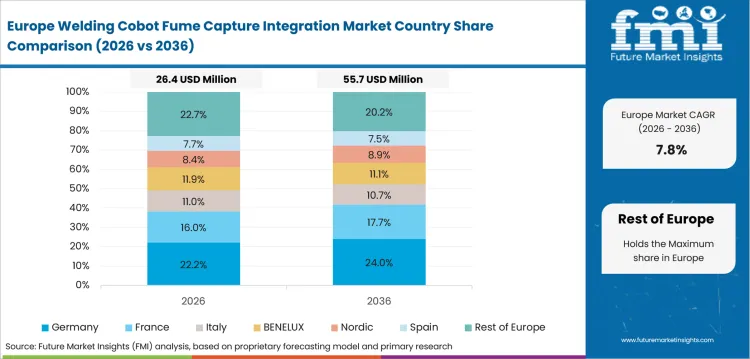
How is the welding cobot fume capture integration market performing in Germany?
An 8.6% CAGR through 2036 reflects strong robot adoption and demanding welding equipment standards.
Country Market Snapshot Table
| Parameter | Value |
|---|---|
| Market Size in 2025 (Value) | USD 12.8 million |
| Market Size in 2026 (Value) | USD 13.9 million |
| Market Forecast in 2036 (Value) | USD 31.7 million |
| CAGR (2026 to 2036) | 8.6% |
| Years Considered | 2021 to 2036 |
| Base Year | 2025 |
| Forecast Period | 2026 to 2036 |
| Units Considered | Value (USD million) |
| Leading Sub-Region | North Rhine-Westphalia and Baden-Wurttemberg automation corridors |
Germany Welding Cobot Fume Capture Integration Market Outlook
Demand in Germany is shaped by strong robot adoption buyers requiring tested engineering before approval. Integrated fume capture needs to satisfy weld quality and airflow proof together.
Local supplier depth supports premium packages. German fabricators often assess lifetime service needs, making torch durability and documentation important during purchase review.
Key Growth Drivers
- Robot deployment supports premium integrated cells, underlined by 26,982 industrial robot installations in 2024 and Europe’s largest automation base for welding upgrades.
- Industrial order recovery improves equipment planning, marked by 7.8% month-over-month new manufacturing order expansion in December 2025.
- Welding equipment depth helps buyers compare source-capture torches and filter service options locally.
- Automotive and machinery suppliers require weld repeatability and documented exposure control before cell approval.
Key Restraints
- Production softness can delay discretionary cell upgrades, reflected by a 0.3% month-over-month industrial production decline in February 2026.
- Strict engineering reviews can extend sales cycles for smaller suppliers lacking proven airflow and service documentation.
- Custom German buyer specifications can raise engineering cost for standard cobot extraction packages.
What makes Germany unique
Germany is unique due to its combination of robot demand and buyer expectations around proof-led installation.
Key Companies
- KEMPER
- ABICOR BINZEL
- KUKA
- FANUC Germany
- ABB Robotics Germany
- Yaskawa Germany
Sales & Marketing Channels
- Specialist welding distributors
- Robot integrator networks
- Direct sales to Tier suppliers
- Safety engineering consultants
- Industrial trade fairs
- Maintenance service contracts
Country Segment Breakdown Table
| Segment | Sub-Segments |
|---|---|
| By Robot Type | Collaborative Robots · SCARA · Articulated · AMR/AGV · Delta Robots |
| By Payload | <5 kg · 5-20 kg · 20-80 kg · >80 kg |
| By Application | Material Handling · Inspection · Assembly · Welding · Packaging · Machine Tending |
| By End-use Industry | Automotive · Electronics · Food & Beverage · Logistics · Pharmaceuticals · Metals |
| By Fume Capture Type | On-Torch Extraction · Downdraft Tables · Modular Hoods · Mobile Filter Units · Airflow Sensor and Monitoring Kits |
| Key Sub-Regions Covered, Manufacturing Clusters | North Rhine-Westphalia · Baden-Wurttemberg · Bavaria · Lower Saxony · Saxony · Hesse |
Frequently Asked Questions
How fast is Germany welding cobot fume capture integration market growing?
Germany is expected to expand at 8.6% CAGR from 2026 to 2036, led by robot depth and welding supplier strength.
Who leads Germany welding cobot fume capture integration market?
KEMPER, ABICOR BINZEL, KUKA, FANUC Germany, ABB Robotics Germany, and Yaskawa Germany compete across welding automation.
What is driving adoption in Germany welding cobot fume capture integration market?
Robot deployment and proof-led buyer reviews support demand for integrated extraction cells.
How is the welding cobot fume capture integration market performing in Japan?
An 8.4% CAGR through 2036 reflects mature robotics expertise and compact plant safety needs.
Country Market Snapshot Table
| Parameter | Value |
|---|---|
| Market Size in 2025 (Value) | USD 11.5 million |
| Market Size in 2026 (Value) | USD 12.5 million |
| Market Forecast in 2036 (Value) | USD 28.0 million |
| CAGR (2026 to 2036) | 8.4% |
| Years Considered | 2021 to 2036 |
| Base Year | 2025 |
| Forecast Period | 2026 to 2036 |
| Units Considered | Value (USD million) |
| Leading Sub-Region | Kanto, Chubu and Kansai manufacturing corridors |
Japan Welding Cobot Fume Capture Integration Market Outlook
Sales in Japan are influenced by mature robotics expertise and compact plant layouts. Welding cobot fume capture packages must protect torch center point stability while keeping filter access simple for plant teams.
Buyers value reliable supplier continuity and careful pilot validation. Compact source-capture systems can support plants that need better local fume control without major shop-floor redesign.
Key Growth Drivers
- Robot scale supports adjacent fume-capture upgrades, backed by 44,500 industrial robot installations in 2024 and a large automation-ready manufacturing base.
- Industrial output improvement supports cell trials, indicated by Japan’s 102.5 production index in April 2026 and 0.5% month-over-month expansion.
- Compact plant layouts favor source capture and mobile filtration instead of large overhead hood projects.
- Local robot know-how supports careful validation of torch angles and filter service before rollout.
Key Restraints
- Softer machinery ordering can slow new cell planning, shown by a 4.5% forecast decline in private-sector machinery orders excluding volatile items from January to March 2026.
- Conservative approval culture can lengthen pilot timelines for new torch and filtration combinations.
- Small workshops may delay retrofit projects if filter maintenance access disrupts current cell layouts.
What makes Japan unique
Japan is unique due to mature robot engineering and buyer emphasis on precision during welding cell approval.
Key Companies
- FANUC
- Yaskawa
- Kawasaki Robotics
- Denso Robotics
- Universal Robots partners
Sales & Marketing Channels
- Robot OEM service networks
- Precision welding integrators
- Machinery supplier channels
- Factory automation distributors
- Technical training centers
- Maintenance-led retrofit channels
Country Segment Breakdown Table
| Segment | Sub-Segments |
|---|---|
| By Robot Type | Collaborative Robots · SCARA · Articulated · AMR/AGV · Delta Robots |
| By Payload | <5 kg · 5-20 kg · 20-80 kg · >80 kg |
| By Application | Material Handling · Inspection · Assembly · Welding · Packaging · Machine Tending |
| By End-use Industry | Automotive · Electronics · Food & Beverage · Logistics · Pharmaceuticals · Metals |
| By Fume Capture Type | On-Torch Extraction · Downdraft Tables · Modular Hoods · Mobile Filter Units · Airflow Sensor and Monitoring Kits |
| Key Sub-Regions Covered, Manufacturing Clusters | Kanto · Chubu · Kansai · Kyushu · Tohoku · Chugoku |
Frequently Asked Questions
How fast is Japan welding cobot fume capture integration market growing?
Japan is expected to expand at 8.4% CAGR from 2026 to 2036, guided by compact plants and source-capture welding cells.
Who leads Japan welding cobot fume capture integration market?
FANUC, Yaskawa, Kawasaki Robotics, Denso Robotics, and Universal Robots partners compete through robot and welding channels.
What is driving adoption in Japan welding cobot fume capture integration market?
Robot expertise, compact layouts, and precision welding requirements support adoption of integrated fume capture packages.
How is the welding cobot fume capture integration market performing in the United Kingdom?
An 8.1% CAGR through 2036 reflects welding fume control guidance and LEV service activity.
Country Market Snapshot Table
| Parameter | Value |
|---|---|
| Market Size in 2025 (Value) | USD 5.8 million |
| Market Size in 2026 (Value) | USD 6.3 million |
| Market Forecast in 2036 (Value) | USD 13.7 million |
| CAGR (2026 to 2036) | 8.1% |
| Years Considered | 2021 to 2036 |
| Base Year | 2025 |
| Forecast Period | 2026 to 2036 |
| Units Considered | Value (USD million) |
| Leading Sub-Region | Midlands, Yorkshire and national LEV service networks |
United Kingdom Welding Cobot Fume Capture Integration Market Outlook
United Kingdom demand is shaped by welding fume control guidance and a large base of smaller fabrication shops. Source-capture cobot packages need to include LEV checks, operator training, and service records from initial planning.
Buyers prefer practical systems that reduce setup complexity and protect weld quality. Integrators connecting robot programming and extraction testing can shorten approval for compact welding cells.
Key Growth Drivers
- Welding fume rules directly support source-capture adoption, reinforced by safety guidance listing on-torch extraction, extracted benches, extracted booths, and movable LEV as control options.
- Smaller automation penetration leaves room for targeted upgrades, reflected by 2,500 robot installations in 2024 and a focused opportunity for compact welding cells.
- LEV service familiarity helps buyers assess extraction records, filter checks, and operator routines before cell release.
- Regional fabricators can adopt staged cobot packages that pair welding automation and practical source capture.
Key Restraints
- Automation timing can stay cautious after a pullback, reflected by a 35% decline in United Kingdom industrial robot installations in 2024.
- Smaller shops may postpone upgrades if examination records and service planning appear difficult to manage.
- Budget caution can favor manual extraction arms unless integrators prove clear welding productivity gains.
What makes the United Kingdom unique
United Kingdom is unique due to LEV inspection discipline and a fabrication base that responds to practical safety documentation.
Key Companies
- Nederman UK
- KEMPER UK
- Universal Robots partners
- ABB UK
- Translas channels
Sales & Marketing Channels
- LEV inspection networks
- Welding distributors
- Cobot integrators
- Health and safety consultants
- Direct sales to fabrication groups
- Demonstration centers
Country Segment Breakdown Table
| Segment | Sub-Segments |
|---|---|
| By Robot Type | Collaborative Robots · SCARA · Articulated · AMR/AGV · Delta Robots |
| By Payload | <5 kg · 5-20 kg · 20-80 kg · >80 kg |
| By Application | Material Handling · Inspection · Assembly · Welding · Packaging · Machine Tending |
| By End-use Industry | Automotive · Electronics · Food & Beverage · Logistics · Pharmaceuticals · Metals |
| By Fume Capture Type | On-Torch Extraction · Downdraft Tables · Modular Hoods · Mobile Filter Units · Airflow Sensor and Monitoring Kits |
| Key Sub-Regions Covered, Manufacturing Clusters | Midlands · Yorkshire · North West England · Scotland · Wales · South East England |
Frequently Asked Questions
How fast is United Kingdom welding cobot fume capture integration market growing?
United Kingdom is expected to expand at 8.1% CAGR from 2026 to 2036, supported by LEV discipline and welding extraction upgrades.
Who leads United Kingdom welding cobot fume capture integration market?
Nederman UK, KEMPER UK, Universal Robots partners, ABB UK, and Translas channels compete through welding and LEV networks.
What is driving adoption in United Kingdom welding cobot fume capture integration market?
LEV inspection discipline, smaller fabrication upgrades, and source-capture guidance support adoption.
How is the welding cobot fume capture integration market performing in France?
A 7.9% CAGR through 2036 reflects regional fabrication demand and measured automation investment.
Country Market Snapshot Table
| Parameter | Value |
|---|---|
| Market Size in 2025 (Value) | USD 4.6 million |
| Market Size in 2026 (Value) | USD 5.0 million |
| Market Forecast in 2036 (Value) | USD 10.7 million |
| CAGR (2026 to 2036) | 7.9% |
| Years Considered | 2021 to 2036 |
| Base Year | 2025 |
| Forecast Period | 2026 to 2036 |
| Units Considered | Value (USD million) |
| Leading Sub-Region | Auvergne-Rhone-Alpes, Hauts-de-France and Grand Est industrial corridors |
France Welding Cobot Fume Capture Integration Market Outlook
France demand is linked to automotive, aerospace, machinery, and regional metal fabrication activity. Cobot fume capture integration supports flexible welding capacity while improving local extraction planning.
Buyer decisions often involve distributor support, installation proof, and service access. Packages combining on-torch capture and mobile filtration can suit constrained workshops and retrofit projects.
Key Growth Drivers
- Manufacturing recovery supports selective equipment planning, evidenced by 1.4% month-over-month output expansion in February 2025 and a stronger case for compact welding-cell trials.
- Regional automation access supports cobot welding deployment, demonstrated by 4,900 industrial robot installations in 2024 and a targeted base for extraction packages.
- Industrial distributors help buyers evaluate robot-ready torches, mobile filters, and downdraft table layouts.
- Aerospace and machinery clusters support controlled weld cells supported by documented extraction checks.
Key Restraints
- Production volatility can delay non-urgent cell upgrades, shown by a 1.0% month-over-month manufacturing output decline in May 2025.
- Distributor coverage varies by region, affecting after-sales support for filters and replacement torches.
- Custom fixture needs can reduce standard package repeatability across mixed metalworking shops.
What makes France unique
France is unique due to prevention-led safety planning and regional industrial clusters that favor targeted cobot welding sales.
Key Companies
- ABB France
- FANUC France
- KUKA France
- Universal Robots partners
- Nederman France channels
- ABICOR BINZEL France
Sales & Marketing Channels
- Welding distributor networks
- Robot integrators
- Direct sales to automotive suppliers
- Regional metalworking associations
- Maintenance and inspection firms
Country Segment Breakdown Table
| Segment | Sub-Segments |
|---|---|
| By Robot Type | Collaborative Robots · SCARA · Articulated · AMR/AGV · Delta Robots |
| By Payload | <5 kg · 5-20 kg · 20-80 kg · >80 kg |
| By Application | Material Handling · Inspection · Assembly · Welding · Packaging · Machine Tending |
| By End-use Industry | Automotive · Electronics · Food & Beverage · Logistics · Pharmaceuticals · Metals |
| By Fume Capture Type | On-Torch Extraction · Downdraft Tables · Modular Hoods · Mobile Filter Units · Airflow Sensor and Monitoring Kits |
| Key Sub-Regions Covered, Manufacturing Clusters | Auvergne-Rhone-Alpes · Hauts-de-France · Grand Est · Ile-de-France · Occitanie · Pays de la Loire |
Frequently Asked Questions
How fast is France welding cobot fume capture integration market growing?
France is expected to expand at 7.9% CAGR from 2026 to 2036, led by regional metalworking clusters and selective cobot welding upgrades.
Who leads France welding cobot fume capture integration market?
ABB France, FANUC France, KUKA France, Universal Robots partners, and Nederman France channels compete through automation networks.
What is driving adoption in France welding cobot fume capture integration market?
Manufacturing recovery and safety-led installation planning support adoption.
Who are the leading companies in the welding cobot fume capture integration market?
ABB Robotics, FANUC, Universal Robots, Nederman, KEMPER, ABICOR BINZEL, Translas, and Omron.
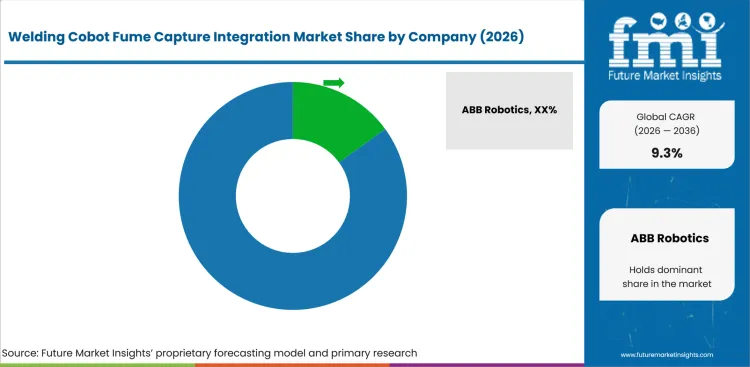
- Robot OEMs compete through platform availability with cobot programming tools and integrator depth.
- Extraction specialists compete led by on-torch capture and airflow service support.
- Welding torch suppliers gain an advantage by keeping torch center point stability and fixture access consistent after extraction hardware is added.
- System integrators shape buyer decisions by connecting robot motion and installation records.
Competition is shaped by robot platform access and service coverage. Robot OEMs control motion platforms and partner networks. Extraction specialists compete depending on source-capture torches and maintenance services. Integrators connect both sides by designing fixture access and documentation for plant approval.
Supplier positioning favors tested combinations. Universal Robots lists the 8XR Cobot MIG Extractor package with ClearO2 W-series 100 and 200 support. Nederman promotes Fume Eliminator GoMax for manual and cobot welding applications. ABICOR BINZEL offers xFUME ROBO extraction kits for conventional welding robots and welding cobots. Omron expanded its collaborative robot lineup in December 2025 with TM30S, TM20S, and TM6S models alongside TMflow 2.22 software.
How do top welding cobot fume capture integration companies compare?
Universal Robots and ABB score strongest on robot-channel access, while Nederman, KEMPER, ABICOR BINZEL, and Translas score strongly on extraction and torch integration.
| Company | Market Title Match | Robot Platform Depth | Fume Capture Portfolio | Integrator Channel Control | Service Reach | Geographic Footprint |
|---|---|---|---|---|---|---|
| ABB Robotics | Very High | Very Strong | Moderate | Very Strong | Very Strong | Global |
| FANUC | Very High | Very Strong | Moderate | Very Strong | Very Strong | Global |
| Universal Robots | Very High | Very Strong | Strong | Very Strong | Strong | Global |
| Nederman | Very High | Low | Very Strong | Strong | Very Strong | Global |
| KEMPER | High | Low | Very Strong | Strong | Strong | Europe and North America |
| ABICOR BINZEL | High | Low | Very Strong | Strong | Strong | Global |
| Translas | High | Low | Very Strong | Moderate | Moderate | Europe and Americas |
| Omron | Moderate to High | Strong | Low | Strong | Strong | Global |
| Yaskawa | Moderate to High | Very Strong | Low | Strong | Strong | Global |
| KUKA | Moderate to High | Very Strong | Low | Strong | Strong | Europe, Americas and Asia |
Source: Future Market Insights competitive analysis, 2026.
Who are the key players in the welding cobot fume capture integration market?
ABB Robotics, FANUC, Universal Robots, Nederman, KEMPER, ABICOR BINZEL, Translas, and Omron are listed with Yaskawa, KUKA, RoboVent, and Lincoln Electric Automation among other suppliers.
Key global companies leading the welding cobot fume capture integration market include:
- ABB Robotics
- FANUC
- Universal Robots
- Nederman
- KEMPER
- ABICOR BINZEL
- Translas
- Omron
- Yaskawa
- KUKA
- RoboVent
- Lincoln Electric Automation
Key Developments in Welding Cobot Fume Capture Integration Market
- In 2026, Universal Robots listed the 8XR Cobot MIG Extractor package for UR5e, UR10e, and UR16e platforms with four torch angle options.
- In May 2025, Nederman introduced Fume Eliminator GoMax for on-torch, robotic, cobot, and manual welding applications.
- In December 2025, Omron announced TM S Series expansion with TM30S, TM20S, and TM6S cobots plus TMflow 2.22 software.
Key Players in the Welding Cobot Fume Capture Integration Market
Robot Platform Suppliers
- ABB Robotics
- FANUC
- Universal Robots
- Omron
- Yaskawa
- KUKA
Fume Capture and Torch Specialists
- Nederman
- KEMPER
- ABICOR BINZEL
- Translas
- RoboVent
Integration and Welding Automation Companies
- Lincoln Electric Automation
Welding Cobot Fume Capture Integration Market - Report Scope
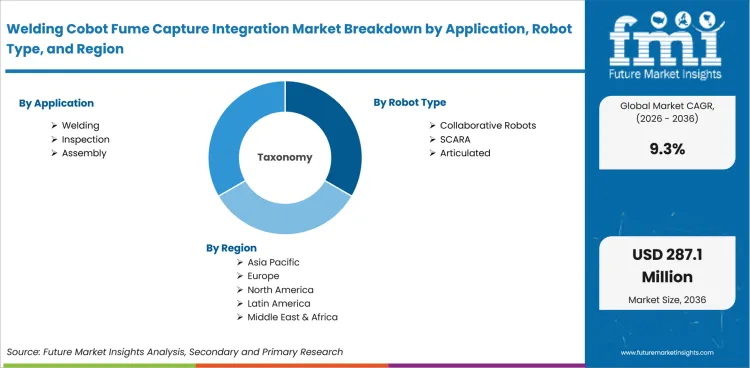
| Parameter | Details |
|---|---|
| Forecast period | 2026 to 2036 |
| Historical period | 2021 to 2025 |
| Quantitative unit | Revenue in USD million |
| By robot type | Collaborative Robots, SCARA, Articulated, AMR/AGV, Delta Robots |
| By payload | <5 kg, 5-20 kg, 20-80 kg, >80 kg |
| By application | Material Handling, Inspection, Assembly, Welding, Packaging, Machine Tending |
| By end-use industry | Automotive, Electronics, Food & Beverage, Logistics, Pharmaceuticals, Metals |
| By fume capture type | On-Torch Extraction, Downdraft Tables, Modular Hoods, Mobile Filter Units, Airflow Sensor and Monitoring Kits |
| Regions covered | North America, Latin America, Europe, East Asia, South Asia and Pacific, Middle East and Africa |
| Countries covered | China, India, South Korea, United States, Germany, Japan, United Kingdom, France |
| Key companies profiled | ABB Robotics, FANUC, Universal Robots, Nederman, KEMPER, ABICOR BINZEL, Translas, Omron |
| Approach | Bottom-up integrated cell revenue approach using robot payload, welding cell demand, extraction attachment, filter service, and country-level automation readiness |
Source: Future Market Insights, 2026.
Welding Cobot Fume Capture Integration Market - Scope & Definition
| Attribute | Detail |
|---|---|
| Market Definition | Integrated systems combining collaborative welding robots with fume extraction hardware, filtration, airflow control, and setup support for industrial welding cells |
| Functions Covered | Source capture, local exhaust ventilation, filtration, downdraft extraction, airflow monitoring, operator protection, robot-cell commissioning, and service documentation |
| Applications Covered | Material handling, inspection, assembly, welding, packaging, and machine tending, with welding as the core fume-generating application |
| End-Use Industries | Automotive, electronics, food and beverage, logistics, pharmaceuticals, metals, machinery, and adjacent fabrication users |
| Product Types Covered | On-torch extraction, downdraft tables, modular hoods, mobile filter units, airflow sensor kits, hoses, and source-capture accessories |
| Inclusions | Robot-ready extraction torches, cobot-compatible filter units, fume capture tables, monitoring kits, commissioning support, and aftermarket filter service |
| Exclusions | Manual-only welding extractors, general HVAC systems, welding consumables sold without integration support, and non-welding cobot tools |
Welding Cobot Fume Capture Integration Market - Research Methodology
| Method | Description |
|---|---|
| Primary Research | FMI analyst interviews with welding automation integrators, cobot distributors, extraction suppliers, fabrication buyers, and safety managers across key markets |
| Desk Research | Review of safety guidance, robot installation data, company product pages, datasheets, regulatory documents, and manufacturing statistics |
| Market Sizing & Forecasting | Bottom-up cell revenue approach using cobot welding adoption, payload mix, fume capture attachment rates, filter pricing, and country-level automation maturity |
| Data Validation | Cross-verification using robot installation patterns, welding fume control guidance, supplier portfolios, service-channel evidence, and buyer adoption signals |
Welding Cobot Fume Capture Integration Market Breakdown by Robot Type, Payload, Application, End-use Industry, Fume Capture Type, and Region
Welding Cobot Fume Capture Integration Market Segmented by Robot Type
- Collaborative Robots
- SCARA
- Articulated
- AMR/AGV
- Delta Robots
Welding Cobot Fume Capture Integration Market Segmented by Payload
- <5 kg
- 5-20 kg
- 20-80 kg
- >80 kg
Welding Cobot Fume Capture Integration Market Segmented by Application
- Material Handling
- Inspection
- Assembly
- Welding
- Packaging
- Machine Tending
Welding Cobot Fume Capture Integration Market Segmented by End-use Industry
- Automotive
- Electronics
- Food & Beverage
- Logistics
- Pharmaceuticals
- Metals
Welding Cobot Fume Capture Integration Market Segmented by Fume Capture Type
- On-Torch Extraction
- Downdraft Tables
- Modular Hoods
- Mobile Filter Units
- Airflow Sensor and Monitoring Kits
Welding Cobot Fume Capture Integration Market by Region
- North America
- Latin America
- Europe
- East Asia
- South Asia and Pacific
- Middle East and Africa
Research Sources and Bibliography
- ABICOR BINZEL. (2026). xFUME ROBO extraction kit for welding robots and welding cobots.
- Board of Governors of the Federal Reserve System. (2026, June 16). Industrial production and capacity utilization.
- Federal Statistical Office. (2026, February 5). New orders in manufacturing in December 2025: +7.8% on the previous month.
- Federal Statistical Office. (2026, April 9). Production in February 2026: -0.3% on the previous month.
- Health and Safety Executive. (2025, January 9). Welding fume: Protect your workers.
- Health and Safety Executive. (2025). Controlling the risks from welding.
- INSEE. (2025, April 4). In February 2025, manufacturing output bounced back (+1.4%).
- INSEE. (2025, July 4). In May 2025, manufacturing output went down by 1.0%.
- International Federation of Robotics. (2025, September 25). World Robotics 2025 report: Industrial robots.
- International Federation of Robotics. (2026, April 8). Robot density surges in Europe, Asia, and Americas.
- Ministry of Economy, Trade and Industry. (2026, June 12). Indices of Industrial Production: Revised report for April 2026.
- Ministry of Statistics and Programme Implementation. (2025, April 11). Quick estimate of Index of Industrial Production and use-based index for February 2025.
- National Bureau of Statistics of China. (2025, May 20). Investment in fixed assets from January to April 2025.
- National Bureau of Statistics of China. (2026, January 20). Investment in fixed assets in 2025.
- Nederman. (2025). Discover Fume Eliminator GoMax.
- OMRON Robotics and Safety Technologies. (2025, December 12). OMRON TM S Series launch: Introducing TM30S, TM20S, and TM6S.
- Press Information Bureau. (2025, December 29). India’s Index of Industrial Production records growth of 6.7% in November 2025.
- Universal Robots. (2026). 8XR Cobot MIG Extractor Package.
This bibliography is provided for reader reference and is not exhaustive. The full report contains the complete reference list and detailed citations.
This Report Answers
- Market size estimates for 2026 and forecasts through 2036 for the welding cobot fume capture integration market.
- Insights across regional and country-level markets for integrated cobot welding extraction.
- Analysis of demand drivers, safety requirements, automation adoption patterns, and purchase behavior.
- Evaluation of robot type, payload, application, end-use industry, and fume capture type segments.
- Assessment of welding fume control rules, LEV expectations, airflow documentation, and service requirements.
- Identification of opportunities across on-torch extraction, downdraft tables, mobile filtration, and monitoring kits.
- Evaluation of integration dynamics, product development, source-capture design, and channel structures.
- Country-level analysis covering China, India, South Korea, United States, Germany, Japan, United Kingdom, and France.
- Assessment of competition, including robot OEMs, extraction specialists, welding torch suppliers, and integrators.
- Analysis of buyer preferences, retrofit demand, compact cell adoption, and recurring filter service opportunities.
- Regional outlooks across North America, Latin America, Europe, East Asia, South Asia and Pacific, and Middle East and Africa.
- Delivery of market data, forecasts, and supporting analysis in PDF and Excel formats.
Frequently Asked Questions
What is the growth prospect for welding cobot fume capture integration?
Demand for welding cobot fume capture integration is expected to rise at a considerable pace as fabricators combine compact robotic welding with source-capture extraction.
Which companies are expected to shape the welding cobot fume capture integration market?
ABB Robotics, FANUC, Universal Robots, Nederman, KEMPER, ABICOR BINZEL, Translas, and Omron are expected to shape market competition led by robot platforms and integration channels.
Why are leading automation companies investing in welding cobot fume capture integration?
Leading automation companies are investing in welding cobot fume capture integration to support safer robotic welding cells and reduce buyer reliance on separate extraction planning.
Why are source-capture systems important in the welding cobot fume capture integration market?
Source-capture systems are important since welding fumes need extraction close to the arc before plant teams approve compact robotic welding layouts.
Which product formats are gaining attention in welding cobot fume capture integration?
On-torch extraction packages and airflow sensor kits are gaining attention across compact welding cells.
How do regulations influence welding cobot fume capture integration?
Regulations influence product selection through exposure-control duties and documentation requirements.
Why is payload selection important for welding cobot fume capture integration?
Payload selection is important since torch weight and extraction hose load affect reach, path stability, and fixture access.
What role do integrators play in welding cobot fume capture integration?
Integrators connect robot programming and operator training into one approval-ready welding cell.
How do service channels support welding cobot fume capture integration in some countries?
Service channels support adoption by providing filter replacement and operator training after cell installation.
Preview the report firsthand - request a free sample
Get SampleGet the brochure for pricing and purchase details.
Get PDFTable of Content
- Key Takeaways
- Market Size and CAGR
- Top Growth Driver
- Fastest Growing Segment
- Leading Region
- Key Companies
- Emerging Opportunities
- Executive Summary
- Global Market Outlook
- Demand-side Trends
- Supply-side Trends
- Technology Roadmap Analysis
- Analysis and Recommendations
- Analyst Perspective (What is happening? Why now? What should investors know?)
- Key Questions Answered
- How large is the market?
- What is the CAGR?
- What are key trends?
- Which region dominates?
- Who are the leaders?
- Market Overview
- Market Coverage / Taxonomy
- Market Definition / Scope / Limitations
- Research Methodology
- Chapter Orientation
- Analytical Lens and Working Hypotheses
- Market Structure, Signals, and Trend Drivers
- Benchmarking and Cross-market Comparability
- Market Sizing, Forecasting, and Opportunity Mapping
- Research Design and Evidence Framework
- Desk Research Programme (Secondary Evidence)
- Expert Input and Fieldwork (Primary Evidence)
- Tooling, Models, and Reference Databases
- Data Engineering and Model Build
- Quality Assurance and Audit Trail
- Market Background
- Market Dynamics (Drivers, Restraints, Opportunity, Trends)
- Scenario Forecast (Optimistic, Likely, Conservative)
- Impact Analysis
- AI Impact
- Sustainability Impact
- Regulatory Impact
- Technology Impact
- Consumer / Buyer Analysis
- Purchase Drivers
- Adoption Barriers
- Buyer Journey
- Opportunity Map Analysis
- Product Life Cycle Analysis
- Supply Chain Analysis
- Investment Feasibility Matrix
- Value Chain Analysis
- PESTLE and Porter's Analysis
- Regulatory Landscape
- Regional Parent Market Outlook
- Production and Consumption Statistics
- Import and Export Statistics
- Global Market Analysis and Forecast, 2021 to 2036
- Historical Market Size Value (USD Million) Analysis, 2021 to 2025
- Current and Future Market Size Value (USD Million) Projections, 2026 to 2036
- Y-o-Y Growth Trend Analysis
- Absolute $ Opportunity Analysis
- Global Market Pricing Analysis, 2021 to 2036
- Global Market Analysis and Forecast, By Application, 2021 to 2036
- Introduction / Key Findings
- Historical Market Size Value (USD Million) Analysis By Application, 2021 to 2025
- Current and Future Market Size Value (USD Million) Analysis and Forecast By Application, 2026 to 2036
- Welding
- Inspection
- Assembly
- Welding
- Y-o-Y Growth Trend Analysis By Application, 2021 to 2025
- Absolute $ Opportunity Analysis By Application, 2026 to 2036
- Global Market Analysis and Forecast, By Robot Type, 2021 to 2036
- Introduction / Key Findings
- Historical Market Size Value (USD Million) Analysis By Robot Type, 2021 to 2025
- Current and Future Market Size Value (USD Million) Analysis and Forecast By Robot Type, 2026 to 2036
- Collaborative Robots
- SCARA
- Articulated
- Collaborative Robots
- Y-o-Y Growth Trend Analysis By Robot Type, 2021 to 2025
- Absolute $ Opportunity Analysis By Robot Type, 2026 to 2036
- Global Market Analysis and Forecast, By Payload, 2021 to 2036
- Introduction / Key Findings
- Historical Market Size Value (USD Million) Analysis By Payload, 2021 to 2025
- Current and Future Market Size Value (USD Million) Analysis and Forecast By Payload, 2026 to 2036
- 5-20 kg
- <5 kg
- >80 kg
- 5-20 kg
- Y-o-Y Growth Trend Analysis By Payload, 2021 to 2025
- Absolute $ Opportunity Analysis By Payload, 2026 to 2036
- Global Market Analysis and Forecast, By Fume Capture Type, 2021 to 2036
- Introduction / Key Findings
- Historical Market Size Value (USD Million) Analysis By Fume Capture Type, 2021 to 2025
- Current and Future Market Size Value (USD Million) Analysis and Forecast By Fume Capture Type, 2026 to 2036
- On-Torch Extraction
- Downdraft Tables
- Modular Hoods
- On-Torch Extraction
- Y-o-Y Growth Trend Analysis By Fume Capture Type, 2021 to 2025
- Absolute $ Opportunity Analysis By Fume Capture Type, 2026 to 2036
- Global Market Analysis and Forecast, By End-use Industry, 2021 to 2036
- Introduction / Key Findings
- Historical Market Size Value (USD Million) Analysis By End-use Industry, 2021 to 2025
- Current and Future Market Size Value (USD Million) Analysis and Forecast By End-use Industry, 2026 to 2036
- Metals
- Pharmaceuticals
- Electronics
- Metals
- Y-o-Y Growth Trend Analysis By End-use Industry, 2021 to 2025
- Absolute $ Opportunity Analysis By End-use Industry, 2026 to 2036
- Global Market Analysis and Forecast, By Region, 2021 to 2036
- Introduction
- Historical Market Size Value (USD Million) Analysis By Region, 2021 to 2025
- Current Market Size Value (USD Million) Analysis and Forecast By Region, 2026 to 2036
- North America
- Latin America
- Western Europe
- Eastern Europe
- East Asia
- South Asia and Pacific
- Middle East & Africa
- Market Attractiveness Analysis By Region
- North America Market Analysis and Forecast, By Country, 2021 to 2036
- Historical Market Size Value (USD Million) Trend Analysis By Market Taxonomy, 2021 to 2025
- Market Size Value (USD Million) Forecast By Market Taxonomy, 2026 to 2036
- By Country
- USA
- Canada
- Mexico
- By Application
- By Robot Type
- By Payload
- By Fume Capture Type
- By End-use Industry
- By Country
- Market Attractiveness Analysis
- By Country
- By Application
- By Robot Type
- By Payload
- By Fume Capture Type
- By End-use Industry
- Key Takeaways
- Latin America Market Analysis and Forecast, By Country
- Historical Market Size Value (USD Million) Trend Analysis By Market Taxonomy, 2021 to 2025
- Market Size Value (USD Million) Forecast By Market Taxonomy, 2026 to 2036
- By Country
- Brazil
- Chile
- Rest of Latin America
- By Application
- By Robot Type
- By Payload
- By Fume Capture Type
- By End-use Industry
- By Country
- Market Attractiveness Analysis
- By Country
- By Application
- By Robot Type
- By Payload
- By Fume Capture Type
- By End-use Industry
- Key Takeaways
- Western Europe Market Analysis and Forecast, By Country
- Historical Market Size Value (USD Million) Trend Analysis By Market Taxonomy, 2021 to 2025
- Market Size Value (USD Million) Forecast By Market Taxonomy, 2026 to 2036
- By Country
- Germany
- UK
- Italy
- Spain
- France
- Nordic
- BENELUX
- Rest of Western Europe
- By Application
- By Robot Type
- By Payload
- By Fume Capture Type
- By End-use Industry
- By Country
- Market Attractiveness Analysis
- By Country
- By Application
- By Robot Type
- By Payload
- By Fume Capture Type
- By End-use Industry
- Key Takeaways
- Eastern Europe Market Analysis and Forecast, By Country
- Historical Market Size Value (USD Million) Trend Analysis By Market Taxonomy, 2021 to 2025
- Market Size Value (USD Million) Forecast By Market Taxonomy, 2026 to 2036
- By Country
- Russia
- Poland
- Hungary
- Balkan & Baltic
- Rest of Eastern Europe
- By Application
- By Robot Type
- By Payload
- By Fume Capture Type
- By End-use Industry
- By Country
- Market Attractiveness Analysis
- By Country
- By Application
- By Robot Type
- By Payload
- By Fume Capture Type
- By End-use Industry
- Key Takeaways
- East Asia Market Analysis and Forecast, By Country
- Historical Market Size Value (USD Million) Trend Analysis By Market Taxonomy, 2021 to 2025
- Market Size Value (USD Million) Forecast By Market Taxonomy, 2026 to 2036
- By Country
- China
- Japan
- South Korea
- By Application
- By Robot Type
- By Payload
- By Fume Capture Type
- By End-use Industry
- By Country
- Market Attractiveness Analysis
- By Country
- By Application
- By Robot Type
- By Payload
- By Fume Capture Type
- By End-use Industry
- Key Takeaways
- South Asia and Pacific Market Analysis and Forecast, By Country
- Historical Market Size Value (USD Million) Trend Analysis By Market Taxonomy, 2021 to 2025
- Market Size Value (USD Million) Forecast By Market Taxonomy, 2026 to 2036
- By Country
- India
- ASEAN
- Australia & New Zealand
- Rest of South Asia and Pacific
- By Application
- By Robot Type
- By Payload
- By Fume Capture Type
- By End-use Industry
- By Country
- Market Attractiveness Analysis
- By Country
- By Application
- By Robot Type
- By Payload
- By Fume Capture Type
- By End-use Industry
- Key Takeaways
- Middle East & Africa Market Analysis and Forecast, By Country
- Historical Market Size Value (USD Million) Trend Analysis By Market Taxonomy, 2021 to 2025
- Market Size Value (USD Million) Forecast By Market Taxonomy, 2026 to 2036
- By Country
- Kingdom of Saudi Arabia
- Other GCC Countries
- Türkiye
- South Africa
- Other African Union
- Rest of Middle East & Africa
- By Application
- By Robot Type
- By Payload
- By Fume Capture Type
- By End-use Industry
- By Country
- Market Attractiveness Analysis
- By Country
- By Application
- By Robot Type
- By Payload
- By Fume Capture Type
- By End-use Industry
- Key Takeaways
- Key Countries Market Analysis
- USA
- Pricing Analysis
- Market Share Analysis, 2025
- By Application
- By Robot Type
- By Payload
- By Fume Capture Type
- By End-use Industry
- Canada
- Pricing Analysis
- Market Share Analysis, 2025
- By Application
- By Robot Type
- By Payload
- By Fume Capture Type
- By End-use Industry
- Mexico
- Pricing Analysis
- Market Share Analysis, 2025
- By Application
- By Robot Type
- By Payload
- By Fume Capture Type
- By End-use Industry
- Brazil
- Pricing Analysis
- Market Share Analysis, 2025
- By Application
- By Robot Type
- By Payload
- By Fume Capture Type
- By End-use Industry
- Chile
- Pricing Analysis
- Market Share Analysis, 2025
- By Application
- By Robot Type
- By Payload
- By Fume Capture Type
- By End-use Industry
- Germany
- Pricing Analysis
- Market Share Analysis, 2025
- By Application
- By Robot Type
- By Payload
- By Fume Capture Type
- By End-use Industry
- UK
- Pricing Analysis
- Market Share Analysis, 2025
- By Application
- By Robot Type
- By Payload
- By Fume Capture Type
- By End-use Industry
- Italy
- Pricing Analysis
- Market Share Analysis, 2025
- By Application
- By Robot Type
- By Payload
- By Fume Capture Type
- By End-use Industry
- Spain
- Pricing Analysis
- Market Share Analysis, 2025
- By Application
- By Robot Type
- By Payload
- By Fume Capture Type
- By End-use Industry
- France
- Pricing Analysis
- Market Share Analysis, 2025
- By Application
- By Robot Type
- By Payload
- By Fume Capture Type
- By End-use Industry
- India
- Pricing Analysis
- Market Share Analysis, 2025
- By Application
- By Robot Type
- By Payload
- By Fume Capture Type
- By End-use Industry
- ASEAN
- Pricing Analysis
- Market Share Analysis, 2025
- By Application
- By Robot Type
- By Payload
- By Fume Capture Type
- By End-use Industry
- Australia & New Zealand
- Pricing Analysis
- Market Share Analysis, 2025
- By Application
- By Robot Type
- By Payload
- By Fume Capture Type
- By End-use Industry
- China
- Pricing Analysis
- Market Share Analysis, 2025
- By Application
- By Robot Type
- By Payload
- By Fume Capture Type
- By End-use Industry
- Japan
- Pricing Analysis
- Market Share Analysis, 2025
- By Application
- By Robot Type
- By Payload
- By Fume Capture Type
- By End-use Industry
- South Korea
- Pricing Analysis
- Market Share Analysis, 2025
- By Application
- By Robot Type
- By Payload
- By Fume Capture Type
- By End-use Industry
- Russia
- Pricing Analysis
- Market Share Analysis, 2025
- By Application
- By Robot Type
- By Payload
- By Fume Capture Type
- By End-use Industry
- Poland
- Pricing Analysis
- Market Share Analysis, 2025
- By Application
- By Robot Type
- By Payload
- By Fume Capture Type
- By End-use Industry
- Hungary
- Pricing Analysis
- Market Share Analysis, 2025
- By Application
- By Robot Type
- By Payload
- By Fume Capture Type
- By End-use Industry
- Kingdom of Saudi Arabia
- Pricing Analysis
- Market Share Analysis, 2025
- By Application
- By Robot Type
- By Payload
- By Fume Capture Type
- By End-use Industry
- Türkiye
- Pricing Analysis
- Market Share Analysis, 2025
- By Application
- By Robot Type
- By Payload
- By Fume Capture Type
- By End-use Industry
- South Africa
- Pricing Analysis
- Market Share Analysis, 2025
- By Application
- By Robot Type
- By Payload
- By Fume Capture Type
- By End-use Industry
- USA
- Market Structure Analysis
- Competition Dashboard
- Competition Benchmarking
- Market Share Analysis of Top Players
- By Regional
- By Application
- By Robot Type
- By Payload
- By Fume Capture Type
- By End-use Industry
- Emerging Startups
- Innovation Benchmarking
- Competition Analysis
- Competition Deep Dive
- ABB Robotics
- Overview
- Product Portfolio
- Profitability by Market Segments (Product/Region/Sales Channel)
- Sales Footprint
- Strategy Overview
- Marketing Strategy
- Product Strategy
- Channel Strategy
- FANUC
- Universal Robots
- Nederman
- KEMPER
- ABICOR BINZEL
- Translas
- ABB Robotics
- Case Studies
- Success Stories
- Recent Developments
- Competition Deep Dive
- Assumptions & Acronyms Used


