

- Market Size (2026)
- USD 168.2 Mn
- Forecast (2036)
- USD 251.4 Mn
- CAGR (2026 to 2036)
- 4.1%
How big is Wig Care Products Market in 2026?
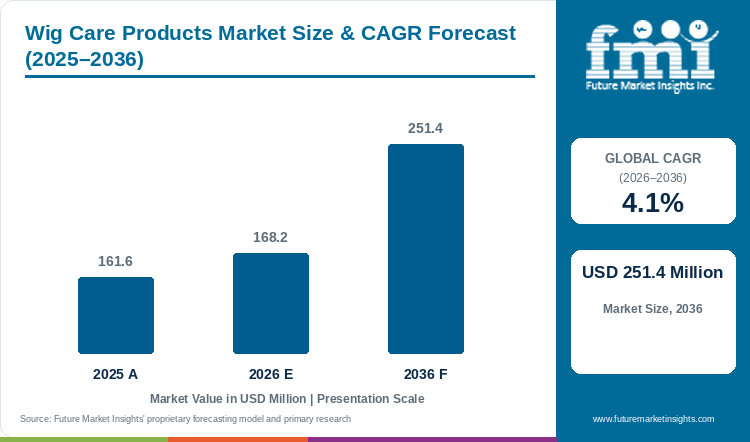
The wig care products market is estimated at USD 161.6 million in 2025 and is expected to reach USD 168.2 million in 2026. Sales of wig care products are projected to grow at a CAGR of 4.1% and reach USD 251.4 million by 2036.
Demand for wig care products is rising with the number of wigs in regular wear, as most synthetic units go into the basin after six to eight wears. The wig care products market is estimated at USD 161.6 million in 2025 on shampoo, spray and conditioner bought for wigs, rising to an expected USD 168.2 million for 2026. Over the forecast period, a CAGR of 4.1% is projected to take sales of wig care products to USD 251.4 million by 2036. Repeat orders are growing as new wearers who receive a fiber-matched shampoo and conditioning spray at the fitting come back for refills. As an illustration, Jon Renau tells synthetic wearers to use Fiber Love Shampoo and Fiber Love Conditioning Spray and gives a synthetic system six to nine months of life with proper care.[1] A unit life of that length means each synthetic wearer buys care for about two units a year, a steady base for refills.
Competition is moving into the hands of the wig brands. As a case in point, Luvme Hair, which reports over 3 million customers, opened 2026 with wig offers from USD 74.9 under a Better Hair, Easy Care theme.[2] Low entry prices put more units into rotation, and each one needs a care routine. On the other hand, Jon Renau answers with a branded routine, naming Fiber Love Shampoo and Fiber Love Conditioning Spray for every synthetic unit.[1] As a result, FMI analysts expect wig makers that pack care into every unit to keep the reorder, leaving unbranded bottles in beauty supply aisles to compete on price.
Key Market Trends & Insights
- Each wash uses a cleanser, so shampoos and cleansers are expected to lead product type at 31% in 2026, with conditioners and detanglers close behind on 28%. To support this routine, Jon Renau pairs Fiber Love Shampoo with a separate conditioning spray for synthetic units.[1] Branded pairs sold together raise the conditioner share of each basket, keeping the two categories close.
- Standard synthetic fiber is expected to account for 50% of wig fiber sales in 2026 on low unit prices and stock prescriptions, ahead of human hair at 36%. For instance, NHS patients at Royal Berkshire receive a stock modacrylic wig as standard and pay for cleaning themselves.[3] Synthetic units handed out as standard create care buyers who pay for products out of pocket.
- Online retail is likely to hold 24% of sales channel sales in 2026, a point ahead of beauty supply stores. Evidence of this channel shift comes from retail, as online orders brought Sally Beauty Holdings USD 110 million in April to June 2026, 11% above the prior-year quarter.[4] Double-digit online growth at a beauty supply chain shows reorders moving to the web, which favours brands with strong online listings.
Regional Highlights
- South Africa leads the FMI forecast at 5.6%, 1.5 points over the 4.1% global CAGR, as charity wig banks fit first wigs on cancer patients.
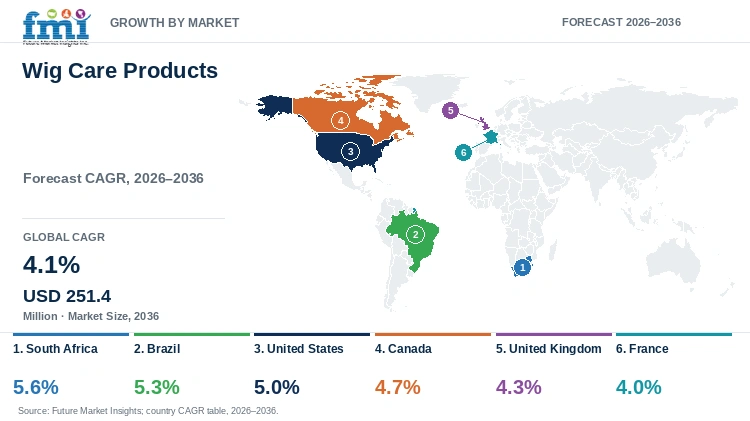
- Brazil is forecast at 5.3% on protective styling and the United States at 5% on online reorders, with Canada a few tenths lower at 4.7%. Growth in the United Kingdom is projected at 4.3% under mature medical wig funding, and France grows slowest, at 4%.
- Public funding in France sets the price ceiling for medical wigs. Ameli set a EUR 350 reimbursement base for every full wig class from 1 January 2026 and covers up to three hair accessories in each 12-month period.[5] Full reimbursement of synthetic units steers French patients to synthetic fiber, which shapes care product choice.
Market Size & Forecast
Table 1: Market Size and Forecast for the Wig Care Products Market (USD million and percentage), 2025 to 2036
| Metric | Value |
|---|---|
| 2025 Market Size | USD 161.6 million |
| Estimated Market Size in 2026 | USD 168.2 million |
| Projected Market Size by 2036 | USD 251.4 million |
| CAGR, 2026 to 2036 | 4.1% |
| Added Revenue, 2026 to 2036 | USD 83.2 million |
| Market Expansion Multiple | 1.5x |
Sales of wig care products are rising as more wigs enter active wear, and each wig needs cleanser, conditioner and a detangler several times a month. Brands also set the method, and a shower rinse instead of a soak, with detangler kept away from hand-tied knots, is the Jon Renau method.[1] Brand-set routines tie the wearer to the matching products, which supports repeat orders of dedicated ranges. At the same time, finished wigs belong to the hair wig and extension market, which carries a 5.6% CAGR outlook, so new wearers keep entering the care routine. By FMI estimates, wearers will add USD 83.2 million to sales of wig care products between 2026 and 2036, so the 2036 total comes close to one and a half times the 2026 figure. Even so, cheap general shampoos used on synthetic fiber remain the main risk to repeat orders of dedicated products.
Wash Cycles, Fiber Rules and Fitting-Room Sales
Wash cycles set the reorder pace. In particular, a synthetic system lasts six to nine months with proper care, according to Jon Renau, and needs shampoo, conditioning spray and shine spray throughout.[1] Therefore, a wearer who replaces two synthetic units over twelve months buys a care set with each one.
Fiber rules set the product choice. Standard synthetic fiber is not heat friendly and is reshaped only by steaming.[1] By contrast, human hair accepts heat styling and richer conditioners, so the two fibers need separate ranges. Funding rules add a further split, as NHS patients at Royal Berkshire pay the standard appliance charge for a stock modacrylic wig, and the service does not fund cleaning or repairs.[3] Patients who fund cleaning become retail buyers of care products. Consequently, wig fitters will keep separate synthetic and human hair shelves.
Table 2: Wash Cycle, Fiber and Channel Indicators for the Wig Care Products Market (care guidance, prices and sales), 2026
| Indicator | Data Point | Relevance | Source |
|---|---|---|---|
| Jon Renau synthetic wash interval, April 2026 | Every six to eight wears | Reorder pace for shampoo and conditioner | [1] |
| Jon Renau synthetic system life, April 2026 | Six to nine months with proper care | Replacement cycle for care sets | [1] |
| Luvme Hair customer base, January 2026 | Over 3 million customers; offers from USD 74.9 | Installed base of wig wearers | [2] |
| Sally Beauty Holdings e-commerce, June 2026 quarter | USD 110 million; up 11% | Online beauty supply sales | [4] |
| Ameli full wig base, 2026 | EUR 350 for every class | Wig affordability in France | [5] |
| Royal Berkshire NHS wig service, April 2026 | Stock modacrylic wig as standard | Synthetic fiber share among medical wearers | [3] |
Analyst Perspective
“Every wig that leaves a fitting room is, in my view, a care customer for as long as the unit is worn, and a synthetic piece lasts about six to nine months. The brands that hand over a fiber-matched shampoo, a conditioning spray and clear wash instructions at the fitting will collect most reorders, which is opening a refill lane for fiber-matched care at wig boutiques and online stores. I would advise care suppliers to label every bottle for synthetic, heat-friendly or human hair use, since a wearer who damages a wig with the wrong product rarely tries the brand again.”
- Rahul Pandita, Principal Consultant, Future Market Insights.
How is the wig care products market segmented?
The market is segmented into product type, wig fiber, sales channel, and region. Shampoos and cleansers are expected to lead product type with 31% share in 2026, and standard synthetic fiber leads wig fiber with 50%.
By product type: shampoos and cleansers, conditioners and detanglers, styling and finishing products, wearer scalp care, and care kits.
By wig fiber: standard synthetic fiber, human hair, and heat-friendly synthetic fiber.
By sales channel: online retail, beauty supply stores, wig boutiques and salons, mass merchandisers and drugstores, and medical hair loss centers.
By region: wig wearers, wig boutiques, salons and beauty supply stores in North America, Latin America, Western Europe, Eastern Europe, East Asia, South Asia and Pacific, and Middle East and Africa.
Why do shampoos and cleansers lead wig care products sales by product type?
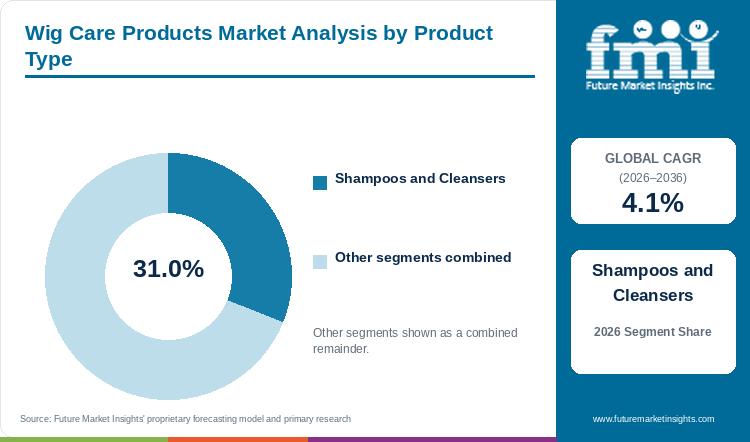
Shampoos and cleansers are expected to lead product type sales with 31% share in 2026, ahead of conditioners and detanglers at 28% and styling and finishing products at 17%.
Table 3: Product Type Share for the Wig Care Products Market (percentage share), 2026
| Product Type | Estimated Share (2026) |
|---|---|
| Shampoos and Cleansers | 31% |
| Conditioners and Detanglers | 28% |
| Styling and Finishing Products | 17% |
| Wearer Scalp Care | 13% |
| Care Kits | 11% |
| Total | 100.0% |
Table 4: Product Type Leadership and Market Growth for the Wig Care Products Market (segment and CAGR percentage), 2026 to 2036
| Metric | Value |
|---|---|
| Global CAGR (2026 to 2036) | 4.1% |
| Leading Segment | Shampoos and Cleansers |
Every wash starts at the basin, and shampoos and cleansers are expected to carry 31% of 2026 product type demand. Conditioners and detanglers, about 28%, are used after each wash and between wears, so the gap to the leader is small. Beyond these, styling and finishing products, an estimated 17%, cover shine sprays, holding sprays and heat protectants for human hair units. Wearer scalp care accounts for 13% and care kits 11%, as many fitters hand over a starter set with the first wig. For context, mainstream hair washing belongs to the hair care market, and dedicated wig formulas avoid the heavy oils and silicones that cling to synthetic fiber. In line with this, the Jon Renau guide sets a wash every six to eight wears.[1] A wash every week or two of wear keeps shampoo the most frequent purchase in the range.
- Sulfate-free wig shampoos, fiber cleansers and rinse-free foams make up most cleanser volume.
- Wig brands sell full routines around the shampoo. Jon Renau lists HD Smooth Detangler and Revitalizing Shine Spray beside Fiber Love Shampoo for synthetic units.[1] Each routine adds detangler and shine spray to the basket, widening the categories tied to each wash.
Why does standard synthetic fiber lead wig care products sales by wig fiber?
Standard synthetic fiber is likely to lead wig fiber sales with 50% share in 2026, with human hair at 36% and heat-friendly synthetic fiber at 14%.
Table 5: Wig Fiber Share for the Wig Care Products Market (percentage share), 2026
| Wig Fiber | Estimated Share (2026) |
|---|---|
| Standard Synthetic Fiber | 50% |
| Human Hair | 36% |
| Heat-Friendly Synthetic Fiber | 14% |
| Total | 100.0% |
Most wigs sold to first-time and medical wearers are standard synthetic, so this fiber will hold the lead at 50% in 2026. At Royal Berkshire NHS Foundation Trust, a stock modacrylic wig is the standard prescription, and human hair is offered only for a proven modacrylic allergy.[3] Prescription rules of this kind keep most medical wearers on synthetic fiber and on synthetic care ranges. Human hair units, about 36%, by comparison need more conditioner and heat protection per wash and carry a higher care bill per wearer. Meanwhile, heat-friendly synthetic fiber, an estimated 14%, falls between the two. Professional formulas for human hair pieces overlap with the professional hair care products market, growing at 4.6% CAGR over the same decade, and the hair extensions market draws on the same human hair conditioners.
- Modacrylic and other standard synthetic fibers need cool water, light conditioning sprays and no heat.
- French reimbursement favours synthetic units at the low end. Ameli caps a class 1 synthetic wig at EUR 350 and leaves a class 4 natural hair wig uncapped.[5] Patients choosing uncapped natural hair wigs pay more and tend to buy richer human hair care.
Why does online retail lead wig care products sales by sales channel?
Online retail is likely to lead sales channel sales with 24% share in 2026, ahead of beauty supply stores at 23% and wig boutiques and salons at 22%.
Table 6: Sales Channel Share for the Wig Care Products Market (percentage share), 2026
| Sales Channel | Estimated Share (2026) |
|---|---|
| Online Retail | 24% |
| Beauty Supply Stores | 23% |
| Wig Boutiques and Salons | 22% |
| Mass Merchandisers and Drugstores | 18% |
| Medical Hair Loss Centers | 13% |
| Total | 100.0% |
Wearers reorder the same shampoo and spray without a second fitting, so online retail is likely to stay first, with 24% of channel sales in 2026. For example, online orders made up 12% of Sally Beauty Holdings net sales in April to June 2026, or USD 110 million.[4] A beauty supply chain earning that share online shows refills moving to the web. Beauty supply stores, about 23%, serve wearers of lace front and protective-style units who shop in person. Wig boutiques and salons, by contrast, hold an estimated 22% and sell the first care set at the fitting. This first sale matters, as Jon Renau tells retailers that 85% of consumers research online before buying and that first-time wearers often forget care steps.[6] Retailers that teach care at the fitting therefore keep the refill that online stores would otherwise collect. Among the remaining channels, mass merchandisers and drugstores take 18% and medical hair loss centers 13%.
- Brand web stores, marketplaces and beauty supply web shops carry most online reorders.
- Physical beauty supply networks remain large. At 30 June 2026, the Sally store count was 3,066, according to Sally Beauty Holdings.[4] A network of that size keeps in-store wig care sales close behind online orders.
What are the drivers, restraints, and opportunities in the wig care products market?
More wigs in daily wear keep demand for wig care products steady. Cheap general hair care used on wigs holds back dedicated brands, and fiber-matched kits sold at the fitting open repeat business.
- Driver: Each wig in use needs regular washing, conditioning and detangling, and synthetic units are replaced every few months.
- Restraint: Wearers often reach for ordinary shampoo and conditioner, which can dull synthetic fiber and loosen knots, and few labels state fiber fit.
- Opportunity: Fitters, boutiques and online wig brands can attach a fiber-matched starter kit to every unit and follow up with refills.
More Wigs in Wear Drive Regular Washing
Medical hair loss, fashion wigs and protective styling all add wigs to daily use. For instance, Luvme Hair reports over 3 million customers and sells units from USD 74.9.[2] Cheaper units mean more wearers own two or more wigs. In addition, Jon Renau sets the synthetic wash at every six to eight wears.[1] As a result, a wearer with two units in rotation buys shampoo and spray every few weeks.
General Hair Care Undercuts Dedicated Formulas
Ordinary shampoo is cheaper and already in the bathroom, and many wearers pour the same bottle over synthetic units. FMI data indicate that this switching does the most harm to cleanser sales in beauty supply and drugstore aisles. The wrong product can also damage the wig, and Jon Renau warns that detangler on hand-tied knots can loosen them and cause shedding.[1] In response, brands will put fiber warnings on the front label.
Starter Kits at the Fitting Build Repeat Orders
The fitting room is the best place to start a care routine. Accordingly, Jon Renau advises retailers to display care products and accessories with each wig and to follow up after the sale.[6] Follow-up after the sale turns a single care set into a refill account. Likewise, the Royal Berkshire service does not pay for wig cleaning, so NHS wearers buy care products themselves.[3] In turn, boutiques that hand over a kit will keep the first refill order.
Which country CAGRs are profiled in the wig care products market?
Table 7: Country CAGR Comparison for the Wig Care Products Market (CAGR percentage), 2026 to 2036
| Country | CAGR (2026 to 2036) |
|---|---|
| South Africa | 5.6% |
| Brazil | 5.3% |
| United States | 5% |
| Canada | 4.7% |
| United Kingdom | 4.3% |
| France | 4% |
How do country-level CAGRs compare in the wig care products market?
Cancer charities in South Africa run wig banks through care centres, and FMI expects growth there of 5.6%, the fastest of the six countries. Brazil follows at 5.3%, carried by protective styling and a large textured hair consumer base. Next, the United States grows at 5%, with online reorders and beauty supply stores in every metro area. Canada, at 4.7%, is still 0.6 points above the global rate. At the lower end, the United Kingdom (4.3%) and France (4%) are mature medical wig markets with public wig funding, and France grows slower than the market average of 4.1%.
- Charity wig banks in South Africa fit first wigs on cancer patients who have never bought wig care before. Brands that supply starter kits through these programmes can turn new wearers into retail buyers.
- Lace front and protective-style wigs are part of everyday styling in Brazil, so wearers buy holding sprays and scalp care on a regular cycle. Anvisa notification and Portuguese labels add an entry step that favours brands already registered.
- US wearers increasingly reorder shampoo and spray online, and beauty supply stores serve those who shop in person. Care brands that sell on both shelves capture the widest refill base.
- Loaned wigs from the Canadian Cancer Society come with fiber-specific care instructions, which teaches new wearers to buy matched products. Online wig brands shipping nationwide then pick up the follow-on orders.
- NHS stock modacrylic wigs leave cleaning costs with the patient. British medical wearers therefore buy synthetic care at retail, a modest but steady base.
- Ameli caps reimbursement for synthetic wigs at EUR 350, steering most French patients to class 1 units. Care demand leans toward synthetic ranges, with limited room for premium human hair products.
Full report country CAGRs cover: South Africa, Brazil, the United States, Canada, the United Kingdom and France in this edition, with charity wig banks behind the top rate and public wig funding behind the bottom one, plus every other standard country by region.
Country-wise Analysis
South Africa Wig Care Products Market Outlook (2026 to 2036)
Charity programmes are bringing new wearers into wig care in South Africa. CANSA thanked Tymeless Hair & Wigs in July 2025 for making up donated ponytails into wigs for cancer patients.[7] Such wig banks put a first unit on wearers who then need cleanser and conditioner for months of use. Consequently, a 5.6% CAGR, the highest of the six countries, is projected for demand for wig care products in South Africa, as textured hair wearers also add lace front and protective-style units.
Key takeaway: Charity wig banks create new care buyers in South Africa.
Brazil Wig Care Products Market Outlook (2026 to 2036)
Brazilian wearers of lace front and protective-style wigs buy detanglers, holding sprays and scalp care through beauty supply stores and marketplaces. On that demand, the forecast CAGR for Brazil is 5.3%, with imported wig brands and local care labels chasing the same shoppers. Before entry, however, products classed as cosmetics need Anvisa notification and Portuguese labels before sale.
Key takeaway: Protective styling keeps Brazil among the fastest-growing countries.
United States Wig Care Products Market Outlook (2026 to 2036)
Low wig prices are widening the US wearer base. Luvme Hair opened 2026 with offers from USD 74.9 and reports over 3 million customers.[2] More units in rotation mean more shampoo and spray reorders per wearer. Alongside this, the Sally Beauty Supply segment of Sally Beauty Holdings added 2.2% in April to June 2026, reaching USD 538.6 million.[4] Modest growth in the core beauty supply segment shows in-store sales holding as online orders grow faster. On these trends, FMI analysts expect demand for wig care products in the United States to grow at 5%, as wearers reorder shampoo and spray online and in beauty supply stores.
Key takeaway: US refills split between web orders and beauty supply aisles.
Canada Wig Care Products Market Outlook (2026 to 2036)
The Canadian Cancer Society lends synthetic and human hair wigs with care instructions for each fiber, and volunteers clean returned units. Beyond the loan scheme, private buyers add care products of the same kind once a loaned or purchased wig is in daily wear. The FMI rate for Canada is 4.7%, with growth from online wig brands shipping across the country.
Key takeaway: Wig loans teach Canadian wearers fiber-specific care.
United Kingdom Wig Care Products Market Outlook (2026 to 2036)
British medical wearers fund wig care themselves. Royal Berkshire NHS Foundation Trust updated the dermatology wig service in April 2026, keeping a stock modacrylic wig as the standard prescription and leaving cleaning and repairs to the patient.[3] Self-funded cleaning creates a retail base for synthetic care products among NHS patients. On the supply side, the Office for Product Safety and Standards requires a Responsible Person, a safety assessment and English labels for cosmetics sold in Great Britain.[8] Compliance costs of that kind favour established care brands over small importers. Given this mature setting, sales of wig care products in the United Kingdom are expected to rise at a 4.3% CAGR.
Key takeaway: NHS wearers who pay for cleaning buy care at retail.
France Wig Care Products Market Outlook (2026 to 2036)
French reimbursement rules shape which wigs patients choose. Ameli set a EUR 350 reimbursement base for all four full wig classes from 1 January 2026, with a EUR 350 cap on class 1 synthetic wigs and a EUR 1,000 cap on class 3.[5] Full coverage of synthetic wigs, in turn, steers most patients to class 1 units. With care sales tied to a stable count of medical wearers, France is likely to see 4% growth, a tenth of a point under the 4.1% global figure.
Key takeaway: Synthetic wig coverage steers care choice in France.
Who are the notable companies in the wig care products market?
Jon Renau, HairUWear, Ellen Wille, Belle Tress, Aderans, Luvme Hair, Ebin New York, Kiss Products and Sally Beauty Holdings are the profiled companies.
FMI analysis shows wig makers and brands, wig care and lace specialists and a beauty supply chain competing in the market. Jon Renau sells Fiber Love products for synthetic units and runs certification courses for partner businesses.[1][6] Training partners to sell care with each wig gives Jon Renau a strong hold on the first sale. Among online brands, Luvme Hair reports over 3 million customers.[2] A customer base of that size makes online wig brands a large outlet for bundled care. Retail chains remain the main shelf for unbranded care. Meanwhile, for the quarter to June 2026, consolidated net sales at Sally Beauty Holdings came to USD 935.5 million.[4] Sales on that scale give the chain room to add own-brand wig shampoos at lower prices. HairUWear, Ellen Wille, Belle Tress, Aderans, Ebin New York and Kiss Products complete the group.
- Wig makers and brands: Jon Renau, HairUWear, Ellen Wille, Belle Tress, Aderans and Luvme Hair.
- Wig care and lace specialists: Ebin New York and Kiss Products.
- Beauty supply chain: Sally Beauty Holdings.
Competitive Benchmarking: Wig Care Products Market
Table 8: Competitive Benchmarking for the Wig Care Products Market (qualitative ratings), 2026
| Company | Fiber-Specific Care | Retailer Education | Online Reach | Recent Activity |
|---|---|---|---|---|
| Jon Renau | High | High | Medium | High |
| Luvme Hair | Low | Low | High | High |
| Sally Beauty Holdings | Low | Medium | High | High |
| HairUWear | Medium | Medium | Medium | Low |
| Ebin New York | Low | Low | Medium | Low |
Ratings compare the companies on fiber-specific care, retailer education, online reach and recent activity.
Key Developments in the Wig Care Products Market
- Sally Beauty Holdings reported June quarter e-commerce sales of USD 110 million, 11% higher, on 3 August 2026, a sign that wig care refills are moving online.[4]
- On 28 April 2026, Jon Renau published guidance for alternative hair businesses on care displays and follow-up with first-time wearers, aimed at keeping the first refill in the store.[6]
- A synthetic care guide published by Jon Renau on 23 April 2026, built around Fiber Love Shampoo and Fiber Love Conditioning Spray, ties care purchases to the wig brand.[1]
- In April 2026, Royal Berkshire NHS Foundation Trust reissued the dermatology wig service leaflet with a stock modacrylic wig as standard, which keeps NHS wearers on synthetic care ranges.[3]
- Luvme Hair announced New Year offers on wigs from USD 74.9 on 7 January 2026, lowering the entry price that brings new wearers into care routines.[2]
- On 17 July 2025, CANSA thanked Tymeless Hair & Wigs for turning donated hair into wigs for cancer patients, a programme that creates first-time care buyers.[7]
Key Players in the Wig Care Products Market
Wig Makers and Brands
- Jon Renau
- HairUWear
- Ellen Wille
- Belle Tress
- Aderans
- Luvme Hair
Wig Care and Lace Specialists
- Ebin New York
- Kiss Products
Beauty Supply Chain
- Sally Beauty Holdings
Wig Care Products Market - Report Scope
Table 9: Report Scope for the Wig Care Products Market (coverage fields and definitions), 2026 to 2036
| Coverage field | Report scope |
|---|---|
| Market breakdown | Product type; wig fiber; sales channel; region |
| Quantitative units | USD million |
| Market definition | Shampoos, conditioners, detanglers, styling and finishing products, wearer scalp care and care kits sold for cleaning and maintaining wigs, toppers and hairpieces made of synthetic fiber or human hair. Finished wigs, adhesives, tools, wig heads and services are excluded. |
| Regions covered | North America; Latin America; Western Europe; Eastern Europe; East Asia; South Asia and Pacific; Middle East and Africa |
| Countries covered | United States; Canada; Brazil; Mexico; Argentina; Chile; Germany; France; United Kingdom; Italy; Spain; Benelux; Nordics; Poland; Czech Republic; Romania; Hungary; China; Japan; South Korea; India; ASEAN; Australia and New Zealand; GCC Countries; South Africa; Türkiye; Israel |
| Key companies profiled | Jon Renau, HairUWear, Ellen Wille, Belle Tress, Aderans, Luvme Hair, Ebin New York, Kiss Products, Sally Beauty Holdings |
| Forecast period | 2026 to 2036 |
Wig Care Products Market - Research Methodology
Table 10: Research Methodology for the Wig Care Products Market (research methods and approach), 2026 edition
| Method | Approach |
|---|---|
| Data Sources | Company results, industry associations, government statistics and trade publications. |
| Desk Research | Desk research covers wash intervals, fiber types, wig prices, care product ranges and sales channels. |
| Market Sizing and Forecasting | Sizing starts from the 2026 base of USD 168.2 million and the 4.1% CAGR for 2026 to 2036. |
| Data Validation | Figures are cross-checked across company, industry and government sources. |
Wig Care Products Market by Segments
Wig Care Products Market segmented by Product Type:
- Shampoos and Cleansers
- Conditioners and Detanglers
- Styling and Finishing Products
- Wearer Scalp Care
- Care Kits
Wig Care Products Market segmented by Wig Fiber:
- Standard Synthetic Fiber
- Human Hair
- Heat-Friendly Synthetic Fiber
Wig Care Products Market segmented by Sales Channel:
- Online Retail
- Beauty Supply Stores
- Wig Boutiques and Salons
- Mass Merchandisers and Drugstores
- Medical Hair Loss Centers
Wig Care Products Market by Region
- North America
- United States
- Canada
- Latin America
- Brazil
- Mexico
- Argentina
- Chile
- Western Europe
- Germany
- France
- United Kingdom
- Italy
- Spain
- Benelux
- Nordics
- Eastern Europe
- Poland
- Czech Republic
- Romania
- Hungary
- East Asia
- China
- Japan
- South Korea
- South Asia and Pacific
- India
- ASEAN
- Australia and New Zealand
- Middle East and Africa
- GCC Countries
- South Africa
- Türkiye
- Israel
Research Sources and Bibliography
- [1] Jon Renau. (2026, April 23). Synthetic Guide. https://jonrenau.com/blog/synthetic-guide/
- [2] Luvme Hair. (2026, January 7). Luvme Announces 2026 New Year New Look Offers Starting at $74.9. Business Wire. https://www.businesswire.com/news/home/20260107097832/en
- [3] Royal Berkshire NHS Foundation Trust. (2026, April). Dermatology wig service. https://www.royalberkshire.nhs.uk/media/4fcjvqee/the-dermatology-wig-service_apr26.pdf
- [4] Sally Beauty Holdings, Inc. (2026, August 3). Sally Beauty Holdings Reports Third Quarter Fiscal 2026 Results. Business Wire. https://www.businesswire.com/news/home/20260803430399/en/
- [5] Assurance Maladie. (2026, May 4). Prise en charge des perruques et accessoires capillaires. https://www.ameli.fr/assure/remboursements/rembourse/medicaments-vaccins-dispositifs-medicaux/remboursement-perruques
- [6] Jon Renau. (2026, April 28). Grow your alternative hair business. https://jonrenau.com/blog/grow-your-alternative-hair-business/
- [7] Cancer Association of South Africa. (2025, July 17). How Your Ponytail Becomes a Wig for a Cancer Patient. https://cansa.org.za/how-your-ponytail-becomes-a-wig-for-a-cancer-patient/
- [8] Office for Product Safety and Standards. (2025, July 10). Consumer products: cosmetics. https://www.gov.uk/guidance/consumer-products-cosmetics
This bibliography is provided for reader reference. The full report contains the complete reference list and detailed citations.
This Report Answers
- How big is the wig care products market during 2026?
- What market size is projected by 2036?
- Which product type holds notable share?
- Which wig fiber holds notable share?
- Which countries have notable growth?
- Which companies are notable in the market?
Frequently Asked Questions
How large is the wig care products market expected in 2026?
FMI's estimate for the wig care products market in 2026 is USD 168.2 million, up from USD 161.6 million in 2025. Sales of wig care products are projected to reach USD 251.4 million by 2036.
What CAGR is projected for the wig care products market through 2036?
Sales of wig care products are expected to grow at a CAGR of 4.1% through 2036. Regular washing of synthetic units, new medical wearers and online reorders carry that growth.
Which product type holds a notable market share in 2026?
Shampoos and cleansers are expected to hold 31% of product type sales in 2026, three points ahead of conditioners and detanglers.
Which wig fiber holds a notable market share in 2026?
Care for standard synthetic fiber is likely to make up half of 2026 sales, against an estimated 36% for human hair.
Which country has a notable expansion outlook through 2036?
FMI projects South Africa to grow fastest, at a 5.6% CAGR. Brazil follows at 5.3%.
Who are the key companies in the wig care products market?
Jon Renau, HairUWear, Ellen Wille, Belle Tress, Aderans and Luvme Hair lead the wig makers and brands. Ebin New York, Kiss Products and Sally Beauty Holdings complete the company group.
Preview the report firsthand - request a free sample
Get SampleGet the brochure for pricing and purchase details.
Get PDFTable of Content
- Key Takeaways
- Market Size and CAGR
- Top Growth Driver
- Fastest Growing Segment
- Leading Region
- Key Companies
- Emerging Opportunities
- Executive Summary
- Global Market Outlook
- Demand-side Trends
- Supply-side Trends
- Technology Roadmap Analysis
- Analysis and Recommendations
- Analyst Perspective (What is happening? Why now? What should investors know?)
- Key Questions Answered
- How large is the market?
- What is the CAGR?
- What are key trends?
- Which region dominates?
- Who are the leaders?
- Market Overview
- Market Coverage / Taxonomy
- Market Definition / Scope / Limitations
- Research Methodology
- Chapter Orientation
- Analytical Lens and Working Hypotheses
- Market Structure, Signals, and Trend Drivers
- Benchmarking and Cross-market Comparability
- Market Sizing, Forecasting, and Opportunity Mapping
- Research Design and Evidence Framework
- Desk Research Programme (Secondary Evidence)
- Expert Input and Fieldwork (Primary Evidence)
- Tooling, Models, and Reference Databases
- Data Engineering and Model Build
- Quality Assurance and Audit Trail
- Market Background
- Market Dynamics (Drivers, Restraints, Opportunity, Trends)
- Scenario Forecast (Optimistic, Likely, Conservative)
- Impact Analysis
- AI Impact
- Sustainability Impact
- Regulatory Impact
- Technology Impact
- Consumer / Buyer Analysis
- Purchase Drivers
- Adoption Barriers
- Buyer Journey
- Opportunity Map Analysis
- Product Life Cycle Analysis
- Supply Chain Analysis
- Investment Feasibility Matrix
- Value Chain Analysis
- PESTLE and Porter's Analysis
- Regulatory Landscape
- Regional Parent Market Outlook
- Production and Consumption Statistics
- Import and Export Statistics
- Global Market Analysis and Forecast, 2021 to 2036
- Historical Market Size Value (USD Million) Analysis, 2021 to 2025
- Current and Future Market Size Value (USD Million) Projections, 2026 to 2036
- Y-o-Y Growth Trend Analysis
- Absolute $ Opportunity Analysis
- Global Market Pricing Analysis, 2021 to 2036
- Global Market Analysis and Forecast, By Product Type, 2021 to 2036
- Introduction / Key Findings
- Historical Market Size Value (USD Million) Analysis By Product Type, 2021 to 2025
- Current and Future Market Size Value (USD Million) Analysis and Forecast By Product Type, 2026 to 2036
- Shampoos and Cleansers
- Conditioners and Detanglers
- Styling and Finishing Products
- Wearer Scalp Care
- Care Kits
- Y-o-Y Growth Trend Analysis By Product Type, 2021 to 2025
- Absolute $ Opportunity Analysis By Product Type, 2026 to 2036
- Global Market Analysis and Forecast, By Wig Fiber, 2021 to 2036
- Introduction / Key Findings
- Historical Market Size Value (USD Million) Analysis By Wig Fiber, 2021 to 2025
- Current and Future Market Size Value (USD Million) Analysis and Forecast By Wig Fiber, 2026 to 2036
- Standard Synthetic Fiber
- Human Hair
- Heat-Friendly Synthetic Fiber
- Y-o-Y Growth Trend Analysis By Wig Fiber, 2021 to 2025
- Absolute $ Opportunity Analysis By Wig Fiber, 2026 to 2036
- Global Market Analysis and Forecast, By Sales Channel, 2021 to 2036
- Introduction / Key Findings
- Historical Market Size Value (USD Million) Analysis By Sales Channel, 2021 to 2025
- Current and Future Market Size Value (USD Million) Analysis and Forecast By Sales Channel, 2026 to 2036
- Online Retail
- Beauty Supply Stores
- Wig Boutiques and Salons
- Mass Merchandisers and Drugstores
- Medical Hair Loss Centers
- Y-o-Y Growth Trend Analysis By Sales Channel, 2021 to 2025
- Absolute $ Opportunity Analysis By Sales Channel, 2026 to 2036
- Global Market Analysis and Forecast, By Region, 2021 to 2036
- Introduction
- Historical Market Size Value (USD Million) Analysis By Region, 2021 to 2025
- Current Market Size Value (USD Million) Analysis and Forecast By Region, 2026 to 2036
- North America
- Latin America
- Western Europe
- Eastern Europe
- East Asia
- South Asia and Pacific
- Middle East and Africa
- Market Attractiveness Analysis By Region
- North America Market Analysis and Forecast, By Country, 2021 to 2036
- Historical Market Size Value (USD Million) Trend Analysis By Market Taxonomy, 2021 to 2025
- Market Size Value (USD Million) Forecast By Market Taxonomy, 2026 to 2036
- By Country
- United States
- Canada
- By Product Type
- By Wig Fiber
- By Sales Channel
- By Country
- Market Attractiveness Analysis
- By Country
- By Product Type
- By Wig Fiber
- By Sales Channel
- Key Takeaways
- Latin America Market Analysis and Forecast, By Country
- Historical Market Size Value (USD Million) Trend Analysis By Market Taxonomy, 2021 to 2025
- Market Size Value (USD Million) Forecast By Market Taxonomy, 2026 to 2036
- By Country
- Brazil
- Mexico
- Argentina
- Chile
- By Product Type
- By Wig Fiber
- By Sales Channel
- By Country
- Market Attractiveness Analysis
- By Country
- By Product Type
- By Wig Fiber
- By Sales Channel
- Key Takeaways
- Western Europe Market Analysis and Forecast, By Country
- Historical Market Size Value (USD Million) Trend Analysis By Market Taxonomy, 2021 to 2025
- Market Size Value (USD Million) Forecast By Market Taxonomy, 2026 to 2036
- By Country
- Germany
- France
- United Kingdom
- Italy
- Spain
- Benelux
- Nordics
- By Product Type
- By Wig Fiber
- By Sales Channel
- By Country
- Market Attractiveness Analysis
- By Country
- By Product Type
- By Wig Fiber
- By Sales Channel
- Key Takeaways
- Eastern Europe Market Analysis and Forecast, By Country
- Historical Market Size Value (USD Million) Trend Analysis By Market Taxonomy, 2021 to 2025
- Market Size Value (USD Million) Forecast By Market Taxonomy, 2026 to 2036
- By Country
- Poland
- Czech Republic
- Romania
- Hungary
- By Product Type
- By Wig Fiber
- By Sales Channel
- By Country
- Market Attractiveness Analysis
- By Country
- By Product Type
- By Wig Fiber
- By Sales Channel
- Key Takeaways
- East Asia Market Analysis and Forecast, By Country
- Historical Market Size Value (USD Million) Trend Analysis By Market Taxonomy, 2021 to 2025
- Market Size Value (USD Million) Forecast By Market Taxonomy, 2026 to 2036
- By Country
- China
- Japan
- South Korea
- By Product Type
- By Wig Fiber
- By Sales Channel
- By Country
- Market Attractiveness Analysis
- By Country
- By Product Type
- By Wig Fiber
- By Sales Channel
- Key Takeaways
- South Asia and Pacific Market Analysis and Forecast, By Country
- Historical Market Size Value (USD Million) Trend Analysis By Market Taxonomy, 2021 to 2025
- Market Size Value (USD Million) Forecast By Market Taxonomy, 2026 to 2036
- By Country
- India
- ASEAN
- Australia and New Zealand
- By Product Type
- By Wig Fiber
- By Sales Channel
- By Country
- Market Attractiveness Analysis
- By Country
- By Product Type
- By Wig Fiber
- By Sales Channel
- Key Takeaways
- Middle East and Africa Market Analysis and Forecast, By Country
- Historical Market Size Value (USD Million) Trend Analysis By Market Taxonomy, 2021 to 2025
- Market Size Value (USD Million) Forecast By Market Taxonomy, 2026 to 2036
- By Country
- GCC Countries
- South Africa
- Türkiye
- Israel
- By Product Type
- By Wig Fiber
- By Sales Channel
- By Country
- Market Attractiveness Analysis
- By Country
- By Product Type
- By Wig Fiber
- By Sales Channel
- Key Takeaways
- Key Countries Market Analysis
- United States
- Pricing Analysis
- Market Share Analysis, 2025
- By Product Type
- By Wig Fiber
- By Sales Channel
- Canada
- Pricing Analysis
- Market Share Analysis, 2025
- By Product Type
- By Wig Fiber
- By Sales Channel
- Mexico
- Pricing Analysis
- Market Share Analysis, 2025
- By Product Type
- By Wig Fiber
- By Sales Channel
- Brazil
- Pricing Analysis
- Market Share Analysis, 2025
- By Product Type
- By Wig Fiber
- By Sales Channel
- Chile
- Pricing Analysis
- Market Share Analysis, 2025
- By Product Type
- By Wig Fiber
- By Sales Channel
- Germany
- Pricing Analysis
- Market Share Analysis, 2025
- By Product Type
- By Wig Fiber
- By Sales Channel
- United Kingdom
- Pricing Analysis
- Market Share Analysis, 2025
- By Product Type
- By Wig Fiber
- By Sales Channel
- Italy
- Pricing Analysis
- Market Share Analysis, 2025
- By Product Type
- By Wig Fiber
- By Sales Channel
- Spain
- Pricing Analysis
- Market Share Analysis, 2025
- By Product Type
- By Wig Fiber
- By Sales Channel
- France
- Pricing Analysis
- Market Share Analysis, 2025
- By Product Type
- By Wig Fiber
- By Sales Channel
- India
- Pricing Analysis
- Market Share Analysis, 2025
- By Product Type
- By Wig Fiber
- By Sales Channel
- ASEAN
- Pricing Analysis
- Market Share Analysis, 2025
- By Product Type
- By Wig Fiber
- By Sales Channel
- Australia and New Zealand
- Pricing Analysis
- Market Share Analysis, 2025
- By Product Type
- By Wig Fiber
- By Sales Channel
- China
- Pricing Analysis
- Market Share Analysis, 2025
- By Product Type
- By Wig Fiber
- By Sales Channel
- Japan
- Pricing Analysis
- Market Share Analysis, 2025
- By Product Type
- By Wig Fiber
- By Sales Channel
- South Korea
- Pricing Analysis
- Market Share Analysis, 2025
- By Product Type
- By Wig Fiber
- By Sales Channel
- Poland
- Pricing Analysis
- Market Share Analysis, 2025
- By Product Type
- By Wig Fiber
- By Sales Channel
- Hungary
- Pricing Analysis
- Market Share Analysis, 2025
- By Product Type
- By Wig Fiber
- By Sales Channel
- Türkiye
- Pricing Analysis
- Market Share Analysis, 2025
- By Product Type
- By Wig Fiber
- By Sales Channel
- South Africa
- Pricing Analysis
- Market Share Analysis, 2025
- By Product Type
- By Wig Fiber
- By Sales Channel
- United States
- Market Structure Analysis
- Competition Dashboard
- Competition Benchmarking
- Market Share Analysis of Top Players
- By Regional
- By Product Type
- By Wig Fiber
- By Sales Channel
- Emerging Startups
- Innovation Benchmarking
- Competition Analysis
- Competition Deep Dive
- Jon Renau
- Overview
- Product Portfolio
- Profitability by Market Segments
- Sales Footprint
- Strategy Overview
- Marketing Strategy
- Product Strategy
- Channel Strategy
- Luvme Hair
- Sally Beauty Holdings
- HairUWear
- Ebin New York
- Ellen Wille
- Belle Tress
- Aderans
- Kiss Products
- Jon Renau
- Case Studies
- Success Stories
- Recent Developments
- Competition Deep Dive
- Assumptions & Acronyms Used


