

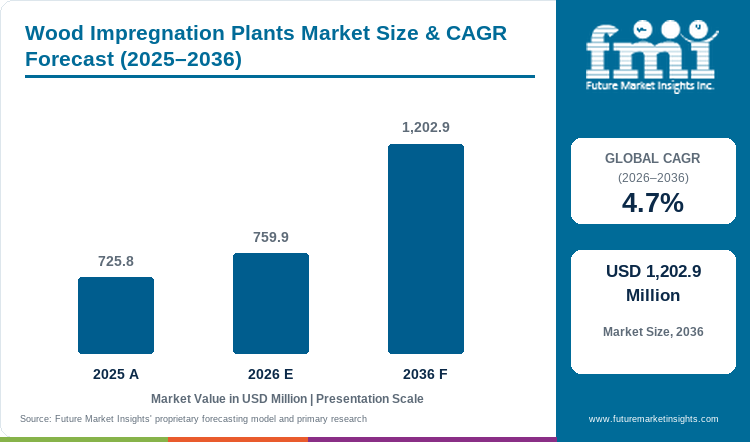
- Market Size (2026)
- USD 759.9 Mn
- Forecast (2036)
- USD 1202.9 Mn
- CAGR (2026 to 2036)
- 4.7%
How big is Wood Impregnation Plants Market in 2026?
The wood impregnation plants market is projected to expand at a CAGR of 4.7% through 2036, rising from USD 725.8 million in 2025 to USD 759.9 million in 2026 and reaching USD 1,202.9 million by the end of the forecast period.
Demand is supported by the need for treatment systems capable of maintaining process conditions that match the intended service class of the wood. ISO 21887 defines five use classes covering different exposure environments and provides a reference framework for preservative pre-treatment applications. The increasing use of digital plant records is also encouraging investment in automation, particularly for facilities running standardized treatment cycles where process consistency and traceability are priorities.
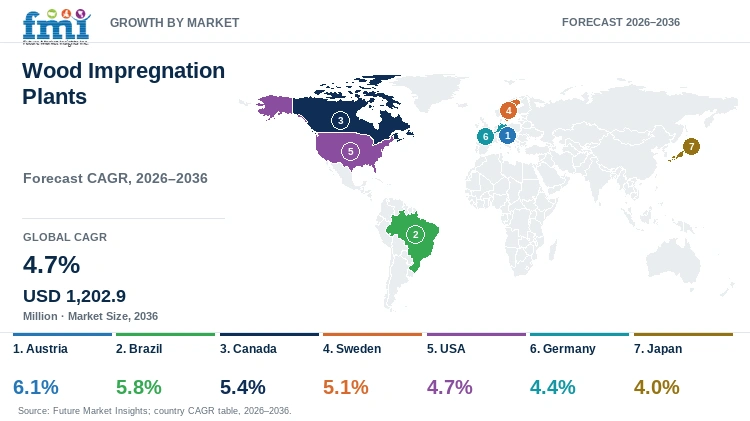
Austria is expected to record a CAGR of 6.1% through 2036, exceeding Japan’s projected 4.0% growth rate. According to Austria’s Wood Initiative, more than 130 timber buildings had received support by 2024. Continued investment in timber construction is expanding demand for structural wood processing, creating opportunities for sawmills to upgrade treatment capacity and related infrastructure. In Japan, purchasing decisions are more often influenced by space constraints, compact plant design, and the availability of local technical support. Suppliers encounter different investment requirements across the two markets, despite a shared emphasis on documented treatment performance, process reliability, and stable cycle control.
Key Takeaways
- Utilities and rail operators are specifying repeatable preservation performance that turns treated-wood output requirements into plant orders.
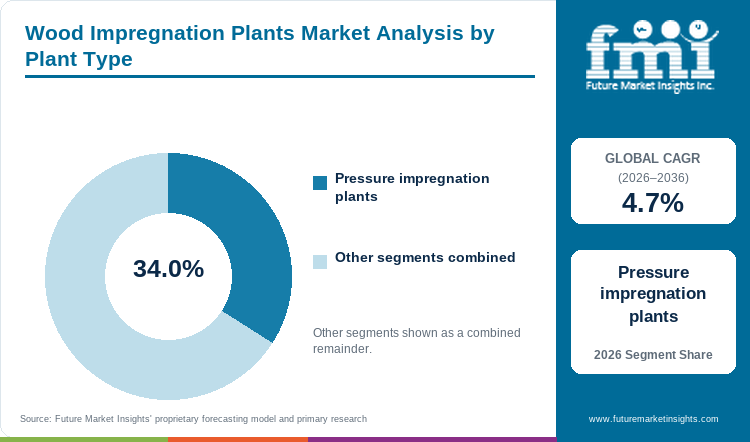
- By plant type, pressure impregnation plants are projected to account for 34.0% in 2026, supported by controlled penetration and retention requirements.
- By chemical type, water-borne preservatives are estimated to hold 38.0% in 2026, influenced by recoverable full-cell processing and broad treatment use.
- In 2026, utility poles are expected to lead end use with 31.0% share, attributable to long service-life and network reliability requirements.
- Capital approval slows when containment work and chemistry conversion extend shutdown time beyond the planned installation window.
- Some of the key players in this market include WTT / Wood Treatment Technology, IWT-Moldrup, Mühlböck, WDE Maspell, Nyle Systems, Koppers Performance Chemicals, Arxada, and Stella-Jones.
Analyst Perspective
“Plant buyers are assigning more weight to recipe control and treatment records than to vessel size alone. Suppliers that can integrate chemistry changes with commissioning support reduce the operating risk behind a retrofit decision.”
- Nikhil Kaitwade, Principal Consultant, Future Market Insights
How is the wood impregnation plants market segmented?
Wood Impregnation Plants Market is segmented by Plant Type, Chemical Type, End Use, Capacity, Sales Channel, and Region.
The wood impregnation plants market is segmented by plant type, chemical type, end use, capacity, sales channel, and region. Plant type includes pressure, vacuum-pressure, thermal, fire-retardant, and modular plants. Chemical type covers water-borne, oil-borne, fire-retardant, bio-based, and specialty formulations. End use includes utility poles, construction timber, railway sleepers, outdoor decking, and industrial wood products. Capacity ranges from small and medium batch to large industrial and continuous systems. Sales channels include plant OEMs, turnkey projects, chemical-led projects, and aftermarket service.
What makes pressure impregnation plants central to the plant type category?
Pressure plants combine vacuum and pressure stages to move preservative below the wood surface. Treaters use controls to hold retention within specified limits. Related wood preservative chemicals can change tank materials and cycle settings. Environment and Climate Change Canada links treatment settings to species and product conditions.
- Based on plant type, pressure impregnation plants are projected to account for 34.0% in 2026, driven by repeatable penetration and retention requirements.
- Registered treatment recipes require pressure accuracy and repeatable batch records before utilities or rail customers accept treated output.
Why do water-borne preservatives hold the chemical type position?
Water-borne chemistry suits full-cell plants that meter dilution and recover working solution after treatment. Process engineers can return solution to storage after the required retention is reached. Low-leaching preservatives add another route for limiting releases. The U.S. Environmental Protection Agency’s pentachlorophenol cancellation increased the need to qualify alternatives.
- By chemical type, water-borne preservatives are estimated to hold 38.0% in 2026, supported by recoverable processing and repeatable dosing.
- Plant owners still verify seal compatibility and fixation requirements before changing chemistry inside an existing pressure system.
How do utility poles shape demand within the end use category?
Utility poles require consistent internal treatment because field failure can interrupt electricity or communications service. Producers match long-load handling with treatment cycles and quality records. Protective wood coatings serve a separate surface function. Stella-Jones reported higher wood utility pole volumes during the first half of 2026.
- In 2026, utility poles are expected to lead end use with 31.0% share, attributable to service-life requirements for network assets.
- Pole treaters favor lines that combine long-load handling with batch documentation and consistent preservative recovery.
What supports medium batch demand within the capacity category?
Medium-batch plants let regional treaters change species and recipes without committing every order to a continuous line. Existing yards can keep civil work within practical limits. Adjacent woodworking machines also compete for material-flow space. Nyle introduced its L200Pro platform in April 2026 for controlled wood processing.
- By capacity, medium batch is forecast to represent 38.0% in 2026, shaped by the balance between throughput and recipe flexibility.
- The capacity choice remains sensitive to utilization because oversized equipment raises fixed cost without improving treatment quality.
Why do treatment plant OEMs lead the sales channel category?
Treatment plant OEMs coordinate vessels and tanks with pumps before commissioning the complete process. Buyers expect one engineering party to align controls with interlocks and data capture. Programmable logic controllers support timed pressure and fluid-transfer steps. Mühlböck commissioned six controlled wood-processing kilns for Woodlink in February 2026.
- Treatment plant OEMs are set to lead the sales channel category with 39.0% share in 2026, influenced by integrated commissioning responsibility.
- Turnkey contractors and chemical suppliers gain influence when civil work or preservative conversion becomes the main project trigger.
What are the drivers, restraints and opportunities in the Wood Impregnation Plants Market?
In wood impregnation plants market, infrastructure durability is sustaining treatment demand, site integration slows approval, and modular automation expands retrofit options.
- Driver: Utilities and timber processors require repeatable treatment output for wood products expected to remain in service for years.
- Restraint: Containment work and qualification downtime can delay approval after the treatment specification has already been selected.
- Opportunity: Modular controls and chemistry-conversion packages can extend useful plant life without replacing every mechanical asset.
Durable timber programs translate end-use specifications into treatment-plant demand. Germany’s Timber Construction Initiative aims to increase wood use and the timber construction rate by 2030. Sawmills serving structural projects need controlled preservation when the intended service environment requires treatment. That work also raises demand for cross-laminated timber processing support at sites handling engineered wood. Plant orders become more likely after a producer has qualified volumes beyond dependable existing capacity. OEMs that document throughput and recipe performance can connect the capital request to a defined production need.
Capital approval becomes harder when an operating site needs containment and piping changes at the same time. Environment and Climate Change Canada requires wood-preservation facilities to account for releases to air and water plus soil. Engineers must therefore align tanks and drainage with the permitted process before commissioning. Existing industrial pumps may also need new seals or materials after a preservative change. Shutdown planning adds another constraint because production stops during tie-ins and validation. Suppliers reduce that friction by defining the retrofit boundary before civil work starts.
Installed pressure vessels can support new treatment recipes when the surrounding process remains serviceable. The U.S. Environmental Protection Agency gave facilities a five-year path to move away from pentachlorophenol after its 2022 cancellation decision. Conversions can require dosing changes and different solution handling. New condition monitoring systems can also protect rotating equipment during an upgrade without replacing the full line. The commercial opening centers on verified compatibility and a short commissioning window. Chemical specialists and OEMs can capture the work by testing the converted process together.
Which country CAGRs are profiled in the Wood Impregnation Plants Market?
| Country | CAGR |
|---|---|
| Austria | 6.1% |
| Brazil | 5.8% |
| Canada | 5.4% |
| Sweden | 5.1% |
| USA | 4.7% |
| Germany | 4.4% |
| Japan | 4.0% |
How do country-level CAGRs compare in the Wood Impregnation Plants Market?
Austria and Brazil form the upper group for forecast growth. Canada and Sweden follow, while the USA and Germany track nearer the global rate. Japan expands more slowly. The 2.1-point range measures forecast speed, not current revenue size. Retrofit intensity and greenfield demand differ by country.
- Austria combines timber-processing investment with engineering demand for efficient drying and integrated treatment systems at mill sites.
- Brazil values service access because forestry sites often operate far from specialist maintenance and replacement parts.
- Canada places greater weight on automated records and containment during pressure-treatment chemistry changes at existing facilities.
- Sweden links treatment choices with biocide controls and operating efficiency at existing timber-processing sites.
- USA demand draws on utility-pole and railway-sleeper throughput plus chemistry-transition work at existing treatment plants.
- Germany favors documented retrofit performance that integrates with mature sawmill operations and existing timber-processing equipment.
- Japan rewards compact equipment and local technical support for plants operating with limited industrial site space.
Comparable CAGRs can produce different order patterns because installed equipment and qualification routes vary by country. The full report covers country CAGR analysis in North America, Latin America, Western Europe, Eastern Europe, East Asia, South Asia and Pacific. It also covers the Middle East and Africa.
Country-wise Analysis
- USA treatment plants serve utility-pole and railway-sleeper programs that require repeatable preservative retention. USA is projected to grow at 4.7% CAGR through 2036, shaped by chemistry-conversion work at existing treatment sites. The U.S. Environmental Protection Agency began a five-year pentachlorophenol cancellation path in February 2022. Treaters moving to alternatives may need different storage materials and cycle validation. Existing cylinders can remain useful if pumps and seals suit the replacement chemistry. Retrofit suppliers gain orders when they protect scheduled production during qualification and peak production periods. Utilities also expect treatment records that can support acceptance of long-life poles and railway products.
- German sawmills evaluate treatment equipment beside existing drying and material-handling systems. Germany is forecast to grow at 4.4% CAGR through 2036. Policy supporting greater wood use in construction reinforces the outlook. In June 2025, the German Government described its Timber Construction Initiative and its 2030 target. Mature sites still face permitting and integration limits during retrofit work. Engineers must fit recovery equipment into existing production layouts. Vendors with documented commissioning plans can reduce the operating risk behind upgrades. Local engineering support matters when new controls connect with older handling and utility systems during live plant work.
- Japanese timber processors place value on compact equipment and stable recipes for domestic wood species. Japan is estimated to post 4.0% CAGR through 2036, influenced by continued promotion of domestic wood use. Japan’s Forestry Agency has encouraged longer-term use of wood in buildings. Industrial space limits the size of some new lines and favors modular layouts. Local service also matters during recipe validation and controls integration. Suppliers that combine compact engineering with domestic technical support can shorten plant acceptance. Stable moisture handling remains important because local species can require different cycle settings before treatment performance is approved during commissioning.
- Austrian timber specialists link treatment capacity with drying and value-added processing inside mill sites. Austria is forecast to rise at 6.1% CAGR through 2036. National support for wood construction reinforces the outlook. Austria's Wood Initiative reported that more than 130 timber buildings had received support through 2024. Energy use remains a project constraint because drying and treatment draw on the same site utilities. Heat recovery and flexible batch design affect equipment selection. Integrators that manage both interfaces can reduce retrofit disruption. Sawmills also favor equipment that can change recipes without long stops between treated-wood orders.
- Brazilian wood processors need durable equipment plus service coverage that can reach dispersed forestry operations. Brazil is projected to expand at 5.8% CAGR through 2036. A large national silviculture base supports the outlook. In September 2025, IBGE reported that silviculture represented 84.1% of forestry production value in 2024. Travel distance can extend response time after a controls or pump failure. Modular capacity additions can reduce the risk of one large greenfield commitment. Local spares and field service carry weight during supplier selection. Treatment systems also need components suited to hot and humid conditions at remote sites during seasonal peaks.
- Canadian pressure treaters work within detailed process and release-reporting requirements. Canada is forecast to rise at 5.4% CAGR through 2036. Chemistry conversion and automated treatment records shape the outlook. In February 2026, Environment and Climate Change Canada stated that pentachlorophenol had been prohibited since October 2023. Its guidance describes extensive automation in water-borne facilities. Cold-weather fixation and containment can complicate an equipment upgrade. Suppliers with closed-loop recovery and reporting-ready controls can reduce rework during commissioning. Operators also need service plans that protect production schedules during winter maintenance and preservative changeovers. Cold-weather service access influences shutdown timing and spare-parts coverage.
- Swedish treaters balance treatment quality with energy use and chemical handling rules at mature sites. Sweden is expected to expand at 5.1% CAGR through 2036. Replacement and compliance work shape the outlook. The Swedish Chemicals Agency restricts creosote use to industrial or professional settings under biocide rules. Those controls narrow the acceptable chemistry and documentation route for some products. Plant owners compare fire-retardant coatings if building codes require a different protection route. Equipment vendors gain an advantage if closed systems accommodate approved alternatives without a full line replacement. Local technical support can shorten validation after a chemistry or controls change.
Who are the notable companies in the Wood Impregnation Plants Market?
WTT / Wood Treatment Technology, IWT-Moldrup, Mühlböck, WDE Maspell, Nyle Systems, Koppers Performance Chemicals, Arxada, Stella-Jones are active within the defined wood impregnation plants market boundary.
Competition divides between plant engineering and thermal processing plus treatment chemistry and operating networks. WTT / Wood Treatment Technology and IWT-Moldrup supply automated pressure-treatment systems. Mühlböck and WDE Maspell cover thermal equipment alongside Nyle Systems. Koppers Performance Chemicals and Arxada supply wood-preservation chemistry. Stella-Jones provides an operator reference for treated infrastructure products.
- Integrated plant engineering: WTT / Wood Treatment Technology and IWT-Moldrup compete on pressure systems and controls with material handling and commissioning.
- Thermal processing equipment: Mühlböck and WDE Maspell focus on controlled heating and wood-processing systems alongside Nyle Systems.
- Treatment chemistry and operating references: Koppers Performance Chemicals and Arxada supply preservatives while Stella-Jones operates pressure-treatment assets.
Competitive Benchmarking: Wood Impregnation Plants Market
| Company | Pressure Treatment Capability | Preservative Integration | Thermal / Automation Capability | Geographic Reach |
|---|---|---|---|---|
| WTT / Wood Treatment Technology | High | Medium | High | Europe, North America and international projects |
| IWT-Moldrup | High | Medium | High | 50+ markets worldwide |
| Mühlböck | Low | Low | High | Europe, Asia and partner coverage in about 30 countries |
| WDE Maspell | Low | Low | High | Europe with international project coverage |
| Nyle Systems | Low | Low | High | North America with international sales |
| Koppers Performance Chemicals | High | High | Medium | North America, South America, Australasia and Europe |
| Arxada | Low | High | Medium | Global wood-protection operations |
| Stella-Jones | High | Medium | Medium | Canada and USA |
Scoring basis: High requires direct commercial-scale evidence. Medium denotes a narrower documented role and Low denotes limited capability. Geographic reach is descriptive and is not scored.
Key Developments in the Wood Impregnation Plants Market
- In May 2026, Stella-Jones reported targeted initiatives to optimize its railway-tie production network and improve operating efficiency.
- In April 2026, Nyle Systems introduced its HT-Series high-temperature dehumidification systems for controlled lumber drying.
- In January 2026, Mühlböck commissioned custom roundwood drying plants for Scanpole in Norway and Finland for utility-pole production.
Key Players in the Wood Impregnation Plants Market
Pressure and Vacuum Plant Engineering
- WTT / Wood Treatment Technology
- IWT-Moldrup
Thermal and Drying Systems
- Mühlböck
- WDE Maspell
- Nyle Systems
Preservative and Treatment Integration
- Koppers Performance Chemicals
- Arxada
Industrial Treatment Operations
- Stella-Jones
Wood Impregnation Plants Market - Report Scope
| Coverage field | Report scope |
|---|---|
| Market breakdown | By plant type, chemical type, end use, capacity, sales channel and region. |
| Quantitative Units | USD million. |
| Market Definition | Commercial wood impregnation and treatment plants include pressure and vacuum systems plus thermal or fire-retardant modules, tanks, pumps, dosing, recovery, controls, integration, upgrades and related service. Preservative-only sales and downstream treated-wood revenue are excluded. |
| Regions Covered | North America, Latin America, Western Europe, Eastern Europe, East Asia, South Asia and Pacific, and Middle East and Africa. |
| Countries Covered | Austria, Brazil, Canada, Sweden, USA, Germany, Japan, and 20+ countries included in the full report. |
| Key Companies Profiled | WTT / Wood Treatment Technology, IWT-Moldrup, Mühlböck, WDE Maspell, Nyle Systems, Koppers Performance Chemicals, Arxada, Stella-Jones. |
| Forecast Period | 2026 to 2036. |
| Approach | Primary and secondary research with market triangulation. |
Wood Impregnation Plants Market - Research Methodology
| Method | Approach |
|---|---|
| Primary Research | FMI analysts gathered input from manufacturers, service providers, technology developers, distributors, end users, procurement teams, and subject-matter experts. Interviews examined purchasing decisions, product or service evaluation, adoption barriers, approval requirements, pricing considerations, and expectations for technical or commercial support. Respondents were also asked what evidence is required before a trial, pilot, or initial order develops into regular purchasing. |
| Desk Research | Desk research covered government statistics, regulatory publications, trade data, industry associations, technical literature, standards, company filings, product information, and official corporate announcements. Sources were reviewed for relevance, publication date, geographic coverage, and consistency with the defined market scope. Claims relating to performance, applications, approvals, capacity, investment, and commercial activity were retained only when supported by credible public evidence. |
| Market Sizing and Forecasting | The market model combined the baseline value with historical performance, segment structure, pricing and volume indicators, adoption levels, company participation, and country-level demand conditions. Forecast assumptions considered economic activity, investment trends, regulatory developments, technology adoption, purchasing cycles, supply availability, and barriers to wider market use. Segment and regional estimates were reconciled before the final market total was calculated. |
| Data Validation | Estimates were checked against multiple independent indicators, including public data, company activity, trade patterns, industry developments, and findings from primary interviews. Validation also tested whether products, services, applications, and company revenues fell within the defined market boundaries. Adjacent categories, unsupported claims, overlapping revenues, and activities without direct market relevance were excluded to reduce double counting and maintain consistency across segments and countries. |
Wood Impregnation Plants Market by Segments
Wood Impregnation Plants Market segmented by Plant Type:
- Pressure impregnation plants
- Vacuum-pressure plants
- Thermal treatment plants
- Fire-retardant impregnation plants
- Modular treatment plants
Wood Impregnation Plants Market segmented by Chemical Type:
- Water-borne preservatives
- Oil-borne preservatives
- Fire retardants
- Bio-based treatments
- Specialty formulations
Wood Impregnation Plants Market segmented by End Use:
- Utility poles
- Construction timber
- Railway sleepers
- Outdoor decking
- Industrial wood products
Wood Impregnation Plants Market segmented by Capacity:
- Medium batch
- Small batch
- Large industrial
- Continuous - automated
Wood Impregnation Plants Market segmented by Sales Channel:
- Treatment plant OEMs
- Turnkey projects
- Chemical supplier projects
- Aftermarket - service
Wood Impregnation Plants Market by Region:
- North America
- United States
- Canada
- Latin America
- Brazil
- Mexico
- Chile
- Rest of Latin America
- Western Europe
- Germany
- United Kingdom
- Italy
- Spain
- France
- Nordics
- Benelux
- Rest of Western Europe
- Eastern Europe
- Russia
- Poland
- Hungary
- Balkan and Baltic States
- Rest of Eastern Europe
- East Asia
- China
- Japan
- South Korea
- South Asia and Pacific
- India
- ASEAN
- Australia and New Zealand
- Rest of South Asia and Pacific
- Middle East and Africa
- Kingdom of Saudi Arabia
- Other GCC Countries
- Türkiye
- South Africa
- Other African Union Countries
- Rest of Middle East and Africa
Research Sources and Bibliography
- International Organization for Standardization. (2007). ISO 21887:2007 Durability of wood and wood-based products - Use classes (confirmed 2023).
- Environment and Climate Change Canada. (2026, February 27). Guidance for wood preservation facilities reporting to the National Pollutant Release Inventory.
- Austrian Federal Ministry of Agriculture, Forestry, Regions and Water Management. (2024). Austrian Wood Initiative: Projects and measures implementation 2021-2024.
- U.S. Environmental Protection Agency. (2022, February 4). EPA requires cancellation of pentachlorophenol to protect human health.
- Stella-Jones Inc. (2026, August 6). Stella-Jones 2026-Q2 results.
- Federal Government of Germany. (2025, June 17). The bioeconomy: The German Government’s Timber Construction Initiative as an example.
- Forestry Agency, Japan. (2024, August 19). Sustainable wood use.
- Brazilian Institute of Geography and Statistics. (2025, September 25). Value of production of silviculture and wild-crop harvesting grows 16.7%.
- Swedish Chemicals Agency. (2024, October 18). Rules for common types of biocidal products.
- Wood Protection Association. (2026, February). Wood protection engineering.
- IWT-Moldrup. (n.d.). Vacuum pressure impregnation plants. Retrieved September 22, 2026.
- Mühlböck. (2026, August 27). Japanese timber processor relies on Mühlböck technology.
- Koppers Holdings Inc. (2026, August 6). Koppers reports second quarter 2026 results.
- Arxada. (2026). Arxada company presentation 2026.
- Nyle Systems. (2026, April 8). Meet the Nyle L200Pro: When your lumber drying operation is ready to level up.
- Nyle Systems. (2026, April 23). High-temp dehumidification done right: Introducing the Nyle HT-Series.
- Mühlböck. (2026, June 26). First contract in California.
- WTT / Wood Treatment Technology. (n.d.). Wood Treatment Technology. Retrieved September 22, 2026.
- Stella-Jones Inc. (2026, May 6). Stella-Jones announces first quarter results.
- Mühlböck. (2026, September 17). Speziallösung für Scanpole: Mühlböck trocknet Rundholz für Holzmasten.
- Mühlböck. (2026, September 11). Major project in Slovenia: Mühlböck supplies 15 drying and steaming kilns.
- Nyle Systems. (2026, April 9). Meet the Nyle L200Pro container package.
- Koppers Holdings Inc. (2026, February 26). Koppers reports fourth quarter and full-year 2025 results; provides 2026 outlook.
- Mühlböck. (2026, May 12). Two new Mühlböck 1306 PRO drying chambers for Despond (Switzerland).
This bibliography is provided for reader reference and is not exhaustive. The full report contains the complete reference list and detailed citations.
This Report Answers
- How large is the wood impregnation plants market in 2026 and 2036?
- Which operating requirements turn treated-wood output into plant investment?
- Why do pressure impregnation plants hold 34.0% of plant type revenue in 2026?
- Why do water-borne preservatives account for 38.0% of chemical type demand?
- How does utility-pole treatment shape equipment specifications and service requirements?
- Which retrofit constraints delay capital approval at existing treatment sites?
- How do country growth conditions differ between Austria, Brazil, Canada, Sweden, USA, Germany and Japan?
- Which companies supply plant engineering, thermal systems, treatment chemistry or operating references?
Frequently Asked Questions
How big is the wood impregnation plants market in 2026?
The wood impregnation plants market is valued at USD 759.9 million in 2026. It is projected to reach USD 1,202.9 million by 2036 as infrastructure treatment needs sustain plant investment.
What is the CAGR of the wood impregnation plants market from 2026 to 2036?
The wood impregnation plants market is projected to grow at 4.7% CAGR between 2026 and 2036. Replacement cycles and chemistry-conversion work support the forecast beside new timber-processing capacity.
Which plant type leads the wood impregnation plants market in 2026?
The pressure impregnation plants segment is expected to hold 34.0% of plant type revenue in 2026. Operators use pressure systems when industrial service conditions require repeatable penetration and retention.
Which chemical type leads the wood impregnation plants market in 2026?
The water-borne preservatives segment is estimated to hold 38.0% of chemical type demand in 2026. Recoverable full-cell processing supports measured dosing and reuse of working solution.
Which companies are active in the wood impregnation plants market?
Key companies include WTT / Wood Treatment Technology, IWT-Moldrup, Mühlböck, WDE Maspell, Nyle Systems, Koppers Performance Chemicals, Arxada, and Stella-Jones. Their roles cover plant engineering and thermal processing plus preservative integration and treatment operations.
Preview the report firsthand - request a free sample
Get SampleGet the brochure for pricing and purchase details.
Get PDFTable of Content
- Key Takeaways
- Market Size and CAGR
- Top Growth Driver
- Fastest Growing Segment
- Leading Region
- Key Companies
- Emerging Opportunities
- Executive Summary
- Global Market Outlook
- Demand-side Trends
- Supply-side Trends
- Technology Roadmap Analysis
- Analysis and Recommendations
- Analyst Perspective (What is happening? Why now? What should investors know?)
- Key Questions Answered
- How large is the market?
- What is the CAGR?
- What are key trends?
- Which region dominates?
- Who are the leaders?
- Market Overview
- Market Coverage / Taxonomy
- Market Definition / Scope / Limitations
- Research Methodology
- Chapter Orientation
- Analytical Lens and Working Hypotheses
- Market Structure, Signals, and Trend Drivers
- Benchmarking and Cross-market Comparability
- Market Sizing, Forecasting, and Opportunity Mapping
- Research Design and Evidence Framework
- Desk Research Programme (Secondary Evidence)
- Expert Input and Fieldwork (Primary Evidence)
- Tooling, Models, and Reference Databases
- Data Engineering and Model Build
- Quality Assurance and Audit Trail
- Market Background
- Market Dynamics (Drivers, Restraints, Opportunity, Trends)
- Scenario Forecast (Optimistic, Likely, Conservative)
- Impact Analysis
- AI Impact
- Sustainability Impact
- Regulatory Impact
- Technology Impact
- Consumer / Buyer Analysis
- Purchase Drivers
- Adoption Barriers
- Buyer Journey
- Opportunity Map Analysis
- Product Life Cycle Analysis
- Supply Chain Analysis
- Investment Feasibility Matrix
- Value Chain Analysis
- PESTLE and Porter's Analysis
- Regulatory Landscape
- Regional Parent Market Outlook
- Production and Consumption Statistics
- Import and Export Statistics
- Global Market Analysis and Forecast, 2021 to 2036
- Historical Market Size Value (USD Million) Analysis, 2021 to 2025
- Current and Future Market Size Value (USD Million) Projections, 2026 to 2036
- Y-o-Y Growth Trend Analysis
- Absolute $ Opportunity Analysis
- Global Market Pricing Analysis, 2021 to 2036
- Global Market Analysis and Forecast, By Plant Type, 2021 to 2036
- Introduction / Key Findings
- Historical Market Size Value (USD Million) Analysis By Plant Type, 2021 to 2025
- Current and Future Market Size Value (USD Million) Analysis and Forecast By Plant Type, 2026 to 2036
- Pressure impregnation plants
- Vacuum-pressure plants
- Thermal treatment plants
- Fire-retardant impregnation plants
- Modular treatment plants
- Y-o-Y Growth Trend Analysis By Plant Type, 2021 to 2025
- Absolute $ Opportunity Analysis By Plant Type, 2026 to 2036
- Global Market Analysis and Forecast, By Chemical Type, 2021 to 2036
- Introduction / Key Findings
- Historical Market Size Value (USD Million) Analysis By Chemical Type, 2021 to 2025
- Current and Future Market Size Value (USD Million) Analysis and Forecast By Chemical Type, 2026 to 2036
- Water-borne preservatives
- Oil-borne preservatives
- Fire retardants
- Bio-based treatments
- Specialty formulations
- Y-o-Y Growth Trend Analysis By Chemical Type, 2021 to 2025
- Absolute $ Opportunity Analysis By Chemical Type, 2026 to 2036
- Global Market Analysis and Forecast, By End Use, 2021 to 2036
- Introduction / Key Findings
- Historical Market Size Value (USD Million) Analysis By End Use, 2021 to 2025
- Current and Future Market Size Value (USD Million) Analysis and Forecast By End Use, 2026 to 2036
- Utility poles
- Construction timber
- Railway sleepers
- Outdoor decking
- Industrial wood products
- Y-o-Y Growth Trend Analysis By End Use, 2021 to 2025
- Absolute $ Opportunity Analysis By End Use, 2026 to 2036
- Global Market Analysis and Forecast, By Capacity, 2021 to 2036
- Introduction / Key Findings
- Historical Market Size Value (USD Million) Analysis By Capacity, 2021 to 2025
- Current and Future Market Size Value (USD Million) Analysis and Forecast By Capacity, 2026 to 2036
- Medium batch
- Small batch
- Large industrial
- Continuous - automated
- Y-o-Y Growth Trend Analysis By Capacity, 2021 to 2025
- Absolute $ Opportunity Analysis By Capacity, 2026 to 2036
- Global Market Analysis and Forecast, By Sales Channel, 2021 to 2036
- Introduction / Key Findings
- Historical Market Size Value (USD Million) Analysis By Sales Channel, 2021 to 2025
- Current and Future Market Size Value (USD Million) Analysis and Forecast By Sales Channel, 2026 to 2036
- Treatment plant OEMs
- Turnkey projects
- Chemical supplier projects
- Aftermarket - service
- Y-o-Y Growth Trend Analysis By Sales Channel, 2021 to 2025
- Absolute $ Opportunity Analysis By Sales Channel, 2026 to 2036
- Global Market Analysis and Forecast, By Region, 2021 to 2036
- Introduction
- Historical Market Size Value (USD Million) Analysis By Region, 2021 to 2025
- Current Market Size Value (USD Million) Analysis and Forecast By Region, 2026 to 2036
- North America
- Latin America
- Western Europe
- Eastern Europe
- East Asia
- South Asia and Pacific
- Middle East and Africa
- Market Attractiveness Analysis By Region
- North America Market Analysis and Forecast, By Country, 2021 to 2036
- Historical Market Size Value (USD Million) Trend Analysis By Market Taxonomy, 2021 to 2025
- Market Size Value (USD Million) Forecast By Market Taxonomy, 2026 to 2036
- By Country
- United States
- Canada
- By Plant Type
- By Chemical Type
- By End Use
- By Capacity
- By Sales Channel
- By Country
- Market Attractiveness Analysis
- By Country
- By Plant Type
- By Chemical Type
- By End Use
- By Capacity
- By Sales Channel
- Key Takeaways
- Latin America Market Analysis and Forecast, By Country
- Historical Market Size Value (USD Million) Trend Analysis By Market Taxonomy, 2021 to 2025
- Market Size Value (USD Million) Forecast By Market Taxonomy, 2026 to 2036
- By Country
- Brazil
- Mexico
- Chile
- Rest of Latin America
- By Plant Type
- By Chemical Type
- By End Use
- By Capacity
- By Sales Channel
- By Country
- Market Attractiveness Analysis
- By Country
- By Plant Type
- By Chemical Type
- By End Use
- By Capacity
- By Sales Channel
- Key Takeaways
- Western Europe Market Analysis and Forecast, By Country
- Historical Market Size Value (USD Million) Trend Analysis By Market Taxonomy, 2021 to 2025
- Market Size Value (USD Million) Forecast By Market Taxonomy, 2026 to 2036
- By Country
- Germany
- United Kingdom
- Italy
- Spain
- France
- Nordics
- Benelux
- Rest of Western Europe
- By Plant Type
- By Chemical Type
- By End Use
- By Capacity
- By Sales Channel
- By Country
- Market Attractiveness Analysis
- By Country
- By Plant Type
- By Chemical Type
- By End Use
- By Capacity
- By Sales Channel
- Key Takeaways
- Eastern Europe Market Analysis and Forecast, By Country
- Historical Market Size Value (USD Million) Trend Analysis By Market Taxonomy, 2021 to 2025
- Market Size Value (USD Million) Forecast By Market Taxonomy, 2026 to 2036
- By Country
- Russia
- Poland
- Hungary
- Balkan and Baltic States
- Rest of Eastern Europe
- By Plant Type
- By Chemical Type
- By End Use
- By Capacity
- By Sales Channel
- By Country
- Market Attractiveness Analysis
- By Country
- By Plant Type
- By Chemical Type
- By End Use
- By Capacity
- By Sales Channel
- Key Takeaways
- East Asia Market Analysis and Forecast, By Country
- Historical Market Size Value (USD Million) Trend Analysis By Market Taxonomy, 2021 to 2025
- Market Size Value (USD Million) Forecast By Market Taxonomy, 2026 to 2036
- By Country
- China
- Japan
- South Korea
- By Plant Type
- By Chemical Type
- By End Use
- By Capacity
- By Sales Channel
- By Country
- Market Attractiveness Analysis
- By Country
- By Plant Type
- By Chemical Type
- By End Use
- By Capacity
- By Sales Channel
- Key Takeaways
- South Asia and Pacific Market Analysis and Forecast, By Country
- Historical Market Size Value (USD Million) Trend Analysis By Market Taxonomy, 2021 to 2025
- Market Size Value (USD Million) Forecast By Market Taxonomy, 2026 to 2036
- By Country
- India
- ASEAN
- Australia and New Zealand
- Rest of South Asia and Pacific
- By Plant Type
- By Chemical Type
- By End Use
- By Capacity
- By Sales Channel
- By Country
- Market Attractiveness Analysis
- By Country
- By Plant Type
- By Chemical Type
- By End Use
- By Capacity
- By Sales Channel
- Key Takeaways
- Middle East and Africa Market Analysis and Forecast, By Country
- Historical Market Size Value (USD Million) Trend Analysis By Market Taxonomy, 2021 to 2025
- Market Size Value (USD Million) Forecast By Market Taxonomy, 2026 to 2036
- By Country
- Kingdom of Saudi Arabia
- Other GCC Countries
- Türkiye
- South Africa
- Other African Union Countries
- Rest of Middle East and Africa
- By Plant Type
- By Chemical Type
- By End Use
- By Capacity
- By Sales Channel
- By Country
- Market Attractiveness Analysis
- By Country
- By Plant Type
- By Chemical Type
- By End Use
- By Capacity
- By Sales Channel
- Key Takeaways
- Key Countries Market Analysis
- United States
- Pricing Analysis
- Market Share Analysis, 2025
- By Plant Type
- By Chemical Type
- By End Use
- By Capacity
- By Sales Channel
- Canada
- Pricing Analysis
- Market Share Analysis, 2025
- By Plant Type
- By Chemical Type
- By End Use
- By Capacity
- By Sales Channel
- Mexico
- Pricing Analysis
- Market Share Analysis, 2025
- By Plant Type
- By Chemical Type
- By End Use
- By Capacity
- By Sales Channel
- Brazil
- Pricing Analysis
- Market Share Analysis, 2025
- By Plant Type
- By Chemical Type
- By End Use
- By Capacity
- By Sales Channel
- Chile
- Pricing Analysis
- Market Share Analysis, 2025
- By Plant Type
- By Chemical Type
- By End Use
- By Capacity
- By Sales Channel
- Germany
- Pricing Analysis
- Market Share Analysis, 2025
- By Plant Type
- By Chemical Type
- By End Use
- By Capacity
- By Sales Channel
- United Kingdom
- Pricing Analysis
- Market Share Analysis, 2025
- By Plant Type
- By Chemical Type
- By End Use
- By Capacity
- By Sales Channel
- Italy
- Pricing Analysis
- Market Share Analysis, 2025
- By Plant Type
- By Chemical Type
- By End Use
- By Capacity
- By Sales Channel
- Spain
- Pricing Analysis
- Market Share Analysis, 2025
- By Plant Type
- By Chemical Type
- By End Use
- By Capacity
- By Sales Channel
- France
- Pricing Analysis
- Market Share Analysis, 2025
- By Plant Type
- By Chemical Type
- By End Use
- By Capacity
- By Sales Channel
- India
- Pricing Analysis
- Market Share Analysis, 2025
- By Plant Type
- By Chemical Type
- By End Use
- By Capacity
- By Sales Channel
- ASEAN
- Pricing Analysis
- Market Share Analysis, 2025
- By Plant Type
- By Chemical Type
- By End Use
- By Capacity
- By Sales Channel
- Australia and New Zealand
- Pricing Analysis
- Market Share Analysis, 2025
- By Plant Type
- By Chemical Type
- By End Use
- By Capacity
- By Sales Channel
- China
- Pricing Analysis
- Market Share Analysis, 2025
- By Plant Type
- By Chemical Type
- By End Use
- By Capacity
- By Sales Channel
- Japan
- Pricing Analysis
- Market Share Analysis, 2025
- By Plant Type
- By Chemical Type
- By End Use
- By Capacity
- By Sales Channel
- South Korea
- Pricing Analysis
- Market Share Analysis, 2025
- By Plant Type
- By Chemical Type
- By End Use
- By Capacity
- By Sales Channel
- Russia
- Pricing Analysis
- Market Share Analysis, 2025
- By Plant Type
- By Chemical Type
- By End Use
- By Capacity
- By Sales Channel
- Poland
- Pricing Analysis
- Market Share Analysis, 2025
- By Plant Type
- By Chemical Type
- By End Use
- By Capacity
- By Sales Channel
- Hungary
- Pricing Analysis
- Market Share Analysis, 2025
- By Plant Type
- By Chemical Type
- By End Use
- By Capacity
- By Sales Channel
- Kingdom of Saudi Arabia
- Pricing Analysis
- Market Share Analysis, 2025
- By Plant Type
- By Chemical Type
- By End Use
- By Capacity
- By Sales Channel
- Türkiye
- Pricing Analysis
- Market Share Analysis, 2025
- By Plant Type
- By Chemical Type
- By End Use
- By Capacity
- By Sales Channel
- South Africa
- Pricing Analysis
- Market Share Analysis, 2025
- By Plant Type
- By Chemical Type
- By End Use
- By Capacity
- By Sales Channel
- Austria
- Pricing Analysis
- Market Share Analysis, 2025
- By Plant Type
- By Chemical Type
- By End Use
- By Capacity
- By Sales Channel
- Sweden
- Pricing Analysis
- Market Share Analysis, 2025
- By Plant Type
- By Chemical Type
- By End Use
- By Capacity
- By Sales Channel
- United States
- Market Structure Analysis
- Competition Dashboard
- Competition Benchmarking
- Market Share Analysis of Top Players
- By Regional
- By Plant Type
- By Chemical Type
- By End Use
- By Capacity
- By Sales Channel
- Emerging Startups
- Innovation Benchmarking
- Competition Analysis
- Competition Deep Dive
- WTT / Wood Treatment Technology
- Overview
- Product Portfolio
- Profitability by Market Segments
- Sales Footprint
- Strategy Overview
- Marketing Strategy
- Product Strategy
- Channel Strategy
- IWT-Moldrup
- Mühlböck
- WDE Maspell
- Nyle Systems
- Koppers Performance Chemicals
- Arxada
- Stella-Jones
- WTT / Wood Treatment Technology
- Case Studies
- Success Stories
- Recent Developments
- Competition Deep Dive
- Assumptions & Acronyms Used


