

- Market Size (2026)
- USD 191.0 Mn
- Forecast (2036)
- USD 408.6 Mn
- CAGR (2026 to 2036)
- 7.9%
How big is Yeast Foods & Nutrients Market in 2026?
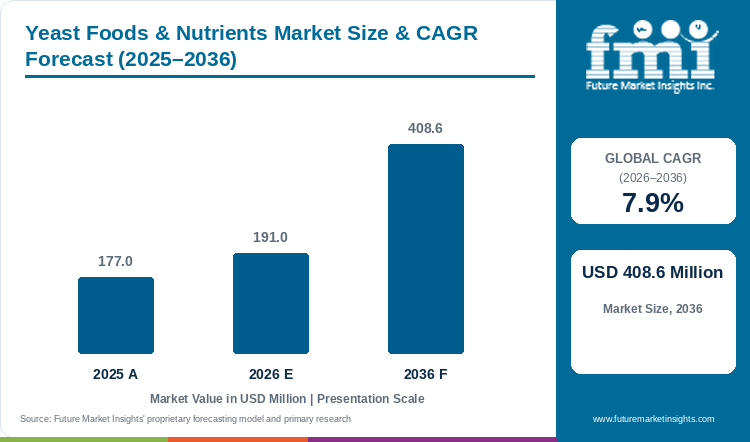
Revenue from yeast foods and nutrients reached USD 177.0 million in 2025 and is estimated at USD 191.0 million in 2026, heading for USD 408.6 million by 2036. The market is set to post a 7.9% CAGR between 2026 and 2036, adding USD 217.6 million in value, according to FMI.
Bread salt cuts and automated dosing at large plants are the main forces behind demand for yeast foods and nutrients. Cream / liquid yeast holds the leading 36% type share in 2026, as bread plants dose liquid yeast automatically from chilled tanks into each mixer. Lesaffre noted in March 2026 that industrial bakers favor liquid yeast for this automated dosing [1]. In August 2024, the US FDA released draft sodium reduction goals for 163 food categories, sending bread plants back into recipe trials [2]. German large delivery bakeries also committed to an average of 1.1 g of salt per 100 g across packaged ranges by the end of 2025 [3]. Owing to these salt programs, sales of yeast and dough nutrients matched to each plant's storage set-up are expected to grow steadily through 2036.
Key Market Trends & Insights
- By type, cream / liquid yeast leads with 36% of 2026 sales, as large bread plants pump yeast cream from chilled tanks straight into the mixer.
- By form, powder / dry formats account for 44% of sales in 2026. Lesaffre gives vacuum-packed instant dry yeast a life of two years at room temperature [1].
- By application, bread & rolls rank first at 44% in 2026, as salt cuts reach bread lines before cakes or biscuits.
- By claim, conventional products keep 61% of 2026 sales, and clean label lines are expected to narrow the gap slowly from a smaller base.
- By sales channel, direct to industrial bakeries accounts for 56% of 2026 sales, as large plants want supplier test bakers on site before any yeast change. Lesaffre ran 51 Baking Centers worldwide in April 2024 [4].
Regional Highlights
- Fastest-growing profiled country: UAE, at a 9.2% CAGR for yeast foods and nutrients during 2026 to 2036.
- By country: the USA at 8.6% and France at 7.6% come next through 2036, and Japan posts the lowest profiled rate at a 7% CAGR during the forecast period.
- Under limits set in October 2026, UAE bread plants have to cut leavened bread to 444 mg of sodium per 100 g in the first phase. The cap falls to 370 mg by 31 December 2030, raising orders for yeast that keeps proof time steady at lower salt [5].
Market Size & Forecast
Table 1: Market Size and Forecast for the Yeast Foods & Nutrients Market (USD million and percentage), 2025 to 2036
| Metric | Value |
|---|---|
| 2025 Market Size | USD 177.0 million |
| Estimated Market Size in 2026 | USD 191.0 million |
| Projected Market Size by 2036 | USD 408.6 million |
| CAGR, 2026 to 2036 | 7.9% |
| Added Revenue, 2026 to 2036 | USD 217.6 million |
| Market Expansion Multiple | 2.1x |
Sales of yeast foods and nutrients now come mostly from large bread plants buying direct from a few fermentation groups. Fewer, bigger bakeries buy more yeast per site and expect technical service with each delivery. Germany had 8,912 craft bakery businesses in 2024, 3.6% fewer than a year earlier, though turnover rose 2% to EUR 17.92 billion [6]. Lesaffre supplies such accounts from 80 production sites in 55 countries [7]. However, Associated British Foods reported in April 2026 that Ingredients revenue slipped to GBP 1,004 million from GBP 1,031 million on weaker US bakery buying [8]. Recipe trials linked to salt rules are expected to restore order growth for baker's yeast and dough nutrients over the forecast period.
Yeast Format Shelf Life and Bread Salt Rules
Bakers choose a yeast format by storage and dosing set-up more than by price per kilo. Lesaffre gives yeast cream 3 to 5 weeks at +4°C and compressed yeast 2 to 10 weeks at 4°C. Vacuum-packed instant dry yeast keeps for two years at room temperature [1]. Large plants with chilled tanks keep buying liquid yeast. Depots, distributors and smaller bakeries with no cold room buy dry yeast and powdered yeast food. Pakmaya sells a frozen fresh yeast with a one-year life at -18°C next to a gold instant dry yeast for doughs with more than 10% sugar [9]. Local test baking also shapes supplier choice for large accounts. Lesaffre described the business in August 2025 as a EUR 3 billion group [7], and the company ran 51 Baking Centers worldwide in April 2024 [4]. Lallemand added the enzymes and micro-ingredients of Singapore-based CerealTech in 2024 [10] and took over French baking ingredient maker AIT on 26 June 2025 [11]. FMI notes that dry formats will keep the larger form share through 2036. Suppliers pairing yeast with improvers and trial support are likely to gain most new contracts.
Bread salt rules across markets now cluster at similar levels, and each cut changes proof time, the time dough needs to rise. The UAE caps leavened bread at 444 mg of sodium per 100 g in the first phase and 370 mg by 31 December 2030 [5]. German large bakeries committed to an average of 1.1 g of salt per 100 g across packaged ranges [3]. The FDA's Phase II goal is about 20% below the intake seen before the Phase I targets [2]. Plants ask yeast suppliers to help with each lower-salt trial, and bread & rolls take most of this work at 44% of application sales in 2026. France and Germany grow at 7.6% and 7.3% through 2036, as both countries started bread salt programs earlier. Salt in French common breads is down 25% since 2015 [12], and the German large-bakery commitment ran to the end of 2025 [3]. Associated British Foods reported lower yeast and bakery ingredient sales for the 24 weeks to 28 February 2026, mainly on weaker US buying, yet expects growth outside the US [8]. The UAE leads at a 9.2% CAGR through 2036, as the population rose 5.7% to 11.3 million in 2024 [13]. A May 2024 health ministry campaign also pushed UAE shoppers toward low-salt products [14]. Japan grows slowest at a 7% CAGR to 2036, with millers paying 12% more for imported wheat, at JPY 70,020 per tonne, from October 2026 [15]. FMI projects US orders to recover as FDA sodium goals send bakers back to recipe trials, supporting an 8.6% CAGR for the USA through 2036 [2].
Table 2: Bread Reformulation and Yeast Format Readiness Indicators for the Yeast Foods & Nutrients Market (sodium and salt levels, food categories, storage life, test-bakery count, population and revenue), mixed reporting years from 2024 to 2026
| Indicator | Data Point | Market Relevance | Source |
|---|---|---|---|
| UAE leavened bread sodium cap | 444 mg per 100 g in the first phase; 370 mg by 31 December 2030 | UAE bread plants need to reformulate and buy yeast that rises steadily at lower salt. | [5] |
| US sodium reduction goals | Draft goals for 163 food categories; about 2,750 mg a day average intake; 15 August 2024 | US bread plants are rerunning recipe trials that need fermentation support. | [2] |
| Germany large-bakery salt target | Average 1.1 g salt per 100 g across packaged ranges by end of 2025 | German delivery bakeries buy yeast that holds proof time at lower salt. | [3] |
| France common bread salt | 25% lower since 2015; 98% of sandwich loaves within thresholds | French bakers need finer fermentation control for any further salt cut. | [12] |
| Yeast cream shelf life | 3 to 5 weeks at +4°C | Liquid yeast stays with plants that hold chilled tanks and get frequent deliveries. | [1] |
| Instant dry yeast shelf life | Two years at room temperature when vacuum-packed | Dry yeast sells on long, warm supply routes into the Gulf and Asia. | [1] |
| Lesaffre test-bakery network | 51 Baking Centers worldwide; April 2024 | Nearby test bakeries help suppliers secure direct contracts with industrial bakeries. | [4] |
| UAE population | 11.3 million in 2024, up 5.7% | More residents add bread sales in the fastest-growing profiled country. | [13] |
| ABF Ingredients segment | GBP 1,004 million revenue in 24 weeks to February 2026; margin 11.2% | US bakery ingredient orders are soft in the near term. | [8] |
Table 3: Yeast Format Shelf Life and Bread Recipe Rule Benchmarks for the Yeast Foods & Nutrients Market (weeks, sodium and salt levels, percentage and USD million), mixed years from 2015 to 2036
| Benchmark | Reported value | Comparison | Source |
|---|---|---|---|
| Yeast cream shelf life | 3 to 5 weeks at +4°C | Shortest life of the three yeast formats | [1] |
| Compressed yeast shelf life | 2 to 10 weeks at 4°C | Longer chilled life than yeast cream | [1] |
| Instant dry yeast shelf life | Two years at room temperature | Longest life, with no cold chain needed | [1] |
| UAE leavened bread sodium cap, first phase | 444 mg sodium per 100 g | First phase, within nine months of the rule taking effect | [5] |
| Germany large-bakery salt target | 1.1 g salt per 100 g average by end of 2025 | Commitment by large delivery bakeries | [3] |
| UAE leavened bread sodium cap, final phase | 370 mg sodium per 100 g by 31 Dec 2030 | Final phase of the UAE limits | [5] |
| France common bread salt | 25% lower since 2015 | Reduction already achieved | [12] |
| Yeast foods and nutrients market | USD 191.0 million (2026); USD 408.6 million (2036) | USD 217.6 million added from 2026 to 2036 | Table 1 |
Analyst Perspective
“Bread plants cutting salt will reward yeast suppliers that keep rise time steady on each plant's own flour and line speed. Through 2036, the larger contracts are likely to go to producers pairing each yeast format with test-bakery support and full recipe records.”
- Nandini Roy Choudhury, Principal Consultant, Future Market Insights.
How is the yeast foods and nutrients market segmented?
Coverage of the yeast foods and nutrients market spans five commercial axes, namely type, form, application, claim and sales channel, plus region. Projected 2026 leaders are cream / liquid yeast at 36%, powder / dry at 44%, bread & rolls at 44%, conventional at 61% and direct supply at 56%.
By type: cream / liquid yeast, compressed, active dry, and specialty strains.
By form: powder / dry, liquid, paste / semi-solid, and granules / pieces.
By application: bread & rolls, cakes & muffins, biscuits & cookies, viennoiserie & pastry, and other bakery & snacks.
By claim: conventional, clean label, organic, and non-GMO / identity preserved.
By sales channel: direct to industrial bakeries, ingredient distributors, foodservice & artisan supply, and online B2B.
By region: North America, Latin America, Western Europe, Eastern Europe, East Asia, South Asia and Pacific, and Middle East and Africa.
Why is cream / liquid yeast the first choice by type?
Metered dosing at large bread plants gives cream / liquid yeast 36% of type sales in 2026.
Table 4: Type Share for the Yeast Foods & Nutrients Market (percentage share), 2026
| Type | Share (2026) |
|---|---|
| Cream / liquid yeast | 36% |
| Other Segments Combined | 64% |
| Total | 100% |
Table 5: Type Leadership and Market Growth for the Yeast Foods & Nutrients Market (segment and CAGR percentage), 2026 to 2036
| Metric | Value |
|---|---|
| Global CAGR (2026 to 2036) | 7.9% |
| Leading Segment | Cream / liquid yeast |
Cream / liquid yeast leads the type split with 36% of 2026 sales, as large lines want the same dose in every batch without manual handling. Sales of cream / liquid yeast follow bread plants running tank storage and metered dosing at each mixer. In March 2026, Lesaffre noted that stabilized yeast cream needs no remixing before use and keeps for 3 to 5 weeks at +4°C [1]. Compressed yeast stays the usual choice for mid-sized bakeries, and active dry and specialty strains serve export routes and high-sugar or frozen doughs, keeping these shares smaller. More bread plants adding metered dosing are expected to keep liquid yeast for bread in first place through 2036.
- Cream / liquid yeast holds a 36% share in 2026, as industrial bakers prefer automated dosing from chilled tanks.
- Plants switching to liquid yeast need chilled tank capacity and deliveries every few weeks to keep yeast cream fresh.
Which storage needs put powder / dry formats first by form?
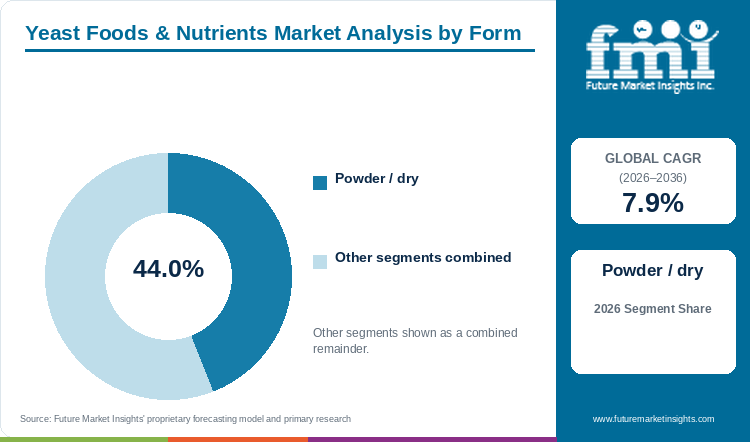
Powder / dry formats take 44% of form sales in 2026, as dry yeast and powdered nutrients need no cold chain.
Powder / dry formats hold 44% of form sales in 2026, owing to depots, distributors and smaller bakeries with no cold room. The share covers instant dry yeast, powdered yeast foods and dough conditioners, all kept on a dry shelf. In March 2026, Lesaffre stated that vacuum-packed instant dry yeast keeps for two years at room temperature [1]. Producers are also widening dry ranges for specific doughs, and Pakmaya offers a gold instant dry yeast for doughs with more than 10% sugar [9]. As per FMI, long, warm supply routes into the Gulf and Asia will keep dry formats ahead of liquid, paste and granule forms through 2036.
- Ambient storage on long supply routes keeps powder / dry formats at a 44% share in 2026.
- Distributors without cold rooms can stock instant dry yeast and powdered nutrients for many months, cutting losses from expired stock.
What makes bread & rolls central to application demand?
Bread & rolls generate 44% of application sales in 2026, the largest single bakery use.
Bread & rolls lead application with 44% of 2026 sales, as salt cuts and flour changes reach bread lines before cakes or biscuits. Each bread line runs a high number of batches every day, due to which recipe changes land there first. In December 2024, the French government reported that salt in common breads had fallen 25% since 2015 [12]. Lower salt speeds up fermentation, so bread plants buy yeast nutrients for fermentation control along with the yeast. FMI finds that viennoiserie & pastry and frozen dough lines will add sales of freeze-tolerant strains, and bread & rolls will keep the largest share through 2036.
- Bread & rolls represent a 44% share in 2026, as bread lines run many batches every day and meet each recipe change first.
- Bakers trialling lower-salt bread should check proof time and loaf volume on the plant's own flour before a full switch.
Why do conventional products still supply most claim sales?
Conventional products are estimated at 61% of claim sales in 2026, as these lines are the simplest to qualify.
FMI places conventional products at 61% of claim sales in 2026, as these lines cost less to qualify than clean label or organic ranges. Industrial bakers using conventional recipes can draw on the full list of approved enzymes, processing aids and bread improvers when a recipe changes. In August 2024, the US FDA released draft sodium reduction goals for 163 food categories [2]. Bakers meeting these goals tend to start with conventional recipes, owing to the wider choice of approved processing aids. Clean label lines are expected to grow from a smaller base, with Lallemand Baking Solutions presenting the business as a leading global supplier of clean-label baking solutions [11].
- Conventional products keep a 61% share in 2026, and clean label lines are expected to gain only gradually.
- Suppliers moving bakers to clean label need ingredient records and line trials ready before the first order.
What supports direct supply as the main sales channel?
Direct to industrial bakeries accounts for 56% of sales channel revenue in 2026, owing to on-site technical service.
Direct to industrial bakeries accounts for 56% of 2026 sales channel revenue, as large plants test every change of yeast or nutrient on the line. In April 2024, Lesaffre reported a network of 51 Baking Centers worldwide [4]. Ingredient distributors reach bakeries in smaller towns, and craft bakers buy through foodservice & artisan supply or online B2B stores. Oriental Yeast opened the Food for all B2B site in August 2024 with 136 products, from yeast to bread improvers [16]. FMI expects direct accounts to stay the main route through 2036, as fresh yeast suppliers with nearby test bakeries keep large contracts.
- On-site trials before any yeast change keep direct to industrial bakeries at a 56% share in 2026.
- Test-bake reports on the buyer's own flour and line speed are a sensible condition before signing a supply contract.
What are the drivers, restraints, and opportunities in the yeast foods and nutrients market?
Salt and sodium limits on bread are raising orders for yeast foods and nutrients. Short chilled shelf life and long line trials slow supplier changes, and combined yeast and improver packages offer the main new revenue.
- Driver: Adoption of yeast foods and nutrients is rising as bread plants cut salt and need steady proof times on every line.
- Restraint: Fresh yeast lasts only weeks under chilling, and long line trials before a supplier change are key challenges faced by yeast foods and nutrients market players.
- Opportunity: Ready-to-dose liquid yeast and combined yeast and improver packages offer the main growth potential in the yeast foods and nutrients market. Orders for these packages are expected to rise with each new salt target through 2036.
Bread Sodium Limits Lift Yeast Orders
Bakeries in several countries are cutting salt in bread, and each recipe change needs new fermentation trials. In October 2026, the UAE set a sodium limit of 444 mg per 100 g for leavened bread, with fines of up to AED 500,000 for breaches [5]. Lower salt makes dough rise faster, so plants order yeast and dough nutrients that keep proof time steady. The FDA's draft goals for 163 food categories add similar recipe work at US bread plants [2]. Key trends in the yeast foods and nutrients market point to steady orders for fermentation support over the forecast period.
Short Fresh Yeast Life Slows Switching
Fresh yeast formats need cold storage and frequent deliveries, which limits sales outside large plants. In March 2026, Lesaffre gave compressed yeast a life of 2 to 10 weeks at 4°C [1]. A bakery changing yeast format or supplier also has to run line trials and update recipe records. Weaker bakery buying can delay such trials, and Associated British Foods reported lower US sales of bakery ingredients in April 2026 [8]. Slow approvals may hold back the switch to new yeast formats in smaller bakeries.
Combined Yeast and Improver Packages Widen Sales
Bakers prefer one partner able to supply yeast, enzymes and improvers for a full recipe. In June 2025, Lallemand completed the purchase of French baking ingredient maker AIT, after adding Singapore-based CerealTech in 2024 [11] [10]. The two deals let Lallemand sell complete bakery ingredients systems to industrial plants. Suppliers with fermentation and formulation teams under one roof can charge more for test-bakery support. Combined packages are expected to open new revenue for yeast producers in the coming decade.
Which country CAGRs are profiled in the yeast foods and nutrients market?
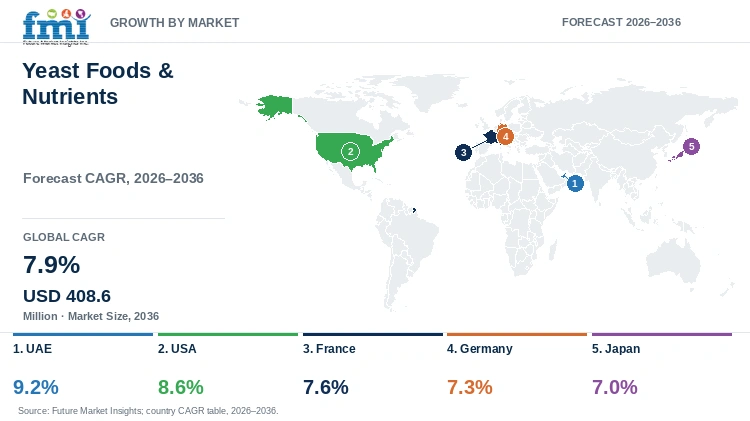
Bakery buyers in the UAE will raise orders of yeast foods and nutrients at a 9.2% CAGR between 2026 and 2036, the quickest of the five markets profiled. Japan is the slowest at a 7% CAGR over the same period. Growth in all five countries turns on bread salt rules, flour prices and the shift of baking from small shops to larger plants.
Table 6: Country CAGRs and Primary Growth Levers for the Yeast Foods & Nutrients Market (CAGR percentage), 2026 to 2036
| Country | CAGR (2026-2036) | Primary Growth Lever |
|---|---|---|
| UAE | 9.2% | New bread sodium limits and a fast-growing population |
| USA | 8.6% | Sodium recipe trials at bread plants |
| France | 7.6% | Yeast and sourdough for additive-free tradition bread |
| Germany | 7.3% | Bread output moving to fewer, larger bakeries |
| Japan | 7% | Online ordering for smaller bakeries as wheat costs rise |
Source: Future Market Insights
UAE Yeast Foods & Nutrients Market Outlook (2026-2036)
Bread makers in the UAE face new sodium limits under a Ministry of Health and Prevention resolution reported on 6 October 2026. Leavened bread has to fall to 444 mg of sodium per 100 g within nine months of the rule taking effect and to 370 mg by 31 December 2030. Breaches of the new caps carry fines of up to AED 500,000 [5]. Lower salt speeds fermentation, so bakeries will buy yeast and dough nutrients that keep proof time steady. Demand for bread is also rising with a population that grew 5.7% to about 11.3 million in 2024 [13]. The UAE leads the five countries at a 9.2% CAGR through 2036, and Lesaffre's Baking Center in Dubai Silicon Oasis lets local bakers trial new recipes close to home [17].
Key takeaway: Reformulating bread for the MoHAP sodium caps is the largest source of new yeast business in the UAE.
USA Yeast Foods & Nutrients Market Outlook (2026-2036)
FMI forecasts an 8.6% CAGR for the USA through 2036, the second-fastest rate in this group, with large bread plants as the main yeast buyers. Associated British Foods reported in April 2026 that weaker US buying of bakery ingredients pulled down yeast and bakery ingredient sales [8]. Bread plants will return to recipe work as the FDA pursues draft sodium goals for 163 food categories, issued on 15 August 2024 [2]. The FDA's updated healthy claim, finalized on 19 December 2024, allows grain products no more than 230 mg of sodium per standard serving [18]. Due to this, bakers with lower-salt loaves that still rise well stand to gain shelf appeal.
Key takeaway: US yeast orders will pick up once bread plants restart sodium trials for the FDA goals and the healthy label.
France Yeast Foods & Nutrients Market Outlook (2026-2036)
Under the 1993 bread decree, pain de tradition française can contain no additives. The dough is limited to bread wheat flour, water, salt and baker's yeast or sourdough, plus small set amounts of faba bean, soy and wheat malt flour [19]. Additive-based dough improvers therefore stay out of tradition loaves sold in French bakeries. Salt in common breads has fallen 25% since 2015, and 98% of sandwich loaves met agreed limits, the government reported in December 2024 [12]. France is set for a 7.6% CAGR through 2036, with sales led by fresh yeast and sourdough cultures for artisan bakers and by improvers for industrial sandwich loaves.
Key takeaway: French bakers will keep buying the fresh yeast and sourdough cultures allowed under the tradition-loaf decree.
Germany Yeast Foods & Nutrients Market Outlook (2026-2036)
Germany had 8,912 craft bakery businesses in 2024, 3.6% fewer than a year earlier, and turnover still rose 2% to EUR 17.92 billion [6]. Fewer bakeries with higher sales each buy more yeast per site and expect more technical service. Sales in Germany are projected to grow at a 7.3% CAGR through 2036, the second-slowest of the five. Large delivery bakeries agreed to an average of 1.1 g of salt per 100 g across packaged ranges by the end of 2025 [3]. The next round of recipe checks will need yeast that keeps rise time stable at lower salt.
Key takeaway: Germany rewards suppliers that deliver yeast in bulk and send technicians to a shrinking number of bigger bakeries.
Japan Yeast Foods & Nutrients Market Outlook (2026-2036)
Japanese millers pay more for imported wheat from October 2026, after the farm ministry raised the resale price 12% to JPY 70,020 per tonne [15]. Higher flour costs squeeze bakery margins, and Japan grows slowest of the five at a 7% CAGR through 2036. Oriental Yeast is targeting smaller accounts through the Food for all online store, which listed 136 products from yeast to bread improvers at launch in August 2024 [16].
Key takeaway: Japanese yeast sellers gain more from serving small bakeries online than from chasing extra bread volume.
Who are the notable companies in the yeast foods and nutrients market?
Lesaffre, AB Mauri, Lallemand, Oriental Yeast, Pakmaya, DSM-Firmenich, ICL Food Specialties, Budenheim, Jungbunzlauer, and Kudos Blends are the key suppliers covered in this study.
The yeast foods and nutrients market is concentrated among a few yeast producers, and dough nutrient and reformulation inputs come from a wider group of ingredient firms. Lesaffre, AB Mauri and Lallemand run global plant and test-bakery networks, and Oriental Yeast and Pakmaya are stronger in home regions with export supply. DSM-Firmenich, ICL Food Specialties and Budenheim sell enzymes, phosphates and buffers used with yeast in bread dough. Jungbunzlauer and Kudos Blends work on minerals and sodium reduction for lower-salt recipes. Larger suppliers are buying bakery ingredient firms and adding plants to sell full recipe systems to industrial bakers.
- Yeast and fermentation producers: Lesaffre, AB Mauri, Lallemand, Oriental Yeast, and Pakmaya each run dedicated yeast plants for bakery customers.
- Bakery functional ingredient suppliers: DSM-Firmenich, ICL Food Specialties, and Budenheim supply enzymes, phosphates and buffers for yeast-leavened dough.
- Mineral and sodium-reduction specialists: Jungbunzlauer and Kudos Blends supply inputs for lower-salt bakery recipes at industrial plants.
Competitive Benchmarking: Yeast Foods & Nutrients Market
Table 7: Competitive Benchmarking for the Yeast Foods & Nutrients Market (qualitative capability ratings), 2026
| Company | Yeast Range | Bakery Support | Reformulation | Reach |
|---|---|---|---|---|
| Lesaffre | High | High | Medium | High |
| AB Mauri | High | High | High | High |
| Lallemand | High | High | High | High |
| Oriental Yeast | Medium | High | Medium | Medium |
| Pakmaya | High | Medium | Medium | Medium |
| DSM-Firmenich | Low | High | High | High |
| ICL Food Specialties | Low | Medium | High | High |
| Budenheim | Low | Medium | High | Medium |
| Jungbunzlauer | Low | Medium | High | High |
| Kudos Blends | Low | Medium | High | Medium |
High means broad documented capability, Medium a narrower or regional offer, and Low limited public documentation, across yeast formats, bakery technical service, reformulation inputs and geographic presence.
Key Developments in the Yeast Foods & Nutrients Market
- In April 2026, Associated British Foods, owner of AB Mauri, reported lower yeast and bakery ingredient sales, mainly on weaker US buying [8].
- In September 2025, Jungbunzlauer agreed to buy a multipurpose site in Thomson, Illinois, from International Flavors & Fragrances [20]. The deal gives the Swiss ingredient maker a first US manufacturing footprint.
- In June 2025, Lallemand completed the acquisition of French baking ingredient maker AIT Ingredients, widening the improver range for industrial bakers [11].
- In January 2025, AB Mauri reported a 9% cut in carbon intensity at the Casteggio yeast plant in Italy since 2018 [21].
Key Players in the Yeast Foods & Nutrients Market
Yeast and Fermentation Platform Suppliers
- Lesaffre et Compagnie
- AB Mauri (Associated British Foods plc)
- Lallemand Inc.
- Oriental Yeast Co., Ltd.
- Pakmaya
Bakery Functional Ingredient Systems
- DSM-Firmenich AG
- ICL Food Specialties (ICL Group Ltd.)
- Chemische Fabrik Budenheim KG
Mineral and Reformulation Specialists
- Jungbunzlauer Suisse AG
- Kudos Blends
Yeast Foods & Nutrients Market - Report Scope
Table 8: Report Scope for the Yeast Foods & Nutrients Market (coverage fields and definitions), 2026 to 2036
| Coverage field | Report scope |
|---|---|
| Market breakdown | Type; form; application; claim; sales channel; region |
| Quantitative units | USD million |
| Market definition | Revenue from commercial baker's yeast and formulated yeast foods, nutrients, buffering, fermentation-support and dough-conditioning systems sold for yeast-leavened bakery production. Finished bakery revenue and stand-alone substitute leavening systems not sold as yeast or fermentation-supporting inputs are excluded. |
| Regions covered | North America; Latin America; Western Europe; Eastern Europe; East Asia; South Asia and Pacific; Middle East and Africa |
| Countries covered | UAE; USA; France; Germany; Japan |
| Key companies profiled | Lesaffre, AB Mauri, Lallemand, Oriental Yeast, Pakmaya, DSM-Firmenich, ICL Food Specialties, Budenheim, Jungbunzlauer, Kudos Blends |
| Forecast period | 2026 to 2036 |
| Approach | Combined bottom-up and top-down model built from yeast producer revenue, bakery ingredient use by application, channel activity and country bread production. |
Yeast Foods & Nutrients Market - Research Methodology
Table 9: Research Methodology for the Yeast Foods & Nutrients Market (research methods and approach), 2026 edition
| Method | Approach |
|---|---|
| Primary Research | Primary research includes discussions with yeast producers, bakery ingredient suppliers, distributors, industrial bakers and procurement teams. Discussions cover yeast format choice, dough nutrient use, price levels and supplier approval steps. |
| Desk Research | Desk research covers bread salt and sodium rules, company results and press releases, technical yeast documentation and bakery trade statistics. |
| Market Sizing and Forecasting | Values are built from yeast and nutrient volumes by format, average selling prices, bakery output by application and country growth conditions, starting from the 2025 base. |
| Data Validation | Each estimate is tested against company results, official bakery statistics and interview findings. Finished bakery revenue and leavening products not sold as yeast or fermentation inputs are excluded. |
Yeast Foods & Nutrients Market by Segments
Yeast Foods & Nutrients Market segmented by Type:
- Cream / liquid yeast
- Compressed
- Active dry
- Specialty strains
Yeast Foods & Nutrients Market segmented by Form:
- Powder / dry
- Liquid
- Paste / semi-solid
- Granules / pieces
Yeast Foods & Nutrients Market segmented by Application:
- Bread & rolls
- Cakes & muffins
- Biscuits & cookies
- Viennoiserie & pastry
- Other bakery & snacks
Yeast Foods & Nutrients Market segmented by Claim:
- Conventional
- Clean label
- Organic
- Non-GMO / identity preserved
Yeast Foods & Nutrients Market segmented by Sales Channel:
- Direct to industrial bakeries
- Ingredient distributors
- Foodservice & artisan supply
- Online B2B
Yeast Foods & Nutrients Market by Region
- North America
- United States
- Canada
- Latin America
- Brazil
- Mexico
- Argentina
- Chile
- Western Europe
- Germany
- France
- United Kingdom
- Italy
- Spain
- Benelux
- Nordics
- Eastern Europe
- Poland
- Czech Republic
- Romania
- Hungary
- East Asia
- Japan
- South Korea
- South Asia and Pacific
- ASEAN
- Australia and New Zealand
- Middle East and Africa
- GCC Countries
- South Africa
- Türkiye
- Israel
Research Sources and Bibliography
- [1] Lesaffre. (2026, March 11). What are the different forms of yeast?.https://www.lesaffre.com/trends-mag/what-are-the-different-forms-of-yeast/
- [2] U.S. Food and Drug Administration. (2024, August 15). FDA Starts Next Phase of Sodium Reduction Efforts.https://www.fda.gov/food/hfp-constituent-updates/fda-starts-next-phase-sodium-reduction-efforts
- [3] Bundesministerium für Landwirtschaft, Ernährung und Heimat (BMLEH). (2026, July 13 (page date)). Nationale Reduktions- und Innovationsstrategie für Zucker, Fette und Salz in Fertigprodukten.https://www.bmleh.de/DE/themen/ernaehrung/gesunde-ernaehrung/reduktionsstrategie/reduktionsstrategie-zucker-salz-fette.html
- [4] Lesaffre. (2024, April 2). Lesaffre welcomes its clients and partners to its new yeast plant in Indonesia, strengthening its presence in Asia Pacific.https://www.lesaffre.com/press-room/lesaffre-inaugurates-a-yeast-plant-in-indonesia/
- [5] Khaleej Times (reporting a Ministry of Health and Prevention resolution). (2026, October 6). UAE sets new sodium, sugar and fat limits; violators face fines up to Dh500,000.https://www.khaleejtimes.com/uae/uae-begins-phased-limits-on-sodium-sugar-fat-in-select-food-products
- [6] Lebensmittel Praxis (citing the Zentralverband des Deutschen Bäckerhandwerks). (2025, April 14). Handwerk unter Druck: Bäckereien steigern Umsatz trotz sinkender Betriebszahlen.https://lebensmittelpraxis.de/handel-aktuell/43997-handwerk-unter-druck-baeckereien-steigern-umsatz-trotz-sinkender-betriebszahlen.html
- [7] Lesaffre. (2025, August 26). Lesaffre invests in a new state-of-the-art yeast production and packaging facility at its Ghent plant (press release).https://www.lesaffre.com/wp-content/uploads/2025/07/PR_ImprovedYeast_EN-vf.pdf
- [8] Associated British Foods plc. (2026, April 21). Interim results for the 24 weeks ended 28 February 2026.https://www.investegate.co.uk/announcement/rns/associated-british-foods--abf/interim-results-announcements/9529235
- [9] Pakmaya. (2026 (accessed October)). Bakery yeast products.https://www.pakmaya.com/en/products/bakery/yeast-products
- [10] Lallemand Baking Solutions. (2024, October 1). Lallemand acquires CerealTech.https://www.lallemandbaking.com/en/united-states/resources/news-blog/lallemand-acquires-cerealtech/
- [11] Lallemand Inc. (2025, July 4). Lallemand acquires AIT Ingredients.https://www.lallemand.com/en/news/lallemand-acquires-ait-ingredients/
- [12] Service d'information du Gouvernement, France. (2024, December 18). L'info.gouv du 18 décembre : moins de sel dans le pain, piles bouton, budget 2025.https://www.info.gouv.fr/index.php/actualite/linfo-gouv-du-18-decembre-moins-de-sel-dans-le-pain-piles-bouton-budget-2025
- [13] Gulf News (citing the Federal Competitiveness and Statistics Centre). (2025, September 8 (updated)). UAE population hits 11.3 million in 2024.https://gulfnews.com/uae/government/uae-population-hits-113-million-in-2024-1.500261527
- [14] Ministry of Health and Prevention, UAE. (2024, May 28). MoHAP launches awareness campaign on dangers of excessive salt consumption.https://mohap.gov.ae/en/w/mohap-launches-awareness-campaign-on-dangers-of-excessive-salt-consumption
- [15] Ministry of Agriculture, Forestry and Fisheries, Japan. (2026, September 9). [Revision of the government resale price of imported wheat].https://www.maff.go.jp/j/press/nousan/boeki/260909.html
- [16] Oriental Yeast Co., Ltd. (2024, August 2). [Launch of the Food for all B2B food service site].https://www.oyc.co.jp/news/240802.html
- [17] Lesaffre. (2021, November 9). Lesaffre inaugurates its brand-new Baking Center in Dubai.https://www.lesaffre.com/press-room/lesaffre-inaugurates-its-brand-new-baking-center-in-dubai
- [18] U.S. Food and Drug Administration. (2024, December 19). Use of the “Healthy” Claim on Food Labeling.https://www.fda.gov/food/nutrition-food-labeling-and-critical-foods/use-healthy-claim-food-labeling
- [19] Government of France (FAOLEX copy, consolidated version of 7 September 2020). (1993, September 13). Décret n°93-1074 du 13 septembre 1993 pris pour l'application de la loi du 1er août 1905 en ce qui concerne certaines catégories de pains.https://faolex.fao.org/docs/pdf/fra198412.pdf
- [20] Jungbunzlauer. (2025, September 2). Jungbunzlauer to acquire multipurpose site in Thomson, Illinois, establishing U.S. manufacturing footprint.https://www.jungbunzlauer.com/news/jungbunzlauer-to-acquire-from-international-flavors-fragrances-inc-multipurpose-site-in-thomson-il-establishing-u-s-manufacturing-footprint/
- [21] AB Mauri. (2025, January 15). Casteggio Emissions reduction.https://www.abmauri.com/media/case-studies/2025-01-15-casteggio-emissions-reduction
- [22] Kudos Blends. (2025, April 30). Kudos Blends Marks 25 Years of Groundbreaking Innovation in Global Baking Science.https://kudosblends.com/kudos-blends-marks-25-years-of-groundbreaking-innovation-in-global-baking-science/
This bibliography is provided for reader reference. The full report contains the complete reference list and detailed citations.
This Report Answers
- What value does the yeast foods and nutrients market hold in 2026?
- What revenue will yeast foods and nutrients sales reach by 2036?
- Which yeast type leads sales in 2026, and why do large bread plants prefer this format?
- Among forms and applications, which segments hold the largest shares in 2026?
- Which profiled countries record the fastest growth in yeast sales through 2036?
- Which yeast and bakery ingredient suppliers are profiled in this report?
Frequently Asked Questions
How large is the yeast foods and nutrients market expected in 2026?
Yeast foods and nutrients revenue is estimated at USD 191.0 million in 2026, against USD 177.0 million in 2025. Sales are forecast to reach USD 408.6 million by 2036, as bread plants buy more fermentation support for lower-salt recipes.
What CAGR is projected for the yeast foods and nutrients market through 2036?
FMI forecasts a 7.9% CAGR for the yeast foods and nutrients market from 2026 to 2036. Salt targets for bread and the shift to larger bakery plants will support this pace.
Which type holds a notable market share in 2026?
Cream / liquid yeast is projected to hold 36% of type sales in 2026. Large bread plants prefer liquid yeast, as metered pumps dose the yeast automatically from chilled tanks.
Which form holds a notable share in 2026?
Powder / dry formats are estimated at 44% of form sales in 2026, according to FMI. Instant dry yeast and powdered nutrients store at room temperature, suiting long supply routes.
Which country has a notable expansion outlook through 2036?
The UAE is the fastest of the five profiled countries, with yeast foods and nutrients sales growing at a 9.2% CAGR between 2026 and 2036. New sodium limits for leavened bread and a growing population are raising bakery orders.
Who are the key companies in the yeast foods and nutrients market?
Lesaffre, AB Mauri, Lallemand, Oriental Yeast and Pakmaya lead yeast supply in this market. DSM-Firmenich, ICL Food Specialties, Budenheim, Jungbunzlauer and Kudos Blends add enzymes, phosphates, minerals and sodium-reduction inputs.
Preview the report firsthand - request a free sample
Get SampleGet the brochure for pricing and purchase details.
Get PDFTable of Content
- Key Takeaways
- Market Size and CAGR
- Top Growth Driver
- Fastest Growing Segment
- Leading Region
- Key Companies
- Emerging Opportunities
- Executive Summary
- Global Market Outlook
- Demand-side Trends
- Supply-side Trends
- Technology Roadmap Analysis
- Analysis and Recommendations
- Analyst Perspective (What is happening? Why now? What should investors know?)
- Key Questions Answered
- How large is the market?
- What is the CAGR?
- What are key trends?
- Which region dominates?
- Who are the leaders?
- Market Overview
- Market Coverage / Taxonomy
- Market Definition / Scope / Limitations
- Research Methodology
- Chapter Orientation
- Analytical Lens and Working Hypotheses
- Market Structure, Signals, and Trend Drivers
- Benchmarking and Cross-market Comparability
- Market Sizing, Forecasting, and Opportunity Mapping
- Research Design and Evidence Framework
- Desk Research Programme (Secondary Evidence)
- Expert Input and Fieldwork (Primary Evidence)
- Tooling, Models, and Reference Databases
- Data Engineering and Model Build
- Quality Assurance and Audit Trail
- Market Background
- Market Dynamics (Drivers, Restraints, Opportunity, Trends)
- Scenario Forecast (Optimistic, Likely, Conservative)
- Impact Analysis
- AI Impact
- Sustainability Impact
- Regulatory Impact
- Technology Impact
- Consumer / Buyer Analysis
- Purchase Drivers
- Adoption Barriers
- Buyer Journey
- Opportunity Map Analysis
- Product Life Cycle Analysis
- Supply Chain Analysis
- Investment Feasibility Matrix
- Value Chain Analysis
- PESTLE and Porter's Analysis
- Regulatory Landscape
- Regional Parent Market Outlook
- Production and Consumption Statistics
- Import and Export Statistics
- Global Market Analysis and Forecast, 2021 to 2036
- Historical Market Size Value (USD Million) Analysis, 2021 to 2025
- Current and Future Market Size Value (USD Million) Projections, 2026 to 2036
- Y-o-Y Growth Trend Analysis
- Absolute $ Opportunity Analysis
- Global Market Pricing Analysis, 2021 to 2036
- Global Market Analysis and Forecast, By Type, 2021 to 2036
- Introduction / Key Findings
- Historical Market Size Value (USD Million) Analysis By Type, 2021 to 2025
- Current and Future Market Size Value (USD Million) Analysis and Forecast By Type, 2026 to 2036
- Cream / liquid yeast
- Compressed
- Active dry
- Specialty strains
- Y-o-Y Growth Trend Analysis By Type, 2021 to 2025
- Absolute $ Opportunity Analysis By Type, 2026 to 2036
- Global Market Analysis and Forecast, By Form, 2021 to 2036
- Introduction / Key Findings
- Historical Market Size Value (USD Million) Analysis By Form, 2021 to 2025
- Current and Future Market Size Value (USD Million) Analysis and Forecast By Form, 2026 to 2036
- Powder / dry
- Liquid
- Paste / semi-solid
- Granules / pieces
- Y-o-Y Growth Trend Analysis By Form, 2021 to 2025
- Absolute $ Opportunity Analysis By Form, 2026 to 2036
- Global Market Analysis and Forecast, By Application, 2021 to 2036
- Introduction / Key Findings
- Historical Market Size Value (USD Million) Analysis By Application, 2021 to 2025
- Current and Future Market Size Value (USD Million) Analysis and Forecast By Application, 2026 to 2036
- Bread & rolls
- Cakes & muffins
- Biscuits & cookies
- Viennoiserie & pastry
- Other bakery & snacks
- Y-o-Y Growth Trend Analysis By Application, 2021 to 2025
- Absolute $ Opportunity Analysis By Application, 2026 to 2036
- Global Market Analysis and Forecast, By Claim, 2021 to 2036
- Introduction / Key Findings
- Historical Market Size Value (USD Million) Analysis By Claim, 2021 to 2025
- Current and Future Market Size Value (USD Million) Analysis and Forecast By Claim, 2026 to 2036
- Conventional
- Clean label
- Organic
- Non-GMO / identity preserved
- Y-o-Y Growth Trend Analysis By Claim, 2021 to 2025
- Absolute $ Opportunity Analysis By Claim, 2026 to 2036
- Global Market Analysis and Forecast, By Sales Channel, 2021 to 2036
- Introduction / Key Findings
- Historical Market Size Value (USD Million) Analysis By Sales Channel, 2021 to 2025
- Current and Future Market Size Value (USD Million) Analysis and Forecast By Sales Channel, 2026 to 2036
- Direct to industrial bakeries
- Ingredient distributors
- Foodservice & artisan supply
- Online B2B
- Y-o-Y Growth Trend Analysis By Sales Channel, 2021 to 2025
- Absolute $ Opportunity Analysis By Sales Channel, 2026 to 2036
- Global Market Analysis and Forecast, By Region, 2021 to 2036
- Introduction
- Historical Market Size Value (USD Million) Analysis By Region, 2021 to 2025
- Current Market Size Value (USD Million) Analysis and Forecast By Region, 2026 to 2036
- North America
- Latin America
- Western Europe
- Eastern Europe
- East Asia
- South Asia and Pacific
- Middle East and Africa
- Market Attractiveness Analysis By Region
- North America Market Analysis and Forecast, By Country, 2021 to 2036
- Historical Market Size Value (USD Million) Trend Analysis By Market Taxonomy, 2021 to 2025
- Market Size Value (USD Million) Forecast By Market Taxonomy, 2026 to 2036
- By Country
- United States
- Canada
- By Type
- By Form
- By Application
- By Claim
- By Sales Channel
- By Country
- Market Attractiveness Analysis
- By Country
- By Type
- By Form
- By Application
- By Claim
- By Sales Channel
- Key Takeaways
- Latin America Market Analysis and Forecast, By Country
- Historical Market Size Value (USD Million) Trend Analysis By Market Taxonomy, 2021 to 2025
- Market Size Value (USD Million) Forecast By Market Taxonomy, 2026 to 2036
- By Country
- Brazil
- Mexico
- Argentina
- Chile
- By Type
- By Form
- By Application
- By Claim
- By Sales Channel
- By Country
- Market Attractiveness Analysis
- By Country
- By Type
- By Form
- By Application
- By Claim
- By Sales Channel
- Key Takeaways
- Western Europe Market Analysis and Forecast, By Country
- Historical Market Size Value (USD Million) Trend Analysis By Market Taxonomy, 2021 to 2025
- Market Size Value (USD Million) Forecast By Market Taxonomy, 2026 to 2036
- By Country
- Germany
- France
- United Kingdom
- Italy
- Spain
- Benelux
- Nordics
- By Type
- By Form
- By Application
- By Claim
- By Sales Channel
- By Country
- Market Attractiveness Analysis
- By Country
- By Type
- By Form
- By Application
- By Claim
- By Sales Channel
- Key Takeaways
- Eastern Europe Market Analysis and Forecast, By Country
- Historical Market Size Value (USD Million) Trend Analysis By Market Taxonomy, 2021 to 2025
- Market Size Value (USD Million) Forecast By Market Taxonomy, 2026 to 2036
- By Country
- Poland
- Czech Republic
- Romania
- Hungary
- By Type
- By Form
- By Application
- By Claim
- By Sales Channel
- By Country
- Market Attractiveness Analysis
- By Country
- By Type
- By Form
- By Application
- By Claim
- By Sales Channel
- Key Takeaways
- East Asia Market Analysis and Forecast, By Country
- Historical Market Size Value (USD Million) Trend Analysis By Market Taxonomy, 2021 to 2025
- Market Size Value (USD Million) Forecast By Market Taxonomy, 2026 to 2036
- By Country
- Japan
- South Korea
- By Type
- By Form
- By Application
- By Claim
- By Sales Channel
- By Country
- Market Attractiveness Analysis
- By Country
- By Type
- By Form
- By Application
- By Claim
- By Sales Channel
- Key Takeaways
- South Asia and Pacific Market Analysis and Forecast, By Country
- Historical Market Size Value (USD Million) Trend Analysis By Market Taxonomy, 2021 to 2025
- Market Size Value (USD Million) Forecast By Market Taxonomy, 2026 to 2036
- By Country
- ASEAN
- Australia and New Zealand
- By Type
- By Form
- By Application
- By Claim
- By Sales Channel
- By Country
- Market Attractiveness Analysis
- By Country
- By Type
- By Form
- By Application
- By Claim
- By Sales Channel
- Key Takeaways
- Middle East and Africa Market Analysis and Forecast, By Country
- Historical Market Size Value (USD Million) Trend Analysis By Market Taxonomy, 2021 to 2025
- Market Size Value (USD Million) Forecast By Market Taxonomy, 2026 to 2036
- By Country
- GCC Countries
- South Africa
- Türkiye
- Israel
- By Type
- By Form
- By Application
- By Claim
- By Sales Channel
- By Country
- Market Attractiveness Analysis
- By Country
- By Type
- By Form
- By Application
- By Claim
- By Sales Channel
- Key Takeaways
- Key Countries Market Analysis
- United States
- Pricing Analysis
- Market Share Analysis, 2025
- By Type
- By Form
- By Application
- By Claim
- By Sales Channel
- Canada
- Pricing Analysis
- Market Share Analysis, 2025
- By Type
- By Form
- By Application
- By Claim
- By Sales Channel
- Mexico
- Pricing Analysis
- Market Share Analysis, 2025
- By Type
- By Form
- By Application
- By Claim
- By Sales Channel
- Brazil
- Pricing Analysis
- Market Share Analysis, 2025
- By Type
- By Form
- By Application
- By Claim
- By Sales Channel
- Chile
- Pricing Analysis
- Market Share Analysis, 2025
- By Type
- By Form
- By Application
- By Claim
- By Sales Channel
- Germany
- Pricing Analysis
- Market Share Analysis, 2025
- By Type
- By Form
- By Application
- By Claim
- By Sales Channel
- United Kingdom
- Pricing Analysis
- Market Share Analysis, 2025
- By Type
- By Form
- By Application
- By Claim
- By Sales Channel
- Italy
- Pricing Analysis
- Market Share Analysis, 2025
- By Type
- By Form
- By Application
- By Claim
- By Sales Channel
- Spain
- Pricing Analysis
- Market Share Analysis, 2025
- By Type
- By Form
- By Application
- By Claim
- By Sales Channel
- France
- Pricing Analysis
- Market Share Analysis, 2025
- By Type
- By Form
- By Application
- By Claim
- By Sales Channel
- ASEAN
- Pricing Analysis
- Market Share Analysis, 2025
- By Type
- By Form
- By Application
- By Claim
- By Sales Channel
- Australia and New Zealand
- Pricing Analysis
- Market Share Analysis, 2025
- By Type
- By Form
- By Application
- By Claim
- By Sales Channel
- Japan
- Pricing Analysis
- Market Share Analysis, 2025
- By Type
- By Form
- By Application
- By Claim
- By Sales Channel
- South Korea
- Pricing Analysis
- Market Share Analysis, 2025
- By Type
- By Form
- By Application
- By Claim
- By Sales Channel
- Poland
- Pricing Analysis
- Market Share Analysis, 2025
- By Type
- By Form
- By Application
- By Claim
- By Sales Channel
- Hungary
- Pricing Analysis
- Market Share Analysis, 2025
- By Type
- By Form
- By Application
- By Claim
- By Sales Channel
- Türkiye
- Pricing Analysis
- Market Share Analysis, 2025
- By Type
- By Form
- By Application
- By Claim
- By Sales Channel
- South Africa
- Pricing Analysis
- Market Share Analysis, 2025
- By Type
- By Form
- By Application
- By Claim
- By Sales Channel
- UAE
- Pricing Analysis
- Market Share Analysis, 2025
- By Type
- By Form
- By Application
- By Claim
- By Sales Channel
- United States
- Market Structure Analysis
- Competition Dashboard
- Competition Benchmarking
- Market Share Analysis of Top Players
- By Regional
- By Type
- By Form
- By Application
- By Claim
- By Sales Channel
- Emerging Startups
- Innovation Benchmarking
- Competition Analysis
- Competition Deep Dive
- Lesaffre
- Overview
- Product Portfolio
- Profitability by Market Segments
- Sales Footprint
- Strategy Overview
- Marketing Strategy
- Product Strategy
- Channel Strategy
- AB Mauri
- Lallemand
- Oriental Yeast
- Pakmaya
- DSM-Firmenich
- ICL Food Specialties
- Budenheim
- Jungbunzlauer
- Kudos Blends
- Lesaffre et Compagnie
- AB Mauri (Associated British Foods plc)
- Oriental Yeast Co., Ltd.
- DSM-Firmenich AG
- ICL Food Specialties (ICL Group Ltd.)
- Chemische Fabrik Budenheim KG
- Jungbunzlauer Suisse AG
- Lesaffre
- Case Studies
- Success Stories
- Recent Developments
- Competition Deep Dive
- Assumptions & Acronyms Used


