

- Market Size (2026)
- USD 232.1 Bn
- Forecast (2036)
- USD 601.3 Bn
- CAGR (2026 to 2036)
- 10.0%
How big is Yogurt Market in 2026?
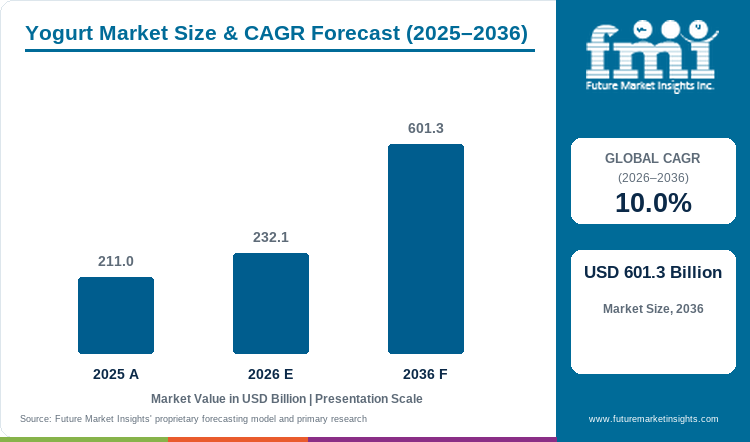
USD 232.1 Billion in 2026 and USD 601.3 Billion by 2036 at a 10.0% CAGR.
Yogurt Market is valued at USD 232.1 Billion in 2026 and is forecast to reach USD 601.3 Billion by 2036 at a 10.0% CAGR. A shopper may choose plain yogurt for an everyday meal, a protein-rich cup after exercise or a cultured drink for convenience. These occasions call for different tastes, textures and pack sizes. Danone's 2025 Oikos Fusion launch illustrates the push toward a more specific nutrition proposition. The challenge is to make that proposition clear without losing the familiar reason people buy yogurt: they enjoy eating it.
The 2025 base is estimated at USD 211.0 Billion.
Production and raw-milk supply tell different parts of the yogurt story. TURKSTAT reported 1,402,485 tonnes of yogurt production in Turkey in 2025. Nigeria's livestock ministry identified farm management; milk collection and cooling as dairy bottlenecks in April 2026. One market has a measured yogurt output base; the other still needs stronger cold-chain inputs. A yogurt supplier must solve the constraint in its own country and channel before expanding assortment.
Key Takeaways
- Demand is moving toward nutrition-dense yogurt that fits breakfast, snack and on-the-go occasions. The commercial consequence is faster product renovation around protein, probiotics and convenience.
- Flavored leads Type in 2026 because taste variety supports frequent rotation and lowers the sensory barrier to functional formulations.
- Drinking leads Form in 2026 because portable packs extend yogurt into commuting, workday and post-exercise consumption occasions.
- Hyper/Super Market leads Distribution Channel in 2026 because chilled shelf visibility supports direct comparison of flavor, nutrition claims and price.
- A flavored or high-protein launch still needs consistent milk, controlled fermentation and chilled delivery at a price that supports repeat household purchases.
- The profiled companies are Danone S.A.; Nestle S.A.; China Mengniu Dairy Company Limited; Lactalis Group; General Mills, Inc.; FrieslandCampina; Chobani, LLC; Inner Mongolia Yili Industrial Group; FAGE International S.A.; Yakult Honsha Co. Ltd.
Analyst Perspective
Protein and probiotic claims can invite trial, but a product keeps its shelf space through familiar taste, dependable cultures and refrigerated availability at a price shoppers will pay again.
- Nandini Roy Choudhury, Principal Consultant, Future Market Insights
How is the yogurt market segmented?
The market is segmented by Type, Form and Distribution Channel.
By Type, the market covers Flavored, Regular/Plain, Low Fat & Fat Free, and Fruit. By Form, it covers Drinking, Strained/Greek, Set, and Frozen. By Distribution Channel, it covers Hyper/Super Market, Retail Stores, Convenience Stores, and Online.
What makes Flavored central to the Type category?
Flavored yogurt lowers the sensory trade-off that can accompany higher protein or probiotic positioning. It also gives brands room to refresh assortments without changing the basic fermentation platform. That makes flavor a practical tool for protecting repeat purchase while introducing new nutrition claims or consumption occasions.
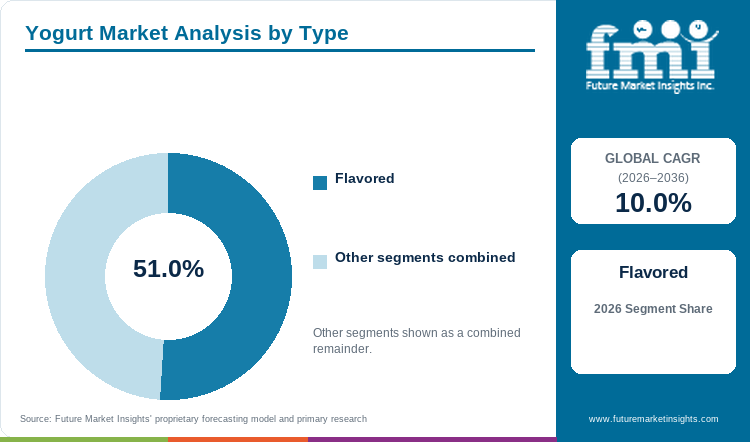
- Flavored holds a 51.0% share of Type in 2026. Brands can refresh flavor assortments without changing the fermentation base, giving shoppers a new reason to revisit the chilled set.
- Danone launched Oikos Fusion in the USA in 2025, combining a high-protein yogurt-drink format with added prebiotic fibre. It gives a familiar cultured-dairy product a more specific nutrition use. Danone said it was watching repeat purchase before deciding how quickly to expand distribution, a useful reminder that a launch is only the start of demand testing.
Why does Drinking hold the lead within Form?
Drinking yogurt removes the spoon and sit-down requirement that constrains some cup formats. Portable packs can be consumed during travel or between meals. The format also gives formulators a direct way to combine protein and probiotic positioning with a compact serving size. That broadens the number of occasions available to the category.
- Drinking yogurt holds a 45.0% share of Form in 2026. A drink removes the spoon required for a cup and allows a measured protein or probiotic serving during travel or between meals.
- In August 2025, Danone North America launched OIKOS FUSION as a 7 fl oz cultured dairy drink with 23g of complete protein and 5g of prebiotic fiber. The product shows how drinking formats can carry dense nutrition into a small refrigerated pack.
How does Hyper/Super Market retain the strongest Distribution Channel position?
Hyper/Super Market combines chilled merchandising with broad assortment and routine household shopping. That lets shoppers compare pack size and price beside taste cues or nutrition claims. The same shelf creates a high bar for suppliers because new products must justify space quickly through clear differentiation and reliable replenishment.
- Hyper/Super Market holds a 45.0% share of Distribution Channel in 2026. The chilled cabinet lets shoppers compare flavor, nutrition claims, pack size and price side by side before choosing a brand.
- In June 2025, USDA Economic Research Service published a retail packaging study showing that yogurt products compete through multiple on-pack claims. That finding underscores how claim clarity and shelf presentation shape retail comparison.
What are the drivers, restraints and opportunities in the yogurt market?
Functional nutrition and portable eating occasions support demand, while milk quality and cold-chain execution constrain scaling, and reformulation creates room for higher-protein or lower-sugar yogurt propositions.
- Driver: Protein, probiotic and other nutrition cues give consumers more reasons to use yogurt across the day.
- Restraint: Uneven dairy productivity and cooling infrastructure can raise cost or restrict consistent chilled supply.
- Opportunity: Reformulation and format innovation can widen usage occasions while meeting clearer nutrition expectations.
Yogurt makers are giving shoppers more precise reasons to choose one product over another. Danone's 2025 Oikos Fusion launch joined protein with prebiotic fibre in a drink format; its management said repeat purchase would guide wider distribution. That is the commercial test for functional yogurt. A claim may earn a first look, but texture, taste and a clear everyday occasion determine whether the product stays in the basket.
The binding restraint appears upstream and in the refrigerated route to market. Nigeria’s Federal Ministry of Livestock Development said in April 2026 that technical capacity and practical farm management were critical dairy bottlenecks. The same announcement described investments in milk collection and cooling. Yogurt processors depend on consistent raw milk and controlled fermentation before the product reaches a chiller. Weakness at any step can increase waste or narrow the serviceable retail footprint. The result is slower scaling even when consumer demand exists.
The US yogurt standard allows manufacturers room to adjust sweeteners and styles while keeping the product within a recognized category. That opens practical choices for lower-sugar and fortified recipes. Each change still has to survive a taste and texture test, and the label must describe the finished product accurately. A successful reformulation should give a shopper a reason to buy the yogurt again, not just a new claim on the cup.
Which country CAGRs are profiled in the yogurt market?
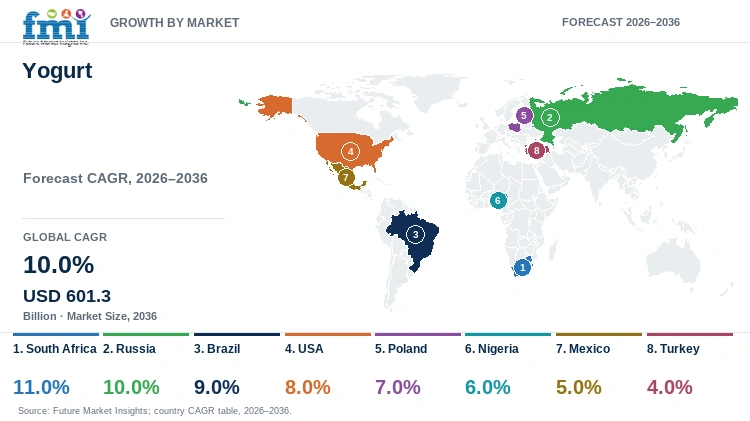
| Country | CAGR |
|---|---|
| South Africa | 11.0% |
| Russia | 10.0% |
| Brazil | 9.0% |
| USA | 8.0% |
| Poland | 7.0% |
| Nigeria | 6.0% |
| Mexico | 5.0% |
| Turkey | 4.0% |
How do country-level CAGRs compare in the yogurt market?
The profiled rates span 11.0% to 4.0%, a spread of 7.0 percentage points. South Africa and Russia sit in the highest growth band. Brazil and the USA form the next tier. Poland and Nigeria occupy the middle of the range, while Mexico and Turkey are lower-growth profiles. These are growth rates rather than measures of absolute market size.
- South Africa: regulatory attention to dairy definitions and routine yoghurt testing raises the importance of compliant formulation and labeling.
- Russia: a large domestic fermented-dairy production base favors suppliers that can compete through local processing and dependable distribution.
- Brazil: record formal-sector raw milk acquisition in 2025 strengthens the processing base available to dairy manufacturers.
- USA: retail claim density and an updated yogurt standard make product positioning and label execution central to competition.
- Poland: easing yogurt price inflation in 2026 improves the setting for value-tier and premium assortment decisions.
- Nigeria: technical farm capability and cooling infrastructure remain important conditions for expanding reliable dairy supply.
- Mexico: processor demand and exchange-rate economics can shift the balance between local milk and imported dairy ingredients.
- Turkey: high existing yogurt output points to a mature production base where mix improvement matters more than category introduction.
Dairy production, refrigerated distribution and retail conditions vary across countries.
Country-wise Analysis
- South Africa carries the fastest profiled rate at 11.0% CAGR from 2026 to 2036. The Department of Agriculture published draft dairy and imitation-dairy regulations in August 2025. Its National Analytical Services unit also lists yoghurt among dairy commodities subject to routine analytical work. Statistics South Africa reported only 0.9% annual inflation for milk and other dairy products plus eggs in May 2026, while fuel inflation was much higher. That combination makes logistics discipline and compliant labeling important commercial tests. Suppliers still need chilled availability at a price consumers can repeat.
- Russia is profiled at a 10.0% CAGR from 2026 to 2036. Rosstat reported 2.2 million tonnes of fermented milk products excluding sour cream in 2025. That official production category is broader than yogurt and should not be read as yogurt market size. It does show a substantial domestic fermentation base. Local manufacturing and route-to-market continuity therefore matter alongside brand choice. For suppliers, the main implication is that product innovation has to fit an established processing system and local distribution realities rather than rely on basic category education.
- Brazil has a 9.0% CAGR profile for 2026 to 2036. IBGE reported that inspected establishments acquired 27.51 billion liters of raw milk in 2025. This is an input measure, not a yogurt sales figure. It shows substantial formal dairy throughput from which yogurt makers can source, while leaving pricing and regional logistics as real constraints. Brands need the right formats and shelf prices to turn that raw-material base into repeat retail demand.
- The USA is profiled to grow at 8.0% CAGR from 2026 to 2036. Its commercial environment puts unusual weight on claim design and product definition. USDA Economic Research Service published a 2025 study showing how health and production-method claims compete for attention on yogurt packaging. FDA rules also require products marketed as yogurt to meet the updated standard of identity and pH requirements. This creates room for innovation but also a clear compliance threshold. Suppliers that combine credible nutrition positioning with strong refrigerated execution are better placed to turn trial into repeat purchase.
- Poland carries a 7.0% CAGR profile from 2026 to 2036. Statistics Poland reported in August 2026 that prices for yogurt and similar products were 1.0% above the prior year in July. That was much softer than the increases recorded during parts of 2025. Moderating price pressure can improve the room for assortment changes because shoppers face less category-wide inflation. Suppliers still need to defend the price gap between standard and value-added products. Growth therefore depends on clear reasons to trade up rather than on price increases alone.
- Nigeria is profiled at a 6.0% CAGR from 2026 to 2036. The Federal Ministry of Livestock Development described technical capacity and practical farm management as a critical dairy bottleneck in April 2026. The same release cited collection and cooling investments tied to local milk development. Those conditions matter directly for yogurt because fermentation quality and chilled distribution depend on consistent milk handling. Local supply development can reduce some operating friction over time. Until then, processors and retailers must plan around variability in raw milk availability and cold-chain economics.
- Mexico is profiled at 5.0% CAGR from 2026 to 2036. A USDA Foreign Agricultural Service outlook for 2025 described domestic milk supply and a possible shift toward skimmed milk powder as a processor input. A yogurt maker may gain sourcing options, but an ingredient switch can change body and flavor. Suppliers that help preserve a consistent cup at a workable cost are more useful than a cheaper input that forces another reformulation.
- Turkey
- Turkey has the lowest profiled rate at 4.0% CAGR from 2026 to 2036. TURKSTAT recorded 1,402,485 tonnes of yogurt production in 2025; covering plain; strained and flavored products. That is a large established production base. A supplier seeking growth needs a reason for consumers to choose a new format or recipe while respecting traditional taste and household price expectations.
Who are the notable companies in the yogurt market?
Danone S.A.; Nestle S.A.; China Mengniu Dairy Company Limited; Lactalis Group; General Mills, Inc.; FrieslandCampina; Chobani, LLC; Inner Mongolia Yili Industrial Group; FAGE International S.A.; Yakult Honsha Co. Ltd. are the notable companies profiled in this market.
Competition spans focused yogurt brands and diversified dairy groups. Danone S.A. and Chobani, LLC emphasize protein-rich cups and drinks alongside other yogurt formats. Lactalis Group expanded its U.S. position through the 2025 purchase of General Mills’ yogurt operations. FAGE International S.A. remains concentrated around strained yogurt. China Mengniu Dairy Company Limited and Inner Mongolia Yili Industrial Group combine yogurt with broader dairy scale in China. Nestle S.A. sells Molico yogurt in Brazil. FrieslandCampina adds dairy and protein-ingredient capabilities. Yakult Honsha Co. Ltd. has current probiotic yogurt products in Japan. General Mills, Inc. divested major yogurt operations in 2025.
- Multi-format branded yogurt operators: Danone S.A., Lactalis Group; Chobani, LLC and FAGE International S.A.
- Diversified dairy and fermented nutrition platforms: Nestle S.A., China Mengniu Dairy Company Limited, FrieslandCampina; Inner Mongolia Yili Industrial Group and Yakult Honsha Co. Ltd.
- Portfolio transition participant: General Mills, Inc.; its North American yogurt businesses were divested during 2025.
Competitive Benchmarking: Yogurt Market
| Company | Yogurt Format Breadth | Functional Nutrition Depth | Yogurt Manufacturing Scale | Geographic Reach |
|---|---|---|---|---|
| Danone S.A. | High | High | High | United States and Canada for directly documented yogurt operations |
| Nestle S.A. | Low | Medium | Low | Brazil (Molico yogurt) |
| China Mengniu Dairy Company Limited | High | High | High | China, with broader dairy activity in selected international markets |
| Lactalis Group | High | Low | High | United States and Europe, with a wider dairy group footprint |
| General Mills, Inc. | Low | Low | Low | North American yogurt operations divested in 2025 |
| FrieslandCampina | Low | Medium | Low | Europe, Americas, Asia; Middle East and Africa through wider dairy operations |
| Chobani, LLC | High | High | Medium | North America, Australia and selected international markets |
| Inner Mongolia Yili Industrial Group | High | High | Low | China, with wider corporate distribution across international markets |
| FAGE International S.A. | Medium | Medium | Low | United States, Europe, Mexico and selected Middle East markets |
| Yakult Honsha Co. Ltd. | Medium | Medium | Low | Japan (probiotic yogurt) |
Scoring basis: Yogurt Format Breadth is High when public evidence shows multiple material yogurt forms or portfolios and Medium when the documented offer is narrower. Functional Nutrition Depth is High when yogurt products carry several specific nutrition propositions and Medium when evidence supports a smaller set. Yogurt Manufacturing Scale is High when dedicated large-scale yogurt production is documented and Medium when substantial capacity or expansion is documented without comparable installed-scale evidence. Low denotes a documented limitation.
Key Developments in the Yogurt Market
- In June 2025, Lactalis Group completed the acquisition of General Mills’ U.S. yogurt business. The transaction transferred Yoplait and Go-Gurt operations. It also covered Oui, Mountain High and :ratio together with two manufacturing facilities. The change concentrates those brands and plants under a dairy-focused owner and alters the competitive control of a large U.S. yogurt portfolio.
- In August 2025, Danone S.A. announced an expansion of its Minster; Ohio yogurt facility. The investment includes about 48,000 square feet of added space plus a new production line and upgrades to existing lines. The action expands capacity behind brands such as Oikos and Activia while reinforcing a local manufacturing base for refrigerated yogurt.
- In June 2026, China Mengniu Dairy Company Limited launched a 15g high-protein chilled probiotic yogurt under its M-PLUS family. The product combines high protein with native calcium and two active probiotic cultures in a portable format. The launch shows how suppliers are using drinking yogurt to connect everyday nutrition with fitness-oriented consumption occasions.
Key Players in the Yogurt Market
Multi-format Branded Yogurt Operators
- Danone S.A.
- Lactalis Group
- Chobani, LLC
- FAGE International S.A.
Diversified Dairy and Fermented Nutrition Platforms
- Nestle S.A.
- China Mengniu Dairy Company Limited
- FrieslandCampina
- Inner Mongolia Yili Industrial Group
- Yakult Honsha Co. Ltd.
Portfolio Transition Participant
- General Mills, Inc.
Yogurt Market - Report Scope
| Coverage field | Report scope |
|---|---|
| Market breakdown | Type; Form; Distribution Channel |
| Quantitative Units | USD Billion |
| Market Definition | Revenue from yogurt products sold across the Type, Form and Distribution Channel categories covered by this report. The scope includes drinking, strained/Greek, set and frozen yogurt within the stated taxonomy. It excludes plant-based yogurt alternatives, kefir and other fermented dairy drinks not marketed as yogurt. It also excludes revenue from downstream foods or beverages that use yogurt as an ingredient. |
| Regions Covered | North America; Latin America; Western Europe; Eastern Europe; East Asia; South Asia and Pacific; Middle East and Africa |
| Countries Covered | Turkey; USA; Russia; Brazil; Mexico; Nigeria; South Africa; Poland |
| Key Companies Profiled | Danone S.A., Nestle S.A., China Mengniu Dairy Company Limited, Lactalis Group, General Mills, Inc., FrieslandCampina, Chobani, LLC, Inner Mongolia Yili Industrial Group, FAGE International S.A., Yakult Honsha Co. Ltd. |
| Forecast Period | 2026 to 2036 |
| Approach | Official yogurt output and dairy input data used as context for FMI revenue forecasts. |
Yogurt Market - Research Methodology
| Method | Approach |
|---|---|
| Market Scope | The report covers plain, strained, flavored and functional yogurt formats. Raw milk collection is treated as an input measure while official yogurt output is a product measure. |
| Public Evidence | Sources include 2025 production data, 2026 statistical releases and recent company product disclosures. A brand launch is evidence of an offer, not proof of sustained demand. |
| Forecast Interpretation | The 2026 value, 2036 forecast and country growth rates are FMI estimates. Production tonnes and milk collection are not converted into global yogurt revenue. |
| Source Checks | Country statistics were checked for product definition and units. Functional claims remain tied to the specific formulation and evidence offered by its producer. |
Yogurt Market by Segments
Yogurt Market segmented by Type:
- Flavored
- Regular/Plain
- Low Fat & Fat Free
- Fruit
Yogurt Market segmented by Form:
- Drinking
- Strained/Greek
- Set
- Frozen
Yogurt Market segmented by Distribution Channel:
- Hyper/Super Market
- Retail Stores
- Convenience Stores
- Online
Yogurt Market by Region:
- North America
- United States
- Canada
- Latin America
- Brazil
- Mexico
- Argentina
- Chile
- Western Europe
- Germany
- France
- United Kingdom
- Italy
- Spain
- Benelux
- Nordics
- Eastern Europe
- Poland
- Czech Republic
- Romania
- Hungary
- East Asia
- China
- Japan
- South Korea
- South Asia and Pacific
- India
- ASEAN
- Australia and New Zealand
- Middle East and Africa
- GCC Countries
- South Africa
- Türkiye
- Israel
Research Sources and Bibliography
- U.S. Department of Agriculture, Economic Research Service (2025, June 6). The Prevalence of Competing and Complementary Claims on U.S. Food Product Packaging: A Case Study of Claims on Milk and Yogurt.
- Turkish Statistical Institute (2026, February 13). Milk and Milk Products, December 2025.
- Federal State Statistics Service of Russia (2026, February 6). Industrial Production in 2025.
- Brazilian Institute of Geography and Statistics (2026, March 18). In 2025, Brazil registers the highest production of milk; leather and eggs in history; slaughter of cattle; chickens and pigs also hits record.
- Statistics Poland (2026, August 25). Consumer prices for goods and services.
- Federal Ministry of Livestock Development, Nigeria (2026, April 7). FG; Nestle Nigeria PLC; Sign MOU to Establish Skill Centre for Dairy Production.
- U.S. Department of Agriculture, Foreign Agricultural Service (2025, May 21). Dairy and Products Semi-annual: Mexico.
- Department of Agriculture, South Africa (2025, August 15). Draft Regulations: Dairy and Imitation Dairy Products.
- Department of Agriculture, South Africa (n.d.). National Analytical Services.
- Statistics South Africa (2026, June 17). Inflation rises to 4,5% in May 2026.
- Danone North America (2025, August 11). OIKOS Launches First-of-Its-Kind Cultured Dairy Drink Featuring A Patented Blend of Nutrients Designed to Help Build & Retain Muscle Mass During Weight Loss.
- Danone North America (2025, August 25). Danone Invests into America’s Heartland, Creating 30 New Full-Time Jobs through Minster; Ohio Yogurt Plant Expansion.
- Chobani, LLC (2026, September 1). Chobani Begins Its Next Chapter of Growth With Approximately $1.2 Billion Investment in Allentown; Pennsylvania.
- General Mills, Inc. (2025, June 30). General Mills Completes Sale of U.S. Yogurt Business to Lactalis.
- General Mills, Inc. (2025, January 27). General Mills Completes Sale of Canadian Yogurt Business and Updates Fiscal 2025 Outlook for Recent Portfolio Reshaping Activity.
- China Mengniu Dairy Company Limited (2026, June 6). Mengniu High-Protein M-PLUS Family Adds New Member: 15g High-Protein Chilled Probiotic Yogurt Launches.
- China Mengniu Dairy Company Limited (2025, August 8). Mengniu Wuhan Plant Certified by Forbes World Records as “World’s Largest Single-Site Low-Temperature Yogurt Facility”.
- Inner Mongolia Yili Industrial Group (n.d.). Ambpomial.
- Inner Mongolia Yili Industrial Group (n.d.). Yili Product Portfolio.
- FrieslandCampina (2026, May 5). FrieslandCampina announces major investment programme to accelerate growth in high-value whey proteins.
- FrieslandCampina (2026, February 18). FrieslandCampina reports good 2025 results.
- Nestle S.A. (n.d.). Adult nutrition.
- FAGE International S.A. (n.d.). FAGE Yoghurt - Rich, Creamy, Delicious.
- FAGE International S.A. (n.d.). Greek Yogurt.
- Yakult Honsha Co. Ltd. (n.d.). Sofuhl.
- Yakult Honsha Co. Ltd. (n.d.). Background.
- Lactalis Group (n.d.). Our history.
- U.S. Department of Agriculture, National Agricultural Statistics Service (2026, April 24). Dairy Products 2025 Summary.
- Danone, 2025 third-quarter results transcript on Oikos Fusion
- Turkish Statistical Institute, 2026 release on 2025 yogurt production
- USDA NASS, April 2026 Dairy Products Annual Summary
This Report Answers
- How large is the Yogurt Market in 2026 and what value is forecast for 2036?
- Which industry pressures support demand for yogurt across the forecast period?
- Why does Flavored hold the leading position within Type?
- Why does Drinking hold the leading position within Form?
- How do the profiled country growth rates differ from 2026 to 2036?
- Which companies supply or shape the yogurt categories covered in this report?
- What factors can limit adoption or slow supplier switching in yogurt?
- What should buyers evaluate before selecting a yogurt supplier or adding a product to the retail assortment?
Frequently Asked Questions
How big is the Yogurt Market in 2026, and what is forecast for 2036?
The market is valued at USD 232.1 Billion in 2026 and is forecast to reach USD 601.3 Billion by 2036. The increase reflects a larger value pool around convenient formats and nutrition-led product renovation.
What is the CAGR for the Yogurt Market from 2026 to 2036?
The Yogurt Market is forecast at a 10.0% CAGR from 2026 to 2036. That rate describes the change in market value over the forecast period and does not represent a segment share.
Which segment leads Type in the Yogurt Market?
Flavored leads Type in 2026. Flavor variety supports repeat purchase and gives brands room to pair familiar taste with new nutrition propositions.
Which segment leads Form in the Yogurt Market?
Drinking leads Form in 2026. Portable packaging extends yogurt into consumption occasions where a spoonable cup is less convenient.
Which profiled countries have the highest growth rates in the Yogurt Market?
South Africa has the highest profiled CAGR at 11.0% from 2026 to 2036, followed by Russia at 10.0% and Brazil at 9.0%.
Which companies are active in the Yogurt Market?
The profiled companies are Danone S.A.; Nestle S.A.; China Mengniu Dairy Company Limited; Lactalis Group; General Mills, Inc.; FrieslandCampina; Chobani, LLC; Inner Mongolia Yili Industrial Group; FAGE International S.A.; Yakult Honsha Co. Ltd.. Their roles range from focused yogurt portfolios to diversified dairy platforms and portfolio-transition activity.
Preview the report firsthand - request a free sample
Get SampleGet the brochure for pricing and purchase details.
Get PDFTable of Content
- Key Takeaways
- Market Size and CAGR
- Top Growth Driver
- Fastest Growing Segment
- Leading Region
- Key Companies
- Emerging Opportunities
- Executive Summary
- Global Market Outlook
- Demand-side Trends
- Supply-side Trends
- Technology Roadmap Analysis
- Analysis and Recommendations
- Analyst Perspective (What is happening? Why now? What should investors know?)
- Key Questions Answered
- How large is the market?
- What is the CAGR?
- What are key trends?
- Which region dominates?
- Who are the leaders?
- Market Overview
- Market Coverage / Taxonomy
- Market Definition / Scope / Limitations
- Research Methodology
- Chapter Orientation
- Analytical Lens and Working Hypotheses
- Market Structure, Signals, and Trend Drivers
- Benchmarking and Cross-market Comparability
- Market Sizing, Forecasting, and Opportunity Mapping
- Research Design and Evidence Framework
- Desk Research Programme (Secondary Evidence)
- Expert Input and Fieldwork (Primary Evidence)
- Tooling, Models, and Reference Databases
- Data Engineering and Model Build
- Quality Assurance and Audit Trail
- Market Background
- Market Dynamics (Drivers, Restraints, Opportunity, Trends)
- Scenario Forecast (Optimistic, Likely, Conservative)
- Impact Analysis
- AI Impact
- Sustainability Impact
- Regulatory Impact
- Technology Impact
- Consumer / Buyer Analysis
- Purchase Drivers
- Adoption Barriers
- Buyer Journey
- Opportunity Map Analysis
- Product Life Cycle Analysis
- Supply Chain Analysis
- Investment Feasibility Matrix
- Value Chain Analysis
- PESTLE and Porter's Analysis
- Regulatory Landscape
- Regional Parent Market Outlook
- Production and Consumption Statistics
- Import and Export Statistics
- Global Market Analysis and Forecast, 2021 to 2036
- Historical Market Size Value (USD Billion) Analysis, 2021 to 2025
- Current and Future Market Size Value (USD Billion) Projections, 2026 to 2036
- Y-o-Y Growth Trend Analysis
- Absolute $ Opportunity Analysis
- Global Market Pricing Analysis, 2021 to 2036
- Global Market Analysis and Forecast, By Type, 2021 to 2036
- Introduction / Key Findings
- Historical Market Size Value (USD Billion) Analysis By Type, 2021 to 2025
- Current and Future Market Size Value (USD Billion) Analysis and Forecast By Type, 2026 to 2036
- Flavored
- Regular/Plain
- Low Fat & Fat Free
- Fruit
- Y-o-Y Growth Trend Analysis By Type, 2021 to 2025
- Absolute $ Opportunity Analysis By Type, 2026 to 2036
- Global Market Analysis and Forecast, By Form, 2021 to 2036
- Introduction / Key Findings
- Historical Market Size Value (USD Billion) Analysis By Form, 2021 to 2025
- Current and Future Market Size Value (USD Billion) Analysis and Forecast By Form, 2026 to 2036
- Drinking
- Strained/Greek
- Set
- Frozen
- Y-o-Y Growth Trend Analysis By Form, 2021 to 2025
- Absolute $ Opportunity Analysis By Form, 2026 to 2036
- Global Market Analysis and Forecast, By Distribution Channel, 2021 to 2036
- Introduction / Key Findings
- Historical Market Size Value (USD Billion) Analysis By Distribution Channel, 2021 to 2025
- Current and Future Market Size Value (USD Billion) Analysis and Forecast By Distribution Channel, 2026 to 2036
- Hyper/Super Market
- Retail Stores
- Convenience Stores
- Online
- Y-o-Y Growth Trend Analysis By Distribution Channel, 2021 to 2025
- Absolute $ Opportunity Analysis By Distribution Channel, 2026 to 2036
- Global Market Analysis and Forecast, By Region, 2021 to 2036
- Introduction
- Historical Market Size Value (USD Billion) Analysis By Region, 2021 to 2025
- Current Market Size Value (USD Billion) Analysis and Forecast By Region, 2026 to 2036
- North America
- Latin America
- Western Europe
- Eastern Europe
- East Asia
- South Asia and Pacific
- Middle East and Africa
- Market Attractiveness Analysis By Region
- North America Market Analysis and Forecast, By Country, 2021 to 2036
- Historical Market Size Value (USD Billion) Trend Analysis By Market Taxonomy, 2021 to 2025
- Market Size Value (USD Billion) Forecast By Market Taxonomy, 2026 to 2036
- By Country
- United States
- Canada
- By Type
- By Form
- By Distribution Channel
- By Country
- Market Attractiveness Analysis
- By Country
- By Type
- By Form
- By Distribution Channel
- Key Takeaways
- Latin America Market Analysis and Forecast, By Country
- Historical Market Size Value (USD Billion) Trend Analysis By Market Taxonomy, 2021 to 2025
- Market Size Value (USD Billion) Forecast By Market Taxonomy, 2026 to 2036
- By Country
- Brazil
- Mexico
- Argentina
- Chile
- By Type
- By Form
- By Distribution Channel
- By Country
- Market Attractiveness Analysis
- By Country
- By Type
- By Form
- By Distribution Channel
- Key Takeaways
- Western Europe Market Analysis and Forecast, By Country
- Historical Market Size Value (USD Billion) Trend Analysis By Market Taxonomy, 2021 to 2025
- Market Size Value (USD Billion) Forecast By Market Taxonomy, 2026 to 2036
- By Country
- Germany
- France
- United Kingdom
- Italy
- Spain
- Benelux
- Nordics
- By Type
- By Form
- By Distribution Channel
- By Country
- Market Attractiveness Analysis
- By Country
- By Type
- By Form
- By Distribution Channel
- Key Takeaways
- Eastern Europe Market Analysis and Forecast, By Country
- Historical Market Size Value (USD Billion) Trend Analysis By Market Taxonomy, 2021 to 2025
- Market Size Value (USD Billion) Forecast By Market Taxonomy, 2026 to 2036
- By Country
- Poland
- Czech Republic
- Romania
- Hungary
- By Type
- By Form
- By Distribution Channel
- By Country
- Market Attractiveness Analysis
- By Country
- By Type
- By Form
- By Distribution Channel
- Key Takeaways
- East Asia Market Analysis and Forecast, By Country
- Historical Market Size Value (USD Billion) Trend Analysis By Market Taxonomy, 2021 to 2025
- Market Size Value (USD Billion) Forecast By Market Taxonomy, 2026 to 2036
- By Country
- China
- Japan
- South Korea
- By Type
- By Form
- By Distribution Channel
- By Country
- Market Attractiveness Analysis
- By Country
- By Type
- By Form
- By Distribution Channel
- Key Takeaways
- South Asia and Pacific Market Analysis and Forecast, By Country
- Historical Market Size Value (USD Billion) Trend Analysis By Market Taxonomy, 2021 to 2025
- Market Size Value (USD Billion) Forecast By Market Taxonomy, 2026 to 2036
- By Country
- India
- ASEAN
- Australia and New Zealand
- By Type
- By Form
- By Distribution Channel
- By Country
- Market Attractiveness Analysis
- By Country
- By Type
- By Form
- By Distribution Channel
- Key Takeaways
- Middle East and Africa Market Analysis and Forecast, By Country
- Historical Market Size Value (USD Billion) Trend Analysis By Market Taxonomy, 2021 to 2025
- Market Size Value (USD Billion) Forecast By Market Taxonomy, 2026 to 2036
- By Country
- GCC Countries
- South Africa
- Türkiye
- Israel
- By Type
- By Form
- By Distribution Channel
- By Country
- Market Attractiveness Analysis
- By Country
- By Type
- By Form
- By Distribution Channel
- Key Takeaways
- Key Countries Market Analysis
- United States
- Pricing Analysis
- Market Share Analysis, 2025
- By Type
- By Form
- By Distribution Channel
- Canada
- Pricing Analysis
- Market Share Analysis, 2025
- By Type
- By Form
- By Distribution Channel
- Mexico
- Pricing Analysis
- Market Share Analysis, 2025
- By Type
- By Form
- By Distribution Channel
- Brazil
- Pricing Analysis
- Market Share Analysis, 2025
- By Type
- By Form
- By Distribution Channel
- Chile
- Pricing Analysis
- Market Share Analysis, 2025
- By Type
- By Form
- By Distribution Channel
- Germany
- Pricing Analysis
- Market Share Analysis, 2025
- By Type
- By Form
- By Distribution Channel
- United Kingdom
- Pricing Analysis
- Market Share Analysis, 2025
- By Type
- By Form
- By Distribution Channel
- Italy
- Pricing Analysis
- Market Share Analysis, 2025
- By Type
- By Form
- By Distribution Channel
- Spain
- Pricing Analysis
- Market Share Analysis, 2025
- By Type
- By Form
- By Distribution Channel
- France
- Pricing Analysis
- Market Share Analysis, 2025
- By Type
- By Form
- By Distribution Channel
- India
- Pricing Analysis
- Market Share Analysis, 2025
- By Type
- By Form
- By Distribution Channel
- ASEAN
- Pricing Analysis
- Market Share Analysis, 2025
- By Type
- By Form
- By Distribution Channel
- Australia and New Zealand
- Pricing Analysis
- Market Share Analysis, 2025
- By Type
- By Form
- By Distribution Channel
- China
- Pricing Analysis
- Market Share Analysis, 2025
- By Type
- By Form
- By Distribution Channel
- Japan
- Pricing Analysis
- Market Share Analysis, 2025
- By Type
- By Form
- By Distribution Channel
- South Korea
- Pricing Analysis
- Market Share Analysis, 2025
- By Type
- By Form
- By Distribution Channel
- Poland
- Pricing Analysis
- Market Share Analysis, 2025
- By Type
- By Form
- By Distribution Channel
- Hungary
- Pricing Analysis
- Market Share Analysis, 2025
- By Type
- By Form
- By Distribution Channel
- Türkiye
- Pricing Analysis
- Market Share Analysis, 2025
- By Type
- By Form
- By Distribution Channel
- South Africa
- Pricing Analysis
- Market Share Analysis, 2025
- By Type
- By Form
- By Distribution Channel
- Russia
- Pricing Analysis
- Market Share Analysis, 2025
- By Type
- By Form
- By Distribution Channel
- Nigeria
- Pricing Analysis
- Market Share Analysis, 2025
- By Type
- By Form
- By Distribution Channel
- Turkey
- Pricing Analysis
- Market Share Analysis, 2025
- By Type
- By Form
- By Distribution Channel
- United States
- Market Structure Analysis
- Competition Dashboard
- Competition Benchmarking
- Market Share Analysis of Top Players
- By Regional
- By Type
- By Form
- By Distribution Channel
- Emerging Startups
- Innovation Benchmarking
- Competition Analysis
- Competition Deep Dive
- Danone S.A.
- Overview
- Product Portfolio
- Profitability by Market Segments
- Sales Footprint
- Strategy Overview
- Marketing Strategy
- Product Strategy
- Channel Strategy
- Nestle S.A.
- China Mengniu Dairy Company Limited
- Lactalis Group
- General Mills, Inc.
- FrieslandCampina
- Chobani, LLC
- Inner Mongolia Yili Industrial Group
- FAGE International S.A.
- Yakult Honsha Co. Ltd.
- Danone S.A.
- Case Studies
- Success Stories
- Recent Developments
- Competition Deep Dive
- Assumptions & Acronyms Used


