

- Market Size (2026)
- USD 27.6 Bn
- Forecast (2036)
- USD 54.2 Bn
- CAGR (2026 to 2036)
- 7.0%
How big is Bakery Ingredients Market in 2026?
USD 27.6 billion in 2026 and USD 54.2 billion by 2036, expanding at 7.0% CAGR.
Sales of bakery ingredients are estimated to rise at 7.0% CAGR through 2036, increasing valuation from USD 25.8 billion in 2025 to USD 27.6 billion in 2026, and reaching USD 54.2 billion by 2036. Industrial bakers are using functional ingredients to stabilize dough handling as flour characteristics and input costs shift. U.S. Department of Agriculture data published in June 2026 show food away from home represented 56.3% of total U.S. food expenditures in 2025. Multi-site operators therefore value repeatable preparation because inconsistency raises waste and service risk during repeated production.
Country demand differs because ingredient availability and application support vary between established and import-dependent processing systems. USDA 2026 reports identify baking ingredients as a prospect in Mexico and imported processing inputs as important in Peru. Suppliers need reliable local inventory before specialty ingredients move from trials into regular commercial orders.
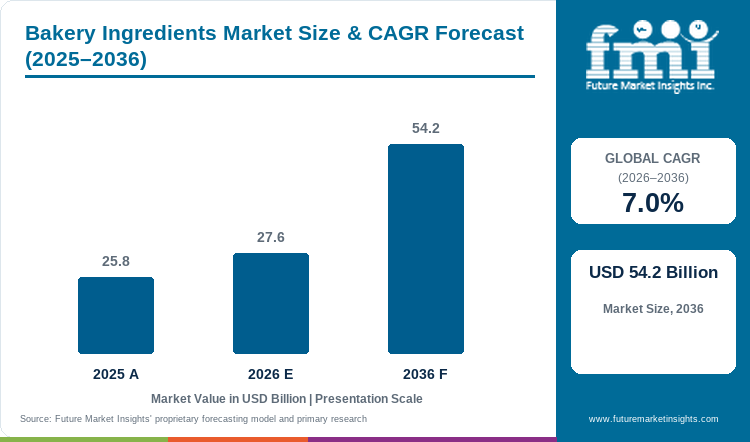
Key Takeaways of Bakery Ingredients Market
- Industrial bakers and foodservice operators are buying ingredients that reduce dough variability and protect shelf life without raising total processing cost.
- Based on Product Type, bakery improvers are projected to account for 23.0% in 2026, supported by their direct role in dough tolerance and freshness control.
- By End User Sales Channel, foodservice is estimated to hold 29.0% in 2026, driven by multi-site operators requiring repeatable preparation and finished-product quality.
- In 2026, breads are expected to lead the Application category with 42.0% share, attributable to frequent production and continuing freshness requirements.
- Reformulation risk restrains supplier switching because an ingredient change can affect machinability and sensory performance plus shelf life and labeling compliance simultaneously.
- Some of the key players in this market include Cargill, Incorporated, Archer Daniels Midland Company, Kerry Group plc, Ingredion Incorporated, dsm-firmenich, Louis Dreyfus Company, Tate & Lyle PLC, International Flavors & Fragrances Inc., Givaudan SA, and Corbion N.V.
Analyst Perspective
"Bakery ingredient suppliers win repeat business when line performance survives reformulation under commercial production conditions. Buyers pay for functionality that reduces waste or protects throughput after application trials confirm cost-in-use."
- Nandini Roy Choudhury, Principal Consultant, Future Market Insights
How is the Bakery Ingredients Market segmented?
Bakery Ingredients Market is segmented by Product Type, End User Sales Channel, Application, Form, and Region. Forecast period from 2026 to 2036.
By product type, it includes improvers, mixes, fillings, flavors, inclusions, sourdough, and preservation ingredients. By end-user sales channel, it covers foodservice, household retail, artisan, branded companies, and private labels. By application, it comprises breads, pastries, cakes, cookies, pizza crust, and other baked goods. By form, it includes powder, blocks, liquid, and paste.
How do bakery improvers shape demand within the product type category?
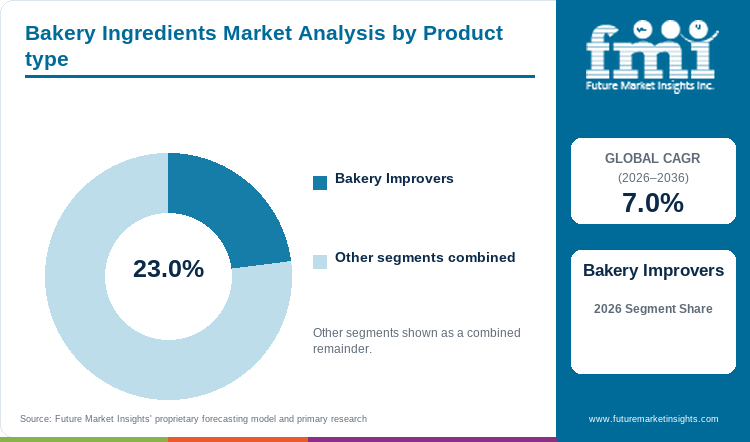
Bakery improvers control flour variation before inconsistent dough behavior disrupts industrial throughput or finished quality. Bakery enzymes and dough conditioners improve gas retention or dough tolerance during repeated production. Industrial bakers retain improver systems after line trials confirm stable handling under the target flour specification.
- Based on Product Type, bakery improvers are projected to account for 23.0% in 2026, driven by recurring demand for dough tolerance and fresh-keeping performance.
- Industrial bakers retain improver systems after line trials confirm stable volume, crumb structure, and handling under the target flour specification.
What supports foodservice demand within the end user sales channel category?
Foodservice operators need ingredient systems that reproduce the same result at locations with different staff and service volumes. Premixes and shelf-life tools reduce preparation variation during decentralized execution without adding local production steps. USDA ERS reported limited-service restaurants represented 36.5% of U.S. food-away-from-home spending in 2025 nationally.
- By End User Sales Channel, foodservice is estimated to hold 29.0% in 2026, supported by demand for standardized formulations that reduce execution variability.
- Multi-site operators favor systems that simplify preparation and preserve product quality during holding, transport, and repeated service cycles.
What makes breads central to the application category?
Bread production exposes formulation weakness quickly because flour variation changes water absorption and dough behavior during repeated production. Freshness and mold control recur during each production cycle so enzyme and preservation choices remain routine quality controls. Kerry described bakery enzymes in March 2026 as tools for consistency and shelf-life performance while food preservatives reduce waste during longer distribution.
- In 2026, breads are expected to lead the Application category with 42.0% share, attributable to frequent production and continuing freshness requirements.
- Producers use food preservatives and enzyme systems to extend saleable life without sacrificing the texture expected from repeat bread purchases.
How does powder format influence selection within the form category?
Powdered ingredients align with dry blending and metered dosing on bakery lines already handling flour and improvers. Powder formats simplify storage when liquid handling adds complexity, and Louis Dreyfus Company launched Lamequick VE56 in March 2026, a powdered plant-based whipping agent positioned for dessert applications including mousses, creams, and whipped foams, as part of its expanded ingredients portfolio presented at Food Ingredients China 2026. Formulators select food starch when existing process design favors measured dosing and stable inventory control.
- By Form, powder is forecast to represent 41.0% in 2026, influenced by dry-blending compatibility and practical storage or dosing requirements.
- Formulators select food starch and other dry functional systems when process design favors stable inventory and rapid incorporation into existing mixes.
What are the drivers, restraints and opportunities in the Bakery Ingredients Market?
Industrial bakery throughput supports repeat ingredient use, reformulation risk slows switching, and targeted label or cost problems create openings for validated functional systems.
- Driver: High-throughput bakery production increases repeat demand for ingredients that stabilize dough behavior and shelf-life performance during routine manufacturing.
- Restraint: Reformulation slows when an ingredient change can alter process behavior plus sensory quality and labeling status or total cost-in-use.
- Opportunity: Suppliers can win replacement projects by solving one documented cost or label or performance problem without forcing a full recipe redesign.
Production consistency keeps functional ingredients tied to repeat industrial bakery orders
Industrial bakeries and foodservice kitchens need ingredients that hold dough behavior and finished quality stable under repeated production. USDA ERS reported full-service and limited-service restaurants represented 71.0% of food-away-from-home spending in 2025 nationally. High service volumes make food texturing agents commercially useful when they reduce rejects and extend distribution time.
Reformulation risk raises the cost of an unsuccessful ingredient substitution
Bakery formulations remain interdependent because changing one ingredient can alter dough strength and finished shelf life. U.S. Bureau of Labor Statistics analysis published in April 2025 found bakery producer prices stayed elevated after grain input prices retreated. Processors therefore compare replacement ingredients on total cost-in-use instead of unit price alone during commercial validation.
Targeted reformulation gives suppliers a defined route into validated replacement projects
Commercial bakers have a clearer switching case when reformulation removes a specific label problem without weakening normal line performance. Corbion launched LUMI Set in June 2026 for titanium-dioxide-free water-based icings used on sweet baked goods. Clean-label ingredients gain repeat orders after trials confirm appearance and finished-product stability under commercial production conditions.
Which country CAGRs are profiled in the Bakery Ingredients Market?
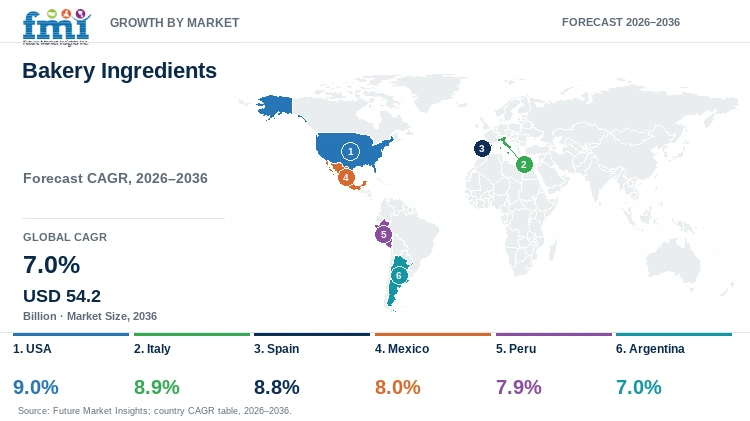
| Country | CAGR |
|---|---|
| USA | 9.0% |
| Italy | 8.9% |
| Spain | 8.8% |
| Mexico | 8.0% |
| Peru | 7.9% |
| Argentina | 7.0% |
How do country-level CAGRs compare in the bakery ingredients market?
The country CAGRs range from 7.0% to 9.0% through 2036. The USA leads at 9.0%, followed by Italy at 8.9% and Spain at 8.8%. Mexico is projected at 8.0%, Peru at 7.9%, and Argentina at 7.0%, reflecting differences in processing scale, import dependence, and ingredient qualification conditions.
- USA demand reflects industrial bakery scale and foodservice operations that measure throughput, waste, and shelf-life performance during repeated production.
- Italy’s fragmented processor base requires ingredient support for both larger plants and specialized regional bakery producers.
- Spain combines ingredient demand with production-cost pressure that increases scrutiny before a commercial formulation change.
- Mexico offers baking-ingredient opportunities through a major processed-food base and an expanding hotel and restaurant channel.
- Peru relies materially on imported processing inputs, making distributor inventory and landed cost central during ingredient qualification.
- Argentina’s revised food trade procedures reduce transaction friction, although price exposure still favors flexible formulations and local sourcing.
Comparable CAGRs produce different purchase conditions because local channel structure and import dependence change qualification requirements by country. The full report provides country-level CAGR analysis across North America, Latin America, Western Europe, Eastern Europe, East Asia, South Asia and Pacific, and the Middle East and Africa.
Country-wise Analysis
- Large industrial bakeries and foodservice operators in the USA reward ingredients that protect throughput and shelf life. The USA is estimated to post 9.0% CAGR over the forecast period, supported by its commercial foodservice base. USDA ERS reported food-away-from-home prices were 3.4% higher in July 2026 than July 2025, keeping cost-in-use central when buyers qualify bakery improvers.
- Italy’s fragmented food-processing base includes specialized regional producers with different plant-scale requirements during commercial ingredient qualification. Italy’s bakery ingredients outlook is anticipated to advance at 8.9% CAGR over the assessment period. USDA reported over 55,000 food-processing enterprises in April 2026, making adaptable application support important for repeat orders.
- Spanish processors balance new-product development against high production costs and price sensitivity in commercial baking. Bakery ingredient demand in Spain is forecast to rise at 8.8% CAGR over the forecast period. USDA described Spain’s food-processing sector as resilient in March 2026, requiring suppliers to prove functional or cost benefits before reformulation.
- Mexico combines a major processed-food manufacturing base with an expanding hotel and restaurant channel for bakery demand. Adoption of bakery ingredients in Mexico is estimated to expand at 8.0% CAGR through 2036. USDA listed baking ingredients among strong prospects in 2026, making local technical support important during qualification.
- Peruvian processors rely on imported inputs for specialized requirements not always covered by local supply. By 2036, Peru is projected to grow at 7.9% CAGR. USDA reported food processing represented about 24% of industrial GDP in April 2026, while inventory planning remains central to repeat orders.
- Argentina’s bakery ingredient purchasing remains sensitive to import procedures and working-capital pressure during commercial sourcing. Bakery ingredient sales in Argentina are forecast to expand at 7.0% CAGR by 2036. USDA’s 2025 country report documented food trade procedure changes, requiring suppliers to balance specialized functionality with flexible sourcing.
Who are the notable companies in the Bakery Ingredients Market?
Cargill, Incorporated, Archer Daniels Midland Company, Kerry Group plc, Ingredion Incorporated, dsm-firmenich, Louis Dreyfus Company, Tate & Lyle PLC, International Flavors & Fragrances Inc., Givaudan SA, and Corbion N.V. are active within the defined bakery ingredients supply boundary.
Bakery ingredient competition includes large formulation groups plus specialists in enzymes and preservation systems. Texture and food flavors specialists also compete for reformulation work involving fats and clean-label ingredients. Food-grade controls and application support determine whether successful trials convert into regular commercial production.
- Broad formulation platforms: Cargill, ADM, and Louis Dreyfus Company cover several bakery ingredient functions. Ingredion announced a recommended all-cash acquisition of Tate & Lyle in June 2026, with completion expected in the second half of 2027; both companies currently operate as independent entities within the defined market.
- Process-functionality specialists: Kerry Group, dsm-firmenich, IFF, and Corbion provide enzymes, preservation, or formulation support for bakery performance.
- Flavor specialists: Givaudan and IFF support sensory development used during bakery differentiation and reformulation.
Competitive Benchmarking: Bakery Ingredients Market
| Company | Dough & Freshness Functionality | Texture & Structure Systems | Flavor / Inclusion Breadth | Geographic Reach |
|---|---|---|---|---|
| Cargill, Incorporated | Medium | High | High | North America, Latin America, Europe and Asia |
| Archer Daniels Midland Company | Medium | High | High | Global food-ingredient reach |
| Kerry Group plc | High | Medium | High | Europe, North America and global food markets |
| Ingredion Incorporated | Medium | High | Medium | North America, Latin America, Europe and Asia-Pacific |
| dsm-firmenich | High | Medium | High | Global |
| Louis Dreyfus Company | Low | Medium | Low | Global with food-ingredient operations in major regions |
| Tate & Lyle PLC | Low | High | Medium | Americas, Europe and Asia |
| International Flavors & Fragrances Inc. | High | Medium | High | Global |
| Givaudan SA | Low | Medium | High | Global |
| Corbion N.V. | High | Medium | Low | North America, Latin America, Europe and Asia-Pacific |
Key Developments in the Bakery Ingredients Market
- In June 2026, Corbion launched LUMI Set for titanium-dioxide-free water-based icings used during commercial bakery reformulation.
- In March 2026, Cargill announced the expansion of its Port Klang, Malaysia specialty fats facility, introducing Bakefry, a frying fat for foodservice and quick-service restaurant operators, and Bakefill, a specialty fat for bakery fillings such as buttercream and bakery cream.
- In March 2026, Louis Dreyfus Company launched Lamequick VE56 and expanded bakery application support for functional ingredients.
Key Players in the Bakery Ingredients Market
Broad formulation and texture platforms
- Cargill, Incorporated
- Archer Daniels Midland Company
- Ingredion Incorporated
- Tate & Lyle PLC
- Louis Dreyfus Company
Enzyme, preservation and bakery performance systems
- Kerry Group plc
- dsm-firmenich
- International Flavors & Fragrances Inc.
- Corbion N.V.
Flavor and sensory systems
- Givaudan SA
Bakery Ingredients Market - Report Scope
| Coverage field | Report scope |
|---|---|
| Market breakdown | By product type, end user sales channel, application, form and region. |
| Quantitative Units | Revenue in USD billion and CAGR in %. |
| Market Definition | Commercial bakery ingredients sold within the stated product, channel, application and form categories are included. Finished bakery-product revenue and unrelated adjacent products are excluded. |
| Regions Covered | North America, Latin America, Western Europe, Eastern Europe, East Asia, South Asia and Pacific, and Middle East and Africa. |
| Countries Covered | USA, Italy, Spain, Mexico, Peru, and Argentina are profiled in the country CAGR analysis; 20+ countries are included in the full report. |
| Key Companies Profiled | Cargill, Incorporated, Archer Daniels Midland Company, Kerry Group plc, Ingredion Incorporated, dsm-firmenich, Louis Dreyfus Company, Tate & Lyle PLC, International Flavors & Fragrances Inc., Givaudan SA, Corbion N.V.. |
| Forecast Period | 2026 to 2036. |
| Approach | Primary and secondary research with market triangulation. |
Bakery Ingredients Market - Research Methodology
| Method | Approach |
|---|---|
| Primary Research | FMI analysts gathered input from manufacturers, service providers, technology developers, distributors, end users, procurement teams, and subject-matter experts. Interviews examined purchasing decisions, product or service evaluation, adoption barriers, approval requirements, pricing considerations, and expectations for technical or commercial support. Respondents were also asked what evidence is required before a trial, pilot, or initial order develops into regular purchasing. |
| Desk Research | Desk research covered government statistics, regulatory publications, trade data, industry associations, technical literature, standards, company filings, product information, and official corporate announcements. Sources were reviewed for relevance, publication date, geographic coverage, and consistency with the defined market scope. Claims relating to performance, applications, approvals, capacity, investment, and commercial activity were retained only when supported by credible public evidence. |
| Market Sizing and Forecasting | The market model combined the baseline value with historical performance, segment structure, pricing and volume indicators, adoption levels, company participation, and country-level demand conditions. Forecast assumptions considered economic activity, investment trends, regulatory developments, technology adoption, purchasing cycles, supply availability, and barriers to wider market use. Segment and regional estimates were reconciled before the final market total was calculated. |
| Data Validation | Estimates were checked against multiple independent indicators, including public data, company activity, trade patterns, industry developments, and findings from primary interviews. Validation also tested whether products, services, applications, and company revenues fell within the defined market boundaries. Adjacent categories, unsupported claims, overlapping revenues, and activities without direct market relevance were excluded to reduce double counting and maintain consistency across segments and countries. |
Bakery Ingredients Market by Segments
Bakery Ingredients Market segmented by Product type:
- Bakery Improvers
- Baking Mixes & Concentrates
- Icings & Coverings
- Frostings & Fondants
- Creme Fillings
- Fruit Fillings & Concentrates
- Flavors & Extracts
- Compounds
- Glazes
- Bakery Inclusions
- Couverture
- Decorations & Toppings
- Sourdough
- Egg wash Alternatives
- Mold Inhibitors
Bakery Ingredients Market segmented by End User Sales Channel:
- Foodservice
- Household Retail
- Artisan
- Bakery & Pastry Companies brands
- Confectionery Companies brands
- Private Label Brands
Bakery Ingredients Market segmented by Application:
- Breads
- Pastries
- Cakes and Desserts
- Cookies and Biscuits
- Pizza Crust
- Others (Pretzels, Scones)
Bakery Ingredients Market segmented by Form:
- Powder
- Blocks
- Liquid
- Paste
Bakery Ingredients Market by Region:
- North America
- United States
- Canada
- Latin America
- Brazil
- Mexico
- Chile
- Western Europe
- Germany
- United Kingdom
- Italy
- Spain
- France
- Nordics
- Benelux
- Rest of Western Europe
- Eastern Europe
- Russia
- Poland
- Hungary
- Balkan and Baltic States
- Rest of Eastern Europe
- East Asia
- China
- Japan
- South Korea
- South Asia and Pacific
- India
- ASEAN
- Australia and New Zealand
- Rest of South Asia and Pacific
- Middle East and Africa
- Kingdom of Saudi Arabia
- Other GCC Countries
- Türkiye
- South Africa
- Other African Union Countries
- Rest of Middle East and Africa
Research Sources and Bibliography
- U.S. Department of Agriculture, Economic Research Service. (2026, June 11). Total U.S. food spending reached $2.51 trillion in 2025.
- International Flavors & Fragrances Inc. (2026, April 7). How to Bake on Strength: Turning Today’s Bakery Challenges into Reliable Results.
- Kerry Group plc. (2026, March 16). How Enzymes Are Reshaping Bakery Performance.
- Louis Dreyfus Company. (2026, March 17). Louis Dreyfus Company Showcases New Plant-based Whipping Agent and Expanded Ingredients Portfolio at Food Ingredients China 2026.
- U.S. Bureau of Labor Statistics. (2025, April). What is behind the rise in prices for bakery products?
- Corbion N.V. (2026, June 15). Corbion launches LUMI™ Set to help bakers reformulate away from titanium dioxide without sacrificing visual appeal.
- USDA Foreign Agricultural Service. (2025, April 9). Food Processing Ingredients Annual - Canada.
- USDA Foreign Agricultural Service. (2026, April 3). Food Processing Ingredients Annual - France.
- USDA Foreign Agricultural Service. (2026, March 30). Food Processing Ingredients Annual - Germany.
- USDA Foreign Agricultural Service. (2026, April 2). Food Processing Ingredients Annual - Italy.
- USDA Foreign Agricultural Service. (2026, March 31). Food Processing Ingredients Annual - Brazil.
- USDA Foreign Agricultural Service. (2026, April 3). Food Processing Ingredients Annual - Peru.
- USDA Foreign Agricultural Service. (2026, March 31). Food Processing Ingredients Annual - Spain.
- USDA Foreign Agricultural Service. (2025, March 31). Food Processing Ingredients Annual - United Kingdom.
- USDA Foreign Agricultural Service. (2025). FAIRS Country Report Annual - Argentina.
- USDA Foreign Agricultural Service. (2026). Food Processing Ingredients Annual - Mexico.
- USDA Foreign Agricultural Service. (2024, October 3). Opportunities for U.S. Agricultural Products in Guatemala.
- Cargill, Incorporated. (2026, March 31). Cargill strengthens global specialty fats portfolio with expansion of Port Klang, Malaysia facility.
- Tate & Lyle PLC. (2026, February 23). Introducing Yume™: A new standard for sweetness.
- Givaudan SA. (2026, July 3). Givaudan inaugurates new production facility in Indonesia.
- International Flavors & Fragrances Inc. (2026, May 11). IFF opens Vanilla Innovation Center in Madagascar.
- Kerry Group plc. (2026, January 14). Kerry Releases 2026 Global Taste Charts: Defining the Future of Flavour with Data-Rich Insights.
- Ingredion Incorporated. (2026, July 6). Ingredion to Spotlight Next-Generation Solutions for Texture, Clean Labels and Positive Nutrition at IFT FIRST 2026.
- dsm-firmenich. (2026, September 16). dsm-firmenich strengthens commitment to Indonesia with new Jakarta office and Karawang manufacturing expansion.
- U.S. Department of Agriculture, Economic Research Service. (2026, July 8). Food Service Industry - Market Segments.
- U.S. Department of Agriculture, Economic Research Service. (2026, August 25). Food Price Outlook - Summary Findings.
- Cargill, Incorporated. (2026, January 28). Cargill invests to expand Beijing plant.
- ADM. (2026, July 31). ADM Invests More Than $16M to Expand Naturally Derived Color Production Capacity at Northern Kentucky Facility.
- Ingredion Incorporated. (2026, June 8). Ingredion Announces Recommended All-Cash Acquisition of Tate & Lyle.
- Tate & Lyle PLC. (2026, May 18). Tate & Lyle expands collaboration with BioHarvest to accelerate next-generation sweetener innovation.
- International Flavors & Fragrances Inc.. (2026, May 29). IFF Enters Into Agreement to Sell Its Food Ingredients Business to CVC.
- Corbion N.V.. (2026, September 8). Corbion expands natural mold inhibition portfolio with Verdad® Essence WH150.
This bibliography is provided for reader reference and is not exhaustive. The full report contains the complete reference list and detailed citations.
This Report Answers
- How large is the bakery ingredients market in 2026 and what value is forecast for 2036?
- Which production conditions support repeat demand for functional bakery ingredients?
- Why do bakery improvers hold 23.0% of product type revenue in 2026?
- Why does foodservice account for 29.0% of end user sales channel demand in 2026?
- Why do breads account for 42.0% of application demand during the 2026 base year?
- How do the profiled country CAGRs differ between 2026 and 2036?
- Which companies operate within the defined bakery ingredients supply boundary?
- Which reformulation and qualification conditions can delay supplier switching?
Frequently Asked Questions
How big is the bakery ingredients market in 2026?
The bakery ingredients market is valued at USD 27.6 billion in 2026 and is projected to reach USD 54.2 billion by 2036. Industrial bakers buy functional ingredients to stabilize production and extend saleable life during repeated commercial runs.
What is the CAGR of the Bakery Ingredients Market from 2026 to 2036?
The bakery ingredients market is projected to grow at 7.0% CAGR between 2026 and 2036. Repeat purchasing is supported by improvers and preservation systems that protect throughput and shelf life during routine commercial production.
Which product type leads the Bakery Ingredients Market in 2026?
The bakery improvers segment is projected to account for 23.0% of product type revenue in the bakery ingredients market in 2026. Industrial bakers use improvers to manage dough tolerance and freshness during repeated high-throughput production runs.
Which end user sales channel leads the Bakery Ingredients Market in 2026?
The foodservice segment is estimated to hold 29.0% of end user sales channel demand in the bakery ingredients market in 2026. Multi-site operators favor standardized systems that reduce preparation variation during repeated service at multiple locations.
Which profiled countries record the highest bakery ingredients growth rates?
The USA is projected to rise at a 9.0% CAGR through 2036, followed by Italy at 8.9% and Spain at 8.8% CAGR. Mexico is projected at 8.0%, Peru at 7.9%, and Argentina at 7.0% CAGR during the forecast period.
Which companies are active in the Bakery Ingredients Market?
Key companies include Cargill and ADM alongside Kerry Group and Ingredion. dsm-firmenich and Louis Dreyfus Company participate with Tate & Lyle and IFF. Givaudan and Corbion complete the profiled group.
Preview the report firsthand - request a free sample
Get SampleGet the brochure for pricing and purchase details.
Get PDFTable of Content
- Key Takeaways
- Market Size and CAGR
- Top Growth Driver
- Fastest Growing Segment
- Leading Region
- Key Companies
- Emerging Opportunities
- Executive Summary
- Global Market Outlook
- Demand-side Trends
- Supply-side Trends
- Technology Roadmap Analysis
- Analysis and Recommendations
- Analyst Perspective (What is happening? Why now? What should investors know?)
- Key Questions Answered
- How large is the market?
- What is the CAGR?
- What are key trends?
- Which region dominates?
- Who are the leaders?
- Market Overview
- Market Coverage / Taxonomy
- Market Definition / Scope / Limitations
- Research Methodology
- Chapter Orientation
- Analytical Lens and Working Hypotheses
- Market Structure, Signals, and Trend Drivers
- Benchmarking and Cross-market Comparability
- Market Sizing, Forecasting, and Opportunity Mapping
- Research Design and Evidence Framework
- Desk Research Programme (Secondary Evidence)
- Expert Input and Fieldwork (Primary Evidence)
- Tooling, Models, and Reference Databases
- Data Engineering and Model Build
- Quality Assurance and Audit Trail
- Market Background
- Market Dynamics (Drivers, Restraints, Opportunity, Trends)
- Scenario Forecast (Optimistic, Likely, Conservative)
- Impact Analysis
- AI Impact
- Sustainability Impact
- Regulatory Impact
- Technology Impact
- Consumer / Buyer Analysis
- Purchase Drivers
- Adoption Barriers
- Buyer Journey
- Opportunity Map Analysis
- Product Life Cycle Analysis
- Supply Chain Analysis
- Investment Feasibility Matrix
- Value Chain Analysis
- PESTLE and Porter's Analysis
- Regulatory Landscape
- Regional Parent Market Outlook
- Production and Consumption Statistics
- Import and Export Statistics
- Global Market Analysis and Forecast, 2021 to 2036
- Historical Market Size Value (USD Billion) Analysis, 2021 to 2025
- Current and Future Market Size Value (USD Billion) Projections, 2026 to 2036
- Y-o-Y Growth Trend Analysis
- Absolute $ Opportunity Analysis
- Global Market Pricing Analysis, 2021 to 2036
- Global Market Analysis and Forecast, By Product type, 2021 to 2036
- Introduction / Key Findings
- Historical Market Size Value (USD Billion) Analysis By Product type, 2021 to 2025
- Current and Future Market Size Value (USD Billion) Analysis and Forecast By Product type, 2026 to 2036
- Bakery Improvers
- Baking Mixes & Concentrates
- Icings & Coverings
- Frostings & Fondants
- Creme Fillings
- Fruit Fillings & Concentrates
- Flavors & Extracts
- Compounds
- Glazes
- Bakery Inclusions
- Couverture
- Decorations & Toppings
- Sourdough
- Egg wash Alternatives
- Mold Inhibitors
- Y-o-Y Growth Trend Analysis By Product type, 2021 to 2025
- Absolute $ Opportunity Analysis By Product type, 2026 to 2036
- Global Market Analysis and Forecast, By End User Sales Channel, 2021 to 2036
- Introduction / Key Findings
- Historical Market Size Value (USD Billion) Analysis By End User Sales Channel, 2021 to 2025
- Current and Future Market Size Value (USD Billion) Analysis and Forecast By End User Sales Channel, 2026 to 2036
- Foodservice
- Household Retail
- Artisan
- Bakery & Pastry Companies brands
- Confectionery Companies brands
- Private Label Brands
- Y-o-Y Growth Trend Analysis By End User Sales Channel, 2021 to 2025
- Absolute $ Opportunity Analysis By End User Sales Channel, 2026 to 2036
- Global Market Analysis and Forecast, By Application, 2021 to 2036
- Introduction / Key Findings
- Historical Market Size Value (USD Billion) Analysis By Application, 2021 to 2025
- Current and Future Market Size Value (USD Billion) Analysis and Forecast By Application, 2026 to 2036
- Breads
- Pastries
- Cakes and Desserts
- Cookies and Biscuits
- Pizza Crust
- Others (Pretzels, Scones)
- Y-o-Y Growth Trend Analysis By Application, 2021 to 2025
- Absolute $ Opportunity Analysis By Application, 2026 to 2036
- Global Market Analysis and Forecast, By Form, 2021 to 2036
- Introduction / Key Findings
- Historical Market Size Value (USD Billion) Analysis By Form, 2021 to 2025
- Current and Future Market Size Value (USD Billion) Analysis and Forecast By Form, 2026 to 2036
- Powder
- Blocks
- Liquid
- Paste
- Y-o-Y Growth Trend Analysis By Form, 2021 to 2025
- Absolute $ Opportunity Analysis By Form, 2026 to 2036
- Global Market Analysis and Forecast, By Region, 2021 to 2036
- Introduction
- Historical Market Size Value (USD Billion) Analysis By Region, 2021 to 2025
- Current Market Size Value (USD Billion) Analysis and Forecast By Region, 2026 to 2036
- North America
- Latin America
- Western Europe
- Eastern Europe
- East Asia
- South Asia and Pacific
- Middle East and Africa
- Market Attractiveness Analysis By Region
- North America Market Analysis and Forecast, By Country, 2021 to 2036
- Historical Market Size Value (USD Billion) Trend Analysis By Market Taxonomy, 2021 to 2025
- Market Size Value (USD Billion) Forecast By Market Taxonomy, 2026 to 2036
- By Country
- United States
- Canada
- By Product type
- By End User Sales Channel
- By Application
- By Form
- By Country
- Market Attractiveness Analysis
- By Country
- By Product type
- By End User Sales Channel
- By Application
- By Form
- Key Takeaways
- Latin America Market Analysis and Forecast, By Country
- Historical Market Size Value (USD Billion) Trend Analysis By Market Taxonomy, 2021 to 2025
- Market Size Value (USD Billion) Forecast By Market Taxonomy, 2026 to 2036
- By Country
- Brazil
- Mexico
- Chile
- By Product type
- By End User Sales Channel
- By Application
- By Form
- By Country
- Market Attractiveness Analysis
- By Country
- By Product type
- By End User Sales Channel
- By Application
- By Form
- Key Takeaways
- Western Europe Market Analysis and Forecast, By Country
- Historical Market Size Value (USD Billion) Trend Analysis By Market Taxonomy, 2021 to 2025
- Market Size Value (USD Billion) Forecast By Market Taxonomy, 2026 to 2036
- By Country
- Germany
- United Kingdom
- Italy
- Spain
- France
- Nordics
- Benelux
- Rest of Western Europe
- By Product type
- By End User Sales Channel
- By Application
- By Form
- By Country
- Market Attractiveness Analysis
- By Country
- By Product type
- By End User Sales Channel
- By Application
- By Form
- Key Takeaways
- Eastern Europe Market Analysis and Forecast, By Country
- Historical Market Size Value (USD Billion) Trend Analysis By Market Taxonomy, 2021 to 2025
- Market Size Value (USD Billion) Forecast By Market Taxonomy, 2026 to 2036
- By Country
- Russia
- Poland
- Hungary
- Balkan and Baltic States
- Rest of Eastern Europe
- By Product type
- By End User Sales Channel
- By Application
- By Form
- By Country
- Market Attractiveness Analysis
- By Country
- By Product type
- By End User Sales Channel
- By Application
- By Form
- Key Takeaways
- East Asia Market Analysis and Forecast, By Country
- Historical Market Size Value (USD Billion) Trend Analysis By Market Taxonomy, 2021 to 2025
- Market Size Value (USD Billion) Forecast By Market Taxonomy, 2026 to 2036
- By Country
- China
- Japan
- South Korea
- By Product type
- By End User Sales Channel
- By Application
- By Form
- By Country
- Market Attractiveness Analysis
- By Country
- By Product type
- By End User Sales Channel
- By Application
- By Form
- Key Takeaways
- South Asia and Pacific Market Analysis and Forecast, By Country
- Historical Market Size Value (USD Billion) Trend Analysis By Market Taxonomy, 2021 to 2025
- Market Size Value (USD Billion) Forecast By Market Taxonomy, 2026 to 2036
- By Country
- India
- ASEAN
- Australia and New Zealand
- Rest of South Asia and Pacific
- By Product type
- By End User Sales Channel
- By Application
- By Form
- By Country
- Market Attractiveness Analysis
- By Country
- By Product type
- By End User Sales Channel
- By Application
- By Form
- Key Takeaways
- Middle East and Africa Market Analysis and Forecast, By Country
- Historical Market Size Value (USD Billion) Trend Analysis By Market Taxonomy, 2021 to 2025
- Market Size Value (USD Billion) Forecast By Market Taxonomy, 2026 to 2036
- By Country
- Kingdom of Saudi Arabia
- Other GCC Countries
- Türkiye
- South Africa
- Other African Union Countries
- Rest of Middle East and Africa
- By Product type
- By End User Sales Channel
- By Application
- By Form
- By Country
- Market Attractiveness Analysis
- By Country
- By Product type
- By End User Sales Channel
- By Application
- By Form
- Key Takeaways
- Key Countries Market Analysis
- United States
- Pricing Analysis
- Market Share Analysis, 2025
- By Product type
- By End User Sales Channel
- By Application
- By Form
- Canada
- Pricing Analysis
- Market Share Analysis, 2025
- By Product type
- By End User Sales Channel
- By Application
- By Form
- Mexico
- Pricing Analysis
- Market Share Analysis, 2025
- By Product type
- By End User Sales Channel
- By Application
- By Form
- Brazil
- Pricing Analysis
- Market Share Analysis, 2025
- By Product type
- By End User Sales Channel
- By Application
- By Form
- Chile
- Pricing Analysis
- Market Share Analysis, 2025
- By Product type
- By End User Sales Channel
- By Application
- By Form
- Germany
- Pricing Analysis
- Market Share Analysis, 2025
- By Product type
- By End User Sales Channel
- By Application
- By Form
- United Kingdom
- Pricing Analysis
- Market Share Analysis, 2025
- By Product type
- By End User Sales Channel
- By Application
- By Form
- Italy
- Pricing Analysis
- Market Share Analysis, 2025
- By Product type
- By End User Sales Channel
- By Application
- By Form
- Spain
- Pricing Analysis
- Market Share Analysis, 2025
- By Product type
- By End User Sales Channel
- By Application
- By Form
- France
- Pricing Analysis
- Market Share Analysis, 2025
- By Product type
- By End User Sales Channel
- By Application
- By Form
- India
- Pricing Analysis
- Market Share Analysis, 2025
- By Product type
- By End User Sales Channel
- By Application
- By Form
- ASEAN
- Pricing Analysis
- Market Share Analysis, 2025
- By Product type
- By End User Sales Channel
- By Application
- By Form
- Australia and New Zealand
- Pricing Analysis
- Market Share Analysis, 2025
- By Product type
- By End User Sales Channel
- By Application
- By Form
- China
- Pricing Analysis
- Market Share Analysis, 2025
- By Product type
- By End User Sales Channel
- By Application
- By Form
- Japan
- Pricing Analysis
- Market Share Analysis, 2025
- By Product type
- By End User Sales Channel
- By Application
- By Form
- South Korea
- Pricing Analysis
- Market Share Analysis, 2025
- By Product type
- By End User Sales Channel
- By Application
- By Form
- Russia
- Pricing Analysis
- Market Share Analysis, 2025
- By Product type
- By End User Sales Channel
- By Application
- By Form
- Poland
- Pricing Analysis
- Market Share Analysis, 2025
- By Product type
- By End User Sales Channel
- By Application
- By Form
- Hungary
- Pricing Analysis
- Market Share Analysis, 2025
- By Product type
- By End User Sales Channel
- By Application
- By Form
- Kingdom of Saudi Arabia
- Pricing Analysis
- Market Share Analysis, 2025
- By Product type
- By End User Sales Channel
- By Application
- By Form
- Türkiye
- Pricing Analysis
- Market Share Analysis, 2025
- By Product type
- By End User Sales Channel
- By Application
- By Form
- South Africa
- Pricing Analysis
- Market Share Analysis, 2025
- By Product type
- By End User Sales Channel
- By Application
- By Form
- Peru
- Pricing Analysis
- Market Share Analysis, 2025
- By Product type
- By End User Sales Channel
- By Application
- By Form
- Argentina
- Pricing Analysis
- Market Share Analysis, 2025
- By Product type
- By End User Sales Channel
- By Application
- By Form
- United States
- Market Structure Analysis
- Competition Dashboard
- Competition Benchmarking
- Market Share Analysis of Top Players
- By Regional
- By Product type
- By End User Sales Channel
- By Application
- By Form
- Emerging Startups
- Innovation Benchmarking
- Competition Analysis
- Competition Deep Dive
- Cargill, Incorporated
- Overview
- Product Portfolio
- Profitability by Market Segments
- Sales Footprint
- Strategy Overview
- Marketing Strategy
- Product Strategy
- Channel Strategy
- Archer Daniels Midland Company
- Kerry Group plc
- Ingredion Incorporated
- dsm-firmenich
- Louis Dreyfus Company
- Tate & Lyle PLC
- International Flavors & Fragrances Inc.
- Givaudan SA
- Corbion N.V.
- Cargill, Incorporated
- Case Studies
- Success Stories
- Recent Developments
- Competition Deep Dive
- Assumptions & Acronyms Used


