


Bioplastics Market : Global Industry Analysis and Opportunity Assessment, 2036
The bioplastics market is segmented by Material Type (Bio-PET, Bio-PE, Bio-PA, Biodegradable Polyesters, PLA & PLA Blends, Starch Blends, PHA, Others), Application (Bottle, Packaging, Food Services, Agriculture/Horticulture, Consumer Products, Automotive), and Region. Forecast for 2026 to 2036.
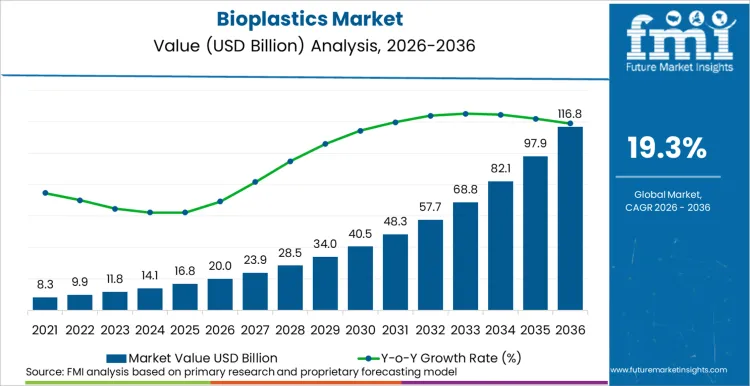
- Industry Size (2026): USD 20.0 Bn
- Forecast (2036): USD 116.9 Bn
- CAGR (2026 to 2036): 19.3%
Bioplastics Market Forecast and Outlook By FMI
The bioplastics market was valued at USD 16.8 billion in 2025. Demand is forecast to rise to USD 20.0 billion in 2026 and USD 116.9 billion by 2036. The market is anticipated to register 19.3% CAGR during the forecast period. PLA and PLA blends lead material demand, while packaging remains the largest application area due to brand sustainability targets and plastic-use regulations.
.webp "Bioplastics Market (2)")
Summary of the Bioplastics Market
- Demand and Growth Drivers
- Single-use plastic rules are pushing converters toward certified bio-based alternatives.
- Brand sustainability programs are increasing demand for compostable packaging materials.
- Automotive lightweighting needs are improving interest in bio-based composites.
- Agriculture films are gaining attention where biodegradable formats reduce removal work.
- Product and Segment View
- PLA and PLA blends lead due to processing ease and compostability credentials.
- Packaging remains the main application as foodservice and retail formats shift away from petroleum plastics.
- PHA and starch blends are gaining visibility in compostable packaging programs.
- Bio-based polyesters are improving adoption where higher durability is required.
- Geography and Competitive Outlook
- Europe leads due to strict packaging waste rules and circular economy policies.
- South Korea and Japan gain from electronics packaging and government material programs.
- The United States is moving through state-level plastic rules and corporate sourcing shifts.
- Producers with feedstock access and certification depth are likely to gain stronger positions.
- Analyst Opinion
- Nikhil Kaitwade, Principal Consultant for Sustainable Materials at FMI, suggests, “The bioplastics market is moving into a performance-focused phase. Suppliers that combine bio-based content, compostability certification, and converter support are likely to gain stronger acceptance across packaging and technical applications.”
- Bioplastics Market Value Analysis
- Bioplastics are moving from sustainability positioning into practical material substitution.
- Packaging converters are seeking materials that run on existing processing equipment.
- Second-generation feedstocks are becoming important for cost control and supply stability.
- Composting partnerships are gaining value as end-of-life gaps affect adoption.
- Certified materials can command stronger pricing where regulation drives replacement.
- Technical support for converters is becoming a key factor in supplier selection.
Market Definition
The bioplastics market comprises polymers derived partially or fully from renewable biomass sources including corn starch, sugarcane, cellulose, and vegetable oils, as well as fossil-based polymers engineered for biodegradability. Products include bio-based polyethylene, polylactic acid, polyhydroxyalkanoates, starch blends, and bio-based polyesters deployed across flexible and rigid packaging, agricultural films, consumer goods, automotive components, and textile fibers.
Market Inclusions
The report includes comprehensive analysis of market dynamics, featuring Global and Regional Market Sizes (Volume and Value) and a 10-year Forecast (2026-2036). It covers segmental breakdowns by material categories (Bio-PET, Bio-PE, Bio-PA, biodegradable polyesters, PLA and PLA blends, starch blends, PHA, and other bio-based plastics), application segments (Packaging, Bottles, Food Services, Agriculture, Automotive, Consumer Products), and regional demand patterns across brand owner procurement, converter specifications, and retail distribution channels.
Market Exclusions
The scope excludes conventional petroleum-based plastics without bio-based content or biodegradability certifications, recycled plastic resins derived from post-consumer waste streams, and bio-based chemicals used as plasticizers or additives rather than base polymers. It also omits finished consumer products and packaging articles, focusing strictly on bio-based and biodegradable polymer resins sold to converters and molders. Report does not account for experimental laboratory-scale biopolymers without commercial production capacity or established supply chains.
Bioplastics Market Research Methodology
- Primary Research: Interviews were conducted with bioplastic resin producers, packaging converters, brand sustainability directors, agricultural film manufacturers, and composting facility operators across major markets.
- Desk Research: Plastic production capacity data from industry associations, single-use plastics legislation databases, corporate sustainability report disclosures, and certification body statistics supported volume benchmarking and market sizing validation.
- Market-Sizing and Forecasting: A hybrid top-down and bottom-up model was developed. Demand was reconstructed from packaging production volumes, agricultural film consumption, automotive component specifications, and brand owner sustainability targets, then validated against bioplastic producer revenue disclosures and trade flow data.
- Data Validation and Update Cycle: Outputs undergo anomaly screening, variance checks across production capacity and end-use consumption datasets, and structured peer review with materials science and sustainability experts prior to release.
Segmental Analysis
Bioplastics Market Analysis by Material Type
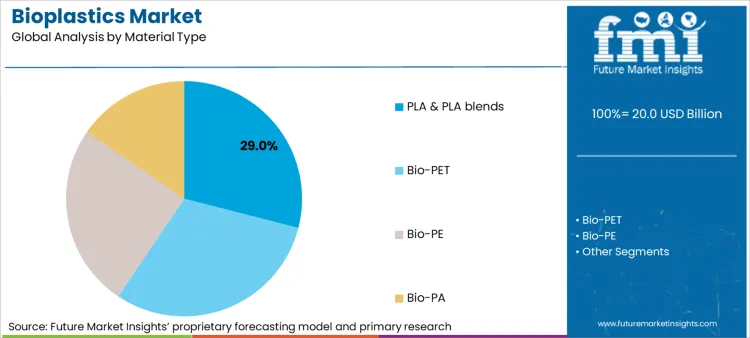
Based on FMI's bioplastics market report, consumption of PLA & PLA blends is estimated to hold 29% share in 2026. PLA dominance stems from corn starch and sugarcane fermentation providing cost-competitive feedstocks, processing compatibility with existing injection molding and extrusion equipment minimizing converter investment requirements, and industrial compostability certifications (EN 13432, ASTM D6400) enabling regulatory compliance across European and North American jurisdictions implementing packaging waste directives.
- Capacity Expansion: NatureWorks announced USD 600 million investment in Thailand manufacturing facility during 2023, adding 75,000 metric tons annual PLA capacity targeting Asia-Pacific packaging demand [1].
- Performance Enhancement: TotalEnergies Corbion developed heat-resistant PLA grades in 2024 achieving 120°C performance enabling hot-fill beverage applications previously limited to petroleum-based PET [2].
- Feedstock Diversification: Industry shift toward second-generation feedstocks including agricultural residues and waste cooking oil reduces food versus fuel concerns while improving carbon footprint calculations supporting corporate sustainability reporting requirements [3].
Bioplastics Market Analysis by Application
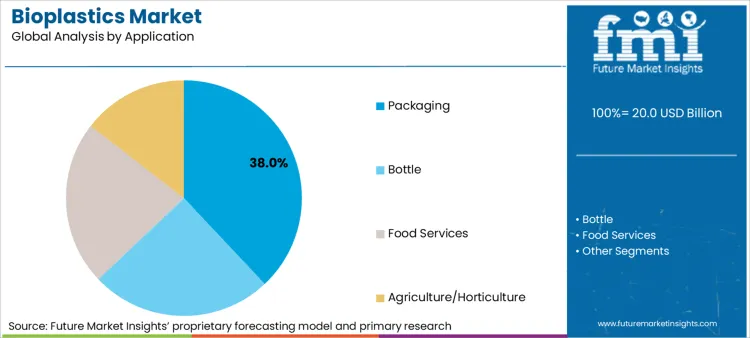
Based on FMI's bioplastics market report, consumption in packaging applications is estimated to hold 38% share in 2026. Packaging dominance reflects brand owner commitments to eliminate petroleum-based materials, European Single-Use Plastics Directive mandating bio-based alternatives for specific product categories, and consumer preference for certified compostable packaging driving retail differentiation strategies across food service, cosmetics, and e-commerce fulfillment segments.
- Brand Owner Commitments: Unilever announced transition to 100% recyclable, reusable, or compostable plastic packaging by 2025, driving procurement of certified bio-based materials across 400+ product lines globally [4].
- Regulatory Compliance: European Parliament approved Single-Use Plastics Directive in 2019, banning petroleum-based cutlery, plates, and straws by July 2021, creating immediate demand for compostable PLA and starch-based alternatives [5].
- Performance Requirements: Flexible packaging applications increasingly specify bio-based films achieving oxygen transmission rates below 5 cm³/m²/day and water vapor transmission below 3 g/m²/day, matching petroleum polyethylene barrier properties critical for shelf-life protection [6].
Bioplastics Market Drivers, Restraints, and Opportunities
Future Market Insights analysis links this market's size to the regulatory reality that petroleum-based single-use plastics face escalating prohibitions across major economies, with over 60 countries implementing bans or restrictions by 2024 according to United Nations Environment Programme data. Bioplastics are purchased because packaging brands require certified sustainable materials supporting ESG reporting, agricultural operations need biodegradable mulch films eliminating post-harvest removal labor, and automotive manufacturers seek bio-based composites achieving lightweighting targets.
FMI analysts observe a structural shift from first-generation food-crop feedstocks toward second-generation agricultural waste and third-generation algae-based systems addressing sustainability concerns about food security impacts. Successful commercialization requires bio-based materials achieving cost parity with petroleum polymers through production scale-up and fermentation efficiency improvements. Premium pricing persists for certified compostable grades commanding 30-50% premiums over conventional plastics, justified through regulatory compliance value and brand positioning benefits that offset material cost differentials in sustainability-focused market segments.
- Extended Producer Responsibility: European Union's Packaging and Packaging Waste Regulation, finalized in November 2023, establishes bio-based content targets reaching 30% by 2030 for specific packaging categories, creating mandated demand regardless of cost competitiveness [7].
- Composting Infrastructure Expansion: Industrial composting capacity in North America reached 4,850 certified facilities by 2024, representing 400% growth since 2015, enabling end-of-life processing for compostable packaging and reducing landfill diversion concerns [8].
- Automotive Integration: Global automakers including Ford, BMW, and Toyota incorporated bio-based composites in vehicle interiors, door panels, and underbody shields achieving 10-20% weight reduction versus petroleum materials while meeting crash safety and durability specifications [9].
Regional Analysis
Based on the regional analysis, bioplastics market is segmented into North America, Europe, Asia Pacific, Latin America, and Middle East & Africa across 40+ countries. The full report also offers market attractiveness analysis based on regional regulatory frameworks and feedstock availability patterns.
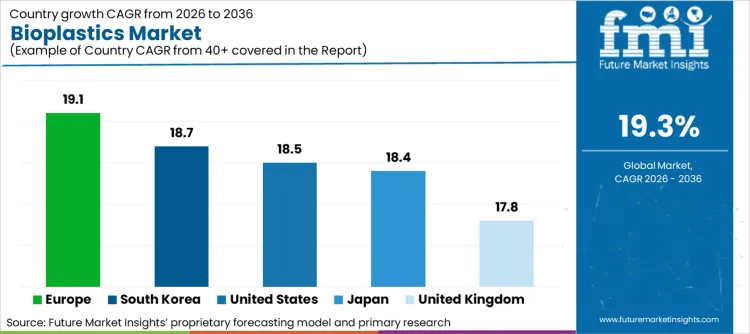
| Country | CAGR (2026 to 2036) |
|---|---|
| EU | 19.1% |
| South Korea | 18.7% |
| United States | 18.5% |
| Japan | 18.4% |
| United Kingdom | 17.8% |
Source: Future Market Insights (FMI) analysis, based on proprietary forecasting model and primary research
North America Bioplastics Market Analysis
North America operates as a corporate sustainability-driven market where brand owner commitments and select state-level regulations create demand pull for bio-based packaging materials. Major producers including NatureWorks and Danimer Scientific serve both domestic and export markets.
- United States: Demand for bioplastics in the United States is projected to rise at 18.5% CAGR through 2036. Growth is supported by state-level single-use plastics bans, with California, New York, Washington, and Oregon implementing prohibitions during 2021-2024 affecting food service ware and retail bags [10]. Market expansion is further driven by corporate commitments, with Walmart announcing sourcing of 100 billion pounds of sustainable packaging materials including certified bio-based content by 2025 [4]. USDA BioPreferred Program expanded in 2023 to include additional bioplastic product categories, providing procurement preference and marketing advantages supporting material adoption across federal purchasing and private sector sustainability programs [10].
FMI's analysis of bioplastics market in North America consists of country-wise assessment that includes the United States and Canada. Readers can find state-level regulatory developments, corporate sustainability program impacts, and agricultural feedstock availability dynamics.
Europe Bioplastics Market Analysis
Europe functions as the global regulatory leadership center where comprehensive waste directives, circular economy frameworks, and producer responsibility mandates create sustained demand for bio-based and compostable materials. Major regional producers including BASF, Novamont, and Bio-on compete through technology innovation and certification portfolios.
- United Kingdom: Demand for bioplastics in the UK is projected to rise at 17.8% CAGR through 2036. UK government implemented Plastic Packaging Tax in April 2022, imposing GBP 200 per ton levy on packaging containing less than 30% recycled or bio-based content, creating immediate financial incentive for material transition [5]. Market growth is supported by retail sector commitments, with Tesco, Sainsbury's, and Marks & Spencer collectively pledging to eliminate petroleum-based packaging from private label products by 2025, affecting over 15,000 SKUs [5].
FMI's analysis of bioplastics market in Europe consists of country-wise assessment that includes United Kingdom, Germany, France, Italy, Spain, and Nordic countries. Readers can find Extended Producer Responsibility frameworks, circular economy implementation timelines, and composting infrastructure development.
Asia Pacific Bioplastics Market Analysis
Asia Pacific represents feedstock advantage and production scale opportunity where agricultural economies provide low-cost biomass and governments implement waste reduction programs addressing urban plastic pollution challenges.
- Japan: Demand for bioplastics in Japan is projected to rise at 18.4% CAGR through 2036. Japanese government announced Plastic Resource Circulation Strategy in May 2019, targeting 200,000 tons annual bioplastic usage by 2030 through procurement preferences and industry partnerships [9]. Market expansion is driven by electronics sector adoption, with Sony, Panasonic, and Toshiba incorporating bio-based materials in product housings, achieving 10-30% petroleum plastic displacement across select consumer electronics lines by 2024 [9].
- South Korea: Demand for bioplastics in South Korea is projected to rise at 18.7% CAGR through 2036. Korean government established Green New Deal in 2020, allocating KRW 7.4 trillion (USD 6.2 billion) for sustainable materials development including bio-based plastics R&D and production subsidies [9]. Market growth is supported by electronics and semiconductor sector integration, with Samsung and SK Hynix specifying bio-based materials for packaging and component applications achieving corporate sustainability targets [9].
FMI's analysis of bioplastics market in Asia Pacific consists of country-wise assessment that includes Japan, South Korea, China, India, ASEAN countries, and Australia. Readers can find government industrial policy frameworks, electronics sector specifications, and agricultural feedstock supply chain dynamics.
Competitive Aligners for Market Players
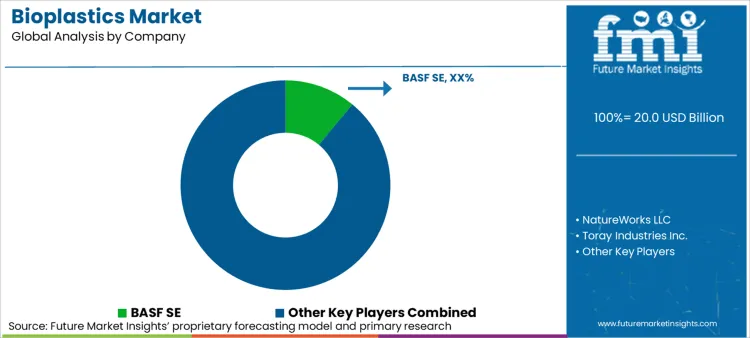
Market structure demonstrates moderate concentration globally with top five producers including NatureWorks, BASF, Total Corbion, Novamont, and Danimer Scientific collectively controlling approximately 45% of bioplastic resin capacity. Competition operates across feedstock access securing low-cost renewable inputs, processing technology achieving cost parity with petroleum plastics, certification portfolios validating compostability and bio-based content claims, and application development supporting converter adoption through technical service. Global chemical majors leverage R&D capabilities and customer relationships, while specialized bioplastic pioneers compete through technology differentiation and sustainability positioning.
Structural advantages accrue to vertically integrated producers controlling fermentation technology and agricultural feedstock sourcing through farming partnerships or captive acreage. Companies with proprietary catalyst systems and process engineering achieving higher yields and lower energy consumption per kilogram output sustain cost advantages. Certification breadth across European EN 13432, American ASTM D6400, and Japanese BioPlastics Association standards enables global market access while competitors lacking certifications face regional market restrictions.
Buyer leverage varies dramatically across application segments. Large brand owners including Unilever, Nestlé, and Procter & Gamble negotiate volume pricing and technology development partnerships, often requiring exclusivity and intellectual property sharing. Packaging converters typically procure through distributors with limited negotiating power but high sensitivity to price volatility versus petroleum resins. Agricultural film buyers in price-sensitive commodity crop applications resist premium pricing, constraining biodegradable mulch adoption despite labor savings eliminating film removal requirements.
Recent Developments
- In January 2025, Northern Illinois University announced bioplastics research program developing hemp and soy-based composites with bio-based polymers, validating mechanical performance to ASTM and ISO standards.
- In October 2024, EU-funded ReBioCycle project launched circular upcycling solutions for PLA and PHA bioplastics, establishing demonstration facilities in Netherlands, Italy, and Spain testing industrial-scale recycling technologies.
- In August 2024, NatureWorks LLC completed debottlenecking project at Nebraska facility, adding 15,000 metric tons annual PLA capacity without major capital investment through process optimization.
Key Players in Bioplastics Market
- BASF SE
- NatureWorks LLC
- Toray Industries Inc.
- Evonik Industries
- DuPont Inc.
- DSM N.V
- Arkema
- Techno Polymer Co. Ltd.
- RTP Company
Scope of the Report
| Metric | Value |
|---|---|
| Quantitative Units | USD 20.0 billion (2026) to USD 116.9 billion (2036), at a CAGR of 19.3% |
| Market Definition | The bioplastics market comprises polymers derived partially or fully from renewable biomass sources and fossil-based polymers engineered for biodegradability, serving packaging, agricultural, automotive, and consumer goods applications through compostability and reduced carbon footprint versus petroleum plastics. |
| Material Type Segmentation | Bio-PET, Bio-PE, Bio-PA, Biodegradable Polyesters, PLA & PLA Blends, Starch Blends, PHA, Others |
| Application Segmentation | Bottle, Packaging, Food Services, Agriculture/Horticulture, Consumer Products, Automotive |
| Regions Covered | North America, Latin America, Western Europe, Eastern Europe, East Asia, South Asia Pacific, Middle East & Africa |
| Countries Covered | United States, Canada, United Kingdom, Germany, France, China, Japan, South Korea, India, Brazil, Australia and 40+ countries |
| Key Companies Profiled | BASF SE, NatureWorks LLC, Toray Industries Inc, Evonik Industries, DuPont Inc, DSM N.V, Arkema, Techno Polymer Co Ltd, RTP Company |
| Forecast Period | 2026 to 2036 |
| Approach | Hybrid top-down and bottom-up market modeling validated through primary interviews with bioplastic producers, packaging converters, and brand sustainability directors, supported by production capacity data and regulatory compliance tracking |
Bioplastics Market Analysis by Segments
Material Type
- Bio-PET
- Bio-PE
- Bio-PA
- Biodegradable Polyesters
- PLA & PLA Blends
- Starch Blends
- PHA
- Others
Application
- Bottle
- Packaging
- Food Services
- Agriculture/Horticulture
- Consumer Products
- Automotive
Region
- North America
- United States
- Canada
- Mexico
- Latin America
- Brazil
- Argentina
- Rest of Latin America
- Western Europe
- Germany
- United Kingdom
- France
- Italy
- Spain
- Nordic
- BENELUX
- Rest of Western Europe
- Eastern Europe
- Russia
- Poland
- Rest of Eastern Europe
- East Asia
- China
- Japan
- South Korea
- South Asia Pacific
- India
- ASEAN
- Australia & New Zealand
- Rest of South Asia Pacific
- Middle East and Africa
- Kingdom of Saudi Arabia
- Other GCC Countries
- Turkey
- South Africa
- Rest of Middle East & Africa
Bibliography
- [1] NatureWorks LLC. (2023). Thailand Manufacturing Facility Investment Announcement. Company Press Release.
- [2] TotalEnergies Corbion. (2024). Heat-Resistant PLA Grades Development and Product Launch. Technical Product Documentation.
- [3] European Bioplastics Association. (2024). Feedstock Trends and Second-Generation Bioplastics Development. Industry Association Reports.
- [4] Unilever PLC and Walmart Inc. (2024-2025). Sustainable Packaging Commitments and Procurement Statistics. Corporate Sustainability Reports.
- [5] European Parliament and UK Government. (2019-2022). Single-Use Plastics Directive Implementation and UK Plastic Packaging Tax Regulations. Official Legislative Documents.
- [7] European Union. (2023, November). Packaging and Packaging Waste Regulation Final Text with Bio-based Content Targets. Official Journal of the European Union.
- [8] Biodegradable Products Institute and USA Composting Council. (2024). North American Industrial Composting Infrastructure Statistics. Industry Reports.
- [9] Automotive OEM Sustainability Reports and Asian Government Agencies. (2019-2024). Ford, BMW, Toyota Bio-based Content Integration, Japanese Plastic Resource Circulation Strategy, and Korean Green New Deal Documentation. Corporate Reports and Government Publications.
- [10] USA State Legislatures and USDA. (2021-2024). California, New York, Washington, Oregon Single-Use Plastics Legislation and USDA BioPreferred Program Expansion. Government Regulatory Documents.
This Report Addresses
- Market intelligence to enable strategic decision making across sustainable packaging and materials innovation sectors
- Market size estimation and 10-year revenue forecasts from 2026 to 2036, supported by validated production capacity and end-use consumption data
- Growth opportunity mapping across PLA, PHA, and bio-based polyethylene serving packaging, automotive, and agricultural applications
- Segment and regional revenue forecasts covering North America, Europe, Asia Pacific, Latin America, and Middle East & Africa
- Competition strategy assessment including feedstock sourcing, fermentation technology development, and certification portfolio expansion
- Material innovation tracking including second-generation feedstocks, performance enhancement, and processing compatibility improvements
- Regulatory impact analysis covering single-use plastics bans, extended producer responsibility, and bio-based content mandates
- Market report delivery in PDF, Excel, PPT, and interactive dashboard formats for executive and operational use
Frequently Asked Questions
How large is the demand for bioplastics in the global market in 2026?
Demand for bioplastics is estimated to be valued at USD 20.0 billion in 2026.
What will be the market size of bioplastics in the global market by 2036?
Market size for bioplastics is projected to reach USD 116.9 billion by 2036.
What is the expected demand growth for bioplastics in the global market between 2026 and 2036?
Demand for bioplastics is expected to grow at a CAGR of 19.3% between 2026 and 2036.
Which material type is poised to lead global sales by 2026?
PLA & PLA blends are expected to dominate, capturing 29% of global market share in 2026.
How significant is the packaging application in driving market demand in 2026?
Packaging applications are projected to hold 38% market share in 2026 due to brand owner sustainability requirements.
What is driving bioplastics demand in the United States?
Growth is driven by state-level single-use plastics bans, corporate sustainability commitments, and USDA BioPreferred Program expansion.
What is the United States growth outlook in this report?
The United States is projected to grow at a CAGR of 18.5% during 2026 to 2036.
Why does Europe lead bioplastics market growth?
Europe's leadership stems from Single-Use Plastics Directive implementation, Extended Producer Responsibility frameworks, and circular economy mandates.
What is Europe's growth outlook in this report?
Europe is projected to expand at a CAGR of 19.1% during 2026 to 2036.
What is South Korea's growth outlook in this report?
South Korea is projected to grow at a CAGR of 18.7% during 2026 to 2036.
What is Japan's growth outlook in this report?
Japan is projected to expand at a CAGR of 18.4% during 2026 to 2036.
What is the United Kingdom's growth outlook in this report?
The United Kingdom is projected to grow at a CAGR of 17.8% during 2026 to 2036.
What role do single-use plastics bans play in market growth?
Single-use plastics legislation across 60+ countries mandates bio-based alternatives, creating regulatory-driven demand regardless of cost competitiveness.
How does corporate sustainability impact bioplastics adoption?
Brand owner commitments to eliminate petroleum-based packaging drive procurement of certified bio-based materials supporting ESG targets.
What are the main challenges facing bioplastics adoption?
Main challenges include feedstock cost volatility, limited industrial composting infrastructure, and performance gaps versus petroleum plastics in barrier applications.
What opportunities exist for market players?
Opportunities include second-generation feedstock development, industrial composting partnerships, and technical service capabilities supporting converter adoption.
What is the market definition of bioplastics?
Bioplastics comprise renewable biomass-derived and biodegradable polymers serving packaging, agriculture, automotive, and consumer goods applications.
Table of Content
- Executive Summary
- Global Market Outlook
- Demand-side Trends
- Supply-side Trends
- Technology Roadmap Analysis
- Analysis and Recommendations
- Market Overview
- Market Coverage / Taxonomy
- Market Definition / Scope / Limitations
- Research Methodology
- Chapter Orientation
- Analytical Lens and Working Hypotheses
- Market Structure, Signals, and Trend Drivers
- Benchmarking and Cross-market Comparability
- Market Sizing, Forecasting, and Opportunity Mapping
- Research Design and Evidence Framework
- Desk Research Programme (Secondary Evidence)
- Company Annual and Sustainability Reports
- Peer-reviewed Journals and Academic Literature
- Corporate Websites, Product Literature, and Technical Notes
- Earnings Decks and Investor Briefings
- Statutory Filings and Regulatory Disclosures
- Technical White Papers and Standards Notes
- Trade Journals, Industry Magazines, and Analyst Briefs
- Conference Proceedings, Webinars, and Seminar Materials
- Government Statistics Portals and Public Data Releases
- Press Releases and Reputable Media Coverage
- Specialist Newsletters and Curated Briefings
- Sector Databases and Reference Repositories
- FMI Internal Proprietary Databases and Historical Market Datasets
- Subscription Datasets and Paid Sources
- Social Channels, Communities, and Digital Listening Inputs
- Additional Desk Sources
- Expert Input and Fieldwork (Primary Evidence)
- Primary Modes
- Qualitative Interviews and Expert Elicitation
- Quantitative Surveys and Structured Data Capture
- Blended Approach
- Why Primary Evidence is Used
- Field Techniques
- Interviews
- Surveys
- Focus Groups
- Observational and In-context Research
- Social and Community Interactions
- Stakeholder Universe Engaged
- C-suite Leaders
- Board Members
- Presidents and Vice Presidents
- R&D and Innovation Heads
- Technical Specialists
- Domain Subject-matter Experts
- Scientists
- Physicians and Other Healthcare Professionals
- Governance, Ethics, and Data Stewardship
- Research Ethics
- Data Integrity and Handling
- Primary Modes
- Tooling, Models, and Reference Databases
- Desk Research Programme (Secondary Evidence)
- Data Engineering and Model Build
- Data Acquisition and Ingestion
- Cleaning, Normalisation, and Verification
- Synthesis, Triangulation, and Analysis
- Quality Assurance and Audit Trail
- Market Background
- Market Dynamics
- Drivers
- Restraints
- Opportunity
- Trends
- Scenario Forecast
- Demand in Optimistic Scenario
- Demand in Likely Scenario
- Demand in Conservative Scenario
- Opportunity Map Analysis
- Product Life Cycle Analysis
- Supply Chain Analysis
- Investment Feasibility Matrix
- Value Chain Analysis
- PESTLE and Porter’s Analysis
- Regulatory Landscape
- Regional Parent Market Outlook
- Production and Consumption Statistics
- Import and Export Statistics
- Market Dynamics
- Global Market Analysis 2021 to 2025 and Forecast, 2026 to 2036
- Historical Market Size Value (USD Million) Analysis, 2021 to 2025
- Current and Future Market Size Value (USD Million) Projections, 2026 to 2036
- Y-o-Y Growth Trend Analysis
- Absolute $ Opportunity Analysis
- Global Market Pricing Analysis 2021 to 2025 and Forecast 2026 to 2036
- Global Market Analysis 2021 to 2025 and Forecast 2026 to 2036, By Material Type
- Introduction / Key Findings
- Historical Market Size Value (USD Million) Analysis By Material Type , 2021 to 2025
- Current and Future Market Size Value (USD Million) Analysis and Forecast By Material Type , 2026 to 2036
- PLA & PLA blends
- Bio-PET
- Bio-PE
- Bio-PA
- PLA & PLA blends
- Y-o-Y Growth Trend Analysis By Material Type , 2021 to 2025
- Absolute $ Opportunity Analysis By Material Type , 2026 to 2036
- Global Market Analysis 2021 to 2025 and Forecast 2026 to 2036, By Application
- Introduction / Key Findings
- Historical Market Size Value (USD Million) Analysis By Application, 2021 to 2025
- Current and Future Market Size Value (USD Million) Analysis and Forecast By Application, 2026 to 2036
- Packaging
- Bottle
- Food Services
- Agriculture/Horticulture
- Packaging
- Y-o-Y Growth Trend Analysis By Application, 2021 to 2025
- Absolute $ Opportunity Analysis By Application, 2026 to 2036
- Global Market Analysis 2021 to 2025 and Forecast 2026 to 2036, By Region
- Introduction
- Historical Market Size Value (USD Million) Analysis By Region, 2021 to 2025
- Current Market Size Value (USD Million) Analysis and Forecast By Region, 2026 to 2036
- North America
- Latin America
- Western Europe
- Eastern Europe
- East Asia
- South Asia and Pacific
- Middle East & Africa
- Market Attractiveness Analysis By Region
- North America Market Analysis 2021 to 2025 and Forecast 2026 to 2036, By Country
- Historical Market Size Value (USD Million) Trend Analysis By Market Taxonomy, 2021 to 2025
- Market Size Value (USD Million) Forecast By Market Taxonomy, 2026 to 2036
- By Country
- USA
- Canada
- Mexico
- By Material Type
- By Application
- By Country
- Market Attractiveness Analysis
- By Country
- By Material Type
- By Application
- Key Takeaways
- Latin America Market Analysis 2021 to 2025 and Forecast 2026 to 2036, By Country
- Historical Market Size Value (USD Million) Trend Analysis By Market Taxonomy, 2021 to 2025
- Market Size Value (USD Million) Forecast By Market Taxonomy, 2026 to 2036
- By Country
- Brazil
- Chile
- Rest of Latin America
- By Material Type
- By Application
- By Country
- Market Attractiveness Analysis
- By Country
- By Material Type
- By Application
- Key Takeaways
- Western Europe Market Analysis 2021 to 2025 and Forecast 2026 to 2036, By Country
- Historical Market Size Value (USD Million) Trend Analysis By Market Taxonomy, 2021 to 2025
- Market Size Value (USD Million) Forecast By Market Taxonomy, 2026 to 2036
- By Country
- Germany
- UK
- Italy
- Spain
- France
- Nordic
- BENELUX
- Rest of Western Europe
- By Material Type
- By Application
- By Country
- Market Attractiveness Analysis
- By Country
- By Material Type
- By Application
- Key Takeaways
- Eastern Europe Market Analysis 2021 to 2025 and Forecast 2026 to 2036, By Country
- Historical Market Size Value (USD Million) Trend Analysis By Market Taxonomy, 2021 to 2025
- Market Size Value (USD Million) Forecast By Market Taxonomy, 2026 to 2036
- By Country
- Russia
- Poland
- Hungary
- Balkan & Baltic
- Rest of Eastern Europe
- By Material Type
- By Application
- By Country
- Market Attractiveness Analysis
- By Country
- By Material Type
- By Application
- Key Takeaways
- East Asia Market Analysis 2021 to 2025 and Forecast 2026 to 2036, By Country
- Historical Market Size Value (USD Million) Trend Analysis By Market Taxonomy, 2021 to 2025
- Market Size Value (USD Million) Forecast By Market Taxonomy, 2026 to 2036
- By Country
- China
- Japan
- South Korea
- By Material Type
- By Application
- By Country
- Market Attractiveness Analysis
- By Country
- By Material Type
- By Application
- Key Takeaways
- South Asia and Pacific Market Analysis 2021 to 2025 and Forecast 2026 to 2036, By Country
- Historical Market Size Value (USD Million) Trend Analysis By Market Taxonomy, 2021 to 2025
- Market Size Value (USD Million) Forecast By Market Taxonomy, 2026 to 2036
- By Country
- India
- ASEAN
- Australia & New Zealand
- Rest of South Asia and Pacific
- By Material Type
- By Application
- By Country
- Market Attractiveness Analysis
- By Country
- By Material Type
- By Application
- Key Takeaways
- Middle East & Africa Market Analysis 2021 to 2025 and Forecast 2026 to 2036, By Country
- Historical Market Size Value (USD Million) Trend Analysis By Market Taxonomy, 2021 to 2025
- Market Size Value (USD Million) Forecast By Market Taxonomy, 2026 to 2036
- By Country
- Kingdom of Saudi Arabia
- Other GCC Countries
- Turkiye
- South Africa
- Other African Union
- Rest of Middle East & Africa
- By Material Type
- By Application
- By Country
- Market Attractiveness Analysis
- By Country
- By Material Type
- By Application
- Key Takeaways
- Key Countries Market Analysis
- USA
- Pricing Analysis
- Market Share Analysis, 2025
- By Material Type
- By Application
- Canada
- Pricing Analysis
- Market Share Analysis, 2025
- By Material Type
- By Application
- Mexico
- Pricing Analysis
- Market Share Analysis, 2025
- By Material Type
- By Application
- Brazil
- Pricing Analysis
- Market Share Analysis, 2025
- By Material Type
- By Application
- Chile
- Pricing Analysis
- Market Share Analysis, 2025
- By Material Type
- By Application
- Germany
- Pricing Analysis
- Market Share Analysis, 2025
- By Material Type
- By Application
- UK
- Pricing Analysis
- Market Share Analysis, 2025
- By Material Type
- By Application
- Italy
- Pricing Analysis
- Market Share Analysis, 2025
- By Material Type
- By Application
- Spain
- Pricing Analysis
- Market Share Analysis, 2025
- By Material Type
- By Application
- France
- Pricing Analysis
- Market Share Analysis, 2025
- By Material Type
- By Application
- India
- Pricing Analysis
- Market Share Analysis, 2025
- By Material Type
- By Application
- ASEAN
- Pricing Analysis
- Market Share Analysis, 2025
- By Material Type
- By Application
- Australia & New Zealand
- Pricing Analysis
- Market Share Analysis, 2025
- By Material Type
- By Application
- China
- Pricing Analysis
- Market Share Analysis, 2025
- By Material Type
- By Application
- Japan
- Pricing Analysis
- Market Share Analysis, 2025
- By Material Type
- By Application
- South Korea
- Pricing Analysis
- Market Share Analysis, 2025
- By Material Type
- By Application
- Russia
- Pricing Analysis
- Market Share Analysis, 2025
- By Material Type
- By Application
- Poland
- Pricing Analysis
- Market Share Analysis, 2025
- By Material Type
- By Application
- Hungary
- Pricing Analysis
- Market Share Analysis, 2025
- By Material Type
- By Application
- Kingdom of Saudi Arabia
- Pricing Analysis
- Market Share Analysis, 2025
- By Material Type
- By Application
- Turkiye
- Pricing Analysis
- Market Share Analysis, 2025
- By Material Type
- By Application
- South Africa
- Pricing Analysis
- Market Share Analysis, 2025
- By Material Type
- By Application
- USA
- Market Structure Analysis
- Competition Dashboard
- Competition Benchmarking
- Market Share Analysis of Top Players
- By Regional
- By Material Type
- By Application
- Competition Analysis
- Competition Deep Dive
- BASF SE
- Overview
- Product Portfolio
- Profitability by Market Segments (Product/Age /Sales Channel/Region)
- Sales Footprint
- Strategy Overview
- Marketing Strategy
- Product Strategy
- Channel Strategy
- NatureWorks LLC
- Toray Industries Inc.
- Evonik Industries
- DuPont Inc.
- DSM N.V
- BASF SE
- Competition Deep Dive
- Assumptions & Acronyms Used
List of Tables
- Table 1: Global Market Value (USD Million) Forecast by Region, 2021 to 2036
- Table 2: Global Market Value (USD Million) Forecast by Material Type , 2021 to 2036
- Table 3: Global Market Value (USD Million) Forecast by Application, 2021 to 2036
- Table 4: North America Market Value (USD Million) Forecast by Country, 2021 to 2036
- Table 5: North America Market Value (USD Million) Forecast by Material Type , 2021 to 2036
- Table 6: North America Market Value (USD Million) Forecast by Application, 2021 to 2036
- Table 7: Latin America Market Value (USD Million) Forecast by Country, 2021 to 2036
- Table 8: Latin America Market Value (USD Million) Forecast by Material Type , 2021 to 2036
- Table 9: Latin America Market Value (USD Million) Forecast by Application, 2021 to 2036
- Table 10: Western Europe Market Value (USD Million) Forecast by Country, 2021 to 2036
- Table 11: Western Europe Market Value (USD Million) Forecast by Material Type , 2021 to 2036
- Table 12: Western Europe Market Value (USD Million) Forecast by Application, 2021 to 2036
- Table 13: Eastern Europe Market Value (USD Million) Forecast by Country, 2021 to 2036
- Table 14: Eastern Europe Market Value (USD Million) Forecast by Material Type , 2021 to 2036
- Table 15: Eastern Europe Market Value (USD Million) Forecast by Application, 2021 to 2036
- Table 16: East Asia Market Value (USD Million) Forecast by Country, 2021 to 2036
- Table 17: East Asia Market Value (USD Million) Forecast by Material Type , 2021 to 2036
- Table 18: East Asia Market Value (USD Million) Forecast by Application, 2021 to 2036
- Table 19: South Asia and Pacific Market Value (USD Million) Forecast by Country, 2021 to 2036
- Table 20: South Asia and Pacific Market Value (USD Million) Forecast by Material Type , 2021 to 2036
- Table 21: South Asia and Pacific Market Value (USD Million) Forecast by Application, 2021 to 2036
- Table 22: Middle East & Africa Market Value (USD Million) Forecast by Country, 2021 to 2036
- Table 23: Middle East & Africa Market Value (USD Million) Forecast by Material Type , 2021 to 2036
- Table 24: Middle East & Africa Market Value (USD Million) Forecast by Application, 2021 to 2036
List of Figures
- Figure 1: Global Market Pricing Analysis
- Figure 2: Global Market Value (USD Million) Forecast 2021-2036
- Figure 3: Global Market Value Share and BPS Analysis by Material Type , 2026 and 2036
- Figure 4: Global Market Y-o-Y Growth Comparison by Material Type , 2026-2036
- Figure 5: Global Market Attractiveness Analysis by Material Type
- Figure 6: Global Market Value Share and BPS Analysis by Application, 2026 and 2036
- Figure 7: Global Market Y-o-Y Growth Comparison by Application, 2026-2036
- Figure 8: Global Market Attractiveness Analysis by Application
- Figure 9: Global Market Value (USD Million) Share and BPS Analysis by Region, 2026 and 2036
- Figure 10: Global Market Y-o-Y Growth Comparison by Region, 2026-2036
- Figure 11: Global Market Attractiveness Analysis by Region
- Figure 12: North America Market Incremental Dollar Opportunity, 2026-2036
- Figure 13: Latin America Market Incremental Dollar Opportunity, 2026-2036
- Figure 14: Western Europe Market Incremental Dollar Opportunity, 2026-2036
- Figure 15: Eastern Europe Market Incremental Dollar Opportunity, 2026-2036
- Figure 16: East Asia Market Incremental Dollar Opportunity, 2026-2036
- Figure 17: South Asia and Pacific Market Incremental Dollar Opportunity, 2026-2036
- Figure 18: Middle East & Africa Market Incremental Dollar Opportunity, 2026-2036
- Figure 19: North America Market Value Share and BPS Analysis by Country, 2026 and 2036
- Figure 20: North America Market Value Share and BPS Analysis by Material Type , 2026 and 2036
- Figure 21: North America Market Y-o-Y Growth Comparison by Material Type , 2026-2036
- Figure 22: North America Market Attractiveness Analysis by Material Type
- Figure 23: North America Market Value Share and BPS Analysis by Application, 2026 and 2036
- Figure 24: North America Market Y-o-Y Growth Comparison by Application, 2026-2036
- Figure 25: North America Market Attractiveness Analysis by Application
- Figure 26: Latin America Market Value Share and BPS Analysis by Country, 2026 and 2036
- Figure 27: Latin America Market Value Share and BPS Analysis by Material Type , 2026 and 2036
- Figure 28: Latin America Market Y-o-Y Growth Comparison by Material Type , 2026-2036
- Figure 29: Latin America Market Attractiveness Analysis by Material Type
- Figure 30: Latin America Market Value Share and BPS Analysis by Application, 2026 and 2036
- Figure 31: Latin America Market Y-o-Y Growth Comparison by Application, 2026-2036
- Figure 32: Latin America Market Attractiveness Analysis by Application
- Figure 33: Western Europe Market Value Share and BPS Analysis by Country, 2026 and 2036
- Figure 34: Western Europe Market Value Share and BPS Analysis by Material Type , 2026 and 2036
- Figure 35: Western Europe Market Y-o-Y Growth Comparison by Material Type , 2026-2036
- Figure 36: Western Europe Market Attractiveness Analysis by Material Type
- Figure 37: Western Europe Market Value Share and BPS Analysis by Application, 2026 and 2036
- Figure 38: Western Europe Market Y-o-Y Growth Comparison by Application, 2026-2036
- Figure 39: Western Europe Market Attractiveness Analysis by Application
- Figure 40: Eastern Europe Market Value Share and BPS Analysis by Country, 2026 and 2036
- Figure 41: Eastern Europe Market Value Share and BPS Analysis by Material Type , 2026 and 2036
- Figure 42: Eastern Europe Market Y-o-Y Growth Comparison by Material Type , 2026-2036
- Figure 43: Eastern Europe Market Attractiveness Analysis by Material Type
- Figure 44: Eastern Europe Market Value Share and BPS Analysis by Application, 2026 and 2036
- Figure 45: Eastern Europe Market Y-o-Y Growth Comparison by Application, 2026-2036
- Figure 46: Eastern Europe Market Attractiveness Analysis by Application
- Figure 47: East Asia Market Value Share and BPS Analysis by Country, 2026 and 2036
- Figure 48: East Asia Market Value Share and BPS Analysis by Material Type , 2026 and 2036
- Figure 49: East Asia Market Y-o-Y Growth Comparison by Material Type , 2026-2036
- Figure 50: East Asia Market Attractiveness Analysis by Material Type
- Figure 51: East Asia Market Value Share and BPS Analysis by Application, 2026 and 2036
- Figure 52: East Asia Market Y-o-Y Growth Comparison by Application, 2026-2036
- Figure 53: East Asia Market Attractiveness Analysis by Application
- Figure 54: South Asia and Pacific Market Value Share and BPS Analysis by Country, 2026 and 2036
- Figure 55: South Asia and Pacific Market Value Share and BPS Analysis by Material Type , 2026 and 2036
- Figure 56: South Asia and Pacific Market Y-o-Y Growth Comparison by Material Type , 2026-2036
- Figure 57: South Asia and Pacific Market Attractiveness Analysis by Material Type
- Figure 58: South Asia and Pacific Market Value Share and BPS Analysis by Application, 2026 and 2036
- Figure 59: South Asia and Pacific Market Y-o-Y Growth Comparison by Application, 2026-2036
- Figure 60: South Asia and Pacific Market Attractiveness Analysis by Application
- Figure 61: Middle East & Africa Market Value Share and BPS Analysis by Country, 2026 and 2036
- Figure 62: Middle East & Africa Market Value Share and BPS Analysis by Material Type , 2026 and 2036
- Figure 63: Middle East & Africa Market Y-o-Y Growth Comparison by Material Type , 2026-2036
- Figure 64: Middle East & Africa Market Attractiveness Analysis by Material Type
- Figure 65: Middle East & Africa Market Value Share and BPS Analysis by Application, 2026 and 2036
- Figure 66: Middle East & Africa Market Y-o-Y Growth Comparison by Application, 2026-2036
- Figure 67: Middle East & Africa Market Attractiveness Analysis by Application
- Figure 68: Global Market - Tier Structure Analysis
- Figure 69: Global Market - Company Share Analysis


