

- Market Size (2026)
- USD 18.6 Bn
- Forecast (2036)
- USD 29.8 Bn
- CAGR (2026 to 2036)
- 4.8%
How big is the meat packaging market in 2026?
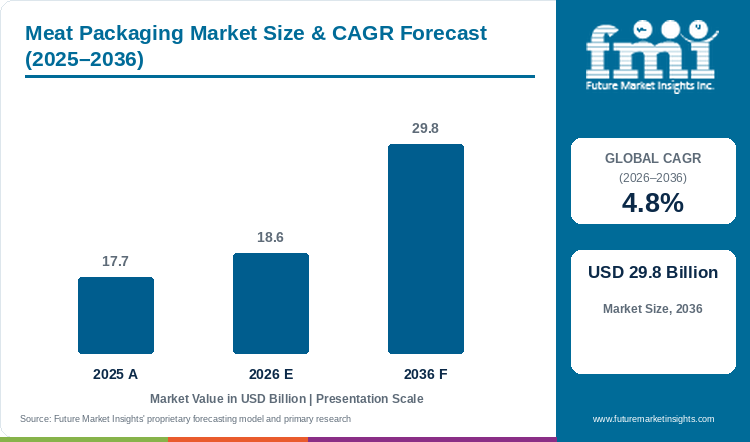
The meat packaging market is forecast to register a CAGR of 4.8% through 2036. Revenue increases from USD 17.7 billion in 2025 to USD 18.6 billion in 2026 before reaching USD 29.8 billion by 2036.
Centralized slaughterhouse fabrication and extended chilled freight networks compel meat processors to replace permeable manual wraps with automated high-barrier skin and vacuum packaging lines that eliminate oxygen contact. According to Future Market Insights analysis, global industry valuation stands at USD 17.7 billion in 2025, rises to USD 18.6 billion in 2026, and reaches USD 29.8 billion by 2036, expanding at a 4.8% CAGR and generating USD 11.2 billion in added market opportunity. Industrial processing hubs handling massive livestock throughput face severe financial penalties if purge leakage or micro-punctures induce bone-sour discoloration during transit. In April 2026, the United States Department of Agriculture National Agricultural Statistics Service reported commercial livestock production totaling 87.6 billion pounds across domestic cattle and hog facilities.[1] Vacuum packaging commands the leading position with a 44.0% share in 2026, as tight skin-tight barriers prevent microbial surface growth, though balancing bone-in puncture toughness with automated line speeds remains a continuous packaging plant challenge.
Key Market Trends & Insights
- By packaging type, vacuum packaging is projected to account for 44.0% in 2026, reflecting oxygen removal for primal cuts and retail portions.
- By material, PE/EVOH structures are estimated to hold 52.0% in 2026, supported by high-barrier oxygen protection across thin coextruded films.
- By application, fresh meat is expected to lead with 46.0% share in 2026, driven by case-ready retail tray volumes and self-service butcher displays.
Regional Highlights
- Fastest-growing evaluated country: Portugal records a 5.9% CAGR from 2026 to 2036, propelled by export meat processing modernization.
- By country: France at 5.4%, Italy at 5.0%, the USA at 4.6%, and Spain at 4.2% follow, while the United Kingdom records 3.8% CAGR under extended producer fees.
Market Size & Forecast
Table 1: Market Size and Forecast for the Meat Packaging Market (USD billion and CAGR percentage), 2025 to 2036
| Metric | Value |
|---|---|
| 2025 Market Size | USD 17.7 billion |
| Estimated Market Size in 2026 | USD 18.6 billion |
| Projected Market Size by 2036 | USD 29.8 billion |
| CAGR, 2026 to 2036 | 4.8% |
| Added Revenue, 2026 to 2036 | USD 11.2 billion |
Commercial conditions differ across the profiled countries owing to statutory packaging waste levies, recycling infrastructure compatibility, and export butchery scale. FMI research indicates that meat packaging converters are re-engineering multilayer flexible packaging structures to meet aggressive European circular economy directives. In the United States, municipal solid waste records compiled by the US Environmental Protection Agency show that containers and packaging represent 82.2 million tons, prompting supermarket chains to demand downgauged materials.[2] In Europe, statutory extended producer responsibility frameworks penalize hard-to-recycle barrier laminates with modulated disposal surcharges. These differing legal pressures prompt converters to supply recyclable mono-PE barrier pouches in Western Europe while delivering thick, puncture-resistant coextrusions to North American heavy-beef packers.
Installed Base and Pack-Volume Sizing
Table 2: Installed Base and Pack-Volume Sizing for the Meat Packaging Market (USD billion and percentages), mixed historical and forecast years from 2025 to 2036
| Metric | 2025 | 2026 | 2036 |
|---|---|---|---|
| Market size (USD billion) | 17.7 | 18.6 | 29.8 |
| Vacuum packaging revenue (USD billion) | 7.8 | 8.2 | 13.1 |
| PE/EVOH revenue (USD billion) | 9.2 | 9.7 | 15.5 |
| Fresh meat revenue (USD billion) | 8.1 | 8.6 | 13.7 |
Calculation basis: Segment revenues apply locked 2026 shares (44.0%, 52.0%, 46.0%) across forecast years as an illustrative sizing frame. According to FMI, the 2026 market value of USD 18.6 billion reflects protection-led procurement across meat supply chains.
Per-Unit and Facility Spending Indicators
Table 3: Per-Unit and Facility Spending Indicators for the Meat Packaging Market (USD), mixed historical and forecast years from 2025 to 2036
| Metric | 2025 | 2026 | 2036 |
|---|---|---|---|
| Meat processing facilities worldwide (thousand) | 12.5 | 13.0 | 15.5 |
| Market spend per facility (USD million) | 1.4 | 1.4 | 1.9 |
| Fresh meat spend per facility (USD million) | 0.6 | 0.7 | 0.9 |
| Vacuum packaging spend per facility (USD million) | 0.6 | 0.6 | 0.8 |
Table 4: Facility and Channel Spend Concentration for the Meat Packaging Market (USD billion and shares), 2026
| Metric | Value | Basis |
|---|---|---|
| Market size, 2026 | USD 18.6 billion | Report value |
| Vacuum packaging revenue, 2026 | USD 8.2 billion | 44.0% share |
| PE/EVOH revenue, 2026 | USD 9.7 billion | 52.0% share |
| Fresh meat revenue, 2026 | USD 8.6 billion | 46.0% share |
Calculation basis: Facility counts use a 2024 secondary estimate carried as a reference baseline. Per-facility figures divide report values by facility counts for the same year.
Analyst Perspective
“Meat processors will pay for sustainable barrier downgauging only when high-speed line efficiency and seal reliability remain intact. Converters qualifying recyclable mono-material barrier films across automated tray sealers will capture decisive multi-year supermarket contracts.”
- Nandini Roy Choudhury, Principal Consultant, Future Market Insights.
How is the meat packaging market segmented?
Meat packaging is segmented by six primary commercial axes and region: packaging type, material, application, meat type, distribution channel, end user, and region. Vacuum packaging, PE/EVOH, and fresh meat are projected to hold 44.0%, 52.0%, and 46.0% shares in 2026.
By packaging type: vacuum packaging, modified atmosphere packaging, vacuum skin packaging, shrink packaging, overwrap, and other formats.
By material: PE/EVOH, PET, polypropylene, polyamide, paper and paperboard, aluminum, and other materials.
By application: fresh meat, processed meat, frozen meat, and ready-to-cook meat products.
By meat type: beef, pork, poultry, lamb and mutton, and other meat.
By distribution channel: supermarkets and hypermarkets, specialty meat stores, foodservice, online retail, and other channels.
By end user: meat processors, slaughterhouses, retailers, foodservice operators, and exporters.
Why does vacuum packaging retain processor preference in packaging type?
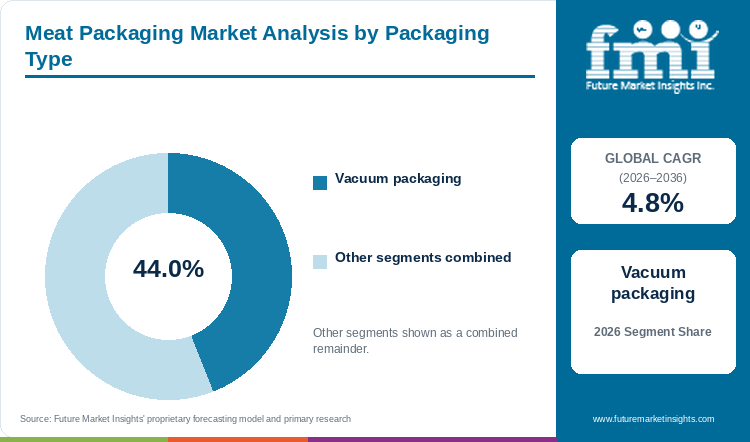
Vacuum packaging is expected to command 44.0% of packaging type revenue in 2026, owing to headspace oxygen evacuation and tight meat surface adhesion.
Table 5: Packaging Type Share for the Meat Packaging Market (percentage share), 2026
| Packaging Type | Share (2026) |
|---|---|
| Vacuum packaging | 44.0% |
| Other formats combined | 56.0%* |
| Total | 100.0% |
*Calculated as the balance remaining after deducting the leading segment's reported share from 100.0%.
Table 6: Packaging Type Leadership and Market Growth for the Meat Packaging Market (segment and CAGR percentage), 2026 to 2036
| Metric | Value |
|---|---|
| Leading packaging type, 2026 | Vacuum packaging, 44.0% |
| Market CAGR, 2026 to 2036 | 4.8% |
| Added market revenue, 2026 to 2036 | USD 11.2 billion |
Automated vacuum evacuation draws flexible barrier film directly against irregular meat contours, eliminating residual aerobic cavities that accelerate lipid oxidation and bacterial proliferation. Primal meat processors integrate automated rotary chamber packaging and vacuum skin packaging to preserve deep myoglobin bloom and inhibit package purge loss during 40-day marine container shipments. The format resists severe handling abrasion during multi-pallet warehousing and container un-stuffing. High machine cycle rates and reliable thermal sealing make vacuum packaging the gold standard for enterprise abattoirs seeking to minimize in-transit shrink rates.
- By packaging type, vacuum packaging is forecast to represent 44.0% in 2026, underpinned by consistent barrier integrity across heavy primal beef and pork cuts.
- In September 2025, Sealed Air Corporation completed commercial installation of its 4,000th CRYOVAC rotary vacuum chamber system for industrial protein processors.[4]
What supports PE/EVOH structures as the preferred material choice?
PE/EVOH structures are estimated to hold 52.0% of material demand in 2026, supported by exceptional gas barrier performance and dependable heat sealing on high-speed lines.
Coextruding ethylene vinyl alcohol (EVOH) cores within polyethylene (PE) exterior skins provides an impermeable gas barrier in ultra-thin gauges without requiring costly aluminum foil layers. These advanced multi-layer barrier films prevent atmospheric oxygen transmission while retaining moisture inside the packaging envelope. Polyethylene seal layers melt predictably across broad heat-sealing windows, facilitating hermetic seam closures even through accidental fat or blood contamination on sealing jaws. The mechanical puncture resistance of PE outer films shields meat from sharp bone fragments, drastically reducing pinhole leakages during transport.
- PE/EVOH is set to lead material demand with 52.0% share in 2026, linked to sealability, low oxygen transmission rates, and high-speed web machinability.
- In January 2026, Amcor plc expanded its North American protein barrier film range, featuring certified thin-gauge EVOH barrier structures for fresh red meat.[5]
How does fresh meat sustain demand within the application category?
Fresh meat is projected to hold 46.0% of application revenue in 2026, driven by case-ready retail packaging and centralized supermarket portioning programs.
Supermarket chains are systematically eliminating in-store butcher rooms in favor of centralized case-ready packaging facilities where fresh steaks, chops, and ground meats are portioned and sealed in protective master trays. Case-ready formats ensure strict sanitation control, reduce back-of-store skilled butchery labor expenses, and extend retail display shelf life by up to 14 days. Absorbent pads and anti-fog barrier lidding films ensure crystal-clear product visibility in self-service upright chillers, appealing directly to convenience-driven supermarket shoppers. Retailers consistently reorder certified case-ready packaging systems as documented store markdown losses drop substantially.
- Fresh meat is likely to capture 46.0% share in 2026, attributed to chilled retail turnover and corporate transition toward centralized case-ready supply chains.
- In April 2026, USDA National Agricultural Statistics Service cattle slaughter records confirmed sustained high-volume livestock marketings driving centralized retail tray demand.[6]
What drives, restrains, and opens opportunity in meat packaging?
As reported by FMI, longer chilled distribution routes expand protective packaging demand, mixed multilayer structures hinder circular recycling, and mono-material barrier films create substantial commercial opportunity.
- Driver: Centralized butchery and extended cold chains increase demand for vacuum, skin, and modified atmosphere packaging that prevents oxygen degradation and leakage.
- Restraint: Multilayer barrier laminates containing incompatible polymers resist mechanical recycling sortation, attracting heavy statutory extended producer responsibility taxes.
- Opportunity: Formulating recyclable mono-material polyethylene and polypropylene barrier structures allows converters to capture long-term retail supermarket contracts.
Growth Analysis and Future Potential: Qualitative Demand Catalysts
Supermarket distribution centers require fresh protein packaging that withstands prolonged inter-state refrigeration transport without seal failure or purge seepage. Industrial meat packers are expanding deployment of automated modified atmosphere packaging and vacuum thermoforming systems to preserve product freshness across extended multi-week supply networks. In February 2025, the European Union published Regulation (EU) 2025/40 on packaging and packaging waste, establishing mandatory recycling design criteria for food packaging.[7] Compliance readiness is transforming packaging selection into a board-level procurement issue. Meat processing enterprises that demonstrate superior package barrier resilience and leak reduction secure multi-year supply contracts across multinational grocery retailers.
Risk Assessment of the Meat Packaging Market: Operational and Material Friction
Traditional multi-material barrier laminates incorporating EVOH, polyamide, and polyethylene present severe technical hurdles during municipal mechanical recycling sorting. When composite films pass through automated optical sorters, immiscible polymers blend together, severely degrading the tensile strength of recycled resin pellets. In July 2025, Japan's Ministry of Economy, Trade and Industry released plastic packaging recycling assessments indicating that over 57% of collected flexible food packaging films suffered contamination downgrades.[8] Regulatory bodies across Europe and Asia are introducing punitive eco-modulation disposal fees on non-recyclable multi-material pouches. Converters unable to transition to mono-material alternatives face immediate margin compression as brand owners pass disposal taxes back onto packaging suppliers.
Commercial Opportunity Analysis: Material Differentiation and Value-Add Formats
Substantial competitive advantage accrues to packaging converters that successfully engineer certified recyclable mono-PE and mono-PP high-barrier films for fresh meat. FMI analysis finds that brand owners are willing to pay packaging premiums for sustainable packaging that qualifies for Class A recyclability grading without compromising shelf life. In November 2025, Amcor plc announced a strategic capital expansion of oriented polyethylene barrier film lines designed specifically for fresh protein packaging applications.[9] Processors adopting these advanced recyclable webs reduce their environmental compliance taxes while securing preferred listing status across major corporate retail accounts.
Meat Packaging Market by Country (2026 to 2036)
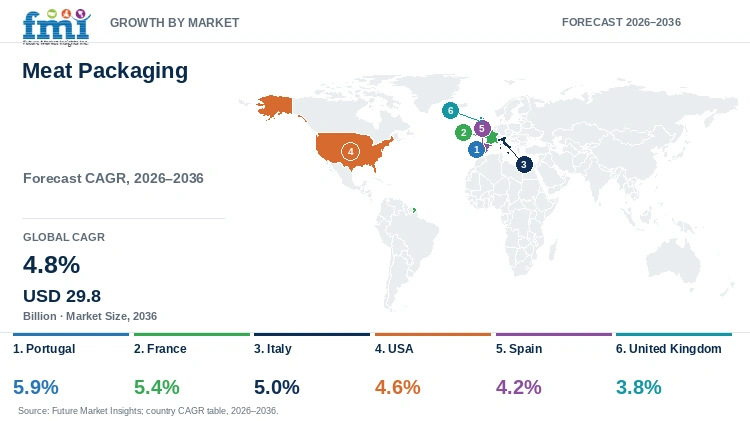
As per Future Market Insights, six evaluated country outlooks range across the forecast period, led by Portugal at a 5.9% CAGR and France at 5.4%, while the United Kingdom records a 3.8% CAGR under extended producer responsibility regulations. Commercial performance across each nation is determined by export slaughterhouse capacity, statutory recycling mandates, and retail butchery automation.
Table 7: Country CAGR and Primary Growth Levers for the Meat Packaging Market (CAGR percentage and operational drivers), 2026 to 2036
| Country | CAGR (2026 to 2036) | Primary Growth Lever |
|---|---|---|
| Portugal | 5.9% | Export food processing and packaging compliance |
| France | 5.4% | Regulated processing and material redesign |
| Italy | 5.0% | Agri-food base and regional products |
| USA | 4.6% | Scale and automated processing |
| Spain | 4.2% | Meat exports and packaging responsibility |
| United Kingdom | 3.8% | Regulatory replacement and fee modulation |
Source: Author analysis of evaluated economies, 2026 to 2036
Portugal Meat Packaging Market Outlook (2026 to 2036)
Portugal's meat packaging sector is anticipated to advance at a leading 5.9% CAGR through 2036, propelled by rapid modernization of domestic export meat processing plants. In April 2025, USDA Foreign Agricultural Service assessments documented that Portuguese food processing ingredient imports expanded to USD 19.4 billion, reflecting aggressive facility upgrades.[10] Portuguese pork and poultry processors are replacing traditional butcher paper with high-barrier thermoformed vacuum packs to access lucrative European export markets. Smaller domestic converters face resin price swings, yet abattoirs continue investing in automated packaging machinery to cut labor expenses and ensure sanitary compliance.
Key takeaway: In Portugal, accelerating meat export throughput and sanitary plant upgrades drive automated vacuum and thermoforming packaging investments.
France Meat Packaging Market Outlook (2026 to 2036)
The French meat packaging market is forecast to rise at a 5.4% CAGR through 2036, shaped by rigorous official veterinary sanitary controls and statutory packaging waste elimination laws. In July 2026, European Commission health and food audit reports confirmed that French meat processing facilities enforce strict hygiene and traceability frameworks.[11] National AGEC circular economy regulations penalize non-recyclable multi-material films, compelling charcuterie and beef packers to evaluate high-barrier shrink packaging and mono-PE lidding webs. Leading processors partner with certified packaging converters to test mono-material films across convection heat tunnels, maintaining product shelf life while satisfying national waste minimization targets.
Key takeaway: In France, strict veterinary traceability oversight and AGEC plastic reduction mandates compel meat packers to transition toward certified recyclable barrier films.
Italy Meat Packaging Market Outlook (2026 to 2036)
Italy is estimated to expand at a 5.0% CAGR over the assessment period, anchored by its world-renowned cured meat and charcuterie manufacturing heritage. European Commission agricultural economic data published in July 2026 showed that the Italian agri-food sector contributes approximately 15% of national gross domestic product.[12] Producers of prosciutto, bresaola, and specialty cured meats require vacuum skin packaging that protects delicate marbling and thin slicing aesthetics while preventing lipid oxidation. Converters supply fiber-hybrid trays lined with peelable barrier films to Italian packers, delivering dignified artisanal presentation alongside verified material circularity.
Key takeaway: In Italy, premium cured charcuterie traditions demand high-clarity vacuum skin packaging and fiber-hybrid barrier trays that showcase artisanal product presentation.
USA Meat Packaging Market Outlook (2026 to 2036)
The United States meat packaging sector is projected to record a 4.6% CAGR through 2036, driven by massive centralized beef fabrication lines and high-velocity retail distribution. In April 2026, USDA National Agricultural Statistics Service reported steady commercial cattle and hog marketings anchoring national meat processing volumes.[13] Meat processors ship case-ready retail packages inside heavy-duty, moisture-resistant corrugated packaging master cartons engineered to withstand refrigerated pallet stacking. Supermarket chains consolidate vendor lists around converters that supply automated leak-proof vacuum skin films, minimizing markdowns and reducing distribution center shrink.
Key takeaway: In the USA, unmatched slaughterhouse fabrication volumes and automated retail tray lines reward converters supplying durable, puncture-resistant barrier films.
Spain Meat Packaging Market Outlook (2026 to 2036)
Spain is estimated to post a 4.2% CAGR across the forecast period, supported by massive pork export infrastructure and statutory packaging waste reforms under Royal Decree 1055/2022.[14] Spanish abattoirs supplying international markets require puncture-resistant barrier pouches capable of surviving 30-day transoceanic freight without seal failures. Concurrently, national packaging regulations penalize hard-to-recycle laminates, driving packers to adopt recyclable mono-polyethylene barrier webs. Spanish meat conglomerates are converting multi-layer rollstock machinery to run certified mono-material films, ensuring export durability while avoiding domestic environmental fines.
Key takeaway: In Spain, massive pork export logistics and statutory extended producer taxes compel processors to transition toward puncture-resistant, recyclable mono-material barrier webs.
United Kingdom Meat Packaging Market Outlook (2026 to 2036)
The United Kingdom market is projected to expand at a 3.8% CAGR through 2036, heavily influenced by statutory Extended Producer Responsibility fee modulation schedules. In July 2026, House of Commons Library briefings confirmed that national packaging EPR fees assign substantial tax surcharges to multi-material barrier laminates.[15] British supermarket chains demand that meat suppliers transition completely to mono-material PET and PE case-ready trays to avoid severe disposal fee penalties. Packaging converters that engineer certified fully recyclable barrier trays secure preferred long-term supply contracts across major UK supermarket groups.
Key takeaway: In the UK, mandatory EPR disposal fee modulation accelerates supermarket procurement of certified mono-material case-ready meat packaging trays.
Full report country CAGRs cover North America plus Latin America and Western Europe. Coverage also includes Eastern Europe plus East Asia and South Asia and Pacific. Middle East and Africa close the regional set for the assessment.
Who are the notable companies in the meat packaging market?
Notable companies include Amcor plc, Sealed Air Corporation, Mondi plc, Huhtamaki Oyj, Sonoco Products Company, Smurfit Westrock plc, Winpak Ltd., and Coveris Holdings S.A.
Future Market Insights analysis indicates that the competitive landscape in meat packaging divides across integrated multinational flexible film converters and paperboard packaging specialists. Multinational film converters compete through proprietary multi-layer barrier coextrusion, puncture-resistant shrink formulations, and global field engineering support. Concurrently, fiber packaging conglomerates supply certified recyclable corrugated master cartons and fiber-hybrid tray bases. An FMI analyst notes that meat processing enterprises select packaging partners based on automated tray-sealer line speeds, verified oxygen barrier ratings, and compliance with statutory recycling mandates.
- High-barrier flexible and vacuum packaging platforms: Amcor plc, Sealed Air Corporation, Winpak Ltd., and Coveris Holdings S.A.
- Corrugated master carton and fiber tray converters: Mondi plc, Smurfit Westrock plc, and Huhtamaki Oyj.
- Rigid paper container and specialty composite packaging converters: Sonoco Products Company.
Competitive Benchmarking: Meat Packaging Market
Table 8: Competitive Benchmarking for the Meat Packaging Market (qualitative capability ratings), 2026
| Company | Portfolio breadth | Current activity | Geographic reach |
|---|---|---|---|
| Amcor plc | High | High | High |
| Sealed Air Corporation | High | High | High |
| Mondi plc | High | High | High |
| Huhtamaki Oyj | High | Medium | High |
| Sonoco Products Company | High | High | High |
| Smurfit Westrock plc | High | Medium | High |
| Winpak Ltd. | Medium | Medium | Medium |
| Coveris Holdings S.A. | Medium | Medium | Medium |
Scoring basis: High indicates broad evidence across the rated aspect; Medium indicates a focused or regional position; Low indicates limited public evidence. Ratings do not represent quality or market share.
Key Developments in the Meat Packaging Market
- In September 2026, Dow and Amcor launched a strategic partnership to accelerate circular low-carbon polyethylene packaging for global food accounts.[16]
- In April 2026, Sealed Air Corporation completed its private transaction acquisition by Clayton, Dubilier & Rice under a revamped capital structure.[17]
- In November 2025, Mondi plc unveiled an expanded food-contact corrugated and solid board portfolio following integration of Schumacher capabilities.[18]
- In April 2025, Amcor completed its combination with Berry Global, creating a comprehensive global consumer packaging platform.[19]
Key Players in the Meat Packaging Market
Barrier Films, Vacuum Systems, and Lidding
- Amcor plc
- Sealed Air Corporation
- Winpak Ltd.
- Coveris Holdings S.A.
Fiber, Corrugated, and Secondary Packaging
- Mondi plc
- Smurfit Westrock plc
- Huhtamaki Oyj
Rigid and Metal Packaging
- Sonoco Products Company
- Amcor plc
- Huhtamaki Oyj
Meat Packaging Market - Report Scope
Table 9: Report Scope for the Meat Packaging Market (coverage fields and definitions), 2026 to 2036
| Scope item | Coverage |
|---|---|
| Base year | 2025 |
| Forecast start | 2026 |
| Forecast end | 2036 |
| Market unit | USD billion |
| Commercial axes | Packaging type; material; application; meat type; distribution channel; end user |
| Regions | North America; Latin America; Western Europe; Eastern Europe; East Asia; South Asia and Pacific; Middle East and Africa |
| Included | Films, trays, bags, wraps, cases, labels, and directly related meat-packaging formats |
| Excluded | Meat-processing machinery sold without packaging, general logistics equipment, and beverage-only packaging |
Meat Packaging Market - Research Methodology
Table 10: Research Methodology for the Meat Packaging Market (research methods and approach), 2026 edition
| Method | Approach |
|---|---|
| Primary Research | Primary interviews were conducted with manufacturers, suppliers and distributors plus procurement teams and subject-matter experts across processing and converting operations. |
| Secondary Research | Secondary research included company annual reports, investor presentations, regulatory publications, industry associations, technical papers, trade journals, company websites, product literature, and other publicly available sources relevant to the market. |
| Market Sizing and Forecasting | Market sizing and forecasting for the 2026 to 2036 forecast period were developed using top-down and bottom-up approaches across packaging type, material, and application demand. |
| Data Triangulation and Validation | Data is validated against macro-economic indicators, meat production drivers, regulatory timelines, and historical trend analysis to support accuracy without double counting adjacent categories. |
Methods combine primary interviews with manufacturers, suppliers, and converters plus desk research across government trade databases. Sizing models reconcile historical baseline sales, packaging line conversions, and material substitution trends to generate 2026 to 2036 market forecasts.
Meat Packaging Market by Segments
Meat Packaging Market segmented by Packaging Type:
- Vacuum packaging
- Modified atmosphere packaging
- Vacuum skin packaging
- Shrink packaging
- Overwrap
- Other formats
Meat Packaging Market segmented by Material:
- PE/EVOH
- PET
- Polypropylene
- Polyamide
- Paper and paperboard
- Aluminum
- Other materials
Meat Packaging Market segmented by Application:
- Fresh meat
- Processed meat
- Frozen meat
- Ready-to-cook meat products
Meat Packaging Market segmented by Meat Type:
- Beef
- Pork
- Poultry
- Lamb and mutton
- Other meat
Meat Packaging Market segmented by Distribution Channel:
- Supermarkets and hypermarkets
- Specialty meat stores
- Foodservice
- Online retail
- Other channels
Meat Packaging Market segmented by End User:
- Meat processors
- Slaughterhouses
- Retailers
- Foodservice operators
- Exporters
Meat Packaging Market by Region
- North America
- United States
- Canada
- United States
- Canada
- Latin America
- Brazil
- Mexico
- Argentina
- Chile
- Brazil
- Mexico
- Argentina
- Chile
- Western Europe
- Germany
- France
- United Kingdom
- Italy
- Spain
- Benelux
- Nordics
- Germany
- France
- United Kingdom
- Italy
- Spain
- Benelux
- Nordics
- Eastern Europe
- Poland
- Czech Republic
- Romania
- Hungary
- Poland
- Czech Republic
- Romania
- Hungary
- East Asia
- China
- Japan
- South Korea
- China
- Japan
- South Korea
- South Asia and Pacific
- India
- ASEAN
- Australia and New Zealand
- India
- ASEAN
- Australia and New Zealand
- Middle East and Africa
- GCC Countries
- South Africa
- Türkiye
- Israel
- GCC Countries
- South Africa
- Türkiye
- Israel
Research Sources and Bibliography
- [1] United States Department of Agriculture, National Agricultural Statistics Service. (2026, April 30). Meat animals production, disposition, and income: 2025 summary. USDA NASS Statistical Reports.
- [2] United States Environmental Protection Agency. (2025, October 23). Containers and packaging: Product-specific data and municipal solid waste trends. U.S. EPA Facts and Figures.
- [3] Flexible Packaging Association. (2025, July). State of the Flexible Packaging Industry Report: Performance metrics, resin utilization, and sustainability benchmarking. FPA Research Publications.
- [4] Sealed Air Corporation. (2025, September 9). CRYOVAC brand food packaging installs 4,000th rotary vacuum packaging system worldwide. Sealed Air Corporate News.
- [5] Amcor plc. (2026, January). Meat, poultry and seafood packaging solutions: Barrier film specifications and shelf-life indicators. Amcor North America Technical Product Bulletin.
- [6] United States Department of Agriculture, National Agricultural Statistics Service. (2026, April 30). Cattle and calves marketings, livestock disposition, and meatpacking throughput, 2025. USDA NASS Agricultural Statistics.
- [7] European Parliament and Council. (2025, February 11). Regulation (EU) 2025/40 on packaging and packaging waste, amending Regulation (EU) 2019/1020. Official Journal of the European Union, L 2025/40.
- [8] Ministry of Economy, Trade and Industry, Japan. (2025, July). Plastic container and packaging recycling: Industrial challenges, sortation limits, and policy measures. METI Technical Policy Reviews.
- [9] Amcor plc. (2025, November 15). Strategic expansion of high-barrier flexible packaging capabilities in North America for fresh protein lines. Amcor Media Centre.
- [10] United States Department of Agriculture, Foreign Agricultural Service. (2025, April 10). Food processing ingredients report 2025: Portugal. USDA FAS GAIN Report PO2025-0004.
- [11] European Commission, Directorate-General for Health and Food Safety. (2026, July 7). Final report of an audit of France carried out from 12 to 30 September 2025 on official veterinary controls in meat processing. EC Health and Food Audits.
- [12] European Commission. (2026, July 24). Italy: CAP strategic plan facts and figures, agri-food economic contribution, and processing infrastructure. EC Agriculture and Rural Development.
- [13] United States Department of Agriculture, National Agricultural Statistics Service. (2026, April 30). Commercial slaughter and livestock processing volume summary. USDA NASS Reports.
- [14] Government of Spain, Ministry for the Ecological Transition. (2025, May). Royal Decree 1055/2022 on packaging and packaging waste: Implementation guidelines and commercial food packaging requirements. Official State Gazette.
- [15] House of Commons Library. (2026, July 29). Packaging extended producer responsibility: Regulatory frameworks, registration, and fee modulation in Great Britain. UK Parliament Research Briefing CBP-9781.
- [16] Dow Inc. (2026, September 17). Dow and Amcor launch strategic collaboration to accelerate adoption of circular low-carbon packaging solutions. Dow Corporate Press Releases.
- [17] Sealed Air Corporation. (2026, April 9). Sealed Air announces completion of acquisition by Clayton, Dubilier & Rice. Sealed Air Corporate News.
- [18] Mondi plc. (2025, November 18). Mondi launches extended corrugated and solid board portfolio for the food packaging industry. Mondi Press Releases.
- [19] Amcor plc. (2025, April 30). Amcor completes combination with Berry Global to create a premier global consumer packaging company. Amcor Corporate News.
This bibliography is provided for reader reference. The full report contains the complete reference list and detailed citations.
This Report Answers
- What is the meat packaging market value expected during 2026?
- How much will the meat packaging market reach by 2036?
- Which packaging type holds a notable 2026 revenue share?
- Which material category leads the meat packaging market in 2026?
- Which application segment holds a notable 2026 revenue share?
- Which country shows a notable meat packaging expansion outlook?
- Which companies are active in the global meat packaging market?
- What should buyers evaluate before purchasing meat packaging systems?
Frequently Asked Questions
What is the global meat packaging market size in 2026?
As per FMI, the meat packaging market is valued at USD 18.6 billion in 2026 and is projected to reach USD 29.8 billion by 2036, advancing at a 4.8% CAGR over the assessment period.
What is the meat packaging market CAGR through 2036?
The market is forecast to grow at a 4.8% CAGR between 2026 and 2036, generating USD 11.2 billion in added revenue driven by case-ready retail packaging and cold-chain shelf-life extension.
Which packaging type leads the market in 2026?
Vacuum packaging is projected to represent 44.0% of packaging type revenue in 2026, benefiting from tight skin adhesion that eliminates oxygen pockets and suppresses surface spoilage.
Which material holds a notable market share in 2026?
PE/EVOH structures are estimated to capture 52.0% of material revenue in 2026, supported by unmatched oxygen barrier protection and dependable heat sealability across high-speed form-fill-seal equipment.
Which country has a notable expansion outlook?
Future Market Insights projects Portugal to record the highest evaluated growth rate at a 5.9% CAGR through 2036, driven by meat export processing facility upgrades and compliance modernization.
Which companies are notable in meat packaging?
Notable industry participants include Amcor plc, Sealed Air Corporation, Mondi plc, Huhtamaki Oyj, Sonoco Products Company, Smurfit Westrock plc, Winpak Ltd., and Coveris Holdings S.A.
Preview the report firsthand - request a free sample
Get SampleGet the brochure for pricing and purchase details.
Get PDFTable of Content
- Key Takeaways
- Market Size and CAGR
- Top Growth Driver
- Fastest Growing Segment
- Leading Region
- Key Companies
- Emerging Opportunities
- Executive Summary
- Global Market Outlook
- Demand-side Trends
- Supply-side Trends
- Technology Roadmap Analysis
- Analysis and Recommendations
- Analyst Perspective (What is happening? Why now? What should investors know?)
- Key Questions Answered
- How large is the market?
- What is the CAGR?
- What are key trends?
- Which region dominates?
- Who are the leaders?
- Market Overview
- Market Coverage / Taxonomy
- Market Definition / Scope / Limitations
- Research Methodology
- Chapter Orientation
- Analytical Lens and Working Hypotheses
- Market Structure, Signals, and Trend Drivers
- Benchmarking and Cross-market Comparability
- Market Sizing, Forecasting, and Opportunity Mapping
- Research Design and Evidence Framework
- Desk Research Programme (Secondary Evidence)
- Expert Input and Fieldwork (Primary Evidence)
- Tooling, Models, and Reference Databases
- Data Engineering and Model Build
- Quality Assurance and Audit Trail
- Market Background
- Market Dynamics (Drivers, Restraints, Opportunity, Trends)
- Scenario Forecast (Optimistic, Likely, Conservative)
- Impact Analysis
- AI Impact
- Sustainability Impact
- Regulatory Impact
- Technology Impact
- Consumer / Buyer Analysis
- Purchase Drivers
- Adoption Barriers
- Buyer Journey
- Opportunity Map Analysis
- Product Life Cycle Analysis
- Supply Chain Analysis
- Investment Feasibility Matrix
- Value Chain Analysis
- PESTLE and Porter's Analysis
- Regulatory Landscape
- Regional Parent Market Outlook
- Production and Consumption Statistics
- Import and Export Statistics
- Global Market Analysis and Forecast, 2021 to 2036
- Historical Market Size Value (USD Billion) Analysis, 2021 to 2025
- Current and Future Market Size Value (USD Billion) Projections, 2026 to 2036
- Y-o-Y Growth Trend Analysis
- Absolute $ Opportunity Analysis
- Global Market Pricing Analysis, 2021 to 2036
- Global Market Analysis and Forecast, By Packaging Type, 2021 to 2036
- Introduction / Key Findings
- Historical Market Size Value (USD Billion) Analysis By Packaging Type, 2021 to 2025
- Current and Future Market Size Value (USD Billion) Analysis and Forecast By Packaging Type, 2026 to 2036
- Vacuum packaging
- Modified atmosphere packaging
- Vacuum skin packaging
- Shrink packaging
- Overwrap
- Other formats
- Y-o-Y Growth Trend Analysis By Packaging Type, 2021 to 2025
- Absolute $ Opportunity Analysis By Packaging Type, 2026 to 2036
- Global Market Analysis and Forecast, By Material, 2021 to 2036
- Introduction / Key Findings
- Historical Market Size Value (USD Billion) Analysis By Material, 2021 to 2025
- Current and Future Market Size Value (USD Billion) Analysis and Forecast By Material, 2026 to 2036
- PE/EVOH
- PET
- Polypropylene
- Polyamide
- Paper and paperboard
- Aluminum
- Other materials
- Y-o-Y Growth Trend Analysis By Material, 2021 to 2025
- Absolute $ Opportunity Analysis By Material, 2026 to 2036
- Global Market Analysis and Forecast, By Application, 2021 to 2036
- Introduction / Key Findings
- Historical Market Size Value (USD Billion) Analysis By Application, 2021 to 2025
- Current and Future Market Size Value (USD Billion) Analysis and Forecast By Application, 2026 to 2036
- Fresh meat
- Processed meat
- Frozen meat
- Ready-to-cook meat products
- Y-o-Y Growth Trend Analysis By Application, 2021 to 2025
- Absolute $ Opportunity Analysis By Application, 2026 to 2036
- Global Market Analysis and Forecast, By Meat Type, 2021 to 2036
- Introduction / Key Findings
- Historical Market Size Value (USD Billion) Analysis By Meat Type, 2021 to 2025
- Current and Future Market Size Value (USD Billion) Analysis and Forecast By Meat Type, 2026 to 2036
- Beef
- Pork
- Poultry
- Lamb and mutton
- Other meat
- Y-o-Y Growth Trend Analysis By Meat Type, 2021 to 2025
- Absolute $ Opportunity Analysis By Meat Type, 2026 to 2036
- Global Market Analysis and Forecast, By Distribution Channel, 2021 to 2036
- Introduction / Key Findings
- Historical Market Size Value (USD Billion) Analysis By Distribution Channel, 2021 to 2025
- Current and Future Market Size Value (USD Billion) Analysis and Forecast By Distribution Channel, 2026 to 2036
- Supermarkets and hypermarkets
- Specialty meat stores
- Foodservice
- Online retail
- Other channels
- Y-o-Y Growth Trend Analysis By Distribution Channel, 2021 to 2025
- Absolute $ Opportunity Analysis By Distribution Channel, 2026 to 2036
- Global Market Analysis and Forecast, By End User, 2021 to 2036
- Introduction / Key Findings
- Historical Market Size Value (USD Billion) Analysis By End User, 2021 to 2025
- Current and Future Market Size Value (USD Billion) Analysis and Forecast By End User, 2026 to 2036
- Meat processors
- Slaughterhouses
- Retailers
- Foodservice operators
- Exporters
- Y-o-Y Growth Trend Analysis By End User, 2021 to 2025
- Absolute $ Opportunity Analysis By End User, 2026 to 2036
- Global Market Analysis and Forecast, By Region, 2021 to 2036
- Introduction
- Historical Market Size Value (USD Billion) Analysis By Region, 2021 to 2025
- Current Market Size Value (USD Billion) Analysis and Forecast By Region, 2026 to 2036
- North America
- Latin America
- Western Europe
- Eastern Europe
- East Asia
- South Asia and Pacific
- Middle East and Africa
- Market Attractiveness Analysis By Region
- North America Market Analysis and Forecast, By Country, 2021 to 2036
- Historical Market Size Value (USD Billion) Trend Analysis By Market Taxonomy, 2021 to 2025
- Market Size Value (USD Billion) Forecast By Market Taxonomy, 2026 to 2036
- By Country
- United States
- Canada
- By Packaging Type
- By Material
- By Application
- By Meat Type
- By Distribution Channel
- By End User
- By Country
- Market Attractiveness Analysis
- By Country
- By Packaging Type
- By Material
- By Application
- By Meat Type
- By Distribution Channel
- By End User
- Key Takeaways
- Latin America Market Analysis and Forecast, By Country
- Historical Market Size Value (USD Billion) Trend Analysis By Market Taxonomy, 2021 to 2025
- Market Size Value (USD Billion) Forecast By Market Taxonomy, 2026 to 2036
- By Country
- Brazil
- Mexico
- Argentina
- Chile
- By Packaging Type
- By Material
- By Application
- By Meat Type
- By Distribution Channel
- By End User
- By Country
- Market Attractiveness Analysis
- By Country
- By Packaging Type
- By Material
- By Application
- By Meat Type
- By Distribution Channel
- By End User
- Key Takeaways
- Western Europe Market Analysis and Forecast, By Country
- Historical Market Size Value (USD Billion) Trend Analysis By Market Taxonomy, 2021 to 2025
- Market Size Value (USD Billion) Forecast By Market Taxonomy, 2026 to 2036
- By Country
- Germany
- France
- United Kingdom
- Italy
- Spain
- Benelux
- Nordics
- By Packaging Type
- By Material
- By Application
- By Meat Type
- By Distribution Channel
- By End User
- By Country
- Market Attractiveness Analysis
- By Country
- By Packaging Type
- By Material
- By Application
- By Meat Type
- By Distribution Channel
- By End User
- Key Takeaways
- Eastern Europe Market Analysis and Forecast, By Country
- Historical Market Size Value (USD Billion) Trend Analysis By Market Taxonomy, 2021 to 2025
- Market Size Value (USD Billion) Forecast By Market Taxonomy, 2026 to 2036
- By Country
- Poland
- Czech Republic
- Romania
- Hungary
- By Packaging Type
- By Material
- By Application
- By Meat Type
- By Distribution Channel
- By End User
- By Country
- Market Attractiveness Analysis
- By Country
- By Packaging Type
- By Material
- By Application
- By Meat Type
- By Distribution Channel
- By End User
- Key Takeaways
- East Asia Market Analysis and Forecast, By Country
- Historical Market Size Value (USD Billion) Trend Analysis By Market Taxonomy, 2021 to 2025
- Market Size Value (USD Billion) Forecast By Market Taxonomy, 2026 to 2036
- By Country
- China
- Japan
- South Korea
- By Packaging Type
- By Material
- By Application
- By Meat Type
- By Distribution Channel
- By End User
- By Country
- Market Attractiveness Analysis
- By Country
- By Packaging Type
- By Material
- By Application
- By Meat Type
- By Distribution Channel
- By End User
- Key Takeaways
- South Asia and Pacific Market Analysis and Forecast, By Country
- Historical Market Size Value (USD Billion) Trend Analysis By Market Taxonomy, 2021 to 2025
- Market Size Value (USD Billion) Forecast By Market Taxonomy, 2026 to 2036
- By Country
- India
- ASEAN
- Australia and New Zealand
- By Packaging Type
- By Material
- By Application
- By Meat Type
- By Distribution Channel
- By End User
- By Country
- Market Attractiveness Analysis
- By Country
- By Packaging Type
- By Material
- By Application
- By Meat Type
- By Distribution Channel
- By End User
- Key Takeaways
- Middle East and Africa Market Analysis and Forecast, By Country
- Historical Market Size Value (USD Billion) Trend Analysis By Market Taxonomy, 2021 to 2025
- Market Size Value (USD Billion) Forecast By Market Taxonomy, 2026 to 2036
- By Country
- GCC Countries
- South Africa
- Türkiye
- Israel
- By Packaging Type
- By Material
- By Application
- By Meat Type
- By Distribution Channel
- By End User
- By Country
- Market Attractiveness Analysis
- By Country
- By Packaging Type
- By Material
- By Application
- By Meat Type
- By Distribution Channel
- By End User
- Key Takeaways
- Key Countries Market Analysis
- United States
- Pricing Analysis
- Market Share Analysis, 2025
- By Packaging Type
- By Material
- By Application
- By Meat Type
- By Distribution Channel
- By End User
- Canada
- Pricing Analysis
- Market Share Analysis, 2025
- By Packaging Type
- By Material
- By Application
- By Meat Type
- By Distribution Channel
- By End User
- Mexico
- Pricing Analysis
- Market Share Analysis, 2025
- By Packaging Type
- By Material
- By Application
- By Meat Type
- By Distribution Channel
- By End User
- Brazil
- Pricing Analysis
- Market Share Analysis, 2025
- By Packaging Type
- By Material
- By Application
- By Meat Type
- By Distribution Channel
- By End User
- Chile
- Pricing Analysis
- Market Share Analysis, 2025
- By Packaging Type
- By Material
- By Application
- By Meat Type
- By Distribution Channel
- By End User
- Germany
- Pricing Analysis
- Market Share Analysis, 2025
- By Packaging Type
- By Material
- By Application
- By Meat Type
- By Distribution Channel
- By End User
- United Kingdom
- Pricing Analysis
- Market Share Analysis, 2025
- By Packaging Type
- By Material
- By Application
- By Meat Type
- By Distribution Channel
- By End User
- Italy
- Pricing Analysis
- Market Share Analysis, 2025
- By Packaging Type
- By Material
- By Application
- By Meat Type
- By Distribution Channel
- By End User
- Spain
- Pricing Analysis
- Market Share Analysis, 2025
- By Packaging Type
- By Material
- By Application
- By Meat Type
- By Distribution Channel
- By End User
- France
- Pricing Analysis
- Market Share Analysis, 2025
- By Packaging Type
- By Material
- By Application
- By Meat Type
- By Distribution Channel
- By End User
- India
- Pricing Analysis
- Market Share Analysis, 2025
- By Packaging Type
- By Material
- By Application
- By Meat Type
- By Distribution Channel
- By End User
- ASEAN
- Pricing Analysis
- Market Share Analysis, 2025
- By Packaging Type
- By Material
- By Application
- By Meat Type
- By Distribution Channel
- By End User
- Australia and New Zealand
- Pricing Analysis
- Market Share Analysis, 2025
- By Packaging Type
- By Material
- By Application
- By Meat Type
- By Distribution Channel
- By End User
- China
- Pricing Analysis
- Market Share Analysis, 2025
- By Packaging Type
- By Material
- By Application
- By Meat Type
- By Distribution Channel
- By End User
- Japan
- Pricing Analysis
- Market Share Analysis, 2025
- By Packaging Type
- By Material
- By Application
- By Meat Type
- By Distribution Channel
- By End User
- South Korea
- Pricing Analysis
- Market Share Analysis, 2025
- By Packaging Type
- By Material
- By Application
- By Meat Type
- By Distribution Channel
- By End User
- Poland
- Pricing Analysis
- Market Share Analysis, 2025
- By Packaging Type
- By Material
- By Application
- By Meat Type
- By Distribution Channel
- By End User
- Hungary
- Pricing Analysis
- Market Share Analysis, 2025
- By Packaging Type
- By Material
- By Application
- By Meat Type
- By Distribution Channel
- By End User
- Türkiye
- Pricing Analysis
- Market Share Analysis, 2025
- By Packaging Type
- By Material
- By Application
- By Meat Type
- By Distribution Channel
- By End User
- South Africa
- Pricing Analysis
- Market Share Analysis, 2025
- By Packaging Type
- By Material
- By Application
- By Meat Type
- By Distribution Channel
- By End User
- Portugal
- Pricing Analysis
- Market Share Analysis, 2025
- By Packaging Type
- By Material
- By Application
- By Meat Type
- By Distribution Channel
- By End User
- United States
- Market Structure Analysis
- Competition Dashboard
- Competition Benchmarking
- Market Share Analysis of Top Players
- By Regional
- By Packaging Type
- By Material
- By Application
- By Meat Type
- By Distribution Channel
- By End User
- Emerging Startups
- Innovation Benchmarking
- Competition Analysis
- Competition Deep Dive
- Amcor plc
- Overview
- Product Portfolio
- Profitability by Market Segments
- Sales Footprint
- Strategy Overview
- Marketing Strategy
- Product Strategy
- Channel Strategy
- Sealed Air Corporation
- Mondi plc
- Huhtamaki Oyj
- Sonoco Products Company
- Smurfit Westrock plc
- Winpak Ltd.
- Coveris Holdings S.A.
- Amcor plc
- Case Studies
- Success Stories
- Recent Developments
- Competition Deep Dive
- Assumptions & Acronyms Used


