


- Air source heat pumps are winning the retrofit race in commercial buildings because they are easier to place on roofs, service yards, and existing packaged-unit replacement sites.
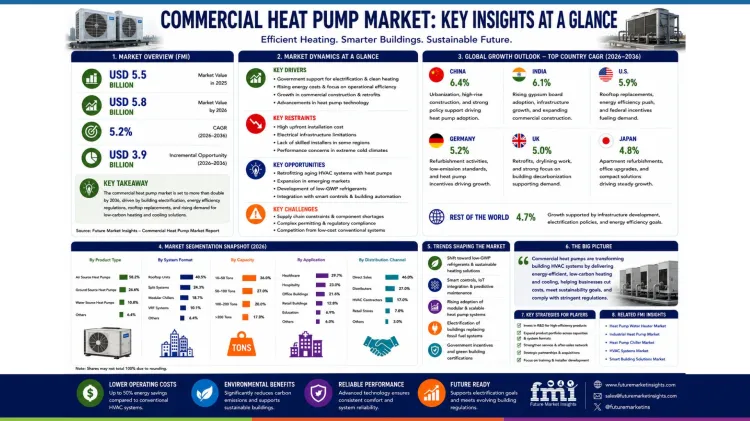
- FMI projects air source systems to account for 58.2% of commercial heat pump product demand in 2026.
- Rooftop units are expected to hold 40.5% of system-format demand, showing that packaged replacement is a practical route for schools, retail buildings, clinics, and smaller commercial assets.
- Ground source systems remain attractive where a site can justify drilling, ground-loop installation, and longer payback through stable efficiency.
- Ground source adoption is more likely in campuses, public buildings, hospitals, universities, and planned developments than in quick replacement cycles.
- The commercial retrofit market is therefore not rejecting ground source. It is favouring air source where speed, installation simplicity, lower disruption, and contractor familiarity decide the project.
Commercial building retrofits usually begin with constraints. The building already exists. The roof has a load limit. The electrical room may be full. Tenants may need the space operational. The owner may be replacing an aging rooftop unit, boiler, chiller, or packaged system within a fixed capital cycle. In that setting, the technology that fits the existing building with the least disruption often moves faster than the one with the highest theoretical seasonal efficiency.
That is why air source heat pumps have the clearer near-term advantage in commercial retrofits.
FMI estimates the commercial heat pump market at USD 20.15 billion in 2026 and USD 69.62 billion by 2036, reflecting a 13.2% CAGR. Air source systems are projected to represent 58.2% of product demand in 2026. Rooftop units are expected to account for 40.5% of system-format demand, while the 10 to 50 tons capacity class is forecast to hold 36.0% share. These figures point to a market shaped by practical replacement of existing commercial HVAC assets rather than only new central-plant redesign.
Air source systems fit retrofit work because they avoid the biggest ground source barrier, namely ground-loop construction. A building owner does not need drilling rigs, trenching, borefield design, subsurface surveys, or long construction windows. Equipment can often be placed on the roof, in a service yard, or in the location of existing outdoor units. That makes the technology easier to evaluate during ordinary equipment replacement.
The FMI report states that air source systems lead because they fit retrofit sites without ground-loop work and can be placed on roofs and service yards. It also notes that rooftop units match existing roof curbs, making packaged replacement important in schools and retail buildings. This is a critical market signal. Commercial owners rarely want HVAC replacement to become a major site redevelopment project unless the building strategy justifies it.
The USA market shows the same retrofit logic. FMI projects the USA commercial heat pump market at USD 5.2 billion in 2026, rising to USD 16.74 billion by 2036 at 12.4% CAGR. The report links USA demand to packaged rooftop replacement, schools, clinics, retail chains, federal efficiency timing, and field-tested heat output. For multi-site owners, the ability to repeat a retrofit across similar buildings is especially valuable.
The DOE Commercial Building HVAC Accelerator reinforces the opportunity around rooftop units. It states that high-efficiency next-generation rooftop units are estimated to reduce energy costs by up to 50% compared with conventional packaged rooftop units. That makes the air source retrofit case easier to explain to commercial buyers, since they can replace the aging packaged unit, reduce energy cost exposure, and avoid a full mechanical-room redesign.
Ground source heat pumps have a different value proposition. They use relatively stable ground temperatures, which can support high efficiency and strong performance in climates where outdoor air temperatures create heating or cooling challenges. In the right project, ground source can be highly attractive. The issue is not technical weakness. It is retrofit complexity.
A ground source project needs land or suitable subsurface access, loop-field engineering, drilling or trenching, permits, civil work, pumping design, and integration with the building hydronic or air-side system. That level of work is easier in new construction, campus-scale projects, public buildings with available land, schools with open grounds, universities, hospitals, and planned developments. It is harder in dense commercial retrofits where space is limited and disruption costs are high.
Ground source systems may therefore win where the building owner has a long investment horizon and control over the site. A hospital campus planning a central-plant upgrade, a university with multiple buildings, a government estate, or a mixed-use development may find the economics more attractive because the ground loop can serve long-term heating and cooling needs. A small retailer replacing an aging rooftop unit is less likely to accept that complexity.
The retrofit buyer decision also depends on climate and building load. Air source systems have improved materially, and cold-climate performance remains a tender concern in colder regions. FMI notes that buyers increasingly need tested heating output and contractor training before approving gas-to-electric replacements. Carrier next-generation rooftop heat pump field-trial data cited by FMI showed 100% heating capacity at 5°F and more than 70% at minus 10°F for its 10 to 14 ton product. This type of field evidence reduces buyer uncertainty around air source retrofits.
Ground source can still be superior in applications with large year-round loads and a long asset life. Hotels, hospitals, campuses, and some institutional buildings may benefit because they need heating, cooling, and hot water across seasons. Stable ground temperatures can support efficiency and load management. The challenge is converting that technical advantage into a financeable retrofit.
The contractor ecosystem also favours air source in many retrofit markets. HVAC contractors already understand packaged rooftop units, split systems, VRF systems, and modular outdoor equipment. Ground source requires a broader project team that may include drilling contractors, geothermal designers, hydronic specialists, civil contractors, and commissioning providers. When installer capacity is tight, the simpler contractor route can influence adoption.
The FMI sales-channel data supports this. Direct sales are projected to account for 46.0% share in 2026 because large buyers need load studies and service guarantees, while HVAC contractors remain important where smaller buildings need installer-led equipment selection. Air source equipment fits both routes. Ground source is more often a project-engineered sale requiring deeper design involvement.
The European retrofit market adds another dimension. The EU Energy Performance of Buildings Directive aims to improve building performance and reduce fossil fuel dependence. The European Commission states that the recast directive makes zero-emission the new standard for new buildings and sets a framework for improving building energy performance. This policy direction supports electrified heating broadly, including both air source and ground source systems.
In Europe, ground source may have a stronger case in dense urban district systems, campuses, and buildings connected to hydronic infrastructure. Air source will still move faster where individual commercial buildings need direct equipment replacement. The split depends on building ownership, heating distribution system, available land, district-heating context, and local incentives.
Supplier positioning should therefore separate the best technology from the best retrofit pathway. Air source wins on installation accessibility, speed, modularity, and repeatability. Ground source wins where the owner can invest in a long-life infrastructure solution and capture efficiency benefits over time. Water source and hydronic systems sit between the two, particularly where buildings already have water loops or central plant rooms.
The practical market read is clear. Air source is winning commercial building retrofits by share and adoption speed. The FMI 58.2% air source share and 40.5% rooftop-unit share indicate that the retrofit market is being pulled by equipment replacement logic. Ground source remains valuable, and its stronger opportunity lies in buildings and campuses where site conditions and capital planning can support deeper infrastructure work.
Commercial buyers are not choosing air source because ground source lacks merit. They are choosing air source because most retrofits reward solutions that can be installed with fewer site constraints, clearer contractor pathways, and more predictable project risk.

